

Introduction
The literature applying the path dependency framework to public policy has conventionally distinguished two distinct but sequentially related phases (what we refer to as a two-phase model) – the phase of path production in which a new path emerges and the phase of path reproduction in which the path formed through path production is maintained (for a review, see Thelen Reference Thelen1999). This two-phase model helps us understand the complex process of path evolution by distinguishing the discontinuity in path production and the continuity in path reproduction.
In this paper, we argue that the two-phase model is conceptually and analytically useful, but it is not sufficient to fully understand path dependency. We emphasize two shortcomings of the two-phase model. Firstly, the analyses of path production usually trace a radical policy change as a causal force of path production (e.g. Collier and Collier Reference Collier and Collier.2002). However, it often leads to underestimating the initial conditions under which policy change occurs. We reassess policy change and instead consider the initial political position of the government as a causal factor for path production.
Secondly, the functionalist approach provides an elegant and powerful explanation of how path reproduction occurs using the mechanisms of increasing returns and feedback effects (North Reference North1990; Pierson Reference Pierson1993; Reference Pierson2000, Arthur Reference Arthur1994). However, it fails to uncover the underlying factors behind this reproduction because such mechanisms are based on the observations on the surface.
To build the case for a richer path dependency model incorporating underlying logic, we use a case of college education expansion in Korea. The expansion appears to follow a path-dependent pattern – the path production triggered by a transformative policy change at critical junctures, and this was followed by an increase in returns and positive feedback, which led to the path reproduction. However, this case has aspects that are inconsistent with the existing explanations based on the two-phase model. We believe that the shortcomings of the two-phase model can be addressed by considering the political and ideological influences on path production and reproduction. Drawing on Esping-Andersen’s welfare regimes, we identify the political underpinnings of the countries that affect path production and reproduction.
Our effort to shed light on the role of the underlying rule of path dependency provides a deeper understanding of path-making and reproduction by pointing out the several types of discrepancy existing in path dependency. Firstly, this study shows the inconsistency between the surface level and the deeper level of policy change – some changes may appear radical on the surface, but they actually can be continuity at a deeper level. Secondly, this study uncovers the hidden costs and risks of path reproduction often concealed by conventional reproduction mechanisms, such as increasing returns and institutional efficiency. Lastly, we discuss the precarious stability obscured by the functional equilibrium between institutions.
If institutional efficiency and equilibrium fall short of explaining path dependency, then the core question is how and why a path is sustained. We argue that welfare regimes underpin both path creation and preservation, building on a growing literature illuminating the role of the social norm in path dependency (Cohen Reference Cohen2017; Tan and Yang Reference Tan and Yang.2021; Choi Reference Choi2022). Therefore, path dependency does not exist in two separate production-reproduction forms, but two phases coexist and continually interact with each other under certain welfare regimes. This study considers how the ideological lineage influences policy formulation and choice at the onset of path production where policy departures, whereas those previous studies have focused on policy implementation “in the sites where (policy) arrives” (Cohen Reference Cohen2017, p. 181).
The rest of this paper is organized as follows: We first present an overview of the path-dependent pattern of college education expansion in Korea using the conventional two-phase model. We then discuss its limitations. Finally, we propose a model incorporating the underlying rule into the two production-reproduction phases. We also provide an alternative explanation of path-making and maintenance in terms of the underlying rule as a fundamental causal force. This paper concludes with a summary and discussion of the theoretical and policy implications.
Path-dependent patterns of college education expansion in Korea
The two-phase model provides a useful baseline for exploring a path-dependent pattern of higher education expansion in Korea. This section provides a brief review of the two-phase model and its application to this case.
Path production: transformative policy change at a critical juncture
In the conventional analyses of path dependency, the current path is taken as a product of the decisions made at the fork in the road where possible options were competing (Ikenberry Reference Ikenberry1994; Hall and Taylor Reference Hall and Taylor.1996; Kato Reference Kato1996; Immergut Reference Immergut1998). This approach entails counterfactual thinking that the outcome would differ if different decisions were made in the past. Therefore, the critical task in the path analyses is to trace the initial point where the decisions were made, widely referred to as the “critical juncture.”
Figure 1 illustrates the conventional critical juncture framework consisting of three components (Mahoney Reference Mahoney2000; Collier and Collier Reference Collier and Collier.2002). The antecedent conditions out of which the critical juncture emerges; the critical juncture at which significant change occurs responding to socioeconomic change, such as industrialization or economic growth, in ways that a particular path is selected among the multiple options; the legacy at which the option selected at the critical juncture is stably reproduced. The legacy becomes an antecedent condition when a new critical juncture emerges in the future.
The critical juncture framework. Source: Collier and Collier Reference Collier and Collier.2002, slightly revised.

The critical junctures are a starting point from which the current path emerges and a breakpoint from the previous path, often described as “punctuation” or “off-equilibrium” (Gould and Eldredge Reference Gould and Eldredge.1977; Baumgartner and Jones Reference Baumgartner and Jones.2002). Thus, the focus is usually on policy change rather than policy stability when analyzing the production of paths.
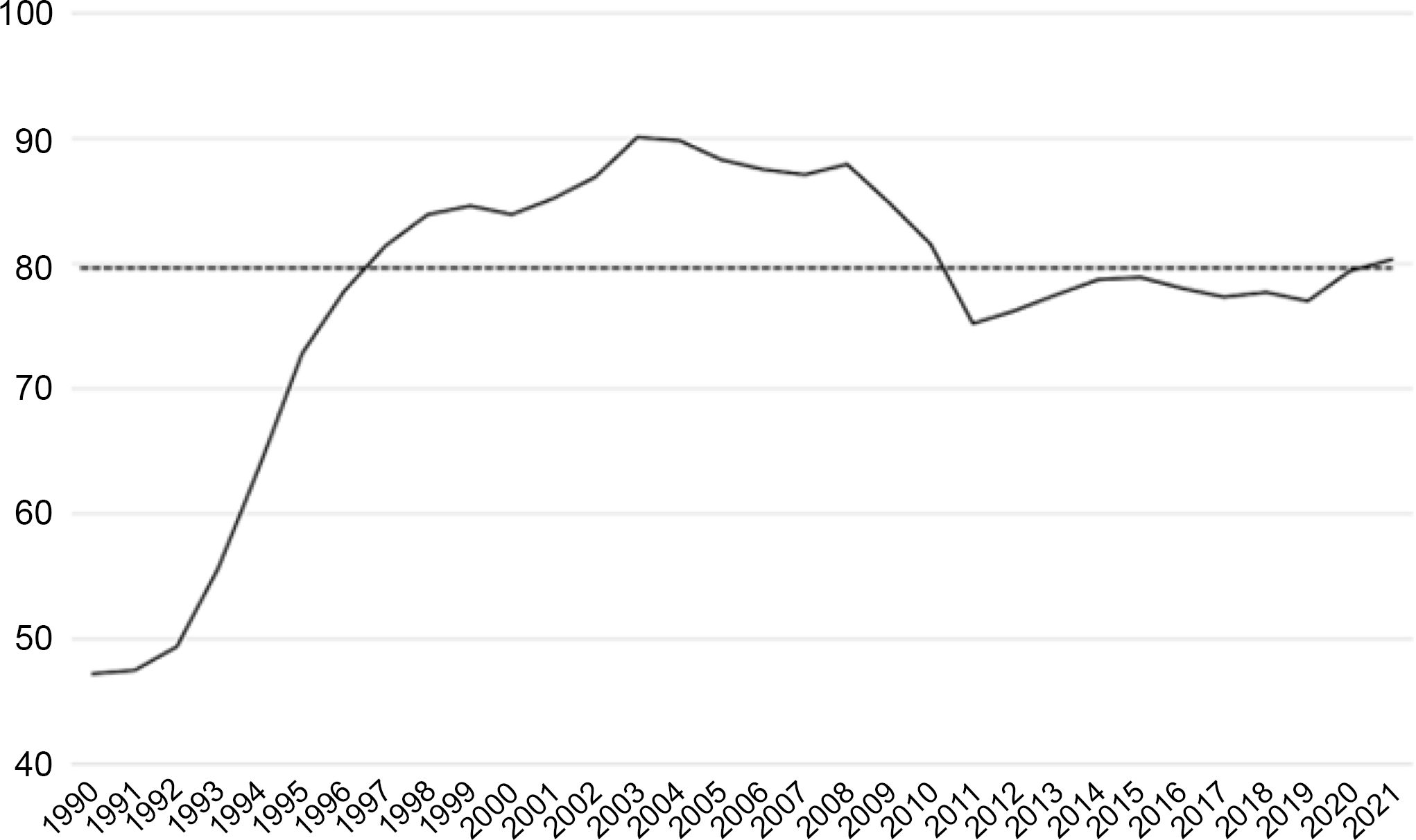
In the case of college education expansion in Korea, such a turning point can be traced back to the Kim Young Sam government, which was formed in 1993. Figure 2 shows a significant increase in college enrollment between 1993 and 1995, with an annual growth rate of 7.8%. The growth continued to rise, albeit at lower rates, reaching its peak at 90.1% in 2003.
The college enrollment rate in Korea (1990–2021). Source: National Statistical Office.
The policy change usually occurs when various internal and external forces intersect at a specific point in time, literally at the “juncture.” Therefore, identifying critical junctures provides an understanding of a spatial and temporal context in which policy change occurs and how the challenges or pressures for policy change are translated into a formal policy change in particular settings (Locke and Thelen Reference Locke and Thelen.1995).
The same is true of college education expansion in Korea. It was influenced by various political, economic, and social factors. One of the significant drivers was the political changes under the Kim Young Sam government, which was the first civilian government in Korea since the military coup in 1961. The new government prioritized freedom and deregulation and, as a result, lifted restrictions on college establishment and student quotas previously imposed by the military governments. This policy decision contributed to the dramatic increase in participation in college education in Korea (Kim and Choi Reference Kim and Choi.2015).
The second factor is changes in the economic environment. The new government vigorously adopted a deregulation approach to economic policy, which marks a departure from the economies controlled by previous governments for economic development (Chang Reference Chang1998; Shin Reference Shin2010). In addition, external pressure accelerated deregulation and liberalization in the economy. Korea faced pressure to open up its national market to the global economy in the 1990s, leading to its accession to the OECD in 1996. In the face of open international competition, the government recognized the importance of human capital development, especially college education, as a critical policy strategy.
Third, the rise of the prosperous middle class is the social force exerted on expanding college education (Kim and Choi Reference Kim and Choi.2015). Since the economic growth plan initiated by the authoritarian government in the 1960s, Korea’s economy experienced a remarkable annual expansion of over 8% in real terms. The rapid industrialization and economic growth created a prosperous middle class, many of whom came from agricultural backgrounds. They witnessed that workers with college education gained high returns in white-collar occupations as the country’s economy rapidly industrialized (Arita Reference Arita2003). Therefore, this group expressed intense demands for college education for their offspring, believing education was a social and economic ladder for upward mobility.
In response to the political and socioeconomic changes discussed above, the new government implemented a historical policy reform that considerably expanded college education, making college education a mass education in Korea (Trow Reference Trow1972). However, the growth in college enrollment stabilized after an initial surge. The enrollment rates in college have remained at around 80%, as illustrated by the dotted line in Figure 2. Particularly noteworthy is that the increasing tendency of college education continued even during the Asian financial crisis of 1997, which led to mass redundancy, the collapse of the middle class and a deepening of economic inequality. It suggests that college education expansion is not solely driven by policy stimuli but also by other forces that sustain the constant trends.
Path reproduction: increasing returns and institutional complementarities
The neo-institutionalist approach, which originates from the economic literature based on the case of technology industries (North Reference North1990; Arthur Reference Arthur1994) and then is applied to policy-making settings (Pierson Reference Pierson1993; Reference Pierson2000), has gained prominence in explaining how the path chosen at the initial point is sustained. According to this approach, the path created by a radical policy change is sustained through its own reproduction mechanisms, such as increasing returns and positive feedback effects.
From the government’s point of view, maintaining the path is to produce increasing returns on particular policies. Implementing policies requires political, economic, and social costs, which can be compared to large setup and fixed costs of the companies to develop new technology (Arthur Reference Arthur1994); therefore, maintaining the policies helps recover the initial costs. On the contrary, reversing the established policies not only incurs additional costs but also turns the initial cost into a sunk cost. In short, it is more profitable to continue reproducing the existing path than to reverse it. Thus, the further the government goes down this path, the more difficult it becomes to reverse course.
Such cost savings are not the only source of path maintenance returns. Path maintenance produces gains through “institutional complementarities” (Hall and Soskice Reference Hall and David.2001). In this view, institutions are arranged in ways that one institution complements the others, achieving optimal institutional efficiencies. For instance, if a country has weak social protections, education can play an equivalent role in providing self-security. This argument is based on the observations that countries with weak social protections tend to have a high participation rate in higher education. Such institutional arrangements can achieve functional equilibria in a way that the weakness of one part is offset by the other, thereby achieving institutional efficiency.
From the individuals’ point of view, positive feedback effects explain path reproduction. Arthur (Reference Arthur1994, p. 12) points out that once a particular technology gains a lead, it is difficult to change it because users maintain their choices following others who make similar choices (termed as “coordination effects”). This is relevant for individuals’ educational decisions. The educational decisions of individuals are influenced by their “neighbour’s choices” (Thurow Reference Thurow1975, p. 96). Once the government initiates a policy toward expanding college education, the number of people surrounding individuals who acquire a college education will increase. Under these circumstances, individuals are likely to calculate their relative position when others possess college degrees, and they do not. In particular, if they observe cases of high returns on college education in their neighborhood, they are likely to follow their neighbors’ choices. In this way, one individual’s educational decision reinforces the others, ultimately leading to a self-reinforcing pattern of education expansion.
In addition, institutions play a significant role in promoting positive feedback effects. They offer incentives and constraints that influence people’s choices. Scholars have elaborated on the interactive relationship between education policies and individuals’ educational decisions (Hall and Soskice Reference Hall and David.2001). According to this argument, weak social protections encourage people to secure themselves by pursuing a college education. As rational actors, individuals adapt strategies that align with their interests and the given conditions. As a result, the expansion of college education is maintained through a mutually reinforcing relationship between individuals and institutions.
The shortcomings of the two-phase model
The two-phase model’s approach to path evolution discussed above resembles the concept of constant acceleration motion in Newtonian mechanics, as shown in Figure 3. This type of motion typically follows a specific pattern: an object moves when a pushing force acts on it; once it starts moving, it tends to maintain its state of motion and resist change, even if its speed decreases.
The two-phase model of path dependency.

In the policy-making context, the pushing force in the two-phase model corresponds to a policy change at a critical juncture, which triggers path production, and the subsequent motion with constant speed compares to path reproduction. However, the perception of change based on motion and subsequent maintenance has limitations when it comes to understanding changes and reproductions in policy-making.
Path production: bias in perceiving policy change
Notably, deciding what counts as a change in policy development is not a simple exercise, unlike observing an object in motion. Identifying policy change involves various epistemological issues (see Capano Reference Capano2009). Therefore, it is essential to define policy change accurately before discussing whether it is a causal force behind the current path (Green-Pedersen Reference Green-Pedersen2004; Howlett and Cashore Reference Howlett and Cashore.2009).
When we understand policy change based on the observed movement, our perception tends to be biased toward magnitude. However, policy change is a “vector” that has not only a velocity but also a direction simultaneously (Kay Reference Kay2005; Cashore and Howlett Reference Cashore and Howlett2007). Thus, the significance of the change depends on where it is “currently situated and ultimately headed” (Jessop Reference Jessop2001, p. 1219). It implies that the initial position is crucial in assessing policy change.
In the two-phase model, however, the initial position is underestimated. It is considered a legacy of past policies, which can be overcome by policy change. Otherwise, it is taken as a contingent event – as shown in the well-known analogy, the selection of the ball is contingent when there is one red ball and one white ball in the urn (see Arthur Reference Arthur1994, p. 36).
However, such contingencies are rare in policy-making, where policy change does not occur in a vacuum but is influenced by various political and ideological forces. Markedly, the countries’ political stands shape the direction of the change to some extent. It is not that possible options are competing with equal probabilities at a critical juncture; instead, specific options are more likely to be considered and selected than others depending on the country’s initial political characteristics. Put differently, the number of red and white balls in the urn initially differs in policy choices. Thus, policy change is never completely discontinuous because the initial conditions continuously and constantly restrict the options and directions of policy change.
Time also causes bias in recognizing change. The policy change can be appraised only retrospectively, which means that its implications are defined based on the current outcomes. Tracking a critical juncture is meaningful when assuming the original policy decision is directly linked to the current outcome. However, the direct link is weaker than it appears. There is a time gap between the initial point where it was formed and the current point where we confront it as the outcome. The current path does not directly result from the initial decisions and is produced as decisions similar to initial choices accumulate over time.
Path reproduction: increasing costs, losses, and risks
The neo-institutional approach to reproduction mechanisms is effective in explaining how we have arrived at our current destination. It recognizes the accumulative nature of the policy outcomes and provides generalizable explanations that can be applied across temporal and spatial contexts. However, a significant weakness of neo-institutionalism is its inability to fully capture what lies beneath the surface-level path reproduction. This is akin to classical physics, which focuses on the observed movement on the surface. This limitation can lead to misunderstanding of how and why the path is reproduced when consequences do not match increasing returns and institutional efficiencies.
The college education expansion in Korea has aspects that contradict functional accounts. It shows that path dependency is accompanied by cost-incurring rather than cost-saving mechanisms. As college education becomes more widespread in Korea, the relative value of college education, such as attending prestigious colleges or pursuing socially and economically rewarding majors, becomes increasingly important, whereas simply attaining a college education becomes less important. Consequently, the competition for qualitatively different college education has intensified since the quantitative expansion. Ironically, although educational opportunities have considerably increased, competition for a college education is heightened (Hirsch [1977] Reference Hirsch2005).
The competition for the relative value of education involves various costs and risks, which implies that maintaining the path does not necessarily create increasing returns but rather increases “losses or wastes” as it continues (Hirsch [1977] Reference Hirsch2005, p. 51). In Korea, students usually rely on private education, in addition to public education, to enter relatively high-ranked colleges. This creates costs that directly fall on parents and students. Private educational expenditures increased fourfold between 1990 and 2009 with the expansion of college education. Over 70% of students from the upper-income decile rely on private education, and even the bottom two decile groups participating in private education reached 55.9% in 2009 (Lee et al. Reference Lee, Jeong and Hong.2014). Private education considerably increases financial burdens for families. The household from the top to the third income decile group spends over 30% of their income on private education (National Statistical Office 2017).
Competition can be an efficient solution when there is a mismatch between supply and demand. It stimulates people to improve their abilities, and the most capable person is assigned to the fitted place. However, the utility of the competition is questionable when it comes to competing for qualitative differences under quantitative expansion. The competition for a relatively high position does not always lead to improving knowledge or skills because participants in the competition are already homogenous in cognitive skills to some extent as a result of college education expansion. Instead, the competition is likely to serve as a “filter,” sorting students and job candidates according to the exchanging value of their education as a “background characteristic” (Spence Reference Spence1972; Arrow Reference Arrow1973; Stiglitz Reference Stiglitz1975), which is not necessarily related to their ability or capacity. The filter is a fine mesh in Korea, considering the substantial proportion of participants in the competition.
Educational investments involve risks like any other investments. Despite that, individuals invest in education, anticipating positive returns. However, the intense competition considerably reduces the likelihood of being selected for better education and occupations and increases the risks accordingly. In Korea, a college education does not necessarily guarantee a positive return. Some college graduates earn less than non-college graduates, which means college premiums are low or even negative for college graduates (Lee et al. Reference Lee, Jeong and Hong.2014; Oh Reference Oh2015). As college education expands, the chances of obtaining positive returns on educational investments become almost like “conditional random lotteries,” where outcomes are determined similarly to lotteries, conditional on educational acquirements (Thurow Reference Thurow1975, p. 207).
The more problematic is that the costs and risks are differentially distributed depending on individuals’ initial economic resources and socioeconomic backgrounds. Furthermore, those who are more financially advantaged are better equipped to manage these costs and risks and are more likely to employ effective strategies to attain a qualitatively better college education and, subsequently, to achieve a higher social and economic status. As a result, the increased educational opportunities seemingly equalize educational opportunities, but they are ironically “equal rights to be unequal” (Marshall [1950] 1992, p. 38).
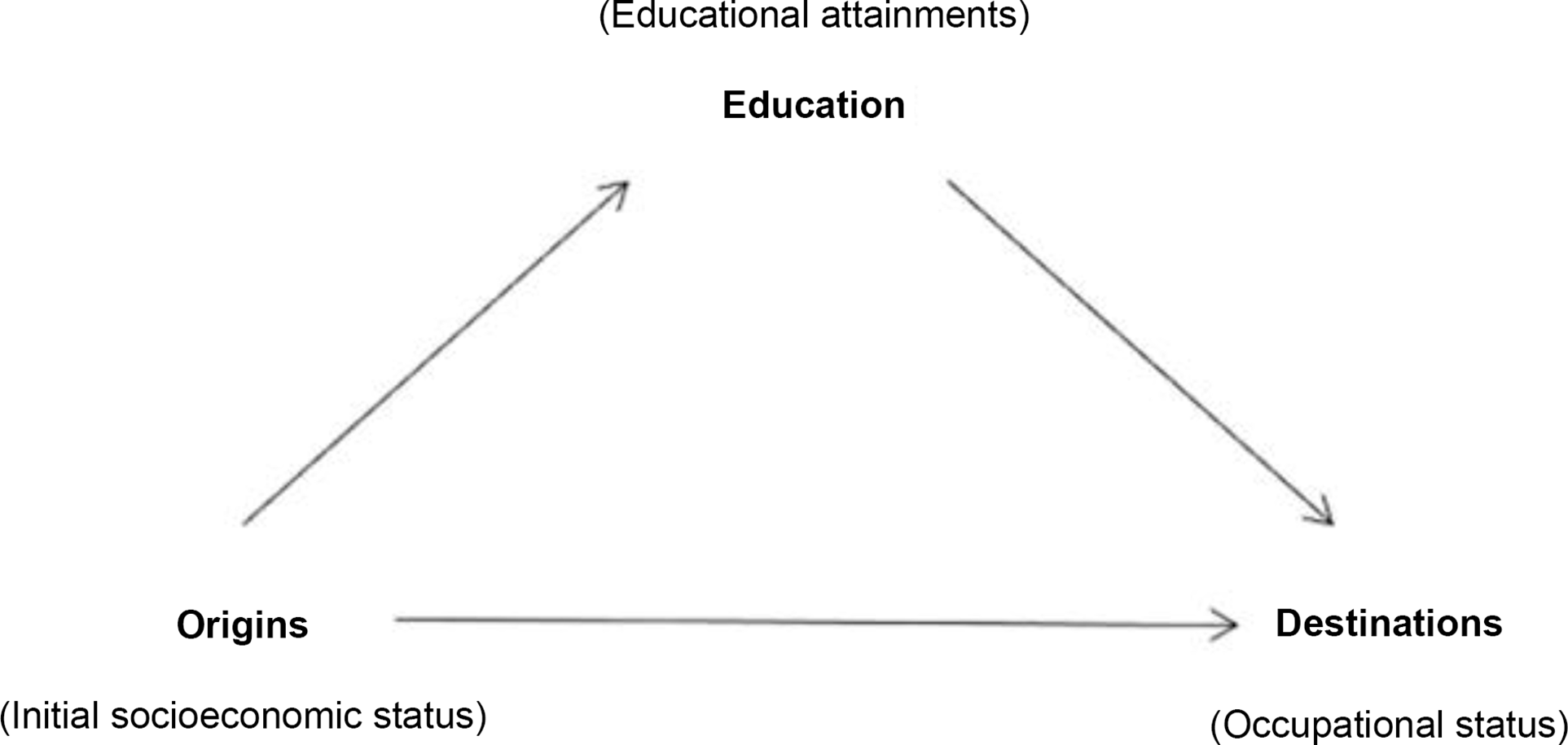
According to neo-institutionalist accounts, the differences in social and economic rewards between the advantaged and the disadvantaged are inevitable. It is obvious that different labor market outcomes are caused by differences in academic performance because educational attainments are a prior condition for the socioeconomic destinations of individuals (see Estevez-Abe et al. Reference Estevez-Abe, Iversen, Soskice., Hall and Soskice2001, p. 157–158). However, Goldthorpe (Reference Goldthorpe2016) pointed out a triangular relationship between OED, as illustrated in Figure 4, where O, E, and D stand for the social origins as family backgrounds, educational attainments and occupational destinations of individuals, respectively. The neo-institutionalist accounts are silent on the impacts of the origins on educational attainments and destinations.
The OED triangle. Source: Goldthorpe Reference Goldthorpe2016.
College education expansion in Korea challenges the neo-institutionalist view that the path is sustained because of returns, including institutional efficiencies and complementarities; instead, it shows that the path is reproduced with costs and risks. Unsurprisingly, dissatisfaction with education policy is high, although it appears to produce positive feedback because high levels of participation in college education have long been sustained on the surface (Kim and Choi Reference Kim and Choi.2015). Therefore, the next question is how the path is sustained despite costs, risks, and discontent, if not because of returns. It requires an alternative viewpoint beyond the conventional neo-institutionalist approach.
Welfare regime as underlying forces
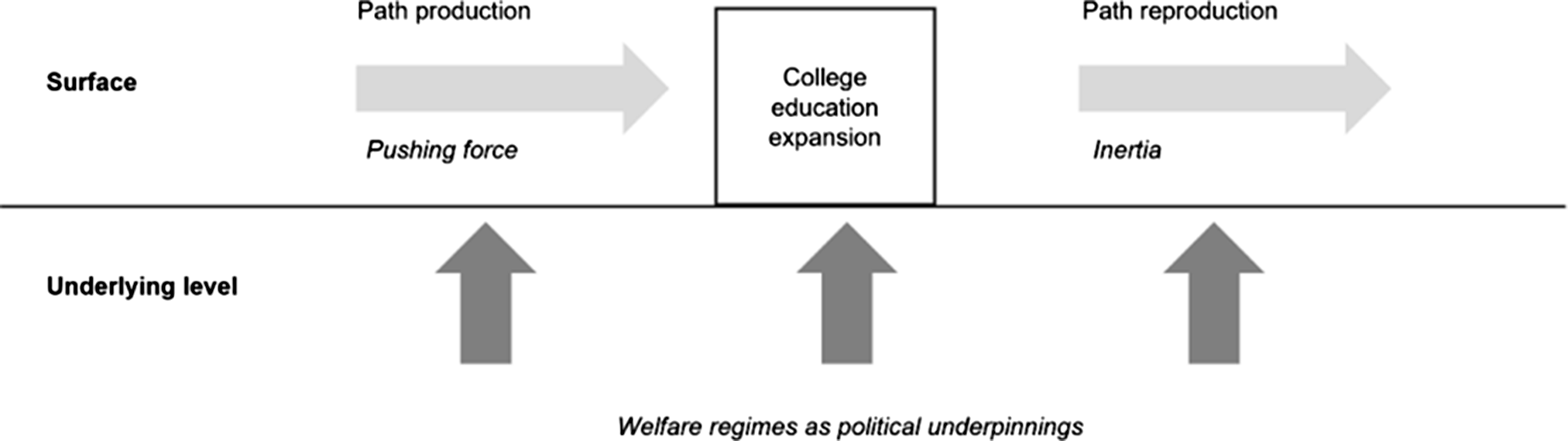
In Newtonian physics, “space” is a mere place where motion occurs, but it was later found that space is actually a “field” consisting of diverse forces that affect the motion of an object. If we perceive the settings of path dependency as a field, it gives us an alternative viewpoint on Newtonian two phases of path production and reproduction. Figure 5 presents a framework incorporating the underlying forces with pushing forces and institutional inertia of the two-phase model. The underlying force is the rules historically formed and built into the countries, thus less visible yet constantly at play in policy-making (Thelen Reference Thelen1999).
The underlying force of path production and reproduction.
Esping-Andersen’s welfare regimes provide a useful theoretical lens through which we can identify the underlying rules intrinsic to the countries. In his three welfare regime types, countries with different welfare regimes have different approaches toward allowing the market to provide welfare services and prioritizing education policy or social protection programs. These differences arise from political decisions on building a coalition with the market and incorporating the working class or middle class into the state’s welfare system (see Esping-Andersen Reference Esping-Andersen1990, p. 18–19).
Specifically, the conservative regime incorporated the working class into the welfare system by providing them with social protections, but education policy was less emphasised, which resulted in social class differentiation given that education serves as a means of social mobility; the liberal regime governments chose to respond to the rising prosperous middle-class formed by industrialization and allowed the market to provide welfare services to satisfy their aspirations, including college education; the social democratic regime promotes cross-class solidarity and emphasizes the government’s responsibility for universal provisions of both education and social protections.
We propose that the shortcomings of the two-phase model can be overcome by including welfare regimes as political and ideological grounds in the analyses. First, it provides the initial point that enables us to consider the direction of the change. The policy change can be overstated because of its visibility and magnitude, but if it aligns with the existing direction, the significance of the change is not decisive. Therefore, it is meaningful to identify the initial position, which enables us to reassess policy change as the driving force for path dependency.
Second, Esping-Andersen’s welfare regimes complement mechanical, functional, and neutral explanations driven by the neo-institutionalist approach. The two key terms in his theory, commodification and stratification, help us capture and explain the costs and risks behind institutional equilibrium – commodification reflects the recognition of the market as the source of suboptimal welfare outcomes; stratification represents costs and risks of educational investments unequally distributed depending on individuals’ initial socioeconomic positions.
Underlying liberal rule
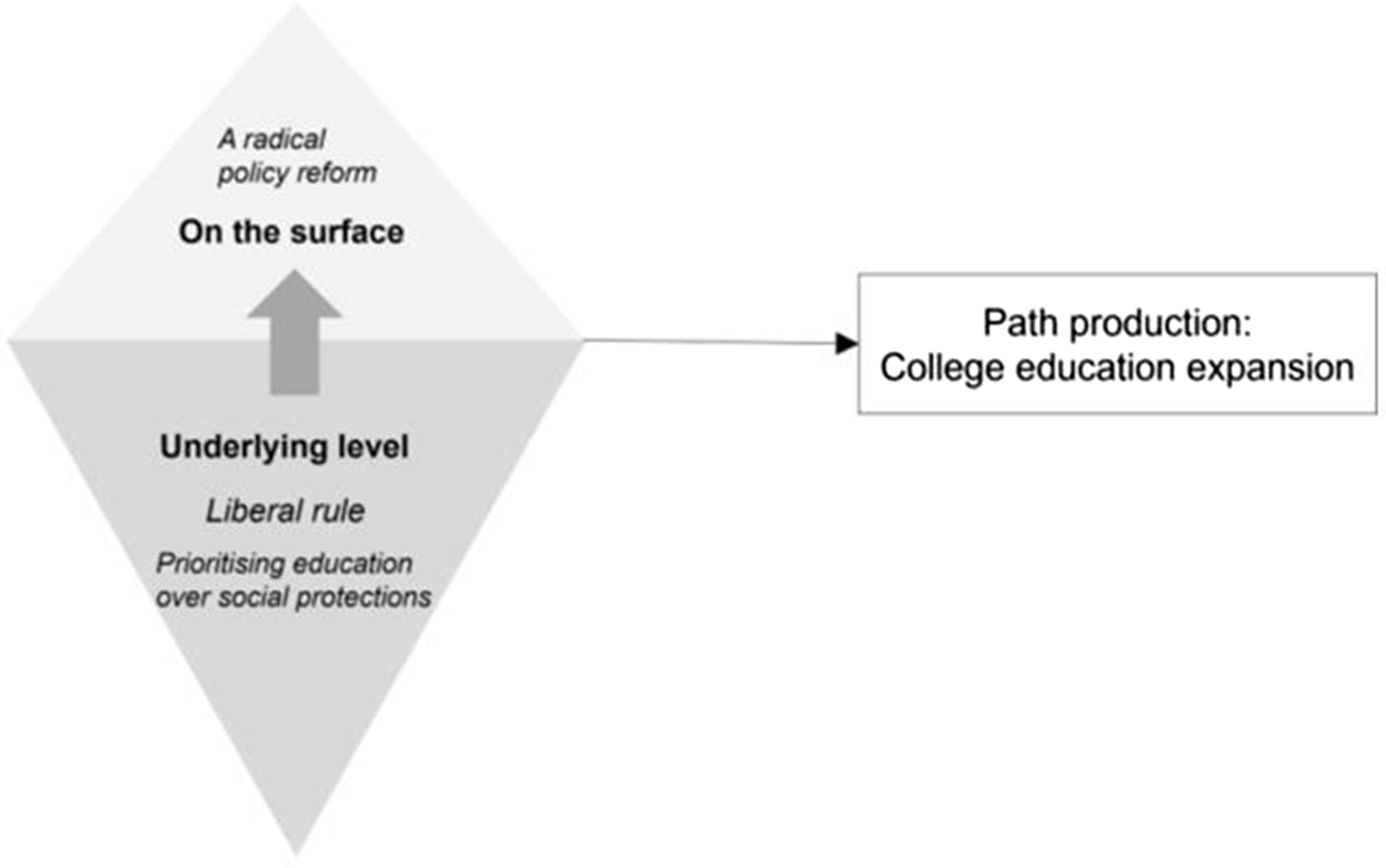
It is not difficult to identify a radical change as a cause of our current path. However, a salient event or a radical policy reform on the surface may be the tip of the iceberg (Figure 6). There may be fundamental causal factors underneath. This is especially important in policy analysis because the implications of a new change can be clearly understood when we consider it with the underlying rule (Palier Reference Palier, Streeck and Thelen2005).
The underlying rule behind the policy change for path production of college education expansion.
This section discusses the liberal regime as the fundamental force producing and reproducing the path to high college education expansion in Korea. First, we define the liberal rule based on Esping-Andersen’s welfare regime framework. Then, we employ Ragin’s (2008) qualitative comparative analysis (hereafter QCA) to identify the liberal rule. QCA is a useful method for identifying interrelated causal factors and determining how a certain combination of causal combinations corresponds to the cases (Shalev Reference Shalev1999).Footnote 1
QCA involves a three-step process. Firstly, we identify countries that have undergone a similar expansion of college education, as observed in Korea. Then, we investigate the factors that caused this expansion. Lastly, we identify the common causal factors shared among countries similar to Korea’s and test the results for significance.
The results cast doubt on policy change as the driving force for the current path, as shown below. The surfacing discontinuity is actually the continuity of the underlying rule at a fundamental level, which we refer to as discontinuous continuity. This leads us to conclude that the path is produced by the underlying rule rather than the radical change itself because the radical policy change merely represents the extension of the constant underlying rule.
We then discuss how a particular rule affects the reproduction of policies. We question the belief that increasing returns are a causal force for policy reproduction; instead, we argue that the inefficiencies inherent in liberal rule are, ironically, the cause of policy reproduction, which we refer to as the self-contradiction of liberal logic. Lastly, we argue that the path is reproduced despite the self-contradiction as individuals accept the rule, which we refer to as the internalization of the liberal rule.
Path production: discontinuous continuity
According to Esping-Andersen, the defining feature of the liberal regime is “commodification.” This means that workers’ status is reduced to a commodity, as their survival depends on selling their labor. The commodification of workers is maintained by providing welfare services as commodities rather than social rights. This idea is that individuals should actively participate in the labor market rather than relying on welfare programs to protect themselves against risks in life (Esping-Andersen Reference Esping-Andersen1990, p. 63). In liberal welfare states, educational opportunities are widely available as they are seen as necessary to enhance individuals’ human capital, ultimately leading to greater independence and self-reliance.
However, we should note that encouraging active participation in labor is not limited to liberal regimes. The social democratic regime in Nordic countries also prioritizes productivism to motivate workers to stay active in the labor market (Huber and Stephens Reference Huber and Stephens.2000). For this reason, if we only consider the degree of education expansion, we cannot differentiate the liberal and social democratic regimes since they both exhibit relatively high rates of participation in college education.
The crucial difference lies in the fact that the liberal regime gives precedence to active labor by investing in education expansion over social protections, whereas the social democratic regime offers educational opportunities simultaneously with social protections. In other words, education policy and social welfare programs, such as income maintenance policy, are considered to be “twin pillars of an active welfare state,” and the liberal regime focuses on one pillar, while the social democratic regime strives to maintain a balance between both pillars (Vandenbroucke and Vleminckx Reference Vandenbroucke and Vleminckx.2011, p. 3).
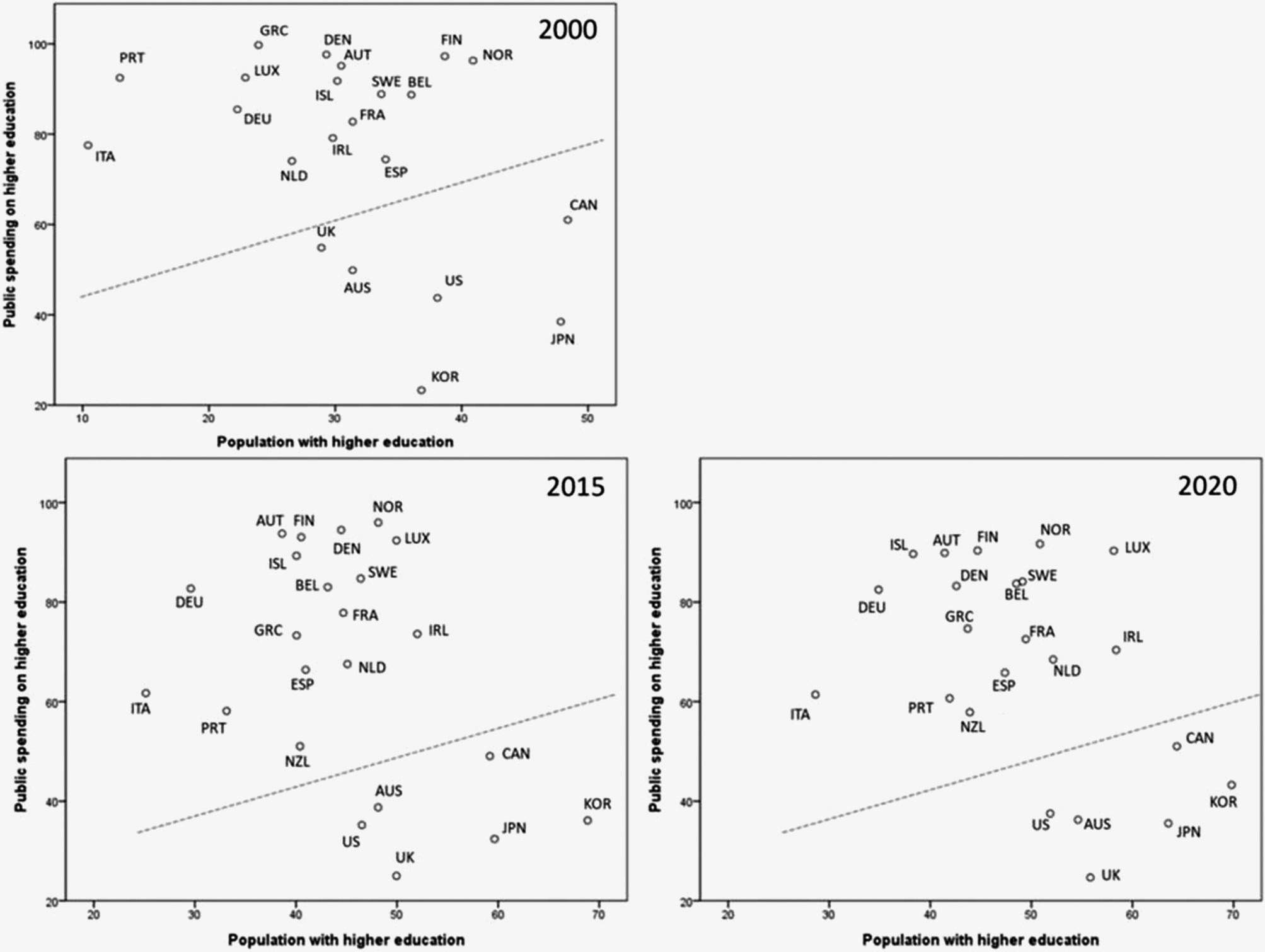
The commodification rule applies to college education in the same way – college education is highly commodified in a liberal regime but decommodified in a social democratic regime, although both regimes show high levels of college education expansion. To capture these fundamental differences between regimes, we decided to categorize countries by intersecting levels of college education expansion with the extent to which college education is commodified because we assume that even the same levels of college education expansion have different implications depending on the commodification rule. Korea is the case that follows the liberal welfare regimes by expanding college education, relying on the commodification of education. Thus, the categorization using this two-by-two matrix helps us identify countries that have expanded college education while also commodifying it, similar to Korea.
The degree of college education expansion is measured by the percentage of individuals who have completed tertiary education between the ages of 25 and 34, as provided by the OECD.Footnote 2 We chose this particular age group to capture the recent expansion of college education in developed countries. To measure the degree of college education commodification, we used the proportion of public spending relative to total spending on college education.Footnote 3
Figure 7 demonstrates the results of our analysis. There is a distinct difference in college education provisions between liberal and non-liberal countries, which can be distinguished by the gray dotted line. As expected, Korea shows a similar pattern of college education provision to countries generally classified as liberal countries in the welfare regime literature, such as Australia, Canada, the UK, and the USA. Japan also falls into this liberal category. These patterns of liberal countries are consistent and stable over time.Footnote 4
The country arrangements by levels of expansion and commodification of college education in 2000, 2015, and 2020 (%). Source: OECD Statistics.
We now attempt to find causal factors for college education expansion in liberal countries, including Korea. Esping-Andersen’s welfare regimes offer theoretical backgrounds where college education expansion relates to weak social protections. From the liberal welfare state standpoint, education expansion provides individualized solutions to social risks instead of institutionalized social protections because human capital improvements are important for people’s self-protection. We, therefore, examine whether weak social protections work as causal conditions for the expansion of liberal types of college education. The measures of social protection we chose are unemployment protection, employment protection, and collective bargaining (Estevez-Abe et al. Reference Estevez-Abe, Iversen, Soskice., Hall and Soskice2001).
The three measures selected have some common features: (a) they represent solutions to risks in life that are social and collective rather than individualized solutions such as human capital improvement; (b) they aim to measure the extent to which the commodity status of labor is loosened, where workers do not necessarily have to continue selling their labor for their survival; (c) they demonstrate the willingness or efforts of the welfare states to protect workers, regardless of the human capital they acquire.
We evaluated the level of support for unemployed individuals by measuring the net replacement rates in unemployment. To measure employment protection level, we referred to the index provided by the OECD, which indicates the severity of collective and individual dismissals. Lastly, we considered the coverage of collective bargaining in various industries. We obtained data on all three measures from the OECD. We analyzed them for three different periods: 2000, 2015, and 2018. The data from 2018 was used instead of 2020 because it was not available.
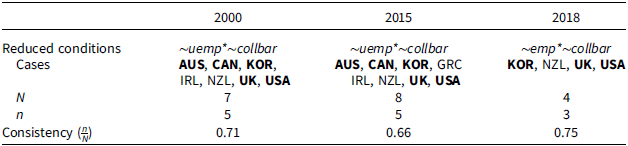
Table 1 displays the relationship between causal factors and college education expansion in liberal countries, including Korea.Footnote 5 Not all liberal countries take the same paths to college education expansion. Korea followed a similar path (∼uemp*∼emp*∼collbar) to Australia, the UK, and the USA in 2001 and 2009, although it took a unique path (uemp*∼emp*∼collbar) in 2018. It indicates that college education expansion occurred under low unemployment protection, low employment protection, and low collective bargaining coverage in Korea in 2001 and 2009 and under high unemployment protection, low unemployment protection and low collective bargaining levels in 2018.
Causal conditions for college education expansion in liberal countries
Source: OECD Statistics.
Note: N=the total number of cases displaying a given causal factor; n=the number of liberal cases in a group displaying a given causal factor (in bold).
We identified the common causal factors that led to the expansion of college education in liberal countries, as listed in Table 1. Table 2 demonstrates the main causal conditions for the expansion of college education in liberal regime countries. There were low unemployment protection and low collective bargaining in 2000 and 2015, and low employment protection and low collective bargaining in 2018.Footnote 6
Paths to college education expansion in liberal countries

Source: OECD Statistics
Note: The tilde (∼) represents the negation of a given causal factor, and * indicates “and,” as usually expressed in QCA. We calibrate “not” when the values are lower than the average. There was no data for Japan in 2001. The detailed data is presented in the appendix (Table A3).
QCA examines the significance of a particular combination of causal factors by measuring the proportion of cases displaying a given causal factor to liberal cases. This implies the consistency of a specific combination of causal conditions in liberal cases. It is calculated by dividing the number of liberal cases having a given set of conditions (n in Table 2) by the total number of cases having the same set of conditions (N in Table 2). If the resulting value of n/N is greater than 0.65, it is generally considered that the consistency is high (Katz et al. Reference Katz, Vom Hau and Mahoney.2005).
Although there are slight differences in the reduced solutions between 2000, 2015, and 2018, our analysis shows that there are common institutional causal conditions that result in liberal types of college education. Specifically, low collective bargaining coverage remains a persistent factor across all three selected years, underscoring the lack of strong social protections for workers.
The results suggest that there are specific factors that contribute to the expansion of college education in liberal countries. Therefore, if we only pay attention to what happens on the surface, the significance of the underlying rule for path-making can be underestimated. Although events on the surface, such as particular policy decisions or implementations, may seem to create a path for the expansion of college education, underlying causal factors exist as the fundamental force beyond the surface.
Furthermore, our analysis challenges the conventional approach to path production, where a path is produced at a breakpoint leading to the new path. We have observed that a discontinuity from the previous pattern can occur, indicated by a considerable surge in college education in Korea. However, this discontinuity on the surface conceals the underlying continuity. Prioritizing and employing education as a welfare policy strategy is not a new concept in the liberal regime. Therefore, the policy decision made in 1997 was not a break from the previous path in terms of the direction of the change, although it appeared to be a radical change in terms of magnitude. Instead, it was the extension of the underlying liberal rule, showing that path-breaking is difficult while the underlying rule exists.
Path reproduction: self-contradictory logic of education expansion
The previous section has discussed how the expansion of college education in Korea is produced by the underlying liberal rule. The following focuses on how this expansion is maintained and reproduced. We have discussed the costs and risks associated with college education expansion. It raises the question of how the expansion is reproduced despite its expenses and uncertainty. The traditional neo-institutionalism in economics cannot provide explanations because it is based on institutional equilibrium and efficiency. We explain how the path is reproduced in two ways: (a) the path is reproduced not because of its efficiency, as conventional wisdom suggests, but because of its inefficiency. The self-contradiction inherent to liberal logic contains “the seeds of their own destruction” (Thelen Reference Thelen1999, p. 400). (b) despite the self-contradiction, the path is maintained because individuals internalize the rule as they are born into the existing rule.
In the liberal welfare regime, the market plays a crucial role in providing welfare provisions, and it provides a core institutional basis of commodification to meet people’s welfare demands. For instance, if people demand higher education, the liberal strategy is to provide education through the market. The benefit of this approach is that it significantly increases educational opportunities as private colleges and private education can instantly respond to consumer demands. However, as we have discussed, the increased educational opportunities do not necessarily contribute to efficiencies and equalities in societies because of the competition for qualitative differentiation under quantitative expansion.
The self-contradiction lies in the fact that it is hard to halt the quantitative expansion of the commodity in the liberal system, even though education expansion entails inefficiency and inequality. The market system is reliant on demand from mass consumers to sustain itself. To continue creating such mass demands, the liberal system should rely on “privatised consumption” (Crouch Reference Crouch2009). Similarly, demands for education can be continuously created in the liberal system when the consumption of education is privatized – i.e. parents and students consume education like a commodity. This is necessary for stimulating and sustaining the market system for education and labor. It is effective for the survival of the markets, but people are exposed to costs and risks.
The liberal welfare state’s approach to education is commonly understood as “responsibility sharing” between governments and individuals (e.g. Jenson and Saint-Martin Reference Jenson and Saint-Martin.2006) – governments assist individuals in accumulating educational assets as a means of self-protection, and individuals are encouraged to stand independently instead of relying on public support. However, liberal welfare states achieve this through the market provisions of education. While market provisions provide benefits such as increased freedom to choose between public and private provisions, this choice depends on the financial resources of individuals (Jonathan Reference Jonathan1990). Furthermore, the freedom of choice for one group has social consequences, as the advancement of one group comes with the retreat of others in educational competition. This implies that responsibility-sharing in the liberal system actually means “responsibility shifts” from the state to its citizens, which contradicts responsibility-sharing (Hacker Reference Hacker2019). In these shifts, individuals and families are left to protect themselves from social risks and are forced to invest in their human capital to cope with costs and risks.
Path reproduction: internalization of institutionalized rule
The self-contradiction of liberal logic provides insight into how paths are reproduced at the institutional level. However, sustaining these paths in the long term requires individual-level mechanisms. Parents’ desire for upward mobility is often cited as a cause for self-reinforcing education expansion, commonly referred to as “education fever” (Lee Reference Lee2008; Seth Reference Seth2002). It involves heavily investing in their children’s education to improve their socioeconomic status. At the same time, people invest in education because of “the fear of falling behind” (Sandel Reference Sandel2020, p. 12). Such fear motivates people to seek education as a “defensive necessity” rather than a way to climb the social ladder when education is widely dispersed across the population (Hirsch [1977] Reference Hirsch2005; Thurow Reference Thurow1975).
However, such fever and fear can be better understood through the lens of institutionalism. There are two different approaches to explaining the relationship between institutionalized rules and individual choices. Neo-institutionalism, which emerged in the late 1990s, put forward a two-way causation of mutual reinforcement between institutions and individuals. In this view, individuals’ preferences are reflected in institutional-level rules. However, the two-way causation is not evident because institutions exist before individuals – people are “born into a pre-existing institutional world, which confronts him or her with its rules and norms” (Hodgson Reference Hodgson2006, p. 13, italics added). This is the difference between neo-institutionalism and the classic institutionalism found in Marks, Veblen, and Polanyi, which can be called “old institutionalism” (Chang Reference Chang2001). In this old institutionalism, the causal direction flows from institutions to individuals.
This suggests that institutions are more than just the environment surrounding individuals or the external condition under which individuals make educational decisions. They affect our perception of which rights and obligations are considered legitimate. Therefore, from an individual’s perspective, the education-based rule is one of the institutions they confront when born, not simply one of the welfare policies implemented by the welfare states. This implies that individuals internalize education-based rules as they live in their societies.
Imagine that people are born into a liberal society where education-based rule is institutionalized. In such a society, education is likely to be “merit,” meaning that educational achievements determine the deservingness of rewards (Hayek [1960] Reference Hayek2006, p. 82). This can be termed an “education-based meritocracy” (Goldthorpe and Jackson Reference Goldthorpe, Jackson., Lareau and Conley2008). This rule affects perceptions of legitimacy and social rights.
Individuals’ success is legitimated by their educational qualifications under meritocratic rule regardless of their social backgrounds, although people are aware that one’s initial socioeconomic status can influence one’s opportunities in life. More problematic is that when we consider someone’s success solely based on merit, we tend to view failure as a result of a lack of effort. This way of thinking can lead to “stigmatizing” those with lower academic performances or occupational status (Esping-Andersen Reference Esping-Andersen1990, p. 22).
Therefore, although increased educational opportunities have helped improve the overall living standard by achieving economic growth through human capital accumulation, society remains stratified under this meritocratic rule. As Marshall puts it, increased educational opportunities “raised the floor level in the basement of the social edifice and perhaps made it rather more hygienic than it was before, leaving the superstructure as it was” (Marshall [1950] 1992, p. 20). Such a highly stratified society fosters people’s desire for upward mobility and fear of downward mobility.
The internalized liberal rule also influences people’s perception of economic rewards for educational attainments. Under the meritocratic rule, high economic returns on educational attainments are seen as legitimate. Therefore, people tend to resist any attempts to adjust economic rewards. Justice is believed to exist in equal opportunities rather than equal outcomes; competition is necessary to ensure fairness; high economic rewards are taken as prizes of the competition; and high rewards are used as incentives for further competition. These economic rewards are seen as personal gains, leaving little room for social obligation and solidarity. For instance, attempts to adjust economic outcomes, such as minimum wage increases, face strong opposition in Korea. Adjustments to outcomes are acceptable only when selective, such as cash benefits for low-income individuals, children, and the elderly.
However, it is obvious that it is difficult to equally distribute opportunities without adjusting economic rewards. Considering a circular relationship between the three components in the OED triangle, reducing the impact of origin on educational and economic outcomes is important to create a virtuous circle of the OED triangle. This underlines the importance of having a welfare system supported not only by education but also by social protection policies. In cases where only one pillar is supported, as seen in the liberal cases, the system achieves only a “precarious stability” (Streeck Reference Streeck, Crouch and Streeck1997). Although the two pillars may appear functionally interdependent and complementary on the surface, one is under heavy pressure while the other is neglected in reality.
Despite that, leveraging a new rule is unlikely to occur because policy-making against the internalized rule requires considerable political costs. Altering the rule involves changing people’s perception of policy issues, not simply modifying the policies and institutional arrangements, and thus can be a costly decision for policymakers. Therefore, as Wilsford (Reference Wilsford1994, p. 279) puts it, “the new path must be decided upon,” but “they may not decide to do so,” suggesting that changing the path is a difficult task.
Conclusion
Having documented a path-dependent pattern of college education expansion in Korea, we have argued that it is necessary to include the underlying rule in historical and neo-institutionalist path dependency (what we refer to as the two-phase model of path production and reproduction). Thus, we have proposed a framework synthesizing the underlying rule with the existing two phases of path dependency to provide a richer understanding of path production and reproduction.
Drawing on Esping-Andersen’s welfare regimes, we have identified underlying rules as the causal factor for the expansion of college education, which is shared by liberal countries, including Korea. We have shown that weak social protections are the causal conditions for college education expansion using QCA. Based on this, we have argued that liberal rule is the fundamental causal force on path production and that the underlying rule plays a key role in maintaining path reproduction.
The underlying rule we have identified in this study has significant implications for path production and reproduction. It is evident that the path is not simply produced by radical policy reform. There is a fundamental causal force behind it, as seen in the fact that countries with high levels of college education expansion share the rules of commodification and self-protection. Also, the underlying rule uncovered in this study highlights the costs and risks associated with college education expansion. These costs and risks lead to inefficiencies and inequalities in the welfare system. Despite this, the path is reproduced due to the self-contradiction inherited in liberal logic and internalization mechanisms at the individual level.
The path dependency based on the underlying rule proposed in this study suggests that the path is more persistent than the conventional historical and functional path dependency. This is because the rule lies at a more fundamental level and constantly affects policy production and reproduction. However, that should not be interpreted to mean that the underlying rule determines policy pathways to the future. The rule as a shared understanding implies that it is changeable, albeit difficult, incrementally.
The approach to path dependency based on the underlying rule has important policy implications. To reverse the trend of college education expansion, policy strategies are commonly based on the direct transition from education completion to the labor market. For example, they increase vocational education to reduce the number of people who enter college or increase job opportunities for college graduates to relieve competition for better education. However, the impact of these measures would be minimal if implemented in stratified societies where the underlying rule remains unchanged.
The rule-based perspective suggests a more fundamental approach to policy formulation is necessary. North (Reference North1990) suggests that if we want to reverse the path, the subsidy can be used to restore balances between options. This study has highlighted two imbalances – one between education and social protections in welfare strategies and the other between private and public spending on college education. Therefore, public support for the weak parts of welfare programs, such as developing social protections or increasing public expenditure on college education, can be considered.
The fundamental change can also be achieved indirectly. Arthur (Reference Arthur1994, p. 118) notes that individuals agree to change the path “provided everybody switched.” But, “individually none dare change in case others do not follow.” It implies that social agreements between the members of society are necessary for path-changing. In the welfare state context, it means the recovery of solidarity as equal membership in society regardless of socioeconomic status. Solidarity can be improved not instantly but gradually. For example, Koreans experienced that a different rule could be possible during the COVID-19 pandemic. The government provided financial assistance to the public through a disaster support fund. Although its explicit goal was to boost the economy by stimulating demand, this change is radical in an ideological term comparable to paradigm shift (Hall Reference Hall1993), where public provisions are conceived as socialism and out of liberal rule. If similar experiences accumulate, they may lead to a discussion about a new path forward.
Supplementary material
The supplementary material for this article can be found at https://doi.org/10.1017/S0143814X24000084
Data availability statement
Replication materials are available in the Journal of Public Policy Dataverse: https://doi.org/10.7910/DVN/ER67ST
Acknowledgments
I would like to thank David Marshall and Giovanni Razzu for their encouraging comments on an earlier version of this article. I am grateful to the editor of the journal and anonymous referees for their review and useful comments. All errors remain my own.
Competing interests
The author declares none.



