Caring for an offspring diagnosed of a long-term psychological disorder is used in research as a model of chronic stress. Indeed, it is usually associated with disturbances in the hypothalamus–pituitary–adrenal (HPA) axis of the caregiver (Chang, Chiou, & Chen, Reference Chang, Chiou and Chen2010), as a consequence of being chronically exposed to several stressors related to caring. An acute stressor usually induces increases in salivary cortisol (Csal) levels and anxiety, decreases in salivary testosterone (Tsal) levels, and a worsening of mood in normative population (Dickerson, Gruenewald, & Kemedy, Reference Dickerson, Gruenewald and Kemedy2004; Heinz et al., Reference Heinz, Hermann, Smolka, Rieks, Gräf, Pöhlau and Bauer2003). Some studies have analyzed Csal changes of caregivers of people with dementia and autism spectrum disorders (ASD) in response to an acute stressor. In all cases caregivers showed lower Csal levels before and during the laboratory tasks than normative population (Cacioppo et al., Reference Cacioppo, Burleson, Poehlmann, Malarkey, Kiecolt-Glaser, Berntson and Glaser2000; Epel et al., Reference Epel, Lin, Dhabhar, Wolkowitz, Puterman, Karan and Blackburn2010), being confirmed by our results (de Andrés-García, Moya-Albiol, & González-Bono, Reference de Andrés-García, Moya-Albiol and González-Bono2012). Both groups (ASD’s caregivers and caregivers of normative offspring) presented a similar pattern of Csal response to acute laboratory stress, with an increase in Csal levels in response to stress and a progressive decrease after the stressor ended (de Andrés-García et al., Reference de Andrés-García, Moya-Albiol and González-Bono2012). Moreover, our previous studies revealed that ASD’s caregivers (fathers and mothers) presented higher Tsal levels than caregivers of normative offspring in specific moments in response to acute laboratory stress (Romero-Martínez, de Andrés-García, Ruiz-Robledillo, González-Bono, & Moya-Albiol, Reference Romero-Martínez, de Andrés-García, Ruiz-Robledillo, González-Bono and Moya-Albiol2014), specifically, both groups presented increases in Tsal levels before the stress and afterwards significantly decreased (Romero-Martínez et al., Reference Romero-Martínez, de Andrés-García, Ruiz-Robledillo, González-Bono and Moya-Albiol2014). Hence, these hormonal alterations could mean that caregivers present a diminished capability to cope with the stress after a long-term exposition to chronic stress.
An imbalance between testosterone (T) and cortisol (C) levels has been proposed as a marker of propensity to both proactive and reactive aggression (Denson, Ronay, von Hippel, & Schira, Reference Denson, Ronay, von Hippel and Schira2013; Montoya, Terburg, Bos, & van Honk, Reference Montoya, Terburg, Bos and van Honk2012; Romero-Martínez, González-Bono, Lila, & Moya-Albiol, Reference Romero-Martínez, González-Bono, Lila and Moya-Albiol2013; Terburg, Morgan, & van Honk, Reference Terburg, Morgan and van Honk2009). Indeed, violent people frequently have a hypoactive HPA axis, which does not inhibit hypothalamus–pituitary–gonadal (HPG) axis activity. As a consequence Tsal levels increase and promote the onset of violent behaviour, an effect that in turns diminishes their sensitivity to punishment or fear, and contribute to involve them in high risk behaviours (Romero-Martínez, González-Bono et al., Reference Romero-Martínez, González-Bono, Lila and Moya-Albiol2013. However, a previous study in women reported that the relationship between both hormones and aggression remains unclear (Banks & Dabbs Jr, Reference Banks and Dabbs1996), nonetheless, there was not studied the relationship between anger feelings and Csal oscillations. Although, a recent study revealed that caregivers with low Csal levels showed high self-reported anger expression (Leggett, Zarit, Kim, Almeida, & Klein, Reference Leggett, Zarit, Kim, Almeida and Klein2015), some other studies have also suggested a positive or even absence of a relationship between Csal levels and aggressive behaviors in normative population (Gordis, Granger, Susman, & Trickett, Reference Gordis, Granger, Susman and Trickett2006; van Bokhoven et al., Reference van Bokhoven, van Goozen, van Engeland, Schaal, Arseneault, Séguin and Tremblay2005). Caregivers of people with ASD tend to present negative emotional traits and/or states such as anger (Anastasiadou, Medina-Pradas, Sepulveda, & Treasure, Reference Anastasiadou, Medina-Pradas, Sepulveda and Treasure2014; Benson & Karlof, Reference Benson and Karlof2009). Moreover, they reported higher pre-stress anger feelings, which increase after the laboratory stressor, in comparison to caregivers of normative offspring who showed a similar pattern (de Andrés-García et al., Reference de Andrés-García, Moya-Albiol and González-Bono2012). Nonetheless, to our knowledge no studies have examined the Tsal and/or Tsal/Csal ratio responses to stress and its effects in anger feelings in this population submitted to chronic stress. The interaction between hormonal parameters is established as part of a complex system in which mood and personality traits have a relevant role. In line with this, both Tsal and Csal together with trait and/or state anger have been related to the development and maintenance of aggression (Norlander & Eckhardt, Reference Norlander and Eckhardt2005). Hence, hormonal oscillations may be related to anger swings (Herrero, Gadea, Rodriguez-Alarcón, Espert, & Salvador, Reference Herrero, Gadea, Rodriguez-Alarcón, Espert and Salvador2010; Leggett et al., Reference Leggett, Zarit, Kim, Almeida and Klein2015; Liening & Josephs, Reference Liening and Josephs2010; Montoya et al., Reference Montoya, Terburg, Bos and van Honk2012; Peterson & Harmon-Jones, Reference Peterson and Harmon-Jones2012; von der, Sarkola, Seppa, & Eriksson, Reference von der, Sarkola, Seppa and Eriksson2002), and exogenous T administration have reported to increase anger, hostility, and/or irritability (van Honk & Schutter, Reference van Honk, Schutter, Harmon-Jones and Winkielman2007). With all this in mind, the aim of this study was to assess whether the testosterone/cortisol (Tsal/Csal) ratio response to acute psychosocial stress could be employed as an indicator of propensity to anger in informal caregivers of offspring with different years of caregiving and level of autonomy of the patient. For this purpose, Tsal/Csal ratio and anger responses to a set of cognitive tasks as well as trait anger and its expression were compared in caregivers of offspring with ASD (all them being parents) and caregivers of normative offspring. Further, we explored if both T/C ratio and anger responses to the mental stress followed the same pattern and were then associated in the case of informal caregivers. As our previous studies revealed that ASD caregivers showed lower Csal levels and higher Tsal levels and anger feelings than caregivers of normative offspring (de Andrés-García et al., Reference de Andrés-García, Moya-Albiol and González-Bono2012; Romero-Martínez et al., Reference Romero-Martínez, de Andrés-García, Ruiz-Robledillo, González-Bono and Moya-Albiol2014), we would expect that caregivers would show higher levels and magnitude of response of Tsal/Csal ratio than caregivers of normative offspring which in addition could be associated to an increase in anger state feelings and high trait anger and expression (Herrero et al., Reference Herrero, Gadea, Rodriguez-Alarcón, Espert and Salvador2010; Leggett et al., Reference Leggett, Zarit, Kim, Almeida and Klein2015; Liening & Josephs, Reference Liening and Josephs2010; Montoya et al., Reference Montoya, Terburg, Bos and van Honk2012; Peterson & Harmon-Jones, Reference Peterson and Harmon-Jones2012; Romero-Martínez, González-Bono et al., Reference Romero-Martínez, González-Bono, Lila and Moya-Albiol2013; von der et al., Reference von der, Sarkola, Seppa and Eriksson2002).
Method
Participants
The final sample was composed of 70 participants, including 35 parents of offspring with ASDs (13 fathers and 22 mothers), and 35 controls who cared for normally developing offspring with no diagnosed disorders (13 fathers and 22 mothers). Caregivers were recruited from an association of parents of people with autism located in Valencia, Spain (Asociación Valenciana de Padres de Autistas). Parents participated voluntarily in the study and gave written informed consent in accordance with ethical standards for human research (Declaration of Helsinki).
Participants were 29 men and six women (M age = 13.88, SD = 1.04, age range: 5–30 years). The fact that the number of men is much higher than the number of women is attributable to the high prevalence of this disorder in males. Participating offspring were clinically diagnosed with an ASD by clinical staff following the Diagnostic and Statistical Manual of Mental Disorders (DSM-IV-TR) criteria. A suitable control group was selected: this was composed of non-adolescent parents who had healthy offspring with no chronic illness or dependence due to disability. The inclusion criteria for participating in the study were as follows: being a parent of an ASD patient with a clinical diagnosis, living at home with the patient, and being the main informal caregiver for at least 2 years before the study. Additionally, parents in the control group had not been caregivers for any relative with a chronic illness in the previous 2 years. The number of offspring per parent, the mean age and the gender of the children were similar in the experimental and control groups.
Procedure
Participants were instructed to abstain from eating, drinking stimulants (such as tea, coffee, or alcohol), brushing their teeth, or smoking during the two-hour period before arriving at the laboratory. The experimental procedure was performed between 4:00 and 7:00 pm to minimize hormonal variations attributable to the circadian rhythm, and each session lasted approximately two and a half hours. After participants arrived, anthropometric data (age, weight, height) were collected, and compliance with the instructions was checked. An initial two pre-task saliva samples were collected to measure Tsal and Csal levels (baseline) and a Spanish version of the State-Trait Anger Expression Inventory (STAXI-2, see below). Afterwards, participants were conducted to the task room. This room was sound-attenuated, temperature-controlled (21 ± 2°C), and light-constant during all sessions. Prior to start the Trier Social Stress Task (TSST) participants received instructions about the laboratory task, the participants then remained silent for three minutes and subsequent saliva samples were collected (to assess preparation period Tsal and Csal levels). All participants were exposed to a psychosocial stressor consisting of twenty minutes in front of a committee of two men and three women while a set of cognitive tasks was performed. All participants spent the same period of time completing cognitive tasks completed by each individual in exactly the same sequence composed of three neuropsychological tests: the Stroop test, arithmetic tasks and the mirror-drawing test. The stressor was an adapted version of the TSST, a standardized protocol for the induction of moderate psychosocial stress in laboratory settings (Kirschbaum, Pirke, & Hellhammer, Reference Kirschbaum, Pirke and Hellhammer1993) and a video camera was connected during the test (false registration), as suggested in previous studies (Dickerson & Kemeny, Reference Dickerson and Kemeny2004). Specific time points for measuring the hormones were carefully chosen following previous recommendations (de Andrés-García, Sariñana-González, Romero-Martínez, Moya-Albiol, & González-Bono, Reference de Andrés-García, Sariñana-González, Romero-Martínez, Moya-Albiol and Gonzalez-Bono2013; Romero-Martínez, González-Bono et al., Reference Romero-Martínez, González-Bono, Lila and Moya-Albiol2013; Romero-Martínez, Lila, Sariñana-González, González-Bono, & Moya-Albiol, Reference Romero-Martínez, González-Bono, Lila and Moya-Albiol2013). Immediately after completing the cognitive tasks, further saliva samples were collected (post-task T and C levels) while participants completed questionnaires for the evaluation of post-task anger state. Afterwards, the participants returned to the first room where additional saliva samples were collected at 20 and 30 min after the cognitive tasks were completed (for assessing T and C 20 and 30-minutes, respectively).
Finally, in a third session, participants completed the STAXI-2 anger trait and expression subscales. Moreover, In the case of caregivers, the researchers conducted an interview regarding the characteristics of the care recipient (diagnosis, gender, age, autism quotient, global activity, and dependence percentage) and the status of the caregiver (years from the definitive diagnosis, time spent caregiving per week, burden, level of worry regarding the future and the disease).
Anger state-trait and expression
State-trait anger and its expression were measured by an adapted version (Miguel-Tobal, Casado, Cano-Vindel, & Spielberger, Reference Miguel-Tobal, Casado, Cano-Vindel and Spielberger2001) of the State-Trait Anger Expression Inventory-2 (STAXI-2) (Spielberger, Reference Spielberger1999). This test is distributed into six subscales: two for evaluating trait anger (temperament and reaction) and four for anger expression (anger expression out, anger expression in, anger control out, and anger control in). Moreover, three subscales for state anger (feelings, verbal, and physical expression) were employed, all being rated on a 4-point Likert-type scale (1 = not at all to 4 = very much so). Cronbach’s alpha ranged from 0.67 to 0.89. Moreover, following the Miguel-Tobal et al. (Reference Miguel-Tobal, Casado, Cano-Vindel and Spielberger2001) recommendations there was obtained a general anger expression index (AEI) which was calculated by adding the scores of the two expression subscales and subtracting the scores of the two control scales, and finally adding 36 units to avoid negative scores. To reduce the number of tests, increase power for effect size, and aid interpretation within a conceptual framework, trait anger subscales were combined into a single variable (T-Ang). Furthermore, state anger subscales were combined into single variable too (S-Ang).
Behavioral and cognitive autonomy of the care recipient
To evaluate the level of offspring dependence, caregivers answered the Barthel Index (Mahoney & Barthel, Reference Mahoney and Barthel1965) referring to their sons/daughters. This questionnaire covers 12 different basic activities such as eating, showering, and urinating (among others) with a Cronbach’s alpha higher than 0.87. Higher scores in this questionnaire reveal a greater degree of independence by the care recipient with a maximum score of 100.
The global activity of the care recipient was evaluated using the Global Assessment Scale (Endicott, Spitzer, Fleiss, & Cohen, Reference Endicott, Spitzer, Fleiss and Cohen1976) with a reliability coefficient of 0.91. The scale is composed of ten sentences resulting in a single score from 1 (severity of symptoms and risk of suicide attempt) to 100 (lack of symptoms).
Hormone measurements
Given the large number of biological samples that needed to be collected and to avoid a task-induced increase in T that can be caused by the venipuncture method, all biomarkers were measured from saliva samples. Saliva was directly collected from the mouth using Salivettes for C (Sarstedt, Rommelsdorf, Germany) and sterile glass tubes for T measurements due to the fact that it has been reported spurious alterations in salivary T levels using the cotton pledged method of collection (Granger, Schwartz, Booth, & Arentz, Reference Granger, Schwartz, Booth and Arentz1999), direct and spontaneous salivation was preferred for saliva collection in the present study. In all cases, participants were informed about the need to follow the instructions for saliva sampling to obtain meaningful data and samples were collected in the same order, C then T, and frozen at –20°C until analysis.
Salivary T levels were assessed by chemiluminescence immunoassays using testosterone saliva ELISA kits (Diagnostics Biochem Canada). Intra- and interassay coefficients of variation were 3.98% and 7.98%, respectively, indicating good reproducibility. Salivary C levels were determined by radioimmunoassay using Coat-to-Count cortisol kits (DPC-Siemens Medical Solutions Diagnostics) with 1.4 nmol/L sensitivity. All samples were analyzed in duplicate and those from the same subject were included in the same assay. Though the criterion for measurement replication was a coefficient of variation between duplicates of 8%, the maximum intra- and inter-assay coefficients of variation obtained were 4.3% and 5.2%, respectively. As the T was expressed in pmol/L and the C in nmol/L, they were transformed in the same scale in order to obtain the ratio.
Data analysis
After confirming the normality of the data using the Kolmogorov–Smirnov test, T-tests were used to check for significant differences in age, body mass index (BMI), and anger trait and expression profiles and care recipient characteristics between the groups (ASD’s caregivers and caregivers of normative offspring). Effect sizes for the between-group differences were calculated using Cohen’s d (Cohen, Reference Cohen1988). Furthermore, chi-square analyses were performed to check for significant differences in socio-demographic variables (educational level, marital and employment status).
For S-Ang responses, repeated-measures ANOVAs with moment (pre and post) as the within-subject factor and group as the between-subject factor were performed. To control for potential differences in anthropometric and/or socio-demographic variables, repeated measures-ANCOVAs were carried out using as covariates to see if there were any differences between the groups.
Performance in the stress tasks in the total sample was examined by repeated-measures ANOVAs for Tsal/Csal ratio levels. Further, to explore group effects, repeated-measures ANOVAs were performed with moment (at five levels: baseline, preparation period, 0, 20, and 30 min after psychosocial stressor) as the within-subject factor, group as the between-subjects factor. To control for potential differences in anthropometric and/or socio-demographic variables, repeated measures-ANCOVAs were carried out using as covariates to see if there were any differences between the groups. Greenhouse-Geisser adjustments for degrees of freedom were employed. Partial eta squared was reported as a measurement for effect size (η p 2).
The magnitude of the Tsal/Csal response was estimated by the area under the curve (AUC) with respect to increase (AUCi), which were calculated using formula derived from the trapezoidal rule as previously described (Pruessner, Kirschbaum, Meinlschmidt, & Hellhammer, Reference Pruessner, Kirschbaum, Meinlschmidt and Hellhammer2003). T-tests were used to check for significant differences in AUCi. Moreover, to control for potential differences in anthropometric and/or socio-demographic variables, univariate ANCOVAs were carried out using as covariates to see if there were any differences between the groups.
Linear regressions were used to study the association between the Tsal/Csal ratio baseline and AUCi with the anger scales (S-Ang, T-Ang and AEI).
Results
Anthropometric, socio-demographic, psychological trait profiles, and care recipient characteristics
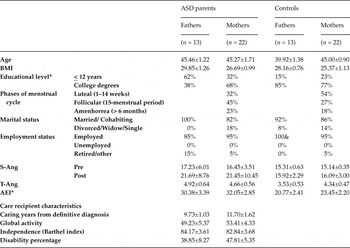
Although groups did not differ in BMI, a significant effect was found for the group in the case of age (F(1, 70) = 4.00, p = .050, η p 2 = .06), with control fathers being younger than the rest of the former (p < .05 for all) (see table 1). Moreover, they did not differ in marital and employment status and the distribution of menstrual cycle phases was homogeneous. Nevertheless, there was found a group effect in educational levels, χ2 (2, N = 70) = 5.90, p < .050, where most of they had secondary studies while control subjects had university studies. For this reason, age and educational level were included as covariates in the subsequent analysis.
Descriptive statistics for demographic data of parents

Notes: We have adopted the format M(SD)”.
Body mass index (BMI), State-Anger (S-Ang), Trait-Anger (T-Ang) and Anger Expression Index (AEI).
* p < .05 **p < .01 ***p < .001.
S-Ang responses to the TSST
The stressor proved to be effective for eliciting S-Ang responses as provoked a significant increase in both men, F(1, 25) = 4.62, p = .042, η p 2 = .16, and women F(1, 43) = 7.66, p = .014, η p 2 = .15 (see table 1). With respect to men, a significant effect for the group was found for S-Ang F(1, 25) = 4.62, p = .02, η p 2 = .16. In fact, ASD’s caregivers had higher S-Ang average score than controls, p < .050. After including age and educational level as covariates group remained still significant, F(1, 22) = 6.48, p = .020, η p 2 = .23. Regarding women, there was found significant group effect F(1, 42) = 5.82, p = .021, η p 2 = .12, with ASD women presenting S-Ang average score than control women (p < .050). After including age and educational level as covariates group remained still significant F(1, 40) = 4.73, p = .042, η p 2 = .11.
Hormonal responses to the TSST
Intra-group comparisons revealed a significant effect for moment in ASD’s fathers F(1, 13) = 4.55, p = .050, η p 2 = .10 but fathers of normative offspring did not present a significant moment effect. ASD fathers showed a drop in Tsal levels from baseline to post-task. However, their Tsal levels diminished from this point to 30 minutes post-task. Regarding fathers of normative offspring, a decrease was found from baseline to preparation period and then increased from this point to 20 minutes post-task. Afterwards, Tsal decreased from 20 to 30 minutes post-task (for all p < .050). Finally, a significant group effect was found F(1, 23) = 4.76, p = .044, η p 2 = .17, with ASD‘s fathers presenting higher Tsal levels than fathers of normative offspring (20.43 ± 1.73 and 15.22 ± 1.66, respectively). After including age and educational levels as covariates the result was still significant F(1, 21) = 5.27, p = .032, η p 2 = .20.
There were found a significant moment effect for the total sample of fathers ε = 0.29, F(1.63, 39.13) = 2.85, p = .048, η p 2 = .11. ASD’s fathers showed a decrease in Csal levels from baseline to preparation period. However, their Csal levels increased from this point to 20 minutes post-task. Afterwards, Csal decreased from 20 to 30 minutes post-task. Regarding fathers of normative offspring, a decrease was found from baseline to preparation period and then increased from this point to post-task. Afterwards, Csal decreased from this point to 30 minutes post-task. Finally, a significant group effect was found F(1, 23) = 6.83, p = .018, η p 2 = .23, with ASD fathers presenting lower Csal levels than fathers of normative offspring (1.58 ± 0.18 and 1.81 ± 0.18, respectively). After including age and educational levels as covariates the result was still significant F(1, 21) = 3.75, p = .045, η p 2 = .15.
Regarding women, intra-group comparisons revealed a significant effect for moment in Tsal levels ASD’s caregivers ε = 0.81, F(3.24, 68.11) = 3.72, p = .012, η p 2 = .15 but mothers of normative offspring did not present a significant moment effect. ASD’s caregivers showed an increase in Tsal levels from baseline to 20 minutes post-task. Afterwards, Tsal decreased from 20 to 30 minutes post-task. Regarding mothers of normative offspring, Tsal showed a similar pattern to ASD’s caregivers. Finally, a significant group effect was found F(1, 41) = 5.77, p = .022, η p 2 = .12, with ASD’s caregivers presenting higher Tsal levels than mothers of normative offspring (7.81 ± 0.99 and 4.81 ± 1.01, respectively). After including age and educational levels as covariates the result was still significant F(1, 39) = 5.52, p = .019, η p 2 = .12.
There were found a significant moment effect for the total sample of mothers in Csal levels ε = 0.36, F(1.45, 60.87) = 5.85, p = .012, η p 2 = .12. In fact, ASD’s caregivers showed a decrease in Csal levels from baseline to preparation period. However, their Csal levels increased from this point to 20 minutes post-task. Afterwards, Csal decreased from 20 to 30 minutes post-task. Regarding mothers of normative offspring, their Csal levels followed a similar pattern. Although there were not found a significant group or moment x group interaction ASD’s mothers presented lower Csal levels than mothers of normative offspring (1.58 ± 0.18 and 1.81 ± 0.18, respectively). Similar results were found after included as covariates age and educational level.
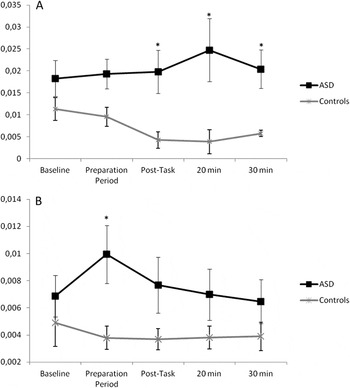
The psychosocial stressor employed in this study has proven to be effective for eliciting hormonal responses, as a significant effect of moment on the Tsal/Csal ratio levels in the total sample of men and women ε = 0.40, F(1.60, 59.20) = 7.37, p = .003, η p 2 = .17 and ε = 0.29, F(1.16, 68.66) = 5.96, p = .013, η p 2 = .09, respectively. Regarding men, ASD’s caregivers presented an initial increase from baseline to 20 minutes post-task. Afterwards, from Tsal/Csal ratio levels decrease from this point to 30 minutes post-task. Nevertheless, caregivers of normative offspring showed an initial decrease from baseline to post-task. Afterwards, their levels increase from 20 to 30 minutes post-task.
Regarding women, ASD’s caregivers presented an initial increase from baseline to preparation period. Afterwards, their Tsal/Csal ratio levels decrease from this point to 30-minutes post-task. Nonetheless, caregivers of normative offspring presented an initial decrease from baseline to preparation period. Afterwards, their Tsal/Csal ratio levels remain low after 30 minutes post-task.
With regards to men, significant moment x group interaction effects were found ε = 0.55, F(2.52, 60.48) = 2.84, p = .05, η p 2 = .11, respectively, with ASD’s caregivers presenting higher Tsal/Csal ratio levels than caregivers of normative offspring at all time points assessed (p < .05) except the baseline (p > .05) (see Figure 1a). After including age and educational level as covariates group and time x group interaction remained still significant ε = 0.54, F(1, 22) = 4.26, p = .047, η p 2 = .16; ε = 0.55, F(2.14, 59.62) = 2.29, p = .045, η p 2 = .10, respectively. Moreover, there was a significant effect for group in AUCi (t 24 = 2.31, p = .03, d = .94), with ASD’s caregivers presenting higher Tsal/Csal ratio magnitude of response than caregivers of normative offspring. After including age and educational levels as covariates the result was still significant F(3, 25) = 3.91, p = .049, η p 2 = .15.
Mean Tsal/Csal ratio levels in ASD and control (a) men and (b) women.
*p < .05.

In the case of women, significant moment x group interaction effects were found ε = 0.55, F(2.43, 99.62) = 2.84, p = .046, η p 2 = .06, with ASD‘s caregivers showing higher Tsal/Csal ratio levels than controls, particularly in the preparation period (p < .05) (see Figure 1b). After including age and educational level time x group interaction remained still significant ε = 0.54, F(2.14, 83.48) = 2.67, p = .028, η p 2 = .06. Concerning the magnitude of the response, a significant group effect were found in Tsal/Csal ratio AUCi F(2, 43) = 4.41, p = .039, η p 2 = .10. In fact, whereas Tsal/Csal ratio levels increased in ASD’s caregivers, they fell significantly in caregivers of normative offspring. After including age and educational level as covariates the results were still significant F(4, 43) = 5.61, p = .038, η p 2 = .12.
Patterns of prediction of the Tsal/Csal ratio baseline and AUCi in terms of being a caregiver or not of offspring with ASD
In the case of men, the Tsal/Csal ratio baseline of caregivers offspring with ASD explained 39.2% of S-Ang baseline, β = .665, p < .009, 62.4% of T-Ang (β = .710, p < .001) and 7.3% of AEI (β = .387, p < .045). Moreover, Tsal/Csal ratio AUCi predicted 45.9% of AEI (β = .710, p < .01) but was unrelated with the other variables. Tsal/Csal ratio did not predict these variables in caregiver of normative offspring. Nevertheless, Tsal/Csal ratio AUCi only predicted 24.6% of AEI (β = .556, p < .048). After including age and educational level as covariates similar the results were still significant.
Regarding women, the Tsal/Csal ratio baseline of caregivers offspring with ASD explained 39.3% of S-Ang baseline (β = .654, p < .001) but unrelated with T-Ang and/or AEI. Moreover, AUCi predicted 52.6% of AEI (β = .741, p < .001). With regards to caregivers of normative offspring, Tsal/Csal ratio predicted the 18.5% of T-Ang (β = .473, p < .046) but unrelated with the other variables. Moreover, AUCi did not predict the anger variables. After including age and educational level as covariates similar the results were still significant.
Discussion
Caregivers, particularly those of offspring with ASD, had higher Tsal/Csal ratio than controls in response to acute stress, concretely at post-task, and at 20- and 30-minute post-task periods in the case of men and at preparation period when analyzing women. Moreover, ASD parents (both fathers and mothers) obtained higher magnitude of the Tsal/Csal ratio response to stress, state anger and anger expression than controls. Finally, high Tsal/Csal ratio levels and response to stress were significantly associated with high anger feelings increases, trait anger and its expression in caregivers, mainly in those of offspring with ASD. These results reinforced the previously reported hypothesis that not only a high Tsal/Csal ratio is associated to greater proneness to aggression by means of a poor control of anger in violent people, but also in different stressed non-violent populations such is the case of informal caregivers.
The validity of the stress protocol for eliciting psychological and hormonal response was demonstrated by the significant increase in anger feelings and Tsal, Csal as well as Tsal/Csal ratio. It has been previously shown that acute psychosocial stressors induce decreases in Tsal levels and increases in Csal levels and negative affect (Dickerson et al., Reference Dickerson, Gruenewald and Kemedy2004; Heinz et al., Reference Heinz, Hermann, Smolka, Rieks, Gräf, Pöhlau and Bauer2003). Nevertheless, in our study informal caregivers of offspring with ASD (fathers and mothers) experienced an initial Tsal/Csal increase between baseline and preparatory periods. This can be partially explained by their increase in Tsal levels and a decrease in Csal levels from baseline to preparation period. Nevertheless, parents (fathers and mothers) of normative offspring presented an initial decrease in their Tsal/Csal levels which can be explained by their initial decrease in Tsal as well as in their Csal levels. Afterwards, ASD parents experience a decrease in their Tsal/Csal ratio levels due to the fact that they experienced a decrease in Tsal levels and an increase in Csal levels. Moreover, ASD parents presented higher average of Tsal levels and lower average of Csal levels than control parents, which could explain the differences in Tsal/Csal ratio. That is, caregivers under stress for long periods present a marked HPG/HPA imbalance, which in turns may facilitate the appearance of anger feelings and a tendency to express their anger (Herrero et al., Reference Herrero, Gadea, Rodriguez-Alarcón, Espert and Salvador2010; Leggett et al., Reference Leggett, Zarit, Kim, Almeida and Klein2015; Liening & Josephs, Reference Liening and Josephs2010; Montoya et al., Reference Montoya, Terburg, Bos and van Honk2012; Peterson & Harmon-Jones, Reference Peterson and Harmon-Jones2012; van Honk & Schutter, Reference van Honk, Schutter, Harmon-Jones and Winkielman2007; von der et al., Reference von der, Sarkola, Seppa and Eriksson2002).
As it has been previously found, Tsal/Csal ratio could be useful for identifying men who are violent or prone to violence as a baseline measure (Glenn, Raine, Schug, Gao, & Granger, Reference Glenn, Raine, Schug, Gao and Granger2011) or in response to acute psychosocial stress (Romero-Martínez, González-Bono et al., Reference Romero-Martínez, González-Bono, Lila and Moya-Albiol2013; Romero-Martínez, Lila et al., Reference Romero-Martínez, González-Bono, Lila and Moya-Albiol2013). However, attending to our results the Tsal and Csal imbalance may prone or it has been associated to self-reported anger in a non-violent population of men and women. In the case of the intimate partner violence (IPV) perpetrators a high Tsal/Csal ratio could be explained by a genetic predisposition to have a hyporeactive HPA axis (Romero-Martínez & Moya-Albiol, Reference Romero-Martínez, Moya-Albiol and Moya-Albiol2015a). Nevertheless, in the case of the caregivers, the hyporeactive HPA may be explained by the exposition to stress for long periods which were defined in our study by the duration of the caregiving, the autonomy and the disability percentage of the care recipient. Moreover, it is important to note the possible existence of an autistic endophenotype characterized by a high brain masculinization as it has been demonstrated by previous studies. In fact, ASD parents tend to present certain cognitive characteristics of their offspring (masculinized brain) as well as a high sensitivity and T levels (Hauth, de Bruijn, Staal, Buitelaar, & Rommelse, Reference Hauth, de Bruijn, Staal, Buitelaar and Rommelse2014; Romero-Martínez et al., Reference Romero-Martínez, de Andrés-García, Ruiz-Robledillo, González-Bono and Moya-Albiol2014; Romero-Martínez & Moya-Albiol, Reference Romero-Martínez and Moya-Albiol2015b).
The interaction between the T and the C is established as part of a complex system in which neurocognitive factors must be considered. Hence, the imbalance between these two steroids ‘per se’ is not enough to induce aggressive behaviour and/or violence (Terburg et al., Reference Terburg, Morgan and van Honk2009). The main limitation of this study is the fact that it is a cross-sectional one, so individual difference may mask other effects evaluated at a single moment in life. It is, however, extremely difficult to conduct longitudinal studies regarding the personal situation of caregivers as they have to take care personally of their offspring and consequently can’t spend more time in experimental protocols. Future research should consider relevant variables which demonstrated a modulator role in the caregivers’ steroid response to stress such as parental ASD endophenotypes (Hauth et al., Reference Hauth, de Bruijn, Staal, Buitelaar and Rommelse2014; Romero-Martínez & Moya-Albiol Reference Romero-Martínez and Moya-Albiol2014; Romero-Martínez & Moya-Albiol, Reference Romero-Martínez and Moya-Albiol2015b).
In conclusion, our study reveals that the exposition to stress for long periods was associated with an imbalance between Tsal and Csal levels, which in turns was associated with an augment of anger and a tendency to express the anger. Hence, these results reinforced the hypothesis that the high Tsal/Csal ratio could explain greater proneness to aggression in non-violent as well as in violent populations (Montoya et al., Reference Montoya, Terburg, Bos and van Honk2012). Our data are relevant and novel as no laboratory studies have analyzed the Tsal/Csal ratio response to TSST and its relationship with anger and aggression in a stressed non-violent population such is the case of informal caregivers. Furthermore, we have employed a relatively large sample size of caregivers of people with two different disorders. For this reason, our reseach could benefit pharmacological targets for the control of aggressive behavior and violence. As recently publication reveals the prescription of testosterone-lowering medications coadjutant to psychotherapy moderately increases the treatment effectiveness in sex offenders (Turner, Basdekis-Jozsa, & Briken, Reference Turner, Basdekis-Jozsa and Briken2013). Our results also enable the selection of psychotherapeutical intervention programs target to helping caregivers for managing with anger and the control of aggression when coping with this situation. Further investigation is required to extend our knowledge of the factors involved in the onset of violence to design intervention psychotherapeutical programs adapted to the specific requirements of each population.
This work was supported by the Ministerio de Sanidad, Servicios Sociales e Igualdad. Plan Nacional Sobre Drogas (PNSD/2012/001).