





Plain language summary
Historians working with large collections of printed or handwritten documents often want to know whether visual features can be traced back to the institutions that produced them. A scriptorium, a printshop, or a publishing house leaves traces in the materials it produces, traces that reflect equipment, training, economic decisions, and the habits of daily practice. When these traces survive in the printed or written record, they constitute a material archive that can speak to questions conventional documentation cannot answer. Deep learning offers a natural approach to reading this archive at scale. Models can be trained to distinguish the outputs of different institutions based on visual properties alone, and recent work in font classification and writer identification has demonstrated that such models can perform well on historical materials. Yet high performance on these tasks frequently obscures more than it reveals. For the historian, knowing that a model can tell two printshops apart is only the beginning of the inquiry. The substantive question is which visual features drive that distinction and whether those features correspond to anything historically meaningful. A model that achieves high accuracy by learning artifacts of digitization or idiosyncrasies of page layout has answered a technical question while leaving the historical one untouched.
We test three computational approaches on 57,583 digitized pages from four colonial Korean printshops (1910–1945). Colonial Korean print provides a particularly demanding case because the visual differences between shops are subtle. Metal type was extraordinarily expensive, and most printshops purchased matrices from the same limited pool of Japanese foundries, creating apparent standardization across publications. Yet scholars such as De Fremery (De Fremery Reference De Fremery2014) and Ryu (Ryu Reference Ryu2015) have identified shop-specific signatures in stroke weight, terminal angles, and character component design through painstaking manual examination of individual volumes. Whether these patterns hold systematically across large corpora has remained an open question.
The first two approaches presented in this study achieved reasonable accuracy, and their visualization tools did produce attention maps, but the patterns these maps revealed were either uninformative or too diffuse to connect to specific typographic features. Multiple instance learning (MIL) addressed this gap. Because page-random splits can put pages from the same book in both training and test sets, we treat them as diagnostic. Under held-out-book evaluation, MIL classified individual pages by printshop with 84.5 percent accuracy while directing attention to specific sub-character features, such as stroke terminals, serif weight, and the rendering of individual letter components. The features the model learned to attend to align with what De Fremery and Ryu had documented through intensive manual analysis, confirming that the method recovers genuine typographic patterns rather than artifacts of digitization or layout. Because MIL identifies which specific visual features drive its classifications, the framework applies wherever scholars need to recover institutional signatures from materially constrained production systems.
Introduction
The printed page carries more information than the text it transmits. The design of a typeface, the weight of its strokes, the angle of its terminals, and the proportions of its components preserve traces of the institutions that produced or purchased it (Gaskell Reference Gaskell1995; McKenzie Reference McKenzie1999). For the historian, a font can function as an artifact for reconstructing printing practices, particularly when ledgers, correspondence, and the machinery of the printshop itself have not survived. This is especially true for Korea under Japan’s 35-year colonial occupation (1910–1945), where a modern printing industry developed in earnest under colonial rule, leaving behind millions of printed pages yet few continuous business records.Footnote 1 The material traces of production decisions persist in these pages even when other documentation does not, and decoding them allows historians to reconstruct the business ecology of publishing, from supply networks and equipment investments to the tacit knowledge that structured daily production. This article examines the typographic output of four major colonial Korean printshops across 57,583 digitized pages spanning the full breadth of the colonial period, testing three computational approaches to detecting shop-level typographic signatures and documenting the process by which each approach’s limitations motivated the next. Throughout the study, the prediction unit is the individual page, and the central test is whether a classifier can assign pages to printshops when every page from the tested book has been withheld from training. We therefore use page-random splits only as a diagnostic baseline and treat held-out-book splits as the meaningful generalization test. We arrive at multiple instance learning (MIL), a framework that identifies which specific visual regions drive classification decisions, enabling scholars to inspect and evaluate the features a model treats as diagnostic rather than accepting an opaque accuracy score.
The colonial print landscape
Although the Korean peninsula possessed a long tradition of movable metal-type printing stretching back to the Koryŏ dynasty (Walraven Reference Walraven and Idema2007), the shift that occurred under Japanese rule was the reorganization of print production as an industrial capitalist enterprise operating within a colonial economy. The aesthetic forms of modern Hangŭl type were determined primarily by matrices produced at Japanese foundries from the 1880s onward, and these standards persisted well into the 1930s (Ryu Reference Ryu2015). Following a relaxation of censorship after the March First Movement of 1919, a commercial print industry emerged in Kyŏngsŏng (京城, present-day Seoul), where between 100 and 200 shops operated by the 1920s (De Fremery Reference De Fremery2011, 102–3). Private Korean firms such as Taedong Inswaeso (大東印刷所) and Hansŏng Tosŏ Chusik Hoesa (漢城圖書株式會社) competed for contracts alongside Japanese-backed enterprises.
These firms operated within severe economic constraints that bear directly on the computational problem this article addresses. The trilingual demands of Korean publishing required separate fonts for the Korean alphabet (Hangŭl), Chinese characters (Hanja), and with increasing frequency Japanese kana. Metal type was extraordinarily expensive. The 1923 balance sheet of Taedong Inswaeso illustrates these pressures concretely. The shop held matrices valued at ₩4,445 while spending only ₩800 on annual wages, a ratio that demonstrates how equipment costs dominated the business model (De Fremery Reference De Fremery2014). Most shops could barely afford a single typeface, and such conditions often led printers to individuate their books through subtle adjustments in spacing and page architecture rather than by deploying a wide array of typefaces (De Fremery Reference De Fremery2014, 18–23).
Hwisang Cho has argued that these material conditions operated within a broader discursive framework he terms typographic hegemony (Cho Reference Cho2024). Mechanical printing became the primary medium through which modernity itself was defined, and imperialist powers used printing technology as proof of civilizational superiority. This discourse subordinated indigenous Korean textual culture by establishing mechanical type as the only legitimate form of modern knowledge production, obscuring the diversity of pre-modern Korean textual practices. The result was a broadly standardized visual page.
Paradoxically, the very process of naturalization that made Japanese foundry output the standard also created a baseline against which shop-level variations became legible. Within this prescribed visual landscape, distinct matrices, specific wear patterns, and habitual spacing practices invariably produced unique shop-specific typographic signatures (De Fremery Reference De Fremery2014). These subtle marks constitute a historical archive that is difficult to access systematically, since business records from the period are fragmentary, and we often cannot determine which shop printed which text through conventional documentary evidence. In the absence of such records, the printed page becomes the primary archive.
What manual bibliography has revealed
De Fremery has demonstrated that intensive manual bibliography can identify material variations within this landscape (De Fremery Reference De Fremery2014). Through detailed examination of poetry volumes and periodicals from the 1920s, he identified shop-specific signatures in stroke weight, modulation, and axis. He noted that Taedong Inswaeso used thinner strokes with less dramatic modulation compared to Hansŏng Tosŏ, where strokes tapered dramatically toward their terminals. He documented how the oblique axis and weight of strokes in common syllables like tang (당) differed consistently between shops. The typefaces used by pressman No Ki-jŏng at Hansŏng Tosŏ established an aesthetic rhythm so characteristic that even before one checks the colophon of a book, it is often possible to identify volumes as his work simply by looking at the type (De Fremery Reference De Fremery2014).
Ryu Hyŏn’guk pursued an even more microscopic analysis of how typeface design responded to material constraints (Ryu Reference Ryu2015). He identified systematic modifications that distinguished specific matrices and their functional contexts. The 1884 Hansŏng-style 4-ho (한성식 4호) type featured upward-turning terminals in consonants like niŭn (ㄴ), tigŭt (ㄷ), and riŭl (ㄹ) that referenced brush calligraphy. The 6-ho (6호) type used in Mansebo (만세보, 1906) employed systematically elongated horizontal strokes in characters, such as k’iŭk (ㅋ), miŭm (ㅁ), and tigŭt (ㄷ), which Ryu interpreted as a compensatory design strategy to preserve character integrity at reduced scales in dense newspaper columns. These minute anatomical features functioned as typographic fingerprints that could identify specific matrices and their circulation through the colonial printing network.
Manual analysis demonstrated that these patterns exist and identified specific distinguishing features in selected volumes. It cannot, however, establish the scope or consistency of these patterns across the millions of pages produced during the colonial period. The historiographical value of typographic signatures depends precisely on determining whether they persist systematically or appear only sporadically, and on whether a given shop’s signature remains stable across its full production history or shifts at identifiable moments, indicating changes in equipment, personnel, or production practices. A computational approach operating across the full corpus can surface candidate features for scholarly inspection at a scale that complements the close reading of individual volumes, and can do so without requiring diagnostic features to be specified in advance. This article addresses that methodological problem. Before we can pursue broader historiographical questions about what these signatures reveal, we must first establish whether computational methods can reliably detect them at scale.
Computational approaches to script and type analysis
Several recent studies have treated computational similarity as a way to recover historically meaningful visual regularities from damaged or difficult document images. In computational paleography, this problem has often been framed through writer identification. Christlein’s pipeline of local descriptors and exemplar classifiers achieved identification rates above 99 percent on contemporary datasets and close to 90 percent on a large historical corpus (Christlein Reference Christlein2019). Work on Greek papyri extended this problem to fragmentary and degraded material, showing that preprocessing and feature sampling matter when substrate, conservation state, and digitization introduce noise (Christlein et al. Reference Christlein, Marthot-Santaniello, Mayr, Nicolaou, Seuret, Carmona-Duarte, Diaz, Ferrer and Morales2022). Popović, Dhali, and Schomaker (Reference Popović, Dhali and Schomaker2021) used feature-space separation, statistical testing, and visual inspection of discriminative character fragments to generate new evidence for a scribal transition in the Great Isaiah Scroll. Marthot-Santaniello et al. extend this line by computing similarity at the level of individual Greek letter forms, aggregating those measurements into manuscript-level networks, and interpreting the resulting clusters against established paleographic categories (Marthot-Santaniello et al. Reference Marthot-Santaniello, Vu, Serbaeva, Beurton-Aimar, Coustaty and Fornés2023). These studies matter here because they show that subtle visual regularities can carry historical information, especially when conventional metadata is absent, and that computational similarity can be made legible to domain specialists. The primary task across this body of work, however, remains the attribution of handwritten materials.
Typeface identification in printed documents is closer to this material context but has usually been pursued at a different scale. Christlein et al. tested classification and retrieval methods on incunabula types from the Typenrepertorium der Wiegendrucke and found that visually distinctive types could be classified with near-perfect accuracy, while closely similar types resisted differentiation (Christlein et al. Reference Christlein, Weichselbaumer, Limbach, Seuret, Reussner, Koziolek and Heinrich2021). The retrieval side of that experiment also shows why classical local-feature descriptors remain relevant, since SIFT formalized the extraction and matching of stable local visual structures before neural document-image pipelines became dominant (Lowe Reference Lowe2004). Kordon et al. developed energy-based models for classifying individual glyphs across 42 character types in an incunable edition while filtering out ligatures and other out-of-distribution samples (Kordon et al. Reference Kordon, Weichselbaumer, Herz, Mossman, Potten, Seuret, Mayr and Christlein2023). These studies confirm that printed type is computationally tractable. They do not fully address the present problem, where the question is whether a model can recover shop-level signatures inside a constrained market where firms often worked with the same or closely related matrices.
The closest print-historical analog is the Print and Probability project at Carnegie Mellon and UC San Diego. Across work on Areopagitica, probabilistic glyph modeling, contrastive attention over damaged type-imprints, and running-title clustering, this project treats early modern English print as evidence for production history (Goyal et al. Reference Goyal, Dyer, Warren, G’Sell, Berg-Kirkpatrick, Jurafsky, Chai, Schluter and Tetreault2020; Vogler et al. Reference Vogler, Goyal, Reddy, Pertseva, Lemley, Warren, G’Sell and Berg-Kirkpatrick2023, Reference Vogler, Goyal, Lemley, Schuldt, Warren, G’Sell, Berg-Kirkpatrick, Barney Smith, Liwicki and Peng2024; Warren et al. Reference Warren, Williams, Rijhwani and G’Sell2020). It asks what material traces reveal about attribution and reconstruction, not how a page belongs to a font class. Its studies show how repeated letterforms, damaged sorts, and reusable forme elements can support printer attribution and bibliographical reconstruction. The present study shares that production-historical premise, but the difference lies in procedure rather than evidentiary scale. Rather than beginning from a predefined typographic unit, such as a segmented glyph, damaged type-imprint, or running title, it lets small regions across the page become candidate evidence for shop attribution. This means that the resulting evidence can include letterform details, sub-character components, separators, spacing, and page architecture without deciding in advance which type of page element will be diagnostic.
Research contribution
We show that shop-level typographic signatures in colonial Korean print are computationally recoverable across tens of thousands of pages, and that the features driving that recovery can be made legible for scholarly evaluation. To do so, we introduce MIL to the analysis of historical documents, a framework not previously applied in this domain. We test it on four presses that reflect distinct ownership models and institutional aims. Sinmungwan (新文館), founded in 1908 by Ch’oe Nam-sŏn (崔南善, 1890–1957), was one of the very few Korean presses of its time to cast its own metal type. Taedong Inswaeso (大東印刷所) and Hansŏng Tosŏ Chusik Hoesa (漢城圖書株式會社) illustrate private Korean entrepreneurship evolving from the 1910s through the 1930s. Chosŏn Inswae Chusik Hoesa (朝鮮印刷株式會社), established with substantial Japanese capital and enjoying official patronage, represents an entirely different model and grew into the largest printing enterprise in colonial Korea (Ryu Reference Ryu2015, 136–7). Each developed its own solutions to the economic and political constraints of colonial printing, solutions that would leave subtle but detectable traces in their typographic output.
The article proceeds through these stages. The “Data” section describes the corpus and the rationale for preserving its natural class imbalance. The “Methodology” section traces the progression from a convolutional baseline through a cutout-based vision transformer to MIL, documenting the data leakage problem that required reassessing all three approaches with held-out-book splits. The “Findings and analysis” section turns from classification performance to interpretation. It clusters the patches with the highest attention scores, characterizes the typographic features that distinguish each press, and compares these with findings from manual bibliography. The “Conclusion” section identifies what the method has established and where its limitations point. We arrive at MIL through two prior approaches whose limitations motivated it. We begin with a convolutional neural network trained on full-page images, then move to a vision transformer trained on page cutouts to redirect attention away from layout (Cai et al. Reference Cai, Huang, Zhang, Lu and Zhang2025). The visualization tools available for both approaches produce broad heatmaps rather than discrete regions that scholars can inspect and evaluate against existing domain knowledge. MIL addresses this limitation by conceptualizing each page as a collection of patches and learning which specific regions are most informative for classification. This granular localization capability becomes critical when distinguishing features exist at the sub-character level. Our contribution lies in interpretability, in making visible precisely which regions the model identifies as distinctive. The features the model learns to attend to (stroke terminals, serif weight, and the rendering of individual letter components) are consistent with genuine typographic properties rather than artifacts of digitization or layout. This enables direct comparison with the findings of manual bibliography and the potential discovery of patterns not yet documented. The approach we develop here addresses this problem for colonial Korean print, though the underlying challenge of distinguishing institutional outputs within materially constrained production systems is not specific to this context.
Data
Our corpus comprises 57,583 page images drawn from the Hyundam Mun’go digitization project. The collection spans four printshops that emerged as dominant forces in Kyŏngsŏng (Seoul), each developing its own approach to the constraints of colonial printing.
Taedong Inswaeso (大東印刷所), despite employing only two to three salaried workers in 1923, invested heavily in land (₩31,860), machinery (₩24,558), and matrices (₩4,445), operating multiple 4.6- and 5.7-sheet presses for high-volume printing (De Fremery Reference De Fremery2011). Hansŏng Tosŏ Chusik Hoesa (漢城圖書株式 會社), with ₩75,000 in paid-in capital, combined bookstore, offices, and pressroom. Its three 5.7-sheet letterpresses produced approximately one quarter of all vernacular poetry during the 1920s (De Fremery Reference De Fremery2011).
Sinmungwan (新文館), founded in 1908 by cultural nationalist Ch’oe Nam-sŏn (崔南善), pursued a different strategy entirely. It was one of the very few Korean presses of its time to cast its own metal type. Having studied at Waseda University in Tokyo, Ch’oe purchased a Western-style printing press and type-casting machines in Japan. Assisted by Japanese technicians, he transported them back to Korea, making Sinmungwan part of a small vanguard with in-house metal-type capability. This independence enabled Sinmungwan to typeset many documents, including the original March First Declaration of Independence itself, and to experiment freely.
In contrast, Chosŏn Inswae Chusik Hoesa (朝鮮印刷株式 會社) represented an entirely different model. Established in 1919 with ₩200,000 in capital, the company emerged when major Japanese investors, including shareholders from 20 Japanese banks and companies operating in Korea, acquired an existing press. Backed by substantial capital and enjoying official patronage, the company grew rapidly. By 1939, it had become a 500-employee, 45-press enterprise whose facilities included Western-style gravure and autotypy equipment unique in Korea at the time, along with the country’s first automatic offset printing machine (Ryu Reference Ryu2015, 136–7).
Together, these four presses cover the colonial period from 1908 through the early 1940s and represent the range of ownership models operating in Kyŏngsŏng. We selected all extant materials for which clear colophon metadata were available.
Class distribution and the question of rebalancing
Table 1 presents the distribution of pages by printshop. The imbalance is immediately apparent. Taedong Inswaeso contributes 44 percent of all pages, while Chosŏn Inswae contributes just under 11 percent. We chose not to rebalance the dataset. The reasons for this decision are methodological, historical, and archival, and they bear directly on what the computational analysis can reasonably claim to detect.
Distribution of analyzed pages across the four most productive colonial Korean printshops
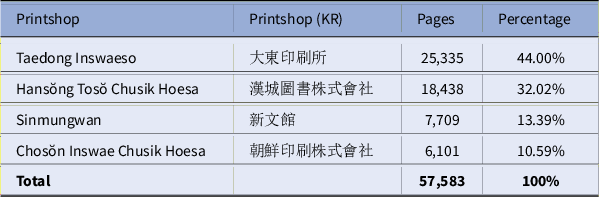
Table 1 Long description
The table consists of four columns: Printshop, Printshop K R, Pages, and Percentage.
* Row 1: Taedong Inswaeso, written in K R as 大東印刷所, has 25,335 pages, accounting for 44.00 percent.
* Row 2: Hansŏng Tosŏ Chusik Hoesa, written in K R as 漢城圖書株式會社, has 18,438 pages, accounting for 32.02 percent.
* Row 3: Sinmungwan, written in K R as 新文館, has 7,709 pages, accounting for 13.39 percent.
* Row 4: Chosŏn Inswae Chusik Hoesa, written in K R as 朝鮮印刷株式會社, has 6,101 pages, accounting for 10.59 percent.
* Total: The final row shows a total of 57,583 pages, representing 100 percent.
The most fundamental reason is that the imbalance in the dataset reflects a real imbalance in the historical record. These four printshops did not operate at the same scale. Taedong Inswaeso, despite its small workforce, was an extraordinarily prolific letterpress operation that printed across a wide range of genres over a long period (1911–1935). Sinmungwan’s surviving output clusters in the early 1920s, and its materials in the Hyundam Mun’go collection are accordingly fewer. Chosŏn Inswae, though it grew into the largest press in Korea by the late 1930s, entered the vernacular book market somewhat later than its competitors. These are facts about the colonial printing industry, and they carry real consequences for the kind of typographic evidence available to us. To flatten the class distribution would be to pretend that each press left behind an equal body of work, which none of them did.
Oversampling the minority classes would mean duplicating page images from Sinmungwan and Chosŏn Inswae. In a study of typographic features, this introduces a specific and serious problem. Each page in the corpus is a physical artifact with its own history of ink adhesion, paper degradation, and digitization conditions. Duplicating a page does not create new typographic evidence. It tells the model to pay more attention to the particular wear patterns, scanning artifacts, and paper condition of that specific sheet. A model trained on oversampled data would risk learning to recognize the material idiosyncrasies of individual pages rather than the generalizable typographic signatures of the printshop that produced them. For a study concerned with identifying shop-level patterns across thousands of pages, this is precisely the wrong kind of signal to amplify.
Undersampling the majority classes would mean discarding pages from Taedong Inswaeso and Hansŏng Tosŏ. The difficulty here is that we are working with a finite historical archive. The pages in this corpus are not experimental data that can be regenerated at will. They are the surviving material traces of institutions that ceased to exist decades ago. Throwing away thousands of pages to achieve numerical balance would sacrifice the very breadth of typographic variation within a given press that makes shop-level identification possible. A printshop’s typographic signature is revealed through the accumulation of many pages across many publications, not through a handful of representative examples. The more pages we retain from a prolific press, the better positioned the model is to learn which features are consistent characteristics of that shop’s output and which are incidental variations introduced by a particular publication or print run.
Given this decision, it becomes important to verify that the imbalance does not distort classification. We evaluate with five-fold cross-validation and report per-class metrics alongside aggregate scores, so that performance on minority classes is transparent rather than hidden inside averaged results. We examine per-fold class balance to ensure that no single fold produces anomalous results driven by the distribution of a particular press. As we show in the results section, all models achieve strong accuracy and F1 scores across all four printshops, confirming that the imbalance does not undermine classification.
Figure 1 shows when materials from each printshop appear in our corpus. Taedong Inswaeso spans the longest period (1911–1935). Hansŏng Tosŏ and Chosŏn Inswae extend into the 1940s, while Sinmungwan’s surviving materials cluster in the early 1920s. The four shops cover overlapping but distinct periods of the colonial era.
Date range of extant digitized publications in the analyzed corpus, shown by printshop. The timelines indicate the earliest and latest surviving materials included in the dataset.
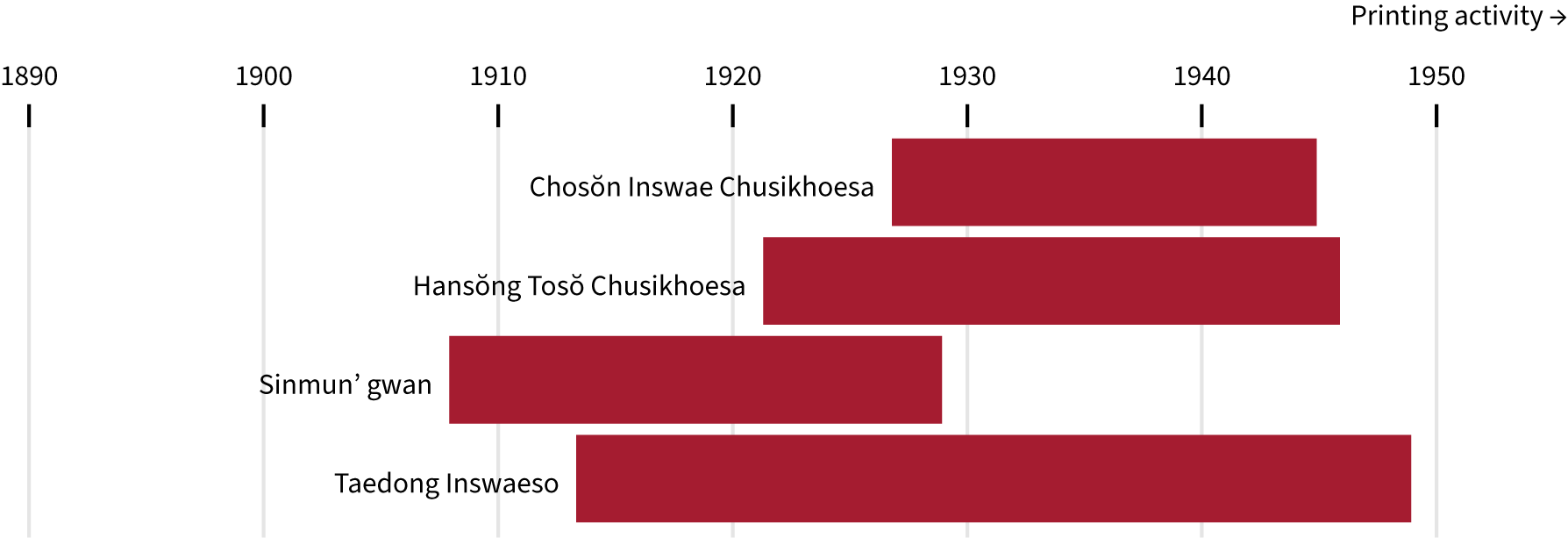
Figure 1 Long description
The x-axis is a timeline with vertical grid lines at 10-year intervals from 1890 to 1950. Four horizontal red bars represent the duration of printing activity for specific shops.
* Choson Inswae Chusikhoesa: The top bar begins around 1927 and ends around 1946.
* Hansong Toso Chusikhoesa: The second bar begins around 1921 and ends around 1947.
* Sinmun’ gwan: The third bar begins around 1908 and ends around 1929.
* Taedong Inswaeso: The bottom bar begins around 1913 and ends around 1949.
An arrow at the top right points right, labeled Printing activity.
Methodology
We tested three computational approaches to printshop classification, each motivated by the limitations of its predecessor. The first was a baseline convolutional neural network trained on full-page images, following established practice in computational font analysis. When this approach proved to rely on page layout rather than typographic features, we moved to a second approach that trained a vision transformer on page cutouts, removing margins from consideration entirely. This redirected the model’s attention but did not produce interpretable results. The third approach, MIL, was designed from the outset to address the interpretability problem that the first two had exposed, by assigning importance scores to individual regions of the page rather than generating continuous heatmaps. Before presenting each approach in turn, we describe the tools used to assess what the models had learned, for the ability to inspect a model’s reasoning matters as much as the accuracy of its classifications.
Data preparation and preprocessing
All three approaches draw on the same underlying data preparation pipeline, so that differences in model performance reflect architectural choices rather than the varying quality of digitized scans. The digitized pages were subjected to a uniform preprocessing workflow implemented with the albumentations library (Buslaev et al. Reference Buslaev, Iglovikov, Khvedchenya, Parinov, Druzhinin and Kalinin2020). Each image was first resized to 896
$\times $
 896 pixels and then converted to grayscale. Grayscale conversion removes color variations introduced by different scanning equipment and paper discoloration, forcing the model to focus on structural and textural features rather than incidental chromatic differences. We then applied contrast-limited adaptive histogram equalization (CLAHE) to enhance local contrast. Historical documents often exhibit faded ink, uneven illumination, and age-related degradation. CLAHE addresses these issues by equalizing the histogram within localized tiles while limiting contrast amplification, thereby improving text visibility without over-enhancing noise. Finally, we normalized pixel values using ImageNet statistics to ensure compatibility with pretrained backbones. All models share the same normalization values derived from ImageNet. For architectures expecting single-channel input, we used the luminance channel statistics (mean 0.485, standard deviation 0.229). For architectures expecting three-channel input, we replicated the grayscale values across RGB channels and applied the full ImageNet normalization.
During training, we applied photometric augmentations to improve generalization. Gaussian blur simulates focus variation across different scanning sessions. Random brightness and contrast shifts account for inconsistent lighting conditions during digitization. Gaussian noise injection mimics sensor noise present in lower-quality scans. JPEG compression artifacts simulate the lossy compression applied to many archival images. Sharpening counteracts blur and enhances edge definition. This augmentation strategy encourages the network to learn typographic features specific to each printshop rather than artifacts introduced by the digitization pipeline.
Validation strategy
We evaluate with five-fold cross-validation, partitioning the dataset into five non-overlapping splits and training the model five times, each time holding out a different split for validation. This approach ensures every page is used for validation exactly once and reduces the chance that results depend on a particular partition (Kohavi Reference Kohavi and Mellish1995).
Given that our corpus is imbalanced across printshops, cross-validation also helps check stability: we report mean
$\pm $
 SD across folds and inspect per-fold class balance to ensure no single fold dominates outcomes. We use shuffled folds with a fixed random seed. Comparable metrics across folds indicate that results are not driven by idiosyncratic subsets of the data.Footnote
2
Interpretability methods
Given the humanities context of our research, interpretability is as important as classification accuracy. Our central research question requires understanding which visual features inform printshop classifications, so that scholars can verify whether a model’s decisions align with established typographic knowledge and potentially discover patterns that manual analysis has not yet documented.
We use gradient-weighted class activation mapping (Grad-CAM) (Selvaraju et al. Reference Selvaraju, Cogswell, Das, Vedantam, Parikh and Batra2020) as our primary visualization tool for the CNN and vision transformer experiments. Grad-CAM computes gradients of the class score with respect to feature maps, then weights these maps by their gradients to produce localization maps showing where the model focuses its attention. Among the available interpretability methods, including perturbation-based approaches such as LIME (Ribeiro, Singh, and Guestrin Reference Ribeiro, Singh and Guestrin2016) and game-theoretic approaches such as Shapley values (Lundberg and Lee Reference Lundberg, Lee, Guyon, Luxburg, Bengio, Wallach, Fergus, Vishwanathan and Garnett2017), Grad-CAM offered the most direct inspection of which image regions influence classification decisions, which is precisely what our research question demands. The MIL approach, described in the “Multiple instance learning approach” section, produces its own attention scores and does not rely on Grad-CAM. Adjacent work has improved explanation maps for CLIP-style vision-language models. CLIP Surgery modifies CLIP’s inference architecture and feature representations to correct foreground-background reversals and noisy activations in open-vocabulary similarity maps (Li et al. Reference Li, Wang, Duan and Li2023). Such methods could be relevant to a CLIP-based variant of this pipeline, but they are not direct replacements for Grad-CAM or MIL attention in the single-modality models evaluated here.
Baseline approach
Our initial approach followed established practice in computational print analysis by applying pretrained architectures to complete page images. The aim was to create a baseline using methods already proven effective in the study of historical fonts (Christlein et al. Reference Christlein, Weichselbaumer, Limbach, Seuret, Reussner, Koziolek and Heinrich2021; Im, Kim, and Mandl Reference Im, Kim and Mandl2022; Seuret et al. Reference Seuret, Limbach, Weichselbaumer, Maier and Christlein2019). These earlier studies focused on distinguishing font groups through convolutional neural network architectures, and they provided a model for our own interest in identifying typefaces. In line with this precedent, we began by training on full-page representations. At this stage, our method was deliberately straightforward. Beyond standard data augmentation, we made no adjustments to guide the model toward typographic features or printshop-specific traits. The results of this experiment thus provided a baseline measure, testing what such architectures could achieve on their own before we introduced refinements tailored to our historical questions.
We employed a ConvNeXt Base architecture (Liu et al. Reference Liu, Mao, Chao-Yuan, Feichtenhofer, Darrell and Xie2022) for full-page analysis. In contrast to the earlier mentioned works, we opted for a newer architecture to test whether more recent advances in network design might capture typographic distinctions more effectively. The network was trained end-to-end on full pages, resized to standard input dimensions. Using page-random splits, the model achieved 98.1 percent validation accuracy in distinguishing printshop origins.
Grad-CAM visualizations (Selvaraju et al. Reference Selvaraju, Cogswell, Das, Vedantam, Parikh and Batra2020) revealed what the model had learned (Figure 2). Rather than attending to typographic features, the model concentrated on page margins and other peripheral cues. These elements may reflect differences in printing equipment or page conventions, but they are not the typographic signatures we set out to investigate.
Grad-CAM visualizations for the ConvNeXt full-page model trained with page-random splits. The model’s attention concentrates on page margins rather than typographic features.
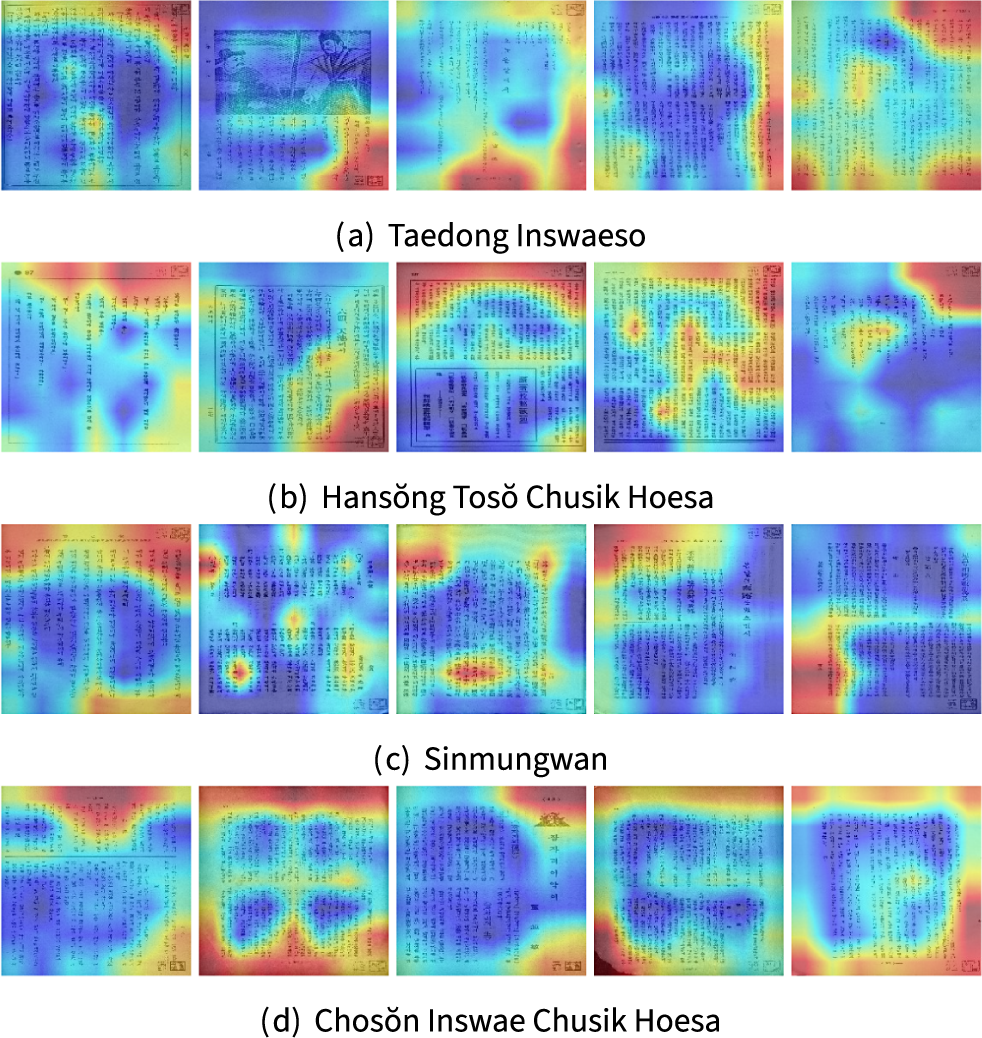
Figure 2 Long description
A multi-panel visualization consisting of 20 heatmaps arranged in four rows, each containing five document pages. The heatmaps use a color scale where red indicates high attention and blue indicates low attention.
* Row a is labeled Taedong Inswaeso. The five panels show red and yellow heat signatures primarily concentrated along the top, bottom, and right-side outer margins of the pages. The central text blocks remain blue.
* Row b is labeled Hansong Toso Chusik Hoesa. These panels exhibit high-intensity red zones at the extreme corners and along the vertical edges of the pages. In the third panel, a large red band covers the top margin.
* Row c is labeled Sinmungwan. The heatmaps show a similar pattern where the model attention avoids the central typographic features, instead highlighting the blank space at the page boundaries and the gutters between columns.
* Row d is labeled Choson Inswae Chusik Hoesa. The final five panels show red heat signatures forming a frame-like pattern around the perimeter of the documents, with the most intense focus on the bottom-left and top-right corners.
Across all 20 examples, the ConvNeXt model consistently ignores the printed characters and focuses on the structural white space and page edges.
Page cutout CNN/ViT approach
The baseline results suggested that modern CNN architectures could separate pages by printshop with high accuracy. We therefore investigated whether redirecting the model’s attention away from page-level layout features and toward the text block itself might yield different results.
To do so, we followed the approach of Seuret et al. (Reference Seuret, Limbach, Weichselbaumer, Maier and Christlein2019), who had shown that training on random crops could prevent networks from learning fixed positional cues. By removing the page frame from the training data, we hoped to disrupt the layout patterns that the baseline may have exploited and force the network to extract its evidence from the text block itself. Conceptually, this was a shift in our design, as we were no longer asking whether an entire page could be identified with a particular shop, but whether fragments of the printed surface carried enough information for such identification. Crops were taken at the page’s native scan resolution, so stroke terminals and serif weight remained at original scale rather than being lost to a downsampling step.
We tested several architectures using this method. The ConvNeXt Base model that had performed strongly on the baseline was retrained on cutouts, alongside other CNN variants and vision transformers. The Swin S3 Base-224 model (Liu et al. Reference Liu, Lin, Cao, Hu, Wei, Zhang, Lin and Guo2021) achieved the strongest results, reaching 98.2 percent validation accuracy under page-random evaluation. Its hierarchical attention design, which builds larger representations from smaller windows, appeared well suited to the fragmentary input.
Grad-CAM visualizations showed that the network’s focus had shifted away from margins (Figure 3). However, the patterns were difficult to interpret. The model often attended to seemingly random patches of white space and had not learned to focus on typographic features. What it had learned remained opaque. Unlike the baseline, where the focus on margins was at least legible as a finding about layout conventions, the cutout results offered little interpretive value.
Grad-CAM visualizations for the Swin cutout model trained with page-random splits. Attention has shifted away from margins but often settles on blemishes and gaps rather than typographic features.
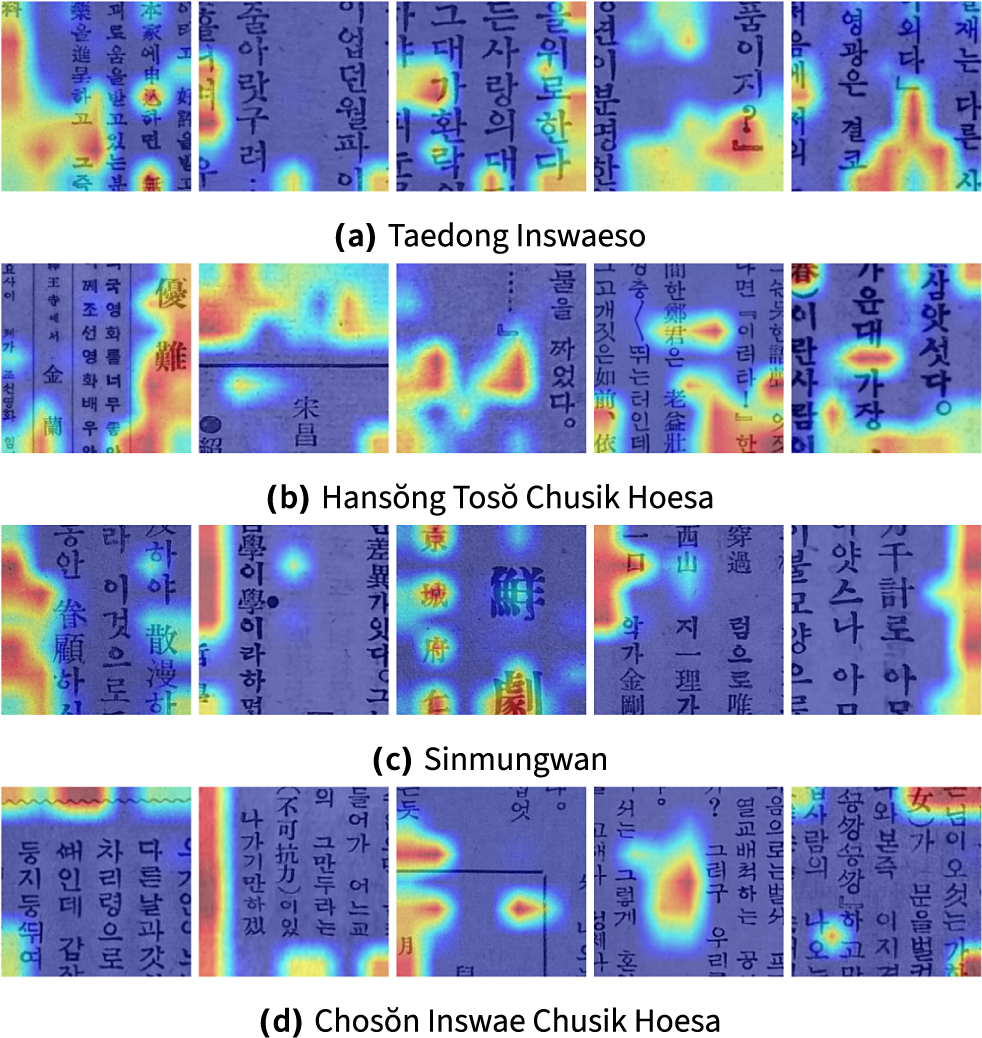
Figure 3 Long description
A multi-panel visualization consisting of 20 square heatmaps arranged in a 4 by 5 grid. Each row represents a different dataset labeled a through d.
* Row a, Taedong Inswaeso. Five panels showing vertical Korean text. Heatmaps indicate high attention (red and yellow) concentrated on paper blemishes, margins, and gaps between text blocks rather than the characters themselves.
* Row b, Hansong Toso Chusik Hoesa. Five panels featuring a mix of Hanja and Hangul characters. The heatmaps show scattered attention points, often highlighting the edges of the paper or blank spaces between columns.
* Row c, Sinmungwan. Five panels where the heatmaps are predominantly blue (low attention) over the main text bodies, with red and yellow hotspots appearing on the far right or left edges of the document fragments.
* Row d, Choson Inswae Chusik Hoesa. Five panels where the attention is highly localized on specific non-typographic artifacts, such as ink bleeds or paper texture variations, while the actual printed text remains in the blue low-attention zones.
Across all panels, the G r a d - C A M visualizations demonstrate that the Swin cutout model focuses on background noise and structural gaps instead of the semantic typographic features of the historical documents.
Reassessing the evaluation protocol
The consistently high accuracy of both approaches warranted scrutiny. A 98.1 percent baseline followed by a 98.2 percent result suggested either that printshop classification was a trivially easy task or that something in our evaluation inflated performance. Given the material constraints documented in the historical literature, which describe printshops drawing from the same limited pool of type foundries, near-perfect classification seemed implausible. We examined the evaluation protocol more closely.
Both experiments had used page-random splits, partitioning individual pages into training and test sets regardless of which book they belonged to. This design allows pages from the same book to appear on both sides of the split. Books exhibit internal consistency in paper quality, scanning conditions, binding marks, and layout conventions. A model trained on some pages from a book can recognize other pages from the same book through these shared characteristics, independent of any typographic learning. When we examined our original splits, we found that 100 percent of test pages came from books that also contributed pages to the training set. The high accuracy figures reflected this contamination rather than genuine generalization to unseen material.
To obtain valid generalization metrics, we retrained both models using held-out-book splits. We implemented five-fold cross-validation with GroupKFold, ensuring that no book appears in both training and test sets within any fold (Pedregosa et al. Reference Pedregosa, Varoquaux, Gramfort, Michel, Thirion, Grisel, Blondel, Prettenhofer, Weiss, Dubourg, Vanderplas, Passos, Cournapeau, Brucher, Perrot and Duchesnay2011). Both models were trained from scratch under this stricter protocol, using the same hyperparameters and early stopping criteria as the original experiments. Table 2 summarizes the results.
CNN model performance under page-random and held-out-book evaluation
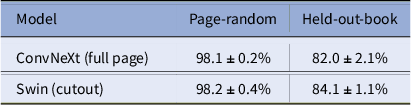
Table 2 Long description
The table consists of three columns: Model, Page-random, and Held-out-book.
* The first data row shows the ConvNeXt (full page) model with a Page-random score of 98.1 plus or minus 0.2 percent and a Held-out-book score of 82.0 plus or minus 2.1 percent.
* The second data row shows the Swin (cutout) model with a Page-random score of 98.2 plus or minus 0.4 percent and a Held-out-book score of 84.1 plus or minus 1.1 percent.
A footer note specifies that Held-out-book results show the mean plus or minus S D across five folds.
Note: Held-out-book results show mean
$\pm $
 SD across five folds.
The results changed substantially. The ConvNeXt baseline dropped from 98.1 percent to 82.0 percent (mean across folds). The Swin cutout model dropped from 98.2 percent to 84.1 percent. The two approaches performed equivalently once same-book leakage was eliminated. The apparent advantage of the cutout method disappeared entirely.
Grad-CAM analysis showed that the retrained models produced different attention patterns. The full-page ConvNeXt model displayed vertical stripe-like activations aligned with page structure (Figure 4). These patterns were consistent across samples from the same printshop and differed between printshops. The patterns appear to reflect macro layout features, such as column width and text density. While we cannot entirely exclude scanning or paper artifacts, the cutout model provides indirect evidence against this interpretation. If such artifacts were present, the cutout model would encounter them too, yet it shows no similar attention patterns. This suggests that the full-page model exploits page-level layout structure that requires full-page context to detect.
Grad-CAM visualizations for the ConvNeXt full-page model trained with held-out-book splits. The model shows consistent vertical stripe patterns corresponding to column structure and layout conventions.
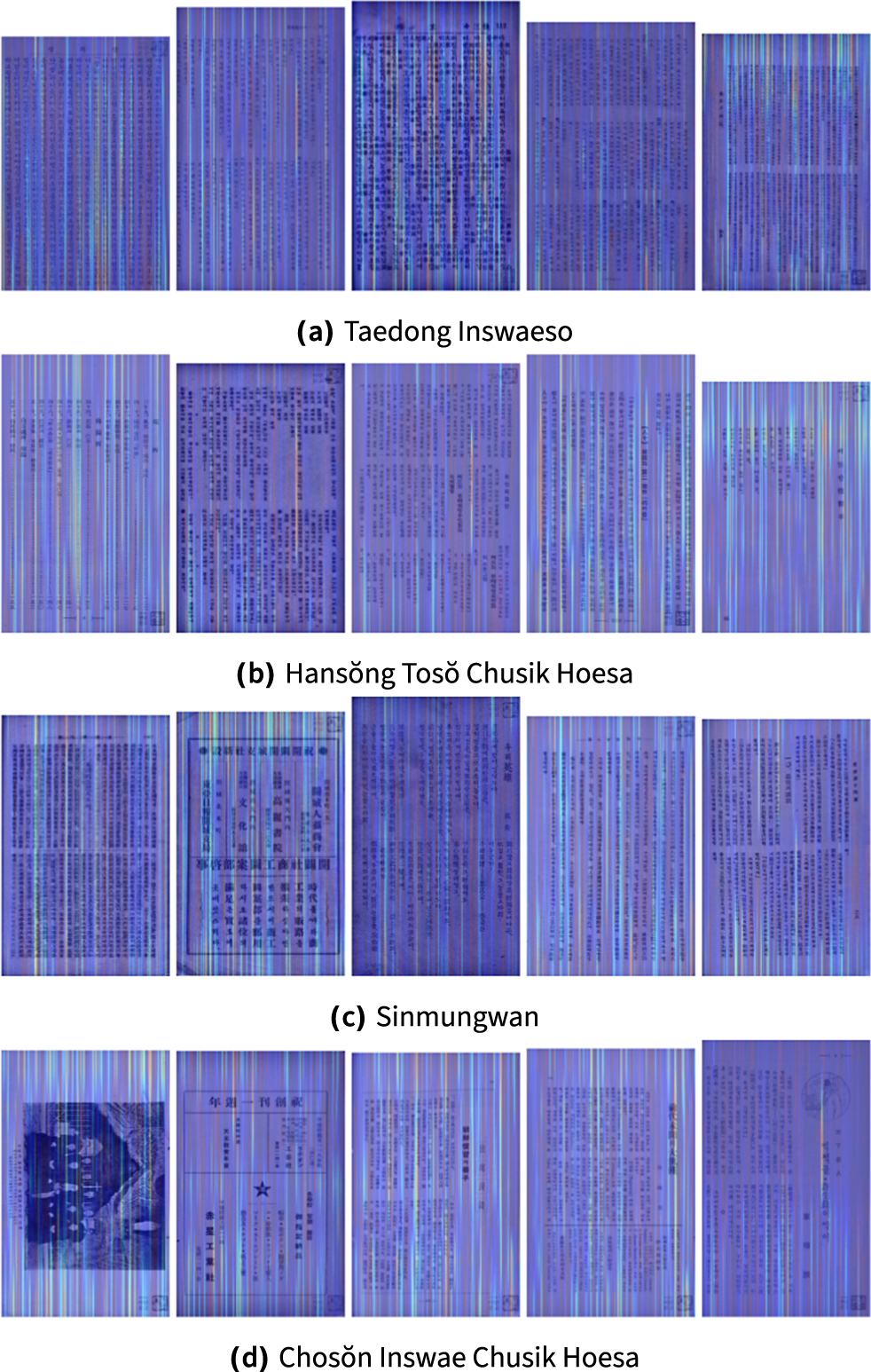
Figure 4 Long description
The visualization consists of four horizontal rows, each containing five document page images. Every page is overlaid with a blue-tinted heat map featuring bright vertical stripes of yellow, cyan, and red.
* Row a, labeled Taedong Inswaeso, contains five pages where the vertical heat map stripes align with the columns of text, showing high activation along the vertical axis of the printed characters.
* Row b, labeled Hansong Toso Chusik Hoesa, displays five pages with similar vertical activation patterns. The stripes are more densely packed in the third and fourth pages compared to the first two.
* Row c, labeled Sinmungwan, shows five pages where the heat map highlights vertical structures. The second page in this row features a distinct border and larger text blocks, yet the model maintains the vertical stripe activation.
* Row d, labeled Choson Inswae Chusik Hoesa, includes five pages. The first page contains a dark photographic illustration, but the heat map still applies vertical stripes across the entire page area. The second page features a star symbol and tabular data, with activations following the vertical grid lines.
Across all twenty panels, the ConvNeXt model consistently identifies vertical layout features regardless of the specific text content or presence of illustrations.
The cutout Swin model showed a different pattern (Figure 5). Attention varied widely across samples of the same class, settling on seemingly arbitrary patches of white space, random character groupings, or horizontal rules. No stable pattern emerged that could be linked to typographic practice. The 224
$\times $
 224 pixel crops may lack sufficient context for the model to learn meaningful typographic features. Alternatively, the model may have learned to exploit subtle correlations in paper texture or scanning artifacts that do not generalize reliably. The cutout strategy had removed margins from consideration but did not produce interpretable evidence about typography.
Grad-CAM visualizations for the Swin cutout model trained with held-out-book splits. Attention patterns are inconsistent across samples, with no clear correspondence to typographic features.
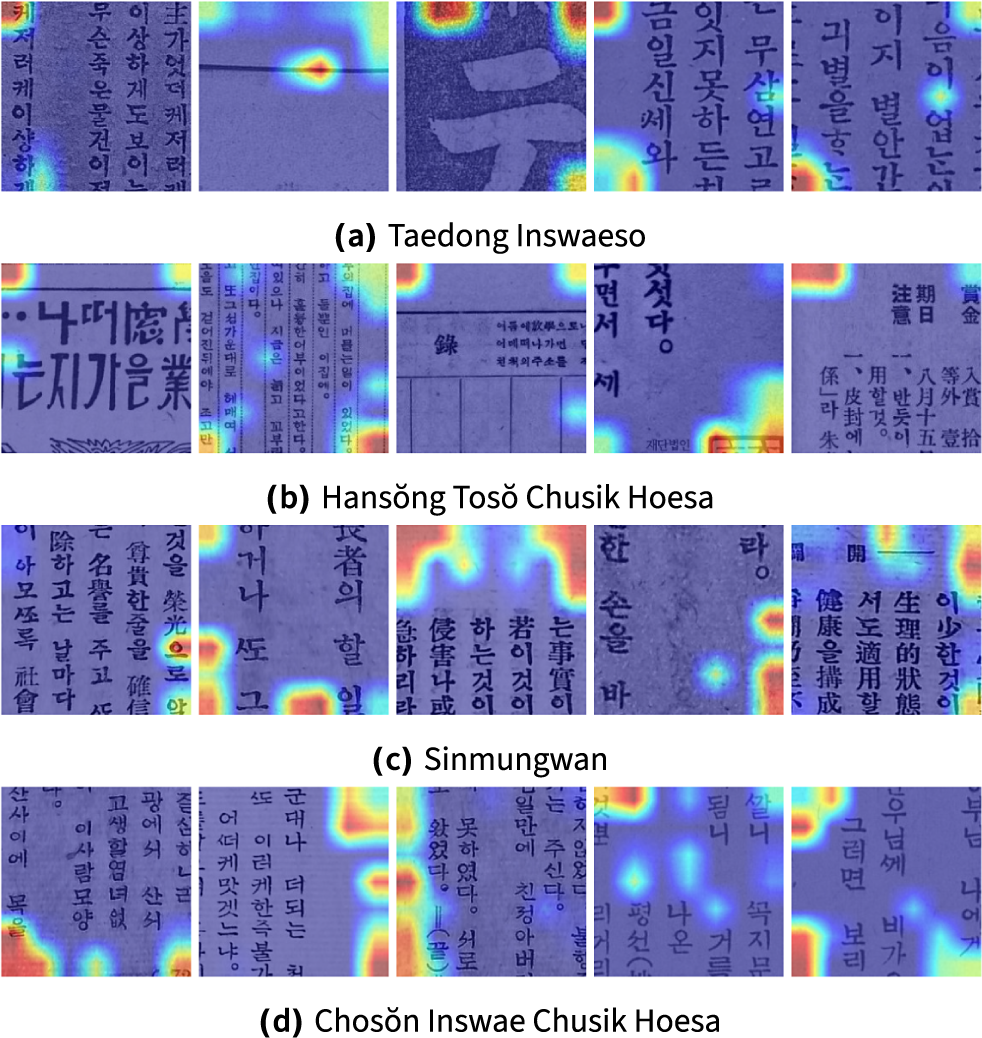
Figure 5 Long description
The grid consists of 20 square panels arranged in four rows of five. Each panel shows a blue-tinted image of historical Korean typography with vibrant heat map overlays ranging from blue (low attention) to red (high attention).
* Row a, Taedong Inswaeso. The heat maps show isolated, small circular hotspots. In the first panel, a red spot is at the bottom left. In the second, a single red spot is centered on a horizontal line. The third and fourth panels show hotspots near the bottom right and top right respectively.
* Row b, Hansong Toso Chusik Hoesa. The attention patterns are more dispersed. The first panel has a large red area on the left edge. The second panel shows vertical bands of yellow and green on the right. The fourth and fifth panels show multiple scattered hotspots across the text.
* Row c, Sinmungwan. These panels exhibit larger, more irregular heat map shapes. The third panel shows two large red peaks at the top. The fifth panel shows a vertical red band along the right edge.
* Row d, Choson Inswae Chusik Hoesa. The heat maps are frequently located at the margins. The first, second, and fifth panels show significant red and yellow activity along the left and right vertical borders of the frame, often cutting off at the edge of the panel.
Across all rows, the red high-attention zones do not consistently align with specific characters or words, appearing instead as arbitrary clusters or edge-focused gradients.
The full-page approach, despite its reduced accuracy under proper evaluation, learned features that correspond to historical printing practices. These layout-level features, while not the letterform-level signatures we initially sought, nonetheless carry historical information about how each printshop organized its pages. The interpretability of the full-page model stood in contrast to the opacity of the cutout approach. Neither method, however, provided the localized attention to specific typographic features that our research questions required. This limitation motivated our turn to MIL.
Marthot-Santaniello et al. (Reference Marthot-Santaniello, Vu, Serbaeva, Beurton-Aimar, Coustaty and Fornés2023) examine Greek papyri. Kordon et al. (Reference Kordon, Weichselbaumer, Herz, Mossman, Potten, Seuret, Mayr and Christlein2023) classify incunable glyphs. Both studies use character-based comparison. Print and Probability applies probabilistic glyph modeling, damaged type-imprint matching, and running-title clustering to related attribution problems (Goyal et al. Reference Goyal, Dyer, Warren, G’Sell, Berg-Kirkpatrick, Jurafsky, Chai, Schluter and Tetreault2020; Vogler et al. Reference Vogler, Goyal, Reddy, Pertseva, Lemley, Warren, G’Sell and Berg-Kirkpatrick2023, Reference Vogler, Goyal, Lemley, Schuldt, Warren, G’Sell, Berg-Kirkpatrick, Barney Smith, Liwicki and Peng2024). SIFT-style descriptors remain useful because they match stable local visual structures without requiring an end-to-end neural classifier (Lowe Reference Lowe2004). Such methods would be a plausible route for a different version of this study, especially one organized around repeated glyphs or reused printing surfaces. Our question is broader. The evidence we needed to preserve includes details inside characters, character spacing, separators, column structure, and page architecture. A glyph-cutout pipeline would make repeated character comparison cleaner. It would also decide in advance that the relevant evidence lies inside glyph boundaries. Patch-based MIL avoids that prior restriction. It lets character fragments, spacing effects, and non-character page elements compete as candidate evidence. The resulting discriminative regions remain available for visual inspection. In practice, spacing did not emerge as a dominant interpretable cluster in the present analysis. Cluster 12 nevertheless shows that the model can register page-architectural evidence when it is discriminative.
Multiple instance learning approach
The experiments described above clarified that the problem was not simply model resolution. The cutout model showed that local fragments of the printed surface could carry class signal, but it treated each crop as an isolated image and then relied on post-hoc Grad-CAM maps to explain that prediction. Those maps were broad and unstable, which made them difficult to extract, cluster, or compare with typographic scholarship. A larger crop or higher-resolution transformer would test a stronger baseline, but it would still leave the evidentiary unit implicit unless the model were designed to expose discrete regions for comparison. MIL changes the formulation by keeping the page as the labeled object while learning to rank patches within it according to their contribution to the printshop label. This makes the unit of interpretation explicit, allowing high-attention patches to be extracted, clustered, and compared with typographic evidence.
MIL provided this structure. Originally introduced by Dietterich, Lathrop, and Lozano-Pérez (Reference Dietterich, Lathrop and Lozano-Pérez1997) and Maron and Lozano-Pérez (Reference Maron, Lozano-Pérez, Jordan, Kearns and Solla1997), MIL eventually found wide application in pathology and medical imaging. In that field, simply classifying whether a tissue sample contains cancerous cells is not sufficient. Physicians need to know where those cells are located. A model that outputs only a classification, without indicating which regions of an image informed that classification, offers limited clinical value. For an overview of MIL variants and their broader applications, see Waqas et al. (Reference Waqas, Ahmed, Tahir, Wu and Qureshi2024). Our situation was similar. Classifying pages by printshop was not sufficient for our purposes. We needed to know which visual features on the page led to that classification. MIL offered this capacity for localization, assigning importance scores to specific regions of an image and showing which parts the model considers informative.
We adapted an attention-based MIL model developed by Cai et al. (Reference Cai, Huang, Zhang, Lu and Zhang2025) for our study of colonial printshops. Each page is divided into small square patches, and these patches together form what has been termed a “bag of instances.” The bag receives the label of the printshop that produced it, but the model is not told which patches within the page are responsible for that label. During training, the model learns to weigh each patch according to how informative it is for distinguishing printshops. This design helps the model focus on inked regions containing letters and other marks of the printing process, while margins and white space naturally receive lower attention.Footnote 3
MIL learns from this uncertainty by iteratively adjusting how much attention it gives to each patch. Through training, it identifies which patches consistently contribute to correct classifications and which can be ignored. As a result, the model produces an attention map that highlights the regions it found most characteristic for each printshop. These maps show where on a page the distinctive features of a press appear, which allows for comparison with what human scholars might notice when examining the same material.
We used an attribute-driven variant of MIL that includes two additional constraints to improve interpretability. First, a spatial consistency constraint smooths attention patterns so that neighboring patches with similar texture or layout receive similar importance scores. This prevents scattered or noisy attention and aligns the model’s focus with visually coherent regions such as text blocks or headline bands. Second, a ranking constraint encourages the model to assign higher importance to genuinely distinctive features of a specific printshop rather than to common elements found across all pages. Patches containing visible ink are thus prioritized over empty regions.Footnote 4
Together, these mechanisms allow the model to classify pages and explain its classifications in terms of the visual evidence present on the page. Scholars can therefore check whether the model’s distinctions correspond to features they recognize as typographically significant.
All pages were resized to 896
$\times $
 896 pixels. We trained the model for 30 epochs with a batch size of 128, using the Adam optimizer (learning rate
$1{\times }10^{-4}$
 ) and a scheduler that reduced the rate after 10 epochs without improvement. Two rounds of five-fold cross-validation were conducted, one with 16
$\times $
 16-pixel patches and another with 8
$\times $
 8-pixel patches, keeping all other parameters constant.
Table 3 presents the page-random test performance metrics for both MIL configurations across five-fold cross-validation. These results are retained as a diagnostic comparison rather than as the main generalization claim. The 16
$\times $
 16 pixel configuration outperforms the 8
$\times $
 8 configuration across all metrics, achieving 93.8 percent accuracy compared to 91.2 percent. The low standard deviations indicate stable performance across page-random folds, with the 16
$\times $
 16 model showing particularly consistent results (
$\pm $
 0.4% accuracy).
MIL test performance (five-fold CV, page-random splits)
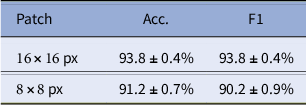
Table 3 Long description
The expression consists of the numeral 8 followed by a multiplication symbol represented as a small cross or times sign, followed by another numeral 8.
Note: Mean
$\pm $
 SD across five folds, macro-averaged.
Tables 4 and 5 present detailed per-class performance metrics for both patch configurations. For 16
$\times $
 16 pixels, performance is consistently high across all printshops, with F1-scores ranging from 92.3 percent to 95.9 percent. Chosŏn Inswae achieves the highest F1-score (95.9%), while Sinmungwan shows the lowest recall (89.5%).
Per-class metrics,
$16\times 16$
 px (fold 1)
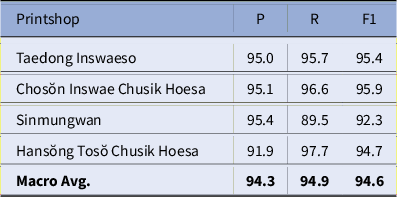
Table 4 Long description
The table consists of four columns: Printshop, P (Precision), R (Recall), and F 1. All numerical values are percentages.
* Taedong Inswaeso: P 95.0, R 95.7, F 1 95.4.
* Choso n Inswae Chusik Hoesa: P 95.1, R 96.6, F 1 95.9.
* Sinmungwan: P 95.4, R 89.5, F 1 92.3.
* Hanso ng Toso Chusik Hoesa: P 91.9, R 97.7, F 1 94.7.
* Macro Avg.: P 94.3, R 94.9, F 1 94.6.
Note: P: Precision, R: Recall (all %).
Per-class metrics,
$8\times 8$
 px (fold 0)
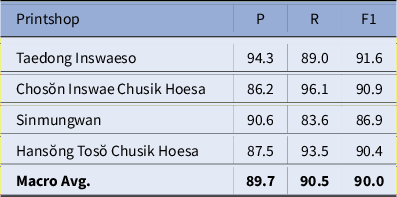
Table 5 Long description
The table consists of four columns: Printshop, P, R, and F 1. P stands for Precision and R stands for Recall, both measured in percentages.
* Row 1: Taedong Inswaeso; P 94.3; R 89.0; F 1 91.6.
* Row 2: Choso n Inswae Chusik Hoesa; P 86.2; R 96.1; F 1 90.9.
* Row 3: Sinmungwan; P 90.6; R 83.6; F 1 86.9.
* Row 4: Hanso ng Toso Chusik Hoesa; P 87.5; R 93.5; F 1 90.4.
* Row 5: Macro Avg.; P 89.7; R 90.5; F 1 90.0.
Note: P: Precision, R: Recall (all %).
The 8
$\times $
 8 pixel results show greater variation, with F1-scores ranging from 86.9 percent to 91.6 percent, and the relative performance rankings shift at this smaller scale. Taedong Inswaeso maintains the highest performance (91.6%), while Sinmungwan drops to the lowest (86.9%). This suggests that smaller patch sizes may struggle to capture Sinmungwan’s typographic characteristics, which require larger contextual windows for reliable identification.
These page-random tables document the model’s behavior under the initial split protocol. They are not used as the main generalization evidence.
Both MIL configurations were evaluated under page-random and held-out-book splits. Under page-random splits, the 16
$\times $
 16 model achieves 93.8 percent and the 8
$\times $
 8 model 91.2 percent. Under held-out-book splits, the 16
$\times $
 16 configuration achieves 84.5
$\pm $
 2.2 percent and the 8
$\times $
 8 configuration 83.6
$\pm $
 3.2 percent, confirming that page-random splits include same-book leakage, though the drop is substantially smaller than for the previous approaches. The 16
$\times $
 16 held-out-book result is slightly higher than the CNN point estimates, and the 8
$\times $
 8 result remains comparable while providing more localized evidence for interpretation. More importantly, the MIL approach offers interpretable results that the CNN methods could not provide. The ConvNeXt and Swin models lost 16 and 14 percentage points, respectively, when moving to held-out-book splits, while MIL loses 8–9 points. This reduced sensitivity to leakage is consistent with the architectural difference. The data leakage that inflated ConvNeXt and Swin accuracy operated through book-specific features, including layout structure, margin conventions, and other characteristics that remain consistent within a single volume. At the patch scales used here (8
$\times $
 8 and 16
$\times $
 16 pixels), these features are largely inaccessible. A patch capturing a single stroke terminal or serif ending cannot encode page layout or binding characteristics. The interpretability analysis in the following section uses the held-out-book 8
$\times $
 8 model and provides further evidence that the model has learned genuine typographic features rather than artifacts. The enriched clusters correspond to sub-character forms that align with features documented through manual scholarship. If the model were primarily exploiting book-specific artifacts, the attention maps would not converge on typographically meaningful regions in this way.
Findings and analysis
The preceding section documented the three modeling stages and their immediate results. We now draw these together to assess what the Multiple Instance Learning attention mechanism reveals about the typographic structure of the corpus.
Performance and interpretability
Table 6 summarizes the three approaches tested in this study. Under page-random splits, both CNN approaches achieved over 98 percent validation accuracy. When evaluated with held-out-book splits, these figures dropped to 82 percent and 84 percent, respectively, revealing the extent of data leakage in the original evaluation. The MIL model achieved 84.5
$\pm $
 2.2 percent at 16
$\times $
 16 pixel resolution under the held-out-book protocol, at least matching the CNN baselines while providing the localized, interpretable attention we required.
Comparative performance across approaches
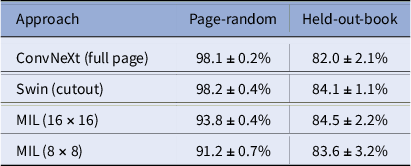
Table 6 Long description
The table consists of three columns: Approach, Page-random, and Held-out-book.
* ConvNeXt (full page): Page-random 98.1 plus or minus 0.2 percent; Held-out-book 82.0 plus or minus 2.1 percent.
* Swin (cutout): Page-random 98.2 plus or minus 0.4 percent; Held-out-book 84.1 plus or minus 1.1 percent.
* M I L (16 times 16): Page-random 93.8 plus or minus 0.4 percent; Held-out-book 84.5 plus or minus 2.2 percent.
* M I L (8 times 8): Page-random 91.2 plus or minus 0.7 percent; Held-out-book 83.6 plus or minus 3.2 percent.
A note below the table explains that Page-random splits assign pages randomly regardless of book origin, while Held-out-book splits hold all pages from each tested book out of training using five-fold C V.
Note: Page-random splits assign pages randomly regardless of book origin. Held-out-book splits hold all pages from each tested book out of training, five-fold CV.
The next question is historical. Does this interpretability reveal meaningful patterns in colonial Korean typography, or has the model learned different spurious correlations than the CNN approaches? To answer this, we extracted all patches receiving attention scores in the top 0.5 percent across the corpus, embedded them using the trained network’s internal representations, and clustered the resulting vectors using HDBSCAN after UMAP dimensionality reduction. This procedure yielded 921,280 high-attention patches at the 16
$\times $
 16 scale and 3,627,572 at 8
$\times $
 8. The clusters group patches by visual similarity as perceived by the model, making it possible to examine what kinds of forms the network treats as equivalent.
Although the 16
$\times $
 16 configuration achieves higher classification accuracy, its patches span regions large enough to contain multiple sub-character components simultaneously. This makes it difficult to attribute the model’s attention to any single typographic feature. The 8
$\times $
 8 patches, by contrast, isolate individual elements such as stroke terminals, serif treatments, and the curves of specific letter components. For the interpretability analysis that follows, this granularity matters more than raw classification performance. The remaining analysis therefore uses the 8
$\times $
 8 model trained with held-out-book splits exclusively.
A shared typographic space
Figure 6 presents the distribution of high-attention patches in the reduced embedding space, with Figure 7 providing the same embedding annotated with cluster numbers for reference. The scatter plot reveals that the model attends to recurring sub-character components rather than whole letterforms. Different regions of the space correspond to different typographic elements. Clusters 3 and 4 in the upper left and right portions capture vertical strokes forming vowels like i (ㅣ) and a (ㅏ). The central left clusters 7, 24, and 26 group angular consonant strokes from characters like tigŭt (ㄷ), riŭl (ㄹ), and niŭn (ㄴ). The circular forms of iŭng (ㅇ) appear in clusters 8, 10, and 15, with cluster 18 capturing these forms to a lesser extent, distributed across both the lower left and lower right sides as different regions capture different portions of the same character shape. Cluster 11 at center bottom groups horizontal strokes, possibly distinguished by thickness. Cluster 12, adjacent to it at the bottom, captures vertical lines that are predominantly page separators of varying thickness and style, with occasional character strokes mixed in. Cluster 19 in the upper left isolates strong serif endings. Cluster 17 occupies a large area in the center and captures double-line formations from characters like ㄹ, ㄷ, and ㅈ in both angled and non-angled orientations. Its size suggests that HDBSCAN may not have separated what are likely multiple distinct clusters with the current parameters. These clusters emerged without any instruction about Hangul structure, yet the model learned to decompose characters into sub-components that typographers would recognize as analytically meaningful. Vertical strokes, angular consonants, circular forms, serif endings, and horizontal elements each occupy distinct regions of the embedding space. This decomposition also reveals what the model found most useful for classification. Despite the mixed Hangul-hanja composition of many pages, the predominant clusters capture Hangul forms. Hanja characters appear in the attention patches but not as dominant patterns, likely because individual hanja recur less frequently than common Hangul particles and suffixes.
UMAP representation of high-attention patches at 8
$\times $
 8 resolution, with representative patch samples overlaid on cluster regions. The embedding space captures sub-character components: vowel strokes, consonant angles, and circular forms.
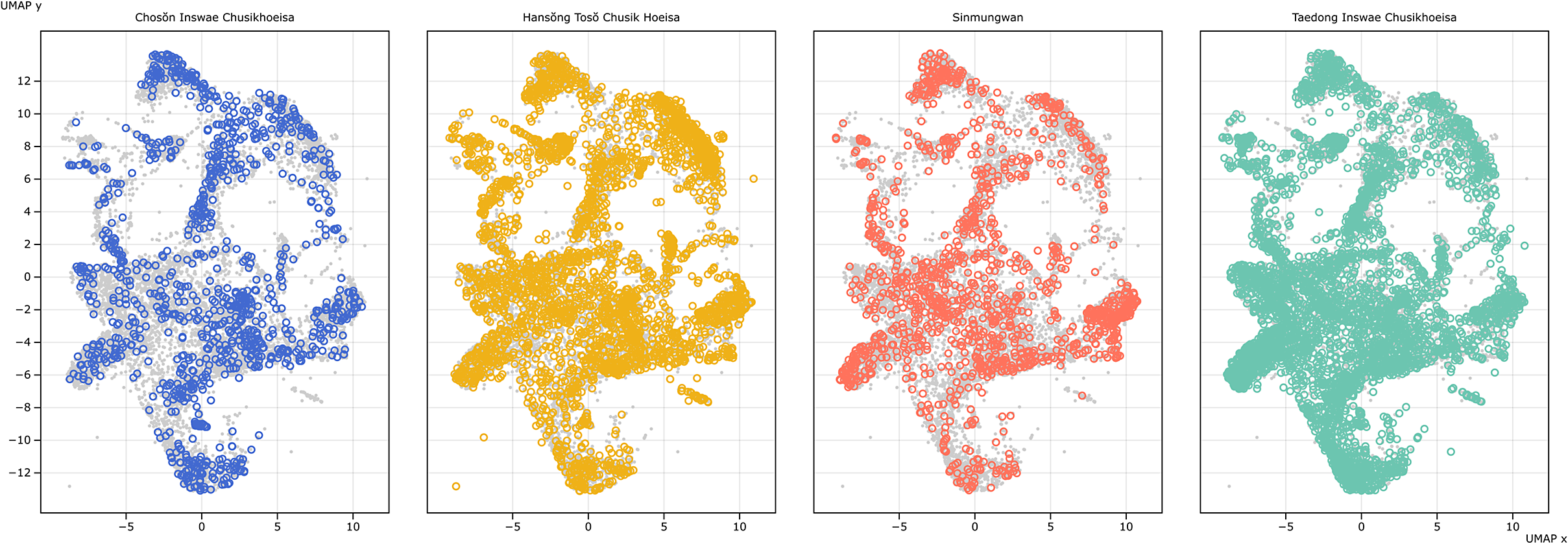
Figure 6 Long description
A four-panel attribute space diagram. Each panel shares a common coordinate system with U M A P x on the horizontal axis ranging from minus 5 to 10 and U M A P y on the vertical axis ranging from minus 12 to 12. Small grey background dots represent the global distribution of 8 times 8 resolution patches, while colored circles highlight specific subsets.
* Panel 1 (Top-Left) is titled Choson Inswae Chusikhoeisa. It features blue circles concentrated in a vertical band near x equals 0 and a dense cluster in the bottom-left quadrant.
* Panel 2 (Top-Center-Right) is titled Hansong Toso Chusik Hoeisa. It features yellow circles densely populated across the upper-center and right-center regions of the plot.
* Panel 3 (Top-Center-Left) is titled Sinmungwan. It features red circles primarily distributed in the top-left and bottom-center regions, with a distinct horizontal band across the middle.
* Panel 4 (Top-Right) is titled Taedong Inswae Chusikhoeisa. It features teal circles forming a large, dense mass in the center and bottom-right quadrants.
The clusters represent sub-character components such as vowel strokes and consonant angles, showing how different printing sources occupy distinct regions of the embedding space.
UMAP representation of high-attention patches at 8
$\times $
 8 resolution. The embedding space captures sub-character components: vowel strokes, consonant angles, and circular forms.
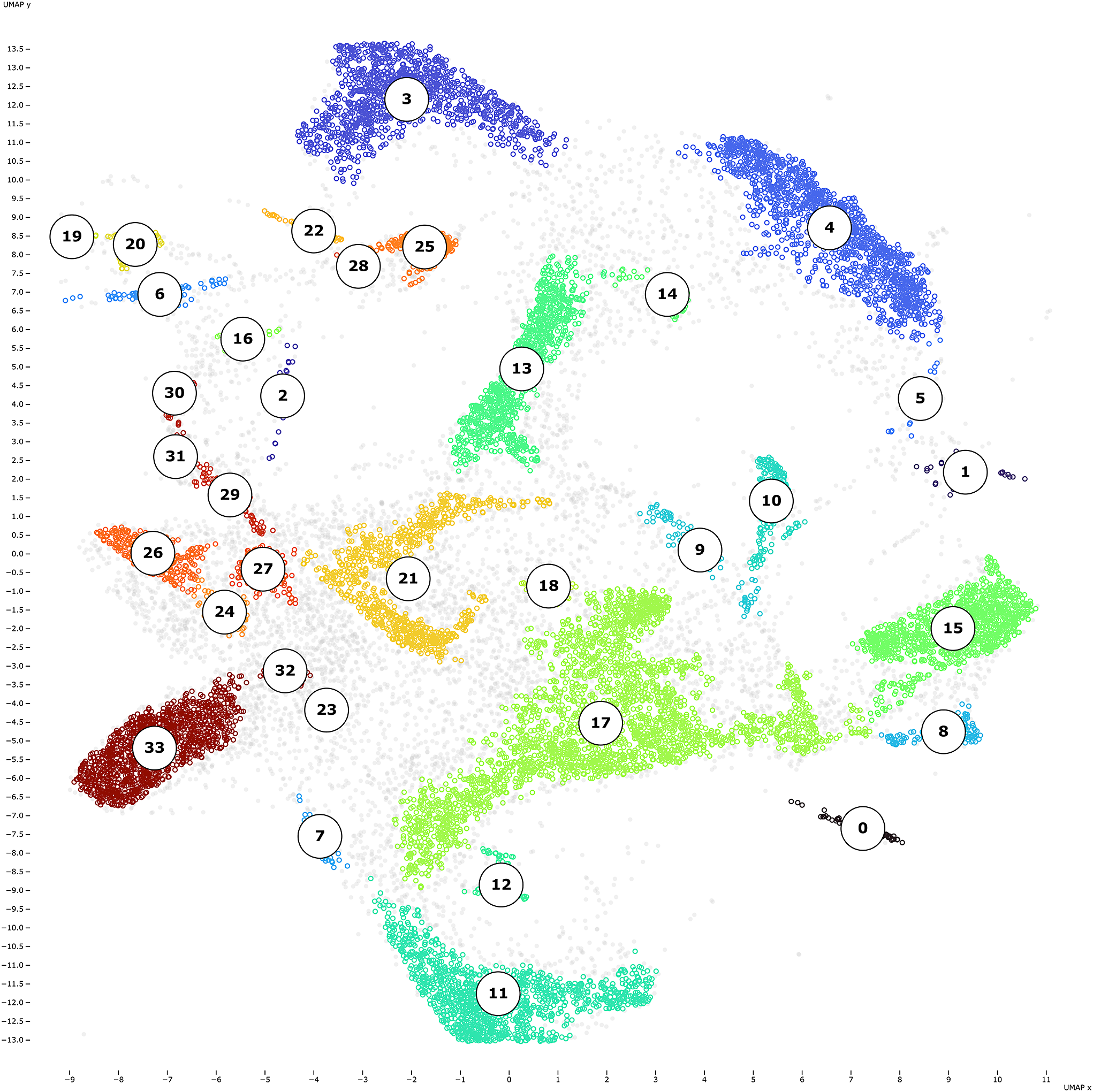
Figure 7 Long description
The scatter plot is organized on a coordinate system with U M A P x on the horizontal axis ranging from negative 9 to 11 and U M A P y on the vertical axis ranging from negative 13.0 to 13.5.
* At the top, blue clusters are labeled 3 and 4.
* The upper-left quadrant contains clusters 19, 20, 6, 22, 28, and 25 in shades of yellow, orange, and light blue.
* The center-left area features a vertical arrangement of clusters 16, 2, 30, 31, and 29.
* The central region is dominated by a large green cluster labeled 13 and 14, and a yellow cluster labeled 21 and 18.
* The right side contains cyan and light green clusters labeled 10, 9, 5, 1, 15, and 8.
* The bottom-left features a dense dark red cluster labeled 33, with nearby clusters 26, 24, 27, 32, 23, and 7.
* The bottom-center contains teal clusters labeled 12 and 11.
* A small black cluster labeled 0 is located in the bottom-right.
Faint gray points fill the background between the distinct colored clusters, indicating the overall density of the embedding space.
The immediate impression from the scatter plot is one of continuity, as the four printshops appear to occupy the same territory. There is no clean separation into press-specific regions. Patches from Taedong Inswaeso, Hansŏng Tosŏ, Sinmungwan, and Chosŏn Inswae intermingle throughout the space. This result aligns with the historical conditions outlined in the introduction, as these were not presses working with radically different typographic resources. They operated within a market offering limited diversity in type design and availability. The embedding space reflects this constrained environment in so far as it demonstrates that differentiation, if present, must operate at the level of small details rather than significant font diversity.
The scatter plot alone does not explain the model’s performance. Features extracted from each printshop occupy the same regions of the embedding space, suggesting a shared typographic vocabulary. Still, the 8
$\times $
 8 model remains accurate under held-out-book evaluation. It reaches 83.6 percent accuracy, with the fold variation reported in Table 6. The question is not whether differentiation exists, but where it hides within this apparently shared space. Plotting the density of each printshop’s patches separately begins to answer that question.
Density patterns across printshops
The scatter plot, however, tells only part of the story. When we plot the density of patches from each printshop separately rather than overlaying them, a more differentiated picture emerges (Figure 8). The presses occupy the same overall territory, but they concentrate in different regions of it. Taedong Inswaeso shows its highest density in the upper-left quadrant. Hansŏng Tosŏ concentrates in the center-right. Sinmungwan and Chosŏn Inswae distribute differently still. What appeared as uniform overlap turns out to contain structured variation.
Density distribution of high-attention patches, faceted by printshop. The presses occupy overlapping territory but with distinct concentrations. Contour lines reveal where each press contributes disproportionately to the shared embedding space.
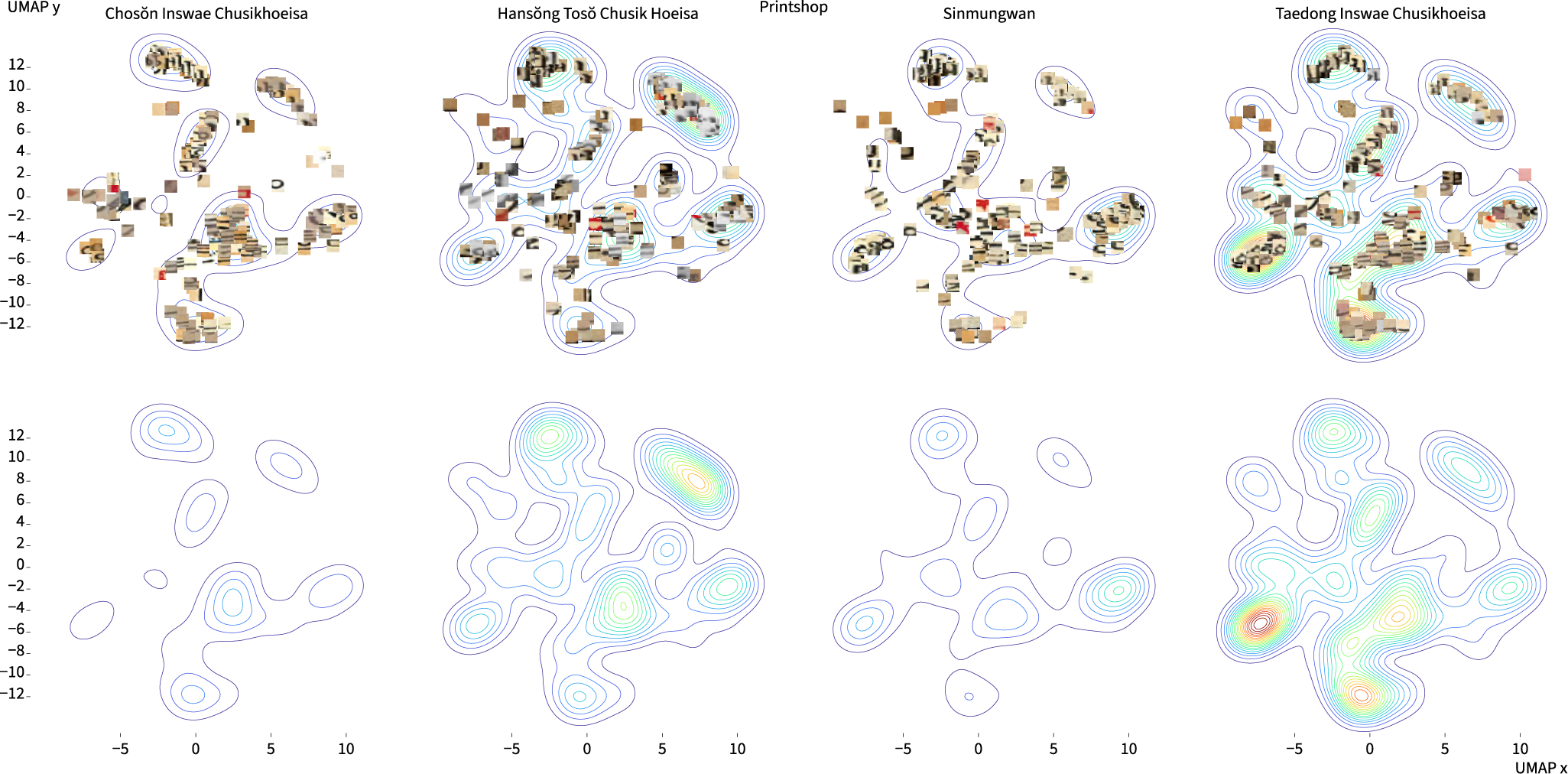
Figure 8 Long description
The visualization consists of two rows and four columns. The top row displays image patches overlaid on contour lines, while the bottom row shows only the contour density maps for the same data. The X-axis is labeled U M A P x ranging from negative 5 to 10, and the Y-axis is labeled U M A P y ranging from negative 12 to 12.
* Column 1, Choson Inswae Chusikhoeisa: Shows a primary concentration of patches and dense contours in the lower-center region around Y equals negative 4 and a secondary peak at the top-left near Y equals 12.
* Column 2, Hansong Toso Chusik Hoeisa: Displays a more dispersed distribution with a significant density peak in the upper-right quadrant around X equals 7, Y equals 8, and another in the lower-center.
* Column 3, Sinmungwan: Features a sparse distribution with a primary density cluster on the right side at Y equals negative 2 and a smaller peak at the top-left.
* Column 4, Taedong Inswae Chusikhoeisa: Exhibits the highest density of all panels, with intense heat map peaks in the bottom-left at X equals negative 7, Y equals negative 4, and the bottom-center at Y equals negative 10.
The contour lines transition from blue for low density to red for high density, illustrating that while the printshops share the same embedding space, their specific stylistic or technical concentrations are distinct.
The model distinguishes printshops not by finding features unique to each press, but by learning these density patterns within a shared space. MIL classifies each page by extracting multiple patches and aggregating their features. Pages from different printshops yield patches that concentrate in different regions of the embedding space, which explains why the scatter plot shows intermingling rather than separation. The differences are too minute for clean spatial clustering. Differentiation operates through relative frequency rather than exclusive presence. A given cluster might contain patches from all four printshops, but one press contributes disproportionately to it. The patch-based approach also offers something that full-page analysis cannot. By isolating small regions, it allows us to visually inspect which specific character components drive these density patterns, making it possible to compare the model’s diagnostic features directly with the observations of prior scholarship.
This pattern of differentiation within shared typographic territory is consistent with the historical conditions that De Fremery and Ryu have documented. Both scholars observed that colonial Korean printshops worked within a constrained market offering limited diversity in type design and availability, and that distinguishing features tended to operate at the level of individual letterforms rather than wholesale differences in font. The density distributions rendered visible by MIL are compatible with that account. They show that the model recovers shop-level signatures from subtle, recurring variations in sub-character forms rather than from categorically distinct typographic resources. Whether the density patterns correspond to the specific features these scholars identified through examination is the question we turn to next.
Statistical validation
To test whether the observed clusters and density patterns reflect genuine printshop-specific patterns, we conducted an enrichment analysis. Each high-attention patch inherits the printshop label of its source page. We constructed contingency tables of cluster membership by printshop, computed standardized residuals following Haberman’s adjustment, and tested significance through a permutation procedure that shuffles printshop labels while preserving cluster structure. After Benjamini–Hochberg correction for multiple comparisons, numerous cluster-printshop associations remain significant at
$q < 0.01$
 . Table 7 lists the significantly enriched clusters for each printshop.
Significantly enriched clusters per printshop (8
$\times $
 8 patches,
$q < 0.01$
 )
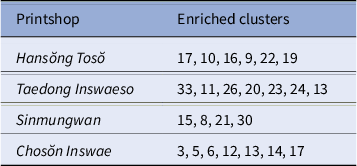
Table 7 Long description
The table consists of two columns: Printshop and Enriched clusters.
Row 1: Hanso n g Toso n g lists clusters 17, 10, 16, 9, 22, and 19.
Row 2: Taedong Inswaeso lists clusters 33, 11, 26, 20, 23, 24, and 13.
Row 3: Sinmungwan lists clusters 15, 8, 21, and 30.
Row 4: Choso n g Inswae lists clusters 3, 5, 6, 12, 13, 14, and 17.
The enrichment patterns show reciprocal structure. Clusters where one printshop is overrepresented tend to show corresponding depletion in others. Cluster 33, dominated by Taedong, is significantly underrepresented in Hansŏng Tosŏ and Chosŏn Inswae (Figure 9b). Cluster 17, associated with Hansŏng Tosŏ, is depleted in Taedong. This reciprocity confirms that the density differences capture genuine distinctions rather than artifacts of uneven sampling.
Representative patches from clusters enriched for Taedong Inswaeso. Clusters 26 and 11 align with De Fremery’s characterization of Taedong’s thinner strokes and distinctive terminal angles. Clusters 33 and 13 surface additional patterns the model found diagnostic.
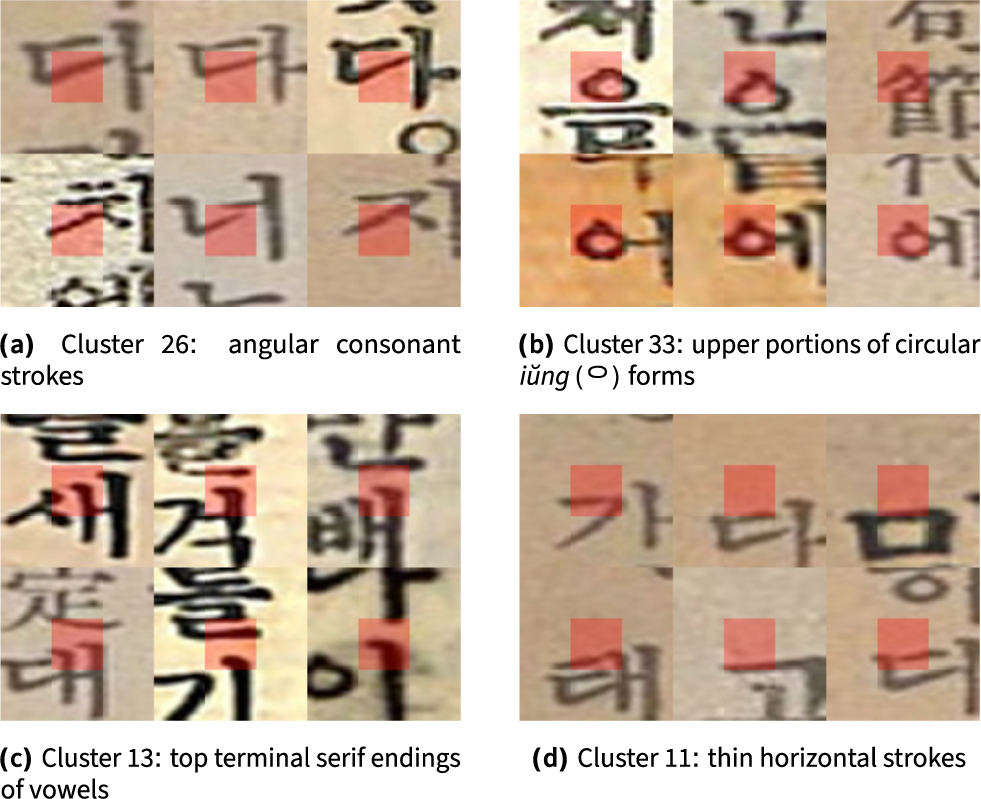
Figure 9 Long description
The multi-panel figure consists of four quadrants, each containing a three-by-two grid of cropped text patches from historical documents.
* Top-left, panel a, Cluster 26: Six patches showing angular consonant strokes. Red squares highlight the sharp, ninety-degree bends in the horizontal-to-vertical transitions of characters.
* Top-right, panel b, Cluster 33: Six patches focusing on the upper portions of circular i u n g forms. Red squares are placed over the top curves of the circular characters and some vertical stroke intersections.
* Bottom-left, panel c, Cluster 13: Six patches illustrating top terminal serif endings of vowels. Red squares highlight the small, decorative horizontal or slightly angled ticks at the top of vertical vowel strokes.
* Bottom-right, panel d, Cluster 11: Six patches demonstrating thin horizontal strokes. Red squares highlight the mid-sections of horizontal lines, emphasizing their consistent, slender weight across different characters.
Typographic features in the enriched clusters
The statistical validation establishes that the density patterns are genuine rather than artifactual, but it does not tell us what the enriched clusters contain. To answer that question, we examined the representative patches within each printshop’s significantly enriched clusters and characterized their visual content. In the figures that follow, each thumbnail shows a patch with its surrounding page context. A red box marks the actual region the model attended to. We include this context because the patches themselves are often too small to interpret in isolation.
Taedong Inswaeso’s enriched clusters reveal a consistent set of features. Cluster 26 groups angular consonant strokes, particularly those with upward-slanted terminals on characters like tigŭt (ㄷ) and riŭl (ㄹ) (Figure 9a). Cluster 33 attends to the upper portions of the circular iŭng (ㅇ) form, focusing on the serif at the top of the character (Figure 9b). Cluster 13 isolates the top terminal serif endings of vowels like ae (ㅐ), e (ㅔ), ŏ (ㅓ), i (ㅣ), and a (ㅏ) (Figure 9c). Cluster 11 groups thin horizontal strokes (Figure 9d). Taedong’s enrichment in these clusters means not that other presses lacked these features entirely, but that Taedong pages contributed disproportionately to them. Taken together, the clusters suggest a typographic profile characterized by thinner strokes, distinctive terminal angles, and particular serif treatments on both vowels and circular forms.
Hansŏng Tosŏ’s enriched clusters present a different profile. Cluster 19 captures thick, bold serif endings across a diverse set of letters (Figure 10b). Cluster 10 groups primarily circular iŭng (ㅇ) forms, though with some variation at the cluster’s periphery (Figure 10c). Clusters 17 and 9 are more difficult to characterize. Cluster 17 appears to capture vertical stroke thickness, but its breadth suggests the clustering may be too coarse to isolate a single feature (Figure 10a). Cluster 9 groups small terminal endings, though the pattern is less clear (Figure 10d). The overall impression is of heavier, sturdier forms, particularly in the bold serif endings of cluster 19, though not all of the enriched clusters lend themselves to concise typographic description.
Representative patches from clusters enriched for Hansŏng Tosŏ. Cluster 19 aligns with De Fremery’s characterization of Hansŏng’s sturdy faces and dramatic taper. Other clusters capture patterns the model found diagnostic, though some resist straightforward typographic description.
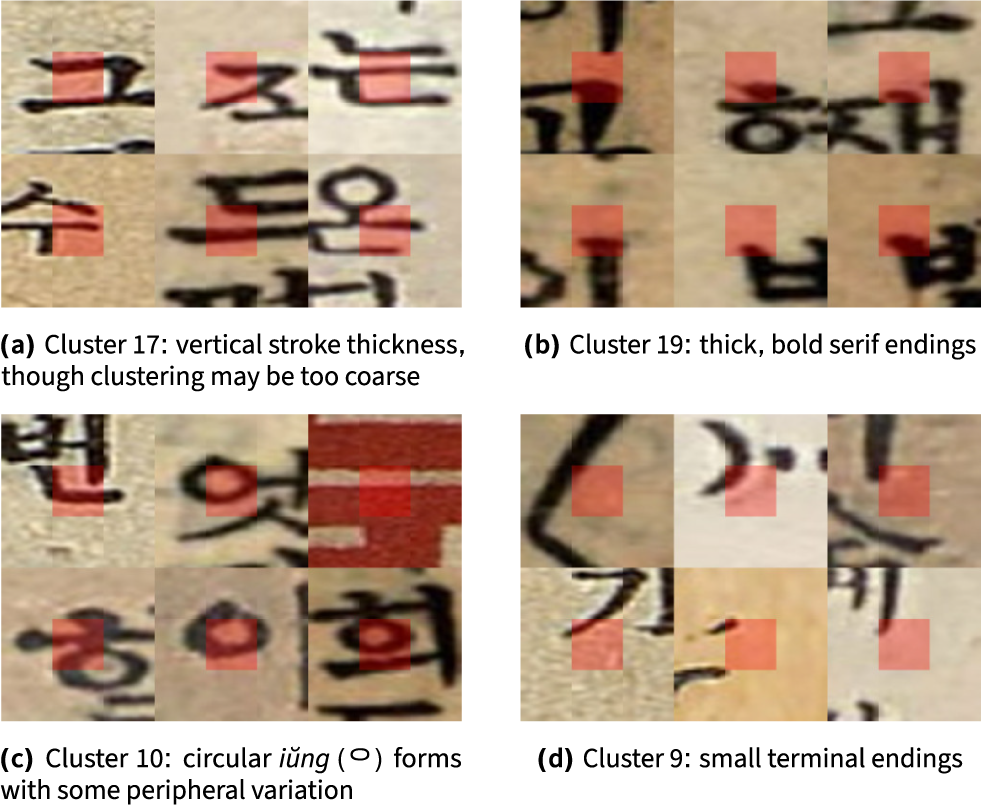
Figure 10 Long description
The multi-panel layout consists of four quadrants, each containing a 2 by 3 or 3 by 2 grid of close-up typographic samples from historical Korean texts.
* Panel a, Cluster 17, located at the top-left, displays six patches of black ink characters on aged paper. Red translucent squares highlight the vertical strokes of various Hangul characters to demonstrate stroke thickness.
* Panel b, Cluster 19, at the top-right, shows six patches where red squares pinpoint the terminal points of strokes, emphasizing thick and bold serif endings characteristic of the Hansŏng style.
* Panel c, Cluster 10, at the bottom-left, features six patches focusing on the circular i u n g character. Red squares are centered over the circular forms to highlight their shape and peripheral variations.
* Panel d, Cluster 9, at the bottom-right, contains six patches where red squares highlight the very tips of character strokes to illustrate small terminal endings.
Across all panels, the background is a textured, light-tan paper, and the characters are printed in a dense black ink with visible variations in pressure and edge crispness.
Sinmungwan’s enriched clusters suggest a distinctive treatment of circular forms and stroke endings. Clusters 15 and 8 both capture the circular iŭng (ㅇ) form, with cluster 15 also attending to tapered endings of vertical strokes (Figure 11a and b). The treatment of iŭng in these clusters appears distinct from how other printshops rendered this character. Cluster 21 is more sporadic and difficult to characterize (Figure 11c). Cluster 30 attends to stroke thickness and line endings, and notably captures both Hangul and hanja characters, one of the few clusters where Chinese characters appear prominently (Figure 11d).
Representative patches from clusters enriched for Sinmungwan. Clusters 15 and 8 capture circular forms consistent with De Fremery’s broad-stroke characterization. Cluster 30 is notable for including hanja alongside Hangul.
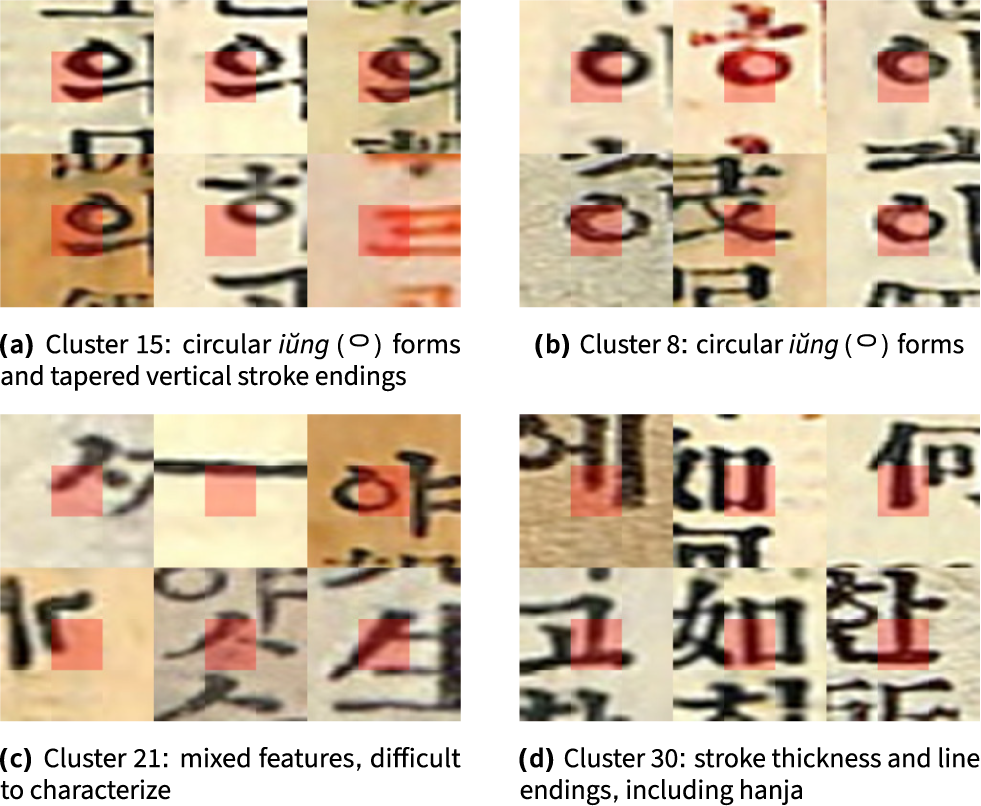
Figure 11 Long description
The four panels are arranged in a two-by-two grid. Each panel contains six small square patches of historical Korean calligraphy arranged in two rows of three. Red translucent squares highlight specific calligraphic features in each patch.
* Panel a, Cluster 15. Located at the top-left. It displays circular iung forms and tapered vertical stroke endings. The red highlights focus on the circular components of the Hangul characters.
* Panel b, Cluster 8. Located at the top-right. It also features circular iung forms. The red highlights are placed over the round, circular strokes of the characters.
* Panel c, Cluster 21. Located at the bottom-left. It shows mixed features that are difficult to characterize. The red highlights are scattered across various horizontal and vertical strokes.
* Panel d, Cluster 30. Located at the bottom-right. It highlights stroke thickness and line endings. This panel is distinct for including Hanja characters alongside Hangul. The red highlights are placed on thick vertical and horizontal strokes of both script types.
Chosŏn Inswae contributes the fewest pages to our corpus, which is reflected in the smaller sample sizes within its enriched clusters. The model nonetheless identifies several distinguishing patterns. Cluster 3 captures thin terminal endings with a slight angular tilt (Figure 12a). Cluster 13 appears to attend to stroke thickness, though its breadth suggests the clustering may group heterogeneous features (Figure 12b). Cluster 17 focuses on horizontal line configurations, particularly the spacing between paired horizontal strokes in characters (Figure 12c). Most notably, cluster 12 captures not character forms but vertical line separators (Figure 12d). This suggests that Chosŏn Inswae’s page layout, including its use of vertical rules, may have been sufficiently distinctive to register as a classifying feature.
Representative patches from clusters enriched for Chosŏn Inswae. Unlike for the other presses, no prior manual analysis exists for comparison. Cluster 12 captures page layout elements rather than typographic features.
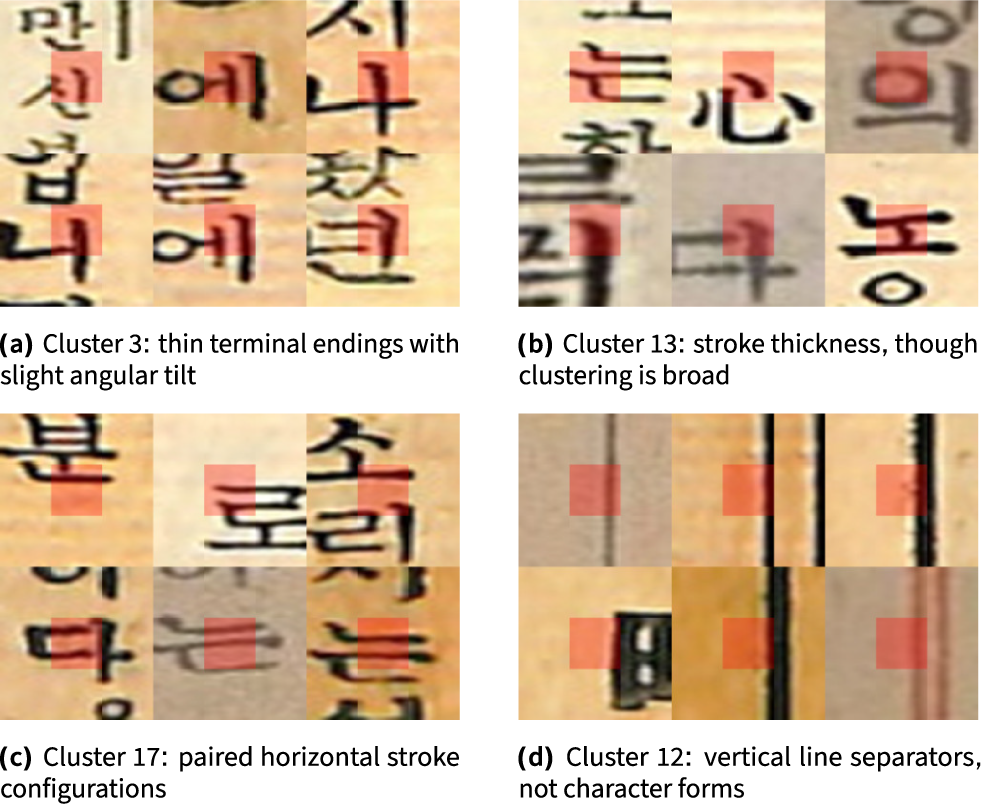
Figure 12 Long description
The multi-panel display consists of four quadrants, each containing a three-by-two grid of small square patches. Each patch features a semi-transparent red square highlight at its center.
* Panel a, Cluster 3. Six patches of Korean characters on aged paper. The red highlights focus on the thin terminal endings of the strokes, which exhibit a slight angular tilt.
* Panel b, Cluster 13. Six patches showing Korean characters with varying stroke thickness. The red highlights are placed over thick vertical and horizontal strokes, indicating a broad clustering of typographic weight.
* Panel c, Cluster 17. Six patches highlighting paired horizontal stroke configurations within Korean characters. The red squares are centered on parallel horizontal lines.
* Panel d, Cluster 12. Six patches that do not contain typographic characters. Instead, the red highlights identify vertical line separators and page layout elements, including solid black lines and faint red vertical borders on the paper background.
Correspondence with manual scholarship
The computational findings can be evaluated against De Fremery’s manual analysis of colonial Korean typefaces, which documented specific features distinguishing Taedong Inswaeso, Hansŏng Tosŏ, and Sinmungwan on the basis of manual examination and comparison of individual letterforms. His analysis did not include Chosŏn Inswae. The strongest convergence appears with Taedong Inswaeso. De Fremery characterized Taedong’s type by its thinner strokes, less dramatic modulation in the title face, and distinctive upward-slanted terminals on consonants like tigŭt (ㄷ) and riŭl (ㄹ). The angular strokes captured in cluster 26 align with this terminal treatment, and the thin strokes in cluster 11 are consistent with his observations about stroke weight. Clusters 33 and 13, which attend to serif treatments on circular forms and vowels, respectively, surface patterns that the model found diagnostic but that have not been documented in prior scholarship. For Hansŏng Tosŏ, De Fremery described the typefaces as “sturdy,” with heavier stroke weight and more dramatic modulation, and noted that the title face features a wide stroke that tapers dramatically toward its lower terminals. The bold serif endings in cluster 19 are consistent with that characterization. De Fremery also observed that pressman No Ki-jŏng’s typefaces at Hansŏng “establish an aesthetic rhythm so characteristic” that volumes can be identified by type alone. The model’s ability to differentiate Hansŏng pages through density patterns is consistent with that observation, even where individual clusters like 17 and 9 resist straightforward typographic description. De Fremery characterized Sinmungwan’s type as “broad-stroked.” The circular forms and stroke endings in clusters 15 and 8 are consistent with that description, though the model isolates features at a finer level of detail than the broad-stroke characterization implies.
Where comparison is possible, the two approaches converge on similar features arrived at through entirely different means. The model learned to attend to features that a typographer examining individual letterforms would recognize as distinctive, without any instruction about what constitutes a meaningful typographic difference. This convergence lends credibility to the model’s outputs more broadly, including those clusters that surface patterns not previously documented.
Several of these undocumented patterns merit attention. The vowel terminal treatments in cluster 13, enriched for Taedong, isolate a feature at the sub-character level that De Fremery’s analysis did not address, yet the model treats it as among the most diagnostic for that press. The circular form variations across clusters 33, 8, and 15, each enriched for a different printshop, suggest that the rendering of iŭng (ㅇ) varied in ways specific enough to serve as a distinguishing feature, a possibility that manual examination of individual letterforms would be unlikely to surface given how labor-intensive systematic comparison across presses and volumes would be. Cluster 30, enriched for Sinmungwan, is notable for a different reason. It is one of the few clusters where hanja appear prominently alongside Hangul, raising the question of whether Sinmungwan’s treatment of Chinese characters carried a distinctive visual signature that other presses did not share. Finally, cluster 12’s capture of vertical line separators rather than character forms for Chosŏn Inswae points toward layout as a potential axis of differentiation. It suggests that a “printshop signature” can include page architecture as well as letterform design. These patterns represent starting points for further manual investigation rather than conclusions in themselves, but they illustrate the capacity of the MIL framework to direct scholarly attention toward features that might otherwise go unnoticed.
Conclusion
This study asked whether computational methods can detect shop-level typographic signatures in colonial Korean print and, if so, whether the features driving that detection can be made visible for scholarly evaluation. Under a held-out-book evaluation in which all pages from each tested book were withheld from training, the MIL model classified individual pages by printshop with 84.5 percent accuracy while producing interpretable attention maps that localize classification decisions to specific sub-character regions.
When we clustered the high-attention patches and projected them into a shared embedding space, the four presses occupied the same territory. No clean separation into press-specific regions appeared. The density maps, however, reveal that each press concentrated disproportionately in different regions of this shared space. Taedong Inswaeso’s pages contributed more patches to clusters capturing thin strokes and angular consonant terminals. Hansŏng Tosŏ concentrated in clusters grouping thick, bold serif endings. Sinmungwan showed distinctive treatments of circular forms. Chosŏn Inswae was partially distinguished by page layout elements rather than typographic features alone. Differentiation, in other words, operates through relative frequency within a constrained typographic space rather than through exclusive features.
Where comparison with De Fremery’s manual analysis is possible, the two approaches converge on similar features arrived at through entirely different means. The angular terminals and thinner strokes the model identified as diagnostic for Taedong correspond to the characteristics De Fremery documented through close examination of individual letterforms. The bold serif endings enriched for Hansŏng are consistent with his characterization of that press’s typefaces as sturdy with dramatic taper. This convergence, achieved without any instruction to the model about what constitutes a meaningful typographic difference, lends credibility to the computational outputs more broadly.
The model also surfaces features that prior scholarship has not addressed. The vowel terminal treatments in cluster 13, the press-specific variations in how iŭng (ㅇ) was rendered across clusters 33, 8, and 15, the hanja-inclusive cluster 30 enriched for Sinmungwan, and the vertical line separators in cluster 12 enriched for Chosŏn Inswae all represent patterns that the model treats as diagnostic but that have not been documented through manual examination. These findings remain provisional and require closer evaluation, but the convergence on known features suggests they warrant serious attention.
Several limitations should be acknowledged. The cluster analysis did not work equally well across the embedding space. Many clusters isolated coherent typographic elements, but broader groups such as cluster 17 combined related patch types that may need to be evaluated separately. Manual inspection of representative patch samples made this unevenness visible, but exploratory HDBSCAN sweeps did not provide a simple remedy. Finer settings increased the number of clusters while also treating many more patches as noise. This limitation lies partly in the clustering criterion and partly in the MIL model’s internal patch representation, which keeps the analysis tied to the classifier’s evidence but does not guarantee categories that match typographic description. Future work should compare alternative patch embeddings and clustering strategies, using the same kind of manual inspection to assess whether broad groups divide into meaningful typographic sub-patterns. The model cannot establish causal relationships between the visual patterns it detects and the institutional or economic factors that may have produced them. We cannot determine from visual analysis alone whether Taedong’s thin strokes reflect investment decisions, equipment wear, or the particular matrices available through Japanese foundries. The method reveals that patterns exist and that they are statistically robust, but explaining why they exist requires the kind of archival and material investigation that falls outside the scope of this computational analysis.
The density-based differentiation documented here carries implications for how we understand the typographic production of colonial Korea. The conventional account emphasizes standardization, and rightly so. The material conditions and economic pressures colonial printshops faced were severe, and matrices from Japanese foundries dominated the market. Yet within this prescribed visual landscape, individual presses maintained distinguishable visual identities. The signatures were sometimes subtle enough to escape casual observation, but consistent enough to be recoverable across thousands of pages. For questions of attribution, this finding is directly practical. Documents of uncertain provenance can be evaluated against the density profiles established here, and the interpretability of the MIL framework means that any proposed attribution rests on inspectable visual evidence rather than an opaque classification score.
The framework can be pushed further in several directions. Tracking whether a press’s signature shifted across years or decades could reveal when equipment was replaced or matrices were exchanged between shops. Expanding the corpus to include additional presses would test whether the density-based approach scales beyond the four institutions examined here. The same problem of recovering institutional signatures from within a constrained production system arises in other historical contexts as well. Early modern European printshops, medieval scriptoria, and colonial Korean newspaper production all involved workshops operating with shared or similar materials, and the question of whether computational methods can distinguish their outputs at the level of typeface design remains largely open.
In the absence of continuous business records, the printed page becomes the primary archive. The MIL framework makes that archive legible, locating shop-level signatures at the sub-character level and rendering them available for scholarly examination. That these signatures are recoverable at all, from within a production system where economic constraints pushed typography toward uniformity, suggests that the material record of colonial Korean printing carries more information than has yet been read from it.
Data availability statement
Code, release metadata, trained model weights, and numerical interpretability artifacts are available through the GitHub repository at https://github.com/aronvandepol/visual-feature-discovery and the versioned Zenodo archive at https://doi.org/10.5281/zenodo.20015055. The source code is released under the MIT License. The Zenodo deposit, which covers the dataset metadata, fold definitions, trained model weights, evaluation results, and interpretability artifacts, is released under CC-BY-4.0. The release includes page-level metadata for the 57,583-page corpus, page-random and held-out-book fold definitions, the page-to-book mappings used for the GroupKFold splits, trained AttriMIL checkpoints for both patch configurations, ConvNeXtV2 and Swin S3 baseline checkpoints under both evaluation protocols, precomputed patch embeddings, HDBSCAN cluster assignments, and per-fold evaluation metrics. The released numerical artifacts do not contain reconstructable page-image data. The digitized page images themselves derive from the Hyundam Mun’go collection (https://www.hyundammungo.org/) and are not redistributed in the repository or Zenodo archive. Researchers wishing to reproduce the full pipeline from raw images should obtain access through the Hyundam Mun’go portal directly.
Acknowledgements
The authors used Claude (Anthropic), in versions Sonnet 4.5, Sonnet 4.6, Opus 4.5, Opus 4.6, and Opus 4.7, to assist with rewriting and condensing portions of this manuscript during drafting and revision. The same family of models, accessed through the Claude Code (https://www.anthropic.com/claude-code) and Opencode (https://opencode.ai) command-line agent tools, the latter run with OpenAI’s GPT Codex as a backend, were also used to profile and refactor portions of the multiple instance learning implementation released alongside the article. The tools were not used to generate citations, claims, or analytical results. All scholarly judgments and conclusions are the authors’ own.
Author contributions
Conceptualization: A.v.d.P., J.P., and A.M.; Data curation: A.v.d.P.; Formal analysis: A.v.d.P.; Methodology: A.v.d.P., J.P., and A.M.; Software: A.v.d.P.; Supervision: J.P. and A.M.; Visualization: A.v.d.P.; Writing (original draft): A.v.d.P.; Writing (review and editing): J.P. and A.M. All authors approved the final submitted draft.
Funding statement
This research was supported by the Leiden University Centre for Digital Humanities (LUCDH). Open access funding provided by Leiden University.
Competing interests
The authors declare none.
Ethical standards
The research meets all ethical guidelines, including adherence to the legal requirements of the study country.
AttriMIL mathematical formulation
This appendix formalizes the AttriMIL classifier and its interpretability scores. Figure A1 summarizes the pipeline formalized below. The notation follows the same sequence: patch extraction, feature encoding, attention pooling, and attribute scoring.
Multiple instance learning pipeline for printshop classification. The model processes page images through patch extraction, feature encoding, and gated attention to identify typographically distinctive regions. Red overlays show attention weights, while cyan boxes highlight top-scoring patches. Patch sizes are illustrative and smaller during training.
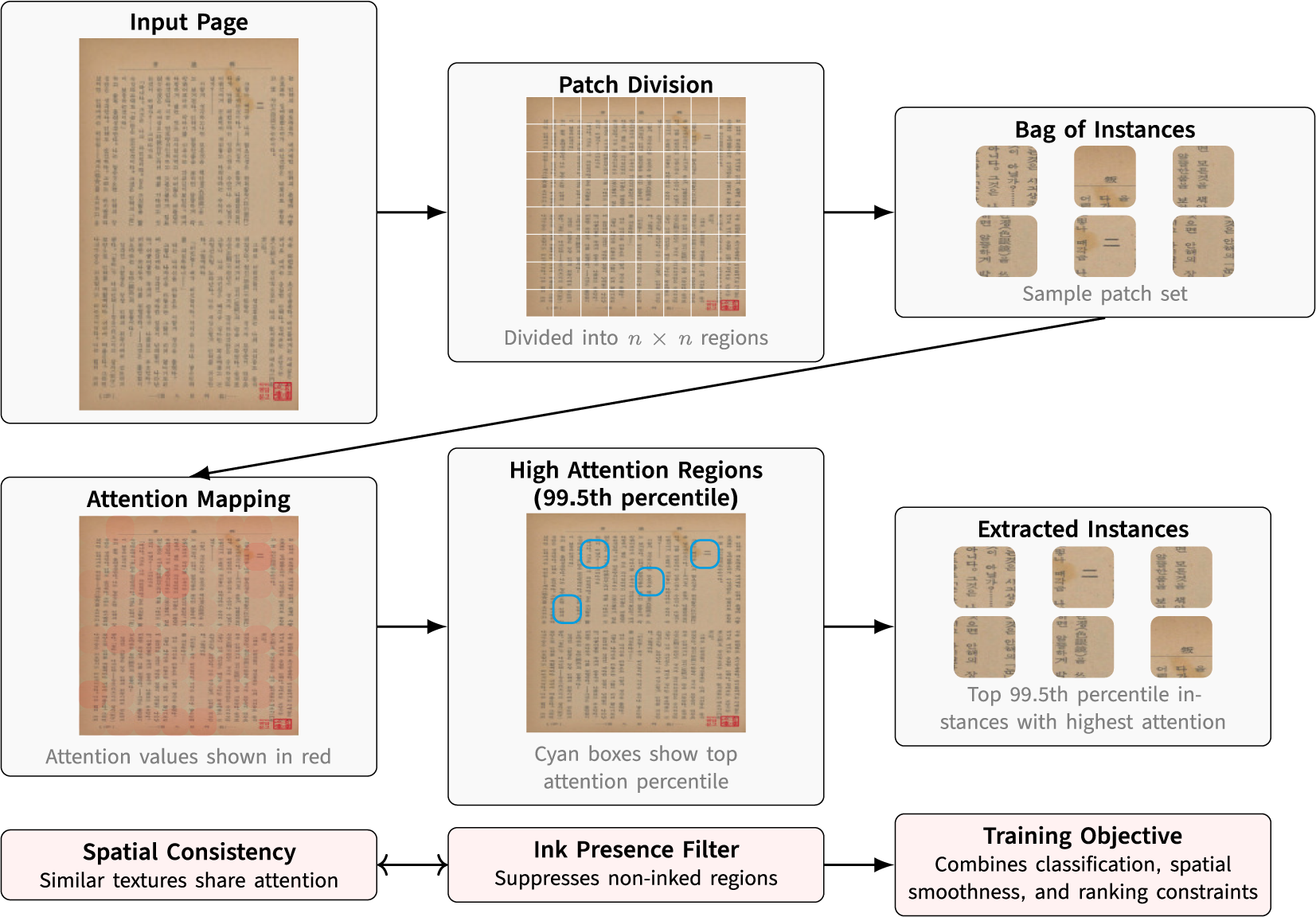
Figure A1 Long description
The flowchart consists of two rows of panels connected by arrows.
Top Row (Left to Right):
1. Input Page: Shows an original document with vertical text and a red seal.
2. Patch Division: The page is overlaid with a white grid, labeled Divided into n times n regions.
3. Bag of Instances: Displays a Sample patch set containing six individual square crops of text.
Bottom Row (Left to Right):
4. Attention Mapping: The original page is shown with red rectangular overlays of varying opacity, labeled Attention values shown in red.
5. High Attention Regions (99.5th percentile): The page features cyan circles highlighting specific characters, labeled Cyan boxes show top attention percentile.
6. Extracted Instances: Shows six isolated patches corresponding to the high-attention areas, labeled Top 99.5th percentile instances with highest attention.
Footer Blocks:
Below the main panels are three pink-shaded boxes. From left to right, they are Spatial Consistency (Similar textures share attention), which has a double-headed arrow pointing to Ink Presence Filter (Suppresses non-inked regions). An arrow from the filter points to the final block, Training Objective (Combines classification, spatial smoothness, and ranking constraints).
Patch features
Each page image is divided into n patches
$\{x_i\}_{i=1}^n$
 . A frozen ResNet18 backbone with lightweight adapter modules produces an L-dimensional representation:

All patch features are stacked into
$H = [h_1,\dots ,h_n]^\top \in \mathbb {R}^{n\times L}$
 .
Attention scoring
AttriMIL replaces a global softmax gate with a single-head scaled dot-product self-attention block followed by a learned scoring head, following the transformer attention formulation (Vaswani et al. Reference Vaswani, Shazeer, Parmar, Uszkoreit, Jones, Gomez, Kaiser, Polosukhin, Guyon, von Luxburg, Bengio, Wallach, Fergus, Vishwanathan and Garnett2017). The block measures pairwise patch compatibility and the scoring head collapses each context vector to a scalar logit, which is normalized across patches to yield the bag-level attention weights. Each patch feature
$h_i$
 is projected to a query, key, and value of dimension d via
$W_Q, W_K, W_V \in \mathbb {R}^{d\times L}$
 :

Scaled dot-product attention produces a context vector for each patch:

and a learned scoring vector
$w_o \in \mathbb {R}^{d}$
 collapses each context vector to a scalar. The patch-level attention weights are obtained by softmax across patches:

The attention vector
$A=(a_1,\ldots ,a_n)$
 highlights patches most informative for printshop distinction.
Bag representation and classification
A page-level embedding is computed by attention pooling over the patch features:
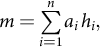
and classified through a linear layer:

Predictions follow from
$\mathrm {softmax}(y)$
 .
Patch-level attribute scores
To visualize typographically distinctive regions, AttriMIL defines for each patch
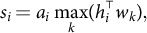
where
$w_k$
 is the classifier weight for class k. This product highlights patches that are both attended and discriminative.
Hybrid regularization loss
Training minimizes a hybrid loss combining classification, spatial smoothness, and ranking constraints:

(1) Classification loss:

where Y is the true class index.
(2) Spatial smoothness: Neighboring patches should receive similar attention weights. Summing absolute differences over each horizontally or vertically adjacent patch pair
$(p,q)$
 in the patch grid, counted once:
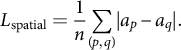
(3) Hybrid ranking: The term enforces two score orders through max-margin penalties on the highest-scoring patches in each set. Within a page, the highest-scoring inked patch should outrank the highest-scoring empty patch. Across the batch, the highest-scoring patch among class-c pages should outrank the highest-scoring patch among other-class pages.
Let I and E denote inked and empty patch indices on a page,
$X^c$
 and
$X^{\bar c}$
 denote patches drawn from class-c and non-class-c pages in the batch, and
$\delta =0.1$
 the margin. The within-page contribution combines a hinge term with two sign regularizers:

and
$L_{\text {within}}$
 is the average of
$\ell _{\text {within}}$
 over pages with at least one inked and one empty patch. The cross-page contribution applies the same hinge term, without the sign regularizers, between maximum scores of correct and competing classes,

and
$L_{\text {cross}}$
 is the average of
$\ell ^{c}_{\text {cross}}$
 over the classes present in the batch. Under the hybrid strategy,
$L_{\text {rank}}$
 is the average of
$L_{\text {within}}$
 and
$L_{\text {cross}}$
 .
Ink detection
A patch is classified as empty if it satisfies any grayscale condition below, with
$\nabla x_i$
 as the Sobel gradient magnitude:
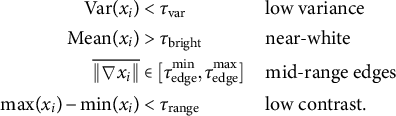
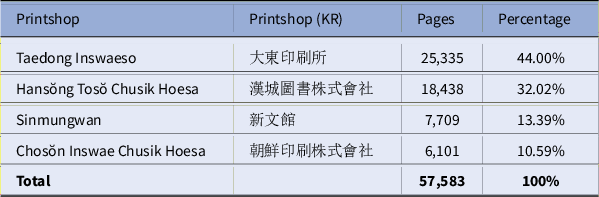
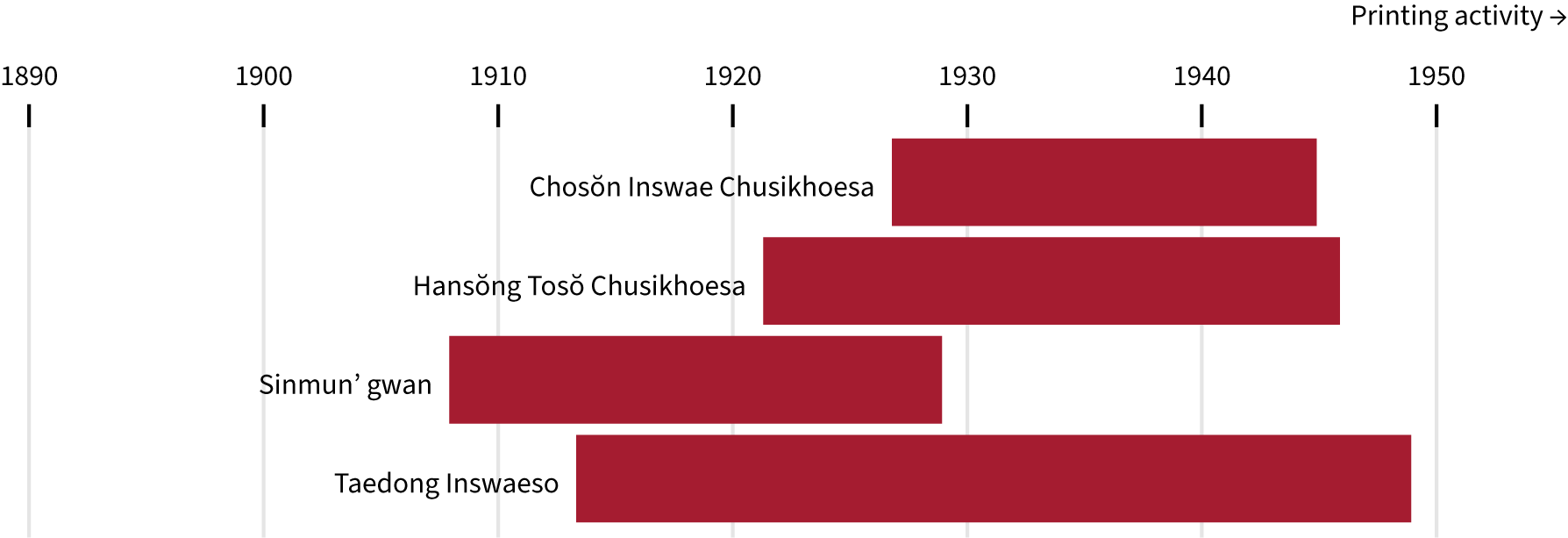
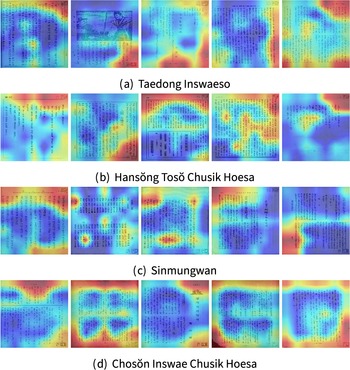
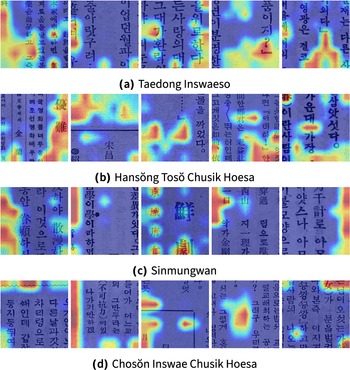
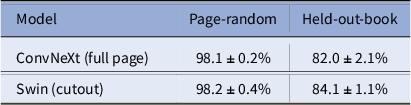
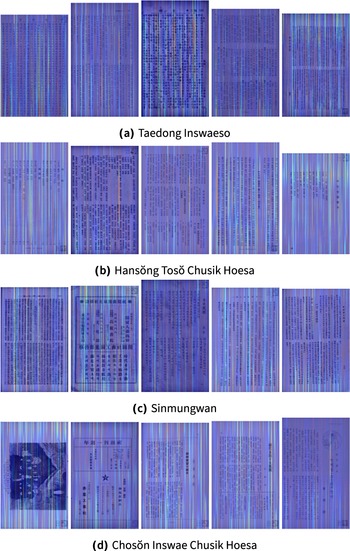
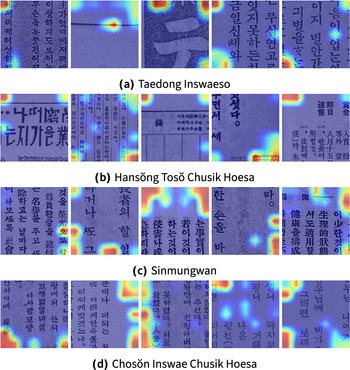
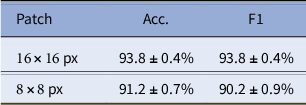
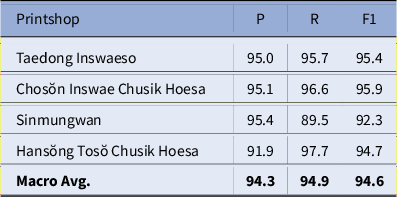

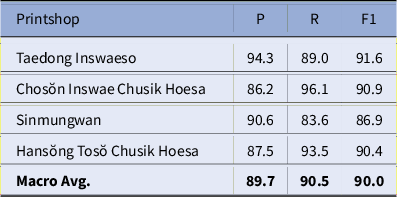

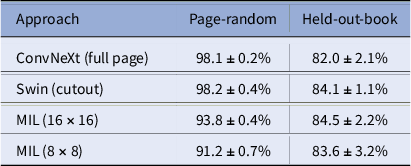
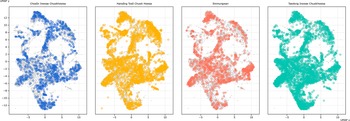

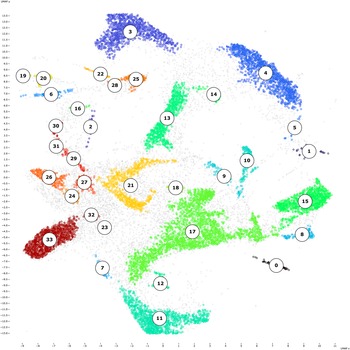

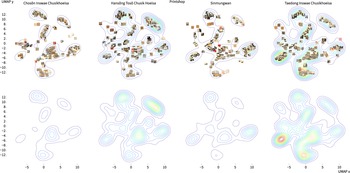
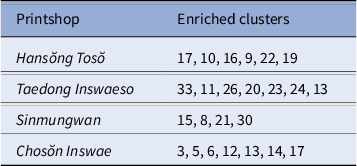


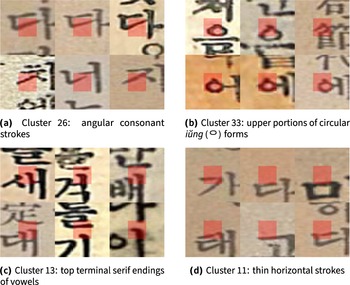
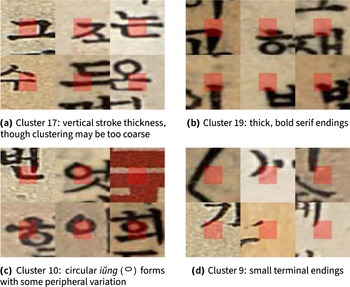
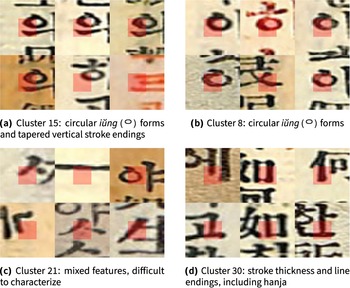
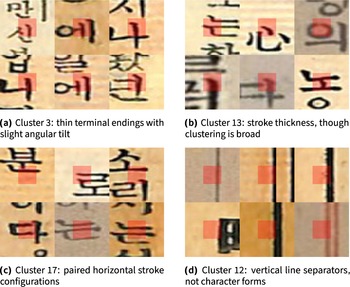
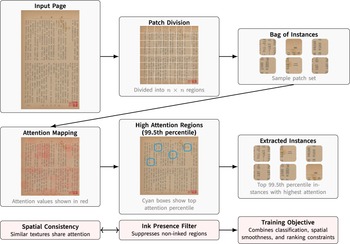

 Open access


Rapid Responses
No Rapid Responses have been published for this article.