The trouble with modern theories of behaviorism is not that they are wrong but that they could become true.Footnote 1
— Hannah Arendt
The 2010 coalition government in the UK and the Obama administration in the United States are just two prominent examples of governments worldwide that have committed themselves to utilizing the behavioral sciences (especially psychology and behavioral economics) to design new approaches to public policy with the aim of influencing human behavior for the better.Footnote 2 Government-sponsored “Behavioral Insight Teams” are shaping public policy in a variety of domains, including public health, energy, and personal finance; the behavioral policy mechanisms that are employed in these sectors are equally diverse. While “nudges” are just one policy tool that government-sponsored behavioral teams employ,Footnote 3 policy nudges by public agencies embody what is at once novel, powerful, and controversial about the latest integration of the behavioral sciences with the policy making powers of cities, states, and international organizations. Nudges refer to interventions on “choice architectures” by public or private entities that seek to influence individual behaviors in predictable ways that (in principle) preserve freedom of choice without forbidding options or imposing significant material penalties or rewards.Footnote 4 For example, a state that utilizes human inertia and procrastination to automatically register adults as organ donors unless they actively opt-out (as in Austria, Spain, and Wales) nudges its citizens through the law; a state that utilizes the power of descriptive social norms to increase tax payment compliance also nudges its citizens into desired forms of behavior.Footnote 5
There is a great deal of elasticity in the concept of nudging, with examples ranging from GPS devices, to information disclosures, to more “toxic” nudges like subliminal advertising.Footnote 6 For the purpose of concentrating and limiting the scope of this paper I will broadly follow Grüne-Yanoff and HertwigFootnote 7 and distinguish between “nudging” and “boosting” mechanisms: the former is predominantly a non-educative form of intervention on choice architectures or the background conditions surrounding individual choice (through framing effects, sequencing, spatial design, default rules, etc.) and these will be my primary focus; the latter are characterized by efforts to “extend the decision-making competences of laypeople and professionals alike.”Footnote 8 These differences track alternative (and at times opposing) ways of responding to the challenges of bounded rationality;Footnote 9 by tapping into and utilizing widespread biases and flawed heuristics in human decision-making to generate “better” individual and social outcomes, in the case of nudges, or by providing information and improving skills or competencies in decision-making, in the case of “boosts.”Footnote 10 In many policy domains non-educative nudges are considered a more effective policy design mechanism than informational boosts owing to the systemic behavioral biases that both shape individual decision making and constrain educational efforts to counteract bounded rationality.Footnote 11 The unique challenges and limits of educational nudges or boosts as both a conceptual and public policy matter fall outside of the scope of the present essay.
Given the relatively recent adoption of applied behavioral sciences and nudging tactics on the part of governments and international organizations throughout the world,Footnote 12 we do not know very much about the effects of this policy mechanism on political engagement, political trust, or civic capacity. As is usually the case, policy analysts, program evaluators, and the governments who sponsor them are primarily concerned with gauging policy effectiveness (understood as cost-effective behavior change within specific populations) and avoiding strong public “reactance” to these new policy mechanisms and the model of public management that they embody.Footnote 13 Yet, following a long and robust line of political science research concerned with policy feedback effects,Footnote 14 it seems reasonable to expect that in this policy domain, as in so many others preceding it, “new policies create new politics.” In the case of nudges, however, new policies and forms of public administration may create new anti-politics; that is, under the growing influence of the behavioral sciences, the policy objectives of the state can be executed through opaque behavioral interventions that do not meaningfully include, engage, or empower citizens in their own self-governance.
I am concerned with the possible policy effects of nudging as it relates to political agency and civic capacity, especially the democratic-deliberative capacities and virtues of public reasoning, reciprocal listening, and pursuing mutually workable agreements to collective problems. The concept of civic capacity at issue here refers to both the personal skills, qualities, and virtues that facilitate democratic deliberation and the institutional conditions that make civic-oriented communication and decision-making with others possible. My thesis is that these personal and institutional qualities are the features of political life that a reliance on nudging risks overlooking or bypassing given the governing philosophy and expert-led practices that are enacted by the “nudging state”.Footnote 15 The primary support for these concerns derives from the way in which citizens, freedom, normative behavior, and related concepts are understood and operationalized within the burgeoning fields of behavioral law and economics and within the increasing adoption of nudging and related behavioral techniques by governments and organizations around the world. More extensive empirical work is needed to capture the full range of possible effects that nudge policies may have on the capacities and opportunities for democratic citizenship, particularly for differently situated persons and social groups. Yet, as I will show, citizens in their public-political capacity as reflective agents in their own self-governance are largely missing from the elaboration, defense, and implementation of nudging policies. A critical examination of the public philosophy of the nudging state will help to account for this absence.
Ethical and philosophical objections to nudging are widely discussed in the literature;Footnote 16 I seek to make a new contribution to these discussions by considering the political and democratic stakes of the nudging city or state. Since the use and overall scope of nudging techniques by public and private entities are likely to continue to expand in the years ahead, I also call for concurrent institutional experiments in empowered democratic deliberation as a means of cultivating and sustaining the civic capacities upon which democratic self-governance relies. Since deliberative democracy is its own form of nudge and choice architecture that shapes the conditions, norms, and processes of public reasoning in relation to questions of public policy, I conclude with some ways of assessing the civic benefits of integrating the insights of the behavioral sciences with the practices of democratic deliberation.
The remainder of this paper is structured by the following three questions: what theory of the subject and what conception of freedom is expressed by the nudging state? How do these conceptions of subjectivity and freedom—embodied in specific public policy mechanisms—relate to democratic principles and practice? Are there additional ways of addressing the bounded rationality that is thought to justify the nudging state without potentially bypassing citizens in their own collective self-governance?
Nudge and the Neuroliberal State
There seems to be something to love about nudging even by those who occupy otherwise opposing political perspectives. Liberal Democrats like the focus on general human welfare and the promise of addressing complex social problems such as climate change through the “soft” but active influence of government. For example, if default settings on an office printer can reduce the overall usage of paper,Footnote 17 or if mailed notices about one’s energy consumption relative to one’s neighbors can help spur greater efforts at energy conservation,Footnote 18 then what’s not to like? At the same time, conservatives embrace the inexpensive and non-coercive way in which policy design mechanisms (borrowed heavily from private sector strategies) might facilitate more responsible human behavior in various domains of consumer choice with the promise of reducing government expenditures in areas like unemployment and health care. For example, if automatic enrollment in savings plans can increase private savings while maintaining “opt-out” options for employees,Footnote 19 then individuals, companies, and governments alike may stand to benefit from inexpensive changes in choice architecture.Footnote 20 Feminist scholarsFootnote 21 have also drawn upon nudges as a policy design mechanism to help address the gendered division of labor by, for example, providing women with more detailed information about the “long-term financial vulnerability that results from taking time out of the workplace.”Footnote 22
Despite the cross-ideological interest and globalizing spread of the behavioral sciences in a plethora of policy domains at multiple levels of governance, there also seems to be plenty to hate about nudging.Footnote 23 The most developed philosophical critiques of nudging have come from the broad perspective of libertarianism. Libertarians (and liberals) question the grounds and the legitimacy of using state power to subtly steer human behavior in ways that policy architects believe are in an individual’s long-term best interest.Footnote 24 Since the legitimacy of non-educative nudges depend on policy goals that are consistent with the heterogeneous preferences of individuals, the task of selecting appropriate policy goals while avoiding abuses of power where the preferences of individuals are not uniform, stable, or clear is a significant political and ethical challenge.Footnote 25 Libertarians also raise alarms about governing human behavior through processes that intentionally do not engage reflective, conscious thought, that is, via “System 1” manipulations of fast heuristics and widespread biases (like loss aversion, status quo bias, and time discounting).Footnote 26 For liberals and libertarians alike there is both too much paternalism and too little security or respect for private liberty and autonomy in the so-called third way of “libertarian paternalism.”Footnote 27 For a different and more recent group of social critics, nudging practices represent an intensification of neoliberal efforts to simultaneously scale back the state from numerous domains of life while designing more rationally predictable and pliant economic actors.Footnote 28
Each one of these critiques is illuminating in its own way. However, they are also incomplete, particularly in relation to questions of democratic agency and civic capacity, understood as the ability of citizens to identify, frame, and address public problems in concert with other diverse actors and institutions. The libertarian critique rightly highlights the dangers of enlisting the state (or other public entities) to quietly circumnavigate our apparently shoddy capacities for consistently optimal decision-making, particularly since no one seems to be claiming that the cognitive and behavioral flaws that are taken to justify the nudging state don’t (ex hypothesi) also apply to our appointed nudgers and choice architects.Footnote 29 Yet, libertarians are not in a position to complete this critique or provide an alternative account of the necessary political conditions for addressing collective action problems because they don’t address the possible civic consequences of nudging or the democratic conditions (both ethical and institutional) of legitimate governance.
From the perspective of those who champion the individual and aggregate welfare benefits of a nudging state, selective discomfort with government paternalism and worries about potential abuses of power (or private interest capture) simply call for better behavioral science, more randomized control trials, leading to more refined nudging.Footnote 30 The libertarian critique faces a difficulty in surmounting this response because the theory of the reasoning subject and the conception of liberty that anchors the libertarian outlook is too individualistic and negative to marshal the resources necessary to offer a more explicitly political and democratic critique of nudging. Indeed, “soft” paternalists and their libertarian critics share an individualist frame of reference that leaves citizens in their collective reasoning and communicative capacity out of the picture: the former are focused on the individual cognitive frailties and motivational deficiencies that are thought to constrain human welfare (with Bayesian reasoners as the implicit gold standard), while the latter invoke some of these same individual limitations to further restrain democratic practices.Footnote 31
Despite their inattention to the social, institutional, and broadly “ecological” conditions of a great deal of human decision-making,Footnote 32 the defenders of nudging are right to claim that some type of choice architecture is inevitable. Yet our would-be choice architects are misguided when they claim on this basis that concerns about freedom and respect for autonomy have been overstated by their critics.Footnote 33 The problem is that questions of freedom and autonomy have not been engaged at the political level of shared self-governance and democratic decision-making. The mere inevitability and non-neutrality of choice architecture does not say anything ethically or politically significant about the prior normative question of who these choice architects should be, nor does it say anything about the possible long-term political consequences for civic capacity, political identity, or public trust of answering this question one way versus another. In contrast to the libertarian critique, a more robustly political and democratic response to the nudging state would seek to surmount the false binary choice between private liberty and the behaviorally-interventionist state by integrating citizens into public considerations of the legitimacy, scope, aims, and design of public policy, including nudges. Part three of this essay offers an outline and some preliminary evidence in support of this type of response.
In contrast to the libertarian critique, the neoliberal reading of the nudging state seems misaligned with the unique aims and methods of behavioral public policy. Instead of seeking to turn the individual into an economically responsible and independent entrepreneur, the role of the state in the “new age of behavioral science”Footnote 34 is primarily directed at saving the flimsy rational individual from his or her robustly and predictably irrational (or sub-optimizing) self. But, uniquely, this is a targeted form of secular redemption that does not depend on the individual’s soul, mind, or even self-awareness: nudges constitute “reason-bypassing non-argumentative influences.”Footnote 35 Hence, instead of market failures and externalities produced by the calculations of rational economic actors, it is the widespread existence of personal “internalities” generated by flawed and irrational actors that seem to matter the most to governmental “nudge units.” Of course, if internalities (like insufficient retirement savings, obesity, diabetes, the effects of smoking, etc.) can be mitigated through nudges, then the neoliberal state stands to benefit in the form of reduced government expenditures; but these benefits would be realized in other regime-types as well. Presumably, that is why the behavioral sciences are informing public policy design in over 136 countries today as well as the European Commission, the OECD, and the World Bank.Footnote 36
More fundamentally, to the extent that nudging and related techniques expand as a new mode and rationality of governing human behavior, the state is not thereby diminishing but subtly shifting its role and reach in our lives, governing at the micro-level of everyday choices in ways that are often quite opaque to individuals (hence the designation “neuroliberalism”). At the same time, the conception of the human subject that is embodied in nudging—rooted in the latest developments in cognitive and social psychology—is murkier and less inspiring when compared to the recalcitrantly optimistic and rational figure that still animates neoliberal ideology. While political regimes hospitable to neoliberalism have embraced nudging and the behavioral sciences on which it is based, the reasons for this embrace don’t neatly track neoliberal homilies about the self. It is precisely because we (i.e., most human beings) are not fully rational, calculating, and autonomous beings that the state is turning to policy design mechanisms that don’t promise to transform human nature but will, it is hoped, close the inconvenient gaps in human decision-making and behavior that prevent the state from achieving its policy goals.
As is true of neoliberal regimes, the aim of the nudging state is still the production of predictable patterns of human behavior to help ease the task and costs of governance,Footnote 37 but the sources of this predictability will now be supplied by sector-specific policy interventions by behaviorally-informed government agencies and civil servants. Coincidently, this means that the neoliberal state is embedded in a performative contradiction in which its reigning moral philosophy—personal responsibility, autonomy, and individual entrepreneurialism—is belied by the behavioral sciences that increasingly informs and justifies its newest modes of governance. As Jones et al. put it: “libertarian paternalism is as much about neuroliberalism as it is neoliberalism.”Footnote 38 However, philosophical consistency is not my primary concern: instead, I want to consider the status of democratic citizenship and political agency amid the public policy embrace of the behavioral sciences. Nudging has rightly been criticized for its “thin conception of the social”;Footnote 39 its conception of democratic citizenship is even more impoverished.
From Cognitive Constraints to Democratic Deficits: Asymmetric Power and the Eclipse of Political Freedom
Mid-twentieth century behavioralism in the field of political science was characterized by a methodological plea for science and a research focus on political behavior.Footnote 40 Unlike their peers in psychological behavioralism (especially B.F. Skinner), political behavioralistsFootnote 41 sought to uncover what was uniquely political about political behaviors, especially as these played out in groups, legal and administrative processes, and larger political systems.Footnote 42 Today’s behavioralists, in contrast to their academic ancestors in the 1950s and 1960s, are less interested in explaining political behavior (as individual and collective phenomena) and far more concerned with orchestrating private (often consumer-oriented) behaviors to serve individual- and social-welfare ends.Footnote 43
In her discussion of the “rise of the social,” Hannah Arendt referred critically to the “substitution of behavior for action” that was facilitated by the integration of the behavioral sciences (especially economics) within the modernizing administrative state. In light of the different center of intellectual gravity that distinguishes the old and the new behavioralists, Arendt’s mid-century analysis of the imbrication of the behavioral sciences and the state seems guilty of some rather sweeping (or at least premature) generalizations: “the behavioral sciences aim to reduce man as a whole, in all his activities, to the level of a conditioned and behaving animal.”Footnote 44 At the same time, however, Arendt points to something important that has eluded many of the more recent critics of behaviorally-informed public policy: the administrative focus on generating normative individual behaviors risks crowding-out concerns about the status and sustainability of political agency, responsible democratic citizenship, and the institutional conditions necessary for their public development and exercise. Likewise, concerns about individual consumer freedom within the fabricated settings for “choice” threatens to overwhelm concerns about the exercise of political freedom and the civic dispositions and deliberative capacities upon which this shared freedom depends.
While it is substantially correct to see in nudging and related policy mechanisms the latest iteration of state-society relations (as well as an intellectual re-focusing of science-society techniques), these practices are also an index to more enduring and widespread forces of “de-democratization,” or the ongoing eclipse of citizens in their own self-governance.Footnote 45 How might this be so?
Nudges—particularly the non-educative kind that manipulate choice architecture—are celebrated as an effective, cost-efficient, and evidence-based way of steering human behavior by working with, rather than against, individuals’ various cognitive and behavioral biases (e.g., loss aversion, status quo bias, time inconsistency, etc.) Relative to the other mechanisms that governments employ to modify human behavior (mandates, bans, taxes, incentives, etc.), what is new about the nudging approach is the self-conscious manipulation of biases and heuristics under conditions that otherwise sustain “free choice.” The claim that freedom of choice is maintained in relation to “mere” nudges is of great importance to the defenders of libertarian paternalism. Yet this freedom, like the subject who exercises it, is a private form of liberty that is usually tied to some mode of consumption or market-like purchase. Hence, even if the behavior modification that is engineered by the nudging state is liberty-preserving (and there are significant doubts about this),Footnote 46 it is a nonpolitical conception of freedom that has been preserved. This matters because democratic principles of consent and legitimacy are not satisfied by the protection of a formal private freedom to opt out of pre-formulated defaults or other forms of choice architecture; these principles can only be fully satisfied by the meaningful and equal opportunity to participate in the consideration of policies that affect citizens’ interests.Footnote 47
Yet, as other scholars have pointed out, non-educative nudges like policy defaults and framing effects “work” because people generally don’t know that these devices are working on them and they don’t know which specific element of the choice architecture is influencing their behavior.Footnote 48 By contrast, some nudges don’t seem to work—or don’t work as well—when people are aware that they are the objects of a nudge.Footnote 49 Additionally, public opinion studies show that overt, informational methods of “decisional enhancement” are generally favored over more covert forms of nudging even if this means sacrificing overall policy effectiveness.Footnote 50 If transparency can be a self-defeating condition for nudging under some conditions—and if transparency is accordingly considered an “impractical” standard to apply in all cases of nudgingFootnote 51—this clearly raises important ethical and political questions about the nature of the influence that government actors are wielding through these mechanisms. It is one thing to choose not to choose wherein one, for example, knowingly accepts a default option created by a public or private actor; it is quite another thing to occupy a position in which one is unaware that one is ceding this power to another—perhaps numerous others, over many such choices, in a general field of influence whose scope, players, and rules are blurry and changing rapidly.
Less frequently considered are the incentives and reciprocal path dependencies that may be facilitated by the unique mixture of knowledge/power embodied in this new behavioral science-public policy nexus. If nudges work because of the ingenious ways that they intervene on our cognitive and motivational deficiencies (“bounded rationality” and “bounded will-power”), then it might stand to reason that policy makers will have incentives to not only learn about these biases as a precondition of their effectiveness as policy design architects, but they may also have incentives to sustain (or at least do little to mitigate) these flawed features of human decision-making as a precondition of the enduring effectiveness of these policy mechanisms and the goals (often admirable) they are designed to serve. At issue here is not the “asymmetric paternalism”Footnote 52 of nudges that purport to help the least sophisticated decision-makers while imposing little or no harm on the “fully rational”, but the more general asymmetric epistemic and political conditions embodied by the nudging state. In a recent paper utilizing a game-theoretic approach, Hertwig and Ryall show how significant principal-agency problems can arise under nudging. The authors demonstrate that when the goals of policy makers and individual citizens are in conflict, policy makers “may get their way precisely by denying the latter the cognitive tools required to make individually rational decisions.”Footnote 53 In a related way, Bovens warns about the long-term “infantilisation” effects of nudging that may generate short-term “success” (behavior change) with long-term “failure” (decreased capabilities in relation to individual decision making).Footnote 54 Based upon research that shows that the endurance of certain nudge policy effects varies in accordance with socio-economic status—with higher barriers for active decision-making and exit from sub-optimal defaults for those who are the least well-off—further research into the relationship between decision-making capabilities and behavioral public policies across different social groups and within specific decision domains is needed.Footnote 55
For policy makers to act as necessary and effective social managers of human internalities, the cognitive and behavioral flaws that generate these challenges must be fairly stable and widespread. Of course, this is precisely what a growing body of literature in cognitive psychology and behavioral economics continues to reveal.Footnote 56 But what this also means is that the state is not only invested in the behavioral sciences as implements in its own powers of governance, but so long as nudges trump boosts in terms of perceived effectiveness and cost-efficiency in many policy domains, the state is also potentially implicated in the perpetuation of a certain kind of population; that is, beings whose biases and bounded rationality are largely unknown to the subject and who remain in this state of relative ignorance (e.g., ignorant of the complex interactions between their own heuristics and biases and the implementation of specific policy design mechanisms). The nature of these asymmetric relations—both cognitive and political—provide the self-authorizing conditions for the neuroliberal state and its appointed choice architects. Why does this matter?
The asymmetric conditions of behavioral governance and the manipulation of human biases and flawed heuristics stand in stark contrast to the rhetoric of empowerment that surrounds the application of the behavioral sciences to public policy. In the domain of public health, for example, nudges are touted as a “new approach that empowers individuals to make healthy choices.”Footnote 57 While nudges—like setting healthy food choices at eye level or first in a cafeteria line—may be a cost-effective tool for choice architects in some circumstances, there is very little that is “empowering” about nudges because they do not address or seek to improve the capacities of human decision making and shared political agency;Footnote 58 as Arendt presciently observed, behavior has been substituted for action. Indeed, it is more accurate to say that nudges entail hidden opportunity costs for human agency and civic capacity by consistently doubting, over-riding, or failing to meaningfully engage citizens’ reflective, deliberative capacities of practical judgment. This is true in two distinct senses: first, nudges like default rules, priming, and manipulations in the settings of choice override or simply bracket individual citizens’ capacities for reflective consideration in favor of what social psychologists call “the power of the situation.” Second, nudges circumvent or just ignore the opportunity to build public spaces for citizens to govern themselves in association with others in favor of empowering behaviorally-informed choice architects. In combination, nudges not only bypass self-conscious public reasoning—individually and collectively—they also express and help consolidate a view of citizens as passive, clientalistic, socially irresponsible, and irrevocably bounded by bounded rationality.
To be sure, one of the aims of nudging is to help economize on individuals’ System 2 capacities of effortful reflection and careful deliberation by utilizing mechanisms (like default rules) that allow people to passively “choose” not to choose.Footnote 59 While there are surely some consumer domains—like complicated financial products—in which defeasible default rules might help individuals avoid significant “internalities” while preserving time and effort for other things, democratic societies also depend on pursuing an additional policy orientation: one that incorporates diverse citizens into the public process of considering the aims, design, and justification of laws and policies that seek to change their behavior in a particular direction. In the absence of these institutional conditions of public deliberation and self-conscious reflection, no coherent conception of informed consent or democratic will formation is feasible. It might seem self-evident that behavioral change policies in a democracy would entail the informed and inclusive participation of citizens in the consideration and fashioning of these policy regimes. If, as Sunstein argues,Footnote 60 it is a moral duty to nudge (in the name of our own welfare), then it is an even more profound and prior political duty to ensure that this conception of welfare is itself open to inclusive, recurrent, and reflective democratic engagement by all those affected. As a basic condition of their political legitimacy, their overall practical wisdom, and their long-term effectiveness, nudges—like any other public policy—would benefit from a strong infusion of democratic principle and practice.
These claims might appear as friendly amendments to the behavioral science-public policy agenda since the stated objective of nudging is to “influence choices in a way that will make choosers better off, as judged by themselves.”Footnote 61 Yet, deeper challenges remain because the “as judged by themselves” constraint is consistently applied in an individualistic and consumer-oriented fashion: do you approve of this or that nudge? But this orientation—like the economic theory of democracy that preceded the nudging state—does not take seriously the reality that preferences and judgments are shaped in significant ways by social and political processes themselves (inclusive now of nudge policies). When the constraint of “as judged by themselves” is employed as an individual barometer of support (via opinion surveys), nudge policies perpetuate the myth that individuals have independent preferencesFootnote 62 and further contributes to the de-politicization of citizenship by seeing individuals as the objects and consumers of nudging, rather than agents embedded in communities who also act as the authors and addressees of their social and political environments.
The “as judged by themselves” criteria may provide thin administrative protections against unconstitutional or unethical state interventions, but it leaves a range of substantive and procedural possibilities unexplored. In contrast, for example, to the global proliferation of a wide variety of deliberative public practices from citizens’ juries, National Issues Forums, deliberative polls, and participatory budgeting, there is no idea here of mobilizing and empowering citizens to determine—collectively and publicly—what they consider desirable in terms of policy responses to pressing social and political challenges.Footnote 63 Recognizing the complexity of most public policy issues and the importance of making practical concessions for the limits on people’s time and energy, the designers of effective democratic deliberative practices have found a variety of ways to manage and reduce information costs for participants (with policy guides, expert witnesses, online modules, etc.) These costs (of time, effort, and opportunity) are indeed a practical constraint on democratic deliberation but they are not as prohibitively costly or devoid of proven means of remediation as to warrant the retrenchment of bounded human rationality (for the many) and the further empowerment of a technocratic elite few.
Citizens in their public capacity as agents of political freedom are missing from the latest integration of behavioral science and public policy. According to one recent report, “when looked at in global perspective, it appears that there is often relatively little meaningful public deliberation surrounding new behavioural policies.”Footnote 64 One possible reason for this absence is that self-government is not really a political category for the defenders of nudge but an ideal of personal self-rule. As Sunstein characterizes it, “ideas about autonomy and dignity emphasize the importance of a kind of self-government for individuals in their own lives.”Footnote 65 As a consequence of this depoliticized construction of the meaning and implications of self-government, the role of citizens within the nudging state is functionally minimalist because “self-governance” is equated with holding elites accountableFootnote 66 rather than viewing citizens as full and equal participants in the formation of institutions and policies that will shape their lives in turn. Nudging is also depoliticizing in the sense that the response to pressing social problems is not to facilitate the formation of inclusive deliberative publics dedicated to imagining and weighing public policy alternatives; instead the state—through its “nudge units”—assumes the responsibility to engineer ever-more refined individual behavioral interventions to address these challenges.
Why should we be concerned about policy mechanisms that work through by-passing citizens’ individual and collective reasoning about the nature of public challenges and the public weighing of alternative means of addressing them? Worries about manipulation and threats to personal autonomy with nudge policies have been raised by many others,Footnote 67 but just as significant are issues of long-term civic capacity—especially under the asymmetric conditions of knowledge/power within the new behaviorally informed state. It is helpful to know that governments should be expected to give reasons for nudges when asked to do so, assuming, of course, that the nudge is detected in the first place.Footnote 68 But the larger question of citizens’ political and deliberating capacities remains unaccounted for. As John Dryzek has argued, “political systems are deliberatively undemocratic to the extent that they minimize opportunities for individuals to reflect freely on their political preferences.”Footnote 69 In accordance with this outlook, democratic societies cannot restrict themselves to economizing on System 2 capacities; they must also invest in practical efforts to maximize—in the sense of seed, cultivate, refine, and improve—these capacities of deliberation and reflection and the institutional conditions upon which they depend. Why might this be so?
Moral and civic agency, not welfare-enhancing behavior simpliciter, is a necessary and proper focus for liberal-democratic societies concerned with sustaining cooperation in the provision of collective goods because good citizenship is not simply instrumental to other things that “we” (usually) also want like stability, order, and peace; good citizenship is a constitutive good that is grounded in a lively (or internalized) sense of social and political responsibility for our complexly interdependent condition. A policy focus on individual behavior modification fits very well with widespread corporate practices in the economy, and it is, for similar reasons, an effective way of avoiding the development of political consciousness and a shared sense of political responsibility for and efficacy in relation to societal challenges like climate change.Footnote 70 But what nudging gains in purported efficiencies of behavior change, it may lose in collective political efficacy and shared civic identity.
More broadly speaking, the difference between engineering normative behavior on the one hand and building civic and deliberative capacities on the other tracks the difference between an outlook focused on external mechanisms (whether nudges, norms, incentives, or constraints), and one focused on civic and ethical virtues. Civic and ethical virtues are not reducible to concerns about generating certain types of desirable behaviors because civic and ethical virtues describe reliable ways of being in the world that are connected to how one perceives, feels, thinks, judges, and acts in relation to virtue-relevant situations.Footnote 71 Diverse liberal societies will likely always depend upon a mix of both external mechanisms and the cultivation of ethical and civic virtue because while some moral actors show intrinsic preferences for trust, reciprocity, and fairness, some individuals respond to social dilemmas the way that traditional rational choice theory predicts.Footnote 72 Despite the diversity that characterizes human motivation and conduct, the increasing focus today (within the academy and in public policy circles) is on the engineering of social norms and nudges to produce socially desired behaviors with little or no corresponding interest in the cultivation of civic agency and democratic virtues. In this respect policy architects and social science researchers seem bound (ironically enough) to repeat some of the errors of neoclassical economics by overlooking (or turning a willfully blind eye to) the preferences and motivations of citizens and the important ways in which these dispositions are not simply “inputs” within a system but also outcomes of the interactions between institutions, policies, and norms.Footnote 73 Scholars in the policy feedback tradition recognize that policies are not simply the linear “output” of a political process but also lead to significant changes in the political landscape. “Policies can set political agendas and shape identities and interests. They can influence beliefs about what is possible, desirable, and normal. They can alter conceptions of citizenship and status.”Footnote 74
In this context it is important to consider the possibility that the very features of human decision-making that are thought to justify the nudging state—status quo bias, optimism bias, inertia, social imitation, etc.—might also be the qualities that could breed dependency on choice architects and the elite model of governance that these architects embody in practice. This concern is particularly relevant insofar as nudging policies are left unchecked by corresponding institutional efforts to facilitate public practices of political reflexivity and related civic virtues. Nudges, norms, and other external behavioral interventions guide private choice as long as these mechanisms are operative, but they do not currently facilitate the exercise of practical reasoning or other civic capacities beyond teaching individuals the propriety (and increasing ease) of anchoring practical reason in status quo inertia, conformity to others, and deference to the structure of pre-selected choice architectures. Indeed, under the growing influence of behavioral public policy, “good citizenship” seems to mean a ready and efficient compliance with the nudges that define and choreograph normative personal conduct.Footnote 75
Recent experimental studies of public attitudes toward liberal paternalist mechanisms indicate yet another way in which nudge policies might “alter conceptions of citizenship and status.” These studies show that opposition to nudging techniques—even when the public policy goals are supported by a majority of respondents—derive from citizens’ concerns about manipulation and the formation of a “slippery slope.”Footnote 76 Negative attitudes toward “soft” government paternalism amid simultaneous agreement about the ends of public policy indicates the strong possibility of public “reactance” and the related possibility of augmenting trust deficits for public institutions that utilize these methods (at least when these techniques are disclosed to participants). To be sure, we need greater clarity about the possible relationship between “reactance” to nudges and levels of trust in government and whether these policy mechanisms may have an independent effect on the willingness of citizens to contribute to the provision of collective goods.Footnote 77 As “nudge units” proliferate at multiple levels of political organization and come to define a new paradigm of public service delivery,Footnote 78 more extensive empirical work will also be needed to assess how this development impacts citizens’ perceptions of the office and responsibilities of elected officials, civil servants, and citizens alike.
Of course, nudging does not forbid public agencies from cultivating civic capacity or facilitating the exercise of democratic virtues, and these efforts could potentially co-exist to the betterment of citizens and political societies alike (I will elaborate on this point later). Nonetheless, some of the very features that make nudging attractive to policy makers—cost efficiency, quantifiable metrics, scalable, and heterogeneous targeted interventions—are also the things that make investing in civic capacity appear hard and unattractive by comparison. The trouble, then, is not simply with the use of nudges to generate normative behaviors; the trouble is instead when these mechanisms are not accompanied by a non-instrumental concern for civic capacities and democratic virtues and the public’s direct and recurrent participation in the formation of civic environments conducive to normative character and conduct. The concern with civic capacity and democratic virtues that I am raising in relation to the growing prominence of nudge policies mirrors the recourse to the concept of character in response to utilitarian and deontological morality in ethics.Footnote 79 Both of these responses signal an attempt to bring human agency—and the dispositions, habits, and virtues thereof—more clearly into the conversation about political and ethical self-governance.Footnote 80 While direct, interventionist soul-crafting is clearly anathema to equal liberty and human diversity, an exclusive focus on the regulation and production of behavior by elite choice architects seems destined to give us laws without liberals and subjects without democratic citizens. To make nudging compatible and reinforcing of responsible democratic citizenship, more than publicity and accountability for behavioral interventions are required. To satisfy principles of democratic legitimacy and to build long-term civic capacity, citizens must also be empowered as their own choice architects.
Bounded Rationality without Civic Pessimism: Civic Virtues and Empowered Deliberation
Long-standing and legitimate concerns about the moral costs of cultivating virtue in a liberal society can be addressed, in part, by turning to the social and institutional context of virtue. Politically speaking, it is not the direct, individual cultivation of virtue that is of primary interest, but the formation of social and institutional conditions conducive to one or more key civic virtues (toleration, mutual respect, reciprocity, practical reasoning, etc.) Insofar as liberal societies incorporate representatively diverse citizens into the process of considering how to give shape to social structures (or choice architectures) that will shape them in turn, we can preempt objectionable forms of authoritarianism, moralism, and paternalism. As Eamonn Callan has pointed out, the primary concern here is about creating the conditions that help to facilitate the aspiration toward civic virtues, not coercing people into some specific conception of the good.Footnote 81 Additionally, citizens can be mobilized to exercise their local knowledge and political agency to help imagine and create these institutional conditions, as they are in cities throughout the world where community organizations, private businesses, and local governments have dedicated themselves to nurturing the growth of compassion in their cities through reiterated and practical forms of action.Footnote 82
A democratic-institutional approach to civic virtue cannot disregard the empirical challenges that come from cognitive science and social psychology and hope to remain psychologically plausible. At the same time, however, normative political theory should not abandon the critical and aspirational roles that an ethics of virtue can play within society, particularly as this relates to the formation and conduct of democratic citizenship. The concern with character that is at issue here is not about making people morally better—whatever that might mean—but aligning the cultivation of character with the qualities and dispositions necessary for democratic self-governance under contemporary conditions, qualities like mutual respect, toleration, critical reflection, open-mindedness, etc. But how can this concern for character take meaningful or effective shape within systems—like contemporary liberal societies—that are characterized by multidimensional pluralism and defined by a moral commitment to equal freedom? Philosophically, if not historically or practically, these are regimes that profess themselves committed to keeping their hands off of our character.Footnote 83
In what immediately follows I draw on recent evidence from the empirical study of deliberative democracy to show how public institutions can help to motivate or “crowd-in” civic capacities and democratic virtues. Based on what scholars have discovered regarding the crowding-out of intrinsic civic motivations through the use of external mechanisms and policies that are perceived as controllingFootnote 84, alternative institutional arrangements for crowding-in civic virtue must begin by communicating a basic level of trust in the capacities and motivations of citizens (i.e., citizens cannot be treated as if “we” were certain that they are all irrepressible knaves or irrational fools). One the clearest ways to convey trust in the capacities and public spirit of citizens is to enable them to have a direct voice in the agenda setting and formation of public policies by which they will be governed, whether this is through electoral mechanisms (like initiatives and citizen initiative review boards) or through practices of empowered democratic deliberation (like participatory budgeting, citizen juries, and citizen panels). Mini-publics and other practical forms of deliberative democracy are “empowered” insofar as deliberative results have some mechanism of influence (formal or otherwise) on public decisions and policy-making processes.Footnote 85 In the empirical literature the crowding-in effect is directly associated with the opportunity to take part in a decision. In doing so, an individual’s self-esteem is supported and intrinsic civic motivations are crowded in.Footnote 86 As a matter of institutional design, empowered sites of democratic deliberation are a particularly promising pathway for crowding-in democratic citizenship because they combine the usual features of normative deliberative theory (pluralism, reciprocity, mutual respect, and public reasoning) with forms of participatory governance that are embedded within policy-making processes and thus communicate trust in civic capacities and public motivations while also conveying the real public consequences of citizens’ public deliberations.
In this context it is important to emphasize that bounded rationality need not be viewed as an exclusive entry point for policy elites who seek to make our lives go better behind our backs and without our meaningful and informed participation. Bounded rationality can also serve as a psychologically-realistic motivation and justificatory source for diverse experiments in empowered deliberative democracy. The reason for this is that many of the biases, cognitive boundaries, and faulty heuristics that are thought to justify the nudging state are also combatted through properly designed deliberative democratic forums, that is, deliberative forums that are educational, feature effective facilitation, are inclusive and respectful of diverse perspectives and contrasting opinions, and preferably have some form of influence (direct or indirect) on political decision-making.Footnote 87 At the same time, bounded morality—that is, the philosophical, moral, and epistemic limits of ourselves and our immediate social networks—is arguably as important as bounded rationality in limiting and confounding efforts to address collective action problems. Unlike nudging, which leaves both conditions in place (and may further aggravate them), democratic deliberation shows how these conditions can be addressed without bypassing citizens in their uniquely political and democratic capacity. Since these last points have not been well developed in the existing literature—even by those who view deliberative democracy as an alternative to nudgingFootnote 88—I elaborate briefly on these dimensions of deliberative democracy in what follows. At the same time, advocates of democratic deliberation also need to take into account the ways in which deliberative democracy is itself a choice architecture that can shape preferences and influence behaviors in various ways. One of the advantages of taking the behavioral sciences seriously within the design and conduct of democratic deliberative practices is that we can purchase greater psychological realism without sacrificing democratic aspirationalism.
Many of the same biases and flawed heuristics that are taken to justify “soft” paternalism are also the features of human decision-making that deliberative democracy (properly constituted) has been shown to address. Here I refer to well-known problems of availability bias, framing effects, status quo bias, limited objectivity, etc. and the ability of inclusive, diverse, and effectively moderated public deliberative engagements to counteract these tendencies. Take, for example, framing effects on policy preferences and limited objectivity. Research in psychology has shown that individuals who possess the motivation to think more deliberatively about a problem will be more likely to engage in conscious processing.Footnote 89 But even more telling are findings from the empirical study of deliberative democracy that show that “heterogeneous discussions limit framing effects (from elites) by prompting deliberate processing and offering reformulations of problems.”Footnote 90 Given access to information-rich contexts that also provide a diversity of conflicting opinions on a public policy issue, participants are able to resist framing effects and exhibit coherent preferences. Likewise, evidence from the empirical study of mini-publics shows that public deliberation can correct for the rampant distortions of symbolic politics (manipulative or otherwise) while also enabling citizens to develop a shared logic (or “meta-consensus”) in relation to a public issue at hand.Footnote 91 Nudge-policies use framing techniques to generate normative behaviors; democratic deliberation can undo framing effects and generate critical-minded citizens capable of deciding for themselves about the normativity of public policies. Taken together, nudge and democratic deliberation might constitute a reciprocal and mutually beneficial check and balance on each other.
In relation to the challenge of limited objectivity and motivated reasoning, a recent comparative study of several small group deliberations across the United States shows that a spirit of impartiality frequently animates the shared public work of citizens weighing alternatives to specific public policy challenges under the right procedural conditions.Footnote 92 The unique ethical architecture of practical experiments in democratic deliberation can facilitate a form of impartiality understood as an associational (rather than an individual or cognitive) orientation that is born out of reflective civic collaborations within processes that prioritize free, equal, and inclusive communicative participation. To employ “reason by-passing non-argumentative” mechanisms like nudges in relation to the policy questions that deliberative forums take up would effectively undercut the shared work and sense of collective responsibility that citizens form in applying their imaginations, experiences, and reasons to these public challenges. Other studies have shown that democratic deliberation can also have positive consequences for citizens’ efficacy, not in a global sense, but in reference to citizens’ ability to deliberate about complex political issues.Footnote 93 Increases in political trust and a readiness to contribute to voluntary collective action have also been tied to citizens’ participation in experiments with democratic deliberation.Footnote 94
Scholars, activists, and organizations in the field of deliberative democracy are mindful of the fact that public deliberation can be easily denigrated as mere “talk,” but the dense social networks that are forming around these experiments are dedicated to building lasting community habits and problem-solving skills through participatory self-governance.Footnote 95 In places like Brazil, Australia, British Columbia, and the state of Oregon, organizations and governments are collaborating to build “deliberative systems”Footnote 96 where diverse citizens are meaningfully incorporated into the process of selecting and reasoning about the means and ends of public policy. More work needs to be done to confirm the specific features of deliberative engagements that help to alleviate common biases and flawed heuristics in human decision making and to determine how enduring or stable these modifications might be. Nonetheless, the advantages of deliberative democracy in comparison to an exclusive or wholesale reliance on nudges and related behavioral interventions not only adheres in the avoidance of stealth moral paternalism by policy elites but in the practical affirmation and exercise of civic capacities and political judgment. Instead of following a policy agenda that seeks primarily to economize on civic capacities and reflective judgments so as to better manage our “internalities,” democratic societies might also make institutional space for the cultivation of civic virtues in order to sustain the meaningful practice of democratic citizenship. While these pursuits are not mutually exclusive as a matter of public policy, in keeping with the long-standing appreciation for the deep tensions between elite and participatory conceptions of democracy,Footnote 97 citizens and leaders alike should be cautious about allowing one approach to colonize or dominate our public philosophy and our everyday practices of political self-governance.
But what about the possible paternalism of deliberative democracy? Are these efforts guilty of imposing on peoples’ revealed preferences that otherwise tell against more extensive forms of political participationFootnote 98 or simply attract the already privileged and politically active?Footnote 99 In an important study utilizing representative national survey data, researchers have responded to both of these important critiques by showing that a willingness to participate in deliberation is quite widespread (83% of the total sample) and further, “it is precisely people who are less likely to participate in traditional partisan politics who are most interested in deliberative participation.”Footnote 100 To be sure, practical challenges for deliberative democracy remain: it is possible that manipulations in the “choice architecture” of empowered deliberative democracy could produce different deliberative and policy outcomes contingent upon different behavioral interventions and deliberative designs. Likewise, if deliberations are conducted without careful attention to the institutional conditions that make them democratic and epistemically sound—especially in relation to heterogeneous perspectives set in critical exchange with each other and informed by norms of equality and reciprocity—we should not be surprised by the presence of group polarization effects.Footnote 101 Additionally, the task of “scaling-up” representative mini-publics in ways that can help to meet broader challenge of public legitimacy is ongoing.Footnote 102
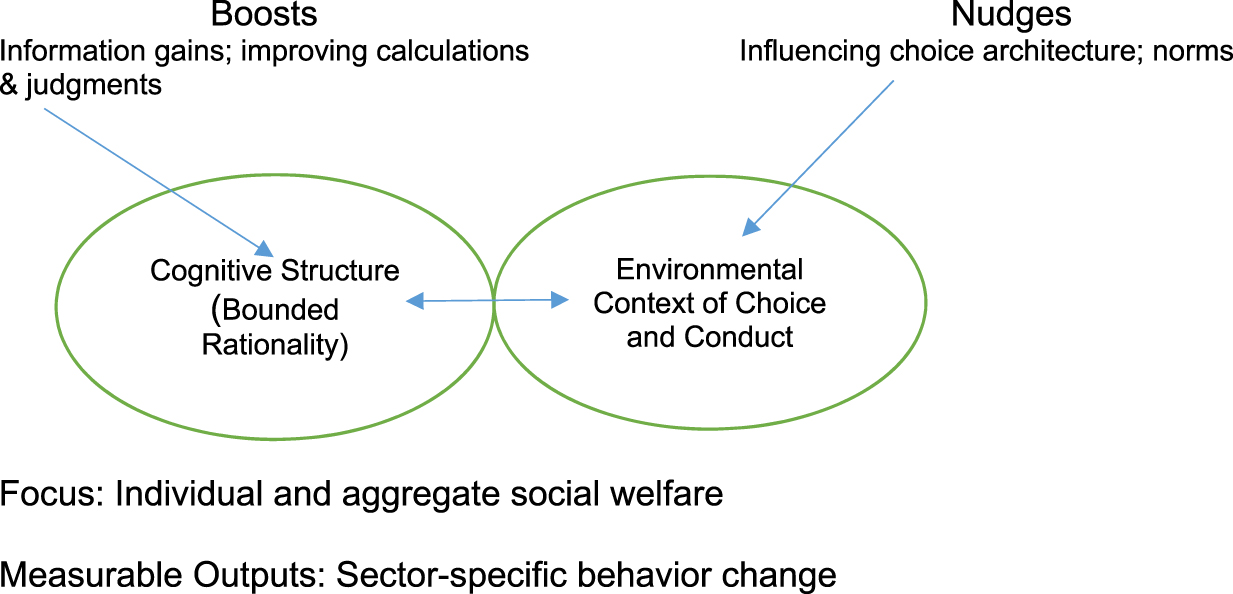
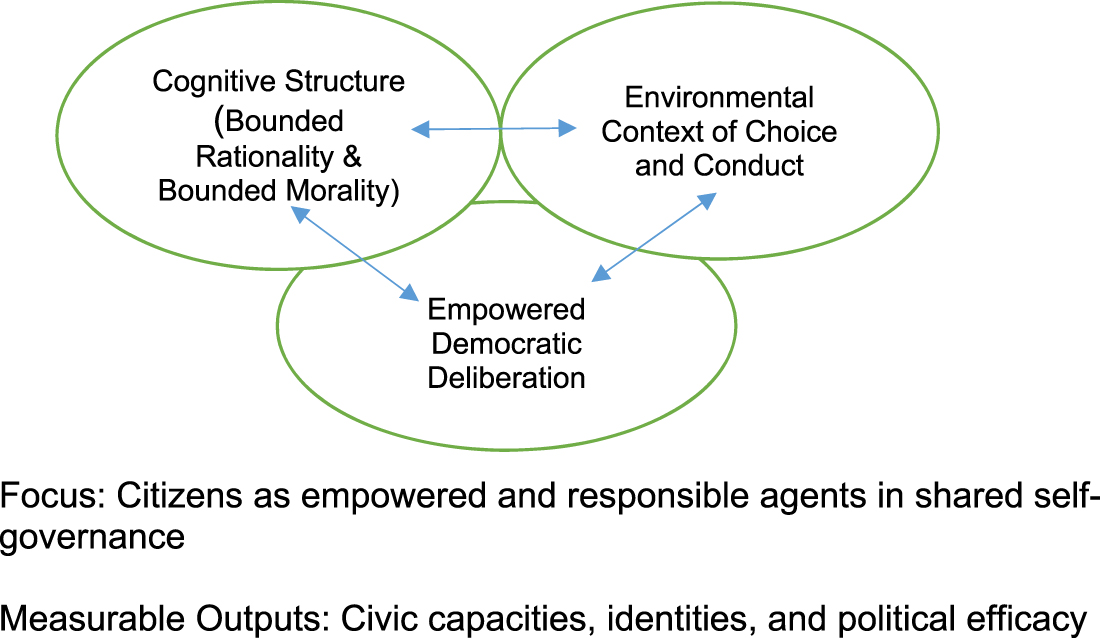
Yet as the following figures attempt to illustrate, empowered democratic deliberation can be a source of “boosts” (educational effects) and “nudges” (self-conscious changes within the institutional conditions of choice) by including rather than bypassing citizens in the meaningful consideration of public policy goals and methods. As examples like citizen juries, citizen redistricting commissions (California), citizen assemblies on constitutional and political reforms (British Columbia; Australia) and participatory budgeting (Brazil) reveal, a more active and public role for citizens in the procedures and architectural design of governance can not only crowd-in civic capacity and the exercise of political judgment but could also potentially mitigate concerns about the illegitimacy and non-transparency of the nudging state. At the same time, mini-publics have also been found to function within wider political systems as “trusted information proxies that help citizens make the most of their scarce cognitive resources.”Footnote 103
The fundamental difference between figure 1 and figure 2 is the difference between state-society (and science-society) relations defined substantially by unidirectional policy interventions within the neuroliberal state (figure 1), and political relations characterized by the empowered participation and shared responsibility of diverse citizens giving shape to the social and political world that will shape them in turn (figure 2). Figure 2 also indicates that the theory and practice of democratic deliberation must strive to incorporate the recent findings of the behavioral sciences because in this domain, as elsewhere, “new policies create new politics.” In other words, democratic deliberation is its own form of nudging: one that seeks to engage citizens’ mutual reason-giving and listening capacities and one that encourages and models the exercise of civic virtues like reciprocity.Footnote 104 In contrast to the policy nudges by behavioral architects that aim for predictable subjective choices across a range of private decisions, the choice architecture of deliberative democracy seeks to cultivate the procedural and civic conditions for coming to shared and self-conscious political agreements about the best direction for public policy and collective governance. To be sure, this latter task is unpredictable and fraught with conflict and moral disagreement. Yet if representatively diverse citizens are meaningfully incorporated within the consideration of the aims and design of various forms of choice architecture and provided with information about the nature of common decision making errors, the “as judged by themselves” criteria will be rendered more democratically robust (and more socially and epistemically sound) and the public policy outputs will thereby gain greater democratic legitimacy.
Behavioral science/elite policy interventions on individual behaviors

Empowered democratic deliberation as participatory choice architecture

The critical and normative point of these figures—and this essay as a whole—is that by maximizing institutional opportunities for empowered deliberative democracy and building additional pathways for the cultivation of civic capacity our ineluctably bounded rationality and bounded morality need not pave the way for an even more bounded democratic polity.
Conclusion
The application of the behavioral sciences to the design and implementation of public policy promises to give us smarter and more efficient government. Alongside these admirable goals I have argued that we should also be attentive to the potential high price of a depoliticized and democratically de-skilled citizenry: one that is nudged, steered, and manipulated by public agencies and administrators, but not included, empowered, or engaged in the arts and responsibilities of democratic self-governance. More empirical studies are necessary to gauge the possible consequences of nudge policies on civic capacities, political trust, and the willingness to voluntarily contribute to collective goods. Yet for nudging to be compatible with and reinforcing of democratic citizenship, more than behavioral transparency is required: citizens must also be empowered as their own choice architects in order to satisfy basic principles of democratic legitimacy and to help build long-term civic capacity at the individual and institutional level. The integration of the behavioral sciences with the design and practice of deliberative democracy points in the direction of educating citizens (and deliberative activists) about systemic and predictable errors in human decision-making alongside the consideration of public policy responses to social dilemmas. In doing so, psychological insights can be enlisted to challenge and inform the exercise of citizens’ political judgments. The integration of the behavioral sciences and democratic deliberation would also entail using the processes of public deliberation to reflect openly and critically upon the findings of the behavioral sciences and the new governing techniques that cities, states, and international organizations are increasingly adopting on the basis of their authority. The additional political advantages of empowering citizens as public choice architects include enhancing the personal and institutional capabilities for addressing the conditions of bounded rationality without compromising democratic legitimacy or aggravating trust deficits in our public institutions.