INTRODUCTION
Infectious disease researchers tend to think of ‘their’ disease in isolation, but in real life diseases happen together. The study of the heterologous immunity that occurs between such concomitant infections can have outcomes of immediate value. But more importantly, the basic biological concepts unearthed along the way have yielded secrets that have proved to have broad applicability. This review summarises where the study of the immunity observed when two unrelated infectious agents encounter each other in the one host has led our group, and thereby allowed others to be influenced by the literature that has developed.
These days our laboratory investigates the pathophysiology of the syndrome seen in severe falciparum malaria in children, as described by several groups working in Africa (Taylor, Borgstein & Molyneux, 1993; March et al. 1996), which typically includes metabolic acidosis and associated respiratory distress, hypoglycaemia, seizures, coma and cerebral oedema. I entered this area about 20 years ago, with no apparently relevant credentials, by making the then unlikely suggestion that excessive systemic production of pro-inflammatory cytokines, such as TNF (tumour necrosis factor) plays a key role in human malarial disease, gram-negative bacterial infection and the Jarisch-Herxheimer reaction (Clark et al. 1981). As its name implies, TNF was previously known only as a mediator that killed tumour cells, and until our interest in it had been worked on only by the Sloan Kettering group who named it. Cytokine-induced nitric oxide generated by inducible nitric oxide synthase (iNOS) was subsequently added to this model (Clark, Rockett & Cowden, 1992b). The harmful systemic effects of excess iNOS are now well recognised, with an ample literature (Ruetten et al. 1996; Schwartz et al. 1997; Numata et al. 1998) documenting the protective effect against illness of specific iNOS inhibitors in circumstances where pro-inflammatory cytokine levels are increased.
These concepts now drive much current work on malarial disease pathogenesis (Burgner et al. 1998; Kun et al. 1998; Knight et al. 1999; McGuire et al. 1999), and have paved the way to similar investigations in many other infectious diseases. While this work was effectively a revival of Brian Maegraith's insights of the 1940s (Maegraith, 1948) on malarial disease being a systemic inflammation, they actually arose, not from studying patients, but from trying to understand the basic nature of heterologous immunity between different parasites in mouse models. This review is about how experiments on heterologous immunity led us to the concept of involvement of the same pathways, involving the same mediators, in both host protection and host illness. This cast fresh light, from an unexpected quarter, on the nature of malarial disease, and our malaria experiments have in turn provided information that has fed back into understanding heterologous immunity, as well as giving a philosophical background into vaccine development.
BABESIA AND MALARIA
My interest in heterologous immunity, or immunity between phylogenetically unrelated organisms, began 25 years ago with Frank Cox pointing out to me the implications of the observations he had made a few years earlier that certain mutually cross-protecting malaria parasites (Plasmodium chabaudi and P. vinckei) also cross-protected with Babesia microti and B. rodhaini, but not with P. berghei or P. yoelii (Cox, 1970). Cross-reacting antibodies could not account for these observations, which went against all the rules of the specific antibody-dependent immunity thought, in those days, to control these infections. This effect was most graphically illustrated some years later by demonstrating the elimination of high densities of P. vinckei, a normally lethal malaria parasite, when it was present during the crisis phase of infections with the non-fatal organism, B. microti (Cox, 1978).
We were then trying to understand what killed B. microti and P. chabaudi parasites inside circulating red cells during the resolution of these infections (Clark et al. 1975), where antibody could not reach them. The manner of death of these parasites was in keeping with the ‘crisis forms’ described in monkeys in the 1930s (Taliaferro & Cannon, 1936). Cox's results encouraged us to see just how phylogenetically different an organism could be from Plasmodium or Babesia and still act in this heterologous protective fashion against these haemoprotozoa. On the hunch of a colleague, Jean-Louis Virelizier, that a newly-described type of interferon, later termed interferon-γ, might be involved (Salvin et al. 1975), we infected mice i.p. or i.v. with live BCG (the Bacillus Calmette-Guérin strain of Mycobacterium tuberculosis) several weeks before infecting them with haemoprotozoa. This was dramatically protective, particularly against B. microti, but also against malaria (Clark, Allison & Cox, 1976). Most revealingly, the parasites again died in circulating red cells, within 12 hours of being injected, and independently of antibody. The immunity was as strong and durable as that seen after recovery from a primary infection (Clark et al. 1977b). Killed Corynebacterium parvum had the same effects (Clark, Cox & Allison, 1977a). Again, protection against blood forms of B. microti and B. rodhaini was absolute, with no parasites being seen on smears, then or after repeated challenge.
BACTERIA RICKETTSIAS AND INTRA-MACROPHAGE PROTOZOA
These results made us realise that we were dealing with a much wider question than we had originally thought, in that both BCG and C. parvum had been long-recognised to protect against tumours (Old, Clarke & Benacerraf, 1959; Halpern et al. 1966), bacteria (Dubos & Schaedler, 1957; Howard et al. 1959; Collins & Scott, 1974) and macrophage-dwelling protozoa (Swartzberg, Krahenbuhl & Remington, 1975; Smrkovski & Larson, 1977). These parallels continued to hold as we widened our range of macrophage-activating agents that gave this protection to include Brucella abortus Strain 19 (Herod, Clark & Allison, 1978), an extract of Coxiella burnetii (Clark, 1979b), and live Salmonella enteriditis and Listeria monocytogenes (Clark, 1979a). We also became aware that other researchers, as puzzled as we were, had been reporting that these infectious agents cross-protected against each other (Nyka, 1957; Jespersen, 1976; Zinkernagel, 1976). Such unexplained cross-protections could be as strong as the real thing – in fact, in our hands an extract of Coxiella burnetii, a rickettsia, would protect mice against the bacterium L. monocytogenes more effectively than would recovery from L. monocytogenes itself. Most importantly, our results with haemoprotozoa provided an irrefutable answer to the question of whether these organisms were being killed by enhanced phagocytosis or by the release of soluble mediators from macrophages, with broad-spectrum effects. With our organisms dying inside circulating erythrocytes instead of within macrophages, we could be in no doubt that the mechanism in our case, and conceivably in others as well, was a soluble factor released from macrophages, a concept beginning to emerge in this field (Sharma & Middlebrook, 1977).
TUMOUR NECROSIS FACTOR
Where to head next? The most widespread characteristic of our protectants was that most of them, including BCG (Old, Clarke & Benacerraf, 1959), C. parvum (Halpern et al. 1966), Listeria (Youdin, Moser & Stutman, 1974), Salmonella (Hardy & Kotlarski, 1971) and Coxiella burnetii (Kelly et al. 1976), had been shown to be effective against tumours as well as, in our hands, against protozoa inside red cells. Since tumour cells, on size alone, had almost as good a case as protozoa inside circulating red cells to be resistant to phagocytosis, we became increasingly interested in a mediator termed tumour necrosis factor, or TNF. This had recently been described by Carswell and co-workers at the Sloan Kettering Institute in New York, who were seeking an explanation for the protective effect of BCG and C. parvum against experimental tumours (Carswell et al. 1975; Helson et al. 1975; Green et al. 1977). At that time bacterial lipopolysaccharide (LPS) was the only known trigger for TNF release and it also released endogenous pyrogen (subsequently termed interleukin-1). Logically this was the cause of the recurrent fever in malaria, known since last century to begin about 2 hours after the post-schizogony disruption of the red cell that begins each cycle of multiplication of the erythrocytic stage of malaria parasites.
There had been an assumption for about 100 years that schizogony releases some undefined toxin of parasite origin that acted directly on the host to cause illness (reviewed by Kitchen, 1949). We added to this the proposal that such a toxin acted indirectly by inducing host cells to release various harmful mediators, including TNF (Clark, 1978). These were then termed lymphokines and monokines, but as their cellular sources became known to be very diverse they were soon collectively termed cytokines and were realised to be central to the inflammatory response. Since injecting LPS into early-stage malarial mice rapidly (hours) mimicked the pathological changes that normally were not observed until the infections reached their terminal stage, we proposed that these lymphokines and monokines, when produced excessively, caused the fever, hypoglycaemia, bone marrow depression, consumption coagulopathy, hypergammaglobulinemia, hypotension and rise in serum levels of acute phase reactants seen in both endotoxicity and malaria (Clark et al. 1981; Clark, 1982b). Meanwhile, we had done collaborative experiments with the Sloan Kettering group in which malaria infection proved to prime mice for TNF production as effectively as did BCG or C. parvum, and serum containing TNF inhibited in vivo multiplication of Plasmodium vinckei (Clark et al. 1981). Others subsequently reported that rabbit serum rich in TNF inhibited in vitro growth of P. falciparum (Haidaris et al. 1983). We could not detect TNF activity in terminal P. vinckei serum, but proposed that this failure was simply because the assays of the day were too insensitive, a prediction subsequently borne out when the advantage of adding actinomycin D to the bioassay became known (Grau et al. 1987; Clark & Chaudhri, 1988b).
MALARIA AND TNF
In due course recombinant TNF became available and we were able to show that it would reproduce the predicted malaria-like pathology in mice. Much less TNF was required in mice carrying a non-symptomatic low load of malaria parasites (Clark et al. 1987a), in hindsight because their IFN-γ levels were increased. Likewise, TNF proved to be an excellent emulator of the signs and symptoms of human malaria, in the form of the side-effects caused when it was given therapeutically to tumour patients (Creagan et al. 1988; Spriggs et al. 1988). By this time TNF had also begun to be recognised as a mediator of the pathology of gram-negative bacterial infections, as we had proposed earlier (Clark et al. 1981), and the first experiments with it in this context were being reported (Tracey et al. 1986, 1987a, b). We were also able to show that recombinant TNF inhibited in vivo growth of P. chabaudi (Clark et al. 1987b), and could cause foetal loss (Clark & Chaudhri, 1988a) as well as erythrophagocytosis and dyserythropoiesis (Clark & Chaudhri 1988b), all of which are associated with malaria infection. Moreover, TNF generation was noted in human monocytes co-cultured with rupturing schizonts (Kwiatkowski et al. 1989) and it began to be found in the circulation of malarial patients in proportion to their severity of illness (Grau et al. 1989; Kern et al. 1989; Butcher et al. 1990; Kwiatkowski et al. 1990). Thus, as has been reviewed (Clark, 1987a, b; Clark, Chaudhri & Cowden, 1989), TNF escaped from the confines of the tumour world and began to be seen as a bona fide mediator of both cell-mediated immunity against malaria parasites and the pathophysiology of the disease itself. Over this period it was realised that TNF was simply one of a number of pro-inflammatory cytokines interacting in these circumstances and was countered by a series of anti-inflammatory cytokines, as well as by soluble forms of the cytokine receptors. New members of the TNF family, such as fas ligand (Helmby, Jonsson & Troye-Blomberg, 2000; Matsumoto et al. 2000) have recently appeared on the scene and will no doubt be explored in as much detail as was TNF. All of this adds complexity, but no difference in principle.
MALARIA AND NITRIC OXIDE FROM INOS
As noted, circulating levels of TNF had been associated with the illness of falciparum malaria, particularly its coma, but this did not immediately suggest how loss of consciousness could occur. Proteins such as these cytokines require a number of subsequent signalling steps before they can influence function and nitric oxide generated by iNOS has come to be recognised as a major candidate for the next step along this pathway. Undoubtedly all of us in this area were greatly influenced by John Hibbs' seminal work on nitric oxide as an effector molecule of macrophage origin (Hibbs et al. 1988). The connection of nitric oxide with malarial disease came from linking two observations in unrelated research areas, one that TNF induced nitric oxide release from mammalian endothelial cells (Kilbourn et al. 1990) and the other that normal excitatory synaptic activity depended on nitric oxide (Garthwaite, Charles & Chess-Williams, 1988). Since nitric oxide is a non-polar gas that can, like oxygen and carbon dioxide, diffuse freely across cell membranes, it seemed plausible to us that circulating TNF, particularly if concentrated at the site of rupture of sequestered schizonts, could thus influence synaptic function within the brain. Accordingly, we proposed a link, through iNOS-induced nitric oxide, for how TNF could reversibly alter the function of the central nervous system during falciparum malaria (Clark, Rockett & Cowden, 1991; Clark et al. 1992a).
It has not been easy to establish this connection between nitric oxide and systemic disease, chiefly because of difficulty in assaying for this short-lived molecule, which is active only a very short distance from its cell of origin. Nevertheless, there has been much recent activity in this area, with various groups expressing their interest in the effects of nitric oxide against both P. falciparum (Rockett et al. 1991) and the human host, by assaying plasma, urine or cerebrospinal fluid from malaria patients for nitrites and nitrates, the stable oxidation products of nitric oxide (Cot et al. 1994; Prada & Kremsner, 1995; Al Yaman et al. 1996; Anstey et al. 1996; Dondorp et al. 1998). Difficulties in the interpretation of these data include estimating how much nitric oxide is actually converted to these anions and knowing precisely where the nitric oxide is being generated. To overcome these obstacles others are employing immunohistochemistry to detect iNOS and nitrotyrosine, a biochemical footprint for nitric oxide production in autopsy samples.
AN OVERVIEW OF HETEROLOGOUS IMMUNITY
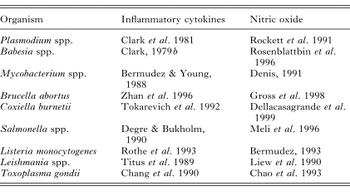
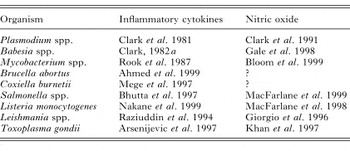
As shown in Tables 1 and 2, the set of principles we developed to help us understand why BCG and C. parvum protected against babesia and malaria were, in hindsight, a model for heterologous immunity as a whole. As noted, a literature has developed that implicates TNF and related cytokines, as well as nitric oxide, in the protective host response against, and the disease caused by, the range of organisms noted in this review to be involved in heterologous immunity. Table 1 gives the earliest apparent examples of arguments for the involvement of these mediators in killing the infectious agent, and Table 2 reports their involvement in generating the disease caused by that organism. The two question marks in the nitric oxide columns are largely because the area has not yet been explored and at least one group has recorded being unable to demonstrate protection against Coxiella burnetii being mediated by nitric oxide (Dellacasagrande et al. 1999).


The list of known protective heterologous interactions is still incomplete, with, for example, recent evidence for Plasmodium vinckei protecting against subsequent Salmonella enteritidis infection (Lehman, Prada & Kremsner, 1998), with nitric oxide being the probable mediator of the effect. This observation has practical implications as well as adding to basic knowledge, since dual infections with these genera are common in the wet tropics. In a recent study in Cameroon, for example, 17% of 200 acute malaria cases were also infected with typhoid (Ammah et al. 1999).
IMPLICATIONS FOR VACCINES
Vaccines designed to induce a strong specific antibody-based immune response against the organisms listed in the tables have, at best, not been very effective or long lasting. With some of these parasites it is accepted that this is because the immunity that develops during natural infections is cell mediated, another way of saying that they rely on the same mediators as does heterologous immunity. Observations that led to the argument that children exposed to Plasmodium vivax have a degree of protection against P. falciparum (Maitland, Williams & Newbold, 1997) may have this mechanism as part of their explanation. The steps along the pathway of antigen recognition to effector molecule are, however, still imperfectly understood, as is its potency compared to humoral immunity. Research to develop and refine vaccines based on this cell-mediated immunity is still hampered by insufficient knowledge of how they actually work, combined with an inability, to date, to develop in vitro or in vivo correlates of their potency. The usual assumption is that this response is a primitive initial mechanism that protects the host until specific immunity, typically based on antibody, gets underway. But this is often untested and the possibility that the non-specific system is in fact never superseded warrants closer investigation in some of these parasites.
Probably the best known example of how strong heterologous immunity can be is that seen in B. microti in the mouse. Certainly no mechanism of immunity stronger or more durable than that induced in this model by BCG, killed C. parvum or C. burnetii extract would ever be needed for absolute protection against an invading organism. For example the protection BCG gives in this circumstance has been shown to be fully active for many months, to protect against a massive challenge (109 organisms) and to do so through a mechanism that causes intra-erythrocytic pyknosis of the challenge dose of parasites in the absence of antibody (Clark et al. 1977b). It also protects absolutely, with parasites beginning to die inside red cells within hours of injection, against 109 Babesia rodhaini, which is invariably fatal in normal mice when just one parasite is injected. As these authors noted, all of these findings are characteristic of natural immunity against this parasite. Thus it is plausible that no specific antibody-based immune mechanism ever becomes dominant in B. microti-infected mice and that generating a vaccine on these principles would be correspondingly difficult. In this way, the susceptibility of a parasite to heterologous immunity could well be a marker of its susceptibility to cell-mediated compared to humoral immunity, useful information when planning to develop a vaccine against it. For example, BCG protected less solidly against Plasmodium yoelii than against B. microti (Clark et al. 1976) and humoral immune responses appear to play a correspondingly larger role (Matsumoto et al. 1998).
By this circuitous route, the heterologous immunity reported between babesiosis and malaria in mice (Cox, 1970) has led to the cytokine theory of disease pathogenesis and has also uncovered the role of these mediators in the host response against a wide range of infectious organisms. It also has provided useful background information for vaccine researchers. This will continue to be a growth area in parasitology.