Introduction
Why is it that objects which are travelling along, when they come into collision with anything, rebound in a direction opposite to that in which they are naturally travelling, and at similar angles. Is it because they move not only with the impetus which accords with their own nature but also with that which is due to the agent which throws them? … Now every object rebounds at similar angles, because it is travelling to the point to which it is carried by the impetus which was imparted by the person who threw it; and at that point it must be travelling at an acute angle or at a right angle. … As then in a mirror the image appears at the end of the line along which the sight travels, so the opposite occurs in moving objects for they are repelled at an angle of the same magnitude as the angle at the apex … and in these circumstances it is clear that moving objects must rebound at similar angles.Footnote 1
Here is the ancient Greek claim that rebounding bodies obey the optical law of reflection, with an appeal to the geometry of image location as an explanation for such motion. This constitutes an analogy of rebound as reflection. The analogy of reflection as rebound had been made much earlier by Aristotle in his analysis of echoes: what is called rebound in relation to sound is called reflection in relation to light; that is, repercussion.Footnote 2 Of the two, the analogy of rebound as reflection most clearly sanctions the applicability of geometrical optics to the collision of bodies, while the analogy of reflection as rebound most clearly sanctions an interpretation of the relevant geometry in terms of physical projection. Taken together they sanction the gradual development of a dynamical theory of rectilinear motion and collision within optics. With the anti-Aristotelian mechanization of light in the early seventeenth century, this mature dynamical theory of rectilinear light motion and collision also became generalizable to material rectilinear motion and collision. This transition from the optical tradition to mechanics has three main stages: the introduction and development of the mechanical analogy of reflection within optics, the concretization of this analogy by the generalization of principles of reflection to material bodies in rectilinear motion, and the identification and axiomatization of certain optical principles generalizable to all instances of impact/impulse. This paper is designed to guide the reader along this path in order to reveal the extent to which the new science of mechanics was built upon light.
The optical tradition
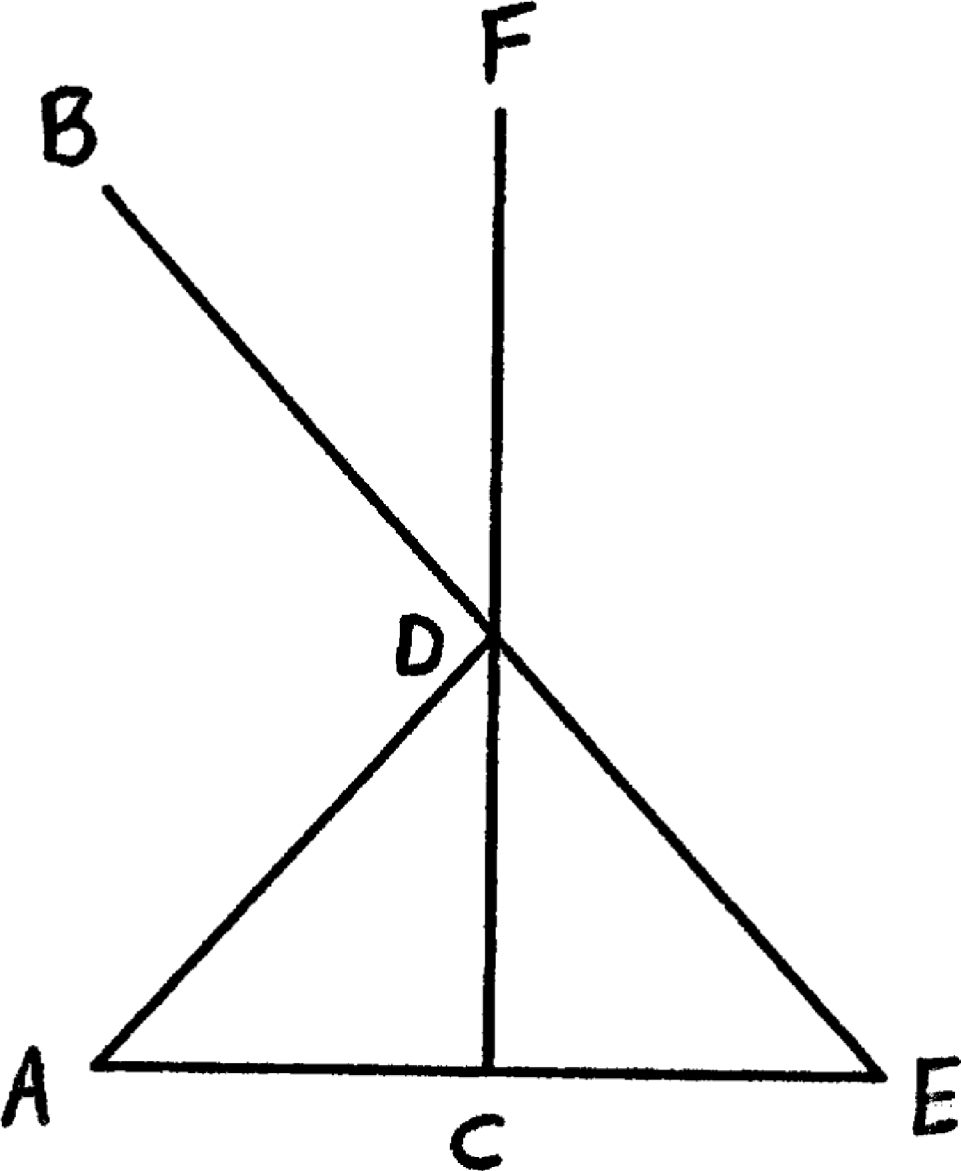
Let us begin with the above analogy of rebound as reflection. Though there was no accompanying diagram, the author was undoubtedly familiarFootnote 3 with this figure for image location (Figure 1Footnote 4). Here we have the mirror GD, the eye B, object A, the reflected visual ray BDA and the image E appearing at the end of the line of sight BDE. The meaning of the above claim now becomes clear. Since an object in rectilinear motion BD able to continue in a straight line through the mirror to E (the image's location) would make the angle GDE behind the mirror surface, its repelled motion will make the same angle in front of the mirror surface as do similarly repelled visual rays, as GDA. In other words, since a moving body cannot reach the point E due to the obstacle, it rebounds to the opposite point A with the same angular relation to the surface.Footnote 5 This abstraction from physical differences between a ray and a moving body in favour of a purely geometrical identification of their rectilinear motions represents an important conceptual development. We shall now turn to the optical tradition of treating reflection (and refraction) as an impact phenomenon, which greatly reduces the conceptual distance between mechanical rebound and optical reflection created via Aristotelian physics and a non-kinematical notion of light.Footnote 6
Euclid: reflection and image location.

Hero and Ptolemy
Hero of Alexandria's Catoptrics Footnote 7 introduces the core mechanical analogy of reflection into the optical tradition itself via analogies between projectile motion and visual rays. He links the dynamics of physical projection to an object's tendency to rectilinear motion, arguing that what moves most swiftly moves rectilinearly.Footnote 8 He provides an atomistic account of matter through which he seeks to make the compactness of walls comparable with that of mirrors. Just as stones or balls do not find entry through the compact surfaces of walls, so neither do rays upon mirrors.Footnote 9 Moreover, he ascribes a force of motion to the stone and argues that the force of motion in the case of visual flux also causes its rebounding according to the law of reflection at equal angles, for the combined paths of incidence and reflection are always the minimum possible distance between eye, surface and object. Swift physical projection entails not only visual rays' rectilinear motion but also their reflection at equal angles on encountering a compact obstacle.Footnote 10
Early in his Optics,Footnote 11 Ptolemy extends this mechanical analogy of visual rays by providing an explanation for the qualitative differences in acuity of vision and intensity of illumination in terms of their rays' angles of incidence or impact (as opposed to differences due to a greater or lesser number of such rays). The variable intensity of such rays is explained as instances of a general physical principle governing the variable impact forces of falling bodies.Footnote 12 Later, he analyses the resistance which obstacles offer to projectiles in perpendicular and tangential motion in terms of perpendicular resistance (or opposition) to explain the physical basis of the geometrical law of reflection:
The relationship of equality between the angles … is easily adduced, as is the fact that it follows a natural course. For projectiles are scarcely obstructed by objects they strike at tangents, whereas they are obstructed to a considerable extent by objects that resist them [directly] along the line of projection. Accordingly, when anything stands directly in the way of these projectiles and stoutly resists them, it interrupts and opposes the line of projection extending to the origin [of motion], just as walls obstruct balls that strike them at right angles. But obstacles [disposed at a tangent] pose no obstruction at all, just as curved bucklers do not obstruct arrows. It should be borne in mind that this explanation extends to all sorts of moving objects, and it should be understood that they all act in such a way. The action of the visual ray itself must therefore follow this rule, and any of the rays that approaches a mirror and then bounces back from it must maintain the disposition that occurs in the paradigm case – i.e. that the angle formed by the line normal to the mirror at the point of reflection and the line of incidence be equal to the angle formed by the same normal and the line of reflection.Footnote 13
Ptolemy here proposes a physical explanation for the equality of angles in terms of the degree of resistance projectiles encounter on impact. Perpendicular incidence entails maximum resistance, and the object rebounds back along the same line of projection (for example, a ball directly against a wall). Tangential incidence entails no resistance, and the object's motion parallel with the obstacle's surface is unaffected (for example, an arrow along a bow-handle). In oblique incidence, the degree of resistance determining a projectile's rebound angle from the obstacle is determined by its incident angle upon the obstacle. Taking this physical explanation as a general rule covering ‘all sorts of moving objects’, Ptolemy includes the motion of a visual ray, such that the magnitude of its deviation from impact at right angles to the obstructing surface is also the magnitude of its deviation from rebound at right angles to the obstructing surface.Footnote 14 Here, reflection is taken to be the paradigm case of rebound and must therefore follow exactly the general rule governing such physical phenomena, i.e. the geometrical law of equal angles.
Ibn al-Haytham
The physico-mathematical analysis of reflection and rebound in terms of physical projection was further developed via Ibn al-Haytham's dynamical approach in his Optics. Footnote 15 In rejecting the extramissionist theory of vision and its concept of visual rays,Footnote 16 al-Haytham focuses on the reflection of physical light. His dynamical analysis of reflection as a rebound phenomenon thus becomes fully applicable to material rebound. Like Hero, al-Haytham bases his physical explanation of reflection at equal angles upon the force of rapid motion persisting in light and its encounter with a resisting surface.Footnote 17 Like Ptolemy, he appeals to the perpendicular rebound of a ball-like body in the case of natural, downward motion; however, his example of violent (projectile) motion is an arrow being shot horizontally against a mirror; that is, against the very same polished surface from which light rebounds.Footnote 18 This clearly indicates that his dynamical explanations of rebound and reflection are conjoined. He then elaborates upon Ptolemy's conception of oblique incidence as a mean between two orthogonal extremes, positing that motion along this oblique line has two components: one perpendicular to the repelling surface, the other parallel to it. He first explicates this via implicit reference to the geometry of image location; that is, as if the body were to pass through the obstacle's surface unhindered (see Figure 1). However, unlike the Problemata's appeal to similar angles formed above and below the surface line, al-Haytham here argues that the oblique motion of a body or light ray below the surface would maintain the same perpendicular and parallel components it has above the surface:
When the body descends along a sloping line, the line of descent falls between the perpendicular to the surface of the polished body (passing through that body) and the line in the surface orthogonal to this perpendicular. And if the motion were to penetrate beyond the point of its incidence, finding free passage, this line would fall between the perpendicular passing through the body and the line in the surface orthogonal to the perpendicular, and it would maintain the same measure of position with respect to the perpendicular passing [through the body] and the other line orthogonal to that perpendicular.Footnote 19
Al-Haytham's clear geometrical formulation of Ptolemy's physical intuitions of the forces involved in oblique rebound is original. How he achieved this is unknown, yet a kinematically identical analysis of compound rectilinear motion within the Greek tradition was available to al-Haytham through Hero's Mechanica:Footnote 20 this is the parallelogram rule.Footnote 21 Hero resolves a geometrical point's motion along a diagonal line into two perpendicular components, and also applies this at a specific location (position) along the line. The compatibility of the parallelogram rule's representation of diagonal motion and the geometry of oblique incidence makes al-Haytham's linking of the two a reasonable explanation for his geometrically refined analysis of oblique incidence and reflection/rebound within optics. In this way, al-Haytham would effectively transfer the parallelogram rule's kinematical analysis of a geometrical point's rectilinear motion from the geometrical foundations of ancient Greek mechanics to the optical analysis of rectilinear impact and rebound/reflection, positing a dynamical interpretation of the rule's perpendicularly related, rectilinear components of motion.Footnote 22
Al-Haytham is thus able to conduct a sophisticated analysis of rebound/reflection. Firstly, he interprets the components of oblique rectilinear motion as dynamical magnitudes. Secondly, he demonstrates that the perpendicular component of motion/force in oblique incidence is alone opposed by the surface, which resists the motive force of the body or light ray and so repels it with equal perpendicular magnitude, while the parallel component, since it in no way opposes the surface, is neither diminished nor altered by the impact. Thirdly, he demonstrates that the ratio between a body's/ray's two components of motion/force remains constant both before and after impact; that is, no matter what position on the line of incidence one chooses, the one position sharing the same magnitude of perpendicular motion/force on the line of reflection will also share the same magnitude of parallel motion/force.Footnote 23
Though this is a thoroughly mechanical treatment of reflection based upon a sophisticated analysis of the rectilinear impact and rebound of material bodies, al-Haytham is careful not to claim a complete identity between rebound and reflection, for rebounding bodies cannot maintain the rectilinear line of reflection due to their natural tendency to fall downwards, whereas light has no such tendency. Light reflection is the paradigm case showing how bodies would move/rebound if they did not possess a heavy nature.Footnote 24 Al-Haytham also lacks an atomistic view of light as the locomotion of material particles. Rather, it is the rectilinear transmission of its power or form of heat through a material medium, modelled on the action of fire upon the surrounding air and nearby objects.Footnote 25 Nevertheless, his physico-mathematical treatment of reflection to explain the rebound at equal angles of light and bodies from resisting surfaces represents a high watermark in the conceptualization of collision phenomena unsurpassed until the seventeenth century.
Concretization: light and laws of motion
Harriot: a doctrine of material reflexions
In the late sixteenth century the non-Aristotelian and Neoplatonic natural philosophies of Giordano Bruno and Francesco Patrizi reasserted the explanatory importance of light outside optics by each establishing light as one of their basic theoretical principles.Footnote 26 This no doubt influenced the so-called Northumberland SchoolFootnote 27 by reinforcing the theoretical importance of optical principles for understanding the (re-emergent) atomistic view of Nature. Initially, the rectilinear propagation of particles and force was seen as the most fundamental issue, so principles of light metaphysics were employed.Footnote 28 When the issue of the rectilinear impact/rebound of elementary particles became important, principles of light mechanics came more into focus. Interest in such principles grew with the popularity of ‘table billiards’ among the aristocracy in Europe around the 1570s and 1580s.Footnote 29 Moreover, in 1572 al-Haytham's Optics was published for the first time, together with Witelo's work.Footnote 30 Someone studying the mechanical principles of rectilinear incidence and reflection/rebound contained in these works might easily see their relevance to the rectilinear impact and rebound of billiard balls. The first person to do so was Thomas Harriot.Footnote 31
By the late 1590s Harriot had carefully studied al-Haytham's Optics and Witelo's Perspectiva, had begun measuring refraction in water and glass,Footnote 32 and declared an intention to ‘commence war against the Aristotelians’.Footnote 33 Reading al-Haytham's book, Harriot would have found that the Arab scholar had taken seriously Ptolemy's suggested grounding of the geometrical law of reflection in the physics of mechanical rebound,Footnote 34 analysing the latter to explain the cause of light's reflection in line with the former. Besides the perpendicular composition of motions discussed above, Harriot undoubtedly came across several dynamical principles of mechanical rebound: (i) ‘the force of reflected motion will be proportional to the force of incident motion and the force of resistance’; (ii) ‘the distance covered by reflected motion relative to the obstacle will be proportional to the distance covered by the incident motion relative to the obstacle’; (iii) ‘The second [rebound] motion is acquired by the moveable (or mobile) from [this] same resistance’,Footnote 35 where the incident motion is annulled; (iv) ‘the force of resistance is proportional to the force of the first [incident] motion and proportional to the absence of any [additional] effect of the obstacle’; and (v) resistance/repulsion in rebound acts only along the perpendicular.Footnote 36 These dynamical insights concern the rebound of movables against hard surfaces, whether by natural (usually perpendicular) or violent (usually oblique) motion – just as light falls upon reflecting surfaces either perpendicularly or obliquely.
Harriot had also read Kepler's Optics,Footnote 37 which emphasizes the methodological principle of conjoining the motion of light with the motion of bodies.Footnote 38 Kepler gives a dynamical explanation of repercussion covering both light reflection and mechanical rebound,Footnote 39 employing the principle of composition of motions,Footnote 40 and stresses the equality of action and effect in his physical explanation of the geometrical law of reflection.Footnote 41 Crucially, he goes on to provide a geometrical demonstration of his argument, employing both the image location diagram of Euclid's demonstration of the law of reflection in his Catoptrics (see Figures 1 and 4) and the generalization of its principles from light to bodies – found explicitly in the Pseudo-Aristotelian Problemata Footnote 42 and, implicitly, in al-Haytham's Optics.
Al-Haytham's and Kepler's physico-mathematical analyses of impact and rebound both involve impact against an immovable obstacle, in which the ideal case of mechanical rebound in line with the geometrical law of reflection is clearly manifest. In order to fit the different physical situation of mutual mechanical collisions, where the mechanical rebound of bodies need not follow this optical law,Footnote 43 the optically based construction of a theory of mechanical impact required conceptual refinement. Harriot undertook this task by seeking to demonstrate that bodies in collision did not always obey the optical law of reflection, as was commonly thought at the time. In this way, the kinematics and dynamics of reflection constitute the ‘first principles’ on which Harriot constructed his ‘doctrine of reflexions’ (De reflexione corporum rotundorum).Footnote 44 He is the first explicitly to employ the geometry of a parallelogram in analysing perpendicularly related components of oblique material collision. In generalizing this composition of motion from light mechanics to colliding balls, he employs a novel rhomboid parallelogram.Footnote 45 He also includes the dynamical principle that the force of impact and resistance acts only along the line perpendicular to the obstacle's surface at the point of impact. This is the above-mentioned principle (v) that Harriot came across in al-Haytham. Harriot's rhomboid parallelogram is the key to his theory. He sets out basic dynamical principles which govern the construction of its diagonal, through which the forces of impact and resistance act. Combining the resultant diagonal with a ball's incident motion allows the parallelogram's completion and hence the ball's path of reflection/rebound.
Harriot states that the rebound motion is composed of two nutus: the incident nutus, which is only deflected on impact, and a new nutus imparted by the other body on impact.Footnote 46 Here Harriot rejects al-Haytham's annulment of incident motion, expressed in (iii) above, in favour of its deflection, expressed in Kepler's Optics, Proposition 18. The line along which this new nutus acts is, of course, the same perpendicular line through which the force of impact/resistance acts in optical reflection, in conformity with al-Haytham's (v) above. This is the line along which the parallelogram's diagonal is constructed, because the perpendicular component of obliquely incident motion ‘determines the forces or active powers of the two colliding bodies’.Footnote 47
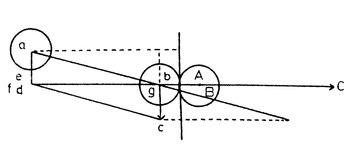
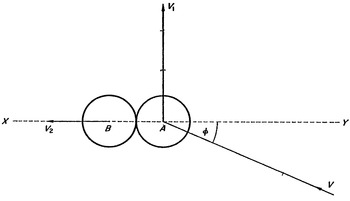
The principles employed in the construction of this diagonal are encapsulated in three distinct motive acts, by which Harriot calculates the total quantity of rebound motion. Firstly, Harriot treats the case of equal bodies (or billiard balls) where one is at rest. Here, the ball at rest resists the incident ball with a force equal to the force of incident motion.Footnote 48 This principle assumes al-Haytham's (i) and (iv) above, and provides the first part of the diagonal (bd, Figure 2). It is this force of resistance that prevents the incident ball from continuing along its line of motion, as if it were travelling unhindered, and is equal to the perpendicular component (db) of the incident motion (ab).Footnote 49 This new line of nutus (bd) constitutes the diagonal (bd), and the parallelogram for this type of collision can be completed (abcd): Ball b rebounds to c, at right angles to the rebound motion of ball B to C. In line with Kepler's Proposition 19, the perpendicular component of b's motion (db), which on impact entails B's rebound motion BD, is equal and opposite to B's resistant force bd. It is this nutus (bd) of B that, on impact, resists b's motion along its incident line beyond B with a perpendicular component equal to db (indicated, though unlettered, in Figure 2). Harriot's dynamical understanding of this type of collision corresponds to that of contemporary mechanics (abc, Figure 2=VAV 1, Figure 3; BC, Figure 2=BV 2, Figure 3).Footnote 50
Harriot's motive action one (c.1619) (movable obstacle).

Oblique impact of billiard balls (1972). Simplified diagram from C. B. Daish, The Physics of Ball Games, London, 1972, 159.

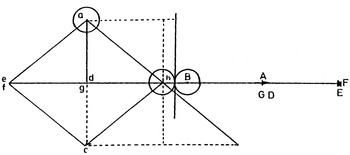
Secondly, Harriot treats the case where the obstacle ball is also moving in line with the other's perpendicular component, and provides equal resistance according to both its equal size (bd) and its equal quantity of motion along the perpendicular line (AB) (Figure 5).Footnote 51 This principle extends al-Haytham's (iv) above, by making allowance for the increase in an obstacle's effect, via its motion. This provides the second part (de, equal to AB) of the diagonal. Combining these two motive actions gives the diagonal be, and the parallelogram for this type of collision can be constructed (abce). Ball b rebounds to c while ball B rebounds to E. Harriot's reliance on optical principles is evident in his appeal to the geometry of image location and its mechanical application found in Kepler's Optics (Figure 4),Footnote 52 including the drawing of a tangent line at the point of impact to represent a reflecting surface.Footnote 53
Harriot's motive actions 1 and 2 (moving obstacle).

Kepler on mechanical rebound.

Thirdly, in treating the case of unequal bodies in mutually oblique motion, Harriot develops further al-Haytham's (iv) above, by incorporating into his calculation of forces (or active powers) the effect of size differentiation. The greater body impacts upon the lesser with a force greater than if they had been of equal size – as calculated in the first motive act; so, if it is bigger than the other by, say, one-third, then one-third of the nutus be must be added onto it to give ef, resulting in the final nutus bf (Figure 7).Footnote 54 This is because the excess in size would increase both its force of resistance simply as an obstacle at rest (bd, due to motive act one) and its force of resistance as a moving obstacle (de, due to motive act two). Once this diagonal is completed (bf), the parallelogram for this type of collision can be constructed for ball b (abcf). Ball b rebounds to c. Footnote 55
Harriot's motive actions 1 and 2 (immovable obstacle).

Harriot's motive actions 1, 2 and 3.

Having provided the dynamical and geometrical principles of his ‘doctrine of reflexions’, Harriot demonstrates three corollaries:
First in what cases the angles of reflection are equal to the angles of incidence and in what cases they are not. Indeed, they are believed to be equal always, but this is false. Secondly, that each of the bodies, equal or not, has at the finish the same distance from the line of nutus as it had at the start. Finally, that the mutual distance of the two bodies is the same at the finish as at the start.Footnote 56
In the first corollary he successfully corrects the then common notion that the geometrical law of reflection holds for all cases of rebound. However, the latter two are derived directly from the physical interpretation of this same geometrical law within the tradition of light mechanics. In the second corollary, this ‘distance from the line of nutus’ constitutes the parallel component of obliquely incident motion that is unaffected by perpendicularly acting forces of impact and rebound, and is therefore always conserved. This basic principle of light mechanics is clearly expressed in the Optics of al-Haytham and Kepler. The third corollary extends al-Haytham's (ii) above to the case of two incident bodies. This principle is itself a mechanical generalization of the law of reflection: the incident ray and reflected ray, seen as the oblique trajectory of a body, show by their equal perpendicular components that the body's first and final positions are equally distant from the reflecting surface, or obstacle (Figure 2). Harriot generalizes this further, first in the cases of mechanical reflection in which the obstacle is effectively fixed (aA and cC, Figure 6), then in the cases of mutual collision where each moving body is the other's obstacle (aA and cC, Figure 7).
Finally, let us examine Harriot's analysis of the reflected line bc (or BC).Footnote 57 For Harriot, the reflected motion compounds the deflected ball's incident motion, or nutus (ab) and the new nutus resulting from impact (diagonal bf).Footnote 58 He again appeals to the geometry, and mechanical interpretation, of image location (Figure 1) in his interpretation of side fc of the parallelogram as the conserved first nutus (ab):
The motion due to the first nutus no longer takes place in the same line as before but in a parallel line which also in the second time x must be of the same magnitude, and signified by the line fc which is equal and parallel to ab. If there had not been any nutus due to the stroke, fc would have been a continuation of ab, and so much would the body have moved in the second time x.Footnote 59
Harriot's method of compounding the two lines of nutus is to imagine the ball continuing along line ab as if unhindered (as Kepler's line DE) while at the same time the force of impact carries the starting point of this second line at b along the diagonal to f: in any time t in which this starting point travels along bf, the ball travels in a direction parallel to ab to a point on line bc (see line op in Figure 7).Footnote 60 He is careful to clarify that ‘the apparent and true second motion [rebound] does not take place in any of the lines bf or fc, but they denote the ratio of the forces in these two nutus which compose the apparent motion in a third line [bc]’.Footnote 61 This way of compounding the two nutus ensures that the optical principle of the unchanged parallel component of oblique motion (ad, gc) is built into the process of parallelogram construction, where such lines represent a real component of oblique motion – since a ball will physically move along this when its perpendicular component is lost on impact (see Figure 2 above).
Conclusion
While Harriot's theory elaborates further on collisions between bodies of varying sizes, this paper has sought to show that his ‘doctrine of reflexions’ rests upon basic kinematical and dynamical principles of optical reflection. These were developed within the tradition of light mechanics, and subsequently generalized to accommodate rectilinear material impact and rebound from a surface. With the re-emergence of atomism and the appearance of rectilinear collisions between bodies via the billiard table's horizontal plane, Harriot made a creative connection between optics and mechanics. He generalized these optical principles further to accommodate two-body collisions, constructing a geometrical method for their dynamical analysis capable of accommodating their reduction to cases of simple rebound in line with the law of reflection. The slight inaccuracy of his formulae for the rebound velocities of unequal balls, resulting from an error in calculating their respective third actions, is irrelevant in this connection.Footnote 62 What is important is Harriot's grounding of his ‘doctrine of reflexions’ in these principles, with which he analyses the dynamics involved in material collisions.
Given Harriot's more sophisticated use of optical principles to analyse impact phenomena, the issue of his influence upon later mathematicians and natural philosophers should be considered. Though he never published his ‘doctrine of reflexions’, there were at least two distinct paths of possible transmission. Firstly, Harriot personally gave copies of his ‘doctrine of reflexions’ (De reflexione …) to the Earl of Northumberland and Walter Warner.Footnote 63 Warner later became an associate of the so-called Cavendish Circle,Footnote 64 and Charles Cavendish himself possessed a copy of De reflexione.Footnote 65 These facts establish a crucial link between the Northumberland School and the later Cavendish Circle. This Circle opened up an informal English channel for the communication of ideas (especially about light/optics) with European thinkers. Its members (especially Hobbes) and their associates either met or corresponded with figures such as Descartes, Galileo, Gassendi, Mersenne, Mydorge and Roberval in the 1630s and 1640s.Footnote 66 Secondly, by around 1670 the librarian of the Royal society, John Collins, had read transcriptions of Harriot's work on collisions,Footnote 67 and the society's first president, Lord Brouncker, owned ‘two sheets of HARRIOT de Motu et Collisione Corporum’.Footnote 68 It was Collins whom the Royal Society asked in 1688 ‘to make a study of all the authors who had written on “the nature, principles and laws of motion”, especially Descartes, Borelli and Marcus Marci’.Footnote 69 Yet there was no mention of Harriot's ‘reflections of round bodies’ in any of the discussions or literature on laws of motion/impact sponsored by the Royal Society. We can therefore plausibly conclude that his influence upon these mathematicians working on laws of motion for direct collisions did not involve direct study of his De reflexione. Their basic appeal to statical concepts represents a developmental strand of mechanical thought distinct from the more optical approach stemming from the atomistic concretization of the mechanical analogy of optical reflection, exemplified by Harriot's early attempt to correct the late sixteenth-century belief that mechanical collisions always occur in accordance with the law of reflection. Perhaps all that can be reasonably claimed is that knowledge of his general approach to the study of collisions in terms of reflections most probably passed by word of mouth between members and associates of the Cavendish Circle, then to a select group of European mathematicians and would-be mechanicists centred in Paris. Its traceable influence was lost as it flowed into and merged with a rising tide of optico-mechanical thought.Footnote 70 In the absence of any direct causal influence, we can say that Harriot's ‘doctrine of reflexions’ was ahead of its time and effectively illustrates the potential of this more optical approach to the formulation of laws of motion/impact in the hands of a great mind, a potential fully realized by Newton but glimpsed in others such as Pardies.Footnote 71
The historical significance of Harriot's ‘doctrine of reflexions’ lies in the fact that it shows the extent to which someone could successfully employ the kinematics and dynamics of optical reflection in constructing a mechanistic theory of (direct and oblique) impact motion at the beginning of the seventeenth century. It constitutes the purest conceptual distillation of the ‘reflection as rebound’ Zeitgeist achieved before Newton.Footnote 72 This was a potent concoction that explicitly analysed the idealized, oblique (rectilinear) motion of bodies in terms of two perpendicularly related independent components, decades before Galileo's similar analysis of (oblique) projectile motionFootnote 73 and the dynamically simpler theories of direct impact propounded fifty years later by Wallis, Wren and Huygens.Footnote 74
This paper has shown how Aristotle's original development of the mechanical analogy of reflection eventually led to its atomistic concretization in Harriott's ‘doctrine of relexions’, through the development of a projectile model of light motion within optics which allowed the kinematics and dynamics of impact/collision to be constructed outside the prohibitive framework of Aristotelian physics. A second part will show how Harriot's light-mechanical ‘high-watermark’ was entirely transcended by the selective axiomatization of such generalized kinematical and dynamical principles developed in the physical interpretation of optical reflection. This part having traced the first conceptual shift, the light-mechanical generalization of optical principles to material collisions, the argument of the second part will trace out the next conceptual shift, from Harriot's optically grounded theory of impact to the creation of optically grounded laws of nature/motion by Descartes and Newton.