Introduction
Over the past decade, there has been increasing interest in subthreshold psychiatric disorders, or cases that exhibit significant symptomatology that falls beneath the threshold for the diagnosis (Helmchen & Linden, Reference Helmchen and Linden2000; Pincus et al. Reference Pincus, McQueen, Elinson, Phillips, First and Pincus2003). This work has several important implications. First, subthreshold disorders have been reported to be common, and are associated with significant psychosocial impairment and an increased risk for developing the corresponding (or homotypic) full syndrome disorder (Solomon et al. Reference Solomon, Haaga and Arnow2001; Rucci et al. Reference Rucci, Gherardi, Tansella, Piccinelli, Berardi, Bisoffi, Corsino and Pini2003). Thus, subthreshold disorders are clinically significant in their own right, and provide important opportunities for early intervention/prevention.
Second, subthreshold and full syndrome (FS) disorders often appear to have overlapping etiologies. Subthreshold and FS disorders often co-aggregate in families, and as noted above, subthreshold conditions often progress to FS disorders over time (Pincus et al. Reference Pincus, McQueen, Elinson, Phillips, First and Pincus2003). This suggests that subthreshold and FS disorders can be considered as falling along a spectrum (Angst et al. Reference Angst, Sellaro and Merikangas2000), with subthreshold disorders being viewed as quantitatively milder than, but qualitatively similar to, FS disorders. This is consistent with dimensional or continuum views of psychopathology (Flett et al. Reference Flett, Vredenburg and Krames1997; Widiger & Samuel, Reference Widiger and Samuel2005), although the demonstration of an association between subthreshold and FS disorders does not necessarily exclude the possibility of discrete, or qualitative, breaks elsewhere in the distribution (e.g. between subthreshold and non-cases, or subgroups within the larger group of subthreshold and FS cases).
The majority of work in this area has focused on subthreshold major depressive disorder (MDD) (Flett et al. Reference Flett, Vredenburg and Krames1997; Solomon et al. Reference Solomon, Haaga and Arnow2001; Pincus et al. Reference Pincus, McQueen, Elinson, Phillips, First and Pincus2003). A number of studies have demonstrated that subthreshold MDD is associated with significant psychosocial impairment (e.g. Gotlib et al. Reference Gotlib, Lewinsohn and Seeley1995), exhibits familial co-aggregation with FS MDD (e.g. Kendler & Gardner, Reference Kendler and Gardner1998; Lewinsohn et al. Reference Lewinsohn, Klein, Durbin, Seeley and Rohde2003), and predicts the later development of FS MDD (e.g. Horwath et al. Reference Horwath, Johnson, Klerman and Weissman1992; Lewinsohn et al. Reference Lewinsohn, Solomon, Seeley and Zeiss2000a; Fergusson et al. Reference Fergusson, Horwood, Ridder and Beautrais2005). Similar findings have been reported for subthreshold bipolar disorder (Angst et al. Reference Angst, Gamma, Benazzi, Ajdacic, Eich and Rossler2003; Lewinsohn et al. Reference Lewinsohn, Klein and Seeley2000b) and schizophrenia (Cornblatt et al. Reference Cornblatt, Lencz, Smith, Correll, Auther and Nakayama2003; Olsen & Rosenbaum, Reference Olsen and Rosenbaum2006). Moreover, there are growing literatures on subthreshold anxiety disorders (Angst et al. Reference Angst, Merikangas and Preisig1997; Katerndahl & Realini, Reference Katerndahl and Realini1998; Zlotnick et al. Reference Zlotnick, Franklin and Zimmerman2002), substance use disorders (Saunders & Lee, Reference Saunders and Lee2000; Chung et al. Reference Chung, Martin, Armstrong and Labouvie2002), conduct disorder, antisocial personality disorder and psychopathy (van Honk et al. Reference van Honk, Hermans, Putman, Montagne and Schutter2002; LeBreton et al. Reference LeBreton, Binning, Adorno, Thomas, Segal and Hersen2006; Messer et al. Reference Messer, Goodman, Rowe, Meltzer and Maughan2006), and eating disorders (Lewinsohn et al. Reference Lewinsohn, Striegel-Moore and Seeley2000c; LeGrange et al. Reference Le Grange, Binford, Peterson, Crow, Crosby, Klein, Bardone-Cone, Joiner, Mitchell and Wonderlich2006).
However, the large and growing literature on subthreshold mental disorders suffers from an important limitation. Most studies have focused on a single subthreshold disorder and its corresponding FS form. Unfortunately, this fails to consider the possibility that a subthreshold disorder may be associated with multiple FS disorders, and vice versa. Unfortunately, there are few data on the specificity of the associations between subthreshold and FS conditions. Moreover, just as there is high co-morbidity between FS disorders (Kessler et al. Reference Kessler, Wai, Demler, Merikangas and Walters2005), there is also high co-morbidity between subthreshold conditions (Lewinsohn et al. Reference Lewinsohn, Shankman, Gau and Klein2004). Hence, it is possible that the research on the relationships between single pairs of subthreshold and FS disorders is confounded by associations with other co-morbid subthreshold and FS disorders.
In this paper, we report a family study of a variety of subthreshold disorders (MDD, bipolar disorder, anxiety disorders, alcohol use disorders, drug use disorders, and conduct disorder/antisocial personality disorder) in a large community sample of young adults. By examining the relationships between multiple subthreshold disorders in probands and multiple full-threshold disorders in their first-degree relatives, we can determine the specificity of patterns of familial co-aggregation and control for the effects of co-morbidity between subthreshold and FS conditions. We addressed four specific questions: (1) are subthreshold and FS conditions associated with similar familial liabilities?; (2) do the relatives of probands with subthreshold disorders exhibit an increased rate of the corresponding (or homotypic) FS disorder?; (3) do relatives of probands with subthreshold disorders exhibit an increased rate of other (or heterotypic) FS disorders; and (4) do these homotypic and heterotypic associations persist after controlling for co-morbid subthreshold and FS disorders in probands and relatives?
Method
Participants
Probands
The present study uses data from the Oregon Adolescent Depression Project (OADP) (Lewinsohn et al. Reference Lewinsohn, Hops, Roberts, Seeley and Andrews1993, Reference Lewinsohn, Roberts, Seeley, Rohde, Gotlib and Hops1994), a longitudinal community study of high-school students who were assessed twice during adolescence, a third time at approximately age 24, and a fourth time at approximately age 30. Participants were randomly selected for the initial assessment from nine senior high schools representative of urban and rural districts in western Oregon. A total of 1709 adolescents (mean age 16.6, s.d.=1.2) completed the initial (T1) assessments between 1987 and 1989. The participation rate at T1 was 61% (greater sampling details are provided in Lewinsohn et al. Reference Lewinsohn, Hops, Roberts, Seeley and Andrews1993).
Approximately 1 year later, 1507 of the adolescents (88%) returned for a second evaluation (T2). Differences between the sample and the larger population from which it was selected, and between participants and those who declined to participate or dropped out of the study before T2, were small (Lewinsohn et al. Reference Lewinsohn, Hops, Roberts, Seeley and Andrews1993).
All adolescents with a history of psychopathology by T2 (n=644) and a random sample of adolescents from the OADP with no history of psychopathology by T2 (n=457) were invited to participate in a third (T3) evaluation. All non-white T2 participants were retained in the T3 sample to maximize ethnic diversity. Of the 1101 T2 participants selected for a T3 interview, 941 (85%) completed the age 24 evaluation. The T2 diagnostic groups did not differ on the rate of participation at T3. At age 30, all T3 participants were asked to complete the T4 interview assessment. Of the 941 who participated in the T3 assessment, 816 (87%) completed the T4 assessment.
Family members
We assessed directly lifetime psychopathology in 1744 biological first-degree family members of the OADP probands during the T3 evaluation (1008 parents; 736 full siblings). This represented 63.4% of all possible first-degree relatives. Family diagnostic data were available for 739 (90.1%) of the 816 probands with T3 and T4 data [2.4 per proband (s.d.=1.2)].
Diagnostic measures
At T1 and T2, probands were interviewed with a version of the Schedule for Affective Disorders and Schizophrenia for School-Age Children (K-SADS; Orvaschel et al. Reference Orvaschel, Puig-Antich, Chambers, Tabrizi and Johnson1982), which combined features of the Epidemiologic and Present Episode versions, and included additional items to derive DSM-III-R diagnoses (APA, 1987). At T3 and T4 probands were interviewed using the Longitudinal Interval Follow-up Evaluation (LIFE; Keller et al. Reference Keller, Lavori, Friedman and Nielsen1987), which elicited detailed information about the onset and course of psychiatric disorders since the previous evaluation. Diagnoses were based on DSM-III-R criteria (APA, 1987) for T1 through T3 and DSM-IVcriteria (APA, 1994) for T4. Interviews at T3 and T4 were conducted by telephone, which generally yields comparable results to face-to-face interviews (Rohde et al. Reference Rohde, Lewinsohn and Seeley1997; Sobin et al. Reference Sobin, Weissman, Goldstein and Adams1993).
Diagnostic interviewers had advanced degrees in a mental health field and had completed a 70-hour didactic and experiential course in diagnostic interviewing. At each of the four assessment waves, a randomly selected sample of proband interviews indicated good to excellent inter-rater reliabilities for the lifetime full threshold diagnoses reported in this study (Lewinsohn et al. Reference Lewinsohn, Rohde and Seeley1995; Rohde et al. Reference Rohde, Lewinsohn and Seeley1997, Reference Rohde, Lewinsohn, Seeley, Klein, Andrews and Small2007). Data to compute inter-rater reliabilities for subthreshold conditions was not available.
Parents and siblings age 18 years or older were directly interviewed with the non-patient edition of the Structured Clinical Interview for DSM-IV (First et al. Reference First, Spitzer, Gibbon and Williams1996) during the T3 assessment wave. Siblings between age 14 and 18 years were interviewed with the K-SADS. All interviewers of family members were unaware of probands' diagnoses. Inter-rater reliabilities for the FS diagnoses in this study were good to excellent, MDD (κ=0.94); anxiety (κ=0.91); alcohol abuse/dependence (κ=0.90); substance abuse/dependence (κ=0.91); conduct or antisocial personality disorder (ASPD) (κ=0.65).
Definition of subthreshold groups
Six subthreshold proband groups were formed via computer algorithms for the purpose of this study. A proband was considered subthreshold if he/she met criteria for a particular subthreshold condition at any of the four assessments and never met criteria for that full threshold condition (or class of disorders). While the definitions of subthreshold conditions are somewhat arbitrary, they are all based on definitions used in previous family and follow-up studies, including our initial report on co-morbidity of subthreshold conditions (Lewinsohn et al. Reference Lewinsohn, Shankman, Gau and Klein2004). Subthreshold MDD was defined as an episode of depressed mood or loss of interest or pleasure lasting at least 1 week, plus at least two of the seven associated symptoms (yielding a total of at least three symptoms; Lewinsohn et al. Reference Lewinsohn, Klein, Durbin, Seeley and Rohde2003). These criteria are similar to the criteria for minor depressive disorder set forth by the Research Diagnostic Criteria (Spitzer et al. Reference Spitzer, Endicott and Robins1978) and DSM-IV (APA, 1994), differing in that our definition required more symptoms (three instead of two) but a shorter minimum duration (1 week instead of 2). A proband could not have subthreshold MDD if they ever met criteria for dysthymic disorder or a bipolar depressive disorder. Subthreshold bipolar was defined as having experienced a distinct period of abnormally and persistently elevated, expansive, or irritable mood, in addition to having one or more manic or hypomanic symptoms (Lewinsohn et al. Reference Lewinsohn, Klein and Seeley2000b). Subthreshold anxiety was defined as the presence of at least three anxiety symptoms across the following anxiety disorders – panic disorder, agoraphobia without a history of panic, social phobia, simple phobia, obsessive–compulsive disorder (OCD), separation anxiety, overanxious disorder, generalized anxiety disorder and post-traumatic stress disorder. The rank order prevalence of subthreshold anxiety disorders in this sample mirrors the rank-order prevalence of FS anxiety disorders reported in a previous adolescent co-morbidity study with the same sample (Lewinsohn et al. Reference Lewinsohn, Zinbarg, Seeley, Lewinsohn and Sack1997). Subthreshold alcohol use disorder was defined as those who met criteria for one or more symptoms of alcohol abuse or dependence (Rohde et al. Reference Rohde, Lewinsohn and Seeley1996). This definition differs from other subthreshold definitions such as hazardous alcohol use (Saunders & Lee, Reference Saunders and Lee2000) in that it is not directly tied to adverse health effects. A cut-off definition of one or more symptoms was chosen because it defines an alcohol use group that lies on a continuum between abstainers and those with FS alcohol abuse or dependence (Rohde et al. Reference Rohde, Lewinsohn and Seeley1996). Subthreshold substance use disorder was defined as never having met criteria for any substance (excluding alcohol and cigarettes) abuse or dependence, but having one or two symptoms (Pollock & Martin, Reference Pollock and Martin1999). Subthreshold conduct disorder was defined as having two or more symptoms of conduct disorder but never meeting FS criteria for conduct disorder, oppositional defiant disorder, or antisocial personality disorder (Lewinsohn et al. Reference Lewinsohn, Shankman, Gau and Klein2004).
Data analyses
As probands with no history of psychopathology were undersampled in the T3 follow-up, probands and relatives were weighted as a function of the probability of the probands' selection at T3. Descriptive features were compared between subthreshold proband groups using χ2 tests for categorical variables. Rates of familial disorders were analyzed using logistic regression models. Because age of relatives was bimodally distributed, we adjusted for age of relatives by including relative generation (parent versus sibling) in all models. We also adjusted for relative sex, and, in some analyses, co-morbidity in the probands. Relatives were clustered within families rather than comprising independent observations, hence the use of standard statistical tests would underestimate the standard errors, increasing the chance of Type I errors. Therefore, all statistical comparisons were conducted using Taylor series linearization (or Generalized Estimating Equations), which takes the clustered structure of the data into account (King et al. Reference King, Beaty and Liang1996).
The primary contrast focused on the differences between the relatives of disordered probands and non-subthreshold/non-FS probands. Therefore, n for each logistic regression model varied as different probands (and their families) were excluded from each model. For example, families of FS MDD probands were excluded for the subthreshold MDD analyses (but not the other analyses), families of subthreshold MDD probands were excluded for the FS MDD analyses (but not the other analyses), etc. In addition, to separate disordered and control relatives from each other (and thus increase the association between proband subthreshold and familial FS conditions), we also excluded relatives who had the subthreshold form of the disorder. Thus, the dichotomous dependent variable used in the logistic regressions was FS condition versus non-FS/non-subthreshold condition in relatives.
Results
Descriptive characteristics of probands and relatives
Of the 739 families for whom we had family data, we excluded the families of four probands with non-affective psychosis from all analyses yielding a maximum of 735 probands (1731 relatives).
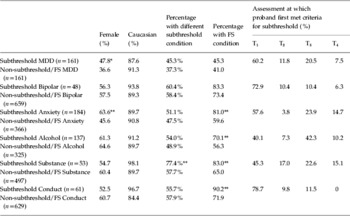
Table 1 presents the numbers and characteristics of the each of the subthreshold proband groupsFootnote 1Footnote †. The only gender or racial difference between the groups was that women had elevated rates of subthreshold MDD and subthreshold anxiety. While subthreshold conditions often co-occurred with other subthreshold conditions, only probands with subthreshold substance disorders had a higher rate of other subthreshold conditions than non-subthreshold/non-FS probands. Many subthreshold conditions did, however, significantly co-occur with other FS conditions. Probands with subthreshold anxiety, alcohol, substance, and conduct disorder were each more likely to have other co-occurring FS conditions than their respective non-subthreshold/non-FS complements. Table 1 also illustrates when the proband first met criteria for the subthreshold condition. With the exception of subthreshold alcohol, the vast majority of the probands who developed the subthreshold condition did so by early adolescence [i.e. T1 (age ~16) or T2 (age ~17)].
Characteristics of proband groups

MDD, Major depressive disorder; FS, full syndrome; Bipolar, bipolar spectrum disorder; Anxiety, anxiety disorder; Alcohol, alcohol dependence; Substance, substance dependence; Conduct, conduct disorder or ASPD.
* Different from non-subthreshold, non-FS group at p<0.05
** different from non-subthreshold, non-FS group at p<0.01.
Associations with FS conditions in relatives
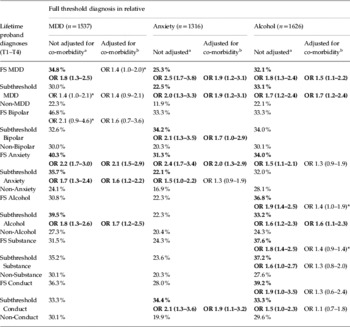
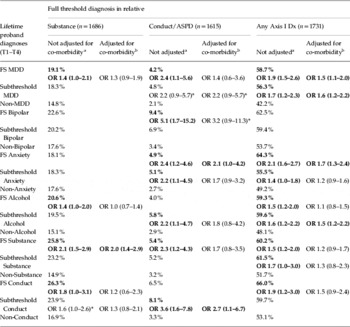
In the 1731 relatives, 472 (27.3%) had diagnoses of MDD, 282 (16.3%) had diagnoses of anxiety, 495 (28.6%) had diagnoses of alcohol use, 302 (17.4%) had diagnoses of substance use, 62 (3.6%) had diagnoses of conduct/ASPD, and 940 (54.3%) had any Axis I diagnoses. Because there were so few family members with an FS bipolar condition (n=19), these analyses were excluded from the study. Table 2 thus presents the results of the family study analyses for FS MDD, anxiety disorders, alcohol use disorders, non-alcohol substance use disorders, conduct/ASPD, and any Axis I disorder.
Familial associations between full syndrome (FS) conditions in relatives and proband FS and subthreshold conditions

Percentages are per cent of probands' relatives who have diagnosis. Comparison group for odds ratios (OR) is non-subthreshold, non-FS probands. Ninety-five per cent confidence intervals are presented next to OR. Dependent variable is family history of full syndrome v. non-subthreshold, non-FS (i.e. subthreshold relatives are excluded).
MDD, Major depressive disorder; Anxiety, anxiety disorder; Alcohol, alcohol dependence; Bipolar, bipolar spectrum disorder; Substance, substance dependence; Conduct, conduct disorder or antisocial personality disorder.
a OR are only adjusted for relative sex and whether relative is parent or sibling.
b OR are adjusted for sex, whether relative is parent or sibling, and proband conditions that are associated with independent variable and dependent variable (see text). OR that are in bold type are significant at p<0.05.
* p<0.10.
Familial associations between full syndrome (FS) conditions in relatives and proband FS and subthreshold conditions

Percentages are per cent of probands' relatives who have diagnosis. Comparison group for odds ratios (OR) is non-subthreshold, non-FS probands. Ninety-five per cent confidence intervals are presented next to OR. Dependent variable is family history of full syndrome v. non-subthreshold, non-FS (i.e. subthreshold relatives are excluded).
ASPD, Antisocial personality disorder; MDD, major depressive disorder; Bipolar, bipolar spectrum disorder; Anxiety, anxiety disorder; Alcohol, alcohol dependence; Substance, substance dependence; Conduct, conduct disorder or ASPD.
a OR are only adjusted for relative sex and whether relative is parent or sibling.
b OR are adjusted for sex, whether relative is parent or sibling, and proband conditions that are associated with independent variable and dependent variable (see text). OR that are in bold type are significant at p<0.05.
* p<0.10.
The first set of analyses examined the associations between proband subthreshold conditions and family FS conditions without adjusting for other co-morbid conditions. These analyses include as covariates relative gender and whether the relative was a parent or siblingFootnote 2. The results of these analyses are presented in Table 2, in the left column for each condition (e.g. proband subthreshold MDD predicting relative FS anxiety: [odds ratio (OR) 2.0, 95% confidence interval (CI) 1.3–3.3]. Subthreshold MDD was associated with familial anxiety, alcohol, any Axis I disorder, and trends for MDD and conduct/ASPD. Subthreshold bipolar disorder was only associated with familial anxiety. Subthreshold anxiety was associated with familial MDD, anxiety, conduct/ASPD, and any Axis I disorder. Subthreshold alcohol was associated with familial MDD, alcohol, conduct/ASPD, and any Axis I disorder. Subthreshold substance use was associated with familial alcohol and any Axis I disorder. Subthreshold conduct was associated with anxiety, alcohol, conduct/ASPD, and a trend for substance use.
To examine whether the subthreshold results reflect a similar pattern to that of FS disorders, we analyzed the association between FS proband diagnoses and FS conditions in relatives. These results are presented in Table 2, in the left column for each condition (e.g. proband FS MDD predicting relative FS anxiety: OR 2.5, 95% CI 1.7–3.8). With one exception (proband subthreshold conduct/ASPD with relative conduct/ASPD), if a subthreshold form of a condition was associated with a particular disorder in relatives, the FS form of that condition was also associated with that particular disorder in relatives. However, FS disorders were associated with more familial disorders than subthreshold conditions.
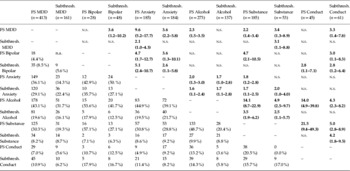
The second set of family study analyses examined whether the significant associations reported in the previous section were due to co-morbid proband conditions. Rather than including the presence of any co-occurring subthreshold condition, we only included subthreshold and FS conditions as covariates if they were significantly associated with the dependent variable (DV) (i.e. relative condition) and the independent variable (IV) (i.e. proband condition) in the first set of family study analyses. Table 3 presents the lifetime associations among proband subthreshold and FS conditions. As an example, subthreshold bipolar and FS MDD were included as covariates in the model examining the association between proband subthreshold anxiety and relative anxiety as both covariates were associated with the subthreshold anxiety in probands (i.e. the IV) and anxiety in relatives (i.e. the DV). Thus, each analysis included a different set of covariates.
Associations among proband subthreshold and full syndrome (FS) conditions

Number of cases and percentage of condition in column are given below diagonal. For example, of the 161 cases with subthreshold MDD, 23 (14.3%) also had an FS diagnosis of an anxiety disorder. Odds ratios (OR) are given above diagonal and comparison group for OR is non-subthreshold, non-FS probands. Ninety-five per cent confidence intervals are presented below odds ratios.
MDD, Major depressive disorder; Bipolar, bipolar disorder; Anxiety, anxiety disorder; Alcohol, alcohol use disorder; Substance, non-alcohol substance use disorder; Conduct, conduct disorder/ASPD; n.s., non-significant.
OR that are in bold type are significant at p<0.05.
The results of the models adjusting for co-morbid subthreshold and FS conditions are displayed in Table 2, in the right column for each condition (i.e. in columns labeled ‘adjusted for co-morbidity’). For subthreshold MDD and subthreshold bipolar disorder, the significant associations and trends from the first set of analyses remained significant after adjusting for co-morbidity, with the exception of FS-MDD. For subthreshold anxiety, the association with relative MDD remained significant, but the other associations became non significant once we adjusted for co-morbidity. For subthreshold alcohol, the associations with relative MDD, alcohol, and any disorder remained significant, but the association with relative conduct/ASPD became non-significant. For subthreshold substance, the significant associations from the first set of analyses became non-significant after we adjusted for co-morbidity. For subthreshold conduct, the associations with relative anxiety and conduct/ASPD remained significant once we adjusted for co-morbidity, but the association with alcohol use and substance use disorder did not.
Discussion
This study extends the growing literature on subthreshold psychiatric disorders by reporting a family study that examined the associations between multiple subthreshold disorders in probands and multiple FS disorders in their first-degree relatives. In addition, we examined the effects of co-morbidity at both the subthreshold and FS levels on these associations.
With one exception, if a subthreshold condition was associated with a particular familial disorder, the FS form of that condition was associated with the same familial disorder. However, compared with subthreshold conditions, FS disorders were associated with more familial disorders and the magnitudes were generally larger. These findings indicate that the pattern of familial aggregation risk for subthreshold conditions is qualitatively similar to that of FS disorders (Kendler & Gardner, Reference Kendler and Gardner1998; Lewinsohn et al. Reference Lewinsohn, Klein, Durbin, Seeley and Rohde2003), and that the two only differ by degree, rather than kind.
As expected, we found evidence for homotypic associations between most subthreshold disorders in probands and the corresponding FS disorder in their relatives. Homotypic associations were observed for subthreshold anxiety, alcohol use, and conduct disorders, although not for drug use disorders. In addition, the association between subthreshold MDD in probands and FS MDD in relatives only reached a trend level of significance. This was surprising, as in a previous paper using the OADP sample we reported a significant association between subthreshold MDD in probands and FS MDD in relatives (Lewinsohn et al. Reference Lewinsohn, Klein, Durbin, Seeley and Rohde2003). A major difference between the two reports is that in the earlier paper probands had only been followed through age 24, whereas the present report includes data from the age 30 follow-up. An important consequence of including the additional wave of data is that a number of probands with subthreshold MDD through age 24 developed FS MDD by age 30, and a number of probands with no history of subthreshold or FS MDD through age 24 developed subthreshold or FS MDD by age 30. This reduced the size of the sample, and may have eliminated some of the subthreshold MDD probands with the greatest familial vulnerability. After controlling for co-morbid subthreshold and full threshold disorders, the homotypic associations for alcohol use disorder and conduct/ASPD remained. However, the homotypic association for anxiety disorder and the trend homotypic association for MDD were no longer significant. A plausible explanation for these effects stems from the substantial phenotypic and genetic overlap between depressive disorders and many anxiety disorders (Kendler et al. Reference Kendler, Prescott, Myers and Neale2003; Watson, Reference Watson2005; Krueger & Markon, Reference Krueger and Markon2006). In controlling for co-morbidity, we may have partialled out the common factor underlying the two disorders, substantially reducing the magnitude of the effect for familial aggregation.
Heterotypic associations between subthreshold forms of one disorder and FS forms of other disorders have rarely been examined in the literature. Thus, it is noteworthy that we observed a number of significant heterotypic associations between subthreshold disorders in probands and FS disorders in relatives. Moreover, many of these effects were bidirectional. Subthreshold MDD in probands was associated with FS anxiety disorders in relatives, and subthreshold anxiety disorders in probands were associated with FS MDD in relatives. Similarly, subthreshold MDD in probands was associated with FS alcohol use disorders in relatives, and subthreshold alcohol use disorder in probands was associated with FS MDD in relatives. In addition, subthreshold alcohol use disorder in probands was associated with FS conduct/ASPD in relatives, and subthreshold conduct/ASPD in probands was associated with FS alcohol use disorders in relatives. These findings for subthreshold psychopathology are consistent with other studies documenting familial associations between FS MDD and both FS anxiety disorders (Middeldorp et al. Reference Middeldorp, Cath, Van Dyck and Boomsma2005) and alcoholism (Kendler et al. Reference Kendler, Heath, Neale, Kessler and Eaves1993), as well as between FS alcoholism and conduct disorder and ASPD (Hicks et al. Reference Hicks, Krueger, Iacono, McGue and Patrick2004). Thus, one interpretation is that for these pairs of disorders, familial co-aggregation is evident at both the FS and subthreshold levels.
Subthreshold drug use disorder in probands was associated with FS alcohol use disorder in relatives. This is also consistent with the literature documenting substantial co-transmission between FS drug and alcohol use disorders (Hicks et al. Reference Hicks, Krueger, Iacono, McGue and Patrick2004). However, the converse was not observed; subthreshold alcohol use disorder was not associated with FS drug use disorder in relatives. Indeed, there were surprisingly few associations between any subthreshold disorders and FS drug use disorders in relatives.
The findings that subthreshold anxiety disorder in probands was associated with FS conduct disorder/ASPD in relatives, and subthreshold conduct disorder was associated with FS anxiety disorders in probands were intriguing. Anxiety disorders and conduct/ASPD are not generally viewed as closely related conditions and classical conceptualizations of psychopathy suggest that it is characterized by the absence of anxiety (Cleckley, Reference Cleckley1941). However, recent conceptualizations have reported that anxiety may be associated with the behavioral aspects of psychopathy (as emphasized in the DSM criteria for conduct/ASPD) more than the affective-interpersonal components (Verona et al. Reference Verona, Patrick and Joiner2001). Additionally, studies have found within-person longitudinal relationships between anxiety disorders and conduct problems (Kim-Cohen et al. Reference Kim-Cohen, Caspi, Moffitt, Harrington, Milne and Poulton2003; Burke et al. Reference Burke, Loeber, Lahey and Rathouz2005).
Finally, subthreshold bipolar disorder in probands was also associated with FS anxiety disorders in relatives. Owing to the small number of relatives with FS bipolar disorder, we could not examine the opposite association. However, this last finding extends the growing literature reporting substantial co-morbidity between bipolar and anxiety disorders (McIntyre et al. Reference McIntyre, Soczynska, Bottas, Bordbar, Konarski and Kennedy2006) by indicating that this association is also evident in patterns of familial transmission.
The majority of heterotypic associations between subthreshold disorders in probands and FS disorders in relatives remained significant after adjusting for co-morbid subthreshold and FS disorders. However, controlling for co-morbidity did eliminate the significant associations between subthreshold anxiety disorder in probands and FS conduct disorder/ASPD in relatives; subthreshold alcoholism in probands and FS conduct disorder/ASPD in relatives; and subthreshold drug use disorder in probands and FS alcohol use disorders in relatives. This may mean that that these subthreshold conditions do not have unique heterotypic associations with the above FS disorders, although an examination of the confidence intervals suggests that adjusting for co-morbidity did not have dramatic effects on some of these associations. Alternatively, for some of these associations (e.g. conduct and alcohol), adjusting for co-morbidity could have removed common variance related to externalizing factors (Markon & Krueger, Reference Markon and Krueger2005).
This study had a number of strengths, including a large representative sample of probands who were assessed on up to four occasions over approximately 15 years, and direct assessments of relatives using semi-structured diagnostic interviews. However, it should be noted that the numbers in some groups were small, so we had to aggregate some specific disorders into higher-order categories (e.g. anxiety disorders), and some disorders were not prevalent enough in the sample to include in the analyses (e.g. eating disorders). Second, due to the multiple comparisons, some of our findings (particularly our exploratory heterotypic associations), may have been due to a Type I error. Third, lifetime psychopathology was determined in one assessment for relatives, but four for probands, suggesting that group status was likely more reliable for probands. This, however, likely improved the validity of the analyses as probands were divided into three groups (FS, subthreshold, and non-subthreshold/non-FS) but relatives were only divided into two (FS and non-subthreshold/non-FS). Fourth, probands were only assessed through age 30 and may have thus not passed through the full period of risk for some disorders such as MDD (Kessler et al. Reference Kessler, Wai, Demler, Merikangas and Walters2005). For these disorders, our results may therefore only generalize to those with an early onset of subthreshold or FS disorder. Finally, although our definitions of subthreshold disorders were consistent with the literature, they are admittedly somewhat arbitrary.
In conclusion, these findings highlight the importance of broadening the scope of studies of subthreshold psychopathology to multiple disorders. Thus, in addition to demonstrating a number of homotypic associations between subthreshold psychopathology in probands and the corresponding FS disorders in relatives, we also found evidence for multiple heterotypic associations between one form of subthreshold disorder and other forms of FS disorders. Finally, this study suggests that subthreshold and FS disorders may not have qualitatively different familial liabilities and future diagnostic systems should perhaps consider lowering the diagnostic ‘threshold’ or possibly adopting dimensional or continuous conceptualizations for particular psychopathologies (Widiger & Samuel, Reference Widiger and Samuel2005).
Acknowledgements
This research is supported by NIMH Grants R01 MH50522 (Dr Lewinsohn) and R01 MH66023 (Dr Klein).
Declaration of Interest
None.