Significant outcomes
LFrTMS as an add-on to ECT did not accelerate the anti-depressant effect. On the contrary, the study states the hypothesis that LFrTMS can act as an inhibitor of the anti-depressant effect of ECT.
Limitations
The study is under-powered. The rate of dropout was high and unevenly distributed.
Introduction
Repetitive transcranial magnetic stimulation (rTMS) is a non-invasive anti-depressive treatment method utilising non-convulsive focal stimulation of the brain through a time-varying electromagnetic field. An electromagnetic coil placed on the scalp produces an oscillating magnetic field that penetrates the scalp and skull unattenuated resulting in the induction of a current in the adjacent parts of the cerebral cortex as well as functionally connected areas of the brain. Previous research has associated the anti-depressant effect of rTMS with specific stimulation of the dorsolateral prefrontal cortex. Stimulus frequency has been shown to play a key role in the mechanisms of action of rTMS. Preclinical studies (Post et al., Reference Post, Speer, Weiss and Li2000) have revealed that low-frequency rTMS (LFrTMS) is associated with long-term inhibition of neuronal activity (long-term depression), while high-frequency stimulation is followed by prolonged activation (long-term potentiation). To some extent, this differential effect of the two types of frequencies are reflected in human studies (Kimbrell et al., Reference Kimbrell, Little, Dunn, Frye, Greenberg, Wassermann, Repella, Danielson, Willis, Benson, Speer, Osuch, George and Post1999; Speer et al., Reference Speer, Kimbrell, Wassermann, Repella, Willis, Herscovitch and Post2000; Speer et al., Reference Speer, Benson, Kimbrell, Wassermann, Willis, Herscovitch and Post2009).
The majority of clinically controlled studies on the anti-depressant efficacy of rTMS have used high-frequency stimulation of left prefrontal cortex supporting the evidence of the anti-depressant efficacy of this treatment model, which has been approved by the Food and Drug Administration in the USA and later in the EU for the treatment of depression (Fitzgerald et al., Reference Fitzgerald, Brown, Marston, Daskalakis, De Castella and Kulkarni2003; Rumi et al., Reference Rumi, Gattaz, Rigonatti, Rosa, Fregni, Rosa, Mansur, Myczkowski, Moreno and Marcolin2005; Avery et al., Reference Avery, Fawaz, Russo, Russo, Neumaier, Dunner, Haynor, Claypoole, Wajdik and Roy-Byrne2006; Avery et al., Reference Avery, Fawaz, Russo, Russo, Neumaier, Dunner, Haynor, Claypoole, Wajdik and Roy-Byrne2006; Herwig et al., Reference Herwig, Fallgatter, Höppner, Eschweiler, Kron, Hajak, Padberg, Naderi-Heiden, Abler, Eichhammer, Grossheinrich, Hay, Kammer, Langguth, Laske, Plewnia, Richter, Schulz, Unterecker, Zinke, Spitzer and Schönfeldt-Lecuona2007; Eranti et al., Reference Eranti, Mogg, Pluck, Landau, Purvis, Brown, Howard, Knapp, Philpot, Rabe-Hesketh, Romeo, Rothwell, Edwards and McLoughlin2007; O’Reardon et al., Reference O’Reardon, Solvason, Janicak, Sampson, Isenberg, Nahas, McDonald, Avery, Fitzgerald, Loo, Demitrack, George and Sackeim2007; Lam et al., Reference Lam, Chan, Wilkins-Ho and Yatham2008; Berlim et al., Reference Berlim, van den Eynde, Tovar-Perdomo and Daskalakis2014). Fewer studies have used right prefrontal LFrTMS, though this model of stimulation compared to high-frequency rTMS is associated with fewer side effects, such as local discomfort and a lower risk of inducing epileptic seizures (Klein et al., Reference Klein, Kreinen, Chistyakov, Koren, Mecz, Marmur, Ben-Shachar and Feinsod1999; Buchholtz Hansen et al., Reference Buchholtz Hansen, Videbech, Clemmensen, Jensen and Vestergaard2004; Januel et al., Reference Januel, Dumortier, Verdon, Stamatiadis, Saba, Cabaret, Benadhira, Rocamora, Braha, Kalalou, Vicaut and Fermanian2006; Fitzgerald et al., Reference Fitzgerald, Huntsman, Gunewardene, Kulkarni and Daskalakis2006; Fitzgerald et al., Reference Fitzgerald, Sritharan, Daskalakis, de Castella, Kulkarni and Egan2007; Bares et al., Reference Bares, Kopecek, Novak, Stopkova, Sos, Kozeny, Brunovsky and Höschl2009; Pallanti et al., Reference Pallanti, Bernardi, Di Rollo, Antonini and Quercioli2010; Brunelin et al., Reference Brunelin, Jalenques, Trojak, Attal, Szekely, Gay, Januel, Haffen, Schott-Pethelaz, Brault and Poulet2014; Theleritis et al., Reference Theleritis, Sakkas, Paparrigopoulos, Vitoratou, Tzavara, Bonaccorso, Politis, Soldatos and Psarros2017). Both stimulus models have been shown to have a statistically and clinically significant anti-depressant effect of equal magnitude as add-on to other anti-depressant treatments (Klein et al., Reference Klein, Kreinen, Chistyakov, Koren, Mecz, Marmur, Ben-Shachar and Feinsod1999; Fitzgerald et al., Reference Fitzgerald, Brown, Marston, Daskalakis, De Castella and Kulkarni2003; Buchholtz Hansen et al., Reference Buchholtz Hansen, Videbech, Clemmensen, Jensen and Vestergaard2004; Rumi et al., Reference Rumi, Gattaz, Rigonatti, Rosa, Fregni, Rosa, Mansur, Myczkowski, Moreno and Marcolin2005; Isenberg et al., Reference Isenberg, Downs, Pierce, Svarakic, Garcia, Jarvis, North and Kormos2005; Avery et al., Reference Avery, Fawaz, Russo, Russo, Neumaier, Dunner, Haynor, Claypoole, Wajdik and Roy-Byrne2006; Januel et al., Reference Januel, Dumortier, Verdon, Stamatiadis, Saba, Cabaret, Benadhira, Rocamora, Braha, Kalalou, Vicaut and Fermanian2006; Fitzgerald et al., Reference Fitzgerald, Huntsman, Gunewardene, Kulkarni and Daskalakis2006; Herwig et al., Reference Herwig, Fallgatter, Höppner, Eschweiler, Kron, Hajak, Padberg, Naderi-Heiden, Abler, Eichhammer, Grossheinrich, Hay, Kammer, Langguth, Laske, Plewnia, Richter, Schulz, Unterecker, Zinke, Spitzer and Schönfeldt-Lecuona2007; Eranti et al., Reference Eranti, Mogg, Pluck, Landau, Purvis, Brown, Howard, Knapp, Philpot, Rabe-Hesketh, Romeo, Rothwell, Edwards and McLoughlin2007; Fitzgerald et al., Reference Fitzgerald, Sritharan, Daskalakis, de Castella, Kulkarni and Egan2007; Lam et al., Reference Lam, Chan, Wilkins-Ho and Yatham2008; Bares et al., Reference Bares, Kopecek, Novak, Stopkova, Sos, Kozeny, Brunovsky and Höschl2009; Pallanti et al., Reference Pallanti, Bernardi, Di Rollo, Antonini and Quercioli2010; Berlim et al., Reference Berlim, Van den Eynde and Daskalakis2013b; Berlim et al., Reference Berlim, van den Eynde, Tovar-Perdomo and Daskalakis2014; Brunelin et al., Reference Brunelin, Jalenques, Trojak, Attal, Szekely, Gay, Januel, Haffen, Schott-Pethelaz, Brault and Poulet2014; Theleritis et al., Reference Theleritis, Sakkas, Paparrigopoulos, Vitoratou, Tzavara, Bonaccorso, Politis, Soldatos and Psarros2017).
Electroconvulsive therapy (ECT) was used in approximately 5% of all psychiatric patients in Denmark in 1999. The proportion of patients receiving ECT has increased slightly since with approximately 11% (Bjørnshauge et al., Reference Bjørnshauge, Hjerrild and Videbech2019). ECT acts through the induction of epileptic seizures and a documented anti-kindling effect involving limbic and paralimbic structures. This kindling repressing effect is probably of significance for the mechanism of ECT (Post et al., Reference Post, Speer, Weiss and Li2000). The anti-depressant effect of rTMS does not involve seizures, but like ECT LFrTMS has been shown to inhibit amygdala-kindled seizures in animal studies. Therefore, theoretically it is possible that LFrTMS can amplify and thus accelerate the anti-depressant effect of ECT.
Aim of the study
The present study was carried out to investigate whether prefrontal LFrTMS as add-on may accelerate the anti-depressant effect of ECT, increase rates of response and remission as well as minimise cognitive side effects
Clinical trial registration: ClinicalTrials.gov Identifier: NCT02123485.
Material and methods
Design
The present study was carried out as a randomised, clinically controlled, double-blind investigation comparing conventional ECT + sham-stimulation with ECT + right prefrontal LFrTMS.
Previous research concerning the anti-depressant effect of ECT versus rTMS has found remission rates on ECT between 50% and 60% (Eranti et al., Reference Eranti, Mogg, Pluck, Landau, Purvis, Brown, Howard, Knapp, Philpot, Rabe-Hesketh, Romeo, Rothwell, Edwards and McLoughlin2007; Buchholtz Hansen et al., Reference Buchholtz Hansen, Ravnkilde, Videbech, Clemmensen, Sturlason, Reiner, Parner, Rosenberg and Vestergaard2011; Berlim et al., Reference Berlim, Van den Eynde and Daskalakis2013b; Ren et al., Reference Ren, Palaniyappan, Liu, Liu, Wang, Li and Rossini2014). On the basis of these figures and the outcome of previous randomised controlled trial (RCT) studies on the anti-depressant effect of LFrTMS compared to placebo (15,19), the difference in the incidence of remission was expected to be 20–30%. A rate difference of 20% would require 81 patients, while a rate difference of 30% would require 31 patients in each group to have 80% power in a two-sided test at a 5% significance level. The post hoc power was calculated to 45.5%.
Randomisation
The patients were randomly allocated to ECT + rTMS or ECT + sham according to the principle of block randomisation. Six blocks were created with 10 sealed opaque envelopes in each, half of them containing a treatment code for rTMS and the other half for ECT. The envelopes in each block were shuffled thoroughly and numbered from 1 to 10. To ensure allocation concealment, the patients were randomly allocated to treatment by an independent third party.
Study population
The study population was inpatients with major depression referred to ECT and admitted to the department for Depression and Anxiety, Aarhus University Hospital, Risskov, Denmark. They were recruited primarily from the city of Aarhus with associated rural districts, a catchment area of approximately 300,000 inhabitants.
Participants were recruited during the period from February 2015 to July 2018.
The initial examination for eligibility was performed by a research nurse and a trained psychiatrist. Patients with major depression referred for ECT were eligible for inclusion. The inclusion criteria were age between 18 and 80 years, a total score on 17-item HAM-D (Hamilton, Reference Hamilton1967) of 20 or higher and/or 9 or higher on the 6-item HAM-D subscale, which includes the core symptoms of depression: depressive mood, guilt, psychomotor retardation, and diminished ability to work, reduced interest, anxiety, and fatigue (Timmerby et al., Reference Timmerby, Andersen, Søndergaard and Østergaard2017).
All included patients were evaluated using the Present State Examination interview (Schedules for Clinical Assessment (SCAN), 1994) and fulfilled the International Classification of Diseases (ICD)-10 criteria for moderate to severe depression as well as the Diagnostic and Statistical Manual of Mental Disorders-IV criteria for major depressive disorder. Unipolar as well as bipolar patients were included. Patients with organic brain damage, personal or family history of epileptic seizures, metallic objects in the chest or brain, cardiac pacemakers, and somatic diseases associated with brain dysfunction were excluded from the study. Pregnancy, use of coercive measures, severe suicidal risk, severe agitation or delirium, and alcohol or drug dependence (ICD-10) constituted additional exclusion criteria.
General physical and neurological examination was followed by list routine blood tests and electrocardiograms.
External validity
A total of 433 patients with depression (ICD-10) were referred to one or more series of right unilateral ECT in the project period. Two hundred and seventy (62%) patients were women. The mean age of the patients at index ECT was 53.5 years (SD = 18.9). Seventy-three percent of the patients fulfilled the ICD-10 criteria for unipolar depression, and 27% for bipolar depression. In total, 65.6% of the sample suffered from depression of severe degree, and 37.1% had psychotic symptoms. The 35 included patients were comparable to the 433 patients referred to ECT during the project period regarding mean age (p = 0.16, t = 1.41), gender distribution (p = 0.28, df = 1, χ 2 = 1.14), the frequency of bipolarity (p = 0.36, df = 1, χ 2 = 0.36), and depression severity (p = 0.30, df = 1, χ 2 = 1.09). However, fewer of the included patients had psychotic depression (p = 0.007, df = 1, χ 2 = 7.20) compared to the 398 patients not allocated to the study. Reasons for exclusion were generally distributed in three main groups. The majority was not included due to the severity of the depression (severe agitation or depressive stupor, eminent suicide risk), and a minor part of the patients refused to take part in the study or were not evaluated with respect to eligibility.
Outcome measures
The psychometric properties of the HAM-D17 as an unidimensional measure of depression severity have been questioned (Bagby et al., Reference Bagby, Ryder, Schuller and Marshall2004), but it still remains the most widely used measure and was included for comparability to previous studies. The HAM-D6 subscale has been shown to be a psychometrically valid and unidimensional measure of depression severity (Timmerby et al., Reference Timmerby, Andersen, Søndergaard and Østergaard2017) alongside the major Depression Inventory (MDI). The latter has also shown satisfactory psychometric properties (Olesen et al., Reference Olsen, Jensen, Noerholm, Martiny and Bech2003).
Primary effect measures were response and remission, and a secondary outcome measure was change in cognitive function. Depression severity was evaluated by trained clinicians using the Hamilton 17-item (HAM-D17), the 6-item scale for depression (HAM-D6), and the MDI scale (Olsen et al., Reference Olsen, Jensen, Noerholm, Martiny and Bech2003; Timmerby et al., Reference Timmerby, Andersen, Søndergaard and Østergaard2017). Response was defined as a 50% reduction in total HAM-D6 or HAM-D17 score and remission as a total HAM-D17-item score of 8 or lower. Adverse effects were assessed by the Udvalget for Kliniske Undersogelser (UKU) scale, a comprehensive, validated rating scale recording both psychological and physical adverse effects of psychotropic drugs (Lingjaerde et al., Reference Lingjaerde, Ahlfors, Bech, Dencker and Elgen1987).
The degree of depression was assessed at baseline (before treatment) and at weekly intervals corresponding to less than 24 h after the 3rd, 6th, and 9th/last ECT. Side effects were assessed using the UKU at baseline, and within 24 h after last ECT. Additional HAM-D, MDI, and UKU ratings were carried out 4 weeks after the last ECT in the series of treatments. In the majority of cases, all the ratings for an individual patient were performed by the same rater.
Cognitive function
All patients were assessed at baseline, 48 h after the last ECT in the series of treatments, and again 4 weeks later. Only patients who were fully able to cooperate and completed examination at all three time points were included in the analyses. Global cognitive functioning was assessed with a short test battery comprising measures of attention and speed (Trail-Making Tests A and B), visual and verbal memory and learning (Rey Complex Figure Test, Logical Memory/Wechsler Memory Scale Revised), and Executive Function (using semantic and phonological verbal fluency) (Smith et al., Reference Smith1967; Nelson & O’Connel, Reference Nelson and O’Connel1978; Christensen, Reference Christensen1975; Wechsler, Reference Wechsler1987; Spreen & Strauss, Reference Spreen and Strauss1998).
Pharmacological treatment
Treatment with anti-depressant drugs was monitored continuously, and psychopharmacological treatment was held constant from inclusion until the end of ECT treatment. If possible, benzodiazepines were tapered off 2 to 3 days before the first ECT. In case of severe anxiety, oxazepam could be administered until 5 PM the day before ECT treatment. If hypnotic medication was needed, zolpidem or quetiapine was preferred.
Anti-epileptic drugs prescribed as mood stabilisers were discontinued (lamotrigine dose was halved) before the first treatment. After termination of the ECT treatment series, the patients continued any psychopharmacological medication with no restrictions.
rTMS treatment
A MagPro type R30 stimulator (MagVenture A/S, Lucernemarken 15, 3520 Farum, Denmark), which is approved in the EU for treatment of depression, was used for rTMS stimulation. We used a computer-controlled, water-cooled double-blind, figure eight placebo spool (type Cool-B65 A/P Butterfly Coil), which made it possible to stimulate focally, corresponding to the selected area of the brain.
The patient was awake, placed in a sitting position and offered earplugs as protection against the noise generated by the stimulation. The coil was placed with the flat side tangentially above the area selected for stimulation.
The motor threshold was determined by placing the centre of the coil on a line connecting the vertex with the auditory meatus, stimulating the cortex to find the lowest intensity that produced a visual motor response in the thenar of the left hand. The treatment site over the right dorsolateral prefrontal cortex was then found by moving the coil 5 cm anterior to this point at a right angle to the line connecting the auditory meatus and the vertex.
The patients received either placebo stimulation or two 180-second 1-Hz trains delivered at an intensity of 110% of motor threshold with a 180-second intertrain interval. The anti-depressant efficacy of corresponding stimulus models (3600–6300 pulses in total) has been documented in previous studies (Klein et al., Reference Klein, Kreinen, Chistyakov, Koren, Mecz, Marmur, Ben-Shachar and Feinsod1999; Pallanti et al., Reference Pallanti, Bernardi, Di Rollo, Antonini and Quercioli2010; Berlim et al., Reference Berlim, Van den Eynde and Daskalaskis2013a; Brunelin et al., Reference Brunelin, Jalenques, Trojak, Attal, Szekely, Gay, Januel, Haffen, Schott-Pethelaz, Brault and Poulet2014). In this study, the described procedure was followed two times a week on ECT-free days (2000 pulses in total on the average), that is, on Tuesdays and Thursdays as ECT was delivered on Mondays, Wednesdays, and Fridays.
Blinding
The result of the randomisation (active or sham rTMS) was downloaded by an independent third party to a patient-specific key (USB memory stick) that was sent to the treatment centre and inserted in the MagPro stimulator.
The coil, which was identical on both sides, had a built-in position sensor used to ensure that the correct (active or sham) side of the coil faced towards the patient’s head. If the coil position was wrong, the operator received a prompt on the MagPro’s display reading “Flip Coil”. To ensure blinding of patients, electrodes from the MagPro were used to stimulate the patient’s skin in the coil area to mimic real rTMS.
Electroconvulsive therapy
Thymatron IV (Fred Berninger Import OHG, Taufkirchen, Germany) (maximum dose of stimulation, 1008 millicoulombs) was used for ECT. On average, patients received 9-10 ECTs during the project period. The treatment was administered 3 times weekly with handheld electrodes according to the guidelines of the Danish Psychiatric Society, using a brief pulse stimulus model with a pulse width of 1.0–2.0 ms (Ziebach & Honoré, Reference Ziebach and Honoré2003).
First, atropine was given to prevent parasympathetic hyperactivity after the seizure. Then, general anaesthesia was induced with sodium thiopental (2-6 mg/kg), supplied with suxamethonium chloride for muscular relaxation, and the patient was hyperventilated with 100% oxygen 1 min before stimulation.
The electrodes were placed unilaterally over the right hemisphere according to d’Elia. The initial intensity of stimulation was pre-determined according to age and later adjusted according to the recorded seizure quality as well as clinical effect. In case of insufficient clinical response on maximal stimulus intensity, the patient was switched to bilateral stimulation.
Seizure quality was assessed on a three-level scale based on seizure length, the postictal suppression index, the wave amplitude and hemispheric brain wave synchronicity. The assessors were blinded to the treatment arm.
Statistics
Eligible patients were compared with the population of all patients referred to ECT using t-test or chi-square test dependent on whether the data were normally distributed or not. Moreover, treatment and placebo groups were compared based on a t-test or chi-square test dependent on which was most suitable. The effect of treatment on HAM-D6, HAM-D17 and MDI over time was evaluated based on a quadratic linear mixed model. A sensitivity analysis was performed by carrying the last observation forward to evaluate the potential influence of missing values in the data. The effect of treatment on cognitive function over time was evaluated based on a linear mixed model. A visual inspection indicated a linear relationship between the response and explanatory variables.
The results were evaluated for importance based on the estimates and P-values. The variables were inspected visually for a linear relationship and outliers from a scatterplot of the dependent variable and the explanatory variables. The homoscedasticity and normal distribution were evaluated using a p–p plot. Based on these plots, the data appeared heteroscedastic and normally distributed. All statistical analyses were performed using Stata version 16 (StataCorp LP, College Station, TX, USA) or R 3.2 (R Core Team).
Results
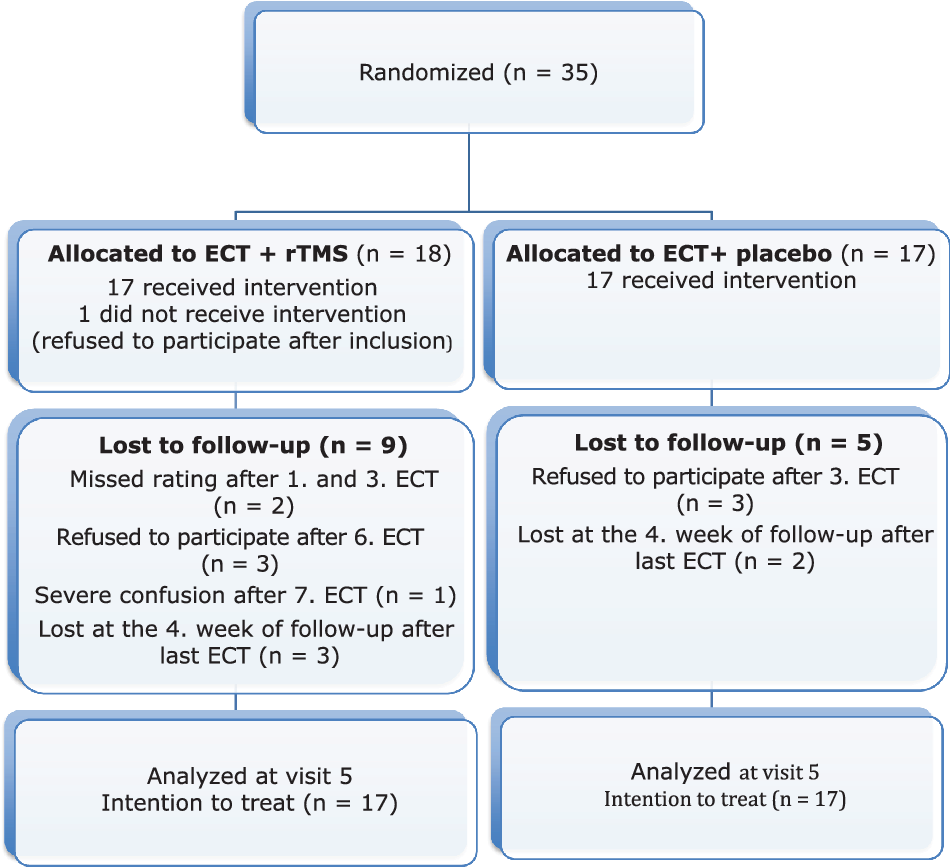
A total of 35 patients were included in the study and randomly allocated to ECT + rTMS or ECT + placebo (sham-stimulation). Fourteen patients (40%) were lost to follow up during the project period, 9 (26%) of them dropped out before termination of the ECT and rTMS/placebo series (Fig. 1). The sample did not differ from the total population of depressed patients admitted to the hospital regarding neither sex, age, nor severity of depression. A higher proportion of dropouts was found in the rTMS group (47%) compared to the placebo-group (29%). This was, however, not statistically significant (p = 0.29, df = 1, χ 2 = 1.22).
The trial profile for the study.

Five patients in the placebo group dropped out during the project period. Three of them left the study after three ECTs due to adverse effects. One of them experienced headache but wished to continue placebo rTMS. Two patients did not attend at follow-up 4 weeks after termination of the ECT series.
Nine patients on rTMS were lost to follow-up. Two treatment courses were interrupted for logistical reasons (lost data and missing ratings) just before and after 3rd ECT. Both patients continued treatment with ECT as well as rTMS. Three dropped out after 6th ECT. One due to somatic co-morbidity, one refused to continue due to the lack of effect and headache and one dropped out due to missed ratings. One patient was lost after 7th ECT due to severe confusion, and three patients did not attend at follow-up.
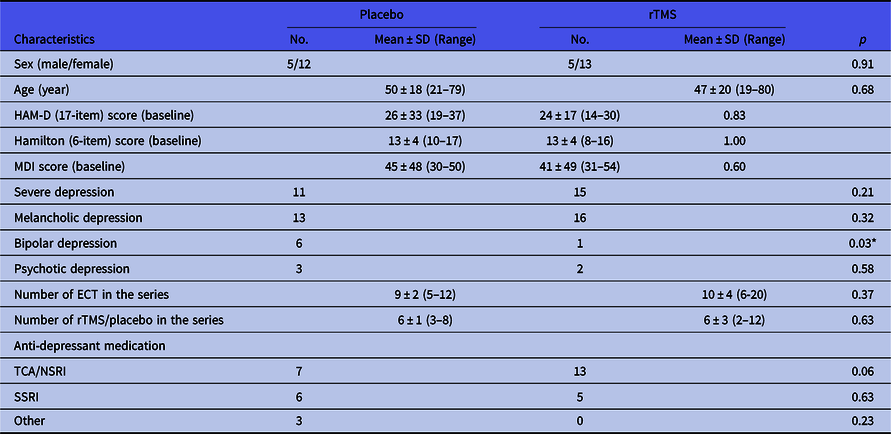
There was found no statistical differences between the two groups regarding the clinical characteristics shown in Table 1 apart from bipolarity. Bipolar depressed patients occurred more frequently in the placebo group compared to the rTMS group (p = 0.03, df=1, χ 2 = 4.83). However, the remission and response rates did not differ significantly between bipolar and unipolar depressed patients (p = 0.63, df = 1, χ 2 = 0.23, p = 0.62, df = 1, χ 2 = 0.24). The average number of ECTs delivered was 9 in the placebo group versus 10 in the rTMS group (P = 0.36, t-statistic 0.919, df = 33), and rTMS was given 6 times on the average in both groups.
Clinical characteristics of 35 inpatients with moderate to severe depression for type of treatment

NSRI, noradrenergic serotonergic reuptake inhibitors;SD, standard deviation; SSRI, selective serotonin reuptake inhibitors; TCA, tricyclic anti-depressants.
* df = 1, χ 2 = 4.83.
Number of participants = no compared by the chi-square test. Means compared by the t-test.
Anti-depressant drug treatment was initiated or intensified within the last 4 weeks before inclusion for 13 patients in the placebo group and for 12 patients in the rTMS group, and only in two cases in each group the anti-depressant medication was changed during the project period.
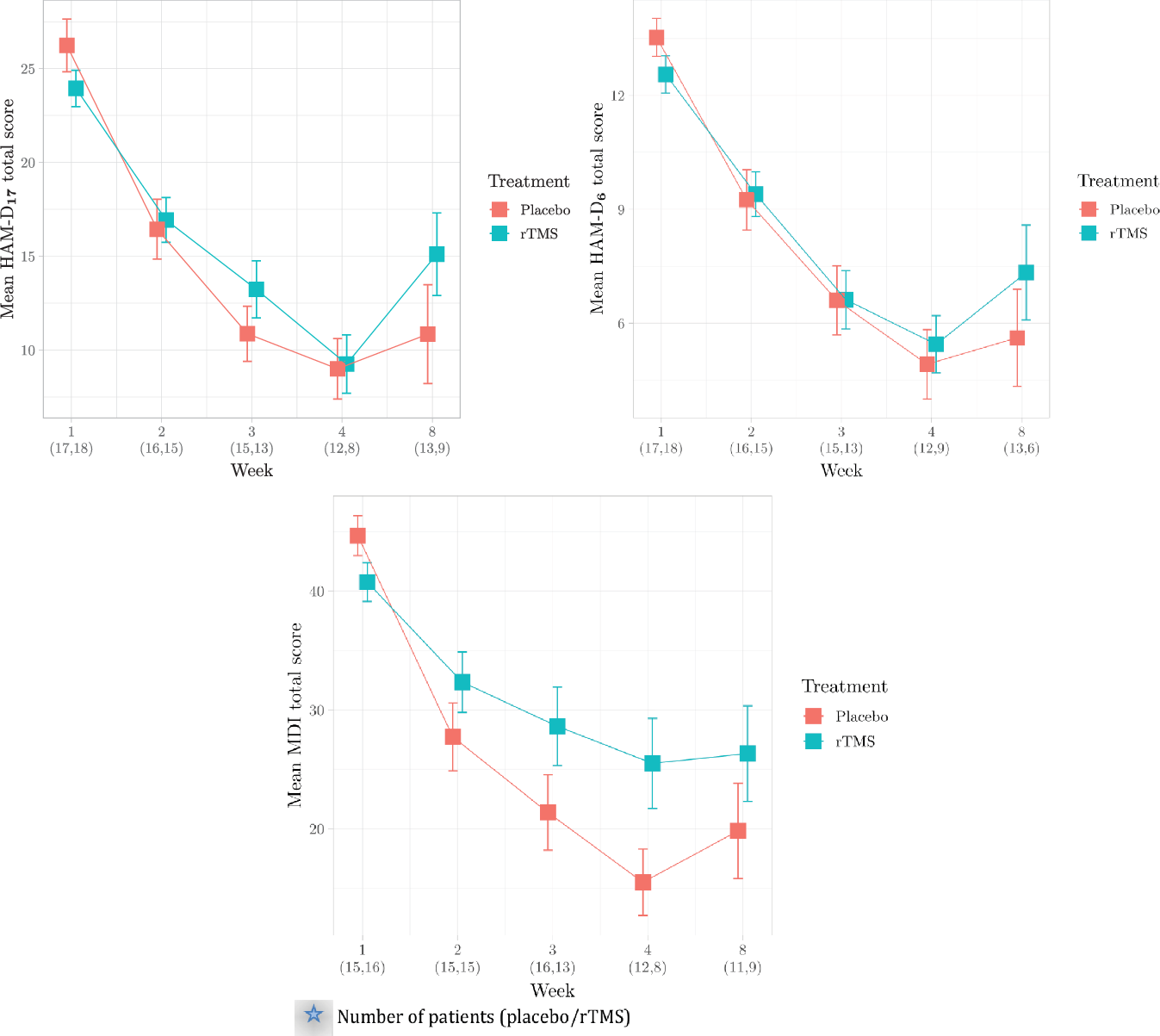
As displayed in Fig. 2, the mean scores for HAM-D17, HAM-D6 and MDI were reduced significantly over time in both groups, but with a trend to greater reduction in the placebo group. This was most marked for the MDI, which showed lower mean scores over all time points in the placebo group. These differences were, however, non-significant.
Mean score plots for HAM-D17, HAM-D6 and MDI over time for type of treatment (placebo vs. rTMS as add-on to ECT) by removing missing values from the data. The number of patients in the two groups indicated in parenthesis (placebo/rTMS).

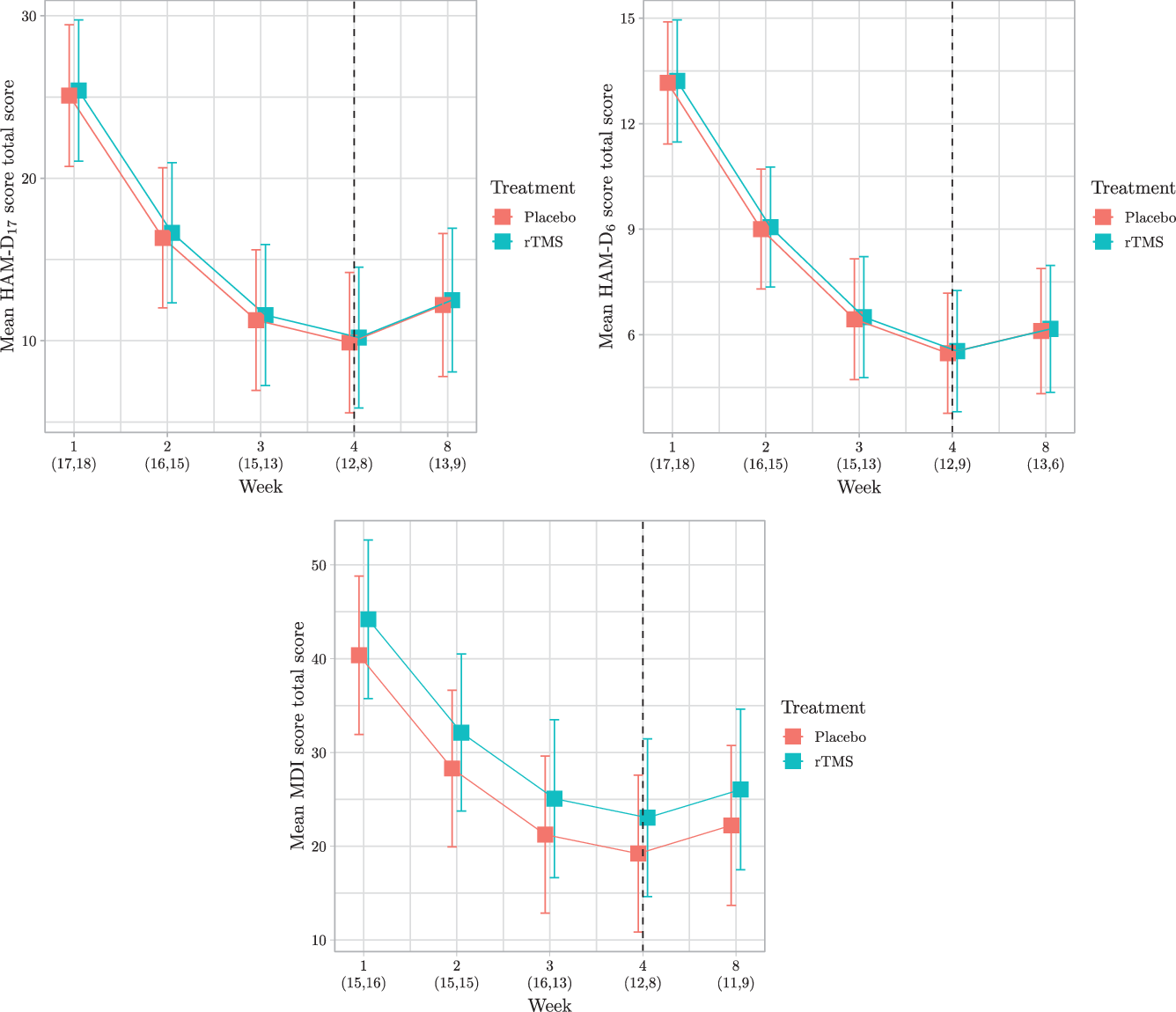
Missing data were handled by using the linear mixed effects model (Fig. 3), which revealed no significant difference between the two groups for any of the three scores, but still with a visible trend to lower MDI scores.
Mean score plots for HAM-D17, HAM-D6 and MDI over time for type of treatment (placebo vs. rTMS as add-on to ECT). Missing values replaced by using quadratic linear mixed model. The number of patients in the two groups indicated in parenthesis (placebo/rTMS).

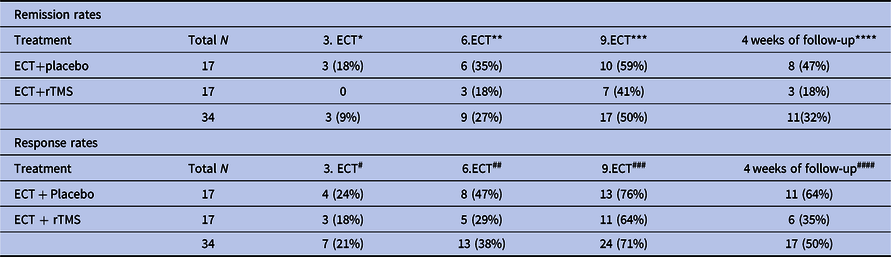
The placebo group showed a trend of obtaining faster anti-depressant effect and a higher proportion of remission and response at follow-up using an last observation carried forward model (Table 2). The recorded difference did, however, not reach the level of significance and using the linear mixed model the observed difference partially disappeared. When the electroencephalogram recordings were analysed for each patient, 73 percent of the total number of seizures in the rTMS-group versus 80% in the placebo group were described as being of high quality (P = 0.22, df = 1, χ 2 = 1.47). In addition, the two groups did not differ neither with respect to change in seizure quality nor the amount of energy used during the ECT series.
Rates of remission and response by type of treatment

Based on the last observation carried forward model.
* P = 0.26, df = 1, χ 2 = 1.26.
** P = 0.24, df = 1, χ 2 = 1.36.
*** P = 0.30, df = 1, χ 2 = 1.36.
**** P = 0.06, df = 1, χ 2 = 3.36.
# P = 0.67, df = 1, χ 2 = 0.18.
## P = 0.29, df = 1, χ 2 = 1.12.
### P = 0.45, df = 1, χ 2 = 0.57.
#### P = .0.08, df = 1, χ 2 = 2.94.
Side effects
Both treatment models were generally well tolerated. However, one patient in the rTMS group had to leave the project after the 7th ECT due to severe confusion. Apart from that no serious adverse effects were reported.
Twenty-six (74%) of the study population was recorded with respect to the experience of discomfort and side effects during the treatment courses. The sample was comparable to the total study population regarding mean age (p = 1.0, df = 56, t = −0.6), gender distribution (p = 0.56, df = 1, χ 2 = 0.34), as well as HAM-D 17-item mean score at baseline (p = 1.0, df = 56, t = −0.8). Two out of 12 patients (17%) receiving active rTMS and one (5%) in the placebo group experienced mild discomfort during the procedure itself (p = 0.45, df = 1, χ 2 = 0.57). Four (33%) patients on rTMS versus 3 (21%) on placebo developed a mild to moderate headache during treatment (p = 0.50, df = 1, χ 2 = 0.47).
Neuropsychological assessment of cognitive function
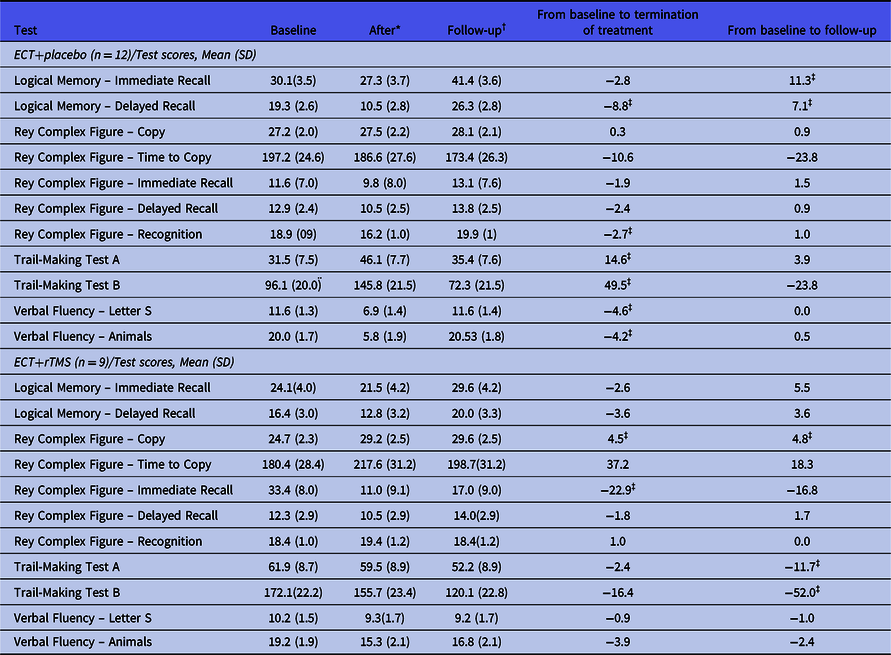
Twenty-one patients, 9 (50%) in the active rTMS arm and 12 (71%) in the placebo arm were neuropsychological assessed (Table 3) at the three time points. The ECT-placebo group was significantly impaired on a number of cognitive tests (logical and visual memory, verbal fluency as well as tests on psychomotor speed and attention) within 48 h after completion of the ECT treatment series. All of them recovered and measures on logical memory improved significantly beyond baseline 4 weeks after termination of the ECT series. The ECT-rTMS group showed minor impairment on aspect of executive functions (Rey’s complex figure copy test) and immediate visual memory (Rey’s complex test) after termination of the ECT treatment series but also improved significantly on psychomotor speed and attention at 4 weeks of follow-up after last treatment. Eight patients were still improved beyond baseline on logic memory in spite of increasing HAM-D scores at follow-up.
Cognitive assessment by time and type of treatment

* After last ECT in the series.
† After 4 weeks of follow-up.
‡ P < 0.05, based on the intention-to-treat and linear mixed model.
The ECT-rTMS group revealed generally less impairment of cognitive functions than the ECT-placebo group. No significant differences were found between the two treatment groups regarding age, sex and severity of depression or for any cognitive measures except for Rey’s complex test, trail A and trail B (see Table 3).
Discussion
The present study, which to our knowledge is the first randomised, placebo-controlled, double-blind investigation of the anti-depressant effect of LFrTMS as add-on to ECT, was not able to show any increased anti-depressant effect of LFrTMS as add-on to ECT. The mean scores for HAM-D17, HAM-D6 and MDI were reduced significantly in both groups, but with a trend to greater reduction in the placebo group. Furthermore, the patients in the placebo group showed a trend towards faster anti-depressant effect and a higher proportion of remission and response at follow-up, although without reaching statistical significance. Rates of remission were generally found at the same level as in previous rTMS-ECT studies (Eranti et al., Reference Eranti, Mogg, Pluck, Landau, Purvis, Brown, Howard, Knapp, Philpot, Rabe-Hesketh, Romeo, Rothwell, Edwards and McLoughlin2007; Buchholtz Hansen et al., Reference Buchholtz Hansen, Ravnkilde, Videbech, Clemmensen, Sturlason, Reiner, Parner, Rosenberg and Vestergaard2011; Berlim et al., Reference Berlim, Van den Eynde and Daskalakis2013b; Ren et al., Reference Ren, Palaniyappan, Liu, Liu, Wang, Li and Rossini2014). According to Figs. 2 and 3, the recorded trend to a better anti-depressant effect in the placebo group was limited to the MDI, which according to previous psychometric evaluations (Konstantinidis et al., Reference Konstantinidis, Martiny, Bech and Kasper2011; Bech et al., Reference Bech, Timmerby, Martiny, Lunde and Soendergaard2015) presents the highest coefficient of homogeneity indicating unidimensionality compared to the HAM-D17 item as well as the HAM-D6 item scale. In addition, the MDI was found highly correlated to the HAM-D17 item scale in showing the same sensitivity to measure improvement over the first 2 weeks of treatment.
The anti-depressant effect of right prefrontal LFrTMS has been substantiated in previous RCTs and meta-analysis (Klein et al., Reference Klein, Kreinen, Chistyakov, Koren, Mecz, Marmur, Ben-Shachar and Feinsod1999; Fitzgerald et al., Reference Fitzgerald, Huntsman, Gunewardene, Kulkarni and Daskalakis2006; Fitzgerald et al., Reference Fitzgerald, Sritharan, Daskalakis, de Castella, Kulkarni and Egan2007; Bares et al., Reference Bares, Kopecek, Novak, Stopkova, Sos, Kozeny, Brunovsky and Höschl2009; Pallanti et al., Reference Pallanti, Bernardi, Di Rollo, Antonini and Quercioli2010; Brunelin et al., Reference Brunelin, Jalenques, Trojak, Attal, Szekely, Gay, Januel, Haffen, Schott-Pethelaz, Brault and Poulet2014). The trend towards a better outcome on the depression scale scores among patients receiving placebo as add-on to ECT is therefore surprising. Naturally, this could be a chance finding, but as the study was underpowered, one cannot preclude that the inferiority of rTMS as add-on in this study is actually underestimated.
ECT has a documented anti-depressive superiority compared to LFrTMS (Buchholtz Hansen et al., Reference Buchholtz Hansen, Ravnkilde, Videbech, Clemmensen, Sturlason, Reiner, Parner, Rosenberg and Vestergaard2011), which may have contributed to diminish an eventual negative effect of rTMS as add-on. In addition, the fact that rTMS was only applied 2 times weekly whereas ECT was applied 3 times a week combined with the higher rate of dropouts in the rTMS group may have diluted a potential inhibiting effect of rTMS on the anti-depressive effect of ECT. We found no difference between the two groups regarding the number of ECT treatments used, but an insignificant trend to a higher average number of ECT treatments was found in the rTMS group.
The impact of different anti-depressant drug treatment was limited by the randomisation process and is not considered a confounder.
Our findings raise the question, whether LFrTMS may inhibit the anti-depressant effect of ECT.
Our literature search revealed only one comparable open randomised study (Chistyakov et al., Reference Chistyakov, Kaplan, Rubichek, Kreinin, Koren, Hafner, Feinsod and Klein2005) of 22 major depressed patients assigned to ECT + 1 Hz rTMS or ECT + sham rTMS. ECT was given twice weekly, and rTMS was applied the remaining 4 days in 3 weeks. This study revealed no difference between the two groups, neither for the degree of clinical improvement nor the measures of cortical excitability. This study did not confirm our findings. The lower number of rTMS treatments used in the present study may have weakened the anti-depressant response in our rTMS group but at the same time diluted a potential inhibiting effect of rTMS on the anti-depressant effect of ECT. However, the study by Christaykov et al. was due to its unblinded design associated with a high risk of bias.
The main hypothesis regarding the mechanism of ECT is that the anti-depressant effect is dependent on the induction of generalised seizures. According to the neuroendocrine–diencephalic theory (Bolwig, Reference Bolwig2011), the seizure exerts a strong influence on diencephalic structures increasing production of certain neuropeptides especially neuropeptide Y, which has an anti-epileptic effect and is thought to have direct implication on the pathophysiology of depression. Previous animal studies (Sánchez et al., Reference Sánchez, Alcoverro and Pagerols2009) have shown that rTMS induces some of the same neurophysiological and neuroendocrinological changes as ECT. For instance, both treatments can enhance the GABAergic system and the cortical inhibition. Previous studies have shown that LFrTMS just like ECT has an anticonvulsive effect (Sun et al., Reference Sun, Mao, Meng, Wang, Qiao, Tao, Li, Jia, Han, Fu, Tong, Wu and Wang2012; Carrette et al., Reference Carrette, Boon, Dekeyser, Klooster, Carrette, Meurs, Raedt, Baeken and Vanhove2016; Mishra et al., Reference Mishra, Maiti, Mishra, Jena and Srinivasna2020), which is associated with a capability of quenching amygdala-kindled seizures (1). This could explain a negative impact of LFrTMS on the anti-depressive effect of ECT. We were, however, not able to detect any significant differences between the groups with respect to average seizure quality.
None of the two treatment models were associated with any serious adverse events, and rTMS was generally well tolerated. The negative impact of ECT+placebo on neurocognitive functions was short-lived, fading away within a month after last treatment. None of the cognitive test scores were impaired by the end of the follow-up period. On the contrary, patients in the ECT-placebo group obtained scores on logical memory 4 weeks after last ECT that were significantly improved beyond baseline. The outcome is in accordance with previous studies on the issue (Calev et al., Reference Calev, Nigal, Shapira, Tubi, Chazan, Ben-Yehuda, Kugelmass and Lerer1991; Semkovska & McLoughlin, Reference Semkovska and McLoughlin2010; Bodnar et al., Reference Bodnar, Krzywotulski, Lewandowska, Chlopocka-Wozniak, Bartkowska-Sniatkowska, Michalak and Rybakowski2016; Nuninga et al., Reference Nuninga, Claessens, Somers, Mandl, Nieuwdorp, Boks, Bakker, Begemann, Heringa and Sommer2018; Mohn & Rund, Reference Mohn and Rund2019). The rTMS-ECT group revealed generally less impairment of cognitive functions than the ECT-placebo group suggesting a possible cognitive enhancing effect of LFrTMS. The rTMS-ECT group improved significantly better than the ECT-placebo group on the Trail-Making Tests (p < 0.01, Cohen’s d effect size) after termination of the ECT series. However, elevated baseline performance in the rTMS group relative to the placebo group may have confounded this. In addition, a recent systematic review (Lage et al., Reference Lage, Wiles, Shergill and Derek2016) of the effects of LFrTMS on cognition could not confirm this. Some data in our study indicated that LFrTMS might have a cognitive enhancing potential, but this should be evaluated with caution due to the small sample size.
We therefore put forward the hypothesis that LFrTMS can act as an inhibitor of the anti-depressant effect of ECT. Further research including preclinical as well as clinical studies is needed to clarify the issue.
Acknowledgements
The authors thank Frode Bjerkely, rTMS practitioner, social and healthcare assistant; Signe Groth Renveillard, clinical psychologist; Camilla Wilborg research nurse; Lotte Brix research nurse and Karin Noerlaem research nurse, Department of Depression and Anxiety, Aarhus University Hospital for their contribution to the study.
Financial support
This work was supported by The Foundation of Psychiatric Research, Region Midtjylland, the Foundation of Health science, Region Midtjylland, and the Research Committee, Department of Affective Disorder, Aarhus University Hospital.
Conflict of interest
None.
Ethical standards
The study met the criteria of the Helsinki Declaration II. The patients’ consent was based on written and oral information, and the regional ethics committee approved the project protocol (Jr. number. 1-10-72-509-12).