Long-lasting and recurrent internal wars remain a persistent concern for the international community.Footnote 1 One tool often proposed to help end these wars is amnesty, a legal device that blocks the criminal prosecution of combatants. If rebels know that they will be protected from trial—either for crimes against the state or the civilian population—they may be more willing to join negotiations. And in the event a settlement is reached, amnesties can sweeten the deal, promoting peace by assuring rebels they will not be targeted for indictment. However rational, this logic cannot explain why rebels often rebuff amnesty offers. For instance, after the Nepalese government extended an amnesty to Maoist rebels in 2003, insurgent leader Pushpa Kamal Dahal responded by calling the offer “an extremely ridiculous and shameless exercise.”Footnote 2 If amnesties give rebels what they want, then it is puzzling that rebels sometimes reject the deals and keep fighting. This raises a bigger question: do amnesties really work to promote peace?
I study this question using original and extensive cross-national evidence on amnesties in internal wars since 1946. Building on bargaining theories of war, I develop and support the counterintuitive expectation that amnesties sometimes inspire rebels and government forces to continue fighting. But I also show that amnesties promote peace under two main conditions. The first relates to timing. Amnesties passed amid ongoing intrastate hostilities, before negotiations begin, do not appear to increase the probability of conflict termination. However, they do decrease the risk of conflict recurrence when offered during negotiations at the end of fighting. A second condition relates to design. Amnesties’ post-termination pacifying effects are strong when they accompany a formal peace agreement, but absent in instances where the offer exculpates combatants for atrocity crimes and other serious violations of human rights.Footnote 3 In short, forgiving actors for serious rights violations is not a tried and true strategy for ending civil war.
These discoveries are meant to assist in a policy terrain that is highly contested. Peace negotiators, like those active in Colombia in 2016, often advocate for the provision of amnesties to end wars and prevent further loss of life.Footnote 4 However, unlike other mechanisms in the peacemaker's playbook, amnesties are the source of great controversy. Human rights advocates often perceive amnesties as deals with the devil because they block prosecution for acts like mass killing, torture, and extreme sexual violence.Footnote 5 At the 1999 Lomé Accords for Sierra Leone, the UN officially articulated the position that it could not “condone amnesty for war crimes, crimes against humanity, or genocide,” given that the Rome Statute for the International Criminal Court obligates states to prosecute those who commit such acts.Footnote 6 This position invites complaints from some in the conflict-resolution community because it effectively means one fewer option when dealing with rebels.
Peacemakers are at odds with human rights advocates over the pursuit of criminal accountability in civil war states.Footnote 7 These two camps are engaged in what is known as the “peace versus justice” debate. Peacemakers contend that amnesties serve the interest of local populations desperate for order and security. Human rights advocates worry that amnesties are immoral, interfering with a duty to prosecute crimes under international law.Footnote 8 The debate thus turns on a difficult ethical confrontation between consequentialism and moralism.Footnote 9 In this debate, consequentialists have an advantage. If amnesties help end the destruction of war, and save lives, they are worth the blow to justice.Footnote 10
The purpose of this research is to bring more evidence to this debate. The consequentialist argument has surprisingly little empirical support. It remains unclear whether amnesties are effective. For every amnesty that is associated with peace, as in 1992 Mozambique or 1994 South Africa,Footnote 11 there is another that did not stop violence, such as the 2009 amnesty granted to the National Congress for the Defence of the People (CNDP) rebel group in the Democratic Republic of the Congo.Footnote 12 Few studies conduct systematic comparative studies of amnesty performance. As experts Kieran McEvoy and Louise Mallinder write, “we are unaware of any meta-analysis on reoffending rates for those who have been granted an amnesty. While there are sporadic local studies which are encouraging, we do not believe that there is sufficient robust data to say that amnesties either ‘work’ or do not ‘work’ in simple recidivism terms.”Footnote 13 Here, I conduct a meta-analysis of rebel group re-offense, with the hope of providing some useful lessons for practitioners working to end wars.
The first contribution of this article is descriptive. I present a new dyad-level data set on “conflict amnesties” that I assembled using multiple sources. The summary statistics on this data set reveal an interesting fact: amnesties that forgive armed combatants for atrocity crimes and other serious violations—and fuel the “peace versus justice” debate—are in the minority. As such, this particular set of amnesties should not be the sole focus of discussion. The article's second contribution is to suggest that scholarship has not done enough theoretically to specify what mechanisms link amnesties to peace. On this basis, I develop a bargaining model of amnesties rooted in the assumption that civil wars continually recur because of information problems and lack of credible commitments. This theory predicts that amnesties will work best (1) when they follow conflict termination, (2) when they are embedded in peace agreements, and (3) when they do not include immunities for serious violations. I test these predictions with models that account for issues of selection and find that they are supported by empirical evidence.
Amnesties
An amnesty is an “extraordinary legal measure whose primary function is to remove the prospect and consequences of criminal liability for designated individuals or classes of persons in respect of designated types of offenses.”Footnote 14 Amnesties can serve a variety of purposes: state leaders use them to exonerate military deserters, to exculpate those who avoid conscription, to forgive coup planners, to show magnanimity to opponents of the regime, or to release political prisoners languishing in jail.Footnote 15 Leaders can also use amnesty laws to protect themselves from future criminal prosecution amid democratic transition, or to forgive rebel forces for their crimes against the state and civilian populations during civil war.Footnote 16
Those who debate the peace dividend of amnesties are focused on ones that indemnify combatants in situations of internal armed conflict. These “conflict amnesties” have a rich and storied history.Footnote 17 Some, like Abraham Lincoln's 1863 Proclamation of Amnesty and Reconstruction, are passed unilaterally amid fighting to incentivize rebels to lay down arms.Footnote 18 Other, like Charles II's 1660 Act of Indemnity and Oblivion, are meant to inspire long-term peace following a period of violent hostility.Footnote 19
Although conflict amnesties are fairly common throughout history, they have enjoyed a recent surge in attention because their legal status is now unsure following developments in international criminal and human rights law. In the last decade, researchers have analyzed patterns in amnesties across time and space.Footnote 20 Most recently, the Transitional Justice Research Collaborative (TJRC) constructed a comprehensive list of 822 amnesty laws and offers between 1946 and 2010.Footnote 21 Two hundred and ninety-seven of these are conflict amnesties. To determine which amnesties fit this category, a team of researchers and I matched information on groups targeted for amnesty with information on warring state-rebel group pairings (dyads) collected by the Uppsala Conflict Data Program (UCDP).Footnote 22 Laws or offers qualify as conflict amnesties if they protected members of rebel groups from prosecution related to crimes committed during an armed internal conflict.Footnote 23 In addition to matching these amnesties to the appropriate armed group (or groups) to which they applied, our team collected information on other attributes of conflict amnesties, including their context, timing, and design.
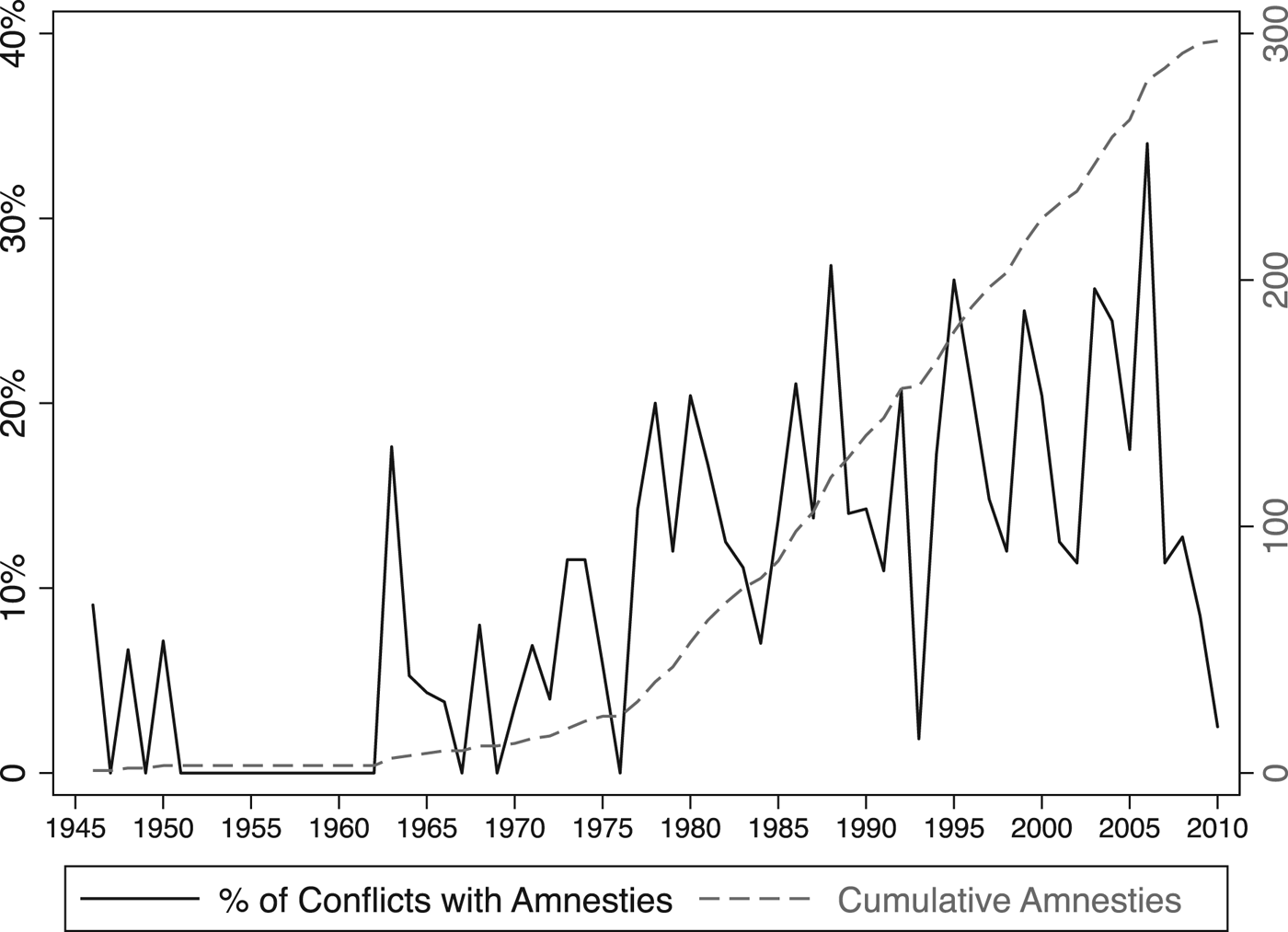
The first scholar to construct an extensive data set on amnesties, Louise Mallinder, contends that the worldwide “justice cascade” for atrocity crimes led to an increase in the use of amnesties over time because leaders use them to avoid accountability.Footnote 24 Indeed, amnesties are quite common for contemporary states in conflict. Since the end of World War II, an average of over four conflict amnesties were passed per year. The number of amnesties spiked after 1975, averaging over seven per year. Figure 1 depicts trends in the use of conflict amnesties as a percentage of ongoing wars. The number of amnesties increased with the number of states fighting civil wars toward the end of the mid-twentieth century.Footnote 25 Though this trend is noisy, its highest peak was in 2006, when 30 percent of civil wars featured amnesties. The use of amnesties increased with time, and was diffuse across contexts: 78 of 104 countries (75%) that experienced civil war enacted at least one conflict amnesty during or after the fighting. Thirty countries passed only one amnesty, and forty-eight passed more than one. In general, the spreading popularity of amnesties may speak to a global normative shift in favor of legal solutions to problems of political violence.Footnote 26
Conflict amnesties over time

Do all of these amnesties actually matter? Two camps offer answers. The first equates the passage of exceptional amnesty laws to the cynical avoidance of accountability for atrocity crimes. “The harmful effects of impunity,” writes Diane Orentlicher, “are compounded when prosecutions are foreclosed by an amnesty law enacted by, or to appease, the military or other autonomous sectors.”Footnote 27 This statement reflects the human rights model, which predicts a relationship between amnesties and future repression and war.Footnote 28 For proponents of this model, amnesties erect a roadblock to criminal justice, which should be a goal of post-authoritarian and post-conflict societies facing a legacy of systematic rights violations.
This is the official position of the UN. In 1998, Secretary General Kofi Annan requested that UN mediators refrain from supporting amnesties for war crimes, crimes against humanity, and genocide.Footnote 29 In 2004, he expanded this to cover gross human rights violations as well.Footnote 30 Today, human rights proponents remain very suspicious of amnesties because they are open to political manipulation. For example, in 2012, Yemen's President Ali Abdullah Saleh agreed to end his thirty-three-year rule in exchange for an amnesty for himself and his family for a violent crackdown committed during the Arab Spring.Footnote 31 The amnesty was passed despite protest and condemnation from the UN High Commissioner for Human Rights.Footnote 32 Only two years later, investigators discovered that Saleh was organizing terror attacks and fomenting a rebellion against his successor.Footnote 33 Saleh's amnesty represents the worst fear for proponents of the human rights model: if perpetrators are allowed to walk free, conflict will resume in the near future.Footnote 34
A second camp are proponents of the peacemaker model. They maintain that the human rights model is too hopeful about criminal punishment. One variant of the peacemaker model promotes amnesties as a form of restorative justice. According to Mallinder and McEvoy, “properly constituted, amnesties bring law to a previously lawless domain in the exercise of post-conflict mercy.”Footnote 35 Following this logic, amnesties create social transactions where former combatants are offered forgiveness for confessions of the truth, promises to demobilize, or efforts to rebuild society. Examples include Mozambique's blanket amnesty (1992) combined with ritualized, public forgetting; South Africa's conditional amnesty (1995) process that attached legal immunity to the truth-telling process outlined by the Truth and Reconciliation Commission; or Uganda's amnesty (2000) that offered rebel soldiers amnesty in exchange for their participation in local ceremonies of social reintegration.Footnote 36
Other peacemakers root their ideas about amnesties not in reconciliation but in political bargaining. They admit that amnesties are deals with the devil, but contend that they are necessary to strengthen the prospects for human rights in the long term. Snyder and Vinjamuri argue that “when the bargaining situation demands it … granting a formal amnesty may sometimes be necessary.”Footnote 37 Amnesties are needed most in contexts like postindependence East Timor, where weak institutions are overburdened by the prospect of prosecution,Footnote 38 or in other situations where so-called spoilers remain powerful. Spoilers are “leaders and parties who believe that peace emerging from negotiations threatens their power, worldview, and interests, and use violence to undermine attempts to achieve it,” and if they succeed in ruining peacemaking efforts, they can generate a long and intense episode of renewed fighting.Footnote 39 To explain, Snyder and Vinjamuri appeal to bargaining, arguing that amnesties represent a deal wherein spoilers surrender power in exchange for immunity or a share in government control.Footnote 40 The authors point to examples like El Salvador (1992) and Sierra Leone (1999), which both involved embedding amnesty laws within peace accords containing power-sharing stipulations. By neutralizing opposition threats, rather than angering them, these amnesty deals paved the way for fragile but durable periods of peace.
The peace-versus-justice debate between the human rights and peacemaker camps remains unresolved. One reason is a lack of empirical studies examining whether amnesties do in fact have a pacifying effect. A World Bank working paper finds a small, positive effect for amnesties on civil war recurrence (meaning that amnesties are associated with more violence).Footnote 41 Another working paper by Eric Melander discovers that amnesties are effective in decreasing violence, but only when they are enacted by institutionally powerful governments.Footnote 42 While valuable, these studies are based on a limited number of conflict amnesties. Snyder and Vinjamuri's work is still the most systematic of published studies on amnesties, based on a qualitative comparative engagement with thirty-two postauthoritarian and postconflict cases. However, the authors discuss only a few high-profile cases in any detail, and their conclusions are debatable.Footnote 43
A second reason for deadlock is that each of the theoretical perspectives make hidden empirical assumptions about the scope, timing, and target of conflict amnesties. The human rights model tends to treat amnesties as if their main purpose is to ignore questions of justice by providing blanket cover for atrocity criminals. However, this does not stand up to the historical record. My data set codes conflict amnesties based on whether they forgive combatants for serious violations of human rights or humanitarian law. A precondition for such an amnesty is the presence of widespread acts of violence against civilians, like mass killing, torture, disappearance, or sexual violence.Footnote 44 An amnesty is then coded as having immunities for serious violations if (1) it explicitly provided immunity for any of the acts listed here; (2) the amnesty provided a blanket immunity for all crimes committed during conflict; (3) the amnesty did not contain an exception for acts considered to be in violation of international law;Footnote 45 or (4) the amnesty was worded in a legally ambivalent way that allowed groups to escape criminal prosecution for serious violations. (See the appendix for a more extended explanation of these categories.) Of the 297 conflict amnesties since 1946, only seventy-seven (26%) fit these criteria. Far more amnesties release political prisoners of conscience, forgive rebels for crimes against the state, or aim to repatriate displaced individuals. A minority of amnesties explicitly provide immunities for serious violations (SV).
Where the human rights model overestimates the number of blanket amnesties, the peacemaker model focuses exclusively on a limited number of amnesties passed after conflict termination, or in peace agreements. These too are a minority. Amnesties passed after conflict termination make up only 116 of 297 (39.2%). The remaining 181 conflict amnesties were extended while the fighting was ongoing. Fifty-nine of the 116 amnesties passed after termination were not embedded within peace agreements, but passed unilaterally by the government. That leaves only 57 of 297 amnesties (19.2%) that were offered in peace agreements following conflict. Like the human rights approach, peacemakers tend to examine only one-quarter of amnesties in their research. It is clear that, to move forward, theory must be more nuanced, and data on amnesties must be disaggregated.
A third and final reason the peace-versus-justice debate remains unresolved is that while the human rights and peacemaker models generate expectations about the ability of amnesty laws to aggravate or end conflict, neither does much to engage the extensive body of knowledge in political science on civil war termination and recurrence. The two models instead rely on hard-to-measure psycho-social notions like grievance or deterrence. And while some jurists and political scientists speak to the importance of amnesties in bargaining,Footnote 46 none actually uses bargaining theory to develop or test expectations. For instance, what are the various ways that rebels might react to amnesty offers that come from their state adversaries? Will they have some reason to suspect weakness or insincerity on the part of the offering government, and does this affect the likelihood of peace? I draw on the bargaining approach to conflict to answer these questions, and to generate expectations about the peace-promoting potential of conflict amnesties.
A Bargaining Theory of Conflict Amnesties
The Conflict Process
Most civil wars being fought today are not new, but rather new offshoots of previous wars.Footnote 47 For this reason, studying how to generate stable and lasting peace agreements between actors already fighting is of paramount importance.Footnote 48 An elegant approach to this problem draws on bargaining theory, which considers how parties interact and “search for advantage through accommodation.”Footnote 49 Bargaining theory has long been used to investigate interstate wars,Footnote 50 but only more recently has it been adapted to intrastate conflicts.Footnote 51 A principal contribution of this tradition is to model the perpetuation of war as a series of bargaining failures: governments and opposition groups simply have a very difficult time communicating preferences, reaching agreements, and trusting in the other side to keep its promises when agreements are reached.Footnote 52 Bargaining theory assumes that conflict over ideas and resources is inevitable. It also expects that conflicts escalate to war and fail to end because of two major complications: (1) information asymmetry, which is a lack of reliable estimates of the opponent's military capacity or fighting resolve; and (2) commitment problems, which encapsulate the general “inability of parties to commit to deals.”Footnote 53
Early work on bargaining in war focused mostly on the information asymmetry problem. It assumed that wars are a “costly lottery” fought by sides that underestimate their opponents because of incomplete or bad intelligence.Footnote 54 In a situation of perfect information, neither rebels nor state forces would start a disastrous civil war because the outcome would be evident prior to fighting. When war is a real possibility, however, both sides have an incentive to hide information regarding their military capacity and their willingness to fight. The costly lottery model is fairly good at explaining why wars start. However, it does not fully explain why certain wars become intractable, nor why some wars consistently recur.Footnote 55 In theory, the impulse to fight should subside with time, as opponents obtain reliable intelligence through iterated conflict interactions, but this is often not the case.
A second “conflict process” model adapts early work on bargaining to account for the persistence of internal armed conflict. In wars of long duration, it is not solely lack of information, uncertainty, or miscalculation that is responsible for continued fighting. Instead, as Robert Powell writes, “fighting ensues when the resolution of uncertainty indicates that a state is facing an adversary it would rather fight than accommodate.”Footnote 56 In short, the decision to continue fighting is not an accident. Self-interested fighting groups strategically toggle back and forth between cooperation and coercion to gain leverage and maximize gains in a peace contract. In this sense, “conflict [is a] part of the bargaining process rather than the end of the bargaining process.”Footnote 57
This bargaining process between civil war parties can be separated into two main phases: the prenegotiation and negotiation periods. The prenegotiation phase, which is prior to the initiation of formal talks, occurs while fighting is still ongoing. During prenegotiation, combatants must send signals that they are interested in conducting formal talks, or at least in temporarily ceasing hostilities. Sending these signals can be very difficult because of regular breakdowns in communication. True signals are “dismissed as noise, noise is mistaken for signals, and signals are recognized for what they are but misinterpreted.”Footnote 58 The real task for combatants is to sort out whether gestures made by the other side are genuine or spurious. Negotiators often shroud their own intentions during this period. “Phony bargaining,” where one or both sides insincerely pursue accommodation, is a persistent concern.Footnote 59 The result is a constant risk of defection before periods of negotiation even commence.
The negotiation period, which encompasses formal talks and sometimes ends with an official agreement, is subject less to signaling problems and more to problems of commitment. Parties to talks can attempt to deceive their opponents about their willingness to abide by various provisions, and they use periods of sustained negotiation to regroup and re-arm. If negotiations are to succeed, parties must make promises that the other side can trust. But how do combatants signal to opponents their desire to seek a genuine resolution to conflict? They must make credible commitments that can foster compliance and implementation. A credible commitment is a believable assurance to Side X that Side Y will not threaten or use force to revise the terms of any peace deal. Concerns over credible commitments are particularly acute for rebel groups, who possess no means for enforcing the terms of the deal and who are often asked to demobilize in exchange for power sharing or other terms of the settlement. Already weaker in most cases, rebel groups are very reluctant to lay down arms. In the event that the government gains in strength and then decides to renege on the deal, the rebels will have no way to fight back. These commitment problems are exacerbated in situations where political institutions are weak,Footnote 60 no third parties are present,Footnote 61 and conflict actors are divided into large ethnic or religious blocs.Footnote 62
Evidence suggests that the bargaining environment, as well as the terms of the deal, are important for establishing credible commitments and ultimately securing a long-lasting peace. For example, settlements that are mediated by third parties have had some success in prolonging peace, though the scope of their success is uncertain.Footnote 63 Those settlements with power-sharing provisions, which typically incorporate rebel leaders into government or military positions, are also correlated with less conflict recurrence.Footnote 64 Mediation and power sharing are both pacifying because they provide a better settlement design and improve monitoring of rebel and state forces’ continued commitment.
Conflict Amnesties
In the literature, amnesties are often treated as an additional, and sometimes integral, tool for making credible commitments to larger peace offers.Footnote 65 As official acts of the state, amnesties are binding contracts that can demonstrate the government's willingness to sue for peace.Footnote 66 By publicly announcing an offer or legislating an amnesty, the government is removing its own legal prerogative to hold challengers to state sovereignty criminally accountable. The move can also tie the government's hands: by legally foreclosing forms of punishment, the government makes it tougher to renege on its own commitments to integrate the rebels into the political system.
At first blush, this logic seems clear enough. But the ability of amnesties to help end armed conflict is not so straightforward, for two reasons. First, the link between amnesties and credible commitments requires fleshing out. It is likely the case that amnesties’ effects will depend on the conditions of their enactment, along with their specific provisions. Second, theorists have not done enough to separate between amnesties enacted in the prenegotiation conflict phase and those that result from conflict-ending negotiations. As one observer argues, “there is a need to differentiate between amnesties’ effects on conflict cessation (‘negative peace’) and peace sustainability (‘positive peace’).”Footnote 67 The next two sections take up this challenge. First, I consider whether amnesties will lead to conflict termination when they are passed during ongoing conflict. Second, I address how amnesties passed following conflict termination can decrease the risk of conflict recurrence.
Amnesties and Conflict Termination
The state is the issuer of amnesties. The question for rebel groups engaged in conflict is whether to accept the state's amnesty-supported bargaining offer or to continue fighting. If the rebel group accepts the offer, then the state has the option of honoring the offer or reneging. If the rebel group accepts, and the state honors the amnesty offer, then the conflict can move from a fighting phase to a negotiation phase, which could eventually lead to conflict termination.
However, amnesties issued during the prenegotiation period, amid rounds of fighting, hold only a false hope of conflict termination. The reason is adverse selection. In microeconomic theory, adverse selection is caused by the presence of “asymmetric information prior to the contract period.”Footnote 68 Before formal talks have begun, and fighting is ongoing, amnesties cannot overcome the problem of adverse selection. They are noisy signals that will either be misused by the government or misinterpreted by rebels.
Consider that in most civil wars, rebel fighters rely on low-cost, high-reward guerrilla and terror tactics.Footnote 69 Weaker than state forces, rebels rely on a long-term, piecemeal strategy of slowly gaining control in the country's peripheries, while state forces must engage in expensive counter-insurgency campaigns.Footnote 70 In this context, rebels search hard for evidence that the government is growing weary of fighting, and governments attempt to lure rebels into deals that require demobilization. In this environment, amnesties will be an instrument of asymmetric information, not a solution to the problem of asymmetric information. To see the logic, we must consider why governments make amnesty offers in the first place.
There are two scenarios in which governments offer amnesties to rebels amid fighting. In the blackmail scenario, the rebel group moves first. It make demands and the government responds. One tactic rebels often pursue is to insist on amnesty as a precondition to a ceasefire and the commencement of formal talks. In this scenario, amnesties have the potential to backfire on the government.Footnote 71 If the government gives in to rebel demands and makes the amnesty offer, then rebels interpret the signal as evidence that the government is weakening, or that its fighting resolve is waning. In response, the rebel leadership declines the offer and continues pursuing its strategy of slow military gains. Qualitative evidence suggests the possibility of rebel misinterpretation is a constant worry for state leaders. Based on interviews in the Democratic Republic of Congo, Valerie Arnould finds that “the government was concerned that granting amnesties to its opponents would be interpreted as a sign of weakness.”Footnote 72 Whether or not the gesture is truly conciliatory, rebels in the blackmail scenario will take amnesty offers as evidence that they are in a superior position. A rational move in this circumstance is to continue fighting in hopes of a victory rather than agreeing to negotiate further.
In the second, phony bargaining scenario, governments initiate amnesty offers without requests from rebels. In this scenario, amnesties are still unlikely to overcome problems of adverse selection. Uncertain about the government's preferences, rebels read the signal with cynicism, and interpret the amnesty as the state's attempt to trick them into a bad deal. This is the second reason amnesties are not productive in the prenegotiation period: rebels question whether the government is actually willing to abide by its offer. For example, in May 1982, at the height of a grisly civil war between the Guatemalan National Revolutionary Unity (GRNU) and right-wing government death squads, General Efrain Ríos Montt issued Decreto Ley 33–82. This amnesty forgave guerrillas for “past political and related offences to persons who applied for it to appropriate civilian and military authorities within thirty days.”Footnote 73 To qualify, guerrillas had to surrender to authorities. This amnesty followed a bloody, five-month counter-insurgency campaign and a March coup that installed Ríos Montt. Ultimately, the rebels did not accept because they suspected that Ríos Montt's offer was insincere, and that he was engaged in phony bargaining. The 1982 amnesty did nothing to curb the violence, nor did five additional amnesties that were passed between 1983 and 1988.
Problems of adverse selection can tank the prospects that amnesties will inspire a bargained solution to armed conflict.Footnote 74 Without complete information, combatants fret over the other sides’ true preferences, and they also worry that they are being suckered.
These adverse selection problems are only exacerbated when immunities for serious violations are proposed in the amnesty offer. Serious violation (SV) amnesties are especially unpopular with the winning coalitions that support state leadership, and with civilian populations that have been victimized during war. For example, Sierra Leoneans complained in global media outlets that amnesty, if it were awarded to the RUF, would put “mass murderers” in political office.Footnote 75 In the blackmail scenario, where rebels demand amnesty, government promises to include SV provisions is a signal that communicates extreme government weakness to rebels. If the government is willing to promise that opposition fighters will not be held accountable for terrible crimes against civilians, then it is a sign that the government is so desperate for an end to the conflict that it will accept a tremendous blow to its own legitimacy. In the phony bargaining scenario, where governments lead with the idea of an SV immunity, the rebels will doubt that the deal is genuine. Giving an SV amnesty requires that the government pay a high price with its winning coalition, who despise the rebel opposition and do not want it completely absolved of wrongdoing. It is thus hard to believe that the government is willing to act with such munificence on its own volition. Therefore, SV amnesties should only enhance the adverse selection problems that amnesties present in the first place. Based on this reasoning, I propose the following hypotheses:
H1a
Amnesties offered during periods of fighting will be associated with a lowered probability of conflict termination.
H1b
Amnesties with SV immunity provisions offered during periods of fighting will be associated with a lowered probability of conflict termination.
Amnesties and Duration of Peace
According to bargaining logic, amnesties issued in the prenegotiation phase will not result in the end of fighting because of adverse selection issues. In this context of great uncertainty over the enemies’ preferences, amnesties are nosiy signals. However, the function of amnesties changes as fighting terminates.Footnote 76 After sides fight to a stalemate, they will use amnesties less as a source of information because the postconflict environment is already rich in intelligence about fighting capacity and resolve. After all, combatants decide to stop fighting in the first place based on what they learn through iterated battlefield interactions. The goal for the government using conflict amnesties during negotiations is not to send signals of its willingness to bargain, but to send signals of commitment that will compel the rebels to reach a deal. Thus, in the context of negotiation, adverse selection problems give way to credible commitment problems.
Long-term peace requires credible commitments to disarmament and demobilization. Rebels are not comfortable surrendering arms and disbanding if they do not believe that the government will refrain from attacking again in the future. The task for negotiators is to reach a peace settlement even though both sides recognize that future exogenous factors, like a sudden change in the balance of forces, may later generate incentives to renege on the deal.
Amnesties can send signals of commitment in the negotiation phase. First, they are part of a longer and iterated process of postconflict interactions, rather than a one-shot, unilateral offer extended during fighting. Second, in strong states, amnesties are enforceable laws often associated with the establishment of a refreshed postwar legal order.Footnote 77 Instead of getting lost in the noise of wartime signaling, amnesties after termination can help governments establish a fresh new set of institutions to reinforce peace, and to bring the remnants of the former rebellion into the political fold.Footnote 78 Third, in weak or highly fragmented states, amnesties might also make tenuous peace more agreeable by insulating former combatants against reprisal in the event that the distribution of power between former opponents shifts. Surrounding 1997 peace accords in Tajikistan, for instance, head of state Emomali Rakhmon offered amnesty to dozens of warlords to bring them into the ruling coalition and neutralize the threat against his government.Footnote 79 Whether the state is institutionally strong or weak, negotiated amnesties can be part of a long-lasting end-game, rather than fleeting wartime overtures toward the opposition. On the basis of this reasoning, I propose the following hypothesis:
H2a
Amnesties issued following conflict termination will be associated with a decreased probability of conflict recurrence.
Hypothesis 2a is subject to important conditions related to reputation and commitment. The commitment problem in the negotiation period is caused by “asymmetric information during the contract period” and aggravated by uncertainty “stemming from the inability to monitor” other actors after a deal is reached.Footnote 80 Commitment failure occurs when one side decides not to abide by the agreement. In one such instance, governments are the defectors. State leaders often have an incentive to challenge an agreement's terms, or threaten coercion, following negotiation. The reason is that governments are loss averse, and peace agreements nearly always entail some kind of unpalatable concessions of authority to rebels.Footnote 81 An amnesty is one such concession. It requires forfeiting legal authority over criminal prosecutions to inspire rebels to agree to peace.
However, amnesty could simultaneously make it difficult for the government to comply because leaders worry that amnesties will damage the state's reputation. Governments seek to develop a reputation for being tough, which wards off future insurrection.Footnote 82 A conciliatory gesture, amnesties are perceived by governments as creating an opposite reputation for weakness. States that want to avoid this perception will be inclined to renege on amnesties or later impose more onerous conditions.
Newer research suggests that reputation effects make conciliatory gestures dangerous but that a peace agreement can mitigate this danger.Footnote 83 Peace agreements are useful not necessarily because they keep rebels from defecting but because they serve as a legally binding framework that can check against government noncompliance.Footnote 84 Agreements normally result from many rounds of bargaining and they often include provisions that allow for extensive monitoring during implementation. If governments take steps to implement, their commitments become more reliable and less obviously based on moment-to-moment power political calculations. When amnesties are a part of this broader effort, they will be associated with longer peace. Amnesties should thus be more likely to stick when they are embedded within formal peace agreements.
Once again, the Guatemala example is instructive. An amnesty was passed in December 1996 following a comprehensive peace settlement between rebels and the government. This amnesty was far more likely to stick. The peace agreement framework resulted from a six-year process of negotiation involving members of former opposition groups, civil society, European negotiators, and the UN. The presence of these actors not only helped the sides make commitments but also made them more credible. The 1996 amnesty in Guatemala did not overburden the former rebels in relation to the government, as some of the other amnesties did. Whereas previous amnesties required that rebels lay down arms with little assurance that the government would abide by its commitments, this agreement stipulated that the state and rebels would have to follow procedures reviewable by the judiciary. This amnesty, embedded within a larger brokered peace deal between opponents in a vicious civil war, is associated with a peace spell that is now twenty years old. This example demonstrates the wisdom of waiting to issue an amnesty until fighting has slowed, and the negotiation phase is well under way.
The Guatemalan amnesty was also prudent because, knowingly or unknowingly, it avoided a second cause of commitment failure: immunities for serious rights violations. Agreed upon within the 1996 Peace Accord and subsequent National Reconciliation Law, the amnesty forgave combatants for common, political, and security crimes. However, it stopped short of granting immunity for offenses to international human rights and humanitarian law, which the Guatemalan government was duty bound to enforce. This meant that combatants could still be held accountable in the future for genocide and crimes against humanity.Footnote 85
I predict that serious violations amnesties—which unlike the Guatemalan amnesty foreclose the possibility of prosecution—will not promote peace, even if they are passed following conflict termination. The reason is that they will encourage defection by both sides. This is counter-intuitive. These amnesties give rebels everything they want, which should make them more devoted to any settlement. However, SV amnesties create a reputation for governments as highly conciliatory, which rebels will exploit in the future. They send a message to the rebels that violent tactics, no matter how indiscriminately applied, will be noncostly. Having previously gotten away with egregious violence with no penalty, amnestied rebel groups will in the future see no reason to avoid breaking the bargain and reigniting conflict when the opportunity again presents itself. As Barbara Walter writes, “Negotiated settlements [can] provide information about a government's willingess to compromise with rebel groups, signaling to potential challengers that rebellion is likely to be rewarded.”Footnote 86 Rebels who benefit from amnesty protections know that should they choose to resume the war, fighting hard against the government and using atrocity-level violence against civilians may again be excused. Not only that, it may even result in gains.
SV amnesties may compound the difficulties that the government has in implementing the terms of peace. Domestic victims of violence in civil war do not want their tormentors to walk free, and outside audiences generally deem SV amnesties to be a violation of international norms. The ruling coalition in the Democratic Republic of the Congo (DRC), to quote experts, “strongly opposed granting any immunity to the rebels, finding it politically unacceptable. The government position on amnesty was generally even stricter than prevailing international standards.”Footnote 87 The stigma against large-scale rights violations and war crimes is so strong that some rebel leaders, like Laurent Nkunda of the rebel CNDP in DR Congo, do not negotiate hard for such immunities because it would mean confessing to terrible acts.Footnote 88 Because SV amnesties are so unpopular, the government will also find it more difficult to follow through with any deal that involves legal immunity. It would prefer a return to coercion. This was the case in 2016 Colombia, where Álvaro Uribe and his supporters protested against the state's initial peace deal with FARC because it provided too much leniency with regard to justice for atrocity crimes (though it did not offer an outright immunity).Footnote 89 If these demands become too costly for governments, they may seek a revision to the deal, which could lead to breakdown and the resumption of war. The irony of the commitment problem, exacerbated by concern for reputation, is this: if amnesties offers are too favorable to rebels, it may weaken their overall ability to make peace.
H2b
Amnesties embedded in peace agreements will be associated with a decreased risk of conflict recurrence.
H2c
Amnesties with SV immunities will be associated with an increased risk of conflict recurrence.
Research Design
My theory of conflict amnesties focuses on the motivations of state and rebel groups that are bargaining to end armed conflict. The theory offers predictions about whether amnesties help to bring about conflict termination, and if so, how amnesties affect the duration of the post-termination peace. Thus, there are two dependent variables for this analysis. One is whether a conflict ends in the first place (termination), and the other is whether and how long a conflict takes to resume after fighting has stopped (recurrence). While many studies separate these into two different questions, the theory demands a consideration of both because it makes predictions concerning the pre- and post-termination effects of amnesties.Footnote 90 Testing the hypotheses thus requires the analysis to proceed in two steps. In the first step, I test whether amnesties are associated with conflict termination when offered during fighting. In a second step, I analyze whether postconflict amnesties are associated with longer periods of peace before recurrence.
Level of Analysis: Fighting Dyads
All of the models in this article use the dyad as the level of analysis so that the relationship between states and specific rebel groups can be examined. I use data sets produced by the Uppsala Conflict Data Program, which include a separate panel for all intrastate conflict pairings involving the state and a single rebel group between 1946 and 2014.Footnote 91 The data set includes every year that a dyadic conflict was ongoing up until the year that a particular episode terminated, defined as at least one year of non-activity.Footnote 92 In the event of a termination, two variables are included: one measures the length of time in days that the post-termination peace spell lasted, and another registers whether the conflict recurs. If a dyadic conflict recurred, then a new panel of ongoing conflict years is added, starting in the first year of fighting and ending in the year of termination. Of the 619 conflict episodes that began before 2010—the last year for which reliable data on amnesties are available—588 terminated. Of those, 182 experienced conflict recurrence. This is a baseline recurrence rate of 31 percent among all intrastate armed conflicts.
The independent variables of interest in the models are amnesties. An amnesty that is offered or passed during ongoing conflict is assigned a 1 for the appropriate dyad-year. Post-termination amnesties are coded as 1 in the dyad-year of termination if they were offered or passed within two years of the end of fighting. Amnesties were coded as having happened prior to a termination if their passage date preceded the date of conflict termination recorded by UCDP. They were coded as post-termination amnesties if they were passed on a date following termination. If the date of the amnesty was the same as the final date of conflict—which happens when amnesties are embedded in peace settlements—then the amnesties were coded as occurring post-termination.
The dyadic panel data set includes 163 conflicts that ended in victory by either government or rebel sides. These must be excluded from the models analyzing postconflict duration of peace. The theory predicts that amnesties are poor prenegotiation signals, but are good signals of commitment in the negotiation phase. Conflicts that end in victory might still involve prenegotiation signals at some point over the course of the war, so I choose to retain these conflicts in the analyses considering conflict termination. In this context, amnesties could be phony bargaining tools that give one side an advantage. However, conflicts that terminate with a victory do not feature rounds of negotiation. Victors impose their will on their vanquished opponents, rather than bargaining. For this reason, victories are excluded from the set of analyses modeling conflict recurrence. Following a civil war victory, we should neither expect amnesties to be extended to rebels nor to be used as a bargaining chip. When victories are excluded, the postconflict termination cases are pared down from 588 to 425 terminations, with 161 recurrences. Because conflicts that end in victory are less likely to recur, when these cases victories are excluded, the baseline recurrence rate for terminated conflicts increases to 37.9 percent.
Selection
My argument is that amnesties are partially endogenous to the conflict process but that, under certain conditions, amnesties might still assist in overcoming bargaining problems. Assessing this argument statistically requires a modeling design that accounts for selection issues. It could be that some civil war factors both inspire the passage of amnesty laws and affect the overall likelihood of conflict termination or recurrence. If this is the case, then selection bias will be present. Resulting from strategic choices, amnesty “treatments” are assigned nonrandomly to conflict groups. Because the data are drawn from the observed world, it is not possible to solve this problem by manipulation, randomly assigning amnesty laws to some dyads and not others.Footnote 93
Given these issues, I use coarsened exact matching (CEM) techniques in both stages of the analysis to address issues of selection.Footnote 94 In an ideal set of observed data, treatment and control groups are “balanced,” meaning that the groups possess the same mean values of all covariates. In a situation of perfect balance, one can simply perform a difference in means test to assess the effects of treatment. However, in most observational data, perfect balance of this kind rarely exists. CEM can be used to create more balance between groups by (1) generating matched strata that share the same levels of different pretreatment characteristics (2) “pruning” observations that are not matched and (3) using the number of treated and untreated observations in each stratum to create weights for further analysis.Footnote 95
For this study, matching has two advantages over selection models, like a two-stage least squared regression. The first is theoretical. To perform a two-stage model, one must have a clear theory of what factors inform the treatment assignment process.Footnote 96 Yet no established theory of conflict-amnesty provision exists. Little research addresses this issue, and the theory developed here cannot answer certain crucial questions. For instance, in the prenegotiation phase of conflict, if state leaders know that rebels may interpret amnesties as a sign of weakness, why would they issue them in the first place? Because we know very little about these decisions, we can only theoretically speculate about the assignment process. This means that a selection model would be difficult to justify. A second advantage of matching is methodological. Two-stage models introduce a number of identification issues related to the use of instrumental variables,Footnote 97 as well a host of restrictive and potentially unwarranted statistical assumptions.Footnote 98 For these reasons, matching methods are the better choice.
Results
Conflict Termination
I begin by testing Hypotheses 1a and 1b, which make predictions about the effects of amnesties on the prospects of conflict termination. Terminations could follow well after amnesties are offered but still be causally related. Therefore, the main amnesty variables are coded as 1 in the year if an amnesty was offered in time t or in time t−1. This allows us to test whether a termination followed at any point in the year of the amnesty, or the year following, thus avoiding bias against findings in support of amnesties. Of the 181 amnesties extended to rebels amid fighting (amnesty), 32 (17.7%) were followed by conflict termination within two years. Twenty-nine amnesties forgive rebels for human rights abuses (hr amnesty). Only five (17.2%) of those were followed by a termination within two years.
To perform a matching analysis, we must first speculate about what pretreatment factors might make the government more likely to offer an amnesty in a prenegotiation phase of conflict. These factors are separated into three categories: political conditions, general conflict dynamics, and conditions related to the bargaining environment. The first category includes political conditions that might make amnesties more or less likely. Variables in this category are:
1. A binary measure of whether the conflict was ongoing after 1998 (after 1998), given that the international community has since officially advocated against more expansive amnesties.Footnote 99
2. A binary measure of whether the country is transitioning to democracy (demo trans), since amnesties are often passed during regime change in response to demands for “transitional justice.”Footnote 100
3. A normalized 0–1 measure of judicial independence (judicial independence).Footnote 101 This indicator, which correlates highly with binary measures of democracy (0.77), controls for the possibility that amnesties will be more necessary in situations where rebels have a reasonable expectation of prosecution by domestic courts.
A second category of control variables involves general conflict dynamics. Amnesties are likely a function of how intractable a conflict is. The following variables, taken from the UCDP Armed Conflict Data Set, attempt to account for intractability:
1. An interval indicator of how many years the civil war lasts (years at war)
2. A binary measure of whether the fight is over territory (territory)
3. A binary measure of whether the conflict reached 1,000 battle deaths (intensity level)
4. A binary measure of whether the conflict had an ethnicized dimension (ethnic)
5. A continuous indicator of how many other rebel groups are fighting in the conflict (dyads). If rebel groups are jointly participating in conflict, or attempting to negotiate with the government, this variable could also influence the bargaining environment.
A third and final category of control variables involves conditions that influence the bargaining environment between a rebel group and the government. These include:
1. A continuous indicator counting how many previous amnesties have been offered to the rebel group (previous amnesties). Some governments may simply be more willing to offer amnesties, or it could be the case that governments design deals in iterations, using trial and error and making improvements until rebels agree to negotiate.Footnote 102
2. An ordinal indicator (−2 to 2) measuring how strong rebel forces are in comparison to the government (rebel strength). It could be that governments are less likely to offer amnesties to rebel groups that are much weaker because state forces will hold out hope that the rebels can be defeated. Negative scores indicate weaker rebel forces.Footnote 103
3. An ordinal indicator (0–2) measuring whether the fighting capacity of the rebels is low, moderate, or high (fighting capacity).Footnote 104 This measure is different than rebel strength because it captures the ability of the rebels to mobilize and strike state targets. The higher a rebel group's fighting capacity, the stronger its bargaining position, which should make the government more willing to accommodate. Inversely, a group that cannot easily return to the battlefield is unlikely to convince governments to provide an amnesty.
4. A binary indicating whether both state and rebel forces were guilty of atrocity-level crimes during the civil war (bloody hands). This variable is drawn from UCDP's One-Sided Violence data, which registers massacres committed by various groups.Footnote 105 The logic here is that if both sides to the conflict were guilty of serious violations, then they will be more likely to agree to a deal involving reciprocal immunity.
5. A binary variable measuring whether a UN Peacekeeping operation was present (unpko).Footnote 106 By monitoring, peacekeeping forces might help facilitate early bargaining between conflict actors.
All of these factors might feasibly affect both the choice to extend an amnesty to rebels, and ultimately, the chance that a conflict will terminate. Therefore, I start by conducting a pre-matching analysis to observe which variables correlate with amnesties and with conflict termination. This pre-analysis consists of a Logit predicting the occurrence of an amnesty, using all of the mentioned variables as covariates, followed by other Logits predicting conflict termination using the same covariates. Five variables are significantly correlated with amnesties: demo trans, judicial independence, territory, intensity level, and previous amnesties. These variables also appear to be correlated with conflict termination, suggesting a concern over selection (see appendix for Table A2 of findings and explanation). Therefore, these variables are used to match observations. The CEM matching procedure works well. Based on these five variables, the data are grouped into fifty-one strata, thirty-nine of which are matched. Only thirty-nine of 2,256 observations are unmatched (see appendix Table A3).
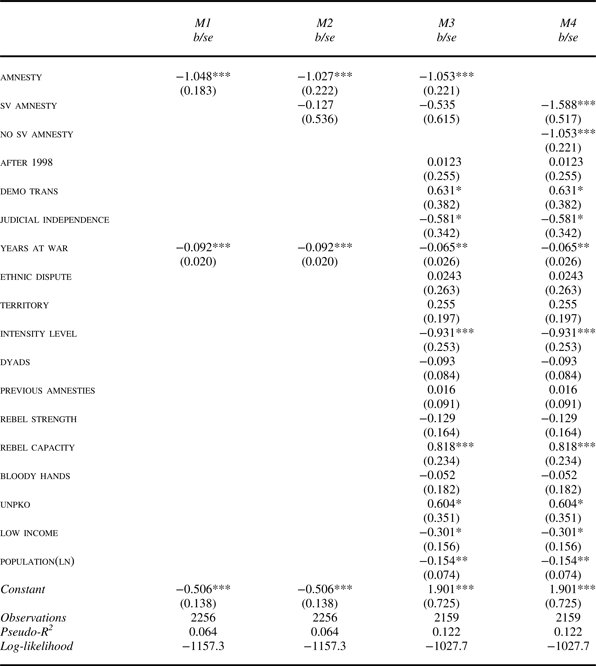
Perfect balance is not achieved, however, so it is necessary to include all of the covariates at their original values in the models correlating amnesties with conflict termination, along with matching weights to reflect the different size of the matched strata. This, along with two additional predictors—state-level controls for logged population (population) and whether the country is low-income (low income)Footnote 107—helps account for remaining variation. The final Logit models are reported in Table 1. Since multiple rebel groups might fight in the same conflict, robust standard errors are clustered by a conflict ID produced by UCDP.
Amnesties and conflict termination
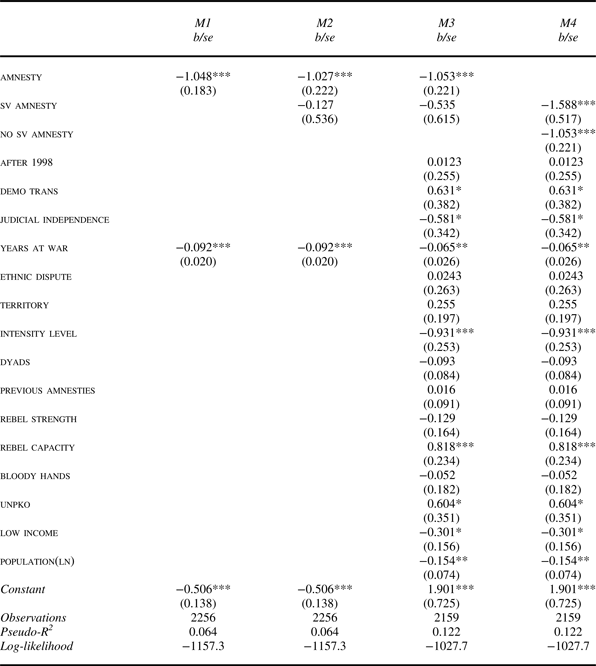
Note: Baseline category for each model are conflicts with no amnesty at all. Errors clustered by conflict. *p < .10; **p < .05; ***p < .01.
M1 is a basic model with only the amnesty and years at war variables, and no additional controls. The model shows a statistically and substantively negative relationship (β = −1.048) between amnesty and conflict termination, as predicted in Hypothesis 1a. According to M1, even when matching observations and controlling for selection, the probability that a conflict will terminate following any amnesty is 13.8 percent less than conflicts without amnesties.Footnote 108 M2 tests Hypothesis 1b, adding a variable that registers whether serious violations immunities are incorporated into the amnesty law. Amnesties that forgive serious violations are a subset of all amnesties offered to rebels, so in this specification the sv amnesty variable should be treated as an additive term wherein the coefficient will indicate the difference between all amnesties and those amnesties with human rights provisions. The interaction is statistically and substantively insignificant, indicating that no improvement comes when rebels are amnestied for serious violations.
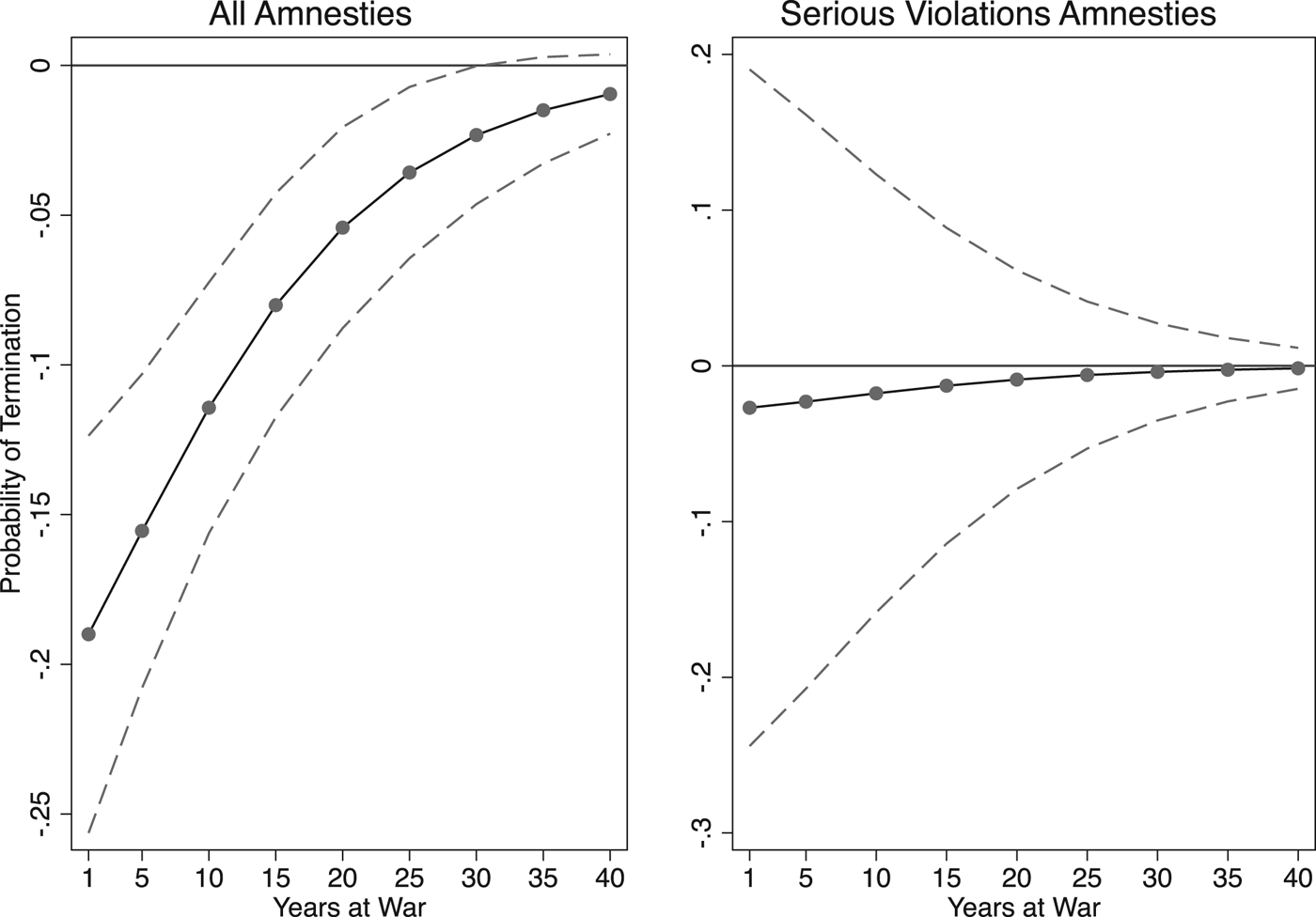
Figure 2 plots the marginal effect of all amnesties on the prospects of conflict termination at different values of years at war. In the left panel, one can see that amnesties passed in the first twenty-five years of conflict are negatively associated with conflict termination. This effect becomes indistinguishable from zero at the thirty-year mark. This makes sense based on bargaining theory. As wars carry on, and sides gather more information, amnesties are less deceiving signals. They are not as likely to be misused or misinterpreted. The right panel of this chart shows the marginal effect that adding a serious violations immunity has, in comparison to all amnesties. The confidence interval never passes the zero line, demonstrating that amnesties with SV provisions do not have an effect that is appreciably different than amnesties in the aggregate. This too is predicted by the theory.
Marginal effect of amnesties

M3 uses the same operationalization of the amnesty variables but includes all of the additional covariates at their original levels. The findings still support Hypothesis 1a and the substantive negative effect of the amnesty variable increases in magnitude. Some of the control variables are also significant: conflicts occurring in transitional democracies have a much higher probability of termination, as do those where rebel fighting capacity is much higher. Conflicts are less likely to end if they reached a high level of intensity because they become more intractable as each side escalates. Greater rebel fighting capacity is also correlated with a higher probability of termination, probably because the government will not seek to escalate against a side that is able to mobilize quickly.
M2 and M3 use an interaction variable to measure SV provisions. But what if the mean effect of all SV amnesties is compared only to the mean effect of those amnesties without SV immunities? To analyze this, M4 alters the way that the main amnesty variables are operationalized. Rather than including indicators of all amnesties and an additional term measuring SV immunities, M4 splits amnesties into two types: those with SV provisions (sv amnesty) and those without (no sv amnesty). The difference between these types sharpens into view. The coefficient on the sv amnesty variable is negative, statistically significant, and larger than the coefficient for no sv amnesty.
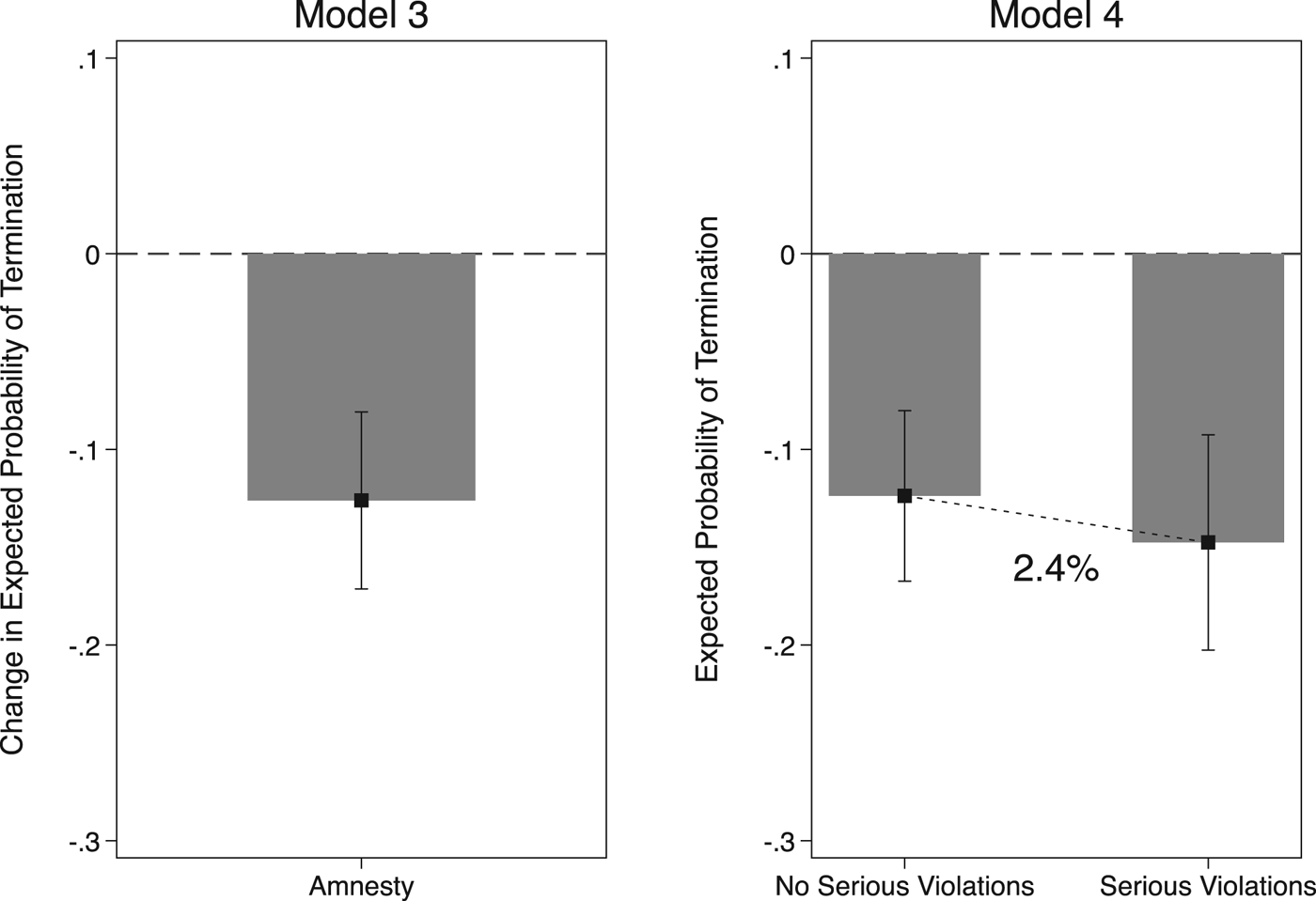
The difference in amnesties is not merely a statistically significant factor, but also substantively significant. Figure 3 plots the marginal effects of each variable from M4, and compares them to M3. One can see that the overall effect of amnesties, depicted in the left panel, is to decrease the probability of termination by 12.6 percent. But when these amnesties are disaggregated in the right panel, it becomes clear that those with SV immunities are associated with an even lower probability of termination, as predicted in the theory. No sv amnesty is associated with a −.124 change in expected probability of termination. For sv amnesty, the change is −.148. Conflicts with serious violations amnesties are 2.4 percent less likely to end than those with regular amnesties.
Marginal effect of amnesties

Overall, results from Models 1 to 4 create a clear picture of amnesties offered amid violent conflict. Amnesties as a whole are negatively associated with the probability of conflict termination, and those with SV provisions are even less likely to contribute to the end of fighting than those without. These findings support the hypotheses generated by the bargaining theory. Amnesties serve as noisy signals while armed conflict is ongoing. In response to amnesties offered in the prenegotiation phase during fighting, rebels will most likely continue hostilities.
Conflict Recurrence
The second piece of the empirical puzzle is the relationship between conflict amnesties and the sustainability of peace (Hypotheses 2a–2c). I construct events history models to test the relationship between amnesties and duration of peace before conflict recurrence. Weibull regressions are used to estimate the probability of conflict recurrence given the survival of a peace spell to time t, measured in days.Footnote 109
In these models of conflict recurrence, some of the variables change slightly. First, amnesty is scored as 1 if it is passed in the same year as the date of termination, or within two years following. Amnesties passed in the same year but prior to termination are included to allow for uncertainty over conflict termination dates, and to account for the possibility that amnesties passed prior to the absolute end of hostilities are still part of a larger postconflict bargaining process. The two-year lag following termination is built into the measure because amnesties are often passed over one year following the official date of termination registered in UCDP's dyadic conflict data set. Amnesties passed within this window of fighting's conclusion are commonly an extension of the negotiated settlement. Second, these models include measures of whether the conflict amnesty was embedded in a peace agreement (PAG) to test directly Hypothesis 2b. I coded this based on information present in the Transitional Justice Research Collaborative Data. And third, the years at war variable is changed to measure the number of years the previous fighting episode lasted prior to termination.Footnote 110
Multivariate events history models must also use matching methods to account for selection. It could be that factors affecting the conflict or bargaining dynamic are associated both with the decision to pass a postconflict amnesty, and with the likelihood of an extended peace. To handle this issue, I follow the same procedure as before. I first conduct a pre-matching analysis (reported in the appendix). This analysis suggests that four variables are associated with the passage of a postconflict amnesty: after 1998, territory, dyads, and rebel strength. Each of these variables is also associated with the stability or instability of peace, so they are the ones used to create matched strata.
The matching procedure, which again performs well, generates sixteen strata, fifteen of which are matched (see appendix Table A5). Only five observations are unmatched and pruned from the analysis. The imbalance between the strata is reduced to a near-zero value. To incorporate this information into the Weibull models, I include strata identifiers as a frailty parameter. This allows observations within each matched stratum to share a baseline hazard rate, much like using random effects in a regression analysis. In essence, the statistical tests are allowing groups with different combinations of pre-amnesty conditions to share the same risk of conflict recurrence. This controls for the fact that cases in various strata might be more failure prone than others. We can thus assess the effect of treatment while accounting for heterogeneous risk factors, along with additional control variables to account for remaining variation.
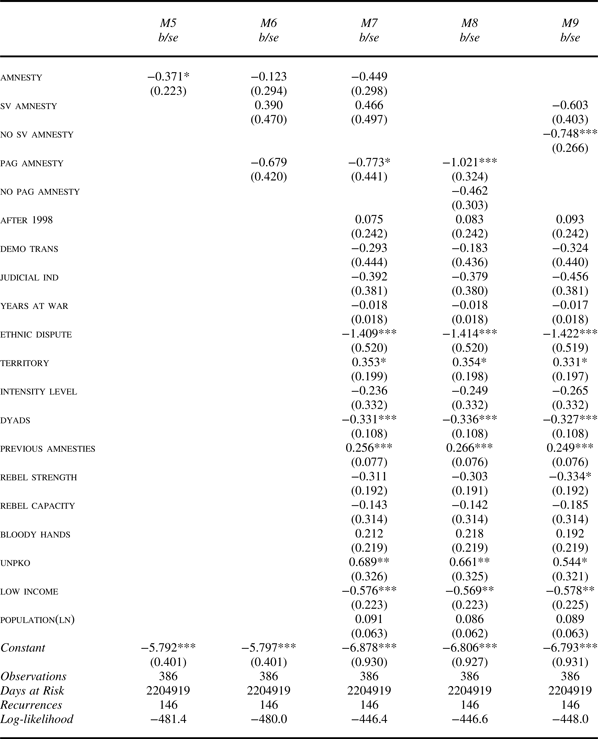
Table 2 reports the results of four Weibull models. The first, M5, is a basic bivariate model. In support of Hypothesis 2, the coefficient is negative, suggesting a correlation between amnesty and a decreased likelihood of conflict recurrence. However, the coefficient is not statistically significant. Its p-value is 0.096. M6 includes additive terms for hr amnesty and peace agreement (pag) amnesty, similar to the construction of M2 and M3 in the previous section. Amnesty has a negative coefficient, as does pag amnesty. Hr amnesty is positive, indicating that these amnesties are associated with an increased risk of recurrence when compared to all amnesties, yet the coefficient is not significant. None are. M7 demonstrates that these results stay the same when all confounding variables are included.
Amnesties and conflict recurrence
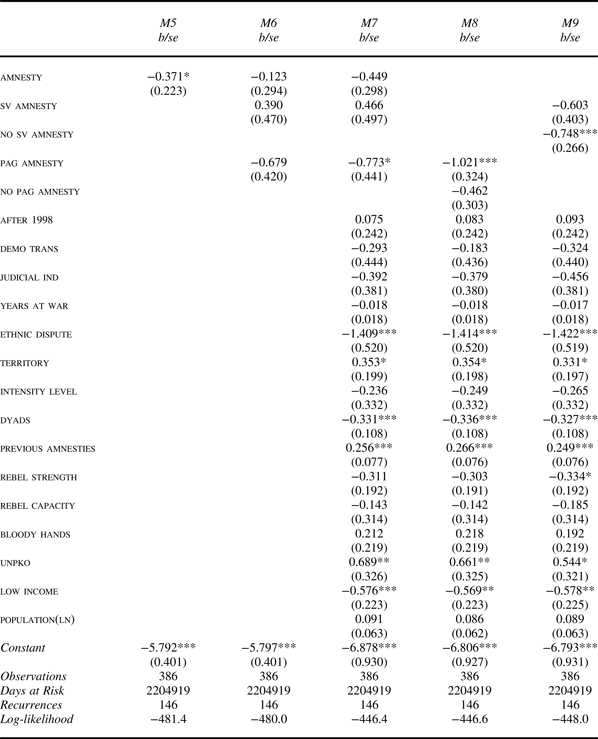
Notes: Baseline category for each model are terminations with no amnesty at all. We have full information on amnesties in 420 matched postconflict periods. However, N = 386 in these models due to missingness on covariates in M7–M9. Observations with missing values are thus dropped in M5 and M6 for valid comparison between all models. The results are unaltered. *p < .10; **p < .05; ***p < .01.
Taken together, Models 5 to 7 lend only weak support to Hypothesis 2a. Amnesties passed after fighting are associated with a lengthened peace on average, but not at conventional levels of statistical significance. Furthermore, peace agreement and SV amnesties show no significant difference from the average effects of all amnesties.
It remains possible that the weakness of Models 5 to 7 is attributable to the fact that the average effect of amnesties is not uniform, and that different amnesties should be modeled separately. Models 8 and 9 split amnesties into two groups, rather than operationalizing the specific properties of amnesties as additive terms. In these models, one can find support for Hypotheses 2b and 2c. M8 shows that amnesties included within peace agreements are associated with less risk of conflict recurrence, in statistically significant fashion. The coefficient for no pag amnesty is in the same direction, but it does not achieve statistical significance. The effect of amnesties outside of peace agreements is not statistically distinguishable from zero when compared to duration of peace in non-amnesty contexts. However, amnesties embedded within larger peace agreement frameworks are associated with long periods of peace, compared to the average conflict that lacks such an amnesty.
A similar pattern is evident in M9, which separates amnesties with SV immunities from those without. The coefficient for no sv amnesty is statistically and substantively significant, whereas the coefficient for sv amnesty is not. What this indicates is that, among armed conflicts that end in bargained outcomes, amnesties forgiving combatants for extreme violence against civilians are not pacifying: they are not associated with peace spells that are significantly longer than the average duration of peace in non-amnesty contexts. However, moderate amnesties that forgive combatants for crimes against the state but stop short of full indemnity are associated with longer peace spells, on average.
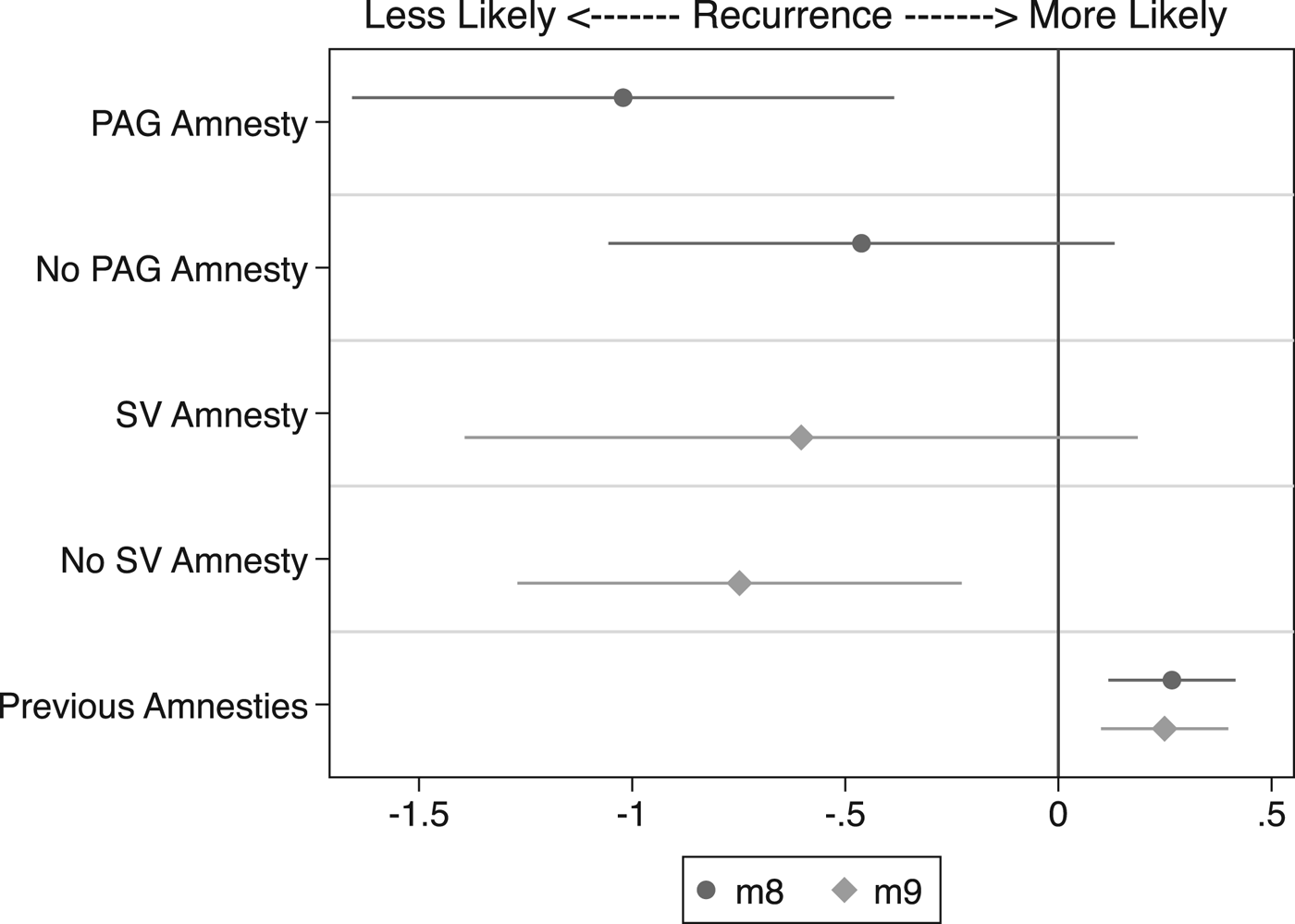
Figure 4 shows that these are substantively significant findings. Dyadic conflicts that terminate with PAG amnesties are 64 percent less likely to return to fighting. No pag amnesties is correlated with a 37 percent decrease in the risk of recurrence, but the confidence interval on the coefficient cross the zero line, meaning that the null hypothesis cannot be rejected. No sv amnesties is associated with a 53 percent reduction in the probability of conflict recurrence. This effect is not present when human rights provisions are included in amnesties. The coefficient on sv amnesty is indistinguishable from zero.
Different types of amnesties and conflict recurrence

Figure 4 depicts another finding of interest for conflict scholars. While it is convincingly argued that iterated negotiations involving multiple ceasefires often produce a lasting peace agreement,Footnote 111 it does not seem to be the case that repeated amnesties lead to a better outcome. The more amnesties a dyadic conflict has featured over time, the more prone it is to conflict recurrence. This is logical based on the theory. Amnesties are laws that must be supported by commitments on each side. If previous amnesties have failed, it will decrease trust in future offers.
This research rests on the assumption that studying averages and analyzing baselines can help us evaluate influential theories about amnesties, and shape expectations in future negotiations. But averages do not tell us everything. Aggregate research should be supported by more studies of deviant cases, and in-depth studies that closely examine amnesties in the conflict process. This will help to further isolate the causal mechanisms at play, and to address issues like endogeneity. The matching methods used here can partially address this problem, modeling how certain characteristics of a conflict are correlated both with the choice to offer amnesties, and the outcome of interest: peace. Worth noting, though, is that the presented results do not depend on the application of Coarsened Exact Matching techniques, and are robust to alternative specifications.Footnote 112
Together, these tests demonstrate that, ceteris paribus, amnesties are not particularly effective when offered in the prebargaining phase, especially early in the war. Across the board, amnesties passed amid active fighting are correlated with a lower probability of conflict termination. Crucially, though, the statistical evidence also shows that amnesties are pacifying in situations where combatants must bargain at the end of hostilities. When amnesties result from rounds of negotiation, and are situated within larger peace deals, they are correlated with longer spells of peace. This effect is not overpowering but it is clear. Also, while it is sometimes argued that immunities for serious rights violations will make peace agreements more successful, the evidence here suggests the contrary. In all of the models, SV amnesties are never associated with a measurable, statistically significant effect on peace.
Conclusion
One task for those working to end civil wars is preventing old violent antagonisms from returning. I find that offers of legal amnesty can be used to halt intrastate conflicts, but this is subject to three ancillary rules. The first rule is that amnesties work better if they are enacted in the negotiation phase. During conflict, amid the prenegotiation phase, both sides face problems of adverse selection, or lack of information on their opponent's preferences for peace. In this context, amnesties serve as a noisy signal. They convey either government weakness or cunning to rebels. For this reason, negotiators should investigate other two-track solutions to coax rebels to the bargaining table. If and when armed combatants get to the negotiation phase, amnesties may serve as a more useful tool. They are still a signal but of costly commitments to peace. The trick is designing them in a way that is balanced, granting some concessions without making the deal too costly for the government in the future.
It may be too costly to forgive rebels for serious violations of human rights and humanitarian law. The second finding is that amnesties with explicit immunities for serious violations are not associated with a lower risk of conflict recurrence. This challenges the conventional wisdom among peacemakers that forgiving human rights abuses may be a necessary element of war-ending bargains. In the last sixty years, that is simply not the case. SV immunities are a roll of the dice. On one hand, they may encourage peace discussions with recalcitrant groups but, on the other hand, they weaken the government's position. Immunities for terrible acts create a negative reputation for the governments that offer them. Governments will be punished, by civilians audiences and by rebels, for making deals that are too accommodating. Rebels will see no reason not to fight against such conciliatory leaders in the future. Civilians will pressure those leaders to renege on the deal and go back to war. Negotiators need to be clear with rebel and state leaders that human rights violations—especially if they are extreme—will have to be investigated. That is now part of the political landscape following conflicts. Ignoring the problem of human rights atrocities is no longer realistic and it was never very effective anyway.
The third finding is that amnesties are also more effective when they are embedded within larger processes of peace. If amnesties are disembodied from a larger framework, or haphazardly offered by governments in high-pressure moments, it might do little to produce trust on the other side. The offer simply will not be perceived as credible. However, when they are passed following lengthy and iterated processes of negotiation—often as part of larger postconflict deals to release political prisoners, forgive former soldiers of crimes against the state, or to help demobilize the opposition—they are sometimes successful.
Taken together, the evidence in this article offers an empirical foundation for the evolving practice of issuing “qualified” amnesties in negotiated settlements. This practice is outlined in the Belfast Guidelines on Amnesty and Accountability recently penned by experts in transitional justice.Footnote 113 As this report suggests, amnesties that bring together various veto players, spoilers, and combatant groups, while being careful not to provide impunity for atrocity, help countries stay at peace following civil war.
By showing that amnesties are pacifying in postconflict settings, but not when they immunize human rights violators, in this article I directly address a persistent source of debate between human rights activists and peacemakers. Furthermore, I develop a bargaining theory of amnesties in civil war, and test hypotheses from that theory using the best available data on conflicts and amnesties. These tests resolve lingering issues about what is necessary and desirable in the wake of civil wars. Forgiving opponents for political crimes is an act of mercy that helps the country, but forgiving them for rights abuses is a tragedy that does not work. It already appears that states like Colombia are learning these lessons: government and rebel forces cannot be exculpated for everything they have done in the context of the very long civil war. Entirely absolving FARC and other groups of responsibility for human rights crimes would only encourage them to violate the terms of peace over and over. Alternatively, it might anger victims’ groups and government constituencies to such an extent that they will spoil the peace by encouraging new rounds of violence against the enemy.
Other elements of the peace-versus-justice debate remain unresolved. For example, it is still unclear whether mechanisms like human rights prosecutions exacerbate tensions in postwar environments, or whether truth commissions or reparations have much of any effect. Future research should examine these questions in greater detail. For now, it is a good start to know that if actors are seeking productive interventions into cyclical wars, making “deals with the devil” that forgive atrocity crimes is not necessary.
Supplementary Material
Supplementary material for this article is available at <https://doi.org/10.1017/S0020818318000012>.