INTRODUTION
A traditional assumption about the penetration of schistosome cercariae is that the cercariae lose their tails at the onset of penetration, even though early histological studies demonstrated that some Schistosoma mansoni cercarial tails entered the epidermis during the penetration of mouse skin (Gordon and Griffths, Reference Gordon and Griffiths1951; Griffths, Reference Griffiths1953). Tail retention has not generally been accepted as a normal phenomenon since those early studies used implausibly high cercarial densities. More recently Whitfield et al. (Reference Whitfield, Bartlett, Khammo, Brain, Brown, Marriott and Clothier2003), using human skin in Franz cells, demonstrated that S. mansoni cercarial tails were not always being cast off at the onset of penetration and a high proportion of cercarial tails entered the skin. They termed this phenomenon delayed tail loss (DTL). Their findings suggest that penetration of tails is a genuine component of S. mansoni invasion of host skin. It would be dangerous though, to extrapolate this finding to other schistosomes without direct evidence since schistosomes show extreme diversity (Ruppel et al. Reference Ruppel, Katerina and Mahmoud2004). Haas and Haeberlein (Reference Haas and Haeberlein2009) have demonstrated that Trichobilharzia szidati cercariae shed their tails in the range 0–105 s after the onset of penetration movements. In a recent consideration of skin invasion by schistosome cercariae (Ruppel et al. Reference Ruppel, Katerina and Mahmoud2004; He et al. 2005) it was noted that almost all our current knowledge is based on the S. mansoni model. The present study attempts to rectify this gap in our knowledge by experimentally investigating the entry of S. japonicum cercariae into host skin with the specific aim of quantifying possible DTL. For this purpose Franz cells (Bartlett et al. Reference Bartlett, Brown, Marriott and Whitfield2000) were used to investigate the penetration of S. japonicum cercariae through mouse skin. These experiments also studied the effect of cercarial density on DTL.
MATERIALS AND METHODS
Parasites
Oncomelania snails infected with S. japonicum were supplied by Jiangxi Province Institute of Parasitosis Control and Prevention, China. Cercariae were shed from the infected snails in spring water under bright light for 3 h at 25°C and collected with a dissecting needle. Separated cercariae were put on a 1·5 cm×1·5 cm cover slip with 1∼2 drops of water and counted under a microscope under low power.
Preparation of skin and the use of Franz cells
Abdominal skin was obtained from 6 to 7-week-old BALB/c female mice, (supplied by Hubei Province Center for Disease Control and Prevention, China). The experiment was approved by the Committee on Animal Research of Tongji Medical College. Hair on the abdominal skin was removed gently with a shaver. Full thickness skin was excised and subcutaneous fat removed as previously described (Brown et al. Reference Brown, Marriott and Martin1995; Bartlett et al. Reference Bartlett, Brown, Marriott and Whitfield2000) and the skin used immediately.
Franz cells were first used for the investigation of schistosome cercarial penetration by Bartlett et al. (Reference Bartlett, Brown, Marriott and Whitfield2000). The cells used in the present study were a slightly modified version of those used by Bartlett et al. (Reference Bartlett, Brown, Marriott and Whitfield2000). The upper donor well was shorter so that a cover slip could easily be applied to the skin. The fresh skin was clamped between the 2 wells with spring clamps. The lower receptor well was filled with tissue-culture medium (RPMI1640 with 10% FBS and 1% antibiotic/antimycotic solution, Gibco) ensuring that the tissue-culture medium in the lower cell was in direct contact with the skin, without any air bubbles. After putting the cover slip carrying cercariae onto the upper surface of the skin in the donor well, the Franz cell was incubated with 5% CO2/air at 32°C.
Qualitative demonstration of the existence of DTL during Schistosoma japonicum skin penetration using Franz cells
In each replicate of this experiment, a cover slip carrying 100 cercariae was gently and quickly applied to shaved mouse skin in a Franz cell and the device was incubated at 32°C in 5% CO2/air for 48 h. To ensure that the skin was in contact with the liquid in the lower well at all times, fresh tissue-culture medium was added through the side arm at intervals during the period of exposure. This experiment was repeated 3 times. After 48 h the medium in the receptor well was removed and transferred to counting dishes. These were scanned under low power for any schistosome larvae that had penetrated the skin.
Quantitative assessment of irreversible cercarial attachment to skin and DTL during Schistosoma japonicum skin penetration
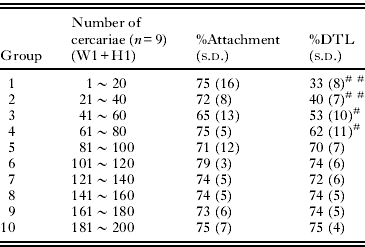
In these experiments the numbers of cercariae applied to the skin were varied between 1–20 and 181–200 as detailed in Table 1. Cells were set up as described above and incubations were for 30 min at 32°C. At the end of the exposure, the cover slip in each upper well was removed and both cover slip and skin were washed twice with a total of 10 ml of spring water to remove any whole cercariae, bodies and tails that were not firmly attached to the skin. The material collected from the skins and slips was fixed and stained with Lugol's iodine for counting. Separate counts were made of whole cercariae, separate cercarial bodies and tails. The experiments in each density group were repeated 9 times.
Percentage attachment and percentage DTL for infection of mouse skin with different dosages of Schistosoma japonicum cercariae
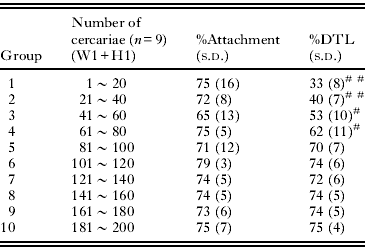
# P<0·05 vs. %DTL of group 5;
## P<0·01 vs. %DTL of group 5.
The quantitative assessment of attachment and DTL was determined by the formulae described by Whitfield et al. (Reference Whitfield, Bartlett, Khammo, Brain, Brown, Marriott and Clothier2003). In the formulae, W represents whole cercariae, B cercarial bodies and T tails. W1, B1, T1 represent the values pre-infection and W2, B2, T2 represent values post-infection. The percentage of cercarial attachment was estimated by 100− ((W2+B2)/(W1+B1))×100 and the percentage of DTL by ((W1+T1)−(W2+T2)/(W1+B1)− (W2+B2))×100.
Statistical analysis
Data were analysed using one-way ANOVA. Results were expressed as mean values±standard deviations. Differences of P<0·05 were considered to be statistically significant.
RESULTS
Qualitative demonstration of the existence of DTL during Schistosoma japonicum skin penetration using Franz cells
Examination of the contents of the receptor well after 48 h incubation showed the presence of both schistosomula and whole, tailed cercariae in all 3 replicates. The fact that some cercariae had traversed the whole thickness of the skin layer without shedding their tails demonstrated that at least some DTL was occurring.
Quantitative assessment of irreversible cercarial attachment to skin and DTL during Schistosoma japonicum skin penetration
Table 1 summarizes the percentage attachment of cercariae and percentage DTL at different densities of cercarial application to skin for 30 min. The results show that a mean of about 73% of cercariae irreversibly attached to the skin with no significant variation attributable to different exposure densities. In contrast, DTL shows a density-dependent variation with DTL increasing from about 33% at the lowest densities to around 73% at an applied density of 81–100. The DTL value then remained at about this level with increasing application density up to 181–200 cercariae.
DISCUSSION
The free-swimming and skin penetration behaviours of schistosome cercariae have been studied for many decades but some aspects remain poorly understood. A key area of uncertainty relates to what actually happens when the cercariae penetrate the host skin. Do the cercariae cast off their tails at the initiation of penetration or do they enter the skin with their tails still attached? Recently, Whitfield et al. (Reference Whitfield, Bartlett, Khammo, Brain, Brown, Marriott and Clothier2003) obtained microscopical images and quantitative data, using Franz cells, which suggested that, for a large proportion of S. mansoni cercariae penetrating human skin, tails were not being shed as penetration occurred. In the present study, we have demonstrated that, as with S. mansoni cercariae penetrating human skin, significant DTL occurred in the process of S. japonicum cercariae penetrating mouse skin.
DTL was first described about 60 years ago from histological studies that showed that some S. mansoni cercarial tails entered the epidermis during skin penetration (Gordon and Griffths, Reference Gordon and Griffiths1951; Griffths, Reference Griffiths1953). This evidence was largely discounted due to the very high cercarial densities applied, ones that would never be attained in natural circumstances. In contrast, we have demonstrated for S. japonicum, that DTL occurred even with cercarial densities as low as 10 in contact with 2·25 cm2 of skin surface. This suggests that for S. japonicum cercarial retention of tails during the process of penetration is a genuine component of invasion behaviour. The fact that S. japonicum cercariae, following emission from the snail host, aggregate at the water surface at high densities (Wu and Liu, Reference Wu, Liu and Wu2005) means that even the highest cercarial densities used in the present experiments are perfectly likely in natural infection circumstances.
Another poorly understood aspect of schistosome cercarial biology concerns the putative interactions between cercariae during the infection process. Some early studies (Griffiths, Reference Griffiths1953) suggested that when large numbers of S. mansoni cercariae were applied to a limited area of skin, penetration success was enhanced compared with that occurring with lower cercarial densities. Standen (Reference Standen1953) came to similar conclusions and postulated that damage to skin integrity at high cercarial densities facilitated enhanced penetration. Later studies (Ingram et al. Reference Ingram, Bartlett, Brown, Marriott and Whitfield2003), however, with S. mansoni gave clear evidence that multiple sequential exposures of human skin in Franz cells to cercariae showed no enhancement of penetration with each successive exposure. There is therefore no consensus to suggest that high cercarial densities are associated with a cooperative enhancement of penetration. Indeed, the very high densities used in these studies were certainly outside the range of those that could occur in nature.
In the present study we have found no enhancement of attachment of S. japonicum with increasing cercarial density that is consistent with the observations of Ingram et al. (Reference Ingram, Bartlett, Brown, Marriott and Whitfield2003) with regard to S. mansoni. In parallel, though, we have found clear evidence of an enhancement of DTL with increasing cercarial density up to 81–100 cercariae per Franz cell. At present it is difficult to suggest a mechanism for this phenomenon. The possibility that increasing tail retention could be due to cercarial-induced skin damage as suggested by Standen (Reference Standen1953), seems unlikely given the fact that such damage would be expected to enhance attachment and penetration at high densities as well. We have found no such enhancement in this study. However, Griffiths (Reference Griffiths1953) found that the tunnels produced in the stratum corneum frequently contained several cercariae, and he thought that the process of penetration might be facilitated by some early-penetrating cercariae preparing the way for others following in their wake. This finding may be involved in the density-dependent increase in DTL as cercarial densities increased.
Given that there is now clear evidence of DTL in both S. mansoni and S. japonicum infections it is now appropriate to reconsider the possible importance of tail-derived antigens in skin and whole body immunological responses to schistosome infections, both those that result in schistosomiasis and those with non-human schistosomes that cause cercarial dermatitis.
ACKNOWLEDGEMENT
We thank Professor Andreas Ruppel (Heidelberg University, Heidelberg, Germany) for the critical reading of the article. This work was funded by the National Natural Foundation of China (project grant 81000738). This research was performed in compliance with the laws of China and the authors’ respective institutions.