Introduction
A core goal of theories of second language (L2) acquisition and processing is to better understand the domains in which L2 acquisition is successful as compared to the domains that seem to present persistent difficulty, even for L2 learners who have otherwise achieved high levels of proficiency. The Interface Hypothesis proposes that linguistic properties that lie at the interface of syntax and discourse and require the integration of multiple sources of linguistic information present persistent challenges in L2 acquisition (Sorace, Reference Sorace2011; Sorace & Filiaci, Reference Sorace and Filiaci2006). Referential dependencies, which occur when two linguistic expressions are interpreted as referring to the same individual, have been highlighted as one such domain that may be vulnerable for L2 learners (Sorace, Reference Sorace2011). Referential dependencies require that a link be established between a new referent, such as a pronoun, and a representation of that entity in the discourse model (e.g., Clark et al., Reference Clark, Haviland and Freedle1977), a mental representation of the characters and the events mentioned in the discourse (e.g., Johnson-Laird, Reference Johnson-Laird1983). The interpretation of a pronoun requires the integration of linguistic information, such as gender, which can be used to resolve the pronoun in (1) if the subject is Paul, as well as information relevant to the discourse, such as which entity in the discourse is most accessible or salient (e.g., Ariel, Reference Ariel1990, Reference Ariel, Sanders, Schilperoord and Spooren2001). Discourse information may be particularly important when morphosyntactic properties cannot be used to unambiguously select an antecedent as in (1) if the subject is Mary.

One factor that has been argued to impact the accessibility or salience of a discourse entity is syntactic prominence, as it is more likely for a pronoun to refer to an antecedent in subject position as opposed to object position (e.g., Brennan, Reference Brennan1995; see Arnold, Reference Arnold2010 for a review). Thus in (2), she is more likely to be interpreted as Ruby. Recent research has suggested that L2 learners can use information such as syntactic prominence to guide pronoun resolution in contexts similar to (2) (e.g., Contemori et al., Reference Contemori, Asiri and Perea Irigoyen2019; Cunnings et al., Reference Cunnings, Fotiadou and Tsimpli2017), but have more difficulty in more complex contexts such as when two discourse entities are introduced into the discourse with similar prominence as in coordinate noun phrases (Ruby and Frances) (e.g., Contemori et al., Reference Contemori, Asiri and Perea Irigoyen2019; Roberts et al., Reference Roberts, Gullberg and Indefrey2008).
A discourse entity’s semantic role also plays a role in determining how salient or accessible it is in the discourse. In (1), when Mary is the subject and thus there are two potential gender-matching antecedents for the pronoun she, the pronoun is more likely to be interpreted as referring to Ruby as there is a bias for the pronoun to refer to the entity who is most likely to have been the cause of the event (Brown & Fish, Reference Brown and Fish1983; Garvey & Caramazza, Reference Garvey and Caramazza1974). In (3), when the verb changes to impressed, the cause or stimulus argument is now in subject position, and the most likely antecedent for the pronoun is also the subject, Ruby. This phenomenon, which has been referred to as implicit causality (IC), has recently become a topic of interest in the L2 literature because of its potential to shed light on the kind of information that L2 learners can use in processing (Cheng & Almor, Reference Cheng and Almor2017, Reference Cheng and Almor2019; Contemori & Dussias, Reference Contemori and Dussias2019; Kim & Grüter, Reference Kim and Grüter2021; Liu & Nichols, Reference Liu, Nicol, Prior, Watanabe and Lee2010). Recent theoretical accounts of IC bias argue that verbs such as admire and impress trigger an expectation for an explanation of the stimulus argument of the verb, or the cause of the event, and the coreference bias is related to the expectation that the specific cause will be explained (Bott & Solstad, Reference Bott, Solstad, Hemforth, Mertins and Fabricius-Hansen2014, Reference Bott and Solstad2021). On this account, IC bias is related to both verbal properties and discourse coherence, in that an expectation for an explanation is generated (Kehler et al., Reference Kehler, Kertz, Rohde and Elman2008). Results in the L2 literature thus far are mixed with respect to whether or not L2 learners have been observed to use this information similarly to native speakers. Cheng and Almor (Reference Cheng and Almor2017, Reference Cheng and Almor2019), based on their studies of Chinese-speaking learners of English, proposed that L2 learners may be more likely to exhibit a subject bias during pronoun resolution, in line with the syntactic prominence factor described in the preceding text, as opposed to integrating the IC bias of the verb (but see Liu & Nicol, Reference Liu, Nicol, Prior, Watanabe and Lee2010). These results are important because they suggest that L2 learners may weight information in the discourse differently than native speakers, giving prominence in pronoun resolution to factors such as subjecthood, as opposed to also integrating information related to the verb and discourse coherence. However, there is also reason to believe that characteristics of the learners may play a role as the Chinese-speaking learners of English in a study by Liu and Nichol (Reference Liu, Nicol, Prior, Watanabe and Lee2010) did show native-like sensitivity to IC bias. Although both studies tested advanced learners of English, the learners tested in Cheng and Almor’s studies were tested in China while the learners tested in Liu and Nichols’s study were students in the United States. It is possible that individual differences in language experience and exposure could play a role in determining whether L2 learners can successfully use these cues.
There is support for this idea in research on IC bias in native (L1) speakers. A recent study by Johnson and Arnold (Reference Johnson and Arnold2021) reported that L1 English speakers’ language experience modulated their use of IC bias in pronoun resolution. Language experience was measured by the Author Recognition Task (ART; Acheson et al., Reference Acheson, Wells and MacDonald2008; Moore & Gordon, Reference Moore and Gordon2015; Stanovich & West, Reference Stanovich and West1989), which is designed to measure participants’ exposure to print materials by providing participants with a list of names that includes both real author names and “foil” names and asking participants to decide whether or not a given name represents an actual author. The experiment involved listening to stories and making judgments about reference. Results showed that as ART scores increased, English speakers were more likely to interpret the pronoun as referring to the implicit cause encoded by the verb. These results suggest that certain individuals can use discourse cues to resolve pronouns more successfully than others and that there is variability even in native speakers. As we will review in the next section, several other papers have shown that other individual-level characteristics such as working memory (Koornneef et al., Reference Koornneef, Dotlačil, den Broek and Sanders2016) and reading abilities (Long & De Ley, Reference Long and De Ley2000) modulate the use of IC bias in native speakers. Despite these findings, L2 studies have generally not explored the role of individual-level characteristics in modulating the use of IC bias in pronoun resolution outside of considering the role of L2 proficiency, which has not been found to be a significant factor (e.g., Kim & Grüter, Reference Kim and Grüter2021). Thus, a key open question is what explains the variability in previous studies on implicit causality in L2. Are L2 learners truly restricted in integrating discourse cues such as implicit causality to resolve pronouns successfully or does success depend on the individual-level characteristics of the learner? Do the same individual differences modulate variability in native speakers and L2 learners? The present study examines these questions by examining English native speakers and Chinese-speaking learners of English in two experiments, one which included an offline sentence completion task, and the second, which included both a self-paced reading task and two measures of individual differences. The study aims to shed light on the kind of information that L2 learners can use during referential processing and more importantly, the specific conditions under which they are successful, thus extending what we know about the factors that may facilitate pronoun resolution in L2 learners (Sorace, Reference Sorace2011).
Use of Implicit Causality Bias in Native Speakers
IC was defined by Garvey and Caramazza (Reference Garvey and Caramazza1974) as the information encoded in verbs that implicitly attributes the cause of the action to one of the antecedents mentioned earlier in the sentence. For instance, when reading or listening to a sentence with an NP1-biased verb such as frighten as in (4a) in the following text, readers tend to think that the upcoming context likely relates to David. In contrast, when the verb is changed to the NP2-biased verb fear as in (4b), a possible continuation could be one that attributes the cause of the event in the main clause to Mary.

The IC bias is made clear in a discourse with a causal relation that can be explicitly marked by discourse connectors such as because, but the bias holds even if the causal relation is implicit (Kehler et al., Reference Kehler, Kertz, Rohde and Elman2008).
Researchers have proposed various accounts in terms of the underlying mechanism of IC bias. Some researchers argue that IC bias stems from individuals’ world knowledge about the causes and effects of various events (Corrigan, Reference Corrigan2002; Pickering & Majid, Reference Pickering and Majid2007). Other accounts argue that IC bias is related to the thematic roles that specific verbs assign to their arguments (Brown & Fish, Reference Brown and Fish1983; Crinean & Garnham, Reference Crinean and Garnham2006; Hartshorne et al., Reference Hartshorne, O’Donnell and Tenenbaum2015). A recent account proposed by Bott and Solstad (Reference Bott, Solstad, Hemforth, Mertins and Fabricius-Hansen2014) (see also Bott & Solstad, Reference Bott and Solstad2021) incorporates a semantic account, but crucially considers discourse coherence as well (Kehler et al., Reference Kehler, Kertz, Rohde and Elman2008). Bott and Solstad (Reference Bott and Solstad2021) argue that the semantic properties of IC verbs trigger expectations or preferences for specific kinds of explanations, which are intimately linked to one of the verb’s arguments. For example, in (4a), the phrase David frightened Mary triggers an expectation that the stimulus or cause of the event will be explained because the specific cause has not been provided in this context. This has implications for reference because if the specific cause of the “frighten” event is indeed specified in the following clause, it is more likely that David will be rementioned or interpreted as the antecedent of a subsequent pronoun. In (4b), in which the NP2 Mary is the stimulus argument, it is more likely that an explanation of the event will mention her. As one piece of evidence for this account, Bott and Solstad (Reference Bott and Solstad2021) show that IC bias can be manipulated by specifying an explanation of the cause in the context. Because of this evidence that shows an important role for discourse coherence and the broader context, we refer to IC bias in this article as a discourse cue.
Successful use of IC bias has generally been reported by L1 speakers in various languages by using both offline and online methods (Cozijn et al., Reference Cozijn, Commandeur, Vonk and Noordman2011; De La Fuente, Reference De La Fuente2015: Spanish; Featherstone & Sturt, Reference Featherstone and Sturt2010: English; Holler & Suckow, Reference Holler, Suckow, Holler and Suckow2016: German; Koornneef & Van Berkum, Reference Koornneef and Van Berkum2006: Dutch; Pyykkönen & Järvikivi, Reference Pyykkönen and Järvikivi2009: Finnish; Rigalleau et al., Reference Rigalleau, Caplan and Baudiffier2004: French). Recent studies employing time-sensitive methods (e.g., self-paced reading, eye-tracking) have generally reported that sensitivity to IC bias can be activated early in the sentence, at or before the pronoun (Featherstone & Sturt, Reference Featherstone and Sturt2010; Greene & McKoon, Reference Greene and McKoon1995; Koornneef & Van Berkum, Reference Koornneef and Van Berkum2006; Long & De Ley, Reference Long and De Ley2000; McKoon et al., Reference McKoon, Greene and Ratcliff1993; Pyykkönen & Järvikivi, Reference Pyykkönen and Järvikivi2009).
However, several studies have also demonstrated that native speakers’ ability to use IC bias may be modulated by individual differences (Johnson & Arnold, Reference Johnson and Arnold2021; Koornneef et al., Reference Koornneef, Dotlačil, den Broek and Sanders2016; Koornneef & Mulders, Reference Koornneef and Mulders2017; Long & De Ley, Reference Long and De Ley2000; Van Berkum et al., Reference Van Berkum, De Goede, Van Alphen, Mulder and Kerstholt2013). An early study by Long and De Ley (Reference Long and De Ley2000) showed a relationship between reading abilities and use of IC bias. Their study used three probe tasks where participants read sentences as in (5) that either contained a match or a mismatch between the noun phrase associated with the verb bias (Evette for the NP2 verb envy) and the noun phrase most likely to be associated with the pronoun in the subordinate clause based on the semantic context. Participants were asked to read the sentences, and judge whether they had seen a probe word (e.g., Sherry/Evette) earlier in the sentence. They predicted faster responses to the probe words in the match condition as compared to the mismatch condition.

Long and De Ley (Reference Long and De Ley2000) also categorized participants as skilled/less skilled readers on the basis of performance on the Nelson–Denny Reading Test, arguing that computing causal inferences, as is required in these contexts, is complex, and may require increased resources that may be afforded by higher level reading skills. Indeed, the results showed that it was only skilled readers who showed an early effect of IC bias (right after the pronoun), responding faster to names that matched with the verb bias, but this effect was limited to NP2 verbs. Less skilled readers only showed sensitivity to IC bias at the end of the sentence. They concluded that the ability to use the causal information encoded by the verb depends on characteristics of both the stimuli and of the reader. With respect to why reading skills may facilitate the use of IC bias, Long and De Ley (Reference Long and De Ley2000) propose that skilled readers may have better word recognition skills or a higher level of resources available to generate causal inferences. The study by Johnson and Arnold (Reference Johnson and Arnold2021), which was discussed in the preceding text, makes a related claim. In their study, individuals with higher print exposure were better able to use IC bias to make predictions about the likelihood of remention. They propose that individuals with higher print exposure may be better at using the discourse information available to generate causal inferences. They also consider the possibility that higher print exposure may be related to a higher quality of input that enables individuals to learn which patterns of reference are more likely to occur in a discourse.
The relationship between working memory and the use of IC bias was explored by Koornneef et al. (Reference Koornneef, Dotlačil, den Broek and Sanders2016) in an eye-tracking experiment. Following Long and De Ley (Reference Long and De Ley2000), they predicted an early use of IC bias for individuals with higher working memory (as measured by a digit span task). In addition, in one block of the experiment, they added a secondary task (storing and recalling a sequence of digits) to examine if the use of IC bias would be modulated by the amount of processing resources available. The results showed a complex pattern. In the condition without the secondary task, an IC effect emerged at the pronoun only for individuals with higher working memory; a similar effect emerged three words after the pronoun as well. In contrast, in the condition with the secondary task, at the region three words after the pronoun, the opposite pattern emerged: It was the lower-span readers who showed a more pronounced IC effect. Thus, surprisingly, lower-span readers were more likely to use IC bias in pronoun resolution under a processing burden; Koornneef et al. (Reference Koornneef, Dotlačil, den Broek and Sanders2016) interpret this finding as evidence against Long and De Ley’s (Reference Long and De Ley2000) argument that the use of IC bias is related to the amount of resources available. Koornneef et al. (Reference Koornneef, Dotlačil, den Broek and Sanders2016) propose that the differences between high- and low-span individuals might be explained in terms of reading strategies: higher-span readers may, under normal circumstances, rely on a proactive reading strategy, generating expectations about reference, while lower-span readers do not generate these expectations, and wait instead for bottom-up information. In contrast, under a processing burden, higher-span individuals may become more conservative, waiting for bottom-up information, while lower-span readers take a “risky” approach to compensate for the lack of available resources.
Use of Implicit Causality Bias by L2 Learners
In the L2 literature, results are mixed with respect to whether or not learners have been observed to use IC bias successfully in pronoun resolution. Cheng and Almor (Reference Cheng and Almor2017, Reference Cheng and Almor2019), based on their studies of Chinese-speaking learners of English, proposed that L2 learners may be more likely to exhibit a subject or first mention bias in assigning reference to a pronoun as opposed to integrating the IC bias of the verb. Their experiments utilized sentence-completion tasks including sentence fragments that consisted of two same-gendered names, with a verb that carried either NP1 or NP2 bias, the connector because, and an ambiguous pronoun (e.g., Paul liked Alan because he…). Cheng and Almor (Reference Cheng and Almor2017) showed that both native English speakers and L2 learners displayed a strong NP1 bias for NP1 verbs, but learners displayed a weaker NP2 bias by showing more NP1 choices for NP2 verbs than native speakers. In a follow-up study, Cheng and Almor (Reference Cheng and Almor2019) found that learners showed a weaker association between pronouns and NP1 referents in contexts containing NP1 verbs, but a stronger association between pronouns and NP1 referents following NP2 verbs.
In contrast, Liu and Nicol (Reference Liu, Nicol, Prior, Watanabe and Lee2010) also observed similar performance for L1 Chinese L2 English learners and English natives. Their study used a self-paced reading task where Chinese learners of English (n = 41) and native English speakers (n = 41) read sentences that contained either a match (plausible condition) or a mismatch (implausible condition) between the verb bias and the gender of the pronoun (e.g., The motheri amused the father because he*i told funny jokes at dinner). The results show that both L1 speakers and L2 learners showed significant reading time slowdowns in the implausible condition as compared to the plausible condition for both NP1 and NP2 verbs.
More recent studies have used visual-world eye-tracking to examine whether IC bias can be used to proactively predict which antecedent is most likely to be referred to based on the discourse context. A study by Kim and Grüter (Reference Kim and Grüter2021) showed an early use of IC bias by L1 English speakers starting before the pronoun, whereas L1 Korean L2 English learners showed a weaker effect of IC bias starting after the pronoun offset. Thus, the L2 learners showed a similar pattern, but differed from the natives with respect to the strength and timing of the effect. However, a study by Contemori and Dussias (Reference Contemori and Dussias2019) that used a similar design did not find group differences between L1 English speakers and highly proficient Spanish-English bilinguals, a result that they attributed to the advanced proficiency level of the bilinguals, who were exposed to English at an early age and who had lived in the United States for many years. Similar to the point we raised in the “Introduction,” this is another example that suggests that the background characteristics of the L2 learners may play an important role in determining whether or not L2 learners can use IC bias similarly to native speakers. While the role of proficiency in the L2 is a natural candidate for potentially explaining the variability in findings, analyses by Kim and Grüter (Reference Kim and Grüter2021) did not find proficiency to be a significant factor. Thus, the present study takes a different approach, examining the role of individual differences that have been found to be significant in the native processing literature and testing whether variability in the use of IC bias is similarly explained in native speakers and L2 learners.
Current Study
The main goal of the present study is to examine the role of individual differences in the use of IC bias during pronoun resolution by both native speakers and learners to examine whether processing in the two populations is qualitatively similar or different. The study will address two main questions. First, we investigate whether L2 learners show sensitivity to IC bias in resolving pronouns offline and online. Second, we examine whether individual differences modulate successful use of IC bias for both natives and L2 learners. The study includes two experiments: Experiment 1 uses an offline sentence completion task and Experiment 2 uses a self-paced reading task as well as two individual difference measures.
Experiment 1: Sentence Completion Task
The first experiment, which used a sentence-completion task, had two main goals. First, we wished to confirm that the experimental sentences that we designed for the self-paced reading study to be reported in Experiment 2 did indeed show the intended verb biases. Second, this task also allowed us to examine whether L2 learners have similar biases as native speakers when given unlimited time and when asked to focus somewhat more explicitly on reference.
Participants
We included 67 L1 English speakers (44 females, mean age = 19.6, range: 18–28) in the United States and 69 Chinese-speaking learners of English (59 females, mean age = 22.0, range: 18–31) who were university students in China. All learners reported that they started to learn English as a second language in a school setting from age 5 onward (M = 10, range: 5–14). The LexTALE, a lexical decision task consisting of 60 items made up of both real and nonce words, was used as a proficiency measure (Lemhöfer & Broersma, Reference Lemhöfer and Broersma2012). The learners’ mean score of 67.5/100 (SD = 11.57, range: 47.8–97.5), places them at an intermediate to advanced proficiency level. All participants completed the task online using Qualtrics. Native speakers were offered extra credit in a course and learners were offered monetary compensation for their participation.
Materials
We used a sentence-completion task, adopting the three-sentence design used in Koornneef and Van Berkum (Reference Koornneef and Van Berkum2006). In this design, two different-gendered names are initially introduced in the first sentence by a conjoined noun phrase (Lindsey and Brad) and are then referred to by a plural pronominal they in the second sentence (see 6/7). By doing so, we hope to attenuate a potential first-mention bias by introducing the two potential antecedents into the discourse with equal prominence (Gordon et al., Reference Gordon, Hendrick, Ledoux and Yang1999). The third sentence is the target sentence, where two blanks in the main clause and a blank in the subordinate clause were provided for completion. We selected 36 sets of unique name pairs stereotypically associated with either male or female pronouns. Participants were instructed to use the two names to fill in the first two blanks, and to provide a natural ending to the story starting with either he or she, by typing the completed version of the third sentence into a text box.

We selected 18 NP1 and 18 NP2 English verbs with strong IC bias in both English and Chinese based on three previous studies (Cheng, Reference Cheng2016; Ferstl et al., Reference Ferstl, Garnham and Manouilidou2011; Hartshorne et al., Reference Hartshorne, Sudo and Uruwashi2013). Details on the verb selection in the study are provided in Supplementary Materials-Verb Selection (https://osf.io/b3cqp/). Two lists were prepared: In one list, half the lead-in sentences started with a male name while the other half started with a female name, and the order of the two names were switched in the second list. In addition to 36 target trials, five “catch” trials that instructed participants to type the sentence “I love dogs and cats” into a response box randomly appeared during the experiment, serving as a test of whether participants were indeed attending to the test items, as the experiment was administered remotely.
Procedure
Participants completed a language background questionnaire first, followed by the sentence-completion task. Finally, L2 learners also completed the LexTALE.
Data analysis
Continuations were coded as either NP1 or NP2 choice based on whether the pronoun matched with the first or second antecedent in gender. Continuations that contained the wrong verb or did not include a third-person singular gendered pronoun (e.g., it, they) were eliminated from the analysis (L1: 4.6%, L2: 2.9%). Following previous studies (Cheng & Almor, Reference Cheng and Almor2017, Reference Cheng and Almor2019; Contemori et al., Reference Contemori, Asiri and Perea Irigoyen2019; Kim, Reference Kim2019), we used NP1 choice as the dependent variable for the analyses. Mixed-effects logistic regression (Baayen, Reference Baayen2008; Jaeger, Reference Jaeger2008) was used in examining the proportion of NP1 choice in NP1 and NP2 stories. The model included Group (Natives, Learners) and VerbType (NP1, NP2) as fixed effects (sum-coded), and Participant and Item as random effects. The model also contained the maximal random effects structure by including a by-participant slope for VerbType. The by-item slope for Group was excluded to solve a model convergence problem. Data analysis was conducted using the lme4 package in R (Bates et al., Reference Bates, Mächler, Bolker and Walker2015). Degrees of freedom for the t-values and p-values in the mixed-effects models were computed using the R package lmerTest (Kuznetsova et al. Reference Kuznetsova, Brockhoff and Christensen2017).
Results
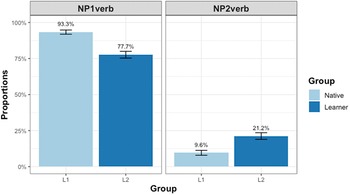
The model revealed a significant main effect of VerbType (b = 2.15, SE = .12, z = 17.39, p < .001), with a significant interaction between VerbType and Group (b = –.65, SE = .05, z = –13.04, p < .001). Follow-up analysis was conducted by using the “emmeans” package in R (Lenth, Reference Lenth2021) in comparing the NP1 choice between native speakers and learners in stories with NP1 verbs and NP2 verbs (the Holm method was chosen to control family-wise error rate). Results showed that in the NP1 stories, learners chose NP1 significantly less than native speakers (b = –1.56, SE = .15, z = –10.48, p < .001), while in the NP2 stories, learners chose NP1 significantly more than native speakers (b = 1.05, SE = .13, z = 7.91, p < .001) (Figure 1).
Mean proportion of NP1 choice by native speakers and learners.

The offline results suggest that L2 learners are sensitive to the IC bias encoded by the verb when resolving pronouns. However, their sensitivity was not as strong as native speakers. The results do not suggest that L2 learners were relying on a heuristic such as a general subject/first-mention bias (Cheng & Almor, Reference Cheng and Almor2017) because learners showed a weaker bias for both the NP1 and the NP2 biased verbs, as opposed to showing an overall NP1 bias in both verb types.
Experiment 2: Examining the Online Use of IC Bias by L1 and L2 Speakers of English
Participants
We recruited 40 native English speakers (9 males, mean age = 19.3, age range: 18–23) and 39 Chinese learners of EnglishFootnote 1 (9 males, mean age = 24.7, age range: 19–41) from a university in the United States. We assessed proficiency using the LexTALE (Lemhöfer & Broersma, Reference Lemhöfer and Broersma2012), and the University of Michigan Listening Comprehension Test, which targets various aspects of English grammar. Based on the proficiency scores (LexTALE: 60.8/100; Michigan: 89/100), learners were characterized as high intermediate-advanced learners. All participants were offered course credit or monetary compensation for their participation. Learners’ English-learning background information as well as the results from the two proficiency tests are summarized in Table 1.
Descriptive statistics for L2 learners’ background information.

Materials
Self-Paced Reading Task
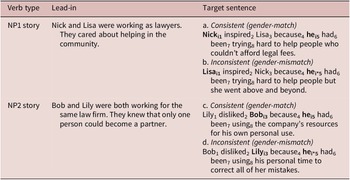
The main task utilized a word-by-word noncumulative moving window self-paced reading paradigm. Our design was inspired by Koornneef and Van Berkum (Reference Koornneef and Van Berkum2006) who examined implicit causality using self-paced reading in Dutch. Examples from the NP1 and NP2 conditions are given in Table 2. We used the same 36 three-sentence stories from Experiment 1, but following Koornneef and Van Berkum (Reference Koornneef and Van Berkum2006), the target sentence was manipulated such that in the Consistent Condition (a/c), there was a match between the gender of the pronoun (he) and the stereotypical gender of the noun phrase associated with the IC bias (NP1/NP2), and in the Inconsistent Condition (b/d), there was a mismatch between the gender of the pronoun and the gender of the noun phrase associated with the antecedent bias of the verb. We predicted a reading time slowdown at the pronoun in the Inconsistent Conditions as compared to the Consistent Conditions.
Examples of the stimuli in experiment 2

Regions 1–4 included two names with opposite genders, the IC verb, and the discourse connector because. Region 5, the critical region, included the pronoun. Following Koornneef and Van Berkum (Reference Koornneef and Van Berkum2006) and Featherstone and Sturt (Reference Featherstone and Sturt2010), we used he as the pronoun in the target sentences to avoid possible reading time differences of pronouns in different genders. Regions 6–8 were the spillover regions, which were kept identical between the two conditions in the same set. The target sentences in both the Consistent and Inconsistent conditions wrapped up in a plausible way. In half the target sentences, the order of the names in the lead-in sentence matched that of the target sentence while in the other half they didn’t. We also included 36 filler stories using verbs with no known IC biases. Fillers were similar to the target stories, but the target sentences either did not include pronouns or included different pronouns (they, she). For all stories, lead-in sentences were presented in full, one sentence at a time, while the target sentence was read by participants word by word. Participants also read four practice trials.
Measures of Individual Differences
Following Koornneef et al. (Reference Koornneef, Dotlačil, den Broek and Sanders2016), we selected a nonverbal measure of working memory, the counting span task (Case et al., Reference Case, Kurland and Goldberg1982). During the task, participants were presented with an array of target shapes (dark blue circles) and distractors (light green circles). On each trial, they were asked to count the number of target shapes out loud (in their native language) and then repeat the total number; the experimenter then entered that number, which triggered the next trial. After a series of 2–6 trials, a series of boxes appeared on the screen prompting the participants to recall the total number of target shapes from each previous trial in order. Instructions were given in the participants’ L1.
We also included the Peabody Picture Vocabulary Test 4th edition (PPVT-4; Dunn & Dunn, Reference Dunn and Dunn2007) as a measure of English vocabulary knowledge. While Long and De Ley (Reference Long and De Ley2000) used a standardized reading test, we did not have the time in our experimental session to include a comprehensive reading assessment. Johnson and Arnold (Reference Johnson and Arnold2021) used the ART as a measure of language experience/print exposure, but the English version of the task has not been found to be appropriate for L2 learners (see McCarron & Kuperman, Reference McCarron and Kuperman2021). Because better vocabulary knowledge has been shown to be a predictor of both reading skills (Braze et al., Reference Braze, Tabor, Shankweiler and Mencl2007) and language comprehension in native speakers (Van Dyke et al., Reference Van Dyke, Johns and Kukona2014), we felt a vocabulary test may be a reasonable replacement and would be appropriate for both L2 learners and native speakers. The PPVT-4 is widely used with English natives and has been reported to be a suitable measurement for assessing vocabulary size in more advanced L2 learners (Goriot et al., Reference Goriot, Broersma, McQueen, Unsworth and Van Hout2018). Participants were shown four pictures and were instructed to choose the correct picture that matched the target word that the experimenter said out loud. Each set contained 12 trials, and the sets were ordered with increasing difficulty. For each participant, a raw score was calculated by subtracting the number of errors from the number of completed items. We did not use the standardized score as these age‑based scores are normed for native speakers. Instead, we used raw PPVT scores for both natives and learners.
Lexical Tasks
L2 learners also completed two additional tasks. First, they completed a task to examine the IC bias for the Chinese translations of the English verbs used in the experiments. The Chinese task was modeled on Hartshorne et al. (Reference Hartshorne, O’Donnell and Tenenbaum2015). We calculated learners’ mean bias scores of the Chinese counterpart of the English IC verbs. If learners chose the antecedent that aligned with the expected verb bias, the choice was given a score of 1. If learners chose the antecedent that didn’t align with the verb bias, the choice was given a score of 0. Learners generally displayed a strong bias in the expected direction for Chinese NP1 verbs (M = 0.84/1, SD = 0.15, range: 0.44–1.00) and for Chinese NP2 verbs (M = 0.96/1, SD = 0.07, range: 0.67–1.00). This suggests that the IC bias is similar in Chinese and English and, thus, crosslinguistic differences in verb bias should not impact processing.
We also administered a translation task to make sure that learners were familiar with the target verbs. We asked participants to translate the main clause of all 36 target sentences (e.g., Lily disliked Bob) into Chinese. Correctly translated items were scored 1 while incorrectly translated ones were given 0. Learners had an average score of 0.90/1 (SD = 0.15, range: 0.42–1.00) for NP1 items, and 0.94/1 (SD = 0.1, range: 0.76–1.00) for NP2 items, suggesting that they were familiar with the lexical items.
Procedure
All participants first provided informed consent and completed a language background questionnaire. L2 learners were also shown two vocabulary lists prior to beginning the experiment to ensure familiarity with the lexical items in the stories. One list contained all the critical verbs and a selection of nouns/phrases, along with Chinese translations. A second list contained all the English names used in the main task to ensure familiarity.
Both natives and L2 learners completed the main self-paced reading (SPR) task and the working memory task on a computer in a quiet lab. Learners also completed the Michigan Listening Comprehension Test right after the working memory task. Then, the vocabulary task (PPVT-4) was administered to both groups by the experimenter. Lastly, learners completed the two additional lexical tasks on a laptop using Qualtrics. Participants received $10 per hour for their participation; the session lasted approximately one hour for the natives, and two hours for the learners.
Predictions
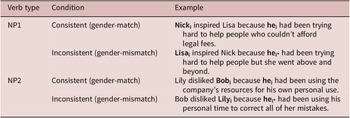
Target sentences for each condition are listed in Table 3. If participants use IC bias, they should slow down at the pronoun (e.g., he) in the Inconsistent Conditions as compared to the Consistent Conditions in both NP1/NP2 sentences. However, if, as proposed by Cheng and Almor (Reference Cheng and Almor2017, Reference Cheng and Almor2019), learners resolve the pronoun in favor of the first-mentioned/subject antecedent, they would slow down at the pronoun in the Inconsistent Condition for NP1 sentences, but they would show the reverse pattern for NP2 sentences. Specifically, for NP2, they would slow down at the pronoun in the Consistent Condition as the subject in that condition mismatches in gender with the pronoun.
Target sentences for NP1/NP2 sentences

For individual differences, based on the previous studies described in the preceding text, we predict a positive modulation of slowdowns at the pronoun in the Inconsistent Condition compared to the Consistent Condition based on participants’ working memory abilities and vocabulary scores.
Statistical Analysis
Data Preprocessing for the SPR Task
Only the target trials for which the comprehension question was correctly answered were included in the analysis (mean accuracy: L1: 96%; L2: 93%). In line with Nicklin and Plonsky (Reference Nicklin and Plonsky2020), we excluded reading times falling outside of the range of 150 ms and 2000 ms, which resulted in the removal of 2.9% of native speakers’ data and 1.0% of learners’ data. We then log-transformed the reading times to repair the skewness of the data distribution. SD boundaries were not used in our data trimming process since it has been argued that log-transformation circumvents the need for such method, which has the potential of altering potentially legitimate data (Nicklin & Plonsky, Reference Nicklin and Plonsky2020).
Data Preprocessing for the Individual Differences Measures
We used mean accuracy in the counting span task, and raw scores in the PPVT-4 task. The two individual differences (ID) scores were z-transformed when entered into the statistical models.
Statistical Analysis
Log-transformed reading times (logRTs) were statistically analyzed by fitting linear mixed-effects models in R (R Core Team, 2021) using lme4 (Bates et al., Reference Bates, Mächler, Bolker and Walker2015). Separate analyses were conducted for the pronoun (pro), and the spillover regions (pro+1, pro+2, pro+3). We included three spillover regions in line with Koornneef and Van Berkum (Reference Koornneef and Van Berkum2006), who analyzed five words after the pronoun and revealed an effect in a SPR experiment at two words following the pronoun. Other studies that used a similar gender-mismatch paradigm also found that IC effect emerged in the spillover regions (Liu & Nicol, Reference Liu, Nicol, Prior, Watanabe and Lee2010, SPR task: two words after the pronoun; Featherstone & Sturt, Reference Featherstone and Sturt2010, eye-tracking: one and three words after the pronoun).
In the model that examined the IC effect at the pronoun, Consistency (Consistent, Inconsistent), Group (Natives, Learners),VerbType (NP1, NP2), and the two ID measures: Counting Span and PPVT, as well as all possible interactions among those variables were included as fixed effects. In the model that examined the IC effect at the spillover regions, Consistency (Consistent, Inconsistent), Group (Natives, Learners), VerbType (NP1, NP2), Region (pro+1, pro+2, pro+3), and the two ID measures: Counting Span and PPVT, as well as all possible interactions among those variables were included as fixed effects. The IC effect at the precritical region (pro-1) was also examined by including Consistency, Group, and VerbType as fixed effects to ensure that no reading time differences emerged before the critical region; the analysis showed that no significant differences were observed. In all the models, categorical factors were sum coded and the two ID factors were z-transformed. All models also contained the maximal random effects structure, including by-participant slopes for Consistency, VerbType, and Region (only for models of the spillover regions), and a by-item slope for Group.Footnote 2 Data analysis was conducted using the lme4 package in R (Bates et al., Reference Bates, Mächler, Bolker and Walker2015). Degrees of freedom for the t-values and p-values in the mixed-effects models were computed using the R package lmerTest (Kuznetsova et al., Reference Kuznetsova, Brockhoff and Christensen2017).
Descriptive Statistics of ID Measures
Descriptive statistics for the ID measures are shown in Table 4. Pearson correlation tests showed that the two ID measures are not significantly correlated (r (76) = .2, p = –.15). The results of t-tests also showed that there was no statistically significant difference in the Counting Span scores between the two groups (t (73.6) = –1.64, p = .10), but native speakers’ raw PPVT scores were significantly higher than learners’ (t (46.2) = 12.14, p < .001).
Descriptive statistics for the individual difference measures

Results
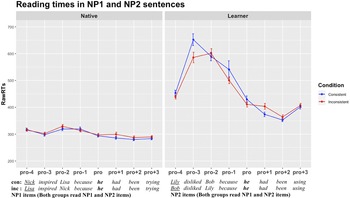
Figure 2 illustrates the mean RTs for native speakers and learners in items combining NP1 and NP2 verbs. Table 5 presents the mean RTs and standard deviations of each region. At the group level, the descriptive data show that effects are very subtle and at the pronoun, learners’ mean reading times are in the opposite of the predicted pattern. However, our inclusion of the individual difference measures allows us to examine variability in both groups, investigating whether the effects, which are not robust at the group level, depend on working memory or vocabulary knowledge. In what follows, we present the statistical results for the pronoun and the spillover regions (pro+1, pro+2, pro+3) in detail, including measures of individual differences.Footnote 3
Mean RTs for native speakers and learners in consistent and inconsistent items (NP1 and NP items combined).

Descriptive statistics for raw reading times and standard deviations in the pronoun and the spillover regions (pro+1, pro+2, pro+3)

Critical Region (Pronoun)
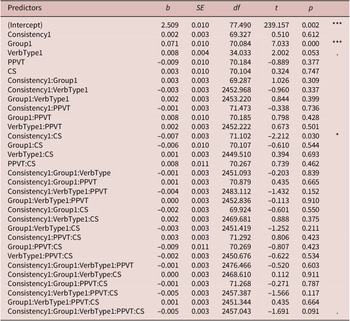
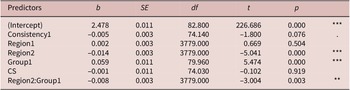
At the pronoun, we were interested in whether participants showed sensitivity to IC bias and whether the sensitivity would vary by individual’s performance on the Counting Span and PPVT-4. The model showed no significant main effect of Consistency but showed a significant interaction between Consistency and Counting Span (b = –0.007, SE = 0.003, t = –2.212, p = .030) (Table 6).
Results of the mixed-effects regression at the critical region (pronoun) (N = 78)

Note: The random slopes of VerbType and Group were removed due to the singularity warning.
Formula: lmer (logRT ~ Consistency * Group * VerbType * PPVT * CS + (1+ Consistency|Participant) + (1|Item))
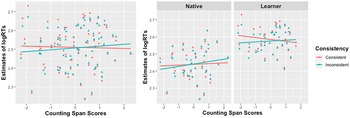
To understand the significant Consistency by Counting Span interaction, we plotted the relation between individual’s Counting Span scores and their reading times of the pronoun at the Consistent and Inconsistent Conditions in Figure 3. The figures suggest that both native speakers and learners with higher working memory showed larger reading time slowdowns at the pronoun in the Inconsistent Condition compared to the Consistent Condition when combining both NP1 and NP2 sentences. The lack of a three-way interaction between Consistency, Counting Span, and Group suggests that working memory modulates sensitivity to the IC bias similarly in native speakers and learners.Footnote 4
Relationship between counting span scores and reading times at the pronoun in consistent (red line) and inconsistent (blue line) conditions when combining two participant groups (left) and splitting the data by group (right).

Spillover Regions (pro+1, pro+2, pro+3)
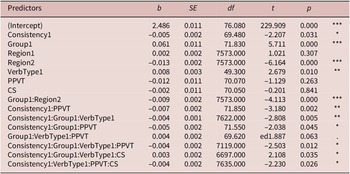
We also analyzed the spillover regions to capture any late effects (e.g., Featherstone & Sturt, Reference Featherstone and Sturt2010; Koornneef & Van Berkum, Reference Koornneef and Van Berkum2006; Liu & Nicol, Reference Liu, Nicol, Prior, Watanabe and Lee2010). The results showed a significant main effect of Consistency (b = –.005, SE = .002, t = –2.207, p = .031), with a significant two-way interaction between Consistency and PPVT (b = –.007, SE = .002, t = –3.180, p = .002). There were also two significant three-way interactions that involved the variable Consistency: a significant interaction between Consistency, Group, and VerbType (b = –.004, SE = .001, t = –2.808, p = .005); and a significant interaction between Consistency, Group, and PPVT (b = –.005, SE = .002, t = –2.038, p = .045). Lastly, there were also three significant four-way interactions that involved the variable Consistency: a significant interaction between Consistency, Group, VerbType, and PPVT (b = –.004, SE = .002, t = –2.503, p = .012); a significant interaction between Consistency, Group, VerbType and CS (b = .003, SE = .002, t = 2.108, p = .035); and a significant interaction between Consistency, VerbType, PPVT, and CS (b = –.004, SE = .002, t = –2.230, p = .026) (Table 7). The results indicate that the effect of Consistency, and the modulation of this effect by the two ID measures differed depending on the participant group and the verb type. To further examine these interactions, we conducted follow-up analyses splitting the data by VerbType. Due to length considerations, in the tables that follow, we only report the results for the fixed effects and all significant interactions. See Supplementary Materials: Full Model Output for the comprehensive set of results (https://osf.io/b3cqp/).
Results of the mixed-effects regression model at the spillover regions (pro+1, pro+2, pro+3) (N = 78)

Note: The random slope of Region was removed due to the singularity warning.
Formula: lmer (logRT ~ Consistency * Group * Region * VerbType * PPVT * CS (1+ Consistency + VerbType|Participant) + (1+Group|Item))
Spillover Regions: NP1 items
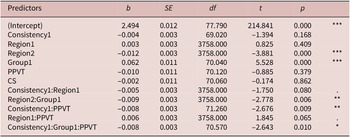
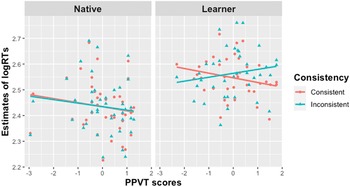
Results of the model that only contained NP1 items didn’t show any significant effect of Consistency but showed a significant two-way interaction between Consistency and PPVT (b = –.008, SE = .003, t = –2.676, p = .009), and a significant three-way interaction between Consistency, Group, and PPVT (b = –.008, SE = .003, t = –2.643, p = .01) (Table 8). This suggests that the Consistency effect at the spillover regions in NP1 items was dependent on participants’ PPVT-4 scores, and the pattern differed between natives and learners.
Results of the mixed-effects regression model at the spillover regions for NP1 items (N = 78)

Note: Formula: lmer (logRT ~ Consistency * Region * Group * PPVT * CS (1+ Consistency |Participant) + (1|Item))
To further investigate the Consistency by Group by PPVT interaction, we first conducted a follow-up analysis comparing the Consistency effect between the two groups using the “emmeans” package in R (Lenth, Reference Lenth2021). The results showed that only learners showed a marginal reading time slowdown at the spillover regions of the NP1 items in the Inconsistent Condition compared to the Consistent Condition (b = .018, SE = .009, t = 2.043, p = .082) (Table 9).
Results of the Follow-up Analysis of the Consistency by VerbType Interaction for Natives and L2 Learners

Note: p value adjustment: holm method for two tests.
Next, we plotted the relation between individual’s PPVT-4 scores and their reading times in the two conditions (Figure 4). The figure shows that while learners with higher PPVT-4 scores showed a larger Consistency effect than learners with lower PPVT-4 scores; native speakers’ sensitivity to the IC bias was not modulated by their PPVT-4 scores. Overall, analyses of the NP1 items at the spillover regions showed different patterns between native speakers and learners: Native speakers didn’t show any sensitivity to the IC bias while learners with higher vocabulary scores showed stronger sensitivity to IC bias.Footnote 5
Relationship between PPVT scores and reading times at the spillover regions in Consistent (red line) and Inconsistent (blue line) conditions in NP1 items by the two participant groups.

Spillover Regions: NP2 items
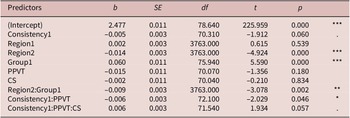
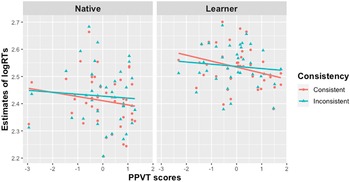
Results of the model that only contained NP2 items show a marginal effect of Consistency (b = –.005, SE = .003, t = –1.912, p = .060), with a significant two-way interaction between Consistency and PPVT (b = –.006, SE = .003, t = –2.029, p = .046), and a marginal three-way interaction between Consistency, PPVT, and Counting Span (b = .006, SE = .003, t = 1.934, p = .057) (Table 10). The results suggest that the effect of Consistency was dependent on individuals’ PPVT-4 scores, which may be modulated differently by individuals’ Counting Span scores, and the patterns were similar between natives and learners.
Results of the mixed-effects regression model at the spillover regions for NP2 items (N = 78)

Note: Formula: lmer (logRT ~ Consistency * Region * Group * PPVT * CS (1+ Consistency|Participant) + (1+Group|Item))
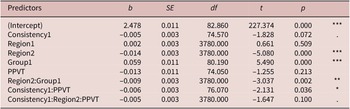
To further explore the Consistency by PPVT by Counting Span three-way interaction, we included Counting Span scores and PPVT-4 scores separately into the model, along with variables of Consistency, Group, Region, and all possible interactions. First, the model that included individuals’ PPVT-4 scores revealed a marginal Consistency effect (b = –.005, SE = .003, t = –1.828, p =. 072), with a significant interaction between Consistency and PPVT (b = –.006, SE = .003, t = –2.131, p =.036) (Table 11).
Results of the mixed-effects regression model at the spillover regions for NP2 items including PPVT as the ID measure (N = 78)

Note: The random slope of Region was removed due to the singularity warning. Formula: lmer (logRT ~ Consistency * Region * Group * PPVT (1+ Consistency + |Participant) + (1+Group|Item))
Visualization of the relation between PPVT-4 scores and reading times indicate that both native speakers and learners with higher PPVT-4 scores showed a large effect of Consistency than those with lower PPVT-4 scores (Figure 5).Footnote 6
Relationship between PPVT scores and reading times at the spillover regions in Consistent (red line) and Inconsistent (blue line) conditions in NP2 items by the two participant groups.

Second, the model that included individuals’ Counting Span scores revealed a marginal Consistency effect (b = –.005, SE = .003, t = –1.800, p =. 076) but with no significant interaction that involved Consistency or Counting Span (Table 12). The results indicate that the Consistency effect found in both natives and learners was not related to individuals’ Counting Span scores, and the three-way interaction between Consistency, PPVT, and Counting Span was present due to the different modulations of the Consistency effect by individuals’ PPVT scores versus their Counting Span scores. Overall, analyses of the NP2 items at the spillover regions showed similar patterns between native speakers and learners: Participants in both groups with higher English vocabulary knowledge showed greater sensitivity to IC bias.
Results of the mixed-effects regression model at the spillover regions for NP2 items including Counting Span as the ID measure (N = 78)

Note: The random slope of Region was removed due to the singularity warning. Formula: lmer (logRT ~ Consistency * Region * Group * CS (1+ Consistency + |Participant) + (1+Group|Item))
Summary of the SPR task
At the pronoun, a significant interaction between Consistency and Counting Span suggests that both native speakers and learners with higher working memory were more likely to show reading time slowdowns at the pronoun in the Inconsistent Condition as compared to the Consistent Condition. In the spillover regions (pro+1, pro+2, pro+3), only learners showed reading time slowdowns in the Inconsistent Condition compared to the Consistent Condition in NP1 items, an effect that was modulated by vocabulary scores. However, in NP2 items, both natives and learners showed reading time slowdowns in the Inconsistent Condition compared to the Consistent Condition, which were similarly modulated by their vocabulary knowledge. Overall, these results suggest that participants with higher working memory may have more resources available to integrate the IC bias right at the pronoun. In the spillover regions, this effect was more robust in NP1 items for learners with higher vocabulary scores, and more robust in NP2 items for both native speakers and learners with higher vocabulary scores.
A few points are worth highlighting with respect to the overall patterns that emerged. As a reviewer points out, we did not observe an overall effect of Consistency but rather an effect of Consistency that was modulated by working memory at the critical region (for both native speakers and learners) and vocabulary scores in the spillover region (for both NP1/NP2 for learners and NP2 for native speakers). A reviewer points out that the lack of an overall effect of Consistency contrasts with the previous literature. While this is true, very few studies have used word-by-word self-paced reading experiments to examine IC bias, and to our knowledge, Koornneef and Van Berkum (Reference Koornneef and Van Berkum2006) (Experiment 1) is the only other study whose stimuli included extended discourses as opposed to using a single-sentence design (as in Liu and Nicol, Reference Liu, Nicol, Prior, Watanabe and Lee2010). Our English experiment followed the design and procedures of Koornneef and Van Berkum’s (Reference Koornneef and Van Berkum2006) Dutch experiment with just small modifications (e.g., we included 9 experimental items per condition as compared to 10 in their study and we tested n = 39 learners and n = 40 native speakers as compared to n = 24 in their study). Although Koornneef and Van Berkum (Reference Koornneef and Van Berkum2006) observed an overall effect of Consistency, their effects were still subtle, emerging only two words after in the pronoun in the self-paced reading experiment. Thus, it is possible that our inclusion of individual difference measures in the current study allowed us to observe effects of IC bias earlier in the sentence, but only for individuals with higher working memory or higher vocabulary scores.
Secondly, although the significant interactions that emerged between Consistency and Counting Span scores and Consistency and PPVT scores are in the predicted direction, with individuals with higher working memory (at the critical region) and higher vocabulary scores (at the spillover region) showing larger effects of IC bias, there are some individuals with lower scores on the working memory and vocabulary tasks who show effects in the opposite direction. A similar tendency was observed by Koornneef et al. (Reference Koornneef, Dotlačil, den Broek and Sanders2016) in their eye-tracking study that also examined the relationship between working memory and use of IC bias. Although these effects seem to be driven by few individuals, we acknowledge that a future study should continue to explore these patterns and it is possible that a study with a larger sample size may show more robust qualitative differences in the processing of IC bias between individuals at the higher and lower ends of the working memory and vocabulary spectrum.
Discussion
This study investigated sensitivity to IC bias in pronoun resolution in native speakers and Chinese-speaking learners of English and explored the role of individual differences in both populations. The results suggest that in both offline and online tasks, L2 learners showed qualitatively similar patterns to native speakers. However, in the offline task, learners’ preferences were weaker than the natives for both NP1 and NP2 verbs. In the SPR task, both groups showed online sensitivity to IC bias, with effects being modulated by individual’s working memory and vocabulary knowledge in both groups. The results overall provide important evidence that L2 learners of English whose L1 is Chinese are sensitive to discourse-level cues such as IC bias and furthermore, that individual-level variability is similarly explained in both populations.
Different from Cheng and Almor (Reference Cheng and Almor2017, Reference Cheng and Almor2019), learners in our study did not show a general subject/first-mention preference. In the offline task, not only did learners show more NP1 choices for NP2 verbs but they also showed fewer NP1 choices for NP1 verbs. Thus, our learners just showed a quantitively weaker bias than the natives, but the overall patterns were similar. We think that it is at least possible that the subject bias in Cheng and Almor’s (Reference Cheng and Almor2017) study was influenced by the single-sentence design used in the study. In sentence fragments such as Paul liked Alan because he…., Paul is introduced first in subject position, and thus, based on previous studies (Crawley et al., Reference Crawley, Stevenson and Kleinman1990; Frederiksen, Reference Frederiksen1981; Gernsbacher & Hargreaves, Reference Gernsbacher and Hargreaves1988), may be more prominent than the antecedent in object position. In NP1 sentences, the subject and the antecedent aligned with the IC bias of the verb point to the same discourse entity, but in NP2 sentences, the two cues point to different entities. If the subject antecedent initially carries prominence, then, in processing sentences with NP2 verbs, the discourse model needs to be updated, from the entity in subject position carrying prominence to the entity aligned with the IC bias (NP2) carrying prominence. It is possible that the learners in Cheng and Almor’s studies were more likely to choose NP1 (subject) antecedents, particularly for NP2 items because they had difficulty updating the discourse model on the basis of the verb. In the present study, the three-sentence story design that we used, inspired by Koornneef and Van Berkum (Reference Koornneef and Van Berkum2006), introduced the two possible antecedents into the discourse with equal prominence and, thus, may have weakened the prominence of the subject antecedent.
In the online task, learners’ sensitivity to IC bias generally resembled that of native speakers. We will first consider the role of individual differences for both populations and then consider the findings in light of L2 theories. At the pronoun (collapsing over both NP1/NP2 items), both L2 learners and native speakers with higher working memory showed significant slowdowns at the pronoun in the Inconsistent Condition compared to the Consistent Condition. These results are in line with Koornneef et al. (Reference Koornneef, Dotlačil, den Broek and Sanders2016), who showed an effect of IC bias at the pronoun only for individuals with higher working memory in the “normal” reading condition without the secondary task. Thus, we replicated their results for native speakers and extended the finding to L2 learners. An important question then is what this relationship between working memory and the use of IC bias indexes. Koornneef et al.’s original prediction was inspired by a capacity-based approach to working memory, in line with proposals such as Daneman and Carpenter (Reference Daneman and Carpenter1980) and Just and Carpenter (Reference Just and Carpenter1992), who argue that difficulty in language comprehension is related to limitations in the processing resources available. However, Koornneef et al. (Reference Koornneef, Dotlačil, den Broek and Sanders2016) argue that the results of the experiment with the secondary task do not support an account based on capacity limitations as it was individuals with lower working memory who were more likely to use IC bias when under a processing burden. As discussed earlier, Koornneef et al. propose that the patterns in their study may be explained by differences in processing strategies, with higher span individuals being more likely, under normal circumstances, to engage in proactive processing, generating expectations about which entities in the discourse are more likely to be rementioned. The relationship between working memory and anticipatory processing is a potentially interesting direction to pursue in future research in this domain, particularly with experimental paradigms that allow for a more direct test of predictive processing (e.g., Kim & Grüter, Reference Kim and Grüter2021; Pyykkönen & Järvkivi, Reference Pyykkönen and Järvikivi2009).
An additional consideration against capacity-based approaches is that theoretical accounts such as Lewis et al. (Reference Lewis, Vasishth and Van Dyke2006) and McElree et al. (Reference McElree, Foraker and Dyer2003) have argued that it is retrieval from memory, as opposed to storage capacity, that is critical for language comprehension (see Van Dyke & Johns, Reference Van Dyke and Johns2012 for a review). Research has shown that retrieval of the correct target in language comprehension is more difficult when similar items are stored in memory, leading to interference (e.g., Gordon et al., Reference Gordon, Hendrick and Levine2002; Van Dyke & McElree, Reference Van Dyke and McElree2006). Memory interference accounts have been applied to the domain of reference (e.g., Cunnings et al., Reference Cunnings, Patterson and Felser2014) as pronoun resolution involves retrieval of the target antecedent from memory on the basis of cues related to morphosyntax, syntax, and discourse. On memory interference accounts, individual differences in language comprehension are related to how successfully an individual uses the relevant cues to retrieve the correct target (Van Dyke & Johns, Reference Van Dyke and Johns2012). A large-scale individual differences study by Van Dyke et al. (Reference Van Dyke, Johns and Kukona2014), which included an extensive number of measures targeting both language skills and cognitive skills, showed that successful language comprehension (low susceptibility to interference) was best predicted by vocabulary knowledge. Working memory, which was highly correlated with many of the measures tested, did not uniquely explain any of the variance in comprehension.
In the present study, we observed a relationship between vocabulary knowledge and the use of IC bias, a finding that has, to our knowledge, not been observed previously for either native speakers or L2 learners. Our results showed that at the spillover regions, learners with higher vocabulary showed a significant IC effect for the NP1 items, while both native speakers and learners with higher vocabulary showed such a pattern in the NP2 items. It is unclear why the effect was significant for learners for both NP1 and NP2 items but was only significant for natives for NP2 items. As these effects emerged in the spillover region, it is possible that the effect was longer lasting in NP1 items for leaners with higher vocabulary knowledge. Sentences in the Inconsistent Conditions with NP1 verbs such as Lisa inspired Nick because he…. present contexts in which initially there is a gender mismatch between the pronoun and the name that carries the verb bias. However, all sentences wrap up in a plausible way and thus, the pronoun in the Inconsistent Condition ultimately needs to be resolved in favor of the gender-matching antecedent. This may cause processing difficulties that are prolonged in learners as compared to native speakers in certain contexts, and it is possible that it is only learners with higher vocabulary knowledge who are actively attempting to resolve the pronoun in favor of the gender-matching antecedent.
Although the finding that vocabulary knowledge modulates the use of IC bias is unique to our study, it is possible that the explanation is related to previous accounts of individual differences such as Johnson and Arnold (Reference Johnson and Arnold2021) in the domain of IC bias and accounts such as Van Dyke et al. (Reference Van Dyke, Johns and Kukona2014) for language comprehension more broadly. Vocabulary knowledge has been shown to be related to reading skill overall (Braze et al., Reference Braze, Tabor, Shankweiler and Mencl2007) and it is possible that individuals with higher vocabulary/reading skills have more exposure to input that allows them to better form expectations about which discourse entities are more likely to be rementioned in certain contexts (Johnson & Arnold, Reference Johnson and Arnold2021). It is also possible, in line with Van Dyke et al. (Reference Van Dyke, Johns and Kukona2014), that better vocabulary is related to higher quality lexical representations, which may facilitate the retrieval of the correct target. Successful retrieval in pronoun resolution relies on the use of a number of cues. Individuals with higher quality lexical representations may be better able to use those cues, and thus retrieval is less vulnerable to interference. Related to this issue, an anonymous reviewer asked to what extent our findings may have been influenced by the fact that we provided learners with a vocabulary list before the experiment (names used in the experiment and a selection of nouns and verbs) to ensure familiarity with the lexical items in the stimuli. While we do not believe that providing the list could have influenced their knowledge of IC bias, we acknowledge that it may have facilitated lexical access and processing overall, which could have in turn facilitated learners’ use of the relevant cues in the study, such as, for example, the gender of the names. We also acknowledge that providing the learners with the list of names and not giving the list to the native speakers could have provided the learners with an advantage; a reviewer notes that the overall effect of Consistency is more robust at the spillover region for the learners than it is for native speakers. Future studies that more systematically manipulate this factor can shed light on the extent to which processing patterns are modulated by lexical familiarity.
Overall, the results of our study are in line with previous L2 studies in reporting nativelike patterns in using IC verb bias in resolving pronouns online (Contemori & Dussias, Reference Contemori and Dussias2019; Kim & Grüter, Reference Kim and Grüter2021; Liu & Nicol, Reference Liu, Nicol, Prior, Watanabe and Lee2010). However, the fact that learners’ biases are weaker than native speakers in the offline task and the fact that sensitivity to IC bias online is facilitated by enhanced vocabulary knowledge and working memory also suggests that the use of IC bias in pronoun resolution is quite complex. This complexity is in the spirit of the Interface Hypothesis (Sorace & Filiaci, Reference Sorace and Filiaci2006) and the RAGE hypothesis (Grüter et al., Reference Grüter, Rohde and Schafer2017) that both predict difficulty in referential processing, but the results do not support a strong version of either account, which would predict inevitable vulnerabilities in antecedent choice (Sorace & Filiaci, Reference Sorace and Filiaci2006) or a reduced ability in L2 learners to use discourse cues to generate expectations (Grüter et al., Reference Grüter, Rohde and Schafer2017). However, more recent versions of these proposals suggest a more nuanced approach (e.g., Kaan & Grüter, Reference Kaan, Grüter, Kaan and Grüter2021; Sorace, Reference Sorace2011), and our results suggest, in line with the spirit of these recent proposals, that the goal of current research in this domain should be to better understand the specific conditions under which L2 processing is successful. The conditions likely need to account for grammatical factors (L1-L2 differences), experimental factors (nature of the task), and individual-level factors as well, which we have focused on here (see also Gabriele et al., Reference Gabriele, Alemán Bañón, Hoffman, Covey, Rossomondo and Fiorentino2021). In a comparison of native and L2 processing, while we can systematically compare the impact of experimental factors and individual-level factors, obviously the role of certain grammatical factors, such as differences between the L1 and L2, is an issue specific to the learner population being tested. For this reason, in the present study we aimed to control for L1/L2 differences and specifically examined IC verbs that carry similar biases in Chinese and English. This allowed us to focus more precisely on whether variability in the natives and the learners could be explained by similar sources. We believe that our results do indeed suggest that processing is qualitatively similar in both populations (Hopp, Reference Hopp2010; Kaan, Reference Kaan2014; McDonald, Reference McDonald2006). These results are an important contribution to the literature in that previous studies, such as Roberts et al. (Reference Roberts, Gullberg and Indefrey2008), had suggested that L2 learners cannot successfully use discourse cues to resolve pronouns online, even in cases of L1-L2 similarity. We believe the examination of individual differences helps to shed light on why difficulty in this domain is often observed; the ability to use subtle discourse cues to generate implicatures as to which antecedent is in focus is modulated by an individual’s language abilities, such as vocabulary knowledge, and cognitive abilities, and thus, may be beyond the range of some learners and even some native speakers. Importantly, our results suggest that the same abilities facilitate processing in both populations. We propose, in line with Kaan (Reference Kaan2014), that variability in the two populations may be derived from similar sources, specifically individual differences related to the abilities that support the fundamental operations of language processing.
Conclusion
This study used an offline sentence completion task and an online SPR task to investigate native English speakers and L1 Chinese L2 learners of English’s sensitivity to IC bias in resolving pronouns and investigated how individual differences in vocabulary and working memory modulated that sensitivity. Results showed that both native speakers and learners utilize IC bias in resolving pronouns in similar ways, with individual differences in vocabulary knowledge and working memory explaining variability in both populations. We propose, in line with Kaan (Reference Kaan2014), that L2 processing and native processing is fundamentally similar, and that a lack of sensitivity in previous L2 studies may be due in part to not adequately capturing variability in learners.
Supplementary Materials
To view supplementary material for this article, please visit http://doi.org/10.1017/S0272263122000468.
Data Availability Statement
We have no known conflicts of interest to disclose. The experiment in this article earned Open Data and Open Materials badges for transparent practices. The materials are available at https://osf.io/b3cqp/.