Introduction
The peach-potato aphid, Myzus persicae (Sulzer) (Homoptera: Aphididae), is one of the most widespread and well-studied aphid species. It is a major problem for agriculture because it spreads plant viruses amongst crops such as potato, sugar beet, tobacco and pepper (van Emden et al., Reference van Emden, Eastop, Hughes and Way1969). The control measures used on M. persicae include intensive insecticide spraying, and this species has been particularly successful in evolving insecticide resistance (Foster et al., Reference Foster, Denholm and Devonshire2000). There are three known major mechanisms which render individuals carrying them resistant to three main classes of insecticide: (i) increased production of carboxylesterases (E4 or FE4), which confer resistance primarily to organophosphorous (OP) and some resistance to carbamates and pyrethroids; (ii) knock-down resistance (kdr) and super-kdr (skdr) are point mutations leading to changes in nerve sodium channels, which confer resistance to pyrethroids; and (iii) modified acetylcholinesterase (MACE) confers resistance specifically to the di-methyl carbamates, pirimicarb and triazamate. MACE is the most recent mechanism to have evolved; and it is still moving through the M. persicae population, a situation which facilitates an understanding of the evolution of resistant populations. MACE was originally detected in Greek M. persicae, then in populations from Japan and South America (Moores et al., Reference Moores, Devine and Devonshire1994a, Reference Moores, Devine and Devonshireb). It has also been found in Holland, France, Italy and Turkey (Moores et al., Reference Moores, Devine and Devonshire1994b; Mazzoni & Cravedi, Reference Mazzoni and Cravedi2002; Guillemaud et al., Reference Guillemaud, Brun, Anthony, Sauge, Boll, Delorme, Fournier, Lapchin and Vanlerberghe-Masutti2003; Fenton et al., Reference Fenton, Malloch, Woodford, Foster, Anstead, Denholm, King and Pickup2005; Zamoum et al., Reference Zamoum, Simon, Crochard, Ballanger, Lapchin, Vanlerberghe-Masutti and Guillemaud2005). In the UK, MACE was first detected in small numbers in 1995. In 1996, pirimicarb failed to control M. persicae in eastern England and this was found to be due to aphids carrying MACE (Foster et al., Reference Foster, Denholm, Harling, Moores and Devonshire1998). However, MACE resistance in England has generally fallen since 1996 (Foster et al., Reference Foster, Harrington, Dewar, Denholm and Devonshire2002). In 2001 in Scotland, there was a major breakdown of insecticide control, on seed potato and other crops, which was due to MACE-carrying aphids (Fenton et al., Reference Fenton, Malloch, Woodford, Foster, Anstead, Denholm, King and Pickup2005). It was found that the Scottish breakdown was caused by large numbers of two clones (A and B) carrying multiple resistance mechanisms including MACE (ibid). A molecular analysis suggested that clone B had been in the UK for some time, whereas clone A was a recent arrival (ibid). Since 2001, MACE forms of M. persicae remain prevalent in Scotland, where carbamate insecticides are being used. There are a number of possible explanations for this: (i) clones A and B have remained where the spraying regimes used on local Scottish crops select for them, and they are reintroduced from a protected source each year; (ii) clones A and B have become more adapted to overwinter in Scotland (possibly through reversion of the esterase mechanism, see Field et al. (Reference Field, Devonshire, Ffrench-Constant and Forde1989) ; (iii) the MACE allele has transferred to, or mutated in, local populations (Zamoum et al., Reference Zamoum, Simon, Crochard, Ballanger, Lapchin, Vanlerberghe-Masutti and Guillemaud2005); and (iv) new MACE-carrying genotypes with different physiologies have continued to arrive in Scotland.
The aim of the current paper was to address these hypotheses by examining M. persicae collected in Scotland in 1995 (to set a historical context), 2002, 2003 and 2004 using microsatellite analysis and compare them to a study carried out in 2001 (Fenton et al., Reference Fenton, Malloch, Woodford, Foster, Anstead, Denholm, King and Pickup2005). The analysis was carried out on both freshly collected field samples and alatae collected in suction traps using a recently developed technique (Malloch et al., Reference Malloch, Highet, Kasprowicz, Pickup, Neilson and Fenton2006).
Materials and methods
Aphid samples
1995 M. persicae samples
In 1995, single parthenogenetic females collected and analyzed by intergenic spacer (IGS) fingerprinting had been grown in culture and their DNA extracted and stored, see Fenton et al. (Reference Fenton, Woodford and Malloch1998) for details. Individuals from these colonies had also been preserved in ethanol. These samples were analyzed using the methods described below on stored DNA or, if none was available, by extracting DNA from individuals preserved in ethanol using the sodium hydroxide extraction method described below.
2002–2004 M. persicae samples
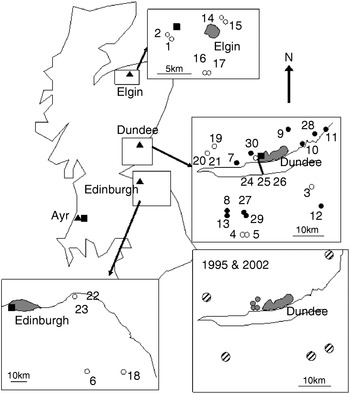
In 2002, samples were collected from six field sites located in the Dundee sector, including potato and insecticide-treated brassica crops (see fig. 1). In 2003, samples were collected from 13 field sites and in 2004 from 17 field sites (table 1). In 2003, the fields were of various crop types, which had either been treated with an insecticide or not. In 2004, samples were mostly taken from unsprayed brassica or potato crops, which were visited up to three times throughout the season. It was not possible to use exactly the same fields between years, but fields in the same areas were used, representing northeast Scotland, Fife, east Scotland and the Scottish Borders (fig. 1). Live aphids were taken from single plants separated by at least three metres. Either one or, if more were present, up to five aphids from each plant were put into 1.5 ml Eppendorf® tubes and stored at −70°C until a randomly chosen individual could be analyzed by microsatellite analysis. On the rare occasions that this individual failed to amplify, another individual from the same tube was used as a replacement. To obtain living material for resistance testing of new genotypes, single aptera from colonies in areas where these genotypes were expected to be frequent were placed onto potato tubersprouts in plastic containers. Once a colony had been established, an individual was genotyped and several live aphids were sent to Rothamsted Research (Harpenden, UK) for insecticide resistance testing.
Map of Scotland showing sampling sites in 2003 (1–13) and 2004 (14–30). Sites that were being sprayed or had been sprayed are represented by black circles and organic or unsprayed sites are represented by open circles. Major towns are shown by black triangles in main map and by grey shaded areas in the detailed insets. Black squares represent the location of the suction traps. The East Craigs and Gogarbank traps are represented by a single square as they are only 3 km apart. The sample locations for 1995 (grey circles) and 2002 (large hatched cirlces) are shown in a separate inset.

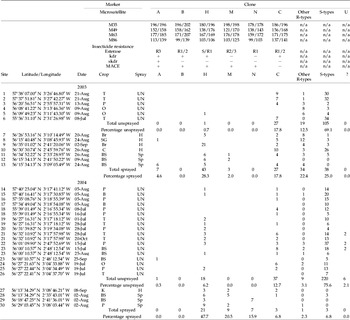
Sample sites and frequency of clones defined by microsatellite markers in 2003 and 2004.

The first and second row identifies each clone (A, H, M etc.). Other R-types (D, E, F and K) are clones carrying elevated esterase and/or kdr but not MACE. S-types (G, I, J and L) are clones carrying no resistance. Allele sizes in basepairs are shown for the four loci in rows three to six. Rows eight to eleven contain the results of insecticide resistance tests. U in the header row means that these were unclassified genotypes; n/a=not applicable (more than one clone in each group). Field site number, location, date, crop type, spray regime and clonal composition are shown from row 14 onwards. The total number of individuals from each clone and percentage of the total are shown in rows at the bottom of each year's data. Samples were taken from the following crops: potato (P); oilseed rape (O); turnip (T); cauliflower (C); broccoli (Br); Brussels sprouts (BS); spring greens (SG); and kale (K).
2003 and 2004 suction trap M. persicae samples
A European network of suction traps collect flying aphid populations to help monitor and predict their movement. In Scotland, these were located at Elgin, Dundee, Ayr and two sites in Edinburgh (East Craigs and Gogarbank). In 2003, it was only possible to analyze alatae caught in the Elgin suction trap, as aphids from other traps were stored in a solution that does not preserve DNA. In 2004, all the trap samples in Scotland were collected in an ethanol-based preservation solution. DNA could be extracted and analyzed from alatae collected in this solution.
DNA extraction
DNA from the samples collected in 1995, 2002 and 2003 was extracted using the method of Chia et al. (Reference Chia, Savakis, Karp, Pelham and Ashburner1985). The DNA was then treated with 0.5 μg RNase (Roche, Mannheim, Germany). DNA was extracted from the ethanol-preserved aphids from 1995, aphids from suction traps and 2004 field samples using a sodium hydroxide technique modified from Stanton et al. (Reference Stanton, McNicol and Steele1998), as described in Malloch et al. (Reference Malloch, Highet, Kasprowicz, Pickup, Neilson and Fenton2006).
Genotyping
Four microsatellite loci (Sloane et al., Reference Sloane, Sunnucks, Wilson and Hales2001), M35, M49, M63 and M86, were chosen on the basis of their resolving power (allele numbers of 6, 16, 7 and 9, respectively, giving 3.6×10⁶ combinations). These loci were amplified using fluorochrome primers labelled at the 5′ end of the reverse primer (M35 TET, M49 HEX, M63 FAM, M86 TET; MWG Biotech, Munich, Germany) and PCR ready-to-go beads (Amersham, UK; for conditions of use, see Malloch et al. (Reference Malloch, Fenton and Butcher2000)). The products were then analyzed on an ABI 377 (96) automated sequencer with Genescan v3.4 and Genotyper v2.5 software (Applied Biosystems, USA), which visualised and analyzed the products (Fenton et al., Reference Fenton, Malloch, Navajas, Hillier and Birch2003). To examine different lineages of clone C in more detail, we increased the resolution of the analysis by the addition of microsatellite markers M40 and M107, which have four and six alleles, respectively (Sloane et al., Reference Sloane, Sunnucks, Wilson and Hales2001). These microsatellite markers were also used in the studies by Terradot et al. (Reference Terradot, Simon, Leterme, Bourdin, Wilson, Gauthier and Robert1999) and Zamoum et al. (Reference Zamoum, Simon, Crochard, Ballanger, Lapchin, Vanlerberghe-Masutti and Guillemaud2005), which made cross comparison possible.
Insecticide resistance tests
Genotypes identified in 2002, 2003 and 2004 for the first time were sent for insecticide resistance testing at Rothamsted Research. Esterase levels were measured by ELISA; and aphids were categorized as S (susceptible), R1 (moderately resistant), R2 (highly resistant) or R3 (extremely resistant) (Foster et al., Reference Foster, Denholm and Devonshire2000). MACE activity was tested by kinetic enzyme assay in the absence or presence of a diagnostic concentration of insecticides (Moores et al., Reference Moores, Devine and Devonshire1994a). Finally, kdr and skdr were determined by high-throughput real-time PCR techniques (Anstead et al., Reference Anstead, Williamson, Eleftherianos and Denholm2004).
Analysis of clone relationships
An analysis using a simple mismatch co-efficient (Sneath & Sokal, Reference Sneath and Sokal1973; Kosman & Leonard, Reference Kosman and Leonard2005) was carried out on Scottish genotypes. Two data sets were used with one consisting of microsatellite alleles and insecticide resistance traits and the second only microsatellite alleles. The microsatellite alleles and resistance traits were scored as either ‘presence’ or ‘absence’. A dendrogram was produced from the output table using the programmes Neighbor (Felsenstein, Reference Felsenstein1993) and then Treeview (Page, Reference Page1996).
Results
Field samples
1995
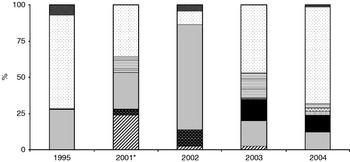
None of the 1995 samples resembled any of the MACE genotypes in the current study or those reported by Fenton et al. (Reference Fenton, Malloch, Woodford, Foster, Anstead, Denholm, King and Pickup2005). The 1995 sample consisted almost entirely of clone C and sensitive clones (S-types) (fig. 2). This is consistent with other observations at this time as there were no reports of resistance to pirimicarb and/or triazamate in Scotland and some of these samples were tested and found to contain S to R1 levels of esterase (B. Fenton, J.A.T. Woodford and A. Devonshire, unpublished data). There were small numbers of four ‘rare’ genotypes that have not been sampled in Scotland since (fig. 2, indicated by U=unclassified).
The clonal composition of samples from 1995 (n=189); 2001 (n=188)*; 2002 (n=46); 2003 (n=304) and 2004 (n=335). Other R-types=other clones carrying elevated esterase and/or kdr but not MACE; S-types=clones carrying no resistance; U=unclassified genotypes. *=data taken from Fenton et al. (Reference Fenton, Malloch, Woodford, Foster, Anstead, Denholm, King and Pickup2005) ( , U;
 , S-types;
 , other R-types;
 , N;
 , M; ■, H;
 , C;
 , B;
 , A).

2002
The samples in 2002 were all taken from sprayed brassica crops apart from two samples from unsprayed potato. The MACE-carrying B clone, present in 2001, was still present in small numbers (fig. 2) as was the MACE-carrying A clone, also found in 2001, which was sampled once. The C clone was the most predominant and only 9% of aphids sampled were sensitive (S-types) (i.e. fully susceptible to insecticides).
2003
Aphids collected in 2003 belonged to 11 clones. Seven of these had been identified in previous work (Fenton et al., Reference Fenton, Malloch, Woodford, Foster, Anstead, Denholm, King and Pickup2005); therefore, four were unidentified genotypes. The four genotypes were tested for insecticide resistance, which found that independent examples of two clones, H and M, carried MACE resistance, whereas the others carried no insecticide resistance, or kdr and increased levels of esterase (table 1). This meant that 54 (18%) of the 304 aphids collected in 2003 belonged to a clone known to carry MACE. Clone A made up 13% of the MACE aphids collected; and it was found at two sites (8 and 13), which were ~20 metres apart at the closest point (fig. 1). Clone B was not found in 2003. Clone H made up 81% of MACE-carrying aphids and was found widely at six sites, both in Fife (e.g. site 13) and Angus (e.g. site 9) (separated by ~60 km). Clone M made up 5.6% of MACE aphids, being found in two commercial Brussels sprouts fields located ~65 km apart (sites 10 and 12) (table 1). A single H clone was the only MACE aphid to be collected at an unsprayed site. No MACE-carrying clones were found at site 6, the most southerly, or at sites 1 and 2, the most northerly.
Clone C made up more than 10% of the total 2003 sample, clones carrying other resistance mechanisms, but not MACE (other R-types), made up 17% and sensitive clones (S-types) made up 47% of the total (fig. 2).
2004
A total of 335 aphids were collected and they belonged to 10 genotypes. One new genotype, denoted clone N, was found. N was a reddish colour and it carried MACE, S/R1 esterase, kdr and skdr. This meant that in 2004, 56 individuals belonged to a MACE-carrying clone (either A, H, M or N) and the sites where they were found included eight of the 13 unsprayed fields where 19 MACE-carrying individuals were identified (5% of total population; table 1). Only one clone A individual was found, and this was on unsprayed Brussels sprouts in the last sample of the season (site 22, table 1). Clone H was found at all eight unsprayed sites where MACE-carrying aphids had been identified, including the furthest north, 14 and 15 (fig. 1). Over half (56%) of clone H collected at unsprayed sites, was found at three sites within ~5 km of each other: 19, 20 and 21. It was present on each date that these sites were sampled. Four unsprayed sites had no MACE clones including site 18, which is the furthest south. In sprayed fields, MACE clones contributed to 84% of the aphids collected.
As in 2003, clone C made up more than 10% of the total population, while resistant types with no MACE (other R-types) contributed 12% and S- types 67% (fig. 2).
Suction trap samples and their relationship to field samples
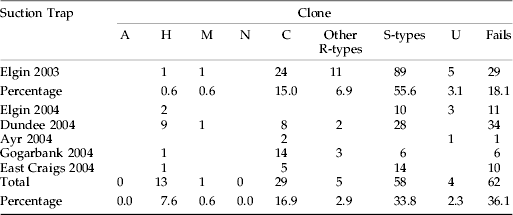
In 2003, a total of 160 alatae were caught in the Elgin trap, from which 131 could be scored and allocated to specific genotypes (table 2). Two alatae belonged to clones known to carry MACE resistance, one H (caught 13–14 July) and one M (8–9 August). Clone C made up 15% of the total catch. Fully insecticide-sensitive types made up 56% of alatae caught in this trap. Other R-types made up 7%. In 2004, clone H was found in four out of five of the traps (not in Ayr, in which very few M. persicae were caught), suggesting a widespread distribution; while M was caught once, at Dundee (table 2). Clones A, B and N were not detected in the traps.
The genotypic composition of suction trap catches from 2003 and 2004.
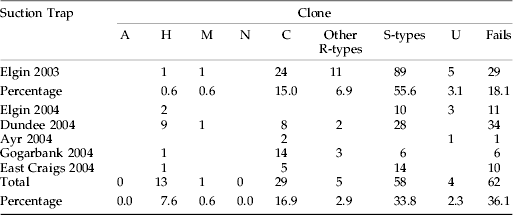
The first and second row identifies each clone (A, H, M etc.). Other R-types are clones carrying elevated esterase and/or kdr but not MACE. S-types are clones carrying no resistance. Rows three and four show the genotypic composition (number of alatae) and the percentage of the total catch of the Elgin suction trap in 2003. Rows five to nine show the genotypic composition (no. of alatae) for each of the traps in 2004, followed by the total catch in 2004 (row ten) and percentage of the total for each clone (row eleven). U in the header row means unclassified genotypes. Fails=samples which failed to produce a microsatellite pattern.
Comparison of C and MACE clones with other clones
Clone C
Nineteen clone C samples from throughout the UK and other parts of the world (Zimbabwe and France), which varied in their IGS patterns (Fenton et al., Reference Fenton, Malloch, Woodford, Foster, Anstead, Denholm, King and Pickup2005) or kdr status, were analyzed with markers M35, 49, 63 and 86 and two additional markers M40 and M107. The lineages were identical at all six loci (results not shown). A comparison with clones p3 (Terradot et al., Reference Terradot, Simon, Leterme, Bourdin, Wilson, Gauthier and Robert1999) and G1 (Zamoum et al., Reference Zamoum, Simon, Crochard, Ballanger, Lapchin, Vanlerberghe-Masutti and Guillemaud2005) indicated that, in addition to the general abundance of clones C, p3 and G1, there is a high degree of similarity between their markers (table 3). The slight differences in microsatellite sizes are artefacts due to different techniques (see Fenton et al., Reference Fenton, Malloch, Navajas, Hillier and Birch2003). This was confirmed by comparing the results of clone J with clone p2 described in Terradot et al. (Reference Terradot, Simon, Leterme, Bourdin, Wilson, Gauthier and Robert1999) as these are known to be the same clone (results not shown). As the addition of another two markers did not change the outcome, these results confirm that using four highly polymorphic markers (i.e. M35, M49, M63 and M86) is a rapid and effective method of detecting clones in asexual populations.
Comparison of clones G1, p3, C.

The first two rows identify the insecticide resistance and microsatellite markers used to compare the clones. Microsatellite allele sizes are shown in basepairs. Est=type of esterase; Level=level of esterase resistance; nt=not tested.
MACE Clones
Microsatellite marker analysis of laboratory cultures maintained at Rothamsted Research showed that three of these cultures matched the H, M and N MACE clones (results not shown). All three had been collected in fields in England, UK. There was at least 220 km between the Scottish and English collections of clone H and 400–480 km between collections of clones N and M, respectively. H and M were collected in England, the same year as they were found in Scotland, while the N clone was collected a year earlier.
Relatedness of MACE genotypes
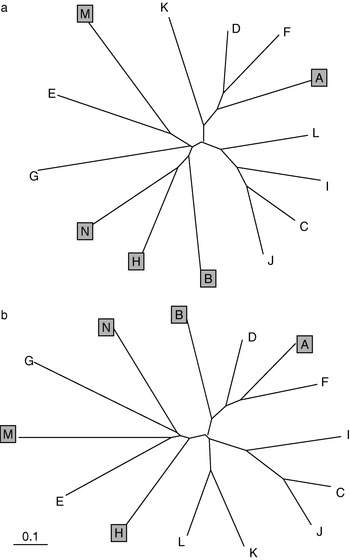
An analysis of the MACE genotypes revealed that they are not closely related to each other, even when insecticide resistance is taken into account (fig. 3). Additionally, they are not closely related to any of the local clones, suggesting that the Scottish MACE clones come from outside Scotland and from independent genetic backgrounds.
(a) An unrooted tree showing the relationships between genotypes using both insecticide resistance and microsatellite markers. (b) An unrooted tree using only microsatellite markers to calculate the relationships. Genotypes in shaded boxes carry MACE resistance.

Effects of spraying regime on clonal composition
In 2003, at unsprayed sites, only one MACE-carrying aphid was collected, <1%, but in 2004, 6% of aphids from unsprayed sites carried MACE (table 1). A χ2 analysis found that aphids carrying MACE resistance were selected on sprayed crops. (χ2=116.86, with 1 df; P<0.001).
Discussion
The possible origins of MACE-carrying clones
MACE is the result of a base change (Nabeshima et al., Reference Nabeshima, Kozaki, Tomita and Kono2003), which will arise through de novo mutation. There are distinct ways in which a MACE mutation could become present in the Scottish population. MACE resistance could appear de novo in long-term widespread asexual clones. The probability of any individual mutating to MACE is low, but the sheer number of individuals in an abundant clone makes it more likely. As an example, Zamoum et al. (Reference Zamoum, Simon, Crochard, Ballanger, Lapchin, Vanlerberghe-Masutti and Guillemaud2005) found the vast majority of clone G1 was non-MACE, but three individuals (1.5%) carried MACE. In the UK, clone C is a prime candidate for this process to act on; as we have now shown it has been present in large numbers in the UK every year since 1995. Clone C also exhibit considerable variation in its rDNA spacer and kdr (Fenton et al., Reference Fenton, Malloch, Woodford, Foster, Anstead, Denholm, King and Pickup2005). This intraclonal variation could have indicated that there are distinct but related genotypes (e.g. sisters) within clone C, and four microsatellite markers had failed to resolve them. We have now demonstrated that lineages of clone C, which differ for these characters, are identical for six high-resolution markers and are, therefore, almost certainly derived from the same egg. As clone C appears to be the same genotype as G1, then, by analogy, clone C could mutate to a MACE-carrying form, as appears to have happened in G1. By sampling different agroecosystems, we have demonstrated spray conditions that would have selected for MACE carrying C have been present, and continue to be present, as evidenced by the selection of MACE clones (A and B in 2001 and H, M and N in later years). Despite the obvious advantage a MACE-mutated clone C would have, it has not been detected. It is difficult to predict, but a genotype C, carrying MACE, should be at least as fit as the MACE clones that arrive and colonize the same area, as C is an extremely successful genotype. However, the afore-mentioned observations suggest there may be other unknown adaptations necessary in a successful MACE clone, such as additional compensatory changes in other parts of the neurotransmitter pathway. To help address this paradox, we believe that a careful examination of the field distribution of any MACE-mutated lineages (i.e. derived from the same insecticide-sensitive MLG) is required. For example, it was not clear where the G1 MACE aphids were collected in France (Zamoum et al., Reference Zamoum, Simon, Crochard, Ballanger, Lapchin, Vanlerberghe-Masutti and Guillemaud2005). If they exhibited clustering, this would be very strong evidence that there has been a stable MACE mutation in this clone and that the line carrying it had been able to increase by clonal expansion from an initial colonization event. In addition to eliminating de novo mutation of clone C as a local origin of MACE, the current study has also shown that none of the other genotypes characterized in 1995 corresponded to a subsequent MACE genotypes.
Instead of de novo mutation in a local asexual clone, it seems that the UK MACE mutation(s) and the clones carrying it have an exotic origin, which is consistent with the spread of pirimicarb insecticide control failures. MACE was first detected in Greece (Moores et al., Reference Moores, Devine and Devonshire1994a), a region where M. persicae sexual recombination can occur. Sexual recombination is likely to have provided the opportunity for the MACE allele to have spread into many genetic backgrounds. Four genotypes have been found in seven characterised MACE samples from Greece (Fenton et al., Reference Fenton, Malloch, Woodford, Foster, Anstead, Denholm, King and Pickup2005). In New Zealand, an analysis using the same microsatellite markers as used in the current study found that MACE appears to be spreading into the sexually reproducing population (van Toor et al., in press). In Italy, MACE resistance has also been detected in 25% of samples from peach orchards (Mazzoni & Cravedi, Reference Mazzoni and Cravedi2002). In France, there appears to be direct evidence of new MACE genotypes generated from the sexual cycle on peach trees colonizing crops (genotypes G12 and G15; Zamoum et al., Reference Zamoum, Simon, Crochard, Ballanger, Lapchin, Vanlerberghe-Masutti and Guillemaud2005). However, recombination coupled to migration has not led to any widespread French MACE genotypes, as the incidence of MACE resistance in France appears low at 3% and 2% (Guillemaud et al., Reference Guillemaud, Brun, Anthony, Sauge, Boll, Delorme, Fournier, Lapchin and Vanlerberghe-Masutti2003; Zamoum et al., Reference Zamoum, Simon, Crochard, Ballanger, Lapchin, Vanlerberghe-Masutti and Guillemaud2005). This low incidence may indicate that MACE resistance has not been around long enough to be recombined into ecologically successful French clones. It could also be due to a lack of recent chemical selection in peach orchards with new chemicals, such as pymetrozine, being applied, resulting in a situation where MACE is of no advantage. In the UK, MACE clones are frequently collected from vegetable brassica crops. These crops are not usually sprayed for M. persicae control, but resistance is indirectly selected with the application of pyrethroids, pirimicarb and triazamate to control other aphids and insects. Compared to the French studies, those described in this paper may have sampled in the right place at the right time to successfully detect MACE resistant clones. The proportion of MACE clones on untreated crops is generally much lower.
In the UK, and Scotland in particular, the general absence of M. persicae's primary host, peach, suggests that sexual reproduction is unlikely to play a role in generating new MACE genotypes. This assumption is supported by the lack of male M. persicae in the Scottish suction traps, the last being identified in 1996 (J. Pickup, unpublished observation). This also concurrs with the known inability of local clones to produce female sexual forms (Pozarowska, Reference Pozarowska1987), although life-cycle can exhibit intraclonal variation (Vorburger et al., Reference Vorburger, Lancaster and Sunnucks2003). An additional direct line of evidence that sex was not involved in generating the UK MACE clones came from the analysis of genetic relatedness. At most, two sexual generations could have taken place between autumn 2001 and summer 2003. Assuming the MACE clones could undergo sex locally then, given the frequency and recent arrival of clone A in 2001, most new MACE genotypes would be derived from selfings of type A. Rare out crossing with clone B or local populations was also possible. However, the new MACE clones H, M and N are unrelated to A and B, local clones or even each other (fig. 3).
All the evidence indicates that the five UK MACE clones originate from different populations outside the UK. The apparent lack of widespread MACE resistance in France suggests that MACE-carrying genotypes are unlikely to arrive by direct flight from there. Plant transport from Europe is much more likely to bring in new MACE genotypes, especially from intensely sprayed glasshouses where MACE resistance has been found (Moores et al., Reference Moores, Devine and Devonshire1994b). The B clone was found on pepper in both the UK and Turkey and clone A has also been found on pepper in the UK (Fenton et al., Reference Fenton, Malloch, Woodford, Foster, Anstead, Denholm, King and Pickup2005). Pepper has been grown in protected environments in the UK. MACE clones H, M and N were compared to the global MACE genotypes reported by Fenton et al. (Reference Fenton, Malloch, Woodford, Foster, Anstead, Denholm, King and Pickup2005), and they were different. They were also compared to laboratory clones recently collected and maintained at Rothamsted Research. This found that they had been sampled in England, H and M in the same year as Scotland and N a year earlier. However, they did not match any recently isolated MACE clones from other parts of the world. This suggests that new MACE clones arriving in Scotland are coming from England and not directly from outside the UK. However, apart from clone B, a direct link between a UK MACE clone and another from continental Europe remains elusive. This is probably a reflection of the existence of MACE in many gene combinations in regions where they are being generated.
The spread of MACE clones at a local level
The analysis of the 2001 data is a particularly useful baseline, as it provided no evidence of genotypes H, M and N amongst many independent field samples where pirimicarb and triazamate selection for clones A and B had occurred as well as other fields (Fenton et al., Reference Fenton, Malloch, Woodford, Foster, Anstead, Denholm, King and Pickup2005) and suction traps (Malloch et al., Reference Malloch, Highet, Kasprowicz, Pickup, Neilson and Fenton2006). Therefore, we can be confident that H, M and N appear to have arrived in Scotland after 2001. There is no major geographical barrier between Scotland and England to prevent movement by gradual clonal expansion. However, crops near the border produced no evidence of MACE clones in a two-year period despite their presence in the other sampling areas. Clone N was only present in one field in 2004 but was in England in 2003. As found for clones A and B in 2001, the distributions of H, M and N indicate a rapid spread of MACE clones in short timescales and are dramatic examples of the ability of some aphid clones to survive, reproduce and disperse. A plausible explanation for this spread extrapolates from the observations by Moores et al. (Reference Moores, Devine and Devonshire1994b), i.e. plant transport from glasshouses in England to field crops. One possible example of this is the cluster of clone H in three unsprayed fields in Perthshire at sites 19, 20 and 21. Clone H was found at unsprayed sites with a frequency of 0.044 (number of H individuals per sample size). From this frequency, three individuals would have been expected from the 68 samples collected at the Perthshire sites, but there were ten. With the frequency of 0.044, Fisher's exact test shows the probability of finding ten or more individuals in 68 samples is 0.000761, suggesting significantly more observed than expected clone H. At other unsprayed field sites, 16 clone H individuals would have been expected in the 375 samples, yet only nine were detected and Fisher's exact test shows significantly (P=0.0309) fewer observed than expected H genotype. It was later discovered that in 2004, in the Perthshire area, there were ~28 hectares of commercial broccoli being grown, ~10 km from the field sites, which would have originated from vegetable brassica plugs grown under intensive propagation in England. This may have acted as a source of the higher concentration of clone H.
MACE resistance in Scotland is maintained by clonal turnover
In 2001, two multiple insecticide resistant clones, denoted A and B, caused major control problems on intensively sprayed Scottish seed potato crops (Fenton et al., Reference Fenton, Malloch, Woodford, Foster, Anstead, Denholm, King and Pickup2005). After their peak in this year, these clones have almost disappeared, a situation that apparently parallels the decreasing levels of MACE resistance seen in England from 1996 to 2001 (Foster et al., Reference Foster, Harrington, Dewar, Denholm and Devonshire2002). However, the current study has found that the overall levels of MACE in Scottish M. persicae remain high, which, from the results presented herein, can now be attributed to three new colonizing clones (denoted H, M and N), some of which appear to be on the increase. While resistance tests can provide information about resistance levels, the current work using high resolution microsatellite analysis, has clearly shown that, in Scotland, MACE resistance can best be explained by a turnover of MACE-carrying clones. Lack of plant availability is unlikely to be a factor in turnover as, while the numbers of M. persicae overwintering are extremely small, they have many host plants on which they could do so (Jacob, Reference Jacob1941; van Emden et al., Reference van Emden, Eastop, Hughes and Way1969). In spring, they are presented with large acreages of newly growing plants. As populations rarely reach densities that would result in competition for resources, it is highly unlikely that the turnover is due to direct competition between clones. Instead, the turnover could be driven by different genotypes arriving each year from propagation facilities combined with the differential ability of these genotypes to survive the rigours of life in the fields. For example, it is known that individuals with elevated esterase can be subject to negative selection over winter (Foster et al., Reference Foster, Harrington, Devonshire, Denholm, Devine and Kenward1996). The replacement and survival over more than one season suggests that MACE clone H (and possibly M) is better adapted to the current Scottish environment than the A and B clones.
Complex interactions between the phenotype and insecticide resistance mechanisms make it difficult to predict how resistant clones will perform in the field. Fitness costs, such as maladaptive behaviour during times of stress or reduced reproductive fitness, are associated with elevated esterases and kdr (Foster et al., Reference Foster, Denholm and Devonshire2000, Reference Foster, Kift, Baverstock, Sime, Reynolds, Jones, Thompson and Tatchell2003, Reference Foster, Denholm, Thompson, Poppy and Powell2005). Clone H carries little esterase resistance compared to clones A and B, and high esterase levels have been associated with poor overwintering survival (Foster et al., Reference Foster, Harrington, Devonshire, Denholm, Devine and Kenward1996), and this reduced level of esterase could benefit clone H in the field. Also, clone M is the only Scottish MACE clone identified so far that does not carry kdr, which can increase vulnerability to parasitoid attack (Foster et al., Reference Foster, Denholm, Thompson, Poppy and Powell2005), so it may not be as prone to parasitism in unsprayed conditions. Thus, both clones H and M could be fitter than clone A, which carries all three resistance mechanisms including skdr. The relative field success also suggests that esterase has a higher fitness cost than kdr resistance, as clone H with reduced esterase but carrying kdr was more numerous than clone M, which does not carry kdr but has higher esterase levels. Clone C also has kdr, yet is very successful. Therefore, the key to a clone's survival may not be solely the emergence of new resistance mechanisms but optimising those in existence, or somehow counteracting their negative effects, through other fitness modifiers. As more MACE resistance is recombined into new genotypes, further aphids that are better suited for the equilibrium between agricultural and natural ecosystems will be generated. In Scotland, at least, there has been a turnover of MACE genotypes, with successive colonizers appearing to be more successful in the absence of selection. Understanding the ecology of M. persicae clones is important for many reasons, including virus epidemiology and monitoring new insecticide resistance combinations in different agroecosystems. Identifying new genotypes and analyzing them quickly will improve intelligence and allow preparation of control strategies at the start of a season. This should help reduce the occurrence of further control breakdown of this important aphid pest.
Acknowledgements
This project was funded by the Scottish Government Rural and Environment Research and Analysis Directorate (RERAD). The Scottish Society for Crop Research provided support to publish the work. The authors are grateful for the help of Sheena Lamond, Andy Evans (SAC), Chris Clyne, Rocio Alarcon Reverté and Lorna King, Fiona Borthwick, Kim Davie and Neil Graham at SASA for helping to source fields and collect samples. We appreciate and thank farmers and advisors for access to local fields. We thank Ian Denholm and Scott Johnson for their advice and comments on drafts of the manuscript. Many thanks go to our colleagues, James Anstead and Diana Cox, at Rothamsted Research for insecticide resistance testing. Rothamsted Research receives grant-aided support from the Biotechnology and Biological Sciences Research Council of the United Kingdom.