INTRODUCTION
How are members of marginalized communities connected with the criminal legal system? How might reformers understand the complexities of those entanglements?
This article sets forth four modalities of the relationship between members of marginalized communities and the criminal justice system: subordination, consumption, resistance, and transformation. These modalities attempt to break out of traditional ways of thinking about community members’ formal roles in the system—defendants, witnesses, victims, judges, prosecutors, police officers, correctional officers, and the indeterminate but oft-invoked “community.” Instead, these modalities are fluid and situational.
This article also calls for new research, scholarship, and advocacy that takes seriously how members of communities that the criminal justice system most deeply and directly affects engage in these fluid and situational modalities. In order to create lasting change, such as the democratization of justice systems and the drastic reduction of social marginality, policymakers, scholars, and advocates must be cognizant of all of these modalities and must not attend to one or two modalities while neglecting the rest. A shallow understanding of the interconnectedness of these modalities is one reason that the link between social marginality and crime control remains so difficult to address. Moreover, a lens that focuses only on subordination limits forward-thinking, normative thought about policies that can encourage community members’ transformative engagement with the justice system.
Community-criminal legal interaction, visually represented in Figure 1, might be organized around two axes. Traditionally, studies of criminal legal-community relations focus only on one mode of community engagement at a time, often in the community’s passive capacities as audiences or targets of the criminal justice system. This new framework substantially departs from the traditional approach by providing a dynamic lens on criminal justice-community interactions, one that centers heterogeneity and movement rather than ignoring them.Footnote 1 The horizontal axis describes the level of agency associated with the modality, while the vertical axis describes the amount of institutionalized stigma associated with the modality. By “agency,” I mean “the efficacy of human action,” (Sewell 1992) or an individual and collective sense of autonomy and power in the face of the criminal justice system. Here, being subjected to the penal state (subordination) and asking the penal state for help (consumption) are distinguished from fighting the penal state (resistance) and trying to change or find alternatives to the penal state (transformation). By “institutionalized stigma,” I mean the degree to which law, policies, institutional practices, and social norms, acting together, bestow moral dishonor upon certain people, places, communities, and behaviors.Footnote 2 Here, subordination to and resistance of the penal state are disfavored modes of engagement, resulting in pity, antipathy, and sometimes punishment. In contrast, consumption and transformation are somewhat favored, or at least less actively disfavored. Consumption signals embrace of the idea that people who experience or witness crime should rely on the police and seek recourse through the penal state’s established channels. Transformation represents constructive effort to use established channels to change the criminal justice system or to create alternatives that support human flourishing. I explain these theoretical terms in greater detail below.
Modalities of Community-Criminal Justice Engagement

SUBORDINATION
How does the criminal justice system deprive and dispossess communities?
The overarching relationship between marginalized communities in the United States and the criminal justice system has been one of race-class domination and subjugation. From a subordination framework, members of marginalized communities are institutionally scorned and low in agency. Regardless of their official role in the system—victim, defendant, witness—marginalized community members can be understood as system outsiders. Even the status of victim, which for some groups (for example, White women) elicits social responses of protection and punitiveness, does not accrue equally across demographic lines.Footnote 3 From a subordination perspective, attempts at agency may simply underscore the brutality of the system. For example, recent research by Matthew Clair (Reference Clair2018) shows that lower-status criminal defendants are less likely to trust their lawyer and thus are more likely to be involved in their case, but in ways that are ultimately unhelpful and elicit the ire of court authorities. Nicole Gonzalez Van Cleve (Reference Gonzalez Van Cleve2016) found that an array of court actors, including judges, prosecutors, and even public defenders, contributed to the racialized powerlessness within criminal adjudicative bodies.
Black Americans have been the iconic–though far from the only–group subordinated through the controlling image of criminality and the interlocking tools of punishment and control. As historian Khalil Gibran Muhammad (Reference Muhammad2010) has documented, the construction of Black Americans as criminals began in earnest during the late nineteenth century, most prominently with the publication of Frederick L. Hoffman’s (Reference Hoffman1896) Race Traits and Tendencies of the American Negro, which deployed statistical analysis to make sweeping claims about the tendencies of Black Americans, a group that he called “a distinct element” that “presents more than at any time in the past the most complicated and seemingly hopeless problem among those confronting the American people” (p. 1). Hoffman believed that his statistics—which were merely descriptive statistics comparing white and “colored” by a wide variety of indicators, far below the standard for making racially comparative claims today—“speak for themselves” (Muhammad Reference Muhammad2010, p. 36).
While White scholars constructed Black criminality, Black people were recognizing and responding to systemic abuse. In the early twentieth century, W. E. B. Du Bois was likely the first scholar to empirically document this dynamic (Du Bois 1905; Morris Reference Morris2015). As part of a series of studies of Black American life, Du Bois and his collaborators collected survey, interview, and administrative data on crime, arrest, and incarceration. Du Bois and collaborators found, among other things, that White officials and Black men had greatly divergent perspectives on the possibilities of justice for Black people in Georgia courts. Du Bois (1904) reasoned that practices of racial terrorism prevalent at the time such as lynching, which masqueraded as a form of punishment, “spread[...] among black folk the firmly fixed idea that few accused Negroes are really guilty” (p. 65). Du Bois also condemned the relative lack of legal protection for Black Americans, as well as criminal justice practices such as the leasing of convicts, that sent a message to Black communities that the purpose of the system was to make money for the state rather than to rehabilitate supposed lawbreakers (Du Bois 1904).
Du Bois’ research was prescient, at least with respect to the direction of research and scholarship on African Americans’ relationship to the crime control system over the next century. The evidence confirming the existence of a tense and distrustful relationship between Black Americans and law enforcement mounted over the ensuing decades.Footnote 4 A high watermark was the 1968 Kerner Commission Report, commissioned by the Johnson Administration in the wake of twenty-three episodes of urban unrest during the mid- and late-1960s. The Report concluded that, for many Black Americans, the “police have come to symbolize white power, white racism, and white repression” (National Advisory Commission on Civil Disorders 1968, p. 5). The Report documented “tension” and “hostility” between law enforcement and urban Black Americans, blaming the “abrasive relationship” on a combination of increased demands for protection and service and the police practices thought necessary to provide those services. Bayley and Mendelsohn (Reference Bayley and Mendelsohn1969) concluded that Blacks, Latinxs, and Whites “live in completely different worlds” with respect to policing. In the South and in the Northeastern and Midwestern Rust Belt cities where many Black Americans relocated during the Second Great Migration, police forces often functioned to maintain the expulsion of Black Americans from the center of social and political life, at times violating the law in service of racial control (Johnson Reference Johnson2003; Muhammad Reference Muhammad2010). Despite pervasive harsh policing that ostensibly was intended to suppress and deter crime, Black Americans felt neglected and inadequately protected (Forman Reference Forman2017; Fortner Reference Fortner2015; Venkatesh Reference Venkatesh and Alladi2000).
Recent events only underscore both the perception and the reality that criminal justice constitutes and reconstitutes racial subjugation by denying marginalized groups, especially young African American men, full educational and employment opportunities (Pager Reference Pager2007; Pettit Reference Pettit2012; Western Reference Western2006). While consequences are most severe for people with felony convictions who experience prison sentences, lower level criminal justice involvements have deleterious effects on the hardest-hit communities (Kohler-Hausmann Reference Kohler-Hausmann2018; Natapoff Reference Natapoff2015).
Poverty and other forms of disadvantage multiply the racial character of criminal justice system interaction. Perceived police nonchalance about crimes against residents of struggling communities further alienates the community from the government officials tasked with protecting them, a perceived indifference with deep history and ongoing salience (Anderson Reference Anderson1999; Leovy Reference Leovy2015). Residents of Black disadvantaged neighborhoods often suspect that police uses of force are merely displays of power, and are not born of a desire to meet communities’ safety needs (Anderson Reference Anderson1999; Brunson Reference Brunson2007). Contemporary events have shed new light on longstanding tensions between Black communities and law enforcement. Disproportionate use of fines and warrants, along with controversial policies like broken windows policing and “stop-and-frisk,” have exacerbated the troubled relationship between poor African Americans and law enforcement (Fagan Reference Fagan2002; Harris Reference Harris2016; Stuart Reference Stuart2016). Of course, the various potential “back ends” of the criminal justice system—repeated arrest and processing (Feeley Reference Feeley1979; Kohler-Hausmann Reference Kohler-Hausmann2018), probation (Doherty Reference Doherty2016; Phelps Reference Phelps2017), parole (Petersilia Reference Petersilia2003; Simon Reference Simon1993), incarceration (NRC 2014)—reinforce race and class hierarchy.
Community members recognize these injustices, and it shapes their broader perceptions of the criminal justice system (Weitzer and Tuch Reference Weitzer and Tuch2006; Terrill and Reisig Reference Terrill and Reisig2003). Professor Carla Shedd (Reference Shedd2015), in a rich study of youth, school, and policing, finds that unequal policing of Black students in diverse contexts makes them more aware of their social position and thus exacerbates their distrust of legal authority and perception of social injustice relative to youth who attend more segregated schools. Professor Forrest Stuart (Reference Stuart2016) shows that residents of Los Angeles’ Skid Row, largely Black and Latinx, move away from a trust/distrust framework and describe a number of strategies of “cop wisdom” that Skid Row residents use to navigate policing in daily life, hoping to avoid the harshness of even “therapeutic” policing (p. 19). In these works and others (Goffman Reference Goffman2014; Jones Reference Jones2010; Rios Reference Rios2011), the relevant question is not how people who are in marginalized communities feel about the police affectively or even whether they trust the police to deliver certain goods. Instead, the broad, common set of questions might be: How does policing send messages to groups about their place in the social order? How do members of those groups cope with the daily realities and consequences of those messages?
Contemporary social science research on policing has often focused on the legitimacy of legal authorities. This research, operating from a social psychological angle, has used a conception of legitimacy that tends to focus more on whether people, generally speaking, are more or less likely to comply or cooperate with law enforcement based on how the police treat them (Tyler and Huo, Reference Tyler and Huo2002; Sunshine and Tyler, Reference Sunshine and Tyler2003; Tyler and Fagan, Reference Tyler and Fagan2008).Footnote 5 In some work, Tyler and colleagues have been more attentive to the racialized milieu of police-community contacts and relations (Tyler and Wakslak, Reference Tyler and Wakslak2004; Tyler Reference Tyler2005). Yet, because of the individualist and direct interaction-focused framing applied even in that work, this body of research tends to imply that the core issues shaping trust in law enforcement relate to the respect shown in encounters, not the social meanings of law enforcement to particular social groups, or the deep structures that link up with those meanings.Footnote 6
Sociologists Robert J. Sampson and Dawn Jeglum Bartusch (Reference Sampson and Bartusch1998) have described “‘anomie’ about law” (p. 777) in predominantly Black and poor neighborhoods in Chicago, a phenomenon they label “legal cynicism” (p. 778). Sampson and Bartusch were describing ruptures in the social bonds that connect individuals to their community and, in particular, to the state through law enforcement, thereby perpetuating criminal offending.Footnote 7 Rebutting the idea that crime was high in predominantly Black neighborhoods because Black people were more accepting of criminal behavior than other groups, Sampson and Bartusch found that Blacks and Latinxs were less tolerant of deviance than Whites, but higher in cynicism about the law and legal authorities because of concentrated disadvantage. In the years since Sampson and Bartusch developed the legal cynicism concept, numerous scholars have built on the notion.Footnote 8
Kirk and Papachristos (Reference Kirk and Papachristos2011) offer an important reiteration and slightly more specific interpretation, describing legal cynicism as a “cultural orientation in which the law and the agents of its enforcement, such as the police and courts, are viewed as illegitimate, unresponsive, and ill equipped to ensure public safety” (p. 1191). However, their definition still emphasizes the subjective outcome of perceived illegitimacy rather than embedding a specific set of processes, or the precise structural conditions thought to produce it, into the theory.
Regardless of how trust is conceived or measured or conceived, much literature has shown that Black Americans, particularly those who are poor or who live in high-poverty or predominantly Black communities, tend to be less trustful not only of police, but also other of governmental institutions, their neighbors, and even their intimate partners in comparison to other racial and ethnic groups in the United States (Smith Reference Smith2010). The picture that emerges from the research on race, poverty, and trust—separately from policing—is one of profound social diminishment. As explained in coming sections, distrust and subjugation do not encapsulate the fullness of the Black experience with criminal justice. Yet, it is clear that poor Black Americans as a group tend to have a distinctive social experience from those of other ethnic and socioeconomic groups in the United States, mediated through the criminal legal system. Thus, most discussions of Black “distrust” of the police only skirt the edges of a deeper, hierarchy-driven fracture between these communities and legal authorities.
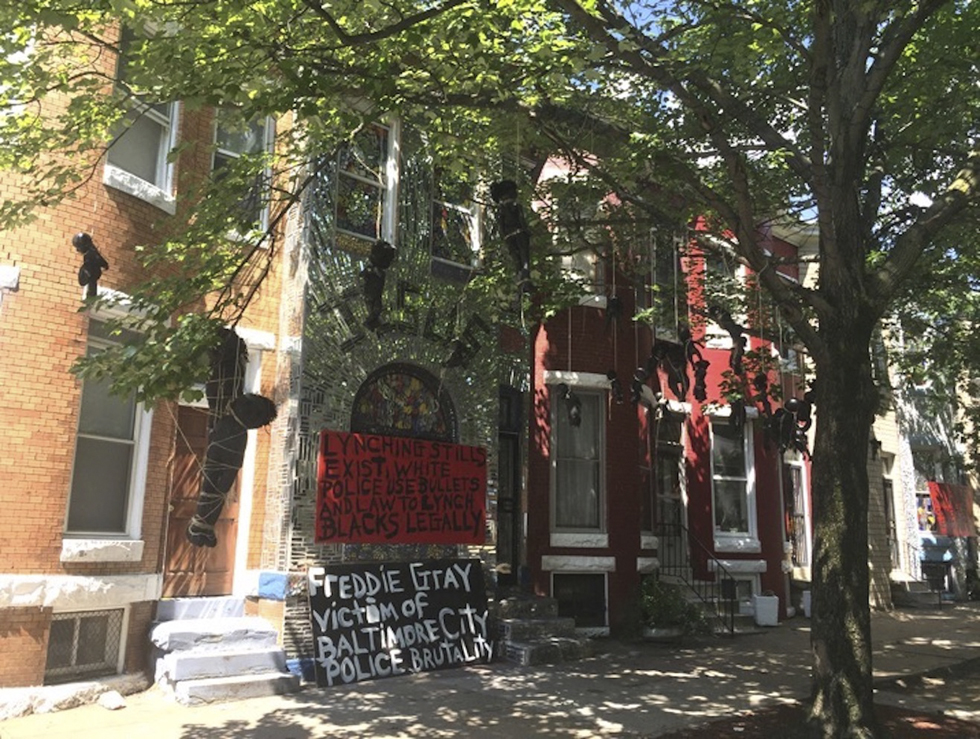
Figure 2 captures part of a public art display in Baltimore, Maryland. The display, created by respected Baltimore artist Loring Cornish shortly after the arrest and death of Freddie Gray in police custody in April 2015, includes two signs. One sign, painted in black on a red background reads, “Lynching stills exist, white police use bullets and law to lynch blacks legally.” The other sign, painted in white on a black background, reads, “Freddie Gray victim of Baltimore City police brutality.” Jarringly, the display features several small figurines that look like dolls, painted in black, wrapped in rope, and hung from the trees in front of Cornish’s studio. The figurines drive home the connection Cornish sees between racist lynching and police violence.
Public art in Baltimore, Maryland, Fells Point. Photo taken by Hearing Their Voices research team, June 26, 2015.

While Cornish’s art does not necessarily represent the views of other Black Americans, it is a searing illustration of what research suggests about the overarching relationship between Black communities and the criminal justice system: Many Black Americans see the criminal justice system not merely as a bundle of interactions with street-level bureaucrats whom they may or may not trust depending on how they are treated in a given moment, as implied in procedural justice and legitimacy interventions, but rather as a “total” or “greedy” institution that arbitrarily affects Black Americans regardless of criminal behavior (Coser Reference Coser1974; Goffman Reference Goffman1968). From this perspective, the criminal legal system functions primarily as a means of racial control and estrangement (Wacquant Reference Wacquant2001; Bell Reference Bell2017).
Finally, while this article largely focuses on Black communities and the criminal legal system, there are particular and growing concerns related to the carceral system and other groups, all of which need further explication in the literature and in policy. For example, the policing and incarceration of Native Americans, including Native Americans in the juvenile justice system (Rolnick Reference Rolnick2016), needs much more research and analysis for change. The policing of Native Americans has earned criticism for racial disparity, including traffic stops (Harcourt and Meares, Reference Harcourt and Meares2011). Research and journalism have suggested that Native Americans are overrepresented in prisons and face disproportionately long sentences;Footnote 9 according some research, young Native American males are sentenced more harshly for the same offenses than both Black and White men (Franklin Reference Franklin2013). Because the federal government has jurisdiction over crimes committed in Indian Country, Native Americans may sometimes get longer sentences because ordinary crimes there are adjudicated as federal offenses (Droske Reference Droske2008; Eid and Covington Doyle, Reference Eid and Carrie Covington2010). Scholars have proposed various ways to reduce these disparities, such as amplifying tribal control over the sentencing process and convincing district judges to reduce the sentences they impose against Native Americans because of the sentencing disparity (Droske Reference Droske2008; Jones and Ironroad, Reference Jones and Ironroad2013). Yet, it is unclear whether any of these proposals have been adopted or effective.
After 9/11, Muslim Americans, particularly those of Middle Eastern or North African descent, have drawn intense attention from law enforcement under the guise of counterterrorism. The FBI’s “community engagement” policing strategy aimed at Muslim communities (Akbar Reference Akbar2015; Aziz Reference Aziz2014; Harris Reference Harris2010), along with police profiling of those perceived as Muslim (Ahmad Reference Ahmad2004; Beydoun Reference Beydoun2018), are further manifestations of the expanded analogical reach of criminal justice techniques to an identifiable and institutionally maligned group that need further probing. Additional research might especially focus on community members’ interpretations and experiences with counterterrorism policing and surveillance.Footnote 10
The Latinx community is also disproportionately subordinated via the crime control system, directly and also indirectly through the immigration control system. In places where Latinx and Black people have long lived alongside each other, the processes of criminalization are somewhat similar (Rios Reference Rios2011). Under other circumstances, perceived or real differences in immigration documentation structure how and why people engage or avoid the criminal justice system. For example, Cecilia Menjívar and Leisy Abrego (Reference Menjívar and Abrego2011) have written of the “legal violence” of the intersection of criminal law and immigration law at the local, state, and federal levels, a term that they argue “captures the suffering that results from and is made possible through the implementation of the body of laws that delimit and shape individuals’ lives on a routine basis” (pp. 1380, 1387). Menjívar and Abrego focus on the violence of immigration enforcement on Latinx undocumented immigrants, but documented Latinx immigrants, too, may live with concern about the linkages between criminal legal authority and immigration enforcement, in part because documentation makes them legible to these interlocking systems.Footnote 11 Although the immigration system itself is not a criminal justice system, their processes often intersect (Wishnie Reference Wishnie2004). They intersect, for example, via the use of deportation as punishment for “crimes of moral turpitude” and a very broad range of “aggravated felonies” (Das Reference Das2011, p. 1669), the similarities between (and often shared private administration of) immigration detention centers and prisons, and the occasional housing of immigration detainees in federal prisons (Lynch and Cooke, Reference Lynch and Cooke2018).
Asian Americans and Pacific Islanders are often overlooked in conversations about crime control due to the “model minority” stereotype, but particularly in California, Asian Americans face sharp disparities in both the regular and juvenile justice systems—especially those of Samoan, Cambodian, or Laotian descent (Jung et al., Reference Jung, Cendana, Chiang, Wang, Zheng, Thammarath, Dinh and Mariategue2015). Like the Latinx community, members of the Asian American and Pacific Islander community in California—especially Southeast Asian Americans—have been subjected to high rates of deportation flowing from their involvement in the criminal justice system. A growing body of scholarship is beginning to reckon with the ways immigration and crime control operate together to make it nearly impossible for numerous marginalized communities to thrive alongside the criminal legal system.
CONSUMPTION
How do members of communities make use of the criminal justice system?
Quadrant 2 considers the less stigmatized but low-agency position of being a consumer of the criminal justice system, someone who uses the system like a good or service (Goold et al., Reference Goold, Loader and Thumala2010).Footnote 12 This is the way the police, at least, might imagine a passive public using the system: When a crime occurs, a member of the public calls the police, provides information, and steps out of the way.
The overarching body of scholarship and analysis of community-focused criminal justice research finds that marginalized people generally avoid official channels for public safety, governing themselves instead according to a “code of the street” whereby violence becomes an acceptable extra-legal strategy of protecting oneself or resolving disputes (Anderson Reference Anderson1999; Venkatesh Reference Venkatesh and Alladi2000). As writer Ta-Nehisi Coates (Reference Coates2016) has written, the police in some communities are largely “indistinguishable from any other street gang.”
However, as I have explained elsewhere, the “code of the street” has never been fixed or universal on either an individual or collective level (Bell: Reference Bell2016 p.315). Critically, consumptive engagement with the criminal legal system, for marginalized people is not fully agentic. The choice to engage with the criminal justice system is structured by other structural and institutional factors, including the failure of other arms of government and institutions to provide alternatives. At a collective policy level, James Forman (Reference Forman2017) and Michael Javen Fortner (Reference Fortner2015) describe Black support for some of the policies that ultimately produced mass incarceration, explain that there was, for many, an earnest desire for safer neighborhoods and a tentative hope that crime control—coupled with social safety net expansion—would have positive results. Yet many African American leaders ultimately lacked the political power to ensure that the safety net was expanded alongside the carceral state (Forman Reference Forman2017).
Policing scholars have long reported that poor people called the police more often than wealthier people because they “depend upon police assistance in times of trouble, crises, and indecision,” often to resolve noncriminal issues (Reiss 1972).Footnote 13 Research using administrative data on police reporting has shown that—even controlling for crime rates—Black Americans, women, and residents of high-poverty neighborhoods are equally or more likely to call the police than other groups (Avakame et al., Reference Avakame, Fyfe and McCoy1999; Baumer Reference Baumer2002; Bosick et al., Reference Bosick, Rennison, Gover and Dodge2012; Desmond et al., Reference Desmond, Papachristos and Kirk2016; Schaible and Hughes, Reference Schaible and Hughes2012).
Qualitative studies have identified poor Black women, especially women with children, as a population of particular interest given their occasional use of police to control male partners and children, to find support that is mostly unavailable through the welfare state, or to avoid harsh outcomes associated with child protection and other punitive social services (Goffman Reference Goffman2009; Jones Reference Jones2010; Venkatesh Reference Venkatesh and Alladi2000). Victor Rios (Reference Rios2011), in a qualitative study of Black and Latino boys in Oakland, California, finds that mothers are part of a “youth control complex” along with police, probation officers, schools, community centers, the media, and other institutions (pp. 40). According to Rios, because mothers acquiesce to institutional messages about appropriate parenting behavior, they call the police on their children and thereby label them as criminal. Alice Goffman (Reference Goffman2014), in an ethnographic study of a Philadelphia neighborhood, finds that women sometimes proactively contact the police as a means of socially controlling their male intimate partners, and at other times are actively coerced to report their partner’s, son’s, or grandson’s whereabouts through threats of arrest, loss of child custody, and physical force. Nikki Jones (Reference Jones2010) tells the story of “Shante,” a young woman who got hit in the head with a brick during a fight and whose mother decides to “let the law deal with it” instead of using their usual tactic of retaliating. Shante’s mother, who had formerly been incarcerated, did not want to put their family’s stability at risk. She did not expect “the law” to do much, and it didn’t: the young woman who had thrown the brick was briefly detained, and she and Shante were disappointed with this outcome. Shante and her mother wanted the other young woman to experience a harsher punishment. Even after the police responded, Shante daily fights the urge to “blow this heifer” (Jones Reference Jones2010, p. 41).
In my own work, I find similar reasons that marginalized people, especially women, consume the carceral state despite their disdain and distrust of it. I find that women justify occasional semi-agentic engagement with the criminal legal system in four ways, including making exceptions for especially helpful individual officers, emphasizing protection of their physical home rather than the broader community, explaining the possibility of therapeutic consequences for their partners or children, and emphasizing the ways police reports are helpful for navigating other government institutions such as the Housing Authority or child protection (Bell Reference Bell2016).
Conversations that focus on the subordinating relationship that marginalized communities have with the carceral state give short shrift to the reality that people who live in marginalized communities often engage the criminal legal system by deploying it. This is not to say that relying on formal mechanisms of social control is a natural response. Perhaps reliance on the criminal legal system despite distrusting it underscores the hegemonic nature of criminal legal ideology. As Carr, Napolitano, and Keating (Reference Carr, Napolitano and Keating2007) found in their study of a diverse group of Philadelphia youth, even young people who had negative experiences with the criminal justice system thought increasing the presence of police was a good solution to the problem of crime.
Recognizing that marginalized communities contain many consumers of crime control does not suggest a specific policy direction. Some reformers, such as those who operate from an abolitionist framework, are using community organizing to denaturalize police and prison as the obvious response to crime.Footnote 14 These abolitionist reformers support some incremental policy and practice changes, but only those that, in their estimation, lead directly toward a smaller criminal justice system. This means, for example, they oppose training police to respond more effectively to mental health crises, strongly discourage community members from calling 911, and propose investment in alternative pathways for getting people mental health support.Footnote 15 They might, for example, be skeptical of reforms like Seattle’s Law Enforcement Assisted Diversion (LEAD) program—not because of the premise of the program, which diverts low-level offenders pre-booking—but because the police department runs it. This is reflective of a deep skepticism shared by some activists and many community members, in line with a legal estrangement perspective, that police cannot be trusted even when the agenda they are promoting sounds appealing. (“Community policing” is another troubling example in which rhetoric and deeds are often misaligned.)
Other reform-minded people would argue that paying attention to marginalized peoples’ strategies and reasons for consuming the criminal justice system should support reform that improves these systems—turning them into “public goods”—rather than dismantling them (Meares Reference Meares2017). While some activists in the Black Lives Matter movement (BLM) may support reforms that would increase the criminal justice system’s legitimacy,Footnote 16 others have adopted a more decisively radical perspective (Akbar Reference Akbar2018). These cleavages and debates, even within the reform community, shed light on the complexity of figuring out the problem of consumption. Identifying a path forward requires dialogue that does not just examine how the system oppresses marginalized community members, but also whether and how it provides—or should provide—security and support.
RESISTANCE
How do community members express unwillingness to yield to the criminal justice system?
Quadrant 3 invites discussion of the seemingly high-agency but low-esteem position of resistance. Resistance can be defined in many ways, but here I focus on intentional resistance to the law or its enforcement. As Richard Brisbin (Reference Brisbin2010) has explained, “[r]esistance to law requires a consciousness of how legality denies or excludes recognition of an individual’s desires, is arbitrarily applied, or establishes unjust distributions of power, wealth, or status” (pp. 25, 27).Footnote 17 Thus, mere deviance from the law is not resistance. This understanding of resistance is akin to what James C. Scott (Reference Scott1985) has called “weapons of the weak,” the ways subordinated people signal that they do not passively accept domination but instead struggle against it (p. 304).Footnote 18 It is, perhaps, a mode of survival and a means of hanging on to one’s dignity and self-respect in a world that diminishes them.
In a 2003 article, Patricia Ewick and Susan Silbey invited scholars to study community members’ everyday resistance to legality more extensively, pointing out the thinness of this body of scholarship. Yet, almost two decades after they wrote—and despite their high citation count—the body of research focusing on everyday resistance to the law remains relatively shallow. Scholarship on everyday resistance to criminal legal authority in the United States is especially minimal. Some notable exceptions include the important work of Ashley Rubin (Reference Rubin2017) on prisoners’ resistant daily behaviors and the scholarship of Robert Werth (Reference Werth2011) on parolees, which reveals strategies that parolees use to selectively engage with their parole officers in order to “go straight,” but “on their own terms” (pp. 329, 342).
To be sure, emphasizing community resistance can feel beside the point. The “big story” in the relationship between marginalized communities and the criminal justice system is subordination. Thus, it is reasonable to pay more attention to subordination, and to consumption as another mode of subordination, than to resistance. Moreover, scholarship on resistance is often mired in jargon and theory about ideology and hegemony, which might make it harder to use and might distract from its description of daily practices that people in marginalized communities use to resist.
However, an understanding of community members’ everyday resistance is critical for illuminating pathways toward more innovative systemic criminal justice transformation, for finding touchpoints that community members find the most dehumanizing or the least productive, and for building a legal structure that is more responsive to community concerns. A new agenda might stop seeing resistance as a problem that research can help police overcome and instead understand resistance as a response to an overzealous state. Instead of trying to “fix” resistance or simply to theorize it, scholars can try to really understand it in ways that might illuminate pathways forward for policymakers, decision makers, practitioners, and activists.
For example, in Commonwealth v. Warren (2016), the Massachusetts Supreme Judicial Court famously ruled that a Black man’s decision to run from police officers is not on its own evidence of wrongdoing that could support officers’ reasonable suspicion that the Black man is committing a crime. Drawing from a statistical study of racial profiling in Boston, the court reasoned that a Black man fleeing “might just as easily be motivated by the desire to avoid the recurring indignity of being racially profiled as by the desire to hide criminal activity” (Commonwealth v. Warren 2016, p. 19). In other words, the court understood that Black men might reasonably choose to flee to resist racial inequity, not because of their own criminality. The statistical racial profiling research made this outcome possible, but the evidentiary base for the court’s ruling would have been even stronger if it had also included narratives of Black male Bostonians describing flight as resistance to racialized criminal legal power.
Resistance presents a challenge for some reformers: Resistance to the criminal justice system can raise moral questions because it seems antithetical to the rule of law. Some resistance, such as talking back to an officer, can seem harmless from a distance. But what about when individual acts of resistance are harmful? Trevor Gardner (Reference Gardner2004) has argued that even when Blacks commit individual street crime, they are engaging in a form of resistance that has roots in historical political struggle. If he is right, does this information matter for how criminal justice institutions should respond to street-level crimes, especially when they are committed under conditions of social marginality?
“Riots,”—which some would label as “moments of unrest” or “uprisings”—are a form of collective resistance that may similarly unsettle reformers. Riots cause real damage; yet, they have been a response to injustice, particularly injustice and oppression via the criminal justice system. As Martin Luther King, Jr. (1966) famously surmised after the summer of 1966, in the wake of riots in Birmingham, Alabama; New York, NY; Watts, CA; and Chicago, IL: “A riot is the language of the unheard.” King also said, less famously but in the same interview, that “riots are self-defeating and socially destructive.” In this sense, King’s comments represent the justifiable unease that even contemporary justice reformers have with this manifestation of community resistance to the justice system.
This unease was apparent during the Baltimore unrest of 2015. For all of the attention the Baltimore riot received, it was a tame event in a longer history of urban riots in the United States, and in Baltimore. The Baltimore unrest of 2015 went on for no longer than three days, and there were no casualties directly related to the unrest. To be sure, the riot had serious economic impact: It caused nearly $9 million worth of damage to homes, businesses, and municipal properties (Toppa Reference Toppa2015). But Baltimore’s 1968 riot was much more serious, lasting for eight days, resulting in six casualties, and causing more than $13 million worth of property damage in 1968 dollars, which equates to about $93 million in 2018 dollars (Yockel Reference Yockel2007).
Yet, Black political leaders today, unlike those in the 1960s and 1970s, have not attempted to construct a narrative of the Baltimore unrest as political resistance. The 1960s riots “came to be used rhetorically by black leaders as a tactic and widely interpreted as a form of political protest within the black community” (McAdam Reference McAdam1983, pp. 735, 750). In contrast, the Black progressive political class universally maligned the 2015 Baltimore unrest. For example, President Obama, Mayor Stephanie Rawlings-Blake, and City Council President Jack Young all famously called the rioters “thugs,” minimizing the possible political content of this resistance-by-riot and emphasizing its criminality (Chuck Reference Chuck2015; Feuerherd and Fredericks, Reference Feuerherd and Fredericks2015; Reutter and Shen, Reference Reutter and Shen2015).Footnote 19
If one believes that law reflects collective moral rules,Footnote 20 then it is a deep problem for people to break the law, damage property, and disobey the commands of legal authorities. If, however, one sees law primarily as a means of organizing social power, concerns about the morality of resistance become more complex.Footnote 21 Rather than condemning members of subordinated communities for failing to adhere to the system, one sees their resistance in a more charitable—and perhaps fundamentally moral—light.Footnote 22 Thus, reformers who want to understand the modality of resistance must think deeply about the blameworthiness of resistance in a system that is thought to be, at least in the ideal, governed by law. How can we destigmatize resistance—or at least, certain forms of it—while supporting the rule of just law?
TRANSFORMATION
How do community members, individually and collectively, seek to reform and reimagine the criminal justice system?
Transformative engagement (Quadrant 4) is high in agency and low in stigma. I define transformation as community engagement in deliberate, organized, and often collective action to ease the negative impact of the criminal legal system on members of marginalized communities. Transformative engagement is hard, and I would wager that it is the rarest modality. This category, like the others, is descriptive, but it might also be thought of as a particular obligation for members of marginalized communities: Perhaps, as subordinates of the criminal justice system, members of marginalized communities are especially knowledgeable about systemic injustice and thus especially capable of and responsible for rectifying it (Vasanthakumar Reference Vasanthakumar2018).Footnote 23 System participants, then, should cede power to those directly affected not only because it may make the system more just, but also because it will enable directly affected individuals and communities to better meet their own societal obligations.
Movement Activism and Collective Action
Transformative community engagement sometimes involves movement activism. The criminal justice reform movement has brought together a wide array of people from various perspectives and backgrounds. That movement has produced a small decline in the incarceration rate. While many activists are concerned about the lack of a shared set of commitments in this movement, it has, no doubt, operated in an organized fashion and produced positive—though perhaps not truly transformational—results.
Black Lives Matter, too, represents collective community response aimed at system change that operates through both persuasion and adversarialism. One challenge for that movement’s legibility in mainstream audiences has been an inconsistency in precise legal “asks” within the criminal justice system. This is not to say that law is unimportant to Black Lives Matter: As Amna Akbar (Reference Akbar2018) has helpfully explained, “The movement is not attempting to operate outside of law, but rather to reimagine its possibilities within a broader attempt to reimagine the state. Law is fundamental to what movement actors are fighting against and for” (p. 409). However, this transformative legal engagement is not really with the criminal justice system, but with the state writ large. Thus, criminal justice policymakers may have difficulty translating this mode of engagement into action. Criminal justice policymakers have an easier time understanding community movements regarding specific cases, of which there have been many.Footnote 24 These movements around individual cases tend to request releasing someone or reducing a harsh sentence, and their lack of structural demands make them less of a systemic threat.
One mode of collective response that adopts a more cooperative positionality is “reconciliation,” a set of strategies proposed by David Kennedy’s National Network for Safe Communities that has been embraced by some community movements. The reconciliation model focuses on police departments, not the entire criminal justice system. It requires that 1) police publicly acknowledge harm that they have done, whether it be individual, departmental, or institutional harm; 2) police and community members engage by sharing narratives and listening to each other; 3) someone compile a set of facts that is “clear” and “objective”; and 4) police and community members work together to develop policies and practices that respond to the narratives and history revealed earlier in the reconciliation process (NNSC 2018). While reconciliation has some promise conceptually, it is still largely untested. While it has transformational ambitions, it is not clear whether it is actually transformative. Moreover, the degree to which community members actively support these approaches remains uncertain. One important area for research in coming years will be whether approaches like this produce positive outcomes, and if so, how and under what circumstances.
Finally, there is a long history of bureaucratically endorsed civilian/community committees that are meant to either soften the blow of crime control in marginalized neighborhoods generally or to make officers more accountable for misconduct (Walker Reference Walker2001).Footnote 25 These might be considered collective efforts, but they do not fundamentally restructure power in the criminal justice system.
Local and Individual Transformative Engagement
Although transformation requires some collective action, some community members at local and individual levels are aiming to transform the criminal justice system. One of the most celebrated modes of transformative engagement is “restorative justice,” a bundle of practices such as victim-offender mediation, circles and conferences that include family members and community members along with victims and offenders, community-based alternatives to sentencing, and sometimes reparative methods that aim to make victims, offenders, and communities whole again after a crime. These are often more local modes of engagement—deeply of the community—and may look different depending on local characteristics and the nature of the harm. One of the worries with restorative justice, however, is precisely the local variation in approaches. In some places, “restorative justice” has just been used as code for justice that explicitly includes victims in the adjudication process (Bonta et al., Reference Bonta, Wallace-Capretta, Rooney and McAnoy2002).Footnote 26 While victim involvement can be valuable, it can also be used as a way to justify system harshness, thereby feeding back into the subordinating relationship between marginalized communities and the criminal justice system.
The work of restorative justice, aimed at healing the breach created by crime and carceral experience, must extend beyond individual cases and specific, horrific events. Healing is necessary for people across many officially designated categories, such as victims and formerly incarcerated persons. Yet, many community members have suffered because of state-sponsored trauma even if they have never been a victim of crime, participated in crime, or spent time under direct supervision of the penal state. Thus, collective healing is also an essential part of community work toward justice transformation.
More localized movements, such as organized copwatching (monitoring and documenting individual encounters with the police and other police activity), represent transformative community engagement with the criminal justice system. Rather than using consensus and cooperation to persuade criminal justice officials to adopt reforms, organized copwatching seeks criminal justice transformation through “adversarialism” and “agonism” (Simonson Reference Simonson2016, p. 1609).Footnote 27 Community members have also engaged in participatory community defense, set up community bail funds, and created and participated in prison education efforts (Godsoe Reference Godsoe2018; Simonson Reference Simonson2017b; Smith Reference Smith2017; Smith Reference Smith2018).Footnote 28 This type of transformative engagement, which is growing in prominence, needs to be a part of a serious research agenda on criminal justice. Currently there is very little on-the-ground empirical research that probes this type of organized local advocacy and community work.
More controversially, one could think about the employment of members of marginalized community members within the criminal justice system as police officers, correctional officers, judges, prosecutors, and more as a mode of transformative engagement. For example, at various points in history, the diversification of police forces has been a rallying point for racial justice activists. In the past, some racial justice advocates believed that force diversity would make the system less racially oppressive. In the late 1960s, Cleveland’s first Black mayor, Carl B. Stokes, made police force diversification the centerpiece of his political agenda (Moore Reference Moore2002; Stokes Reference Stokes1973). Some scholars, such as David Sklansky (Reference Sklansky2006), have more recently celebrated increased racial, gender, and sexual orientation diversity on American police forces as a key achievement of criminal justice reform. Yet, at least with respect to race and policing, it is unclear to what extent bringing more Black officers into the police force produces the dividends for Black communities that it ideally would; some argue that benefit accrues only when departments gain a “critical mass” of Black officers.Footnote 29 Some scholars and advocates have suggested that lawyers of color can help reform the system by becoming prosecutors, and there is a burgeoning but robust group of progressive prosecutors, some who are of color and some who are not, but who ostensibly aim to make the criminal justice system less arbitrarily punitive. We tend not to think of system diversification as a “community” effort, but given that certain groups of people of color—across class—are at risk of subordinating relationships with the criminal legal system, perhaps it makes sense to imagine legal system employment as a mode of transformative engagement. To be sure, this type of reform would be viewed as profoundly unsatisfying, non-transformative, and counterproductive to many advocates.
CONCLUSION: TOWARD AGENTIC COMMUNITIES
In this paper, I have introduced four fluid and situational modalities of community criminal justice involvement: subordination, consumption, resistance, and transformation. This conceptualization deemphasizes the precise functions individuals play in the system and suggests that even across functional roles, modes of engagement could differ based on time and other circumstances. However, more importantly, as a way of understanding community engagement, this framework aims to provoke richer and more nuanced research and advocacy. Instead of thinking in a static way about what “the community” wants or needs, it encourages recognition of how members of marginalized communities who seem similarly situated can simultaneously have multiple types of relationships with the crime control apparatus. Understanding these modalities could ultimately help increase the power of communities to determine the type of criminal justice they want and need.
This framework encourages forward-looking research about linkages between the criminal justice system and the community. Social science research on this topic is, by necessity, often retrospective and descriptive. Research on criminal justice often examines the subordinating relationship that members of marginalized communities have with the criminal justice system. This emphasis on the subordinated relationship explains why, since the early twentieth century, social scientists have repeatedly “discovered” that Black Americans distrust the police. Yet, this community modality framework suggests that the laser-focus on subordination obscures visions of community engagement that might suggest new paths forward. Increased study of consumption, resistance, and transformation will build an evidentiary base that takes complex community concerns more seriously, and it could provide a more substantive groundwork to support deeper reforms.
This article suggests that scholars of the criminal justice system and community life can expand both what they study and how they study it. Research methods that view community members as co-producers of knowledge, not mere “subjects,” might place qualitative data on par with quantitative dataFootnote 30 and measure more than the usual outcome variables. This framework supports, for example, participatory action research, which sees members of marginalized communities as creators of valuable knowledge, not just passive subordinates and consumers of the criminal justice apparatus.Footnote 31 It also gives credence to multiple goals of research: Even if the primary goal of research is knowledge production, important ancillary goals include narrative sharing, community organization, and democratic power-building. While participatory research is not a panacea,Footnote 32 it is an example of how researchers can design studies in an intentional way that privileges both accuracy and community power-building. Indeed, scholars can see the accuracy of research as reliant upon meaningful community engagement for change.
Going back to square one requires breaking out of how we have traditionally thought of the community’s role in the criminal justice system—either as subordinate and marginalized, or as passive consumers of governmental resources. Seeing the community as a locus and source of power in the criminal justice system will be critical to justice reimagination and transformation. Current justice reform conversations tend to emphasize institutional change, initiated and situated within agencies, as the primary pathway to reform. To the extent the community is part of the conversation, it is a passive presence, groveling at the feet of true power-holders to change their ways but lacking power to force institutional change. The transformation modality demands a different conception. A subordinated community needs to ask for new policies, better training models, and other incremental reforms. A transformative community demands change, harnesses democratic power to shift leadership, learns about the inner-workings of the power structure in order to change policies and budgets, and models change by developing community-based alternatives to the current, punitive criminal legal system.
Reimagining justice must also mean reimagining the goals of criminal justice policy, and perhaps law and policy generally (Bell Reference Bell2018). The criteria for evaluating justice policy tend to include recidivism, crime rates, arrest rates, and, occasionally, an increased sense of the legitimacy of the system. A more robust vision of community might add the mobilizing capacity of the justice system to that list. This conception of community supports ideas like participatory justice, which places, as core goals, increasing communities’ engagement and sense of collective efficacy and decreasing community poverty (Jannetta et al., Reference Jannetta, Travis and McCoy2018). To what extent can a justice policy contribute to the cohesion of marginalized communities? To what extent can a justice policy nurture social and political solidarity? What are the consequences of justice policy for political organizing and expressions of democratic power?
ACKNOWLEDGMENTS
Thanks to participants in the Square One Project’s Roundtable on the Future of Justice Policy for insightful engagement that enriched this paper. Thanks also to Carl Jiang, Stephen Lurie, Tracey Meares, and Ashwini Vasanthakumar for helpful comments and conversations. Some background information is paraphrased from the author’s doctoral dissertation, Policing, Legal Estrangement, and Urban Marginality (April 19, 2018) (on file with author, available upon request).