1 Introduction
In rule-based theories of phonology, different positions can be and have been taken about the order in which phonological rules apply relative to one another. One possible position is that all of the rules which mediate the mapping from one representation onto another apply simultaneously. The principle of local determinacy, which was widely subscribed to in structuralist phonemics, states that the allophonic realisation of each phoneme of an utterance can be determined solely with reference to the phonemic level itself. This is equivalent to assuming that all allophonic rules apply simultaneously (Anderson Reference Anderson1974: 29). If allophonic rules could apply one at a time, then the application of each rule would create a new representation intermediate between the phonemic level and the phonetic level, and it would then be possible for the allophonic realisation of some phoneme to be crucially defined with respect to conditions on this intermediate level. The idea was also advanced that the rules that mapped morphophonemic representations onto phonemic ones also all applied simultaneously; Chomsky & Halle (Reference Chomsky and Halle1968: 19, n. 5) credit Harris (Reference Harris1951: §14.32, app.) with having ‘first made explicit’ this view.Footnote 1 Subsequent works exploring the possibility of simultaneous application include Chafe (Reference Chafe1968), Ballard (Reference Ballard1971) and Hyman (Reference Hyman and Goldsmith1993: §7.2).
Another position, probably more familiar nowadays, is the one staked out in the early years of generative phonology: that rules are ordered and apply one at a time.Footnote 2 During the 1960s and 70s, when rule ordering was a matter of intense debate, two main arguments appeared against the position that rules all applied at the same time. The first and most often mentioned (Chomsky & Halle Reference Chomsky and Halle1968: 349, McCawley Reference McCawley1968: 21–23, Postal Reference Postal1968: ch. 7, Pullum Reference Pullum1976: 228–232) is that, if all rules apply simultaneously, feeding interactions are impossible, since no rule can apply to the output of any other rule, forcing the analyst in many cases to posit several rules which redundantly help enforce the same generalisations. Similar considerations arise with bleeding interactions (Bromberger & Halle Reference Bromberger and Halle1989: 59–60).
The other argument which was made against all-simultaneous rule application is that it permits modes of rule interaction which (it was argued) are not attested; two main kinds have been noted. The first (Chomsky & Halle Reference Chomsky and Halle1968: 19, n. 5) is of a type that we may call mutual counterfeeding. In a mutual counterfeeding scenario, there are two rules, each of which creates strings which satisfy the structural description of the other rule; however, neither rule applies to the output of the other. For example, suppose that we have a language with the following two rules (both of which are eminently known to occur in real languages).Footnote 3
(1)


Each of these rules has the potential to feed the other. If syncope deletes a /ə/ which falls between an /h/ and another consonant, it will place the /h/ in preconsonantal position and make it eligible for /h/-deletion. Likewise, deleting an /h/ from a sequence /VhCəCV/ or /VCəhCV/ leaves the schwa with only one consonant on either side, making it eligible for syncope.
If these rules apply one at a time, there are two possible orders. If /ə/-syncope happens first, then /ə/-syncope will feed /h/-deletion, and /h/-deletion will counterfeed /ə/-syncope.
(2)
If /h/-deletion happens first, then /h/-deletion will feed /ə/-syncope, and /ə/-syncope will counterfeed /h/-deletion.
(3)
But suppose instead that it were possible for a grammar to specify that these two rules applied simultaneously, and that neither rule could reapply later. This results in each of the two rules counterfeeding the other.
(4)
A second type of hypothetical interaction which is predicted under a theory with all-simultaneous application (Vago Reference Vago1977, Baković Reference Baković2007b) is one which we can call mutual counterbleeding. Here, there are two rules which are such that applying either rule to a form will cause the form to no longer meet the structural description of the other rule. However, when the input form meets the structural description of both rules, both rules nevertheless apply. Suppose, for instance, that we have a language with the same /h/-deletion rule as the previous example, along with a rule that vocalises glides not adjacent to a vowel (as in Bedouin Arabic (McCarthy Reference McCarthy1999 and references therein) or Hungarian (Vago Reference Vago1977: 32)).
(5)
Each of these rules stands in a potentially bleeding relation to the other. To illustrate, consider an input /dahw/, which meets the structural description of both rules, as it has an /h/ not followed by a vowel, and a glide not adjacent to a vowel. Suppose that vocalisation is ordered before deletion. Vocalisation will convert /dahw/ into /dahu/, which no longer meets the structural description of /h/-deletion, as the /h/ is now prevocalic. Vocalisation will have bled deletion. On the other hand, if /h/-deletion is ordered first, it will convert /dahw/ into /daw/, which no longer meets the structural description of vocalisation, since the /w/ is now adjacent to a vowel. Deletion will have bled vocalisation.
But now suppose that we permit the two rules to apply simultaneously. The input /dahw/ meets the structural description of both rules, so both will apply, giving [da.u]. In this scenario, the two rules interact in a mutually counterbleeding fashion. The glide vocalises even though /h/-deletion takes away the C__ part of the environment for vocalisation, and the /h/ deletes even though vocalisation takes away the __[–vocalic] part of the environment for deletion.
Arguments involving mutual counterbleeding have also arisen in regard to debates between different approaches to opacity in Optimality Theory (Prince & Smolensky Reference Prince and Smolensky2004). Kiparsky (Reference Kiparsky2001, cited by McCarthy Reference McCarthy2007), for instance, demonstrates that Sympathy Theory (McCarthy Reference McCarthy1999) can produce mutual counterbleeding interactions, which he uses as an argument in favour of Stratal OT (Kiparsky Reference Kiparsky2000, among many others) relative to Sympathy Theory. Baković (Reference Baković2007b) points out that the two-level constraints proposed in McCarthy (Reference McCarthy, Lecarme, Lowenstamm and Shlonsky1996) can, like simultaneous rule application, produce mutual counterbleeding interactions (or ‘mutually assured destruction’, as Baković dubs this mode of process interaction). Because OT approaches to opacity are not formally isomorphic to a rule-based phonology with sequential, one-at-a-time application, we would not in general expect the kinds of opacity that can be modelled under any given OT approach to be identical to those which can be modelled using sequential rule application (Ito & Mester Reference Ito, Mester, Féry and de Vijver2003). As such, for any given approach to opacity in OT, it is important that we inquire into its ability or inability to model ‘exotic’ and possibly unattested kinds of opaque interactions, such as mutual counterfeeding and mutual counterbleeding.
OT with Candidate Chains (OT-CC: McCarthy Reference McCarthy2007) is a particularly interesting theory to examine in this regard. OT-CC is a theory in which candidates are (approximately) multi-step derivations, and so it bears a closer resemblance to sequential, rule-based theories than many other approaches to opacity in OT. On the other hand, because OT-CC involves evaluating entire candidate derivations, the precedence constraints which regulate the order of processes in the derivation function as a type of global derivational constraint (or ‘global rule’: Lakoff Reference Lakoff1970) – restrictions on the application of a process at one point in the derivation which can refer to conditions at non-adjacent (earlier or later) stages of the derivation. Allowing global rules brings with it the worry that the space of predicted opaque interactions would become completely unlimited, since ‘any imaginable rule can be described as a ‘constraint on derivations’' (Chomsky Reference Chomsky1972: 133). The types of global rules within OT-CC's known powers includes interactions whose existence is widely accepted, such as non-derived environment blocking (Wolf Reference Wolf2008: ch. 4), as well as others whose status is less clear, such as obligatory counterbleeding (Wolf Reference Wolf2008: §4.4.1) and counterfeeding from the past (Wilson Reference Wilson2006; cf. Wolf Reference Wolf2010). Given this, it becomes interesting (and important) to ask what limits, if any, exist on the kinds of derivational interactions that are predicted possible in OT-CC, and how those predictions match up to attested language typology.
This paper's goal is to provide a partial answer to that question, focusing on the two hypothetical interactions discussed above: mutual counterfeeding and mutual counterbleeding. As we'll see, the original version of OT-CC permits neither of these types of interactions; however, we will also see that some (but crucially not all) types of each could be brought into the fold via rather simple changes to the original OT-CC model. As adopting one change is logically independent from adopting the other, we will end up considering four different versions of OT-CC, which differ in subtle ways about which kinds of opaque interactions they do and don't admit. Along the way, we will also look at the available evidence regarding the possible existence of mutual counterfeeding and of mutual counterbleeding. A few possible cases are reported, but none can yet be called unambiguously convincing.
This paper is organised as follows. §2 reviews the premises of OT-CC and the reasons for its ability to model global rules. §3 discusses mutual counterfeeding, along with the related interaction of self-counterfeeding. §4 discusses mutual counterbleeding and §5 summarises the paper's overall conclusions.
2 Basic premises of OT-CC
In this section I will briefly review the fundamental assumptions of OT-CC which are essential to what follows.Footnote 4 In classic OT (Prince & Smolensky Reference Prince and Smolensky2004; though cf. their exploration of Harmonic Serialism in §5.2.3.3), each candidate is a direct mapping from an input to a candidate output form with no intermediate stages. OT-CC is different in that the candidate-generating function Gen produces candidates as gradual, one-step-at-a-time mappings from the input to a candidate output. These candidate chains are subject to the three universal conditions in (6), which define what is a well-formed candidate.Footnote 5
(6)
With respect to the gradualness requirement (6a), we can entertain any number of different hypotheses about what the inventory of available localised unfaithfulness mappings (LUMs) consists of. In this paper, I will follow McCarthy (Reference McCarthy2007a) in taking the available LUM types to be: delete one segment; epenthesise one segment; change one feature-value of one segment; metathesise two adjacent segments.
To briefly illustrate how the gradualness and harmonic improvement requirements interact, consider a language with the rankings in (7).
(7)
The constraints in (7) are defined as in (8).
(8)
Descriptively, this is a language with both coda devoicing and vowel apocope. For an input like /pada/, (9) shows the valid chains involving violation of MaxV and/or Ident[voice].Footnote 7
(9)
Let's compare these with a couple of examples of invalid chains. The hypothetical chain **<pa.da, pat> is invalid under the gradualness requirement, given our assumption that deleting a segment and changing a segment's value of [voice] are distinct LUMs.Footnote 8 This candidate flouts gradualness by performing two basic operations (two LUMs) in one go. Another invalid chain is **<pa.da, pa.ta, pat>, which runs afoul of the harmonic improvement requirement. The first step, of devoicing the onset /d/, is not harmonically improving with respect to the constraints included in the ranking in (10). The form [pa.da] violates *Voiced.bstruent, which [pa.ta] does not, but [pa.ta] gets rid of that violation at the expense of trading it in for a violation of the higher-ranked Ident[voice].
When a set of candidate chains like those in (9) compete, the markedness constraints assess only the final form in the chain. With only markedness and faithfulness constraints, we thus expect OT-CC to be just like classic, fully parallel OT to the extent that candidates with transparent interaction of processes would generally beat candidates corresponding to opaque interactions. For example, compare (9c) and (9b). Chain (9c), <pa.da, pad, pat>, corresponds to a transparent interaction in which apocope feeds final devoicing. Chain (9b), <pa.da, pad>, corresponds to an opaque interaction in which apocope counterfeeds final devoicing. Given only the constraints in (7), the transparent chain (9c) will win, since the highest-ranked constraint among those depicted which has a preference between these two candidates is *Voiced.oda. It prefers (9c), which has a voiceless coda, over (9b), which has a voiced one.
To be able to allow opaque candidates like (9b) to win, OT-CC augments the markedness and faithfulness constraints with an additional class of constraints which make demands about the order in which operations occur in the chains. These are known as precedence constraints, and have the form in (10).
(10)
Again following McCarthy (Reference McCarthy2007), I will take the ‘basic’ faithfulness constraints to be the non-positional constraints of the Max, Dep, Ident and Linearity families.
For our hypothetical language with apocope and final devoicing, if we wanted candidate (9b), with the counterfeeding interaction, to win, we could achieve this by ranking Prec(Ident[voice], MaxV) over *Voiced.oda.Footnote 9
(11)
The winning candidate, (11b), violates the precedence constraint once, because it has an instance of apocope (which violates MaxV) which is not preceded by an instance of devoicing. This contravenes clause (a) of the precedence constraint. Its competitor (11c), however, is assigned two violation marks for the precedence constraint, because it violates both clauses: its MaxV-violating step fails to be preceded by an Ident[voice]-violating LUM, and is followed by an Ident[voice]-violating LUM.
A constraint Prec(A, B) is analogous (though not identical) to an extrinsic rule-ordering statement in rule-based phonology, in this case a statement that rule A (devoicing, in the hypothetical example just given) precedes rule B (apocope). The difference between precedence constraints and rule-ordering statements is that precedence constraints come into play ‘after the fact’: Gen initially constructs all candidate derivations compatible with the principles in (6), during which the precedence constraints have no role in harmonic evaluation. They only become active when the completed set of candidate derivations are compared.
The way in which OT-CC obtains opaque effects by constructing multiple alternative derivations and then comparing them places it in contrast with the related theory of Harmonic Serialism (HS; Prince & Smolensky Reference Prince and Smolensky2004: §5.2.3.3). In HS, the output of one optimisation is resubmitted to Gen to serve as the input to a new optimisation with the same grammar. This looping through Gen and Eval continues repeatedly until convergence: that is, until some input yields a fully faithful output (which will occur once it is no longer harmonically improving to make any further changes). While in principle this looping could be coupled with an unrestricted Gen which could produce candidates that differed from the input in multiple ways, empirically HS is uninteresting unless coupled with the assumption that candidate outputs can differ from the input only in limited, basic ways (McCarthy Reference McCarthy2000). HS is thus quite like OT-CC, except that only a single derivational path is constructed; the form reached when that path converges becomes the output. Because they both use a Gen which is limited to one ‘basic operation’ at a time, OT-CC and HS both exclude various kinds of unattested global interactions. This is because every process that occurs must be harmonically improving at the point it occurs; nothing can occur which contributes to increased harmony only in conjunction with something else that happens later. There is now a substantial literature on how HS, coupled with particular assumptions about what the basic operations are, yields desirable results of this kind in various domains (see the bibliography referred to in note 4 for references). These results will generally carry over into OT-CC as well, to the extent that similar assumptions are made about the operations available to Gen.Footnote 10
One place where HS and OT-CC crucially differ is in the domain of opacity. In general, neither counterfeeding nor counterbleeding opacity can be modelled in HS (McCarthy Reference McCarthy2000).Footnote 11 For the counterfeeding scenario just considered, the problem is that when the form [pad] (produced via apocope) is resubmitted to the grammar as an input, the winner will be [pat], with final devoicing.
(12)
Because there is no way for the grammar to know that the [pad] presented to it ends in a voiced obstruent which became word-final via apocope (as opposed to being underlyingly final), there is no way to stop devoicing from applying here, short of ranking Ident[voice] over *Voiced.oda, which will prevent coda devoicing from ever happening in this language. OT-CC does not have this limitation, because in the final evaluation of derivational paths, the precedence constraints get to inspect entire derivations, so they can tell whether one process has applied before or after some other process.
In this way, OT-CC's approach to opacity echoes certain ideas about the interaction and ordering of rules which were debated in the 1970s. Postal (Reference Postal and Peters1972: 140–141) and Kisseberth (Reference Kisseberth, Kachru, Lees, Malkiel, Pietrangeli and Saporta1973) observe that extrinsic rule-ordering statements can be regarded as a type of global derivational constraint (or ‘global rule’) in the sense of Lakoff (Reference Lakoff1970) : they dictate that a certain operation cannot be performed at a certain point in a derivation if certain other operations either were or were not performed earlier in the derivation. OT-CC implements essentially this idea in order to allow opacity to be possible, by setting up the precedence constraints and making each candidate's entire derivational history available to their assessment. Doing things in this way, though, means that OT-CC also opens the door to various types of ‘global’ interactions which are impossible (or at least, not straightforward) to model using the standard assumption of post-SPE rule-based phonology that rules apply sequentially, one at a time, and are Markovian (i.e. unable to ‘see’ derivational history earlier than the form which is the output of the previous rule). This has been cited as both a virtue and as a liability of OT-CC. Wolf (Reference Wolf2008: ch. 4), for instance, shows that OT-CC can be applied to the analysis of non-derived environment blocking (NDEB; Kenstowicz & Kisseberth Reference Kenstowicz and Kisseberth1970, Kiparsky Reference Kiparsky and Fujimura1973), which is the classic example of a global rule.Footnote 12 In an NDEB scenario, a rule applies in derived environments but not in underived ones. NDEB is a global rule effect because reference to prior derivational history is necessary to be able to tell derived environments apart from underived ones. On the other hand, Wilson (Reference Wilson2006) shows that OT-CC can also produce a type of interaction which he dubs ‘counterfeeding from the past’, and which he argues is not attested.Footnote 13 Because the ‘global’ nature of precedence constraints allows OT-CC to potentially model forms of opacity which the standard rule-based approach cannot, establishing what limits (if any) exist on OT-CC's global powers is an important task.Footnote 14
3 Mutual counterfeeding and self-counterfeeding
3.1 Mutual counterfeeding in OT-CC
Let us return, then, to the hypothetical mutual counterfeeding scenario described earlier and determine whether we can model it in OT-CC. The first thing we would need to make it possible is a ranking of markedness and faithfulness constraints which will make the desired winning derivations <ehtəmu, etəmu> and <ahəpi, ahpi> harmonically improving. A straightforward way to do this with relatively general constraints such as those in (13) would be as in (14).
(13)
(14)
Additionally, the ranking *CCC≫*ə will ensure that /ə/-deletion will not be harmonically improving when it would produce a triconsonantal cluster.
(15)
This gives us the overall rankings in (16).
(16)
Our next step is to identify, for the two inputs /ehtəmu/ and /ahəpi/, which other chains will be harmonically improving with respect to the rankings just presented. These are the competitors which <ehtəmu, etəmu> and <ahəpi, ahpi> will have to beat in order to emerge as the winners. The chains we need to consider are as follows (assuming for expository simplicity that /h/-deletion and /ə/-deletion are the only phonological processes which occur in our hypothetical language).
(17)
To get the mutual counterfeeding scenario, we need the second candidate listed for each input to beat the other two candidates for that input. The ranking conditions necessary for each winner to beat each of its losing competitors are expressed in the table of elementary ranking conditions (ERCs; Prince Reference Prince, Carpenter, Coetzee and de Lacy2002a, Reference Princeb) in (18) below. An ERC is a proposition about constraint ranking expressed as a winner/loser pair and a set of constraints, with each constraint annotated as to whether it favours the winner (indicated by a W), favours the loser (indicated by an L) or is indifferent. The proposition that this expresses is that for each row (each winner/loser pair), all of the L-assigning constraints have to be dominated by at least one of the W-assigning constraints (because otherwise the loser would win). The ERC table in (18) includes all of the markedness and faithfulness constraints already mentioned in this section, as well as the two precedence constraints which are potentially relevant, namely the two which mention only the two basic faithfulness constraints Max[h] and Max[ə].
In order to depict the full set of ranking conditions necessary for the success of some analysis in OT-CC, we need to consider not only the ranking conditions which make a winning candidate beat each of its losing competitors; we also need to include the ranking conditions which will ensure that the processes of interest are or are not harmonically improving in the appropriate environments. In the case at hand, ensuring the harmonically improving status of /ə/-deletion and /h/-deletion is equivalent to ensuring that the two chains <ahəpi, ahpi> and <ehtəmu, etəmu> each beat their fully faithful competitors.Footnote 15 The only ‘extra’ thing we need to include, then, is a row giving the ranking conditions to ensure that /ə/-deletion is not harmonically improving if a CCC cluster would result. This is given in the last row of the ERC table, with [ehtəmu] as the ‘winner’ and [ehtmu] as its ‘losing’ competitor. I use ‘>’ rather than ‘~’ to separate the two forms being compared, to indicate the different status of this pair (as the member which needs to be judged more harmonic, namely [ehtəmu], is not a winning surface form).Footnote 16
(18)
We can now use recursive constraint demotion (Tesar Reference Tesar1995, Tesar & Smolensky Reference Tesar and Smolensky2000, Prince Reference Prince2002b) to check whether these ERCs are consistent. We first look for constraints which assign no Ls, which are safe to install in the topmost ranking stratum. *CCC is the only one, and the W it supplies in the final row lets us eliminate that ‘winner’~‘loser’ pair from consideration when we move on to the next pass of RCD.
(19)
On the next pass, RCD will crash, because all of the remaining constraints assign at least one L. Given this set of constraints, at least, our mutual counterfeeding scenario cannot be modelled in OT-CC.
What changes could we make to OT-CC in order to remove the inconsistency and allow the mutual counterfeeding scenario to be modelled? Let us consider the structure of precedence constraints and the sources of the Ws and Ls that they assign in our table of ERCs. As originally formulated in McCarthy (Reference McCarthy2007), a constraint Prec(A, B) has two clauses setting forth when violation marks are to be assigned; the canonical Prec schema is here repeated from (10).
(20)
Consider now the constraint Prec(Max[h], Max[ə]). This constraint will assign a violation mark if (a) /ə/-deletion occurs and is not preceded by /h/-deletion, or (b) /ə/-deletion occurs and is followed by /h/-deletion. For the winner~loser pair <ahəpi, ahpi>~<ahəpi, ahpi, api>, both chains incur a violation of clause (a), since each begins by deleting a schwa without having earlier deleted an /h/. However, the loser in this pair also violates clause (b), since the loser deletes an /h/ after having previously deleted a schwa. It is by virtue of the loser's violation of clause (b) that Prec(Max[h], Max[ə]) crucially assigns a W with regard to this winner~loser pair. Here, Prec(Max[h], Max[ə]) is doing the work that needs doing in order to bring about mutual counterfeeding: it demands that we not do /h/-deletion if the conditions for /h/-deletion's application have been brought about by earlier application of /ə/-syncope.
The constraint Prec(Max[h], Max[ə]) is not indifferent in one other case: the winner~loser pair <ahəpi, ahpi>~<ahəpi>. Here, the loser vacuously satisfies both clauses by virtue of having no Max[ə]-violating LUM (and, indeed, no LUMs at all). However, the winner violates clause (a), since it has a LUM of /ə/-deletion which is not preceded by an earlier LUM of /h/-deletion. As in the previous pair we considered, the winner does not violate clause (b), because in the winner the Max[ə]-violating LUM of /ə/-syncope is not followed by /h/-deletion or by anything else. In this pair, then, it is the winner's violation of clause (a) which results in the L.
The situation is the same, mutatis mutandis, for Prec(Max[ə], Max[h]) with respect to the chains derived from input /ehtəmu/: for one pair, the constraint supplies a W due to the loser's violation of clause (20b), but for another pair, the constraint supplies an L due to the winner's violation of clause (20a). By virtue of assigning an L which cannot be disposed of by ranking *CCC on the first pass of RCD, both precedence constraints are unrankable on the second pass, contributing to the inconsistency of the ERCs which we witnessed above.
The reader may by this point have guessed the strategy I will now explore for eliminating the inconsistency: split the precedence constraints in two, so that their (a) and (b) clauses are separate, independently rankable constraints. In illustrating this option, I will call the spun-off (a)-clause A←B (i.e. ‘B implies preceding A’): it assigns a violation mark if there is a B-violating LUM which is not preceded by an A-violating LUM. I will call the (b)-clause of Prec(A, B) *B-then-A: it assigns a violation mark if an A-violating LUM follows a B-violating LUM.
If we split the precedence constraints in this way and then run RCD on the revised table of ERCs, it no longer crashes, and instead returns the ranking depicted in the following tableau. This shows that that mutual counterbleeding ERCs, which were inconsistent under unsplit Prec, become consistent under the split-Prec alternative.
(21)
Notice that this ranking is compatible with the rankings at in (16), in that it is necessary to ensure harmonic improvement in the desired winning chains, as well as placing on top the *B-then-A constraints which produce the mutual counterfeeding effect: neither process is permitted to apply if its application is crucially preceded by application of the other process.
We have thus demonstrated that, if the two clauses of the precedence constraints are split into independent constraints, the ERCs for our mutual counterfeeding scenario become consistent, meaning that OT-CC would now predict this to be possible pattern in natural languages. By contrast, if we keep the two clauses together as single constraints, the mutual counterfeeding interaction is still predicted to be impossible. The reason for this impossibility can be described as follows. As we have just said, in order for /ə/-deletion to be blocked in environments derived by /h/-deletion, we would need to rank Prec(Max[ə], Max[h]) and its ‘no Max[ə] violation after Max[h] violation’ requirement above the markedness constraint *ə, which motivates /ə/-syncope. However, this ranking also means that the other clause of Prec(Max[ə], Max[h]) – the ‘Max[h] violation must be preceded by Max[ə] violation’ requirement – will be ranked above *ə and therefore by transitivity above *hC, the markedness constraint that motivates /h/-deletion. This means that /h/-deletion will be blocked in environments not derived by /ə/-syncope, which is precisely where we need /h/-deletion to be allowed.
3.2 Do mutual counterfeeding interactions exist?
Excluding exchange rules (discussed below), I know of only one analysis which, if accepted, would involve countenancing mutual counterfeeding. This case – of which the hypothetical interaction in §3.1 is a simplification – involves /ə/-syncope and VN coalescence in Hindi-Urdu, as analysed by Narang & Becker (Reference Narang and Becker1971). The facts are as follows. Schwa deletes except when it would create a triconsonantal cluster, accounting for alternations like those in (22).
(22)
Narang & Becker (Reference Narang and Becker1971) observe that syncope also fails to occur in the environment  C__C.
(23)
Based on this, they argue that nasal vowels in Hindi-Urdu are underlyingly /VN/ sequences, which coalesce to a nasal vowel before a consonant or word boundary.Footnote 17 If VN-coalescence is ordered after syncope, then at the point syncope applies, the representation of the form in (23) is [angən-on], with the schwa in the environment CC__C and hence unable to syncopate. On this analysis, VN-coalescence counterfeeds syncope, because syncope creates strings like [ãːgən-õː] which meet the structural description of syncope (the schwa has no more than one consonant on each side), but which syncope nevertheless does not apply to.
Bhatia & Kenstowicz (Reference Bhatia and Kenstowicz1972) present a critique of Narang & Becker's (Reference Narang and Becker1971) analysis of the nasal vowels. Most pertinent to our concerns, they note that syncope also has the potential to feed VN-coalescence, specifically when deletion of a schwa would cause the nasal to become preconsonantal, and hence eligible for coalescence. Ordering syncope before coalescence predicts that an underlying form like /maːnəsi/ ‘mind-adj’ will first become /maːnsi/ via syncope, and then [mãːsi] via coalescence. This, however, is incorrect: the attested output is [maːnsi]. Indeed, Bhatia & Kenstowicz (Reference Bhatia and Kenstowicz1972) argue, coalescence never applies to /VNC/ sequences created by syncope from /VNəC/. If we accept Narang & Becker's (Reference Narang and Becker1971) analysis of nasal vowels in Hindi-Urdu as arising via coalescence from underlying /VN/, then coalescence and syncope will have to be mutually counterfeeding, which requires recourse to either global rules or simultaneous application.
Bhatia & Kenstowicz (Reference Bhatia and Kenstowicz1972) argue, however, that such theoretical innovations are probably not necessary in order to cope with the data at issue. Suppose we were to assume, contraNarang & Becker (Reference Narang and Becker1971), that vowel nasality in Hindi-Urdu is contrastive, that nasal vowels are simply nasal vowels rather than /VN/ sequences underlyingly and that there is no synchronic rule of VN-coalescence. The failure of syncope to feed VN-coalescence is hardly surprising if the latter rule does not exist. The underlying status of vowel nasality, and the synchronic non-existence of the coalescence rule, are supported by several observations made by Bhatia & Kenstowicz (Reference Bhatia and Kenstowicz1972). First, there are a number of lexical exceptions to coalescence. They cite [ʃaːnt] ‘quiet’, [pɣaːnt] ‘district’, [kaːntaː] ‘wife’, [aːntɣik] ‘internal’, [xzaːnciː] ‘treasurer’ and [jaːnkiː] ‘wife of lord Ram’ as examples. Second, coalescence does not apply to /VN+C/ sequences created by morpheme concatenation.
(24)
Third, they note that ‘many speakers of Hindi now syncopate [schwa] even if the preceding syllable contains a nasal vowel [i.e. in the environment C__CV] … In other words, nasalized vowels are becoming (and have become for many speakers) just like other vowels with respect to syncopation and hence one of the prime motivations for deriving them from [VNC] clusters has been lost, which further suggests that nasal vowels are phonemic’ (1972: 210). If these arguments go through, and there is no synchronic VN-coalescence rule, then there is obviously no rule interaction (mutually counterfeeding or otherwise) that needs to be accounted for here.
Besides the possible Hindi-Urdu example, there is one class of mutual counterfeeding interactions which has been argued to exist, but which could still not be modelled in OT-CC even if the precedence constraints were split apart. This is the mutual counterfeeding interaction which would hold between the two halves of an exchange rule. Consider, for illustration, the example in (25).
(25)
This rule will reverse the [±voice] specification of a word-final segment: /pat/ will become [pad] and /pad/ will become [pat]. This exchange rule is equivalent to the following two ‘ordinary’ rules interacting in a mutually counterfeeding manner.
(26)
If the two separate rules of final devoicing and final voicing apply one at a time, then whichever applies first will feed the other, resulting in the first rule's application being totally obscured (since the second rule will always undo its effects).
(27)
If, however, the two rules can be specified to apply simultaneously, and neither is permitted to apply again subsequently, then neither will apply to the output of the other, and we will get the flip-flop scenario where /pad/ goes to [pat] and /pat/ goes to [pad] (Chafe Reference Chafe1968: 124–125, Anderson Reference Anderson1974: 91–97). Even if we don't allow literally simultaneous rule application, then the alpha-variable notation allows us to sneak it in through the back door by packaging final voicing and final devoicing in a single rule, whose application then becomes equivalent to simultaneously attempting to apply both sub-rules.
This particular type of mutual counterfeeding scenario cannot be recapitulated in OT-CC, because the chains <pad, pat> and <pat, pad> cannot both be harmonically improving, given a single ranking of markedness and faithfulness constraints (Moreton Reference Moreton and McCarthy2004; see Kavitskaya & Staroverov Reference Kavitskaya and Staroverov2010 for discussion in an OT-CC context). In an exchange-rule scenario, we would need a process motivated by markedness constraint A which created new violations of markedness constraint B, and a process motivated by markedness constraint B which created new violations of markedness constraint A; the problem is that the two processes are inconsistent in their requirements about the relative ranking of A and B. The hypothetical example we considered above, however, does not have this character: /ə/-syncope does indeed create new violations of *hC, thus giving it the potential to feed /h/-deletion. However, /h/-deletion has the potential to feed /ə/-syncope not by creating new violations of *ə (the markedness constraint which motivates syncope) but instead by reducing the number of consonants to one side of a schwa, thus removing the barrier to syncope posed by high-ranked *CCC.
Given all this, we can conclude that even a version of OT-CC where the precedence constraints are split into two is less powerful than a version of rule-based phonology in which all rules apply simultaneously. The latter theory allows the exchange-rule type of mutual counterfeeding, but the former does not. The exclusion of exchange rules in OT-CC and in OT generally is typologically desirable, since very few if any plausible examples of input–output exchange processes have ever been reported. Most if not all reported examples of exchange rules can be regarded as morpholexical in nature, i.e. driven by the need to give overt realisation to a morphological category (see e.g. Anderson & Browne Reference Anderson and Browne1973, Moreton Reference Moreton and McCarthy2004). Whether even this type of exchange rule exists has recently come in for much questioning, in particular with regard to the well-known example of final voicing alternations in DhoLuo (see e.g. Pulleyblank Reference Pulleyblank2006, Trommer Reference Trommer2007). The other most famous example of an exchange process is the Taiwanese tone-sandhi circle; a number of arguments have been raised that this is no longer part of the productive phonology of the language (see especially Myers & Tsay Reference Myers and Tsay2002, Zhang et al. Reference Zhang, Lai and Turnbull-Sailor2006 and references therein).
3.3 Self-counterfeeding
As mentioned above, a theory with all-simultaneous rule application does not permit any rule to feed any other. One subcase of this prediction is that no rule will ever be able to feed itself. One-at-a-time rule application makes the same prediction, unless provision is made for some or all rules to be iterative (Howard Reference Howard1972, Johnson Reference Johnson1972, Anderson Reference Anderson1974, among others). In this section, I will briefly demonstrate that certain self-counterfeeding interactions can obtain in OT-CC under the same conditions as are required for mutual counterfeeding, namely the splitting in two of the precedence constraints. Unlike mutual counterfeeding, several plausible examples of self-counterfeeding are known. I will illustrate the predictions of OT-CC using a schematic example of self-counterfeeding apocope where /… CVV#/ surfaces as [… CV#] and /… CV#/ surfaces as [… C#]. Chemehuevi (Press Reference Press1979: §1.33, Vago & Battistella Reference Vago and Battistella1982) is one language where this has been argued to occur.
(28)
Other languages which have been argued to have self-counterfeeding word-final shortening or deletion processes include Catalan (Wheeler Reference Wheeler1979, Boersma Reference Boersma2001), Hidatsa (Harris Reference Harris1942, Kenstowicz & Kisseberth Reference Kenstowicz and Kisseberth1977: 178–179, Reference Kenstowicz and Kisseberth1979: 318–319, McCarthy Reference McCarthy2003), Karok (Bright Reference Bright1957: §§321, 331), Latvian (Halle & Zeps Reference Halle and Zeps1966), Lithuanian (Lightner Reference Lightner1972), Odawa (Piggott Reference Piggott1975), Ponapean (Howard Reference Howard1972: 179–81) and Woleaian (Sohn Reference Sohn1975).
For the two inputs /CVV/ and /CV/ that participate in an interaction of this sort, the chains of interest are those in (29).
(29)
The harmonic improvement requirement of OT-CC has an important consequence for how we analyse this scenario. The /CV#/→[C#] mapping can be straightforwardly attributed to FinalC. However, the /CVV#/→[CV#] mapping cannot be attributed to the same constraint. The forms [CVV#] and [CV#] both end in a vowel, so the unfaithful mapping brings no pay-off in terms of improved performance on FinalC. Therefore, there has to be some other markedness constraint which favours [CV#] over [CVV#]; a reasonable possibility is that [CV#] is preferred because it lacks the vowel hiatus found in [CVV#]. Now, in principle, we could attribute the harmonically improving status of the /CV#/→[C#] and /CVV#/→[CV#] mappings to a single markedness constraint if that constraint assigned two or more marks to [CVV#], and some smaller but non-zero number of marks to [CV#]. For instance, if there were a constraint that said something like ‘assign one violation mark to every vowel that is not followed by a consonant in the same prosodic word’, that constraint would assign two violation marks to [CVV#], one to [CV#] and none to [C#].Footnote 18 Absent such a constraint, however, this means that the two steps of a ‘mutual counterfeeding’ chain-shift will have to be attributed to different markedness constraints. This contrasts interestingly with how the scenario might be analysed using rules, where a single, non-iterative rule that deleted a word-final vowel could be responsible for both the /CV#/→[C#] and /CVV#/→[CV#] mappings. The potential for modelling ‘mutual counterfeeding’ in OT-CC thus depends in delicate ways on the substantive contents of the constraint set: if we don't have a single markedness constraint available which would motivate both steps, then a second constraint (like *Hiatus in this example) would have to be found which could kick-start the chain shift. *Hiatus is defined in (30).
(30)
Under the split-Prec hypothesis, supposing FinalC and *Hiatus to be the two relevant markedness constraints, and MaxV to be the relevant faithfulness constraint, the following tableau shows the ERCs of the required winner/loser pairs, along with the ranking of the constraints found by RCD.
(31)
Since a consistent ranking for these winner~loser pairs can be found, we conclude that self-counterfeeding is possible in OT-CC under the split-Prec hypothesis. We may now compare that result to what happens with unsplit Prec. Here the ERCs are as in (32); to save space we proceed directly to the result of the first pass of RCD, where the constraint *Hiatus is installed in the topmost stratum.
(32)
After this, however, RCD will crash, since there is no remaining constraint that doesn't assign an L.
To conclude this section, then, separating the two clauses of precedence constraints into independent constraints results in both mutual counterfeeding and self-counterfeeding being allowed. In both cases, though, there are limitations. For mutual counterfeeding, the limitation is formal: the exchange-rule type of mutual counterfeeding can still not be modelled. For self-counterfeeding, the limitation is substantive: we need either a single markedness constraint which will motivate both steps of the chain shift, or separate markedness constraints to motivate each of the steps independently. These observations foreshadow considerations that we will encounter in the next section when examining the conditions under which OT-CC can model mutual counterbleeding interactions.
4 Mutual counterbleeding
4.1 Mutually counterbleeding processes that violate different basic faithfulness constraints
To illustrate what is required to be able to analyse mutual counterbleeding in OT-CC, let us return to the hypothetical scenario presented in the introduction. Suppose that we have a language where /h/ deletes in coda position, as in (33).
(33)
Suppose that in this same language, glides vocalise when not adjacent to a vowel, as in (34).
(34)
Mutual counterbleeding interaction of these two processes would mean that word-final (or preconsonantal) […Vhj] sequences undergo both /h/-deletion and glide vocalisation.
(35)
The two processes are mutually counterbleeding in the /ahj/→[a.i] mapping, because deleting the /h/ places the glide next to a vowel (taking away the environment for vocalisation), and vocalising the glide would allow /h/ to syllabify as the onset to the newly created vowel, taking away the environment for /h/-deletion.
For the inputs where only one of the two processes is applicable, defining what the relevant chains would be is straightforward.
(36)
Things become more complicated when we consider an input like /ahj/, which we want to undergo both processes. Obviously, the candidate set for this input will have to include the fully faithful chain, as well as the chains where only one or the other of the two processes occurs, as in (37).
(37)
The complication is how we can get a chain that ends in [a.i], which is the intended winner for this input given our assumption that the language has mutual counterbleeding. To be able to get to [a.i], it must be the case that either (a) it is harmonically improving to change /aj/ to [a.i] via glide vocalisation, or (b) it is harmonically improving to change /a.hi/ to [a.i] via /h/-deletion. To achieve the surface form corresponding to mutual counterbleeding interaction, it is necessary that one process happen first and the other second, and whichever goes second will thus have to be harmonically improving in more situations than our original description of the hypothetical language would apparently call for. For illustration, let us suppose that it is the change of /aj/ to [a.i] which is harmonically improving – that is, it is in fact always harmonically improving to change a glide to a vowel, presumably because a general markedness constraint *Glide outranks Ident[vocalic]. (The choice is arbitrary; the same issues of analysis laid out below would arise if we assumed instead that the change of /a.hi/ to [a.i] was harmonically improving.)
Allowing that intermediate /aj/ is less harmonic than unfaithful [a.i], however, obviously imperils our characterisation of the language as vocalising those glides which are not vowel-adjacent; the ranking of *Glide over Ident[vocalic] means that it will also be harmonically improving to vocalise a glide which is underlyingly vowel-adjacent.
(38)
What we need to happen, then, is for <aj> to beat <aj, a.i>, while also having <ahj, aj, a.i> beat <ahj, aj>. *Glide's preference for glide vocalisation in all circumstances whatsoever will have to be overruled when the glide in question is underlyingly vowel-adjacent (as in the <aj>~<aj, a.i> comparison), but not when the glide in question has become vowel-adjacent as a result of /h/-deletion (as in the <ahj, aj, a.i>~<ahj, aj> comparison). That is, the permissibility of glide deletion has to be sensitive to derivational history, and so the constraint which crucially outranks *Glide therefore has to be a precedence constraint.
Now we are ready to proceed to the full analysis. Suppose that glide vocalisation in non-vowel-adjacent contexts is due to a constraint against complex syllable margins, *Complex, defined in (39), along with other constraints introduced at this point.
(39)
If we put *Complex, *Glide, *Coda/h, the violated faithfulness constraints Max[h] and Ident[vocalic], and the two precedence constraints relating those two LUMs into the table of ERCs for the relevant winner/loser pairs, and run RCD on those ERCs, we succeed in finding the ranking in (40).
(40)
Since RCD succeeded in finding a ranking, this analysis obviously works; exactly how and why it works is less obvious. For an input like /aj/, with an underlyingly vowel-adjacent glide, the ranking *Glide over Ident[vocalic] has the effect of favouring the vocalising chain <aj, a.i> over faithful <a.i>. However, it is the faithful candidate that wins, because *Glide is in turn dominated by Prec(Max[h], Ident[vocalic]). The vocalising chain <aj, a.i> runs afoul of Prec(Max[h], Ident[vocalic]), because it vocalises the glide without previously having deleted an /h/.
While vocalisation of glides is thus blocked for inputs like /aj/, it is allowed for inputs like /ahj/, where the winning chain <ahj, aj, a.i> deletes its /h/ before performing vocalisation. The constraint Prec(Max[h], Ident[vocalic]) thus has no objection to this chain, which is then able to beat its non-vocalising competitor <ahj, aj> by virtue of the preference exerted by *Glide. Under the assumptions we are making, there is an inherent ordering relation between /h/-deletion and /j/-vocalisation for an input like /ahj/, where the processes can interact. It is possible for glide vocalisation to occur after /h/-deletion, given our assumption that glide vocalisation is harmonically improving across the board. However, it is not possible to vocalise first and then delete the /h/, given our assumption that /h/-deletion is not harmonically improving except when the /h/ is a coda. Vocalisation would bleed /h/-deletion, so if both are to happen, the order has to be /h/-deletion first, which subsequent glide vocalisation then counterbleeds. The effect of the ranking Prec(Max[h], Ident[vocalic])≫*Glide≫Ident[vocalic] is thus that vocalisation of glides is harmonically improving at any point during chain construction, but that glide vocalisation is blocked in chain comparison when there isn't a preceding instance of /h/-deletion that the vocalisation counterbleeds.
That isn't the final word, though, because Prec(Max[h], Ident[vocalic]) is itself outranked by *Complex. In comparisons like <atj, a.ti>~<atj>, the winner has glide vocalisation, even though there is no /h/-deletion for it to counterbleed. Violation of the precedence constraint is tolerated in cases like this, where vocalisation is needed in order to eliminate complex syllable margins on the surface. The overall effect of the ranking found is that glide vocalisation can be carried out at any time during chain construction, but only takes place in winning candidates when it either (a) serves to eliminate violations of *Complex, or (b) counterbleeds prior application of /h/-deletion.
The analysis of an apparent mutual counterbleeding interaction in OT-CC thus demands that the interaction in fact be treated as a partially concealed case of obligatory counterbleeding (Wolf Reference Wolf2008: §4.4.1), that is, of a process which is allowed to happen only when it will counterbleed some other process. As mentioned in §4.4, one possible example has been reported, from Chimwiːni (see Wolf Reference Wolf2008: §4.4.1 and references therein); I am not aware of any others. It is precisely to rule out this form of opacity that McCarthy (Reference McCarthy2007) proposes the following ranking metaconstraint for OT-CC.
(41)
Looking back at the ranking arrived at for the mutual counterbleeding scenario, we may observe that this ranking does not comply with the metaconstraint: *Glide has to outrank Ident[vocalic] to get vocalisation to be harmonically improving across the board, and Prec(Max[h], Ident[vocalic]) has to outrank *Glide in order to block vocalisation when it would not counterbleed (and thus follow) /h/-deletion. Thus, by transitivity, Prec(Max[h], Ident[vocalic]) has to outrank Ident[vocalic] – a case of precisely what the ranking metaconstraint forbids.
While a version of OT-CC without the ranking metaconstraint will allow mutual counterbleeding by virtue of allowing obligatory counterbleeding, its abilities in that regard are not unlimited. As with self-counterfeeding, the limitations are substantive in nature. The limitation is imposed by the need for a markedness constraint which will play the role of *Glide in the analysis above: a constraint which will favour performing one of the changes that make up the mutual counterbleeding interaction across the board. If we can't find such a constraint, then an analysis of the kind we constructed above will not be possible. The following hypothetical case, where a constraint of the requisite kind may not be available, is inspired by some of the Hungarian facts discussed by Vago (Reference Vago1977: §2) in arguing in favour of the need for extrinsic rule ordering. Suppose that some language has a rule of regressive velar assimilation, as in (42).
(42)
And suppose that the language also has a rule of progressive retroflex assimilation (Steriade Reference Steriade, Hume and Johnson2001).
(43)
What will happen, then, to an input like /eɖke/, which has a retroflex followed by a velar? Under one-at-a-time application, we expect either [eɖʈe] (if retroflex assimilation applies first) or [egke] (if velar assimilation happens first). With either order, the rule that goes second will be bled by the application of the first, since the source of assimilation for the second rule is destroyed by assimilating it to the place of articulation of the source of assimilation for the first rule.
But what if the two rules apply simultaneously? The input /eɖke/ meets the structural description of both rules, so we expect both to apply, each counterbleeding the other, to yield [egʈe]. Such an input–output mapping is exceedingly implausible. Indeed, in light of Steriade's (Reference Steriade, Hume and Johnson2001) perceptually based account of why retroflex assimilation is progressive while assimilation in other C-place features is regressive – namely that retroflex place is best cued in postvocalic position while other places of consonant articulation are best cued in prevocalic position – the /eɖke/→[egʈe] mapping is strikingly perverse, since it means that both of the two C-place features are being shifted to a position where they are perceptually less well cued.
In terms of OT-CC, this hypothetical example of mutual counterbleeding is probably excluded, because, once we perform one of the feature changes, it's unlikely that any markedness constraint is available which would motivate the other change. Suppose that retroflex assimilation happens first, giving the subchain <eɖke, eɖʈe>. From here, it's hard to see what is to be gained in markedness terms by changing the first retroflex stop to a velar. (Place dissimilation might be a motivation, but then we would probably expect the first /ɖ/ to change into something less marked than [g].) Similarly, if velar assimilation happened first, giving the subchain <eɖke, egke>, it's difficult to see why we would want to change the /k/ into [ʈ]. The concoction of other, yet more absurd, mutual counterbleeding scenarios of this sort is left to the reader's imagination.
An interesting point to ask about the ranking metaconstraint at this juncture is: could the metaconstraint be retained under a version of OT-CC which split apart the precedence constraints, as discussed in §3? The obligatory counterbleeding type of interactions which the B≫Prec(A, B) ranking metaconstraint is meant to rule out arises from the activity of the ‘B-violation must be preceded by A-violation’ clause of Prec(A, B). If examples of mutual counterfeeding were indeed found, motivating a division of the clauses of precedence constraints, it would be possible for us to retain the ranking metaconstraint in modified form as B≫A←B. Recall that the A←B constraints ended up bottom-ranked in the mutual counterfeeding analysis; the mutual counterfeeding effect results from the high-ranked status of the *B-then-A constraints. Thus, in OT-CC, whether we allow mutual counterfeeding (by splitting Prec) and whether we allow mutual counterbleeding (by dropping the ranking metaconstraint) are logically independent choices. This is an interesting difference from a rule-based phonology in which all rules apply simultaneously; those assumptions will predict both mutual counterfeeding and mutual counterbleeding.
One last point before concluding this subsection: the considerations which forced us to assume an across-the-board process of glide vocalisation which is subject to obligatory counterbleeding nicely illustrate why Harmonic Serialism by itself doesn't help with counterbleeding opacity (which was first shown by McCarthy Reference McCarthy2000). For an input like /ahj/, either vocalising the glide or deleting the /h/ would eliminate the violations of *Coda/h and *Complex at a stroke; whether [a.hi] or [aj] wins on the first pass through Gen and Eval would be decided by lower-ranked constraints. Let us suppose, arbitrarily, that [aj] is the winner due to Max[h] being lower-ranked than Ident[vocalic].
(44)
At this point, the HS treatment encounters the same problem we ran into in chain construction for the OT-CC analysis: given only the constraints depicted, there is no reason for [aj] to map to [a.i] on the next pass. The assumed markedness motivation for glide vocalisation, namely violation of *Complex, has already been taken care of by /h/-deletion. To be able to get [aj] to map to [a.i], we could assume, as before, that *Glide outranks Ident[vocalic], but as before that will mean that underlying as well as derived /aj/ would undergo glide vocalisation. In the OT-CC analysis, we foreclosed this via the ranking of the precedence constraint which imposed obligatory counterbleeding – a move which is not available in HS because there is only one derivational path, no precedence constraints and no other mechanism for referring to derivational history.
4.2 Mutually counterbleeding processes that violate the same basic faithfulness constraint
The hypothetical mutual counterbleeding scenario in the previous section involved two processes – /h/-deletion and glide vocalisation – which violate different basic faithfulness constraints. What about mutual counterbleeding scenarios in which the two processes violate the same basic faithfulness constraint? It turns out that modelling this sort of interaction in OT-CC only becomes possible if we both lift the ranking metaconstraint and split the precedence constraints in two. I'll illustrate using an example of a hypothetical mutual counterbleeding interaction between rules of the form in (45).
(45)
If these rules apply simultaneously, then two adjacent underlying Xs will both be deleted, while a solitary underlying X will survive intact. I will illustrate what is required to analyse an interaction of this sort in OT-CC with a hypothetical example in which the Xs are High tones. This example is a (severely) simplified version of an interaction which occurs in the Bantu language Tachoni (Odden Reference Odden, Vaux and Nevins2008: §3.2.3; see the discussion in the next subsection for more details).
Suppose that in some language, underlying High tones which are not next to any other High surface intact, while underlying High–High sequences suffer the deletion of both High tones. The chains that need to be dealt with are given in (46a) for input /Hroot Haffix/ and in (46b) for input /H/.
(46)
In the above, I use H to indicate a tone-bearing unit (TBU) that carries a High tone and 0 to indicate a toneless TBU. Additionally, because we have two potential loci for High-tone deletion, we require in our sequences of LUMs some notation which disambiguates which is the one in question. For this purpose I follow the use of ‘@’ in McCarthy (Reference McCarthy2007) : here, ‘Max[H]@1’ means deletion of the first High, and ‘Max[H]@2’ means deletion of the second High.
For input /HH/, we intend the winner to be [00], with both of the High tones being deleted. Starting from /HH/, in principle both /H0/ and /0H/ could be harmonically improving steps that could follow in the chain. However, because of OT-CC's Local Optimality assumption, only one of these options can actually appear in the candidate set. Both /H0/ and /0H/ would be produced from /HH/ via the same basic operation of High-tone deletion. Therefore, only the more harmonic of these two possible moves may actually be pursued in the process of constructing chains. I will assume in the case of (46a) that it is /H0/ which is locally optimal relative to /0H/, due to the existence of root faithfulness (McCarthy & Prince Reference McCarthy, Prince, Beckman, Dickey and Urbanczyk1995, Casali Reference Casali1996, Beckman Reference Beckman1998). Local Optimality has an important consequence for this miniature example: in the intended winner <HH, H0, 00>, the two High tone deletions will inevitably have to be ordered, since Local Optimality forces us to consider only one High-tone deletion as the one that happens first, and so each High-tone deletion cannot but be ordered with respect to the other.
Let us first consider what happens under the split-Prec hypothesis. The following table of ERCs includes the markedness constraints OCP[H] (motivating deletion in cases where there are two High tones), *H (motivating deletion of any High tone), the countervailing faithfulness constraints Max[H] and Max[H]Root, and the two split-apart halves of Prec(Max[H], Max[H]). Given the ERCs with these constraints, defined in (47) and the requisite winner/loser pairs, RCD succeeds in finding the ranking in (48).
(47)
(48)
A ranking was successfully found; however, note that this requires that in addition to adopting the split-Prec hypothesis, we have to set aside the ranking metaconstraint, since we have Max[H]←Max[H] ranked above Max[H].
Now suppose we attempt the exact same thing, but with unsplit Prec. In that case we start with the ERCs in (49); to save space we proceed directly to showing the result of the first pass of RCD.
(49)
On the next pass, RCD will crash, as all the remaining constraints have at least one L.
So why exactly do we need split precedence constraints, in addition to freedom from the ranking metaconstraint, in order to cope with mutual counterbleeding interactions where the two processes violate the same basic faithfulness constraint? Let's examine where we got to after the initial pass of RCD under the unsplit-Prec hypothesis, as depicted in (49). Prec(Max[H], Max[H]), like all of the constraints, assigns both a W and an L, which is why RCD crashed. It assigns a W in the comparison <H>~<H, 0>, because the loser violates the Max[H]←Max[H] clause. (Inevitably, every candidate with one or more Max[H] violations will do so at least once, because one of them will of necessity be the first one, and as it is preceded by no other Max[H] violation, the Max[H]←Max[H] clause is violated.)
The L assigned by Prec(Max[H], Max[H]) which is left after OCP[H] has been ranked is with respect to the comparison <HH, H0, 00>~<HH, H0>. Both winner and loser here equally violate the Max[H]←Max[H] clause, for the reasons mentioned in the previous paragraph. However, the winner violates the *Max[H]-then-Max[H] clause by virtue of having two Max[H] violations which are ordered with respect to one another.
To get the analysis to work, we need the W resulting from the Max[H]←Max[H] clause's preference for <H> over <H, 0> to outrank *H's opposite preference between these two candidates. That is, we need this clause to be high-ranked in order to inhibit deletion of solitary High tones, except when deleting some solitary High tone will counterbleed earlier, OCP-driven deletion of another High. Contrariwise, we also need for the L resulting from the *Max[H]-then-Max[H] clause's preference for <HH, H0> over <HH, H0, 00> to rank below *H. This is because we need Prec clause's L not to inhibit us from deleting a solitary High tone in situations where we have previously deleted another High. If the two clauses are part of single constraint, then these ranking requirements are inconsistent, but if we make them separate constraints, then the inconsistency is eliminated.
The last step here is to understand why having unsplit precedence constraints is not a problem in the analysis of mutual counterbleeding interactions where the two processes violate different basic faithfulness constraints. In the hypothetical example of mutual counterbleeding in §4.1, the precedence constraint at work is Prec(Max[h], Ident[vocalic]). Its crucial work is done by its Max[h]←Ident[vocalic] clause: having this ranked above *Glide serves to inhibit vocalisation from happening in cases when vocalisation will not counterbleed earlier /h/-deletion. If the precedence constraints are unsplit, then this ranking will also result in the *Ident[vocalic]-then-Max[h] clause ranking above *Glide. This is not a problem, because in the intended winner in that mutual counterbleeding scenario, the winner did not have /h/-deletion occurring after vocalisation. (Indeed, there was not any candidate with such an ordering in the candidate set depicted, and there could not be, given the assumptions that underlay the exposition of the hypothetical example, i.e. that deletion of /h/ before a vowel is not harmonically improving in the language in question.)
4.3 Do mutual counterbleeding interactions exist?
As mentioned earlier, the mutual dissimilation scenario in the previous section is based on facts from the Bantu language Tachoni (Odden Reference Odden, Vaux and Nevins2008). Verbs in this language are underlyingly either H-toned or toneless. Tachoni also has a tense/aspect marker which consists of a (floating) melodic High tone. This marker manifests itself as the addition of an H tone to toneless verbs, but in underlyingly H-toned verbs neither the stem High nor the melodic High surfaces.
(50)
Odden's (Reference Odden, Vaux and Nevins2008) rule-based analysis of these facts is that the presence of the stem H tone either causes delinking of the melodic H or else prevents it from docking in the first place. The presence of the floating melodic H then triggers application of a rule which deletes the stem H; finally the floating H is deleted by some clean-up rule, or else it remains in place but is phonetically uninterpreted, due to its unlinked status. In this analysis, the melodic H which is initially delinked rather than outright deleted serves as a diacritic marker of derivational history. First, the melodic H is delinked, in effect marking it for later deletion, but it remains in the representation to condition deletion of the stem H. In this way, Odden's (Reference Odden, Vaux and Nevins2008) analysis obtains the effect of mutual dissimilation without needing simultaneous application.Footnote 19
This illustrates an important point, namely that using diacritic features to pass information about earlier stages of a derivation on to later stages is always in principle available, often allowing a particular theory of rule application (e.g. ‘rules apply one at a time and can't refer to prior history’) to model interactions which at first glance might seem to counterexemplify that theory.Footnote 20 Naturally, phonologists are accustomed to assuming some sort of limits to the ability of phonological rules to introduce or manipulate diacritic features (Kiparsky Reference Kiparsky and Fujimura1973), so this gambit – even if always available in a formal sense – will not always pass most phonologists' intuitive plausibility test. Odden's (Reference Odden, Vaux and Nevins2008) analysis of Tachoni is an example in which the posited ‘diacritic’ – a delinked tone which is left floating – is not especially implausible at all, given an autosegmental theory of tonal representations (Goldsmith Reference Goldsmith1976).
I know of only two works in the published literature which have explicitly advocated the existence of mutual counterbleeding interactions.Footnote 21 The first, Ballard (Reference Ballard1971), actually deals mainly with mutually counterbleeding historical changes rather than synchronic rules. Moreover, the example given, of certain developments in the history of the Wu dialects of eastern China, is presented so briefly as to make it hard to judge either its plausibility or its compatibility with OT-CC. Ballard (Reference Ballard1971) speculates that this type of interaction may also occur in synchronic grammars, but does not suggest any examples.
The second is Bliese (Reference Bliese1975), who argues for the existence of a case of mutual dissimilation in ‘Afar. The argument, however, relies crucially on the assumption that two alternations in which /a/ raises to [o] (one in which a following /a/ is part of the environment, and one in which a following [i] derived from underlying /a/ is part of the environment) can be collapsed together as a single dissimilation rule. This rule would be assumed to interact in a mutually counterbleeding fashion with the /a/→[i] rule. However, the result of collapsing together the two /a/→[o] rules (1975: 104), is extremely cumbersome, so it does not seem that we gain a lot in terms of analytic parsimony by going with this analysis. So, as with mutual counterfeeding, it would seem that – while the current literature does provide some leads – conclusive evidence for the existence of mutual counterbleeding interactions has yet to be found.
4.4 Why should we care whether mutual counterbleeding exists?
As we have seen, mutual counterbleeding interactions, as analysed in OT-CC, would actually represent covert cases of obligatory counterbleeding. In an obligatory counterbleeding interaction, some process Y is blocked from applying when it would not be crucially preceded by some other process X. One way for there to be such a crucial ordering is if Y stands in a (counter)bleeding functional relationship to X. If this is so, then the only way for X and Y to both occur is if X goes first. Thus, Y applies only when there is a preceding instance of X for Y to counterbleed. It is not clear that such interactions exist. (Wolf Reference Wolf2008: §4.4.1 discusses as a possible example the interaction of assibilation and vowel shortening in Chimwiːni (Kisseberth & Abasheikh 1975, Kenstowicz & Kisseberth Reference Kenstowicz and Kisseberth1977, Hyman Reference Hyman and Goldsmith1993); I know of no possible examples besides this one.)
The other way for Y to be crucially preceded by X is for X to stand in a (counter)feeding functional relationship to Y – that is, if doing X creates new configurations which meet the structural description of Y. If Y is barred from occurring except when X crucially precedes, then Y is applying in environments derived by X, and is blocked otherwise. Unlike mutual counterbleeding, this sort of ‘a process is blocked except when something else crucially occurred earlier’ scenario is richly attested: this is the familiar phenomenon of non-derived environment blocking, instances of which are also referred to as derived environment effects (DEEs).
NDEB was first brought to the attention of the field by Kenstowicz & Kisseberth (Reference Kenstowicz and Kisseberth1970) and Kiparsky (Reference Kiparsky and Fujimura1973) ; Wolf (Reference Wolf2008: 247–248) provides an extensive list of possible examples of NDEB which have been proposed in the literature since then. Wolf (Reference Wolf2008) also shows that – like obligatory counterbleeding – NDEB can be modelled in OT-CC if we lift the ranking metaconstraint. Additionally, it is shown there that the OT-CC approach makes several restrictive and arguably correct predictions about the typology of NDEB. Most notably, the OT-CC approach to NDEB predicts that NDEB processes are barred from occurring in various kinds of vacuously derived environments, something which many other theories of NDEB do not achieve except by stipulation.
A second motivation for lifting the ranking metaconstraint is that this would make it possible for the precedence constraints to be ranked above the faithfulness constraints in the initial state of L1 acquisition. As first suggested by Wolf (Reference Wolf2008: §4.4.2) and as more fully developed by Tihonova (Reference Tihonova2009), this assumption about the initial state would make it possible to model emergent, non-target-like opacity in child phonology in OT-CC. As with NDEB, examples of this are abundantly attested, suggesting again that lifting the ranking metaconstraint would be a desirable move.
There remains, though, one potential liability for the proposals that OT-CC is the appropriate framework for analysing NDEB or emergent child opacity: a version of OT-CC shorn of the ranking metaconstraint, and therefore capable of modelling NDEB, also predicts the existence of obligatory counterbleeding, and, as we have seen in the present paper, of mutual counterbleeding as well. Therefore, the existence (or non-existence) of obligatory counterbleeding or mutual counterbleeding interactions is a consideration of no small importance in helping us to decide whether to accept these extensions of OT-CC's empirical coverage. Alternatively, if we do accept the proposal that the ranking metaconstraint be lifted but convincing examples of obligatory or mutual counterbleeding fail to turn up, then some new assumption will have to be added to OT-CC to account for their absence.
In terms of theory comparison, it is interesting to note that the metaconstraintless version of OT-CC is not the only theory of NDEB in OT which also predicts obligatory counterbleeding. Both NDEB and obligatory counterbleeding arise from precedence constraints saying that process Y (which is otherwise generally applicable) cannot apply unless it's been preceded by some other process X. A different way of connecting the obligatoriness of different processes with one another is found in Łubowicz's (Reference Łubowicz2002) proposal that NDEB arises from the local conjunction (Smolensky Reference Smolensky1995) of markedness and faithfulness constraints. A locally conjoined constraint is created by combining together two independently existing constraints A and B to create a new constraint [A&B]D. This combined constraint is violated only just in case constraints A and B are both violated in some domain D.
Łubowicz's (Reference Łubowicz2002) idea is that derived environment effects arise from [M&F]D conjunction, where M is the markedness constraint that motivates the NDEB process, and F is the faithfulness constraint that is violated by the process that creates the derived environment in which the NDEB process applies. Normally, it is not obligatory in the language to obey markedness constraint M, but when the F-violating process occurs, then it becomes necessary (within the domain of conjunction) to obey M. The faithfulness constraint F is already violated, and so the conjoined constraint would then be violated if the markedness constraint M was also violated. Informally, violation of F ‘activates’ the markedness constraint M, which is otherwise not enforced.
This same device can also be used to produce obligatory counterbleeding, because there is no requirement that the functional relationship between the F-violating ‘activating’ process and the M-motivated ‘activated’ process is a feeding one: the conjoined constraint simply says that, within domain D, M violation is not tolerated if an F-violating process has occurred. To illustrate this, suppose that the two processes at work are raising of word-final mid vowels (/e o/→[i u]) and epenthesis of glottal stop at the end of a vowel-final word (driven by FinalC). An obligatory counterbleeding interaction of these processes would mean that [ʔ]-epenthesis happened only to the right of erstwhile mid vowels which had raised to high; words ending in an underlying high (or low) vowel would not undergo [ʔ]-epenthesis. That is to say, epenthesis would only occur when it would counterbleed word-final raising. The tableau in (52) shows how we can achieve this using [M&F] conjunction, given the constraints in (51).
(51)
(52)
The fully faithful candidate [e#] is ruled out by undominated *Mid#, which forbids word-final mid vowels. This markedness constraint outranks two faithfulness constraints, Ident[high] and DepC, so the *Mid# violation could be ‘repaired’ in one of two ways: raising the mid vowel to high, or epenthesising a consonant to make the mid vowel no longer be word-final.
Candidate (52b) raises the /e/ to [i], which gets rid of the violation of *Mid#. However, it now violates the conjoined constraint [Ident[high]& FinalC]seg. This constraint is violated by any single vowel which is both unfaithful to its input correspondent's [high] specification (which violates Ident[high]) and which is word-final (which violates FinalC). Informally, raising ‘activates’ a requirement that words cannot end in a vowel. Candidate (52c) eliminates the *Mid# violation by epenthesising a glottal stop. However, in so doing it runs afoul of a different conjoined constraint, [DepC&*Mid]σ. This constraint forbids syllables which contain both an epenthetic consonant (which violates DepC) and a mid vowel (which violates *Mid). Informally, glottal stop epenthesis ‘activates’ a ban on mid vowels, even if not word-final. Thus the only way to eliminate the *Mid# violation without violating either conjoined constraint is to both raise the mid vowel and epenthesise the consonant, as in candidate (52d), which is our winner.
By contrast, when a word ends in a non-mid vowel, there is no glottal stop epenthesis, because DepC outranks FinalC.
(53)
We thus have modelled the obligatory counterbleeding interaction between final raising and final [ʔ]-epenthesis: [ʔ]-epenthesis, which counterbleeds raising of underlyingly final mid vowels, only occurs when raising also happens.
Is there any reason why theories that can model NDEB effects might tend to also allow obligatory counterbleeding? As the discussion at the beginning of this subsection attempted to bring out, there is a close conceptual link between the two notions: both involve some process, otherwise not applicable, becoming obligatory just in case some other process has occurred ‘nearby’ either in derivational (OT-CC) or structural (M&F conjunction) terms. This indicates that ‘does this theory allow obligatory counterbleeding?’ may be a question that we want to ask generally when assessing any proposal about how to model NDEB in OT.
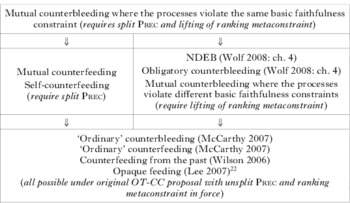
5 Conclusion
In this paper, we have examined the properties of four different versions of OT-CC which correspond to all the possible combinations of two theoretical choices: whether or not to split the precedence constraints in two, and whether or not to retain the ranking metaconstraint. Different sets of kinds of opaque interactions are possible under each combination of these assumptions. As a result (assuming these to be the only relevant parameters defining versions of OT-CC under consideration), we can then define the implicational relationships in Table I between the modellability, in OT-CC, of different kinds of opaque interactions.Footnote 22 We have also seen that a number of possible examples of mutual counterfeeding and of mutual counterbleeding have been reported; however, probably none of them can yet be seen as totally convincing.
Implicational relationships between forms of opacity possible in four versions of OT-CC.

These findings are interesting for two reasons. First, they establish that at least certain versions of OT-CC are not unlimited in their ability to model global rule effects. The original version of OT-CC, with unsplit Prec and the ranking metaconstraint, allows neither mutual counterfeeding nor mutual counterbleeding. If such interactions don't exist, then this is obviously a desirable prediction. In addition, should a clear example of one of these interactions be found, we now know how we would need to revise the original version of OT-CC in order to bring this interaction into the scope of the theory. Second, the uncovering of implicational relationships among the types of opaque interactions that can be modelled in different versions of OT-CC will be useful for future research on the theory. For example, we know that the existence or non-existence of mutual counterbleeding will bear on the question of whether we want to adopt OT-CC as our account of NDEB, but that the existence or non-existence of mutual counterfeeding will not.
For both of these reasons, these results will be important in the long run in helping to decide whether OT-CC will be viable as a theory of which forms of opacity can and cannot exist in human language. As noted in the introduction, predictions about mutual counterfeeding and mutual counterbleeding have a long history in phonological theory as arguments for and against various theories of opacity, and OT-CC in its various conceivable forms will certainly be no exception.