Introduction
The treatment of an alcohol, drug, or mental health condition (ADMC) is a major public health challenge of our time (WHO, 2001; Demyttenaere et al. Reference Demyttenaere, Bruffaerts, Posada-Villa, Gasquet, Kovess, Lepine, Angermeyer, Bernert, de Girolamo, Morosini, Polidori, Kikkawa, Kawakami, Ono, Takeshima, Uda, Karam, Fayyad, Karam, Mneimneh, Medina-Mora, Borges, Lara, de Graaf, Ormel, Gureje, Shen, Huang, Zhang, Alonso, Haro, Vilagut, Bromet, Gluzman, Webb, Kessler, Merikangas, Anthony, Von Korff, Wang, Brugha, Aguilar-Gaxiola, Lee, Heeringa, Pennell, Zaslavsky, Ustun and Chatterji2004), with ADMCs being considered prominent causes of disability-adjusted life years (Hugo et al. Reference Hugo, Boshoff, Traut, Zungu-Dirwayi and Stein2003; WHO, 2004a; Buka, Reference Buka2008). Unfortunately, patients with an ADMC often face barriers to care. To illustrate, in the USA, an estimated 8-year median lag-time separates depression onset and treatment services entry; for alcohol and other drug disorders, the median is 5 years (Wang et al. Reference Wang, Berglund, Olfson, Pincus, Wells and Kessler2005).
Stigma-related feelings about illness are among the barriers leading World Psychiatric Association (WPA) leaders to make recommendations for ameliorative interventions (Sartorius et al. Reference Sartorius, Gaebel, Cleveland, Stuart, Akiyama, Arboleda-Flórez, Baumann, Gureje, Jorge, Kastrup, Suzuki and Tasman2010). In this context, stigma can be defined broadly ‘to encompass the negative stereotypes and prejudicial beliefs that people may hold, as well as discriminatory or inequitable practices that may result’ (Sartorius et al. Reference Sartorius, Gaebel, Cleveland, Stuart, Akiyama, Arboleda-Flórez, Baumann, Gureje, Jorge, Kastrup, Suzuki and Tasman2010). In research on this construct, it has been typical to study self stigma (e.g. patients' feelings about themselves) and social stigma as manifest in a desire to increase ‘social distance’ between self and an ADMC (Crocker, Reference Crocker1999; Alonso et al. Reference Alonso, Buron, Bruffaerts, He, Posada-Villa, Lepine, Angermeyer, Levinson, de Girolamo, Tachimori, Mneimneh, Medina-Mora, Ormel, Scott, Gureje, Haro, Gluzman, Lee, Vilagut, Kessler and Von Korff2008; Jorm & Oh, Reference Jorm and Oh2009; Brohan et al. Reference Brohan, Elgie, Sartorius and Thornicroft2010, Reference Brohan, Gauci, Sartorius and Thornicroft2011). In this study we have focused on a unique aspect of social stigma, investigating whether family members are more often embarrassed by their relatives' mental health compared to a general medical condition (GMC).
Manifestations of social stigma have been studied at the macro- and micro-level as potential barriers that separate the illness-affected person from prompt access to effective services (U.S. Surgeon General, 1999; WHO, 2001; Alonso et al. Reference Alonso, Buron, Bruffaerts, He, Posada-Villa, Lepine, Angermeyer, Levinson, de Girolamo, Tachimori, Mneimneh, Medina-Mora, Ormel, Scott, Gureje, Haro, Gluzman, Lee, Vilagut, Kessler and Von Korff2008, Reference Alonso, Buron, Rojas-Farreras, de Graaf, Haro, de Girolamo, Bruffaerts, Kovess, Matschinger and Vilagut2009; Cao et al. Reference Cao, He, Jiang, Yang, Liu, Gao, Ding, Chen and Detels2010; Ahmedani et al. Reference Ahmedani, Kubiak, Rios-Bedoya, Mickus and Anthony2011). Individuals with an ADMC are regularly perceived as dangerous or violent and are frequently avoided (Goffman, Reference Goffman1963; Crocker, Reference Crocker1999; Dudley, Reference Dudley2000). These stigma-related feelings do not seem to have changed appreciably over time (Pescosolido et al. Reference Pescosolido, Martin, Long, Medina, Phelan and Link2010) and the mass media sustain negative portrayal of these conditions (Sayce, Reference Sayce2000; Corrigan et al. Reference Corrigan, Markowitz, Watson, Rowan and Kubiak2003; Dietrich et al. Reference Dietrich, Heider, Matschinger and Angermeyer2006; Klin & Lemish, Reference Klin and Lemish2008). Moreover, in relation to many ADMCs, victims are often told that they should be able to ‘pull themselves together’ and to control themselves without help (Corrigan et al. Reference Corrigan, River, Lundin, Wasowski, Campion, Mathisen, Goldstein, Bergman, Gagnon and Kubiak2000, Reference Corrigan, River, Lundin, Penn, Uphoff-Wasowski, Campion, Mathisen, Gagnon, Bergman, Goldstein and Kubiak2001; Crisp et al. Reference Crisp, Gelder, Rix, Meltzer and Rowlands2000). These examples illustrate a variety of ways to conceptualize and measure social stigma, for example social distance, dangerousness and controllability (Ahmedani, Reference Ahmedani2011).
ADMCs, in particular, seem to evoke stigma-related feelings more often than GMCs, although the evidence base from rigorous research on this topic needs development. For instance, in some research, levels of stigma-related feelings attached to schizophrenia and cocaine addiction have been found to be greater than corresponding levels attached to cancer; individuals with more severely stigmatized psychiatric conditions have been thought to be able to control their symptoms more readily, and perceived controllability of the condition may help to explain some observed variations (Corrigan et al. Reference Corrigan, River, Lundin, Wasowski, Campion, Mathisen, Goldstein, Bergman, Gagnon and Kubiak2000).
Despite variation within ADMCs, there remains an overarching issue in societies around the world, such that an ADMC is viewed less favorably than a GMC. To illustrate, within the USA, public support for government health care funding to treat GMCs is substantially greater than support for funding of ADMC services (McSween, Reference McSween2002). In Australia, public health promotion and prevention campaigns are more prevalent for GMCs (Jorm et al. Reference Jorm, Barney, Christensen, Highet, Kelly and Kitchener2006). The many gaps in the evidence base have elicited recommendations for new international health research agenda that will foster a more complete understanding of variations in stigma attached to illnesses and to psychiatry (Weiss & Ramakrishna, Reference Weiss and Ramakrishna2006; Sartorius et al. Reference Sartorius, Gaebel, Cleveland, Stuart, Akiyama, Arboleda-Flórez, Baumann, Gureje, Jorge, Kastrup, Suzuki and Tasman2010).
In theory, there is another reason to study social stigma as it is manifest within family systems. Application of a social systems perspective, with the individual as a focus, clarifies the family as one of the closest subsystems of society to the individual's system, and this gives the family special leverage in relation to the individual's decisions and behavior (Wahl, Reference Wahl1999; Robbins et al. Reference Robbins, Chatterjee and Canda2005; Stier & Hinshaw, Reference Stier and Hinshaw2007). More specifically, ADMCs, unlike most GMCs, may create unique burdens on family members, causing isolation from the community at large, with potential loss of extrafamilial support and friendship-related social capital (Lefley, Reference Lefley1989). Once a close relative is affected by an ADMC, family members may themselves feel stigmatized, blamed and embarrassed (Ostman & Kjellin, Reference Ostman and Kjellin2002; Corrigan et al. Reference Corrigan, Watson and Miller2006). Behavioral manifestations of these stigma-related feelings include concealment of the close relatives' illnesses, and possibly self-blame about the events leading up to the relative suffering from an ADMC (Phelan et al. Reference Phelan, Bromet and Link1998; Hinshaw, Reference Hinshaw2005).
One of the most well-studied social stigma constructs is ‘social distance’, the primary topic in a review by Jorm & Oh (Reference Jorm and Oh2009). To illustrate, according to estimates from Sweden (Ostman & Kjellin, Reference Ostman and Kjellin2002), 18% of individuals thought that their close relative with an ADMC would be better off dead; it is also noteworthy that 40% believed that they, themselves, had developed an ADMC from their association with their afflicted family member. From Hong Kong, there is evidence that ADMC-associated social stigma as felt by a family member is greater for schizophrenia than for diabetes (Lee et al. Reference Lee, Lee, Chiu and Kleinman2005). In addition to ‘social distance’, one of the unifying constructs in the empirical stigma research on familial reactions to ADMCs may be ‘embarrassment’, which we have adopted here, consistent with its application in prior research (Phelan et al. Reference Phelan, Bromet and Link1998; Link & Phelan, Reference Link and Phelan2001; Alonso et al. Reference Alonso, Buron, Bruffaerts, He, Posada-Villa, Lepine, Angermeyer, Levinson, de Girolamo, Tachimori, Mneimneh, Medina-Mora, Ormel, Scott, Gureje, Haro, Gluzman, Lee, Vilagut, Kessler and Von Korff2008, Reference Alonso, Buron, Rojas-Farreras, de Graaf, Haro, de Girolamo, Bruffaerts, Kovess, Matschinger and Vilagut2009). Embarrassment was chosen as a measure of stigma for two main reasons: (1) its use extends World Mental Health Surveys (WMHS) research highlighting the extent of personal embarrassment (Alonso et al. Reference Alonso, Buron, Bruffaerts, He, Posada-Villa, Lepine, Angermeyer, Levinson, de Girolamo, Tachimori, Mneimneh, Medina-Mora, Ormel, Scott, Gureje, Haro, Gluzman, Lee, Vilagut, Kessler and Von Korff2008, Reference Alonso, Buron, Rojas-Farreras, de Graaf, Haro, de Girolamo, Bruffaerts, Kovess, Matschinger and Vilagut2009), and (2) the WMHS protocol measured embarrassment by asking family members about their relatives' health conditions; other social stigma variables were not measured.
In this project, the focus is on the construct of ‘embarrassment’ as a facet of stigma-related feelings that can affect the lives of family members. This research project places illness-associated family embarrassment as a response variable in a conceptual model such that its occurrence is expressed as a function of whether close relatives have been affected by a burdensome ADMC only, by a GMC only, or by both. Instead of asking the family member to attribute the embarrassment to one or another of the close relative's health conditions, we have estimated the strength of association that links these feelings of embarrassment with each group of conditions. Use of a ‘fixed effects’ conditional logistic regression model has made it possible to constrain macro-level influences such as society-wide social stigma, even though the WMHS research protocol had no explicit measurement of these sources of variation in embarrassment felt at the individual level.
Purpose of the study
The main aim of the current study was to assess ‘family embarrassment’ as a construct of social stigma in representative samples drawn, recruited and assessed in 16 different sites of the WMHS. Furthermore, this study estimates the degree to which family embarrassment is associated with having one or more close relatives affected by a burdensome ADMC only, a GMC only, or both, with covariate adjustment for sex and age, while mitigating the influence of socially shared or macro-level influences on embarrassment through within-country matching and conditional logistic regression. We hypothesized that family embarrassment would be greater towards individuals with an ADMC compared with a GMC, but would be greatest for the GMC + ADMC group because co-morbidity may result in greater embarrassment for the family.
Method
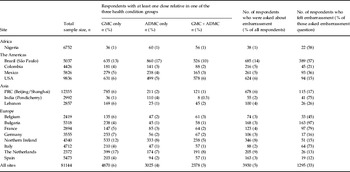
The WMHS consist of coordinated household surveys with nearly 120000 participants in 23 sites distributed across world regions, including Africa (Nigeria and South Africa), the Americas [Brazil (São Paulo), Colombia, Mexico and the USA], Asia [China, Japan (11 Metropolitan areas), India (Pondicherry), Iraq, Israel and Lebanon], Europe (Belgium, Bulgaria, France, Germany, Ireland, Italy, The Netherlands, Romania, Spain and Ukraine) and Oceania/South Pacific (New Zealand). The initial protocol consisted of two independent surveys in the People's Republic of China (PRC: Beijing and Shanghai). In this study, 16 sites with complete data on family embarrassment contribute information for the study estimates (combined n = 81144), which includes the combination into one site of samples from both PRC sites, based on a convention established by the WMHS team. Table 1 lists sites contributing data for this research project.
Unweighted sample distributions of burdensome health condition in a close relative, nature of the condition, and family embarrassment, by site. Data from the World Mental Health Surveys (WMHS)

GMC, General medical condition; ADMC, alcohol, drug, or other mental health condition; PRC, People's Republic of China.
A thorough presentation of the study development and methods has been published elsewhere (Kessler & Ustun, Reference Kessler and Ustun2004). In brief, after standard field survey sampling and recruitment of consenting adult participants, the assessment plan included administration of standardized modules from the WMH version of the World Health Organization (WHO) Composite International Diagnostic Interview (CIDI 3.0). These modules were used to assess psychiatric conditions and other variables in a fully structured interview schedule format; an optional module covered aspects of family burden. The sample sizes of participants, shown in Table 1 for the WMHS sites that administered the interview module on family burden, ranged from 2372 participants in The Netherlands to 12335 in the PRC. The institutional review boards responsible for each site-specific data collection reviewed and approved the field survey protocols.
The survey was administered in two parts, either by face-to-face interviewing by a staff member or by computer-assisted interview, with standardized survey items that had been translated, back-translated and harmonized to local languages. The English language instrument is available online (www.hcp.med.harvard.edu/wmhcidi/index.php). Readers are encouraged to contact administrators for other language versions through information on the website. Part I, which consisted of screening questions and the assessment of demographic information, some psychiatric conditions and basic health status, was administered to those who agreed to participate; more than 70% of the sample participated (Kessler & Ustun, Reference Kessler and Ustun2004; Alonso et al. Reference Alonso, Buron, Bruffaerts, He, Posada-Villa, Lepine, Angermeyer, Levinson, de Girolamo, Tachimori, Mneimneh, Medina-Mora, Ormel, Scott, Gureje, Haro, Gluzman, Lee, Vilagut, Kessler and Von Korff2008). All participants who reported having a history of psychiatric symptoms, along with a probability subsample (approximately 25%) of those who did not, were asked to complete Part II. The content of Part II varied slightly by site but typically included items that assessed lower prevalence mental disorders and special topics such as family burden, including family embarrassment (Kessler & Ustun, Reference Kessler and Ustun2004).
Health conditions
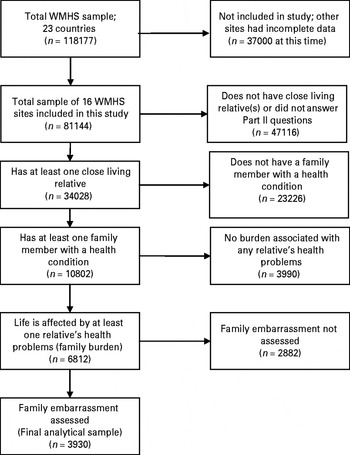
Questions about burdensome health conditions among close relatives were asked in the family burden section of the WMHS interview, Part II (i.e. the subsamples). Figure 1 shows the WMHS branching protocol for this section and how the final analytical sample was derived. First, participants sampled to complete the family burden module were asked a question about the number of close living family members including their spouse/partner, parents, children, and brothers and sisters. When participants acknowledged having one or more family members, they were directed to health condition questions of the following form and a list of conditions: ‘Do any of your close family members have any of the following health conditions?’ (WHO, 2004b). The list included: (1) cancer, (2) heart problems, (3) serious memory problems, (4) mental retardation, (5) permanent physical disabilities such as blindness or paralysis, (6) other chronic physical illnesses, (7) alcohol or drug problems, (8) depression, (9) anxiety, (10) schizophrenia or psychosis, (11) manic depression, and (12) other serious mental health problems.
Process for identifying individuals who were queried about embarrassment towards close relatives with health conditions in the World Mental Health Surveys (WMHS).

Participants answering ‘Yes’ to any condition were asked a question about ‘family burden’. The question was: ‘The next questions are about how your life is affected by the health problems of your [relative/relative(s)]. Taking into consideration your time, energy, emotions, finances, and daily activities, would you say that (his/her/their) health problems affect your life: a lot, some, a little, or not at all?’ Respondents who answered ‘a lot’ or ‘some’ were routed into a series of questions, including the family embarrassment item. No other participants were asked about embarrassment.
For clarity, we note that, in response to the questions about health conditions affecting their close relatives, participants might say ‘yes’ to all, some, no more than one, or none of the 12 conditions. At least one ‘yes’ answer was required for routing into the family burden items. Based on the observed data, the health conditions were sorted to form two intercorrelated variables: (1) GMC (items 1, 2, 5 and 6) and (2) ADMC (items 3, 4 and 7–12). Subgroups of participants were formed by crossing these variables, making it possible to study an ADMC-only subgroup, a GMC-only subgroup, and a co-morbidity subgroup. Table 1 provides the frequency and proportion of participants whose assessment indicated that a close relative was affected by at least one health condition, stratified by health condition category and by site. We note an ambiguity when both a GMC and an ADMC were mentioned. The co-morbidity of a GMC and an ADMC is observed within the family, not necessarily within a single close relative. That is, one of the relatives might have been affected by a burdensome GMC, with a different close relative being affected by a burdensome ADMC. Alternatively, the participant might be mentioning a single individual, with burden from two co-morbid individual conditions.
Family embarrassment
Once a participant acknowledged (1) having at least one family member with at least one listed health condition and (2) feeling burdened by the condition(s), they were asked: ‘How much do (his/her/their) health problems cause you embarrassment?’ (WHO, 2004b). The possible response options for this question were ‘a lot’, ‘some’, ‘a little’ and ‘not at all’. Answers of ‘a lot’, ‘some’ or ‘a little’ were considered as family embarrassment. The item was collapsed into a binary format so as to harness the conditional logistic regression matching approach and to estimate ‘any degree’ of embarrassment versus no embarrassment. Table 1 includes a sample description of participants, stratified by site.
Analyses
All WMHS sites with equivalent question structure and usable data for ‘embarrassment’ and ‘health condition’ contributed data, as shown in Fig. 1. Participants were grouped by site, and the individual-level analysis plan was carried out with site-level matching. The main analysis involved a conditional form of multiple logistic regression, with the log odds of burdensome family embarrassment expressed as a function of ADMC, GMC, age and sex. Small sample sizes within some sites imposed constraints on more detailed modeling. By conditioning on each site, we take into account the fact that each WMHS site conducted autonomous field research operations according to the common protocol. The substantive implication is that participants at one site who feel embarrassed are compared to participants who do not feel embarrassed at that same site. The regression models yield slope estimates on the natural log scale. We have exponentiated these estimates and the text describes the patterns of association in the form of the resulting odds ratio (OR) estimates. Post-estimation analyses included probes into several assumptions, including the possibility that variation in the odds of embarrassment might be driven by variation in the participants' assessments of being burdened by the health conditions of family members. In addition, because the analysis of site-matched individual-level data does not permit explicit weighting for sample selection probabilities (SSPs) or post-stratification adjustment factors (PSAFs), the post-estimation analyses included a stratification approach. The main analysis was repeated for each of 10 strata, formed by taking deciles of the SSP-PSAF analysis weight distribution. We also compared the conditional model results with estimates from a weighted unconditional logistic regression model with area of residence held constant through dummy-coded indicator covariates, and variance estimation for complex samples. Essentially the same point estimates were obtained, and the conditional model yielded slightly smaller variance estimates and narrower confidence intervals (CIs), in contrast with what others have sometimes found in the form of noteworthy differences with respect to both point estimates and variances, with the possibility of differences in inference (Brumback et al. Reference Brumback, Dailey and Zheng2012). The unconditional model estimates are available upon request. The study estimates, 95% CIs and p values are presented for the main analyses.
Results
Table 1 shows the proportion of participants whose data indicate having a family member with one or more burdensome health conditions, along with individuals who felt embarrassed, stratified by site. Overall, 6% of participants had a family member with a burdensome GMC (n = 4870) and 3.7% had a family member with a burdensome ADMC (n = 3025). Slightly fewer (2.9%) described the co-morbidity situation (n = 2378). Site-specific variations in these GMC-only, ADMC-only and GMC + ADMC proportions, based on weighted survey data, are being reported in other publications by the WMHS stigma work group; hence the weighted estimates are not reported here (Alonso et al. Reference Alonso, Buron, Bruffaerts, He, Posada-Villa, Lepine, Angermeyer, Levinson, de Girolamo, Tachimori, Mneimneh, Medina-Mora, Ormel, Scott, Gureje, Haro, Gluzman, Lee, Vilagut, Kessler and Von Korff2008, Reference Alonso, Buron, Rojas-Farreras, de Graaf, Haro, de Girolamo, Bruffaerts, Kovess, Matschinger and Vilagut2009). Nearly 33% of participants (n = 1295) who were asked about embarrassment (n = 3930) felt at least ‘a little’ embarrassed about a relative's condition. This equated to 11.7% (n = 460) who were embarrassed ‘a lot’, 11.7% (n = 458) ‘some’ and 9.6% (n = 377) ‘a little’. Furthermore, 24.9% (527/2113) of participants with relatives in the GMC-only group felt embarrassed, compared to 49.5% (397/802) in the ADMC-only group and 36.6% (371/1015) in the GMC + ADMC group.
Table 2 presents estimates from conditional logistic regression analyses with covariate adjustment for age and sex, and with site-level matching. Here, the reference is family embarrassment in relation to relatives with GMC only. The subgroup of participants in families with ADMC only were more often embarrassed by the condition (exponentiated slope estimate yields OR 3.7, p < 0.01). This was also found for those in families where both ADMC and GMC were present (OR 2.2, p < 0.01). In comparison, those in the ADMC-only subgroup were more likely to feel embarrassment than those in the ADMC + GMC subgroup, even with covariate adjustment for age and sex (OR 1.7, p < 0.01), although neither age nor sex was associated with family embarrassment.
Estimated association linking type of family health condition with occurrence of family embarrassment, based on conditional form of multiple logistic regression. Data from the World Mental Health Surveys (WMHS)

GMC, General medical condition; ADMC, alcohol, drug, or other mental health condition; s.e., standard error; CI, confidence interval.
a Estimated slope coefficient from the regression model. Exponentiated, this estimate is interpretable as an odds ratio. Exp(1.3) = 3.7; Exp(0.79) = 2.2, as explained in the text.
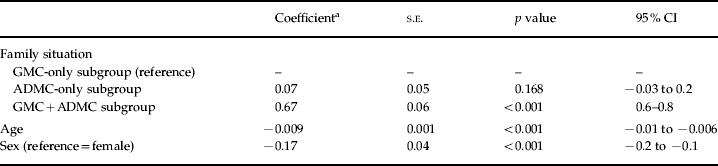
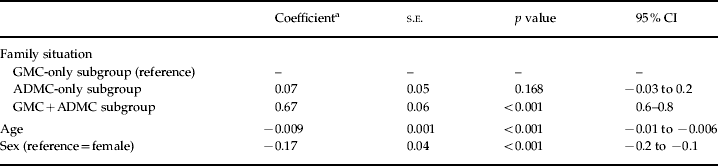
To probe into the unexpected result that co-morbid GMC and ADMC was associated with lower odds of family embarrassment, we conducted a post-estimation exploration of the possibility that family burden might be occurring more frequently in the ADMC-only subgroup. As shown in Table 3, the subgroup with both GMC and ADMC in the family has greater odds of describing family burden compared to the GMC-only subgroup (OR 2.0); the contrast with the ADMC-only subgroup is also noteworthy. The estimated odds of family burden for the ADMC-only subgroup is not appreciably different from the GMC-only subgroup (OR 1.07, p = 0.168), indicating that the ADMC-only subgroup members are more likely to feel embarrassed but not to have greater family burden.
Estimated association linking type of family health condition with occurrence of family burden, based on conditional form of multiple logistic regression. Data from the World Mental Health Surveys (WMHS)
GMC, General medical condition; ADMC, alcohol, drug, or other mental health condition; s.e., standard error; CI, confidence interval.
a Estimated slope coefficient from the regression model. Exponentiated, this estimate is interpretable as an odds ratio. Exp(0.07) = 1.07; Exp(0.67) = 1.95, as explained in the text.
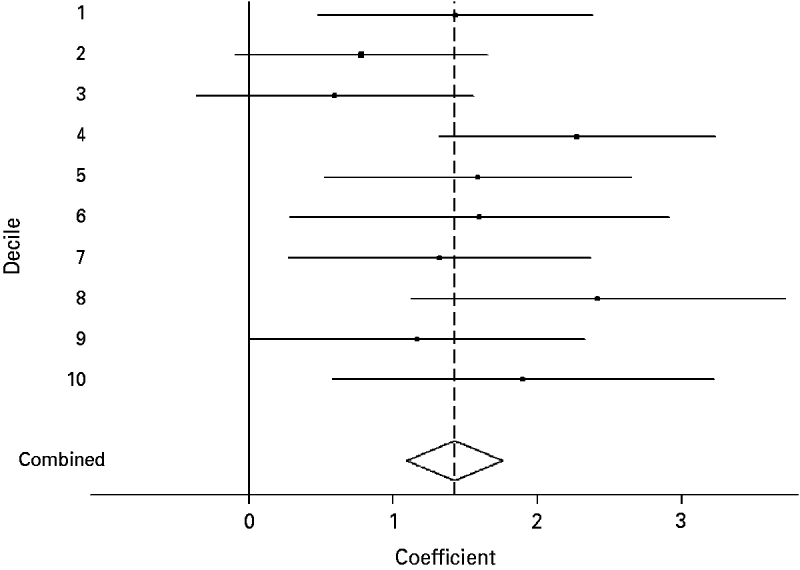
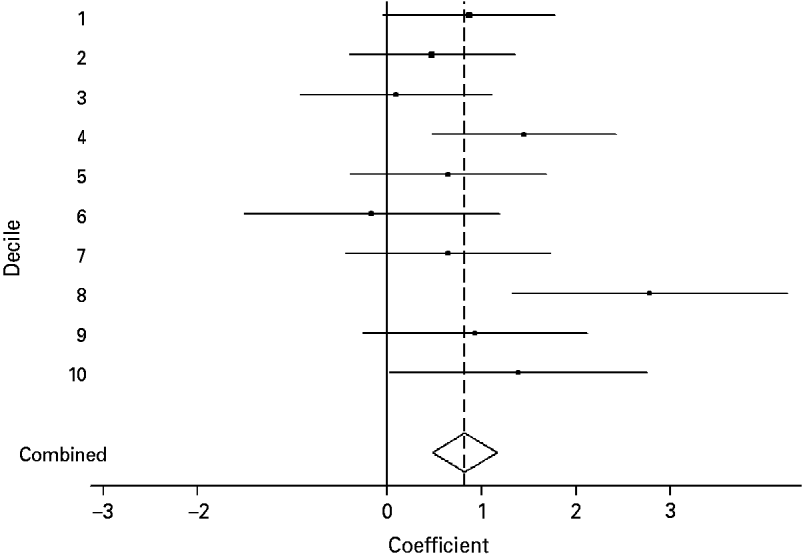
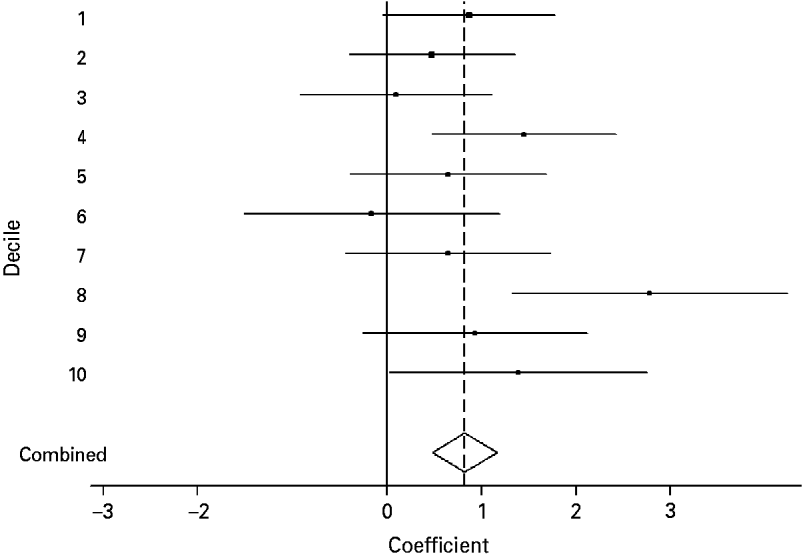
In post-estimation analyses with respect to sampling weights, we found no appreciable variation in the estimates across weight variable deciles with one possible exception (Figs 2 and 3). The exception involved the eighth decile (Fig. 3), where the estimated association for the GMC + ADMC subgroup was modestly larger than the value reported in Table 2. The original full sample coefficient was 0.79 whereas the eighth decile subsample estimate was 2.8. As noted in the Method section, the unconditional logistic regression approach with weights and variance estimation for complex samples yielded consistent estimates with no meaningful change in conclusions.
Weight variable deciles for observed alcohol, drug, or other mental health condition (ADMC)-only association in Table 2.
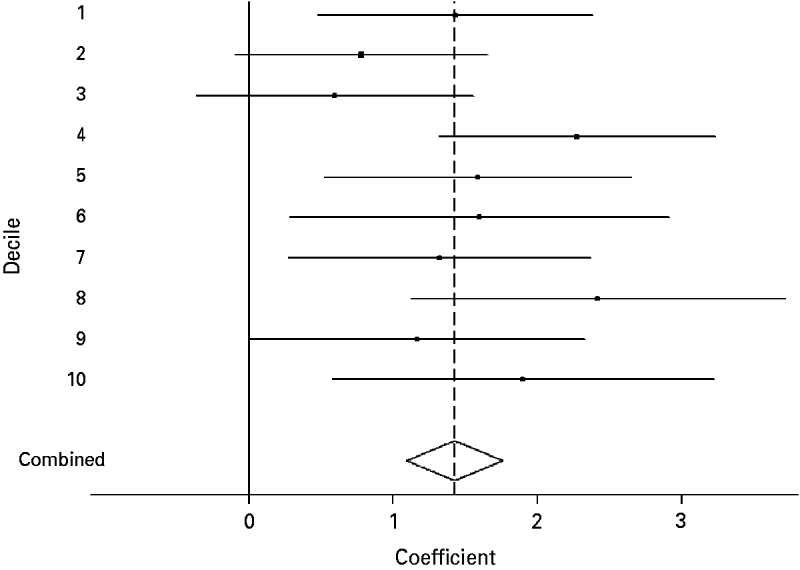
Weight variable deciles for observed alcohol, drug, or other mental health condition + general medical condition (ADMC + GMC) association in Table 2.
Discussion
The main finding of this study is the greater occurrence of family embarrassment when a close relative is affected by a burdensome ADMC compared to a GMC. One novel aspect of this finding is that local site matching was used to constrain socially shared influences on feelings of embarrassment, which vary from country to country. As a consequence, the resulting estimates pertain to the occurrence of family embarrassment as it is experienced at the subgroup and individual level within each site. With the between-site macro-level influences held constant, the subgroup with both ADMC and GMC was more likely than the ADMC-only and GMC-only subgroups to describe burden of illness; even so, the ADMC-only subgroup was more likely to feel embarrassed, suggesting that embarrassment is not strictly a function of the associated burden felt by the family member.
Before more detailed discussion, several limitations deserve attention. First, the WMHS project did not include stigma research as a primary aim. Hence, this study sheds light on the ‘family embarrassment’ facet but not other stigma constructs. In addition, some stigmatized GMCs (e.g. epilepsy) were not mentioned in the WMHS items. Furthermore, the placement of the stigma questions in Part II, with constrained subsample sizes, has limited the modeling of potential explanations for observed variations, including variations in the occurrence of family embarrassment from site to site. Noting that translation/back-translation may not provide complete measurement equivalence results (Shrout et al. Reference Shrout, Alegria, Canino, Guarnaccia, Vega, Duan and Cao2008), we can speculate that variations in language, understanding and perhaps perceived burden or severity of the ADMC or GMC under study might help to account for the observed site-to-site variations, but the WMHS project was designed to document but not to explain such differences.
Second, we turned to the conditional form of logistic regression with site matching to derive estimates in a fashion that constrains socially shared sources of variation site by site, akin to what is done in behavioral genetics and other family research, but this ‘fixed effects’ approach does not permit use of analysis weights. A counterbalanced strength is that essentially the same conclusions were derived during post-estimation exploratory analyses, including a post-hoc use of the unconditional logistic regression model with sampling weights and variance estimation for complex sample data as described elsewhere (Heeringa et al. Reference Heeringa, West and Berglund2010).
Third, we had hoped to study stigma variation across individual ADMCs, but the Part II sample size constraints thwarted this aim. In this regard, the driving influence was the number of survey respondents who were drawn into the sample for the Part II modules, a number that proved to be too small for our pre-planned analyses and too small for individual country estimates. Here, again, in future research focused more on stigma, it should be possible to achieve disorder-level specificity in the estimated associations with odds of family embarrassment and social distance.
Implications
Despite these limitations, the evidence from this study is generally consistent with observations from other single-site research. In a departure from typical stigma research, we did not ask the participants to tell us whether they were embarrassed by an ADMC specifically. Instead, we asked whether burdensome health conditions might have affected a close family member and, separately, we asked whether they might have feelings of embarrassment. We then estimated the degree of association between the odds of feeling embarrassed and the nature of the health condition, without requiring the participants to tell us whether it was the ADMC that caused them to feel embarrassed. With this approach, we avoided problems faced when participants are required to have insight into the specific causes of their feelings. The result is stronger evidence that stigma-laden feelings such as family embarrassment occur more often when a close relative has an ADMC. The demonstrably greater occurrence of family embarrassment in association with an ADMC compared to a GMC highlights the importance of the ongoing work of the WPA and others who are trying to reduce stigma attached to psychiatry and psychiatrists (Sartorius et al. Reference Sartorius, Gaebel, Cleveland, Stuart, Akiyama, Arboleda-Flórez, Baumann, Gureje, Jorge, Kastrup, Suzuki and Tasman2010). There is some evidence of increasing levels of stigma in this context, despite a greater understanding of mental illness in many societies (Phelan & Link, Reference Phelan and Link1998).
Targeted anti-stigma campaigns represent an important part of within-country and global initiatives (Corrigan et al. Reference Corrigan, River, Lundin, Penn, Uphoff-Wasowski, Campion, Mathisen, Gagnon, Bergman, Goldstein and Kubiak2001; Thornicroft et al. Reference Thornicroft, Brohan, Kassam and Lewis-Holmes2008; Evans-Lacko et al. Reference Evans-Lacko, Brohan, Mojtabai and Thornicroft2012). These campaigns, including the network of the WPA, have centered on groups such as medical personnel, police and journalists (Thornicroft et al. Reference Thornicroft, Brohan, Kassam and Lewis-Holmes2008). Nonetheless, targeted campaigns may not be enough on their own unless paired with other systematic changes (Pinfold et al. Reference Pinfold, Huxley, Thornicroft, Farmer, Toulmin and Graham2003).
The findings provoke ideas about anti-stigma campaigns that focus on family members, perhaps mounted in complement with other targeted campaigns. Family-focused initiatives may reduce family subsystem-level barriers to care, perhaps by changing the attitudes and beliefs of the family, who are often an afflicted individual's closest support network. As noted, practitioners need to pay more attention to family members' experiences of discrimination and stigma (Thornicroft et al. Reference Thornicroft, Brohan, Kassam and Lewis-Holmes2008). In theory, by strengthening an individual's support system (i.e. the family), the individual patient may be more likely to become engaged in a treatment process that yields success, with a shift of disorder severity toward milder forms and away from more severe forms associated with delayed care. Similarly, afflicted individuals with relatives who are less embarrassed may be less fearful of seeking treatment. Of course, there is no need to start the design of family-focused anti-stigma campaigns from scratch. There are already promising interventions (Copello et al. Reference Copello, Velleman and Templeton2005; Glynn et al. Reference Glynn, Cohen, Dixon and Niv2006; Adeponle et al. Reference Adeponle, Thombs, Adelekan and Kirmayer2009).
Conclusions
Using an approach that has constrained the influence of between-site macro-level differences, and without requiring participants to know and to state the specific causes of embarrassment, we find that family embarrassment is tangibly manifest in association with a burdensome ADMC. Family embarrassment may lead to the concealment of an individual's condition and impose barriers to care, unnecessarily lengthening the duration of the condition and thereby increasing the population prevalence, and possibly yielding more serious consequences due to treatment delay. We have described several novel features of this research, including its focused look at subgroups and individuals within countries. The resulting evidence is good reason to strengthen family-focused anti-stigma initiatives, in addition to national-scale anti-stigma campaigns.
Acknowledgements
We thank Drs C. Broman and R. Harold for their reviews, comments and feedback, which improved the final paper; J. Troost for assistance with forest plots; and the many WMHS-affiliated principal investigators and researchers whose hard work produced the survey data. The WHO WMHS Initiative was funded and supported in several ways: National Institutes of Health (NIH) grants R01MH070884, R13MH066849, R01MH069864, R01DA016558, R01MH059575, U01MH60220, RO1MH61905, R01DA016558 (J.C.A.), T32DA021129 (B.A., J.C.A.) and K05DA015799 (J.C.A.). Additional funding was from the John D. and Catherine T. MacArthur Foundation, the Pfizer Foundation, the Fogarty International Center (FIRCA R01-TW006481), the Pan American Health Organization, the Eli Lilly & Company Foundation, Ortho-McNeil Pharmaceutical, Inc., GlaxoSmithKline, Bristol-Myers Squibb, the Ministry of Social Protection in Colombia, the European Commission (Contracts QLG5–1999–01042; SANCO 2004123), the Piedmont Region (Italy), Fondo de Investigación Sanitaria, Instituto de Salud Carlos III, Spain (FIS 00/0028), Ministerio de Ciencia y Tecnología, Spain (SAF 2000–158-CE), Departament de Salut, Generalitat de Catalunya, Spain, Instituto de Salud Carlos III (CIBER CB06/02/0046, RETICS RD06/0011 REM-TAP), the Lebanese Ministry of Public Health, the WHO, Fogarty International, Act for Lebanon, anonymous private donations to IDRAAC, Janssen Cilag, Roche, Novartis, the National Institute of Psychiatry Ramon de la Fuente (INPRFMDIES 4280), the National Council on Science and Technology (CONACyT-G30544-H), and the Pan-American Health Organization, the Federal Ministry of Health in Nigeria, the Substance Abuse and Mental Health Services Administration, the Robert Wood Johnson Foundation (RWJF; Grant 044708), and the John W. Alden Trust. The epidemiology of mental disorders study in India was supported by WHO/Directorate of General Health Services and helped by R. Chandrasekaran, Jawaharlal Institute of Postgraduate Medical Education and Research. The WMH staff was instrumental in implementing the survey protocol, fieldwork, and data analysis. A list of the WMHS publications can be found at www.hcp.med.harvard.edu/wmh/. The content is solely the responsibility of the authors and does not necessarily represent the official views of the NIH or the other agencies that provided funding support.
Declaration of Interest
Dr Kessler has been a consultant for AstraZeneca, Analysis Group, Bristol-Myers Squibb, Cerner-Galt Associates, Eli Lilly & Company, GlaxoSmithKline Inc., HealthCore Inc., Health Dialog, Integrated Benefits Institute, John Snow Inc., Kaiser Permanente, Matria Inc., Mensante, Merck & Co. Inc., Ortho-McNeil Janssen Scientific Affairs, Pfizer Inc., Primary Care Network, Research Triangle Institute, Sanofi-Aventis Group, Shire US Inc., SRA International Inc., Takeda Global Research & Development, Transcept Pharmaceuticals Inc., and Wyeth-Ayerst; has served on advisory boards for Appliance Computing II, Eli Lilly & Company, Mindsite, Ortho-McNeil Janssen Scientific Affairs, and Wyeth-Ayerst; and has had research support for his epidemiological studies from Analysis Group Inc., Bristol-Myers Squibb, Eli Lilly & Company, EPI-Q, GlaxoSmithKline, Johnson & Johnson Pharmaceuticals, Ortho-McNeil Janssen Scientific Affairs., Pfizer Inc., Sanofi-Aventis Group, and Shire US Inc. Dr Lepine has served on speakers' bureaux for Servier, Pfizer-Wyeth, Sanofi and Pierre Fabre.