The household registration system (hukou 戶口) has regulated the massive flows of rural-to-urban migration in post-reform China. Rural migrants were deprived of the right to permanent residency in the city and the social benefits associated with urban citizenship, including the entitlement to send their children to urban public schools.Footnote 1 Since the late 1990s, the governments at both national and local levels have made a variety of adjustments to the hukou system.Footnote 2 As a result, the migrant population in recent years has come to display signs of urban settlement and family unification.
According to an official survey conducted in five metropolises in China, the majority of migrant households (67.4 per cent) are composed of parents and children, and 70 per cent of migrant parents keep their children in the cities rather than leaving them behind in the countryside.Footnote 3 These children have become the second generation of rural migrants in the city, a term that encompasses children born in the city to migrant parents, and also those born in the countryside but raised by migrant parents in the city.
Despite being born or growing up in the cities, migrant children are still registered as peasants on their hukou. According to the 2010 census, the number of migrants (people who have lived somewhere different from their hukou locations for over six months) reached 221 million. This included 22.9 million children aged 14 years or below, accounting for 10 per cent of the national population of children within this age range.Footnote 4
The language used by the Chinese press and official documents to refer to migrant children has changed in response to the shifting patterns of migration. “Floating children” (liudong ertong 流动儿童), a common term in the 1990s which carries with it connotations of transience and instability, was gradually replaced by more neutral terms like “children living with peasant workers” (nongmingong tongzhu zinü 农民工同住子女、jincheng wugong jiuye nongmin zinü 进城务工就业农民子女) in the early 2000s.Footnote 5 More recently, the Chinese press has coined the terms “second-generation peasants” (nongerdai 农二代) and “second-generation migrant workers” (mingong erdai 民工二代), which give the younger generation an identity as a group with an autonomous existence in the city, rather than simply being attached to their parents.
Given that second-generation rural migrants are now incorporated into the city and are no longer excluded, is hukou status still as significant? My investigation of the changing frameworks of migration incorporation focuses on Shanghai, a city that has launched a series of pioneering reforms in regard to hukou policies and migrant welfare, including incorporating migrant children into urban mandatory education. I use the term “segmented incorporation” to characterize this new receiving context in which second-generation migrants are incorporated into educational institutions but channelled into segmented paths.
Segmented Assimilation and Incorporation
The concept of assimilation has dominated the literature on second-generation immigrants. Traditionally, the concept is defined as “a natural process by which diverse ethnic groups come to share a common culture and to gain equal access to the opportunity structure of society.”Footnote 6 Scholars have recently challenged such views of linear assimilation by developing new conceptual tools to explore the complexity of immigrant adaptation and incorporation.
According to Portes and his colleagues, the central question is no longer “whether the second generation will assimilate to American society,” but rather “to what segment of that society it will assimilate.”Footnote 7 The heterogeneity of assimilation outcomes can be explained by the “modes of incorporation,” which consist of the “contexts of reception” defined by the policies of the host government, the conditions of the labour market, the values of the receiving society, and the characteristics of the co-ethnic community. Certain receiving contexts create vulnerability to “downward assimilation” for immigrant youth, for example where the policies of the receiving government lean towards exclusion or passive acceptance, and the labour market is bifurcated and lacking in mobility ladders for immigrants.Footnote 8
Other scholars have reformulated the concept of assimilation to see it as a process of boundary negotiation and reconstitution. Alba and Nee define assimilation as the “decline of an ethnic distinction and its corollary cultural and social differences.”Footnote 9 Alba also argues that the nature of the ethnic boundary – as “bright” or “blurry” – would shape the various processes involved in the incorporation of second-generation immigrants. When the boundary is “bright,” assimilation is likely to take the form of boundary crossing, such as conversion or naturalization. When the boundary is “blurry,” individuals may negotiate with ambiguous locations with respect to the boundary and develop hyphenated or intermediate identities.Footnote 10
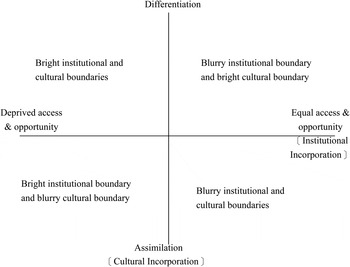
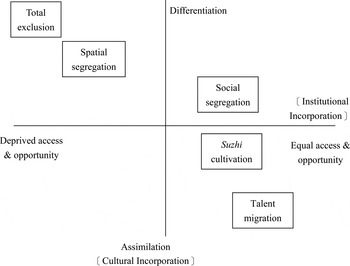
The above literature has inspired my research of Chinese rural-to-urban migration. However, I prefer to use the term “incorporation” instead of “assimilation” to underscore the institutionalized nature of hukou boundaries. I propose that it is necessary to distinguish the processes of institutional incorporation (the redistribution of rights, resources and opportunities) and cultural incorporation (the recognition of difference between host and immigrant). I have coined the concept “segmented incorporation” to describe how the above two processes, often operating in different domains and involving boundaries of distinct natures, result in various modes of incorporation and segmented paths for the second- generation migrants. My analytic framework, as demonstrated in Figure 1, views segmented incorporation as a social space (field) structured by the coordinates of institutional incorporation (towards equality or deprivation) and cultural incorporation (towards differentiation or assimilation). The four quadrants denote various combinations of institutional and cultural boundaries.
Field of Segmented Incorporation as an Analytic Framework

The distinction between institutional and cultural incorporation is critical in the case of China. The barriers to adaptation faced by Chinese migrants are two-fold: institutional exclusion and systematic marginalization based on their lack of a local hukou, and cultural prejudices and discrimination built on the back of the urban–rural divide. The boundary between urbanites and migrants in China has a dual nature that appears to be contradictory: it is a “bright” boundary because hukou classification involves unambiguous institutional categories enforced by the state; yet the boundary also appears “blurry” because urbanites and migrants share racial and cultural similarities.
Most rural migrants are Han Chinese with the same racial origin and national citizenship as urban residents. The quasi-ethnic divisions between them are therefore based on regional identities defined by native place. Honig's study on the labour migration of the Subei 苏北 people in Republican-era Shanghai has demonstrated that such “ethnicity” does not involve inherent traits that people are born with, but involves a social and historical process of constructing boundaries between groups of people in specific contexts.Footnote 11
In the Communist period, regional boundaries were further consolidated by the hukou system. It is important to note that a hukou is categorized based on two related parts: one's regional location (local vs. non-local) and one's socio-economic eligibility (agricultural or non-agricultural).Footnote 12 The so-called Shanghainese population actually contains vast heterogeneity: for instance, many Shanghainese are descendents of Subei immigrants, and some only converted their agricultural hukou during the recent nongzhuanfei 农转非 (transferring agricultural to non-agricultural hukou) reform. They nevertheless share a common institutional membership, the boundary of which is marked by the exclusion of non-hukou migrants.
Despite the rigid categorization of institutional membership, the fuzzy boundary between urbanites and migrants is subject to symbolic struggle by which the dominant group mobilizes cultural and discursive resources to naturalize the fabricated status hierarchy. In Republican Shanghai, the locals turned the Subei label into a class metaphor connoting poverty and backwardness. Similarly, in the post-reform era, the institutional exclusion of non-hukou migrants is justified by the powerful discourse on suzhi 素质 (personal quality) that marginalizes peasants as the underclass for their alleged lack of cultivation.
This article focuses on education as a major institution that defines the receiving contexts for second-generation migrants in urban China. Education is not only a means for individuals to cultivate human skills or cultural capital, it is also an institutional field highly regulated by the Chinese state and tightly coupled with the hukou policy. This article follows several lines of enquiry: how does the current policy regime incorporate migrant children in terms of the redistribution of educational resources and opportunities? How do urbanites and migrants negotiate cultural differences and social boundaries between them in the context of educational incorporation? How do educational institutions channel the future of second-generation migrants into particular segments and specific paths?
Research Methods
Shanghai is an ideal site to study second-generation migrants for several reasons. First, family settlement is a common residential pattern among the city's rural migrants. They are employed across a wide range of job sectors and many of them live with their families in the city in rental property rather than in factory dormitories. Second, Shanghai has launched a series of reforms to improve the welfare of rural migrants. Most importantly, it is the first Chinese city to incorporate migrant children into public schools at the primary and secondary levels. Although a pioneer in the domain of educational incorporation, Shanghai is not an exceptional case: many other Chinese cities have gradually introduced similar measures in order to comply with State Council policies.Footnote 13
In the summers of 2009 and 2010, I located migrant families in a village in Baoshan 宝山 district in northern Shanghai. I interviewed 84 people from 44 families, including 40 women and 44 men. Thirty-six informants belonged to the second generation. Although I was unable to gain access to observe classes at public schools, I did conduct interviews with teachers, migrant-worker school administrators, employers, and NGO staff members. I also collected relevant statistics, news and opinions on internet forums.
Hukou Policy Reform in Shanghai
Shanghai has accommodated a fast-growing population of non-hukou migrants in the reform era: in 1986, the migrant population numbered 1.55 million, by 1993 it had grown to 2.6 million, it reached 3.9 million in 2000, and 8.98 million in 2010.Footnote 14 The 2010 census revealed that two out of five residents in Shanghai have a non-local hukou.Footnote 15 Shanghai's government, famous for its fiscal and administrative capacities, has implemented a series of new policies to reform the hukou system. In 1994, Shanghai ran a pilot scheme of “blue-stamp” (lanyin 蓝印) hukou to attract the moneyed and the skilled from other provinces. In 2002, Shanghai replaced the blue-stamp hukou with “talent” (rencai 人才) residence permits to attract migrants with higher education levels and special talents.Footnote 16 In 2009, the city further opened the gate by granting talented migrants “naturalization.” A point system was established to evaluate the eligibility of migrant applicants for the granting of local hukou.Footnote 17 Shanghai launched this new “green card” policy to demonstrate its eagerness for competition and its determination to become a megacity of finance and trade.
It follows that peasant migrant workers are not eligible for the new permits on the basis of their lack of education and talent. However, their status and benefits have also improved in recent years. In 2007, Shanghai introduced a complex social insurance system for migrant workers, which covers occupational injuries, basic medical insurance, and retirement pensions. The city requires employers to buy comprehensive insurance for all migrant workers who hold a long-term residence permit and who have signed an employment contract. Although the migrants have improved protection and rights, they are still locked into a hierarchical scheme of social security that demonstrates “the institutionalization of differential citizenship.”Footnote 18
In the 1990s, migrant children could only attend public schools if they paid exorbitant “sponsor fees” (800 yuan per semester). Instead, they enrolled in unlicensed peasant-worker schools. These were run by migrant entrepreneurs and offered a low standard of education and poor facilities. In response to rising public concern about the education of migrant children, Premier Wen Jiabao 温家宝 visited a peasant-worker school in Beijing in September 2003. He wrote on the blackboard: “Under the same blue sky, grow up and progress together.”Footnote 19 Afterwards, a policy document issued by the State Council urged local governments to take responsibility for the provision of nine-year compulsory education for migrant children without charging discriminatory tuition fees.Footnote 20 In 2008, the State Council demanded that all host governments comply with the Compulsory Education Act, which was revised in 2006, and provide free and accessible compulsory education for all migrant children with valid documents.
Institutional Incorporation in Education
Beginning in 2008, Shanghai launched a three-year campaign aimed at incorporating at least 70 per cent of migrant children into primary education, and 100 per cent into secondary education. In 2007, there were still 258 unregistered informal peasant-worker schools, but by the end of 2009, only 23 such schools remained. The rest were either shut down or transformed into private institutions with public subsidies (minban gongzhu 民办公助). The government approved the applications of 151 schools to become registered schools that would only admit migrant students.Footnote 21 These schools were founded via one of three ways: first, those schools whose facilities and qualities met the standards stipulated by the government received state funding and became registered institutions; second, the government bought out some schools and reassigned the management; and third, the government introduced funding and personnel to establish new schools. A school can receive a public subsidy ranging from 2,000–5,000 yuan (varying by year and district) for the enrolment of each migrant student. Students do not have to pay tuition fees but they are still responsible for their own stationery, uniforms and field trips.
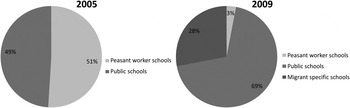
In addition to migrant-specific schools, public and private schools in Shanghai are legally obliged to accept migrant children without charging sponsor fees. Based on official statistics, the proportion of migrant children admitted to public schools rose from 49 per cent in 2005 to 69 per cent in 2009; the proportion of migrant children attending unlicensed peasant-worker schools dropped from 51 per cent to 3 per cent; and, in 2009, 28 per cent of migrant students were placed in state-subsidized private schools for migrant students.
The Distribution of Migrant Children by Variety of School in Shanghai, 2005 and 2009

The number of migrant children enrolled in public schools rose to 538,000 in 2012, including 391,000 in primary school and 147,000 in junior high school. The coverage rate was reported to be as high as 97 per cent.Footnote 22 However, the official reports of the Chinese government have a tendency to exaggerate success and should be taken with a grain of salt. For instance, the denominator of the ratio, the population of migrant children aged between six and 14 years old in Shanghai, is underestimated. Migrant children under 16 are not legally required to register as temporary residents, and only a small proportion of migrant children born in urban areas have their births registered. Statistics about migrant populations, often incomplete and sometimes unreliable, only touch on the surface. In the following, I draw on interviews and field observations to explore how this policy reform affects everyday school life, and whether migrant children are fully incorporated into the urban education system or are channelled into segregated space and segmented paths.
Spatial segregation
Spatial practices, such as access to and use of public space, manifest the symbolic marginality of peasant migrants in Chinese cities.Footnote 23 The spatial allocation of migrant students in public schools also demonstrates the politics of inclusion and segregation – the urban–rural boundary is spatially embodied as porous or rigid for various groups of migrant students. Migrant children in the first grade, who are perceived to have not come under the negative influence of peasant-migrant schools, are usually placed in mixed classes and mixed schools. However, older students who have transferred from peasant-worker schools tend to be placed in separate classes, located on different floors or in different buildings from the local students, or are even placed in separate schools.
Spatial segregation is most tangible in examination-oriented junior high schools. A Chinese newspaper article in 2010 chronicled the admission of migrant children in a junior middle school in Shanghai.Footnote 24 In this school, migrant and local students were completely segregated – not only were they placed in separate classes, but they even used different doorways to enter the campus, wore uniforms of different styles, and had different timetables so that the students would not mingle during class breaks. In short, despite attending the same school, local children avoided all interaction with migrant children.
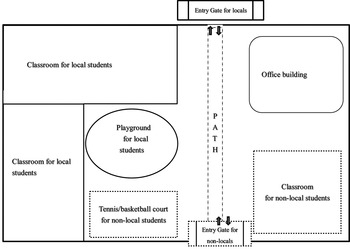
This school embodies what I call “the apartheid model.” Spatial segregation at other schools takes place more subtly, following what I term “the concession model.” Zhou was a fifth grader, born in Shanghai to parents from Jiangxi. His dream for the future was to become a professional athlete like the ones he had seen in the 2008 Beijing Olympics. He had recently been transferred from an unlicensed peasant-migrant school to a local primary school that was newly opened in 2009. This school, along with many other state-subsidized migrant-specific schools, “borrowed” part of the campus belonging to a local primary school. Zhou drew a picture for me to demonstrate the layout of the campus, which I represent in Figure 3.
The Concession Model

I asked Zhou what he thought of Shanghai children. He answered, “I don't know. We never play with them.” “Even in the playground?” I asked. “Yeah, our teacher said we should not play there… Their half is bigger and they have many facilities there. They play some kind of ball game, I don't know what it is,” said Zhou, sounding slightly envious. I probed further: “Can you play there if nobody is around?” “No.” “Why not?” “I don't know. You have to ask my teacher.” He answered as if the question had never occurred to him. I wondered how the rule played on the other side: “Can they come to your court to play?” He answered in a taken-for-granted tone: “Yes they can. It was theirs, anyway.” “Can you tell who is a Shanghainese and who is a waidiren 外地人 (people from outside locales)?” “Sure, you can tell right away. Our faces are dark; theirs are white.”
Despite sharing the same campus, visible walls and invisible fences, reinforced by school rules, divided local and migrant students. These boundaries substantiate the inferior status of migrant newcomers; the skin colour bar in the playground embodies class distinctions as well as the urban–rural hierarchy. Migrant students were confined to the leased territory, with second-class facilities, equipment and resources. Their teachers, many of whom had transferred from closed-down peasant-worker schools, received substantially lower salaries than the teachers at regular public schools.
Barricades to institutional incorporation
Why has spatial segregation, sometimes as extreme as in the cases described above, been set up to divide local and migrant students? Some school administrators defend their segregation measures, claiming that they are put in place with the good intention of “protecting migrant children's self-esteem.”Footnote 25 More importantly, they face pressure from local parents who request that local and migrant children are taught in separate classes. Some parents choose to transfer their children elsewhere when they learn that their school has admitted a substantial number of migrant children.Footnote 26 Despite policy reforms to open educational opportunities up to migrant children, anti-rural prejudices in the receiving society persist and obstruct the equal distribution of resources and opportunities.
The exclusionist attitudes of parents and school administrators are rooted in institutional contexts. First, the one-child policy heightens urban parents' anxieties about their precious singletons' futures and causes them to be calculative about educational investment and reward. Second, China's education system is fiercely competitive and examination-oriented. Schools are desperate to improve the academic performance of their students because premier schools can demand higher donations and school-selection feesFootnote 27 from parents. Teachers' bonuses are also contingent upon their students' scores.Footnote 28 Migrant students are assumed to be academically inferior, especially those who have transferred from peasant-worker schools. Parents view schools that accept a substantial number of migrant students as being compromised and disadvantaged in the competitive race for results.
The host governments, out of concern for budgets and migrant inflows, also install invisible barriers that limit the educational access of migrant children. Until the requirement was somewhat relaxed in 2011, Shanghai used to request five or six documents in order to assess the eligibility of migrant children for urban education.Footnote 29 Beijing and many other cities continue to solicit documents such as a city residency permit, proof of parents' employment and residence in the city, proof of peasant identity (household registration certificate), a child's birth certificate, and sometimes planned birth certificate (jihua shengyu zheng 计划生育证).Footnote 30 Such bureaucratic barricades disqualify a large proportion of migrant children: labour contracts are rarely drawn up for the casual jobs held by migrant parents, and rental agreements are also hard to obtain considering the precarious living conditions of most migrants households. Furthermore, owing to the restrictions of the one-child policy, births of migrant children in the cities are often not registered. So it follows that, given the fact that many unregistered peasant-worker schools have already been shut down, these “black children” will be deprived of education opportunities in the city.
In addition, each school has a quota for the number of migrant children it will admit. Migrant parents have to seek out schools on their own and compete for available slots. It is especially difficult to gain entry to junior high school owing to the fact that, for migrant children, a student's registration at primary school is not linked to his/her registration at secondary school. Guanxi 关系 (personal networks) is still a necessary prerequisite for getting into quality schools. It is difficult for migrant parents, who have little local social capital, to acquire the necessary information and navigate the process of school selection.
Residential segregation has also contributed to the persistence of educational inequality. Statistics from the Shanghai Population Census show a move towards gentrification from 1990 to 2000. Rural migrants now tend to live on the outskirts of the city. Before, newly arrived migrants gravitated to the central districts, but they later relocated to suburban areas. Urban renewal projects have contributed further to this trend because the city government demolished most of the shantytowns in central districts.Footnote 31 Nowadays, migrant settlements are concentrated in suburban areas like Pudong 浦东, Minhang 闵行, Songjiang 松江, Jiading 嘉定 and Baoshan,Footnote 32 where quality schools and educational funds are more limited than in central districts.
Cultural Incorporation in the Classroom
Scholars have pointed out that the everyday term suzhi acts as a floating signifier to convey a variety of meanings: it marks rural migrants with the presumed lack of value and civilization, whilst urban middle-class children cultivate suzhi as a neoliberal strategy to achieve social and global mobility.Footnote 33 This section explores the cultural incorporation of migrant children in school life, or more specifically, how the marker of suzhi has been used to denote cultural difference between urban and migrant children, and to differentiate between various groups of migrant children. The first part demonstrates that social segregation continues to operate in an institutional incorporated classroom. The second part shows that urban educators and citizens impose suzhi cultivation as a means to distinguish between migrant children who are deemed worthy or unworthy.
Social segregation
In schools where local and migrant children are taught together in the same class, there still remain invisible yet tangible social boundaries to divide them. Tang, born in a village in Anhui, moved to Shanghai at the age of three. Her dream is to become a TV presenter and she believes that Shanghai is the only place where that dream can be realized. Tang is an eloquent speaker and speaks beautiful Mandarin. She can speak only a little Anhui dialect because her parents intentionally speak Mandarin at home to prevent their children from developing a hometown accent, which is considered vulgar. In 2008, after her graduation from a migrant primary school, Tang passed an exam to enter a local junior high school which only admitted a select few migrant children. Although her excellent school record earned her admittance, she was asked to register again for the sixth grade. She was excited, and yet nervous, about the new opportunity of joining local students at school. She recalled her thoughts when the school term began:
I was thinking that the Shanghai children must be good; they must sit tight and always raise their hands before talking in class; they must behave well at recess; they must listen to the teacher; and they probably have beautiful handwriting. They are students from Shanghai schools – they must be different and very, very good. I was thinking, oh, I have to study harder; otherwise I would lag behind from them. So, I borrowed books and I took extra lessons. I even bought a dictionary for this! But, when I went to the school, I changed my mind completely. Their writing is worse than mine; they are real crazy, fooling around and fighting with each other; they don't behave in class, just sit there lazily or yelling “Me, Me, Me,” without raising their hands at all! The class is such a mess! I was very confused at that time and felt very uncomfortable because this was not what I imagined. I thought Shanghai kids are good students, they must study hard and I must learn from them. But actually, they are not good at all.
Writing proper Chinese characters, speaking standardized Mandarin, having the correct posture when seated at the desk and being polite towards teachers are considered essential embodiments of suzhi in the civilizing mission advocated by the Chinese government in recent decades.Footnote 34 I asked Tang where her idealized images of Shanghai students came from. She said, “Teachers at peasant-worker school often told us.” Some of the teachers were rural migrants themselves, who had tried to encourage the migrant pupils' competitive spirit; others were retired local teachers who unconsciously delivered the message that local students were superior to rural migrants.Footnote 35
The reality check Tang experienced at her new school involved more than naughty urban children. She also encountered hidden fences that prevented her from fitting in with the local crowd:
It seems that we waidiren are not as rich as them, so they like to hang out with locals. Every time we go out, locals and waidiren group separately… I watch them saying to each other, “let's go out.” They never ask us waidiren. I hear them saying how much money they will bring and we have no such money.
Her classmates, the children of the new rich, like to compete with each other over the models of their computers, the size of birthday cakes, and the purchase of expensive footwear brands. Tang, on the other hand, has no computer at home to help her with schoolwork. Urban youth not only view migrant children as an underclass without wealth and commodities, but also discriminate against them for being rural – and therefore uncivilized – “others,” despite the fact that many of them were born and raised in Shanghai. “Some classmates call us country bumpkins (xiangbalao 乡巴佬),” said Tang. “To your face? How do you respond?” I asked Tang. She calmly answered: “Nothing. I just pretend I didn't hear it… I watch them like I am watching a play.” Then she concluded, “Now I think waidi students are better. We have a common language. We are all waidiren. Nobody looks down at one another.”
Tang's experience is shared by other migrant children. According to Xiong Yihan's study conducted in Shanghai, those migrant children who attend public schools together with local children experience discrimination and a low sense of worth because their teachers at public schools look down upon them and bestow preferential treatment on local students. Xiong even observed the unfortunate “ceiling effect” among some migrant children at mixed schools: these children believed that their future prospects were limited and gave up their studies.Footnote 36
Tang has adopted a strategy of distance and alienation in response to the unfriendly and sometimes hostile manner of her Shanghai classmates. Occasionally, she fights back by debating the definition of suzhi and cultural capital with them. For example, she told her fellow students: “You have KFC fried chicken and piano, but my father can play erhu 二胡 (two-stringed Chinese fiddle) and kuaiban 快板 (traditional Chinese rap)!” Experiences like this have also allowed her to construct an identity of waidiren. In fact, rural migrants do not speak the same language but a variety of dialects. People from different provinces often discriminate against other groups and label them with negative stereotypes. Her phrase, “we have a common language,” is metaphorical, referring to the position shared by all rural migrants, given the institutional and discursive contexts of marginalization and “otherization.”
Suzhi cultivation
In the summer of 2009, when the first wave of migrant children was admitted to urban schools, I attended an elementary school meeting held for peasant-migrant parents. Most parents were nervous. Many were wearing stained factory uniforms or soiled tank tops. They were in stark contrast to the school staff who were turned out in well-ironed skirts and make-up. The meeting began with an hour-long speech about the importance of suzhi. The dean complained about the uncivilized habits of some parents – arriving late, wearing slippers and talking loudly on campus. Then, she went on to impress upon them the importance of civilizing themselves, so that their children could cultivate good habits in learning, hygiene and courtesy. However, many of the “civilized habits” emphasized in the talk were vastly at odds with the actual living conditions of the migrant families. For example, the dean urged them to clean their bathrooms on a regular basis (most of them have no private bathrooms in their rental rooms) and asked them not to wear work outfits to school meetings (assuming that they would have weekends off, like most urban residents).
Peasant parents are regarded as uncivilized and it is thought that their rural upbringing renders their bodies and minds unsuited to urban lifestyles. Migrant children are stigmatized as being unclean, and are associated with poverty, backwardness and rurality. Some parents who had children attending local kindergartens told me that their children were asked to have a medical check-up or vaccines after returning to school from a vacation in the countryside. The purpose was to avoid the spread of contagious diseases, which urbanites assume to be prevalent in the “filthy” countryside. Surprisingly, these parents do not object to such requests or consider them discriminatory. Rather, they agree with urban residents that some caution about the sanitary conditions in the countryside is necessary for the protection of their urbanized offspring. Some parents encourage children to discard apparent markers of cultural differences associated with their hometown, especially dialects and accents. Some are proud that their children not only speak standardized Mandarin, but have also developed some literacy in the Shanghai dialect.
After the implementation of the educational incorporation policy, many urban parents in Shanghai voiced their objections. A letter written by a “Shanghai mother” and addressed to the mayor has been widely circulated on the internet. The letter says, “Shanghai citizens in general have obeyed the one-child policy. Do you think it is fair for us to compete [for educational resources] with the wider population from outside provinces who have three or four children in a family?” The writer concludes by suggesting that, first, those migrants with a high-level of education and one-child certificates should be allowed to enrol in public schools if they pay taxes and own a residential property locally, and second, the government should establish new migrant-specific schools to accommodate all other migrant children. These suggestions support spatial segregation for migrant children with the exception of just a few selected families – those with education, talent, money and a single child.
On the Shanghai-based popular internet forum, KDSlife, some urban users complain about waidiren Footnote 37 taking over space and resources, and contributing to the rise in crime and unemployment. Zhang Li describes this phenomenon as the “cultural logic of migrant criminality:” “displaced people who cross spatial and social boundaries tend to be regarded as a source of danger and social pollution.”Footnote 38 Moreover, urbanites often use denigrating terms like “over-birth guerilla” (chaosheng youjidui 超生游击队) when criticizing rural migrants for surpassing their birth quotas. These narratives justify the segregation of migrant children, based on the alleged contrast in the contribution urbanites and peasants make to China's bio-political regime: unlike urban parents, rural migrants not only overlook their patriotic duty to comply with the national policy of reducing the quantity of the population, but also fail to instil in their many children the improvement of quality.
Some township governments have sponsored after-school programmes for migrant children in recent years. When I visited one of them, the teacher told me that, in addition to academic subjects, their curriculum covered the cultivation of hygienic habits, manners, and mental ability. She described the major obstacle to the education of migrant children: “The most difficult thing to change is their learning aptitudes. They lack the capacity of self-management. They are too wild.” It is important to note that this after-school programme only accepted first-year students who had registered in public schools. Teachers and administrators considered these younger children to be more “assimilatable” on the grounds that they had not been exposed to unlicensed peasant-worker schools.
Despite the official categorization of peasantry, second-generation migrants born in the city have little experience of their rural hometowns. Young children often become sick when they visit their hometowns because their bodies are unused to the local climate or living conditions (shui tu bu fu 水土不服). Out of concern for the safety of their children, some parents take buckets of filtered water back home for their children to drink and shower with. These city-born migrant children are caught in a state of “inbetween-ness” in that they are labelled as peasants in the city, while the villagers back home call them “Shanghainese.” In these cases, the differences between urbanites and migrants are even harder to identify, and the host society is more inclined to impose assimilation upon them in the scheme of segmented incorporation. Yet, their liminal status and institutional identity block their access to quality education and social mobility.
The Channelling Effect of Educational Institutions
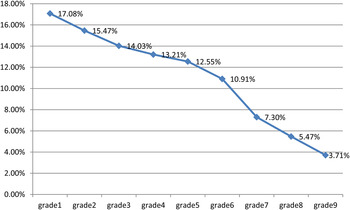
The access to public education has drawn an increasing number of migrant children to live in the city with their parents.Footnote 39 However, statistics (see Figure 4) also reveal a substantial decline in the numbers of migrant children with age. The trend of reverse migration (moving back to the countryside) is most significant when migrant children reach grade seven.
The Distribution of Migrant Children Attending Public Schools in Shanghai by Grade.

Migrant children studying in the city eventually are faced with an impossible hurdle: the senior high school entrance exam. No matter where migrant children attend school, they must take the entrance exam in their hukou hometowns. Moreover, textbooks used in public schools in Shanghai differ from those used in other provinces. The “exam closure”Footnote 40 truncates the study path of migrant children, and migrant parents are concerned that an urban education might hurt their children's chances of getting into a good high school and later attending university.
Migrant parents constantly debate if their children should stay in the city or go home to study. My interviewees shared similar opinions about the pros and cons of these two routes: urban education was considered “extensive but shallow” (guang er qian 广而浅), while rural education was thought of as “narrow but deep” (zhai er shen 窄而深). Since the late 1980s, national curriculum reform in China has advocated “education for quality” (suzhi jiaoyu 素质教育) as a means to develop the moral character and innovative spirit of children, in contrast to the old model of examination-oriented education (yingshi jiaoyu 应试教育). The pedagogy of suzhi education, although loosely defined, has been better received by urban educators, while rural communities tend to resist reforms designed to decrease the importance of testing and the amount of homework.Footnote 41
Migrant parents appreciate their children's exposure to versatile cultural curriculum and early learning of English at urban schools, and they are proud that their children learn to speak as eloquently (hui shuohua 会说话) as urbanities. However, they worry that their children would not be able to catch up in rural schools if they returned home at a later time, because the textbook content in Shanghai is too “easy.” In other words, migrant children are forced to choose between giving up the possibility of a university education in the future and losing an education that may better prepare them for urban lifestyles and job prospects in the service sector.
These institutional prerequisites have brought about a channelling effect on the educational trajectories of second-generation migrants. First, migrant children with better grades tend to return to their hometowns, usually one or two years before the high school entrance exam. Some children are sent back alone to attend a “boot-camp” style boarding high school, at the cost of family life. For others, one of the parents, usually the mother, must quit his or her life in the city to accompany the children to the countryside. For those migrant families who choose to stay together in the city, the children face an involuntary end to their educational trajectory as they are expected to work in the city after secondary or vocational school.
Seeking talent migration
For peasant children, a university education is a necessary prerequisite to social mobility – not only will it improve their future chances in the labour market, but it will also liberate them from the constraint of an agriculture hukou. College graduates, for their hard-earned degrees and marketable skills, may gain urban citizen status. The suzhi discourse has permeated the political rhetoric of recruiting the “new Shanghainese.” On the one hand, this indicates an institutional framework that divides migrant children into those who have acquired proper “quality” and those who have not; on the other hand, this renders migrant children responsible for their own self-governance as modern citizens and neoliberal subjects.Footnote 42
Yang was a 21-year-old college student with a major in engineering. She had left her parents and brother in Shanghai and returned to Anhui province to attend high school in their home township. Yang described her expectations for the future: “I want to find a clean job, never a dagong 打工 (manual labour) job. If I didn't go to college, my future would be hopeless.” She was determined to avoid her parents' fate – irregular menial work and marginal status in the city. A college education was also her ticket to leave the countryside. Yang described her grandfather as a hard-working farmer with skin “so dark that you could not see him at night.” She religiously used whitening skincare products and carefully avoided tanning which embodies rurality in China and an identity she wanted to dissociate herself from.
To prepare herself for fierce competition in the labour market, Yang had been attending job fairs since she was a sophomore. She diligently studied for certified exams in order to improve her suzhi. However, owing to the strict qualifications for this “green card policy,” very few migrants are actually eligible for “talent migration.”Footnote 43 Yang was worried about joining the “ant tribe” (yi zu 蚁族), a term used to refer to those college graduates who end up earning low wages and enduring unstable employment and crowded housing on the fringe of the metropolis.
Learning to labour
Shanghai recently opened another route for migrant children wishing to continue with their education in the city. Starting in 2009, migrant children can enrol in public vocational schools. However, there are only a limited number of subjects available for migrant students, such as hotel management, cooking, hairdressing, car repair and electroplating.
Why does vocational education offer only certain subjects to migrant children? When I threw this question at the vice-principal of a vocational school during an interview, she diplomatically answered that these fields were selected to meet the alleged “urgent demands” in the local labour market. However, these are low-paid, dirty and menial jobs which the local youth are not interested in. The policy to offer these courses to migrant children also aims to ease the enrolment crisis faced by these vocational schools largely owing to the declining birth rate of local children.
The deregulation of education in China in the post-reform era has resulted in a rapid expansion of private vocational schools. Many of these schools act as job brokers and are at the forefront of labour exploitation. The administrators can make significant profits by sending “student workers” for internships in restaurants, hotels and factories. Based on my interviews with restaurant owners and hotel managers in 2009, for each student worker who earned a monthly wage of 800 yuan (far below the then minimum wage of 960 yuan), the school extracted 100 yuan as “education feedback fees.” The government has also encouraged vocational school students to take internships in order to ease the labour shortage in manufacturing.Footnote 44 In short, vocational education, with open access and yet restricted diversity, cannot substantially improve the labour market opportunities of second-generation migrants. Moreover, it channels young migrants into exploitative and oppressive labour conditions, helping the city reproduce the next generation of migrant workers.
Conclusion
When I asked my migrant informants if the hukou still mattered, most of them replied, “Not anymore,” and some added, “not as long as you have money.” Compared to the previous policy of total exclusion, older migrants feel content about the current situation – they can at least have a “place to stand” in the cities. One migrant told me why it was futile to complain about the hukou policy: “Don't say the world is unfair to you. You are the one who hasn't worked hard enough.” This echoes the prevalent discourse in post-reform China that celebrates market freedom and individual entrepreneurship. Inequality, in this discursive frame, is seen as being down to a lack of individual effort. However, when our conversations led to the issue of education for their children, most migrant parents became agitated by the injustice hidden in the hukou-based systems of education and examination. The desire for their urbanized offspring to pursue a bright future made them question the persisting inequalities and boundaries. The neoliberal myth of the free market is shattered by the visible blocks and ceilings that hinder the second generation from gaining equal access to education and job opportunities in the city.
Indeed, the significance of the hukou has diminished owing to the disintegration of the planned economy and the privatization of social security. The access to urban education, along with the possibility of “talent migration,” opens up opportunities and offers hope to second-generation migrants. Yet, the hukou system still contributes to stratified citizenship in China; its basis has nevertheless transformed from exterior categories that characterize the control strategy of total exclusion to internal boundaries embedded in the institutions of education and the labour market.Footnote 45 In this article, I have demonstrated a variety of ways in which the urban educational system incorporates second-generation migrants. I map these modes of incorporation in the field of segmented incorporation in Figure 5.
Field of Segmented Incorporation for Chinese Second-generation Migrants

In the past, migrant children were unable to access public education and exposed to blatant discrimination in the receiving context of total exclusion. Despite the recent policy reform of educational incorporation, migrant students still suffer from spatial segregation owing to resistance from the host society. Both conditions indicate the rigidity of institutional and cultural boundaries. Second-generation migrants are institutionally excluded as well as culturally ostracized.
In mixed schools and classes, social segregation shadows the daily encounters between migrant children and urban students. Boundary marking is especially salient when imposed upon those migrant children who were born in the countryside and who display marked differences, such as dark skin or hometown accents. Even in a context of institutional incorporation, urban students continue to underscore differences in culture and status between themselves and migrant classmates.
Teachers and administrators are more inclined to impose suzhi cultivation on those migrant children who were born in the city or who have had limited exposure to rural hometowns or migrant schools as a means of cultural assimilation. Migrant children themselves are eager to cultivate and discipline themselves in order to compete for the slim chance of being accepted for “talent migration” in the future. These modes of incorporation assume that the urbanite–migrant boundary is penetrable to a certain degree, and offer the opportunity to cross that boundary to a chosen few.
I emphasize that the regime of segmented incorporation not only involves top-down policy measures but also entails symbolic struggles around cultural differences and social boundaries that operate in everyday interactions between hosts and migrants. Echoing the scholarship on ethnic boundaries,Footnote 46 I found that inter-group encounters do not always penetrate or eradicate group boundaries, but often reinforce group differentiation. The redistribution of resources and opportunities stirs anxiety among urbanites about the loss of social privilege, and they are inclined to reinforce or differentiate the boundaries to safeguard their status quo.
In this new receiving context of “segmented incorporation,” systematic exclusion has given way to more subtle forms of segregation, channelling and segmentation. The contradiction between China's pursuit of market capitalism and its institutional heritage of categorical inequality is revealed in the fate of second-generation migrants. Without lifting the ceiling on exam closure and the veil of cultural prejudice, the partial access to public education and the distant promise of talent migration simply obscure the deep-rooted social inequalities behind a façade of meritocracy.
The issue of educational inequality has stirred public outcry and has finally led to forthcoming policy reforms. In 2012, the Chinese Ministry of Education asked local governments to formulate plans regarding opening up exam opportunities for migrant workers' children. Shanghai has announced that it will allow those migrant children who are qualified based on a point system to enter local senior high schools or vocational schools and to take college entrance exams locally starting in 2014.Footnote 47 We need to observe closely how this new policy will be implemented in the near future and how it will shape the modes of incorporation for the second generation of migrants.