Introduction
In South Africa the Campanulaceae sensu stricto are represented by about 250 species assigned to 10 genera, of which eight are endemic to this region (Welman & Cupido, Reference Welman, Cupido, Germishuizen and Meyer2003). Recent molecular phylogenetic studies (Cupido, Reference Cupido2009) have confirmed that the mode of capsule dehiscence is unsatisfactory as the primary character to define broadly circumscribed genera. All the well-supported major clades revealed in these studies comprise taxa with diverse modes of capsule dehiscence or taxa assigned to different genera. Furthermore, the molecular phylogenetic trees are incongruent with trees for morphological characters, and therefore the molecular results also cannot provide a complete basis for taxonomic distinction. Above the generic level, pollen morphology and biogeography have proved useful in dividing the Campanulaceae into three lineages: the campanuloids, platycodonoids and wahlenbergioids (Eddie et al., Reference Eddie, Shulkina, Gaskin, Haberle and Jansen2003; Haberle et al., Reference Haberle, Dang, Lee, Peňaflor, Cortes-Burns and Oestreich2009). These criteria, plus the possession of unique reproductive morphological characters, have allowed us to recognise the distinctiveness of Siphocodon Turcz. and Rhigiophyllum Hochst. and to place them in a separate tribe, the Rhigiophylleae Eddie & Cupido (Eddie et al., Reference Eddie, Cupido and Skvarla2010).
Netolitzky (Reference Netolitzky and Linsbauer1926) summarised the literature on seed anatomy of angiosperms available at that time and was the first to notice that the structure of the seed coat is characteristic of a family in general and is of taxonomic value. Takhtajan (Reference Takhtajan1991) also pointed out that, even for phylogenetic correlations between families and genera, the structure of the seed coat might be important. Scanning electron microscopy data may be useful to delimit taxa at the species level, or sometimes as indicators of suprageneric groupings (Barthlott, Reference Barthlott1981, Reference Barthlott, Heywood and Moore1984; Behnke & Barthlott, Reference Behnke and Barthlott1983), while variation in seed coat surface sculpturing among taxa could be correlated to ecological aspects (Barthlott, Reference Barthlott1981). However, according to Barthlott (Reference Barthlott, Heywood and Moore1984), seed surface features are little affected by environmental conditions and are merely the expression of genetic–phylogenetic differences in the plants concerned (Haridasan & Mukherjee, Reference Haridasan and Mukherjee1988).
In his brief summary of seed characteristics in the family Campanulaceae, Corner (Reference Corner1976) listed previous literature on seed studies for this family. However, there has been no systematic study of seed surface morphology in the family as a whole, apart from the surveys of genera from the three main lineages by Eddie (Reference Eddie1984, Reference Eddie1997). The results of these surveys were hard to interpret, especially for phylogenetic studies, and the conclusion was that testa pattern seems to be closely correlated with ecology and may be useful for recognition at the species level, but of little value at the generic level. Eddie found that, as a general feature of the family, seeds that are regular in symmetry, lack wings and have pronounced reticulations with high relief are more primitive than those more irregular seeds which are rather smooth or striated and possess wings.
The usefulness of seed morphology as a character in the systematics of the Campanulaceae in North America was comprehensively studied by Shetler & Morin (Reference Shetler and Morin1986). They included representatives of all the genera of campanuloids found on the continent, reported recognisable generic patterns and speculated on the adaptive significance of seed coat sculpturing. In another broad-scale study Haridasan & Mukherjee (Reference Haridasan and Mukherjee1988) assessed the seed coat surface features in 27 species belonging to nine genera of Indian Campanulaceae, including Sphenoclea zeylanica Gaertn. (now classified in the Sphenocleaceae), and found them to be useful characters to distinguish species but not diagnostic for genera. Turkish Campanula L. species have been the focus of recent studies by Akcin (Reference Akcin2009) and Alçitepe (Reference Alçitepe2010), who also found seed coat useful in the identification of some species. Prior to these studies, 17 European species of Campanula were surveyed by Geslot (Reference Geslot1980), who came to the same conclusions. Hong & Pan (Reference Hong and Pan1998) found useful characters in pollen and seed morphology to reinstate the genus Cyclocodon Griff. ex Hook.f. However, for African Campanulaceae, only Thulin (Reference Thulin1974, Reference Thulin1975) has provided data on seed coat morphology in his studies of Namacodon Thulin, Gunillaea Thulin and Wahlenbergia Schrad. ex Roth. He found great variation in the pattern of the seed coat sculpturing in species of these genera, and many gaps remain in our knowledge of the utility of seed coat surface features for the systematics of the South African Campanulaceae.
The high species and ecological diversity in South African wahlenbergioids makes them uniquely suitable for the assessment of seed coat patterns. This study arose from the need to find additional morphological characters that would provide a practical basis for the delimitation of the South African wahlenbergioids, and to evaluate these characters for their usefulness in taxonomic and phylogenetic studies (i.e. whether they are useful in the circumscription of genera and whether they support clades). We also investigated whether these characters were associated with particular ecological conditions.
Materials and Methods
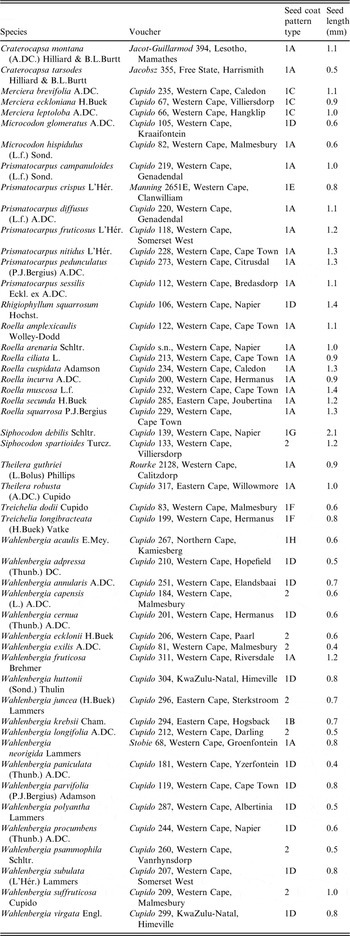
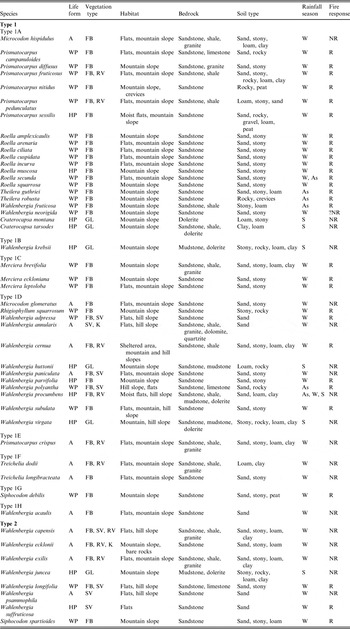
Seed samples of 50 species from 10 genera of South African Campanulaceae were examined. The selected species are representative of the major clades revealed by molecular studies (Cupido, Reference Cupido2009). Seeds were taken from mature capsules collected in the field or from herbarium specimens. Species examined, and their voucher specimens, are summarised in Table 1. The seeds were studied with an FEI Quanta 200 ESEM operating under high vacuum at an acceleration voltage of 10 kV using secondary-electron detection. Life history (annual, herbaceous and woody perennial) and ecological data (habitat, bedrock, soil type, rainfall season and fire response) for each species were obtained from herbarium specimens, personal observation and the literature (Welman & Cupido, Reference Welman, Cupido, Germishuizen and Meyer2003; Mucina & Rutherford, Reference Mucina and Rutherford2006) (Table 2). Vegetation types (fynbos, strandveld, renosterveld, grassland and karoo) follow the definitions of Mucina & Rutherford (Reference Mucina and Rutherford2006).
List of species examined, collection data and seed characteristics. Specimens are deposited at NBG and PRE

Life forms and ecological parameters scored for sampled species

A = annual; HP = herbaceous perennial; WP = woody perennial.
GL = grassland; FB = fynbos; SV = strandveld; RV = renosterveld; K = karoo.
As = aseasonal; W = winter; S = summer.
R = resprouter; NR = non-resprouter.
Results
Scanning electron microscope studies of the secondary sculpturing (fine relief of the cell wall; Barthlott, Reference Barthlott1981) of the seed coat patterns of 50 South African Campanulaceae species revealed differences in sculpturing patterns. The pattern of variation suggests a basic dichotomy of seed coat types. In accordance with the terminology of Barthlott (Reference Barthlott1981), these are identified as reticulate (Type 1) and striate/wavy (Type 2), with further subdivision into subtypes where significant variability within types is found. Types 1 and 2 conform to those described by Haridasan & Mukherjee (Reference Haridasan and Mukherjee1988) for the Indian Campanulaceae, and for Turkish Campanula species by Akcin (Reference Akcin2009). The four seed coat types described by Murata (Reference Murata1992) for the Lobelioideae also fit into these types (Tables 1 and 2).
Seed coat pattern types
Type 1: Reticulate
Type 1A
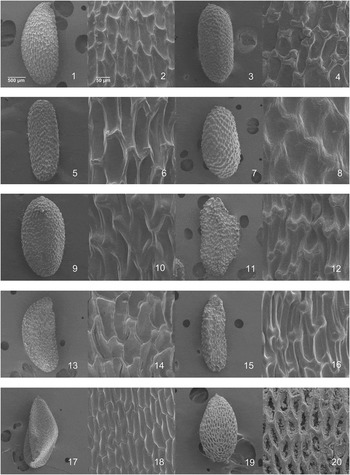
Seeds are 0.6–1.4 mm long with a smooth coarsely reticulate surface. The cells are commonly laterally compressed, with the presence of protrusions from the surface at the junction of the radial and outer tangential walls. Present in all examined species of Theilera E.Phillips, Roella L., Craterocapsa Hilliard & B.L.Burtt and Prismatocarpus L’Hér., except P. crispus L’Hér., and present in Microcodon hispidulus (L.f.) Sond., Wahlenbergia fruticosa Brehmer and W. neorigida Lammers (Figs 1–20).
Scanning electron micrographs of selected seeds of Campanulaceae. 1 & 2: Microcodon hispidulus. 3 & 4: Prismatocarpus diffusus. 5 & 6: P. pedunculatus. 7 & 8: Roella ciliata. 9 & 10: R. secunda. 11 & 12: Theilera guthriei. 13 & 14: T. robusta. 15 & 16: Wahlenbergia fruticosa. 17 & 18: W. neorigida. 19 & 20: Craterocapsa montana. Whole seed: Figs 1, 3, 5, 7, 9, 11, 13, 15, 17, 19 (scale bar = 500 μm). Detail of seed coat: Figs 2, 4, 6, 8, 10, 12, 14, 16, 18, 20 (scale bar = 50 μm).

Type 1B
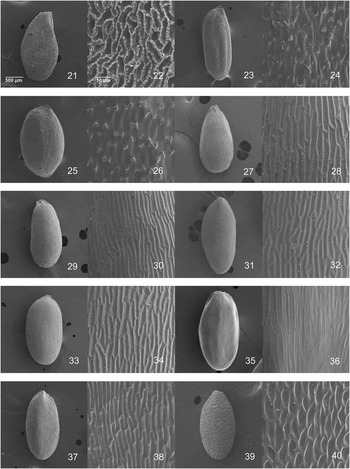
The seed coat surface is distinctly reticulate with keeled and verrucate radial walls. Cells are distinctly or slightly elongated and have a distinct areole. The seeds are 0.7 mm long. Present in Wahlenbergia krebsii Cham. (Figs 21, 22).
Type 1C
Present in all examined species of Merciera A.DC. and is similar to Type 1B, but with a weak reticulation formed by depressed radial walls and indistinct areole, giving the seed coat a warty appearance. Seeds are 0.9–1.1 mm long (Figs 23–26).
Scanning electron micrographs of selected seeds of Campanulaceae. 21 & 22: Wahlenbergia krebsii. 23 & 24: Merciera brevifolia. 25 & 26: M. leptoloba. 27 & 28: Microcodon glomeratus. 29 & 30: W. adpressa. 31 & 32: W. subulata. 33 & 34: W. parvifolia. 35 & 36: W. annularis. 37 & 38: W. huttonii. 39 & 40: W. procumbens. Whole seed: Figs 21, 23, 25, 27, 29, 31, 33, 35, 37, 39 (scale bar = 500 μm). Detail of seed coat: Figs 22, 24, 26, 28, 30, 32, 34, 36, 38, 40 (scale bar = 50 μm).

Type 1D
The seed coat surface is a distinctly or more or less smooth reticulum, sometimes keeled or verrucate. The cells are elongated with a distinct or indistinct areole. In species with weak reticulation the seed surface may appear striate or almost smooth. Type 1D seeds are 0.4–1.4 mm long and are present in Wahlenbergia procumbens (Thunb.) A.DC., W. virgata Engl., W. subulata (L’Hér.) Lammers, W. parvifolia (P.J.Bergius) Adamson, W. huttonii (Sond.) Thulin, W. adpressa (Thunb.) DC., W. cernua (Thunb.) A.DC., W. annularis A.DC., W. paniculata (Thunb.) A.DC., Microcodon glomeratus A.DC. and Rhigiophyllum squarrosum Hochst. (Figs 27–44).
Type 1E
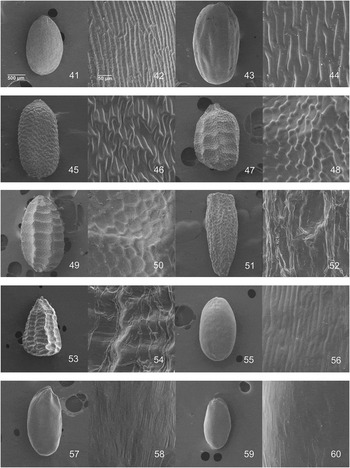
Type 1E seeds are present in Prismatocarpus crispus (Figs 45, 46) and resemble the seed coat pattern in Wahlenbergia huttonii (Type 1D; Figs 37, 38) in having a smooth reticulum with a linear areole. However, irregularly depressed radial walls create ridges that run more or less perpendicular to the long axis of the seed, giving the seed coat a rugose appearance. Seeds are 0.8 mm long.
Scanning electron micrographs of selected seeds of Campanulaceae. 41 & 42: Wahlenbergia paniculata. 43 & 44: Rhigiophyllum squarrosum. 45 & 46: Prismatocarpus crispus. 47 & 48: Treichelia dodii. 49 & 50: T. longibracteata. 51 & 52: Siphocodon debilis. 53 & 54: W. acaulis. 55 & 56: W. longifolia. 57 & 58: W. ecklonii. 59 & 60: W. exilis. Whole seed: Figs 41, 43, 45, 47, 49, 51, 53, 55, 57, 59 (scale bar = 500 μm). Detail of seed coat: Figs 42, 44, 46, 48, 50, 52, 54, 56, 58, 60 (scale bar = 50 μm).

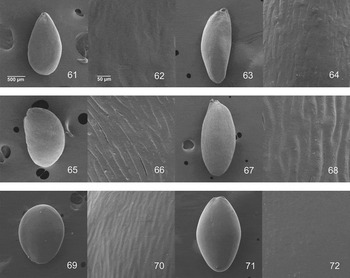
Scanning electron micrographs of selected seeds of Campanulaceae. 61 & 62: Wahlenbergia psammophila. 63 & 64: W. juncea. 65 & 66: W. polyantha. 67 & 68: W. suffruticosa. 69 & 70: W. capensis. 71 & 72: Siphocodon spartioides. Whole seed: Figs 61, 63, 65, 67, 69, 71 (scale bar = 500 μm). Detail of seed coat: Figs 62, 64, 66, 68, 70, 72 (scale bar = 50 μm).

Type 1F
The seeds are 0.6–0.8 mm long with the seed coat surface distinctly reticulate which follows the contour of pronounced longitudinal and transverse ridges. The cells are more or less isodiametrical with a distinct areole and the presence of protrusions from the surface at the junction of the radial and outer tangential walls. This type is present in the species of Treichelia Vatke (Figs 47–50).
Type 1G
Seeds are 2.1 mm long, characterised by a weakly reticulate surface with the radial walls irregularly elevated, giving the seed a wrinkled appearance. This type is present in Siphocodon debilis Schltr. (Figs 51, 52).
Type 1H
This type, present in Wahlenbergia acaulis E.Mey. (Figs 53, 54), resembles Type 1E in its pronounced longitudinal and transverse ridges. However, the seed coat surface has a very fine reticulate pattern formed by irregularly shaped radial walls superimposed on the ridges. Seeds are generally 0.6 mm long.
Type 2: Striate or wavy
The seeds are 0.4–1.2 mm long and the cell outlines are indiscernible. The seed surface is characterised by longitudinal interrupted grooves or a wavy-striped appearance. Present in Wahlenbergia longifolia A.DC., W. ecklonii H.Buek, W. exilis A.DC., W. psammophila Schltr., W. juncea (H.Buek) Lammers, W. polyantha Lammers, W. suffruticosa Cupido, W. capensis (L.) A.DC. and Siphocodon spartioides Turcz. (Figs 55–72).
Seed coat sculpturing and ecological and life history patterns
Among the species sampled, none of the seed coat types or subtypes here described is uniquely associated with any specific ecological factor or life form, although four types are found only in single species (Table 2). However, some general trends can be seen, ranging from uniform to highly diverse patterns.
Restricted to fynbos
The majority of fynbos species had seed Type 1A (reticulate). All are woody perennials except Microcodon hispidulus (annual), Prismatocarpus sessilis Eckl. ex A.DC. (herbaceous perennial) and Roella muscosa L.f. (herbaceous perennial). Microcodon hispidulus is found on shale, sandstone and granite derived soils (sand, stony, clay and loam) of mountains and flats, whereas its congener, M. glomeratus, has seed Type 1D and prefers sandstone derived soils (sand and stony) of mountains and flats. Among the Prismatocarpus species, P. sessilis seems to have a wide soil-type tolerance, including peat and loam. Roella secunda H.Buek has similar soil requirements to other fynbos Roella species, but its distribution extends to aseasonal rainfall areas. The two species of Theilera are restricted to aseasonal rainfall areas, but T. guthriei (L.Bolus) Phillips has a wider soil-type tolerance than T. robusta (A.DC.) Cupido. Wahlenbergia fruticosa and W. neorigida are among the Wahlenbergia species with reticulate seed Type 1A, with the former species occurring in areas with aseasonal rainfall. Two species of Wahlenbergia with reticulate Type 1D seeds seem to be confined to purely fynbos vegetation: Wahlenbergia parvifolia (herbaceous perennial) and W. subulata (woody perennial). The three species of Merciera are resprouting, woody perennials and all have reticulate Type 1C seeds. All of them occur on mountain slopes and require sandy, stony soils. Merciera brevifolia A.DC. may have a requirement for more moisture since it occurs on clay soils also. Rhigiophyllum squarrosum has reticulate Type 1D seeds. It is a fynbos species of stony or rocky hill and mountain slopes with sandy soils. Siphocodon debilis (woody perennial) has seeds of reticulate Type 1G whereas its congener, S. spartioides (woody perennial), has seeds of Type 2. Both are fynbos species of sandy mountain slopes on loam or peat. Wahlenbergia acaulis has reticulate seeds of Type 1H. It too is a fynbos species of mountain slopes and flats, on sand.
Primarily fynbos but with wider ecological amplitude
These included species that have wider ecological amplitude and occur in two or more vegetation types including fynbos. Those with Type 1D seeds are the woody perennials Wahlenbergia adpressa and W. polyantha (both strandveld), the herbaceous perennial W. procumbens (renosterveld), and the annuals W. cernua (renosterveld) and W. paniculata (strandveld). Prismatocarpus crispus has seeds of reticulate Type 1E, whereas the two species of Treichelia have reticulate Type 1F seeds. All of these taxa are found on sandy slopes of mountains or flats. Prismatocarpus crispus and Treichelia dodii Cupido also occur on clay soils derived from shale. They may have greater moister requirements, and therefore also occur in renosterveld. Species of Wahlenbergia with Type 2 seeds are the woody perennial W. longifolia on sandstone or limestone (extending also to strandveld), the annual W. capensis on sands, loams and clays (strandveld and renosterveld), the annual W. ecklonii on sandy loam among bare rocks (renosterveld and karoo), and the annual W. exilis on sands, loams and clays (renosterveld).
Montane grasslands
The two species of Craterocapsa, and Wahlenbergia krebsii, are plants of montane grasslands. Craterocapsa has reticulate seeds of Type 1A while Wahlenbergia krebsii has seeds of Type 1B. All three are herbaceous perennials and all require a loamy soil. Craterocapsa tarsodes Hilliard & B.L.Burtt and Wahlenbergia krebsii appear to tolerate clay soils and may require more soil moisture. Wahlenbergia huttonii and W. virgata are herbaceous perennials with seeds of Type 1D. They prefer grassy mountain slopes in sandy, stony or loamy soils on sandstone, mudstone or dolerite. Wahlenbergia juncea is also a herbaceous perennial, and grows in a similar habitat, but has Type 2 seeds. All the species associated with grasslands occur in the summer rainfall areas.
Strandveld and karoo
Three Wahlenbergia species are unique to these vegetation types. The herbaceous perennial Wahlenbergia suffruticosa (strandveld) and the annual W. psammophila (strandveld) have Type 2 seeds. The annual Wahlenbergia annularis (strandveld and karoo) has seed Type 1D. All these species prefer sandy soil on flats.
Discussion and Conclusions
The seed coat surface patterns found in the South African Campanulaceae appear to be variations of a reticulate pattern. In its most basic organisation, this reticulum is formed by a raised network of cells. However, by a combination of various degrees of depression of the radial and tangential walls, lateral compression of cells, and the development of secondary wall features, a number of recognisable seed coat patterns are established. These are in essence a transformation series among homologues. The resulting seed surface characters are complex. Although many of the characters appear to be highly adapted for dormancy, dispersal, water-uptake, and so on, the adaptive significance of seed coat sculpturing and ornamentation has been little studied at the autecological level. Shetler & Morin (Reference Shetler and Morin1986) concluded that the seeds of the Campanulaceae in North America show degrees of specialisation in the seed coat although it was not clear whether these specialisations have evolved in response to ecological or other selective factors, or show patterns found elsewhere in the family. The patterns found in the South African samples are discussed below in relation to the current genera, ecological and life history traits, and phylogenetic groups from molecular data.
Distinction of current genera in relation to seed types
Among the 10 genera, species of Merciera and Treichelia are uniform in seed type – Types 1C and 1G, respectively – with subtle variation between individual species. The remaining seed types are species specific or include species from more than one genus. Type 1A seed, corresponding to Type A in Murata (Reference Murata1992), is reportedly only found in the Lobelioideae. However, it is also characteristic of the Campanuloideae genera Craterocapsa, Theilera, Roella, Prismatocarpus (except P. crispus), and one Microcodon and two Wahlenbergia species. The species of Wahlenbergia are most diverse in seed types, ranging from coarsely reticulate to almost smooth in surface features. The unique seed type of Wahlenbergia acaulis is associated with a mode of capsule dehiscence, via protruding folds, found nowhere else in the genus. A similar association between seed type and capsule dehiscence is found in Prismatocarpus crispus. This species differs from the usual longitudinally dehiscent capsule in Prismatocarpus in having what appears to be an indehiscent capsule. The two species of Siphocodon have distinctly different seed types to each other although, together with Rhigiophyllum squarrosum, they share unique pollen morphology (Eddie et al., Reference Eddie, Cupido and Skvarla2010). Rhigiophyllum squarrosum has a similar seed surface morphology to Microcodon glomeratus and species of Wahlenbergia, some of which were previously classified in Lightfootia L’Hér., nom. illeg.
Ecology and life history in relation to seed types
It has been suggested that the remarkably diverse South African landscape, with its associated climatic conditions and soil types, has created numerous niches that have in turn led to high species diversity. These factors partly explain the high level of endemism and species diversity of the Cape flora (Goldblatt, Reference Goldblatt1978; Linder, Reference Linder2003). Elsewhere, Givnish et al. (Reference Givnish, Sytsma, Smith, Hahn, Wagner and Funk1995) found a striking correlation between niche and phenotypic diversification within genera for the Hawaiian lobelioids. They found that species occupying habitats such as sea-cliffs, wet forest and mesic forest have altered growth forms.
Although most of the herbarium specimens used in our study generally lacked detailed ecological data, the broad categories used permit us to see general trends in relation to seed types. Species with Type 1A seeds have a more restricted ecological tolerance, whereas those with seed Types 1D and 2 have wider tolerance and are also likely to include diverse life forms. In the North American study, Shetler & Morin (Reference Shetler and Morin1986) suggested that annual species have seed surface features comparable to those present in Type 1D, which perhaps have selective advantages in dry or disturbed habitats by reducing water loss. Our study offers little evidence that seed types are closely correlated to unique ecological factors present in the vegetation types, such as the regular occurrence of fire, nutrient-poor soils, winter or summer rainfall season, soil type or even life form. Typically in South Africa, annuals occur in the winter-wet south Western Cape, where the seed germinates during this wet period and survives the dry summer in the soil. In the same area, the perennial species flower during the dry summer months, with their seeds maturing on the plant through most of the hot dry conditions and then being released during the cooler autumn months. As with the ecological factors, our study does not show a correlation between life form and seed type despite these different strategies. Instead the seeds have an equal tolerance to different pH levels in soils derived from different bedrock types, or equal tolerance to the higher moisture levels in renosterveld or lower moisture levels in fynbos.
Phylogenetic patterns in relation to seed types
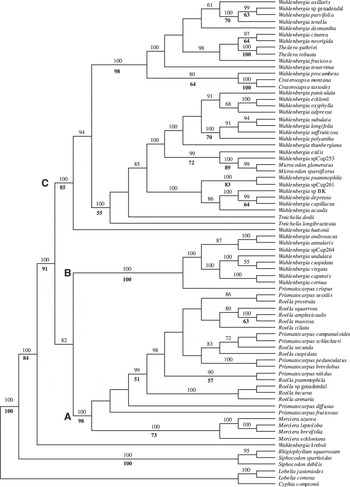
In recent phylogenetic studies of the South African Campanulaceae using DNA sequence data (Cupido, Reference Cupido2009), the 50% majority rule consensus tree inferred from the Bayesian analysis reveals that Wahlenbergia is paraphyletic and forms three major clades (A, B and C; see Fig. 73) with one minor outlier (W. krebsii). Reticulate seed (Type 1) is distributed in all three clades and occurs in all genera. Type 1A occurs predominantly in clade C comprising Craterocapsa, Theilera and Wahlenbergia (the majority of the species in this clade being formerly treated as Lightfootia, nom. illeg.), and also in clade A comprising Roella, Prismatocarpus and Merciera. No genus is characterised by possession of striate or wavy seed (Type 2). This seed type occurs in clade C (Wahlenbergia ecklonii, W. longifolia, W. exilis) and clade B (W. capensis), but does not occur in clade A. Eddie (Reference Eddie1997) concluded that the distribution of character states in the seeds of the Campanulaceae is reticulate (tokogenetic) across taxa, making cladistic analysis difficult. Nevertheless, from a phylogenetic perspective it would appear that a transition series of testa surface relief can be distinguished. The reticulate pattern appears to be the ancestral condition whereas striated arrangements are more derived. The general picture that is emerging is of the reticulate seed (Type 1) being found in all genera, with subtype 1A being the most ancestral and predominant in the majority of fynbos taxa. There is a departure from the ancestral reticulate type towards a number of reticulate subtypes until we reach the derived striated or wavy type (Type 2). This conclusion would accord with what is known of the gradual aridification of the South African climate since the Oligocene and the subsequent proliferation of mosaic speciation across a diversity of soil types and microclimatic conditions associated with the vicissitudes of the mid–late Tertiary. Many of the unique wahlenbergioid genera of the ‘fynbos’ vegetation may be relictual palaeoendemic elements of a formerly more widespread afro-montane flora. This sclerophyllous heath vegetation is not restricted to the Cape but occurs elsewhere in southern Africa, in Pondoland and the Drakensberg, and throughout sub-Saharan Africa, Madagascar and the Mascarene Islands, in cool, montane environments where rainfall is high and soils are highly leached (Linder, Reference Linder1990; Carbutt & Edwards, Reference Carbutt and Edwards2001).
Fifty per cent majority rule consensus of trees retained in the Bayesian analysis of the combined trnL–F and ITS data sets for 72 taxa of the Campanulaceae and three Lobeliaceae (outgroup). Numbers above branches indicate posterior probability values expressed as percentages. Bootstrap values ≥ 50% are indicated below the branches.

The molecular studies further revealed five assemblages, each comprising all, or some, of the species of each genus (Fig. 73): 1. Wahlenbergia–Theilera–Microcodon–Craterocapsa–Treichelia (clade A); 2. Wahlenbergia–Prismatocarpus crispus (clade B); 3. Roella–Prismatocarpus–Merciera (clade A); 4. Wahlenbergia krebsii; 5. Rhigiophyllum–Siphocodon. Wahlenbergia resolved as paraphyletic, and except for W. krebsii none of the lineages that involve Wahlenbergia species can be correlated with any unique seed type. The isolated position of Wahlenbergia krebsii, already reported by Thulin (Reference Thulin1975), is supported by its possession of Type 1B seeds while all the other Wahlenbergia lineages possess diverse seed-type patterns. The inclusion of Wahlenbergia krebsii in Wahlenbergia requires further investigation. The common possession of Type 1A seeds supports the close relationship between Theilera, Craterocapsa, Wahlenbergia fruticosa and W. neorigida, but the sharing of this seed type with Prismatocarpus and Roella is surprising. The species of Prismatocarpus and Roella appear in a thoroughly mixed clade which is sister to Merciera, the entire clade being well supported. The monophyly of Merciera revealed by the molecular data is supported morphologically by Type 1C seeds.
In Prismatocarpus, Siphocodon and Microcodon two distinct seed types are evident. The placement of Prismatocarpus crispus is corroborated by increasing morphological evidence, including its unique seed type, suggesting the re-classification of this species or even the formation of a new genus. Seed-type patterns do not support the close relationship between Siphocodon and Rhigiophyllum as revealed by molecular and pollen data, but rather the uniqueness of the individual species. Similarly, the phylogenetic pattern found for the two sampled species of Microcodon contradicts their species-specific seed-type pattern.
Seed coat morphology in the South African wahlenbergioids is of limited use as a diagnostic character to circumscribe genera or as a synapomorphy to define clades. It does, however, appear to be useful to distinguish species, a conclusion also arrived at by Haridasan & Mukherjee (Reference Haridasan and Mukherjee1988) for Indian Campanulaceae and by Eddie (Reference Eddie1984, Reference Eddie1997) for all three main lineages of the family. Differences in seed coat sculpturing patterns are not correlated with specialised ecological requirements or life history traits, but instead indicate adaptability for survival in a set of diverse environmental conditions.
Acknowledgements
We thank the Western Cape Nature Conservation Board for granting a collecting permit.