Introduction
In India, female sterilization is the most popular method of family planning and its contribution to contraceptive prevalence is increasing. In 2005–06, about 37% of ever-married women were female sterilization adopters compared with 30% in 1992–93. Nationally, among modern family planning users (49%) about 71% were sterilization adopters (IIPS & ORC Macro, 2007). The 2005–6 National Family Health Survey (NFHS-3) revealed a substantially higher percentage of sterilization users among the modern family planning users in south India (90%) compared with other regions (between 48% and 75%) in the country. Another important feature of female sterilization in India is the declining age at sterilization. The median age at female sterilization declined from 27 years in 1992–93 to 25 years in 2005–06. In addition, the number of children at sterilization has been decreasing. Nationally, in 2005–06, about 34% of sterilized women in the age group 15–49 years had two children compared with 20% in 1992–93. South India had a substantially higher percentage (49%) of sterilized women with two children compared with the rest of the regions (between 26% and 35%) in the country. Thus, family planning practices in south India are characterized by higher female sterilization prevalence, lower age at sterilization and fewer children at sterilization. Mothers, in particular young mothers, in such settings will have lower childbearing responsibilities and several years of reproduction free time, even at the age of 30 years. As this pattern of fertility behaviour is being adopted by women in other regions, early age at female sterilization and low fertility are likely to become national features of fertility behaviour.
To what extent such changes in the reproductive behaviour of young mothers enhance their autonomy is an important question that has not been addressed in previous studies. Previous studies have defined women's autonomy in a number of ways, but two of the themes are women's ability to participate in household decision-making and their freedom of mobility (Bloom et al., Reference Bloom, Wypij and Gupta2001; Jejeebhoy, Reference Jejeebhoy2002; Saleem & Bobak, Reference Saleem and Bobak2005; Kishore & Gupta, Reference Kishore and Gupta2009; Mistry et al., Reference Mistry, Galal and Lu2009; Acharya et al., Reference Acharya, Bell, Simkhada, van Teijlingen and Regmi2010; Acharya et al., Reference Acharya, Sabarwal and Jejeebhoy2012). This paper focuses on these two important domains of women's autonomy (Shroff et al., Reference Shroff, Griffiths, Adair, Suchindran and Bentley2009; Afridi, Reference Afridi2010). It is recognized that women's autonomy is multidimensional and there are many characterizations of it in the demographic and sociological literature (Ghuman et al., Reference Ghuman, Lee and Smith2006). Thus, the domains included in this paper only represent some of the women's autonomy domains and do not account for a wider concept of autonomy. However, participation in decision-making on household purchases and freedom of mobility are key determinants of women's autonomy, which in turn enhance women's empowerment (Bloom et al., Reference Bloom, Wypij and Gupta2001; Mistry et al., Reference Mistry, Galal and Lu2009; Afridi, Reference Afridi2010; Acharya et al., Reference Acharya, Sabarwal and Jejeebhoy2012): an important goal enunciated by the 1994 International Conference on Population and Development (ICPD, 1994).
Previous studies have identified several demographic and social factors associated with the two domains of women's autonomy discussed above in developing countries. These include women's age (Senarath & Gunawardena, Reference Senarath and Gunawardena2009; Acharya et al., Reference Acharya, Bell, Simkhada, van Teijlingen and Regmi2010), employment status and wages (Rahman & Rao, Reference Rahman and Rao2004; Acharya et al., Reference Acharya, Bell, Simkhada, van Teijlingen and Regmi2010), education (Gulati, Reference Gulati1993; Senarath & Gunawardena, Reference Senarath and Gunawardena2009; Afridi, Reference Afridi2010), number of children and sons (Senarath & Gunawardena, Reference Senarath and Gunawardena2009) and kinship (Dyson & Moore, Reference Dyson and Moore1983; Niraula & Morgan, Reference Niraula and Morgan1996; Bloom et al., Reference Bloom, Wypij and Gupta2001; Jejeebhoy & Sathar, Reference Jejeebhoy and Sathar2001), and contextual factors, including state interventions (Malhotra et al., Reference Malhotra, Vanneman and Kishor1995; DasGupta et al., Reference DasGupta, Lee, Uberoi, Wang, Wang and Zhang2000; Moursund & Kravadal, Reference Moursund and Kravadal2003; Rahman & Rao, Reference Rahman and Rao2004).
This paper argues that in the context of early sterilization and low fertility, young mothers' autonomy in household decision-making and freedom of mobility are reinforced during the post-sterilization period, particularly within the first few years after sterilization. As a result, young sterilized mothers have greater autonomy compared with non-sterilized young mothers of similar socioeconomic backgrounds. The paper further argues that female sterilization at younger ages accelerates the acquisition of autonomy, which is normally achieved towards the end of natural reproduction (Saavala, Reference Saavala2001, Reference Saavala, Fruzzetti and Tenhunen2006; Mumtaz & Salway, Reference Mumtaz and Salway2005). However, with progress in age, difference in autonomy between sterilized and non-sterilized women diminishes as women achieve autonomy through socially ascribed roles commensurate with age and life-cycle stage.
Given the context, the main objective of this paper was to examine whether or not sterilized young mothers below 30 years of age have greater participation in household decision-making and greater freedom of mobility compared with young mothers who have never used any modern family planning method, while controlling for demographic and social variables. In order to establish the role of female sterilization in autonomy, the paper also examines whether or not young mothers who have ever used any modern temporary family planning methods have greater autonomy compared with young married mothers who have never used any modern family planning method. The paper also examines the autonomy of sterilized women aged 30 years and above in order to establish whether or not the impact of early age at sterilization diminishes with age. Finally, the socio-cultural pathways from sterilization to women's autonomy are discussed using qualitative data collected from two south Indian states.
Data
Quantitative data
Data for this paper were taken from the third round of the National Family Health Survey (NFHS-3), a nationally representative cross-sectional household survey carried out during 2005–06. The data are available for academic use from the International Institute for Population Sciences (IIPS), Mumbai, for which no ethical approval is required. The objective of NFHS-3 was to provide state- and national-level estimates on various demographic measures including family planning (IIPS & ORC Macro, 2007). The NFHS-3 included a two-stage sample design in most rural areas and a three-stage sample design in most urban areas. In rural areas, the villages were selected at the first stage using a Probability Proportional to Size (PPS) mechanism. In the second stage the required number of households was selected using systematic sampling methodology. In urban areas, development blocks were selected at the first stage. In the second stage Census Enumeration Blocks (CEB) containing approximately 150–200 households were selected followed by selection of the required number of households using systematic sampling methodology (IIPS & ORC Macro, 2007). The NFHS-3 collected information from 109,041 households and 124,385 women aged 15–49 years. The details of the survey design and other information are given in the NFHS 2005–06 report (IIPS & ORC Macro, 2007).
As this study focused on south India, data were extracted for Andhra Pradesh, Karnataka, Kerala, and Tamil Nadu from the main data set. The analysis was restricted to currently married women, as women's autonomy might be related to marital status. As women are unlikely to be sterilized if they have no children, childless women were excluded from the analysis. Thus, the total sample was 14,575 currently married south Indian women aged 15–49 years.
Qualitative data
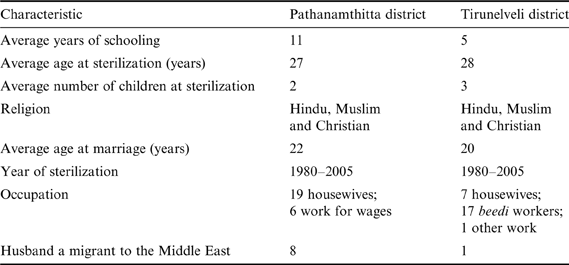
Fieldwork was carried out as part of a larger study ‘Social Benefits of Early Sterilization and Low Fertility in South India’ in one village each in Pathanamthitta district in Kerala and Tirunelveli district in Tamil Nadu during 2010–11. These two districts were selected because of their low fertility and high female sterilization acceptance. In total 50 women were interviewed from 50 households: 25 each from Pathanamthitta and Tirunelveli. In addition, fifteen husbands, five in-laws and two community members were interviewed. Women and men were interviewed by female and male interviewers, respectively, using an interview guide. All the interviews were conducted at the respondent's home. The themes of the interviews were the impact of early age on female sterilization and low fertility on women's well-being. The interviews focused on four main themes: health, education, employment and social status. All the interviews were carried out in the local language and were audio-recoded. Transcribed data were analysed for themes using the Nvivo 9 package. The characteristics of the women interviewed in the study are given in Table 1. The objective of the qualitative data was to explain associations obtained from the statistical analysis of quantitative data and, therefore, the results of the qualitative analysis are not presented in the Results section.
Characteristics of women interviewed, Kerala and Tamil Nadu, 2010–11, N=50

Methods
Dependent variables
Household decision-making autonomy
In the survey two questions were asked to each woman regarding their decision-making role in household purchases, i.e. Who makes the following decisions: (1) decisions about making major household purchases, (2) decisions about making purchases for daily household needs? The pre-coded answers provided in the interview questionnaire were: mainly you; mainly your husband; you and your husband; or someone else. The categories of answers ‘mainly you’ and ‘you and husband jointly’ were grouped together and referred to as women having decision-making autonomy in the family (Yes, coded 1). The other categories ‘husband’ and ‘someone else’ were grouped together and referred to as women having no decision-making autonomy in the family (No, coded 0). For the analysis, this variable is considered as a ‘count’ variable as it considers each question as an ‘event’ with success (have autonomy) or failure (does not have autonomy) outcomes. It may be noted that this would not refer to number of times women were involved in such decision-making as such data were not gathered in the survey. Thus, the questions asked in the survey could be best expressed as a summary measure of women's participation in household decision-making. As there are only two questions on household decision-marking autonomy, the total number of possible outcomes are three: 0 (if women reported no autonomy in the two ‘events’); 1 (if women reported autonomy in any one of the two ‘events’); and 2 (if women reported autonomy in both the ‘events’).
Mobility autonomy
Two questions were asked in the survey on women's freedom of mobility with regard to visiting market or places outside the village (a third question on visiting health facilities was also asked in the survey, but as this does not fall within the conceptual remit of the paper it was not included in this study). These questions were phrased as: Are you usually allowed to go to the following places alone, only with someone else, or not at all: (a) market or (b) places outside this village/community. The response category ‘alone’ is referred to having mobility autonomy (Yes, coded 1) and ‘with someone else’ and ‘not at all’ were grouped together and referred to as having no mobility autonomy (No, coded 0). One additional question regarding decision-making regarding visiting family or relatives was also asked in the survey and the answers were categorized as in the section ‘household decision-making autonomy’ given above. The ‘mobility autonomy’ variable was also considered as a ‘count’ variable as each question was considered as an ‘event’. Since there were three mobility-related questions (events), four possible outcomes were considered: 0 (if women reported no autonomy in all the three ‘events’); 1 (if women reported autonomy in any one ‘event’); 2 (if women reported autonomy in any of the two ‘events’); 3 (if women reported autonomy in all the three ‘events’).
Independent variables
The main independent variable of interest is the family planning ever-use status reported by currently married women. The three categories of this were: (1) never-users of any modern family planning method (this includes users of traditional methods), (2) female sterilization adopters and (3) current or past users of any modern temporary family planning method. The three categories were obtained from two main questions administered in the survey. These two main questions and the sub-questions were: (1) Have you ever used anything or tried in any way to delay or avoid getting pregnant? If yes: What have you used or done; and (2) Are you currently using any method to delay or avoid getting pregnant? If Yes: Which method are you using? From the two questions, women who have never used any modern family planning method were identified, which included women using traditional methods. From the question on current users, women who had undergone female sterilization were identified. Current or past users of pills, IUD, diaphragm, condom, implant, female condom, foam or jelly were denoted as ever-users of modern temporary family planning methods and were identified from the questions on current and ever-use of family planning methods.
The control variables included in the analysis were: current age of women, women's education and occupation, husband's education, number of surviving children, number of surviving sons, household type (nuclear/non-nuclear), place of residence (rural/urban), caste, religion, state and household economic status. Selection of control variables was guided by previous research where theoretical or empirical association with women's autonomy was identified.
Statistical analysis
Bivariate analysis and Poisson regression modelling were carried out to examine the association between female sterilization and female autonomy. Bivariate analyses were used to provide number and percentage of women across the categories of independent variables with dependent variable. The associations were tested using the χ2 test. Poisson regression was selected because the dependent variable is a count variable. Test for over-dispersion was carried out and there was no indication of such problem in the models. The two models carried out in the paper were below 30 years and 30 years and above. The Incidence Rate Ratio (IRR) was estimated to show the rate of the ‘event’ occurring (household decision-making and mobility autonomy) as a result of the independent variable (family planning use) while keeping other variables in the model constant. Control variables were also included in the regression models although the results for these variables are not presented in this paper. Analyses were carried out using STATA MP11 (StataCorp, 2009).
Results
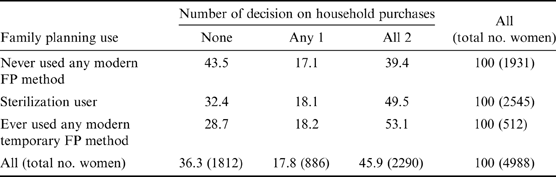
Tables 2 and 3 provide the percentages of currently married women below 30 years of age according to their family planning use and decisions on household purchases and freedom of mobility. As shown in Table 2, overall, about 36% of the currently married women below 30 years in south India did not report participation in any decision-making on household purchases. Further, among the never-users of modern family planning methods about 43% did not report participation in any of the decision-making on household purchases (major or daily purchases) compared with 32% among the sterilized women and 29% among ever-users of modern temporary family planning methods. The percentage of women reporting participation in decision-making on both the household purchases was highest (53%) among ever-users of modern temporary family planning methods followed by sterilization users (49%) and never-users of modern family planning methods (39%). Overall, never-users of modern family planning methods had lower participation in household decision-making compared with sterilization and modern temporary family planning users, and the association was statistically significant.
Percentages of currently married women below 30 years according to number of decisions about household purchases, south India, 2005–06
Pearson's χ2(4)=77.6605; p<0.001.
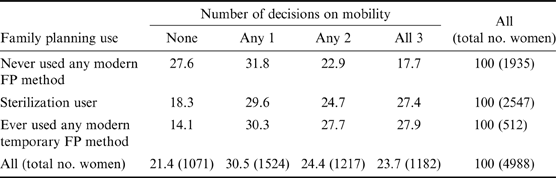
Percentages of currently married women below 30 years according to number of decisions about freedom of mobility, south India, 2005–06
Pearson's χ2(6)=113.4233; p<0.001.
As shown in Table 3, overall, 21% of the currently married women below 30 years of age reported no mobility autonomy. Further, among never-users of modern family planning methods about 28% of the women reported no freedom of mobility compared with 18% among sterilized women and 14% among ever-users of modern temporary methods. The percentage of women reporting freedom of mobility in all the three questions was highest among temporary modern family planning users (28%) followed by sterilization users (27%) and never-users (18%). The association between family planning use and freedom of mobility among currently married women in the age group 15–29 was statistically significant.
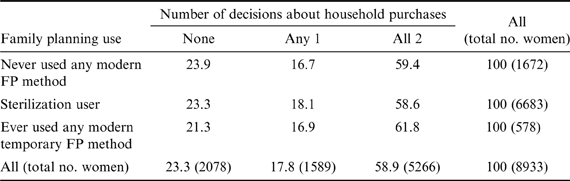
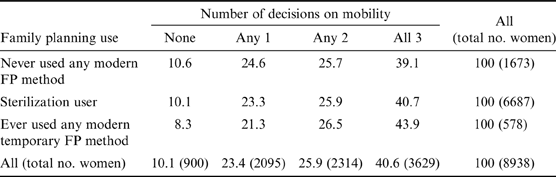
Tables 4 and 5 provide the percentage of currently married women aged 30 years and above according to family planning use and decisions about household purchases and freedom of mobility. As evident from Table 4, about 23% of the currently married women aged 30 years and above in south India reported no participation in decision-making on household purchases. Further, among the never-users of modern family planning methods about 24% reported no participation in household decision-making compared with 23% among sterilized women and 21% among modern temporary family planning users. The percentage of women reporting participation in decision-making on both the household purchases was highest (62%) among ever-users of modern temporary family planning methods followed by sterilization users and never-users of modern family planning methods (59%). Overall, there was no significant association between status of family planning use and participation in household decision-making in south India.
Percentages of currently married women 30 year and above according to number of decisions about household purchases, south India, 2005–06
Pearson's χ2(4)=4.0834; p=0.395.
Percentages of currently married women 30 years and above according to number of decisions about freedom of mobility, south India, 2005–06
Pearson's χ2(6)=6.8724; p=0.333.
As revealed in Table 5, about 10% of the currently married women aged 30 years and above did not report freedom in all the three domains of mobility (relatives, outside the village, market). Among never-users this was 11%, among sterilization users it was 10% and among ever-users of modern family planning methods it was 8%. Freedom to visit all the three mobility areas was lowest among never-users of modern family planning methods (39%) followed by users of modern temporary family planning methods (44%) then sterilization users (41%). However, the association between family planning use and freedom of mobility was not statistically significant.
Household decision-making autonomy
Women aged below 30 years
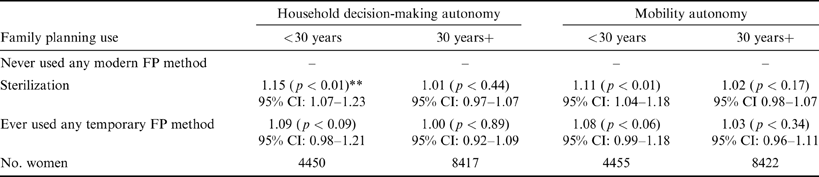
Table 6 provides the Incidence Rate Ratios (IRR) for household decision-making autonomy for the three family planning groups. Sterilized women compared with never-users of modern family planning methods, while holding the other variables in the model constant, had an incidence rate 1.15 (95% CI: 1.07–1.23) times greater for household decision-making autonomy. This difference was statistically significant. Women using a modern temporary family planning method had a rate 1.09 (95% CI: 0.98–1.21) times greater for household decision-making autonomy compared with never-users of modern family planning methods. This difference, however, was not statistically significant.
Incident rate ratios (IRR) for ‘decision’ and ‘mobility’ autonomy according to family planning use and current age of women, south India and states, 2005–06
Variables controlled in the model: education of woman, woman's work status, caste, religion, wealth status of household (wealth quintiles), place of residence (urban; rural), relationship with household type (nuclear and non-nuclear), age of women, number of surviving children and number of surviving sons.
Women aged 30 years and above
Currently married sterilized women had a 1.01 (95% CI: 0.97–1.07) times greater rate for household decision-making autonomy compared with never-users of modern family planning methods. Clearly, this difference was not statistically significant. Similarly, there was no statistically significant difference between never-users and ever-users of modern family planning methods with regard to household decision-making autonomy (IRR 1.00; 95% CI: 0.92–1.09).
Mobility autonomy
Women aged below 30 years
The last two columns of Table 6 provide IRRs for mobility autonomy. Sterilized women compared with never-users of modern family planning methods had a rate 1.11 (95% CI: 1.04–1.18) times greater for mobility autonomy while controlling for other factors. This difference was statistically significant. Ever-users of modern temporary family planning methods compared with never-users had a rate 1.08 (95% CI: 0.99–1.18) times greater mobility autonomy. This difference was not statistically significant.
Women aged 30 years and above
Sterilized women compared with never-users of modern family planning methods had a rate 1.02 (95% CI: 0.98–1.07) times greater for mobility autonomy. Clearly, this relationship was not statistically significant. Women using modern family planning methods had a slightly higher rate of mobility autonomy (IRR 1.03; 95% CI: 0.96–1.11) compared with women who had never used a modern family planning method. However, the relationship was not statistically significant.
Discussion
Although women's autonomy has been extensively researched in developing country contexts, no previous research has examined post-sterilization autonomy. In the Indian context research in this area is important as the national family planning programme is dominated by female sterilization and is increasingly taking place in women at younger ages and with fewer children. This study demonstrates that currently married young sterilized mothers in south India have substantially greater autonomy in two important domains of female autonomy: decision-making on household purchases and freedom of mobility. These findings, derived from the analysis of quantitative data, were supported by the thematic analysis of qualitative data gathered in this research.
A brief discussion about the context of female sterilization in the two study villages would be useful to understand pathways from female sterilization to autonomy. In the villages female sterilization was the preferred family planning method of both women and men. Male sterilization was uncommon: men reported that sterilization would adversely affect their ability to undertake hard work and therefore preferred their wives, who generally carry out home-based work, to undergo sterilization. Similar findings have also been reported in a study carried out in Madhya Pradesh, India (Char et al., Reference Char, Saavala and Teija2009). At the time of fieldwork the fertility norm in the villages was for women to be sterilized after having two children of any sex: a 30-year-old woman from Tamil Nadu reported:
… presently most of the females are doing operation after having two children. They do not worry about whether it is male or female.
This pattern of reproductive behaviour was reported in an earlier study carried out in Kerala (Pallikadavath & Wilson, Reference Pallikadavath and Wilson2005). The more recent sterilization cohorts of women in this study had accepted sterilization after having two children. Some of the social and economic contexts in the villages that promoted female sterilization were the following. Couples desired to limit the number of children to two in order to provide them with better education and good standard of living. In both the villages boys and girls were given equal opportunities for primary education. However, girls were more likely to be withdrawn from schools if their performance was not considered adequate to obtain a level required to obtain a job. An earlier study carried out in the Tamil Nadu village about 15 years ago also reported the desire of both men and women to provider better education for their children (Dharmalingam, Reference Dharmalingam1995). In the study villages divorce and remarriages were uncommon among women, although recent media reports suggested an increase in divorce in urban areas of India (Giridharadas, Reference Giridharadas2008). Therefore, women were not required to remain fertile for the potential prospects of remarriage and having children in the new union. The majority of the women in the study reported that temporary family planning methods were not suitable for prolonged use primarily due to the fear of side-effects. A 32-year-old woman reported:
I did not know about the condom but I knew about copper-T. Some of my relatives used it. They suggested me that copper-T is not good for the health; it will create health problems in our body so you do not use it. She suggested undergoing family planning operation after having two children. As a result, I did the family planning operation with two children.
Women and men in this study also perceived temporary methods as not being suitable for limiting the number of children. They believed that this could be done through sterilization only. Further, poor women in both the villages were influenced by free provision of the sterilization operation and monitory incentives offered by the public health care system. The majority of the women in this study reported receiving monitory benefits for undergoing sterilization. Indeed there has been a female sterilization focus in the Indian family planning programme (Koenig et al., Reference Koenig, Foo and Joshi2000), and this was evident in the two study villages given the very low use of modern temporary family planning, similar to the findings of a study carried out in Kerala (Zavier & Padmadas, Reference Zavier and Padmadas2000). Further, women preferred to undergo sterilization in order to protect their health from the harmful effects of repeated pregnancies. This was particularly the case in Tamil Nadu where women had to work long hours in beedi (traditional cigarette) making, besides undertaking labour-intensive household work. Although there were differences in the social and economic situation in the two villages, there were similarities in motivation for adopting female sterilization, particularly those related to the education and well-being of children. However, women did report some negative health impacts of the sterilization operation. Younger women reported menstrual problems, pain in the stomach and weight gain. Older women reported back pain, lack of blood in the body and an inability to work as problems associated with the sterilization operation.
At the time of fieldwork, all the households that participated in this study, irrespective of their religion, practised the patrilocal form of residence. It may be noted here that upper caste families in Kerala had practised the matrilocal form of residence in the past (Chacko, Reference Chacko2003). In patrilocal families the daughter-in-law cohabits with her husband's family, including parents-in-law (Allendorf, Reference Allendorf2010). In such settings newly married daughters-in-law do not command any authority in household decision-making; most of the decisions are taken by the senior members of the family. Female sterilization altered this relationship as mothers-in-law and daughters-in-law attain similar reproductive status through sterilization. This convergence in reproductive status transforms the equitable intra-household relationship between daughters-in-law and mothers-in-law. This had facilitated joint household decision-making and more freedom of mobility for daughters-in-law. Research carried out in Andhra Pradesh in India had similar findings, whereby young daughters-in-law adopted sterilization to enhance their social status to be on a par with their mothers-in-law (Saavala, Reference Saavala1999).
However, the pace of daughter-in-law's involvement in household decision-making during the post-sterilization period was gradual and associated with life-cycle stages, particularly age. Interviews with women revealed that young mothers started participating in household decisions when they had completed their childbearing and adopted sterilization. As reported in other studies (DasGupta, Reference DasGupta1995) women in this study also reported that they started to participate more in household matters when they had completed their family as per the norms in the society. Undergoing sterilization after achieving the required number of children was as a ‘rite of passage’ where accomplishment of reproduction was socially acknowledged and rewarded. Increased household responsibilities and associated authority to carry out those responsibilities are a recognition of a woman's new social role in the family. In this study women reported shouldering increased household responsibilities when their children reached pre-school age, around 4–5 years. With increase in women's age responsibilities in the family also increased and by the age of 30 years both sterilized and non-sterilized women of similar socio-demographic backgrounds achieved similar levels of participation in household decision-making and freedom of mobility. These findings are supported by a study carried out in Pakistan where the number of unaccompanied visits by women increased with age and life-cycle stages (Mumtaz & Salway, Reference Mumtaz and Salway2005).
Accepting sterilization after having the desired number of children also increased women's autonomy within marriage – particularly with husbands. In Tamil Nadu, having fewer children enabled women to work more hours in beedi making and thus contributed significantly to the family economy. Women in Tamil Nadu contributd around Rs300–500 per week to the household budget. Women had significant control of the money they earned and most of them had bank accounts. Further, the beedi industry guarantees regular income and, therefore, women become the breadwinners in the family. They also had savings and other benefits as part of their employment benefits package. Husbands in this study reported consulting their wives before making any important decisions. Women in Tamil Nadu in these circumstances also had greater freedom to visit places within and outside the village. In Kerala, as the majority of the women did not work in paid jobs their direct economic contribution to the family was limited. However, women had similar or even higher levels of education compared with their husbands. The majority of the women in this study reported participating in self-help groups supported by the government. These consisted of groups of 10–15 women who carried out many economic activities including micro-finance and in some cases small businesses. These activities helped women to acquire knowledge and information about government programmes for women and families, besides improving their overall awareness. It is highly likely that such exposure gives women the courage and ability to participate in household decision-making and achieve freedom of mobility.
It was a cultural practice in the study villages for women to return to their natal home for prenatal, delivery and postnatal care. The majority of the women in the study spent 2–4 months in their natal home for each delivery; longer periods were reported for the first delivery. As a result of sterilization women had fewer long-duration maternity visits to their natal home. For example, as the majority of the women were sterilized with two children, long-duration maternity visits to the natal home were reduced to two occasions compared with several occasions when women used to have many children. Due to the limited use of family planning for spacing, the gap between the first and second child was also short among the women interviewed. As a result maternity-related, long-duration visits to natal home were confined to the first few years after marriage. Thus, female sterilization enabled women to spend uninterrupted long-duration stays in their husband's family when they were still young. In these circumstances women could strengthen their social network within the household, among the relatives and neighbourhood. This could enable her to exercise greater participation in household decision-making and to achieve more freedom of mobility. However, it may be noted that reduced maternal visits of long duration did not stop women from undertaking short-duration frequent visits to their natal home. In this study women did report visiting natal home frequently and thus have benefited from it to acquire autonomy through kin support, as reported in a study in Nepal (Niraula & Morgan, Reference Niraula and Morgan1996).
An important consequence of female sterilization at younger ages is ‘social compression’ whereby women accomplish reproductive social events – starting and ending childbearing – within a relatively short period of time. The ‘social compression’ experienced by daughters-in-law impacts on the social status of mothers-in-law by advancing their less-authoritative older age social status at relatively younger ages. In this circumstance, from a life-cycle perspective, mothers-in-law have relatively less authoritative social status within the family at younger ages.
The findings of this study have important policy implications as female sterilization continues to dominate family planning in India; age at female sterilization continues to decline, and sterilization takes place with fewer children. While women should be given choice of family planning methods, the potential social merits of female sterilization should not be understated. Policies and programmes are needed to tap the autonomy benefits of female sterilization for women's further education and employment. This could include flexible age criteria for entering jobs in the government sector and relaxed criteria for entering and completing formal courses in colleges and universities.
Acknowledgments
This study was supported by a British Academy Research Development Award (Grant Number BARDA-52798). The authors thank Dr Sunitha Shyam and Mrs Jaya for undertaking interviews in the Tamil Nadu and Kerala villages. The authors would like to thank Professor Andy Thorpe and Dr Tamsin Bradley for their comments on an earlier draft of the paper.