1. Introduction
With the Doha Round deadlocked and preferential trade agreements (PTAs) rapidly proliferating, there is considerable anxiety over the decline of multilateralism and the rise of bilateralism in international trade relations. As the negotiating impasse at the World Trade Organization (WTO) is unlikely to abate, ever more states are looking to PTAs to advance their export interests and economic liberalization. Over 300 PTAs are now in force. Scholars of international trade are increasingly turning their attention to how bilateralism and multilateralism can best be reconciled.Footnote 1
Each additional PTA further fragments the sources of international trade law. Fragmentation can generate incoherence across the myriad treaties that form the body of international trade law, including PTAs and the multilateral WTO Agreements. Such incoherence may undermine the legitimacy of the international trade regime as a whole. Fragmentation in the sources of international trade law can also cause economic harm, by producing trade diversion and heightening the transaction costs faced by states and economic actors navigating the international trade regime.
In considering how to address fragmentation in international trade law, important insights can be drawn from the international investment regime, which is structured around 3,000 bilateral investment treaties (BITs) and lacks a substantive multilateral treaty. Despite this highly fragmented structure, Stephan Schill persuasively argues that international investment law has developed as a largely non-discriminatory, harmonious, and conceptually coherent body of law.Footnote 2
Schill identifies several mechanisms that drive harmonization in international investment law. Two of these are cross-treaty interpretation in dispute settlement and the inclusion of most-favoured nation (MFN) clauses in BITs. When international investment arbitration tribunals engage in cross-treaty interpretation, they interpret the governing treaty in light of other international investment treaties and prior arbitral decisions interpreting those other treaties. Another harmonizing force is supplied by the MFN clauses included in essentially all BITs. An MFN provision amounts to a promise by the granting state to the beneficiary state that any more advantageous investment treatment offered to a third state will be extended to the beneficiary state as well, equalizing the standard of treatment accorded to investments across the entire network of a state's BITs.Footnote 3
This paper considers the potential for these two harmonizing mechanisms, cross-treaty interpretation and MFN clauses in bilateral treaties, to emerge in the increasingly fragmented landscape of the international trade regime. Section 2 of the paper surveys the role of bilateralism in international economic relations, and identifies several pressing consequences of fragmentation in international trade and investment law. Section 3 examines the widespread practice of cross-treaty interpretation in international investment arbitration and finds that a similar practice is likely to emerge in the international trade regime, promoting doctrinal coherence. The section considers both the legal framework for cross-treaty interpretation under the Vienna Convention on the Law of Treaties (VCLT) and the non-legal drivers of cross-treaty interpretation in dispute settlement. Section 4 assesses the effect of MFN clauses in bilateral economic treaties and the varied patterns of their use in PTAs, finding that more extensive use of these clauses in PTAs is possible and would have a significant harmonizing effect on the international trade regime. Section 5 concludes.
2. The rise of bilateralism in international economic relations
2.1 The proliferation of PTAs and BITs
The explosive growth of PTAs has reshaped the institutional landscape of the international trade regime, moving away from multilateralism and toward bilateralism. With this shift, the institutional framework governing international trade has come to more closely resemble the international investment regime. Undoubtedly, there remain fundamental structural differences between the two regimes.Footnote 4 Foremost among these is the longstanding multilateral governance of international trade law, from the inception of the GATT in 1947 to the creation of the WTO in 1994, and the absence of a substantive multilateral treaty on investment.Footnote 5 Attempts to reach such an agreement on investment repeatedly failed, beginning with the abandoned Havana Charter of 1948 and more recently with unsuccessful attempts to negotiate the Multilateral Agreement on Investment (MAI) under the auspices of the Organization for Economic Cooperation and Development (OECD).Footnote 6
The absence of a multilateral regime governing investment must be qualified in three ways. First, the treatment of international investment has been subject to obligations binding on all states under customary international law (CIL) for centuries.Footnote 7 However, the substance of CIL on investment protection is highly contested and has never been clearly defined.Footnote 8 Over time, the importance of CIL for investment protection has been displaced by treaty obligations undertaken in BITs. Second, a number of multilateral treaties addressing related subjects also deal with particular elements of international investment law. For example, certain trade in services liberalization commitments under the General Agreement on Trade in Services (GATS) relate to the treatment of investment.Footnote 9 Third, the international investment regime features robust procedural multilateral treaties governing the settlement of investment disputes. The 1966 ICSID (International Centre for Settlement of Investment Disputes) Convention provides an institutional framework for investor-state arbitration to which 156 countries are now party. However, the ICSID Convention imposes no substantive investment treatment obligations on member states.Footnote 10
Bilateralism has long been the norm in international investment relations. From the eighteenth century, states entered into bilateral Friendship, Commerce, and Navigation (FCN) treaties, governing both trade and investment.Footnote 11 Following World War II, efforts to create a multilateral institution governing investment failed when the Havana Charter was abandoned. Beginning with Germany in 1959, states began entering into BITs dealing exclusively with investment. These bilateral accords were signed with increasing frequency in the ensuing decades: roughly 75 were concluded in the 1960s, 90 in the 1970s, and 220 in the 1980s.Footnote 12 In the 1990s, BIT formation rapidly escalated, and by the end of 2011, there were 2,833 BITs in force in addition to 331 other types of international investment agreements (generally bilateral in nature and often forming part of a PTA).Footnote 13
The trajectory of bilateralism in the international trade regime has been more varied. Prior to the creation of the GATT in 1947, states regularly entered into bilateral treaties governing trade.Footnote 14 For example, the 1860 Cobden–Chevalier Treaty between Britain and France, and the extensive United States FCN treaty program were all bilateral in nature. The creation of the GATT dramatically reshaped the international trade regime along multilateral lines, though states continued to go beyond multilateral commitments through bilateral accords addressing trade. GATT Article XXIV permitted the formation of PTAs, subject to certain disciplines. Consequently, a hybrid landscape of multilateral and bilateral governance developed in the international trade regime. Multilateral commitments were advanced through successive GATT trade rounds and the creation of the WTO in 1995; but states also pursued trade liberalization regionally, motivated by objectives ranging from the post-World War II political integration of Europe to frustration with the slow pace of multilateral trade liberalization.
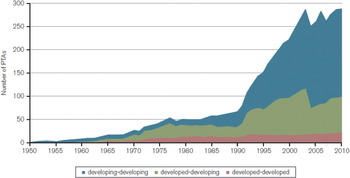
Though the dynamic interaction of multilateral and regional trade governance is longstanding, there has been a marked shift toward bilateralism in the trade regime over the past two decades due to the proliferation of PTAs. Between 1948 and 1990, only 70 PTAs came into force. The pace of PTA formation then accelerated sharply, with approximately 300 PTAs in force by 2010.Footnote 15 Among WTO Members, only Mongolia is not party to a PTA.Footnote 16
Cumulative number of PTAs in force, 1950–2010, by country group Source: WTO, World Trade Report 2011, supra note 15 at 55.

As PTAs have proliferated, the nature of these agreements has evolved, revealing several emerging trends.Footnote 17 PTAs are today more likely to be formed among developing countries.Footnote 18 Roughly two-thirds of PTAs in force today are between developing countries, compared with 20% in the late 1970s. Cross-regional PTAsFootnote 19 are also becoming more common. Half of in-force PTAs are cross-regional, and this proportion is rising.Footnote 20 Finally, PTAs increasingly involve deep integration among members. Deep integration PTAs include rules going beyond the scope of WTO commitments, affecting behind the border domestic policies in areas such as intellectual property, competition, investment, environment, labour standards, and human rights.Footnote 21
The recent wave of PTA formation is driven in part by pessimism over the fate of the Doha Round. The difficulties in concluding the Doha Round relate to the changing balance of power in the global economy and the cumbersome institutional structure of the WTO. Many commentators argue that the WTO's structure must be reformed if future multilateral trade liberalization is to be achieved.Footnote 22 Given the difficulty of undertaking such reforms, states will continue to pursue liberalization through PTAs. As they do, the trade regime increasingly resembles the investment regime, which has been structured around bilateral treaty relationships for decades.
2.2 Implications of fragmentation in trade and investment law
The rise of bilateralism in the international trade regime entails fragmentation in the sources of international trade law. This may have negative implications for both economic welfare and the conceptual coherence of trade law. First, economic welfare may suffer from fragmentation as the complex network of bilateral agreements heightens transaction costs for economic actors or produces trade diversion.Footnote 23 Second, conceptual incoherence in international trade law can arise when two trade treaties impose conflicting obligations on a state (an issue discussed extensively elsewhere)Footnote 24 or when similar trade law terms come to have substantially different meanings under different treaties. Two treaties may explicitly assign different definitions to the same trade law term, or dispute settlement panels may arrive at divergent interpretations of facially identical terms. Such incoherence in trade law doctrine across treaties is problematic in two respects. First, the transaction costs for economic actors to navigate the international trade regime are increased where terms are not given a common meaning across the entire regime. Second, the legitimacy of the international trade regime may suffer if seemingly identical trade law concepts have distinct, or even conflicting, meanings across the roughly 300 bilateral, plurilateral, and multilateral trade agreements.
Similar risks from fragmentation have been faced in the international investment regime, with its network of over 3,000 BITs. Each treaty may contain different standards of investment protection, and similar investment law terms may be given unique meanings across treaties by dispute settlement tribunals.Footnote 25 As with fragmentation in international trade, this can have negative implications for economic welfare, by increasing transaction costs and diverting investment away from its optimal allocation,Footnote 26 and for the conceptual coherence of international investment law across treaties, possibly undermining the legitimacy of the international investment regime.Footnote 27
Despite the fragmented structure of the international investment regime, Schill compellingly argues that there is a strong countervailing tendency toward convergence and unity in the content of international investment law.Footnote 28 Certainly, incoherence across the regime is observed in some areas, but this occurs to a far lesser extent than would be expected from a regime organized around bilateral relationships. How such convergence has emerged from a structurally fragmented system may be highly relevant to understanding processes of harmonization and fragmentation in international trade law as PTAs continue to proliferate.
Schill identifies several mechanisms that promote coherence across the international investment regime, two of which are the practice of cross-treaty interpretation in dispute settlement and the inclusion of MFN clauses in BITs. Before turning to these in detail, a third harmonizing mechanism identified by Schill in the international investment regime should be noted and distinguished: nationality planning through corporate structuring.Footnote 29
Corporate investors can change their nationality, and therefore the BIT governing their foreign investments, by reincorporating in another jurisdiction or channelling the investment through subsidiaries created in another jurisdiction. Most BITs assess the nationality of corporate investors based on the country of incorporation or the formally designated corporate headquarters, rather than where the corporation's operations are actually located or the nationality of shareholders. By restructuring to change nationality, the investor can effectively opt into the most protective BIT offered by the capital importing state. This capacity for treaty shopping by investors promotes harmonization in international investment law by undermining capital importing states' incentives to vary the level of investment protection offered under different treaties.Footnote 30
The harmonizing mechanism of nationality planning through corporate structuring has no close analogue in the international trade regime, and therefore is not explored in detail in this paper. The rules of origin requirements that are ubiquitous in PTAs prevent exporters from easily restructuring operations to take advantage of the most favourable PTA offered by an importing state. The general principle underlying rules of origin is that a product will only receive preferential treatment if a sufficient proportion of the product's value was generated through activities within the territory of a party to the PTA. This means that nationality planning through corporate restructuring cannot alone enable an exporter to secure preferential market access under a PTA. The question is where the value is added to the product. Similarly, the benefits of a PTA cannot be accessed through transshipment. If country A has separate PTAs with countries B and C, but B and C do not have a PTA with each other, an exporter in B cannot access the market of C on preferential terms simply by routing the export through A. While a corporation's international production network could be restructured to secure preferential access under a PTA by complying with its rules of origin requirements, this would entail major transaction costs in physically shifting operations and altering supply chains, rather than simply reorganizing the legal structure of the corporation. Consequently, corporate structuring does not offer the same harmonizing potential in the international trade regime as it does with respect to international investment.
However, two other harmonizing mechanisms identified by Schill, cross-treaty interpretation and MFN clauses, may have far greater applicability to the international trade regime. The next two sections of this paper examine how these mechanisms operate in the international investment regime and the extent to which they may develop in the trade regime as the sources of trade law become increasingly fragmented.
3. Harmonization through cross-treaty interpretation
3.1 Cross-treaty interpretation in international investment law
Opportunities for convergence or divergence in the content of similarly worded treaties arise through dispute settlement, as investment arbitration tribunals must arrive at precise interpretations of vaguely worded obligations. BITs generally provide for investor–state arbitration by a dispute settlement institution, such as ICSID, or under a particular set of rules, such as UNCITRAL (United Nations Commission on International Trade Law) rules. Two features of the institutional design of investment dispute settlement are particularly susceptible to generating incoherence in international investment law. First, tribunals are mandated with interpreting the substantive obligations under a particular BIT governing the relationship between the parties, not the obligations existing between other states under unrelated BITs. Second, precedent does not formally bind arbitral tribunals, even where prior decisions have addressed precisely the same matter under the same BIT.
However, neither of these formal features of dispute settlement under BITs reflects the actual practice of arbitral tribunals.Footnote 31 First, arbitrators frequently interpret the governing BIT in light of third-party treaties that do not bind the disputing parties.Footnote 32 Tribunals refer to other BITs signed by one of the parties to the dispute to clarify that party's intention when concluding the governing BIT.Footnote 33 They also compare the governing treaty with wholly unrelated BITs, to which neither of the disputing parties is a signatory, drawing interpretive conclusions by comparing different treaty texts.Footnote 34
Second, arbitral tribunals consider the decisions of prior tribunals, including those interpreting third-country BITs. Indeed, a de facto system of precedent has emerged in investment treaty arbitration,Footnote 35 and the precedents followed by tribunals are frequently derived from wholly unrelated BITs. Schill argues that the use of cross-treaty precedent ‘creates intra-system communication and consistency’.Footnote 36 Prior awards ‘exercise, as a matter of fact, strong extra-legal constraints upon subsequent tribunals’, and do so across the network of BITs.Footnote 37 In this way, cross-treaty interpretation creates a discourse on the substance of international investment law that cuts across different treaty relationships, promoting the unity of the investment law regime as a whole.
The legal basis for cross-treaty interpretation in investment
The pervasive phenomenon of cross-treaty interpretation in investment arbitration is surprising from a traditional perspective of treaty interpretation, reflected in the interpretive rules of the Vienna Convention on the Law of Treaties (VCLT). As Schill explains, cross-treaty interpretation ‘is problematic in view of the inter partes effect of international treaties, since using a third-party treaty as an interpretive aid can amount to either creating additional obligations, or conversely diminishing a right of one of the parties’, in violation of Article 34 of the VCLT.Footnote 38 This concern applies both to references to third-party treaty texts and to arbitral precedents arising under those third-party texts.Footnote 39
Under the VCLT, there are limited circumstances in which cross-treaty interpretation may be permissible,Footnote 40 but it is clear that tribunal practice frequently goes beyond the bounds of the VCLT. Two interpretive rules are salient. First, it may be appropriate for tribunals to refer to third party treaties to determine the ordinary or special meaning of terms under Articles 31(1) and 31(4) of the VCLT. When referred to in this way, third party treaties are used like dictionaries, clarifying the meaning of the treaty terms that the parties selected.Footnote 41 As McLachlan explains, treaties do not exist in a legal vacuum and ‘some reference must be made to the surrounding legal system which defines the obligations assumed by the parties’.Footnote 42 However, tribunals' use of third-party treaties regularly goes beyond this dictionary function, for example by considering third-party treaties drafted years after the treaty under interpretation. Subsequent treaties could not possibly have been in the minds of the drafters, and therefore are not probative of the legal meanings that they intended.Footnote 43
Second, Article 31(3)(c) of the VCLT requires tribunals to interpret obligations in the governing treaty in light of ‘any relevant rules of international law applicable in the relations between the parties’. However, BITs between completely different parties or involving just one of the parties to the dispute do not fall within the scope of this rule because they are not applicable between the parties.Footnote 44 Nevertheless, investment tribunals frequently refer to such third-party BITs, going beyond what is permissible under Article 31(3)(c).Footnote 45
It is clear that investment arbitration tribunals frequently operate outside the traditional interpretive rules set out in the VCLT. Paparinskis describes the observed interpretive methods as a ‘vernacular prima facie reaching further than the traditional approaches’.Footnote 46 An extreme expression of this vernacular was evident in Saipem v. Bangladesh, where the tribunal opined that while not bound by previous ICSID decisions, ‘it must pay due consideration to earlier decisions of international tribunals’ and ‘has a duty to adopt solutions established in a series of consistent cases’.Footnote 47 It is difficult to reconcile such a view with the interpretive rules of the VCLT.
Non-legal drivers of cross-treaty interpretation in investment
Despite the often tenuous legal basis for cross-treaty interpretation in investment arbitration, Schill observes that any ‘purely positivistic critique of the practice of investment tribunals would have difficulty in changing the behaviour of tribunals’.Footnote 48 Tribunals have strong incentives to engage in cross-treaty interpretation because of the structure of the international investment regime and the demands of states and investors for coherence across the system.
First, the existence of thousands of highly similar BITs makes it extremely tempting for tribunals to draw comparative conclusions across these agreements.Footnote 49 Second, the vagueness of many substantive BIT obligations, such as ‘fair and equitable treatment’, provokes tribunals to look to previous interpretations of similar provisions for clarification, even where the available precedents are established under third-party BITs.Footnote 50 Indeed, a de facto system of precedent cutting across treaty lines has emerged in the international investment regime.
The incentives for tribunals to draw upon precedents established under third-party BITs are reinforced by the existence of a focal point institution for investment dispute resolution: ICSID. There is no de jure reason for ICSID investment arbitration tribunals to interpret similar obligations arising under different BITs in the same way;Footnote 51 ICSID merely provides common procedural rules for arbitration, while substantive investment obligations arise bilaterally under BITs. Nevertheless, the Jeffery Commission argues that consistency in ICSID jurisprudence is encouraged by an esprit de corps among ICSID arbitrators.Footnote 52 The repeat appointment, similar education, and professional encounters of arbitrators all support the development of ‘progressive continuity’ in ICSID jurisprudence.Footnote 53 However, ICSID institutional identity cannot fully account for cross-treaty interpretation in investment. ICSID tribunals regularly cite precedents set under other investment arbitration procedural frameworks, such as UNCITRAL. The converse is also true, with decisions under UNCITRAL frequently citing ICSID jurisprudence.Footnote 54 In this way, the system of de facto precedent and the phenomenon of cross-treaty interpretation in the international investment regime are not confined to one procedural institution.
3.2 The proliferation of PTAs and cross-treaty interpretation
Could a similar practice of cross-treaty interpretation emerge in the trade regime to promote system-wide coherence despite the increasingly fragmented sources of international trade law? The answer to this question remains unsettled, in large part due to the limited interstateFootnote 55 dispute settlement activity that has occurred under PTAs.Footnote 56 Most PTAs provide for dispute settlement through ad hoc panels, convened to adjudicate a single dispute.Footnote 57 By 2011, there were only 25 known ad hoc panel decisions for interstate disputes across all PTAs.Footnote 58 Some PTAs do not provide for dispute settlement through ad hoc panels, but through a permanent supranational court or tribunal structure, which may have jurisdiction over a broad range of issues relating to regional integration. Prominent examples include the European Court of Justice (ECJ) and the Andean Tribunal of Justice (ATJ).Footnote 59 With the exception of these two bodies,Footnote 60 other permanent supranational courts or tribunals have been largely inactive in settling disputes arising under PTAs.Footnote 61 Given the limited interstate dispute settlement activity under PTAs to date, the WTO dispute settlement system is the dominant producer of jurisprudence on interstate trade law disputes.Footnote 62
However, it is probable that interstate litigation under PTAs will become more prevalent in the coming years. First, as the number of PTAs proliferates, so too does the potential for interstate litigation under PTA law. Second, PTAs are shifting away from informal, diplomatic systems of dispute resolution to legalized dispute settlement through ad hoc panels.Footnote 63 Third, many PTAs have only been recently concluded, and the implementation of their most controversial aspects has yet to occur.Footnote 64 As contentious elements of PTAs are progressively implemented, more dispute settlement activity under PTAs may be observed. Fourth, the alternative of WTO dispute settlement will not be available to states litigating disputes on issues covered by PTAs but not covered under WTO law. As noted above,Footnote 65 PTAs increasingly pursue deep integration by including issue areas not covered by the WTO Agreements (such as competition law and environmental and labour standards).Footnote 66 Interstate litigation in these areas will necessarily be undertaken through PTA dispute settlement machinery, as the alternative of filing a complaint at the WTO will be unavailable.
As PTA dispute settlement activity rises, so does the potential for fragmentation in international trade law jurisprudence across treaties, both multilateral and bilateral. However, it also creates the opportunity for a practice of cross-treaty interpretation to emerge that would counter fragmentation and promote coherence, as it has in the international investment regime.
The current practice of WTO panels and the Appellate Body with respect to cross-treaty interpretation is mixed. WTO dispute settlement bodies have interpreted the WTO Agreements in light of non-WTO treaties, even where the legal basis for doing so under the interpretive rules of the VCLT was unclear.Footnote 67 For example, in US – Foreign Sourced Income,Footnote 68 the Appellate Body engaged in cross-treaty interpretation to determine the meaning of ‘foreign sourced income’ in the Agreement on Subsidies and Countervailing Measures (SCM Agreement). The Appellate Body interpreted the term in light of a common approach found in a number of bilateral and multilateral treaties addressing double taxation, but it did not explain the legal basis for doing so under the VCLT. Additionally, in Mexico – Taxes on Soft Drinks,Footnote 69 the Appellate Body left open the possibility that Members’ obligations under a PTA could pose a ‘legal impediment’ to a WTO panel ruling on the merits of a claim. While the Appellate Body did not clarify what such legal impediments might be, this could entail cross-treaty interpretation if a WTO panel interpreted its jurisdiction under the WTO Agreements more narrowly based on the text of a PTA (for example, by having regard to a PTA forum selection clause). These examples suggest a willingness by WTO dispute settlement bodies to engage in cross-treaty interpretation through reference to the text of external treaties, as is observed in the investment regime.
Yet, unlike investment arbitration panels, WTO panels and the Appellate Body have seldom made reference to precedents generated by other tribunals interpreting non-WTO treaties. Busch argues that the absence of citation to non-WTO jurisprudence indicates that precedents established in one trade dispute settlement institution do not spill over into another, such that ‘one can speak meaningfully about separate bodies of de facto stare decisis at the WTO and NAFTA [North American Free Trade Agreement]’.Footnote 70 If the operation of de facto stare decisis in the international trade regime is indeed confined within individual treaty bodies, then a process of cross-treaty interpretation with reference to precedents established under other treaties, as seen in the international investment regime, is unlikely to emerge.
However, the view that WTO and PTA dispute settlement bodies are disinclined to consider each other's case law is unwarranted. The small number of WTO panel and Appellate Body references to PTA case law is best explained by the limited extent of PTA dispute settlement activity, as noted above.Footnote 71 Moreover, there are already several instances in which WTO dispute settlement bodies have referred to the trade jurisprudence of regional dispute settlement institutions. Decisions of the ECJ were relied upon by the Appellate Body in EC–Bananas III Footnote 72 and by the panel in US–Gambling.Footnote 73 Notably, in US–Gambling, the WTO panel's interpretation of the GATS Article XIV(a) public morals exception was supported with reference to ECJ jurisprudence concerning an equivalent provision in the EC Treaty. This is a clear example of cross-treaty interpretation at the WTO, and tribunal jurisprudence having precedential effect across institutional boundaries.Footnote 74
With respect to PTA tribunal consideration of multilateral precedents, Busch contends that PTA tribunals generally do not refer to case law generated by WTO panels and the Appellate Body.Footnote 75 He notes that references to WTO case law in NAFTA Chapter 20 interstate disputes ‘have been ad hoc and controversial, rather than setting expectations about the institution's de facto stare decisis’.Footnote 76
This is not a fair characterization of the NAFTA interstate dispute jurisprudence.Footnote 77 Although there have only been three decided Chapter 20 cases on which to base any assessment,Footnote 78 the NAFTA panels in all three cases cited GATT/WTO case law. In Cross Border Trucking Services,Footnote 79 the NAFTA panel held that GATT/WTO jurisprudence on the GATT Article XX general exceptions provisions ‘proves helpful in determining what “necessary” means’ under the NAFTA Article 2101 general exceptions provision.Footnote 80 Similarly, the NAFTA panel in Broom Corn Brooms Footnote 81 drew an analogy to a GATT panel decisionFootnote 82 in finding that the International Trade Commission violated NAFTA requirements concerning the sufficiency of reasons.Footnote 83 The panel also considered GATT/WTO case law on like product determinationsFootnote 84 and the requirements for adequacy of notice.Footnote 85 Finally, the NAFTA panel in US-Origin Agricultural Products Footnote 86 stated that exceptions to trade liberalization obligations must be viewed with caution, noting that the ‘principle that exceptions to general obligations are to be construed narrowly is well accepted in the interpretation of the GATT’.Footnote 87
The foregoing examples show that cross-treaty interpretation is already occurring in the trade regime. How far the practice will develop will only become clear as PTA dispute settlement activity grows. Both the legal framework of treaty interpretation and the institutional features of the international trade regime will bear on whether a robust practice of cross-treaty interpretation, akin to that observed in the investment regime, will emerge. This issue has not yet been examined in the scholarly literature and is considered in the following sections.
The legal basis for cross-treaty interpretation in trade
The VCLT rules concerning cross-treaty interpretation described above for international investment law also apply to international trade law. Cross-treaty interpretation under VCLT Article 31(1) and 31(4), to clarify the ordinary or special meaning of words, operates in a similar manner in the international investment and trade regimes. Under these rules, WTO or PTA panels may be justified in relying upon third-party treaties (whether regional or multilateral) to the extent that they elucidate the meaning of treaty terms selected by the parties at the time of drafting.Footnote 88
However, another possible justification for cross-treaty interpretation under the VCLT, Article 31(3)(c), has substantially different implications in the international trade regime. This rule requires tribunals to interpret the governing treaty in light of ‘any relevant rules of international law applicable in the relations between the parties’. As noted above, this rule does not justify cross-treaty interpretation across BITs, since other BITs will involve different parties, and will therefore not constitute rules of international law applicable between with parties within the meaning of VCLT Article 31(3)(c).Footnote 89 However, applied in the international trade regime, Article 31(3)(c) does permit and indeed requires cross-treaty interpretation, but only in one direction. PTA tribunals are essentially always required to interpret PTA obligations in light of relevant WTO law. However, WTO tribunals cannot rely on this rule to justify consideration of PTA law, nor can PTA tribunals rely on this provision to justify consideration of third-party PTAs.
This unidirectional basis for cross-treaty interpretation under Article 31(3)(c) results from the article's relational requirement: the external international law obligation relied on as an interpretive aid must be one that is applicable in the relations between all parties to the treaty under consideration. For any given PTA, all parties to the PTA are also likely to be WTO members. Therefore, a PTA tribunal is required under Article 31(3)(c) to interpret the governing PTA in light of relevant and applicable WTO law.Footnote 90 However, the PTA tribunal could not interpret the governing treaty in light of another PTA under Article 31(3)(c) because, in almost all situations, not all parties to the governing treaty would also be party to the other PTA. Similarly, the rule would not justify consideration by a WTO tribunal of PTA law or jurisprudence when interpreting the WTO Agreements, because not all WTO Members will also be members of the PTA.Footnote 91
In summary, the rules of the VCLT are more conducive to cross-treaty interpretation in the international trade regime than in the international investment regime in one important respect. While Article 31(3)(c) cannot justify cross-treaty interpretation in the international investment regime, it effectively demands that PTA tribunals interpret their governing treaties in light of WTO law.
Non-legal drivers of cross-treaty interpretation in trade
The experience of the international investment regime suggests that the interpretive practice of WTO and PTA tribunals will not be confined by the rules of the VCLT. The institutional landscape, the content of the treaties under interpretation, the conduct of the disputing parties, and the identity of the parties can also encourage or discourage cross-treaty interpretation. On balance, these factors suggest that the incentives for cross-treaty interpretation in the international trade regime are weaker than in the international investment regime, but nevertheless remain significant. They indicate that in the short-run, the most likely form of cross-treaty interpretation to emerge is PTA tribunals citing WTO precedent, but that in the long-run inter-PTA citation and WTO reliance on PTA jurisprudence could also expand.
The institutional landscape
Though there is no formal legal hierarchy between WTO and PTA dispute settlement tribunals, WTO institutions occupy a perceived position of pre-eminence. The perceived legitimacy of WTO dispute settlement is heightened by its well-developed jurisprudence, robust appellate review (with the creation of the WTO Appellate Body in 1995), reputation for neutrality and technical expertise, and most importantly by the WTO's broad multilateral membership.Footnote 92 This de facto hierarchy may encourage PTA tribunals to look to WTO law as an interpretive guide, but discourage WTO tribunals from relying on PTA law.Footnote 93 This contrasts with the horizontal relationship between investment tribunals resolving disputes under BITs. A similar horizontal relationship exists among PTA tribunals. However, they may be less likely than investment tribunals to cite each other's precedents because they lack a common procedural regime for dispute settlement, such as ICSID, which may foster an esprit de corps among arbitrators,Footnote 94 encouraging coherence across ICSID jurisprudence irrespective of the BIT under interpretation.Footnote 95 Yet the community of potential international trade panellists is also quite limited, and an esprit de corps could develop within this epistemic community even in the absence of a unifying procedural institution.
The content of PTAs
The scope for cross-treaty interpretation in the trade regime may be more limited than in the investment regime because of greater divergences in the content of trade agreements. However, the similarities in content across PTAs should not be understated. Nearly all trade agreements make reference to common trade concepts such as national treatment, most-favoured nation treatment, and safeguards. Such similarities in content create scope for cross-treaty interpretation among PTA and WTO tribunals.
Increasingly, PTAs address deep integration issues not covered in the WTO Agreements, such as competition and human rights, encouraging cross-treaty interpretation among PTAs rather than between PTAs and the WTO.Footnote 96 When PTA tribunals are faced with disputes engaging these issues, there will be an absence of directly relevant WTO jurisprudence. They may therefore turn to the jurisprudence of other PTA tribunals for interpretive guidance. PTA tribunals, rather than the WTO, will be the leading generators of jurisprudence in these rapidly developing areas of deep integration not governed by the WTO but increasingly covered in PTAs. In these new areas of economic integration, a substantial body of PTA jurisprudence can be expected to develop. If such deep integration issues are ultimately brought within the ambit of WTO law, WTO panels and the Appellate Body seeking interpretive guidance will have strong incentives to look to PTA precedents, encouraging the flow of trade law norms from PTAs to the WTO.Footnote 97
The conduct of disputing parties
The conduct of the disputing parties will also be an important determinant of cross-treaty interpretation in the international trade regime. State parties to a trade dispute may cite jurisprudence arising under unrelated trade agreements for rhetorical effect, to illustrate how other tribunals have applied similar trade law concepts to similar fact patterns. Given the limited volume of PTA dispute settlement activity, parties will inevitably have to look beyond disputes arising under the governing treaty for such examples. Tribunals are then likely to feel compelled to respond to these comparisons when issuing their judgment, despite their lack of legal significance under the governing BIT. This has been evident in the international investment regime.Footnote 98 For example, in El Paso v. Argentina,Footnote 99 an ICSID tribunal stated that it was reasonable to consider the decisions of other international tribunals, ‘especially since both parties, in their written pleadings and oral arguments, have heavily relied on precedent’.Footnote 100
The identity of the parties
An important distinction between the trade and investment regimes is the identity of the parties. Most BITs provide for investor–state dispute settlement, while private economic actors do not have standing in trade disputes under the WTO and most types of trade disputes under PTAs.Footnote 101 While this should not impact the tendency of tribunals to engage in cross-treaty interpretation, it does result in far more dispute settlement activity in the international investment regime, since decisions by investors to litigate are not tempered by diplomatic considerations. This larger body of jurisprudence then facilitates cross-treaty interpretation, in contrast to the limited current PTA jurisprudence constraining the dialogue between trade tribunals. As dispute settlement activity under PTAs increases, this constraint will be eased, but these tribunals are never likely to be as active as investor–state investment arbitration panels.
3.3 The expected rise of cross-treaty interpretation in trade
Though the practice of cross-treaty interpretation is not yet firmly established in the international trade regime, it is likely to develop in the coming years as PTA dispute tribunals become more active. The legal scope for cross-treaty interpretation is arguably greater for the international trade regime than the international investment regime, since VCLT Article 31(3)(c) effectively requires PTA tribunals to consider relevant and applicable WTO law, but does not justify cross-treaty interpretation between BITs. Both the VCLT legal framework and the de facto hierarchy of trade institutions suggest that trade law norms will tend to flow from the WTO to PTAs. Such a hub-and-spoke model would be particularly effective in countering fragmentation in the international trade regime. However, as PTA dispute settlement activity grows, there will be greater potential for horizontal dialogue between PTA tribunals, analogous to that occurring between BIT tribunals. This will be most likely when disputes involve deep integration issues beyond the scope of the WTO Agreements and therefore of WTO jurisprudence.
4. Harmonization through MFN clauses
Another important insight to be drawn from the international investment regime concerns MFN clauses. The use of unconditional MFN clauses in PTAs has been suggested as a way to mitigate fragmentation in the international trade regime as PTAs proliferate.Footnote 102 Such clauses are standard features of BITs, and have served an important multilateralizing function in the international investment regime.Footnote 103
MFN clauses guarantee that the parties will extend to each other the most favourable treatment granted to any other state. There are two forms of MFN treatment: conditional and unconditional.Footnote 104 For more favourable treatment to be extended to a trading partner under a conditional MFN clause, that partner must provide equivalent concessions in return. In contrast, an unconditional MFN clause automatically extends to the beneficiary trading partner any more favourable treatment accorded by the granting state to a third-party state by incorporating into the governing treaty more favourable terms offered to the third-party.Footnote 105 As Pauwelyn explains, an unconditional MFN clause could be included within PTAs such that ‘whatever PTA parties have conceded in the past or may concede in a future PTA must also be extended to the current PTA partner(s)’.Footnote 106
The use of MFN clauses in PTAs is currently limited. While these provisions are not uncommon in PTA services and government procurement chapters, they are almost never included in trade in goods chapters.Footnote 107 However, the inclusion of MFN clauses in trade in goods chapters is not inconceivable. Historically, MFN clauses covering trade in goods were regular features of pre-GATT trade agreements and, more recently, were included in the Economic Partnership Agreements (EPAs) between the EC (European Communities) and ACP (African, Caribbean, and Pacific) states.
The variable use of unconditional MFN clauses between the investment and trade regimes, and within trade agreements across time and issue area, presents a number of puzzles requiring further research. This section offers some initial observations about the use of unconditional MFN clauses in the trade and investment regimes today, their historical use in the trade regime, and the potential implications for the global trading system if unconditional MFN clauses are included more broadly in PTAs.
4.1 MFN in the investment regime
The fragmented structure of the international investment regime suggests that standards of investor protection could vary considerably across different treaties. Indeed, there are textual variations across agreements, reflecting negotiated outcomes between different dyads of states and the evolution of state preferences over time.Footnote 108 Despite these variations, investors enjoy highly similar substantive treatment across the global network of BITs. This is due in part to the effect of unconditional MFN clauses, found in essentially all BITs. As Schill explains, ‘MFN clauses have the effect of multilateralizing the substantive standards of treatment and prevent differentiated, preferential, and discriminatory treatment among investors from different States.’Footnote 109 MFN clauses in BITs enhance global welfare by removing market distortions arising from different levels of investment protection being accorded to investors from different countries.Footnote 110 They also eliminate transaction costs that would arise if states had to constantly renegotiate previous agreements to update and harmonize levels of investor protection.
Practically, MFN clauses enable an investor covered by a BIT with an MFN clause to ‘invoke the benefits granted to third-party nationals by another BIT of the host State and import them into its relationship with the host State’.Footnote 111 Importing substantive investor protections through MFN is legally uncontroversial.Footnote 112 This is reflected in the arbitral jurisprudence, including cases such as MTD v. Chile,Footnote 113Pope & Talbot v. Canada,Footnote 114Rumeli v. Kazakhstan,Footnote 115ATA v. Jordan,Footnote 116 and White Industries v. India.Footnote 117
The inclusion of MFN clauses also impacts the drafting of BITs by neutralizing state incentives to alter or restrict investor protections. Such restrictions would simply be undone through the operation of MFN. In this way, MFN clauses play a causal role in producing the highly convergent standards observed across BIT texts. However, some states have reacted to the constraining effect of MFN by including sectoral carve-outs and temporal limitations in unconditional MFN clauses. For example, Canada's most recent model BIT excludes from the MFN provision all treaties previously in force at the time a new BIT is signed, enabling Canada to ‘ratchet down’ investor protections with each subsequent BIT while still guaranteeing investors that they would benefit from any more advantageous treatment offered in later BITs.Footnote 118 Most states have not limited the unconditional MFN clause in their BITs in this way.
4.2 MFN in the trade regime
Though the use of MFN clauses in PTAs today is relatively limited, these provisions were prevalent in bilateral trade agreements before the creation of the GATT. Conditional MFN was the dominant form used in trade agreements in the late eighteenth and early nineteenth century, accounting for 90% of all MFN clauses in treaties until 1860.Footnote 119
At that point, a shift in state practice occurred and unconditional MFN clauses became more prevalent. Schill suggests that the transition to unconditional MFN reflected the high cost and complexity of administering the system of conditional MFN, given the need to constantly renegotiate concessions between states.Footnote 120 However, the export interests of Britain, the dominant trading power, were also an important cause of the transition to unconditional MFN. When negotiating the 1860 Cobden–Chevalier Treaty with France, Britain – which had already undertaken substantial unilateral trade liberalization – insisted on an unconditional rather than conditional MFN clause. With its markets already highly liberalized, it would have little to bargain with to obtain further concessions if France made a more advantageous trade pact with another partner.Footnote 121 In the years following Cobden–Chevalier, unconditional MFN became dominant, resulting in substantial trade liberalization throughout Europe.Footnote 122
In the inter-war period, unconditional MFN clauses again served an important function in international trade agreements. In the 1920s, the US abandoned its insistence on the conditional form of MFN in its commercial treaties.Footnote 123 The 1927 International Economic Conference advocated the inclusion of unconditional MFN clauses, free of any limitations, in international trade agreements as ‘an essential condition of the free and healthy development of commerce between States’.Footnote 124 Following the Great Depression, the 1934 US Reciprocal Trade Agreements Act called for the use of the unconditional form in all international trade agreements.Footnote 125 From 1934 to 1945, the US negotiated 27 bilateral trade agreements, all containing an unconditional MFN clause.Footnote 126 Yanai argues that the American adoption of unconditional MFN in its bilateral trade agreements was not driven by an ideological attachment to the principle of non-discrimination, but rather by a desire to maximize market access for US exporters.Footnote 127
With the inception of the GATT, MFN became a pillar of the multilateral trading system and the pursuit of bilateral trade agreements subsided. Though bilateral trade agreements are once again proliferating, MFN clauses are now included on a far more limited basis and with considerable variation. MFN clauses are found in almost all PTA investment chapters, many trade in services chapters, and some government procurement chapters. Most often, unconditional MFN clauses are used though there are some instances of conditional MFN clauses in services and government procurement chapters. MFN clauses are almost never used in PTA trade in goods chapters, despite the fact that trade in goods is precisely what unconditional MFN clauses governed in the bilateral treaties of the pre-GATT period.
There is some indication that MFN clauses may be incorporated more frequently in trade in goods chapters in the future. The EC's recent Economic Partnership Agreements (EPAs) with African, Caribbean, and Pacific (ACP) states controversially include unconditional MFN clauses for market access relating to trade in goods.Footnote 128 Notably, these clauses are prospective only; more favourable treatment under PTAs concluded prior to the signing of the EPA would not be captured. Additionally, the reciprocal MFN obligation on ACP states is only triggered where more favourable treatment is accorded through a free trade agreement with a ‘major trading economy’.Footnote 129 Subsequent PTAs between ACP states and small countries would not trigger the clause.Footnote 130
The EPA MFN clauses are controversial because they are viewed as impeding ACP states from concluding South–South PTAs with emerging economies that would come within the ‘major trading economy’ definition, including Brazil, India, and China.Footnote 131 Some commentators have argued that the EPA MFN obligations could violate the Enabling Clause of the GATT/WTO, which endorses the promotion of South–South PTAs, and that the clauses are at odds with the development objectives of the EPAs.Footnote 132 Undoubtedly, the EC's motivation in including the MFN clause is to secure its preferred market access in EPA partner economies, and particularly to avoid becoming a less favoured trading partner than a rival major economy. Indeed, EC Development Commissioner Louis Michel stated in an interview, ‘It is difficult to say that Europe should let our partner countries treat our economic adversaries better than us. We are generous but not naive.’Footnote 133 In this way, a desire to secure export markets motivates the EC's insistence on unconditional MFN clauses in the EPAs, much like it motivated Britain in the 1860 Cobden–Chevalier Treaty and the United States in its bilateral trade agreements of the 1930s and 1940s.
4.3 The political economy of unconditional MFN clauses
A number of puzzles are presented by the current usage of unconditional MFN clauses in trade and investment agreements. Foremost among these is why MFN clauses are so prevalent in BITs but subject to such variable use in PTAs, including their overwhelming exclusion from PTA trade in goods chapters. These differences may largely be accounted for by the distinct content of BITs and PTAs and the unique dynamics of political economy engaged by each type of agreement.
Including an unconditional MFN clause in a BIT comes at a relatively low cost to the granting state. By the same token, it also offers relatively modest gains for the beneficiary state and interested private economic actors. The content of BITs is highly similar, meaning that few differences arise between agreements that would trigger extension to other BITs through an MFN clause.Footnote 134 Moreover, BITs generally involve only investor protection, and not market access for investment. Unlike preferential tariff rates for trade, which relate directly to market access, variations in investor protection are less likely to impact investment flows, particularly with respect to states where investor rights are already well protected through domestic legal institutions.Footnote 135 Finally, to the extent that MFN in BITs enhances investment flows by raising the terms of investor protection for all partners to the most advantageous level offered to any partner, inflows of investment are not generally regarded as a threat by domestic political constituencies to the same extent as surges in imports of goods (and are indeed the very raison d'etre for host countries negotiating BITs).
In contrast, unconditional MFN clauses in PTAs could have profound distributive implications between countries and among domestic interest groups. There is more variation in the content of PTAs than BITs, creating greater scope for MFN to operate. Importantly, the content of PTAs reflects a carefully calibrated quid pro quo bargain, as the parties generally aim to maximize market access abroad for export-oriented industries and minimize market access concessions for import-competing industries.Footnote 136 An unconditional MFN clause may threaten to disrupt this bargain. If one PTA partner but not the other subsequently concludes a more favourable PTA, then extension of these additional benefits through MFN will disrupt the equilibrium struck in the original deal.Footnote 137 However, even in the absence of unconditional MFN, maintaining the balance of concessions in PTAs cannot be assured. If one party subsequently signs another PTA with a second country whose exporters are rivals of those of the first PTA partner, then the equilibrium of the value of concessions in the first PTA will be disrupted.
In general, MFN clauses facilitate greater liberalization over time, since any additional concession granted to a new partner must be extended to all existing PTA partners. Consequently, unconditional MFN clauses are likely to be opposed by import-competing industries. However, they would be supported by export-oriented industries, keen to ensure that newly obtained margins of preference are not lost through the PTA partner subsequently offering superior preferences to a third country. Indeed, studying the use of MFN clauses in the trade in services chapters of PTAs, Fink and Jansen argue that countries ‘which maintain restrictive trade policies and a “defensive” negotiating position in services are more likely to shun such a clause than countries with liberal service policies and “offensive” interests’ and find this to be borne out in the incidence of MFN clauses in existing services chapters.Footnote 138
The higher distributive stakes involved in PTA MFN clauses may explain their greater use in investment agreements over trade agreements, but a number of puzzles remain. One is the common use of MFN clauses in trade in services chapters but extremely rare use in trade in goods chapters. Pauwelyn suggests that many services concessions only make sense on a nondiscriminatory MFN basis, such as service sector transparency or regulatory reforms.Footnote 139 However, other aspects of services agreements concern market access in a manner that is analogous to trade in goods. Export-oriented and import-competing services industries would therefore be expected to have strong preferences regarding unconditional MFN clauses in these areas.
A further puzzle is the willingness of states to include MFN provisions in PTA government procurement chapters, which involve trade in goods, but not in trade in goods chapters more generally. Baldwin, Evenett, and Low suggest that ‘there is something particular to the nature of competition in procurement markets (perhaps the rents in such markets are on average higher or exporters in procurement markets are more concentrated and potentially better at lobbying for their own interests)’.Footnote 140 If this is the case, there may be other instances in which goods exporters enjoy sufficient rents or are sufficiently concentrated to seek the inclusion of an unconditional MFN clause for trade in goods. More research is needed on what conditions are conducive to the institutional choice of unconditional MFN in PTAs, and whether those conditions are likely to be present as the global economy evolves in the coming years.
4.4 Implications of a return to unconditional MFN in PTAs
The recent inclusion of MFN clauses in EPAs and the long history of MFN clauses in trade agreements make clear that in certain circumstances it may be in a state's interest to insist upon an unconditional MFN clause for trade in goods. In general, the political dominance of export-oriented or import-competing industries could play an important role in openness to unconditional MFN. Also, where a state has liberalized trade to a greater degree than its partner, it will have strong incentives to seek an unconditional MFN clause. A fully liberalized state will have few trade-related concessions to bargain with if a PTA partner subsequently offers superior preferences to a third-country. This is one reason that unconditional MFN was insisted upon by Britain in the 1860 Cobden–Chevalier Treaty, and may help to explain the EC's insistence on unconditional MFN in the EPAs.Footnote 141
If unconditional MFN clauses were widely introduced in PTA goods and services chapters, a number of important implications for the global trading system would likely follow. First, global welfare gains would result from the overall lowering of protection levels and by eliminating market distortions caused by differing levels of preferences across PTAs. Even where existing PTAs appear to offer the same levels of preference on the same tariff lines, differences in rules of origin radically impact the effective level of trade liberalization. These types of variations create great potential for an MFN clause to multilateralize trade in goods concessions across a state's network of PTAs.Footnote 142
Second, the presence of MFN clauses would promote the convergence of PTA treaty terms, since any substantive differences in drafting would in any case be levelled out through the operation of MFN. This impact of MFN on the incentives of treaty drafters may account in part for the high degree of convergence observed in treaty terms across BITs.
Third, states may become more reluctant to widen or deepen trade commitments in new PTAs, since these new concessions would be extended across their entire network of PTAs. Because new concessions that must be shared through MFN carry a higher cost for the offering state (from the perspective of import-competing industries), deeper and wider agreements are only likely to be struck with large potential trading partners that justify the unconditional extension of benefits to all previous PTA partners without compensation. This would significantly change the nature of PTAs involving small countries, which today often serve as laboratories for new deep integration initiativesFootnote 143 because the PTA partner's small export capability limits the potential negative impact of liberalization on import-competing producers. Since unconditional MFN would require more advantageous treatment conferred on a small country partner to be shared across a state's entire network of PTAs, this laboratory function may cease.Footnote 144
Fourth, to the extent that unconditional MFN clauses multilateralize the gains from trade liberalization achieved through PTAs, they may undermine political will for progress on liberalization through the WTO. In the international investment regime, Pauwelyn observes that the lack of will for a substantive multilateral agreement is ‘in no small part due to the MFN clause traditionally included in BITs’.Footnote 145 Just as the creation of the GATT in 1947 displaced the use of unconditional MFN in bilateral trade agreements, a return to unconditional MFN clauses in PTAs today could diminish reliance on the WTO to supply multilateral trade liberalization.
5. Conclusion
The movement toward bilateralism in the international trade regime shows no signs of abating. The resulting fragmentation in the sources of international trade law poses a number of serious challenges. Economic harm can result from trade diversion and heightened transaction costs. Moreover, the coherence and legitimacy of international trade law may be undermined where similar trade law terms are accorded different, or even contradictory, meanings under various treaties.
As PTAs proliferate, the international trade regime comes to more closely resemble the international investment regime, which is structured around over 3,000 BITs. Despite the highly fragmented structure of the international investment regime, Schill persuasively argues that there are strong tendencies toward harmonization and coherence in the content of international investment law.Footnote 146 Two mechanisms driving this harmonization and coherence are cross-treaty interpretation in dispute settlement and the inclusion of unconditional MFN clauses in bilateral investment treaties. These same mechanisms could emerge in the international trade regime, mitigating the challenges of fragmentation posed by the proliferation of PTAs.
The practice of cross-treaty interpretation in trade is likely to develop among PTA and WTO dispute settlement panels as PTA jurisprudence grows. The legal framework of the VCLT is indeed more conducive to cross-treaty interpretation in the international trade regime than in the international investment regime, but only with respect to the consideration of WTO treaties and case law by PTA tribunals. This unidirectional flow of trade law norms from the multilateral to regional levels, further reinforced by the de facto institutional hierarchy between the WTO and PTAs, is favourable to maintaining coherence in international trade law. As the body of PTA jurisprudence grows over the long-term, cross-treaty interpretation among PTA tribunals is also likely to develop, particularly in deep integration issue areas beyond the scope of the WTO Agreements, on which no WTO jurisprudence would exist. Importantly, tribunals, rather than states, largely drive the practice of cross-treaty interpretation, as they confront the task of resolving trade disputes in an increasingly fragmented legal landscape.
In contrast, the inclusion of unconditional MFN clauses in PTAs is a deliberate policy choice that states must make. While this has only been done to a limited extent in existing PTAs, there is strong historical precedent for the use of unconditional MFN clauses in bilateral trade agreements and the EC recently insisted on the inclusion of such clauses in trade agreements with ACP states. The political economy conditions that induce states to include unconditional MFN clauses in PTAs require further study, but it appears that high existing levels of liberalization by one of the treaty parties and politically dominant export oriented industries have historically been important factors driving the selection of unconditional MFN. The implications of widespread use of unconditional MFN clauses in PTAs would be immense, effectively multilateralizing trade liberalization across the entire network of a state's PTAs. MFN clauses would also alter the incentives facing PTA treaty drafters, discouraging them from pursuing treaty variations that would in any case be undone through the operation of MFN.
Cross-treaty interpretation and MFN clauses in PTAs are undoubtedly imperfect substitutes for strengthening multilateral institutions and advancing multilateral trade liberalization. But the changing balance of power in the global economy and the cumbersome institutional structure of the WTO suggest that multilateral progress will remain elusive in the coming years and that PTAs will continue to proliferate. Faced with this reality, cross-treaty interpretation and the use of MFN clauses in PTAs could mitigate the risks posed by fragmentation in the international trade regime, much as they have in the international investment regime.