Introduction
Menière's disease is a chronic, progressive, inner-ear disorder which manifests itself in attacks of vertigo, tinnitus, aural fullness and hearing loss. During the course of the disease, auditory and vestibular function is progressively lost.
Despite the current use of a variety of treatment modalities, there is a strong need for level I sources of evidence.Reference Thorp, Shehab, Bance and Rutka1
The only fundamentally new therapeutic concept to appear in recent decades is the intermittent application of low-pressure pulses via the external auditory canal and a tympanostomy tube. Tjernstrom et al. Reference Tjernstrom2 first described the concept of over-pressure treatment of Menière's disease, using a pressure chamber. Electrophysiological animal experiments conducted by Densert et al. Reference Densert, Densert, Erlandsson and Sheppard3 showed that the inner-ear pressure balance can be influenced by manipulation of the middle-ear cavity pressure. These authors presented a new method of local application of pressure.
This latter work led finally to the development of the Meniett® device (Metronic Xomed, Minneapolis, Minnesota, USA). In a seminal study, Gates et al. Reference Gates, Green, Tucci and Telian4 examined Meniett® device therapy in a randomised, placebo-controlled, double-blinded, multi-centre trial involving 67 patients. This study found a significant therapeutic effect on vertigo symptoms.
Nevertheless, only a minority of North American neurotologists currently recommend use of the Meniett® device for medically recalcitrant Menière's disease,Reference Kim, Wiet and Battista5 and in Germany it is also rarely used.Reference Plontke6
The main advantages of low-pressure therapy over other therapeutic modalities are its low invasiveness (compared with endolymphatic sac surgery) and its non-destructive nature (compared with gentamicin instillation).
In Germany, betahistine is the first-line treatment for Menière's disease in clinical practice, prior to consideration of endolymphatic sac surgery or ablative gentamicin therapy.Reference Westhofen7
The present study comprised a randomised, controlled, double-blinded, clinical trial of Meniett® device therapy in patients with unilateral Menière's disease unresponsive to oral betahistine treatment.
Methods
Between November 2004 and November 2008, consecutive patients were screened at the two out-patient facilities of a tertiary referral centre otolaryngology department. Prospective subjects' eligibility for study inclusion was assessed using clinical history-taking and examination, audiometry, video-oculography, auditory brainstem response audiometry (ABR), and cranial magnetic resonance imaging.
The approval of the local ethics committee was obtained (protocol number 03705).
The study's inclusion criteria were: definite Menière's disease as per the diagnostic criteria of the American Academy of Otolaryngology – Head and Neck Surgery (i.e. two or more definitive, spontaneous episodes of vertigo of 20 minutes or longer, audiometrically documented hearing loss on at least one occasion, tinnitus or aural fullness in the treated ear, and exclusion of other causes); two or more vertigo attacks (lasting at least 20 minutes) per month in the last two months; and treatment with betahistine (i.e. from 3 × 16 to 3 × 24 mg for three months) without subjective vertigo control.
The study's exclusion criteria were: bilateral Menière's disease; previous destructive or surgical therapy (e.g. gentamicin instillation or endolymphatic sac surgery); and age below 18 years.
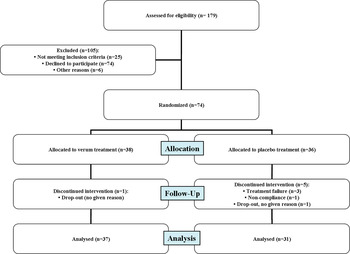
One hundred and fifty-four patients met the inclusion criteria and were offered a place in the study. A total of 74 patients accepted, and were individually randomised into either the active treatment group or the placebo group, prior to study commencement and after written, informed consent had been obtained.
Prior to treatment, all study patients were observed for four weeks in order to document their symptom severity.
A ventilation tube was then placed and each patient was observed for another four weeks.
Subsequently, patients in the active treatment group underwent 16 weeks of low-pressure therapy using the Meniett® device, visiting the study centre at four-week intervals. At each visit, compliance was assessed via questioning by the clinical coordinator.
Both physicians and patients were blinded to the treatment allocation until the end of the treatment period.
Subjective data acquisition
Patients were given a symptom report calendar in which they daily recorded the severity of their vertigo and its influence on their daily activities, using a five-point Likert scale. Vertigo-free days were scored as 0. Days with a mild attack were scored as 1. Moderately severe attacks lasting more than 20 minutes were scored as 2. Severe attacks lasting an hour or more or accompanied by nausea or vomiting were scored as 3. A level 4 attack was the worst attack ever experienced to date. A definitive vertigo day was any day with a vertigo score of 2 or greater.
Activity level was scored in a similar manner, using a 0–4 scale as follows: 0 indicated no reduction in activity; 1 and 2 indicated minor or moderate reductions in activity, respectively, without having to cancel a planned schedule; 3 indicated the need to stay at home, leave work or cancel a planned schedule; and 4 indicated being bedridden or largely incapacitated during that day. A sick day was defined as any day with an activity score of 3 or 4.
Audiovestibular testing
Pure tone audiometry and air caloric irrigation testing were performed using standard equipment and methods, at each visit. Due to the presence of the ventilation tube, water caloric irrigation was contraindicated; thus, air caloric irrigation was performed instead, using a previously established protocol.Reference Zapala, Sholt and Lundy8
Therapy
The Meniett® low-pressure generator delivered 0.6-second pressure pulses at 6 Hz within the range of 0 to 20 cm H2O to the ear canal, via a polyethylene tube with a close-fitting cuff. The 5-minute treatment sequence had three cycles, each with 1 minute of pressure pulses and 40 seconds of no pressure pulses.Reference Densert, Densert, Arlinger, Sass and Odkvist9 The device was used three times daily (morning, noon and evening).
The placebo device had identical acoustic properties to the Meniett® device, but only produced a slight pressure increase, to 2 cm H2O. Despite countering evidence from animal studies, we could not completely exclude the possibility that the slight pressure impulses of the placebo device may have had a therapeutic effect. However, patients were unable to detect whether they were using the active or the placebo device.
Patients were advised to continue their pre-existing medical therapy with daily doses of 48 to 72 mg of betahistine.
Data analysis
Vertigo is the chief complaint of patients with Menière's disease and has the greatest impact on daily life. It can only be measured by patient self-reporting. In order to minimise problems with recall and perceptual variations, the present study used daily self-reporting in a standardised format, in analogy to Gates and colleagues' previous study.Reference Gates, Green, Tucci and Telian4
The primary outcome parameters were vertigo score, number of definitive vertigo days and number of sick days.
Secondary outcome parameters were activity score, number of vertigo-free days, hearing thresholds averaged across 0.25, 0.5 and 1 kHz, and caloric stimulus induced slow phase nystagmus velocity.
Since local over-pressure treatment was intended as a prophylactic treatment, a delayed therapeutic effect was expected. Therefore, statistical analysis compared the data from the four-week interval before the treatment period with that from the four-week period at the end of the treatment period.
The Mann–Whitney U-test and the t-test were used where appropriate. A p value of less than 0.05 was set as the clinically relevant level of statistical significance. The power to detect a treatment difference was calculated as 80 per cent (definitive vertigo days, standard deviation = 5, difference in means = 3, n = 70).
Results
Of the 74 patients randomised, six were excluded during the course of the study: three patients (all in the placebo group) left during the treatment phase because of a lack of improvement, two patients (one each in the placebo and active treatment groups) were excluded due to lack of compliance, and one patient left without giving a reason.
No adverse effects of Meniett® device treatment were reported. One patient suffered self-limiting otitis media related to their ventilation tube.
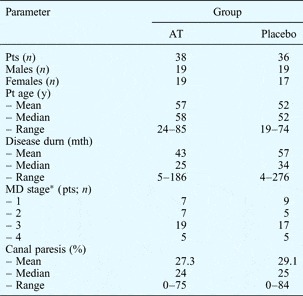
Sixty-eight patients completed the study (37 in the active treatment group and 31 in the placebo group) and were included in the data analysis. Figure 1 shows a flow diagram summarising the study design and patient numbers (according to the Consort Statement). Baseline characteristics were assessed at randomisation, and indicated that the different Menière's disease stages were approximately equally represented in the two study groups (Table I).
Flow diagram showing study design and patient numbers.

Baseline data at randomisation

*By American Academy of Otolaryngology – Head and Neck Surgery criteria. AT = active treatment; pts = patients; y = years; durn = duration; MD = Menière's disease
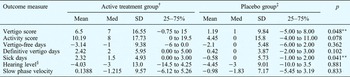
The following text presents results for the different outcome measures. Table II shows statistical parameters for these same outcome measures, which evaluate the treatment effect in both the active treatment and placebo groups, and also analyse the difference in treatment effects between these two groups.
Treatment effect data* for outcome measures

All p values calculated using Mann–Whitney U-test, except for hearing level, for which t-test was used.
* Comparing pre- vs post-treatment values. †n=37; ‡n = 31. **Statistically significant difference between active treatment and placebo groups. §0.25–1 kHz. Med = median; SD = standard deviation; 25–75% = 25th to 75th quartile
Vertigo score
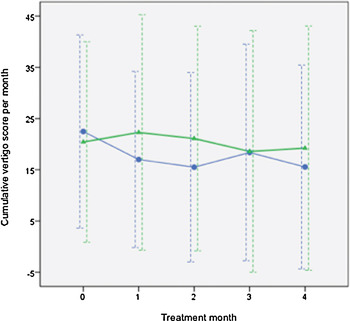
The mean four-week cumulative vertigo score decreased from 22.47 to 15.97 in the active treatment group and from 20.42 to 19.23 in the placebo group (Figure 2). The treatment effect, expressed as the difference between the pre-treatment and the post-treatment vertigo score, was 6.5 for the active treatment group and 1.19 for the placebo group. The treatment effect was significantly greater in the active treatment group (p = 0.048).
Cumulative vertigo score per month. Centre plots indicate means, whiskers indicate ± one standard deviation. Active treatment group = blue circles; placebo group = green triangles

Vertigo days
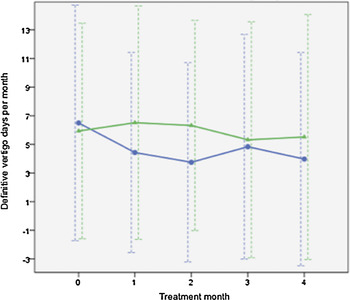
The mean number of definitive vertigo days decreased from 6.5 to 4.08 in the active treatment group and from 5.94 to 5.52 in the placebo group (Figure 3). The treatment effect, expressed as the difference between the pre- and post-treatment number of definitive vertigo days, was 2.42 for the active treatment group and 0.42 for the placebo group. The treatment effect was not significantly greater in the active treatment group (p = 0.102).
Definitive vertigo days per month. Centre plots indicate means, whiskers indicate ± one standard deviation. Active treatment group = blue circles; placebo group = green triangles

Sick days
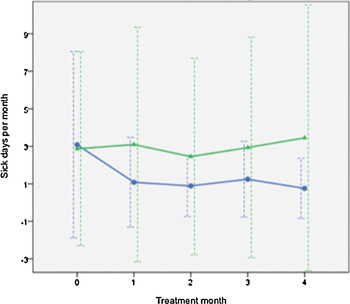
The mean number of sick days decreased from 3.08 to 0.78 in the active treatment group, but increased from 2.87 to 3.45 in the placebo group (Figure 4). The treatment effect, expressed as the difference between the pre- and post-treatment number of sick days, was 2.32 for the active treatment group and −0.58 for the placebo group. The treatment effect was significantly greater in the active treatment group (p = 0.041).
Sick days per month. Centre plots indicate means, whiskers indicate ± one standard deviation. Active treatment group = blue circles; placebo group = green triangles

Vertigo-free days
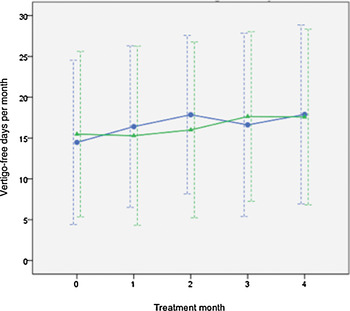
The mean number of vertigo-free days increased from 14.47 to 17.61 in the active treatment group and from 15.48 to 17.58 in the placebo group (Figure 5). The treatment effect, expressed as the difference between the pre- and post-treatment number of vertigo-free days, was −3.14 for the active treatment group and −2.1 for the placebo group. The treatment effect was not significantly greater in the active treatment group (p = 0.362).
Vertigo-free days per month. Centre plots indicate means, whiskers indicate ± one standard deviation. Active treatment group = blue circles; placebo group = green triangles

Activity score
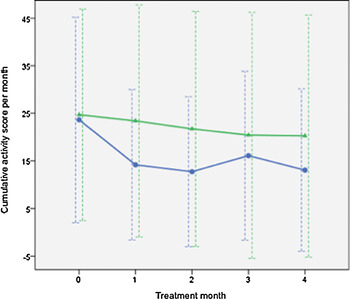
The mean cumulative activity score decreased from 23.61 to 13.42 in the active treatment group and from 24.68 to 20.23 in the placebo group (Figure 6). The treatment effect, expressed as the difference between the pre- and post-treatment cumulative activity score, was 10.19 for the active treatment group and 4.45 for the placebo group. The treatment effect was not significantly greater in the active treatment group (p = 0.078).
Cumulative activity score per month. A higher score represents more severe restriction of activities of daily living. Centre plots indicate means, whiskers indicate ± one standard deviation. Active treatment group = blue circles; placebo group = green triangles

Hearing level
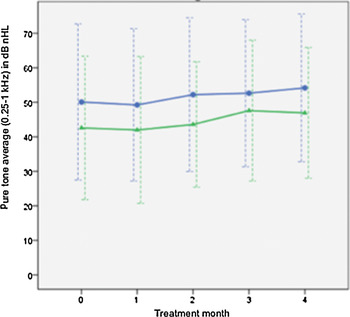
The mean hearing threshold, assessed by pure tone average at 0.25 to 1 kHz, increased from 49.15 to 53.18 dB nHL in the active treatment group and from 41.66 to 46.10 dB nHL in the placebo group (Figure 7). The treatment effect, expressed as the difference between the pre- and post-treatment hearing thresholds, was −4.03 for the active treatment group and −4.45 for the placebo group. Hence, a slight deterioration in hearing levels was observed in both groups over the study period. However, there was no significant difference between the groups in this respect (p = 0.881).
Hearing level, assessed by pure tone average at 0.25–1 kHz. Centre plots indicate means, whiskers indicate ± one standard deviation. Active treatment group = blue circles; placebo group = green triangles

Horizontal semicircular canal function
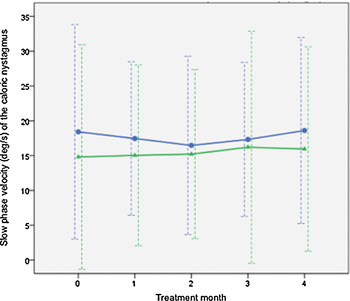
The mean slow phase velocity of nystagmus in response to air caloric stimulation of the diseased ear decreased from 18.86 to 18.72°/second in the active treatment group, but increased from 14.97 to 15.95°/second in the placebo group (Figure 8). The treatment effect, expressed as the difference between the pre- and post-treatment slow phase velocity, was 0.14 for the active treatment group and −0.98 for the placebo group; there was no significant difference between the groups in this respect (p = 0.833).
Slow phase velocity of the nystagmus induced by air caloric irrigation of the diseased ear. Centre plots indicate means, whiskers indicate ± one standard deviation. Active treatment group = blue circles; placebo group = green triangles

Discussion
Previous studies have examined the therapeutic effects of low-pressure therapy in cases of Menière's disease. Three randomised, placebo-controlled trials have been published thus far.
Odkvist et al. Reference Odkvist, Arlinger, Billermark, Densert, Lindholm and Wallqvist10 examined 56 patients during a two-week period, and found improved visual analogue scale scores for vertigo, tinnitus and aural pressure. Furthermore, hearing levels at 0.5 and 1 kHz improved by 4–5 dB. However, the authors gave no information on blinding, and the placebo device delivered ‘no stimulation to the ear’, resulting in some uncertainty over whether patients were truly blinded to treatment allocation.
Thomsen et al. Reference Thomsen, Sass, Odkvist and Arlinger11 performed a randomised, double-blinded, placebo-controlled trial involving 40 patients over a trial period of two months. They found significant improvements in functionality and vertigo perception, assessed using visual analogue scale scores, but not in vertigo attack frequency or hearing thresholds.
Gates et al. Reference Gates, Green, Tucci and Telian4 conducted a randomised, placebo-controlled, double-blinded trial involving 62 patients over a treatment period of four months. Their study design was very similar to the present study, except that nystagmography was not performed regularly. These authors reported a significant treatment effect as regards the number of definitive vertigo days and sick days. However, low frequency hearing thresholds (i.e. at 0.25, 0.5 and 1 kHz) and electrocochleographic results did not show any significant treatment effect.
Similar to previous studies, we found that subjective symptom control was significantly improved in the active treatment group, with respect to two of the three primary outcome measures: cumulative vertigo score and number of work days lost. Our results for these clinically important parameters confirm the beneficial effect of low-pressure therapy. Notably, all three patients who left the study because of a lack of symptom improvement were from the placebo group.
However, in contrast to the findings of Gates et al.,Reference Gates, Green, Tucci and Telian4 the reduction in the number of definitive vertigo days did not differ significantly between the active treatment and placebo groups. Furthermore, our overall treatment effects for subjective symptom severity seem to be slightly smaller than those reported by Gates et al. This may partially be due to the different concomitant medical therapies used in the two studies: whereas Gates and colleagues' patients were instructed to take a low-sodium diet and were allowed to continue their pre-study medication, all our patients continued their standard regimen of 16–24 mg betahistine three times daily.
In our study, in addition to the standardised self-reporting of symptom severity previously used by Gates et al.,Reference Gates, Green, Tucci and Telian4 we also integrated serial audiometric and nystagmographic measurements into the study protocol. The rationale for this was the presumed mechanism of action of low-pressure therapy: if endolymphatic hydrops is the pathogenetically crucial phenomenon in Menière's disease, and if low-pressure therapy reduces endolymphatic hydrops,Reference Densert, Densert, Arlinger, Sass and Odkvist9 then this therapy would be expected to have a beneficial effect on the disease course, which would eventually be detectable by hearing level and/or vestibular function tests. We used air caloric irrigation to evaluate horizontal semicircular canal function, due to the presence of a ventilation tube. Care was taken to direct the air jet towards the superoposterior quadrant of the ear drum, under visual control, in order to maximise caloric stimulation of the horizontal canal and to minimise air flow directly towards the ventilation tube and middle-ear cavity. Neither the audiometric data nor the caloric vestibular function test data showed a significant treatment effect over the medium-term study period of four months. In the future, longer-term follow-up assessment of the hearing and vestibular function data of low-pressure therapy recipients should further advance our understanding of this potential treatment effect.
• This study assessed low-pressure therapy in unilateral Menière's disease patients unresponsive to oral betahistine
• Cumulative vertigo severity and number of sick days were reduced
• Auditory and vestibular function did not improve
A limitation of our study was the relatively short follow-up period (four months). For therapeutic studies of such a chronic and progressive disorder as Menière's disease, a longer period of randomised, blinded therapy would be desirable.
The strengths of our study were the frequent measurements of auditory and vestibular function and the clearly defined concomitant therapy with betahistine.
Conclusion
Our study confirms previous findings of improved vertigo control with use of the Meniett® low-pressure generator, in patients with unilateral Menière's disease unresponsive to betahistine treatment alone. This safe and minimally invasive therapeutic modality is therefore recommended as a second-line treatment before considering ablative therapy (e.g. gentamicin instillation). However, over the four-month study period, no beneficial effects on hearing or vestibular function were detected.
Acknowledgement
The Meniett® devices used were provided by Medtronic Xomed for the duration of the study.