Introduction
Personality disorders have pervasive impacts on subjective well-being, quality of life, and socioeconomics (Tyrer, Reed, & Crawford, Reference Tyrer, Reed and Crawford2015). Of the 10 currently recognized personality disorders, obsessive-compulsive personality disorder (OCPD) is the most common with a prevalence range of 2.1–7.9% (APA, 2013). A national epidemiologic survey in the USA showed that the prevalence of lifetime OCPD was 7.8% in the community (Grant, Mooney, & Kushner, Reference Grant, Mooney and Kushner2012). In China, the prevalence of OCPD among patients with psychotic and non-psychotic disorders was reported to be 6.6% and 14.6%, respectively (Wang et al., Reference Wang, Zhang, Zhang, Ye, Li, Wang and Zhao2021).
According to the DSM-5, OCPD is ‘a pervasive pattern of preoccupation with orderliness, perfectionism, and mental and interpersonal control, at the expense of flexibility, openness’. These tendencies can have marked psycho-social consequences, especially with respect to establishing and sustaining close relationships (APA, 2013). The negative impacts of OCPD behaviors tend to become more pronounced the longer they persist. In a longitudinal study investigating the interpersonal impairments of several personality disorders, including OCPD as well as schizotypal, borderline, and avoidant personality disorders, participants' social relationships with parents, life partners, and friends were evaluated prior to treatment, after 1 year of treatment, and after 2 years of treatment. The OCPD group was the only diagnostic group that did not show significant improvements in any of these three social relationship realms after treatment (Skodol et al., Reference Skodol, Pagano, Bender, Shea, Gunderson, Yen and McGlashan2005).
Empathy is an important psychological process that facilitates pro-social behaviors (Decety, Bartal, Uzefovsky, & Knafo-Noam, Reference Decety, Bartal, Uzefovsky and Knafo-Noam2016). A lack of empathy in individuals with OCPD may lead to stubbornness, hostility, and misunderstanding in interpersonal communication, ultimately impairing interpersonal relationships (Cain, Ansell, Simpson, & Pinto, Reference Cain, Ansell, Simpson and Pinto2015; Hummelen, Wilberg, Pedersen, & Karterud, Reference Hummelen, Wilberg, Pedersen and Karterud2008). Recently, the link between mental processes and behaviors has been attracting more attention. A core function of empathy in social interactions is to induce the feeling of guilt. Guilt is a moral emotion that functions positively in interpersonal relationships by stimulating prosocial behaviors such as apologizing, compensation, and cooperation (Baumeister, Stillwell, & Heatherton, Reference Baumeister, Stillwell and Heatherton1994; Ketelaar & Tung Au, Reference Ketelaar and Tung Au2003; Tangney, Stuewig, & Mashek, Reference Tangney, Stuewig and Mashek2007). It is induced when a personal moral rule or social standard has been violated, especially when one is aware that they have inflicted harm, loss, or distress upon others. Guilt requires an inherent capacity for empathy that enables one to recognize another person's suffering (Hoffman, Reference Hoffman and Eisenberg1982). In neuroimaging studies, both guilt and empathy have been shown to elicit similar areas of activation, such as the insula (Moll & de Oliveira-Souza, Reference Moll and de Oliveira-Souza2007; Morey et al., Reference Morey, McCarthy, Selgrade, Seth, Nasser and LaBar2012; Takahashi et al., Reference Takahashi, Yahata, Koeda, Matsuda, Asai and Okubo2004). Moreover, patients with damage to empathy-related brain regions display diminished guilt (Koenigs et al., Reference Koenigs, Young, Adolphs, Tranel, Cushman, Hauser and Damasio2007). Thus, we hypothesize that, due to a deficiency in their ability to empathize, individuals with OCPD may exhibit less guilt-related responses than healthy controls (HCs), which may result in OCPD-associated interpersonal dysfunctions (hypothesis 1).
However, higher than typical levels of guilt are common to many mental disorders, including major depression (Ghatavi, Nicolson, MacDonald, Osher, & Levitt, Reference Ghatavi, Nicolson, MacDonald, Osher and Levitt2002), other mood disorders (Zahn, de Oliveira-Souza, & Moll, Reference Zahn, de Oliveira-Souza, Moll, Armony and Vuilleumier2013), and notably obsessive-compulsive disorder (OCD) (Shafran, Watkins, & Charman, Reference Shafran, Watkins and Charman1996; Shapiro & Stewart, Reference Shapiro and Stewart2011). OCD patients have been shown to exhibit particularly strong responses of guilt, commonly triggered by a perceived inflated responsibility for interpersonal transgressions (Shafran et al., Reference Shafran, Watkins and Charman1996; Shapiro & Stewart, Reference Shapiro and Stewart2011). Moreover, it has been shown that the level of guilt experience correlates directly with OCD symptom severity (Chiang, Reference Chiang2013). Indeed, researchers have proposed that guilt may contribute to the occurrence and maintenance of OCD symptoms in that guilt-related fears of improper behavior may further augment obsessive-compulsive thoughts and behaviors (Mancini & Gangemi, Reference Mancini and Gangemi2004; Nissenson, Reference Nissenson2007).
It has been suggested that OCPD may be a candidate member of the obsessive-compulsive spectrum, since OCPD resembles OCD in terms of phenomenology, comorbidity, neurocognition, and treatment response characteristics (Fineberg, Sharma, Sivakumaran, Sahakian, & Chamberlain, Reference Fineberg, Sharma, Sivakumaran, Sahakian and Chamberlain2007; Stein et al., Reference Stein, Kogan, Atmaca, Fineberg, Fontenelle, Grant and Reed2016; Thamby & Khanna, Reference Thamby and Khanna2019). Although how guilt contributes to the formation and maintenance of OCD is well discussed, few studies have investigated guilt in OCPD from a social-emotional response perspective (Pinto, Eisen, Mancebo, & Rasmussen, Reference Pinto, Eisen, Mancebo, Rasmussen, Abramowitz, McKay and Taylor2007). It is not yet known whether individuals with OCPD have guilt responses similar to individuals with OCD. Given the commonalities between these two disorders that have been identified in previous studies, we aim to test a second, and contradictory, hypothesis that as a candidate member of the obsessive-compulsive spectrum, OCPDs may be associated with more intense guilt-related responses than HCs (hypothesis 2).
Previous studies conducted with healthy participants have suggested that guilt may affect interpersonal decision-making in two ways, namely that the anticipatory guilt may have a promoting effect on cooperative behaviors, while the experienced guilt may have a promoting effect on compensation behaviors (Battigalli & Dufwenberg, Reference Battigalli and Dufwenberg2007; Baumeister et al., Reference Baumeister, Stillwell and Heatherton1994; Chang, Smith, Dufwenberg, & Sanfey, Reference Chang, Smith, Dufwenberg and Sanfey2011; Reuben, Sapienza, & Zingales, Reference Reuben, Sapienza and Zingales2009; Yu, Hu, Hu, & Zhou, Reference Yu, Hu, Hu and Zhou2014). These two aspects of guilt influences on behaviors can be captured quantitatively by combining the computational modeling approach with two multiple-round social behavioral interaction tasks: the Guilt Aversion Task (Nihonsugi, Ihara, & Haruno, Reference Nihonsugi, Ihara and Haruno2015) and the Guilt Compensation Task (Gao et al., Reference Gao, Yu, Sáez, Blue, Zhu, Hsu and Zhou2018). In this study, we employed these two tasks to assess guilt-related responses in OCPDs and HCs. The methodological approach of combining interactive games that applied in social psychology with computational modeling approaches that developed in neuroeconomics have several advantages over past studies that have used mainly guilt-inducing scenarios and questionnaires to assess guilt (Chiang, Purdon, & Radomsky, Reference Chiang, Purdon and Radomsky2016; Jones, Schratter, & Kugler, Reference Jones, Schratter and Kugler2001). Firstly, scenarios or questionnaires do not involve real social interactions, rely heavily on participants' imaginations, and are insufficient to measure emotion-induced behavioral responses (Sesso et al., Reference Sesso, Brancati, Fantozzi, Inguaggiato, Milone and Masi2021). In contrast, interactive games enable us to observe participants' emotions and subsequent behaviors in realistic contexts. Secondly, the effect of social desirability may lead participants to augment the display of moral emotions in scenarios or questionnaires in the absence of any real-world outcome or cost of reporting emotions (Larsen & Fredrickson, Reference Larsen and Fredrickson1999; Nisbett & Wilson, Reference Nisbett and Wilson1977). Contrarily, in interactive games, participants' decisions do impact self- and other-payoffs; thus, potential monetary costs can mitigate the effect of social desirability. Finally, social behaviors (e.g. cooperation) may involve multiple psychological concerns in addition to guilt (Rutledge, de Berker, Espenhahn, Dayan, & Dolan, Reference Rutledge, de Berker, Espenhahn, Dayan and Dolan2016; Yu, Shen, Yin, Blue, & Chang, Reference Yu, Shen, Yin, Blue and Chang2015), which cannot be quantitatively dissociated by traditional data analysis based on scenarios or questionnaires. The multiple-round interactive game enables us to apply computational modeling, which can dissociate and quantify guilt-specific effects underlying social behaviors (Fehr & Schmidt, Reference Fehr and Schmidt1999; Nihonsugi et al., Reference Nihonsugi, Ihara and Haruno2015). Given this advantage of dissociating and quantifying different psychological constructs mathematically, the applications of computational modeling in clinical research are drawing increasing attention [e.g. computational psychiatry (Mujica-Parodi & Strey, Reference Mujica-Parodi and Strey2020; Wilson & Collins, Reference Wilson and Collins2019)].
The purpose of the current study was to employ two interpersonal interactive tasks, the Guilt Aversion Task and the Guilt Compensation Task, together with computational modeling to induce and compare quantitatively the guilt-related responses in individuals with OCPD and HCs. We will thus determine which of our two contradicting proposed hypotheses is better supported by the resultant data. That is, if OCPD group exhibits decreased guilt-related responses relative to HCs, then our first hypothesis proposing the role of the empathy deficiency in OCPD's guilt-related responses will be supported. Conversely, if the OCPD group exhibits increased guilt-related responses, then our second hypothesis proposing heightened guilt due to OCPD being on a spectral continuum with OCD will be supported. Our findings will contribute to a better understanding of guilt-related interpersonal dysfunctions in OCPD.
Methods
Participants
Firstly, a sample pool of 8303 undergraduates were recruited from four universities in Hunan Province to complete the Personality Diagnostic Questionnaire-4 (PDQ-4; Bagby & Farvolden, Reference Bagby and Farvolden2004). Those who obtained a composite score ⩾5 on the OCPD subscale were considered clinically relevant and invited to be evaluated. Secondly, OCPD was diagnosed by a psychiatrist using the structured clinical interview for DSM-IV axis II personality disorders (SCID-II; First, Benjamin, Gibbon, Spitzer, & Williams, Reference First, Benjamin, Gibbon, Spitzer and Williams1997a). Meanwhile, to exclude the influences of other mental disorders, participants with current or past mental disorders were excluded using the structured clinical interview for DSM-IV axis I disorders (SCID-I, First, Spitzer, Gibbon, & Williams, Reference First, Spitzer, Gibbon and Williams1997b). A total of 46 people (22 women, 48%; 20.4 ± 1.4 years) were diagnosed with OCPD and constituted our OCPD group.
The HC participants were collected from the randomly recruited 8303 undergraduates described above, whose scores in all subscales of PDQ-4 were lower than the cutoffs (Bagby & Farvolden, Reference Bagby and Farvolden2004). Individuals who had a past or ongoing history of a SCID-I diagnosis based on a clinical interview by a psychiatrist were excluded (First et al., Reference First, Spitzer, Gibbon and Williams1997b). A randomly selected group of 67 (38 women, 57%; 21.9 ± 1.3 years) of the remaining participants constituted the HC group.
All 113 participants (46 OCPDs and 67 HCs) completed questionnaires to collect clinical and psychological information and then completed the Guilt Aversion Task; five participants were excluded from the data processing due to a failure to understand the instructions. The remaining 108 participants (42 OCPDs and 66 HCs) were included in the final analysis of the Guilt Aversion Task. Due to the relatively long duration of the task and the potential risk of inflicting pain upon others in the Guilt Compensation Task, 29 participants dropped out, leaving a total of 79 participants (42 OCPDs and 37 HCs) in the final analysis of the Guilt Compensation Task. The study was approved by the Institutional Ethical Board of the Second Hospital of Xiangya, Central South University, and participants provided written informed consent before testing. To reduce the Hawthorne Effect (Sedgwick, Reference Sedgwick2012), all participants were unaware of grouping information and the study purpose during the experiment.
After enrollment and grouping, participants were numbered and led to the laboratory to complete questionnaires and perform the Guilt Aversion Task and the Guilt Compensation Task. The experimenter could identify group association based on participant numbers. Because this was a single-blinded experiment, there was a potential risk of the Experimenter Effect (Kintz, Delprato, Mettee, Persons, & Schappe, Reference Kintz, Delprato, Mettee, Persons and Schappe1965). However, several factors mitigate this concern. First, all of the procedures and instructions were standardized. Additionally, and most importantly, we posed two contradictive hypotheses based on previous evidence: (1) individuals with OCPD exhibit decreased level of guilt-related responses compared to HCs due to an empathy deficiency; v. (2) similar to people with OCD, individuals with OCPD are inclined to have an elevated level of guilt-related responses. All of the experimenters knew these two hypotheses and they could not predict which hypothesis would be supported before or during the experiment. Moreover, the experimenters were not allowed to analyze the data until the data collection had been completed. The background condition of these two contradictive hypotheses thus abates explicit or implicit experimenter influences on the participants to behave in accordance with the hypotheses, which to some extent exclude the Experimenter Effect.
For the questionnaires, a priori power analysis was conducted using G*Power version 3.1 (Faul, Erdfelder, Lang, & Buchner, Reference Faul, Erdfelder, Lang and Buchner2007) for sample size estimation. The prior effect size was determined based on the data from a published study (Cain et al., Reference Cain, Ansell, Simpson and Pinto2015) (N = 50), which compared OCPD to HC groups using the Interpersonal Reactivity Index (IRI). The effect size in this prior study was 0.70, considered to be medium according to Cohen's (Reference Cohen1988) criteria. With a significance criterion of α = 0.05 and power = 0.80, the minimum sample size needed to obtain a similar effect size was N = 34 for an independent sample t test. Thus, for questionnaire analyses, the obtained sample size of 46 OCPD participants and 67 HCs was adequate to test the statistical hypotheses. For the interactive tasks, because there are no previous studies that have investigated guilt-related responses in OCPD participants using this method, we could not determine prior effect sizes for our interactive tasks and thus could not perform a power analysis or sample size determination prior to data collection. Nevertheless, we conducted post-hoc power analyses for our main results, i.e. the Bayesian t tests for parameters estimated from computational modeling. The results suggest that the sample size in our experiment was adequate to draw our main conclusions (see details in Methods and Results).
Procedures
Overview
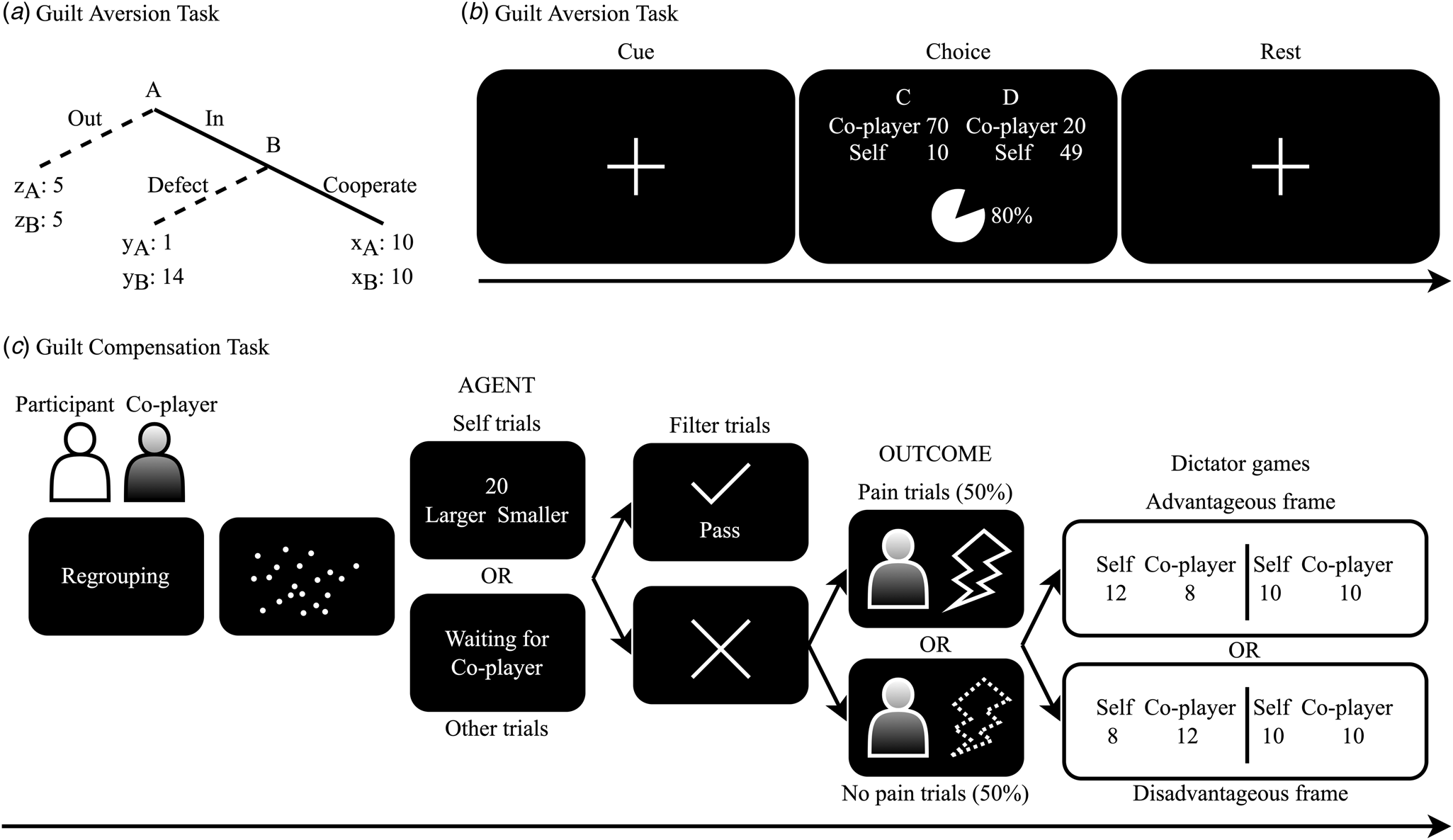
Guilt is derived from the violation of a personal moral rule or a social standard, especially when individuals are aware that they have inflicted harm, loss, or distress upon others (Baumeister et al., Reference Baumeister, Stillwell and Heatherton1994). Previous studies have suggested two aspects of guilt, the anticipatory guilt and the experienced guilt. The anticipatory guilt describes the phenomenon that, when making decisions, individuals can anticipate the feeling of guilt that may be caused by their inappropriate actions, and thus altering their actions in ways that maintain and strengthen relationships with others, e.g. cooperation (Charness & Dufwenberg, Reference Charness and Dufwenberg2006; Reuben et al., Reference Reuben, Sapienza and Zingales2009). Meanwhile, after harming others, the experienced guilt may motivate one to compensate for past actions in order to restore relationships with the victim (Gao et al., Reference Gao, Yu, Sáez, Blue, Zhu, Hsu and Zhou2018; Ketelaar & Tung Au, Reference Ketelaar and Tung Au2003). Both the anticipatory guilt and the experienced guilt promote prosocial behaviors and facilitate interpersonal relationships (Baumeister et al., Reference Baumeister, Stillwell and Heatherton1994). We employed two decision interactive tasks that were established by previous studies to measure the effects of these two aspects of guilt, respectively. The Guilt Aversion Task (Fig. 1a, b) was implemented to investigate the effect of anticipatory guilt on cooperative behaviors (Nihonsugi et al., Reference Nihonsugi, Ihara and Haruno2015) and the Guilt Compensation Task (Fig. 1c) was implemented to investigate the effect of experienced guilt on compensation behaviors (Gao et al., Reference Gao, Yu, Sáez, Blue, Zhu, Hsu and Zhou2018). Three psychometric instruments (described below) were used to measure clinical and psychological information.
Interactive tasks. (a) An example of the payoff matrix in the Guilt Aversion Task. Investor A chooses either Out or In and indicates their belief of the probability that the investee B cooperates (τA). If the investor A chooses In, then the investee B should choose between the options of Cooperate and Defect. If the investee B chooses the Cooperate option, then the investor A and the investee B receive xA and xB, respectively (condition x). If the investee B chooses the Defect option instead, then the investor A and investee B receive yA and yB, respectively (condition y). If the investor A chooses Out, then the investor A and the investee B receive monetary payoffs of zA and zB, respectively (condition z). (b) Experimental procedure of the formal part of the multi-round Guilt Aversion Task. For each new trial, the participant was told that they would be paired with a new and randomly assigned anonymous investor A who chose In and provided a belief of the probability that the participant (investee B) would chose Cooperate, τA. The participant then chose Cooperate or Defect under the given payoff matrix and having knowledge of the investor A's τA, indicated by a pie chart. (c) Experimental procedure of the multi-round Guilt Compensation Task. Participants were told that they would be playing with three other anonymous players. Each trial began by informing the participants that they were randomly and anonymously paired with one of three co-players. In half of the trials, the participant performed a dot estimation task (Self trials); in the other half of the trials, the participant waited for their co-player to make an estimation (Other trials). If the answer was correct, no one would receive pain stimulation, and the current trial terminated. If either of them responded incorrectly, the co-player in the current trial had a 50% probability of receiving pain stimulation (Pain trials and No-pain trials), determined by the computer program. At the end of each incorrect trial, the participant would act as a dictator in the dictator game (DG) and make four sequential monetary binary choices to determine the payoffs for themselves and for the co-player.

Questionnaires
The Chinese versions of the questionnaires described below were confirmed to be valid and reliable in the Chinese population (Rong, Sun, Huang, Cai, & Li, Reference Rong, Sun, Huang, Cai and Li2010; Wang, Wei, Wang, Jiang, & Peng, Reference Wang, Wei, Wang, Jiang and Peng2015; Wang, Zhan, & Yan, Reference Wang, Zhan and Yan2016).
Obsessive Belief Questionnaire (OBQ-44)
The OBQ-44 is a 44-item self-report measure that assesses obsessive beliefs. Each item is rated on a seven-point Likert scale. The OBQ-44 has three subscales: responsibility and threat estimation; perfectionism and intolerance for uncertainty; and importance and control of thoughts (Obsessive Compulsive Cognitions Working Group, 2005).
Interpersonal Reactivity Index (IRI)
The IRI is a 28-item self-report measure that consists of four seven-item subscales accessing the following aspects of empathy: perspective taking (the tendency to spontaneously adopt the psychological point of view of others), fantasy (the tendency for individuals to transpose themselves imaginatively into the feelings and actions of fictitious characters in books, movies, or play), empathic concern (other-oriented feelings of sympathy and concern for the misfortunate of others), and personal distress (self-oriented feelings of personal anxiety and unease in tense interpersonal settings) (Davis, Reference Davis1980).
Guilt proneness
We adopted two guilt-related subscales of Guilt and Shame Proneness Scale (GASP) to measure proneness to guilt (Cohen, Wolf, Panter, & Insko, Reference Cohen, Wolf, Panter and Insko2011). Specifically, the guilt proneness subscales used are designed to assess guilt-related negative behavior-evaluations (guilt-NBEs) and guilt-motivated repair action tendencies (guilt-repair) following interpersonal transgressions. Guilt-NBEs reflect the experience of guilt, and individuals with higher NBE sub-scores feel guiltier after harming others. Guilt-repair reflects moral action orientation, and individuals with higher guilt-repair sub-scores are more likely to make corrections or compensations for their transgressions.
Interactive tasks
The Guilt Aversion Task
This task (Fig. 1a, b; Nihonsugi et al., Reference Nihonsugi, Ihara and Haruno2015) measures the anticipatory guilt, in which participants are aware of others' expectations before making choices of whether to be cooperative or defect, which enables them to alter their behaviors and fulfill others' expectations to avoid guilt. There are two players in this task: investor A and investee B. First, the investor A chooses either Out or In and indicates their belief of the probability that the investee B cooperates (τA). If the investor A chooses In, then the investee B should choose between the options of Cooperate and Defect. If the investee B chooses the Cooperate option, then the investor A and the investee B receive xA and xB, respectively (condition x). If the investee B chooses the Defect option instead, then the investor A and investee B receive yA and yB, respectively (condition y). If the investor A chooses Out, then the investor A and the investee B receive monetary payoffs of zA and zB, respectively (condition z), and the trial ends. Figure 1a shows an example of the payoff matrix in the Guilt Aversion Task.
The payoffs have several features: (1) for the investor A, xA > zA > yA; and (2) for the investee B, yB > xB > zB. Thus, to maximize their income, the investor A should choose In and expect that the investee B chooses Cooperate. However, if the investor A chooses In but the investee B chooses Defect, the investor A's payoff will be the least of the three conditions. For the investee B, the Defect option always has a higher payoff than the option Cooperate, but it may make one feel guilty for disappointing the investor A.
The Guilt Aversion Task was consisted of two parts. In part I, the participant experienced the decision-making process of investor A, deciding whether to choose In or Out under the above-described payoff matrix (Fig. 1a) and predicting the probability that the investee would cooperate. Through part I, which consisted of 20 trials, the participant thus gained a better understanding of the task rules. The participant was informed that their choices in part I were unrelated to and would not influence those of the next part. In part 2, which consisted of 35 trials, the participant completed the formal task as investee B (Fig. 1b). For each new trial, the participant was told that they would be paired with a new and randomly assigned anonymous investor A who chose In and provided a belief of the probability that the participant (investee B) would chose Cooperate, τA. The participant then chose Cooperate or Defect under the given payoff matrix and having knowledge of the investor A's τA, indicated by a pie chart. Only the data from part II, in which the participant played the role of investee B, were included in the data analysis (Nihonsugi et al., Reference Nihonsugi, Ihara and Haruno2015).
The Guilt Compensation Task
This task (Fig. 1c; Gao et al., Reference Gao, Yu, Sáez, Blue, Zhu, Hsu and Zhou2018) measures the experience of guilt and to what extent the experienced guilt facilitates compensation. The participant was told that they would be playing with three other anonymous players. Each trial began by informing the participants that they were randomly and anonymously paired with one of three co-players. In half of the trials, the participant performed a dot estimation task (Self trials); in the other half of the trials, the participant waited for their co-player to make an estimation (Other trials). If the answer was correct, no one would receive pain stimulation, and the current trial terminated. If either of them responded incorrectly, the co-player in the current trial had a 50% probability of receiving pain stimulation (Pain trials and No-pain trials), determined by the computer program. At the end of each incorrect trial, the participant would act as a dictator in the dictator game (DG) and make four sequential monetary binary choices to determine the payoffs for themselves and for the co-player. This DG gave the participant a chance to compensate the co-player in this trial. This formed a 2 (Agent who performed dot estimation task: Self v. Other) by 2 (Outcome for the co-player: Pain v. Nopain) within-participant design. The Self_Pain condition was the critical condition to induce guilt. The other three conditions controlled for confounding factors, such as empathy for the co-player and regret for providing a wrong estimation. The Agent–Outcome interaction effect [i.e. (Self_Pain − Other_Pain) > (Self_Nopain − Other_Nopain)] was the guilt effect that we focused on (Gao et al., Reference Gao, Yu, Sáez, Blue, Zhu, Hsu and Zhou2018). The experiment consisted of 72 trials, including 12 trials for each of the above four conditions and 24 correct trials. Each condition consisted of 48 monetary binary DG choices (four per trial).
In the DG, each of the four serial binary choices consisted of two options representing the payoffs that the participant and the co-player would earn. One option was an equal allocation (i.e. 10 points for me, and 10 points for the co-player). The other option was an unequal allocation with different values in each trial – either an advantageous inequity frame (i.e. allocating more to self than to the co-player) or a disadvantageous inequity frame (i.e. allocating more to the co-player than to self). For further details about the Guilt Compensation Task and the DG, see Gao et al. (Reference Gao, Yu, Sáez, Blue, Zhu, Hsu and Zhou2018).
After completing the Guilt Compensation Task, the participant was asked to rate how guilty they felt under each of four conditions on a seven-point Likert scale.
Monetary incentive
Participants who completed both the Guilt Aversion Task and the Guilt Compensation Task received a base payment of 300 RMB and those who completed only the Guilt Aversion Task received a base payment of 200 RMB. Additionally, participants were informed that, after the experiment, one choice in each of the two tasks would be randomly selected to determine additional bonuses to themselves and their corresponding co-players. This monetary incentive can make participants more active and focused during the performance of the task. Given that participants made decisions that could influence their own as well as others' payoffs, these potential monetary costs to some extent mitigate the social display effects (Larsen & Fredrickson, Reference Larsen and Fredrickson1999; Nisbett & Wilson, Reference Nisbett and Wilson1977). This arrangement has been proven to be effective in previous studies on guilt-related behaviors (Gao et al., Reference Gao, Yu, Peng, Gong, Xiang, Jiang and Zhou2021, Reference Gao, Yu, Sáez, Blue, Zhu, Hsu and Zhou2018).
Computational modeling
In line with previous studies on anticipatory guilt and experienced guilt, the guilt aversion model (Nihonsugi et al., Reference Nihonsugi, Ihara and Haruno2015) and Fehr–Schmidt inequity aversion model (Fehr & Schmidt, Reference Fehr and Schmidt1999; Gao et al., Reference Gao, Yu, Sáez, Blue, Zhu, Hsu and Zhou2018) were adopted respectively for the Guilt Aversion Task and the Guilt Compensation Task, to capture the influences of anticipatory guilt and experienced guilt in decision-making.
The guilt aversion model
The guilt aversion model (Nihonsugi et al., Reference Nihonsugi, Ihara and Haruno2015) assumes that an individual dislikes disappointing another's belief. Thus, if investor A chose In in the Guilt Aversion Task, then the participant (investee B) was faced with the pressure of the investor A's expectation for cooperation with a belief magnitude of τ A. Therefore, the participant's perceived investor A's expectation of repayment was represented as the multiplicative product of investor A's belief that the participant would choose Cooperate (τ A) and investor A's payoff (x A) when the participant did chose Cooperate: τ A ⋅ x A. The difference between that expectation of repayment (i.e. τ A ⋅ x A) and the investee A's payoff when the participant selecting the Defect option (y A) – represented as τ A ⋅ x A − y A – was thus taken as a measure of how much the participant believed that they would disappoint investor A by choosing Defect. In other words, the difference τ A ⋅ x A − y A was adopted as a representation of the magnitude of guilt that the participant anticipated. In addition, the participant could also consider inequity aversion in the task, which assumed a social preference for equitable payoffs, and one's utility of an action decreased when the allocation of monetary payoffs was unequal (see details in Nihonsugi et al., Reference Nihonsugi, Ihara and Haruno2015). Thus, the participant's utility of the choice Defect can be represented by the difference between their payoff and the loss caused by guilt aversion (τ A ⋅ x A − y A) in addition to the loss caused by inequity aversion (y A − y B). Conversely, the participant's utility of the choice Cooperate was represented as the difference between their payoff and the loss caused by inequity aversion (x A − x B) (Eq. 1). Altogether, the participant's (the investee B's) utility function, uB, was given by:

where γ captured the participant's sensitivity to guilt aversion, and α captured the participant's sensitivity to inequity aversion. Each choice, Defect or Cooperate, had a corresponding utility, u(Defect) and u(Cooperate). Ultimately, the difference between utilities of the two choices contributed to the participant's choice (Eq. 2). The utility function was calibrated to the participant's choice using a softmax specification with an inverse temperature parameter, λ, such that in each trial, the probability that the participant would choose Cooperate was expressed as:

The Fehr–Schmidt inequity aversion model
In the Guilt Compensation Task, the participant chose between the equal and unequal options to determine the payoffs that would be given to themselves and to the co-player, represented as Ms and Mo, respectively. One option was an equal allocation (each getting 10 points) and the other was an unequal allocation. For the equal allocation, since Ms always equaled Mo, u(unequal allocation) was constant as 10, i.e. constant utility without discount caused by inequity aversion. For the unequal allocation, the utility was calculated as shown in Eq. 3:

where p and q were indicator functions. That is, p = 1 and q = 0 if Ms ⩾ Mo (advantageous inequity frame), and q = 1 and p = 0 if Ms < Mo (disadvantageous inequity frame). Thus, α and β represented the participant's extents of aversion to advantage inequity and disadvantage inequity, respectively. In each trial, the probability of choosing the unequal allocation was defined by Eq. 4:

The performance of model fitting was assessed by posterior predictions and parameter recovery. Posterior predictions are synthetic, model-generated datasets that are produced by parameters drawn from the posterior distribution. If the synthetic datasets resemble the empirical data closely, then the model fit is deemed adequate (van Ravenzwaaij, Dutilh, & Wagenmakers, Reference van Ravenzwaaij, Dutilh and Wagenmakers2011). We generated posterior predictions from the estimated parameters and then compared the predicted choices with the true choices, thus computing predictive accuracy. Parameter recovery is another way of evaluating how well the model fit; it indicates whether the models are robustly identifiable (Fareri, Chang, & Delgado, Reference Fareri, Chang and Delgado2015). Similarly, we generated posterior predictions from the estimated parameters (i.e. true parameters) and then fitted the model to these simulated data to ‘recover’ the parameters. Finally, we compared the recovered parameters to their true values. If the model was well fitted, the recovered parameters would correlate strongly with the true parameters (Wilson & Collins, Reference Wilson and Collins2019).
Statistical analysis
Categorical data (gender, habitation, and whether an only child) were compared with χ2 tests. Effect size was reported as Cramer's V. T tests were conducted to assess group differences in scores of OBQ-44, IRI, and Guilt Proneness. Effect size was reported as Cohen's d. Multiple comparison corrections were adopted and p values were corrected using the Benjamini and Hochberg method of false discovery rate (Benjamini & Hochberg, Reference Benjamini and Hochberg1995).
For both the Guilt Aversion Task and the Guilt Compensation Task, parameters were estimated using maximum likelihood estimation with the fmincon function in Matlab (MATLAB, 2018); the standard errors of estimated parameters were obtained through a bootstrap procedure with 200 iterations (Gao et al., Reference Gao, Yu, Sáez, Blue, Zhu, Hsu and Zhou2018; Nihonsugi et al., Reference Nihonsugi, Ihara and Haruno2015). Since the parameters estimated from computational modeling might not fit the normality and variance-homogeneity assumptions of traditional t tests, Bayes factor (BF)/Bayesian t test was adopted to test the null hypothesis (i.e. no inter-group difference) (Morey & Rouder, Reference Morey and Rouder2011; Rouder, Speckman, Sun, Morey, & Iverson, Reference Rouder, Speckman, Sun, Morey and Iverson2009). BF values were computed in JASP (Love et al., Reference Love, Selker, Marsman, Jamil, Dropmann, Verhagen and Wagenmakers2019; Morey & Rouder, Reference Morey and Rouder2018) with default prior width. We reported evidence that the data were more likely under the alternative hypothesis (i.e. HC and OCPD groups differ in terms of the parameter of interest). Values of BF were interpretated in accordance with Jeffreys's theory as follows: <3, anecdotal evidence (non-informative); 3–10, moderately robust evidence; 10–30, strong evidence; 30–100, very strong evidence; and >100, extremely strong evidence (Andraszewicz et al., Reference Andraszewicz, Scheibehenne, Rieskamp, Grasman, Verhagen and Wagenmakers2015). To compute statistic power in the Bayesian framework, instead of the type II error rate β, we used the probability that the Bayesian factor is smaller than a decisive threshold under the alternative hypothesis (Fu, Hoijtink, & Moerbeek, Reference Fu, Hoijtink and Moerbeek2021; Schönbrodt & Wagenmakers, Reference Schönbrodt and Wagenmakers2018). We thus calculated the probability that our data produce an informative BF (i.e. BF10 > 3, providing at least moderately robust evidence) as the statistical power using the bootstrapping method (Fu et al., Reference Fu, Hoijtink and Moerbeek2021; Schönbrodt & Wagenmakers, Reference Schönbrodt and Wagenmakers2018).
To further support our model-based results, the relationship between guilt aversion parameter (γ) and the cooperation rate in the Guilt Aversion Task was examined using Pearson correlation. In the Guilt Compensation Task, a 2 (Agent: Self v. Other) × 2 (Outcome: Pain v. Nopain) × 2 (Group: OCPD v. HC) three-way analysis of variance (ANOVA) was used to assess the group differences in the experienced guilt and the guilt effect on behavior (i.e. monetary compensation, reflected by the difference between the chosen payoffs for self and the co-player). Effect size was reported as partial η 2partial. Analyses were conducted in R 4.0 (R Core Team, 2020) with a significance level of p < 0.05.
Results
Demographics and questionnaire
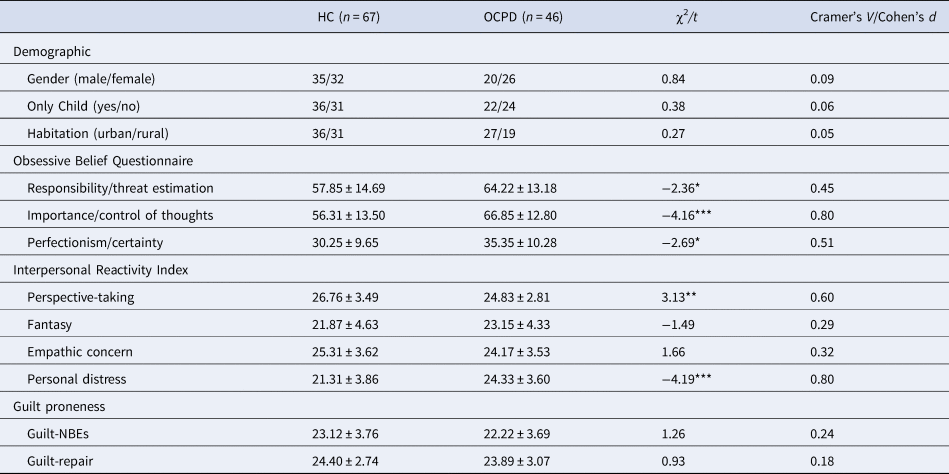
The demographic and psychometric characteristics of the participants are presented in Table 1. This pattern of results remained the same if we used the data of 108 participants of the Guilt Aversion Task or used the data of 74 participants of the Guilt Compensation Task. As expected, OCPD participants had higher obsessive-compulsive traits than HCs, as reflected by OBQ-44 sub-scores, including those for responsibility/threat estimate (t 112 = 2.36, p corr = 0.036, Cohen's d = 0.45), importance/control of thoughts (t 112 = 4.16, p corr < 0.001, Cohen's d = 0.80), and perfectionism/certainty (t 112 = 2.69, p corr = 0.019, Cohen's d = 0.51). There were no significant differences in demographics between the two groups [gender, χ2(1, N = 113) = 0.84, p = 0.360, Cramer's V = 0.09; whether an only child, χ2(1, N = 113) = 0.89, p = 0.482, Cramer's V = 0.06; or habitation, χ2(1, N = 113) = 0.27, p = 0.602, Cramer's V = 0.05]. Likewise, there were no significant differences in guilt proneness between the two groups (guilt NBEs, t 112 = 1.26, p corr = 0.236, Cohen's d = 0.24; and guilt-repair, t 112 = 0.93, p corr = 0.355, Cohen's d = 0.18).
Demographic and psychometric measures of HC and OCPD

Guilt-NBEs, guilt-negative behavior-evaluations; guilt-repair, guilt-repair action tendencies.
Note: p values corrected by B&H method, *p corr < 0.05, **p corr < 0.01, ***p corr < 0.001.
We observed significant differences between the two groups in the perspective-taking and the personal distress subscales of the IRI. OCPD participants reported a lower level of perspective-taking (t 112 = 3.13, p corr = 0.007, Cohen's d = 0.60) and a higher level of personal distress (t 112 = 4.19, p corr < 0.001, Cohen's d = 0.80). No significant difference was observed in the fantasy (t 112 = 1.49, p corr = 0.179, Cohen's d = 0.29) or the empathic concern (t 112 = 1.66, p corr = 0.149, Cohen's d = 0.32) subscales of the IRI.
OCPD participants exhibited less guilt aversion than HCs during cooperation
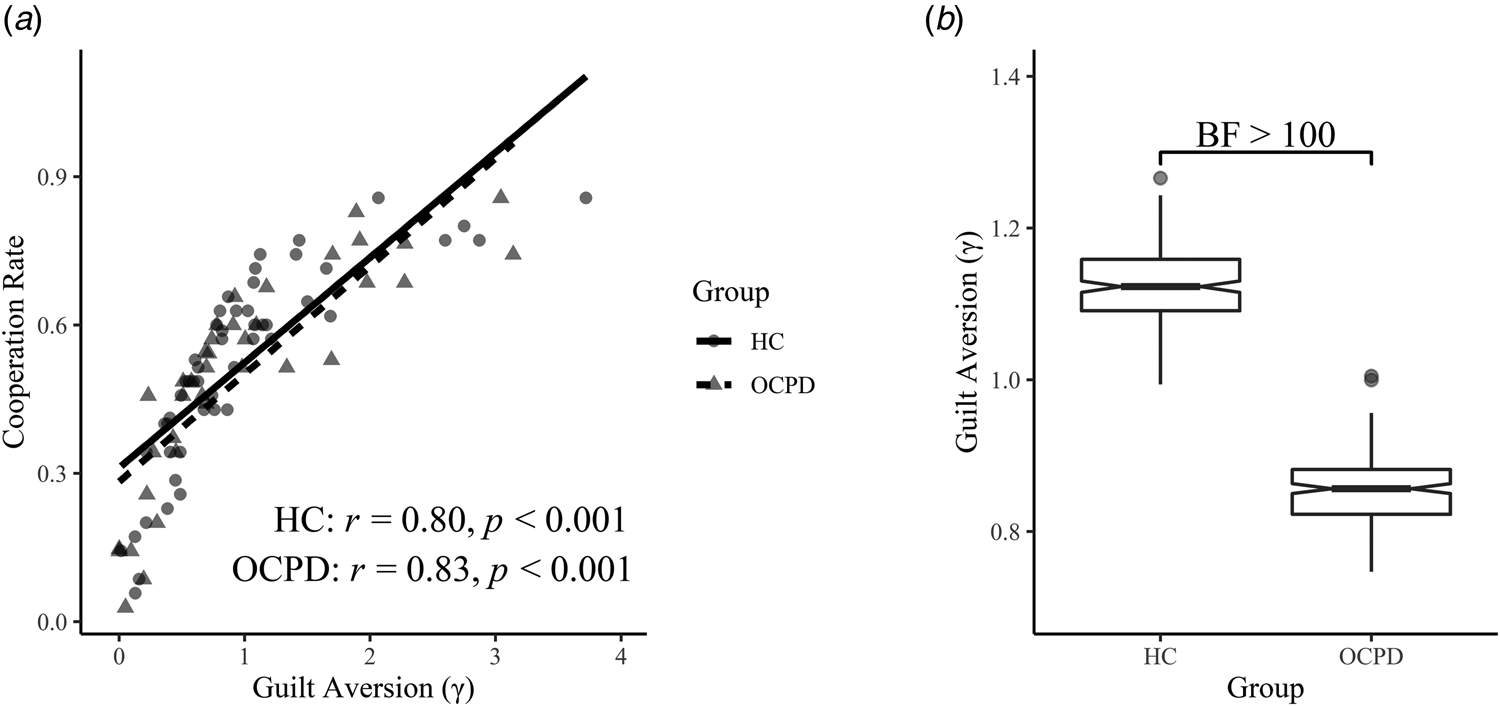
For the Guilt Aversion Task, the computational modeling parameter γ represented the participant's extent of guilt aversion, i.e. to what extent the anticipatory guilt motivated cooperation. For both groups, γ values correlated directly with the cooperation rate (HC: r = 0.80, p < 0.001; OCPD: r = 0.83, p < 0.001; Fig. 2a), indicating that participants' cooperative behaviors were affected by anticipatory guilt and that individuals with higher guilt aversion were more likely to choose to cooperate than to defect.
Results of the Guilt Aversion Task. (a) Correlation of the guilt aversion parameter γ with cooperation rate, indicating that participants' cooperative behaviors were affected by anticipatory guilt and that individuals with higher guilt aversion were more likely to choose to cooperate than to defect. (b) Group distributions of γ. Posterior γ distributions presented as notched boxplots (notches are 95% CIs) showing lower γ in OCPD group than in HC group, consistent with Bayesian t test result, demonstrating a reduced aversion to anticipatory guilt in social interactive decision-making in the OCPD group, which may lead them to be less cooperative.

A Bayesian t test indicated that the OCPD group had a lower level of guilt aversion (γ) than the HC group (Fig. 2b; BF10 > 100; power = 1.00), providing extremely strong evidence for the alternative hypothesis. The results suggest that, compared to HCs, individuals with OCPD tend to have a reduced aversion to anticipatory guilt in social interactive decision-making, which may lead them to be less cooperative.
OCPD participants exhibited less guilt-induced compensation than HCs after harming others
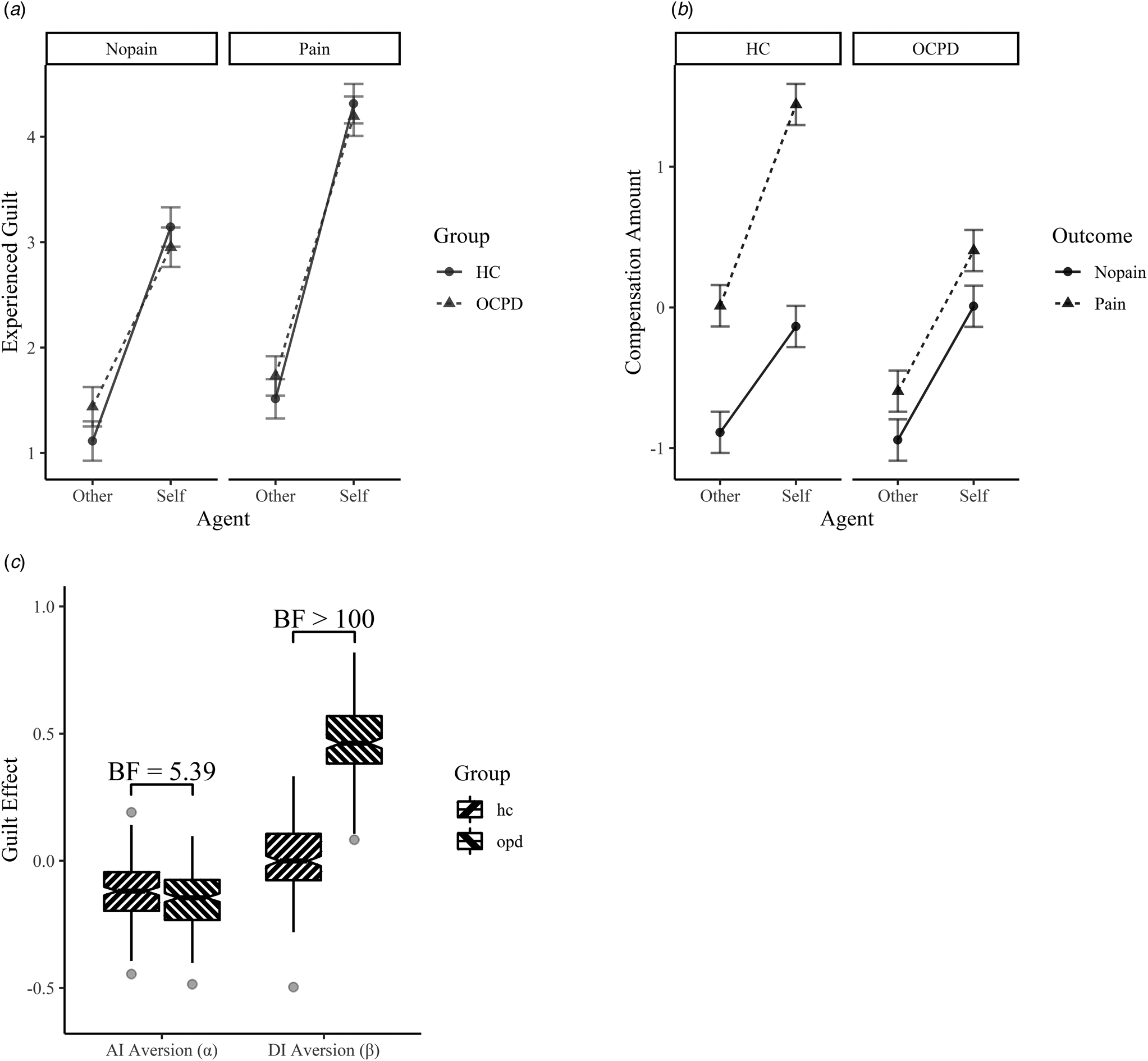
For the Guilt Compensation Task, a 2 (Agent: Self v. Other) × 2 (Outcome: Pain v. Nopain) × 2 (Group: OCPD v. HC) three-way ANOVA was conducted to compare group differences in the experienced guilt (Fig. 3a) and the guilt effect on behavior (i.e. monetary compensation, reflected by the difference between the chosen payoffs for self and the co-player; Fig. 3b). Result showed no significant difference between the two groups in post-task self-reported guilt under the four conditions of the Guilt Compensation Task (F 1, 77 = 0.09, p = 0.759, η 2partial < 0.01), suggesting that individuals with OCPD may experience the same level of guilt as HC participants during this task.
Results of the Guilt Compensation Task. (a) OCPD and HC groups had similar post-task self-reported guilt under the four conditions (three-way ANOVA). (b) The experienced guilt induced significant compensation behaviors in the HC group (i.e. outcome × agent interaction), while this guilt effect was reduced or absent in OCPD participants. (c) 2 (Agent: Self or Other) × 2 (Outcome: Pain or Nopain) interaction effects (i.e. the guilt effect) on advantageous inequity aversion (α) and disadvantageous inequity aversion (β). Experienced guilt contributed less to increases in advantageous inequity aversion (α) and to decreases in disadvantageous inequity aversion (β) in the OCPD group than in HCs.

There was a significant Agent × Outcome × Group interaction effect with respect to the amount of compensation (F 1, 77 = 4.57, p = 0.036, η 2partial = 0.06). Simple two-way interaction post-hoc tests performed separately for each group revealed a significant interaction between Outcome and Agent (a guilt effect) in the HC group (F 1, 36 = 11.55, p = 0.002, η 2partial = 0.11); this effect was not observed in the OCPD group (F 1, 41 = 0.05, p = 0.825, η 2partial < 0.01). These results suggest that the experienced guilt induced significant compensation behaviors in the HC group, while this guilt effect was reduced or absent in OCPD participants.
The previous study using the Guilt Compensation Task has shown that, when experiencing guilt, healthy population tend to exhibit an increased advantageous inequity aversion and decreased disadvantageous inequity aversion during monetary allocation (Gao et al., Reference Gao, Yu, Sáez, Blue, Zhu, Hsu and Zhou2018), a predisposition that promotes compensation to victims. Therefore, to probe the influence of OCPD on this tendency, we used computational modeling to estimate group-level advantageous inequity aversion (α) and disadvantageous inequity aversion (β) across four conditions. The 2 (Agent: Self or Other) × 2 (Outcome: Pain or Nopain) interaction effects (i.e. the guilt effect) on advantageous inequity aversion (α) and disadvantageous inequity aversion (β) are represented visually in Fig. 3c. It was determined that the experienced guilt contributed less to increases in advantageous inequity aversion (α) in the OCPD group than in the HC group (BF10 = 5.39), providing moderate evidence for the alternative hypothesis, albeit with relatively weak power (0.60). Additionally, we found that the experienced guilt contributed less to decreases in disadvantageous inequity aversion (β) in the OCPD group than in the HC group (BF10 > 100), providing extremely strong evidence for the alternative hypothesis (power = 1.00). Thus, although the level of experienced guilt after inflicting harm on others was similar between the two groups, the experienced guilt contributed less to compensation behaviors in the OCPD group than in the HC group, largely driven by the group difference in disadvantageous inequity aversion.
Our computational models performed well in terms of both posterior predictions and parameter recovery. The accuracy of model prediction was 0.83 [95% CI (0.81–0.85)] for the Guilt Aversion Task and 0.85 [95% CI (0.82–0.87)] for the Guilt Compensation Task. For the Guilt Aversion Task, the recovered guilt aversion parameter γ and its true value correlated strongly (r = 0.98, p < 0.001; online Supplementary Fig. S1a). For the Guilt Compensation Task, the recovered parameters of the guilt effects on advantageous inequity aversion (r = 0.74, p < 0.001; online Supplementary Fig. S1b) and disadvantageous inequity aversion (r = 0.86, p < 0.001; online Supplementary Fig. S1c) correlated strongly with their respective true values, affirming an acceptable model fit.
To be noted, previous studies have shown that guilt may induce social avoidance that could be captured using eye-tracking (Yu, Duan, & Zhou, Reference Yu, Duan and Zhou2017) or other technologies. In this view, it is possible that OCPD and HC participants may also have differences in guilt-related social avoidances. If participants showed social avoidances after feeling guilt, it may make participants to hesitate during decision-making and induce more missed choices. To test this possibility, we counted the number of missed choices in the two decision-making tasks, and did not observe significant differences between OCPD and HC groups [Guilt Aversion Task: t (107) = 1.48, p = 0.144; Guilt Compensation Task: t (78) = 1.88, p = 0.074]. Therefore, we assumed that guilt-induced avoidance did not significantly affect the main results of this research. However, as a pioneering study focusing on the influence of anticipatory guilt on cooperative behaviors and the effect of experienced guilt on compensation behaviors, we acknowledge that the current tasks were not designed to measure guilt-induced avoidance directly. Future specially designed studies are needed to address this possibility.
Discussion
The current study investigated the guilt-related responses of OCPD to better understand OCPD's interpersonal dysfunction, since guilt is one of the most important moral emotions in social life that promotes prosocial behaviors. The responses of two aspects of guilt – anticipatory guilt and experienced guilt – were measured respectively, by combining two social interactive tasks with computational modeling approach. Our computational modeling results of these guilt-related responses provide advanced evidence that (1) OCPDs are less affected by anticipatory guilt, and thus cooperate less in interpersonal relationships, and (2) OCPDs are less affected by experienced guilt and thus make fewer compensations to victims, despite that they reported same level of guilt feeling as HCs. The current study provides a proof of the principle that computational modeling can be used to help elucidate complex social behaviors that characterize psychiatric conditions and to help deepen our knowledge about mental disorders.
Anticipatory guilt regulates individuals' social behaviors before decisions are made and interpersonal transgressions happen, which promotes social relationships by driving behavioral adjustments to align with social norms (Baumeister et al., Reference Baumeister, Stillwell and Heatherton1994; Charness & Dufwenberg, Reference Charness and Dufwenberg2006; Reuben et al., Reference Reuben, Sapienza and Zingales2009). For example, in the Guilt Aversion Task where participants decided how much to return to their co-player, self-interest predominated when the co-player expected little from the participant, while the effect of self-interest was relatively diminished when the co-player expressed confidence in the participant's probability of cooperation. Cooperative behaviors increased to avoid disappointing the co-player's expectation, thus reducing or avoiding guilt while enhancing a mutually beneficial relationship (Reuben et al., Reference Reuben, Sapienza and Zingales2009). Thus, our group-level computational modeling results showed that a reduced influence of anticipatory guilt in individuals with OCPD led to less cooperation during social decision-making.
Experienced guilt regulates behavior after decisions have been made and interpersonal transgressions have occurred, and thus may lead the guilty party to take actions that restore social relationships (Baumeister et al., Reference Baumeister, Stillwell and Heatherton1994; Gao et al., Reference Gao, Yu, Peng, Gong, Xiang, Jiang and Zhou2021, Reference Gao, Yu, Sáez, Blue, Zhu, Hsu and Zhou2018; Yu et al., Reference Yu, Koban, Chang, Wagner, Krishnan, Vuilleumier and Wager2020). In some circumstances, violations of a social norm, failing to live up to others' expectations, or harming others' interests are unavoidable. Although the OCPD participants in the present study reported the same level of experienced guilt as HCs, their inequity aversion (especially the disadvantageous form) was altered less when experiencing guilt, suggesting that they were less affected by experienced guilt and thus compensated less to the victims.
Moral emotions function to motivate ethical behaviors and encourage people to act by accepted standards of right and wrong (Tangney et al., Reference Tangney, Stuewig and Mashek2007). For example, inducing people to feel guilty by having them recall past misdeeds causes them to behave more cooperatively in interpersonal interactions (Ketelaar & Tung Au, Reference Ketelaar and Tung Au2003). Atypical handling of guilt in individuals with OCPD could lead to them annoying others or even putting themselves in danger. Individuals with OCPD may be relieved from guilt-driven compensation by blaming others or attributing events to bad luck (Kantor, Reference Kantor2016). When guilt is inevitable, they might adopt an overly polite attitude and punish themselves symbolically (e.g. instant apologizing) to reduce short-term anxiety without modifying their ways of dealing with others in the long run (Kantor, Reference Kantor2016).
Our findings suggest that OCPD-associated deviations from social norms and expectations may be due to a diminished influence of guilt on behavior, despite the experienced guilt being intact. These findings have implications for the treatment of OCPD. Specifically, coping style refers to characteristic ways, both conscious and unconscious, that a person relieves emotional tension, such as tension from guilt; clinically, coping styles vary on a continuum from internalizing to externalizing (Beutler, Moos, & Lane, Reference Beutler, Moos and Lane2003). Previously, researchers have concluded OCPD's maladaptive means of dealing with guilt, such including misattribution, self-punishment, and restricted affect (Kantor, Reference Kantor2016), as internalizing coping skills (Beutler et al., Reference Beutler, Moos and Lane2003). This coping style for dealing with guilt in OCPD may relieve emotional tension, but often take a toll on interpersonal relationships, including leading to social rejection and relationship destruction, which would subsequently increase risks of depression, anxiety, and other neurotic symptoms (Kendler, Hettema, Butera, Gardner, & Prescott, Reference Kendler, Hettema, Butera, Gardner and Prescott2003; Slavich & Irwin, Reference Slavich and Irwin2014). According to Beutler and Clarkin's view that patients with internalizing coping skills perform better in insight-oriented psychotherapy (Beutler et al., Reference Beutler, Engle, Mohr, Daldrup, Bergan, Meredith and Merry1991; Beutler & Clarkin, Reference Beutler and Clarkin1990), therapists could encourage OCPD clients to examine their motivations and behaviors when confronted with guilt with the aim of helping them to understand and change destructive patterns. Related therapies, including interpersonal psychotherapy (Markowitz & Weissman, Reference Markowitz and Weissman2004) and metacognitive interpersonal therapy (Gordon-King, Schweitzer, & Dimaggio, Reference Gordon-King, Schweitzer and Dimaggio2018), have been reported to be effective in the treatment of OCPD (Barber & Muenz, Reference Barber and Muenz1996; Dimaggio et al., Reference Dimaggio, Carcione, Salvatore, Nicol, Sisto and Semerari2011; Fiore, Dimaggio, Nicoló, Semerari, & Carcione, Reference Fiore, Dimaggio, Nicoló, Semerari and Carcione2008; Gordon-King, Schweitzer, & Dimaggio, Reference Gordon-King, Schweitzer and Dimaggio2019).
Our findings suggest a difference between OCPD and OCD, and provide the possibility that the formation of obsession and compulsion may differ etiologically between the two disorders. While the behaviors of individuals with OCPD are less affected by guilt, individuals with OCD make every attempt to prevent or neutralize guilt, and guilt often fuels OCD's obsessional compulsive complaints, such as obsessive-washing behaviors (Ottaviani, Collazzoni, D'Olimpio, Moretta, & Mancini, Reference Ottaviani, Collazzoni, D'Olimpio, Moretta and Mancini2019), difficulty and doubt in decision-making (Chiang & Purdon, Reference Chiang and Purdon2019), intrusive thoughts (Gangemi, Mancini, & van den Hout, Reference Gangemi, Mancini and van den Hout2007), and not-just-right-experiences (Mancini, Gangemi, Perdighe, & Marini, Reference Mancini, Gangemi, Perdighe and Marini2008). In other words, guilt could be an etiological factor of OCD (Mancini & Gangemi, Reference Mancini and Gangemi2004), but may have little influence on the formation of obsessive-compulsive traits in OCPD. On the contrary, individuals with OCPD can resolve anxiety and other negative feelings brought about by guilt through restriction of affectivity and efficient alleviation of responsibility (Kantor, Reference Kantor2016).
Although the obsession/compulsion diagnostic criteria for OCPD are similar to those for OCD (Fineberg et al., Reference Fineberg, Sharma, Sivakumaran, Sahakian and Chamberlain2007; Thamby & Khanna, Reference Thamby and Khanna2019), current OCPD etiology theory attributes OCPD obsession and compulsion mainly to perfectionism, which comes from an abnormal need for predictability rather than guilt (Diedrich & Voderholzer, Reference Diedrich and Voderholzer2015; Hummelen et al., Reference Hummelen, Wilberg, Pedersen and Karterud2008). The need for predictability is natural for human beings. According to Baran-Cohen's study of autism spectrum conditions, individuals normally develop two balanced mechanisms of predictability: a systemizing mechanism (SM) to predict lawful events; and an empathizing mechanism (EM) to predict agency (Baron-Cohen, Reference Baron-Cohen2006). It has been suggested that individuals with OCPD may have a high-SM/low-EM profile (Cain et al., Reference Cain, Ansell, Simpson and Pinto2015; Hummelen et al., Reference Hummelen, Wilberg, Pedersen and Karterud2008). A relatively strong SM may increase the tendency to interpret the world according to mechanical concepts, leading to stubbornness, rigidity, and perfectionism, which are typical OCPD characteristics. Meanwhile, a relatively weak EM may lead to interpersonal problems, such as dysfunctions in cooperativeness, sharing, and compensating others. Consistent with a former study (Cain et al., Reference Cain, Ansell, Simpson and Pinto2015), the present IRI data revealed an empathy deficit in our OCPD group, including an impaired perspective-taking ability and an abnormally high level of personal distress, providing evidence that OCPD is characterized by low EM expression. In fact, perspective-taking has been suggested to be a foundation of guilt-related responses (Basil, Ridgway, & Basil, Reference Basil, Ridgway and Basil2008). Hence, we propose that OCPD-associated difficulties in perspective-taking might limit interpersonal behaviors, including adjusting behaviors according to anticipatory guilt and compensating victims in response to experiencing guilt. That is to say, in OCPD, reduced guilt-related responses might be a result of an EM dysfunction rather than a cause of obsessive and compulsive symptoms. Conversely, the obsessive and compulsive traits characteristic of OCPD might be a result of an excessively powerful SM. The aforementioned etiological differences may to some extent explain the discrepancies between OCPD and OCD symptoms, particularly the OCPD-specific rigidity and excessive self-control v. the OCD-specific pure obsessions and contamination/cleaning-related symptoms (Diedrich & Voderholzer, Reference Diedrich and Voderholzer2015).
The current study has several limitations, which raise important implications for future research. Firstly, although the elevated guilt in OCD has been validated previously and our current data underscore clinical differences between OCPD and OCD, we did not investigate OCD patients directly in this study (Mancini & Gangemi, Reference Mancini and Gangemi2004; Nissenson, Reference Nissenson2007; Shafran et al., Reference Shafran, Watkins and Charman1996; Shapiro & Stewart, Reference Shapiro and Stewart2011). Given that OCPD is often confused with OCD clinically, our observation provides a potential index that may distinguish OCPD and OCD in future clinical practice. Future research may directly compare these two groups to draw more specific conclusions. Secondly, the heterogeneity of OCPD was not considered due to the limited sample size. Individuals with OCPD exhibit a heterogeneous interpersonal profile suggestive of two distinct interpersonal subgroups: aggressive and pleasing (Solomonov, Kuprian, Zilcha-Mano, Muran, & Barber, Reference Solomonov, Kuprian, Zilcha-Mano, Muran and Barber2020). Whether and how this heterogeneity could affect the guilt experience and guilt-related behaviors are as of yet unknown, calling for future investigations. Thirdly, our use of an incentivized setting, wherein participants' decisions affects the fortunes of others as well as themselves, may mitigate moral displays due to social desirability (Larsen & Fredrickson, Reference Larsen and Fredrickson1999; Nisbett & Wilson, Reference Nisbett and Wilson1977). However, on the one hand, we used post-task self-ratings to assess experienced guilt in the Guilt Compensation Task. Although the way of post-task self-ratings has been shown to be effective previously (Chang et al., Reference Chang, Smith, Dufwenberg and Sanfey2011; Gao et al., Reference Gao, Yu, Sáez, Blue, Zhu, Hsu and Zhou2018; Yu et al., Reference Yu, Duan and Zhou2017, Reference Yu, Hu, Hu and Zhou2014), concerns remain regarding participants' introspection and memory abilities and a potential social desirability bias (Larsen & Fredrickson, Reference Larsen and Fredrickson1999; Nisbett & Wilson, Reference Nisbett and Wilson1977). On the other hand, individuals knowing that their answers were destined for research could have influenced their answers. In fact, lack of direct and implicit measurement of emotions is a general limitation for studies on guilt and other social emotions, as no effective and predictive physical (e.g. facial expressions) or physiological (e.g. skin conductance responses) measures have been established. This situation calls for the refinement and development of techniques in future studies.
Conclusion
Compared with HCs, OCPD participants tended to be less affected by guilt: they exhibited less guilt aversion when making cooperative decisions, and they exhibited less guilt-induced compensation after harming others. These impairments in guilt-related responses may prevent adjustments in behaviors toward compliance with social norms and thus result in interpersonal dysfunctions.
Supplementary material
The supplementary material for this article can be found at https://doi.org/10.1017/S003329172200277X
Acknowledgements
We thank all co-authors who helped complete this study, also we are particularly grateful to every participant in our study.
Author contributions
Fan Xiao: investigation, formal analysis, data curation, visualization, writing – original draft. Xiaoxue Gao: conceptualization, methodology, funding acquisition, writing – review and editing. Hongbo Yu: conceptualization, methodology. Lejia Fan, Xinlei Ji, Jiahui Zhao, Shulin Fang, Panwen Zhang, Xinyuan Kong, Qinyu Liu: investigation, data curation. Xiaolin Zhou: supervision, conceptualization, resources, writing – review and editing. Xiang Wang: supervision, funding acquisition, conceptualization, resources, writing – review and editing.
Financial support
This work was funded by the National Natural Science Foundation of China (grant number 31671144, 31900798), Hunan Provincial Natural Science Foundation of China (Grant No. 2019JJ40362), and the Research Foundation of the Education Commission of Hunan Province (Grant No. 2017jy77). Dr. Xiaoxue Gao is supported by Young Elite Scientists Sponsorship Program by China Association for Science and Technology (2021QNRC001). Dr. Xiaoxue Gao and Dr. Xiaolin Zhou are supported by the Research Project of Shanghai Science and Technology Commission (20dz2260300) and the Fundamental Research Funds for the Central Universities.
Conflict of interest
None.
Ethical standards
The authors assert that all procedures contributing to this work comply with the ethical standards of the Institutional Ethical Board of the Second Hospital of Xiangya, Central South University.