Introduction
Genetically modified soybean, expressing Cry1Ac protein from Bacillus thuringiensis (Bt) genes, has been widely used to manage Lepidoptera worldwide (Tabashnik et al., Reference Tabashnik, Fabrick and Carrière2023). Only 8 years after being commercially available in Brazil, where it was first released in the world, the cropped area increased from 1.2 million hectares (2013/14 crop season) to more than 30 million hectares (2020/21 crop season), representing more than 90% of total area cultivated with soybean in the country (Bueno et al., Reference Bueno, Braz-Zini, Horikoshi, Bernardi, Andrade and Sutil2025).
Over those years, the adoption of Bt soybeans (Cry1Ac) has been an efficient strategy within Soybean Integrated Pest Management (Soybean-IPM) to manage the most important Lepidoptera species that injure the crop (Bernardi et al., Reference Bernardi, Dourado, Carvalho, Martinelli, Berger, Head and Omoto2014, Reference Bernardi, Malvestiti, Dourado, Oliveira, Martinelli and Berger2012; Dourado et al., Reference Dourado, Bacalhau, Amado, Carvalho, Martinelli, Head and Omoto2016; MacRae et al., Reference MacRae, Baur, Boethel, Fitzpatrick, Gao and Gamundi2005). The adoption of this technology has provided benefits (Bueno et al., Reference Bueno, Braz-Zini, Horikoshi, Bernardi, Andrade and Sutil2025), including effective Lepidoptera management, reduction of insecticide use, greater preservation of natural biocontrol agents, and higher yields due to the mitigation of losses caused by pests, consequently, increasing farmers’ income (Brookes, Reference Brookes2018; Naranjo, Reference Naranjo, Ricroch, Chopra and Kuntz2021).
However, these benefits have led farmers to adopt this Bt technology in nearly 100% of their fields, resulting in low compliance of structured refuge adoption (non-Bt soybean cultivars) (Bueno et al., Reference Bueno, Braz-Zini, Horikoshi, Bernardi, Andrade and Sutil2025). Consequently, this lack of adopting refuge areas triggered high pressure for selection of resistant insects (Tabashnik et al., Reference Tabashnik, Fabrick and Carrière2023). Therefore, since the 2019/20 crop season, defoliation in Bt soybean (expressing only Cry1Ac) caused by Rachiplusia nu (Guenée, 1852) (Lepidoptera: Noctuidae) has been reported in the country (Nardon et al., Reference Nardon, Mathioni, Santos and Rosa2021), and was later confirmed as the first case of resistance of a Lepidoptera species to Bt soybean (expressing only Cry1Ac) (Reis et al., Reference Reis, Steinhaus, Godoy, Warpechowski, Diniz, Dallanora, Horikoshi, Ovejero, Martinelli, Berger, Head, Dourado and Bernardi2025).
After years of low Lepidoptera population, suppressed by Cry1Ac adoption in the country, the occurrence of this first Cry1Ac-resistant species has prompted an increased number of sprays of traditional chemical insecticides (Bueno et al., Reference Bueno, Braz-Zini, Horikoshi, Bernardi, Andrade and Sutil2025). Unfortunately, such sprays have been performed even when injuries are lower than economic thresholds (30% defoliation in the soybean vegetative stage or 15% defoliation in the soybean reproductive stage) (Hayashida et al., Reference Hayashida, Godoy, Hoback and Bueno2020) endangering one the most important benefits from the adoption of Bt technology, which is the reduced use of chemical insecticides (Bueno et al., Reference Bueno, Braz-Zini, Horikoshi, Bernardi, Andrade and Sutil2025). Therefore, the search for sustainable alternatives to manage R. nu has great theoretical and practical interest that could benefit hundreds of farmers who need to manage this pest not only on Bt but also on non-Bt soybean fields.
Among the most sustainable pest management tools currently available, augmentative biological control (ABC) is a method that has been applied for more than 100 years on millions of hectares worldwide (van Lenteren et al., Reference van Lenteren, Bolckmans, Köhl, Ravensberg and Urbaneja2018). Furthermore, among the different biological control agents that can be used in ABC, egg parasitoids of the genus Trichogramma (Hymenoptera: Trichogrammatidae) have been widely adopted (Hoffmann et al., Reference Hoffmann, Silva and Santos1989; Parra and Coelho, Reference Parra and Coelho2019). Trichogramma pretiosum Riley, 1879 (Hymenoptera: Trichogrammatidae) is responsible for more than 90% of the natural parasitism of lepidopteran eggs recorded in soybean fields (Foerster and Avanci, Reference Foerster and Avanci1999).
Trichogramma pretiosum is an egg parasitoid already commercially available as a biocontrol option to be used in soybean against other species such as Anticarsia gemmatalis Hubner (Lepidoptera: Erebidae) and Chrysodeixis includens (Walker) (Lepidoptera: Noctuidae) (Basso et al., Reference Basso, Chiaravalle and Maignet2020). The recommendations of how to use this parasitoid are well developed and have been adopted by farmers (Bueno et al., Reference Bueno, Parra and Bueno2012, Reference Bueno, Sutil, Cingolani and Colmenarez2024). This raises T. pretiosum as an alternative to also be used to control R. nu, to help reduce the recent return to insecticide use. However, the success of T. pretiosum releases to control R. nu will depend on the bioecological characteristics of the parasitoid and its interaction with the specific host species and different temperatures, which can differ among the parasitoid and host species and need to be studied in laboratory and field conditions (Bleicher and Parra, Reference Bleicher and Parra1989; Pratissoli and Parra, Reference Pratissoli and Parra2001; Smith, Reference Smith1996).
Thus, to propose the potential use of T. pretiosum to control R. nu in commercial releases, the first steps are laboratory studies needed that investigate the biology and parasitism capacity of T. pretiosum on this specific target (Hassan, Reference Hassan, Parra and Zucchi1997; Scholler and Hassan, Reference Scholler and Hassan2001) as parasitism efficiency can be different between different Trichogramma species and target species (Scholler and Hassan, Reference Scholler and Hassan2001). In addition, the parasitoid’s biological parameters are highly influenced by both temperature (Hasan et al., Reference Hasan, Parvin and Athanassiou2024; Noldus, Reference Noldus1989) and host species (Pizzol et al., Reference Pizzol, Desneux, Wajnberg and Thiéry2010). Therefore, this study evaluated the biology and parasitism capacity of T. pretiosum on R. nu eggs at 20, 25, and 30 °C to acquire the necessary information for possible recommendation of its release to manage R. nu in soybean.
Materials and methods
Trichogramma pretiosum and Rachiplusia nu rearings
Both the parasitoid T. pretiosum and the host R. nu eggs used in the trials were from insect colonies maintained at Embrapa Soybean, Londrina, State of Paraná, Brazil. Those colonies were kept under controlled environmental conditions inside biochemical oxygen demand (BOD) climate chambers (ELETROLab®, model EL 212, São Paulo, SP, Brazil) set at 80 ± 10% humidity, temperature of 25 ± 2 °C, and 12/12 h photoperiod (L/D). Trichogramma pretiosum was reared according to the methodology described by Parra (Reference Parra, Parra and Zucchi1997).
The R. nu rearing was started from caterpillars collected from soybean fields in the state of São Paulo during 2022 and 2023 and morphologically identified using the Manual for the Identification of Insects and Other Invertebrates of Soybean Crops (Sosa-Gómez et al., Reference Sosa-Gómez, Corrêa-Ferreira, Hoffmann-Campo, Corso, Oliveira, Moscardi, Panizzi, Bueno, Hirose and Roggia2014). The caterpillars were initially kept in the insect rearing laboratory at Bayer CropScience (Santa Cruz das Palmeiras, SP, Brazil) and later transferred to Embrapa Soybean. The caterpillars were reared on the artificial diet proposed by Greene et al. (Reference Greene, Leppla and Dickerson1976) and Parra (Parra and Coelho, Reference Parra and Coelho2019) and modified by Hoffmann-Campo et al. (Reference Hoffmann-Campo, Oliveira and Moscardi1985) in 50-mL plastic cups until the pupal stage. After eclosion, adults were fed with a 10% pure-bee honey/water solution inside 50 × 50 cm acrylic cages with the walls covered with A4 paper, where their eggs were laid. These eggs were then removed and either used for the trials or to maintain the insect colonies.
Laboratory experiments
All parasitoids used in the experiments had been reared for one generation on eggs of R. nu to avoid the pre-imago experience due to previous rearing on eggs of Ephestia kuehniella, which was used for parasitoid host maintenance (Brotodjojo and Wakter, Reference Brotodjojo and Wakter2006). Two laboratory experiments were independently carried out inside BOD climate chambers (ELETROLab®, model EL 212, São Paulo, SP, Brazil) set at 80 ± 10% humidity, different temperatures (treatments), and 12/12 h photoperiod (L/D) with 3 treatments (temperatures of 20, 25, and 30 ± 2 °C), and 20 replications per treatment formed by individualised female parasitoids into glass vials (12 mm in diameter and 75 mm high). The first experiment studied the biological characteristics of T. pretiosum when developing in R. nu eggs at 20, 25, and 30 ± 2 °C after the parasitism had occurred at 25 °C for 24 h (evaluating the impact of different temperatures on parasitoid larval development). The second experiment was designed to study the performance of adult T. pretiosum on R. nu eggs at the same temperatures (20, 25, and 30 ± 2 °C), with the later larval development occurring at 25 °C.
Experiment 1: Trichogramma pretiosum development on R. nu eggs at different temperatures
Twenty T. pretiosum females (≤24 h old) (replicates) were individualised with 20 R. nu eggs (also ≤24 h old) for 24 h. After that period, the parasitoids were removed, and the vials were then placed into environmental chambers set at different constant temperatures (treatments) of 20, 25, and 30 ± 2 °C. The following biological parameters were then evaluated: egg-to-adult period (days), number of parasitoids emerged per parasitised host egg, and sex ratio (number of females/total number of parasitoids).
Daily evaluations were performed to determine T. pretiosum developmental time (egg-to-adult period). The parasitoid emergence was evaluated by counting the hatched eggs with the aid of a stereomicroscope (Leica Application Suite – Version 1.6.0).
Experiment 2: Parasitism of T. pretiosum on R. nu eggs at different temperatures
Fifty host eggs per replicate (≤24 h old), glued on cards, were offered for parasitism for 24 h on 20, 25, and 30 ± 2 °C to individual females. These cards (with the eggs) were replaced daily until the death of the adult females. The eggs removed daily from the glasses were maintained inside controlled environmental chambers at 25 °C until the emergence of the parasitoids (F2 generation). The parameters recorded were (1) lifetime number of parasitised eggs per parental female; (2) parental female longevity (days); and (3) the lifetime per cent parasitism (F1 generation). Evaluations were performed daily with the aid of a stereomicroscope (Leica Application Suite – Version 1.6.0).
Statistical analysis
The results obtained were subjected to analyses of normality of the residuals (Shapiro and Wilk, Reference Shapiro and Wilk1965), homogeneity of variance of the treatments and additivity of the model (Burr and Foester, Reference Burr and Foester1972), so that ANOVA could be applied. The means were then compared using the Tukey’s test, at 5% probability of error, using the SAS statistical analysis program (SAS Institute, 2009).
Results
Experiment 1: Trichogramma pretiosum development on R. nu eggs at different temperatures
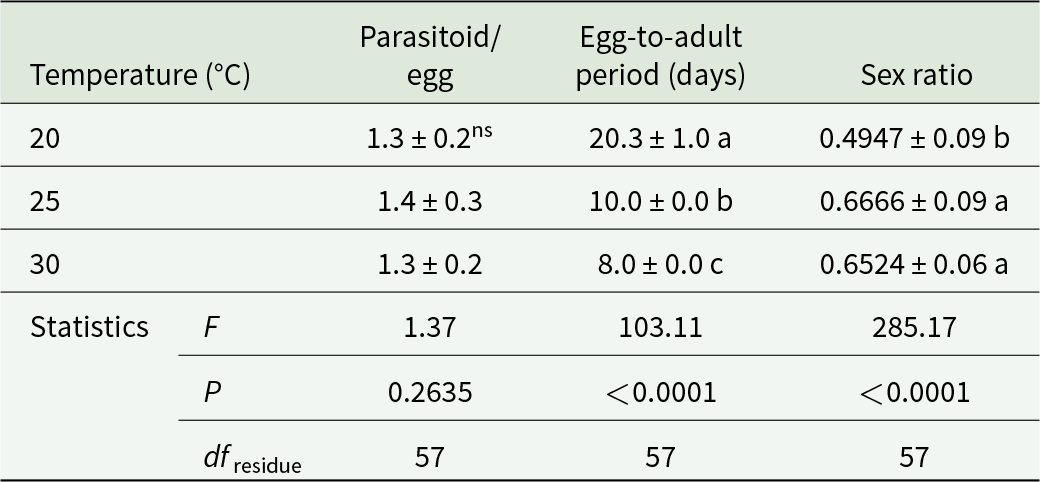
Trichogramma pretiosum had larval development at all studied temperatures (20, 25, and 30 °C). The number of parasitoids per egg, which was from 1.3 to 1.4, was not impacted by the different temperatures. Egg-to-adult period (days) decreased accordingly with the increased temperatures from an average of 20.3 days at 20 °C to 8.0 days at 30 °C, a reduction of 12.3 days. Sex ratio was always similar or higher than 0.5, indicating a high number of females in the progeny (Table 1).
Experiment 2: Parasitism of T. pretiosum on R. nu eggs at different temperatures
Number of parasitoids emerged per host egg, development time from parasitism to emergence of adult parasitoid, and sex ratio of the F1 generation of Trichogramma pretiosum on Rachiplusia nu eggs at different temperatures. RH 80 ± 10% and photoperiod of 12 h light and 12 h dark (Experiment 1)

Means ± SE followed by the same letter in the column did not differ according to Tukey’s test (p > 0.05). nsANOVA non-significant.
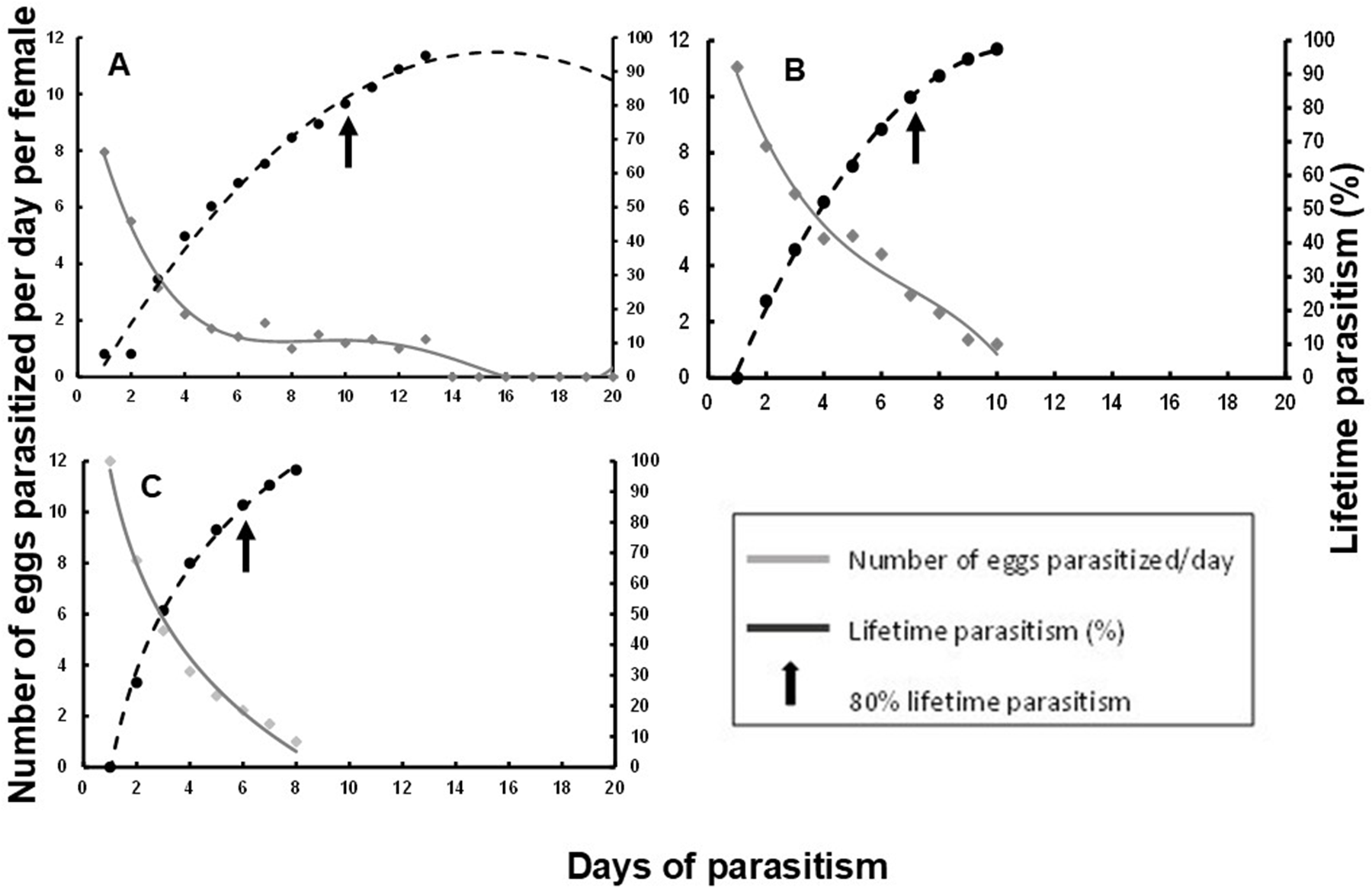
The number of parasitised eggs per day varied among the different temperatures; however, it was higher on the first day of the experiment at all studied temperatures, significantly decreasing at the end of the experiment. The average ± standard error of eggs parasitised during the first 24 h (parasitism %) was 7.95 ± 1.58 (15.9%), 11.05 ± 1.27 (22.1%), and 12.0 ± 1.81 (24.0%) at 20, 25, and 30 °C, respectively. Thus, the parasitoids decreased the number of daily oviposition as a function of the time of parasitism and the temperature at which they were subjected. Higher numbers of parasitised eggs per day were evident at all temperatures during the first 2 days of parasitism, significantly decreasing after that, especially at 25 and 30 °C. As a result of that parasitism rhythm, T. pretiosum reached 80% lifetime parasitism on R. nu eggs on the tenth, seventh, and sixth days at 20, 25, and 30 °C, respectively (fig. 1).
Parasitism of Trichogramma pretiosum Riley, 1879 (Hymenoptera: Trichogrammatidae) on Rachiplusia nu (Guenée, 1852) (Lepidoptera: Noctuidae) at different temperatures. (A) 20 °C, (B) 25 °C, and (C) 30 °C. Relative humidity of 80 ± 10% and photoperiod of 14:10 h light:dark. The arrows indicate 80% of lifetime parasitism.

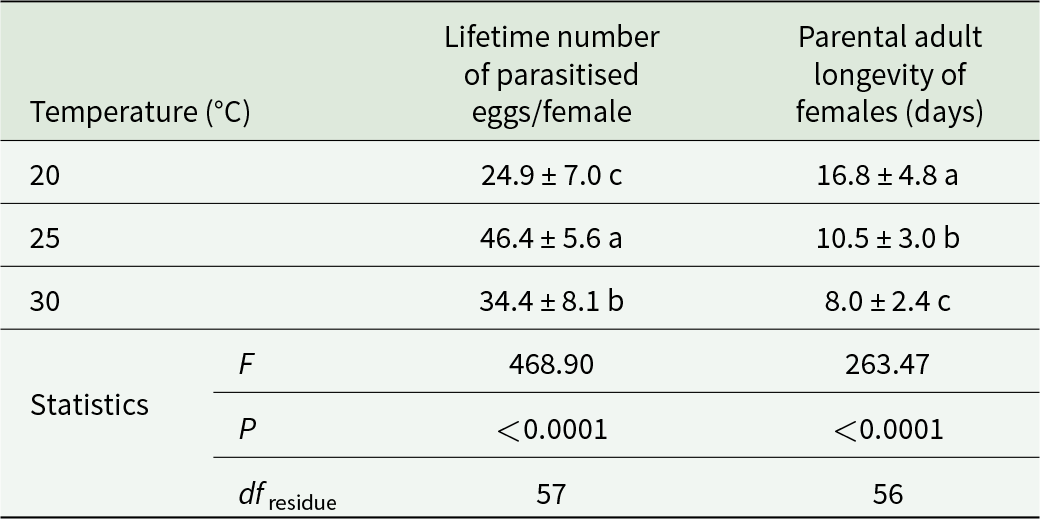
The longevity of parental adult T. pretiosum females when presented with R. nu eggs was inversely correlated to temperature, i.e. the greatest longevity was recorded at 20 °C (16.8 days), reducing at 25 °C (10.5 days) and reaching the lowest longevity at 30 °C (8.0 days). As a combination of adult longevity associated with parasitoid egg load and host quality, the lifetime number of parasitised eggs also varied among the temperatures. The lifetime number of parasitised R. nu eggs was highest at 25 °C (46.4 eggs) and the lowest at 20 °C (24.9 eggs), with intermediary figures at 30 °C (34.4 eggs) (Table 2).
Parasitoid performance of Trichogramma pretiosum on Rachiplusia nu eggs at different temperatures. RH 80 ± 10% and photoperiod of 12 h light and 12 h dark (Experiment 2)

Means ±SE followed by the same letter in the column did not differ according to Tukey’s test (P > 0.05).
Discussion
Although T. pretiosum is known as a generalist egg parasitoid (Li, Reference Li, Wajnberg and Hassan1994), detailed biological evaluations with different host species are necessary to establish the real potential of this biocontrol agent to be applied to manage different lepidopteran species in ABC programmes (Bueno et al., Reference Bueno, Sutil, Cingolani and Colmenarez2024; Smith, Reference Smith1996). Different biotic and abiotic factors can impact the biological aspects of parasitoids, interfering with their field efficiency (Carvalho et al., Reference Carvalho, Silva, Reis, Veras, Carneiro, Almeida, Silva and Lopes2017; McDougall and Mills, Reference McDougall and Mills1997; Thomson and Hoffmann, Reference Thomson and Hoffmann2002).
Despite the mortality caused by high temperatures being previously recorded for T. pretiosum in laboratory (constant temperature of 30oC) (Grande et al., Reference Grande, Queiroz, Gonçalves, Hayashida, Ventura and Bueno2021) and other egg parasitoid species in field conditions (variable temperatures, which peaked 55.2oC) (Braz et al., Reference Braz, Bueno, Colombo and Queiroz2021), that emergence (%) in our trial was 100%, illustrating the good adaptation of T. pretiosum at temperatures from 20 to 30 °C. Emergence (%) higher than 90% at those temperatures was also reported by Bueno et al. (Reference Bueno, Parra and Bueno2012) for T. pretiosum parasitising A. gemmatalis and C. includens eggs, indicating similar responses from the same parasitoid to those host species, which are common soybean pests.
In addition to temperature, the type of host eggs (R. nu) can also impact T. pretiosum. Host eggs of Lepidoptera species can have very different chorion membrane textures, number of pores, and thickness of the layers of mucous/wax (Cônsoli et al., Reference Cônsoli, Kitajima and Parra1999), which might make the eggs more or less susceptible to different temperatures and parasitoid species. Nevertheless, T. pretiosum was found to be adapted and efficient at the tested temperature range from 20 to 30 °C and the studied host (R. nu).
The length of the egg-to-adult period (days) can indicate whether a given temperature is better or worse for the parasitoid growth (Chen et al., Reference Chen, Enkegaard and Sørensen2021). More suitable temperatures would generally provide faster development of the parasitoid’s larval stage (Negahban et al., Reference Negahban, Sedaratian-Jahromi, Ghane-Jahromi, Haghani and Zalucki2021; Sujii et al., Reference Sujii, Costa, Pires, Colazza and Borges2002; Yeargan, Reference Yeargan1980). The longer duration of the egg-to-adult period is probably a compensatory action for the survival of the insects for completing their cycle (Machado et al., Reference Machado, Ferreira, Rosa, Garcia, Pinheiro and Veloso1999; Silveira et al., Reference Silveira, Vendramin and Rossetto1997). At higher temperatures, the egg-to-adult period of T. pretiosum is shorter, indicating quicker development and faster increase of the T. pretiosum population when development occurs at those temperatures. This increase in the parasitoid development is due to increased metabolic activity of the parasitoids when they develop at higher temperatures (Hernández and Díaz, Reference Hernández and Díaz1996; Oliveira and Kanashiro, Reference Oliveira and Kanashiro2010; Pratissoli, Reference Pratissoli1995; Zago et al., Reference Zago, Pratissoli, Barros and Godim2006), which occurs until an upper limit at which the high temperature becomes lethal (Haddad et al., Reference Haddad, Parra and Moraes1999).
The ideal sex ratio should equal or exceed 0.5 for mass rearing and release of Trichogramma spp. (Nava et al., Reference Nava and Parra2008). The influence of temperature on the sex ratio of different Trichogramma species is variable according to the parasitoid and host species (Bueno et al., Reference Bueno, Parra and Bueno2012). Despite the small reduction of the sex ratio recorded at 20 °C, our results for this parameter are still positive, since the emergence of similar number or more female parasitoids than males occurred at all studied temperatures, which is important for biological control programmes to succeed (Pratissoli et al., Reference Pratissoli, Oliveira, Gonçalves, Zanuncio and Holtz2004a; Wakeil et al., Reference Wakeil, Farghaly and Ragab2008) because females is responsible for parasitism (Bueno et al., Reference Bueno, Sutil, Cingolani and Colmenarez2024).
Overall, our study provides an important insight into the influence of temperature on the performance of T. pretiosum parasitising R. nu eggs. According to Chapman (Reference Chapman1998), insects react to changes in temperature by altering their metabolism, which varies from species to species (Firake and Khan, Reference Firake and Khan2014). For the egg parasitoid T. pretiosum, the reported results indicate that despite the significant impacts of temperature on the parasitoid development, the wasps maintained high parasitism capacity (lifetime parasitism from 24.9 to 46.4 eggs) under the studied temperature range (from 20 to 30 °C), with the highest performance recorded from 25 to 30 °C. The better parasitism performance of T. pretiosum between those temperatures is similar to results previously reported in the literature for the same species parasitising other hosts (Bueno et al., Reference Bueno, Sutil, Cingolani and Colmenarez2024; Zachrisson, Reference Zachrisson1997), indicating that this parasitoid species will be efficient at this temperature range independently of the target pest to be controlled.
Increased temperature leading to the reduction of parental adult longevity was already reported in the literature for different species of Trichogramma (Del Pino et al., Reference Del Pino, Gallego, Suárez and Cabello2020; Pereira et al., Reference Pereira, Barros, Pratissoli and Parra2004; Pratissoli and Parra, Reference Pratissoli and Parra2000; Scholler and Hassan, Reference Scholler and Hassan2001; Smith, Reference Smith1996). The parasitism peak in the first days of adulthood is because T. pretiosum is a pro-ovigenic parasitoid, in which adults emerge ready to lay eggs. According to Mills and Kuhlmann (Reference Mills and Kuhlmann2000), this is a consequence of the species’ capacity to store a full complement of mature eggs in the ovaries or oviducts and complete oogenesis either before or shortly after adult emergence. Pro-ovigenic parasitoid is a known trait of several different species of the genus Trichogramma (Bai et al., Reference Bai, Luck, Forster, Stephens and Janssen1992; Pak and Oatman, Reference Pak and Oatman1982; Volkoff and Daumal, Reference Volkoff and Daumal1994).
In addition to the parasitism peak, how long the females actively parasitise (parasitisation period) is important for successful biological control (Bueno et al., Reference Bueno, Sutil, Cingolani and Colmenarez2024). The differences recorded in the parasitisation period can be caused by a response of the parasitoid (Reznik and Vaghina, Reference Reznik and Vaghina2006) or a response of the host (Reznik et al., Reference Reznik, Umarova and Voinovich2001) to temperature (20, 25, and 30 °C) differences and can vary among different parasitoid or host species (Pizzol et al., Reference Pizzol, Desneux, Wajnberg and Thiéry2010; Pratissoli et al., Reference Pratissoli, Oliveira, Gonçalves, Zanuncio and Holtz2004a; Pratissoli and Parra, Reference Pratissoli and Parra2000, Reference Pratissoli and Parra2001). The length of the parasitisation period can significantly impact the biological control performance of Trichogramma spp. (Smith, Reference Smith1996; Wajnberg and Hassan, Reference Wajnberg and Hassan1994). Thus, whether parasitism is more active in the first days of life or more evenly distributed throughout adulthood is among the key characteristics to consider when choosing the best strategies to adopt the parasitoid in IPM (Bueno et al., Reference Bueno, Sutil, Cingolani and Colmenarez2024). Usually, the sooner the parasitoid reaches 80% of its lifetime parasitism, the better, because the parasitoid can achieve most of its potential parasitism before being exposed in the field to different causes of mortality such as pesticides sprayed later in the field or an abrupt temperature change that could kill the egg parasitoid (Bueno et al., Reference Bueno, Sutil, Cingolani and Colmenarez2024; Denis et al., Reference Denis, Pierre, van Baaren and van Alphen2011).
Other considerations related to the parasitoid species (T. pretiosum) were thoroughly studied in previous studies including (1) high parasitism capacity, which as herein confirmed on R. nu eggs, and (2) other variables that interfere in the biological control efficiency in the field such as parasitism searching and dispersal capacity (Bueno et al., Reference Bueno, Parra and Bueno2012). Therefore, these studies suggest that T. pretiosum could also be release in soybean fields to control R. nu using the same recommendations adopted to release T. pretiosum to control A. gemmatalis and C. includens in soybean, which must be studied in future trials in field conditions to confirm or refute this hypothesis.
Competing interests
The authors declare that there are no competing interests in this work.