Branched-chain fatty acids (BCFA) constitute only some 2% of total fatty acids (FA) in milk fat, but they are major lipids of rumen bacterial membranes, where they are incorporated after de novo synthesis from different available substrates. There is a growing interest in BCFA, as their contents in milk fat could be used as biomarkers of ruminal function and their variations could reflect changes of rumen bacteria populations induced by diet composition (Vlaeminck et al., Reference Vlaeminck, Fievez, van Laar, Vlaeminck, Fievez, Cabrita, Fonseca and Dewhurst2006; Fievez et al., Reference Fievez, Colman, Castro-Montoya, Stefanov and Vlaeminck2012; Cívico et al., Reference Cívico, Núñez Sánchez, Gómez-Cortés, De la Fuente, Peña Blanco, Juárez, Schiavone and Martínez Marín2017).
Although the presence of BCFA in milk fat has largely been ascribed to ruminal microorganisms, a recent study has shown that endogenous synthesis of certain BCFA should not be dismissed (Vlaeminck et al., Reference Vlaeminck, Gervais, Rahman, Gadeyne, Gorniak, Doreau and Fievez2015). These authors suggested that a postruminal 2-carbon elongation may occur on BCFA converting iso 15:0 and anteiso 15:0 into iso 17:0 and anteiso 17:0, respectively, which are the four most abundant BCFA in milk fat. Thus, the BCFA profile in milk fat would probably reflect the BCFA absorption in the small intestine combined with certain metabolic reactions that would occur prior to their incorporation into milk fat.
However, the contribution of the endogenous elongation to the milk BCFA C17 content is still poorly understood. The aim of this work was to apply a linear regression model to quantify the postruminal contribution of iso and anteiso 17:0 to goat milk fat. In order to achieve this objective, we examined by chemometrics the BCFA profile of milk fat samples from dairy goats fed with different basal diets.
Materials and methods
The current investigation was carried out at the University of Córdoba facilities in accordance with the EU Directive 2010/63/EU for animal studies (European Commission, 2010). Sixteen Malagueña goats were allocated to two simultaneous experiments in a crossover design with two treatments, four animals per treatment and two experimental periods of 25 d. Goats were blocked by BW and milk production (4 animals per block). Within each block, animals were randomly assigned to dietary treatments and all four diets were represented in all blocks. During the whole study, goats were placed in individual cages and machine milked (DeLaval, Madrid, Spain) before morning feeding. In both experiments, the basal diet consisted of alfalfa hay and concentrate in a 33 : 67 ratio. In experiment 1, the concentrate consisted of (g/kg, as fed): maize, 356.0; barley, 356.0; and soybean meal, 250.0. The concentrate of experiment 2 included (g/kg, as fed): soybean hulls, 356.0; maize, 178.0; barley, 178.0; and soybean meal, 250.0. As a result, the starch-to-nonforage neutral detergent fibre (NDF) ratio of the diet was 3.1 and 0.8 in the experiments 1 and 2, respectively. In both experiments, basal diets were offered either alone or in combination with 30 g/d of linseed oil. Body weight of the animals was recorded to the nearest 0.1 kg at the beginning and at the end of each experimental period. Milk samples were collected the last day of each experimental period and stored at −20 °C until analysis.
A total of 32 milk fat samples were obtained and analysed according to Bichi et al. (Reference Bichi, Toral, Hervás, Frutos, Gómez-Cortés, Juárez and De la Fuente2012). Milk fat extraction was carried out by two consecutive centrifugations and fatty acid methyl esters were prepared by base-catalysed methanolysis of glycerides with KOH in methanol. Two capillary columns (CP-Sil88 100m and SLB-IL111 100m) were used in the chromatographic analysis, in order to prevent possible coelutions and to carry out a proper BCFA quantification.
The regression model proposed by Palmquist et al. (Reference Palmquist, St. Pierre and McClure2004) was used to calculate the proportions of iso 17:0 and anteiso 17:0 that were postruminally synthesized from their putative precursors iso 15:0 and anteiso 15:0. Data were analysed with the REG procedure of SAS 3.5 University Edition (SAS Institute Inc., Cary, NC, USA). The dependent variables were iso 17:0 and anteiso 17:0 and the independent variables were iso 15:0 and anteiso 15:0, respectively. According to Palmquist et al. (Reference Palmquist, St. Pierre and McClure2004), the intercept of the regression equation would correspond to the rumen origin fraction of the dependent variable (C17 BCFA). For our purposes, the regression coefficient allows calculation of the fraction of the independent variable (C15 BCFA) that is converted to the dependent variable (C17 BCFA) by applying the relationship β1/(1 + β1), where β1 is the regression coefficient.
Results and discussion
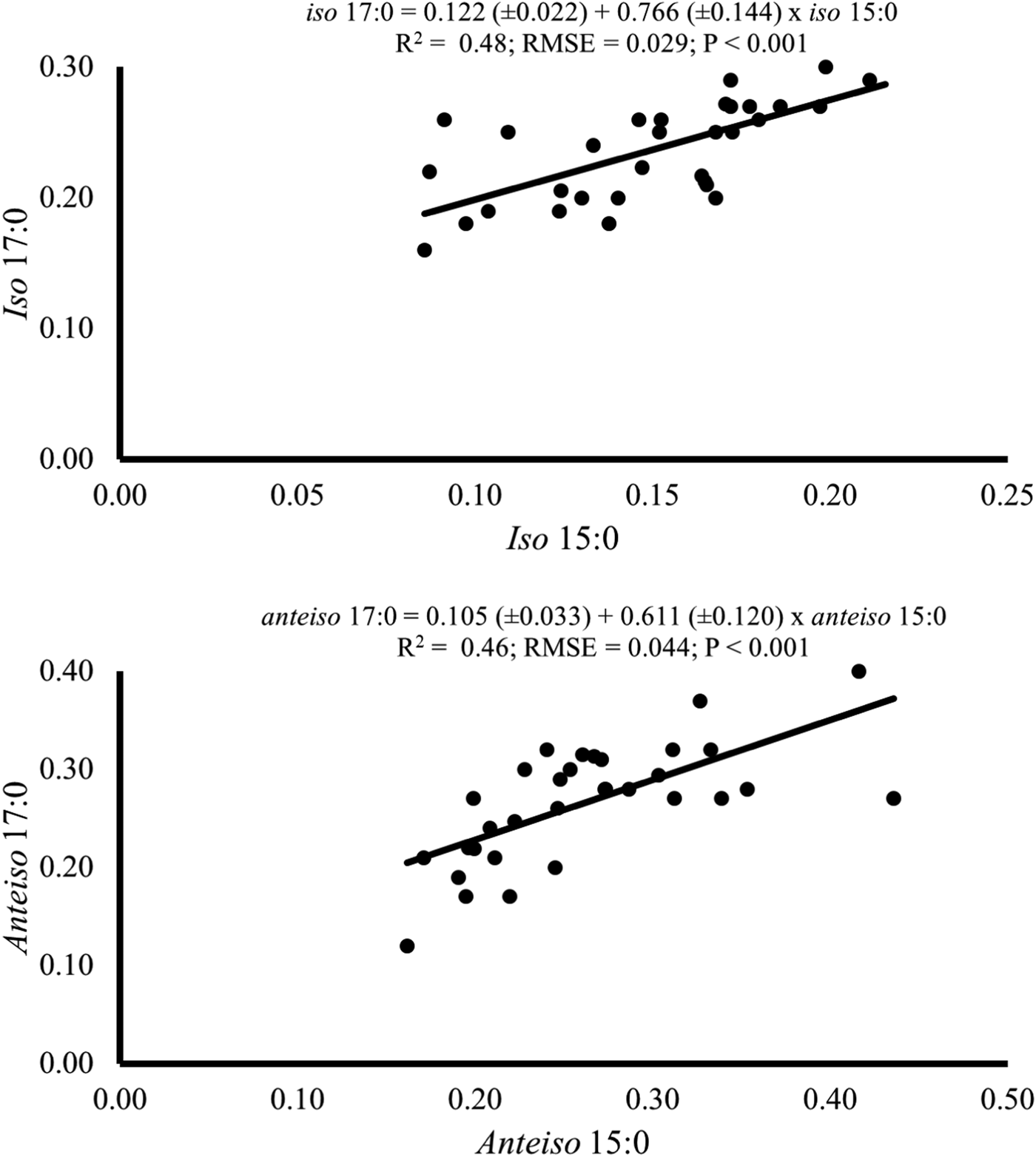
The contents of iso 15:0, anteiso 15:0, iso 17:0 and anteiso 17:0 in milk fat were 0.15 ± 0.036, 0.26 ± 0.066, 0.24 ± 0.039 and 0.27 ± 0.060 g/100 g total fatty acid methyl esters. The pairs iso 15:0/iso 17:0 and anteiso 15:0/anteiso 17:0 showed a strictly linear relationship (Fig. 1). The regression coefficients allowed us to calculate that 43% of iso 15:0 and 38% of anteiso 15:0 would have been converted to iso 17:0 and anteiso 17:0, respectively. Correspondingly 49% of total iso 17:0 and 60% of total anteiso 17:0 in milk fat derived from iso 15:0 and anteiso 15:0. These results would be in line with those derived from in vivo data obtained in dairy cows by Vlaeminck et al. (Reference Vlaeminck, Gervais, Rahman, Gadeyne, Gorniak, Doreau and Fievez2015). These authors found that the proportions iso 15:0/iso 17:0 and anteiso 15:0/anteiso 17:0 in milk fat were lower than those observed in duodenal digesta, which suggest that chain elongation processes on BCFA would occur in extraruminal tissues. Furthermore, the lower ratio iso 15:0 to iso 17:0 and anteiso 15:0 to anteiso 17:0 that those authors observed in plasma triacylglycerols and non-esterified fatty acids as compared with duodenal samples might indicate that elongation would take place before uptake by the mammary gland, as discussed by Vlaeminck et al. (Reference Vlaeminck, Gervais, Rahman, Gadeyne, Gorniak, Doreau and Fievez2015). The extramammary elongation of iso 15:0 and anteiso 15:0 with 2 carbon atoms would be also supported by the fact that ruminal infusions of isovalerate and 2-methylbutyrate, the primers for the de novo synthesis in the mammary gland, did not result in increased secretions of iso or anteiso 17:0 in milk (French et al., Reference French, Bertics and Armentano2012).
Relationship between iso 15:0 and iso 17:0 as well as anteiso 15:0 and anteiso 17:0 contents (g/100 g total fatty acid methyl esters) in milk fat from goats fed with different concentrates and supplemented or not with linseed oil. RMSE, root mean square error.

Enrichment of plasma non-esterified fatty acids with C17 BCFA would also be possible during mobilization of adipose tissue in negative energy balance periods, thus providing more iso 17:0 and anteiso 17:0 to the mammary gland (Craninx et al., Reference Craninx, Steen, Van Laar, Van Nespen, Martin-Tereso, De Baets and Fievez2008). Nevertheless, that confounding factor was not present in the present work because no weight changes were observed in the animals and they were well after the peak of lactation (118 ± 16 d in milk).
Although fatty acid elongase 6 (ELOVL6) activity has been well recognized in humans (Wang et al., Reference Wang, Park, Wang, Goykhman, Lawrence, Kothapalli and Brenna2017), its role and importance in ruminant tissues remain less clear. Moreover, from the current research there is not enough evidence to make a definitive conclusion about the origin of the extraruminal C17 BCFA in milk. In this regard, Castro-Carrera et al. (Reference Castro-Carrera, Frutos, Leroux, Chilliard, Hervás, Belenguer, Bernard and Toral2015) observed in dairy ewes that the mRNA abundance of ELOVL6 genes was higher in subcutaneous and perirenal adipose tissues than in the mammary tissue. However, the possibility that endogenous BCFA elongation could also take place, at least partially, in mammary tissue should not be ruled out. The genes coding ELOVL6 have been detected in mammary epithelial cells of goats (Xu et al., Reference Xu, Luo, Zhao, Yang, Tian, Shi and Bionaz2016) and, an in vitro study has directly assessed the role of ELOVL6 in the elongation of fatty acids in caprine mammary cells (Shi et al., Reference Shi, Wu, Zhu, Zhang, Yao, Luo and Loor2017).
The elongation indexes of iso 17:0 and anteiso 17:0, calculated as [product/(substrate + product)], that were obtained in the present research did not differ (P > 0.05) between diets supplemented and unsupplemented with linseed oil (0.60 vs. 0.62 for iso 17:0 and 0.49 vs. 0.51 for anteiso 17:0). These results agree with the absence of effects on the expression of genes coding ELOVL6 in adipose and mammary tissues of dairy ewes due to sunflower oil supplementation that was found by Castro-Carrera et al. (Reference Castro-Carrera, Frutos, Leroux, Chilliard, Hervás, Belenguer, Bernard and Toral2015).
In conclusion, the linear regression model applied in the current study supports the idea that a relevant fraction of 17C BCFA in milk fat would be synthesized in endogenous tissues via the elongation of 15C BCFA.
Acknowledgements
This work was supported by the Ministerio de Economía y Competitividad (Project AGL2016-75159-C2-2-R). The authors wish to thank Mrs. M.V. Rodríguez Pino (CIAL, Madrid, Spain) for their valuable technical assistance.