1. Introduction
Regional trade agreements (RTAs)Footnote 1 have been a major vehicle of trade liberalization in the world trading system. However, RTAs are undergoing transformation in today's world trading system as global value chains (GVCs) are playing increasingly significant roles in the production of goods.Footnote 2 The GVC economy is characterized by efficient sourcing of intermediate goods on a global scale and production of goods ‘wherever the necessary skills and materials are available at competitive cost and quality’.Footnote 3 In order to adapt to the change in the global manufacturing environment, major trading nations are launching mega-RTAs, which individually will cover a significant share of the world trade if successfully concluded.Footnote 4 Notable examples of planned mega-RTAs are the Trans-Pacific Partnership (TPP),Footnote 5 the Regional Comprehensive Economic Partnership (RCEP),Footnote 6 and the Transatlantic Trade and Investment Partnership (TTIP).Footnote 7 Among the planned mega-RTAs, the negotiations of the TPP were the first to be concluded in 2015. However, the TPP is not likely to be enacted, because the US decided in January 2017 to withdraw as a signatory of the TPP.Footnote 8 Despite the probable demise of the TPP, negotiations on mega-RTAs are likely to continue in other parts of the world as GVCs play a greater role in the world economy.
In the world trading system, which is full of crisscrossing RTAs, a mega-RTA based on GATT Article XXIV is likely to form overlapping RTAsFootnote 9 with other RTAs that are based on GATT Article XXIV or the Enabling Clause.Footnote 10 In this paper, overlapping RTAs are defined as RTAs that meet the following two conditions. First, at least two WTO members are jointly parties to no less than two RTAs. Second, each RTA separately provides preferential market access between the common parties, which are referred to as WTO members that are jointly parties to the RTA and its overlapping RTA.
There are two types of overlapping RTAs. In the first type, all the parties to the mega-RTA's overlapping RTA are common parties. An example of this is the TPP and North American Free Trade Agreement (NAFTA).Footnote 11 In this example, all NAFTA parties are common parties because they are also parties to the TPP. Another example is the overlap between the RCEP and the ASEAN–China FTA. Once again, all the parties to the ASEAN–China FTA are the common parties because they are parties to the RCEP.
In the second type, not all the parties to the mega-RTA's overlapping RTA are common parties. An example of this type of overlapping RTAs is the TPP and the ASEAN–China FTA.Footnote 12 There are parties to the ASEAN–China FTA that are not common parties. They are referred to as the single-agreement parties as they are only parties to the ASEAN–China FTA. Another example is the overlap between the TPP and the RCEP. Although both RTAs are considered mega-RTAs, they form overlapping RTAs. The overlap creates common parties and single-agreement parties on both RTAs. Yet another example is the RCEP and the PACER Plus.Footnote 13 The PACER Plus is a proposed RTA between Pacific Islands Forum countries. Since not all the members of the Pacific Islands Forum are negotiating parties to the RCEP, some of them would be single-agreement parties. This paper focuses on the second type of the overlap between a mega-RTA and another RTA, where some parties to the mega-RTA's overlapping RTA remain as single-agreement parties.
The administration of the liberalization of trade in goods in an RTA relies on preferential rules of origin that determine whether a product qualifies for preferential tariff treatment going beyond the most-favored nation (MFN) tariff treatment under GATT Article I.Footnote 14 Preferential rules of origin are distinguished from non-preferential rules of origin, which are defined as the rules of origin used for MFN treatment under GATT Article I.Footnote 15 Preferential rules of origin are used in RTAs or in non-reciprocal preferential trading arrangements such as the Generalized System of Preferences (GSP). With respect to an RTA, the main elements of preferential rules of origin are usually provided in the rules of origin chapter. Annexed to the rules of origin chapter in an RTA is the list of product-specific rules (PSRs) of origin, which are the rules of origin for each product classification.
Rules of origin aim to determine the origin of an import based on whether an import is ‘substantially transformed’ in the country of origin.Footnote 16 There are three general criteria for determining the origin of an import: change of tariff classification (CTC) criterion, ad valorem percentage (value-added) criterion, and manufacturing or processing operation criterion.Footnote 17 First, the CTC criterion determines that a product is an originating good from a country if all the non-originating materials used in producing a good undergo required shifts in the Harmonized System (HS) tariff classificationFootnote 18 in that country.Footnote 19 A subcategory of a CTC rule is the change in tariff heading (CTH) rule, which is stated as follows: ‘A change to a good of heading [HS Code] from any other heading.’Footnote 20 The CTH rule requires heading (HS four digit) changes in classification from materials to final product. Second, a value-added criterion confers origin if the value of originating materials from the territories of the parties is not less than a minimum percentage of the final product's value.Footnote 21 Third, the manufacturing or processing operation criterion determines the origin of a product based on whether a specific processing occurred in the country from which the product is deemed to be originating.Footnote 22
In a trading environment in which a mega-RTA overlaps another RTA, the preferential rules of origin provided in the mega-RTA may cause a systemic problem as they operate between the trade of the common parties and the single-agreement parties. If the preferential rules of origin are exclusionary, they may serve as ‘surrogate’ trade barriers against imports of intermediate goods from the single-agreement parties.Footnote 23 In particular, if the rules of origin adopted in a mega-RTA are based on the CTC-with-exception criterion, they restrict the imports of the intermediate goods that are included in the exception list from the single-agreement parties.
The CTC-with-exception criterion is the CTC criterion that carves out exceptions for some imported materials. The intermediate goods included in the exception list must be sourced within the territories of the RTA irrespective of whether the non-originating materials met the CTC rule. In general, CTC-with-exception based rules of origin are in the form of PSRs applicable to specific products or product groups.
At the outset, it should be noted that the WTO Agreement does not prohibit preferential rules of origin based on CTC-with-exception criterion per se. In fact, the WTO Agreement on Rules of Origin acknowledges their use as rules of origin in RTAs.Footnote 24 The question examined in this paper is whether the CTC-with-exception based rules of origin of a mega-RTA conform to the requirements of GATT Article XXIV in situations in which the mega-RTA is in an overlapping relationship with another RTA. In previous studies, the legal problem of restrictive rules of origin in RTAs has been examined.Footnote 25 However, the legal problem of restrictive rules of origin in the context of overlapping RTAs poses a different question. In particular, this paper focuses on the exclusionary rules of origin based on the CTC-with-exception criterion provided in a mega-RTA based on GATT Article XXIV that overlaps another RTA based on GATT Article XXIV or the Enabling Clause.
Following the introduction, Section 2 of this paper first describes the landscape of overlapping free-trade areas in the Asia-Pacific region where overlapping RTAs are most frequently observed and explains why overlapping customs unions (CUs) are not feasible under the WTO law. Section 3 examines whether the rules of origin based on the CTC-with-exception criterion provided in a mega-RTA based on GATT Article XXIV conform to WTO law when a mega-RTA overlaps another RTA. By way of example, the discussion is based on the CTC-with-exception based rules of origin under the TPP, which overlaps the ASEAN–China FTA. The TPP is the biggest RTA in its economic size ever concluded between WTO members. Therefore, the objective examination of the provisions of the TPP would provide valuable lessons about consistency of the provisions of an RTA with WTO law, notwithstanding the fact that the TPP may fail to enter into force. Section 4 explores a legal remedy and possible systemic solutions to the problem. Section 5 concludes with a summary and implications.
2. Overview of overlapping RTAs
2.1 Overlapping free-trade areas
Among the regions in the world, overlapping RTAs have been observed most frequently in the Asia-Pacific region as the ASEAN countries together entered into RTAs with many third countries. The ASEAN members formed the ASEAN Free Trade Area (AFTA) as a free-trade area between ASEAN members in 1993.Footnote 26 In the beginning, the AFTA was the sole preferential trading path for the trade between ASEAN countries. Later, the ASEAN countries togetherFootnote 27 have entered into the following ASEAN RTAs: the ASEAN–China FTA,Footnote 28 the ASEAN–Japan FTA,Footnote 29 the ASEAN–Korea FTA,Footnote 30 and the AANZ FTA.Footnote 31
In addition to the AFTA, the ASEAN RTAs respectively created additional preferential trading paths between the ASEAN members. For example, the ASEAN–Japan FTA provides a preferential trading path between the ASEAN members, not just between Japan and the ASEAN members. This can be seen from the tariff liberalization requirement in the ASEAN–Japan FTA, which requires ‘each Party … [to] eliminate or reduce its customs duties on originating goods of the other Parties’.Footnote 32 The imports qualifying for tariff elimination or reduction are ‘originating goods of the other Parties’, where the term ‘Parties’ is defined as ‘Japan and those ASEAN Members States for which this Agreement has entered into force collectively’.Footnote 33 Accordingly, an export to an ASEAN member or Japan from another ASEAN member or Japan would receive preferential treatment under the ASEAN–Japan FTA, provided that the product qualifies as an originating good of ‘the other Parties’. As other ASEAN RTAs also create preferential trading paths between the ASEAN members, the AFTA and the ASEAN RTAs create overlapping RTAs, where the common parties are the ASEAN members.
To further complicate matters, an ASEAN RTA and a bilateral RTA between each member of the ASEAN with that third country result in overlapping RTAs. This can be illustrated by the overlap between the ASEAN–Japan FTA and the bilateral RTA between Japan and individual ASEAN countries. The bilateral RTAs between Japan and an ASEAN member are as follows: the Japan–Singapore FTA, the Japan–Thailand FTA, the Japan–Indonesia FTA, the Japan–Philippines FTA, and the Japan–Vietnam FTA.Footnote 34 The bilateral RTAs respectively form overlapping RTAs with the ASEAN–Japan FTA. The common parties in the resulting five pairs of overlapping RTAs are Japan and the individual ASEAN country with which Japan has entered into a bilateral RTA.
In the crowded landscape of overlapping RTAs in the Asia-Pacific region, the formation of the TPP and the RCEP would create additional overlapping RTAs. If the TPP and the RCEP were enacted, the TPP, the RCEP, the AFTA, and the four ASEAN RTAs would collectively constitute overlapping RTAs. The common parties based on the negotiating parties to the TPP as of 2016 would be Singapore, Vietnam, Malaysia, and Brunei Darussalam, which are parties to all seven overlapping RTAs.
2.2 Overlapping CUs
The above overlapping RTAs in the preceding section are all free-trade areas under GATT Article XXIV or under the Enabling Clause. None of them is a CU. This leads to the question whether overlapping RTAs in the form of CUs can exist at all under the WTO law. To examine this question, consider a formation of overlapping CUs, where some or all the members of a CU may together become parties to another CU. The new CU coexists with the original CU. The resulting overlap in CUs lead to the original CU failing to meet the definition of a CU under GATT Article XXIV:8(a)(ii), because the parties to the original CU cannot maintain ‘substantially the same duties and other regulations of commerce’ on imports from the non-parties to the CU. Hence, GATT Article XXIV does not permit overlapping CUs.
To illustrate the above with an example, consider the EU and the Customs Union between Turkey and the European Community (EU–Turkey CU).Footnote 35 The first part of the definition of overlapping RTAs requires at least two WTO members jointly to become parties to no less than two RTAs. This part of the definition is met because the EU members are the common parties to the EU and the EU–Turkey CU. The second part of the definition of overlapping RTAs requires that the RTAs separately provide preferential market accesses between the common parties. However, this requirement is not met because the goods traded between the EU members are outside the scope of the EU–Turkey CU.Footnote 36 The EU–Turkey CU does not provide preferential market accesses between the EU members. The EU as ‘a single customs territory’Footnote 37 solely provides preferential market access for goods traded between the EU members.Footnote 38 Therefore, the example of the EU and the EU–Turkey CU shows that even if the two CUs share common parties, they do not constitute overlapping RTAs. Instead, the EU–Turkey CU should be characterized as a bilateral CU between a separate customs territory of the EU and Turkey.
3. Legality of exclusionary rules of origin of mega-RTAs under WTO law
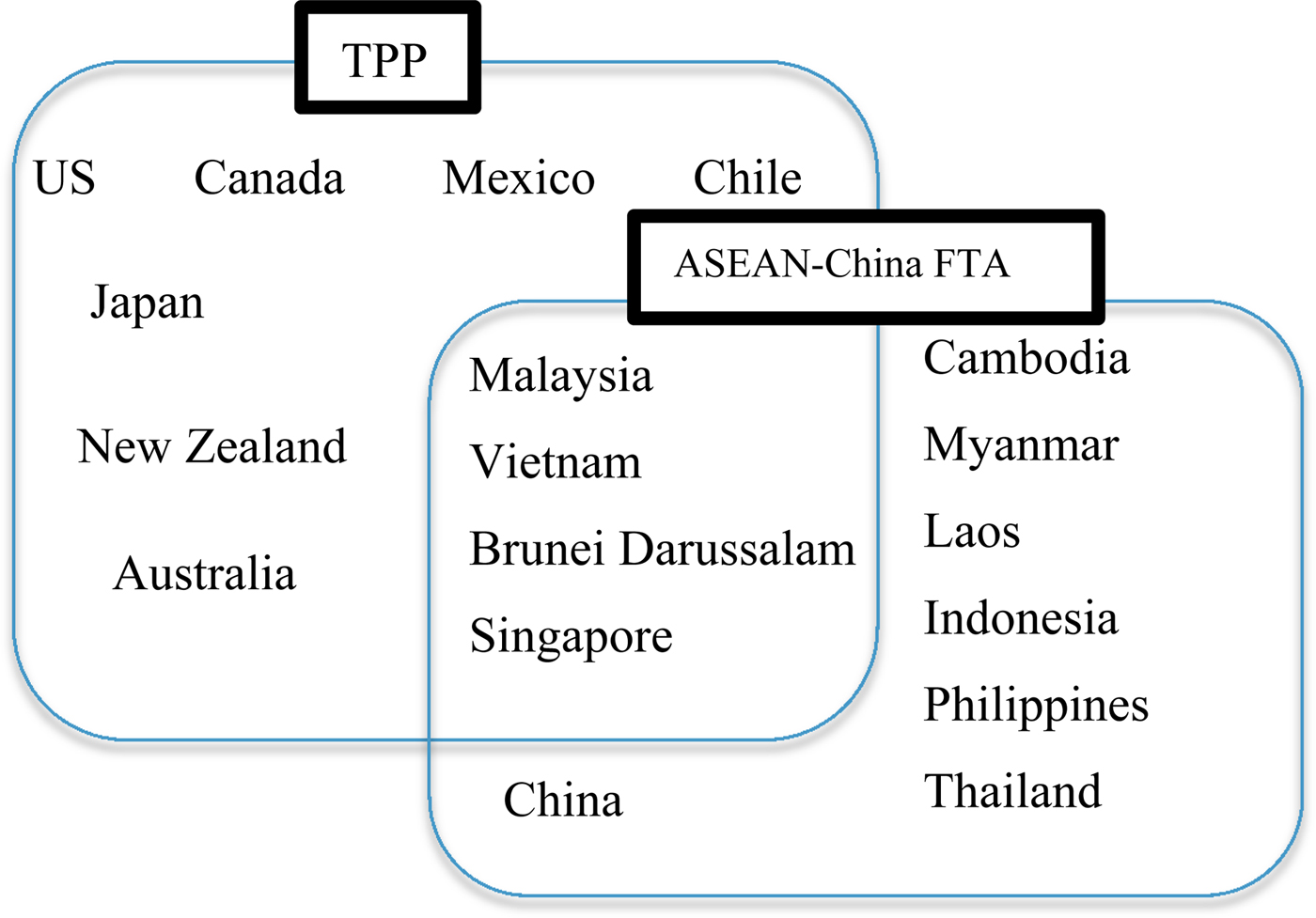
The following analysis is based on the example of the proposed TPP as a mega-RTA that overlaps the ASEAN–China FTA. The common parties to the TPP and the ASEAN–China FTA are Malaysia, Vietnam, Brunei Darussalam, and Singapore. The remaining single-agreement parties are China, Cambodia, Indonesia, Laos, Myanmar, Philippines, and Thailand as shown in Figure 1.Footnote 39
The Overlap Between the TPP and the ASEAN-China FTA.

As a free-trade area, the TPP commits to preferential elimination of tariffs between the TPP parties, resulting in derogation from GATT Article I. Thus, the TPP must satisfy the requirements of GATT Article XXIV exception.Footnote 40 The challenged measures in this paper are the CTC-with-exception based rules of origin provided in the TPP for some products. They are examined under the WTO Appellate Body's Turkey–Textiles two-pronged test to determine whether the requirements of legal defense under GATT Article XXIV are met.Footnote 41 The first prong of Turkey–Textiles examines whether the challenged measure takes effect ‘upon the formation’ of a legitimate RTA that fully meets the requirements of paragraphs 5 and 8 of GATT Article XXIV.Footnote 42 The first prong combines the timing requirement for the challenged measures and the requirements under paragraphs 5 and 8 of GATT Article XXIV. The second prong – the ‘necessity requirement’ – examines whether the formation of an RTA ‘would be prevented if it were not allowed to introduce the measure(s) at issue’.Footnote 43
3.1 First prong of Turkey–Textiles
3.1.1 Timing requirement
The challenged measures are the CTC-with-exception based rules of origin provided in the TPP as part of the rules of origin of the TPP. The rules of origin distinguish the imports that qualify for preferential treatment from other imports. The timing requirement is clearly met because the rules of origin must be enacted upon the formation of the TPP so as to implement the preferential tariff elimination commitments under the TPP.
3.1.2 Paragraphs 5 and 8 of GATT Article XXIV
GATT Article XXIV:8(b)
Next, under the first prong of the Turkey–Textiles test, the TPP is examined to determine whether it fully meets GATT Article XXIV requirements. GATT Article XXIV:8(b) for a free-trade area states that ‘duties’ and ‘other restrictive regulations of commerce’ (ORRC) are ‘eliminated on substantially all the trade between the constituent territories in products originating in such territories’ (emphasis added). As applied to the TPP, the trade subject to the internal trade liberalization is ‘the trade between’ the constituent territories of the TPP. The scope of the trade is further limited to those products ‘originating’ in the constituent territories. A product originates in the territories of the TPP if it meets the preferential rules of origin provided in the TPP. Taken together, GATT Article XXIV:8(b) requires that duties and ORRC be eliminated on ‘substantially all the trade’ between the parties to the TPP for those products that satisfy the rules of origin provided in the TPP.Footnote 44
In view of the overlapping relationship between the TPP and the ASEAN–China FTA, the question then arises whether the fulfillment of the internal trade requirement under GATT Article XXIV:8(b) for the TPP is affected by the TPP's overlap with the ASEAN–China FTA, whose legal basis is the Enabling Clause.Footnote 45 The Enabling Clause provides a general requirement that the parties must ‘facilitate and promote the trade of developing countries’.Footnote 46 Therefore, the trade between the ASEAN–China FTA parties should be facilitated and promoted for those products originating in the parties to the ASEAN–China FTA as determined by its rules of origin. The internal trade requirements under the TPP and the ASEAN–China FTA respectively cover different tradesFootnote 47 that are distinguished by the origin of the imported goods in accordance with the respective preferential rules of origin. Therefore, even with respect to the trade between the common parties such as Malaysia and Vietnam, fulfillment of the GATT Article XXIV:8(b) requirement under the TPP must be met entirely independent of the fulfillment of the Enabling Clause requirement under the ASEAN–China FTA.
The above analysis would not change even if the TPP's overlapping RTA were an RTA based on GATT Article XXIV such as the RCEP. Under the RCEP, duties and ORRC should be eliminated on ‘substantially all the trade’ between the parties to the RCEP for those products that meet the rules of origin provided in the RCEP. Since the rules of origin under the TPP and those under the RCEP are distinct from each other, the scope of the qualifying goods under the two RTAs would not be identical. In sum, the internal trade requirement under GATT Article XXIV:8 with respect to the TPP should be met entirely independent of the internal trade requirement under its overlapping RTA irrespective of whether the TPP's overlapping RTA is based on GATT Article XXIV or the Enabling Clause.
GATT Article XXIV:5(b)
Under the external trade barrier requirement of GATT Article XXIV:5(b) for a free-trade area, the ‘other regulations of commerce’ (ORC) maintained in the parties applicable to the trade of the non-parties shall not be more restrictive than the ‘corresponding’ ORC existing in the parties prior to the formation of the free-trade area. As applied to the TPP, the test compares the measures that existed prior to the formation of TPP with those that are applied after the formation of TPP. According to the Appellate Body decision in Turkey–Textiles, this is an ‘economic test’ to assess whether the challenged measures adopted by the parties to a mega-RTA are not made more trade restrictive overall than those in place prior to the formation of the mega-RTA.Footnote 48
Figure 1 illustrates the overlap between the TPP and the ASEAN–China FTA.Footnote 49 The challenged measures are the preferential rules of origin under the TPP based on the CTC-with-exception criterion.Footnote 50 The TPP's CTC-with-exception based rules of origin as ORC apply to the trade of intermediate goods between the TPP parties and non-parties to the TPP, which are ‘contracting parties not included in such area or not parties to such agreement’ under GATT Article XXIV:5(b). Prior to the formation of the TPP, the rules of origin of the ASEAN–China FTA are applicable to the trade of intermediate goods between the common parties and the single-agreement parties to the ASEAN–China FTA. The common parties are also parties to the TPP and the single-agreement parties are non-parties to the TPP. Therefore, the preferential rules of origin under the ASEAN–China FTA can be considered as ‘corresponding’ ORC under GATT Article XXIV:5(b) with which the TPP's CTC-with-exception based rules of origin can be compared.
Prior to the formation of the TPP, the intermediate materials originating from the ASEAN–China FTA parties are considered as ‘originating in the territory of the Party where working or processing of the finished product has taken place’ in accordance with the cumulation clause of the rules of origin of the ASEAN–China FTA.Footnote 51 If more intermediate materials are sourced from the ASEAN–China FTA region than from outside the region, the final products are more likely to be deemed originating goods under the ASEAN–China FTA because the intermediate materials will be deemed to be originating in the party where the final production occurs. Therefore, the producers are more likely to source the intermediate materials from the territories of the ASEAN–China FTA in order to receive the preferential tariff treatment for the final products under the RTA.
Now, upon formation of the TPP, the TPP's CTC-with-exception based rules of origin are applied to the trade of the intermediate materials to determine whether the final products qualify for the TPP treatment. Under the TPP's CTC-with-exception based rules of origin, the final products incorporating the excluded intermediate materials imported from the non-parties to the TPP including those from the single-agreement parties to the ASEAN–China FTA cannot qualify as originating goods.Footnote 52 Hence, the TPP's CTC-with-exception based rules of origin are more restrictive than the rules of origin under the ASEAN–China FTA with respect to the trade of the intermediate materials imported from the single-agreement parties.Footnote 53
The above comparison for the purpose of GATT Article XXIV:5(b) between the ORC enacted after the formation of an RTA the ‘corresponding’ ORC that existed prior to the formation of an RTA is possible because the TPP and the ASEAN–China FTA are overlapping RTAs. The preferential rules of origin under the ASEAN–China FTA exist ‘in the same constituent territories prior to the formation of’ the TPP and are applicable ‘to the trade of contracting parties not included’ in the TPP.Footnote 54 Therefore, the preferential rules of origin of the ASEAN–China FTA are the ‘corresponding’ ORC with which the TPP's CTC-with-exception based rules of origin could be compared to.
In the absence of the overlap between the TPP and the ASEAN–China FTA, the formation of the TPP results in a situation where the TPP parties would be sourcing the intermediate goods within the TPP region, whereas they were sourcing the intermediate goods from the rest of the world before the TPP. Before the formation of the TPP, the TPP parties, except for those trading under a pre-existing RTA such as NAFTA, were trading on the MFN basis under GATT Article I. The MFN trade is based on the non-preferential rules of origin. Then, a question can be raised whether the non-preferential rules of origin can be deemed the ‘corresponding’ ORC under GATT Article XXIV:5(b) with which the TPP's preferential rules of origin can be compared.Footnote 55
The non-preferential rules of origin determine whether an import qualifies for non-discriminatory MFN treatment, whereas the preferential rules of origin of an RTA determine whether an import qualifies for preferential treatment under an RTA. Although the rules of origin respectively serve different aims, they share the same basic function of distinguishing imports based on their origins. Therefore, a reasonable argument can be made that the non-preferential rules of origin are ‘corresponding’ ORC under GATT Article XXIV:5, with which the challenged preferential rules of origin can be compared. As applied to the case of the TPP, even if the TPP does not overlap another RTA, the CTC-with-exception based rules of origin of the TPP would be considered to infringe on GATT Article XXIV:5(b) because they presumptively restrict the imports of the excluded intermediate goods from the non-parties to the TPP.
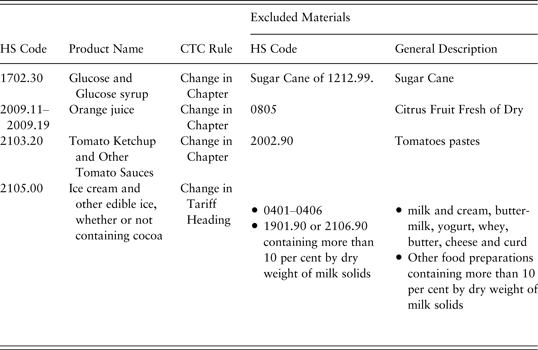
Table 1 provides a few examples of CTC-with-exception based PSRs for processed agricultural products under the TPP. The last column in Table 1 provides the description of the materials that are excluded from the respective CTC rules. The PSRs would disqualify the final product for TPP treatment if any of the excluded materials imported from the non-parties were incorporated in the final product. A well-known example is the PSR for ‘ketchup and other tomato sauces’ (ketchup) in Table 1. The PSR for ketchup under the TPP provides that ketchup (HS 2103.20) produced from materials classified in any other HS chapters will be conferred origin except from non-originating tomato paste (HS 2002.90).Footnote 56 The non-originating tomato pastes are tomato pastes imported from the non-parties to the TPP. If they are used in the production of ketchup, ketchup does not qualify as an originating good. In Table 1, another example is the PSR for ‘ice cream and other edible ice, whether or not containing cocoa’ (ice cream) under the TPP. The PSR for ice cream (HS 2105) excludes the usual ingredients of ice cream such as milk, cream, buttermilk, yogurt, whey, butter, cheese, and curd from the CTH rule.Footnote 57 This means that the usual ingredients of ice cream must be locally sourced from the TPP territories for ice cream as a final product to qualify for the TPP treatment.
Examples of CTC-with-exception based product specific rules of origin of the TPP*

* Source: Annex 3-D, Product Specific Rules of the TPP.
Besides processed agricultural products, for many textiles and clothing products, the TPP adopts yarn-forward rules, which are CTC-with-exception based rules of origin.Footnote 58 Under yarn-forward rules, clothing products subject to yarn-forward rules cannot be deemed originating goods if yarns imported from the non-parties are used in the production of final textiles and clothing products. Therefore, manufacturers from the common parties must now source yarns from the TPP parties rather than from the ASEAN–China FTA parties that are single-agreement parties to benefit from the TPP tariff preferences on final textiles and clothing products.Footnote 59
The yarn-forward rules under the TPP adopted by the common parties regulate the trade between the manufacturers of clothing products in the TPP parties and the suppliers of yarns from the single-agreement parties to the ASEAN–China FTA. Under the ASEAN–China FTA, the imported yarns from all the ASEAN–China FTA parties including the single-agreement parties are treated as originating materials. By contrast, under the TPP the imported yarns from the single-agreement parties are treated as non-originating materials. Unless the yarns used in the production of the final textiles and clothing products are originating yarns, the final products do not qualify for tariff preferences under the TPP. The producers of final clothing products in the common parties would not import yarns from the single-agreement parties unless the producers plan to forego the benefits of tariff preferences under the TPP. The test under GATT Article XXIV:5 is whether the effects of the new measures are more trade restrictive than those of the previous measures before the formation of the TPP.Footnote 60
The above trade restriction due to yarn-forward rules under the TPP can be specifically illustrated by the example of the trade of men's or boys’ cotton shirts (HS 6205.20) between Vietnam and Malaysia, which are the common parties to the TPP and the ASEAN–China FTA. For men's or boys’ cotton shirts, Malaysia committed to eliminate tariffs under the TPP but only reduce tariffs to 5% under the ASEAN–China FTA.Footnote 61 As a result, exporters from Vietnam would likely choose the TPP over the ASEAN–China FTA for export of men's or boys’ cotton shirts to Malaysia.
The PSRs for men's or boys’ cotton shirts (HS 6205.20) are yarn-forward rules under the TPP.Footnote 62 The yarn-forward rules for men's or boys’ cotton shirts under the TPP are applicable to the trade of yarns between the TPP parties that are common parties and the ASEAN–China FTA parties that are single-agreement parties. The manufacturers of men's and boys’ cotton shirts in Vietnam would source cotton yarns from the TPP parties to obtain tariff preferences for men's or boys’ cotton shirts under the TPP instead of sourcing them from suppliers in the non-parties including single-agreement parties.Footnote 63 As a result, the single-agreement parties – China, Cambodia, Myanmar, Laos, Indonesia, Philippines, and Thailand – now face a rise in barriers to their export of yarns to the common parties such as Vietnam.Footnote 64 Therefore, the yarn-forward rules provided in the TPP as ORC applicable to the import of yarns from the single-agreement parties are more restrictive than the rules of origin provided in the ASEAN–China FTA as the ‘corresponding’ ORC existing in the same constituent territories prior to the TPP, failing GATT Article XXIV:5(b) test.
In the above analysis, the switch in the RTA for the trade in the final products is accompanied by the switch in the sourcing of the intermediate materials used in the production of the final products. The switch in the RTA is caused by the difference in the preferential tariffs on the final products between the TPP and the ASEAN–China FTA. However, other factors might also cause this switch even if the tariff difference is zero. For instance, manufacturers in the common parties may source materials from the TPP parties in order to have their final products exported to the TPP market because the TPP market for the final products may be greater in size than the ASEAN–China FTA market. Therefore, the switch in the sourcing of the intermediate materials may occur even if the TPP and the ASEAN–China FTA equally eliminate intra-RTA tariffs on the same products.
As a final note, the above exclusionary effect on the trade of intermediate goods caused by the TPP yarn-forward rules should be contrasted with the exclusionary effect on the trade of men's or boys’ cotton shirts caused by the difference in the preferential tariffs between the TPP and the ASEAN–China FTA with respect to the final products.Footnote 65 The exclusionary effect with respect to the trade in final products arises if a party to the TPP commits to tariff elimination on the product, whereas the same party under the ASEAN–China FTA commits only to tariff reduction. The importers from the TPP party are likely to increase the demand for men's or boys’ cotton shirts from the TPP parties, including the common parties, but reduce the demand for the same product from the single-agreement parties. This trade diversion results in the exclusionary effect on men's or boys’ cotton shirts imported from the single-agreement parties.Footnote 66 However, this exclusionary effect cannot be viewed as failing the GATT Article XXIV:5(b) requirement, because the effect should be considered an inherent consequence of eliminating the internal tariffs between the TPP parties as required by GATT Article XXIV:8(b).
3.2 Second prong of Turkey–Textiles: necessity test
To complete the analysis, under the second-prong of Turkey –Textiles, it must be demonstrated ‘that the formation of that customs union would be prevented if it were not allowed to introduce the measure at issue’.Footnote 67 The challenged measures fail the necessity test if there is a ‘reasonable alternative’ available to the common parties to the TPP other than the CTC-with-exception based rules of origin in order to form the TPP.Footnote 68
As discussed above, the rules of origin based on the CTC-with-exception criterion presumptively exclude the imports of specified intermediate materials from the single-agreement parties to the ASEAN–China FTA, thus failing the GATT Article XXIV:5(b) requirement. The question then is whether there are reasonable alternatives to the CTC-with-exception based rules of origin. The reasonable alternatives to the CTC-with-exception based rules of origin should be the rules of origin that do not presumptively exclude specified intermediate materials from the single-agreement parties.
Three reasonable alternatives are considered in the following. The first alternative is the elimination of the exception from the CTC-with-exception criterion. The result is the CTC criterion such as the CTH criterion. The CTH criterion would be in line with the Nairobi WTO Ministerial Conference in 2015 decisionFootnote 69 to require elimination of ‘all exclusion or restrictions’ to CTC based rules when preference-receiving countries are LDCs in ‘non-reciprocal preferential trading arrangements’.Footnote 70 Although the Nairobi decision applies only to non-reciprocal preferential trading arrangements such as the GSP, the decision is significant in that the WTO members recognized the trade restrictive nature of the CTC-with-exception based rules of origin.
Another reasonable alternative to the CTC-with-exception criterion would be the value-added criterion. Unlike the CTC-with-exception criterion, the value-added criterion does not presumptively exclude specified intermediate materials from third countries. Therefore, they afford more flexibility to manufacturers of final products than CTC-with-exception based rules.Footnote 71
With respect to the value-added criterion, the question arises as to what should be the threshold percentage of the value-added. For the non-preferential rules of origin, the threshold minimum originating value-added percentage that is negotiated between WTO members is found in the Draft Consolidated Text of the Non-Preferential Rules of Origin (Draft Text) agreed by WTO members.Footnote 72 For those textiles and clothing products falling under HS chapters 58, 61, 62, where value-added rules are adopted, WTO members agreed to a 50% minimum originating value-added percentage in the Draft Text. The threshold minimum originating value-added percentage for preferential rules of origin may not have to be the same as the above threshold for the non-preferential rules of origin. Nevertheless, any threshold minimum percentage of the originating value not greater than 50% should be deemed acceptable. An example would be the 40% ‘regional value content’ under the rule of origin of the ASEAN–China FTA.Footnote 73 Even if the threshold minimum percentage of the originating value is greater than 50%, it does not result in presumptive exclusion of the listed non-originating intermediate goods, as would be the case if the CTC-with-exception based criterion were used.
In some cases, rules of origin based on a stand-alone criterion such as the CTC or the value-added criterion may be inadequate. A stand-alone CTC criterion may not capture the ‘substantial transformation’ required for origin determination in some cases, because the HS nomenclature is not always suitable for determining the transformation from materials to a final product.Footnote 74 Likewise, a stand-alone value-added criterion may produce misleading origin determinations due to fluctuating currency.Footnote 75 To address the shortcomings of the stand-alone criteria, the rules of origin under the TPP may offer the choice of the ‘CTC or value-added’ criterion as a substitute for the stand-alone criteria.Footnote 76
The CTC criterion, the value-added criterion, and the choice of the CTC or value-added criterion are all reasonable alternatives to the CTC-with-exception criterion. Therefore, the CTC-with-exception based rules of origin such as yarn-forward rules fail to meet the necessity test of the second prong of Turkey–Textiles Appellate Body decision. As previously discussed, the CTC-with-exception based rules of origin fail the first prong of the Turkey –Textiles test, because they fail to meet the GATT Article XXIV:5(b) requirement. Taken together, the exclusionary rules of origin based on the CTC-with-exception criterion provided in the TPP do not meet the Turkey–Textiles test for legal defense under GATT Article XXIV.
The above result, however, does not imply that CTC-with-exception based rules of origin provided in an RTA in themselves fail the legal defense under GATT Article XXIV. In fact, the Appellate Body in Turkey–Textiles reasoned that ‘a system of certificate of origin would have been a reasonable alternative’ to the quantitative restrictions that are challenged in the case.Footnote 77 In the case, Turkey imposed quantitative restrictions on a range of textiles and clothing products from India in the process of forming the EU–Turkey CU.Footnote 78 India challenged the quantitative restrictions on textiles and clothing products before the WTO dispute settlement panel.Footnote 79 The Appellate Body upheld the panel's decision that Turkey's quantitative restrictions on the imports of the textiles and clothing products were inconsistent with Articles XI and XIII of GATT 1994 as well as Article 2.4 of the Agreement on Textiles and Clothing (ATC). The Appellate Body held that Turkey's quantitative restrictions did not meet the test for legal defense under GATT Article XXIV, because there was a reasonable alternative to the quantitative restrictions.Footnote 80
The Appellate Body decision in Turkey–Textiles does not rule out a priori any criteria for rules of origin, even the CTC-with-exception based criterion, as a reasonable alternative to the challenged quantitative restrictions in the case. In order to show this, for argument's sake, assume that the EU–Turkey CU adopted yarn-forward rules for some clothing products as alternatives to Turkey's quantitative restrictions on the import of textiles and clothing products from India. The yarn-forward rules would require manufacturers to use yarns from the territories of the EU and Turkey in order for the final clothing products to qualify for the EU–Turkey CU treatment. If any yarns imported from third countries are incorporated into the final textiles and clothing products, the final products would not qualify as originating goods for preferential treatment under the EU–Turkey CU.
If yarn-forward rules were adopted for some textiles and clothing products in the EU–Turkey CU, India's yarn producers would be able to export to Turkey provided that the yarns were used to produce final products for consumption in Turkey or for export to third countries. By contrast, Turkey's quantitative restrictions on the import of yarns from India that were challenged would prohibit the import of yarns from India above the quota amount even if the yarns were used to make final clothing products for consumption in Turkey or for export to third countries.
The yarn-forward rules would serve to distinguish the textiles and clothing products originating in Turkey from those originating in third countries, including India, without resulting in the WTO law violations incurred by Turkey's quantitative restrictions on the imports of yarns from India. The yarn-forward rules would be able to form ‘a system of certificate of origin’ that screens the trade between the EU and Turkey. Therefore, the Appellate Body's decision implies that the yarn-forward rules would be reasonable alternatives to the challenged quantitative restrictions in the Turkey–Textiles case. In sum, the Appellate Body's reasoning in Turkey–Textiles does not appear to rule out CTC-with-exception based rules of origin in themselves for use as RTA rules of origin.
4. Solutions
4.1 Legal remedy
As a legal remedy, to bring the CTC-with-exception based rules of origin adopted by the TPP into conformity with the WTO law, the TPP rules of origin should eliminate the exception from the CTC-with-exception based rules of origin. This could be achieved by adopting the CTC criterion, the value-added criterion, or the choice of the CTC or value-added criterion.
The criteria should be applied uniformly to all imports claiming preferential treatment under the TPP. If the TPP parties eliminate the exception from the CTC-with-exception based rules only for the intermediate goods imported from the single-agreement parties to the ASEAN–China FTA, the resulting rules of origin would favor the imports of the intermediate goods from the single-agreement parties to the ASEAN–China FTA over those imports from other non-parties to the TPP. The discriminatory elimination of the exception from the CTC-with-exception based rules results in a GATT Article I violation. For this GATT violation, the GATT Article XXIV legal defense does not succeed, because non-discriminatory rules of origin that are alternatives to the discriminatory rules of origin are available.
4.2 Systemic solutions
4.2.1 Mega-RTA enclosing its overlapping RTAs
The legal problem caused by exclusionary rules of origin provided in a mega-RTA is avoided if a mega-RTA entirely encloses its overlapping RTA by having all the parties to the mega-RTA's overlapping RTA become parties to the mega-RTA. In the example of the overlap between the TPP and the ASEAN–China FTA, if all the single-agreement parties join the TPP, TPP would enclose the ASEAN–China FTA. In that case, the TPP's CTC-with-exception based rules of origin do not fail the requirement under GATT Article XXIV:5(b), because there will not be any single-agreement parties to the ASEAN–China FTA.
Apart from avoiding the legal problem, if a mega-RTA encloses its overlapping RTA, the operation of a cumulation clause in the mega-RTA enlarges the scope of imports that would qualify as originating goods under the mega-RTA. A usual cumulation clause provides that an originating good that is used in the production of a good in the territory of another party is considered as originating in the territory of the other party.Footnote 81 In other words, an originating good imported from any parties to the RTA maintains its originating status when it is used as an intermediate good in the production of a final good in any other RTA parties’ territories. Therefore, as the territory of a mega-RTA expands by enclosing its overlapping RTA, the scope of goods qualifying as originating goods expands. As a result, the existing parties to the mega-RTA benefit from the enlarged mega-RTA, providing incentives for the mega-RTA's existing parties to expand the membership of the mega-RTA.
An example of a mega-RTA that would enclose its overlapping RTA is the proposed TPP, which would enclose NAFTA. The TPP illustrates the expanded trading opportunity attributable to a cumulation clause in a mega-RTA that encloses its overlapping RTA. By way of illustration, take a case of an import that qualifies as an originating good under NAFTA based on the processing of the originating materials only from NAFTA parties. Suppose the product was additionally processed from the intermediate materials imported from the TPP parties that are non-parties to NAFTA.Footnote 82 Then, the final product may not qualify as an originating good under NAFTA, because the transformation of material inputs to the final product in the territories of the NAFTA parties might not be sufficient to qualify the final product as an originating good. In contrast, the final product would be more likely to qualify as an originating good under the TPP because the TPP might account for all the additional processing done in the territories of the TPP parties that are non-parties to NAFTA. The cumulation clause under the TPP would treat all the material inputs sourced from the TPP territories as originating materials in determining the final product's origin. Therefore, the TPP would expand the scope of qualifying imports over and above those already provided by NAFTA.Footnote 83
In this paper's case of the overlap between the TPP and the ASEAN–China FTA, the question arises whether the TPP would be able to enclose the ASEAN–China FTA. Would the LDC membersFootnote 84 of the ASEAN–China FTA be able to accede to the TPP? The answer depends on whether the LDC members of the ASEAN–China FTA would be able to commit to the high level of internal trade liberalization under the TPP as required by GATT Article XXIV:8(b).Footnote 85 In addition, WTO-plus commitments under the TPP would pose barriers to LDC members in acceding to the TPP.
4.2.2 Elimination of duties on final products
Another systemic solution to the problem, albeit an incomplete one, is also available on the part of the common parties. The common parties may eliminate duties under the overlapping RTA on all final products for which the mega-RTA adopted CTC-with-exception based rules of origin. In the case of the overlap between the TPP and the ASEAN–China FTA, the common parties (e.g., Malaysia), may eliminate rather than reduce the duties under the ASEAN–China FTA for all final products for which the TPP provided the CTC-with-exception based rules of origin. The solution would ameliorate the problem of the TPP being chosen over the ASEAN–China FTA for the trade of final products.
The above solution would not be a legal remedy, because it does not require the challenged party to bring CTC-with-exception based rules of origin into conformity with the WTO law. Moreover, the solution can occur only on a voluntary basis because the ASEAN–China FTA is based on the Enabling Clause, which does not require elimination of the intra-RTA tariffs. In addition, the above solution only partly removes the incentives of the exporters of the final products in the common parties to choose the TPP over the ASEAN–China FTA. The manufacturers of the final products subject to the exclusionary rules of origin may still switch sourcing of the intermediate materials from the ASEAN–China FTA parties to the TPP parties in order to benefit from the TPP tariff preferences for the final products that are exported to any parties to the TPP. Thus, even if the tariffs on the final products are equally eliminated under both the TPP and the ASEAN–China RTA, TPP may be chosen over the ASEAN–China FTA. Therefore, the TPP's CTC-with-exception based rules of origin even with the proposed solution still fail the legal defense under GATT Article XXIV.
5. Conclusion
The WTO system permits RTAs based on the understanding that WTO members forming an RTA ‘should to the greatest possible extent avoid creating adverse effects on the trade of other Members’.Footnote 86 In contradiction to this understanding, the CTC-with-exception based rules of origin provided in a mega-RTA that overlaps another RTA result in adverse effects on the trade of the single-agreement parties that remain outside the mega-RTA by presumptively excluding the use of the intermediate materials subject to exception from the CTC rules that are imported from the single-agreement parties. The mega-RTA's CTC-with-exception based rules of origin fail to meet the Turkey–Textiles test for legal defense under GATT Article XXIV, because they are more restrictive than the preferential rules of origin of the mega-RTA's overlapping RTA existing prior to the formation of the mega-RTA.
The CTC-with-exception based rules of origin of the mega-RTA in the above situation impede the internal trade of intermediate goods in the mega-RTA's overlapping RTA, thus harming the trade facilitation objective of the overlapping RTA under GATT Article XXIV. Moreover, if the mega-RTA's overlapping RTA is an RTA based on the Enabling Clause as in the case of the overlap between the TPP and the ASEAN–China FTA, the objective of the overlapping RTA ‘to facilitate and promote the trade of developing countries’Footnote 87 under the Enabling Clause would be harmed by the formation of the mega-RTA.
To bring the CTC-with-exception based rules of origin into conformity with the WTO law, a mega-RTA that overlaps another RTA should adopt rules of origin based on the criteria that do not presumptively exclude the use of certain intermediate materials in producing final goods. By adopting non-exclusionary rules of origin, the parties to the mega-RTA would be able to avoid ‘fracturing’ the mega-RTA's overlapping RTAs. To bring about this remedy multilaterally, WTO members should consider extending the coverage of the Nairobi WTO Ministerial Conference Decision in 2015 that curbs the use of CTC-with-exception based rules of origin in non-reciprocal preferential trading arrangements to those preferential rules of origin under mega-RTAs.