Introduction
The World Health Organization (2016) predicts that the percentage of people worldwide aged 60 years and over will increase from 12 per cent to 22 per cent by 2050. In the United Kingdom (UK) it is expected that, in less that 20 years, the number of people aged 65 and over will increase by 44 per cent, meaning that by 2037, one in four of the population will be over 65 (Centre for Ageing Better, 2019). With the increase in life expectancy, chronic disease and acute conditions, there has been an increasing substantial strain on health and social care services (Lunenfeld and Stratton, Reference Lunenfeld and Stratton2013). Over the past few decades, the live-in carer has become a vital part of the care workforce, providing important support for families across the world (Lowell et al., Reference Lowell, Martin and Stone2010).
Live-in carers are employed to provide care and support to their clients in all aspects of their day-to-day care on a 24-hour basis and are therefore required to be co-resident with clients and their families (Williams et al., Reference Williams, Baláž and Wallace2004; Salami et al., Reference Salami, Duggleby and Rajani2016). The role of a live-in carer varies, with many available to help through the day and at night, if necessary, although breaks are a legal entitlement. Live-in carers may live in the premises all the time, while others work in a rota pattern. The option of home care, particularly live-in care, is increasingly viewed as a popular alternative to moving into a care home, as it enables people to remain in their own homes while accommodating their changing health and care needs (Tarricone and Tsouros, Reference Tarricone and Tsouros2008). For some older people and their families, live-in care offers a way of continuing to live as independently as possible, for as long as possible, at home in their local community. The live-in carer's role includes providing personal care, companionship and social welfare to their clients, as well as general housework. Many are required to work autonomously without the support of colleagues, be flexible, and adapt themselves to the client's living space and standards (Ayalon, Reference Ayalon2009).
Despite common concerns about the pressure on public expenditure associated with the ageing population and community living accepted as general principles underpinning the formulation of policy, home care is practised differently in most European countries (Tarricone and Tsouros, Reference Tarricone and Tsouros2008). Genet et al. (Reference Genet and Boerma2011) provided a comprehensive review of home care in Europe from the limited published literature in the field. In the UK, similar to other domiciliary care workers, the pay of a live-in carer is unregulated, with some being paid close to the National Minimum Wage or less in England, and practices such as ‘zero-hour contracts’ (non-guaranteed hours of work) and termination of contracts at short notice also appear to be commonplace (Kingsmill, Reference Kingsmill2014). In England, many live-in carers report working longer that their contracted hours in their own time, which they believe is necessary (UNISON, 2013), and home care workers report not being able to deliver appropriate care due to time pressures, lack of travel time and unscheduled visits added at short notice (National Institute for Health and Care Excellence, 2015). The international literature corroborates these findings, suggesting that home care workers are also dissatisfied with irregular working hours, workload pressures and lack of management support (Taylor and Donnelly, Reference Taylor and Donnelly2006; Fleming and Taylor, Reference Fleming and Taylor2007), and burnout was reported among home care workers (Xanthopoulou et al., Reference Xanthopoulou, Bakker, Dollard, Demerouti, Schaufeli, Taris and Schreurs2007). These precarious working conditions result in high levels of staff turnover in domiciliary care (Equality and Human Rights Commission, 2011) and may also be unsettling for clients who have to adjust to new faces. Overall, the sector experiences difficulties in attracting and retaining a workforce that can meet the needs of people requiring care and support (Skills for Care, 2017).
The evidence base on the working and living arrangements of live-in carers is scarce and suggests that the long and often unpaid working hours expected in the role impact on their personal lives, restricting the opportunity for leisure time or a social life, often leading to social isolation, dissatisfaction and frustration (Stiell and England, Reference Stiell and England1997). For example, Riley et al. (Reference Riley, Nazareno and Malish2016) found that live-in carers were subjected to sleep deprivation due to the needs of the care recipients on a 24-hour basis and these maladaptive sleeping patterns negatively influenced carers’ sleeping and waking on non-workdays. Such findings illustrate how the demands of such work can have implications for live-in carers’ mental and physical wellbeing, potentially giving rise to mental health issues, stress and burnout (Grandea and Kerr, Reference Grandea and Kerr1998). Furthermore, evidence suggests that the quality of the relationship between client and care provider is a vital element that affects the carer's job satisfaction and consequently work retention, and is also associated with positive health outcomes for the care recipient (Porat and Iecovich, Reference Porat and Iecovich2010). Live-in carers often lack adequate support, supervision and training from management (National Institute for Health and Care Excellence, 2015).
There is also evidence that suggests that abuse, inadequate working conditions and neglect are present in the live-in care working conditions, particularly in the migrant workforce (Abu-Habib, Reference Abu-Habib1998; Ayalon, Reference Ayalon2011, Reference Ayalon2009). Workers moving to a foreign country can experience imply changes in values, identity, loss or changes in support and disempowerment (Ayers et al., Reference Ayers, Hofstetter, Schnakenberg and Kolody2009; Vahabi and Wong, Reference Vahabi and Wong2017). Ayalon and Shiovitz-Ezra (Reference Ayalon and Shiovitz-Ezra2010) point out that there is a high degree of emotional and social loneliness associated with migration and the precarious migration–employment status leads to unclear job expectations, boundaries and rights. Furthermore, deskilling and downward social mobility reinforces alienation in migrant live-in carers and many live a double life of private anguish versus public cheerfulness, which may lead to unrecognised mental health needs (Vahabi and Wong, Reference Vahabi and Wong2017). The evidence therefore suggests that live-in carers may consider their job as stressful and burdensome, similar to carers working in care homes (e.g. Vandrevala et al., Reference Vandrevala, Samsi, Rose, Adenrele, Barnes and Manthorpe2016) and the home care industry (e.g. Yeh et al., Reference Yeh, Samsi, Vandrevala and Manthorpe2018). However, the live-in carer's living arrangement of residing in the place of work makes it a different context to allow direct comparison.
There is an increasing recognition that a growing and ageing population will inevitably add to the number of people requiring social care and this may come in the form of home/domiciliary care, as many older adults and their carers are reluctant to consider a move to a care home (e.g. Cole et al., Reference Cole, Samsi and Manthorpe2018). Many older adults are increasingly likely to live with multiple long-term conditions, or live into old age with frailty or dementia, so that on average older men now spend 2.4 years and women spend three years with ‘substantial’ care needs (National Health Service, 2019). The intensity of the support they require may not be met by family carers, who themselves may be older people living with complex and multiple long-term conditions. In light of these considerations, the role of the live-in carer is considered important and relevant for providing care for our ageing population. The role of live-in carers has not attracted substantial research interest. Therefore, this study addressed the following research questions:
(1) How do live-in carers construct their role?
(2) What challenges do live-in carers report?
(3) What strategies do they report using to mitigate these challenges?
Method
Design
A qualitative research approach was employed to enable participants’ evaluative sense-making to be studied in a contextualised way that could capture complexity. The research is located within what has been termed a ‘big Q’ approach to qualitative work, that is, within a qualitative paradigm that does not seek to quantify data and that does not aspire to an ‘objectivity’ that is problematised (Kidder and Fine, Reference Kidder and Fine1987). This paradigm, which is a common approach to qualitative research in European psychology, centres the meanings and interpretations which participants attach to their own experiences, and acknowledges the ways in which these meanings and interpretations are grounded in specific social, historical and linguistic contexts. This differs from neopositivist or ‘small Q’ qualitative research, e.g. content analysis or particular forms of Grounded Theory (e.g. Glaser and Strauss, Reference Glaser and Strauss1967). Individual interviews were favoured as it allowed the researchers to interview participants who had busy schedules.
Recruitment and participants
Upon receiving approval from the authors’ institutional research ethics committee, 46 live-in care agencies registered with the Care Quality Commission based across the Greater London and South-East England areas were invited to take part in the study. Only three agencies agreed to invite their live-in workers to participate in the study (N = 7). Additionally, an online advertisement was posted on the Facebook page for the live-in carers’ UK group page, in order to target live-in carers directly and therefore reach the required number of participants. This Facebook group page is a widely used (over 2,000 members) and valuable network for live-in carers in the UK – it provides a source of support and also advertises job opportunities. The advert was viewed by 58 people and eight of them made contact with the researcher via email, with six of these meeting the study's inclusion criteria. Personal contacts and snowballing were used to recruit eight participants.
Opportunity sampling was used to recruit participants, who needed to satisfy the following criteria: (a) experience working as a live-in carer for a minimum of three months; (b) living with the client they were caring for; (c) ability to comprehend and speak English to a sufficient level in order to understand instructions; (d) ability to sign a consent form; and (e) availability to be interviewed face to face or via Skype or phone call. Two participants were interviewed in person, two participants chose to be interviewed via Skype and the majority of the interviews were conducted on the phone. We were interested in speaking with live-in carers employed by agencies (rather than by the client directly) as we were interested in the working conditions as well as the level of support provided by care agencies. Those who were interested in taking part contacted the researchers who then provided further information about the study and arranged an interview with individuals who wished to proceed.
Data generation
Data were generated through semi-structured individual interviews. This format was chosen to ensure that core questions were asked of all participants while providing scope for participants to explore relevant but unanticipated domains of experience and reflection that were important to them. A short list of topic areas using open-ended questions and prompts were developed by the first author. Topics included the nature of the job, its positive aspects and challenges, the impact of work, coping with job demands, and support. Five researchers were trained by the first author in interviewing and subsequently conducted the interviews. The research team met regularly during fieldwork to review progress and ensure a consistency of approach. Interviews lasted between 40 and 70 minutes and were audio-recorded and transcribed.
Analytic strategy
Transcripts were analysed using reflexive thematic analysis to generate a set of meaningful patterns or themes and sub-themes associated with the research questions (e.g. Braun and Clarke, Reference Braun and Clarke2006; Braun et al., Reference Braun, Clarke, Terry, Hayfield and Liamputtong2018). This process of analysing qualitative data has been identified as a useful method for identifying, analysing and reporting patterns within data through the development and detailed description of themes (Attard and Coulson, Reference Attard and Coulson2012). In this study, we adopted a critical realist position on the data (e.g. Bhaskar, Reference Bhaskar1975; Fletcher, Reference Fletcher2017) and we pursued a combined approach of inductive and deductive analysis, to discover new information and identify themes aligning with theoretical propositions (Patton, Reference Patton2002). The deductive element of the analysis meant that it was guided by the research questions: analytic attention was paid to (a) the way in which participants described themselves and their role as a live-in carer; (b) the challenges and difficulties which they reported in relation to the role; and (c) the coping strategies which they reported.
The analysis was undertaken by both authors, and was guided by Braun and Clarke's (Reference Braun and Clarke2006) six stages of familiarisation with the data, generation of initial codes, searching for themes, reviewing themes and sub-themes, defining and naming themes and sub-themes, and writing up the analysis. Both authors familiarised themselves with the data initially. The second author was responsible for coding and searching for themes. After this point, discussions between the authors informed the latter stages of the process, with the second author taking primary responsibility.
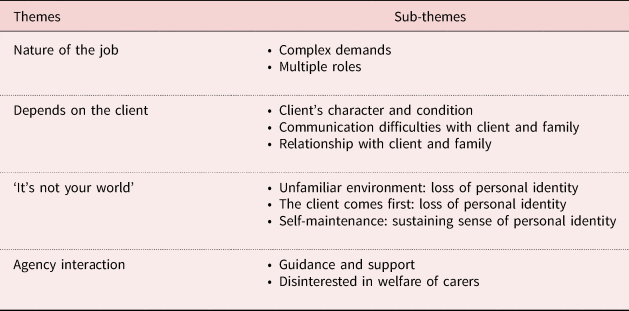
The analysis yielded a number of clusters of meaning that dealt with a variety of issues and were ultimately organised under four major themes. These themes and sub-themes vary in how discrete they are – some overlap with others due to the ways in which particular motifs surfaced across the data-set in relation to several issues. The themes and sub-themes reported in the next section, therefore, constitute one of the several ways in which the findings could have been organised. These themes and sub-themes have been selected because of their capacity to do justice to the nature of the data-set and to answer the research questions. In the data excerpts presented in the next section, participants’ names have been replaced by pseudonyms to protect confidentiality.
The quality of the analysis was promoted through close alignment with recognised criteria for good qualitative research, such as grounding interpretations in examples from the data (which allows readers to confirm or query interpretations), conducting credibility checks and optimising coherence across the study (Elliott et al., Reference Elliott, Fischer and Rennie1999; Yardley, Reference Yardley2000).
Findings
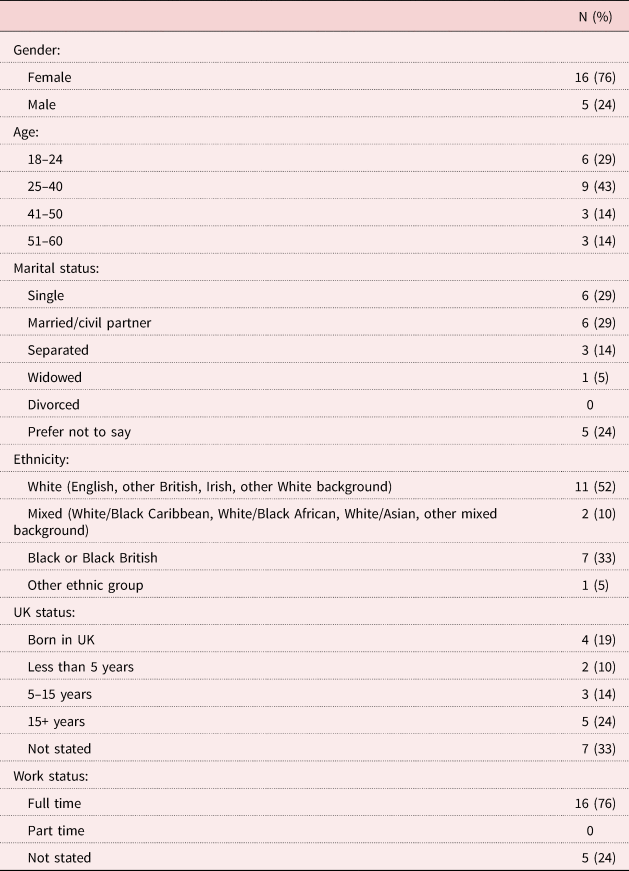
A total of 21 participants (16 female) were interviewed. Details of their demographic and relevant background information are presented in Table 1. Approximately 50 per cent of the participants considered themselves belonging to a non-White ethnic group, with only 20 per cent born in the UK.
Participant characteristics

Notes: N = 21. UK: United Kingdom.
The role of a live-in carer was constructed as complex and characterised by a heavy workload and tiredness. The data emphasised the variability which was introduced to the role as a function of the quality of agency support, the character and condition of the client, and the carer's relationships with the client's family. Participants’ accounts reflected an acknowledgement of the need to orient and respond constantly to the needs and routine of the client. While this orientation was recognised as necessary for effectively fulfilling the demands of the role, it was also related to feelings of dislocation and loss of identity which were linked in the data to the use of strategies which functioned to maintain and enact a sense of agency and personal distinctiveness (see Table 2).
Themes and sub-themes

Nature of the job
Being a live-in carer was constructed as a role with complex demands, as the following excerpts typify:
My job it's a bit complicated and it's a bit demanding and complex as well, because I am the main carer here. So I said, the gentleman has speech impediment. He's got severe cerebral palsy. On a daily basis I am like his hand, his mouth, his everything. This guy can't do anything for himself. On a normal daily basis, I deal with the personal care, after the personal care with medication administration and medication on a daily basis. Take him out shopping. We sit down and we talk a lot … I help him with computer work to do some typing as well. It's a big workload. (Susan)
You know that at any time, any day, anything can happen. Get ready for everything. (Natalie)
In the first excerpt, being a live-in carer is constructed as multi-layered and complex – the participant performs multiple roles – nurse, confidante and professional assistant, for example. These varied responsibilities, which amount to being ‘his everything’, add up to a ‘big workload’. The role necessitates being able to occupy and satisfy multiple roles; it is constructed as a demanding role because of the different challenges which accompany these varied functions. In the second excerpt, the need to be flexible and adaptable is emphasised. Elsewhere in the data, participants’ accounts reflected a need to be responsive to change, which could stem from managing changeovers with other care staff or even the death of a client. A plausible interpretation here is that live-in carers may experience role conflict when confronted with incompatible expectation for each of their tasks (intra-role conflict) and differing expectations by clients and their families (inter-role conflict) (Shumate and Fulk, Reference Shumate and Fulk2004).
As a consequence of the complex and demanding nature of the work, tiredness was consistently reported by participants as a feature of the role. Some participants reported feeling exhausted by the demands of their job. Participants frequently reported difficulties with adjusting to the sleeping patterns of clients:
sometimes he would wake up very early in the morning, go out of the house … then he would call me one hour in the morning to go and pick him up like 4 am or something like that. (James)
This issue was more pronounced when caring for clients with dementia:
During the night times I got a baby monitor in my room well. It means I can hear everything what she is doing at nighttime as well and that. Sometimes you just can't even sleep. (Amber)
This sleep disruption and tiredness could also persist into participants’ free time:
When you come back home and try to sleep your sleeping clock has changed. (Jack)
This suggests that live-in carers may experience particular difficulties in ‘switching off’ and maintaining a clear demarcation between their professional and private lives. Despite the apparent difficulties, participants generally reported acceptance of the role, as they acknowledged that the complexity and demanding nature of the job was inevitable and to be expected.
Depends on the client
This theme related to the particular qualities and characteristics of the client and their families. These factors were constructed throughout the interviews as having the potential to contribute to the stress of being a live-in carer, or alternatively to act as a buffer against the intrinsic stress of the role, bringing about a sense of job satisfaction and meaning.
Participants’ accounts emphasised the extent to which their ability to cope and to enjoy their work was dependent on the client's character and condition. If a client had a challenging personality or was abusive, the work could be incredibly difficult:
the difficult thing is just when you get a slap or punch and that's a difficult one. (Jack)
Otherwise demanding or disrespectful clients were also described:
certain clients obviously just because the person is disabled, that doesn't mean that they are respectful, some of them have a kind of difficulty understanding that you are there to do your job and you can't be available 24/7. (James)
Communication issues specific to the client were also constructed as having the capacity to make the job more difficult:
You can hardly understand him when he's talking or when he's trying to communicate. (Susan)
In addition to disability-related communication issues, language barriers might also be present if the carer or client had different mother-tongues.
Conversely, the idiosyncrasies of the client could facilitate job satisfaction and coping, as the following excerpt typifies:
The gentleman I look after is very easy-going. You are almost made to feel that it is your home. There is no awkwardness. I know in the past from other people's experiences, the customers are very much, it's my house and you are here to help me. It's awkward even if you just want to go and get some food from the fridge if you are hungry. Might be a bit awkward just to get a snack. At the end of the day it isn't your house. (Matt)
Here, the ‘easy-going’ nature of the client is contrasted with the attitude of other ‘customers’ that the carer is there to serve the client and is made to feel unwelcome (‘might be awkward just to get a snack’). Thus, it is clear in this excerpt that the personality and attitude of the client introduces dependency and variability into the role of the live-in carer, working to either enable job satisfaction and coping, or conversely to hinder these outcomes.
Similar to the relationship with the client, relationships with the client's families were constructed as integral to job satisfaction and coping, as the following excerpt illustrates:
There's two different types of relationship I have had with client's families. One of them was quite nice, and they asked how my day was and everything like that. Then with the other one, I was just a worker, there was no: ‘how was your day?’ There was just: how has client been? I did not exist as a person to them, I was just a worker to them. (Jane)
The relationships with clients’ families also introduce dependency into the role of being a live-in carer. Such relationships may be characterised by genuine and personalised interaction (‘they asked how my day was and everything’), or by silence and the failure to recognise the client as an individual (‘I was just a worker to them’). This latter relationship effects a sense of dehumanisation as the participant is acknowledged only to the extent that their existence has any bearing on the life of the client (‘there was just: how has client been?’). As in the case with agency interaction (discussed below), the failure to be recognised as an individual by clients and their families was associated with negative consequences for job satisfaction and coping in the data.
‘It's not your world’
Throughout the interviews, the work of the live-in carer was constructed by participants as taking place within a context which was unfamiliar and which necessarily prioritised the client's needs, wishes and routine. Consequently, participants reported feelings of dislocation and loss of identity, and frequently described engaging in strategies which worked to offset these experiences.
Participants frequently reported feeling awkward or uncomfortable within the client's home, particularly when they recounted their first visit. For most participants, this was just a matter of getting used to it over time (‘it does take a bit of time to settle’, Lucy), however for other participants, this unsettled feeling appeared to persist:
Well the best way to describe it, you never feel at ease. If you have a regular job you, you get home at the end of the day and you sit down watch TV or whatever or, you know, you don't get that kind of homely feeling when you do live-in care. You always feel like you are in someone else's house. (James)
In this excerpt, the role of a live-in carer is contrasted with a ‘regular job’ in which it is possible to relax and experience a ‘homely feeling’. This feeling of being ‘in someone else's house’ is constructed as an essential and unchanging feature of the job; it lingers and creates a perpetual sense of uneasiness. For some participants, this experience of dislocation was exacerbated by the fact that the client's house was situated in an unfamiliar area, far from family and friends:
You are in a strange area. Even on your time off, you don't know anybody. You can't go and have a coffee with someone. (Masie)
The potential for meaningful contact with friends and family was constructed as limited throughout the data, with predominantly virtual contact for the most part being limited to times at which the client was asleep or otherwise engaged.
Additionally, participants characterised their roles as constantly oriented towards the needs, demands and wishes of their clients. Taking on a new client necessitated adjusting to the client's idiosyncratic and often challenging routine. This meant that activities done for the self were always of lesser importance than those undertaken for the client:
It is stressful in a way, because you are living with a strange person and you need adjust all your time or your needs, your interests, everything to their daily routine with somebody even if I have some time for myself, it is very limited time. (Maria)
While this was accepted by participants as a non-negotiable component of the role of the live-in carer (‘But, obviously, you are there with your client. They come first’, Masie), nevertheless there was also an acknowledgement that this meant that ‘everything goes on hold like organising your life, you know admin and things like that’ (Lucy). In essence, being a live-in carer was constructed in the data as contingent on a process of effectively muting one's own life for a set period of time. While it must be pointed out here that the majority of participants accepted this as vital for the effective performance of the role, a couple of participants reported a profound difficulty with this constraint, as the following excerpt illustrates:
For me, I think it's like a little bit like a prison. I don't know. Somebody maybe feeling opposite, different … I am little bit missing my friends and missing my own corner and even when I just had in England, you know, just a room rented and everything like that. You really just feel like you are isolated and you are living in some world. But this world is even, it's not your world. It's your client's world. You need to sweeten your client's world. You really need to be fair. It's out things like you need to help her when she's needed it and I think you need to be there for her. (Amber)
Being a live-in carer is constructed here as a lonely and restrictive existence; the participant is distant from friends and family, and possesses little independence (‘just a room rented and everything like that’). The participant's existence and function is constructed solely in relational terms; they are defined in relation to the client (‘it's your client's world’, ‘need to sweeten your client's world’). While this was an extreme case in the data, nevertheless across the interviews, there was a tendency for participants to reference the necessity to suppress one's life in order to prioritise that of the client.
In order to mitigate the loss of identity which was an inevitable and necessary feature of the role of being a live-in carer, participants frequently referenced engaging in strategies which marked them out as individuals with their own individual personalities and interests. Strategies which were mentioned here included decorating one's room in the client's house (‘I made the space that was my own kind of my own’, Lucy), spending time on hobbies or personal interests (‘that's how I got into littler things like yoga and writing a diary which is good I think’, Amber) and even choosing which foods to eat (‘I told them there are some foods that I don't like. There are some that I like’, Mary). Within the necessarily constrained parameters of the role of live-in carer, each of these strategies can be seen as working to maintain and enact a version of the self which was distinctive and agentic, and linked to positive wellbeing.
Agency interaction
Agencies were constructed in two ways in the data. They could provide extensive guidance and support, and build and maintain personal relationships with live-in carers. On the other hand, agencies were sometimes constructed as disinterested in the welfare of carers, lacking the knowledge of the job necessary to empathise, and as providing inaccurate or misleading information about the client. The following excerpts typify the contrasting experiences with agencies which participants described:
Interviewer: With all my clients, except one I would have another carer come and cover three hours at some point in the day and I would go out and do whatever I wanted to do during those three hours … but with my final client, because my company believed that she didn't need anybody to look after her, when she was on her own, they didn't send anybody around and so I managed my own breaks, but because she had a lot of anxiety I didn't like to leave her for long. So I ended up … sometimes I get half an hour when she was at the hairdressers or something like that so but a lot of the times I didn't really get a break with that client.
Jane: Right and how did you feel in that situation?
Interviewer: I was actually quite unhappy in that situation. I didn't like it at all, I felt completely dehumanised to be honest.
Jane: Did you have the opportunity to express the way you were feeling with someone?
Interviewer: I told the company I worked for that I wasn't happy with doing it anymore. They said they would get someone else in to cover for me and then they never contacted me again.
Jane: How have you felt in that situation?
Interviewer: I felt like they had no respect at all, I just felt like I was a tool. I felt not happy with that at all. I ended up going on to a new company now and no longer doing the live-in because of that experience.
I feel close to this care manager that I can speak about my own life like we have good communication and connection to each other. (Mollie)
It was definitely a positive one. It was a good team, felt well supported, whenever we had a problem we felt we could always call them, even though they are not there with us but we always had a phone number we could call … you had an emergency number if you need support. Yeah it is generally good. (David)
In the first excerpt, the agency is constructed as distrusting the carer and failing to acknowledge their expertise and particular knowledge of the client. Frank communication between the carer and agency was clearly not encouraged as the participant reported their dissatisfaction with the situation and ‘then they never contacted me again’. This dysfunctional and hierarchical relationship between agency and carer was experienced as objectifying, as stripping the participant of their human qualities (‘I just felt like I was a tool’). The second and third excerpts, on the other hand, shed light on the way in which the agency can function as an invaluable source of support as carers undertake their demanding and complex roles. A positive relationship with agencies was characterised by responsiveness (‘whenever we had a problem we could always call them’) and, importantly, by the potential for personal interaction and clear communication.
Discussion
Our study sought to examine how live-in carers construct their role and to identify challenges they face and the strategies used to mitigate them. Overall, the findings suggest that live-in carers perceive their role as complex and characterised by a heavy workload and tiredness. Their experience of working in the field varied as a function of the quality of agency support, the character and condition of the client, and the carer's relationships with the client's family. While prioritising the needs of the client, many live-in carers reported a sense of dislocation and loss of identity.
Our findings make an important contribution towards understanding the role of a live-in carer, shedding light on the implications of the round-the-clock work pattern on live-in carers’ health and wellbeing. Our study attends to the way in which identity dynamics are implicated in carers’ constructions of their work and living arrangements. Specifically, our findings are consonant with the idea that appraisal of one's role can also relate to a person's social identity (rather than solely their personal identity). Personal identity refers to the way in which we define ourselves as unique individuals in contrast to others (‘I’ versus ‘you’), whereas social identity denotes the way in which we define ourselves as members of groups in distinction from other groups (‘we’ versus ‘they’) (Reicher et al., Reference Reicher, Spears, Haslam, Wetherell and Mohanty2010). The live-in carers’ appraisals of events in the workplace may be shaped by circumstances of a relevant in-group in addition to their personal circumstances. For example, our participants seemed accepting of the employment conditions and unpredictable nature of their jobs. As members of the occupational group (in this case a live-in carer) they seem to appraise that dealing with challenging clients and working unpredictable hours were part of their role and this affirmed our participants’ social identity as members of a distinct social group. Participants therefore may not necessarily view their jobs as stressful and burdensome due to their identity as a live-in carer, despite feeling that their jobs were demanding, complex and unpredictable. Live-in carers achnowledged that the conflict between their various responsibilities and tasks, and the necessity of being accountable to both clients and their families, contributed to the role conflict they experienced.
Our findings also draw attention to the importance of recognising the personal identity of live-in carers for job satisfaction and wellbeing. Agencies and families acknowledged the live-in carers’ personal identity by engaging with them as individuals and creating bonds. Some agencies and families failed to acknowledge live-in carers as individuals in their own right. In our study, live-in carers did report a lack of a sense of agency, reporting their inability to be able to speak up due to protocol and felt that their freedom to act as they wish had been taken away. When dealing with difficult families, live-in carers felt unable to express their feelings, even when their dignity was violated. They reported that agencies often made them feel as though they were objects rather than human beings. Todres et al. (Reference Todres, Galvin and Holloway2009) propose that individuals may experience dehumanisation if their sense of agency or their freedom to act as they wish has been taken away. The role of objectification is also noted by Todres et al. (Reference Todres, Galvin and Holloway2009: 70), where dehumanisation is proposed to occur when people are treated as simply a part of a ‘diagnostic system’ or ‘statistical picture’. This supports our findings where live-in carers felt that their sense of being human was neglected by their agencies. A sense of place is a final important aspect of humanisation proposed by Todres et al. (Reference Todres, Galvin and Holloway2009). The fact that live-in carers live and work in the same place means that they are dislocated from their own homes; our results suggested that whilst working, live-in carers found it difficult to feel completely at ease in their clients’ homes and many even reported feeling trapped. Thus, dislocation from their homes may well be another aspect of the round-the-clock nature of the live-in carer role that leads them to them feeling dehumanised. These findings, taken together, speak to the importance of acknowledging the individuality and personal identity of live-in carers for their job satisfaction and wellbeing. Agencies must do more to embed this orientation into their practices in order to support their staff and their clients, as well as to improve staff retention in this difficult role. This will become increasingly important given the growing numbers of live-in carers that an ageing population will require.
The findings are consistent with previous research, which highlights that when a client requires assistance during the night, carers experience sleep deprivation which results in exhaustion and affects performance at work (Cappuccio et al., Reference Cappuccio, Cooper, D'Elia, Strazzullo and Miller2011; Caruso, Reference Caruso2013; Riley et al., Reference Riley, Nazareno and Malish2016). Furthermore, live-in carers can appraise their jobs as isolating and lonely, where lack of social support from agencies and clients’ family contributed to their stress and feelings of exhaustion. Our findings also draw attention to the positive interactions with their agencies and families which have the potential to ameliorate work-related stress. Previous findings have highlighted that migrant live-in carers suffered from social degradation and loneliness (Ayalon and Shiovitz-Ezra, Reference Ayalon and Shiovitz-Ezra2010; Chowdhury and Gutman, Reference Chowdhury and Gutman2012), and burnout can be alleviated by social support (Devereux et al., Reference Devereux, Hastings and Noone2009). However, our findings go beyond previous work by drawing attention to the importance of sustaining both a sense of personal and social identity in the workplace, and with interactions with family and employing agencies.
A particular limitation worth noting were the difficulties the researchers encountered in the initial stages of the research, when trying to access live-in carers via their agencies with little co-operation from the gatekeepers. After months of follow-ups, we decided to access live-in carers directly via social media. Arguably, the difficulties revealed by live-in carers during the interview process with regards to the lack of support from agencies could potentially explain agencies’ reluctance to participate in the research project. It could be possible that they did not want to risk having their agency viewed negatively. We paid particular care to reassure our participants that their personal information would remain confidential and anonymous. The current study did not include the views of family members or service users utilising the services of live-in carers or managers employing live-in carers; enlisting their views could be an avenue for future research. Future studies could also explore whether the views of live-in carers differ according to the mental capacity, cognitive and physical ability or illness of the service users, or presence of family involvement.
Our findings indicate the need for organisations and managerial support for live-in carers and highlighted the importance of having supportive agencies where lines of communication were kept open. Previous research suggests that live-in carers reported more job satisfaction when they received feedback from their supervisor/manager (Iecovich et al., Reference Iecovich, Jacobs and Stessman2011) and health-care organisational culture impacts health-care workers’ experiences and performance (Beardsmore and McSherry, Reference Beardsmore and McSherry2017). There is also a need for agencies and managers to address ways in which live-in carers, clients and families can adequately address the negative effects of living in the place of work. Ensuring that policies are in place for rest periods and adequate cover provided during the rest period would ensure that live-in carers are able to switch off from work.
Conclusion
Agencies and clients and families have an obligation and duty to orient their practices to support live-in carers to ensure that their personal and social identities are acknowledged in order to improve carers’ wellbeing and job satisfaction. Ensuring live-in carers feel part of a wider team will ensure that social identity is maintained despite isolated work practices. At the same time, adequate supervision and policies to safeguard live-in carers will ensure that their personal identity is not neglected, while working with challenging and demanding clients and their families.
Acknowledgements
We would like to thank Natascia Iorio, Bithiah Paul, Abdirahman Mohamed Eniola Olatise and Amy Laing who conducted the interviews as part of their BSc in Psychology at Kingston University. We would also like to thank the study's participants for their involvement.
Author contributions
TV designed the study and supervised data collection, analysis and contributed to the paper. EO analysed the data and assisted with writing the paper. Both authors have been involved in manuscript revisions and final approval.
Financial support
This research received no specific grant from any funding agency, commercial or not-for-profit sectors.
Conflict of interest
The authors declare no conflicts of interest.
Ethical standards
This study was approved by Kingston University Ethics Committee. All participants provided informed consent prior to involvement in the study.