INTRODUCTION
The Canary Islands are situated within the biogeographical region of the Macaronesia which also includes the islands of Azores, Madeira, Savage Islands and Cape Verde (Carrillo, Reference Carrillo2007). The Canary Islands are a major hotspot for marine mammals in European waters with 29 cetacean species recorded in the archipelago (Carrillo, Reference Carrillo2007). The area's unique oceanographical characteristics are suitable for both tropical and temperate-water cetaceans, as warm oligotrophic waters of the open ocean coexist with nutrient-rich waters of the coastal upwelling regime brought by the Canary Current (Barton et al., Reference Barton, Arístegui, Tett, Cantón, García-Braun, Hernández-León, Nykjaer, Almeida, Almunia, Ballesteros, Basterretxea, Escánez, García-Weill, Hernández-Guerra, López-Laatzen, Molina, Montero, Navarro-Pérez, Rodríguez, van Lenning, Vélez and Wild1998). The narrow continental shelf leads to the presence of both oceanic and inshore cetacean species close to the coast (Martín et al., Reference Martín, Montero, Heimlich-Boram, Heimlich-Boram and Evans1992).
Most of the cetacean species recorded in the archipelago have a worldwide distribution or an extended presence in temperate and warm oceans. Sperm whales, Physeter macrocephalus (L., 1758), are widely distributed worldwide, with most of the sightings of the species taking place in deep waters and higher densities found in areas of high primary productivity (Whitehead, Reference Whitehead, Perrin, Würsig and Thewissen2002). Sperm whales segregate by sex and females with calves in the northern hemisphere do not usually travel further north than 40–45°N, whereas juvenile and adult males migrate to higher latitudes in spring/summer returning to lower latitudes in winter (Best, Reference Best, Winn and Olla1979). Other species present in the Canary Islands and distributed worldwide in warm and temperate waters are the pygmy sperm whale Kogia breviceps (de Blainville, 1838), bottlenose dolphin, Tursiops truncatus (Montagu, 1821), Risso's dolphin, Grampus griseus (Cuvier, 1812), common dolphin, Delphinus delphis (L., 1758) and striped dolphin, Stenella coeruleoalba (Meyen, 1833) (Wells & Scott, Reference Wells, Scott, Ridgeway and Harrison1999; Archer, Reference Archer, Perrin, Würsig and Thewissen2002; Baird, Reference Baird, Perrin, Würsig and Thewissen2002; McAlpine, Reference McAlpine, Perrin, Würsig and Thewissen2002; Perrin, Reference Perrin, Perrin, Würsig and Thewissen2002b).
In addition, several cold-water cetacean species are at their southern distribution limit in Macaronesia whereas Macaronesia represents the northern distribution boundary for some warm-water species such as the Atlantic spotted dolphin, Stenella frontalis (Cuvier, 1829), rough-toothed dolphin, Steno bredanensis (Cuvier in Lesson, 1828), or Fraser's dolphin, Lagenodelphis hosei (Fraser, 1956) (Carrillo, Reference Carrillo2007). The Atlantic spotted dolphin is endemic to the tropical and warm-temperate waters of the Atlantic (Perrin, Reference Perrin, Perrin, Würsig and Thewissen2002a) while Fraser's dolphin and rough-toothed dolphin occur in tropical and subtropical seas (Dolar, Reference Dolar, Perrin, Würsig and Thewissen2002; Jefferson, Reference Jefferson, Perrin, Würsig and Thewissen2002). Other warm-water species common in the Canary Islands are Gervais' beaked whale, Mesoplodon europaeus (Gervais, 1838), which is restricted to the North Atlantic (Pitman, Reference Pitman, Perrin, Würsig and Thewissen2002) and the short-finned pilot whale, Globicephala macrorhynchus (Gray, 1846), which occurs both in tropical and subtropical oceans (Olson & Reilly, Reference Olson, Reilly, Perrin, Würsig and Thewissen2002).
Little is known about the diet of most of the Canary Islands' cetacean species. Previous reports have provided information on beaked whales (Ziphiidae) (Martín et al., Reference Martín, Vonk, Escorza, Montero and Evans1990; Hernández-García, Reference Hernández-García1995; Santos et al., 2007b), short-finned pilot whale (Hernández-García & Martín, Reference Hernández-García and Martín1994) and pygmy sperm whale diets (Hernández-García & Martín, Reference Hernández-García and Martín1996). Stomach contents of sperm whales have been analysed from other Macaronesian islands such as Madeira and the Azores (Clarke, Reference Clarke1962; Clarke et al., Reference Clarke, Martins and Pascoe1993).
The aim of this paper is to present new information on the feeding habits of cetaceans present in Canary Islands waters, an area where relatively little information is available on cetacean trophic ecology in spite of the high number of cetacean species present. We also compare our results with those of other European populations of the same species and examine possible threats to cetaceans in the archipelago relating to interactions with fisheries and consumption of plastic debris.
MATERIALS AND METHODS
Sample collection
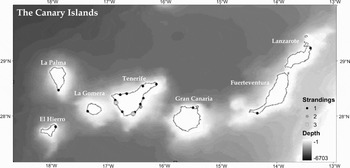
Strandings were attended by Canarias Conservación, based in Tenerife and providing all year-round coverage for the occidental islands of the archipelago (e.g. Tenerife, La Gomera, La Palma and El Hierro) as a member of the local stranding network supported by the Natural Environment Department of the Canary Islands Government. Animals were measured and sexed, and cause of death was determined when possible. Detailed post-mortem examinations of the digestive tract were carried out in all animals and stomach contents were subsequently preserved in 70% ethanol. Stranding locations are shown in Figure 1.
Map of the study area, showing the locations of cetacean strandings in the present study.

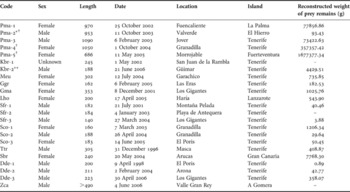
Stomach contents of 23 cetaceans, including 12 species from 4 families, stranded between 1996 and 2006, were analysed (Table 1). The sample set comprised 5 sperm whales, 2 pygmy sperm whales, 1 Gervais' beaked whale, 1 Risso's dolphin, 2 short-finned pilot whales, 1 Fraser's dolphin, 3 Atlantic spotted dolphins, 3 striped dolphins, 1 bottlenose dolphin, 1 rough-toothed dolphin, 3 common dolphins and 1 Cuvier's beaked whale.
Data on stranded cetaceans included in the analysis. Sperm whales (Physeter macrocephalus, Pma), pygmy sperm whales (Kogia breviceps, Kbr), Gervais' beaked whales (Mesoplodon europaeus, Meu), Risso's dolphins (Grampus griseus, Ggr), short-finned pilot whales (Globicephala macrorhynchus, Gma), Fraser's dolphins (Lagenodelphis hosei, Lho), Atlantic spotted dolphins (Stenella frontalis, Sfr), striped dolphins (Stenella coeruleoalba, Sco), bottlenose dolphins (Tursiops truncatus, Ttr), rough-toothed dolphin (Steno bredanensis, Sbr), common dolphins (Delphinus delphis, Dde) and Cuvier's beaked whales (Ziphus cavirostis, Zca).

* , sexually mature; **, genital organs absent, advanced state of decomposition, partially eaten by sharks; †, cause of death was collision with ships.
Prey remains consisted principally of cephalopod mandibles (beaks) and eye lenses. Some fish otoliths, bones and eye lenses were also found. Beaks were retained in 70% ethanol while otoliths and bones of fish were kept dried. Crustacean, mollusc and parasite remains were identified to species level when possible (depending on their state of preservation) and were stored in 70% alcohol.
Sample analysis
Cephalopod beaks and fish otoliths and bones were identified using reference collections held at the University of Aberdeen and published guides (e.g. Clarke, Reference Clarke1986; Härkönen, Reference Härkönen1986).
The numbers of cephalopods and fish present were estimated from the numbers of beaks, otoliths and jaw bones. Cephalopod length and weight were calculated from linear measurements on beaks based on a compilation of published regressions (e.g. Clarke, Reference Clarke1986; Santos et al., Reference Santos, Pierce, García-Hartmann, Smeenk, Addink, Kuiken, Reid, Patterson, Lordan, Rogan and Mente2002). Complete pairs of cephalopod beaks were rarely present and, in all cases, length and weight were estimated from the lower beak using standard measurements (rostral length for squid and hood length for octopus and sepiolids; Clarke, Reference Clarke1986). For stomachs in which one cephalopod species/size-class was represented by >30 beaks, a random sample of 30 to 100 beaks was measured. No published length–weight regressions were available for Taningia danae (Joubin, 1931), Discoteuthis spp. and beaks identified as Cranchia/Lyocranchia (family Cranchiidae). Each fish otolith/jaw bone was assumed to represent 0.5 fish. Total lengths of black scabbard fish, Aphanopus carbo (Lowe, 1839), garfish, Belone belone (L., 1761), and Lophius sp. were estimated from their lower jaws (dentaries) since no otoliths were available. Black scabbard fish and Lophius sp. weights were later derived applying a length–weight regression obtained from Fishbase (www.fishbase.org). Garfish weight was estimated from a published length–weight regression. No published length–weight relationships were available for the lantern fish, Lampadena luminosa (Garman, 1899).
It should be noted that the final reconstructed prey weight is an underestimation since broken or unidentified beaks, otoliths or lower jaws did not contribute to the total estimated prey weight. The same occurred when no length–weight relationships were available (see above).
For each individual cetacean analysed, relative importance for each prey type in its stomach contents was estimated using two standard indices: (a) proportion of the total number of prey; and (b) proportion of total prey weight.
RESULTS
The single specimen of Cuvier's beaked whale examined had only cephalopod eye lenses in its stomach and the stomach of one Atlantic spotted dolphin (Sfr-2) contained only fish eye lenses. These two animals were not included in further analyses.
Sperm whales
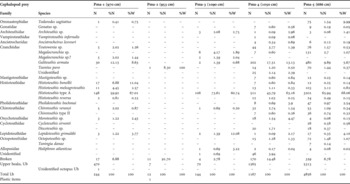
All five sperm whale stomachs contained cephalopod beaks and eye lenses. No fish remains where recorded and crustaceans (identified as Lepas sp.) were present in only one individual (Pma-3; Table 1). This whale also had a plastic bag in its stomach (size 31 × 20 cm) while a fishing hook of approximately 6 cm in length was present in the stomach of another whale (Pma-4). The number of cephalopod beaks in the stomachs ranged from 12 lower and 7 upper beaks (Pma-2) to 4856 lower and 5313 upper beaks (Pma-5). A minimum of 1 (Pma-2) and a maximum of 22 (Pma-5) cephalopod taxa were identified from the stomachs. Cephalopods from the genus Histioteuthis were the most numerous prey for four out of the five whales (Table 2).
Prey species and number of plastic items found in the stomachs of sperm whales, Physeter macrocephalus (Pma). For all prey species, number of beaks/other remains (N) and importance (%N, percentage by number; %W, percentage by weight) are indicated. For cephalopods number of beaks found are indicated (lower beaks, Lb, unless otherwise stated). The category Histioteuthis type A includes the species Histioteuthis arcturi Robson, 1948, H. corona Voss & Voss, 1962, H. meleagroteuthis Chun, 1910 and H. bonellii Clarke, 1980. The category Chirotheuthis type II includes beaks of the genus Chiroteuthis different from Chiroteuthis veranyi Ferussac, 1835 (Santos et al., Reference Santos, Pierce, Herman, Guerra, Mente and Clarke2001).

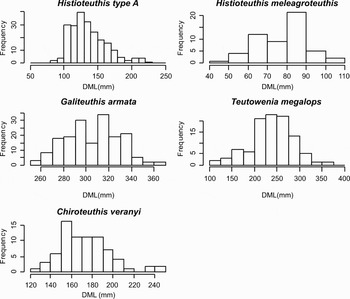
Estimated sizes (dorsal mantle length (DML)) of Histioteuthis type A ranged from 85 mm to 229 mm with a mode at 125 mm, as compared to 44–110 mm (mode 85 mm) for H. meleagroteuthis (Chun, 1910), 252–369 mm (modes 295 and 315 mm) for Galiteuthis armata (Joubin, 1898), 119–361 mm (mode 250 mm) for Teuthowenia megalops (Proch, 1947) and 128–248 mm (mode 155 mm) for Chiroteuthis veranyi (Ferussac, 1835) (Figure 2). Seven beaks of the giant squid Architeuthis sp. were present with an estimated size-range of 738–1952 mm DML.
Frequency distribution of estimated prey size (DML, dorsal mantle length) of the main prey taken by sperm whales in the Canary Islands.

Reconstructed total biomass of prey represented by remains in sperm whale stomachs ranged from 93 g (Pma-2) to more than 1.5 tonnes (Pma-5).
Pygmy sperm whales and Gervais' beaked whale
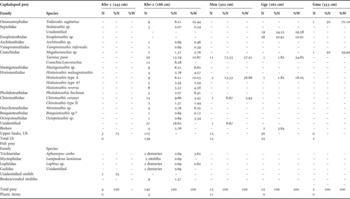
Both pygmy sperm whale stomachs contained remains of crustacean exoskeletons, parasitic nematodes, cephalopod and fish. Sixteen cephalopod species and 4 different fish taxa were identified from the remains (Table 3). Four sheets of plastic (sizes ranging from 34 × 1 cm to 68 × 8 cm) and one plastic filament of approximately 10 cm in length were recovered also from one of the whale stomachs (Kbr-2).
Prey species and number of plastic items found in the stomachs of pygmy sperm whales, Kogia breviceps (Kbr), Gervais' beaked whales, Mesoplodon europaeus (Meu), Risso's dolphins, Grampus griseus (Ggr) and short-finned pilot whales, Globicephala macrorhynchus (Gma). For all prey species, number of beaks/other remains (N) and importance (%N, percentage by number; %W, percentage by weight) are indicated. For cephalopods number of beaks found are indicated (lower beaks, Lb, unless otherwise stated). For fish the type of remains are indicated. The category Histioteuthis type A includes the species Histioteuthis arcturi, H. corona, H. meleagroteuthis and H. bonellii. The category Chirotheuthis type II includes beaks of the genus Chiroteuthis different fromm Chiroteuthis veranyi (Santos et al., Reference Santos, Pierce, Herman, Guerra, Mente and Clarke2001).

The Gervais' beaked whale examined was the animal with the most plastic debris in its digestive tract: a complete plastic bag (size 44 × 24 cm) and pieces of another 2 (sizes 78 × 25 cm and 50 × 18 cm) were found together with 12 upper and 15 lower beaks from at least 3 different cephalopod species (Table 3). Three parasite nematodes were also found.
Estimated sizes (DML) of Histioteuthis type A found in the pygmy sperm whales ranged from 12 to 96 mm, as compared to 32–65 mm for H. meleagroteuthis, 77–286 mm for Taonius pavo and 45–112 mm for Chiroteuthis veranyi. A beak of the giant squid Architeuthis sp. (131 mm estimated DML) was also found together with a specimen of black scabbard fish (Aphanopus carbo) (490 mm estimated total length). In the case of the Gervais' beaked whale, estimated sizes of H. meleagroteuthis type A (DML) were 8 and 111 mm, while the size of C. veranyi was estimated at 120 mm and sizes of T. pavo ranged from 71 to 231 mm.
Reconstructed prey biomass was 4429 g for the second pygmy sperm whale and 736 g for the Gervais' beaked whale (Table 1).
Risso's dolphin and short-finned pilot whale
A total of 55 lower and 30 upper beaks belonging to 4 cephalopod taxa (Histioteuthis type A, Mastigoteuthis sp., Sepiolidae and Enoploteuthis sp.) were recovered from the Risso's dolphin analysed (Table 3). The total prey reconstructed weight was 183 g (Table 1).
Only two lower beaks were found in the short-finned pilot whale stomach (Table 3). Reconstructed weight of the 2 prey taxa identified (Todarodes sagittatus of 309 mm DML and Megalocranchia sp. of 506 mm DML) was estimated to be more than 1 kg (Table 1).
Fraser's dolphin
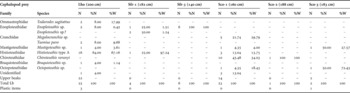
The stomach of the single Fraser's dolphin examined contained 22 lower and 25 upper beaks from at least 6 cephalopod species (Table 4). One parasite isopod and one parasitic nematode were also found. In addition, 2 small pieces of plastic (sizes 11 × 2 cm and 10 × 3 cm) and a plastic filament of approximately 10 cm in length were present. Total reconstructed prey weight was 544 g (Table 1) with Histioteuthis type A (DML 16–50 mm) contributing with 64% by number and 67% by weight of the total prey biomass.
Prey species and number of plastic items found in the stomachs of Fraser's dolphins, Lagenodelphis hosei (Lho), Atlantic spotted dolphins, Stenella frontalis (Sfr) and striped dolphins, Stenella coeruleoalba (Sco). For all prey species, number of beaks/other remains (N) and importance (%N, percentage by number; %W, percentage by weight) are indicated. For cephalopods number of beaks found are indicated (lower beaks, Lb, unless otherwise stated). The category Histioteuthis type A includes the species Histioteuthis arcturi, H. corona, H. meleagroteuthis and H. bonellii.

Atlantic spotted dolphins
Two Atlantic spotted dolphin stomachs were analysed and the lower beaks present were identified as belonging to the taxa Histiotheuthis type A and Enoploteuthis sp. (Table 4). Total reconstructed prey weight was 40 g for the first dolphin and less than 4 g for the second dolphin (Table 1). Remains of crustaceans (infraclass Cirripedia) were also found in one stomach.
Striped dolphins
The stomach of one dolphin contained 14 upper and 23 lower beaks from 5 cephalopod species. The most important prey species was Chiroteuthis veranyi which made up to 43% by number and 34% by weight of the total prey (Table 4). Cephalopod lenses and three parasite nematodes were also present. The other two stomachs examined contained lower beaks of C. veranyi, Mastigoteuthis sp. and Octopoteuthis sp. (Table 4). A plastic filament of around 10 cm in length was also present in one of the stomachs.
Estimated sizes of the squid Histioteuthis type A ranged from 23 to 62 mm DML whereas C. veranyi ranged from 82 to 145 mm DML. Reconstructed total weights of prey taken by the three striped dolphins were 1206 g, 30 g and 50 g, respectively (Table 1).
Bottlenose dolphin and rough-toothed dolphin
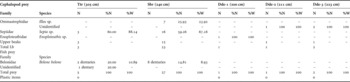
The stomach of the bottlenose dolphin contained remains of three cuttlefish Sepia sp., two dentaries from a garfish (Belone belone) and a third unidentified fish dentary (Table 5). One specimen of the mollusc Dentalium sp. and several fish vertebrae were also found.
Prey species and number of plastic items found in the stomachs of bottlenose dolphins, Tursiops truncatus (Ttr), rough-toothed dolphins, Steno bredanensis (Sbr) and common dolphins, Delphinus delphis (Dde). For all prey species, number of beaks/other remains (N) and importance (%N, percentage by number; %W, percentage by weight) are indicated. For cephalopods number of beaks found are indicated (lower beaks, Lb, unless otherwise stated). For fish the type of remains are indicated.

The rough-toothed dolphin stomach contained 15 upper and 23 lower beaks identified as Illex sp. and Sepia sp. and eight garfish dentaries (4 fish) (Table 5). One parasitic nematode and several cephalopod lenses were also present.
The estimated size of the garfish was 37 cm for the specimen in the stomach of the bottlenose dolphin and between 45 and 60 cm for that in the rough-toothed dolphin. The size-range (DML) of Sepia sp. was 73–137 mm for the bottlenose dolphin and 71–193 mm for the rough-toothed dolphin. The bottlenose dolphin had taken 409 g of prey while the rough-toothed dolphin had taken 7768 g (Table 1).
DISCUSSION
The high marine mammal biodiversity of the Canary Islands is reflected in the sample set which included both coastal and oceanic dolphins and several species of toothed whales. Results from this study show the importance of cephalopods in the diet of several different species of cetaceans in the research area. Even those cetacean species generally described as mainly piscivorous (e.g. common dolphin, see Silva, Reference Silva2001; Santos et al., Reference Santos, Pierce, López, Martínez, Fernández, Ieno, Mente, Porteiro, Carrera and Meixide2004; Pusineri et al., Reference Pusineri, Magnin, Meynier, Spitz, Hassani and Ridoux2007) contained more cephalopod than fish remains in the present dataset.
Traditionally teuthophagous species such as the sperm whale, pygmy sperm whale, long finned pilot whale, Risso's dolphin and to a lesser extent Gervais' beaked whale (e.g. Clarke et al., Reference Clarke, Martins and Pascoe1993; González et al., Reference González, López, Guerra and Barreiro1994; Santos et al., Reference Santos, Pierce, Boyle, Reid, Ross, Patterson, Kinze, Tougaard, Lick, Piatkowski and Hernández-García1999, Reference Santos, Berrow and Pierce2006a, Reference Santos, Pierce, López, Reid, Ridoux and Mente2006b, Reference Santos, Martin, Arbelo, Fernández and Pierce2007b) also had a diet dominated by cephalopods in the present sample but with some differences from what other authors have found in the north-eastern Atlantic. In the case of the sperm whale, which is the species with the highest sample size in the present study, prey diversity was much higher in the Canary Islands than reported in other studies. A total of 23 different prey taxa was found in 5 whales in the Canary Islands compared to 15 prey taxa found in 17 sperm whales stranded in the Azores (Clarke et al., Reference Clarke, Martins and Pascoe1993), 10 prey taxa recorded in 17 sperm whales stranded in Scotland, Denmark and Belgium (Santos et al., Reference Santos, Pierce, Boyle, Reid, Ross, Patterson, Kinze, Tougaard, Lick, Piatkowski and Hernández-García1999) and 11 prey taxa present in 5 sperm whales stranded in Scotland, The Netherlands and Ireland (Santos et al., Reference Santos, Pierce, García-Hartmann, Smeenk, Addink, Kuiken, Reid, Patterson, Lordan, Rogan and Mente2002).
Most recent studies on sperm whale diet in the north-eastern Atlantic are based in the examination of stomach contents from stranded whales, mainly around the North Sea waters (Lick et al., Reference Lick, Bandomir-Krischak, Stede, Wulf, Benke, Evans and Nice1995; Clarke, Reference Clarke, Jaques and Lambersten1997; Santos et al., Reference Santos, Pierce, Boyle, Reid, Ross, Patterson, Kinze, Tougaard, Lick, Piatkowski and Hernández-García1999, Reference Santos, Pierce, García-Hartmann, Smeenk, Addink, Kuiken, Reid, Patterson, Lordan, Rogan and Mente2002) where the most important food resource was identified as squid from the genus Gonatus, probably Gonatus fabricii. Gonatus fabricii is the most abundant squid from Arctic and sub-Arctic areas with a distribution that extends south to about 60°N (Kristensen, Reference Kristensen and Boyle1983). González et al. (Reference González, López, Guerra and Barreiro1994) identified Histioteuthis spp. as the most important prey category for one sperm whale stranded in Galicia (north-western Spain) and Santos et al. (Reference Santos, Berrow and Pierce2006a) obtained similar results for a sperm whale calf stranded in Ireland. In the present study the main prey category both by number and weight was also the oceanic family Histiotheuthidae (they made up more than 50% by weight in all but one of the sperm whales analysed in this paper). As found by Santos et al. (Reference Santos, Berrow and Pierce2006a), Histioteuthis type A was the most important type within the Histioteuthidae.
In common with previous studies, our results also show no evidence of inshore feeding, since no coastal species were present among the prey remains and no fresh remains were found (i.e. no cephalopod flesh was recovered, which would indicate that the whales had not been feeding immediately prior to stranding). Cephalopod mandibles can remain in the stomach for several days (Clarke & MacLeod, Reference Clarke and MacLeod1974). This accumulation could result in the overestimation of cephalopod importance compared to other types of prey, for example fish, the remains of which would be eliminated more quickly from the stomachs. In fact, it is highly likely that the estimated 1.5 tons of food represented by remains recovered from one of the sperm whales in the present study represented several days' feeding.
Santos et al. (Reference Santos, Pierce, López, Reid, Ridoux and Mente2006b) identified 15 different cephalopod families from 14 pygmy sperm whales stranded in Galicia (north-western Spain), Scotland and France and the family Histioteuthidae was the most important. Previous studies in the Azores and Canary Islands archipelagos also recorded histioteuthids as the main prey of pygmy sperm whales (Martins et al., Reference Martins, Clarke, Reiner and Santos1985; Hernández-García, Reference Hernández-García1995). Although in the present study only two specimens were examined, our results are in agreement with previous work since the families Histioteuthidae, Chirotheutidae and Ommastrephidae were the most numerous prey. In addition, a beak from the giant squid Architeuthis sp., a species generally believed to contribute only to the diet of sperm whales (Clarke, Reference Clarke1996), was found in one of the pygmy sperm whales. The squid size was estimated as 131 mm DML, which is considerably smaller than the estimated sizes of the Architeuthis found in the sperm whale stomachs (738–1952 mm DML) described here.
A total of 13 cephalopod and 4 fish families were identified from the remains found in two pygmy sperm whale stomachs, again highlighting the high prey diversity found in our sample. In addition to cephalopods, two bathypelagic fish species (black scabbard fish, Aphanopus carbo, and lantern fish, Lampadena luminosa) and some demersal fish were also found in one of the pygmy sperm whales. Remains of bathypelagic fish species such as Sloane's viperfish Chauliodus sloani (Bloch & Schneider, 1801) were identified from a pygmy sperm whale stranded in Galicia (north-western Spain) by Santos et al. (Reference Santos, Pierce, López, Reid, Ridoux and Mente2006b).
There is little information available on the diet of Gervais' beaked whales. MacLeod (Reference MacLeod2005) argues that both cephalopod and fish are an important part of the diet for the genus Mesoplodon. One specimen of Gervais' beaked whale stranded in the Canary Islands was analysed by Santos et al. (2007b) and indeed contained remains of both cephalopods (family Cranchiidae) and fish (viperfish, Chauliodus sp.). Martín et al. (Reference Martín, Vonk, Escorza, Montero and Evans1990) reported jaw bones of Chauliodus sloani and cephalopod beaks in the stomach of a whale stranded in the same area. In our sample, the single stomach analysed did not contain fish remains but the squid identified were oceanic species of the families Cranchiidae and Histioteuthidae already recorded in the diet of the species. Feeding on this prey is consistent with the habitat of these deep-diving whales (MacLeod, Reference MacLeod2005).
Risso's dolphin has been described as a teuthophagous predator with both oceanic and neritic cephalopod species contributing to its diet (Clarke, Reference Clarke1996) as expected from its habitat range. In the present sample a single stomach was analysed but it contained both coastal (e.g. Enoploteuthidae and Sepiidae) and oceanic (Taonius pavo and Histioteuthis type A) species. Oceanic cephalopods were the main prey in terms of weight while coastal cephalopods were more numerous. Only oceanic cephalopods (the ommastrephid Todarodes sagittatus and the cranchiid Megalocranchia sp.) were found in the single specimen of short-finned pilot whale examined. The species has been recorded as feeding on both neritic and oceanic cephalopods with ommastrephids being the main prey in most areas (Clarke, Reference Clarke1996).
Of the remaining cetacean species analysed, common dolphin diet has been described as mainly piscivorous and opportunistic, with cephalopods and fish species being important contributors to the diet in the north-eastern Atlantic (Silva, Reference Silva2001; Santos et al., Reference Santos, Pierce, López, Martínez, Fernández, Ieno, Mente, Porteiro, Carrera and Meixide2004; Pusineri et al., Reference Pusineri, Magnin, Meynier, Spitz, Hassani and Ridoux2007). In our sample, the 3 stomachs analysed did not contain any fish remains and both coastal (enoploteuthids) and offshore (ommastrephids) cephalopods were found. Cephalopods and fish (both neritic and oceanic species) have been recorded in the diet of striped dolphins (López, Reference López2003; Ringelstein et al., Reference Ringelstein, Pusineri, Hassani, Meynier, Nicolas and Ridoux2006; Spitz et al., Reference Spitz, Richard, Meynier, Pusineri and Ridoux2006; Santos et al., Reference Santos, Pierce, Learmonth, Reid, Patterson and Ross2008). Clarke (Reference Clarke1996) indicated that Stenella coeruleoalba favours ommastrephids, loligids, enoploteuthids and lycoteuthids although none of these taxa are represented in our results. Only oceanic species of cephalopods (Megalocranchia sp., Mastigoteuthis sp., Histioteuthis type A, Chiroteuthis veranyi and Octopoteuthis sp.) were recorded in the three striped dolphin stomach contents analysed here.
Bottlenose dolphins are thought to be opportunistic predators, with a wide variety of locally abundant prey being found in their stomachs (Barros & Odell, Reference Barros, Odell, Leatherwood and Reeves1990). Our sample consisted of one stomach in which both cuttlefish (Sepia sp.) and garfish remains were found. Both prey species have a coastal distribution which would indicate inshore feeding although in other parts of the north-eastern Atlantic the bottlenose dolphin is thought to also feed in offshore waters (Santos et al., Reference Santos, Fernández, López, Martínez and Pierce2007a).
Little is known of the diets of rough-toothed dolphin, Fraser's dolphin and Atlantic spotted dolphin. Aguiar dos Santos & Haimovici (Reference Aguiar dos Santos and Haimovici2001) identified the squid Loligo plei (Lesueur, 1821) as the most important prey for 6 Atlantic spotted dolphins and one rough-toothed dolphin from Brazil, where L. plei can be locally abundant in the outer shelf and inner slope. On the other hand, Fraser's dolphins are known to feed on mesopelagic prey including cephalopods and fish (Aguiar dos Santos & Haimovici, Reference Aguiar dos Santos and Haimovici2001; Dolar et al., Reference Dolar, Walker, Kooyman and Perrin2003). In our study both coastal (Sepia sp. and Belone belone) and oceanic (Illex sp.) species were present in the diet of the rough-toothed dolphin. Inshore (Enoploteuthis sp.) and offshore (Histioteuthis type A) cephalopods were found also in the Atlantic spotted dolphin stomach. Again, oceanic (Todarodes sagittatus, Taonious pavo, Mastigoteuthis sp., Histioteuthis type A and Braquioteuthis sp.) and coastal (Enoploteuthis sp.) prey were identified as part of the Fraser's dolphin diet.
The present sample size is small but provides an insight into the diet of many species of cetaceans which inhabit the waters of the Canary Islands Archipelago. Our results highlight the importance of cephalopods in the diet of all the species studied, although it should be noted that hard remains such as cephalopod beaks could be accumulated in the stomachs over longer periods than less robust prey tissues such as crustacean exoskeletons and fish bones. Taking all this into account, it is worth highlighting the high prey diversity found in the stomachs of most species (particularly the sperm and pygmy sperm whales) when compared with data from stomach contents of stranded individuals from other areas.
The main prey categories taken by sperm, pygmy sperm and Gervais' beaked whales in the present study belonged to two oceanic cephalopod families, Histioteuthidae and Cranchiidae. Different sizes of squid were taken by the different predators which would help reduce interspecific competition.
Most of the dolphin species analysed (even those whose distribution is mainly oceanic), had both inshore and offshore prey species in their stomachs which may point to regular feeding trips towards inshore waters. The narrow width of the continental shelf in the Canary Islands may make possible the exploitation of both niches. Most of the prey species eaten by the cetaceans are of little or no commercial value, although the presence of a hook in a sperm whale stomach suggests that this species sometimes interacts with human fishing activities. Sperm whales have been found to interact with the longline fisheries in other regions by removing catches from fishing gear (Sigler et al., 2008).
Finally, we would like to highlight the high prevalence of plastic debris among the stomach contents analysed. Although food remains were found in all the cases that plastics were present, it has been suggested previously that the presence of artificial materials in high concentrations could prevent the evacuation of the stomach (Santos et al., Reference Santos, Pierce, Herman, Guerra, Mente and Clarke2001) and could cause the death of the animal (Gomerčić et al., Reference Gomerčić, Gomerčić, Gomerčić, Lucić, Dalebout, Galov, Škrtić, Ćurković, Vuković and Huber2006). All the cetacean species included in the present study are recorded in Annexe IV of the Habitats Directive from the EU (Directive 92/43/CEE) as species of community interest in need of strict protection.
ACKNOWLEDGEMENTS
Sample collection was funded by the Department of Natural Environment of the Canary Islands' Government. We wish to thank the assistance throughout the study period of volunteers from Canarias Conservación, Cetacean Research & Educational Society. We also thank Zoi Pataki and Theodoros Nitis from the University of the Aegean and Vasilis Valavanis from the Hellenic Centre for Marine Research for their assistance in drawing the map for Figure 1.