Introduction
Non-native arthropods abound worldwide and many cause substantial ecological and economic damage (Hallman & Schwalbe, Reference Hallman and Schwalbe2002). While invasions of herbivorous pest arthropods are typically the consequence of unintentional introductions, predators and parasitoids of pest arthropods are often introduced deliberately for biological control. Nevertheless, there are numerous cases of alien arthropod predators and parasitoids that became invasive and have undesirable effects on the invaded ecosystems (Roy et al., Reference Roy, Roy and Roques2011). Here we report the case of an accidentally introduced parasitoid of aphids in Europe that appears to be expanding its host range.
The subfamily Aphidiinae (Hymenoptera, Braconidae) consists of solitary endoparasitoids of aphids, several of which are of great value in pest aphid control (Hagvar & Hofsvang, Reference Hagvar and Hofsvang1991, Brewer & Elliott, Reference Brewer and Elliott2004) and are commercially available as biocontol agents (Boivin et al., Reference Boivin, Hance and Brodeur2012). More than 200 species have been recorded in Europe (van Achterberg, Reference van Achterberg2011), but there is variation in how comprehensively the fauna of Aphidiinae is documented in different areas/countries. With 100 recorded species, Serbia is one of the most extensively surveyed European countries (Petrović et al., Reference Petrović, Tomanović, Žikić, Kavallieratos and Starý2009, Petrović et al., Reference Petrović, Žikić, Petrović-Obradović, Mitrovski Bogdanović, Kavallieratos, Starý and Tomanović2011). The genus Lysiphlebus Förster, with about 30 known species, belongs to a taxonomically and biologically less studied genera (Mackauer, Reference Mackauer1961; Kambhampati et al., Reference Kambhampati, Voelkl and Mackauer2000). It comprises highly specialized species such as L. hirticornis Mackauer which parasitize Metopeurum fuscoviride exclusively (Nyabuga et al., Reference Nyabuga, Loxdale, Sharbel, Todd and Weisser2009), as well as relative generalists such as a L. testaceipes (Cr.) with a host range of more than 50 species in Europe (Starý et al., Reference Starý, Lumbierres and Pons2004) and even more in its native home, North America (Pike et al., Reference Pike, Starý, Miller, Graf, Allison, Boydston and Miller2000). An important characteristic of the genus Lysiphlebus is the occurrence of species that have sexual and asexual reproduction such as L. fabarum, L. confusus and L. cardui (summarized in Sandrock et al., Reference Sandrock, Schirrmeister and Vorburger2011).
Aphidiinae parasitoids have been used in biological control programs against pest aphids on various crops worldwide (Hagvar & Hofsvang, Reference Hagvar and Hofsvang1991). Although new biocontrol agents are typically subject to a risk assessment prior to their field release, post-release studies often focus on establishment success and target effects, paying less attention to the effects of introduced parasitoids on non-target hosts. However, the best example on how important the latter studies are is L. testaceipes, a biocontrol agent introduced to Mediterranean Europe from Cuba to control Aphis citricola and Toxoptera aurantii in citrus crops. Within less than three decades L. testaceipes expanded its host range to 50 different aphid species (Cecilio, Reference Cecilio1994; Starý et al., Reference Starý, Lyon and Leclant1988, Reference Starý, Lumbierres and Pons2004), replacing native parasitoid species. In 2008, L. testaceipes was removed from the positive list of biocontrol agents in Europe by the European Plant Protection Organization (EPPO 2008-03-26/28).
Lysiphlebus orientalis Starý & Rakhshani was recently described from northeast China as a specialized parasitoid of the soybean aphid (Aphis glycines Matsumura) on Glycine max (L.). On the basis of field-collected material and laboratory rearing, Starý et al. (Reference Starý, Rakhshani, Tomanović, Hoelmer, Kavallieratos, Yu, Wang and Heimpel2010) determined that this parasitoid occurs in all-female populations that reproduce by thelytokous parthenogenesis. Since the soybean aphid has become a major source of economic loss for soybean production in North America (Heimpel et al., Reference Heimpel, Frelich, Landis, Hopper, Hoelmer, Sezen, Asplen and Wu2010; Ragsdale et al., Reference Ragsdale, Landis, Brodeur, Heimpel and Desneux2011), L. orientalis is currently under investigation as a potential biocontrol agent (Starý et al., Reference Starý, Rakhshani, Tomanović, Hoelmer, Kavallieratos, Yu, Wang and Heimpel2010; Ragsdale et al., Reference Ragsdale, Landis, Brodeur, Heimpel and Desneux2011). In their description of L. orientalis, Starý et al. (Reference Starý, Rakhshani, Tomanović, Hoelmer, Kavallieratos, Yu, Wang and Heimpel2010) determined on the basis of morphological characters that some Lysiphlebus specimens found recently in Europe may be related to L. orientalis. Here we present molecular evidence that L. orientalis is indeed present in Europe, presumably due to an accidental introduction. It was collected repeatedly in Serbia and it appears to be spreading geographically as well as expanding its host range.
Materials and methods
Collecting
For the past two decades, members of Lysiphlebus were intensively collected throughout Serbia as a part of ongoing research on Aphidiinae fauna. Plant samples infested with live and mummified aphids were collected in the field and transferred into plastic containers covered with nylon mesh. Voucher specimens of live aphids from each plant sample were preserved in 70% ethanol for later identification. The remaining aphids were maintained in the laboratory until parasitoid emergence.
The external morphology of emerged parasitoids was studied using a ZEISS Discovery V8 stereomicroscope. All materials used in this study are deposited in the collection of the Institute of Zoology, Faculty of Biology, University of Belgrade.
DNA extraction, polymerase chain reaction (PCR) amplification and sequencing
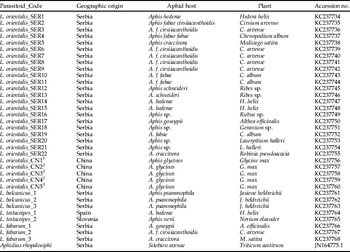
Thirty-five Lysiphlebus specimens were used for the molecular confirmation of species status and for the analysis of genetic variability (table 1). L. orientalis was represented with 22 specimens originating from Serbia and five from China. We also obtained sequences from two specimens of L. testaceipes and three specimens of L. balcanicus. Both species are members of the ‘testaceipes’ group which is closely related to L. orientalis. In addition to members of the ‘testaceipes’ group, we sequenced three specimens of L. fabarum which shares aphid hosts with L. orientalis. Prior to DNA extraction, all specimens were stored in 96% ethanol at −20 °C. DNA was extracted from each individual adult wasp using the KAPA Express Extract kit (Kapa Biosystems) following the manufacturer's instructions. A region of approximately 710 bp of the barcoding region of the mitochondrial cytochrome oxidase subunit I (COI) gene was amplified using the primers LCO1490 (5′-GGTCAACAAATCATAAAGATATTGG-3′) and HCO2198 (5′-TAAACTTCAGGCTGACCAAAAAATCA-3′) (Folmer et al., Reference Folmer, Black, Hoeh, Lutz and Vrijenhoek1994).
Sampling data for specimens used for molecular confirmation of species status and genetic variability study of L. orientalis.

1 lab culture1 Newark USA.
2 lab culture2 Newark USA.
3 lab culture3 Newark USA.
DNA amplification was performed in a final volume of 25 μl containing 1 μl of the extracted DNA, 1 × KAPA2G Robust HotStart ReadyMix (contains 2 mM MgCl2 at 1X) and 0.5 μM of each primer. All PCRs were conducted in an Eppendorf Mastercycler® using the following thermal profile: initial denaturation at 95 °C for 5 min, followed by 35 cycles of 94 °C for 60 s, 54 °C for 60 s, 72 °C for 90 s and a final extension step at 72 °C for 7 min. The PCR products were purified using the QIAquick PCR Purification Kit (Qiagen) according to the manufacturer's instructions, while DNA sequencing in both directions was performed by Macrogen Inc. (Seoul, Korea).
Genetic analysis
Sequences were edited using FinchTV (www.geospiza.com). After multiple alignments, conducted using CLUSTAL W integrated in MEGA5 software (Tamura et al., Reference Tamura, Peterson, Peterson, Stecher, Nei and Kumar2011), sequences showed no indels (insertion/deletion) and were trimmed to a length of 630 bp. All sequences were deposited under accession numbers KC237734-KC237768 in GenBank. For calculation of average genetic distances between sequences, within each group and between groups of species, we used Kimura's two-parameter method (K2P) of base substitution. Maximum parsimony (MP) and neighbor joining (NJ) trees were also obtained using MEGA5 software. The robustness of the trees was assessed using a bootstrap analysis with 1000 replicates. A COI sequence of Aphidius rhopalosiphi De Stefani Perez from GenBank (Accession No. JN164775.1) was used as an outgroup taxon for molecular phylogenetic analyses.
Results
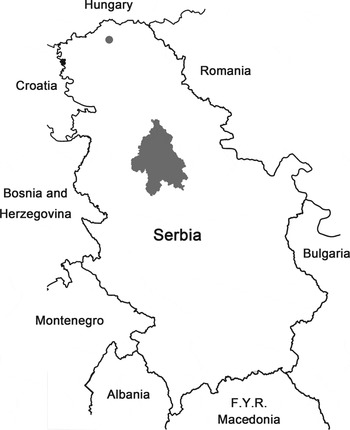
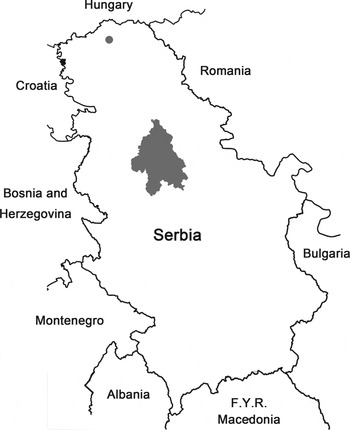
During a nearly two-decade-long research of the Aphiidinae fauna of Serbia, specimens that are morphologically identical to L. orientalis were encountered very sporadically. The first record is from 1995, but finding these parasitoids only became a regular occurrence in 2010 and 2011 (table 2). In total, 214 females, but no males, were collected in two distinct regions of Serbia, the Belgrade region and northern Serbia (fig. 1). These parasitoids emerged from nine aphid hosts on 12 different host plants, forming 13 tri-trophic associations, which are summarized in the next paragraph. The lack of males is consistent with asexual reproduction as reported for L. orientalis in its native range. Molecular identification of the collected material as L. orientalis (see below) makes these the first records of this Far East species in Europe. Based on the number of records and diversity of aphid hosts, it appears that the Belgrade region is the center of introduction where L. orientalis gained a foothold and from where it could expand its geographic range as well as its host range. This opinion is supported by the results of a long-term research on aphid parasitoids (including Lysiphlebus) realized since 1956 in the Czech Republic (Starý, Reference Starý2006) and nearby Slovakia (Starý & Lukáš, Reference Starý and Lukáš2009). In spite of a high number of samples and reared individuals, no L. orientalis have been found in these areas.
Map of Serbia with marked regions where L. orientalis was detected.
Number of collected samples with Lysiphlebus specimens and proportion of samples with L. orientalis in Serbia for period 1995–2011. Only years in which L. orientalis was found are shown.

Tritrophic associations
L. orientalis Starý & Rakhshani
Aphis affinis Del Guercio on Mentha aquatica, Radmilovac, 12.6.1995. (10f); Aphis craccivora Koch. on Medicago sativa, New Belgrade, 13.7.2010. (5f); on Robinia pseudoacacia, Slankamen, 24.6.2011 (1f); Aphis fabae Scop. on Chenopodium album, Zemun, 7.6.2011. (28f), Slankamen, 24.6.2011. (4f); on Vicia sp., Zemun, 18.6.2010. (6f); Aphis fabae cirsiiacanthoidis Scop. on Cirsium arvense, Besni fok, 27.5.2010. (3f), Jabuka, 18.5.2008. (35f), New Belgrade, 26.5.2002. (11f), Surčin 1, 15.6.2010. (8f), Surčin 2, 15.6.2010. (1f), Surčin 3, 15.6.2010. (1f), Vrbovski, 3.6.2008. (1f); Aphis fabae fabae Scop. on C. album, Slankamen, 20.7.2010. (1f), Zemun 1, 18.6.2010. (1f), Zemun 2, 18.6.2010. (6f), Zemun 3, 18.6.2010. (21f); Aphis gossypii Glover on Althea officinalis, Zemun, 7.6.2011. (2f); Aphis hederae Kaltenbach on Hedera helix, Zemun, 2.9.2010. (1f), Zemun, 14.6.2011. (2f); Aphis schneideri (Borner) on Ribes sp., Konjarnik, 6.6.2011. (13f); Aphis sp. on Geranium sp., Zemun, 7.6.2011. (12f); on Laserpitium halleri, Dobanovci, 17.6.2011. (2f), Zemun, 9.6.2011. (5f); on Picris hieracioides, Palić, 6.9.1995. (34f).
Genetic relationships
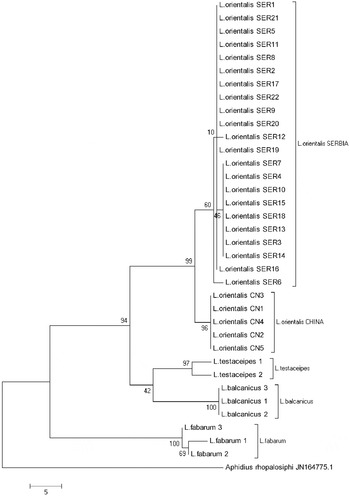
The identical topology of both, the MP (fig. 2) and NJ (not shown) trees, shows that specimens of L. orientalis from Serbia and China are each other's closest relatives and, with bootstrap values of 99% and 100%, respectively, form one phylogenetic clade.
The first out of the 438 most parsimonious trees (length = 126) for COI of Lysiphlebus specimens. A. rhopalosiphi was used as the outgroup species. Numbers above/below the branches represent the bootstrap values (%).

The calculated genetic distances (K2P) between specimens of L. orientalis from Serbia and China are very low with a mean distance of 0.008 (table 3).
Mean K2P genetic distances at COI between and within (gray fields) groups of Lysiphlebus parasitoids included in the present study.

For the COI barcoding region used here, this is within the range of intraspecific divergence observed in other species of Aphidiinae and well below the level typically found for between-species divergence (Derocles et al., Reference Derocles, LE Ralec, Plantegenest, Chaubet, Cruaud, Cruaud and Rasplus2011; Sandrock et al., Reference Sandrock, Schirrmeister and Vorburger2011). Both trees further show that L. orientalis is close to other members of the ‘testaceipes’ group, L. testaceipes and L. balcanicus, and more distantly related to L. fabarum.
Discussion
Although Hymenoptera constitute the largest proportion (63.3%) of alien arthropod predators and parasitoids in Europe, there are presently only five alien Aphidiinae species reported (Roy et al., Reference Roy, Roy and Roques2011). All of them (Aphidius colemani Viereck, Aphidius smithi Shama & Subba Rao, Lysiphlebus testaceipes, Pauesia cedrobii Starý & Leclant, and Pauesia unilachni (Gahan)) were introduced as biocontol agents (Starý, Reference Starý2006). Here we report the occurrence of L. orientalis in Serbia, an aphid parasitoid that is new to Europe and which has the potential to become invasive. Its arrival in Europe appears to predate the recognition of its invasion substantially and it predates its formal species description as a parasitoid of soybean aphid in China (Starý et al., Reference Starý, Rakhshani, Tomanović, Hoelmer, Kavallieratos, Yu, Wang and Heimpel2010). The first records in Serbia are from 1995, but previous to 2010 there are only five records. These specimens were mistakenly treated as rare female morphotypes of L. fabarum. Only when the number of records of these ‘morphotypes’ increased at about the same time as L. orientalis was described in China did we suspect that they belong to L. orientalis. This suspicion is now confirmed by our analyses of COI sequences. The introduction of a parasitoid attacking agricultural pests such as aphids may not appear undesirable at first glance. However, new aphid parasitoids can become invasive by replacing native parasitoid species, as documented for L. testaceipes (EPPO 2008-03-26/28). Important determinants of their potential impact are host range and reproductive mode. L. orientalis is thought to be monophagous on A. glycines in China (Starý et al., Reference Starý, Rakhshani, Tomanović, Hoelmer, Kavallieratos, Yu, Wang and Heimpel2010), but in Serbia it parasitizes several species of the genus Aphis. Based on the limited data available so far, its host range overlaps strongly with that of L. fabarum, which is the most abundant native parasitoid on hosts of the genus Aphis, providing an important ecosystem service through its impact on pest aphid populations (Starý, Reference Starý2006). L. orientalis also shares its mode of reproduction with L. fabarum. Based on the complete absence of males we concluded that L. orientalis in Europe reproduces by thelytokous parthenogenesis, as in its place of origin (Starý et al., Reference Starý, Rakhshani, Tomanović, Hoelmer, Kavallieratos, Yu, Wang and Heimpel2010). This mode of reproduction clearly facilitates invasion, because a single female is sufficient to form a new population, and it can make exotic species more competitive because they forego the cost of producing males (Maynard Smith, Reference Maynard Smith1978), resulting in a higher rate of population increase.
Kaiser & Heimpel (Reference Kaiser and Heimpel2011) described another phenomenon that makes L. orientalis a potentially problematic invader. L. orientalis preferentially attacks older aphids (A. glycines) that are mature enough to reproduce before being killed by the parasitoid larva. Furthermore, offspring of parasitized A. glycines reproduce earlier and faster than offspring of unparasitized A. glycines. These are undesirable attributes from a pest control perspective as they allow the host aphids to maintain high numbers despite high rates of parasitism (Kaiser & Heimpel, Reference Kaiser and Heimpel2011). As yet there are no investigations of such phenomena in Serbian populations of L. orientalis. If present, they could have significant implications for the structure of plant-aphid-parasitoid food webs in agroecosystems. For example, L. orientalis may become a serious competitor of L. fabarum, but not have equivalent effects on aphid population densities.
L. orientalis is indubitably established in Serbia since it is has been present in the same area for at least 17 years, but it appears to still be restricted to ruderal vegetation in urban areas. This is consistent with the community maturity concept of Shea & Chesson (Reference Shea and Chesson2002), which states that man-made environments have high levels of niche opportunities for alien species, because such communities have had less time to assemble, and less time for their constituent species to adapt to the local conditions. Their species might also have lower competitive abilities than those in mature communities (Shea & Chesson, Reference Shea and Chesson2002). The occurrence of L. testaceipes in the Mediterranean also manifests similar occurrence patterns (Starý et al., Reference Starý, Lyon and Leclant1988, Reference Starý, Lumbierres and Pons2004). The expansion of host range observed during the past two years and the increase in population density suggest that L. orientalis is moving past the lag phase of population growth in Serbia. The reasons mentioned above suggest that L. orientalis has a great potential to become a problematic invasive parasitoid in Europe. Constant monitoring is therefore necessary, as well as further research on its distribution, biology and ecology.
The pathways of introduction of L. orientalis are still unknown, but some conjectures can be made. Over the past two decades, a very intensive official and unofficial trade of goods has developed between China and Serbia. New exotic species could thus be introduced together with imported soybean, for example. Belgrade as the capital of Serbia is under the biggest pressure of immigration and trade, and is therefore the most likely center of exotic species introductions. To date Serbia is the only European country in which L. orientalis has been detected, despite the fact that the Aphidiine fauna is extensively investigated also in other parts of Europe (Kavallieratos et al., Reference Kavallieratos, Tomanović, Starý, Athanassiou, Sarlis, Petrović, Niketić and Veroniki2004; Starý, Reference Starý2006; Starý & Lukáš, Reference Starý and Lukáš2009). Considering the level of trade and transfers between western European countries and China, it is possible that L. orientalis is already present but still undetected elsewhere in Europe.
Acknowledgments
We would like to thank Professor George Heimpel (University of Minnesota) for the loan of specimens of L. orientalis from China. This study was supported by the SCOPES program of the Swiss National Science Foundation (Grant No. IZ73Z0_1 28174) and the Ministry of Education and Science of the Republic of Serbia (43001). The work by P. Starý was partially funded from the Entomology Institute Grant No. AV0Z50070508 (Academy of Sciences of the Czech Republic).