Introduction
The standard of care for transitional cell carcinoma invading the muscularis propria of the bladder is a bilateral pelvic lymph-node dissection and a cystoprostatectomy, with or without a urethrectomy in the male patient. In the female patient an anterior exenteration is performed, which includes the bladder and urethra, the ventral vaginal wall and the uterus.Reference McDougal, Shipley and Kaufman 1 Unfortunately, after this radical cystectomy (RC) for locally advanced bladder cancer, there is a significant rate of recurrence (56% among patients with pathological stage T3), most commonly as distant metastases.Reference Grossman, Natale and Tangen 2 In addition, this operation has been associated, sometimes, with poor quality of life results, as there is still no substitute for the patient's own fully functional bladder.Reference Al Gizawy, Essa, Refaiy and Elosaily 3
Therefore, recent strategies have combined the three modalities: transurethral resection of the bladder tumour (TURBT), chemotherapy and radiation therapy in an attempt to improve long-term survival and bladder preservation rates,Reference Perdonà, Autorino and Damiano 4 with salvage cystectomy being reserved for patients with incomplete response or local relapse.Reference Rodel, Weiss and Sauer 5 , Reference Kaufman 6
We had updated our experience in Assiut university hospitals with trimodality bladder-sparing approach.Reference Al Gizawy, Essa, Refaiy and Elosaily 3 For all patients, overall survival (OS), cancer-specific survival and OS with bladder preservation (OSBP) rates at 5 years reached 58, 60 and 51%, respectively. These results, similar to those reported by other studies, support the use of bladder-sparing treatment in selected patients as a safe and an effective alternative to RC.Reference Rödel, Weiss and Sauer 7 - Reference Zietman, Sacco and Skowronski 11
Despite these encouraging results, the outcome of the organ-sparing approach needs to be compared with the surgical standard. Unfortunately, primary cystectomy has not been tested against trimodality approach in randomised trials.Reference Perdonà, Autorino and Damiano 4 , Reference Zapatero, Martin de Vidales, Arellano, Bocardo, Pérez and Ríos 12
Purpose of the paper was to compare the outcome among patients with invasive bladder cancer treated with cystectomy alone, with outcome among those treated with combined-modality treatment in a randomised phase III trial. Secondary objectives were to quantify the rate of complete response after neoadjuvant chemoradiotherapy and survival with preserved bladder.
Patients and methods
Inclusion criteria
This trial included patients with histologically confirmed invasive non-metastatic bladder cancer. Inclusion criteria were clinical stage T2-3, N0 and M0, [AJCC TNM classification 7th edition 2010]; no prior radiotherapy and/or chemotherapy; Eastern Cooperative Oncology Group performance status (PS) ≤2; age at diagnosis of ≥18 years; and adequate bone marrow (absolute neutrophil count ≥1,500/m3 and platelet count ≥100,000/m3), renal (creatinine clearance ≥60 mL/minute, serum creatinine ≤1·3 mg/dL) and hepatic function (total bilirubin <1·5 mg/dL). Before the treatment, all patients received detailed oral information on the treatment protocol and possible side effects, and signed an informed consent. The trial was approved by the ethics committee of the Faculty of Medicine, Assiut University.
Patient evaluation
At baseline, all patients underwent history, physical examination, evaluation of PS, and complete blood count, kidney and liver function tests, and 24-hour urine collection for creatinine clearance. Histopathological diagnosis was established by cystoscopy and TURBT. Distant metastasis was excluded by pre-operative staging, including computed tomography (CT) scan of the chest, abdomen and pelvis. Bone scan was requested only when indicated.
Treatment protocol
Patients were randomly assigned to two arms:
-
• Arm 1: of which all patients underwent RC alone.
-
• Arm 2: of which all patients were subjected to maximal TURBT, followed 2 weeks later by combined chemoradiotherapy (CCRT). Radiotherapy was delivered once per day, 5 days a week. The whole pelvis received 46 Gy in 23 fractions over 4 to 5 weeks. Three-dimensional CT-based treatment planning was carried out.
Chemotherapy was administered concomitantly with radiotherapy with GC: cisplatin 70 mg/m2 q. 3 ws. and Gemcitabine 300 mg/m2 D 1, 8 and 15 q. 3 ws. for two cycles.Reference Mekkawy, Eid, ElTaher, Mostafa and AbdulAziz 13 All patients were pre-medicated for day 1 of each cycle with dexamethasone 20 mg intravenous (IV) injection, ondansetron 8 mg IV and ranitidine 50 mg IV. If the WBC was lower than 3·0 × 109/L or the platelets below 100 × 109/L, or haemoglobin <9 g/dL, or other grade 3 toxicities on day 22, the subsequent cycle was delayed for 1 week.
Four to six weeks after the end of treatment, the patients were re-evaluated by taking a CT scan of the pelvis and second- look cystoscopy, where the base of the tumour was rebiopsied and examined histopathologically.
Patients who had complete response were moved to phase II treatment. Phase II: 20 Gy/10 fractions/2 weeks to the bladder. Patients with residual tumour underwent RC.
Radiotherapy techniques
The target volume in phase I included the bladder, the proximal urethra and the pelvic lymph nodes. The planning target volume extends in the cranial–caudal dimension from L5-S1 interspace to the lower pole of the obturator foramen and 0·5–1 cm beyond the pelvic bones laterally. The anterior border lies 1–2 cm in front of the anterior bladder wall and the posterior border at the mid-rectum. Booster treatment was then used in phase II, which included the whole bladder and a margin of 2 cm.
The patients were treated in the supine position checked by laser lights. Fixation with thermoplastic shells was used in obese patients and in patients having redundant abdomen. IV contrast was used to localise the bladder.
Field arrangement for the proposed target volume was carried out by computerised planning system, taking in consideration homogeneous distribution shape to the target volume and the tolerance dose to the critical organs. For whole-pelvic irradiation (phase I), treatment was administered, with the full bladder displacing the small bowel out of the pelvis. For phase II treatment, the patient was instructed to empty the bladder immediately before the treatment session to ensure that the bladder is inside the target volume. All patients were treated by photon linear accelerator 6 and/or 15 MeV. The total dose did not exceed 45 and 55 Gy to the femoral heads and the posterior rectal wall, respectively.
Surgery
-
• TURBT
-
• Definitive surgery included RC and urinary diversion. Urinary diversion was variable according to the PS and the relationship of the tumour with the bladder neck.
Pathologic analysis
Pathologic analysis of the RC specimen included extensive macroscopic and histologic evaluation. All the lymph nodes were entirely submitted for analysis per designated site and representative sections of surrounding fibroadipose tissue were, in addition, sampled.
Follow-up
During chemoradiotherapy, patients were evaluated weekly for acute toxicity and compliance with the protocol. If radiotherapy was interrupted, chemotherapy was not administered. Clinical examination and complete blood count were carried out. Toxic side effects were assessed according to National Cancer Institute Common Toxicity Criteria (version 2.0). Patients were followed every 3 months for the first 2 years after the last cycle of adjuvant chemotherapy and thereafter every 6 months.
Statistical analysis
Data were analysed using Statistical Package for Social Sciences version 21.0. The 0·05 level was used as the cut-off value for statistical significance. Count and percentage were used for describing and summarising qualitative data. Arithmetic mean and standard deviation were used as measures of central tendency and dispersion for quantitative data, respectively. Univariate analysis for the most important factors regarding patients, tumour and complications were carried out using χ 2 and t-test analysis. The clinical-pathologic factors with proven statistical significance from the univariate analyses were further included in the multivariable Cox proportional hazard regression models. The Kaplan–Meier method with the log-rank test for statistical significance was used for survival analysis of individual prognostic factors.
Actuarial survival rates were calculated from the time of Cystectomy (Arm 1) or initial TURBT (Arm 2) to the time of the last follow-up visit or death. For the estimation of disease-specific survival (DSS), patients who died of unrelated causes were censored at death. Patients whose cause of death was unknown were assumed to have died of bladder cancer. The OSBP was defined as the probability of remaining alive and with a preserved bladder.
Results
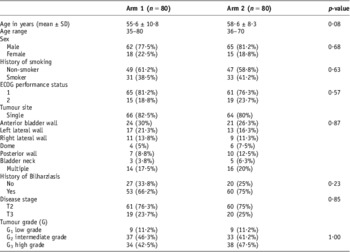
The patients and tumour characteristics are detailed in Table 1. Both arms, with 80 patients each, were demographically well balanced.
Patients and disease characteristics in all cases

Abbreviation: ECOG, Eastern Cooperative Oncology Group.
Protocol completion and response
All patients of Arm 1 underwent RC and urinary diversion, which was variable according to the PS and the relationship of the tumour with the bladder neck. Urinary diversion among those patients was as follows: 47 patients underwent orthotopic neobladder, 21 patients underwent catheterisable neobladder, five patients underwent ureterosigmoidostomy and seven patients underwent ileal conduit.
Of the 80 patients assigned Arm 2, a visibly completed TURBT was possible in 48 patients (60%). Phase I of CCRT was accomplished in 74 patients. Six patients did not complete it: four because of treatment intolerance and the other two owing to the development of acute kidney injury. Post-induction urologic evaluation revealed no evidence of disease (complete response, CR) in 62 patients (83·8%) and residual disease in 12 patients (16·2%). Phase II of CCRT was completed in 58 of the 62 patients with CR and bladder preservation and four patients did not continue consolidation CCRT because of poor compliance and tolerance to CCRT. The remaining 12 patients (16·2%) who had residual disease after induction therapy plus those (six patients) who did not complete phase I included 13 patients (66·7%) subjected to salvage cystectomy, and five patients (33·3%); three patients refused surgery and two were surgically inaccessible because of disease progression. These five patients received off-protocol chemotherapy or best supportive care and were considered failure. The four patients who did not complete phase II were kept on follow-up.
Outcome and pattern of failure
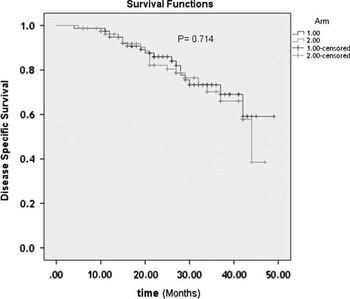
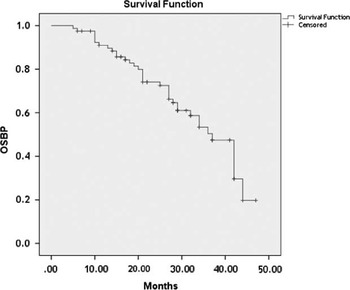
The median follow-up for all patients is 27 months (range: 4–49). The OS and DSS of the two treatment groups are shown in Figures 1 and 2. The 3-year OS for the combined-modality group and for the surgery group were 61 and 63%, respectively (p = 0·425), whereas the DSS for each group was 69 and 73%, respectively (p = 0·714). Thus, there was no significant difference in OS and DSS between both arms. The 3-year OSBP for Arm 2 patients was 50% (Figure 3).
Overall survival.

Disease-specific survival.

The overall survival with bladder preservation curve for Arm 2 patients.

Of the 80 Arm 1 patients, 23 (28·8%) patients experienced local pelvic recurrences and 13 (16·3%) patients developed distant metastases. Of those, three (3·8%) were discovered to have both local and distant recurrences on re-evaluation. Of the 62 Arm 2 patients who had CR, four (6·5%) patients experienced superficial bladder relapse, 15 (24·2%) patients developed muscle-invasive relapse and 10 (16%) patients developed distant metastases. Of those, three (4·8%) were discovered to have developed both local and distant recurrences on re-evaluation. There were no significant differences regarding the incidence of local recurrences (excluding non-invasive recurrence), distant metastasis and deaths from bladder cancer among the two arms (p = 0·20, 0·17, 0·50, respectively).
Patients with superficial bladder relapse were treated conservatively with TURBT and intravesical therapy. During follow-up, two of them developed invasive recurrence and underwent salvage cystectomy. Of the patients who developed muscle-invasive relapse, 11 were treated with salvage cystectomy, whereas radical surgery could not be performed in the other four patients because of poor PS or patient refusal.
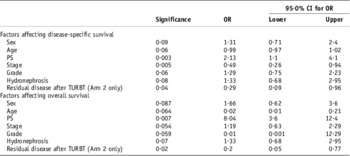
Multivariate analysis (MVA) was performed for the whole series to assess potential prognostic factors for OS and DSS (Table 2). The results of MVA showed that the tumour stage and PS were the only factors independently associated with DSS, whereas PS was the only factor independently associated with OS. In addition, residual disease after TURBT in Arm 2 patients was independently associated with both DSS and OS (Table 2).
Multivariate analysis of potential prognostic factors affecting disease-specific survival and overall survival

Abbreviations: OR, Odd's ratio; CI, confidence interval; PS, performance status; transurethral resection of the bladder tumour.
Toxicity
Regarding Arm 2 patients, post-operative complications were mild and transient and included haematuria in eight patients (relieved by medical treatment and bladder wash) and urinary tract infections in five patients treated by antibiotics.
The acute reactions, attributable to chemotherapy combined with radiotherapy of different grades included bladder irritation in 32% of the patients, diarrhoea in 26%, fatigue in 21% and leucopenia in 8%. None of these patients had incontinence. Grade 3 cystitis and proctitis were recorded in 7·5 and 2·5%, respectively.
Haematologically, grade 3 neutropenia occurred in three patients (3·75%), whereas grade 3 thrombocytopenia and anaemia were encountered each in one patient. No grade 4 toxicities were recorded.
When questioned at the follow-up examinations after the completion of treatment, all patients reported that their bladder function had remained satisfactory.
Regarding Arm 1 patients, intra-operative complications included injury of a major vessel in two patients and rectal tears in three patients that were controlled by surgical repair. Immediate post-operative complications included acute gastric dilatations in four patients and hypovolemic shock in three patients. Early complications included hypokalaemia in five patients, wound adhesions in two patients and urinary tract infections in six patients. All were well managed by appropriate measures.
The main late complications that developed during follow-up of Arm 1 patients included adhesive intestinal obstructions in three patients and hyperchloremic acidosis in three patients.
Of the 62 Arm 2 patients, six patients (9·7%) experienced late gastrointestinal toxicity (grade ≥2) in the form of chronic diarrhoea and tenesmus, whereas 11 (17·7%) patients developed late urinary toxicity (grade ≥2) in the form of reduced bladder capacity, with less-than-voiding intervals <2 hours; however, none required cystectomy for bladder contraction. There was no grade 4 toxicity and no treatment-related deaths.
Discussion
In this study, we aimed to compare the outcome among patients with invasive bladder cancer treated with cystectomy alone, with outcome among those treated with trimodality approach in a randomised phase III trial. On the basis of our results, we found no evidence that survival is compromised by the bladder-sparing technique we used.
The similarity in survival rates between cystectomy arm and selective bladder-preserving arm is likely due, in part, to the prompt use of salvage cystectomy when necessary in Arm 2 (26 (32·5%) of all entered patients). This underscores the need in selective bladder-preserving approaches for close cystoscopic evaluation and prompt removal of the bladder for an incomplete response or invasive recurrence.Reference Shipley, Kaufman and Zehr 14
The 3-year OS rate of 61%, DSS rate of 69% and 3-year survival rate with a preserved native bladder of 50% plus CR achieved in 77·5% of our Arm 2 patients are approaching the results of other recently reported combined-modality series using transurethral surgery plus concurrent chemotherapy and radiotherapy.Reference Sabaa, El-Gamal, Abo-Elenen and Khanam 15 - Reference Shipley, Zietman, Kaufman, Coen and Sandler 23 The current 5-year OS rates range from 50 to 67% with trimodality treatment, and ∼75% of the surviving patients maintain their bladder. After trimodality treatment complete response is obtained in more than 70% of patients with muscle-invasive bladder cancer.Reference Khosravi-Shahi and Cabezón-Gutiérrez 24 The 3-year survival rate with bladder preservation of our patients was in accordance with that (52·1%) reported by Tunio et al.Reference Tunio, Hashmi, Qayyum, Naimatullah, Mohsin and Sultan 25 who conducted a similar study on 116 Pakistani patients with muscle-invasive bladder cancer (MIBC). Using a similar protocol with the addition of adjuvant chemotherapy in one-third of their cases, Ibrahim et al.Reference Ibrahim, Abd El-Hafeez, Mohamed, Elsharawy and Kamal 26 reported post-induction CR in 24 (60%) patients, with 2-year actuarial survival and progression-free survival rates of 67% (95% CI 52·2–82·7%) and 58% (95% CI 42·3–74·0%), respectively.
The Radiation Therapy Oncology Group (RTOG) and the Massachusetts General Hospital (MGH) have great experience in this field.Reference Shipley, Zietman, Kaufman, Coen and Sandler 23 During the years 1985–2001, the RTOG conducted six trials, of which five were phase I and II, and the 6th one a phase III trial, which tested the role of adjuvant chemotherapy with trimodality treatment. A total of 415 patients were enrolled in these trials. The 5-year OS was ∼50%, with 75% of surviving patients retaining a functionally preserved bladder.Reference Shipley, Kaufman and Tester 27 , Reference Beena, Nambiar and Dinesh 28 The MGH's experience with 348 MIBC patients, who were entered on successive prospective trimodality protocols from 1986 to 2006, has recently been recently updated.Reference Efstathiou, Spiegel and Shipley 29 With a median follow-up for all surviving patients of 7·7 years, the 5, 10 and 15-year OS rates were 52, 35 and 22%, respectively. The 5, 10 and 15-year DSS was 64, 59 and 57%, respectively.Reference Gakis, Efstathiou and Lerner 30
Long-term outcomes of 473 patients with muscle-invasive bladder cancer treated with TURBT and radiochemotherapy or radiotherapy with curative intent between 1982 and 2007 in the AKH (Allgemeines Krankenhaus der Stadt Wien) General Hospital was reported by Krause et al.Reference Krause, Walter and Ott 31 in 2011. A total of 99·4% of the patients received a platinum-based chemotherapy: 143 cisplatin, 97 carboplatin, 67 cisplatin/5-FU, six carboplatin/5-FU, nine cisplatin/carboplatin, four cisplatin/carboplatin/5-FU, two 5-FU and three cisplatin/gemcitabine. Complete remission (CR) was achieved in 70·4% of the patients. Focusing on the subgroup of 331 patients treated with TURBT and radiochemotherapy, a median survival of 70 months was found with overall 5, 10 and 15-year survival rates of 54, 36 and 24%, respectively.Reference Krause, Walter and Ott 31
Our results of cystectomised patients (Arm 1) are also approaching those reported in prospective cystectomy series for patients with muscle-invasive bladder cancer. Contemporary series shows 5-year overall and DSS rates of 55–60% and 59–65%, respectively, for RC.Reference Stein, Lieskovsky and Kote 32 - Reference Wijkstrom, Norning and Lagerkvist 34
In cases with initial CR, muscle-invasive recurrences were detected in 15 (24·2%) of our cases during their follow-up. This was found to be worse than the results of Rödel et al.,Reference Rödel, Weiss and Sauer 7 Perdona et al.Reference Perdona, Autorino and Damiano 20 and Weiss et al.Reference Weiss, Engehausen and Krause 10 who reported invasive recurrences in 18, 17·6 and 11·1%, respectively, in their studies. This can be explained by higher percentage of multifocality and Bilharziasis in our series, in addition to poor compliance of some of our patients to be regularly followed by cystoscopy, resulting in failure to detect recurrences earlier at superficial stage. Only 6·5% of our CR cases were diagnosed as superficial recurrences during follow-up. In studies by Rödel et al.,Reference Rödel, Weiss and Sauer 7 Perdona et al.Reference Perdona, Autorino and Damiano 20 and Weiss et al.,Reference Weiss, Engehausen and Krause 10 the superficial recurrences were reported in 14, 16·7 and 13·1%, respectively.
Again, salvage cystectomy was recommended for muscle-invasive recurrences (but only performed for non-metastatic cases with good general conditions), whereas superficial recurrences were treated by TURBT and intravesical immunotherapy (Bacillus–Calmette–Guérin). Intravesical immunotherapy was well tolerated by the previously irradiated bladders, and no patient required treatment breaks.
In the Arm 2 patients, distant metastases were reported in 13 cases (21%) after the initial CR matching with other series. Ten of these cases were having completely disease free bladders. In the study by Rödel et al.,Reference Rödel, Weiss and Sauer 7 the authors demonstrated that distant metastases were evident in 21% of cases after the initial CR with 10 years of follow-up.
Several factors have been correlated with survival and bladder preservation rates in organ-preservation treatments for muscle-invasive bladder cancer. On MVA, the completeness of TURBT, tumour stage, tumour size, and in some studies, the presence of hydronephrosis or ureteral obstruction at diagnosis were found to be correlated with OS and local recurrence.Reference Khosravi-Shahi and Cabezón-Gutiérrez 24 For the whole series of our study, MVA showed that tumour stage and PS were the only factors independently associated with DSS, although PS was the only factor independently associated with OS. In addition, residual disease after TURBT in Arm 2 patients was independently associated with both DSS and OS.
To be a reasonable bladder-preserving alternative, a bladder-preserving approach should also have good bladder-sparing capacities.Reference Nieuwenhuijzen, Pos, Moonen, Hart and Horenblas 35 The 3-year OSBP for Arm 2 patients was 50%. Most of the long-term surviving patients in Arm 2 preserved their functioning native bladders, which is similar to other studies.Reference Sabaa, El-Gamal, Abo-Elenen and Khanam 15 - Reference Shipley, Zietman, Kaufman, Coen and Sandler 23 Acute toxicity was moderate and most of the late toxicities were grade 2 with no grade 4 toxicity and no treatment-related deaths.
However, it is important to realise that the patient numbers are relatively small. Therefore, large multi-institutional well-controlled randomised trials are needed to confirm these results.
Conclusion
This randomised phase III study demonstrates that trimodality bladder-preserving approach and represents a valid alternative for suitable patients. The OS and DSS rates of patients treated with trimodality bladder-preserving protocol are comparable to the results reported on patients treated with immediate RC. Although one-third of the patients treated on this protocol ultimately require cystectomy, this approach with bladder preservation is safe and results in a majority of the long-term survivors retaining functional bladders. The close collaboration of urologists, radiation oncologists and medical oncologists is of paramount importance in succeeding in bladder preservation.
Acknowledgements
The author would like to acknowledge the help provided by all other staff members caring for cancer patients participating in this research.
Financial Support
This research received no specific grant from any funding agency, commercial or not-for-profit sectors.
Conflicts of Interest
Authors certify that there is no actual or potential conflict of interest in relation to this article.