1. INTRODUCTION
This article highlights the demographic and socio-spatial characteristics of, and differences among, the substantial group of women who migrated from Norway to Amsterdam during the seventeenth and early eighteenth centuries, a period of Dutch history known for mass immigration. Several scholars have argued that early modern Amsterdam contained several immigrant communities,Footnote 1 the members of each community sharing common demographic and social features, which they preserved and cultivated in spatially clustered areas of Amsterdam. We wish to challenge this notion that immigrant groups were homogeneous and spatially clustered in particular areas within Amsterdam, by considering the marriage patterns and residential behaviour of women who had migrated to the city from Norway. We ask if the women's ethnicity was the sole explanation for their residential patterns, or whether their social class and region of origin within Norway also played a role. We also examine the extent to which their residential patterns were affected by changing demographic circumstances.
Our analyses are based on Amsterdam's registers of marriage banns, official public announcements of the intention to marry, usually declared between two and three weeks before the wedding. The registers provide information on the age at marriage, place of origin, occupation and place of residence within the city of soon-to-be married couples. Amsterdam – like the whole country – underwent enormous population growth during the seventeenth century, which reached a peak in 1675, and our findings indicate that the demographic constraints that this placed on the marriage market struck Norwegian migrant women in different ways. Whether a woman chose to marry a sailor or a non-seafarer determined her age at marriage and the age gap between her and her spouse. Over time it would also increasingly define where she would stay within the city, thus suggesting that occupation, rather than ethnicity, should be accentuated as an explanation of residential behaviour. This study thus contributes to our knowledge of both international migration and marital behaviour in early modern Europe, emphasising the position of immigrant women in particular. The study offers additional value by using detailed, street-level, spatial data to provide insights into the residence patterns of individual immigrants within Amsterdam.
2. NORWEGIAN SETTLERS IN AMSTERDAM: THE HISTORIOGRAPHIC CONTEXT
Between the last decades of the sixteenth century and the beginning of the nineteenth century, the Dutch Republic underwent a period of mass migration and population turnover as a result of economic growth. Approximately one million people entered the country and a little more than half a million left. During the same period, the Republic emerged as a thoroughly urbanised state, with half of its population living in cities. One city, Amsterdam, grew to be the third largest city in Europe, its population increasing seven-fold between roughly 1585 and 1675 from 30,000 to 219,000 inhabitants. After 1675, the city's population remained stable until the mid-nineteenth century, when new growth ensued.Footnote 2
Norwegians formed a relatively large group within Amsterdam in the early modern period. Jelle van Lottum has estimated that they numbered some 13,500 in 1650, the third largest immigrant group in the city at that time after Germans and Flemings, of which there were approximately 59,500 and 44,500 respectively.Footnote 3 However, compared to the size of the Norwegian population, the number of migrants leaving Norway to migrate to Amsterdam was even more substantial, numbering more than the population of Bergen, Norway's biggest city at the time.
Since sources on the population of Amsterdam in the seventeenth and eighteenth centuries are limited,Footnote 4 our estimates of the minimum numbers of immigrants to Amsterdam are based on our main source material, the city's registers of marriage banns. According to Erika Kuijpers, at least 60 per cent of all immigrants do not appear in the marriage banns as they were already married, never married, or had moved on to marry elsewhere.Footnote 5
Mass immigration often results in skewed sex ratios, most often in a surplus of men, and this can affect the marriage chances of both sexes, irrespectively of being an immigrant or a native-born citizen. As long as men constituted the larger group of immigrants, women in Amsterdam enjoyed an easier marriage market, but this state of affairs only lasted until about 1675. In the first decades of the seventeenth century, women in Amsterdam married young, at a mean age of 24.5 years, but after 1675, the brides' mean age at first marriage was nearly 28 years – Amsterdam born and immigrant women included. Whereas close to two thirds of all brides married before they were 25 years old at the start of the century, less than half did so after 1675.Footnote 6
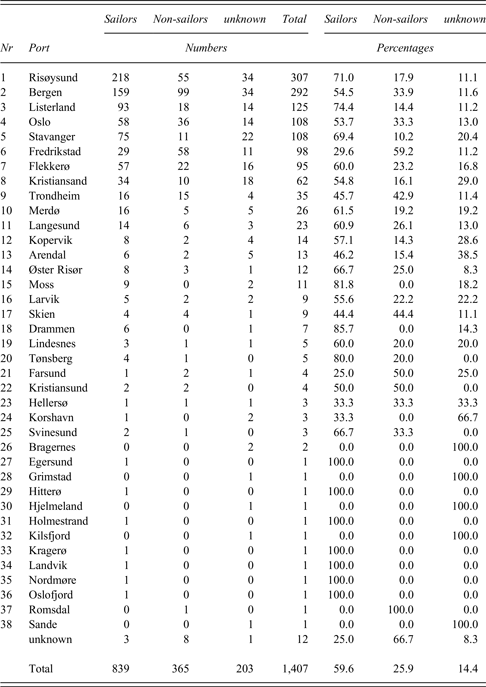
The marriage banns registers of Amsterdam show that 4,911 Norwegian men and 3,275 Norwegian women married in the city over the period 1621–1720; a sex ratio of 150 grooms to 100 brides. Given that women formed 40 per cent of the Norwegians appearing in the registers, and assuming that the sex ratio among those immigrants who did not marry was similar, we estimate that during the 1621–1720 period some 40 per cent of Norwegian immigrants to Amsterdam were women. The marriage banns registers show that 40 per cent of the women from Norway did not marry a fellow countryman, and many of those who did take a Norwegian groom did not marry a man from their hometown or village, according to the brides' and grooms' reported ports of departure from Norway. A total of 1,407 Norwegian women appear to have broken their ties with their homeland, and started new, independent lives in Amsterdam, quite distinct from the one they had left behind.Footnote 7
Norwegian women were not unusual; migrants to Amsterdam from Germany and the Southern Netherlands showed similar sex ratios.Footnote 8 Previous international migration research has shown that women formed a substantial part of those who left their home country to settle elsewhere. Most of those moving were labour migrants, seeking employment, a pattern that has continued from early modern times until the present day. Distance does not seem to have been a barrier to movement; a great number of women crossed the Atlantic Ocean during the huge migration flows from Europe to the USA during the nineteenth century.Footnote 9
A typical migrant woman was young, of marriageable age and worked as a domestic servant. Her employment career was thus similar to the career she would have followed in her home country, although, as she was pursuing it abroad, the tasks she undertook might have been different, as would be the circumstances in which she lived.
The historiography suggests that if a woman travelled to Amsterdam alone, she was likely to meet one of two destinies: either she would marry a sailor, or she would fall into a life of prostitution or crime.Footnote 10 If a Norwegian girl married a sailor, (our data show that in seven out of ten cases she chose a man from Norway), the bride and groom lived in areas with other Norwegians or Scandinavians, contributing to the social enclaves found in certain parts of Amsterdam.Footnote 11 The Norwegians in Amsterdam were thus a relatively homogeneous group of people with a distinct clustered settlement pattern, based on kinship and preserved regional identity from their home country.Footnote 12
Lotte van de Pol and Kuijpers have shown that the marriage market in Amsterdam was different depending on whether one was a native or a newcomer.Footnote 13 Native women had both social and economic capital and, of course, they had the added advantage that they spoke the native language. These advantages made the native women more attractive on the employment market. Newcomers could be excluded from even the lowest status female jobs.Footnote 14 Poverty was predominantly a female phenomenon. Men had a greater variety of work options; even as a newcomer a man without connections could always enlist as a sailor or a soldier.Footnote 15 Many migrant women, of all nationalities, risked becoming outsiders, on the margins of the society to which they had moved.
Despite being in a weak position in the marriage market, the Norwegian women observed in our study still managed to marry, and our analysis must thus be viewed as considering the success stories; by marrying the women had significantly reduced their chances of falling into prostitution or criminal activity.
3. ETHNIC PREFERENCES, ETHNO-CENTRISM AND ETHNIC NICHES
Immigrant enclaves are commonly recognised in both historical and contemporary populations, but previous researchers can agree on only one thing: there are many reasons why migrants congregate, and these are influenced by structural as well as individual conditions.Footnote 16 As described in the previous section, the Norwegian immigrants to Amsterdam were characterised as a homogeneous group with a desire to preserve their distinct identity by their spatial behaviour which can be explained using the so-called ‘in-group’ or ‘ethnic-preferences’ model.Footnote 17 This model emphasises that groups with a distinct identity act with simple ethno-centrism; a strong wish to reside in a neighbourhood in which they can live alongside people who reflect and confirm their own identity. Such individual desires serve to strengthen the community vis-à-vis ‘outsiders’ who challenge the identity of the ‘insiders’ in a variety of ways. The ‘ethnic preferences’ model is based on an understanding of ethnicity as a social phenomenon; the way that ethnic groups categorise and define themselves when encountering others. Ethnic differences are thus viewed as the result of interaction between two or more groups, in which the cultural characteristics of each group are emphasised, maintained and changed depending on the need for cohesion within the group, or as boundaries between groups are established. Certain cultural characteristics become important as symbols signifying identity and unity within a group, while at the same time defining the contrasts between this group and ‘outsiders’. Such symbols may include, for example, a group's language, clothes, architectural traditions or economic niches.Footnote 18
In his study of the long-term development of domestic service in a great variety of countries Jose C. Moya has argued that, although immigrants working in domestic services usually lived with their employers and were not, therefore, necessarily spatially clustered, they nevertheless contributed to the formation of particular ethnic niches within the economy.Footnote 19 In particular, Moya's study revealed that domestic service was dominated by migrants, and that the development of this sector reflected ethno-cultural preferences in a process analogous to the establishment of ethnic niches, involving mechanisms described as the passing of ‘received wisdom’, ‘information’ or ‘assistance’ between different generations of an established ethnic community. What this shows is the complexity of ethnic strategies, where the dominance of certain immigrant-occupations (in this case domestic service) was a result of ethno-cultural preferences rather than simple economic necessity. Through our analysis we explore the extent to which the ‘ethnic-preferences’ model fits the settlement pattern of Norwegian immigrants in Amsterdam, a city that experienced unprecedented economic and demographic growth during the early modern period. With this aim in mind we sought to answer a series of questions. First of all: did unmarried immigrant women search for their future husbands within a short distance of where they were living in Amsterdam? Secondly, did the settlement patterns of Norwegian women marrying a Norwegian man (hereafter referred to an ‘ethnically homogeneous’ marriage), and therefore more likely to remain within the Norwegian ethnic group, differ from those of Norwegian women marrying a man who was not from Norway ('ethnically mixed’ marriages) who were therefore more likely to become, or act like, ‘outsiders’? Finally, did the changes in demographic growth taking place in the period prior to 1675 affect the residential patterns of ethnically homogeneous and ethnically mixed couples?
Our data from the marriage banns registers show that about 90 per cent of the Norwegian bridegrooms in Amsterdam were sailors or worked in other jobs related to maritime activities, and the majority lived close to the harbour. However, approximately 50 per cent of the men from Norway who married did not marry a Norwegian woman, the most popular alternative being a Dutch bride. Of the Norwegian brides appearing in the registers, 40 per cent were not marrying a fellow Norwegian, and 40 per cent of the bridegrooms in these ethnically mixed marriages worked in occupations unconnected with the sea.
A woman who married a man with a land-based occupation might have expected to live a different life course from that of a woman who married a sailor. The wife of a non-sailor became, in one way or another, part of a ‘duo’, her husband's partner in the house, outside on the street, and in the craft or business he followed. A sailor's wife, in contrast, experienced long periods of living on her own, often as a single mother. She might have been fortunate and lived on a street alongside other sailors' wives; or she might have been unlucky, viewed as an outsider on a street where the other wives had non-seafaring husbands. The life courses and spatial moves of migrants thus need to be placed within their wider spatial context.
4. DATA AND METHODS
In order to study Norwegian migrants in Amsterdam during the early modern period a database was constructed of Norwegian men and women who made the move to Amsterdam between 1621 and 1720. The data were drawn from the registers of marriage banns kept in the Amsterdam City Archives.Footnote 20 Archivists began the work of indexing the registers in 1953. The task took many years but ultimately the rich and unique content of the documents were made accessible to researchers. A handwritten, geographically ordered card index now allows researchers to find the particular page they are looking for amongst the innumerable, king-sized protocols containing information registered by public officials in the city. We collected information on bridegrooms and brides with a Norwegian ‘place of origin’. In order to avoid double entries our database only includes previously unmarried marriage partners. Thus, marriages where both partners were Norwegian but widowed, or where a widowed Norwegian was marrying a previously unmarried person from elsewhere were excluded from our database. We believe that the number of such marriages was very small, and that their exclusion will not have seriously skewed the data. It should be remembered that the individuals examined in this study do not represent all those migrating from Norway to Amsterdam. Our analysis looks only at Norwegian brides (and their future spouses) about to embark on marriage and therefore excludes all those people who moved to Amsterdam at a different point in their life cycle, irrespective of whether or not they were married.
The entries in the marriage banns registers referring to men or women from Norway were photographed and the contents transcribed into the database. The registers contain individual data, which are quite rare and unique for the European early modern time: for each bride and groom they give their name, place of origin, age, whether their parents were still alive and the address at which they were living in Amsterdam before their marriage. If a first time Norwegian bride or groom married a non-Norwegian widow or widower, the name of the previous spouse of the widow or widower is recorded. The groom's occupation was also given, as were the names of any witnesses of the recording of the banns. We also noted whether either partner provided a signature on the register.
The addresses given never include house numbers, but most lie on main streets, almost all of which still exist today. One must bear in mind, however, that some more modest dwellings lay off the main thoroughfares and clear-cut social differentials are not always easy to draw along geographical lines. Nevertheless, given the unique level of detail available we were persuaded to undertake our analysis at the level of the street. Information on the addresses at which the Norwegian brides and their grooms were living just before their marriage was identified for 1,251 couples in ethnically mixed marriages and 1,761 ethnically homogeneous unions. All the street names in the database were linked to the historical Geographic Information System of Amsterdam (HISGIS Amsterdam), which has recently become available.Footnote 21 We adapted this digitised version of the first cadastral map of Amsterdam, dating from around 1830, to show the city during the seventeenth century and at the beginning of the eighteenth century.Footnote 22 The longitude and latitude of the central point, or centroid, of each street was calculated according to the Dutch national grid referencing system, which allowed us to compute the straight line distance between a bride's address and that of her groom. Partners living on the same street before marriage thus returned a distance of ‘zero’. To measure the spatial distribution of a set, or subset, of brides' or bridegrooms' addresses we used standard deviational ellipses (SDEs). An SDE – which can be thought of as the spatial equivalent of a standard deviation – summarises the spatial distribution of a set of geographical points.Footnote 23 The centre of the ellipse indicates the spatial mean, or geographically central point, of all the points being considered. Each ellipse is drawn to encompass two thirds of the points surrounding the spatial mean, and thus the shape of the ellipse indicates both the spatial centre of any group of addresses being considered, as well as the dimensions of the spatial distribution; for instance, the smaller the ellipse the more concentrated the spatial distribution of the addresses. The SDE thus makes it much easier to compare the spatial distribution of addresses between different groups or time periods.
To account for the extent to which the population growth prior to 1675 affected the residential patterns of ethnically homogeneous and ethnically mixed couples, we will make a distinction in our analyses between two research periods, 1621–1675 and 1676–1720, respectively.
5. DEMOGRAPHIC PATTERNS
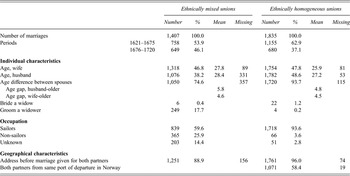
Between 1621 and 1720 1,853 Norwegian women in Amsterdam married a man from their homeland and 1,407 married men who were not Norwegian (Table 1). It would appear that a greater proportion of the women chose to marry one of their compatriots in the earlier, 1621–1675, period than in the later period between 1676 and 1720.
Description of the marriage banns dataset: Norwegian brides in Amsterdam, 1621–1720

Source: Stadsarchief Amsterdam. GAA. inv. no. 883, Collectie Dr S. Hart, ref. no. 706.
Across the entire 1621–1720 period, the mean age at marriage for wives in ethnically mixed marriages was 27.8 years; slightly higher than the mean age for wives in ethnically homogeneous marriages of 25.9 years. In both groups, the groom was a little older than his bride; by ten months in mixed unions, and by slightly more than a year when both partners were from Norway.
Information on age at marriage amongst couples where at least one partner was widowed is scant, as these form less than 1 per cent of couples included in our database. Our calculations of age difference between spouses therefore only include couples where neither partner had previously been married. In marriages where the groom was older, the mean age gap between the spouses was 5.8 years when the groom was not Norwegian, and one year lower, 4.8 years, when he was. When the bride was the older partner, the mean age gaps for the two groups were 4.6 and 4.5 years respectively.
Only the bridegrooms' occupation was recorded in the registers. Given our interest is assessing how the life courses of sailors' wives might differ from those of women who married men in land-based occupations, we differentiated couples by the location of the groom's occupation; at sea or on land. This division revealed a noticeable dichotomy when comparing the ethnically mixed and homogeneous couples. In the latter group almost all (94 per cent) of the bridegrooms gave a seafaring occupation in the marriage banns registers; fewer than 4 per cent had land-based occupations. Amongst the ethnically mixed unions, however, the picture was much more diverse: 60 per cent of the bridegrooms were sailors, but a not-inconsiderable 26 per cent gave different occupations. Nearly 100 different land-based occupations were recorded in the registers. Many of the diverse crafts would have been familiar to the Norwegian women from their home country, whereas some, such as diamond sharpener, would have been completely alien.
The occupation of the remaining 14 per cent of the non-Norwegian bridegrooms was ‘unknown’, although this included apprentices, those who were unemployed, even temporarily, and men of the rentier class. Unfortunately, it was difficult, as shown in recent research on Norwegian immigrant women in Amsterdam and Hoorn, to decipher from the registers exactly which occupations the brides themselves followed.Footnote 24
6. DID THE DEMOGRAPHIC PICTURE CHANGE AROUND 1675?
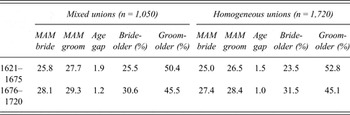
From 1675 onwards, the sex ratio in Amsterdam indicated that the city had a surplus of women, which might have meant that the marriage market would have become more difficult for women in general.Footnote 25 How was the marriage market for Norwegian women affected? For 1,050 ethnically mixed and 1,720 ethnically homogeneous unions information on age differences between the spouses is available. For both groups, 24 per cent of all unions were age-homogeneous, that is, the bride was no more than one year older or younger than her groom. This left 76 per cent of marriages where the ages of the partners showed a larger discrepancy. In 28 per cent of marriages the bride was the older partner, although this proportion was slightly lower, at 27 per cent, in unions where both partners were from Norway. The maximum age difference seen was 20 years when couples were ethnically mixed and 26 years when they were ethnically homogeneous.
Table 2 compares the mean age at marriage of brides and grooms, the age gap between spouses, and the percentage of unions where the woman was older than her husband-to-be and vice versa for our two time periods. In the period up to 1675, the mean age in all-Norwegian unions was slightly lower than in those where the groom was not from Norway. Norwegian women marrying one of their compatriots were, on average, 25 years old, slightly younger than those of their countrywomen who married a non-Norwegian. In both cases, however, the Norwegian brides were slightly older than the average woman marrying in Amsterdam.Footnote 26 This might have been because immigrant women were more likely to be employed as domestic servants, who, in general, tended to marry late.Footnote 27 After 1675, the mean age at marriage for women in both ethnically mixed and ethnically homogeneous marriages increased, but by rather less than the increase seen in Amsterdam overall.
Comparison of female and male mean age at marriage (MAM), marital age gap (in years), and the percentages of bride-older and groom-older unions in ethnically mixed and ethnically homogeneous unions where the bride was Norwegian, Amsterdam, 1621–1675 and 1676–1720

Source: See Table 1.
In unions where both partners were Norwegian, the grooms' mean age at marriage rose rather less than that of their brides. This led to an appreciable narrowing of the spousal age gap from 1.9 years in the 1621–1675 period to 1.2 years in the 1676–1720 period. A similar change occurred among the couples where the groom was not from Norway.
The percentage of age-homogeneous couples remained approximately stable across both of our time periods; at 24 per cent in 1621–1675 and 23 per cent in 1676–1720. Amongst those marriages with an age-gap between spouses, on the other hand, we see contrasting patterns. In more than half of all marriages involving a Norwegian bride contracted in Amsterdam between 1621 and 1675 the groom was the older partner, but this decreased to 45 per cent in the period after 1675. As a result marriages in which the bride was older increased by 5 percentage points between the two periods in ethnically mixed unions, and by 8 percentage points in ethnically homogeneous unions.
While 60 per cent of Norwegian brides with Norwegian grooms (not shown in Table 2) were 25 or younger in the period up to 1675, as many as 63 per cent of the wives were older than 25 in 1675–1720. Amongst Norwegian brides marrying non-Norwegian grooms 48 per cent were 25 years or younger in the earlier period, but after 1675 only 24 per cent were in this age group, and nearly 40 per cent of the women were between the ages of 30 to 40 when they married for the first time. To sum up briefly, our findings reveal that over time Norwegian women's mean age at marriage increased in Amsterdam. Norwegian women were slightly older than native women when they first married. Between the early seventeenth century and the early eighteenth century this age-gap decreased, suggesting that Norwegian women saw a smaller increase in their mean age at marriage, particularly those who took a Norwegian groom. Norwegian women marrying non-Norwegian men did so at a notably later age, particularly after 1675. This led to a relative increase in the number of unions in which the bride was older than the groom, irrespective of whom she married.
As has already been noted, a marked increase in the mean age at first marriage after 1675 was seen not just amongst Norwegian immigrants, but also in the population of Amsterdam as a whole. Although previous researchFootnote 28 revealed that natives and newcomers to the city had different marriage markets, our results suggest that women and men of all nationalities felt the same pressures in common when it came to finding a spouse. The surplus of women in Amsterdam after 1675 might have created a more difficult marriage market for all women in the city; and this may explain the increase in mean age at marriage for women in general. This raises the question of how men in the ‘sailors’ and ‘non-sailors’ occupational groups experienced the changes in the marriage market.
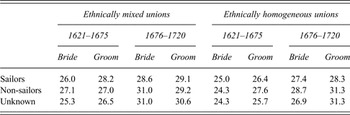
Table 3 shows the mean age at marriage of Norwegian brides before and after 1675, by their groom's place of origin and occupation. The surplus of women in Amsterdam might have affected the marriage chances of various groups of women to different extents, and those women seeking a non-seafaring husband were probably hardest hit. Irrespective of whether they married a Norwegian or a non-Norwegian, first time brides marrying men who worked on shore were four years older in the 1676–1720 period than the generations of female migrants from Norway who married in Amsterdam the previous 55 years. It is, of course, possible that women leaving Norway were older, on average, in the second period than in the first. Unfortunately, there is no information available on the age at which migrants left Norway. Our findings suggest that the pressure on the marriage market did indeed affect sailors and land-based workers differently; although husbands of all kinds became harder to find in the last quarter of the seventeenth century, unmarried men in non-maritime occupations were particularly hard to catch.
Mean age at marriage in ethnically mixed and homogeneous unions where the bride was Norwegian, by gender, occupation and time period, Amsterdam, 1621–1675 and 1676–1720

Source: See Table 1.
We expected to observe a decrease in the mean age at marriage of bridegrooms as the marriage market swung in their favour after 1675. This did not emerge from the data, however. On the contrary, irrespective of their social position and country of origin, men marrying Norwegian women experienced an increase in their mean age at marriage in this period. Emphasis should not therefore be placed on the imbalance in the sex ratio as the reason for the observed changes in the mean age at marriage, as it would seem more complex factors were at work.
It is relevant to consider the social and spatial ranges within which Norwegian women sought a potential spouse. There were undoubtedly some restrictions – such as class, the available social networks and the prevailing economy – which would have limited the choices available, some more so than others. Such restrictions would have had different impacts upon on the marriage market depending on which of the sexes was in surplus in the prime marriageable ages. It should also be remembered that a potential spouse did not necessarily have to be ‘never married’, they could also be widowed. Unfortunately, there are no data such as censuses available for Amsterdam during our study period that might provide a picture of the age, gender and marital distribution of the city's population. Nevertheless, some hypotheses can be put forward. If the establishment of an independent household was the norm for any newly married couple at the time, then it is reasonable to assume that couples were required to have the economic wherewithal to support themselves and any future children. Conversely, if the norm was for couples to attach themselves to an extended, multiple or joint household and live either with close kin or with someone from the same ethnic community, then economic resources might have played a less decisive role in their decision to marry. If the second scenario was more prevalent, then one would expect the mean age at marriage for immigrant groups to decrease over time since it is reasonable to believe that familial and social networks would have become stronger as more members arrived through chain migration. However, the marriage banns data show the opposite: the mean age at marriage for both sexes increased from 1621–1975 to 1676–1720. The most likely explanation for this was that it was crucial for a couple to have an economic basis for their marriage. It would seem that it might have become harder for both men and women to gain access to a livelihood and housing, after 1675. With fewer unmarried men available, the situation became especially difficult for women.
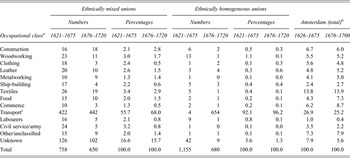
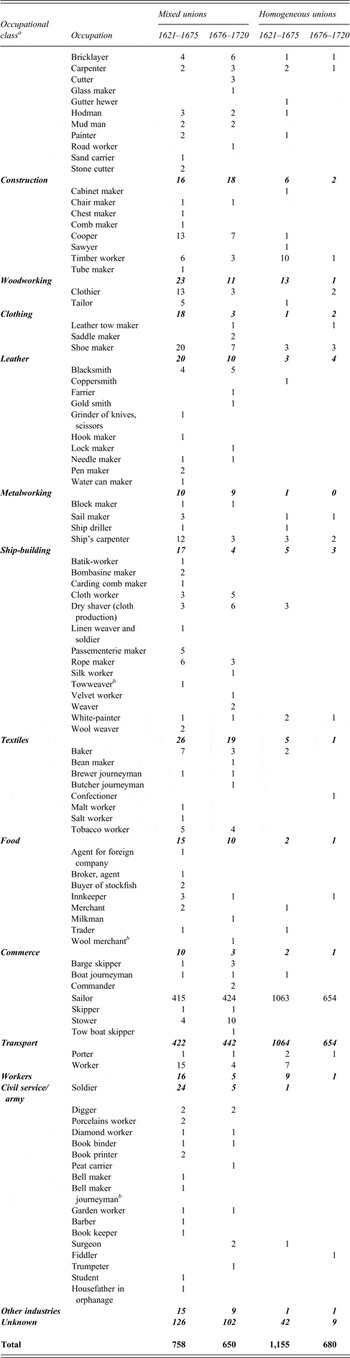
The non-Norwegian grooms of Norwegian women followed a greater variety of non-maritime occupations than the Norwegian grooms, although the percentage of the former who followed non-maritime occupations decreased over time (Table 4 and Appendix Table 1). Nevertheless, even Norwegian brides marrying non-Norwegians were much more likely to marry a sailor than was generally the case in Amsterdam between 1621 and 1720 (Table 4). As the wife of an artisan or any other land-based husband, a Norwegian woman would most likely have participated to some extent in her husband's work even, on some occasion, running the business. As noted earlier, this sort of life must have been quite different from that followed by their compatriots who had married a sailor from Norway or elsewhere. What sort of occupations were followed by the non-sailor, non-Norwegian grooms of the Norwegian brides in our database, and were there any significant differences in the demographic characteristics between these couples and the other ethnically mixed couples, where the groom was a sailor?
Norwegian brides in ethnically mixed and ethnically homogeneous unions, by occupational class of the bridegroom, Amsterdam, 1621–1675 and 1676–1720

a According to S. Hart, Geschrift en Getal: een keuze uit de demografisch-, economisch- en sociaal-historische studiën op grond van Amsterdamse en Zaanse archivalia, 1600–1800 (Dordrecht, 1976), 176–7.
b Calculated from Hart, Geschrift en Getal, 176–7. Hart's data do not go beyond 1700. Thus, for the second period comparison should be undertaken with caution.
c Primarily sailors.
Source: See Table 1.
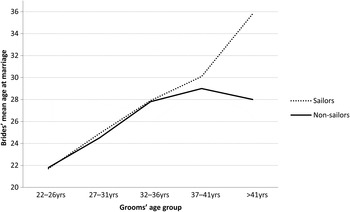
Figure 1 shows the mean age at marriage of wives in ethnically mixed marriages where the bridegroom was the older partner, by the groom's age, calculated in five-year age groups, and by his occupation. Between 1621 and 1675, non-sailors tended to marry increasingly younger wives (not shown in Figure 1), and this pattern is even more evident between 1676 and 1720. In the latter period, brides who married non-sailor grooms over the age of 41 were much younger than the brides of sailors of the same age (Figure 1).
Wife's mean age at marriage in ethnically mixed marriages, where the bride is Norwegian and the groom is the older partner, by the age group and occupation of groom, Amsterdam, 1676–1720. Source: Stadsarchief, Amsterdam. GAA. inv. no. 833, Collectie Dr S Hart, ref. no. 706.

7. SPATIAL PATTERNS
Did the changes in demographic behaviour after 1675, outlined in the previous section, affect the residential patterns of Norwegian brides in Amsterdam and those of their grooms?
Although several scholars have argued that some ‘pure’ immigrant communities existed in early modern Amsterdam,Footnote 29 others suggest that immigrant populations were often more diverse and complex entities.Footnote 30 In this section we will consider the question of complexity within the Norwegian community in Amsterdam by asking the following questions: Did single Norwegian immigrant women to the city search for a future husband within a short distance of their own abode? Was the spatial behaviour of brides and grooms in ethnically homogeneous and ethnically mixed unions different? Could ethnicity alone explain the residential patterns observed, or did social class play a role?
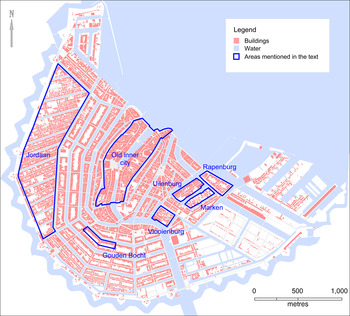
Clé Lesger and Marco H. D. van Leeuwen have demonstrated a complex pattern of residential segregation in Amsterdam during the early modern period.Footnote 31 Focussing on social class groups, they found that different geographic spaces had different patterns of segregation. For instance, in the Jordaan, a manmade island in the west of the city established in the early seventeenth century (Figure 2), poor and wealthier people lived in close proximity, although not on the same street. Segregated communities were typically ‘just around the corner’ or ‘never far away’, in Amsterdam as a direct consequence of the rapid demographic growth, which ultimately meant that the city had to expand rapidly to meet the demand for housing.Footnote 32 Segregation at the neighbourhood- or macro-level could be seen in certain parts of Amsterdam, such as the Gouden bocht (Golden bend) where the wealthiest members of society settled. The city's canals and streets also helped to create socio-spatial differences. Meso-level segregation occurred along the streets crossing the main canals, as the houses of the middle-classes faced out over these streets while the poor lived in the alleys and lanes leading off them, or in houses built completely walled-in within the inner courtyards behind the better class housing. In addition to segregation at the macro and meso levels Lesger and van Leeuwen identified segregation on a micro level.Footnote 33 Houses were divided into multiple apartments, each rented out separately, and thus one single building could house a number of families from several different layers of the social pyramid. This phenomenon was well documented in the seventeenth century by the Dutch novelist Tobias van Domselaer, who reported that neighbourhoods in the east of the old inner city, inhabited by many sailors and craftsmen, were so crowded that occasionally four families occupied a single house.Footnote 34
Map of Amsterdam, c. 1700. Source: HISGIS, Amsterdam.

Lesger and van Leeuwen demonstrated how demography constructs constraints and opportunities that will inevitably shape complex socio-spatial patterns in a city experiencing rapid demographic growth. Furthermore, Marlou Schrover and van Lottum have argued that caution should be used when interpreting spatial concentration as evidence of a ‘community’. Their study of eighteenth- and nineteenth-century Utrecht revealed long-lived immigrant communities, or clusters, in certain residential areas. However, these localities showed significantly higher turnover amongst their inhabitants than other areas of the city, raising the question of whether there was enough time, given the instability of the population, for a coherent group to develop.Footnote 35 Unfortunately, the data from the marriage banns registers do not allow us to investigate the extent to which brides and grooms moved once they were married. Although Schrover and van Lottum point out that unmarried migrant women moved rather frequently from house to house as domestic servants, they said little about the women's residential behaviour after marriage. Our study can only discuss the registered addresses of each soon-to-be married woman and her future husband before they married, and the address at which they first settled as a married couple. Given the debate over the complexity of immigrant communities, a question mark remains as to whether a couple were more likely to remain at an address once they had married.
8. PORTS OF DEPARTURE FROM NORWAY
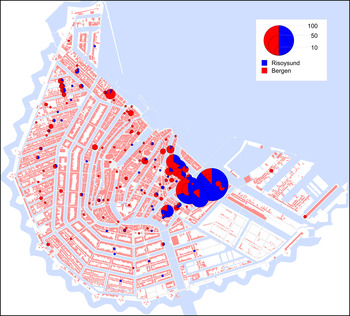
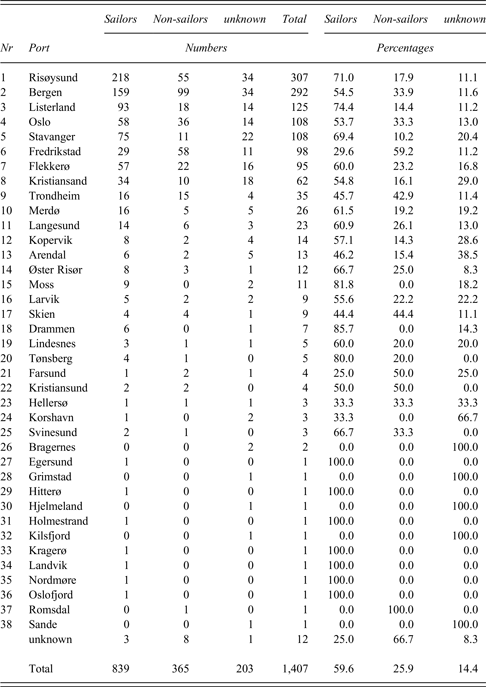
Women formed a substantial part of all those migrating from Norway to Amsterdam. Although the marriage banns registers do not record their region of origin within Norway, they provide information on their ports of departure. This shows that women arrived in Amsterdam from ports stretching from Fredrikstad in eastern Norway all along the coastline to Trondheim in the north-west of the country. We wished to discover whether there was a correlation between the port from which a woman left and her choice of husband in Amsterdam. Did women from Risøysund – which today is called Mandal – and Bergen, the two most frequent ports of departure from Norway at the time, prefer to marry a sailor or a non-sailor? We also wished to investigate whether women marrying non-Norwegian men were encouraged to do so by other Norwegian women settled in the same area of Amsterdam; in other words, were some areas of the city more likely to see a greater concentration of ethnically mixed unions?
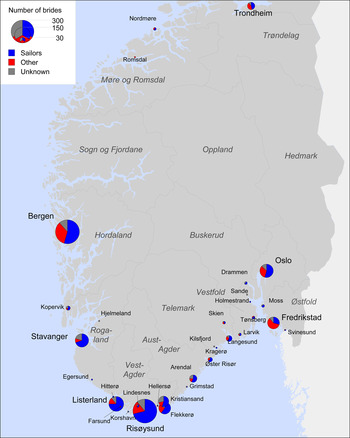
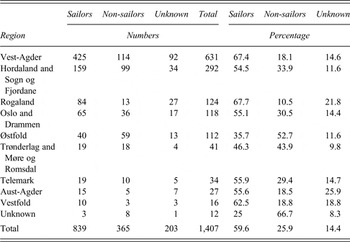
Figure 3 shows the absolute number of marriages of Norwegian women in Amsterdam by their port of departure from Norway and their bridegrooms' occupation. Around two-thirds of the brides departing from the Vest-Agder and Rogaland regions married a sailor in Amsterdam (see Table 5). Risøysund, in Vest-Agder, and Bergen, in Hordaland, were the main points of departure (Appendix Table 2). Those brides who travelled from Bergen to Amsterdam were less likely to marry a sailor than women travelling from Risøysund. Sundsback found, when comparing women departed from Bergen, Kristiansand, Skien and Tønsberg to Amsterdam, that women from Bergen were the most likely to marry non-Norwegians.Footnote 36 Bergen's women would have been more accustomed to foreign lifestyles and languages through living in a vibrant international city that was prominent in the Hanseatic League. Furthermore, the Bergen dialect had clear similarities to both Dutch and German, and this might have given women from that city an advantage in the marriage market in Amsterdam, as it would have given them access to a wider array of marriage partners.Footnote 37 While life in Bergen would have given women an education in urban life that would have stood them in good stead when they settled in Amsterdam, one has to bear in mind that a woman's port of departure did not necessarily reflect her place of birth. Bergen was widely known as a city that attracted young men and women from all over the western part of Norway.
The number of Norwegian brides married in Amsterdam by port of departure in Norway and occupation of the bridegroom, 1621–1720. Source: See Figure 1.

Norwegian brides married to non-Norwegians by region of departure from Norway and groom's occupational group, Amsterdam, 1621–1720

Source: See Table 1.
Figure 4 shows the spatial distribution of the addresses given by brides who had left Norway either through Risøysund or through Bergen and married non-Norwegian men in Amsterdam between 1621 and 1720. The figure shows that women arriving from Risøysund were highly clustered in the harbour area of Amsterdam. This could mean that women from Risøysund formed social networks in Amsterdam, which allowed them to maintain their Norwegian identity, while at the same time consolidating their identity as the wives of non-Norwegian men. Interestingly, while 90 brides who had arrived from Bergen were to be found in two of the city's harbour areas the addresses of the rest of this group were scattered across Amsterdam.
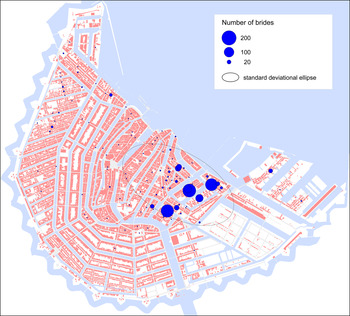
The number of Norwegian brides arriving from the most frequent ports of departure in Norway married to non-Norwegians by brides' pre-marriage address, Amsterdam, 1621–1720.

9. ‘JUST AROUND THE CORNER’
Given that spatial residential patterns can be complex, we approached the settlement patterns of Norwegian immigrants along two of our previous axes of investigation; first by considering couples by their ethnic makeup, and second by making a distinction between grooms with seafaring occupations and those who worked on dry land.
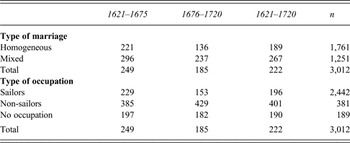
Table 6 shows the average straight line distance between the addresses at which a Norwegian bride and her future spouse were living just before their marriage, by the ethnic mix of the marriage and the groom's occupation. Norwegian women did not have far to go to find their marriage partners, often finding them ‘just around the corner’. The average distance between a bride and bridegroom was 222 metres over the entire study period, but the distance saw a significant decrease over time, from 249 metres in 1621–1675 to 185 metres in 1676–1720. The distance between partners was greater for ethnically mixed unions than marriages where both bride and groom were Norwegian, which supports the idea that Norwegian women and men lived in close proximity. Where the husband-to-be was a non-sailor the distance between the partners was larger than for unions where the groom was a sailor. As we have already seen, most men in marriages where both partners were Norwegian worked in occupations related to the sea (see Table 1), therefore the ethnic mix of a marriage and the grooms' occupation were highly correlated. The distances between partners increased over time amongst those couples when the groom was not a sailor, but decreased when the groom was a sailor, suggesting that Norwegian brides and their grooms were becoming increasingly spatially clustered (Table 6).
The straight line distance (in metres) between spouses' addresses before marriage, by ethnic mix of marriage, type of occupation and time period, Amsterdam, 1621–1720

Source: See Table 1.
Partners in 1,875 marriages, 62 per cent of the total, lived on the same street just before they were married. The most popular streets were found in the harbour area south of the perimeter of the old city: approximately one quarter of all marriages involved couples living on either Rapenburg or Uilenburg, and Vlooienburg and Marken accounted for another 5.2 and 4.6 per cent respectively.
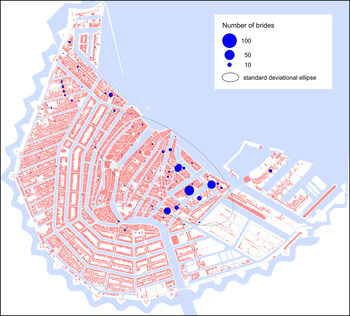
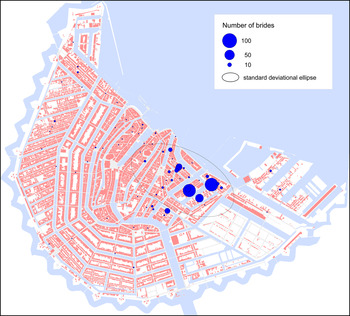
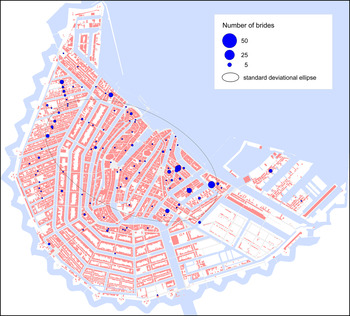
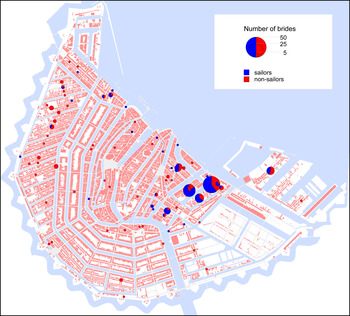
Figures 5 to 8 display the spatial distribution of the addresses at which Norwegian brides lived immediately before their marriage. The spatial distribution is visualised by plotting the number of brides living on a street at the centroid of that street. For ease of comparison between maps, the statistical summary of the spatial distribution of the centroids plotted on each map is given by a standard deviational ellipse (SDE). The smaller the ellipse shown, the more concentrated the spatial distribution of the addresses.
The spatial distribution of the pre-marriage addresses of Norwegian brides who married a Norwegian sailor, Amsterdam, 1621–1675. Source: See Figure 1.

Figures 5 and 6 show the spatial distribution of the Norwegian brides who married sailors between 1621 and 1675, a period of rapid demographic growth. Figure 5 shows brides whose grooms were Norwegian and Figure 6 brides whose grooms were not Norwegian. Both sets of brides were concentrated in the same areas, but those with non-Norwegian grooms to a slightly lesser extent, as can be seen from the somewhat larger ellipse in Figure 6.
The spatial distribution of the pre-marriage addresses of Norwegian brides who married a non-Norwegian sailor, Amsterdam, 1621–1675. Source: See Figure 1.

Compared to the earlier part of the study period, Norwegian brides with sailor husbands-to-be became more concentrated in particular harbour areas to the east of the inner city after 1675. There was a shift from the area around Vlooienburg, which was emerging as a Jewish neighbourhood,Footnote 38 towards the harbour front.
The spatial distribution of the pre-marriage addresses of Norwegian brides who married a non-Norwegian sailor, Amsterdam, 1676–1720. Source: See Figure 1.

Figure 8 shows the spatial distribution of Norwegian brides with non-Norwegian, non-sailor bridegrooms in the 1621–1675 period. These couples were less concentrated than those where the groom was a sailor, and in the 1676–1720 period, they became even more spatially scattered (not shown). It would thus appear that when a Norwegian immigrant woman married a non-Norwegian non-sailor, she could have found him, or he her, in one of a variety of localities within the city. Single migrant women tended to work as domestic servants and live with their employers.Footnote 39 As servants, their work took them to addresses all over the city, making them much more likely to meet a non-Norwegian, non-sailor spouse. Whether these women found their future spouse in the household in which they worked, or in the immediate surroundings cannot be told from the sources. However, 43 per cent of the bridegrooms in the database were not Norwegian, and of these some 50 per cent worked in non-maritime occupations.
The spatial distribution of the pre-marriage addresses of Norwegian brides who married a non-Norwegian non-sailor, Amsterdam, 1621–1675. Source: See Figure 1.

Figure 9 displays the spatial distribution of the addresses of Norwegian brides who married men who were widowers, distinguishing whether the groom was a sailor or not. Although most of these addresses were located in the harbour area, a number lay some distance away in a pattern more like that found amongst ethnically mixed unions where the husband did not work on the sea. If Norwegian immigrants stuck together, as Sundsback proposes,Footnote 40 we would expect to find a cluster of Scandinavian widowers in the harbour area, and indeed, 86 per cent of the widowers who were sailors were also Scandinavians, suggesting that brides and grooms had a preference for spouses with a similar cultural background. In contrast, in those cases where a Norwegian woman from the harbour area married a widower who was not a sailor, only 33 per cent of the grooms were Scandinavian. Some Norwegian women chose to settle far away from the harbour area, and a great proportion of these women married widowers.
The spatial distribution of the pre-marriage addresses of Norwegian brides married to a widower by the bridegrooms' occupation, Amsterdam, 1621–1720. (N sailors = 96, N non-sailors = 107, Unknown (not shown in the map) = 38, Total N = 241.) Source: See Figure 1.

These findings suggest that different behaviours could exist within an immigrant community, even though future spouses lived ‘just around the corner’ from one other. Unfortunately, it was not possible to compare the residential patterns of Norwegian immigrant women with the residential patterns of other groups of immigrant women, as no dataset similar to the one used yet exists for any other migrant group. At present we therefore cannot tell whether Norwegian immigrant woman behaved in different or similar ways to other groups of women migrating to Amsterdam.
10. CONCLUSIONS
Using the marriage banns registers held in the Amsterdam City Archives, we examined the demographic and spatial patterns of Norwegian women who migrated to Amsterdam during the period 1621–1720. By dividing the women's choice of marriage partner into two distinct ethnic categories, either Norwegian or non-Norwegian, and further differentiating the grooms by their occupation, we examined the demographic features of the subsets of our study population. We also made use of the street addresses recorded for both brides and bridegrooms upon marriage, to examine socio-spatial patterns amongst the Norwegian women marrying in Amsterdam in a more profound way than has been reported in most of the existing literature on the history of female migration.
Our demographic analysis suggests that Norwegian women followed a similar demographic pattern to all women living in Amsterdam, in that they experienced an increase in the mean age at which they married in the period after 1675. This change was most pronounced amongst the Norwegian women who married non-Norwegian men. Not only did the Norwegian women marry at a later age in the period after 1675; they were also more likely to marry a non-Norwegian. This led to an increased proportion of ethnically mixed couples in which the bride was the older partner. In contrast, non-Norwegian men working in land-based occupations, tended to marry increasingly younger Norwegian women. Our analysis thus suggests that the constraints placed on the marriage market by the demographic pressure of enormous population growth, which reached its peak in 1675, struck subsets of the Norwegian migrant women in different ways. Over time there was a decrease in the proportion of Norwegian brides taking Norwegian grooms, while at the same time there was less pressure on the women to marry one of their countrymen, especially if he was enlisted as a sailor.
Previous explanations of residential behaviour suggest that ethnicity was a strong determinant of residential patterns. People generally, and ethnic minority groups in particular, preferred to live in neighbourhoods with others with whom they could identify. It was a safe choice. It was assumed that, when faced with an increasingly challenging marriage market, people searched for a partner over a wider area than might have been the case during a period when potential partners were easier to come by.
The spatial analysis undertaken here suggests rather more complex patterns of behaviour. Throughout the 1621–1720 period, Norwegian women tended to find their marriage partners ‘just around the corner’. However, despite a more challenging marriage market toward the end of the period, we found that the distance between brides' and the bridegrooms' addresses decreased significantly. This was, however, only observed among unions where the groom was a sailor. As distance between the addresses increased only among ethnically mixed marriages with non-sailors, this suggests that occupation, rather than ethnicity, explains the widening of the marriage market's geography. This argument is bolstered by the fact that a greater proportion of brides marrying non-Norwegian men chose to marry sailors in the 1675–1720 period. The difficult marriage market at this time made it harder for single Norwegian women to find a husband with a land-based occupation. The latter represented a more stable choice of spouse, as he would be present all year round, and his wife and family would not be at risk of losing their breadwinner at sea. Since more women were marrying sailors, and both Norwegian and non-Norwegian sailors lived ‘just around the corner’, this explains why the distance between the brides' and bridegrooms' addresses decreased.
Our spatial analysis suggests that residential behaviour is complex. Of course, ethnicity played a role, but it should be recognised that ethnicity is not a static quality of a person, but rather a set of relational symbols that changed according to the situation in which an individual found him or herself. It is likely that a woman travelling alone was likely to use a different ethnic repertoire from a woman migrating hand in hand with a man from the neighbouring farm. Norwegian women migrating from city ports would have come to Amsterdam with a different ethnic repertoire from that brought by women from more remote areas of Norway. In fact, women migrating from cities were more likely to settle all over Amsterdam, which corresponds very well with what we know about the immigrant women working as domestic servants.
Although we cannot conclusively determine the factors underpinning the spatial behaviour of Norwegian immigrant women in early-modern Amsterdam, we wish to argue that the ‘ethnicity’ thesis should be modified. The establishment of the most clustered Norwegian enclaves in Amsterdam might not have been motivated solely by kinship and a need to preserve the community's regional identity within a foreign country. Rather the enclaves developed along social lines, and through occupational similarities. In Amsterdam sailors' wives lived among other sailors' wives, regardless of their ethnic affiliation.
ACKNOWLEDGEMENTS
In memory of archivist Oddleif Hodne (1944–2014) whose MA thesis ‘Fra Agder til Amsterdam: en studie av norsk emigrasjon til Nederland i tiden ca. 1625–1800’ (University of Oslo, 1976), was based on pioneering research in the Amsterdam City Archives, which at the time allowed Dr Simon Hart to carry out the gargantuan task of making Amsterdam's unique marriage banns lists from 1600–1800 available to the research community.
Norwegian brides in ethnically mixed and ethnically homogeneous unions, by period and occupation of the bridegroom, Amsterdam, 1621–1720

The number of Norwegian brides married to non-Norwegians in Amsterdam by bride's port of departure from Norway, and groom's occupation, 1621–1720