Introduction
The genus Latibulus Gistel (Hymenoptera: Ichneumonidae: Cryptinae: Cryptini) is the largest genus in the subtribe Sphecophagina Beirne. Since Rossi (Reference Rossi1790) described Latibulus argiolus (Rossi), eight species have been recorded. All these species are distributed in the Palaearctic region and only one, Latibulus nigrinotum (Uchida), is found in both the Palaearctic and the Oriental regions (Yu et al. Reference Yu, van Achterberg and Horstmann2005). This species was first reported from North Korea, Japan, and Taiwan by Uchida (Reference Uchida1936), and is the only known species in Korea.
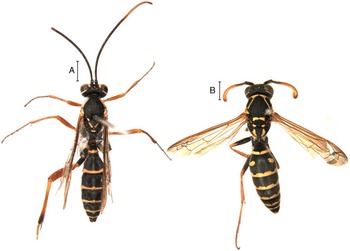
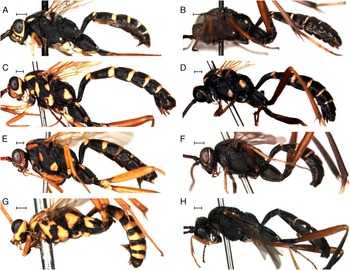
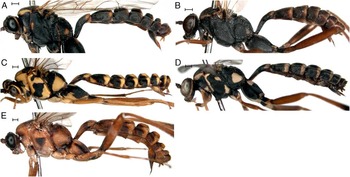
Six of the eight known species, L. argiolus, Latibulus gracilis (Rudow), Latibulus hokkaidensis Lee and Oh, Latibulus lautus (Tosquinet), L. nigrinotum, and Latibulus orientalis Horstmann, are known to parasitise paper wasps in the genera Polistes Latreille and Ropalidia Guérin-Méneville (Hymenoptera: Vespidae) (Rudow Reference Rudow1917; Makino Reference Makino1983; Horstmann Reference Horstmann1987; Kanai et al. Reference Kanai, Yamane and Kusigemati2001; Lee and Oh Reference Lee and Oh2006). Makino (Reference Makino1983) studied the natural history and bionomics of parasitoids associated with paper wasps. In this study, it was observed that the females of L. hokkaidensis lay eggs on the inner wall of cells containing various immature stages of the host, or on the cocoon cap, or directly on the body wall of the larvae, and only eggs laid in cells of mature larvae have a chance to develop into adults. The typical body coloration of Latibulus is strikingly similar to that of their host in having a black to brown body marked with bright colour (Figs. 1–3). By imitating the colour pattern of the polistine wasp, parasitoids may be able to approach the vicinity of a wasp nest a little more easily without being rapidly noticed by adult wasps.
(A, B) Body colour pattern: (A) overwintering form of Latibulus flavopetiolus and (B) Polistes chinensis antennalis. Scale bars = 2 mm.

Five species, L. argiolus, L. hokkaidensis, L. lautus, L. nigrinotum, and L. orientalis, have an overwintering form and a summer form, recognised by differences in the number of antennomeres, size of the yellow marks on the body, and the shape of the frontal horns and temple (Makino Reference Makino1983; Horstmann Reference Horstmann1987; Lee and Oh Reference Lee and Oh2006). They also form two different cocoons (Makino Reference Makino1983): the summer-emerged form is brownish orange or pale brown, soft, membranous, and cone-shaped (soft-type cocoon); the overwintering-emerged form is brown, hard, thick walled, and spindle-shaped (hard-type cocoon). Two seasonal forms of the other species are not known, because they are generally poorly studied and sometimes only known from the type series. Because of such seasonal dimorphism, it is somewhat difficult to associate overwintering and summer forms as belonging to the same species. Horstmann (Reference Horstmann1987) provided an identification key to the species and forms. The key is mainly based on the shape of frontal horns, colour pattern, and distributional data.
In this paper, the three Korean species of Latibulus are reviewed, and two new species, Latibulus flavopetiolus Oh and Lee new species and Latibulus fulvus Oh and Lee new species are described. A key to the world species, the illustrations and photographs of diagnostic features, and new host and distribution records are provided.
Materials and methods
Morphological terminology follows Yu et al. (Reference Yu, van Achterberg and Horstmann2005). Photographs of specimens were captured with an Axiocam MRc5 camera through a stereomicroscope (Stemi SV 11 Apo; Carl Zeiss, Oberkochen, Germany), and were produced with AxioVision40AC software (Carl Zeiss, Oberkochen, Germany). Additionally, a scanning electron microscope (S-3400: Hitachi, Tokyo, Japan) was used to examine the detailed surface sculpture; specimens were sputter coated with carbon using an E-1010 Ion Sputter (Hitachi, Tokyo, Japan). Line drawings of the head were prepared from the digital images, using Adobe Illustrator CS5 software (Adobe Systems Incorporated, San Jose, United States of America). Final plates were prepared in Adobe Photoshop CS5 software (Adobe Systems Incorporated, San Jose, United States of America). Two new hosts, Polistes chinensis antennalis Pérez and Polistes rothneyi koreanus Vecht, were identified by Dr. J. Kojima (Faculty of Science, Ibaraki University, Japan) and Dr. M.B. Choi (Department of Life Sciences, Yeungnam University, Korea), respectively.
Types and voucher specimens of five species, L. argiolus, L. hokkaidensis, L. lautus, L. nigrinotum, and L. orientalis were examined from the following institutions: Department of Entomology, The Natural History Museum, London, United Kingdom (BMNH); National Agricultural Research Center for Hokkaido Region, Japan (NARCH); Senckenberg German Entomological Institute, Leibniz-Centre for Agricultural Landscape Research, Müncheberg, Germany (SDEI); Systematic Entomology, Faculty of Agriculture, Hokkaido University, Sapporo, Japan (SEHU); Zoological Museum, Humboldt University, Berlin, Germany (ZMHU).
The list is given below.
L. argiolus: two summer males, one over wintering female with an identification label by Kupka (SDEI); one summer male, one overwintering male with an identification label by Roman (SEHU).
L. hokkaidensis: holotype (summer female), 11 paratypes (two females and three males of summer form, four females and two males of overwintering form) (SEHU).
L. lautus: lectotype (summer female), one overwintering female with an identification label by Horstmann, one overwintering male with an identification label by Krieger (ZMHU).
L. nigrinotum: holotype (overwintering female), one summer male with an identification label by Uchida (SEHU); one summer female with a holotype label of Latibulus tuberculatus by Cushman (SDEI).
L. orientalis: four paratypes (one female and one male of summer form, one female and one male of overwintering form), one summer female (BMNH).
Repeated requests for a loan of the holotypes of Latibulus bilacunitus and Latibulus liaoningensis, which are deposited in the Ministry of Forestry, General Station of Forest Pest Management (Shenyang, Liaoning, China), remained unanswered, so that the diagnosis of these species in the present key are based only on the original descriptions given by Sheng and Xu (Reference Sheng and Xu1994) and Sheng et al. (Reference Sheng, Wang and Liu1994).
Horstmann (Reference Horstmann1987) did not include L. gracilis in the revision of the western Palaearctic species. The type is lost according to Horstmann (Reference Horstmann1993). The occurrence of this species remains questionable, and for these reasons, it was excluded from the key in the present paper. Types of two new species and the specimens of Korean L. nigrinotum are deposited in the Department of Life Sciences, Yeungnam University, Gyeongsan, Korea (YNUE).
Results
Latibulus Gistel
Crypturus Gravenhorst, Reference Gravenhorst1829: 655. Type species: Ichneumon argiolus Rossi. Junior homonym of Crypturus Illiger, Reference Illiger1811 (Aves: Tinamiformes) and Crypturus Lamarck, Reference Lamarck1817 (Insecta: Hymenoptera).
Latibulus Gistel, Reference Gistel1848: 8. Replacement name for Crypturus Gravenhorst, Reference Gravenhorst1829.
Endurus Rondani, Reference Rondani1876: 66. Replacement name for Crypturus Gravenhorst, Reference Gravenhorst1829.
Pseudosyzeuctus Hedwig, Reference Hedwig1961: 80. Type species: Pseudosyzeuctus italicus Hedwig. Synonymised by Townes, Momoi, and Townes Reference Townes, Momoi and Townes1965.
Diagnosis
Easily distinguished from other genera of Sphecophagina by the following combination of characters: (i) frons with pair of frontal horns (except barely developed in overwintering form of L. lautus), (ii) mesopleuron slightly or strongly rugose to reticulate rugose medially, (iii) intercubitus very short and far distal to second recurrent vein, (iv) posterior transverse carina of propodeum present, but anterior portion somewhat obscure by rugose sculpture, (v) tergites with pair of impressions, impressions faint to very deep.
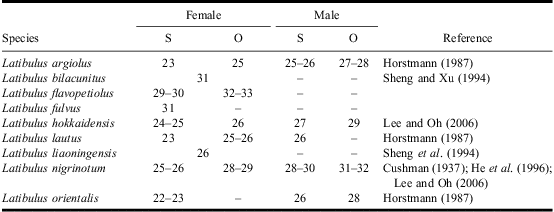
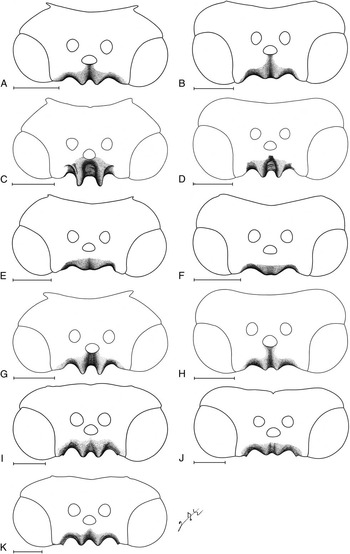
The seasonal forms can also be distinguished by the following features, in both sexes: (i) size of bright marks small in the overwintering form (Figs. 2, 3), (ii) overwintering form usually has more antennomeres than the summer form (Table 1), (iii) temple of overwintering form round in dorsal view, while that of the summer form almost straight or slightly round (Fig. 4), (iv) occipital carina stout in the summer form, (v) frontal horns of overwintering form a little shorter and weaker than those of the summer form (Fig. 4).
Number of flagellomeres of Latibulus spp., based on specimen observations and published data.
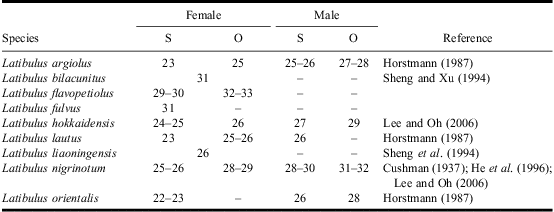
S, summer form; O, overwintering form.
(A–H) Habitus: (A, C, E, G) summer form, (A) Latibulus argiolus, (C) Latibulus hokkaidensis, (E) Latibulus lautus, (G) Latibulus orientalis; (B, D, F, H) overwintering form, (B) L. argiolus, (D) L. hokkaidensis, (F) L. lautus, (H) L. orientalis. Scale bars = 0.5 mm.

(A–E) Habitus: (A, C, E) summer form, (A) Latibulus nigrinotum, (C) Latibulus flavopetiolus, (E) Latibulus fulvus; (B, D) overwintering form, (B) L. nigrinotum, (D) L. flavopetiolus. Scale bars = 0.5 mm.

(A–K) Head, dorsal view: (A, C, E, G, I, K) summer form, (A) Latibulus argiolus, (C) Latibulus hokkaidensis, (E) Latibulus lautus, (G) Latibulus orientalis, (I) Latibulus flavopetiolus, (K) Latibulus fulvus; (B, D, F, H, J) overwintering form, (B) L. argiolus, (D) L. hokkaidensis, (F) L. lautus, (H) L. orientalis, (J) L. flavopetiolus. Scale bars = 0.5 mm.

Comments
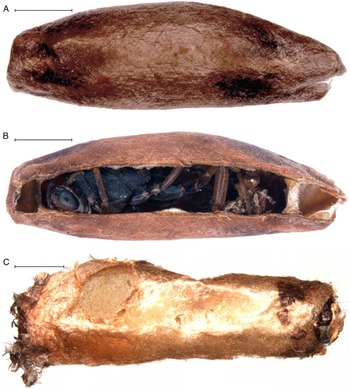
We collected three hard-type cocoons of Latibulus (Fig. 1B) from the nest of P. chinensis antennalis in Mongolia. This represents the first record of Latibulus and new host in Mongolia, but we were unable to identify them to species because they did not fully develop and emerge. According to Ubaidillah et al. (Reference Ubaidillah, Yamaguchi and Kojima2009), the structure of the soft-type cocoon of L. hokkaidensis (Fig. 12C) is nearly identical to that of Arthula plebeja Ubaidillah and Kojima, which makes it difficult or virtually impossible to precisely determine the genus for this cocoon type. However, the hard-type cocoon of Latibulus can be distinguished from those of other genera of Sphecophagina by its darker coloration (Figs. 12A, 12B). Both generations of A. plebeja have only a single cocoon type, which is pale brown in colour (Ubaidillah et al. Reference Ubaidillah, Yamaguchi and Kojima2009), whereas members of Sphecophaga Westwood form three cocoon types: one is flimsy white that gives rise to a brachypterous female within 2 weeks (fast-generation), a second is a little more rigid and yellow that gives winged females and possibly males after 2 weeks, and the third is tough and yellow that gives rise to winged males and females (overwintering) (Beggs et al. Reference Beggs, Harris and Read1996).
Latibulus nigrinotum (Uchida)
(Figs. 3A, 3B, 5B, 6E, 7F, 7G, 8A, 8D, 8G, 9C, 9E, 10A–10D, 12A, 12B)
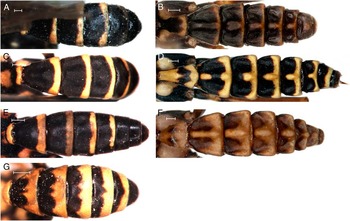
(A–G) Abdomen of summer form, dorsal view: (A) Latibulus argiolus, (B) Latibulus nigrinotum, (C) Latibulus hokkaidensis, (D) Latibulus flavopetiolus, (E) Latibulus lautus, (F) Latibulus fulvus, (G) Latibulus orientalis. Scale bars = 0.5 mm.

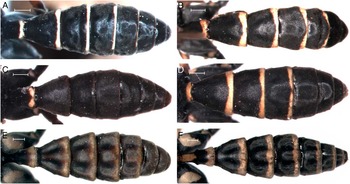
(A–F) Abdomen of overwintering form, dorsal view: (A) Latibulus argiolus, (B) Latibulus hokkaidensis, (C) Latibulus lautus, (D) Latibulus orientalis, (E) Latibulus nigrinotum, (F) Latibulus flavopetiolus. Scale bars = 0.5 mm.

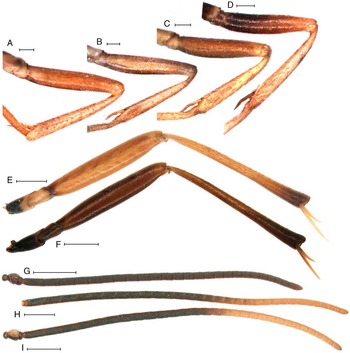
(A–D) Proleg colour pattern: (A) Latibulus orientalis, (B) Latibulus hokkaidensis, (C) Latibulus argiolus, (D) Latibulus lautus. (E, F) Metaleg colour pattern: (E) Latibulus flavopetiolus, (F) Latibulus nigrinotum. (G–I) Antenna colour pattern: (G) L. nigrinotum, (H) Latibulus fulvus, (I) L. flavopetiolus. Scale bars = 0.2 mm for A–D; 1 mm for E–I.

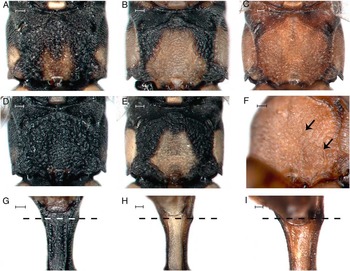
(A–E) Propodeum, dorsal view: (A–C) summer form, (A) Latibulus nigrinotum, (B) Latibulus flavopetiolus, (C) Latibulus fulvus; (D–E) overwintering form, (D) L. nigrinotum, (E) L. flavopetiolus. (F) Posterior transverse carina of L. fulvus. (G–I) Petiole, ventral view: (G) L. nigrinotum, (H) L. flavopetiolus, (I) L. fulvus. The arrows and dotted line indicate posterior transverse carina and spiracle level, respectively. Scale bars = 0.2 mm.

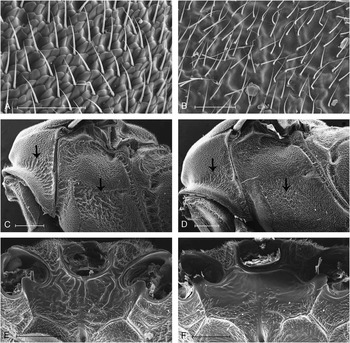
(A, B) Pronotum sculptures of Latibulus flavopetiolus: (A) punctate, (B) rugose. (C, D) thorax, lateral view: (C) Latibulus nigrinotum, (D) L. flavopetiolus. (E, F) Propodeum, ventral view: (E) L. nigrinotum, (F) L. flavopetiolus. The arrows indicate rugose to reticulate rugose area. Scale bars = 0.1 mm for A, B; 0.5 mm for C–F.

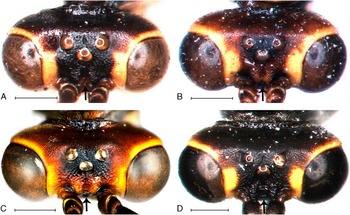
(A–D) Head of Latibulus nigrinotum, dorsal view: (A) Chinese, (B) Taiwanese, (C) Japanese, (D) Korean specimen. The arrows indicate the frontal horns. Scale bars = 0.5 mm.

(A, B) Hard-type cocoons of Latibulus nigrinotum. (C) Soft-type cocoon of Latibulus hokkaidensis. Scale bars = 0.2 mm for A, B; 0.5 mm for C–F.

Endrus flavofasciatus nigrinotum Uchida, Reference Uchida1936: 2. Holotype: male, locality: Laishe (=Raisha), Taiwan, depository: SEHU, Japan.
Latibulus tuberculatus Cushman, Reference Cushman1937: 292. Holotype: female, locality: Talin (=Taihorin), Taiwan, depository: SDEI, Germany. Synonymised by Uchida (Reference Uchida1940).
Latibulus nigrinotum: Uchida, Reference Uchida1940: 125.
Type material examined
Holotype: Taiwan: [Overwintering form] female, Raisha, VIII.1927, J. Sonan (SEHU).
Additional material examined
Korea: [Summer form] one female, Gangwon-do, Wonju-si, Mt. Chiaksan, Temple Guryongsa, 30.VII.1975, J.I. Kim (YNUE); one female, Wonju-si, Yensei Univ., 11.VII.1996, H.W. Byun (YNUE); one male, Inje-gun, Mt. Bangdaesan, 26.VI.1996, S.M. Lee (YNUE); two females, Gyeonggi-do, Namyangju-si, Sudong-myeon, Mt. Chungnyeongsan, 12.VII.1980, J.I. Kim (YNUE); one male, same data, K.H. Park (YNUE); one female, Gyeongsangbuk-do, Mt. Songnisan, 30.VII.1957 (YNUE); one female, Mungyeong-si, Mungyeongsaejae, 11.VII.1977, H.K. Lee (YNUE); one female, Yeongyang-gun, Mt. Heungnimsan, 20.VII.1997, J.W. Lee (YNUE); one male, Gyeongsan-si, Yeongnam Univ., 21.VI.1988, E.S. Kim (YNUE); one female, same data, 9.VII.1988, W.Y. Choi (YNUE); one female, same data, 3.VII.1989, S.M. Ryu (YNUE); one male, Gyeongsangnam-do, Jinju-si, Geumgong-myeon (Host: Polistes snelleni, em. 21.VI.1983) (YNUE); one male, same data (Host: Polistes jadwigae, em. 5.VII.1983) (YNUE); one male, same data (Host: P. jadwigae, em. 23.VII.1983) (YNUE); one female, same data (Host: P. jadwigae, em. 26.VII.1983) (YNUE); one male, Hadong-gun, Hwagae-myeon, Daeseong-ri, Mt. Jirisan, Val. Daeseonggol, 29.VII.1987, J.W. Lee (YNUE); one male, Namhae-gun, Mt. Mangunsan (YNUE); one female, same data, 3.VII.1989, J.W. Lee (YNUE); one female, Jeollabuk-do, Sancheong-gun, Sicheon-myeon, Jungsan-ri, 25.VII.1989 (YNUE); one female, Namwon-si, Sannae-myeon, Mt. Jirisan, Val. Baemsagol, 11.VI.2001 (YNUE). [Overwintering form] one female, Gangwon-do, Sokcho-si, Seorak-dong, 11.VI.1992, J.W. Lee (YNUE); one female, Wonju-si, Mt. Chiaksan, 29.V.1999–19.VI.1999, Malaise trap (YNUE); one male, Wonju-si, Yensei Univ., 5.VI.1997, B.P. So, S.J. Shin (YNUE); one female, same data, 8.VI.1997, C.H. Oh, Y.G. Jee (YNUE); one female, Gyeonggi-do, Mt. Soyosan, 31.V.1983, J.W. Lee (YNUE); one male, Chungcheongbuk-do, Mt. Sobaeksan, Val. Cheondonggyegok, 22.V.1997, J.W. Lee (YNUE); one male, Chungcheongnam-do, Taean-gun, Wonbung-myeon, Sindu-ri, 6.VI.2001, T.H. Ahn (YNUE); one female, Gyeongsangbuk-do, Gyeongsan-si, Yeongnam Univ., 8.V.1989, B.S. Son (YNUE); one female, Gyeongsangnam-do, Jinju-si, Gajwa-dong, 9.VI.1987, J.W. Lee (YNUE); two females, same data, 14.VI.1990, J.W. Lee (YNUE); one female, Miryang-si, Mt. Jaeyaksan, 11.VI.1990, J.W. Lee (YNUE); one female, Hadong-gun, Cheongam-myeon, Gunghyang-ri, 2.VI.2002, T.H. Ahn (YNUE); one female, Jeollabuk-do, Jeongeup-si, Sinjeong-dong, 15.VI.2004, K.B. Kim (YNUE).
China:[Summer form] one male, Ku-ling, 3.VIII.1935, O. Piel (SEHU).
Japan: [Summer form] one male, Yuhara, Okayama, Honshu, 15.VIII.1988, M. Yoshida (NARCH); one male, Aoba-cho, Chiba, Honshu, S. Miyano (Host: P. snelleni, em. 8.VIII.1989) (NARCH); one female, same data (Host: P. jadwigae jadwigae, em. 29.VII.1989) (NARCH); one female, Sadanami, Kitaibaraki, Ibaraki, Honshu, 23.VII.1997, K. Sayama (Host: P. snelleni, soft cocoon, em. 30.VII.1997) (NARCH); one male, same data (Host: P. snelleni, soft cocoon, em. 25.VII.1997) (NARCH); one female, Haji Dam, Yachiyo, Hiroshima, Honshu, 12.VII.2005, S. Nakamura (NARCH); one female, Ainoshima Is., Shingu, Fukuoka, Kyushu, 19.VII.2007, T. Mita (NARCH).
Taiwan: [Summer form] one female, Taihorin, H. Sauter (described as L. tuberculatus by Cushman) (SDEI): one female, nr. Puli, 24.IX.1971, N. Fukuhara (NARCH).
Diagnosis
Distinguished from all other species by the following combination of characters: (i) petiole without bright mark, (ii) antenna with 25–26 flagellomeres in summer female, 28–30 in summer male, 28–29 in overwintering female, 31–32 in overwintering male (Table 1), (iii) temple in dorsal view narrowed at angle less or 45° (Fig. 10), (vi) frontal horns as long as or a little longer than basal width of each horn in summer form (Fig. 10), shorter than basal width in overwintering form, (v) pronotum laterally and mesopleuron medially strongly rugose to reticulate rugose (Fig. 9C), (vi) tergites 2–6 with moderately deep to very deep impressions (Figs. 5B, 6E), (vii) tergite 2 a little shorter than posterior width.
Variation
The Korean populations have slightly longer frontal horns and a wider median furrow between each horn compared with other specimens (Figs. 10A–10D).
Hosts
Polistes jadwigae jadwigae Dalla Torre (new host record), Polistes nipponensis Pérez (Kanai et al. Reference Kanai, Yamane and Kusigemati2001), P. snelleni Saussure (Kanai et al. Reference Kanai, Yamane and Kusigemati2001), Ropalidia fasciata (Fabricius) (Makino Reference Makino1983).
Distribution
Korea, China, Japan, Taiwan.
Latibulus flavopetiolus Oh and Lee, new species
(Figs. 1A, 3C, 3D, 4I, 4J, 5D, 6F, 7E, 7I, 8B, 8E, 8H, 9A, 9B, 9D, 9F, 11)
Material examined
Holotype:Korea: [Summer form] female, Gyeongsangbuk-do, Pohang-si, Buk-gu, Jukjang-myeon, Haok-ri, 3.VII.2004, J.W. Lee (YNUE).
Paratypes:Korea: [Summer form] one female, same data as holotype; two females, same data, 10.VII.2004, J.W. Lee (YNUE); one female, same data, 27.VII.2004, J.W. Lee (YNUE); one female, Bonghwa-gun, Jaesan-myeon, 21.VII.1997, S.M. Ryu (YNUE); one female, Jeollabuk-do, Jeongeup-si, Sinjeong-dong, 21.VII.2004, J.W. Lee (YNUE); one female, Jeongeup-si, Ibam-myeon, Deungcheon-ri, 26.VIII.2004, J.G. Han (YNUE). [Overwintering form] one female, Gangwon-do, Wonju-si, Maeji-ri, 12.VI.1996, Y.K. Choe, M.S. Yim, K.Y. Lee, H.W. Ryu (YNUE); two females, Gyeongsangbuk-do, Pohang-si, Buk-gu, Jukjang-myeon, Haok-ri, 23.VI.2004, J.W. Lee (YNUE); one female, Gyeongsangnam-do, Miryang-si, Danjang-myeon, Gucheon-ri, Sajapyeong, 4.VI.1990, J.W. Lee (YNUE); one female, Jinju-si, 14.VI.1990, J.W. Lee (YNUE).
Etymology
The species name is derived from the Latin word flavus and petiolus, which mean “yellow” and “petiole”.
Description
Female
Summer form
Body: 9.2–9.6 mm, forewing: 5.7–6.3 mm.
Colour. Body black to brown with yellow marks (Fig. 3C), apical one-third of antenna (Fig. 7I), and legs light to reddish brown. Ovipositor dark reddish brown. Yellow marks as follows: scape ventrally, vertical, templar and frontal orbits, face, clypeus, labrum, maxillary and labial palpi, basal half of mandible, pronotum except anteriorly, propleuron, spot in notaulus position and two subposterior spots in mesoscutum, scutellum except for anterior inverted triangular spot, postscutellum, tegula, axilla anteriorly, mesopleuron except for median and subupper area, petiolar area, posterior two-third of metapleuron, protrochanters and mesotrochanters entirely and coxae except for basoanterior spot, metacoxa ventrally and dorsoanteriorly, tergite 1 except for subposterior spot (Fig. 5D), tergite 2 anteromedially, tergites 2–7 posteriorly (Fig. 5D).
Body closely, rugosely punctate on the extremely fine superficial microsculptures (Fig. 9A), with short, dense, whitish yellow setae.
Head. Temple in dorsal view narrowed at angle less than 45°, slightly round (Fig. 4I). Vertex strongly sloped posteriorly; posterior surface almost flat. Interocellar area convex, with weak median longitudinal groove or impression. Outer margin of lateral ocellus coriaceous, impunctate. Occipital carina well developed; dorsal area rather broad, prominent, much stronger than lateral one, slightly emarginated medially; apical margin curved outwardly. Frons with pair of horns a little longer than basal width (Fig. 4I); median furrow between each horn and frontal horns dorsally rugosely punctate. Concave area above antennal socket impunctate, with horizontal striae; striae often extending to horns subdorsolaterally. Face with closely set rugose punctures. Malar space 0.53–0.54 times mandibular base. Clypeus small; median portion transversely convex; upper area with punctures smaller, sparser than on face; lower area impunctate; apical margin impressed along its width, slightly emarginated, impressed medially. Apical margin of labrum truncated medially, with relatively long, parallel setae. Antenna with 29–30 flagellomeres.
Mesosoma. Pronotum with very close to rugose punctures, coriaceous (Fig. 9A); lateral concave area finely and slightly rugose, not coriaceous (Figs. 9B, 9D). Notaulus weak but distinct, extending to tegular base, slightly impressed, finely rugose basally. Mesopleuron with close to rugose, moderately deep punctures, slightly reticulate rugose medially (Fig. 9D). Epicnemial carina extending to half of height of mesopleuron (Fig. 9D). Propodeum rugose to reticulate rugose except anteriorly (Fig. 8B), in ventral view smooth to faintly rugose (Fig. 9F); anterior area of anterior transverse carina with rugose punctures; posterior transverse carina distinct, strong laterally; propodeal spiracle elongated, very close to pleural carina.
Metasoma. Sternite 1 extending beyond spiracle level (Fig. 8H). Postpetiole moderately thick, moderately curved. Tergites 2–6 in dorsal view with pair of very deep impressions, abruptly raised as three tubercle medially and laterally (Fig. 5D), in lateral view strongly sloped anteroposteriorly, moderately impressed behind spiracle; spiracle raised. Tergite 7 in dorsal view only raised medially, in lateral view strongly sloped anteriorly.
Overwintering form
Body: 9.1–9.9 mm, forewing: 5.7–6.4 mm.
Yellow marks as follows: templar, frontal and facial orbits, labrum, maxillary and labial palpi, lower corner and around upper margin of pronotum, posterior one-half of scutellum, postscutellum, tegula, spot at upper end of apicnemial carina, spots on upper and lower posterior of mesopleuron, petiola area, posterior one-third of metapleuron, mesocoxae and metacoxae ventrally and basoanteriorly, tergite 1 except for broad subposterior area (sometimes yellow mark of petiole present as small spot, or rarely absent), tergites 2–7 posteriorly; general sized of yellow marks usually smaller than those female summer form (Fig. 3D).
Dorsal area of occipital carina slightly prominent. Temple in dorsal view round (Fig. 4J). Antenna with 32–33 flagellomeres. Tergites 2–6 in dorsal view with pair of moderately deep impressions (Fig. 6F), sometimes shallow on tergites 2 and 6.
Male
Unknown.
Hosts
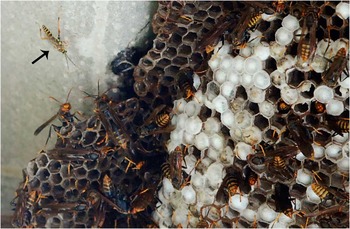
We could not observe oviposition directly, but one female closely approached the nest of P. rothneyi koreanus Vecht (Fig. 11).
Summer form female of Latibulus flavopetiolus approaching the nest of Polistes rothneyi koreanus. The arrow indicates the female of L. flavopetiolus. The size of the wasp nest is ∼25 cm in diameter.

Distribution
Korea.
Comments
The new species similar to L. nigrinotum in having the temple that is narrowed at angle less or at 45°, and a pair of moderately deep to very deep impressions on tergites. The apical one-third of antenna is light brown, and lateral area of pronotum and median area of mesopleuron are slightly rugose to reticulate rugose in L. flavopetiolus, while the antenna is fully dark brown, and lateral area of pronotum and median area of mesopleuron are strongly rugose to reticulate rugose in L. nigrinotum.
Latibulus fulvus Oh and Lee, new species
(Figs. 3E, 4K, 5F, 7H, 8C, 8F, 8I)
Material examined
Holotype: Korea: [Summer form], female, Gyeongsangbuk-do, Pohang-si, Buk-gu, Jukjang-myeon, Haok-ri, 15.VIII.2004, J.W. Lee (YNUE).
Etymology
The species name fulvus comes from Latin adjective that means “tawny or reddish yellow” because of its body colour.
Description
Female
Summer form
Body: 11.9 mm, forewing: 6.9 mm.
Colour. Body largely light brown or orange with dark brown marks (Fig. 3E), light brown as follows: apical one-third of antenna (Fig. 7H), pronotum except for small spot anteriorly, propleuron, mesoscutum except for broad strip posterolaterally, scutellum, postscutellum, axilla, mesopleuron except for inverted triangular spot medially, mesosternum, propodeum largely, metapleuron, procoxae and mesocoxae except for basoanterior spot, tergite 1 except for pair of spots (Fig. 5F), tergites 2–6 except for anterior portion of impressions (Fig. 5F), tergites 7–8 entirely.
Body closely, rugosely punctate on the extremely fine superficial microsculptures, with short, dense, whitish yellow setae.
Head. Temple in dorsal view narrowed at angle less than 45°, slightly round (Fig. 4K). Vertex strongly sloped posteriorly; posterior surface almost flat. Interocellar area convex, with weak median longitudinal groove or impression. Outer margin of lateral ocellus coriaceous, impunctate. Occipital carina well developed; dorsal area rather broad, prominent, much stronger than lateral one, slightly emarginated medially; apical margin curved outwardly. Frons with pair of horns as long as basal width (Fig. 4K); median furrow between each horn and frontal horns dorsally rugosely punctate. Concave area above antennal socket impunctate, with horizontal striae. Face with closely set rugose punctures. Malar space 0.46 times mandibular base. Clypeus small; median portion transversely convex; upper area with punctures smaller, sparser than on face; lower area impunctate; apical margin impressed along its width, slightly emarginate, impressed medially. Antenna with 31 flagellomeres.
Mesosoma. Pronotum with close to rugose punctures; lateral concave area slightly rugose. Notaulus weak but distinct, extending to tegular base, slightly impressed, finely rugose basally. Mesopleuron with close to rugose, moderately deep punctures, slightly reticulate rugose medially. Epicnemial carina extending to half of height of mesopleuron. Propodeum rugose to reticulate rugose except anteriorly (Figs. 8C, 8F), in ventral view smooth to weakly rugose; anterior area of anterior transverse carina with rugose punctures; posterior transverse carina distinct, strong laterally (Fig. 8F); propodeal spiracle elongate, very close to pleural carina.
Metasoma. Sternite 1 not extending to spiracle level (Fig. 8I). Postpetiole stout, strongly curved. Tergites 2–6 in dorsal view with pair of very deep impressions, abruptly raised as three tubercles medially and laterally (Fig. 5F), in lateral view strongly sloped anteroposteriorly, moderately impressed behind spiracle; spiracle raised. Tergite 7 in dorsal view only raised medially, in lateral view strongly sloped anteriorly.
Overwintering form and Male
Unknown.
Host
Unknown.
Distribution
Korea.
Comments
A single specimen was collected, apparently a summer form, as based on its body colour, shape of temple, and intensity of impression on tergites. Latibulus fulvus is a very distinctive species, immediately recognisable by its light brown body colour, stout tergite 1, and sternite 1 that is not extended to spiracle level. All other species are characterised by sternite 1 that is extended past spiracle level.

Acknowledgements
The authors thank Dr. K. Goodger (BMNH), Dr. F. Koch (ZMHU), Dr. A. Taeger (SDEI), and Mr. T. Yoshida (SEHU) for lending the types and voucher specimens used in this study and Dr. K. Konishi (NARCH) and Dr. M.B. Choi for providing photographs of Japanese L. nigrinotum and L. flavopetiolus, respectively. The authors also thank Ms. S.A. Liang (Graduate School of Education, Yeungnam University, Korea) for translations from Chinese, and Dr. J. Kojima for the identification of Polistes chinensis antennalis and two anonymous reviewers for suggesting important improvements to this paper. This study was supported by the Ministry of Education, Science, and Technology, Korea (2011-0002324).