I. INTRODUCTION
Oxide semiconductors have attracted wide attention in the past decades, due to the potential applications in the areas such as photocatalyst, solar cell, and optoelectronic, etc. Compared to other oxide semiconductors, titanium dioxide (TiO2) has been extensively studied for its excellent optical and electronic properties, stabilization, and security. However, its applications are still limited because of its inherent defects involving large band gap (anatase 3.2 eV), which restricts the absorbing wave length no longer than 387 nm within the ultraviolet (UV) light, and the other inherent defect of TiO2 is the high recombining ratio of photoinduced electron–holes, which lowers the photocatalytic property.Reference Liu, Wang, Yang, Cheng and Lu1, Reference Hanaor and Sorrell2 Up to now, many methods have been exploited for overcoming these disadvantages, e.g., doping with metal/nonmetal ionReference Nam, Shim, Kim, Dar, Kim and Kim3–Reference Jiang, Wang and Pan5 and coupling with other oxide semiconductors.Reference Ostermann, Li, Yin, McCann and Xia6–Reference Fragal, Cacciotti, Aleeva, Nigro, Bianco, Malandrino, Spinella, Pezzotti and Gusmano21 Generally, coupling with oxide semiconductor is a simple and efficient method to improve photocatalytic efficiency. That is to say, a heterojunction is introduced between different oxide conductors for both enhancing utilization of solar energy and also reducing the recombination ratio of photoinduced electron and holes pairs simultaneously. Recently, the composite systems includingV2O5/TiO2,Reference Ostermann, Li, Yin, McCann and Xia6 SnO2/TiO2,Reference Liu, Sun, Guo and Leckie7, Reference Akurati, Vital, Hany, Bommer, Graule and Winterer8 CdO/TiO2,Reference Kanjwal, Barakat, Sheikh and Kim9 ZnO/TiO2Reference Wang, Yang, Li, Li and Wang10–Reference Fragal, Cacciotti, Aleeva, Nigro, Bianco, Malandrino, Spinella, Pezzotti and Gusmano21 have been reported.
Around the possible available oxide semiconductor, ZnO/TiO2 composite system obviously has attracted more attentions. The band gap of ZnO is 3.2 eV, which is similar to that of TiO2 (anatase).Reference Wang, Yang, Li, Li and Wang10 Nano ZnO is a typical wide band gap oxide semiconductor with strong size effect and remarkable catalytic, optical, and electronic properties. Nano ZnO has been widely used in areas, such as catalyst, optical and electronic devices, and solar cell.
Up to now, various methods have been reported in preparing ZnO/TiO2 composites, such as electrospinning,Reference Wang, Yang, Li, Li and Wang10 hydrothermal,Reference Kim, Lee, Jung, Kim, Kim, Shin and Hong14 and metal-organic chemical vapor deposition,Reference Fragal, Cacciotti, Aleeva, Nigro, Bianco, Malandrino, Spinella, Pezzotti and Gusmano21 etc. In general, the morphologies of the ZnO/TiO2 include nanoparticles,Reference Marcì, Augugliaro, López, Martín, Palmisano, Rives, Schiavello, Tilley and Venezia11, Reference Kansal, Singh and Sud12 films,Reference Irimpan, Krishnan, Nampoori and Radhakrishnan13–Reference Zhang, Yuan, Fang, Liang, Ding and Jin15 nanotubes,Reference Wang, Li, Wang, Hou, Zou and Chen16, Reference Zhang, Yuan, Liang, Cheng, Shi and Jin17 and nanofibers.Reference Wang, Yang, Li, Li and Wang10, Reference Wang, Sun, Zhao, Zhao, Chen and Jiang18–Reference Fragal, Cacciotti, Aleeva, Nigro, Bianco, Malandrino, Spinella, Pezzotti and Gusmano21 Marcì et al.Reference Marcì, Augugliaro, López, Martín, Palmisano, Rives, Schiavello, Tilley and Venezia11 prepared the ZnO/TiO2 compounds with variant composition ratio, characterized the surface and bulk structures, and studied the photocatalysis properties by degrading 4-nitrophenol. Kansal et al.Reference Kansal, Singh and Sud12 mixed P25 and ZnO with different proportions and degraded lignin under UV irradiation. However, there is no improvement in photocatalysis efficiency because no heterojunction was formed between TiO2 and ZnO.
Kim et al.Reference Kim, Lee, Jung, Kim, Kim, Shin and Hong14 prepared the ZnO/TiO2 films by using hydrothermal and sol–gel processes; they found that the photocatalytic properties were determined by the surface of the films and the recombination of electrons and holes at the heterojunction. Zhang et al.Reference Zhang, Yuan, Fang, Liang, Ding and Jin15 also prepared a kind of layer-by-layer ZnO/TiO2 films by sol–gel method, which improved photocatalytic properties. Wang et al.Reference Wang, Li, Wang, Hou, Zou and Chen16 fabricated the ZnO/TiO2 nanotubes via a two-step route including anodic oxidation and hydrothermal processes and observed about 30 nm redshift in diffuse reflectance. Zhang et al.Reference Zhang, Yuan, Liang, Cheng, Shi and Jin17 fabricated the highly ordered ZnO/TiO2 nanotubes by anodization and cathodic electrodeposition, and the photoelectrocatalytic activity of TiO2 nanotubes was improved due to the ZnO embedding modification.
Wang et al.Reference Wang, Yang, Li, Li and Wang10 prepared the porous ZnO/TiO2 composite nanofibers by electrospinning for the first time, and the improvement of photocatalytic activity was ascribed to the porous structures. Wang et al.Reference Wang, Sun, Zhao, Zhao, Chen and Jiang18 successfully synthesized the three-dimensional ZnO/TiO2 heterojunction with novel hierarchical architecture by a combination of electrospinning and hydrothermal process. They found that high densities of secondary ZnO nanorods and nanoplates grew on primary TiO2 fibers. However, the authors did not provided high-resolution transmission electron microscope (HRTEM) images of the heterojunction.
Obviously, the above chemical routes provide simple and facile processes to get ZnO/TiO2 composites. However, due to low temperature, it is difficult to form a full lattice coherent or partial lattice coherent heterojunction between the TiO2 and ZnO. And therefore, the effect of the heterojunction on synergy for separating electrons and holes will not exhibit during photocatalysis. In addition, in the most case, in the ZnO/TiO2 composites from chemical processes, one component is always covered by the others, which result in insufficient contact of the oxide semiconductors with various environmental pollutants.
As first fabricating TiO2 fibers by electrospinning in 2003,Reference Li and Xia22 electrospinning technique has been widely applied in preparing TiO2 composite nanofibers.Reference Teo, Inai and Ramakrishna23 Pulse plating is a well-known approach for producing nanocrystalline films upon metal or nonmetal substrates, by using high frequency pulse current replacing direct current in conventional plating and changing current density, on time, off time, and frequency.Reference Mohan, Ravindran, Subramanian and Saravanan24 In our previous work, we proposed a process for growing one-dimensional ZnO nanoneedles through thermal oxidizing pulse-plated Zn nanocrystallines film below the Zn melting point in the air.Reference Yu and Pan25
In the present work, we introduce a novel physical route to prepare ZnO/TiO2 heterojunction composite fibers by directly calcining the Zn/TiO2/polyvinylpyrrolidone (PVP) composite fibers. The Zn film was pulse plated upon the TiO2/PVP electrospinning fibers. Then, during thermal heat treatment at 400 °C in the air, PVP was vanished, Zn film changed into ZnO particles, and amorphous TiO2 transformed into anatase TiO2. The most important was that a full lattice coherent or partial lattice coherent heterojunction was formed between the TiO2 and ZnO in the elevated condition through short atoms diffusion at the interface, and the formation mechanism was different from the chemical route. The photocatalytic experiments revealed that the fibers exhibited strong response for both UV and visible lights, greatly enhanced separation efficiency for photoinduced electron and holes pairs, which resulted in an improvement in photocatalytic property.
II. EXPERIMENTAL
The precursor solution used for electrospinning was obtained through the process: (i) adding 11.524 g Ti(OBu)4 (tetrabutyl titanate) (20 wt%) to the mixture of 40 mL ethanol and 10 mL acetic acid, magnetically stirring the solution at room temperature for 0.5 h for getting a homogeneous solution; (ii) adding 4.034 g PVP (7 wt%) into the solution and again magnetically stirring for 2 h. After electrospinning, the initial TiO2/PVP fibers mat was collected by a piece of indium tin oxide (ITO) covered on the collector. The distance and voltage between the needle and collector were 12 cm and 12 kV, respectively. The precursor solution was sprayed at a constant rate of 30 μL/min. During electrospinning, a piece of ITO glass covered on a metal plate as a collector to collect continuous fibers. The initial TiO2/PVP fibers mat was dried at 80 °C for 4 h in the air.
Zn nanocrystalline layer was plated upon the surface of TiO2/PVP fibrofelt by using square-wave pulse plating process. The anode was Zn foil with 99.9% purity and the cathode was TiO2/PVP fibrofelt on ITO substrate. At last, the Zn film-covered TiO2/PVP fibers were put into a regular furnace and thermotreated at 400 °C for 2 h in the air for the purpose of ZnO from Zn oxidation and simultaneous transformation of anatase TiO2 from amorphous TiO2 and also the formation of a heterojunction in the ZnO/TiO2 composite fibers.
The crystalline structure of the composite fibers was characterized by using a x-ray diffraction spectrometer (XRD) (D8 Advanced XRD; Bruker AXS, Karlsruhe, Germany) with Cu Kα radiation. The morphologies of the composite fibers and heterojunction were observed by using a scanning electron microscope (SEM) (SEM, s-4800; Hitachi High-Technologies Corporation, Tokyo, Japan) and a HRTEM (JEM 2010FEFHRTEM; JEOL, Tokyo, Japan). UV–vis diffuse reflectance spectra (DRS) of the fibers were measured by using a diffuse reflectance accessory of UV–vis spectrophotometer (UV-2550; Shimadzu, Kyoto, Japan).
The photocatalytic activity of the ZnO/TiO2 composite fibers was measured by detecting the amount of ·OH generation, which was conducted according to the literature.Reference Hirakawa and Nosaka26 The ZnO/TiO2 fibers were entirely immersed in 2 mL aqueous solution containing 10 mM NaOH and 3 mM terephthalic acid (TA). Before exposure to visible light irradiation, the solution was left in the dark for 30 min. Then, it was irradiated perpendicularly by a 450-W high-pressure mercury lamp. The fluorescence signal of the 2-hydroxyterephthalic acid (TAOH) was measured in situ every hour by using a fluorescence spectrophotometer (F-4500; Hitachi, Tokyo, Japan). The excitation light used in recording fluorescence spectra was 320 nm.
III. RESULT AND DISCUSSION
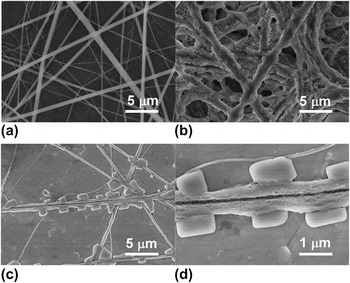
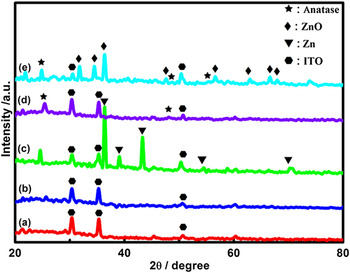
Figure 1 shows the SEM morphologies and Fig. 2 illustrates XRD patterns of the composite fibers. Obviously, the pristine and Zn-coated TiO2 fibers had relatively smooth surfaces, as shown in Figs. 1(a) and 1(b). However, when the fibers were thermal treated in the air, the Zn film was changed into the nano- or microsized ZnO particles and attached to the TiO2 fibers. In the meantime, the pristine amorphous TiO2 fibers were transformed into the anatase phase. As shown in Fig. 1(d), it can be seen that the ZnO particles distributed uniformly on the TiO2 fibers with size around 200 nm. The XRD results of the fibers are shown in Fig. 2. Curve (a) is the XRD pattern of the ITO substrate and curve (b) is the XRD pattern of pristine amorphous TiO2 fibers, which shows no TiO2 peaks. However, after sintering for 2 h, the anatase TiO2 peaks were indexed, as shown in the curve (d). Curve (c) illustrates the Zn peaks. In the curve (e), both ZnO and TiO2 peaks were obtained, which indicated that the ZnO phase and TiO2 phase coexisted in the ZnO/TiO2 fibers.
SEM morphologies of the fibers: (a) pristine TiO2/PVP; (b) Zn/TiO2/PVP; (c) ZnO/TiO2; and (d) ZnO/TiO2(high magnification).

XRD patterns of the fibers: (a) ITO; (b) TiO2/PVP/ITO; (c) Zn/TiO2/PVP/ITO; (d) TiO2/ITO; and (e) ZnO/TiO2/ITO.

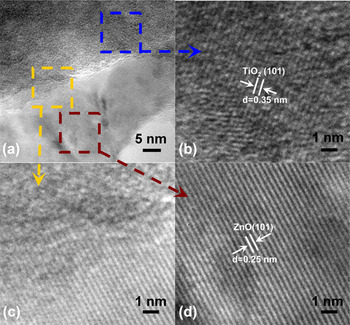
Figure 3 shows the HRTEM micrographs at the interface between the ZnO particles and the anatase TiO2 fibers. Because of the thick particles and fibers (generally 300–500 nm), the HRTEM image at the interface was difficult to be observed. Practically, for getting a better HRTEM image, the thickness of the specimen must be less than 50 nm. But, we still could find that compact combination between ZnO and TiO2 and a possible full lattice coherent or partial lattice coherent heterojunction were formed between the TiO2 fibers and ZnO particles. Because the HRTEM results were not reported when using chemical route,Reference Irimpan, Krishnan, Nampoori and Radhakrishnan13, Reference Zhang, Yuan, Fang, Liang, Ding and Jin15 we believe that the present unique preparation process provides a possibility to get a real ZnO–TiO2 heterojunction. Actually, during high temperature annealing, two phase transformations, i.e., Zn to ZnO and amorphous TiO2 to anatase TiO2, were occurred almost simultaneously, and also, the short-range interdiffusion was happened at the interface, which eventually led to the formation of the heterojunction.
HRTEM micrographs of the ZnO/TiO2 fibers: (a) image around heterojunction; (b) portion of TiO2 lattice image; (c) lattice image at interface; and (d) portion of ZnO lattice image.

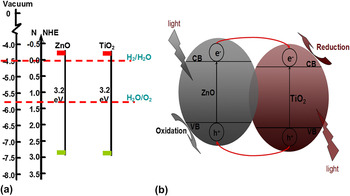
It is well known that TiO2 is a typical indirect band gap oxide semiconductor with a conduction band edge at −4.21 eV. ZnO is a direct band gap oxide semiconductor with a conduction band edge at −4.19 eV,Reference Wang, Li, Wang, Hou, Zou and Chen16, Reference Xu and Schoonen27 as shown in Fig. 4(a). In general, the ZnO/TiO2 composite exhibits the following advantages on photocatalytic activity: (i) it extends the adsorbing range for light; (ii) it achieves a great separation of charges and reduces the recombination ratio of the photoinduced electrons and holes. The mechanism is that the conduction band edge of ZnO is a little bit higher than that of TiO2,Reference Xu and Schoonen27 which therefore results in a transfer of the photoinduced electrons from ZnO conduction band to TiO2 conduction band, while the photoinduced holes from TiO2 valence band to ZnO valence band. This is because the edge of TiO2 valence band is a little bit lower than that of ZnO valence band, as shown in Fig 4(b). However, the premise for these combined energy band structure and charge movements is the formation of a full lattice coherent or partial lattice coherent heterojunction between ZnO and TiO2. Principally, it is difficult to obtain a coherent heterojunction from chemical process because of its low temperature reaction.
(a) Energy band structures of ZnO and TiO2; (b) Transfer and separation of photoinduced electrons and holes between TiO2 and ZnO.

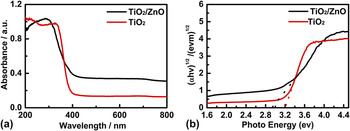
Further UV–vis DRS tests revealed that the ZnO/TiO2 composite fibers exhibited a strong absorption for UV–vis light, and cutting off wave length had a redshift about 50 nm, as shown in Fig. 5. The band gap energy of the ZnO/TiO2 fibers has been narrowed to 2.9 eV from 3.2 eV of the pristine TiO2 fibers, which was calculated by Kubelka–Munk equationReference Butler28:
 $${\rm{\alpha \eta }}v = {\rm{constant}}(hv - Eg),$$
(a) UV–vis DRS of TiO2 and ZnO/TiO2 fibers; (b) (αην)1/2 as a function of photoenergy for the TiO2 and ZnO/TiO2 fibers.

where α = (1 − R)2/2R, R = 10−A, R is the reflection coefficient of the sample,Reference Burova, Petukhov, Eliseev, Lukashin and Tretyakov29, Reference Wan, Li, Feng, Sunb and Mao30 and A is an optical absorption. The band gap of semiconductor was estimated from a function of (αην)1/2 versus photon energy (hν).
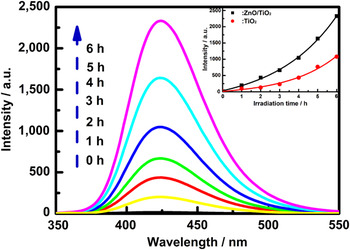
The photocatalytic activity of the pristine TiO2 and ZnO/TiO2 composite fibers was evaluated by measuring the formation of photocatalytic active species ·OH radicals under UV–vis light irradiation. TA was used as the fluorescence probe because it can react with ·OH in solution to generate TAOH, which emits unique fluorescence signal with a peak at 426 nm.Reference Hirakawa and Nosaka26 The fluorescence spectra associate with TAOH were generated by irradiating the ZnO/TiO2 fibers, as shown in Fig. 6, The result demonstrated that the ZnO/TiO2 composite fibers increased the photocatalytic efficiency more than two times than that of the pristine TiO2 fibers, which was ascribed the decrease of the recombination ratio of photoinduced electrons, as shown in Fig. 4(b).
Fluorescence spectra obtain for the supernatant liquid of the irradiated ZnO/TiO2 solution containing 3 mM TA at various irradiation periods and the inset is the time dependence of fluorescence intensity at 426 nm of the ZnO/TiO2 and pristine TiO2 fibers.

IV. CONCLUSIONS
In conclusion, the ZnO/TiO2 heterojunction composite fibers were prepared through a novel three-step process involving electrospinning, pulse plating, and thermal heat treatment. Comparing with chemical route, the present physical route provides a possibility to form a full lattice coherent or partial lattice coherent heterojunction between TiO2 and ZnO materials, which exhibits an efficient separation ratio for photoinduced electrons and holes and greatly improves the photocatalytic property.
ACKNOWLEDGMENTS
This research was financially supported by the National Basic Research Program of China (973 Program) (Nos. 2009CB939705 and 2009CB939704) and Chinese Universities Scientific Fund.