Introduction
Biomedical advances have led to major improvements in the prognosis of women with breast cancer, and quality of survivorship has become important. Several reports have indicated that women may experience cognitive impairment following treatment. Up to one third of women with breast cancer treated with chemotherapy self-report a decline in attention and their abilities to think (“chemo-fog” or “chemo-brain”), and for some survivors the changes last for years (Ahles & Saykin, Reference Ahles and Saykin2001; Coates et al., Reference Coates, Abraham, Kaye, Sowerbutts, Frewin, Fox and Tattersall1983; Koppelmans, Breteler, et al., Reference Koppelmans, Breteler, Boogerd, Seynaeve, Gundy and Schagen2012; Koppelmans, Groot, et al., Reference Koppelmans, Groot, de Ruiter, Boogerd, Seynaeve, Vernooij and Breteler2012; Raffa & Martin, Reference Raffa and Martin2010; Small et al., Reference Small, Rawson, Walsh, Jim, Hughes, Iser and Jacobsen2011; Tannock, Ahles, Ganz, & Van Dam, Reference Tannock, Ahles, Ganz and Van Dam2004). These effects can persist even after controlling for anxiety, depression, and fatigue (Castellon et al., Reference Castellon, Ganz, Bower, Petersen, Abraham and Greendale2004; Schagen, Muller, Boogerd, Mellenbergh, & van Dam, Reference Schagen, Muller, Boogerd, Mellenbergh and van Dam2006; Tchen et al., Reference Tchen, Juffs, Downie, Yi, Hu, Chemerynsky and Tannock2003).
Self-reported symptoms have encompassed a fairly wide variety of cognitive domains, including focusing and maintaining attention, learning, memory recall and retrieval, processing speed, word-finding, decision making, and problem solving. However, findings from studies that have attempted to quantify cognitive changes with objective measures are inconsistent. Some fail to observe deficits in cognitive function at all (Donovan et al., Reference Donovan, Small, Andrykowski, Schmitt, Munster and Jacobsen2005; Jenkins et al., Reference Jenkins, Shilling, Deutsch, Bloomfield, Morris, Allan and Winstanley2006; Shaffer et al., Reference Shaffer, Merkle, Fagerlin, Griggs, Langa and Iwashyna2012; Shilling, Jenkins, Morris, Deutsch, & Bloomfield, Reference Shilling, Jenkins, Morris, Deutsch and Bloomfield2005); others report mild neuropsychological impairments that improve or resolve after treatment is completed (Collins, Mackenzie, Stewart, Bielajew, & Verma, Reference Collins, Mackenzie, Stewart, Bielajew and Verma2009; Schagen et al., Reference Schagen, Muller, Boogerd, Rosenbrand, van Rhijn, Rodenhuis and van Dam2002; Wefel, Lenzi, Theriault, Davis, & Meyers, Reference Wefel, Lenzi, Theriault, Davis and Meyers2004), and still others show long lasting deficits in a subset of survivors (Ahles, Root, & Ryan, Reference Ahles, Root and Ryan2012; Koppelmans, Breteler, et al., Reference Koppelmans, Breteler, Boogerd, Seynaeve, Gundy and Schagen2012; Vardy, Rourke, & Tannock, Reference Vardy, Rourke and Tannock2007; Wefel, Saleeba, Buzdar, & Meyers, Reference Wefel, Saleeba, Buzdar and Meyers2010). Furthermore, there is inconsistency as to which cognitive domains are impacted (see a recent meta-analysis from Jim et al., Reference Jim, Phillips, Chait, Faul, Popa, Lee and Small2012). The reasons for these inconclusive results are multifactorial, and include differences related to the choice of the neuropsychological tests (e.g., different tests used to assess the same cognitive domain), different statistical methods for categorizing cognitive dysfunction, different comparison groups (e.g., published normative data, healthy aged-matched controls, cancer control not treated with chemotherapy), and confounding factors (e.g., mood, hormonal status, type of chemotherapy) (Vardy, Wefel, Ahles, Tannock, & Schagen, Reference Vardy, Wefel, Ahles, Tannock and Schagen2008).
Assessing Cognitive Function
Traditional neuropsychological assessment postulates that performance on a particular test (for example, how many words are recalled from a previously read list) is representative of a person's cognitive ability. With few exceptions (e.g., delirium) there are underlying assumptions that cognitive ability is stable in the short-term, and that test performance assessing that cognitive ability is also relatively stable. Cognitive variability within an individual can only be assessed if similar tests are given multiple times and performance is compared, or if such comparisons can be made across equivalent blocks of a longer cognitive task. If stability were an underlying problem, using traditional neuropsychological tests could be a barrier to finding consistent patterns of results across studies. In contrast, tests that require multiple trials of the same or similar tasks can assess intra-individual variability of performance. This is a crucial distinction if performance stability, because of the underlying disease, treatment effects, hormonal and/or emotional changes associated with cancer, is at the core of the cancer-related cognitive dysfunction.
Although intra-individual variability (IIV) in behavioral performance is often considered to reflect noise, it may represent true short-term fluctuation in performance (Li, Aggen, Nesselroade, & Baltes, Reference Li, Aggen, Nesselroade and Baltes2001). Intra-individual variability represents within-subject variability that, along with inter-individual variability, could lead to the inconsistent findings in cancer studies using neuropsychological tests. There is precedent for studying IIV in the general population and in people with diseases other than cancer, and some of that literature is reviewed here.
Intra-individual Variability and Cognitive Control
Research on aging and inhibitory control supports the notion that mechanisms of selective attention can be assessed by measurement of IIV (Stuss et al., Reference Stuss, Stethem, Hugenholtz, Picton, Pivik and Richard1989; Stuss, Murphy, Binns, & Alexander Reference Stuss, Murphy, Binns and Alexander2003). Paradigms used to assess IIV in selective attention include choice reaction time tasks, in which there are several different stimuli presented and each requires a different response. For instance, participants might be required to press a button as soon as they see an X appear on the screen. Several studies have reported greater IIV of reaction time (RT) on speeded psychomotor tasks in older compared to younger adults (Bielak, Hultsch, Strauss, MacDonald, & Hunter, Reference Bielak, Hultsch, Strauss, MacDonald and Hunter2010; Hultsch, MacDonald, & Dixon, Reference Hultsch, MacDonald and Dixon2002; MacDonald, Hultsch, & Dixon, Reference MacDonald, Hultsch and Dixon2003; Myerson, Robertson, & Hale, Reference Myerson, Robertson and Hale2007; Strauss, MacDonald, Hunter, Moll, & Hultsch, Reference Strauss, MacDonald, Hunter, Moll and Hultsch2002). Others have shown that IIV increases with increased complex, attention-demanding tasks in both young and older people (Bielak, Cherbuin, Bunce, & Anstey, Reference Bielak, Cherbuin, Bunce and Anstey2013; Robertson, Myerson, & Hale, Reference Robertson, Myerson and Hale2006), and in children with attention deficit hyperactivity disorder (Buzy, Medoff, & Schweitzer, Reference Buzy, Medoff and Schweitzer2009). Although the studies are few, increased IIV in other tasks, such as Stroop, n-back, and visual serial addition tasks has been reported in a variety of clinical populations, including those with attention deficit hyperactivity disorder (Buzy et al., Reference Buzy, Medoff and Schweitzer2009; Castellanos & Tannock, Reference Castellanos and Tannock2002), patients with frontal lesions (Stuss et al., Reference Stuss, Murphy, Binns and Alexander2003), human immunodeficiency virus (Morgan, Woods, Delano-Wood, Bondi, & Grant, Reference Morgan, Woods, Delano-Wood, Bondi and Grant2011), and people with mild cognitive impairment (Tales et al., Reference Tales, Leonards, Bompas, Snowden, Philips, Porter and Bayer2012).
Strauss et al. (Reference Strauss, MacDonald, Hunter, Moll and Hultsch2002) proposed that IIV provides a behavioral index of “neurological integrity” given their finding that IIV in RTs distinguished between older adults with and without dementia, with dementia being associated with higher IIV (and see Duchek et al., Reference Duchek, Balota, Tse, Holtzman, Fagan and Goate2009). Intra-individual variability in working memory performance has been shown to predict future cognitive function. MacDonald et al. (Reference MacDonald, Hultsch and Dixon2003) found that initial measurements of IIV of RTs in an n-back working memory task predicted changes in performance across cognitive tasks over a 6-year period (and see Lovden, Li, Shing, & Lindenberger, Reference Lovden, Li, Shing and Lindenberger2007). More recently, behavioral IIV has been linked to white matter integrity (Jackson, Balota, Duchek, & Head, Reference Jackson, Balota, Duchek and Head2012), and these findings appear to indicate that higher behavioral IIV is associated with white matter dysfunction, resulting in less effective neuronal and network activation. There is evidence that IIV has functional relevance as well. Burton, Strauss, Hultsch, and Hunter (Reference Burton, Strauss, Hultsch and Hunter2009) found that higher IIV was significantly associated with everyday problem solving skills.
According to Stuss et al. (Reference Stuss, Murphy, Binns and Alexander2003), there are two general types of IIV: Dispersion and Inconsistency. Dispersion refers to the oscillation of an individual's performance during a single continuous task, without interruption by another type of task or stimulus presentation paradigm (within session or block). Inconsistency refers to the degree of variability of an individual across time; this might be between administrations of the same test either within the same testing session (e.g., different blocks of the same experiment) or over separate sessions of testing.
In the current study, we assessed Dispersion within, and Inconsistency across, different blocks of trials. We were able to perform this secondary analysis on a set of previously published data on one task drawn from a larger battery of cognitive measures (Tchen et al., Reference Tchen, Juffs, Downie, Yi, Hu, Chemerynsky and Tannock2003). This task was the Conner's Continuous Performance Task (CPT, 1994, version 3.0), a “Go-NoGo” test of sustained attention requiring response inhibition, which has been shown previously to be sensitive to assessing IIV (Klein, Wendling, Huettner, Ruder, & Peper, Reference Klein, Wendling, Huettner, Ruder and Peper2006). The test is most frequently used in clinical assessments for attention deficit hyperactivity disorder. Although this test was not specifically used to explore concepts of Dispersion and Inconsistency, they were calculated using information provided in the CPT Detailed Report Statistics by Block output. Our hypotheses were that Dispersion and/or Inconsistency would be higher in cancer patients than in healthy age-matched controls. We are unaware of previous studies of IIV in cognitive performance in women with breast cancer.
Methods
Participants
We re-analyzed previously collected data from a study that evaluated cognitive performance in women with breast cancer who received chemotherapy and in age-matched healthy women (Tchen et al., Reference Tchen, Juffs, Downie, Yi, Hu, Chemerynsky and Tannock2003). In that original study, interim analyses were done on the Go-NoGo test and did not reveal any group differences in speed, accuracy, or categorization of impairment (Tchen et al., Reference Tchen, Juffs, Downie, Yi, Hu, Chemerynsky and Tannock2003), so the administration of the task was discontinued. The participants included in the present study are all participants who completed the Go-NoGo test. One patient was excluded from analysis because she did not follow task instructions: she responded to all distracters (100% false alarm/commission rate), leaving sample size of 65 patients and 28 controls.
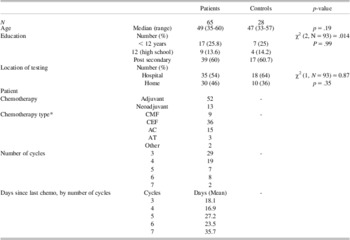
The participants with breast cancer were recruited from outpatient clinics of the Princess Margaret Cancer Centre in Toronto, Ontario. The sample included women who had been treated with at least three courses of adjuvant (post surgery) or neoadjuvant (pre surgery) chemotherapy for breast cancer (Table 1). Eligible women were 60 years or younger and fluent in English. In the original study, agreement to participate among eligible patients was 70% (101/144, the first 66 of those were administered the Go-NoGo test). A healthy control group was recruited by peer nomination. Patients were asked to nominate a control who was a relative or acquaintance, fluent in English, aged <60 years, and with a difference in age to the patient of no more than 5 years. Women nominated as controls were contacted, and the study was described to them; if they gave informed consent, an appointment for assessment was scheduled. Patients or controls with neurologic injury such as stroke, history of other major illness, those with major pre-existing psychiatric history, and those taking neuroleptic drugs were excluded. The protocol was approved by the institutional review board at University Health Network in accordance with the Helsinki Declaration, and all participants gave written consent.
Participant demographics and clinical data

* Chemotherapy regimens included: six monthly cycles of oral cyclophosphamide, with intravenous (IV) methotrexate, and fluorouracil, or eight to nine 3-week cycles of IV CMF (N = 9); six cycles of cyclophosphamide, epirubicin, and fluorouracil (CEF: N = 36); and four cycles of doxorubicin (Adriamycin) and cyclophosphamide (AC: N = 15), sometimes followed by 4 cycles of paclitaxel (Taxotere) (AT: N = 3); and two patients had some other combination (e.g., started with A for one cycle, then switched to CEF).
Assessment
Participants had a choice to be tested in their home or in a quiet room at the hospital. Forty participants elected to have the assessment at home, and 53 choose to have the assessment at the hospital (Table 1). The percentage of participants that were tested at home did not differ between groups (patients vs. controls), χ2 (1,N = 93) = 0.87, p = .35, and there was no association of test location and assessment outcomes.
In addition to the Go-NoGo task (Conners, Reference Conners1994), the Mini-Mental Status Exam (Folstein, Folstein, & McHugh, Reference Folstein, Folstein and McHugh1975) was administered as a brief cognitive screen, and the Trail Making Test A and B (Reitan & Wolfson, Reference Reitan and Wolfson1985) was administered as a standardized neuropsychological test to assess speed for visual attention and mental flexibility. The FACIT-Fatigue (Cella, Reference Cella1998), a self-report questionnaire of fatigue level asking about symptoms over the previous week was also administered. In addition to the tests mentioned above, the large study had participants complete the High Sensitivity Cognitive Screen (Fogel, Reference Fogel1991) and quality of life questionnaires: Functional Assessment of Cancer Therapy-General (patients only) (Cella et al., Reference Cella, Tulsky, Gray, Sarafian, Linn, Bonomi and Harris1993), FACT-ES (menopausal symptoms) (Fallowfield, Leaity, Howell, Benson, & Cella, Reference Fallowfield, Leaity, Howell, Benson and Cella1999), but data from these tests were not available for re-analysis.
Using the CPT Go-NoGo task (Conners, Reference Conners1994), letters were presented one at a time on a computer screen for 250 ms. Participants were told to press the space bar as quickly as possible after a letter appeared on the screen unless the letter was an X. If the letter was an X, they should not press the space bar. Participants completed a 1-min practice block and approximately 14 min of testing divided into six blocks of 60 trials each for a total of 360 trials per participant. There was no signal to participants that one block was finished and another was about to start. Each block was divided into three 20-trial sub-blocks: Each sub-block had one inter-stimulus interval (ISI): 1, 2, or 4 s, and the order of the three sub-blocks within a block was such that each ISI appeared in every position an equal number of times (e.g., ISI 1 appeared first in 2 of the blocks, second in 2 of the blocks, and last in 2 of the blocks). Within every 20-trial sub-block, 18 trials were targets, or Go trials (non-X's), and the remaining 2 trials were NoGo trials (X's). The CPT output provides many variables in the profile report summary tables (e.g., Variability, Hit RT Block Change, Hit RT ISI Change). For our interest in IIV, we used the “raw” data from the detailed sub-block data tables (collapsed across 20 trials), which are free from comparisons to the normative group and expectation regarding directionality in terms of patterns over the course of the test (e.g., getting slower or faster as the test progresses, as Block Change measures capture). For our analysis, the CPT output variables of interest were hits, errors (commissions/false alarms and omissions/misses) for each sub-block and block. We used the mean RT values of the correct-only Go trials within sub-block (the Hit RT) to calculate Dispersion and Inconsistency.
Fatigue can influence alertness. Therefore, participants completed a questionnaire assessing fatigue (Functional Assessment of Chronic Illness Therapy Fatigue, or FACIT-F; Yellen, Cella, Webster, Blendowski, & Kaplan, Reference Yellen, Cella, Webster, Blendowski and Kaplan1997). It is a 13 item questionnaire measuring an individual's level of fatigue during their usual daily activities over the past week. No items make reference to “illness” or “cancer,” so it can be given to both patients and healthy controls. It has been validated in both healthy and non-cancer clinical populations as well as cancer patients. Fatigue is measured on a 4 point rating scale, for a range of 0 to 52. The FACIT-F was administered after the CPT test and other objective measures were finished.
Data Analysis
The first measure of IIV (Dispersion) captures within sub-block variability, and the second measure of IIV (Inconsistency) captures across block variability. Means and standard deviations tend to be highly correlated (Faust, Balota, Spieler, & Ferraro, Reference Faust, Balota, Spieler and Ferraro1999), so it is important that measures of IIV take into account differences in mean RT. The normalized measure of Dispersion, called the Coefficient of Variation (CV) is calculated as a ratio of the within sub-block standard deviation (ISD) to RT [i.e., (SD/mean RT)] for each participant. Dispersion CV at each ISI was calculated using the six Hit RT values contained in the Block Data tables generated for each participant. This provided us with three mean CV values per participant, one for each ISI. Using the CV rather than the standard deviation ensures that differences in Dispersion are not related to differences in overall RT between the groups in the different conditions and is recommended in this type of sustained attention task (Flehmig, Steinborn, Langner, Scholz, & Westhoff, Reference Flehmig, Steinborn, Langner, Scholz and Westhoff2007). It allows one to compare Dispersion between individuals who differ in their average speed (Nesselroade & Salthouse, Reference Nesselroade and Salthouse2004; Stuss, et al., Reference Stuss, Murphy, Binns and Alexander2003). The same normalizing process was applied to Inconsistency. For each block (60 trials), we calculated the standard deviation of the RT, divided by mean RT, using the values in the CPT's Block Data (ISI Collapsed) table. This provided us with six Inconsistency values per participant, one for each block of trials.
Only correct target trials were considered in the analysis of RT, Dispersion and Inconsistency. An incorrect target trial means no response was made to the target (“miss” or omission). An incorrect response refers to a bar press that was mistakenly made following an X (“false alarm,” or commission). The between (patient vs. control) and within (ISI, block) subject variables were analyzed by using a mixed-design repeated measures analysis of variance. No corrections were applied for multiple significance testing. The SPSS 20.0 software package was used for all data analyses.
Results
Participants
Demographic information and details of chemotherapy received by participants are shown in Table 1. There was no significant difference between patient and control groups in age or education. Patients received usual doses of any of several regimens of chemotherapy used at the time of data collection (2000–2001). Standard antiemetic treatments with dexamethasone + ondansetron or granisetron, prochlorperazine, domperidone, or metaclopramide were used as needed. Fifty-two patients were receiving adjuvant chemotherapy after surgery, and 13 were receiving it before surgery. The window for patient assessment ranged between 2 and 6 weeks after their most recent chemotherapy, and they had to have completed at least three courses at the time of assessment.
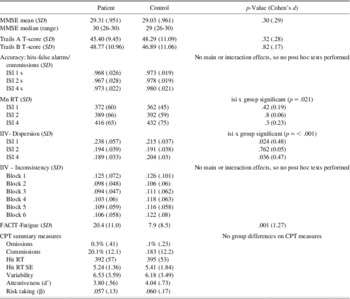
Table 2 includes the IIV variables of interest in addition to data from the MMSE, Trails, FACIT-F, and some of the commonly reported CPT summary measures, including Variability, d-prime (detectability), and Beta (response style).
MMSE, Trails, Accuracy, Reaction Time, IIV Dispersion (Coefficient of Variation), IIV Inconsistency, Fatigue, and CPT Overall Measures.

Fatigue: FACIT-F scale (Possible Range 0–52)
Fatigue scores for patients (mean = 20.4; range: 2–50; std dev = 11.0) were significantly higher than scores for controls (mean = 7.9; range: 0–34; std dev = 8.5; p < .001). Subsequent repeated measures analyses were performed both with and without fatigue scores as a covariate, and there was no difference in results. Results are reported without using fatigue as a covariate.
Accuracy
There was no significant difference in overall Accuracy (Hits minus False Alarms/Commissions) between patients and controls (F(1,91) = 2.69; p = .10), as was reported in Tchen et al. (Reference Tchen, Juffs, Downie, Yi, Hu, Chemerynsky and Tannock2003). There was no significant main effect of ISI (F(2,182) = 2.40; p = .092), nor were there significant interactions between group and ISI or between group and block (F < 1 in both cases).
Reaction Time
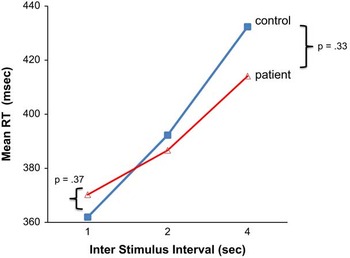
There was no significant difference in overall RT between patients and controls (F < 1), also reported by Tchen et al. (Reference Tchen, Juffs, Downie, Yi, Hu, Chemerynsky and Tannock2003). The main effect of ISI was significant (F(2,182) = 75.50; p < .001; Figure 1), with participants being fastest at the shortest ISI, intermediate for the middle ISI, and slowest for the longest ISI (all pair-wise comparisons, p < .001). The group × ISI interaction was significant (F(2,182) = 3.94; p = .021). Although this suggests that patients were relatively faster at the slower speed, and controls were faster at the faster speed, none of the post hoc comparisons between groups at each ISI were statistically significant (F < 1). The main effect of block was significant (F(5,455) = 12.18; p < .001), with RT decreasing over the course of the experiment. The group ×block interaction was not significant (F < 1).
Mean reaction time in milliseconds (RT) as a function of the inter-stimulus interval (ISI). Presentation speed affects RT.

Dispersion and Inconsistency
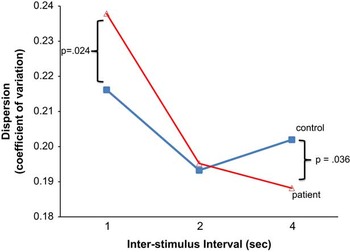
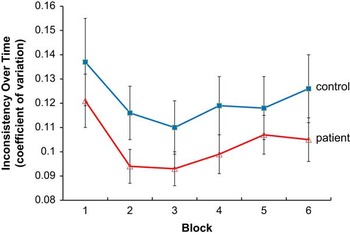
There was no significant main effect of group in Dispersion as measured by the Coefficient of Variation over all trials (F < 1). The main effect of ISI was significant (F(2,182) = 31.07; p < .001), with participants having greater Dispersion in their responses at the shortest ISI than at the middle or longer ISI (pair-wise comparisons, p < .001). The group × ISI interaction was also significant (F(2,182) = 8.12; p < .001; Figure 2). When age and education were included as covariates in the analysis of Dispersion, the interaction retained statistical significance (p < .001). Post hoc comparisons between groups at each ISI revealed that patients had more Dispersion in their responses than controls at the shortest ISI (p = .024). At the long ISI condition, controls had significantly more Dispersion than patients (p = .036). There was no difference at the middle ISI (p = .762). The main effect of block on Dispersion was not significant (F < 1) nor was the group × block interaction (F < 1). For Inconsistency measures, there was no significant main effect of block (F(5, 455) = 2.20; p = .065), group (F(1,91) = 2.70; p = .10), or group × block interaction (F < 1; Figure 3).
Dispersion as indexed by the coefficient of variation as a function of inter-stimulus interval (ISI). Presentation speed affects Dispersion differently in patients and control participants. Women with breast cancer exhibit more dispersion at shorter ISI and less dispersion at longer ISI, as compared with healthy participants.

Inconsistency as indexed by the coefficient of variation over course of experiment (SD/MnRT) for each block, collapsing over inter-stimulus interval.

Correlations
Pearson correlations between performance variables (Accuracy, RT, Dispersion, Inconsistency), fatigue, and patient variables (number of cycles, time since last treatment) were performed. In the patient group, Inconsistency was weakly correlated with time since last treatment (r = -.212; p = .04): that is, Inconsistency was higher when chemotherapy had been given more recently. In the patient group, Inconsistency was also higher when fatigue levels were higher (r = .242; p = .02), but no significant correlation was seen in the control group. Fatigue and time-since-treatment were correlated, with more fatigue being associated with more recent chemotherapy treatment (r = .267; p = .032). No relationship was found between number of chemotherapy cycles received and any other variables.
Correlations were also evaluated between the traditional neuropsychological measures available (Trails A, B, and MMSE) and IIV variables Dispersion and Inconsistency. Dispersion (within ISI or overall) was not significantly associated with Trails A (r ranging from = .02 to −.047) or with Trails B (r ranging from −.134, p = .199, to .198, p = .059). Similarly, Inconsistency over all six blocks was not significantly correlated with Trails A (r = -.098) or with Trails B (r = .048).
Discussion
The primary objective of the present study was to explore whether assessment of intra-individual variability can be a useful approach to learn about cognitive abilities in cancer patients. Although it has been used in other populations, the approach has not been used in cancer populations. The analysis examined whether women with breast cancer treated with at least three cycles of chemotherapy exhibit more Dispersion or Inconsistency in RT than healthy controls matched for age and level of education. The analysis suggests that some measures of stability of performance appear affected by breast cancer treatment, but only in limited conditions.
There was no difference between groups in accuracy or in overall RT. Both groups showed the typical increase in RT with increasing ISI (Conners, Reference Conners2000), and in both groups, RT decreased over the course of the experiment. Patients and controls exhibited similar Inconsistency (variability across blocks) over the course of the experiment. For patients, fatigue was correlated with Inconsistency, but not Dispersion. Patients and controls differed from each other in their Dispersion depending on the ISI. Patients were less variable in the long ISI condition, and were more variable in the short ISI condition. A tentative explanation of this cross-over pattern is that patients have more difficulty coping with more rapid presentation whereas controls have more trouble coping with boredom at long ISI, where coping reflects vigilance. The issue of task demands and cognitive load will be discussed more below.
Results showing group differences in Dispersion but not Inconsistency have been reported in other populations. For example, Stuss and colleagues (2003) showed that in patients with a frontal lobe lesion, Dispersion was impacted more than Inconsistency, and suggested that Dispersion and Inconsistency capture different types of dysfunction and different non-domain specific frontal lobe mechanisms. In addition increased Dispersion is more often observed when the information load or task complexity is higher (e.g., difficult visual discrimination tasks, n-back tasks, visual serial addition tasks), although this pattern is not always observed for Inconsistency (Stuss, Pogue, Buckle, & Bondar, Reference Stuss, Pogue, Buckle and Bondar1994; West, Murphy, Armilio, Craik, & Stuss, Reference West, Murphy, Armilio, Craik and Stuss2002). Furthermore, a more rapid presentation rate does not necessarily mimic task complexity in terms of increasing either Dispersion or Inconsistency (Buzy et al., Reference Buzy, Medoff and Schweitzer2009). The Go-NoGo task used here was easy for participants. We might have seen larger Dispersion with even shorter ISIs or a more challenging task. In terms of mechanisms, increased IIV has been related to both altered response preparation and “lapses in attention” (Vaurio, Simmonds, & Mostofsky, Reference Vaurio, Simmonds and Mostofsky2009), even when accuracy and speed do not change. Consequently, in women with breast cancer treated with chemotherapy, less Dispersion at the long ISI may reflect that cancer survivors perform more consistently when demands on the perceptual and response system are lower. Still, it is difficult to understand why control participants would have greater dispersion than controls at slow presentation rates. Albeit post hoc, one possible explanation is that the presentation speed was too slow to maintain the same engagement throughout the sequences of sub-blocks of trials for the control participants. Dykiert, Der, Starr, and Deary (Reference Dykiert, Der, Starr and Deary2012) recent meta-analysis paper emphasizes the importance of taking both task complexity and presentation rate into account, that complex and simple tasks require different cognitive mechanisms, and conclude that these tasks may not be directly comparable when studying Dispersion and Inconsistency both within and across different populations. Any cognitive or brain mechanism interpretation of the results found in this study would require new experiments to explore some of these ideas.
Evidence from an event-related functional magnetic-resonance imaging study using a Go-NoGo task similar to that used in this study suggests that higher IIV is associated with increased frontal activation, reflecting a higher demand for executive control to maintain task performance (Bellgrove, Hester, & Garavan, Reference Bellgrove, Hester and Garavan2004). Recent diffusion tensor and functional imaging data suggest that frontal cortical areas and white matter are altered in women with breast cancer (de Ruiter et al., Reference de Ruiter, Reneman, Boogerd, Veltman, Caan, Douaud and Schagen2012; Deprez et al., Reference Deprez, Amant, Yigit, Porke, Verhoeven, Van den Stock and Sunaert2011, Reference Deprez, Amant, Smeets, Peeters, Leemans, Van Hecke and Sunaert2012; Kesler, Sheau, Koovakkattu, & Reiss, Reference Kesler, Sheau, Koovakkattu and Reiss2011; McDonald, Conroy, Ahles, West, & Saykin, Reference McDonald, Conroy, Ahles, West and Saykin2012). From this perspective, women with cancer and relatively high IIV may activate inhibitory regions to a greater extent than healthy controls, perhaps reflecting a greater requirement for top-down executive control.
A persisting conundrum in the literature on “chemo-brain” is the discrepancy between the results of objective cognitive tests, which generally show impairments to be subtle and often transient (Jenkins et al., Reference Jenkins, Shilling, Deutsch, Bloomfield, Morris, Allan and Winstanley2006; Schagen et al., Reference Schagen, Muller, Boogerd, Rosenbrand, van Rhijn, Rodenhuis and van Dam2002; Shilling et al., Reference Shilling, Jenkins, Morris, Deutsch and Bloomfield2005; van Dam et al., Reference van Dam, Schagen, Muller, Boogerd, vd Wall, Droogleever Fortuyn and Rodenhuis1998), and the intensity and consistency of self-reported symptoms (Shilling & Jenkins, Reference Shilling and Jenkins2006). Lack of agreement between objective and subjective cognitive performance has been found in populations other than women with breast cancer, including people infected with human immunodeficiency virus (Moore et al., Reference Moore, van Gorp, Hinkin, Stern, Swales and Satz1997; van Gorp et al., Reference van Gorp, Satz, Hinkin, Selnes, Miller, McArthur and Paz1991; Wilkins et al., Reference Wilkins, Robertson, Snyder, Robertson, van der Horst and Hall1991) and multiple sclerosis (Kinsinger, Lattie, & Mohr, Reference Kinsinger, Lattie and Mohr2010; Maor, Olmer, & Mozes, Reference Maor, Olmer and Mozes2001). The absence of a consistent correlation between objective and self-reported cognitive impairment may be related to the tests used to evaluate cognitive dysfunction, and/or that cognitive testing is not sensitive enough to capture the causes of subjective dysfunction, or because the objective and self-reported measures do not assess the same constructs. Structural and functional brain imaging studies have found that in some cases, behavioral testing does not differentiate patients from controls, although imaging does reveal different patterns of brain activity (de Ruiter et al., Reference de Ruiter, Reneman, Boogerd, Veltman, van Dam, Nederveen and Schagen2011, Reference de Ruiter, Reneman, Boogerd, Veltman, Caan, Douaud and Schagen2012; Ferguson, McDonald, Saykin, & Ahles, Reference Ferguson, McDonald, Saykin and Ahles2007). These differences in brain activity have been interpreted as indicating compensation for dysfunction in neural circuitry affected by cancer or chemotherapy (Ferguson et al., Reference Ferguson, McDonald, Saykin and Ahles2007). Prior behavioral research in cancer patients has focused on metrics that reflect success in performing the task (e.g., accuracy or time to complete a task) as opposed to monitoring stability in performance. However, patients often report lapses of attention and a lack of predictability in being able to perform tasks (Downie, Mar Fan, Houede-Tchen, Yi, & Tannock, Reference Downie, Mar Fan, Houede-Tchen, Yi and Tannock2006), so directly measuring variability also has face validity.
Caveats
Although IIV Dispersion differed between patients and controls as a function of speed of presentation, the causes of these differences are unknown and are not necessarily related to chemotherapy. Our analyses did not reveal an association between number of chemotherapy cycles received before testing and IIV outcomes. This is discrepant with some reported literature using standard neuropsychological measures (Collins, Mackenzie, Tasca, Scherling, & Smith, Reference Collins, Mackenzie, Tasca, Scherling and Smith2013; van Dam et al., Reference van Dam, Schagen, Muller, Boogerd, vd Wall, Droogleever Fortuyn and Rodenhuis1998). In addition to using different outcome variables, our patient group had a skewed distribution in the number of chemotherapy cycles received (see Table 1), so we cannot conclude that the differences are unrelated to chemotherapy. Several studies have found pre-chemotherapy differences in self-reported cognitive symptoms, standardized neuropsychological testing performance, and both structural and functional brain imaging results (Cimprich, So, Ronis, & Trask, Reference Cimprich, So, Ronis and Trask2005; Jansen, Cooper, Dodd, & Miaskowski, Reference Jansen, Cooper, Dodd and Miaskowski2011; Scherling, Collins, Mackenzie, Bielajew, & Smith, Reference Scherling, Collins, Mackenzie, Bielajew and Smith2012; Wefel et al., Reference Wefel, Lenzi, Theriault, Davis and Meyers2004). These pre-chemotherapy differences have been attributed to cytokines, fatigue, and/or distress (Seruga, Zhang, Bernstein, & Tannock, Reference Seruga, Zhang, Bernstein and Tannock2008), and post operative impacts such as anesthetic (Samain, Schauvliege, Deval, & Marty, Reference Samain, Schauvliege, Deval and Marty2003). Furthermore, because our patients had already started chemotherapy, many of them were likely experiencing hormonal changes and associated symptoms. Treatment regimens have changed since these data were collected, so it is unknown whether our results would be replicated in patients receiving present day therapies and/or if they are tied with particular chemotherapy agents. We also cannot rule out the possibility that IIV may be affected by time of day (Rabbitt, Osman, Moore, & Stollery, Reference Rabbitt, Osman, Moore and Stollery2001; West et al., Reference West, Murphy, Armilio, Craik and Stuss2002), since when we assessed participants was not controlled. Testing was done during conventional working hours and there was no systematic difference across patients or controls. Assessment of depression, anxiety, and IQ were not done, so their relationships to the results cannot be evaluated. In addition, it would be interesting to know if IIV is correlated with self-reported cognitive function.
Conclusions
Examining intra-individual variability on a test of sustained attention requiring inhibitory control in women treated for breast cancer revealed information that was not available using traditional performance measures. This study offers a new lens with which to think about assessing cognitive capacity in people treated for cancer. The results support the value of investigating stability of performance in cancer patients. In addition, this study adds to the body of knowledge arguing for the value of assessing cognitive variability formally as an adjunct to traditional neuropsychological methods both in research and clinical practice. Standardized instruments with good validity and reliability are needed not only to assess cognitive variability of sustained attention, but also in other cognitive domains. Although neuropsychologists typically focus on mean level of performance rather than its variability, the results of this study show that by doing so important sources of information will be missed. The neurobiological mechanisms of the results presented in this study are unclear. Additional research is needed to evaluate the utility of IIV in other cancer patients, using more complex tasks, and assess whether IIV differences, if found, are acute or persistent and how they are associated with or predict other cognitive measures.
Acknowledgments
The authors have no conflicts of interest to disclose. This work was supported in part by the Princess Margaret Cancer Foundation, Canadian Breast Cancer Research Alliance (L.B., P.C), Canadian Breast Cancer Foundation (L.B., P.C.), and Susan G. Komen Breast Cancer Foundation (I.T., 2001 Professor of Survivorship). Thank you to those who were involved in the original study published in 2003: N. Tchen, H. Juffs, F. Downie, Q-L Yi, H. Hu, I. Chemerynsky, M. Clemons, M. Crump, P. Goss, D. Warr, M. Tweedale, to Kattleya Tirona for technical assistance, to Norma D'Agostino, Jerry Devins, Kim Edelstein, Andrew Matthew, Mary-Pat McAndrews, and Rinat Nissim for valuable comments on an earlier version of this manuscript, and to patients and their friends who participated.