In this short reply to Flynn (Reference Flynn2019) we focus on the question of the causes of racial differences in IQ scores. Black/White differences on the subtests of an IQ battery show a specific pattern, which Flynn (Reference Flynn2019) calls ‘the g-pattern’, and which is also known as a Jensen effect: large differences on higher-complexity subtests and smaller differences on lower-complexity subtests. Te Nijenhuis et al. (Reference te Nijenhuis, Choi, van den Hoek, Valueva and Lee2019) argue that almost without exception, the studies on biological–genetic variables show the same pattern, suggestive of a substantial biological–genetic component in Black/White IQ differences. We agree with Flynn that finding an environmental variable showing the very same g-pattern would indeed weaken an interpretation of a genetic component in IQ differences, because environmental variables cannot have genetic effects. Flynn comes up with thought experiments trying to show that some training gains can also yield Jensen effects. If found with real data, these anomalous Jensen effects would weaken the conclusions drawn in te Nijenhuis et al. (Reference te Nijenhuis, Choi, van den Hoek, Valueva and Lee2019). We prefer real data to thought experiments and therefore present a meta-analysis of educational gains tested for Jensen effects.
The central point here is whether cultural variables yield Jensen effects, because that would constitute a clear anomaly. When cultural variables show an anti-Jensen effect or the absence of a Jensen effect, this does not constitute an anomaly for Jensen’s research programme on the causes of Black/White differences in IQ, and is in line with the empirical findings presented in te Nijenhuis et al. (Reference te Nijenhuis, Choi, van den Hoek, Valueva and Lee2019). Flynn argues that he shows Jensen effects, the absence of a Jensen effect and anti-Jensen effects, but only Jensen effects constitute an anomaly.
A proper test for Jensen effects correlates ratings of complexity with standardized differences between two groups. Flynn commits a fundamental error by not using standardized differences, but instead differences between two groups expressed in percentages. A correlation between complexity ratings and percentages simply does not constitute a proper test of Jensen effects. So, every time it is concluded there is a Jensen effect, an anti-Jensen effect, or the absence of a Jensen effect, these conclusions are not warranted.
Research has convincingly shown that education has a positive effect on intelligence scores. We carried out a meta-analysis to test whether these educational gains show Jensen effects, which would make them anomalies. The inclusion of relevant studies in this meta-analysis was based on one specific decision rule: studies had to be on the effects of education. This could be groups who differed in the amount of education they received; it could be groups that differed in the quality of education they received; and it could also be groups that differed in both the amount and quality of education and where they could not always be clearly separated.
An attempt to localize all the studies regarding the effect of education on IQ and which reported scores on at least four subtests was made. As a first step, a number of studies that supplied reviews of the literature of the effect of education on IQ were studied, and an attempt was made to locate all the original studies. As these reviews by experts strongly overlap in the original studies they describe, we are pretty sure all relevant studies were located. Starting with 41 studies, only four remained, supplying twelve effect sizes.
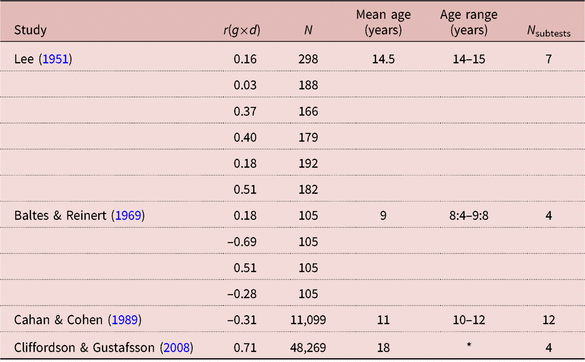
The correlation between the effects of education on the scores of IQ batteries’ subtests and these subtests’ g loadings was calculated. The data points were then analysed using the Schmidt and Le (Reference Schmidt and Le2004) meta-analytical software package. Table 1 shows the twelve data points on the effects of education that were included in the meta-analysis; it includes information on the number of subtests in the IQ battery, which is an indicator of sampling error. Table 2 shows the output of the meta-analytical analyses carried out on these twelve data points. This table displays the number of data points that are included (K), the total sample size (N), the mean correlation d×g weighed by sampling error (r), the standard deviation of the observed correlations (SDr) and the percentage of variance between the twelve data points explained by sampling error (%VE).
Meta-analytical table of effects of education

* The value for range could not be reported because Cliffordson and Gustafsson (Reference Cliffordson and Gustafsson2008) only reported that the participants were 18 years old when tested.
Meta-analytical output of r(g×d) for educational gains

See text for definition of abbreviations.
The overall meta-analytical correlation between the effects of education on the scores of subtests of IQ batteries and the g loadings of these subtests was 0.13 and all of the variance between the data points was explained. We tested whether the number of subtests acted as a moderator, and meta-analysed only the data points based on at least seven subtests. This led to virtually identical outcomes, so number of subtests does not act as a moderator.
The present meta-analysis tested whether educational gains show Jensen effects, and found a zero-ish effect, which means there is no Jensen effect. This meta-analysis was based on a total N = 60,993 from K = 12 datapoints, so the outcomes can be trusted. All of the variance between the data points is explained by the sampling error, which is a very strong outcome. Flynn (Reference Flynn2019) suggested that some educational gains would show a Jensen effect, thereby making them anomalies in Arthur Jensen’s research programme, but this is not supported using empirical data.
We agree with Flynn that a test of Jensen effects is of nil value as a diagnostic instrument when various good-sized meta-analyses show Jensen effects for both genetic effects and non-genetic effects. However, the present meta-analysis shows no Jensen effect for a cultural, non-genetic effect. A thought experiment is a good way to start a discussion, and a meta-analysis helps towards ending the discussion. Empirical outcomes tell us that educational gains are not anomalies.
Real data, especially the data points in a meta-analysis, trump thought experiments. Anomalies can weaken or even ruin a research programme, but educational gains are not a case of a true, empirical anomaly. We encourage Flynn to continue to try to find anomalous Jensen effects or extreme environments that yield weakened Jensen effects, as this pushes the theoretical discussion on this important topic forward.
Author ORCIDs
Jan te Nijenhuis, 0000-0002-1268-6121
Funding
This work was supported by a research grant from Chosun University.
Conflicts of Interest
The authors have no conflicts of interest to declare.
Ethical Approval
The authors assert that all procedures contributing to this work comply with the ethical standards of the relevant national and institutional committees on human experimentation and with the Helsinki Declaration of 1975, as revised in 2008.