Implications
The health-promoting properties of animal-origin products can be increased by changing their proportion of fatty acids, that is, the enrichment of these products with long-chain n-3 polyunsaturated fatty acids (n-3 LCPUFAs). On a production scale, such modifications are done using traditional nutritional methods, that is supplementation of animal diets with fats rich in n-3 PUFAs, mainly fish oils. However, this method is limited by the huge demand for marine products. In recent years several studies have been successfully completed on the application of modern techniques of genetic engineering, mainly transgenesis, to enrich animal-origin products with n-3 LCPUFAs. This review article presents and summarises the results of experiments aimed at the use of genetic engineering techniques to create genetically modified animals producing meat or milk containing health-promoting lipids.
Introduction
For modern communities in developed countries, food serves not only to fulfil nutritional requirements, but also serves as an important tool to influence the status of human health. Taking into account the high frequency in western countries of such chronic lifestyle diseases as obesity, cardiovascular disease, immunological disorders or cancers (Hanson and Gluckman, Reference Hanson and Gluckman2011; Nair et al., Reference Nair, Shu, Volmink, Romieu and Spiegelman2012), as well the growing evidence of the beneficial influence of certain bioactive dietary constituents on human health (Alissa and Ferns, Reference Alissa and Ferns2012), the importance of health-promoting modification of the human diet has increased. This also applies to foods of animal origin, that is meat, milk, and eggs, as they hold a significant position in global food production and consumption and are pivotal constituents of the human diet.
One of the main ways to increase the dietetic value of animal-origin foods is to enrich them with bioactive components that may beneficially affect the metabolic and health status of human organisms. Besides adding minerals (iodine, selenium) and vitamins (vitamin E, D3), the most important strategy is to modify the composition of food lipids by increasing the amount of long-chain n-3 polyunsaturated fatty acids (n-3 LCPUFAs) and conjugated linoleic acids (CLAs). These fatty acids exert several positive health-related influences, that is anti-obesity, anti-atherogenic, anti-hypertension, anti-carcinogenic and immunomodulatory effects (Roche et al., Reference Roche, Noone and Gibney2001; Simopolous, Reference Simopoulos2004; Pisulewski, Reference Pisulewski2005; Simopolous, Reference Simopoulos2008; Riediger et al., Reference Riediger, Othman, Suh and Moghadasian2009; Mori, Reference Mori2014), as well as being important in many metabolic processes, including the proper functioning of the immunological and nervous systems (Benatti et al., Reference Benatti, Peluso, Nicolai and Calvani2004; Calder, Reference Calder2006). Consumers’ knowledge about the importance of diet for health, as well as their acceptance of animal products enriched with n-3 PUFAs, is increasing. For instance, the results of an American study indicated that the majority of consumers considered n-3 PUFA-enriched eggs healthful, and reported their willingness to purchase them even if more expensive (Marshall et al., Reference Marshall, Kubena, Hinton, Hargis and van Elswyk1994). Animal-origin products enriched with n-3 PUFAs are good examples of functional food, that is food that in addition to possessing traditionally understood nutritional value can beneficially affect the metabolic and health status of consumers, thus reducing the risk of various chronic lifestyle diseases (Zdunczyk and Jankowski, Reference Zdunczyk and Jankowski2013).
Health-promoting n-3 LCPUFAs primarily include eicosapentaenoic acid (EPA, C20:5), docosapentaenoic acid (DPA, C22:5) and docosahexaenoic acid (DHA, C22:6). Their positive health influences are related mainly to reduction of the production of inflammatory eicosanoids, cytokines, and reactive oxygen species and the expression of adhesion molecules (James et al., Reference James, Gibson and Cleland2000; Calder, Reference Calder2006; Schmitz and Ecker, Reference Schmitz and Ecker2008). The main dietary source of n-3 LCPUFAs for humans are fishes or fish oils; however, in a majority of western communities, the daily intake and consequently intake of n-3 PUFAs is considerably lower than recommended nutrient levels, with a simultaneous imbalanced (too high) n-6/n-3 PUFA ratio (James et al., Reference James, Gibson and Cleland2000; Givens and Gibbs Reference Givens and Gibbs2008; Simopoulos, Reference Simopoulos2011), which can be a contributing factor in the prevalence of many disorders. Some plant oils, that is flaxseed and rapeseed oils, contain considerable amounts of α-linolenic acid (ALA, C18:3 n-3), which is a dietary precursor of n-3 LCPUFAs; however, the efficiency of conversion of ALA to EPA, DPA, and DHA in mammals is very limited and depends on many factors (Gerster, Reference Gerster1997; Brenna et al., Reference Brenna, Salem, Sinclair and Cunnane2009).
The traditional method of enriching animal-origin products with n-3 LCPUFAs is to manipulate the composition of an animal diet, that is, incorporation of n-3 PUFA sources, mainly fish oil and other marine products. Dietary fat not only directly affects the composition of adipose tissue of animals, but also influences the expression of genes related to lipid synthesis (Bernard et al., Reference Bernard, Leroux and Chilliard2008; Duran-Montge et al., Reference Duran-Montge, Theil, Lauridsen and Esteve-Garcia2009). However, this method is limited by the huge demand for marine products and risk of their contamination with heavy metals (Wu et al., Reference Wu, Ouyang, Duan, Pang, Zhang, Yuan, Xue, Ni, Cheng, Dong, Wei, Li, Yu, Sun, Chen, Lai, Dai and Li2012). In case of milk there is also a possibility of direct supplementation with n-3 PUFA. Great progress in recent years in the development of genetic engineering techniques, for example transgenesis, has enabled the generation of many kinds of genetically modified (GM) animals which can be used in different fields of agriculture, food industry or medicine. The focus of the majority of research efforts in this area has been to develop GM animals with enhanced performance traits; however, in recent years, there has been also a growing interest in the use of techniques of genetic engineering to improve the safety and dietetic value of animal-origin products, mainly through modification of the lipid composition of meat and milk. To date GM food-producing animals, engineered using recombinant DNA technology, have remained almost exclusively at the laboratory stage. However, in the future the use of transgenesis in order to obtain animal products with a more favourable composition of fatty acids may be an effective tool in the prevention of many lifestyle diseases. Thus, the aim of this article is to review and discuss data in the literature regarding studies where techniques of genetic engineering were used to create animal-origin products (i.e. meat, milk and fish) modified to contain health-promoting lipids.
Results of studies on the use of techniques of genetic engineering to alter the lipid composition of animal-origin products
From the point of view of the dietary value of animal-origin foods, the modification of the fatty-acid profile of lipids in the direction of increasing content of n-3 LCPUFAs is of the greatest importance. The majority of studies on changing the composition of the lipid fraction of meat and milk using the methods of genetic engineering (transgenesis) are concentrated on this particular issue.
Model animals
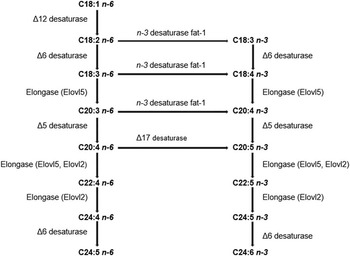
The first successful work concerning this kind of genetic modification was performed, using model animals in the United States, by Kang et al. (Reference Kang, Wang, Wu and Kang2004). They generated a fat-1 transgenic mouse expressing the roundworm Caenorhabditis elegans fat-1 gene. A product of the expression of this gene is a desaturase of n-3 fatty acids, that is an enzyme catalysing the conversion of n-6 to n-3 PUFA (Figure 1), a process which does not occur under normal circumstances in mammals. The substrate for this desaturase is primarily linoleic acid (LA, C18:2 n-6) and, to a lesser extent, γ-linolenic acid (C18:3 n-6) and arachidonic acid (AA, 20:4 n-6). The study proved that fat-1 transgenic mice can add a double bond to an unsaturated fatty-acid hydrocarbon chain and convert n-6 fatty acids to n-3. This results in an abundance of n-3 fatty acids, along with a reduction in n-6 acids, in the organs and tissues of these mice, in the absence of dietary n-3 PUFA (Kang et al., Reference Kang, Wang, Wu and Kang2004). Transgenic mice obtained in this way were the first documented animal models in which endogenous synthesis of n-3 fatty acids occurred in mammals. This was confirmed by the results of chemical analysis, which showed that lipids of control mice (non-transgenic) contained almost exclusively n-6 fatty acids (98%). In the case of transgenic mice, lipids contained a significant amount of n-3 PUFAs (mostly ALA, EPA, DHA and DPA), while the ratio of n-6 to n-3 was significantly reduced to a value close to 1. A subsequent study on the fat-1 transgenic mouse model revealed that this transgenesis also resulted in the enrichment of mammary gland tissue with n-3 LCPUFAs (Ma et al., Reference Ma, Ngo, Huot and Kang2006). In the next experiment Zhu et al. (Reference Zhu, Chen, Wu, Zhou, Lu, Chen and Deng2008) showed that the n-3 fatty-acid desaturase gene (fat-1), synthesised from revised and optimised codons based on another roundworm species (Caenorhabditis briggsae), was successfully expressed in the ovary cells of Chinese hamsters, significantly increasing cellular n-3 PUFA amounts. Tissues of transgenic mice generated by introducing the fat-1 gene into normal mice using the method of microinjection had an altered composition of fatty acids and contained a greatly elevated level of n-3 LCPUFAs. For example, muscle tissues of the fat-1 transgenic mice contained 12.2% DHA, 2.0% DPA and 23.1% total n-3 PUFAs (Zhu et al., Reference Zhu, Chen, Wu, Zhou, Lu, Chen and Deng2008). The described model studies demonstrated that the fat-1 transgene possesses a great capacity for producing n-3 PUFAs, especially DHA and DPA, in transgenic mice, forming the basis on which further work was carried out on the experimental genome modification of livestock for the production of meat and milk enriched with n-3 LCPUFAs.
Scheme of long-chain n-3 polyunsaturated fatty acids (LCPUFAs) synthesis patchway indicating the role of the enzymes which were introduced in the different transgenic models.

In a subsequent study, the cotton fad-2 transgene was introduced into mouse genomes (Chen et al., Reference Chen, Liu, Wu, Wang and Gou2009). Δ12 fatty-acid desaturase, a product of the fad-2 gene, which does not exist in mammals, introduces a double bond in oleic acid to form LA (18:2 n-6) in plants and microbes. As a consequence, its expression in experimental fad-2 transgenic mice significantly increased amounts of n-6 LCPUFAs, mostly LA in muscle lipids and AA in muscle and liver lipids. As the authors concluded, their results indicated that the plant fad-2 gene can be functionally expressed in transgenic mice and may play an active role in the conversion of oleic acid into LA (Chen et al., Reference Chen, Liu, Wu, Wang and Gou2009). The aim of a recent study of Chen et al. (Reference Chen, Mei, Zhang, Ma, Song, Ma, Zhao, Tang, Ouyang, Li and Li2013) was to generate transgenic mice possessing both n-3 and n-6 PUFA biosynthetic pathways, by simultaneously introducing (through microinjection into fertilised mouse eggs) fad-2 genes from spinach and fat-1 genes from C. elegans. The authors obtained seven transgenic mice that expressed functional n-3 and n-6 desaturase enzymes. Analysis of the lipid profiles of their livers showed that transgenic mice were capable of producing their own n-3 and n-6 PUFAs and had greatly increased contents of n-6 and n-3 fatty acids (Chen et al., Reference Chen, Mei, Zhang, Ma, Song, Ma, Zhao, Tang, Ouyang, Li and Li2013).
A series of studies on transgenic fat-1 mice used as an experimental model to assess the role of n-3 LCPUFAs in the formation of many human disorders, mostly diseases of civilisation, produced very promising results. It was found that the high expression of these acids in various tissues of transgenic mice had therapeutic potential and inhibited the development of many experimentally provoked illnesses, that is colitis (Hudert et al., Reference Hudert, Weylandt, Lu, Wang, Hong, Dignass, Serhan and Kang2006; Gravaghi et al., Reference Gravaghi, La Perle, Ogrodwski, Kang, Quimby, Lipkin and Lamprecht2011), colon cancer (Nowak et al., Reference Nowak, Weylandt, Habbel, Wang, Dignass, Glickman and Kang2007; Jia et al., Reference Jia, Lupton, Smith, Weeks, Callaway, Davidson, Kim, Fan, Yang, Newman, Kang, McMurray and Chapkin2008), breast cancer (Reddy et al., Reference Reddy, Bayles and He2012; Zou et al., Reference Zou, Bellenger, Massey, Nicolaou, Geissler, Bidu, Bonotte, Pierre, Minville-Walz, Rialland, Seubert, Kang, Lagrost, Narce and Bellenger2013), melanoma (Xia et al., Reference Xia, Lu, Wang, He, Hong, Serhan and Kang2006), neoplasia (Griffitts et al., Reference Griffitts, Saunders, Tesiram, Reid, Salih, Liu, Lydic, Busik, Kang and Towner2010), liver tumour (Weylandt et al., Reference Weylandt, Krause, Gomolka, Chiu, Bilal, Nadolny, Waechter, Fischer, Rothe and Kang2011), pancreatitis (Weylandt et al., Reference Weylandt, Nadolny, Kahlke, Köhnke, Schmöcker, Wang, Lauwers, Glickman and Kang2008), diabetes (Bellenger et al., Reference Bellenger, Bellenger, Bataille, Massey, Nicolaou, Rialland, Tessier, Kang and Narce2011), stroke (Hu et al., Reference Hu, Zhang, Leak, Zhang, Iwai, Stetler, Dai, Zhao, Gao and Chen2013), age-related glucose intolerance (Romanatto et al., Reference Romanatto, Fiamoncini, Wang, Curi and Kang2014), fatty liver disease (Kim et al., Reference Kim, Bae, Hahm and Cha2012), osteoporosis (Rahman et al., Reference Rahman, Bhattacharya, Banu, Kang and Fernandes2009a), asthma (Bilal et al., Reference Bilal, Haworth, Wu, Weylandt, Levy and Kang2011), spinal cord injury (Lim et al., Reference Lim, Gladman, Dyall, Patel, Virani, Kang, Priestley and Michael-Titus2013) and epilepsy (Taha et al., Reference Taha, Huot, Reza-Lopez, Prayitno, Kang, Burnham and Ma2008). Moreover, increased endogenous synthesis of n-3 LCPUFAs had a beneficial effect on spatial learning performance (He et al., Reference He, Qu, Cui, Wang and Kang2009), as well as attenuation of inflammation processes and oxidative stress in transgenic mice (Rahman et al., Reference Rahman, Halade, Bhattacharya and Fernandes2009b; Jang et al., Reference Jang, Lim, Lee and Park2013). The results of these studies confirmed the beneficial effect of n-3 LCPUFAs on the metabolic and health status of organisms, while also pointing out the usefulness of biotechnology methods for increasing the content of these acids in the lipids of animal-origin products.
In recent years much research work has also been performed to create model transgenic animals overexpressing certain enzymes involved in lipid metabolism. The objective of this kind of modification is not to change the lipid profile of animal origin products, but to produce model animals for studies of the functions of some enzymes and other active proteins in the metabolism of blood plasma lipoproteins and on the mechanism of the formation of some human diseases, for example atherosclerosis of blood vessels. Transgenic rabbits, due to their metabolism of lipids, which is similar to that of humans, are especially useful models for this kind of research (Fan and Watanabe, Reference Fan and Watanabe2003; Kobayashi et al., Reference Kobayashi, Ito and Shiomi2011). For instance, the results of an experiment on such a rabbit model demonstrated that hepatic lipase is an enzyme with a key role in maintaining homeostasis of cholesterol in the body, while expression of the foreign human lipase significantly decreased total cholesterol and HDL, VLDL and LDL in the blood plasma of transgenic rabbits (Fan et al. Reference Fan, Wang, Bensadoun, Lauer, Dang, Mahley and Taylor1997). It was also found that the overexpression of lecithin-cholesterol acyltransferase in transgenic rabbits significantly enhanced levels of blood plasma HDL and prevented diet-induced atherosclerosis (Hoeg et al., Reference Hoeg, Santamarina-Fojo, Berard, Cornhill, Herderick, Feldman, Haudenschild, Vaisman, Hoyt, Demosky, Kauffman, Hazel, Marcovina and Brewer1996). Conversely, proatherogenic action was observed in the case of overexpression of human apolipoprotein A, which significantly increased the severity of atherosclerotic changes in blood vessels of the transgenic rabbits fed a cholesterol-rich diet (Fan et al., Reference Fan, Shimoyamada, Sun, Marcovina, Honda and Watanabe2001).
Modifications of the composition of meat lipids
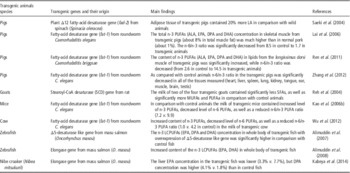
Most studies concerning the application of the methods of genetic engineering to modify the lipid composition of meat are carried out on pigs (Table 1). One of the first of this kind of experiment is a spectacular example of transgenesis in which a plant transgene was introduced into the genome of a mammal. Thus, Saeki et al. (Reference Saeki, Matsumoto, Kinoshita, Suzuki, Tasaka, Kano, Taguchi, Mikami, Hirabayashi, Kashiwazaki, Hosoi, Murata and Iritani2004) generated, through microinjection of foreign (plant) DNA to the pronuclei of zygotes, transgenic pigs that expressed the Δ12 fatty-acid desaturase gene (fad-2) from spinach (Spinacia oleracea). This enzyme is necessary for the synthesis of LA (C18:2 n-6) and ALA (C18:3 n-3), which are necessary for normal growth and development. LA and ALA are not synthesised in mammals and must be provided in the diet, whereas they can be produced in plants, in which Δ12 fatty-acid desaturase has the ability to catalyse the conversion of oleic acid to LA or ALA. Genomic DNA analysis revealed that among 70 farrowed piglets, six (9%) were transgenic and three of them survived (two males and one female). The transgenesis significantly affected the fatty-acid composition of lipids in tissues of modified pigs, that is the white adipose tissue of transgenic pigs contained 20% more LA in comparison with wild pigs. As stressed by the authors, the results of their study demonstrated the functional expression of a plant gene for a fatty-acid desaturase in mammals, opening prospects of modifying the lipid composition of animal-origin products using transgenic technology (Saeki et al., Reference Saeki, Matsumoto, Kinoshita, Suzuki, Tasaka, Kano, Taguchi, Mikami, Hirabayashi, Kashiwazaki, Hosoi, Murata and Iritani2004). Since the authors produced four transgenic pigs of the third generation farrowed by a transgenic female, and all of them grew to a fertile age, their results indicated that it is a possibility to transferring desaturase transgene to subsequent generations. However, it should be emphasized, that functional expression of a desaturase gene was achieved in this study only in white adipose tissue which is rather irrelevant from the prospect of eating of transgenic meat, as well as that transgenic founder female pig became agalactic and was unable to support piglets.
Results of selected experimental studies concerning the use of genetic engineering techniques (transgenesis) to improve the lipid composition in meat, milk and fish products

LA=linoleic acid; PUFA=polyunsaturated fatty acid; ALA=α-linolenic acid, EPA=eicosapentaenoic acid; DPA=docosapentaenoic acid; DHA=docosahexaenoic acid; SFA=saturated fatty acid; MUFA=monounsaturated fatty acid; n-3 LCPUFAs=long-chain n-3 polyunsaturated fatty acids.
The aim of a subsequent study (Lai et al., Reference Lai, Kang, Li, Wang, Wilt, Yong, Hao, Wax, Murphy, Rieke, Samuel, Linville, Corte, Evans, Starzi, Prather and Dai2006) was to create a generation of cloned pigs expressing a humanised roundworm C. elegans fat-1 gene that encodes n-3 fatty-acid desaturase. The fat-1 transgene was transfected by electroporation into early-passage male primary foetal fibroblast cells that were used to clone fat-1 transgenic pigs by nuclear transfer (Lai et al., Reference Lai, Kang, Li, Wang, Wilt, Yong, Hao, Wax, Murphy, Rieke, Samuel, Linville, Corte, Evans, Starzi, Prather and Dai2006). Of 10 live piglets obtained using this method, six were positive for the fat-1 transgene. It should be mentioned, however, that three of the transgenic piglets developed symptoms of heart failure, which, according to the authors, was probably a function of the cloning process (incomplete nuclear reprogramming) rather than the effect of the fat-1 transgene. Analysis of body lipids confirmed desaturase expression in transgenic piglets, which led to a substantial increase in n-3 PUFAs content. Thus, the total n-3 PUFAs (ALA, EPA, DPA and DHA) concentration in skeletal muscle from modified pigs was very high (about 8%) in total muscle fat, which was much higher than in normal pork (about 1%) and was rather similar to values obtained in marine fish. At the same time the n-6/n-3 ratio significantly decreased (P<0.001) from 8.52 in control piglets to 1.69 in transgenic animals. Since the n-6 PUFAs concentration was lower in transgenic pigs, the total PUFAs content was not increased in these animals, which is an important point, as elevated total PUFAs is a factor negatively affecting pork quality. As the authors concluded, the generation of fat-1 pigs can be an economical and sustainable strategy to produce healthy, n-3 LCPUFAs-enriched food, as well as providing a substantial animal model to study the role of n-3 PUFAs in the prevention of different lifestyle disorders (Lai et al., Reference Lai, Kang, Li, Wang, Wilt, Yong, Hao, Wax, Murphy, Rieke, Samuel, Linville, Corte, Evans, Starzi, Prather and Dai2006). The next stage of research work with transgenic pigs was the successful cloning of a pig that contained the fat-1 gene. Ten clones with significantly decreased n-6/n-3 PUFAs ratios in meat lipids in comparison with control animals (2.8 v. 13.5, respectively) were obtained in this way (Li et al., Reference Li, Lai, Wax, Hao, Murphy, Rieke, Samuel, Linville, Korte, Evans, Turk, Kang, Witt, Dai and Prather2006). Similar positive effects of this kind of transgenesis on the lipid composition of tissues of transgenic pigs were found by Zhang et al. (Reference Zhang, Zhang, Dou, Yin, Chen, Pang, Vajta, Bolund, Du and Ma2012) using ‘hand-made’ cloning. Pan et al. (Reference Pan, Zhang, Zhou, Feng, Long, Liu, Wang, Zhang, Ling, Dong, Wang, Xu and Chen2010) created, by somatic cell nuclear transfer, transgenic pigs carrying a synthesised fatty-acid desaturase-1 gene (sFat-1) from another roundworm species, C. briggsae. Ren et al. (Reference Ren, Zheng, Chen and Li2011) aimed at determining whether the fat-1 gene from C. briggsae could be functionally expressed in transgenic pigs. A gene construct was injected into embryos by pronucleus microinjection and first generation transgenic pigs created in this way were mated with wild pigs to produce the next generation. Transgenesis significantly affected the lipid profile of first generation animals; thus the n-6/n-3 ratio decreased from 14.53 in the control to 2.62 in fat-1 transgenic pigs (Ren et al., Reference Ren, Zheng, Chen and Li2011). A generation of cloned pigs expressing the fat-1 gene from C. briggsae and encoding n-3 fatty-acid desaturase was obtained by Zhou et al. (Reference Zhou, Lin, Wu, Feng, Long, Xiong, Wang, Pan and Chen2014). Analysis of lipid profiles demonstrated the functional expression of the desaturase transgene; thus first generation transgenic pigs produced high levels of n-3 PUFAs, which led to a significantly reduced n-6/n-3 PUFA ratio.
The goal of a study by Richards et al. (Reference Richards, Kathirvel, Gong, Lopez-Hernandez, Walters and Prather2011) was to evaluate fatty-acid composition and oxidation indices in the meat of transgenic fat-1 pigs. Their results demonstrated that the loin meat of fat-1 animals was a rich source of desirable n-3 LCPUFAs (EPA, DPA, DHA) and contained about five times the amounts of these acids in comparison with the control group. At the same time there was no clear effect of fat-1 technology leading to changes in fatty-acid profile on lipid oxidation stability of meat (values of lipid peroxide and thiobarbituric acid reactive substances) during storage (Richards et al., Reference Richards, Kathirvel, Gong, Lopez-Hernandez, Walters and Prather2011).
The potential negative influence of transgenesis on the health and welfare of farm animals is an important issue in genetic engineering studies (Van Reenen et al., Reference Van Reenen, Meuwissen, Hopster, Oldenbroek, Kruip and Blokhuis2001; Greger, Reference Greger2011). Tang et al. (Reference Tang, Zheng, Cheng, Jin, Chen, Yang, Cui and Li2011) evaluated the effects of the expression of fat-1 genes on the health status of pigs and on the safety of the environment from the angle of changes in the intestinal population of microbial flora. The results showed that the microbe population in different parts of the intestinal tract and faeces of fat-1 transgenic pigs was unchanged compared with control animals; nor could the transgene sequence be detected in the DNA of bacteria. The authors concluded that the population of intestinal microbial flora was not influenced by the expression of the foreign fat-1 gene in pigs. At the same time they indicated that transgene drifting from animal to microbial genomes must be a rare incident (Tang et al., Reference Tang, Zheng, Cheng, Jin, Chen, Yang, Cui and Li2011). The results of a subsequent study by these authors indicated that there is no possibility of integration and insertion of the foreign fat-1 gene in transgenic pigs into the genome of wild nontransgenic pigs by suckling or mating (Tang et al., Reference Tang, Zheng, Hou, Qian, Jiang, Cui and Li2013). Recently Sun et al. (Reference Sun, Sun, Ma, Liu, Min, Pan, Qin, Shen and Li2014) reported that the proliferation and apoptosis of Boer-goat-cultured foetal fibroblasts were not affected, while the senescence of goat somatic cells was inhibited, by overexpression of the fat-1 transgene.
Transgenes that may favourably alter the lipid composition of livestock meat are sought not only in the genomes of other animal species, but also among different species of fungi and plants. For example, the sdd17 gene, recently isolated from cells of the fungus Saprolegnia diclina, is associated with hope for its effective use in livestock transgenesis. A product of the expression of this gene is an enzyme (a specific Δ17 fatty-acid desaturase), which catalyses the conversion of AA to EPA. The consequence of this process is an increase in the content of n-3 LCPUFAs at the expense of n-6 LCPUFAs. The results of the study with cell cultures showed that the degree of sdd17 transgene expression in mammals can be very high (Chen et al., Reference Chen, Zhang and Gou2010). Transformed cells, in comparison with control cells, had a much higher content of EPA (by 82% to 100%) and reduced n-6/n-3 PUFA ratios (from 4 : 1 in control cells to 1.5 : 1 in sdd17-transformed cells).
A similar experiment was carried out with fad-3 n-3 fatty-acid desaturase from scarlet flax (Linum grandiflorum) (Indo et al., Reference Indo, Tatemizo, Abe, Suzuki, Matsumoto, Hosoi, Kinoshita, Mikami, Murata, Iritani and Saeki2009). The foreign desaturase transgene was introduced into bovine muscle satellite cells, which differentiated into adipocytes. The amounts of n-3 PUFAs, that is ALA, DPA and DHA, in transfected adipocytes were significantly higher, and n-6 PUFAs and the n-6/n-3 PUFA ratio lower, than those in non-transfected adipocytes. Moreover, the authors generated, by somatic cell nuclear transfer, bovine cloned embryos from fad-3 satellite cells (Indo et al., Reference Indo, Tatemizo, Abe, Suzuki, Matsumoto, Hosoi, Kinoshita, Mikami, Murata, Iritani and Saeki2009). Their findings, that is the functional expression of a plant fad-3 gene in mammalian adipocytes, and normal development of cloned embryos carrying this transgene, may be used in the future to create transgenic livestock containing high levels of n-3 LCPUFAs in body tissues.
The composition of lipids in muscle tissue in livestock can also be significantly affected by transgenesis whose main objective is to improve the growth performance of animals. This includes, for example, transgenic pigs whose genomes are supplemented with the bovine growth hormone (somatotropin) transgene. Apart from the basic effect of this transgene in the organism, that is improvement of BW gain and feed conversion ratio in somatotropin-overexpressed pigs, the carcasses of transgenic pigs contained a much lower level of fat (by 64% to 85%) than control animals (Pursel and Solomon, Reference Pursel and Solomon1993; Solomon et al., Reference Solomon, Pursel, Campbell and Steele1997). Moreover, the lipids of carcasses of transgenic animals consisted of 85% less saturated fatty acids (SFAs), 91% less monounsaturated fatty acids (MUFAs), and 66% less polyunsaturated fatty acids (PUFAs). It should be stressed that the SFA : MUFA : PUFA ratio in lipids of transgenic pigs was 1 : 1 : 1, that is close to the optimal values recommended by the National Research Council (NRC), (1988).
Modifications of the composition of milk lipids
The most frequent objective of genetic modification of the mammary glands of farm animals is to express foreign, biologically important proteins, for instance human lysozyme in milk (Maga and Murray, Reference Maga and Murray1995; Cooper et al., Reference Cooper, Klobas, Maga and Murray2013; Lu et al., Reference Lu, Li, Wu, Shang, Liu, Wen, Li, Wu and Li2014). However, for some time there has also been increasing interest in using transgenic techniques to modify the composition of the lipid fractions of milk, as well as to reduce milk’s overall fat content through inactivation of the genes responsible for the synthesis of lipids in the mammary gland.
Compared with other animal fats, milk fat contains a relatively high level of SFAs, which, from the point of view of dietary value, is an unfavourable property of this product. The results of some epidemiological studies indicate that the high content of SFAs in the human diet may be one of the factors in the increase in blood cholesterol levels, atherosclerosis and coronary artery disease (Hu et al., Reference Hu, Manson and Willett2001; Kromhout et al., Reference Kromhout, Menotti, Kestleloot and Sans2002). At the same time, dairy products, due to their popularity, are a very important source of SFAs in the human diet. For example, it has been shown that as much as 30% of the total quantity of these acids present in the food on US market comes from milk and milk products (Havel, Reference Havel1997). For this reason, increased attention is being paid to the possibility of a reduction of SFA content in milk fat and its replacement by PUFAs, especially n-3 LCPUFAs. Moreover, milk is a particularly good target for this kind of modification, because milk fat is dispersed in the form of very small micelles, which leads to high bioavailability of active substances, including n-3 LCPUFAs.
Under normal conditions, cow’s milk lipids are formed of ~75% SFAs (C12:0, C14:0, C16:0), 21% MUFAs (mainly C18:0), and 4% PUFAs (mainly C18:2 and C18:3) (Mansbridge and Blake, Reference Mansbridge and Blake1997). This composition of fat, resulting from the specific transformation of feed lipids in rumen, is inconsistent with nutritional recommendations. According to the suggestions of some authors, ideally, nutritional milk fat would contain 10% PUFAs, 8% SFAs and 82% MUFAs (Grummer, Reference Grummer1991). Owing to the rumen microbial processes of biohydrogenation of dietary unsaturated fatty acids, leading to a substantial reduction in their supply in the milk gland (Jenkins et al., Reference Jenkins, Wallace, Moate and Mosley2008), significant lipid modification of milk can hardly be achieved solely by modification of cows’ diet. Therefore, as an alternative approach, there is an interest in using genetic engineering methods for this purpose.
The first studies aimed at modifying milk lipids in farm animals through transgenesis were carried out on goats. In experimental conditions, goats, due to their small size and short reproductive cycle, are relatively cheap and convenient objects of biotechnological studies whose results can be used successfully as a model for dairy cows. Reh et al. (Reference Reh, Maga, Collette, Moyer, Conrad-Brink, Taylor, DePeters, Oppenheim, Rowe, BonDurant, Anderson and Murray2004) created transgenic goats expressing a rat stearoyl-CoA desaturase (SCD) gene in the epithelial cells of the mammary gland. The SCD enzyme catalyses the formation of double bonds between 9 and 10 carbon atoms of certain SFAs, and therefore is responsible for the conversion of these acids to MUFAs. The analysis showed that this transgenesis significantly affected the fatty-acid profile of milk lipids without influencing the total amount of fat in milk. Thus, the milk fat of transgenic goats expressing the SCD rat gene in the mammary gland contained decreased concentrations of SFAs, while levels of MUFAs and CLAs rose. Thus, as indicated by the authors, such milk may have benefits for human cardiovascular health (Reh et al., Reference Reh, Maga, Collette, Moyer, Conrad-Brink, Taylor, DePeters, Oppenheim, Rowe, BonDurant, Anderson and Murray2004). The results of an in vitro study by Wu et al. (Reference Wu, Li and Gou2010) showed that the foreign SCD1 transgene could be expressed in transformed mammalian cell lines with high efficiency and induced elevated CLA isomers and n-7 MUFA (palmitoleic and cis-vaccenic acid) levels in mammalian cells.
The next step of the research work on transgenic modification of milk fat was to increase the level of n-3 LCPUFAs in milk. In a model experiment, Kao et al. (Reference Kao, Lewis, DePeters and Van Eenennaam2006b) created fat-1 transgenic mice expressing the C. elegans n-3 desaturase under the control of a lactation-induced goat β-casein mammary gland promoter via pronuclear microinjection. The milk of modified mice was characterised by improved lipid composition, that is it contained significantly increased levels of n-3 PUFAs, as well as decreased levels of n-6 PUFAs and a reduced n-6/n-3 PUFA ratio. The authors also evaluated the postnatal influences of n-3 PUFA-enriched milk, by analysing the growth, as well as brain and plasma lipid composition, of mouse pups raised on milk from transgenic mice (Kao et al., Reference Kao, DePeters and Van Eenennaam2006a). There were no significant differences in the weights of the pups, but weanlings raised on milk from transgenic dams had increased concentrations of EPA, DPA and DHA in plasma lipids, and ALA, DPA and DHA in brain lipids. Results of a study by Pohlmeier et al. (Reference Pohlmeier, Hovey and van Eenennaam2011) demonstrated, however, that expression of the fat-1 transgene in the mammary gland of mice can negatively affect female reproduction. Thus, the litter size of transgenic fat-1 females was significantly smaller in comparison with wild controls. At the same time, fat-1 mice have normal ovulation and fertilisation rates. However, fewer embryos in the uterus before implantation and an increased incidence of post-implantation foetal resorptions were observed in transgenic females. Furthermore, surgical removal of the mammary glands increased the subsequent number of implantation sites, but did not affect the high rate of post-implantation resorptions (Pohlmeier et al., Reference Pohlmeier, Hovey and van Eenennaam2011).
A cloned transgenic cow expressing a fat-1 transgene from C. elegans and encoding an n-3 fatty-acid desaturase was generated by Wu et al. (Reference Wu, Ouyang, Duan, Pang, Zhang, Yuan, Xue, Ni, Cheng, Dong, Wei, Li, Yu, Sun, Chen, Lai, Dai and Li2012). The transgenic cow was healthy, and after artificial insemination became pregnant and delivered a healthy calf naturally. The results of fatty-acid analysis of tissue and milk showed that n-3 PUFAs in the transgenic cow were greatly increased, while n-6 PUFAs were significantly decreased. Simultaneously, fat-1 gene expression substantially reduced the n-6/n-3 PUFA ratio in tissue and milk. As the authors concluded, their results demonstrated that the transgenic fat-1 cow was characterised by normal reproduction and gave milk with improved fatty-acid composition, which might become an economically efficient approach to meet the increasing human demand for n-3 PUFAs (Wu et al., Reference Wu, Ouyang, Duan, Pang, Zhang, Yuan, Xue, Ni, Cheng, Dong, Wei, Li, Yu, Sun, Chen, Lai, Dai and Li2012).
Production of therapeutic proteins is an important goal of transgenic modification of the mammary gland. Baldassarre et al. (Reference Baldassarre, Hockley, Olaniyan, Brochu, Zhao, Mustafa and Bordignon2008) reported, that transgenic goats expressing high levels of recombinant human butyrylcholinesterase were found to have significantly decreased short-chain fatty acids and PUFAs, along with increased SFA concentrations in milk lipids, suggesting overall metabolic stress and reduced expression of such key enzymes as fatty-acid synthase and stearoyl-CoA desaturase.
Modifications in the composition of fish
Fish are animals on which research projects related to genetic modifications using transgenesis techniques have been performed with great intensity for many years. Genetic modifications of fish are most commonly associated with improvement of their production or health characteristics, for example an increase in tolerance to low temperatures or increased resistance to certain viral (bacterial) diseases. The most common fish transgenesis is the improvement of growth performance by the introduction of foreign growth hormone (somatotropin) transgenes to fish genomes (Forabosco et al., Reference Forabosco, Löhmus, Rydhmer and Sundström2013). An additional effect of this modification is the alteration of the chemical composition of meat, including the total fat content. An example is a transgenic carp (Cyprinus carpio) containing a growth hormone transgene from a rainbow trout. Chemical analysis showed that compared with control animals, the content of crude fat was significantly lower in the body of the transgenic carp, while the profile of fatty acids in lipids of muscle tissue remained unaltered (Chatakondi et al., Reference Chatakondi, Lovell, Duncan, Hayat, Chen, Powers, Weete, Cummins and Dunham1995; Dunham et al., Reference Dunham, Chatakondi, Nichols, Kucuktas, Chen, Powers, Weete, Cummins and Lovell2002). The trend towards reductions in the level of fat in the meat was also confirmed in the case of an Atlantic salmon (Salmo salar) created by the introduction of a growth hormone transgene (Cook et al., Reference Cook, McNiven, Richardson and Sutterlin2000). The lower lipid content in a growth-enhanced transgenic fish is probably due to a higher rate of metabolism and increased requirements for energy, which results in increased rate of use of fat reserves. Sugiyama et al. (Reference Sugiyama, Takenaga, Kitani, Yamamoto, Okamoto, Masaoka, Araki, Nagoy and Mori2012) reported a significant beneficial influence of growth hormone transgenesis on liver fatty-acid composition in Amago salmon (Oncorhynchus masou ishikawae); thus transgenic fish had decreased contents of SFAs and MUFAs, as well as an increased content of PUFAs, among others EPA and DPA. The impact of an enhanced metabolism rate on lipid changes was also evident in the case of a transgenic tilapia (Oreochromis hornorum) containing foreign growth hormone, with a significantly reduced cholesterol concentration in its blood serum Martínez et al. (Reference Martínez, Arenal, Estrada, Herrera, Huerta, Vázquez, Sanchez and de la Fuente1999). According to the authors, this effect of transgenesis can be linked to an increase in the use of cholesterol in the process of cell membrane synthesis, occurring due to the accelerated rate of mitotic cell division in growth-enhanced fish Martínez et al. (Reference Martínez, Arenal, Estrada, Herrera, Huerta, Vázquez, Sanchez and de la Fuente1999).
Oily saltwater fish consuming natural feed, for instance zooplankton crustaceans, are a rich source of n-3 LCPUFAs in the human diet, as well as in animal feeding. However, due to overfishing and decline of natural resources, the importance of the production of farmed fish has grown considerably in past years (Goldburg and Naylor, Reference Goldburg and Naylor2005). In aquaculture, for economic reasons, relatively cheap vegetable oils are used as a primary dietary fat source, mainly rapeseed and soyabean oil. These oils are characterised by relatively high levels of LA and ALA, but do not contain EPA and DHA (Rasmussen and Morrissey, Reference Rasmussen and Morrissey2007). Conversion of dietary ALA to n-3 PUFAs may occur in fish in the processes of elongation and desaturation by enzymatic elongase and desaturase pathways involved in EPA and DHA synthesis. However, in fish, as in other vertebrates, this conversion, especially in marine species, is limited, mainly due to the insufficient efficiency of desaturase activity. Therefore, the body lipids of farmed fish fed diets supplemented with vegetable oils contain significantly less EPA and DHA than the meat of wild fish of the same species (Bell et al., Reference Bell, McEvoy, Tocher, McGhee, Campbell and Sargent2001). Thus, transgenesis techniques aimed to overexpress enzymes synthesising n-3 LCPUFAs in fish can greatly increase the dietetic value of the meat from farmed fish.
Model studies on fish transgenesis for the improvement of fatty-acid profiles of fish body lipids were carried out in Japan (Alimuddin et al., Reference Alimuddin, Kiron, Satoh and Takeuchi2005 and Reference Alimuddin, Kiron, Satoh and Takeuchi2007). In the first experiment, a gene construct containing the masu salmon Δ6 desaturase-like gene was introduced by microinjection to the genome of zebrafish (Danio rerio). Δ6 desaturase uses ALA as a substrate to produce, via insertion of a double bond, octadecatetraenoic acid, which can be converted to n-3 LCPUFAs. Overexpression of this transgene in modified zebrafish highly elevated body EPA (by a factor of 1.4) and DHA concentrations (by a factor of 2.1). Simultaneously, the content of ALA, being a substrate of Δ6 desaturase, decreased, while total lipids were not changed (Alimuddin et al., Reference Alimuddin, Kiron, Satoh and Takeuchi2005). The authors indicated that their results demonstrated the possibility of beneficial modification of the fatty-acid metabolic pathway in fish through the transgenic technique. The next step of these model studies was to introduce masu salmon Δ5 desaturase (i.e. an enzyme that is active at a later point in the n-3 PUFA metabolic pathway) transgene to the zebrafish genome (Alimuddin et al., Reference Alimuddin, Kiron, Satoh and Takeuchi2007) to enhance the efficacy of EPA and DHA synthesis. Δ5 desaturase has the ability to insert a double bond in eicosatetraenoic acid (C20:4 n-3) to generate EPA and subsequently DHA. The results of this experiment showed that overexpression of this gene in transgenic fish modified the fatty-acid metabolic pathway and enriched meat lipids with n-3 LCPUFAs, that is significantly increased EPA and DHA content (Alimuddin et al., Reference Alimuddin, Kiron, Satoh and Takeuchi2007). Subsequent work by this group of authors concerned the use of the transgenic technique to overexpress an elongase gene, encoding specific elongase (Elovl5), isolated from masu salmon in model zebrafish (Alimuddin et al., Reference Alimuddin, Satoh, Takeuchi and Yoshizaki2008). Chemical analysis showed that the muscles of transgenic fish contained considerably higher levels of EPA and DHA compared with control fish (Alimuddin et al., Reference Alimuddin, Satoh, Takeuchi and Yoshizaki2008). Summing up the findings of this series of model studies, it ought to be stressed that masu salmon desaturases and elongase transgenes were functional in zebrafish and were able to beneficially alter the species’ fatty-acid metabolic pathway, suggesting that this technology might be used to modify farmed fish to produce nutritionally improved, healthy meat for human consumption (Alimuddin et al., Reference Alimuddin, Kiron, Satoh and Takeuchi2005, Reference Alimuddin, Kiron, Satoh and Takeuchi2007 and Reference Alimuddin, Satoh, Takeuchi and Yoshizaki2008).
The objective of a recent study by Kabeya et al. (Reference Kabeya, Takeuchi, Yamamoto, Yazawa, Haga, Satoh and Yoshizaki2014) was to generate a transgenic marine fish, the nibe croaker (Nibea mitsukurii), expressing a foreign elongase (Elovl2) gene isolated from masu salmon. As the authors indicated, saltwater fish are generally unable to synthesise sufficient quantities of n-3 LCPUFAs for their normal growth, as the key fatty-acid-metabolising enzymes in the EPA and DHA production pathway are limited, so they hypothesised that transgenic marine species expressing these enzymes could be reared without dietary supplementation with fish oil. The results showed that the overexpression of elongase transgene significantly modified fatty-acid metabolic pathways in fish; however, these changes were rather inconclusive, as liver EPA concentration in the transgenic fish was lower, while DHA concentration was higher, compared with non-transgenic animals (Kabeya et al., Reference Kabeya, Takeuchi, Yamamoto, Yazawa, Haga, Satoh and Yoshizaki2014).
Conclusions
Foods of animal origin are a very important source of nutrients in the human diet. One of the main objectives of livestock production is undoubtedly to ensure the optimal (for consumers’ health) chemical composition of animal-origin food, mainly the fatty-acid composition of lipids. The purpose of modifying the composition of lipids, particularly in meat and milk, is to change the proportion of fatty acids, that is the enrichment of these products with n-3 LCPUFAs. Presently, such modifications on a production scale are performed by traditional nutritional methods, that is supplementation of animal diets with fats rich in n-3 PUFAs. In the past 20 years many studies have been successfully completed on the application of modern techniques of genetic engineering, mainly transgenesis, to enrich animal-origin products with n-3 LCPUFAs. These studies are still at the laboratory stage, but their results have demonstrated that the transgenesis of pigs, cows, goats and fish can be used in the future as efficient methods of production of healthy animal-origin food of high dietetic value. However, the introduction of this technology to commercial animal production and markets seems to be a distant prospect. Owing to a number of difficulties of a technical nature, animal transgenesis, compared with the production of transgenic plants, is more complicated and costly, as well as less efficient. It should be also stressed that transgenesis that is used strictly for medical purposes, such as production of organs for xenotransplantation, is much better accepted by public opinion than modifications leading to increased dietetic value for animal-origin products.
Acknowledgement
This paper was prepared as a part of statutory activity of National Research Institute of Animal Production, Poland.