Introduction
Lecideaceae Chevall. was originally introduced as a family based on crustose or squamose thalli and apothecia lacking a thalline margin. The family initially included all crustose lecideoid genera (Chevallier Reference Chevallier1826) but it now comprises only genera with lecideine apothecia, simple hyaline ascospores and a Lecidea- or Porpidia-type ascus structure (Fryday & Hertel Reference Fryday and Hertel2014).
The genus Lecidea Ach., first described by Acharius (Reference Acharius1803), includes most of the species in the family Lecideaceae and over time has undergone many systematic changes. More than 1200 species with an extraordinarily wide circumscription were included in Lecidea by Zahlbruckner (Reference Zahlbruckner, Engler and Prantl1926) but most of these species have been moved to other genera during the past few decades (e.g. Hertel Reference Hertel1967, Reference Hertel1977, Reference Hertel, Lackovičová, Guttová, Lisická and Lizoň2006; Hafellner Reference Hafellner1984). Lecidea s. lat. comprises 427 species (Kirk et al. Reference Kirk, Cannon, Minter and Stalpers2008), but only slightly more than 100 species (all saxicolous) are now included in the genus Lecidea s. str. on the basis of specific anatomical diagnostic characters, especially the existence of a Lecidea-type ascus (Hertel Reference Hertel1977, Reference Hertel, Lackovičová, Guttová, Lisická and Lizoň2006; Hertel & Printzen Reference Hertel, Printzen, Nash, Ryan, Diederich, Gries and Bungartz2004). Saxicolous ‘lecideoid’ lichens (Hertel Reference Hertel1984) are genera and species usually described originally under the generic name Lecidea sensu Zahlbruckner (Reference Zahlbruckner1925) and comprise crustose species with apothecia lacking a thalline margin and with hyaline, non-septate ascospores (Ruprecht et al. Reference Ruprecht, Fernández-Mendoza, Türk and Fryday2020). Of the more than 100 taxa belonging to the genus Lecidea s. str., 21 species have been reported in China (Paulson Reference Paulson1925; Magnusson Reference Magnusson1940; Lamb Reference Lamb1963; Hertel Reference Hertel1977; Hertel & Zhao Reference Hertel and Zhao1982; Abbas & Wu Reference Abbas and Wu1998; Aptroot & Sparrius Reference Aptroot and Sparrius2003; Obermayer Reference Obermayer2004; Guo Reference Guo and Zhuang2005; Zhang et al. Reference Zhang, Wang, Sun and Zhao2010, Reference Zhang, Wang, Wang and Zhao2012; Hu et al. Reference Hu, Zhao, Sun, Zhao and Zhang2014; Zhao et al. Reference Zhao, Zhao, Miao, Ren and Zhang2017; Jiamahat & Mamut Reference Jiamahat and Mamut2019; Wei Reference Wei2020), most species having been identified by morphological features and the secondary metabolites produced.
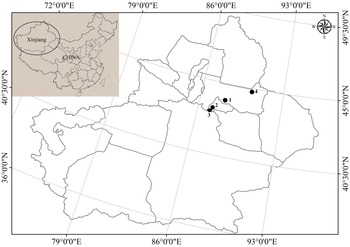
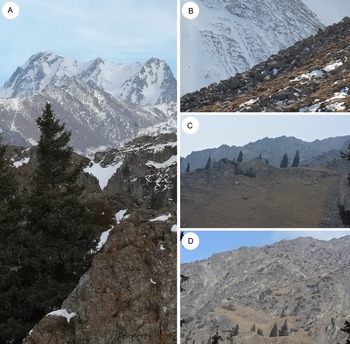
Processes that shape biogeographical patterns in lichens have been of long-standing interest, especially in extreme environments (Hale et al. Reference Hale, Fisher, Keuler, Smith and Leavitt2019). Lecideoid lichen species are abundant in extreme environments in the Tianshan Mountains. During revisionary work on Lecideaceae in the Tianshan No.1 Glacier and Bogeda Peak, and its surroundings in the southern part of the Tianshan Mountains, one species was found to be distributed widely in the study area (Figs 1 & 2). According to the results of morphology, chemistry and molecular data, this species is recognized as a new taxon in Lecidea s. str.
Location of collection sites in Xinjiang Province, China. 1, Bogeda Peak. 2, Yingxiong Bridge. 3, Tianshan No. 1 Glacier. 4, Jiangbulake.

Habitats of Lecidea glacierensis. A, south rim of Bogeda Peak in Fukang. B, alpine meadow in Yingxiong Bridge, Houxia County. C, rocky slopes adjacent to Tianshan No. 1 Glacier, Urumqi. D, steep slopes in Jiangbulake scenic spot. In colour online.

Material and Methods
Morphological and anatomical studies
Specimens of the new species Lecidea glacierensis were collected from the eastern Tianshan Mountains of Xinjiang, China, at an altitude of 1700–3700 m. Climatic and environmental conditions for the sampled specimens of this species are harsh and windy, with the temperature often below freezing. Thallus sections were investigated in water. Apothecial characteristics of hand-cut sections mounted in water were studied by light microscopy and measurements of ascospores and the epihymenium, hymenium, subhymenium, hypothecium and exciple were made in distilled water using a Nikon Eclipse E200 microscope. Amyloid reactions were studied in Lugol's solution both with and without prior treatment with 10% KOH (K). The adherence and structure of the paraphyses were observed in K. The distribution of crystals in the apothecial sections was studied with 25% KOH. The specimens examined are stored at XJU (Lichen Research Center in Arid Zones of Northwest China).
Chemical studies
Spot tests were performed in K, 15% HCl (H), 50% HNO3 (N) or 0.15% aqueous IKI. Thallus sections were investigated in water and K under a dissecting microscope. Acetone extracts of the thallus were analyzed by thin-layer chromatography (TLC) in solvent systems B and C (Orange et al. Reference Orange, James and White2010) and high-performance liquid chromatography (HPLC) was also performed to identify the secondary metabolites present (Feige et al. Reference Feige, Lumbsch, Huneck and Elix1993).
DNA isolation, PCR amplification and sequencing
Two or three apothecia were used for DNA extraction from each specimen. Whole genomic DNA was extracted using the DNeasy Plant Mini Kit (Qiagen, Hilden, Germany), following the manufacturer's protocol. The ITS region was amplified and sequenced using the specific primers ITS1F (CTT GGT CAT TTA GAG GAA GTA A) (Gardes & Bruns Reference Gardes and Bruns1993) and ITS4 (TCC GCT TAT TGA TAT GC) (White et al. Reference White, Bruns, Lee, Taylor, Innis, Gelfand, Sninsky and White1990). The PCR procedure was as follows: 94 °C for 4 min; 34 cycles of 94 °C for 30 s, 55 °C for 30 s and 72 °C for 1 min; and a final extension at 72 °C for 10 min (see Supplementary Material Table S1, available online). PCR products were directly sequenced by Sangon Biotech (Shanghai).
Phylogenetic analyses
DNA was extracted and the ITS region successfully amplified and sequenced for three specimens (20081647, 20091650a, 20091652), and the sequences assembled and edited in Geneious Prime v. 2019.0.4. Additional sequences of Lecidea were downloaded from GenBank based on nucleotide BLAST searches (Supplementary Material Table S2, available online). Multiple sequence alignment was performed using ClustalW (Thompson et al. Reference Thompson, Gibson, Plewniak, Jeanmougin and Higgins1997) and ambiguous alignments were removed manually. Maximum likelihood (ML) and Bayesian inference (BI) approaches were used for analyses. The ML analysis was implemented in RAxML-HPC BlackBox (v. 8.2.12) at https://www.phylo.org/ (Silvestro & Michalak Reference Silvestro and Michalak2012) with the selected model of substitution, rapid ML bootstrapping, 1000 pseudoreplicates and default settings for the other parameters. The BI calculation was performed using MrBayes v. 3.1.1 (Huelsenbeck & Ronquist Reference Huelsenbeck and Ronquist2001). The prior testing procedures were used to select the Bayesian model that fitted the model choice criteria (nst = 6, rates = gamma). Four Markov chains (MCMCs) were run for 2 000 000 generations starting with a random tree and trees were sampled every 1000 generations. After discarding the first 25% of sampled trees as burn-in, the remaining trees were used to calculate the posterior probabilities (PP) for internal branches. The trees were visualized with FigTree v.1.4.0.
Results
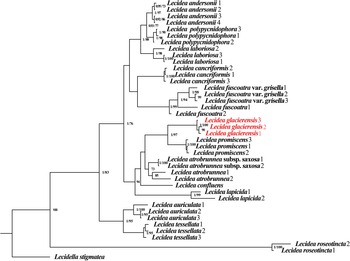
Three new sequences of the ITS locus were generated for the three specimens (see Supplementary Material Table S2, available online). The ITS matrix used in the ITS analysis consisted of a total of 40 sequences representing 14 aligned taxa and 550 nucleotide positions (Supplementary Material Table S2), with Lecidella stigmatea (Ach.) Hertel & Leuckert selected as the outgroup. The Bayesian consensus tree had the same topology as the ML tree produced by RAxML for both datasets. In the ITS phylogram, all L. glacierensis sequences clustered together with strong support (Fig. 3).
Maximum-likelihood (ML) and Bayesian phylogeny of Lecidea glacierensis and related species inferred from the ITS loci; outgroup is Lecidella stigmatea. Bayesian posterior probability (PP) and ML bootstrap values are indicated next to the branches (PP/ML). In colour online.

Taxonomy
Lecidea glacierensis A. Abbas & R. Mamut sp. nov.
MycoBank No.: MB 836099
Thallus occurs on calcareous rock and is whitish, esorediate to farinose, with a non-amyloid medulla and persistent, thin apothecial disc margin.
Type: China, Xinjiang, Urumqi, No. 1 Glacier, 43°07.253ʹN, 86°51.776ʹE, 2145 m alt., 5 October 2009, R. Mamut 20081647 (holotype—XJU). GenBank Accession numbers for the sequences of the type: MK590965 (ITS), MK591821(mtSSU), MK591017(nuLSU).
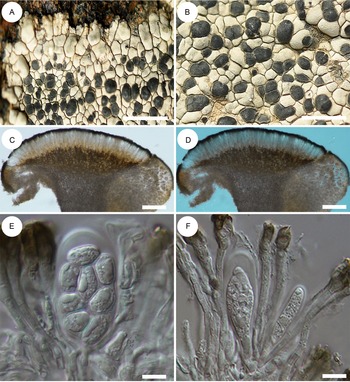
(Fig. 4)
Lecidea glacierensis (R. Mamut 20081647). A & B, thallus and apothecia. C, cross-section of apothecium. D, cross-section of apothecium viewed with polarized light microscopy. E, ascus. F, paraphyses. Scales: A = 6 mm; B = 3 mm; C & D = 200 μm; E = 10 μm; F = 15 μm. In colour online.

Thallus crustose, well developed, regularly areolate to bullate, prothallus distinct, black between areoles and at thallus margin; areoles inflated, swollen, regular to relatively regular, marginal lobes larger than those at the centre, 0.5–1 mm thick; surface whitish grey to bluish grey, rough, mostly esorediate, rarely producing mounds of farinose, granular whitish soredia in places; margins flexuous to lacerate. Upper cortex distinct, with brown granules, 20 μm thick; epinecral layer 20–25 μm thick; algal layer dense, distinctly differentiated, often weakly to strongly divided by narrow, somewhat cone-like hyphal bundles, narrowing downwards to lower side at edges and tips; photobiont green, trebouxioid. Medulla white, non-amyloid.
Apothecia black, immersed between the areoles, seldom overtopping the areoles and absent from near the thallus margin, regularly round, adnate, usually scattered but sometimes clustered, 0.4–1.5 mm diam.; disc plane to slightly convex, matt when young, glossy brown, epruinose to weakly pruinose; proper margin present, 60–150 μm thick, persistent, often raised above the disc. Exciple greenish black in section, composed of radiating hyphae, 10–90 μm wide, cortex similar to epihymenium; epihymenium olive green to dark brown, c. 20 μm thick; hymenium hyaline, 40–50 μm high, I+ blue; paraphyses coherent, unbranched or occasionally branched, slightly swollen at the apices. Subhymenium hyaline to slightly brownish, 35–45 μm thick. Hypothecium pale yellowish brown to dirty brown, 30–100 μm high. Asci Lecidea-type, 8-spored, clavate, moderately thick-walled. Ascospores simple, hyaline, rarely globose to often broadly ellipsoid, with oil droplets, (9–)10–13(–16) × (6.5–)7–9 μm.
Pycnidia not seen.
Chemistry
Thallus and medulla K−, C–, P– and N–. Confluentic acid and accessories detected by TLC and HPLC.
Etymology
The epithet ‘glacierensis’ refers to No. 1 Glacier in the Tianshan Mountains in Xinjiang, China, where the new species was mostly found and collected.
Ecology and distribution
The new species occurs on calciferous rock, often with Rusavskia elegans (Link) S. Y. Kondr. & Kärnefelt and Sporastatia testudinea (Ach.) A. Massal. In terms of distribution, L. glacierensis was collected from extreme environments in the southern part of the Tianshan Mountains. The No.1 Glacier is 4.8 million years old, dating back to the Third Glacial Age. The region is characterized as a layered valley with rock ledge, basins, cirques, and ‘sheep's back’ stones (roche moutonnee) that can be seen from a distance. The No. 1 Glacier is known as the ‘living fossil of glaciers’ and has become the best place to observe and study modern glaciers and ancient glacier remains in China. Bogeda Peak is the highest peak in the eastern section of the Tianshan Mountains, located in the hinterland of the Asian continent where the foothills are hot but the middle and high mountains are wet and cold. The peak is surrounded by desert, with Junggar Basin to the north and the Turpan Basin to the south. It is one of the youngest mountain ranges in the world, emerging from the sea during the orogenic movement 300 million years ago and from the Himalayan orogenic movement 60 000 to 70 000 years ago.
Additional specimens examined
China: Xinjiang Province: No. 1 Glacier, 1700 m, on rock, 2008, R. Mamut 20080704; ibid., 3530 m alt., on rock, 2008, R. Mamut 20081012, 20081013, 20081014; ibid., 2145 m, on rock, 2009, R. Mamut 20091647, 20092134; ibid., 1830 m, on rock, 2009, R. Mamut 20091650-a, 20091652; Yingxiong Bridge, 3596 m, on rock, 2009, R. Mamut 20092298; south rim of Bogeda Peak, 3350 m, on rock, 2018, R. Mamut 20180100; Jiangbulake, 2279 m, on rock, 2018, R. Mamut 20180118.
Discussion
Currently, Lecidea glacierensis is known only from the Tianshan Mountains in Xinjiang, China. It is characterized by a well-developed, regularly areolate to bullate thallus containing confluentic acid, and by its habitat on calciferous rocks. This combination of characters renders it morphologically and anatomically similar to other Lecidea species and some Porpidia Körber species, such as L. tessellata Flörke and P. speirea (Ach.) Kremp. Lecidea glacierensis could be confused with L. tessellata owing to its light grey areolae, well-developed thallus and broadly ellipsoid ascospores (Hertel & Printzen Reference Hertel, Printzen, Nash, Ryan, Diederich, Gries and Bungartz2004), but the new species differs by its bullate areoles and conspicuous apothecial margins. Lecidea glacierensis morphologically resembles L. lapicida (Ach.) Ach., with both species having ashy grey thalli, persistent marginated discs and ellipsoid ascospores, but L. lapicida has a thallus containing stictic acid and also has an amyloid (I+ violet) medulla (Hertel & Printzen Reference Hertel, Printzen, Nash, Ryan, Diederich, Gries and Bungartz2004; Zhang et al. Reference Zhang, Wang, Sun and Zhao2010). In having distinct margins, a well-developed black prothallus and sunken apothecia, Porpidia speirea is similar to L. glacierensis but can be differentiated by the occurrence of a Porpidia-type ascus and an amyloid medulla (Gowan Reference Gowan1989).
According to the phylogenetic analyses of the ITS sequences, Lecidea glacierensis forms a monophyletic clade and is clustered with L. atrobrunnea, L. atrobrunnea subsp. saxosa, L. confluens, L. lapicida, and L. promiscens Nyl. with high support. Lecidea promiscens (Hertel & Printzen Reference Hertel, Printzen, Nash, Ryan, Diederich, Gries and Bungartz2004) is distinguished by having a thinner rimose thallus with an amyloid medulla and L. atrobrunnea has a reddish brown thallus. Lecidea glacierensis and L. confluens both have a well developed, whitish grey thallus, but the ascospores of L. glacierensis are wider (Hertel & Andreev Reference Hertel and Andreev2003).
Acknowledgements
This research was supported by the National Natural Science Foundation of China (grants no. 31670023, 31750001, 31760052). We express our sincere thanks to Shou-Yu Guo (State Key Laboratory of Mycology, Institute of Microbiology, Chinese Academy of Sciences, Beijing, China) for his help in writing this paper. We are very grateful to Bruce Bartholomew (California Academy of Sciences) for discussion and critical comments on the manuscript, and helpful suggestions to improve this paper.
Author ORCID
Reyim Mamut, 0000-0001-8624-9584.
Supplementary Material
To view Supplementary Material for this article, please visit https://doi.org/10.1017/S0024282922000226.