


INTRODUCTION
It is well known that the evaluation and implementation of policy is an expensive process. Policymakers faced with finite budgets must therefore decide how to allocate their limited resources between activities associated with information acquisition or policy enactment.Footnote 1 This presents opportunities to special interest groups intent on influencing policy decisions.Footnote 2 Furthermore, policymaking is a sequential process such that by strategically supplying information and other resources at different stages, special interest groups may influence what policymakers learn and what policy actions they subsequently take. That interest groups exercise such multistage influence is well documented but only partially understood.
In the analysis that follows, we formally model lobby and policymaker resource constraints and their implications for the incentives to gather information and support policies. Our setup allows us to gain new insights into the strategic considerations that underlie legislative subsidies. Over and above the simple role of persuasion in lobbying, we are able to identify four additional distinct strategic motives for informational lobbying termed the salience, insurance, substitution, and commitment motives. This leads to several contributions. We are able to explain in which circumstances, in terms of their prior beliefs and resources, policymakers will gather information themselves or will rely on information supplied by a lobby. A lobby may provide information to policymakers because of a salience motive, where that information induces policymakers to consider a policy issue that they would otherwise ignore. The persuasion motive arises when the lobby supplies information to induce an immediate policy choice by the policymaker without any further information gathering, whereas the insurance motive occurs when the policymaker having received negative information from a lobby still gathers further information because the lobby is expected to provide a policy implementation subsidy. We show that the substitution motive may take one of two forms. First, because of resource constraints, the lobby knows that for its preferred policy to be implemented, it must supply either information or an implementation subsidy. Its choice is then motivated by the respective costs of the two actions. Second, the lobby’s and policymaker’s informational signals may differ in their precision and may also differ in their precision across states (so a status quo signal may be more or less informative than a reform one); lobbies will thus substitute their own information gathering for the policymakers if it is more likely to induce their preferred policy choice. The commitment motive illustrates how a resource-constrained lobby may strategically waste resources by engaging in, relatively uninformative, informational lobbying so as to be unable to offer a policy implementation subsidy. This deters a policymaker from gathering own information and induces the policymaker to make the lobby’s preferred policy choice.
Generally, by varying the policymaker’s and lobby’s resource constraints, we can show that a resource-constrained policymaker is more likely to gather information because of anticipated subsidies from the lobby, whereas the lobby is less likely to engage in informational lobbying because of greater combined costs of information and policy implementation. Overall, we demonstrate that the tempting casual intuition that being resource-rich is a strategic advantage for either a policymaker or lobby is incorrect.
Our analysis also allows us to make statements involving the frequency of correct policy decisions in equilibrium as compared with those that would be made under optimal information gathering. The equilibrium decision quality losses implied can then be quantified. We also provide explanations for when an interest group may lobby a friendly, opposing, or undecided policymaker. Finally, we are able to understand the circumstances when the provision of information and other types of resource transfers from a lobby to a policymaker are complements, substitutes, or independent and relate these to the five strategic informational lobbying motives.
The significance and implications of budget constraints have been recognized by Hall and Deardorff (Reference Hall and Deardorff2006) as well as Lessig (Reference Lessig2011) who points out how constrained policymakers rely heavily on support from lobbies to relax their own resource constraints and how interest groups become de facto “service bureaus” (Hall and Deardorff Reference Hall and Deardorff2006).Footnote 3 This reliance by policymakers on lobbies for resources seems to be growing and can be explained by increasing policy complexity and decreasing congressional capacity (Drutnam Reference Drutnam2015). Congressional capacity with respect to congressional staff has been declining as illustrated in Figure 1(a), and congressional workload has been constant with respect to the introduction and passage of bills but increasing in the number of votes and pages in the Federal Register, which hints at greater policy complexity.Footnote 4 There is also growing pressure on the resources legislators have available for policy evaluation and implementation because of the increasing costs of electoral competition fundraising (Daley and Snowberg Reference Daley and Snowberg2009).Footnote 5 On the other hand, lobbying spending, total and per lobbyist, has increased as documented in Figure 1(b).Footnote 6 Given these trends, it seems that lobbyists are increasingly involved in both making and implementing policies. For example, Mello, Abiola, and James (Reference Mello, Abiola and James2012) provide a case study of Merck’s extensive involvement in the U.S. policymaking process behind the introduction and mandating of vaccinations for the cervical cancer causing papillomavirus. This has proven to be very politically controversial. In an attempt to advocate for the vaccination and increase its profits, Merck provided significant policy-relevant information and other resources to policymakers. Its advocates lobbied policymakers, mobilized female legislators and physicians, drafted legislation, conducted marketing campaigns, and filled gaps in the provision of vaccinations. Within a year, 41 states and the District of Columbia introduced the vaccination and 24 states proposed legislative bills that would mandate the vaccination for teenage girls. Although there was concern about mandatory vaccination and Merck’s involvement, policymakers admitted that they mostly relied on Merck’s efforts and resources to change policies.
Congressional Capacity and Lobbying (a) Congressional Staff (b) Lobbying Resources

In this study, we focus on strategic transfers of information and other resources from an interest group to a policymaker. We distinguish between resources expended for gathering policy-relevant information such as research reports, polling and surveys, and testimonies, and those expended for making policies such as the costs of legislative drafting, gaining majorities, and following institutional protocols. Both the policymaker and interest group are assumed to face budget constraints. In the case of the interest group, resources may be spent on gathering information or for transfers to a policymaker.Footnote 7 The policymaker may spend resources (that may include transfers from the interest group) on information acquisition or policy implementation.Footnote 8 There is no presumption that the policymaker and interest group share common policy goals. We are also agnostic on whether a lobbyist gathers verifiable or nonverifiable information. Rather we apply an information structure which allows for a wide range of observed informational lobbying activities and captures either a lobby’s expertise in providing (truthful) information of a certain quality, or, a lobby’s credibility in a cheap-talk environment.
Our analysis highlights the strategic manipulation of legislative subsidies by interest groups when both they and the policymakers they lobby may face binding budget constraints. Policymakers require resources both to gather information and enact policies; they have initial priors over what policy is desirable and attach a level of salience to each policy issue (Baumgartner et al. Reference Baumgartner, Berry, Hojnacki, Kimball and Leech2009). Two basic forms of manipulation arise: For policymakers who do not initially favor the lobby’s preferred policy, but can be persuaded to do so by sufficient appropriate information, the lobby either supplies information directly or relaxes the policymakers’ budget constraint to induce them to gather information themselves. This implies that policymakers who ex post support the lobbies’ preferred policies were not necessarily ex ante “friends” (Hall and Deardorff Reference Hall and Deardorff2006; Hall and Miler Reference Hall and Miler2008). Surprisingly, a resource-constrained policymaker—although at a resource disadvantage initially—may actually gather own information for a wider range of beliefs. The policymaker, anticipating a policy implementation subsidy, bears de facto lower policy costs and takes advantage of the interest group’s incentives and gathers more costly information. For a policymaker who initially favors the lobby’s preferred policy, the lobby may manipulate the budget such that the policymaker cannot afford information that may change their position. The strategic incentive to waste resources by generating costly but relatively uninformative signals, and hence preventing the policymaker from strategically extracting resources to acquire information at a later stage, differs from the “money burning” incentive of enhancing credibility in models with costly signaling (Potters and van Winden Reference Potters and van Winden1992; Austen-Smith and Banks Reference Austen-Smith and Banks2000, Reference Austen-Smith and Banks2002) or gaining attention in models of costly access (Austen-Smith Reference Austen-Smith1995, Reference Austen-Smith1998; Lohmann Reference Lohmann1995; Cotton Reference Cotton2009, Reference Cotton2012; Cotton and Dellis Reference Cotton and Dellis2016), where the lobby’s expenditure is informative in equilibrium. Furthermore, our results provide a unifying explanation for the seemingly contradictory findings in the literature of whether interest groups lobby undecided, or unbiased, decision makers (Eggers and Hainmueller Reference Eggers and Hainmueller2009; Bertrand, Bombardini, and Trebbi Reference Bertrand, Bombardini and Trebbi2014), target opponents (Austen-Smith and Wright Reference Austen-Smith and Wright1994, Reference Austen-Smith and Wright1996; de Figueiredo and Cameron Reference de Figueiredo and Cameron2009), or target supporters (Kollman Reference Kollman1997; Hojnacki and Kimball Reference Hojnacki and Kimball1998; Mian, Sufi, and Trebbi Reference Mian, Sufi and Trebbi2013; Igan and Mishra Reference Igan and Mishra2014).Footnote 9
One of our model’s extensions highlights that if an interest group has to bear the cost of both information and policy implementation, then the lobby’s optimal strategy is to provide transfers to the policymaker in stages and not commit all resources up front as is common in costly access models (Austen-Smith Reference Austen-Smith1995, Reference Austen-Smith1998; Lohmann Reference Lohmann1995; Cotton Reference Cotton2009, Reference Cotton2012).Footnote 10 We also illustrate how informational lobbying and legislative subsidies arise endogenously and can be either substitutes (Bennedsen and Feldmann Reference Bennedsen and Feldmann2006; Dahm and Porteiro Reference Dahm and Porteiro2008a, Reference Dahm and Porteiro2008b, Groll and Ellis Reference Groll and Ellis2014, Reference Groll and Ellis2017), complements (Austen-Smith Reference Austen-Smith1995, Reference Austen-Smith1998; Lohmann Reference Lohmann1995; Cotton Reference Cotton2009, Reference Cotton2012), or independent.
Some studies of financial transfers appear to support the view that they constitute money-for-favors (Grossman and Helpman Reference Grossman and Helpman1994; Bennedsen and Feldmann Reference Bennedsen and Feldmann2006) or perhaps even outright bribery.Footnote 11 In our analysis, we show that these payments may involve subsidies that allow the policymaker to engage in information gathering that may then persuade the policymaker to adopt a policy favored by the lobby. The change in the policymaker’s position may then appear empirically as money-for-favors. We do not claim that money is nondistortionary, but rather that its role can be different from the one described by the money-for-favors view.
The other related literature that looks at the transfer of resources from lobbyists to policymakers may be divided into three general categories.Footnote 12 The first is associated primarily with Hall and Deardorff (Reference Hall and Deardorff2006) and considers transfers of information or other resources as “legislative subsidies,” whereby special interests subsidize the activities of policymakers with whom they share common interests (Hall and Wayman Reference Hall and Wayman1990; Hall Reference Hall1996). The idea being that this either permits the realization of the interest group’s desired policies or influences the policymaker to prioritize policies related to their common goals. In contrast to the more pessimistic traditional views of lobbying, this implies that such partnerships between policymakers and special interests enable time and resource-constrained policymakers to perform their public duties.Footnote 13 In a second strand, interest groups provide policymakers with information. Many of these models involve private, nonverifiable information and cheap-talk games with partitioning equilibria (Crawford and Sobel Reference Crawford and Sobel1982; Potters and van Winden Reference Potters and van Winden1992), costly signaling (Austen-Smith and Banks Reference Austen-Smith and Banks2000, Reference Austen-Smith and Banks2002), private but verifiable information (Milgrom and Roberts Reference Milgrom and Roberts1986; Bull and Watson Reference Bull and Watson2004, Reference Bull and Watson2007), or access-conditional information provision of nonverifiable or verifiable statements (Austen-Smith Reference Austen-Smith1995, Reference Austen-Smith1998; Lohmann Reference Lohmann1995; Cotton Reference Cotton2009, Reference Cotton2012; Cotton and Dellis Reference Cotton and Dellis2016; Schnakenberg Reference Schnakenberg2017). Finally, another strand of the literature focuses on lobbyists’ strategic considerations when supplying either information or financial resources to policymakers (Bennedsen and Feldmann Reference Bennedsen and Feldmann2006, Dahm and Porteiro Reference Dahm and Porteiro2008a, Reference Dahm and Porteiro2008b, Groll and Ellis Reference Groll and Ellis2014, Reference Groll and Ellis2017). Felli and Merlo (Reference Felli and Merlo2007) analyze interest groups’ trade-offs between providing financial transfers to candidates before and after elections. In their sequential lobbying process, interest groups make financial contributions to their initial supporters but then donate to elected opponents to induce a compromise. On the other hand, Schnakenberg and Turner (Reference Schnakenberg and Turner2019) analyze politicians’ strategies of how to signal to voters about special interest groups’ activities when there is an uncertainty about whether they are influenced by information or bribes.
We extend the idea of legislative subsidies and model a sequential lobbying process in which a lobby may subsidize both information gathering and policy implementation. Our informational lobbying setup allows for either private, nonverifiable information or private, verifiable information and recapitulates previous approaches. The lobby’s policy implementation subsidy may relax a policymaker’s resource constraint such that they then implement a costly policy or, since it is anticipated, incentivize the policymaker to gather information. We do not model money-for-favors in our analysis, but we will discuss at the end how policy subsidies may appear as money-for-favors and provide policy recommendations.
The studies closest to our own are Cotton and Dellis (Reference Cotton and Dellis2016) and Dellis and Oak (Reference Dellis and Oak2019). However, both focus on purely informational lobbying and policy agendas. Their studies consider a policymaker who is considering multiple policy issues but cannot implement them all. Their focus is on how competitive informational lobbying may affect a policymaker’s ranking of proposals when the policymaker’s resource constraint is binding. We allow for only one lobby and one policymaker who play a game whereby the interest group makes strategic transfers—of both information and resources—that relax a policymaker’s resource constraint and are best responses to the policymaker’s expenditures which in turn are a best response to the interest group’s transfers. In our analysis, we are especially interested in how an interest group chooses to strategically relax the policymaker’s resource constraint with legislative subsidies and consider the marginal policy that could be implemented by a constrained policymaker (Hall and Deardorff Reference Hall and Deardorff2006). Obviously this is part of some metagame, whereby policymakers decide which interest groups to interact with, and those interest groups in turn choose the policymakers to lobby. We do not formally model this larger game, but our analysis can be thought of as providing some understanding of the form in which transfers take place and their consequences, given that they are in some casual sense sufficiently large to ensure that the game we analyze is played. Despite this qualification, we are able to gain several new insights into the lobbying process and explain some of the stylized facts heretofore unexplained in the literature.
MODEL
Our model involves a policymaker, P, and a single lobby, L. The policymaker faces a policy choice between maintaining the status quo, s, or implementing a reform, r. We hence write the policy π as π ∈ {π s, π r}. The policymaker’s payoff depends on their policy action and an unknown state of the world, θ, which either calls for the status quo or a reform—that is, θ ∈ {θ s, θ r}. The policymaker’s and lobby’s expected payoffs depend on the policymaker’s prior belief about the state of the world and the signals received from gathering information. The policymaker’s belief is the common prior over the likelihood that the state of the world is θ r, and thus reform is desirable, written as λ = Pr[θ = θ r]. The complimentary likelihood is simply 1 − λ = Pr[θ = θ s], and the lobby knows the policymaker’s prior. The policymaker’s state-dependent payoff is α if her action corresponds to the state of the world and zero otherwise. We refer to the parameter α as the salience of the policy in question.Footnote 14 A policymaker’s policy position is then characterized by their prior belief about the desirability of a policy change and its salience.Footnote 15 The lobby’s payoff is state-independent and depends exclusively on the policymaker’s action—that is, the lobby receives a payoff of one if the policymaker implements a reform and zero otherwise. The policymaker has a resource endowment of y P ≥ 0 that may be spent on gathering information about the policy matter at a fixed cost of e P > 0 and/or on implementing reform at a fixed cost of c > 0.Footnote 16 Maintaining the status quo is costless. To make the problem interesting, we assume α > max{c, e}. The lobby has an endowment of y L ≥ 0 that can be used for gathering information at a fixed cost of e L > 0 or to finance a variable transfer to the policymaker, denoted τ ≥ 0. Parts of endowments that are not spent are retained as private benefits. These elements capture costly information collected by both the lobby and the policymaker as well as the means by which policy changes are financed. The results that follow do not depend in any significant way on the discreteness of information and the cost of gathering it.Footnote 17
Employing the payoffs and budget constraints, we have that the policymaker maximizes
 $$E\left[ {{U^P}\left( {\pi ,\theta } \right)} \right] + {y^P} + \tau - f{e^P} - gc,$$
and the lobby maximizes
 $$E\left[ {{U^L}\left( \pi \right)} \right] + {y^L} - h{e^L} - \tau ,$$
where U P(π, θ) and U L(π) are as described earlier and f, g, and h are indicator variables such that f, g, h ∈ {0, 1}. If the policymaker or the lobby gathers information, then f = 1 or h = 1; if the policymaker enacts a reform, then g = 1.
Information gathered by the lobby and policymaker takes the form of the signals x and z, respectively. Each of these signals is binary and correlated with the state of the world—that is, x ∈ {x r, x s} and z ∈ {z r, z s}. Conditional beliefs, based on a common prior and any publicly observed signal, are then λ(x, z) = Pr[θ = θ r|x, z]. The information signals are noisy but informative, that is, correct signals are more likely than incorrect ones. We denote the signal functions as Pr[x = x r|θ r] = ε L, Pr[z = z r|θ r] = ε P, Pr[x = x s|θ s] = η L, and Pr[z = z s|θ s] = η P with  ${\varepsilon ^k},{\eta ^k} \in \left( {{1 \over 2},1} \right]$ k = L, P. These signals and likelihoods may be interpreted as arising in two possible informational environments, they may reflect: expertise in gathering private, verifiable information or credibility in providing private nonverifiable information. In an environment of verifiable information, the information signals can be interpreted as the accuracy of the information technologies possessed by the lobby and policymaker.Footnote 18 That the accuracy of the signals differ across agents and states allows the lobby to strategically effect not onlythe quantity but also the quality of information that the policymaker acts upon.Footnote 19 The players’ information gathering depends on their expected signals conditional on their beliefs at the respective stages of the game.Footnote 20 We denote the posterior beliefs as λ L ∈ {λ, λ(x)} after any information gathering by the lobby and λ P ∈ {λ, λ(x), λ(z), λ(x, z)} at the game’s last stage.Footnote 21
The sequence of play is illustrated in Figure 2 and is as follows: First, the lobby chooses whether to gather information, h ∈ {0, 1} at the cost e L, given the policymaker’s prior λ. The policymaker observes the lobby’s public signal x and makes an appropriate inference. The policymaker then chooses whether to gather information, f ∈ {0, 1} at cost e P, and generates a publicly observable signal z. The lobby and policymaker observe the signal and form an appropriate inference. The lobby then chooses a subsidy amount τ. Finally, the policymaker chooses his/her policy π.Footnote 22 We solve the game backwards for the Perfect Bayesian Equilibrium. The equilibrium involves solutions for the policy choice, the lobby’s subsidy, the policymaker’s information gathering, and the lobby’s information gathering.Footnote 23
Sequence of Play

PURELY INFORMATIONAL LOBBYING WITH HOMOGENEOUS COSTS AND SIGNAL ACCURACIES
To help set up our analysis and develop sharp intuitive results, we first consider the model’s predictions when neither the lobby nor the policymaker faces a binding resource constraint and where the signal costs and accuracies are the same both across states and actors—that is, e P = e L ≡ e and η L = η P = ε L = ε P ≡ μ. We may think of this as a situation where both the lobby and policymaker have the option of commissioning a report from a third party at a given price. In later sections, we explore different resource constraints and reintroduce heterogeneity in signal costs and accuracies.
The Policy Choice
At the last stage of the lobbying game, the policymaker has a posterior λ P and chooses whether to keep the status quo or to implement a reform. Reform is costly and, therefore, is only chosen when its expected payoff exceeds that of the status quo. We define the policymaker’s reform implementation threshold λ* as the probability the policymaker attaches to the state being “reform” such that they are indifferent between reform and status quo. Hence, they choose reform if
 $${\lambda ^P} \ge {1 \over 2} + {c \over {2\alpha }} \equiv \,{\lambda ^*}.$$
We see that the higher the policymaker’s reform implementation threshold the more costly is the reform or the lower is the policy salience.
The Policymaker’s Information Choice
The policymaker knows that they will implement reform in the final round if (3.1) is satisfied and also the expected payoffs they will experience based on this choice. Their information choice then depends on its cost and the potential impact of that information on their beliefs. This in turn depends on the likelihoods and accuracy of the signals they may receive and their beliefs at this stage. These beliefs depend on the initial prior updated using Bayes’ rule according to any informational signals that have been generated by the lobby.
The policymaker’s options are to (i) never gather information and never reform, (ii) never gather information but always reform, or (iii) gather information and decide based on the signal. Consider first the case when the policymaker would neither gather information nor reform. In this case, the policymaker is termed negatively convinced, and his/her prior is such that they view reform as undesirable and the policy issue not worth further costly investigation. In the second case, the policymaker is termed positively convinced because their prior is such that they will always reform and view further information as unnecessary. The third case describes the range of beliefs for which the policymaker is not convinced and would be willing to gather costly information. This range is further divided into subintervals dependent on the policy choice the policymaker would make based only on their prior. If they would choose reform in the absence of new information, then we term them optimistic; on the other hand, if they would choose status quo in the absence of new information, we term them pessimistic. Let  $\underline \lambda$ and
 $\bar{\lambda }$ denote the upper and lower thresholds of the range of priors for which the policymaker investigates. Formally, we have
 $$\underline \lambda = {{\left( {1 - \mu } \right)\left( {\alpha + c} \right) + e} \over {\alpha + c\left( {1 - 2\mu } \right)}}\;{\rm{and}}\;\overline \lambda = {{\mu \left( {\alpha + c} \right) - e} \over {\alpha + c\left( {2\mu - 1} \right)}}.$$
The lower threshold  $\underline \lambda$ is defined as the belief for which the policymaker is indifferent between cases (iii) and (i). Similarly, the upper threshold
 $\bar{\lambda }$ is defined as the belief for which the policymaker is indifferent between the cases (iii) and (ii). We illustrate the four ranges with their respective thresholds and the policymaker’s policy criterion in Figure 3.
Policymaker’s Beliefs and Information Choice

For the analysis to be of interest requires the following.
Lemma 1. The policymaker gathers information if  $\underline \lambda \lt \min \left\{ {\bar{\lambda },1} \right\}$, which is equivalent to (α 2 − c 2)(2μ − 1) − 2αe > 0.
That this interval exists requires that; the information signals, μ, are sufficiently accurate, policy salience compared with the reform cost is sufficiently high, α > c, and that the cost of information, e, is sufficiently low. The comparative statics of changes in the model’s parameters on the threshold values for gathering information can be summarized as follows:
 $$\underline \lambda = \lambda \left( {\mathop \alpha \limits_{\left( - \right)} ,\mathop c\limits_{\left( + \right)} ,\mathop e\limits_{\left( + \right)} ,\mathop \mu \limits_{\left( - \right)} } \right)\;{\rm{and}}\;\bar{\lambda } = \lambda \left( {\mathop \alpha \limits_{\left( {{ + / - }} \right)} ,\mathop c\limits_{\left( + \right)} ,\mathop e\limits_{\left( - \right)} ,\mathop \mu \limits_{\left( + \right)} } \right).$$
Further, if we define  $\Lambda \,\equiv \,\bar{\lambda } - \underline \lambda$, then we may obtain
 $$\Lambda = \Lambda \left( {\mathop \alpha \limits_{\left( + \right)} ,\mathop c\limits_{\left( - \right)} ,\mathop e\limits_{\left( - \right)} ,\mathop \mu \limits_{\left( + \right)} } \right).$$
The signs under the variables indicate the direction of the comparative statics.Footnote 24 A greater salience makes a policymaker who is indifferent between choosing the status quo and gathering information more likely to gather information as getting the policy right becomes more important to him/her. More interesting is that a policymaker—just indifferent between gathering information and choosing reform immediately—responds ambiguously to a change in the policy salience. A greater salience implies that a policymaker gains more from the right policy, which would increase the threshold,  $\bar{\lambda }$ but also raises the payoff of reform relative to the status quo, making the choice more attractive, hence tending to reduce the threshold. However, we can state clearly that an increase in policy salience increases the range of beliefs for which the policymaker gathers information.
The effect of an increase in the reform cost is to shift the range of beliefs for gathering information to the right and to decrease this range, making the policymaker both more conservative and less informed in his/her policy choice. This is because the expected net benefit from reform is lower but the expected benefit from the status quo remains the same, so the belief for which the policymaker is indifferent between the status quo and gathering information that can lead to reform must be higher; similarly, the belief for which he/she is indifferent between gathering information and reform must also be higher such that the whole range of beliefs for gathering information shifts, although it also shrinks because of greater policy costs. If the information cost increases, then the policymaker gathers information for a narrower range of initial beliefs. This is simply because the net expected benefits of gathering information decline for all beliefs.
An increase in signal accuracy, μ, causes the policymaker to engage in information gathering for a wider range of priors. This follows because an increase in signal accuracy increases the expected value of a signal at all priors.
Because we know that the policymaker will not choose reform for  $\lambda > \underline \lambda$, always chooses reform for
 $\lambda > \bar{\lambda }$, and will choose according to the signal he/she receives for
 $\underline \lambda \,\le \,\lambda \,\le \,\bar{\lambda }$, we can illustrate the probability of reform as in Figure 4.
Policymaker’s Thresholds and Probability of Reform

Given that the lobby understands how information affects the likelihood of reform, and given the initial priors, we may now examine how the lobby makes its information gathering decision.
The Lobby’s Information Choice
We now turn to the lobby’s decision whether or not to engage in costly informational lobbying. The lobby correctly anticipates the policymaker’s strategies and considers the following questions: Can they induce the policymaker to change their information gathering and policy choices, and do they want to given the cost?Footnote 25 Recall that the lobby’s expected payoffs are increasing in the probability that the policymaker will implement a reform. There are two basic ways the lobby might accomplish this: First, it might gather costly information which, if it is a reform signal, induces the policymaker to update their prior to a value above the threshold  $\bar{\lambda }$, guaranteeing that the policymaker will not gather any additional information and will implement reform with probability one (persuasion motive). Second, the lobby might gather information which, if it is a reform signal, raises the policymaker’s prior above
 $\underline \lambda$ but below
 $\bar{\lambda }$ which induces the policymaker to gather more information which, if it is also a reform signal, will induce them to implement the reform policy (salience motive). Hereafter, we only consider the interesting cases, where the lobby’s choices can change the probability of reform, these are illustrated in Figure 5.
Lobby’s Information Choices

For the case denoted C1, the policymakers’ prior is sufficiently low such that unless they receive information from the lobby, they will not gather information and will keep the status quo. If the lobby receives a status quo signal, then clearly the policymaker keeps the status quo. If, however, the lobby receives a reform signal, then the policymaker updates and their prior moves into the range over which they will gather information themselves, as indicated by the arrow on the diagram pointing rightwards from C1, their policy is then determined by this second signal.
Cases C2–C4 can be interpreted similarly. In case C2, a reform signal gathered by the lobby is sufficient to make the policymaker “positively convinced” and triggers a reform. In case C3, a status quo signal generated by the lobby will not prevent the policymaker gathering information and basing their policy that signal, but a reform signal has the same effect as in case C2, immediate reform. Information gathering by the lobby is a form of insurance in this case because a single reform signal drawn by either the lobby or policymaker leads to a reform policy, but two status quo signals are required for the status quo policy to be chosen (insurance motive). Finally, in case C4, if the lobby decides to gather information the signal, either status quo or reform, causes the policymaker to choose not to gather information, and is alone sufficient to determine the policymaker’s policy (substitution motive). However, should the lobby decline to gather information, the policymaker does so with the same expected outcome. It follows that the lobby will leave the cost of information to the policymaker, and there will be no lobbying in equilibrium. Notice that the lobby will never choose to gather information when neither signal will shift the policymaker’s priors out of the unconvinced region as this signal would be redundant with the policy determined by the subsequent policymaker’s signal.
Proposition 1. For the homogeneous case, the lobby may engage in informational lobbying only when the policymaker is initially negatively convinced or optimistic, that is, if,
(i) C1;
 $\lambda \,\le \,\underline \lambda \,\le \,\lambda \left( {{x^r}} \right) \,\le \,\bar{\lambda }$ and (1 − μ)2 + λ(2μ − 1) ≥ e,
(ii) C2;
$\lambda \,\le \,\underline \lambda \,\le \,\bar{\lambda } \,\le \,\lambda \left( {{x^r}} \right)$ and 1 − μ + λ(2μ − 1) ≥ e, or(iii) C3;
$\underline \lambda \,\lt \,\lambda \left( {{x^s}} \right) \lt \,{\lambda ^*} \lt \,\lambda \lt \,\bar{\lambda } \lt \,\lambda \left( {{x^r}} \right)$ and μ − μ 2 ≥ e.



The second part of each of the statements (i)–(iii) in Proposition 1 simply tells us when the expected benefits from informational lobbying exceed the costs. Cases C1 and C2 are where there is a pure persuasion motive for informational lobbying, whereas C3 involves an insurance motive. We may now turn our attention to the further possibilities introduced when resource constraints bind.
INFORMATIONAL LOBBYING WITH POLICY IMPLEMENTATION SUBSIDIES: BINDING RESOURCE CONSTRAINTS
In this section, we investigate the strategic implications of binding resource constraints. There can be incentives for a lobby to transfer resources to a policymaker if this raises the probability of reform. Furthermore, there may be a strategic incentive for the policymaker to change their information gathering activities so as to extract these resource transfers. Here, therefore, we have a combination of informational lobbying and legislative subsidies. We begin with, probably, the most interesting and realistic case where a policymaker faces a binding resource constraint and is being lobbied by a resource rich lobby. To be precise, we assume that policymakers’ resource constraint binds such that they cannot afford to both gather information and pay to implement the reform policy. Further, the lobbies are resource-rich in the sense that they can afford to gather information and supply a policy implementation subsidy to the policymaker if they choose to do so. To summarize, we assume that max{c, e P} ≤ y P < c + e P for the policymaker’s constraint and y L ≥ e L + c for the lobby’s constraint and maintain the symmetry of signal accuracies and costs. We can show then that the key effect of the policymakers’ resource constraint binding is, somewhat surprisingly, to cause them to gather information for priors for which they would not do so if unconstrained.
Policy Choice and Implementation Subsidy
To understand the implications of a binding policymaker resource constraint, it is necessary to consider the policy choice and the resource transfer that flows to them from the lobby. Policymakers wish to choose reform if their belief at the last stage is above the policy implementation threshold as described in (3.1). The lobby correctly anticipates the policymakers’ preferred policy, and, in the case where they prefer reform, knows whether or not the policymaker has the required resources. The lobby thus knows the transfer that would be just sufficient to allow the policymaker to implement reform, hence this involves
 $${\tau ^*} = \left\{ \openup+4pt{\matrix{ {e + c - {y^P}} \hfill & {{\rm{iff}}\;z = {z^r}\;{\rm{and}}\;1 \,\ge \,e + c - {y^P}} \hfill \cr 0 \hfill & {{\rm{otherwise}}} \hfill \cr} .} \right.$$
If the policymaker has not spent resources on information gathering or does not want to reform, then the lobby has no incentive to relax the policymaker’s constraint and the transfer is zero. The lobby only contributes when the policymaker has gathered information—leaving them requiring a subsidy to implement a reform—and when the signal received indicates that the state is reform. Notice that a policy subsidy is then more likely the greater is the likelihood that the policymaker will receive a reform signal and the smaller is the transfer needed to subsidize a reform.
The Policymaker’s Information Choice
Given that a policymaker knows that they will receive a subsidy from the lobby if they receive a reform signal but cannot afford to implement reform, they are de facto unconstrained and face a similar problem to that analyzed before. However, there is one key difference, the policymaker now has a strategic incentive to gather information because this increases the expected implementation subsidy from the lobby. This impacts the policymaker’s updating choice.
Proposition 2. The resource constrained policymaker’s updating thresholds  $\left( {\underline \lambda \prime ,\bar{\lambda }\prime } \right)$ lie outside those of an unconstrained policymaker
 $\left( {\underline \lambda ,\bar{\lambda }} \right)$—that is.,
 $\,\,\underline {\lambda '} \,\lt \,\underline \lambda$ and
 $\bar{\lambda }\prime > \bar{\lambda }$, which implies Λ′ > Λ.
This is perhaps somewhat counter-intuitive, a resource-constrained policymaker engages in costly information gathering for a wider set of beliefs than an unconstrained one. The reason is that the constrained policymaker has a strategic incentive to spend on information so as to extract an expected subsidy from the lobby.Footnote 26 Unconstrained policymakers who gather information and implement reform face the full cost of policy implementation. However, if they are constrained, they can anticipate an implementation subsidy from the lobby in the same circumstances. Hence, the expected cost of reform is lower when the policymaker is constrained, and hence the incentive to gather information greater.Footnote 27
Clearly, there is also an impact on the probability of reform. Figure 6 illustrates the likelihood that a resource-constrained policymaker will enact a reform and compares this to the unconstrained case.
Policymaker’s Thresholds and Probability of Reform

The thresholds  $\underline {\lambda '}$ and
 $\bar{\lambda }'$ are for a constrained policymaker, whereas the thresholds
 $\underline \lambda$ and
 $\bar{\lambda }$ are for the unconstrained policymaker as in Figure 4. The likelihood of reform is zero for priors
 ${\lambda ^L} \,\lt \,\,\underline {\lambda '}$, one for priors
 ${\lambda ^L} > \bar{\lambda }\prime$, and follows the probability of receiving a reform signal for all other beliefs. Hence, we see that the resource constraint makes reform more likely over the interval
 $\left[ {\underline {\lambda '} ,\underline \lambda } \right]$ and less likely over the interval
 $\left[ {\bar{\lambda },\bar{\lambda }\prime } \right]$. The intuition, here, is quite simple; the expected subsidy makes the policymaker more willing to expend resources on information as this will not reduce their ability to implement a reform. The range of initial priors for which they gather information, thus, increases.
We now consider the comparative static effects of changes in the models’ parameters on the range of beliefs for gathering information. We may write
 $$\underline \lambda \prime =\,\, \lambda \left( {\mathop \alpha \limits_{\left( - \right)} ,\mathop c\limits_{\left( 0 \right)} ,\mathop e\limits_{\left( \pm \right)} ,\mathop \mu \limits_{\left( - \right)} ,{{\mathop y\limits_{\left( + \right)} }^P}} \right)\;{\rm{and}}\;\bar{\lambda }\prime = \lambda \left( {\mathop \alpha \limits_{\left( \pm \right)} ,\mathop c\limits_{\left( + \right)} ,\mathop e\limits_{\left( - \right)} ,\mathop \mu \limits_{\left( + \right)} ,{{\mathop y\limits_{\left( - \right)} }^P}} \right).$$
The signs under the variables again indicate the comparative static effects.Footnote 28 For the upper bound,  $\bar{\lambda }\prime$, these are the same as in the unconstrained case and follow from the same intuition. However, for the lower bound,
 $\underline {\lambda '}$, there are some differences reflecting the constrained policymaker’s extra strategic incentives. First, an increase in reform costs has no effect on the constrained policymaker’s lower bound. This is because an increase in the cost is matched dollar-for-dollar by an increase in the policy implementation subsidy. Second, an increase in the policymaker’s information cost unambiguously reduces the range of beliefs for which there is information gathering in the unconstrained case, but has an ambiguous effect on the range here. This reflects that an increase in the information cost is partially offset by the anticipated subsidy.
Next, we turn to the lobby’s information choice. In deciding whether or not to gather information, the lobby is aware of the consequences for the policymaker’s information gathering, the potential need for a policy implementation subsidy, and the subsequent likelihood of reform.
The Lobby’s Information Choice
As before, the lobby’s incentives to gather information come from the effect information has on the probability that the policymaker will implement a reform. Here, there is the additional complication that in equilibrium, this may also trigger the need for the lobby to pay a subsidy to the policymaker. As established previously, and illustrated in Figure 6, the existence of a possible subsidy increases the range of beliefs for which the policymaker gathers information. This feeds back and affects the lobby’s choices. Applying the same logic as in the unconstrained case, we may state the following:
Proposition 3. For the homogeneous case with a constrained policymaker, informational lobbying arises for the same cases as for the unconstrained policymaker, although the thresholds  $\left( {\underline \lambda \prime ,\bar{\lambda }\prime } \right)$ differ. If
(i)
$\lambda \,\le \,\underline \lambda \prime \,\le \,\lambda \left( {{x^r}} \right) \,\le \,\bar{\lambda }\prime$ and ${{\left( {{\mu ^2}\lambda + {{\left( {1 - \mu } \right)}^2}\left( {1 - \lambda } \right)} \right)\left( {1 - c + {y^P}} \right)} \over {\left( {{\mu ^2}\lambda + {{\left( {1 - \mu } \right)}^2}\left( {1 - \lambda } \right) + 1} \right)}} \,\ge \,e$, then informational lobbying occurs, and there are implementation subsidies if z = z r;(ii)
$\lambda \,\le \,\underline \lambda \prime \,\le \,\bar{\lambda }\prime \,\le \,\lambda \left( {{x^r}} \right)$ and 1 − μ − λ(1 − 2μ) ≥ e, then there is only informational lobbying;(iii) λ(x s) ≤
$\underline {\lambda '}$ < λ < λ* ≤ λ(x r) and 1 − e − c + y P > 0; then there is no informational lobbying but there are implementation subsidies if z = z r;(iv)
$\lambda \left( {{x^s}} \right) \,\le \,\underline \lambda \prime \,\le \,\lambda \,\le \bar{\,\lambda }\prime \,\le \,\lambda \left( {{x^r}} \right)$ and 1 − e − c + y P > 0, then there is no informational lobbying, but there are implementation subsidies if z = z r;(v)
$\underline \lambda \prime \,\lt \,\lambda \left( {{x^s}} \right) \,\lt \,{\lambda ^*} \,\lt \,\lambda \,\le \,\bar{\lambda }\prime \,\le \,\lambda \left( {{x^r}} \right)$ and ${{2\left( {\lambda - 1} \right)\mu \left( {c - {y^P}} \right) + {\mu ^2}\left( {c - {y^P} - 1} \right) - \left( {{y^P} - c} \right)\left( {1 - \lambda } \right) + \mu } \over {\lambda - {\mu ^2} - 2\left( {\lambda - 1} \right)\mu }} \,\ge \,\,e$, then both informational lobbying, and implementation subsidies occur.

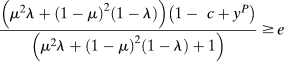





The three cases where informational lobbying occurs in Proposition 3 are essentially the same as the cases C1–C3 in Proposition 1 of the unconstrained case and follow for the same strategic considerations. The obvious difference, of course, is the presence of implementation subsidies in the constrained case. The need for implementation subsidies has two interesting effects: first, as already noted, the range of priors for which the policymaker would choose to gather information expands; second, the conditions under which the lobby would find lobbying economically worthwhile change. This second effect arises both because implementation subsidies are costly and because the change in the policymaker’s information-gathering behavior changes the circumstances under which these costs are incurred.
There are two cases where there are only policy implementation subsidies. Part (iii) of Proposition 3 follows by comparing the likelihood of reform with and without the lobby gathering information. If they gather information and receive the signal x s, then the status quo policy is immediately chosen. If they receive the signal x r, then the policymaker gathers information, and this determines the policy triggering an implementation subsidy if z = z r. Hence, both signals x r and z r are required to give a reform policy. If the lobby does not gather information the policymaker does, and there is reform if z r is received. The lobby then supplies an implementation subsidy. It follows that in this case, information gathering by the lobby is expensive and lowers the probability of reform. Hence, they only supply an implementation subsidy when required. In part (iv), a single signal determines the policy choice, as both a reform or status quo signals push beliefs into one of the “convinced” ranges. The lobby, thus, chooses between gathering information or supplying an implementation subsidy. In expected terms, the latter is cheaper. Hence part (iv).
Part (v) of the proposition is, perhaps, the most interesting because it is observationally equivalent to “damage control” as discussed by Bennedsen and Feldmann (Reference Bennedsen and Feldmann2006) and Dahm and Porteiro (Reference Dahm and Porteiro2008a, Reference Dahm and Porteiro2008b). Here too, the lobby makes a financial contribution to the policymaker after the arrival of unfavorable information, x s, but the role of the implementation subsidy is to relax the policymakers’ resource constraint such that they can afford to both gather information and enact a reform if they so choose. This second round of information gathering by the policymaker acts as insurance to the lobby against an initially negative signal because λ* < λ(x s, z r). Here, damage control is an implementation subsidy that effectively purchases the lobby who tries receiving a decisive reform signal.
Our results in this section yield some novel insights into implementation subsidies; first, there is no ex ante relationship between the policymaker’s prior and implementation subsidies; however, after information gathering, subsidies are offered to policymakers who shifted their policy choice to reform after receiving a reform signal, ex post the lobbyist’s friends.
A Comparison of Lobbying of a Constrained and Unconstrained Policymaker
A comparison between the constrained and unconstrained cases provides some insights into both which policymakers are lobbied and when lobbying occurs at all. We know from Propositions 1 and 3 that the lobby gathers information so as to influence either negatively convinced or optimistic policymakers. They supply information to policymakers with priors in the former group so as to get them to consider reform and to the latter group as they are relatively easy to persuade. The tightening of resource constraints changes the range of priors that define these two lobbied groups. As the policymaker’s resource constraint binds, the lobby stops supplying information to policymakers just below the margin between being negatively convinced and pessimistic. The range of negatively convinced policymakers being supplied by the lobby with information shrinks. However, the reverse is true for the optimistic group. As the policymaker’s resource constraint binds, the lobby starts supplying information to policymakers with priors just above the margin between being optimistic and positively convinced. Hence, this range expands.
Now, we consider the extensive margin where the lobby decides whether to lobby or not. Employing the cost benefit conditions from Propositions 1 and 3, we have the following:
Proposition 4. The lobby will engage in informational lobbying.
(i) In the case C1; of both unconstrained and constrained policymakers if e < [μ 2λ + (1 − μ)2(1 − λ)](1 + y P − c − e) < [μ 2λ + (1 − μ)2(1 − λ)], and of only the unconstrained policymakers if [μ 2λ + (1 − μ)2(1 − λ)](1 + y P − c − e) < e < μ 2λ + (1 − μ)2(1 − λ)];
(ii) In the case C2; of both unconstrained and constrained policymakers if 1 − c + y P > e;
(iii) In the case C3; of both unconstrained and constrained policymakers if e < μ(1 − μ) − μ(1 − μ)(e + c − y P) < μ(1 − μ), and of only the unconstrained one if μ(1 − μ) − μ(1 − μ)(e + c − y P) < e < μ(1 − μ).
In simple terms, proposition 4 tells us that the cost of policy implementation subsidies when policymakers are resource constrained reduces the information gathering cost at which the lobby is just indifferent between lobbying or not. Taken together, Propositions 1, 3, and 4 allow us to broadly conclude that as policymaker’s resource constraints bind, the lobby switches some of their persuasion activities from their ex ante enemies to their ex ante friends, but engages in informational lobbying for a narrower range of parameters.
Tightening the Policymaker’s Constraint Further
Now, suppose that we tighten the policymaker’s constraint further such that they can afford to gather information but cannot afford to implement policy.Footnote 29 Deriving the lower and upper information thresholds for this case, as we did for Proposition 2, and denoting the resulting bounds  $\underline {\lambda ''}$ and
 $\!\!\!\bar{\lambda ''}$, we can state the following:
Lemma 2. If c > y P > e and y L > e + c, then  $\underline {\lambda ''} = \underline {\lambda '}$ and
 $\underline {\lambda ''} = \bar{\lambda '}$, which implies Λ″ > Λ′.
The intuition behind this is very similar to the previous case except that a policymaker who gathers information may now anticipate full rather than partially support for their implementation costs. Hence, there is an incentive to gather information for a wider range of beliefs. The policymaker’s choices are, of course, anticipated by the lobby, which now provides reform subsidies for a wider range of initial priors and makes these subsidies larger. Clearly, then, the range of parameter values for which the lobby finds lobbying optimal decreases.
Tightening the Lobby’s Constraint
Finally, suppose the lobby’s resource constraint is binding such that the lobby can either afford to gather information or pay a policy subsidy but not both. Further, the combined resources of the lobby and policymaker are insufficient to pay for two information signals and implement a reform—that is, e + c > y L ≥ max{e L, c + e − y P} and 2e + c > y P + y L. Clearly, then, there will never be two rounds of information gathering. However, the policymaker’s updating thresholds are unaffected by the tightening of the lobby’s resource constraint and depend only on the policymaker’s constraint as before. The implications are that, given that two signals cannot be gathered in equilibrium, a lobby faced by a negatively convinced policymaker will only choose to gather information if signal accuracy is sufficient to shift the policymaker’s priors into the positively convinced range. Further, the lobby no longer has the option of gathering information as insurance against a status quo signal and, thus, does not lobby optimistic policymakers.
It is interesting to note, however, that the likelihood of lobbying a negatively convinced policymaker and of a reform outcome in this case actually increases. The reason is that a lobby can induce an immediate reform with a less precise information signal as the policymaker’s threshold for immediate reform is no longer the upper threshold when the policymaker can gather information  $\left( {\bar{\lambda },\bar{\lambda }\prime ,\;\!{\rm{or}}\;\!\!\bar{\lambda ''}} \right)$, but rather the policymaker’s policy implementation threshold (λ*) which is lower. In other words, being resource constrained yields a lobby a strategic advantage in lobbying a constrained negatively convinced policymaker. If the lobby generates a reform signal, the policymaker will give them the “benefit of the doubt,” although they would prefer more information. We will discuss further strategic considerations arising from the lobby facing a binding resource constraint when we introduce heterogeneously accurate signals in the following paragraphs.
THE QUALITY OF POLICYMAKER’s DECISIONS
In the preceding sections, we explored some implications of resource constraints for lobbying behavior. We did not, however, consider the quality of decisions in equilibrium. In this section, we assume that the benefit to the policymaker of selecting the correct policy is of an order of magnitude sufficiently large such that this is the policymaker’s only consideration. Formally, we focus on salience becoming extremely large, that is, 0 α → ∞.Footnote 30 It follows then that decision quality is synonymous with the policymaker, making the correct policy decision with a higher frequency. An analysis of how frequently the policymaker makes the correct policy decision requires a further assumption. So far, we have only assumed that the policymaker and lobby share a common prior. Now, we need to assume that this is the true prior which we denote  $\hat{\lambda }$.Footnote 31
We know that there are three possibilities for policy decisions in our analysis, they may be based on none, one, or two information signals. More accurately, if the policymaker received no informational signal, then the policy choice depends solely on their prior; if they receive one signal, then that signal is decisive; if they receive two signals, then there are two possibilities, they choose reform only if both signals are reform or they choose status quo only if both signals are status quo. Given these policy choice “rules,” we can calculate for which ranges of true priors each choice rule yields the highest frequency of the correct policy, that is, the highest decision quality. Further, we can compare these with the equilibrium outcomes, and when they differ, calculate the decision quality losses. We illustrate the results in Figure 7.
Information Signals and Frequency of Correct Policy Choice for α → ∞

On the vertical axis, we have the frequency with which the policymaker chooses the correct policy, Pr(π = θ); on the horizontal axis, we have the true prior,  $\hat{\lambda }$. The blue line in the diagram gives the frequency of correct policy decisions if these are based only on the prior, and the orange line does the same for policy decisions based on a single signal. The green and red lines give correct policy choice frequencies with two signals; the former when status quo is chosen only if both signals are status quo, and the latter when reform is chosen only if both signals are reform.Footnote 32 On the horizontal line denoted “Optimal Number of Signals,” we provide this number for each range of priors. On the horizontal line denoted “Equilibrium Signals,” we indicate the number of signals gathered in equilibrium in the model for the different prior ranges. Notice that as α → ∞, we have
 $\underline \lambda \to \underline \lambda \prime \to 1 - \mu ,\,{\lambda ^*} \to {1 \over 2},\,\bar{\lambda } \to \bar{\lambda }\prime \to \mu$; the reason for these convergences is that the policymaker cares only about maximizing the probability of choosing the correct policy and is not motivated to strategically manipulate transfers.Footnote 33 Further, notice that
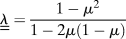 $\underline{\underline \lambda } = {{1 - {\mu ^2}} \over {1 - 2\mu \left( {1 - \mu } \right)}}$ is the true prior at which a reform signal is just sufficient to produce a posterior for which the policymaker would be unconvinced, that is, it updates to
 $\underline \lambda$.Footnote 34
Generally, Figure 7 tells us that the more extreme the true priors are, the more frequently will policies based on these priors be correct, and the more persuasive should be information signals if they are to induce the policymakers to act other than in accordance with their initial priors. As the priors become less extreme, they are less reliable as a basis for policy choice, and, therefore the information signals are more likely to increase the frequency of a correct choice and should be given greater weight.
Now, we can evaluate the quality of decisions for the various equilibria in the lobbying game. Consider first, policymakers who are “very negatively convinced”, with true priors in the range  $\hat{\lambda } \in \left[ {0,\underline{\underline {\lambda '}} } \right)$, the highest frequency of correct policy decisions is obtained when policymakers make the policy choice on the basis of their original prior. They always choose status quo, and this is very likely to be correct. This is exactly what happens in equilibrium in the model for priors in this range. For the remainder of the negatively convinced range,
 $\hat{\lambda } \in \left[ {\underline{\underline {\lambda '}} ,\underline \lambda \prime } \right)$, the frequency of correct policy decisions is highest with two information signals and where reform is chosen only if both of these signals are reform. Here, the frequency of correct decisions is given by λμ 2 + (1 − λ)μ(2 − μ), and this is exactly what arises in equilibrium (one signal can be an equilibrium outcome but only if this signal is status quo, x = x s). For priors in the pessimistic range
 $\left[ {\underline {\lambda '} ,{\lambda ^ * }} \right)$, it remains the case that the frequency of correct policy decisions is highest with two information signals and where reform is chosen only if both of these signals are reform, but this is not the equilibrium outcome. In this range, the lobby does not engage in informational lobbying despite this increasing the likelihood of a correct policy decision. The quality loss from the lobby’s failure to engage in informational lobbying is then μ(1 − μ)[1 − 2λμ] > 0.Footnote 35 Over the range
 $\left[ {{\lambda ^*},\bar{\lambda }\prime } \right)$, the highest frequency of correct policy decisions requires that two signals be generated and reform chosen if one is reform. This is the outcome generated by the insurance incentives in equilibrium for this range of true priors. However, over the range
 $\left[ {\bar{\lambda }\prime ,\overline{\overline {\lambda '}} } \right)$, there is no informational lobbying and no information gathering by any agent in equilibrium despite the fact that the highest frequency of correct policy decisions is achieved when two signals are gathered and reform is chosen if one of those signals is a reform signal. In this case, the quality loss is given by (1 − λ)μ 2 + λμ(2μ − 1) > 0. Over the range
 $\left[ \,{\overline{\overline {\lambda '}} ,1} \right]$, the lobby does not engage in informational lobbying and no information is gathered in equilibrium, and this is welfare maximizing.
Figure 7 reveals that for significant ranges of true priors, the lobby engages in informational lobbying when it should, and indeed, the equilibrium involves the decision quality maximizing the amount of information gathering. The “problematic” ranges are  $\left[ {\underline {\lambda '} ,{\lambda ^ * }} \right)$ and
 $\left[ {\bar{\lambda }\prime ,\overline{\overline {\lambda '}} } \right)$ and arise from the lobby’s incentives to strategically avoid information gathering.
Because the policymaker only cares about choosing the correct policy in this part of the analysis, that is, we assume that α → ∞, they do not engage in any distortionary strategic behavior. Suppose now we relax this assumption but continue to maintain that the quality of decisions is given by the frequency of correct policy decisions. In essence, we reintroduce the policymaker’s incentives to extract resources from the lobby. The question then is what does this imply for the quality of political decisions? Figure 8 provides some answers to this question.Footnote 36, Footnote 37
Information Signals and Frequency of Correct Policy Choice for α Finite

The effects of reintroducing the policymaker’s incentives to strategically extract resources in the form of implementation subsidies from the lobby can be seen best by comparing Figures 7 and 8. A key observation, here, is that as the policymaker cares relatively less about choosing the correct policy and more about resources, then the range of information gathering expends into the ranges of priors where, in a quality sense, the policy choice should be based only on the priors. It follows that the frequency of correct policy decisions declines, that is,  $\underline {\lambda '}$ and
 $\underline{\underline {\lambda '}}$ shift leftwards and
 $\bar{\lambda }\prime$ and
 $\overline{\overline {\lambda '}}$ move rightwards.
HETEROGENEOUS SIGNAL ACCURACIES AND COSTS
In the aforementioned analysis, by assuming that all signals were equally accurate and costs identical, we were able to explore the lobby’s incentives to strategically manipulate the quantity of information gathering in equilibrium. However, there are clearly scenarios where signal accuracies differ across states and between the signals gathered by the lobby and policymaker.Footnote 38 Further, information gathering costs can also differ between the policymaker and lobby. It follows that information quality can also be strategically manipulated in the lobbying process. This makes the relationships between the lobby’s lobbying instruments and information gathering by the policymaker more complex than in the homogeneous case.Footnote 39
We noted in the homogeneous case that the lobby has four distinct motives to engage in lobbying: a salience motive, a persuasion motive, an insurance motive, and a substitution motive depending on the policymaker’s priors, the distribution of resources, and quality of information signals. When costs and signals are heterogeneous, we find that all of these four motives can still arise, but their likelihoods of occurring change. In general, the lobby is more likely to engage in informational lobbying, if the lobby is more likely to gather a reform signal than the policymaker and the lower the information cost would be. The insurance motive becomes applicable to a wider range of initial priors, meaning also pessimistic policymakers may be lobbied, and the salience and persuasion motive are largely driven by the lobby’s likelihood of generating a reform signal. Furthermore, the range of parameter values for which the substitution motive is in operation increases. This is because, in the heterogeneous case, both relative signal quality and costs affect the lobby’s choice of whether to provide information or an implementation subsidy. Finally, a novel lobbying motive arises when we consider these heterogeneities, and both the lobby and policymaker face binding resource constraints.
The Commitment Motive
In almost all equilibria with homogeneous signals and an unconvinced resource-constrained policymaker, information gathering is performed by the policymaker and the lobby supplies an implementation subsidy.Footnote 40 If signal accuracies are heterogeneous, there can also be a commitment motive that leads to information gathering by the lobby. The idea is that by depleting their own resources on information gathering, the lobby is unable to fund an implementation subsidy to the policymaker. The policymaker then has no incentive to engage in information gathering as they could not then afford to implement the policy. The commitment motive operates when the policymaker would choose reform, in the absence of further information, being optimistic, and the lobby’s signals are sufficiently uninformative. The strategic incentive to waste resources in this scenario is then different to the traditional notion of “burning money” in signaling and access models where a lobby is trying to enhance its credibility with costly signals (Potters and van Winden Reference Potters and van Winden1992; Austen-Smith and Banks Reference Austen-Smith and Banks2000, Reference Austen-Smith and Banks2002) or trying to get the policymaker’s attention with contributions (Austen-Smith Reference Austen-Smith1995, Reference Austen-Smith1998; Lohmann Reference Lohmann1995; Cotton Reference Cotton2009, Reference Cotton2012; Cotton and Dellis Reference Cotton and Dellis2016).
IMPLICATIONS OF THE ANALYSIS
Here, we relate our results to the open questions in the literature, to the empirical facts, and to the anecdotal evidence concerning current lobbying practices. We conclude that several of our predictions are in line with the evidence and that our theoretical model explains why some aspects of lobbying have proven to be controversial among well-informed experts in the field.
Who is Lobbied and When?
Consider first, the question of which policymakers get lobbied. Our results indicate that ex ante there is relatively little that can be said about which policymaker will get lobbied simply on the basis of their prior policy positions. Clearly, policymakers with priors sufficiently extreme such that no available information signal will change their policy choice are not subject to informational lobbying. However, extremist “friends”, our positively convinced policymakers, are given implementation subsidies if they require them. The reason why sweeping ex ante statements cannot be made is because the lobby’s decision of whether or not to lobby depends on the policymaker’s priors, the availability and location of resources in the lobbying process, and the relative accuracy and costs of information gathering. However, if we provide a more nuanced answer to this question, we are able to conclude that lobbies lobby policymakers that they expect to become or confirm as their friends ex post. Broadly, they engage in informational lobbying with policymakers whose probability of choosing reform is increased by being lobbied and supply implementation subsidies to those who would choose reform were their resource constraints loosened.
In an informational environment where the lobby and policymaker receive similar homogeneous signals, perhaps, from a given “expert” source (such as an expert body or think tank), we know that negatively convinced and optimistic policymakers will be subject to informational lobbying. If informational signals are sufficiently accurate such that the insurance motive is in operation, we predict a discontinuity in informational lobbying. There will be a range of intermediate unconvinced pessimistic policymaker priors for which the lobby will offer no information. However, only ex post friends, those that support reform, are given policy implementation subsidies.
In a heterogeneous informational and/or cost environment, one for example where the lobby and policymaker have their own separate information sources, there will tend to be more informational lobbying than in a homogeneous environment. In such an environment, both the commitment, substitution, and insurance motives for informational lobbying operate. Most noticeable are the insurance and substitution motives which induce the lobby to engage in informational lobbying of pessimistic policymakers.
De Figueiredo and Richter (Reference de Figueiredo and Richter2014) review empirical studies on lobbying activities and show that many conclude that lobbies mostly lobby policymakers who favor their preferred policy. However, they also note that there are empirical studies that show that lobbies approach opposing policymakers in an attempt to change their initial positions (Austen-Smith and Wright Reference Austen-Smith and Wright1994, Reference Austen-Smith and Wright1996; de Figueiredo and Cameron Reference de Figueiredo and Cameron2009), this is, generally consistent with our analysis of both informational lobbying and implementation subsidies. In our analysis, a lobby engages in informational lobbying with an opposing policymaker to gain their support or to induce them to gather further information. If the policymaker is also resource constrained and does not have sufficient resources for a policy change, then the lobby, if its resources are sufficient, would also provide an implementation subsidy and actually support the policymaker throughout the political process. This is also consistent with Mello, Abiola, and James (Reference Mello, Abiola and James2012)’s case study of Merck discussed in the Introduction.
Other empirical studies document that undecided, or moderate, policymakers are lobbied (Hojnacki and Kimball Reference Hojnacki and Kimball1999, Reference Hojnacki and Kimball2001; Mian, Sufi, and Trebbi Reference Mian, Sufi and Trebbi2010). In our analysis, a lobby approaches these policymakers when informational lobbying is relatively inexpensive and persuasive enough to determine their policy choice. Implementation subsidies, as a sole lobbying strategy, would be provided if a moderate policymaker has, from the lobby’s perspective, an accurate information technology but not sufficient resources to implement reform. Finally, there is also the evidence that lobbies support friendly policymakers (Kollman Reference Kollman1997; Hojnacki and Kimball Reference Hojnacki and Kimball1998; Eggers and Hainmueller Reference Eggers and Hainmueller2009; Mian, Sufi, and Trebbi Reference Mian, Sufi and Trebbi2013; Igan and Mishra Reference Igan and Mishra2014; Schnakenberg Reference Schnakenberg2017). In our analysis, friendly policymakers are lobbied via policy subsidies when they have insufficient resources to implement a policy, which is similar to Hall and Deardorff (Reference Hall and Deardorff2006).
Resource-Constrained Lobby: A Strategic Disadvantage?
Tullock (Reference Tullock1972) famously asked, “why is there so little money in politics?;” this is a question that has been frequently repeated both in the context of campaign contributions and lobbying expenditures.Footnote 41 In the context of our model of lobbying, the answer is that having limited resources can be a strategic advantage. Most obviously, an unconstrained policymaker never receives an implementation subsidy from a lobby but a constrained one does. From the perspective of a lobby, when faced with an optimistic policymaker, resources, either their own or the policymakers, are undesirable. In the absence of more information, a policymaker would choose reform, but resources buy more information. The only context where more resources in the lobbying process are desirable from the lobby’s perspective is when they allow the purchase of a second signal that acts as insurance and induces information gathering by an initially negatively convinced policymaker.
The answer to the question whether the lobby gains or loses a strategic advantage when it is resource constrained is, “it depends.” It depends specifically on the policymaker’s prior and the accuracy of information signals. When the policymaker is negatively convinced and the information technology is not very effective (Case C1), then a constrained lobby is worse off as a potential reform is no longer feasible with given resources. However, when the policymaker is negatively convinced and the information technology is at least intermediate (case C2), then the constrained lobby gains as the necessary threshold to induce a reform is λ* instead of  $\bar{\lambda }\prime$. Furthermore, when the insurance motive is in play (case C3), then the resource-constrained lobby is worse off as a second information signal is no longer feasible; but when the substitution and commitment motives are in play (case C4 and case C4′), then the resource-constrained lobby again gains from the lower threshold to induce reform of λ* instead of
 $\bar{\lambda }\prime$.
Relationships between Information and Implementation Subsidies
We have identified persuasion, commitment, insurance, and substitution motives for informational lobbying. Whereas an implementation subsidy is made whenever the policymaker has the ex post will but not resources to enact reform. These different motives arise with different combinations of resource constraints, signal accuracies, and signal costs, implying different predicted relationships between the lobby’s lobbying instruments and policymaker’s information gathering. These can be thought of as substitutes, complements, or independent in the sense that the choice of information gathering by the lobby influences information gathering by the policymaker and both influence implementation subsidies.
We can state that information gathering by the lobby and policymaker are complements whenever the insurance or persuasion motives are in operation; they are substitutes whenever the commitment or substitution motives are in operation; and they are independent otherwise.Footnote 42 The details may be found in Table 1. Cases C1–C4 are exactly as introduced in Figure 5; case C4′ is the situation where the commitment motive is in operation.Footnote 43
Relationships Between Policymaker’s and Lobby’s Information Gathering

Compl, complements; Subs, substitutes; Ind, independent; +, persuasion motive; * insurance motive.
** Substitution motive; *** commitment motive; n/a, not applicable; λ ∈ {λ, λ′} as defined for each case.
In a similar vein, the details of the circumstances when the lobby supplies an implementation subsidy may be found in Table 2. Table 2 allows us to describe when a policymaker is lobbied and how. First, consider when a lobby uses both lobbying instruments. These are represented by the gray-shaded cells in the table with checkmarks (✓) within them. This occurs in two circumstances, in both of which the lobby is resource-rich and the policymaker constrained. In the case C1, the lobby faces an initially negatively convinced policymaker and gathers information to try to persuade them to consider reform. If they receive a reform signal, this induces the policymaker to gather information; and if they two receive a reform signal, enact a reform policy financed by an implementation subsidy; in the case C3, the lobby faces an unconvinced policymaker and gathers information because of the insurance motive; if they receive a status quo signal, then the policymaker gathers information; and if this signal is reform, enacts a reform policy financed by an implementation subsidy. Next, consider when the lobby employs only informational lobbying; these are represented by the green-shaded cells in the table. We can see that for ten of the seventeen subcases analyzed, there is only informational lobbying. Whenever the lobby gathers information that gives a signal leading to the policymaker being either positively or negatively convinced; loosely when the lobby’s signal is very persuasive, then no implementation subsidy is required. Alternatively, if the lobby’s signal leaves the policymaker unconvinced but they themselves generate a status quo signal, then there will be no implementation subsidy and there will be no reform policy. The only other case is C4′ where a lobby deliberately gathers poor quality information as a commitment device so as to not supply an implementation subsidy. Here, an optimistic policymaker adopts a reform policy essentially on the basis of his/her original prior.
Relationships Between Information Gathering and Implementation Subsidies
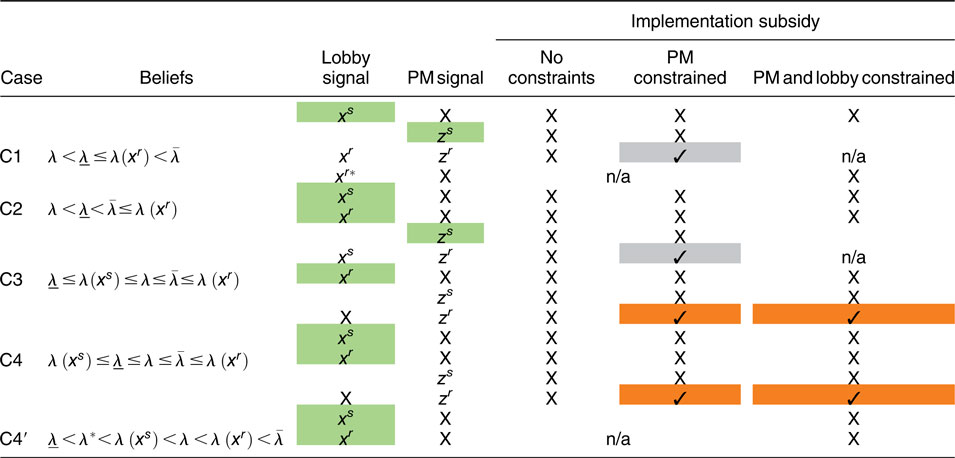
Legend: n/a, not applicable; * when λ(x r) > λ; * λ ∈ {λ, λ′} as defined appropriately for each case.
There are several cases where a lobby only provides an implementation subsidy. These are represented by the orange-shaded cells in the table with checkmarks (✓) within them. These are cases where policymakers are initially unconvinced and will gather information themselves if the lobby does not provide any. If either policymakers are more likely than the lobby to generate a reform signal and/or the cost of their information gathering is lower, then the lobby will prefer to supply an implementation subsidy rather than information to a constrained policymaker.
CONCLUSION
We have analyzed a model of informational lobbying that combines various features of observed lobbying activities and politics. Policymakers can gather their own costly information or rely on the information provided by a lobby, and policymakers can use their own resources to implement a policy change or use legislative subsidies supplied by the lobby. Incorporating these wider trade-offs into our analysis, we show that legislative subsidies have a role beyond the traditional view of allowing policymakers to consider more policies. Legislative subsidies in the form of information and implementation subsidies can allow unconvinced policymakers to gather their own information and subsequently reconsider their positions by strategically taking advantage of interest groups’ resources. However, we also illustrated how lobbies with different endowments can gain strategic advantages in the policymaking process and take advantage of resource-constrained policymakers.
Our study has also shown that a lobby engages in informational lobbying for one of five distinct motives: a salience motive, whereby information raises a policymaker’s awareness of a policy issue, a persuasion motive to directly induce a policy choice, an insurance motive where implementation subsidies help overcome negative information, a substitution motive where the lobby provides information either as a substitute for information gathering by the policymaker or as an alternative to supplying an implementation subsidy, and a commitment motive in strategically wasting resources to avoid a policymaker’s information gathering.
In terms of where information is targeted, the lobby focuses on a policymaker who is either negatively convinced or inclined to gather further information. Policy implementation subsidies are given to a policymaker who is ex ante either negatively convinced or willing to gather further information—rather than to their initial “friends.”
The relationships between information gathering by the lobby and policymaker and policy implementation subsidies can be either complements, substitutes, or independent. These are not assumed but emerge endogenously in our analysis as a consequence of the resource constraints and the policymakers’ initial beliefs.
Our model provides several novel implications for the understanding of lobbying, and we believe that it can be extended in various ways. In some sense, our analysis is part of a metagame in which lobbies and policymakers first gather expertise and resources and then play the game analyzed earlier. Acquiring expertise and resources can be viewed as preplay strategic moves that are of considerable interest for future research.
SUPPLEMENTARY MATERIAL
To view supplementary material for this article, please visit https://doi.org/10.1017/S0003055419000595.
APPENDIX
Proofs
Proof of Lemma 1
The lower threshold  $\underline \lambda$ follows from the policymaker’s trade-off between the expected payoff from costly information with uncertain information signal and policy outcome and the expected payoff from the costless status quo without information choice. Note that the policymaker considers the posterior belief about the state of the world, λ P(z), for the expected payoff associated with the expected information signal, z(λ).Footnote 44 The policymaker gathers information if
 $${z^r}\left( {{\lambda ^L}} \right)\left[ {{y^P} - c + {\lambda ^P}\left( {{z^r}} \right)\alpha } \right] + {z^s}\left( {{\lambda ^L}} \right)\left[ {{y^P} + \left( {1 - {\lambda ^P}\left( {{z^s}} \right)} \right)\alpha } \right] - e \,\ge \,{y^P} + \left( {1 - {\lambda ^L}} \right)\alpha .$$
Applying each information signal’s probability with ε P = ε L = η P = η L ≡ μ, the updating choice reduces to
 $${\lambda ^L} \,\ge\, {{\left( {1 - \mu } \right)\left( {\alpha + c} \right) + e} \over {\alpha + c\left( {1 - 2\mu } \right)}} \,\equiv \,\underline \lambda ,$$
which defines the lower updating threshold. Note that  $\underline \lambda > 0$ because of α > c and 0 < 1 − 2μ < 1.
The upper threshold  $\bar{\lambda }$ follows from the policymaker’s trade-off between the expected payoff from costly information with uncertain information signal and policy outcome and the expected payoff from a costly reform without gathering information. The policymaker gathers information if
 $${z^r}\left( {{\lambda ^L}} \right)\left[ {{y^P} - c + {\lambda ^P}\left( {{z^r}} \right)\alpha } \right] + {z^s}\left( {{\lambda ^L}} \right)\left[ {{y^P} + \left( {1 - {\lambda ^P}\left( {{z^s}} \right)} \right)\alpha } \right] - e \,\ge \,{y^P} - c + {\lambda ^L}\alpha .$$
Solving for λ L, we can write for ε P = ε L = η P = η L ≡ μ
 $${\lambda ^L} \,\le \,{{\mu \left( {\alpha + c} \right) - e} \over {\alpha + c\left( {2\mu - 1} \right)}} \,\equiv \,\bar{\lambda },$$
which defines the upper updating threshold.
Existence of Updating Range
The updating range exists iff  $\underline \lambda \lt \min \left\{ {\bar{\lambda },1} \right\}$. Solving for
 $\underline \lambda \,\lt \,\bar{\lambda }$, we get
 $$\left( {{\alpha ^2} - {c^2}} \right)\left( {2\mu - 1} \right) - 2\alpha e > 0.$$
That this interval exists requires that: μ is sufficiently high, α > c, and e is sufficiently low. For a numerical example, consider α = 0.8, c = e = 0.1, and μ = 0.75 for  $\underline \lambda$ ≈ 0.433, λ* = 0.5625, and
 $\bar{\lambda } \,\approx \,0.676$.
Proof of Proposition 1
The lobby’s lobbying decision follows from the policymaker’s thresholds  $\underline \lambda$ and
 $\bar{\lambda }$ described in Lemma 1, and the four possible informational lobbying cases of C1, C2, C3, and C4. For all four cases, we apply ε P = ε L = η P = η L ≡ μ and e P = e L ≡ e.
For the first case C1 with  $\lambda \,\le \,\underline \lambda \,\le \,\lambda \left( {{x^r}} \right) \,\le \,\bar{\lambda }$, the lobbyist finds it beneficial to gather information if x r(λ)z r(λ(x r)) ≥ e, which using (B.1) and (B.5)Footnote 45 implies
 $${\left( {\mu - 1} \right)^2} + \lambda \left( {2\mu - 1} \right) \,\ge \,e.$$
We are using the characterization of (A.6) to describe the lobby’s net payoff function from informational lobbying and denote this with γ(·) which is then γ 1 = γ(·) for C1. The comparative statics for the lobby’s net payoff are simply 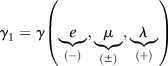 ${\gamma _1} = \gamma \left( {\underbrace e_{\left( - \right)},\underbrace \mu _{\left( \pm \right)},\underbrace \lambda _{\left( + \right)}} \right)$.
For case C2 with  $\lambda \,\le \,\underline \lambda \,\le \,\bar{\lambda } \,\le \,\lambda \left( {{x^r}} \right)$, a lobby’s reform signal would induce a policymaker to implement reform without further gathering of information. The lobby finds it beneficial to provide an information signal if x r(λ) ≥ e L, which using (B.1) implies
 $$1 - \mu - \lambda \left( {1 - 2\mu } \right) \,\ge \,e.$$
The comparative statics for the lobby’s net payoff are simply 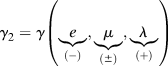 ${\gamma _2} = \gamma \left( {\underbrace e_{\left( - \right)},\underbrace \mu _{\left( \pm \right)},\underbrace \lambda _{\left( + \right)}} \right)$.
For case C3 with  $\underline \lambda \,\le \,\lambda \left( {{x^s}} \right) \,\le \,\lambda \,\le \,\bar{\lambda } \,\le \,\lambda \left( {{x^r}} \right)$, the policymaker would gather information if the lobby gathered a status quo signal and would reform without gathering information if the lobby gathered a reform signal. The lobby, thus, chooses to gather information if x r(λ) + x s(λ)z r(λ(x s)) − e L ≥ z r(λ). We consider two possibilities: (i) an initially pessimistic policymaker,
 $\underline \lambda \,\lt \,\lambda \,\lt \,{\lambda ^*} \,\lt \,\bar{\lambda }$, and (ii) an initially optimistic policymaker,
 $\underline \lambda \,\lt \,{\lambda ^*} \,\lt \,\lambda \,\lt \,\bar{\lambda }$.
If the policymaker is initially pessimistic,  $\underline \lambda$ < λ < λ*, and the signal likelihoods are identical, then a status quo signal by the lobby cannot be offset by a reform signal gathered by the policymaker: λ(x s) < λ and λ(x s) < λ(x s, z r) < λ. In other words, the more expected information signal affects a Bayesian policymaker stronger than a less expected event, and therefore, the status quo signal cannot be offset and the policymaker would not reform, λ(x s, z r) < λ < λ*. Hence, the informational lobbying case C3 does not exist for
 $\underline \lambda$ < λ < λ*.
If the policymaker is initially optimistic,  $\underline \lambda \,\lt \,{\lambda ^*} \,\lt \,\lambda \,\le \,\bar{\lambda }$, and the signal likelihoods are identical, then a status quo signal by the lobby could be offset by a reform signal gathered by the policymaker: λ(x s) < λ but λ(x s, z r) > λ and λ(x s, z r) ⋚ λ*. In other words, the more expected information signal affects a Bayesian policymaker stronger than a less expected event and therefore the status quo signal can be more than offset. The lobby, thus, chooses to gather information if x r(λ) + x s(λ)z r(λ(x s)) − e ≥ z r(λ) with x r(λ) = z r(λ), which implies, using (B.1), (B.2), and (B.6), that
 $$\mu - {\mu ^2} \,\ge \,e.$$
The comparative statics for the lobby’s net payoff are simply 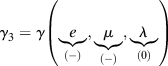 ${\gamma _3} = \gamma \left( {\underbrace e_{\left( - \right)},\underbrace \mu _{\left( - \right)},\underbrace \lambda _{\left( 0 \right)}} \right)$.
Finally, for case C4 with  $\lambda \left( {{x^s}} \right) \,\le \,\underline \lambda \,\le \,\lambda \,\le \,\bar{\lambda } \,\le \,\lambda \,\left( {{x^r}} \right)$, if the lobby gathers information, then the policymaker will not and the signal that the lobby gathered will determine the policy choice. In such a situation the lobby gathers information if x r(λ) − e ≥ z r(λ). However, if the signal likelihoods are identical and, therefore, the probabilities of reform signals, x r(λ) = z r(λ), then the lobby abstains from costly information gathering and only the policymaker collects information.
Proof of Proposition 2
The lower threshold  $\underline {\lambda '}$ follows again from the policymaker’s trade-off between the expected payoff from costly information with uncertain information signal and policy outcome and the expected payoff from the costless status quo without gathering information. Note that the policymaker anticipates a policy implementation subsidy of τ = e + c − y P in the case of a reform signal and zero otherwise. The policymaker gathers information for ε P = ε L = η P = η L ≡ μ if
 $${z^r}\left( {{\lambda ^L}} \right)\left[ {{y^P} - e - c + \tau \left( {{z^r}} \right) + {\lambda ^P}\left( {{z^r}} \right)\alpha } \right] + {z^s}\left( {{\lambda ^L}} \right)\left[ {{y^P} - e + \tau \left( {{z^s}} \right) + \left( {1 - {\lambda ^P}\left( {{z^s}} \right)} \right)\alpha } \right] \ge \,{y^P} + \left( {1 - {\lambda ^L}} \right)\alpha$$
 $$\Rightarrow {z^r}\left( {{\lambda ^L}} \right){\lambda ^P}\left( {{z^r}} \right)\alpha + {z^s}\left( {{\lambda ^L}} \right)\left[ {{y^P} - e + \left( {1 - {\lambda ^P}\left( {{z^s}} \right)} \right)\alpha } \right] \ge \,{y^P} + \left( {1 - {\lambda ^L}} \right)\alpha .$$
Applying each information signal’s probability, the updating choice reduces to
 $${\lambda ^L} \ge {{\left( {1 - \mu } \right)\left( {\alpha + {y^P}} \right) + \mu e} \over {\alpha + \left( {{y^P} - e} \right)\left( {1 - 2\mu } \right)}} \equiv \underline {\lambda '} ,$$
which defines the new lower updating threshold.
The upper threshold  $\overline {\lambda '}$ follows again from the policymaker’s trade-off between costly information and costly reform without gathering information. The policymaker gathers information if
 $${z^r}\left( {{\lambda ^L}} \right)\left[ {{y^P} - e - c + \tau \left( {{z^r}} \right) + {\lambda ^P}\left( {{z^r}} \right)\alpha } \right] + {z^s}\left( {{\lambda ^L}} \right)\left[ {{y^P} - e + \tau \left( {{z^s}} \right) + \left( {1 - {\lambda ^P}\left( {{z^s}} \right)} \right)\alpha } \right] \ge {y^P} - c + {\lambda ^L}\alpha$$
 $$\Rightarrow {z^r}\left( {{\lambda ^L}} \right){\lambda ^P}\left( {{z^r}} \right)\alpha + {z^s}\left( {{\lambda ^L}} \right)\left[ {{y^P} - e + \left( {1 - {\lambda ^P}\left( {{z^s}} \right)} \right)\alpha } \right] \ge \,{y^P} - c + {\lambda ^L}\alpha .$$
Solving for λ L, we can write
 $${\lambda ^L} \le {{c + \mu \left( {\alpha - e + {y^P}} \right) - {y^P}} \over {\alpha + \left( {{y^p} - e} \right)\left( {2\mu - 1} \right)}} \,\equiv \,\bar{\lambda }\prime ,$$
which defines the new upper updating threshold.
Comparison of Thresholds
For the comparison of the lower thresholds we have for  $\underline \lambda - {\underline\lambda '}$ ⋚ 0, using (A.2) and (A.10) such that
 $${{\left( {1 - \mu } \right)\left( {\alpha + c} \right) + e} \over {\alpha + c\left( {1 - 2\mu } \right)}} - {{\left( {1 - \mu } \right)\left( {\alpha + {y^P}} \right) + \mu e} \over {\left( {{y^P} - e} \right)\left( {1 - 2\mu } \right) + \alpha }} \,\gtreqless \,0$$
 $${{\overbrace {\left( {c + e - {y^P}} \right)}^{\left( + \right)}( {\overbrace {e\left( {2\mu - 1} \right)}^{\left( + \right)} + \overbrace {2\alpha \left( {1 - \mu } \right)\mu }^{\left( + \right)}} \right)} \over {\underbrace {\left( {\alpha - c\left( {2\mu - 1} \right)} \right)}_{\left( a \right)}\underbrace {\left( {\alpha + \left( {{y^P} - e} \right)\left( {1 - 2\mu } \right)} \right)}_{\left( b \right)}}} \gtreqless 0$$
 $$\left( a \right):\;\alpha > c \,\Rightarrow \left( + \right)\;{\rm{and}}\;\left(b \right):\alpha > c > {y^P} - e \,\Rightarrow \,\left( + \right)$$
 $$\Rightarrow \,\underline \lambda - \underline \lambda \prime > 0 \,\Leftrightarrow \,\underline \lambda > \underline \lambda \prime .$$
For the comparison of the upper thresholds we have  $\bar{\lambda } - \bar{\lambda }'$ ⋛ 0, using (A.4) and (A.12) such that
 $${{\mu \left( {\alpha + c} \right) - e} \over {\alpha + c\left( {2\mu - 1} \right)}} - {{c + \mu \left( {\alpha - e + {y^P}} \right) - {y^P}} \over {\alpha - 2e\mu + e + \left( {2\mu - 1} \right){y^P}}} \,\gtreqless \,0$$
 $$- {{\left( {c + e - {y^P}} \right)\left( {\alpha + c\left( {2\mu - 1} \right) - 2\mu \left( { - \alpha \mu + \alpha + e} \right) + e} \right)} \over {\left( {\alpha + c\left( {2\mu - 1} \right)} \right)\left( {\alpha - 2e\mu + e + \left( {2\mu - 1} \right){y^P}} \right)}}$$
 $$\scale 92%{- {{\overbrace {\left( {c + e - {y^P}} \right)}^{\left( + \right)}( {\overbrace {c\left( {2\mu - 1} \right)}^{\left( + \right)} + \overbrace {\alpha \left( {1 + 2{\mu ^2} - 2\mu } \right) + e\left( {1 - 2\mu } \right)}^{\left( c \right)}} \right)} \over {\underbrace {\left( {\alpha + c\left( {2\mu - 1} \right)} \right)}_{\left( {\rm{ + }} \right)}\underbrace {\left( {\alpha + \left( {2\mu - 1} \right)\left( {{y^P} - e} \right)} \right)}_{\left( {\rm{ + }} \right)}}} \,\gtreqless \,0$$
 $$\scale 95%{{\left(c \right):\;\alpha > e\;{\rm{and}}\;{1 \over 2} \,\lt \,\mu \,\le \,1 \,\Rightarrow \,\alpha + 2\mu {\alpha ^2} - 2\mu \alpha + e - 2\mu e > 0$$
 $$\Rightarrow \,\bar{\lambda } - \bar{\lambda }\prime \lt \,0 \,\Leftrightarrow \,\bar{\lambda } \,\lt \,\bar{\lambda }\prime .$$
Proof of Proposition 3
The lobby’s lobbying decision follows from the policymaker’s thresholds described in Proposition 2 and the four possible informational lobbying cases.
For the lobby’s problem to lobby a negatively convinced policymaker, we have that a reform signal would induce the policymaker to gather information or to implement an immediate reform—that is,  $\lambda \,\lt \,\underline \lambda \prime \,\le \,\lambda \left( {{x^r}} \,\right) \lt \, {\overline\lambda \prime }$ and
 $\lambda \,\lt \,\underline \lambda \prime \,\lt \, {\overline\lambda \,\prime } \,\le \,\lambda \left( {{x^r}} \right)$. For the first case C1, a lobbyist compares the expected payoff from gathering information and a potential second information gathering with the one from no reform with certainty. The lobby gathers information with τ(z) from (4.1) if
 $${x^r}\left( \lambda \right){z^r}\left( \lambda \right)\left( {1 - \tau \left( z \right)} \right) \,\ge \,e$$
 $${{\left( {{\mu ^2}\lambda + {{\left( {1 - \mu } \right)}^2}\left( {1 - \lambda } \right)} \right)\left( {1 - c + {y^P}} \right)} \over {\left( {{\mu ^2}\lambda + {{\left( {1 - \mu } \right)}^2}\left( {1 - \lambda } \right) + 1} \right)}} \,\ge \,e.$$
The comparative statics for the lobby’s net payoff are simply  $\gamma _1^\prime = \gamma \left( {\underbrace \mu _{\left( \pm \right)},\underbrace \lambda _{\left( + \right)},\underbrace {{y^P}}_{\left( + \right)},\underbrace e_{\left( - \right)},\underbrace c_{\left( - \right)}} \right)$.
For the other case C2, the trade-off follows the expected payoff from gathering information and a potential immediate reform with no reform with certainty. The lobby gathers information if
 $${x^r}\left( \lambda \right) \,\ge \,e$$
 $$1 - \mu - \lambda \left( {1 - 2\mu } \right) \,\ge \,e,$$
which is the same as (A.7) as the policymaker would finance the implementation of the reform. The comparative statics for the lobby’s net payoff are, therefore, simply 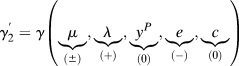 $\gamma _2^\prime = \gamma \left( {\underbrace \mu _{\left( \pm \right)},\underbrace \lambda _{\left( + \right)},\underbrace {{y^P}}_{\left( 0 \right)},\underbrace e_{\left( - \right)},\underbrace c_{\left( 0 \right)}} \right)$.
For case C3, we consider again two possibilities: (i) an initially pessimistic policymaker,  $\underline \lambda \,\lt \,\lambda \,\lt \,{\lambda ^*} \,\lt \,\bar{\lambda }$, and (ii) an initially optimistic policymaker,
 $\underline \lambda \,\lt \,{\lambda ^*} \,\lt \,\lambda \,\lt \,\bar{\lambda }$. In the former case, informational lobbying is not existent for the homogeneous case as in the Proof A.1.2. The policymaker would gather information, and the lobby would pay an implementation signal if the policymaker received a reform signal and 1 − e − c + y P > 0.
However, if the policymaker is initially optimistic,  $\underline \lambda \,\lt \,{\lambda ^*}\, \lt \,\lambda \,\le \,\bar{\lambda }$, and the signal likelihoods are identical, then a status quo signal by the lobby could be offset by a reform signal gathered by the policymaker: λ(x s) < λ but λ(x s, z r) > λ and λ(x s, z r) ⋛ λ*. The lobby, thus, chooses to gather information if
 $${x^r}\left( \lambda \right) + {x^s}\left( \lambda \right){z^r}\left( {\lambda \left( {{x^s}} \right)} \right)\left( {1 - \tau \left( z \right)} \right) - e \,\ge \,{z^r}\left( \lambda \right)\left( {1 - \tau \left( z \right)} \right)$$
 $$\scale 91%{{{2\left( {\lambda - 1} \right)\mu \left( {c - {y^P}} \right) + {\mu ^2}\left( {c - {y^P} - 1} \right) - \left( {{y^P} - c} \right)\left( {1 - \lambda } \right) + \mu } \over {\lambda - {\mu ^2} - 2\left( {\lambda - 1} \right)\mu }} \,\ge \,e.$$
The comparative statics for the lobby’s net payoff are simply  ${\gamma _3}\prime = \gamma \left( {\underbrace \mu _{\left( \pm \right)},\underbrace \lambda _{\left( + \right)},\underbrace {{y^P}}_{\left( - \right)},\underbrace e_{\left( - \right)},\underbrace c_{\left( + \right)}} \right)$.
Finally, for case C4 with  $\lambda \left( {{x^s}} \right) \,\le \,\underline \lambda \,\le \,\lambda \,\le \,\bar{\lambda }\, \le \,\lambda \,\left( {{x^r}} \right)$, if the lobby gathers information, then the policymaker will not. In such a situation, the lobby gathers information if x r(λ) − e ≥ z r(λ)[1 − e − c + y P]. However, if the signal likelihoods are identical and, therefore, the probabilities of reform signals, x r(λ) = z r(λ), then the lobby abstains from costly information gathering, −e(1 − x r(λ)) < (y P − c)x r(λ), which implies that only the policymaker gathers information and the lobby would pay an implementation subsidy if z r and 1 − e − c + y P > 0.
Proof of Proposition 4
We have for C1 that  ${\lambda ^L}\left( {\lambda ,{x^s}} \right) \in \left[ {0,\underline \lambda } \right]$ and
 ${\lambda ^L}\left( {\lambda ,{x^r}} \right) \in \left[ {\underline \lambda ,\bar{\lambda }} \right]$. There is, however, one main difference from the unconstrained case. If both the lobby and policymaker receive reform signals such that reform is the policymaker’s preferred policy choice, then a transfer from the lobby to the policymaker is required if reform is to be implemented. This implies that there are circumstances where a lobby will choose to lobby an unconstrained policymaker but not a constrained one because of the potentially greater cost for the lobby. More precisely, by comparing the lobby’s benefits in the unconstrained policymaker case C1 stated in (A.6) with lobby’s benefits in the constrained policymaker case C1 stated in (A.15), we get (i) if e + [μ 2λ + (1 − μ)2(1 − λ)](c + e − y P) < [μ 2λ + (1 − μ)2(1 − λ)], then both unconstrained and constrained policymakers are lobbied; but (ii) if e < [μ 2λ + (1 − μ)2(1 − λ)] < e + [μ 2λ + (1 − μ)2(1 − λ)](c + e − y P), then unconstrained policymakers are lobbied but constrained ones are not.
Now, consider C2 with  ${\lambda ^L}\left( {\lambda ,{x^s}} \right) \in \left[ {0,\underline \lambda } \right]$ and
 ${\lambda ^L}\left( {\lambda ,{x^r}} \right) \in \left[ {\bar{\lambda },1} \right]$. That the policymaker faces a tighter resource constraint has no implications for equilibrium behavior. The lobby chooses to purchase information, and hence lobbies, in this case if e < λμ + (1 − λ)(1 − μ) as in (A.7), which is the same as the expected cost-benefit calculation in the unconstrained case of (A.16).
Consider next an unconvinced policymaker, one whose initial belief lies in the pessimistic or optimistic ranges,  $\lambda \in \left[ {\underline \lambda ,\bar{\lambda }} \right]$. Obviously, as described in the proofs for Proposition 1 and Proposition 3, an initially pessimistic policymaker,
 $\lambda \in \left[ {\underline \lambda ,{\lambda ^*}} \right]$ which is denoted as C3(a) in Table 7, is not lobbied with information but if constrained, may receive an implementation subsidy. Hence, we consider the relevant comparison for an initially optimistic policymaker,
 $\lambda \in \left[ {{\lambda ^*},\bar{\lambda }} \right]$ which is denoted as C3(b) in Table 7. Here, as in the unconstrained case, the lobby has the option of purchasing a form of insurance against the unwelcome draw of a status quo signal. When facing an unconstrained policymaker, the lobby will choose the insurance of two signals over one if (A.8) holds; but in contrast the lobby when facing a constrained policymaker will choose the insurance of two signals over one if (A.17) holds. Comparing these, we may, thus, state (i) if e < μ(1 − μ) − μ(1 − μ)(e + c − y P), then both constrained and unconstrained policymakers are subject to informational lobbying and the constrained policymaker also receives an implementation subsidy; but (ii) if μ(1 − μ) − μ(1 − μ)(e + c − y P) < e < μ(1 − μ), then the unconstrained policymaker is subject to informational lobbying but the constrained policymaker is not lobbied.
Finally, in case C4, neither an unconstrained nor a constrained policymaker would be lobbied with information, and therefore, the comparison is redundant.
Proof of Lemma 2
The lower threshold  ${\underline\lambda ''}$ follows again from the policymaker’s trade-off between the expected payoff from costly information with uncertain information signal and policy outcome and the expected payoff from the costless status quo without gathering information. The policymaker anticipates again a policy implementation subsidy of τ = e + c − y P in the case of a reform signal and zero otherwise. The policymaker gathers information for ε P = ε L = η P = η L ≡ μ if
 $${z^r}\left( {{\lambda ^L}} \right)\left[ {{y^P} - e - c + \tau \left( {{z^r}} \right) + {\lambda ^P}\left( {{z^r}} \right)\alpha } \right] + {z^s}\left( {{\lambda ^L}} \right)\left[ {{y^P} - e + \tau \left( {{z^s}} \right) + \left( {1 - {\lambda ^P}\left( {{z^s}} \right)} \right)\alpha } \right] \,\ge \,{y^P} + \left( {1 - {\lambda ^L}} \right)\alpha$$
 $$\Rightarrow \,{z^r}\left( {{\lambda ^L}} \right){\lambda ^P}\left( {{z^r}} \right)\alpha + {z^s}\left( {{\lambda ^L}} \right)\left[ {{y^P} - e + \left( {1 - {\lambda ^P}\left( {{z^s}} \right)} \right)\alpha } \right] \ge \,{y^P} + \left( {1 - {\lambda ^L}} \right)\alpha .$$
Applying each information signal’s probability, the updating choice reduces to
 $${\lambda ^L} \ge {{\left( {1 - \mu } \right)\left( {\alpha + {y^P}} \right) + \mu e} \over {\left( {{y^P} - e} \right)\left( {1 - 2\mu } \right) + \alpha }} \,\equiv \, {\underline\lambda ''} ,$$
which is identical to  ${\underline\lambda '}$ of (A.10).
The upper threshold  ${\overline\lambda ''}$ follows again from the policymaker’s trade-off between costly information and costly reform without gathering information. Here, the policymaker anticipates, now, a policy implementation subsidy of τ(z r) = e + c − y P if z r and of τ(z = 0) = c − y P if
 $\lambda > \overline {\lambda ''}$. The policymaker gathers information if
 $${z^r}\left( {{\lambda ^L}} \right)\left[ {{y^P} - e - c + \tau \left( {{z^r}} \right) + {\lambda ^P}\left( {{z^r}} \right)\alpha } \right] + {z^s}\left( {{\lambda ^L}} \right)\left[ {{y^P} - e + \tau \left( {{z^s}} \right) + \left( {1 - {\lambda ^P}\left( {{z^s}} \right)} \right)\alpha } \right] \ge \,{y^P} - c + {\lambda ^L}\alpha + \tau \left( {z = 0} \right)$$
 $$\Rightarrow {z^r}\left( {{\lambda ^L}} \right){\lambda ^P}\left( {{z^r}} \right)\alpha + {z^s}\left( {{\lambda ^L}} \right)\left[ {{y^P} - e + \left( {1 - {\lambda ^P}\left( {{z^s}} \right)} \right)\alpha } \right] \,\ge \,{\lambda ^L}\alpha .$$
Solving for λ L, we can write
 $${\lambda ^L} \le {{\mu \left( {\alpha - e + {y^P}} \right)} \over {\alpha + \left( {{y^P} - e} \right)\left( {2\mu - 1} \right)}} \,\equiv \,\overline {\lambda ''} ,$$
which defines the new upper updating threshold.
Comparing  $\bar{\lambda }\prime$ of (A.12) with
 $\overline {\lambda ''}$ of (A.21), we get
 $$\bar{\lambda }\prime - \overline {\lambda ''} = {{c - {y^P}} \over {\alpha + \left( {{y^P} - e} \right)\left( {2\mu - 1} \right)}} \lt 0$$
 $$\Rightarrow \,\overline {\lambda ''} > \bar{\lambda }\prime .$$
The remaining implication follows straightforward from  $\Lambda '' = {\overline \lambda ''} - \underline \lambda \prime > \Lambda \prime = \bar{\lambda }\prime - \underline \lambda \prime$.
ADDITIONAL RESULTS: HETEROGENEOUS SIGNALS AND COSTS
In the analysis in the main text, by assuming that all signals were equally accurate and costs identical, we were able to explore the lobby’s incentives to strategically manipulate the quantity of information gathering in equilibrium. However, there are clearly scenarios where signal accuracies differ across states and between the signals gathered by the lobby and policymaker.Footnote 46 It follows that information quality can also be strategically manipulated in the lobbying process. Here, we focus on the novel results arising from the heterogeneity in signal accuracies and costs. Unless otherwise stated, it may be assumed that the conclusions reached in the prior analysis of the homogeneous case (except for a few minor quantitative details) continue to hold. We, thus, do not provide a repetitive taxonomy of results here.Footnote 47
We noted in the homogeneous case that the lobby has both a persuasion motive for lobbying and an insurance motive. When signal accuracies and costs are heterogeneous, two further strategic lobbying motives arise and the insurance motive becomes applicable to a wider range of initial priors. We also note that the relationships between the lobby’s lobbying instruments and information gathering by the policymaker are more complex with heterogeneous costs and signal accuracies. We discuss this in the sections that follow.
Lobbying of Pessimistic Policymakers: The Insurance Motive
In the homogeneous case, we noted that a lobby would only have an insurance motive to lobby optimistic policymakers. The signal x r guaranteed reform, whereas the signal x s could be “overturned” by the policymaker receiving the signal z r, giving the lobby a second chance at reform. This argument could not be made for a pessimistic policymaker as homogeneous signals implied that a signal x s could not be overturned by the signal z r; that is, the policymaker’s posterior would remain in the pessimistic region. This need not be the case with heterogeneous signals. To see this, consider the following: suppose that  ${\eta ^L} \to {1 \over 2}$ but ε L → 1 and that
 $\lambda \in \left[ {\underline \lambda ,{\lambda ^*}} \right]$. Now, we can choose η P = ε P such that we have
 $\underline \lambda \,\lt \,\lambda \,\left( {{x^s}} \,\right) \,\lt \,\lambda \,\lt\, {\lambda ^*} \,\lt \,\lambda \,\left( {{x^s},{z^r}} \right) \,\lt \,\bar{\lambda } \,\lt \,\lambda \left( {{x^r}} \right)$ which is precisely the configuration required for the lobby’s insurance motive to operate. The key is that a lobby’s status quo signal is sufficiently uninformative that it does not move the policymaker’s belief out of the unconvinced region, whereas a reform signal is sufficiently informative so as to guarantee the policymaker is positively convinced. This result that a lobby will engage in informational lobbying of a pessimistic policymaker holds whether or not they are constrainedFootnote 48
The Substitution Motive
For all unconvinced policymakers, there are circumstances where a lobby’s signal is decisive in determining policy; that is, if the lobby gathers information, the signal pushes the policymaker’s updated belief into one of the convinced regions,  $\lambda \left( {{x^s}} \right) \,\lt \,\underline \lambda \,\lt \,\lambda \,\lt \,\bar{\lambda } \,\lt \,\lambda \,\left( {{x^r}} \right)$.Footnote 49 The lobby then can simply choose to substitute their own information gathering for that of the policymaker. A choice that is not made in equilibrium with homogeneous costs and signal accuracies.
If the policymaker is unconstrained and receives no implementation subsidy, then the lobby will engage in informational lobbying simply when the likelihood of their receiving a reform signal exceeds that of the policymaker, vis λε L + (1 − λ)(1 − η L) > λε P + (1 − λ)(1 − η P).
When the policymaker is constrained such that they cannot afford both information gathering and policy implementation and, hence, can expect an implementation subsidy from the lobby, then the lobby will substitute its own information gathering for the policymakers if this is expected payoff maximizing. That is if λε L + (1 − λ)(1 − η L) − e L > λε P + (1 − λ)(1 − η P)[1 − c − e P + y P]. Which tends to hold if the lobby gathers information at a lower cost, e L is small, or if the policymaker is less constrained, c + e P − y P, is smaller.
Lobbying of Constrained Optimistic Policymakers: The Commitment Motive
In almost all equilibria with homogeneous signals and an unconvinced resource-constrained policymaker, information gathering was performed only by the policymaker and the lobby supplied an implementation subsidy.Footnote 50 If signal accuracies are heterogeneous, there can also be a commitment motive that leads to information gathering by the lobby. The idea is that by depleting their own resources on information gathering, the lobby is unable to fund an implementation subsidy to the policymaker. The policymaker then has no incentive to engage in information gathering as they could not then afford to implement the policy. They, thus, make their policy choice on the basis of their belief updated on the signal generated by the lobby. There are two variants of the equilibria with a commitment motive. The first is a case of pure commitment where the lobby strategically depletes its resources by gathering information, yet the policymaker’s belief remains in the range above λ* whatever the signal generated by the lobby, that is λ* < λ(x s) < λ < λ(x r). This guarantees the policymaker will choose the reform policy. The second case might be termed impure commitment; here, the signal generated by the lobby may lead to either a reform or status quo policy choice, that is, λ(x s) < λ* < λ < λ(x r); however, here, by strategically preventing information gathering by the policymaker, the lobby raises its own expected payoff. The mechanism is as before; by gathering information, the lobby depletes its own resources and cannot fund both information gathering and an implementation subsidy to the policymaker. The policymaker, thus, doesn’t gather information. This leads to a smaller expected transfer to the policymaker relative to the case where they gather information and can, thus, be expected payoff maximizing for the lobby. A clear case where the expected transfer declines is where the policymaker’s information gathering cost, e P, is sufficiently large. A discussion of how our commitment motives compares with the traditional ”burning money” arguments is given in the main text.
Derivation of Solutions
Formally, we are solving the lobbying game considering e P ⋛ e L, ε P ⋛ ε L, and η P ⋛ η L. Varying the resource constraints for the policymaker and lobby, we are solving each game backward and derive (1) the policymaker’s policy choice, (2) the lobby’s policy implementation subsidy, (3) the policymaker’s information choice, and (4) the lobby’s information choice.
Policy Choice and Implementation Subsidy
At the last stage of the lobbying game, the policymaker has posterior belief λ P and chooses whether to reform or to keep the status quo. Comparing the payoffs for each and deriving the policy threshold λ*, we get as before
 $${\lambda ^P}\alpha - c = \left( {1 - {\lambda ^P}} \right)\alpha$$
 $${\lambda ^P} \ge {1 \over 2} + {c \over {2\alpha }} \equiv \,{\lambda ^*}.$$
The implementation subsidies for the various constraints follow from τ* = 0 if the policymaker is unconstrained and τ* from (4.1) if the policymaker is constrained and recognizing the policymaker’s information cost of e P.
To summarize, we can state that independent of resource constraints, the policymaker’s policy implementation threshold is λ* of (3.1), and the lobby’s implementation subsidies are similar to the homogeneous case and follow (i) τ* = 0 if y P ≥ e P + c; (ii) τ* = e P + c − y P if c > y P ≥ e P, z = z r, and 1 ≥ e P + c − y P; (iii) τ* = e P + c − y P if c > y P ≥ e P, e L + c > y L ≥ max{e L, c},{x = 0, z r}, and 1 ≥ e P + c − y P.
1) Unconstrained Policymaker and Lobby: Information Choices
Here, we derive the policymaker’s information and lobby’s information problem when y P ≥ e P + c and y L ≥ e L(+c).
A) Policymaker’s Information Choice
The lower threshold  $\underline \lambda$ follows from the policymaker’s trade-off between the expected payoff from costly information with uncertain information signal and policy outcome and the expected payoff from the costless status quo without information choice. Note that the policymaker considers the posterior belief about the state of the world, λ P(z), for the expected payoff associated with the expected information signal, z(λ L). The policymaker gathers information if
 $${z^r}\left( {{\lambda ^L}} \right)\left[ {{y^P} - c + {\lambda ^P}\left( {{z^r}} \right)\alpha } \right] + {z^s}\left( {{\lambda ^L}} \right)\left[ {{y^P} + \left( {1 - {\lambda ^P}\left( {{z^s}} \right)} \right)\alpha } \right] - {e^P} \,\ge\, {y^P} + \left( {1 - {\lambda ^L}} \right)\alpha .$$
Applying each information signal’s probability, the updating choice reduces to
 $${\lambda ^L} \ge {{\left( {1 - {\eta ^P}} \right)\left( {\alpha + c} \right) + {e^P}} \over {\alpha \left( {1 + {\varepsilon ^P} - {\eta ^P}} \right) + c\left( {1 - {\varepsilon ^P} - {\eta ^P}} \right)}} \,\equiv \,\underline \lambda ,$$
which defines the lower updating threshold. Note that  $\underline \lambda > 0$ because of α > c.
The upper threshold  $\bar{\lambda }$ follows from the policymaker’s trade-off between the expected payoff from costly information with uncertain information signal and policy outcome and the expected payoff from a costly reform without gathering information. The policymaker gathers information if
 $${z^r}\left( {{\lambda ^L}} \right)\left[ {{y^P} - {e^P} - c + {\lambda ^P}\left( {{z^r}} \right)\alpha } \right] + {z^s}\left( {{\lambda ^L}} \right)\left[ {{y^P} - {e^P} + \left( {1 - {\lambda ^P}\left( {{z^s}} \right)} \right)\alpha } \right] \ge {y^P} - c + {\lambda ^L}\alpha .$$
Solving for λ L, we can write
 $${\lambda ^L} \le {{{\eta ^P}\left( {\alpha + c} \right) - {e^P}} \over {\alpha \left( {1 - {\varepsilon ^P} + {\eta ^P}} \right) + c\left( {{\varepsilon ^P} + {\eta ^P} - 1} \right)}} \,\equiv \,\bar{\lambda },$$
which defines the upper updating threshold.
Existence of Updating Range
The updating range exists iff  $\underline \lambda \lt \min \left\{ {\bar{\lambda },1} \right\}$. Solving for
 $\underline \lambda \lt \bar{\lambda }$, we get
 $$\left( {\alpha - {c \over \alpha }} \right)\left( {{\eta ^P} + {\varepsilon ^P} - 1} \right) - 2{e^P} > 0.$$
That this interval exists requires that; the information signals, η P and ε P, are sufficiently accurate, policy salience compared with the reform cost is sufficiently high, that is, c/α < α, and that the cost of information, e P, is sufficiently low. This is represented on the diagram by the intercepts of the E[z] being sufficiently high.
Illustration of Payoffs, Reform Probability, and Existence
We can illustrate the policymaker’s updating thresholds, expected payoffs from gathering or not gathering information, and the likelihood of a policy change. Figure 9 illustrates the policymaker’s belief λ L at this stage after the lobby’s information gathering choice for which the policymaker will choose to gather information, and the likelihood that this will then lead to a policy reform. Figure 9 is drawn for the case where there exist a range of beliefs  ${\lambda ^L} \in \left[ {\underline \lambda ,\bar{\lambda }} \right]$ for which the policymaker gathers information and is illustrated by the shaded triangle.
Policymaker’s Expected Payoffs and Probability of Reform

In the upper panel of Figure 9, the line denoted E P[π s] gives the policymaker’s expected payoff from choosing the status quo policy without gathering information for all possible values of their beliefs at this stage, λ L ∈ [0, 1]. Similarly, the line denoted E P[π r] gives the policymaker’s expected payoff from choosing the reform policy without gathering information for all values of their belief, λ L ∈ [0, 1]. The line denoted E P[z] gives the policymaker’s expected payoff from gathering information, again for all possible beliefs at this stage, λ L ∈ [0, 1].
The lower panel in Figure 9 is identical—just upside down—to Figure 4 and describes the policymaker’s probability of implementing a reform, denoted Pr(π r), again for all λ L ∈ [0, 1]. This is, of course, zero for  ${\lambda ^L} \lt \,\underline \lambda$, and equal to one for
 ${\lambda ^L} > \bar{\lambda }$. Over the range
 ${\lambda ^L} \in \left( {\underline \lambda ,\bar{\lambda }} \right)$, the probability of reform is equal to the probability of receiving z r which is increasing in λ L.
B) Lobby’s Information Choice
The lobby’s lobbying decision follows from the policymaker’s thresholds  $\underline \lambda$ and
 $\bar{\lambda }$ described in (A.25) and (A.27) as well as the four possible informational lobbying cases of C1, C2, C3, and C4.
For the first case C1 with  $\lambda \,\le \,\underline \lambda \,\le \,\lambda \left( {{x^r}} \right) \,\le \,\bar{\lambda }$, the lobbyist finds it beneficial to gather information if x r(λ)z r(λ(x r)) ≥ e L, which using (B.1) and (B.5), implies
 $${\varepsilon ^P}{\varepsilon ^L}\lambda + \left( {1 - {\eta ^P}} \right)\left( {1 - {\eta ^L}} \right)\left( {1 - \lambda } \right) \,\ge \,{e^L}.$$
The comparative statics for the lobby’s net payoff are simply  ${\gamma _1} = \gamma \left( {\underbrace {{\varepsilon ^L}}_{\left( + \right)},\underbrace {{\varepsilon ^P}}_{\left( + \right)},\underbrace {{e^L}}_{\left( - \right)},\underbrace {{\eta ^L}}_{\left( - \right)},\underbrace {{\eta ^P}}_{\left( - \right)},\underbrace \lambda _{\left( + \right)}} \right)$.
For the case C2 with  $\lambda \,\le \,\underline \lambda \,\le \,\bar{\lambda } \,\le \,\lambda \left( {{x^r}} \right)$, a lobby’s reform signal would induce a policymaker to implement reform without further gathering of information. The lobby finds it beneficial to provide an information signal if x r(λ) ≥ e L, which, using (B.1), implies
 $$1 - {\eta ^L} - \lambda \left( {1 - {\varepsilon ^L} - {\eta ^L}} \right) \ge {e^L}.$$
The comparative statics for the lobby’s net payoff are simply  ${\gamma _2} = \gamma \left( {\underbrace {{\varepsilon ^L}}_{\left( + \right)},\underbrace {{\varepsilon ^P}}_{\left( 0 \right)},\underbrace {{e^L}}_{\left( - \right)},\underbrace {{\eta ^L}}_{\left( - \right)},\underbrace {{\eta ^P}}_{\left( 0 \right)},\underbrace \lambda _{\left( + \right)}} \right)$.
In case C3 with  $\underline \lambda \,\le \,\lambda \left( {{x^s}} \right) \,\le \,\lambda \,\le \,\bar{\lambda } \,\le \,\lambda \left( {{x^r}} \right)$, the policymaker will gather information if the lobby gathered a status quo signal and will reform without gathering information if the lobby gathered a reform signal. The lobby. thus, chooses to gather information if x r(λ) + x s(λ)z r(λ(x s)) − e L ≥ z r(λ), which implies, using (B.1), (B.2), and (B.6), that
 $$\left( {{\varepsilon ^L} - {\varepsilon ^P}} \right)\lambda + \left( {{\eta ^P} - {\eta ^L}} \right)\left( {1 - \lambda } \right) + {\varepsilon ^P}{\eta ^L}\left( {1 - \lambda } \right) + \left( {1 - {\eta ^P}} \right)\left( {1 - {\varepsilon ^L}} \right)\lambda \,\ge \,{e^L}.$$
The comparative statics for the lobby’s net payoff are simply  ${\gamma _3} = \gamma \left( {\underbrace {{\varepsilon ^L}}_{\left( + \right)},\underbrace {{\varepsilon ^P}}_{\left( - \right)},\underbrace {{e^L}}_{\left( - \right)},\underbrace {{\eta ^L}}_{\left( - \right)},\underbrace {{\eta ^P}}_{\left( + \right)},\underbrace \lambda _{\left( \pm \right)}} \right)$.
Finally, in case C4 with  $\lambda \left( {{x^s}} \right) \,\le \,\underline \lambda \,\le \,\lambda \,\le \,\bar{\lambda } \,\le \,\lambda \left( {{x^r}} \right)$, if the lobby gathers information, then the policymaker will not and the signal that the lobby gathered will determine the policy choice. In such a situation, the lobby gathers information if x r(λ) − e L ≥ z r(λ), which implies, using (B.1) and (B.3), that
 $$\left( {{\varepsilon ^L} - {\varepsilon ^P}} \right)\lambda + \left( {1 - \lambda } \right)\left( {{\eta ^P} - {\eta ^L}} \right) \,\ge \,{e^L}.$$
The comparative statics for the lobby’s net payoff are simply 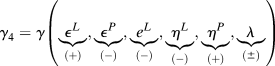 ${\gamma _4} = \gamma \left( {\underbrace {{\varepsilon ^L}}_{\left( + \right)},\underbrace {{\varepsilon ^P}}_{\left( - \right)},\underbrace {{e^L}}_{\left( - \right)},\underbrace {{\eta ^L}}_{\left( - \right)},\underbrace {{\eta ^P}}_{\left( + \right)},\underbrace \lambda _{\left( \pm \right)}} \right)$.
We summarize the comparative statics in Table 3 of the online Supplemental Appendix.
2) Constrained Policymaker and Unconstrained Lobby: Information Choices
Here, we derive the policymaker’s information and lobby’s information problem when c > y L ≥ e P and y L ≥ e L + c.
A) Policymaker’s Information Choice
The lower threshold  $\underline {\lambda '}$ follows again from the policymaker’s trade-off between the expected payoff from costly information with uncertain information signal and policy outcome and the expected payoff from the costless status quo without gathering information. Note that the policymaker anticipates a policy implementation subsidy of τ = e P + c − y P in the case of a reform signal and zero otherwise. The policymaker gathers information if
 $${z^r}\left( {{\lambda ^L}} \right)\left[ {{y^P} - {e^P} - c + \tau \left( {{z^r}} \right) + {\lambda ^P}\left( {{z^r}} \right)\alpha } \right] + {z^s}\left( {{\lambda ^L}} \right)\left[ {{y^P} - {e^P} + \tau \left( {{z^s}} \right) + \left( {1 - {\lambda ^P}\left( {{z^s}} \right)} \right)\alpha } \right] \,\ge\, {y^P} + \left( {1 - {\lambda ^L}} \right)\alpha$$
 $$\Rightarrow \,{z^r}\left( {{\lambda ^L}} \right){\lambda ^P}\left( {{z^r}} \right)\alpha + {z^s}\left( {{\lambda ^L}} \right)\left[ {{y^P} - {e^P} + \left( {1 - {\lambda ^P}\left( {{z^s}} \right)} \right)\alpha } \right] \ge \,{y^P} + \left( {1 - {\lambda ^L}} \right)\alpha .$$
Applying each information signal’s probability, the updating choice reduces to
 $${\lambda ^L} \ge {{\left( {1 - {\eta ^P}} \right)\left( {\alpha + {y^P}} \right) + {\eta ^P}{e^P}} \over {\left( {1 - {\eta ^P}} \right)\left( {\alpha + {y^P} - {e^P}} \right) + {\varepsilon ^P}\left( {\alpha + {e^P} - {y^P}} \right)}} \,\equiv \,\underline {\lambda '} ,$$
which defines the new lower updating threshold.
The upper threshold  $\bar{\lambda }\prime$ follows again from the policymaker’s trade-off between costly information and costly reform without gathering information. The policymaker gathers information if
 $${z^r}\left( {{\lambda ^L}} \right)\left[ {{y^P} - {e^P} - c + \tau \left( {{z^r}} \right) + {\lambda ^P}\left( {{z^r}} \right)\alpha } \right] + {z^s}\left( {{\lambda ^L}} \right)\left[ {{y^P} - {e^P} + \tau \left( {{z^s}} \right) + \left( {1 - {\lambda ^P}\left( {{z^s}} \right)} \right)\alpha } \right] \,\ge \,{y^P} - c + {\lambda ^L}\alpha$$
 $$\Rightarrow {z^r}\left( {{\lambda ^L}} \right){\lambda ^P}\left( {{z^r}} \right)\alpha + {z^s}\left( {{\lambda ^L}} \right)\left[ {{y^P} - {e^P} + \left( {1 - {\lambda ^P}\left( {{z^s}} \right)} \right)\alpha } \right] \ge \,{y^P} - c + {\lambda ^L}\alpha .$$
Solving for λ L, we can write
 $${\lambda ^L} \le {{\left( {\alpha + {y^P} - {e^P}} \right){\eta ^P} + c - {y^P}} \over {\left( {\alpha + {y^P} - {e^P}} \right){\eta ^P} + \left( {\alpha - {y^P} + {e^P}} \right)\left( {1 - {\varepsilon ^P}} \right)}} \,\equiv \,\bar{\lambda }\prime ,$$
which defines the new upper updating threshold.
Comparison of Thresholds
For the comparison of the lower thresholds, we have for  $\underline \lambda - {\underline \lambda '}$ ⋛ 0, using (A.25) and (A.34) such that.
 $$\eqalign & {{\left( {1 - {\eta ^P}} \right)\left( {\alpha + c} \right) + {e^P}} \over {\alpha \left( {1 + {\varepsilon ^P} - {\eta ^P}} \right) + c\left( {1 - {\varepsilon ^P} - {\eta ^P}} \right)}} - {{\left( {1 - {\eta ^P}} \right)\left( {\alpha + {y^P}} \right) + {\eta ^P}{e^P}} \over {\left( {1 - {\eta ^P}} \right)\left( {\alpha + {y^P} - {e^P}} \right) + {\varepsilon ^P}\left( {\alpha + {e^P} - {y^P}} \right)}} \,\gtreqless \,0 \cr & - {{\overbrace {\left( {c + {e^P} - {y^P}} \right)}^{\left( + \right)}\left( {\overbrace {{e^P}\left( {{\eta ^P} + {\varepsilon ^P} - 1} \right)}^{\left( + \right)} + \overbrace {2\alpha (1 - {\eta ^P}){\varepsilon ^P}}^{\left( + \right)}} \right)} \over {\underbrace {\left( {\alpha \left( {1 + {\varepsilon ^P} - {\eta ^P}} \right) + c\left( {1 - {\varepsilon ^P} - {\eta ^P}} \right)} \right)}_{\left( a \right)}\underbrace {\left( {\alpha \left( {1 + {\varepsilon ^P} - {\eta ^P}} \right) + \left( {{y^P} - {e^P}} \right)\left( {1 - {\varepsilon ^P} - {\eta ^P}} \right)} \right)}_{\left( b \right)}}} \,\gtreqless \,0 \cr & \left( a \right):\;\alpha \left( {1 - {\eta ^P}} \right) + \varepsilon \left( {\alpha - c} \right) + c\left( {1 - {\eta ^P}} \right) > 0 \Rightarrow \left( a \right) \to \left( + \right) \cr & \left( b \right):\alpha > c > {y^P} - {e^P}\;{\rm{and}}\;1 + {\varepsilon ^P} - {\eta ^P} > {\varepsilon ^P} + {\eta ^P} - 1 \,\, \Rightarrow \,\left( b \right) \to \left( + \right) \,\,\Rightarrow \,\underline \lambda - \underline \lambda \prime > 0 \,\Leftrightarrow \,\underline \lambda > \underline \lambda \prime .$$
For the comparison of the upper thresholds, we have  $\bar{\lambda } - \bar{\lambda }'$ ⋛ 0, using (A.27) and (A.36) such that
 $${{{\eta ^P}\left( {\alpha + c} \right) - {e^P}} \over {\alpha \left( {1 - {\varepsilon ^P} + {\eta ^P}} \right) + c\left( {{\varepsilon ^P} + {\eta ^P} - 1} \right)}} - {{\left( {\alpha + {y^P} - {e^P}} \right){\eta ^P} + c - {y^P}} \over {\left( {\alpha + {y^P} - {e^P}} \right){\eta ^P} + \left( {\alpha - {y^P} + {e^P}} \right)\left( {1 - {\varepsilon ^P}} \right)}} \,\gtreqless \,0.$$
If ε P = η P, then the comparison of the upper thresholds is
 $${{{\eta ^P}\left( {\alpha + c} \right) - {e^P}} \over {\alpha \left( {1 - {\eta ^P} + {\eta ^P}} \right) + c\left( {{\eta ^P} + {\eta ^P} - 1} \right)}} - {{\left( {\alpha + {y^P} - {e^P}} \right){\eta ^P} + c - {y^P}} \over {\left( {\alpha + {y^P} - {e^P}} \right){\eta ^P} + \left( {\alpha - {y^P} + {e^P}} \right)\left( {1 - {\eta ^P}} \right)}}$$
 $$\scale 83%{= - {{\overbrace {\left( {c + {e^P} - {y^P}} \right)}^{\left( + \right)}\overbrace {\left( {\alpha + c\left( {2{\eta ^P} - 1} \right) - 2{\eta ^P}\left( { - \alpha {\eta ^P} + \alpha + {e^P}} \right) + {e^P}} \right)}^{\left( + \right)}} \over {\underbrace {\left( {\alpha + c\left( {2{\eta ^P} - 1} \right)} \right)}_{\left( + \right)}\underbrace {\left( {\alpha + \left( {2{\eta ^P} - 1} \right)\left( {{y^P} - {e^P}} \right)} \right)}_{\left( + \right)}}} \,\gtreqless \,0$$
 $$\left(c \right):$$
 $$\Rightarrow \,\bar{\lambda } - \bar{\lambda '} \lt \,0 \,\Leftrightarrow \,\bar{\lambda } \,\lt \,\underline \lambda \prime .$$
The comparative statics for  $\underline {\lambda '}$ and
 $\bar{\lambda }\prime$ can be found in the online Supplemental Appendix.
B) Lobby’s Information Choice
The lobby’s lobbying decision follows from the policymaker’s thresholds described in (A.34) and (A.36) as well as the four possible informational lobbying cases of C1, C2, C3, and C4 with the thresholds of  $\underline {\lambda '}$ and
 $\bar{\lambda }\prime$ instead of
 $\underline \lambda$ and
 $\bar{\lambda }$.
For the lobby’s problem to lobby a politically inactive policymaker, we have that a reform signal would induce a policymaker to gather information or to implement an immediate reform—that is,  $\lambda \,\lt \,\underline \lambda \prime \,\le \,\lambda\, \left( {{x^r}} \right) \,\lt \,{\overline \lambda \prime }$ and
 $\lambda \,\lt \,\underline \lambda \prime \,\lt \,{\overline \lambda \prime } \,\le \,\lambda \left( {{x^r}} \right)$. For the first case C1, a lobbyist compares the expected payoff from gathering information and a potential second information gathering with the one from no reform with certainty. The lobby gathers information with τ* from (4.1) if
 $${x^r}\left( \lambda \right){z^r}\left( \lambda \right)\left( {1 - \tau \left( z \right)} \right) \,\ge \,{e^L}$$
 $$\scale 97%{\left( {{\varepsilon ^P}{\varepsilon ^L}\lambda + \left( {1 - {\eta ^P}} \right)\left( {1 - {\eta ^L}} \right)\left( {1 - \lambda } \right)} \right)\left( {1 - {e^P} - c + {y^P}} \right) \,\ge \,{e^L}.$$
The comparative statics for the net payoff are  ${\gamma _{1'}} = \gamma \left( {\underbrace {{\varepsilon ^L}}_{\left( + \right)},\underbrace {{\varepsilon ^P}}_{\left( + \right)},\underbrace {{e^L}}_{\left( - \right)},\underbrace {{\eta ^L}}_{\left( - \right)},\underbrace {{\eta ^P}}_{\left( - \right)},\underbrace \lambda _{\left( + \right)},\underbrace {{y^P}}_{\left( + \right)},\underbrace {{e^P}}_{\left( - \right)},\underbrace c_{\left( - \right)}} \right)$.
For the other case C2, the trade-off follows the expected payoff from gathering information and a potential immediate reform with no reform with certainty. The lobby gathers if
 $${x^r}\left( \lambda \right) \,\ge \,{e^L}$$
 $$1 - {\eta ^L} - \lambda \left( {1 - {\varepsilon ^L} - {\eta ^L}} \right) \,\ge \,{e^L},$$
which is the same as (A.30) as the policymaker finances the implementation of the reform. The comparative statics for the net payoff are  ${\gamma _{2\prime }} = \gamma \left( {\underbrace {{\varepsilon ^L}}_{\left( + \right)},\underbrace {{\varepsilon ^P}}_{\left( 0 \right)},\underbrace {{e^L}}_{\left( - \right)},\underbrace {{\eta ^L}}_{\left( - \right)},\underbrace {{\eta ^P}}_{\left( 0 \right)},\underbrace \lambda _{\left( + \right)},\underbrace {{y^P}}_{\left( 0 \right)},\underbrace {{e^P}}_{\left( 0 \right)},\underbrace c_{\left( 0 \right)}} \right)$.
For the cases for which the lobby is considering a substitution of the policymaker’s information, a lobby’s reform signal would induce an immediate reform and a status quo signal would either (C3) not affect the policymaker’s choice or (C4′) result in an immediate rejection of the reform proposal—that is,  $\underline \lambda \prime \,\le \,\lambda \,\left( {{x^s}} \right) \,\le\, \lambda \,\le \,{\overline \lambda \prime } \,\le \,\lambda \left( {{x^r}} \right)$ and
 $\lambda \left( {{x^s}} \right) \,\le\, \underline \lambda \prime \,\le \,\lambda \,\le \,{\overline \lambda \prime } \,\le \,\lambda \,\left( {{x^r}} \right)$. For the case of “forgivingness” C3, the lobby compares the expected payoff from gathering information and a potential immediate reform with the expected payoff when only the policymaker gathers information. The lobby gathers information with τ* from (4.1) if
 $${x^r}\left( \lambda \right) + {x^s}\left( \lambda \right){z^r}\left( {\lambda \left( {{x^s}} \right)} \right)\left( {1 - \tau \left( z \right)} \right) - {e^L} \,\ge\, {z^r}\left( \lambda \right)\left( {1 - \tau \left( z \right)} \right)$$
 $$\left( {1 - {\varepsilon ^L}} \right)\lambda \left( {{\varepsilon ^L}{\varepsilon ^P}\lambda + \left( {1 - {\eta ^L}} \right)\left( {1 - {\eta ^P}} \right)\left( {1 - \lambda } \right)} \right)\left( {1 - c - {e^P} + {y^P}} \right) - {e^L} + {\varepsilon ^L}\lambda + \left( {1 - {\eta ^L}} \right)\left( {1 - \lambda } \right) + {\eta ^L}\left( {1 - \lambda } \right) \ge \left( {{\varepsilon ^P}\lambda + \left( {1 - {\eta ^P}} \right)\left( {1 - \lambda } \right)} \right)\left( {1 - c - {e^P} + {y^P}} \right).$$
The comparative statics for the net payoff are  ${\gamma _{3\prime }} = \gamma \left( {\underbrace {{\varepsilon ^L}}_{\left( + \right)},\underbrace {{\varepsilon ^P}}_{\left( - \right)},\underbrace {{e^L}}_{\left( - \right)},\underbrace {{\eta ^L}}_{\left( - \right)},\underbrace {{\eta ^P}}_{\left( + \right)},\underbrace \lambda _{\left( \pm \right)},\underbrace {{y^P}}_{\left( \pm \right)},\underbrace {{e^P}}_{\left( \pm \right)},\underbrace c_{\left( \pm \right)}} \right)$.
For the last case C4, the lobby compares the expected payoff of gathering information with the risk of rejection and the expected payoff from a policymaker’s information gathering only. The lobby gathers information if
 $${x^r}\left( \lambda \right) - {e^L} \,\ge \,{z^r}\left( \lambda \right)\left( {1 - {e^P} - c + {y^P}} \right)$$
 $${\varepsilon ^L}\lambda + \left( {1 - {\eta ^L}} \right)\left( {1 - \lambda } \right) - {e^L} \ge \left( {{\varepsilon ^P}\lambda + \left( {1 - {\eta ^P}} \right)\left( {1 - \lambda } \right)} \right)\left( {1 - c - {e^P} + {y^P}} \right).$$
The comparative statics for the payoff are  ${\gamma _{4\prime }} = \gamma \left( {\underbrace {{\varepsilon ^L}}_{\left( + \right)},\underbrace {{\varepsilon ^P}}_{\left( - \right)},\underbrace {{e^L}}_{\left( - \right)},\underbrace {{\eta ^L}}_{\left( - \right)},\underbrace {{\eta ^P}}_{\left( + \right)},\underbrace \lambda _{\left( \pm \right)},\underbrace {{y^P}}_{\left( - \right)},\underbrace {{e^P}}_{\left( + \right)},\underbrace c_{\left( + \right)}} \right)$.
We summarize the comparative statics in Table 4 of the online Supplemental Appendix.
3) Constrained Policymaker and Lobby: Information Choices
Here, we derive the policymaker’s information and lobby’s information problem when max{c, e P} ≤ y P < c + e P, max{e L, e P + c − y P} ≤ y L < e L + c + e P − y P and y L + y P − max{e L, e P} ≥ c. The last condition ensures that the combined resources are sufficient for one information signal and a reform.
Policymaker’s Information Choice
The policymaker’s information problem is similar to the one above and the derived thresholds are identical to  $\underline {\lambda '}$ in (A.34) and
 $\bar{\lambda }\prime$ in (A.36).
Lobby’s Information Choice
A resource-constrained lobby can induce a resource constrained policymaker to reform if λ L(x) ≥ λ*. If the policymaker or the lobby were not constrained, then the policymaker would gather information for  ${\lambda ^L}\left( x \right) \,\le \,\left\{ {\bar{\lambda },\bar{\lambda }\prime } \right\}$ even when λ L(x) ≥ λ*. Hence, the resource-constrained lobby can induce a reform at a lower standard. Furthermore, the number of cases of informational lobbying reduces as there can be only one information signal in total. Hence, the illustration of the informational lobbying case in Figure 5 changes to the one in Figure 10.
Lobby’s Information Choices—Both Constraints Bind

For the lobby’s problem to lobby, a politically inactive policymaker in case C2, we have that a reform signal would induce a reform—that is,  $\lambda \,\lt \,{\overline \lambda \prime }$. Here, and different to the previous cases, a lobby can induce an immediate reform for lower beliefs with λ* < λ(x r) rather than
 ${\lambda ^*} \lt \,{\overline \lambda \prime } \,\lt \,\lambda \,\left( {{x^r}} \right)$. In other words, a lobby may choose to gather information and receive the benefit of the doubt as the policymaker is unable to gather information. Hence, a lobby may choose to gather information for
 $\lambda \lt \,\underline \lambda \prime \,\lt \,{\lambda ^*} \,\lt \,\left\{ {\lambda \left( {{x^r}} \right),{\overline \lambda \prime } } \right\}$ if
 $${x^r}\left( \lambda \right) \,\ge \,{e^L}$$
 $${\varepsilon ^L}\lambda + \left( {1 - {\mu ^l}} \right)\left( {1 - \lambda } \right) \,\ge\, {e^L},$$
which is the same as (A.30) as the policymaker finances the implementation of the reform. The comparative statics for the net payoff are  ${\gamma _{2''}} = \gamma \left( {\underbrace {{\varepsilon ^L}}_{\left( + \right)},\underbrace {{\varepsilon ^P}}_{\left( 0 \right)},\underbrace {{e^L}}_{\left( - \right)},\underbrace {{\eta ^L}}_{\left( - \right)},\underbrace {{\eta ^P}}_{\left( 0 \right)},\underbrace \lambda _{\left( + \right)},\underbrace {{y^P}}_{\left( 0 \right)},\underbrace {{e^P}}_{\left( 0 \right)},\underbrace c_{\left( 0 \right)}} \right)$.
For the case C4, the lobby compares the expected payoff of gathering information with the expected payoff from a policymaker’s information only. The lobby gathers information if
 $${x^r}\left( \lambda \right) - {e^L} \,\ge\, {z^r}\left( \lambda \right)\left( {1 - {e^P} - c + {y^P}} \right)$$
 $${\varepsilon ^L}\lambda + \left( {1 - {\eta ^L}} \right)\left( {1 - \lambda } \right) - {e^L} \,\ge \,\left( {{\varepsilon ^P}\lambda + \left( {1 - {\eta ^P}} \right)\left( {1 - \lambda } \right)} \right)\left( {1 - c - {e^P} + {y^P}} \right).$$
The comparative statics for the net payoff are  ${\gamma _{4''}} = \gamma \left( {\underbrace {{\varepsilon ^L}}_{\left( + \right)},\underbrace {{\varepsilon ^P}}_{\left( - \right)},\underbrace {{e^L}}_{\left( - \right)},\underbrace {{\eta ^L}}_{\left( - \right)},\underbrace {{\eta ^P}}_{\left( + \right)},\underbrace \lambda _{\left( \pm \right)},\underbrace {{y^P}}_{\left( - \right)},\underbrace {{e^P}}_{\left( + \right)},\underbrace c_{\left( + \right)}} \right)$.
For the special case CS, a lobby may actually choose to gather information and diminish own resources to prevent a policymaker’s information gathering and realize a reform with certainty—that is,  $\underline {\lambda '}$ < λ(z s) < λ* < (x s) < λ < {λ(z r), λ(x r)}. The lobby engages in informational lobbying if
 $$1 - {e^L} \,\ge\, {z^r}\left( \lambda \right)\left( {1 - c - {e^P} + {y^P}} \right)$$
 $$1 - {e^L} \ge \left( {{\varepsilon ^P}\lambda + \left( {1 - {\eta ^P}} \right)\left( {1 - \lambda } \right)} \right)\left( {1 - {e^P} - c} \right).$$
The comparative statics for the net payoff are  ${\gamma _{s''}} = \gamma \left( {\underbrace {{\varepsilon ^L}}_{\left( 0 \right)},\underbrace {{\varepsilon ^P}}_{\left( - \right)},\underbrace {{e^L}}_{\left( - \right)},\underbrace {{\eta ^L}}_{\left( 0 \right)},\underbrace {{\eta ^P}}_{\left( + \right)},\underbrace \lambda _{\left( - \right)},\underbrace {{y^P}}_{\left( - \right)},\underbrace {{e^P}}_{\left( + \right)},\underbrace c_{\left( + \right)}} \right)$.
For the case C2, the lobby’s instruments are independent as the lobby would only engage in informational lobbying but in neither alternative provide a policy implementation subsidy. For the case C4 and its special case, the policymaker either gathers information and the lobby finances the reform or the lobby gathers information and the policymaker finances the reform. Hence, the lobbying instruments are substitutes in this scenario.
We summarize the comparative statics in Table 5 of the online Supplemental Appendix.


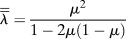


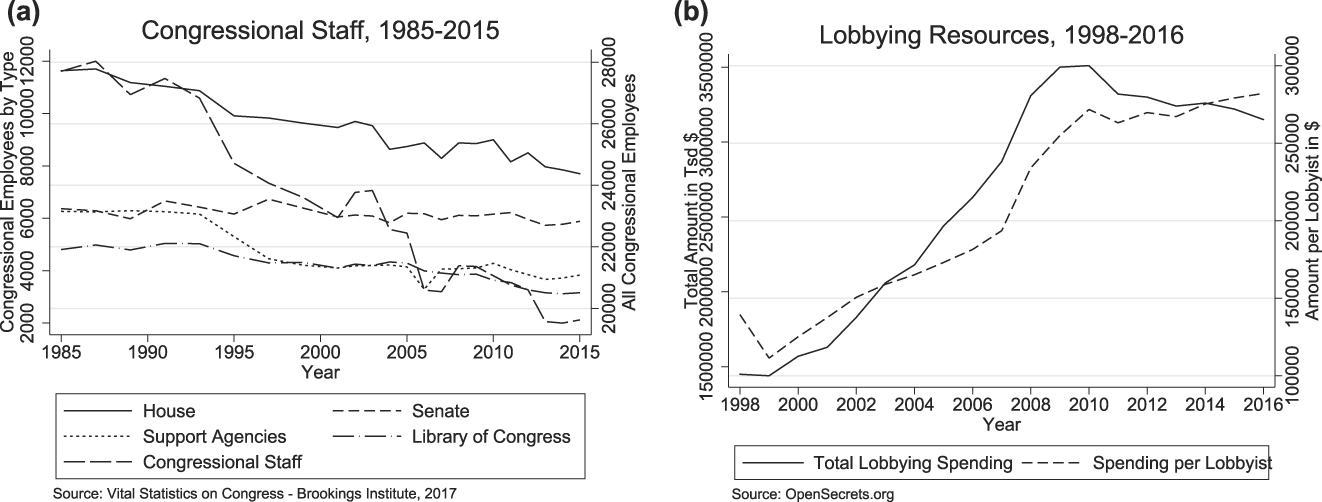

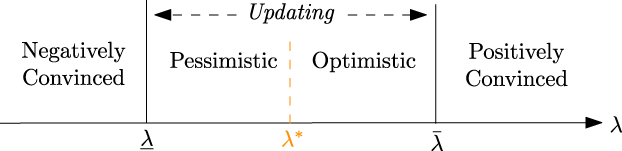
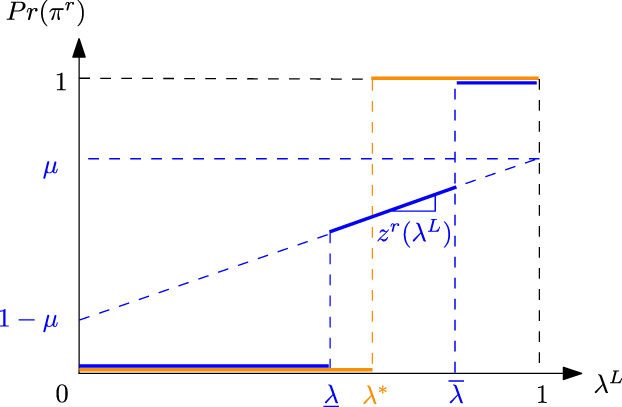
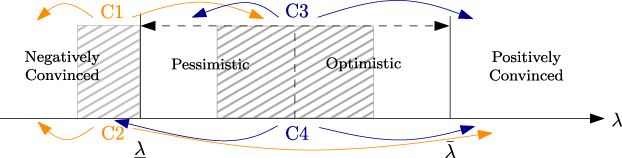
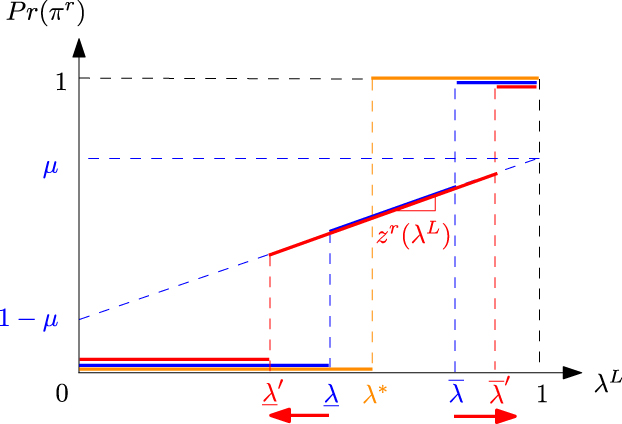
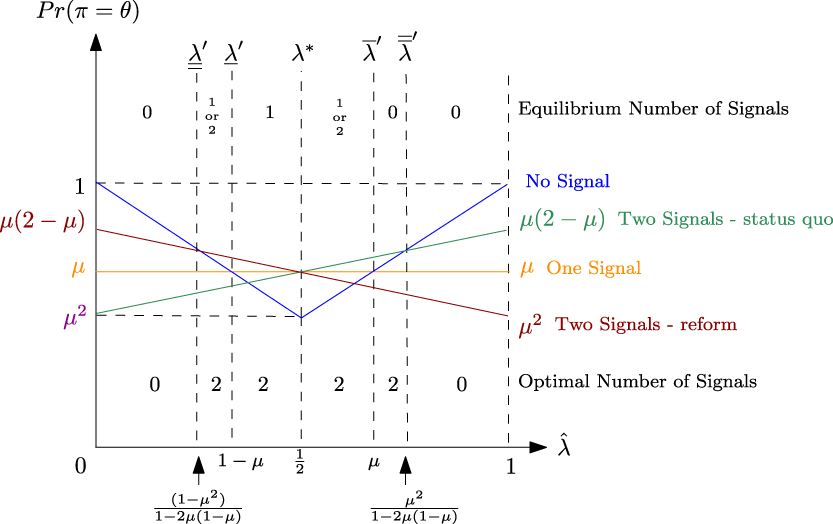
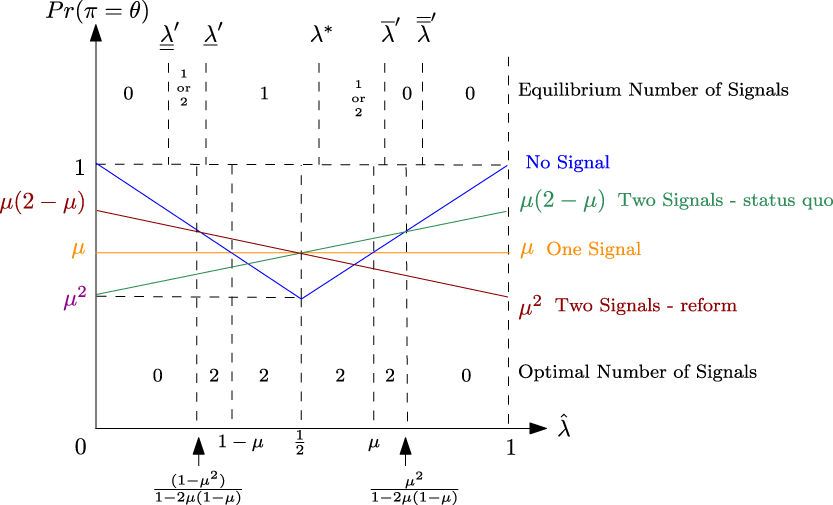


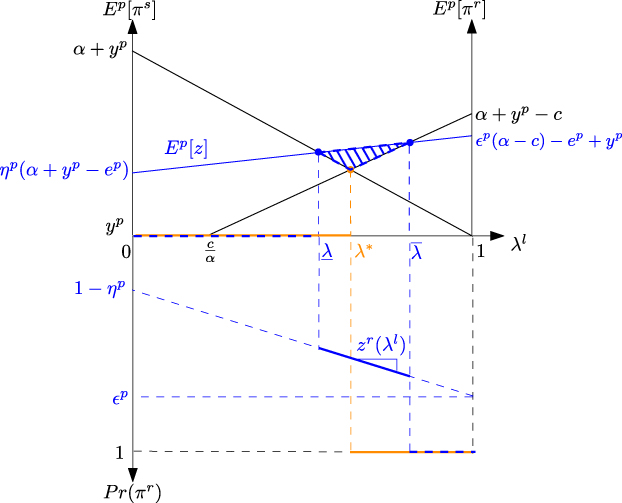
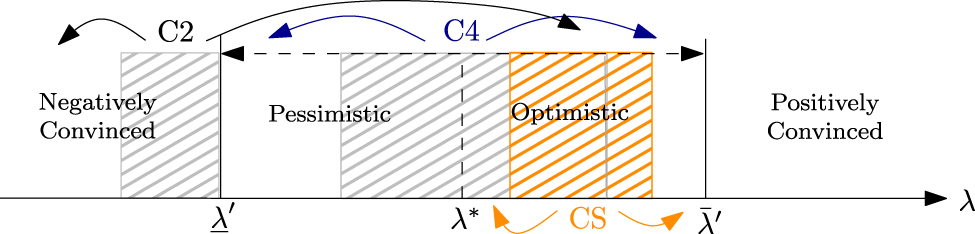




Comments
No Comments have been published for this article.