Barnyardgrass is a grass weed in the Poaceae family and is a summer annual that reproduces through seed (Bryson and DeFelice Reference Bryson and DeFelice2009). It can be identified by the collar region of the leaf, which has no ligule, auricles, or pubescences. Barnyardgrass is difficult to control in rice. This is mainly attributed its ability to outcompete C3 rice, due to its C4 photosynthetic pathway, allowing the weed to proliferate in the high light and high temperature environments commonly found in rice-producing regions (Mitich Reference Norsworthy, Bond and Scott1990). The weed can also reproduce at a rate of 39,000 seeds per plant in rice, and typically reaches heights over 1.5 m tall (Bagavathiannan et al. Reference Bagavathiannan, Norsworthy, Smith and Neve2012).
In rice, herbicides may be applied PRE, delayed PRE (DPRE), early POST (EPOST), preflood (PREFLD), and POST flood (POSTFLD). Currently, the soil-applied herbicides registered for control of barnyardgrass in U.S. rice include clomazone (WSSA group 12), quinclorac (WSSA group 4), thiobencarb (WSSA group 8), imazethapyr (WSSA group 2), and pendimethalin (WSSA group 3). Bispyribac (WSSA group 2), cyhalofop (WSSA group 1), fenoxaprop (WSSA group 1), penoxsulam (WSSA group 2), propanil (WSSA group 7), and quinclorac can be applied POST for barnyardgrass control (Hardke Reference Hardke2014). Imazamox and imazethapyr (WSSA group 2) are also registered for use POST when planting an imidazolinone-resistant (ClearfieldTM, BASF, Research Triangle Park, NC) rice cultivar (Hardke Reference Hardke2014). However, ineffectiveness of herbicide applications on barnyardgrass can be attributed to resistance. Therefore, determining whether resistant populations exist within a field is imperative, as is introducing a new site of action (SOA) (Norsworthy et al. Reference Norsworthy, Scott, Smith, Still, Estorninos and Bangarwa2012b).
Currently, barnyardgrass has evolved resistance to at least 9 SOAs worldwide and at least 7 SOAs in the United States (Heap Reference Heap2016). Rotating herbicide SOA is a widely recommended practice to mitigate herbicide resistance. The high level of competiveness and ever-present risk for evolution of herbicide resistance in barnyardgrass is particularly concerning. In Arkansas rice production, barnyardgrass is highly problematic and has evolved resistance to propanil, quinclorac, clomazone, and ALS-inhibiting herbicides (Lovelace et al. Reference Matzenbacher, Bortoly, Kalsing and Merotto2002; Norsworthy et al. Reference Norsworthy, Scott, Smith, Still, Estorninos and Bangarwa2009, Reference Norsworthy, Scott and Johnson2013; Wilson et al. Reference Wilson, Norsworthy, Scott and Gbur2011). To combat this troublesome weed, a new herbicide is being developed which is the second herbicide in a new structural class of synthetic auxins, the arylpicolinates. The compound, florpyrauxifen-benzyl (LoyantTM herbicide with RinskorTM active, Dow AgroSciences LLC, Indianapolis, IN), will provide an alternative SOA in rice, thereby potentially providing effective control of propanil-, quinclorac-, clomazone-, and acetolactate synthase–resistant barnyardgrass in rice (Epp et al. Reference Epp, Alexander, Balko, Buysse, Brewster, Bryan, Daeuble, Fields, Gast, Green, Irvine, Lo, Lowe, Renga, Richburg, Ruiz, Satchivi, Schmitzer, Siddall, Webster, Weimer, Whiteker and Yerkes2016).
Given its alternative SOA and potent herbicidal activity (Epp at al. Reference Epp, Alexander, Balko, Buysse, Brewster, Bryan, Daeuble, Fields, Gast, Green, Irvine, Lo, Lowe, Renga, Richburg, Ruiz, Satchivi, Schmitzer, Siddall, Webster, Weimer, Whiteker and Yerkes2016), it was hypothesized that florpyrauxifen-benzyl would provide a consistent, high level of control of barnyardgrass accessions collected from various fields and would control already existing herbicide-resistant biotypes. The objectives of this research were to 1) evaluate florpyrauxifen-benzyl efficacy on barnyardgrass accessions collected in rice fields across Arkansas and 2) determine the dose necessary to provide effective control of herbicide-resistant barnyardgrass biotypes.
Materials and Methods
Accession Collection and Evaluation
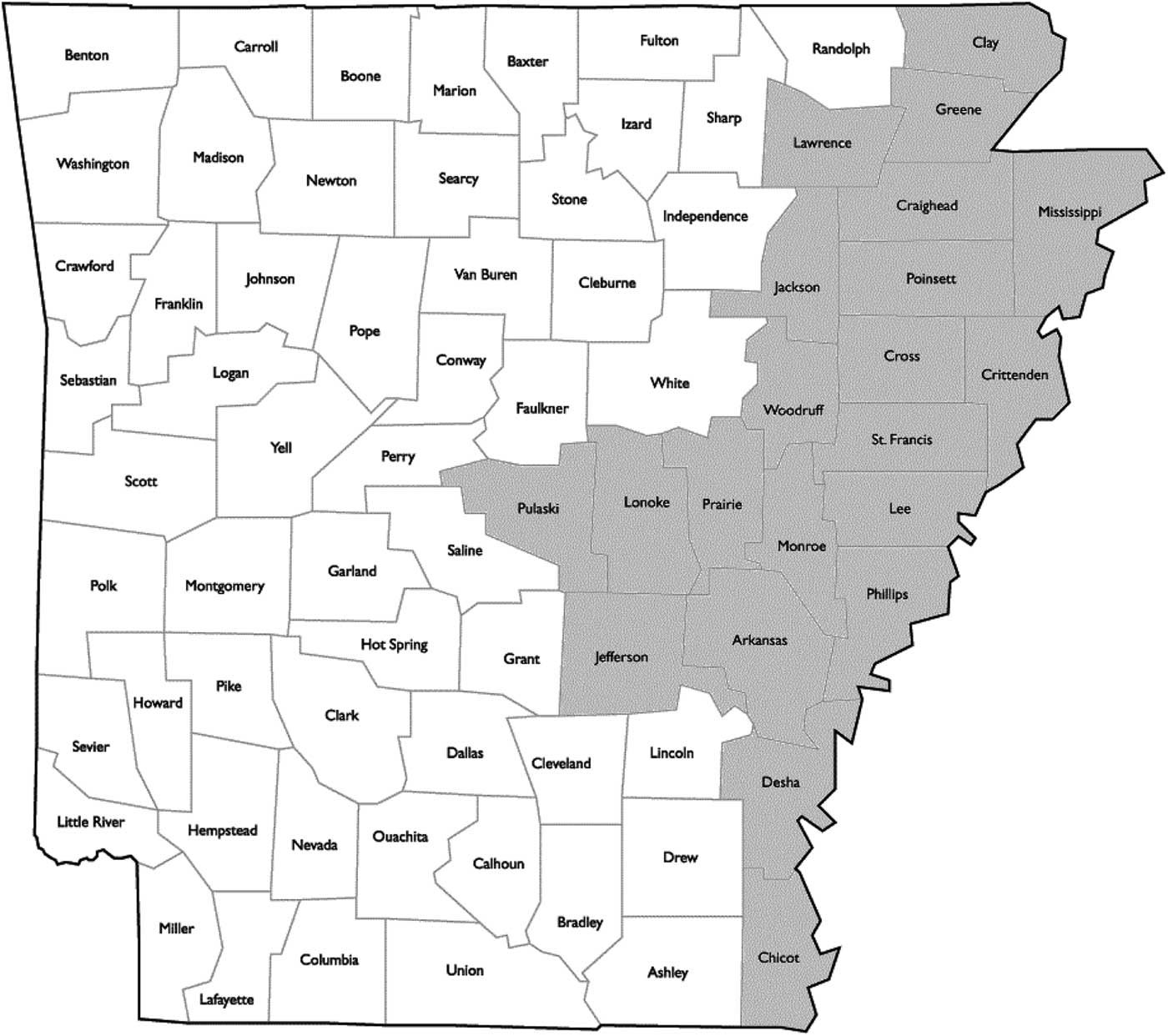
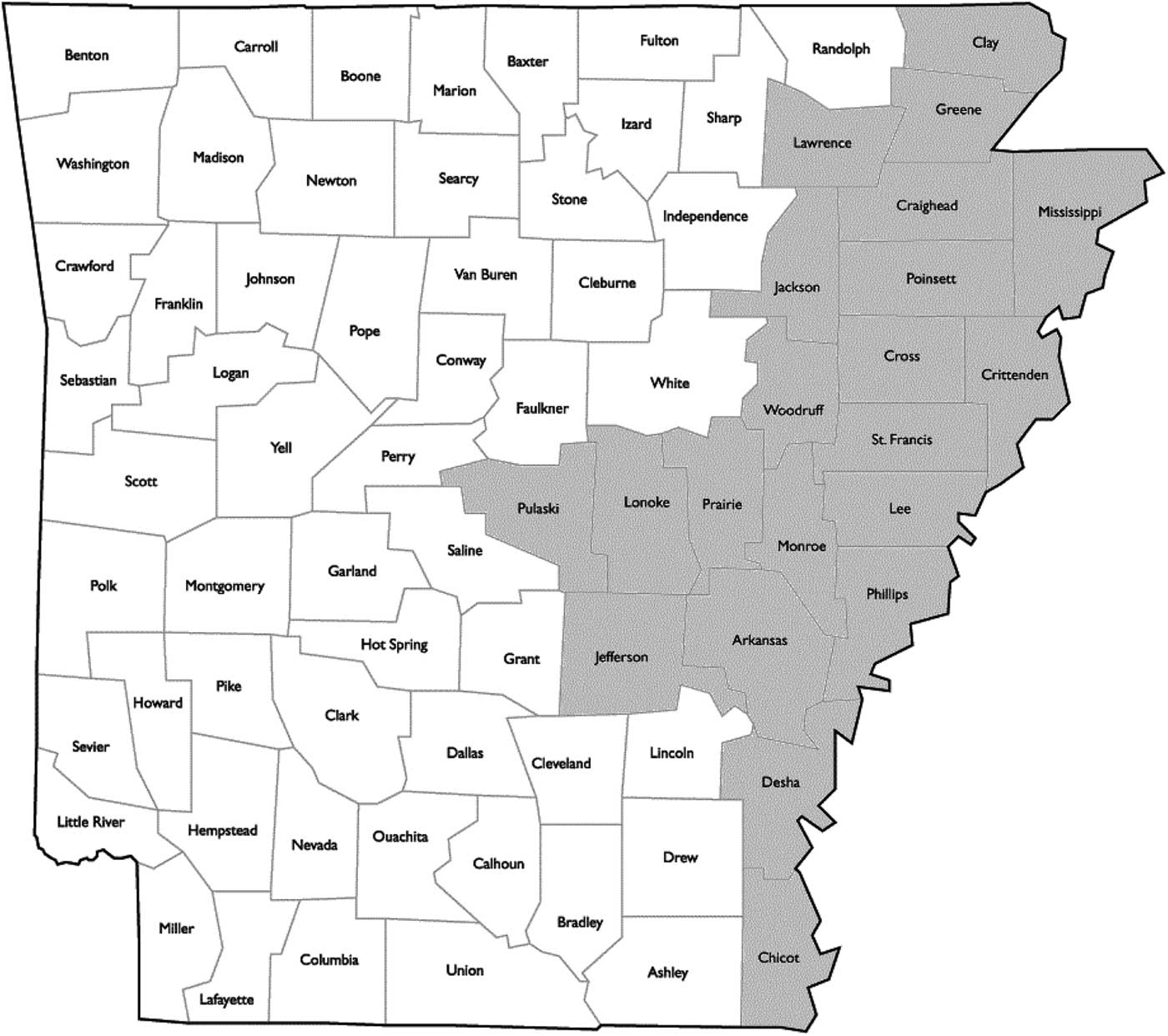
Barnyardgrass panicles were collected from 152 agricultural fields spanning 21 Arkansas counties during the fall of 2015 (Table 1, Figure 1). The number of panicles collected was dependent upon the density of the plants present within each field. During the time of collection, a handheld global positioning system was used to record the coordinates for each sampling location. Sampling sites were not pre-determined but instead were selected based on the presence of barnyardgrass during the time of collection. Therefore, the presence or absence of herbicide resistance within each accession was not known during the time of collection. In addition, at the time of collection it was not known what herbicides the plants had been exposed to in that season or if the plants had emerged since the last herbicide application. Immediately after collection plants were dried for 7 days in a greenhouse (32/22 C day/night temperatures), and seed was threshed and combined into a single composite sample for each accession. In addition, in order to overcome any dormancy, seed was stored at room temperature for approximately 4 months.
A total of 152 barnyardgrass accessions were collected from 21 Arkansas counties (shaded in gray). See Table 1 for the number of samples collected from each county.
Barnyardgrass accessions listed by county, crop, and global positioning system coordinates from which they were collected in 2015.

The greenhouse experiment was conducted during the spring of 2015 and repeated in the fall of the same year at the University of Arkansas Altheimer Laboratory located in Fayetteville, Arkansas. The experiment was a completely randomized design with four replications. A total of four plants from each accession were planted in potting mix in a single 12-cm-diam pot and were subjected to an application of florpyrauxifen-benzyl at 30 g ai ha−1 (anticipated labeled rate) or were left untreated. Herbicide treatments were applied to three- to four-leaf seedling barnyardgrass plants (12 to 16 cm in height) during preflood application timing. Applications were made in a spray chamber with a two-nozzle boom track sprayer fitted with flat-fan 800067 nozzles (TeeJet Technologies, Springfield, IL) calibrated to deliver 187 L ha−1 at 276 kPa. Herbicide treatments contained 2.5% (v/v) methylated seed oil concentrate (MSO concentrate with LECI-TECH, Loveland Products, Loveland, CO).
Visual estimates of control were recorded 21 days after treatment (DAT) on a 0 to 100 scale where 0 represented no control and 100 represented complete control of the treated barnyardgrass accessions compared with their nontreated counterparts. Plant heights were also collected for each accession (treated and nontreated) 21 DAT. In addition, aboveground biomass was collected 21 DAT, oven dried at 66 C for 7 days, and weighed. Dry weight was then converted to a percent dry weight reduction compared with the nontreated control for each of the 152 accessions.
All data were analyzed in JMP (JMP Pro 12, SAS Institute Inc. Cary, NC). Data collected from the barnyardgrass accessions for control, height reduction, and biomass reduction were subjected to ANOVA. None of the response parameters had significant F-tests (P≥0.05); therefore, individual means and standard errors (SE) of the means were reported.
Dose Response of Herbicide-Resistant Biotypes
An additional greenhouse experiment was conducted during the spring of 2015 and repeated during the fall of the same year. Previous results from the University of Arkansas herbicide-resistance screening program confirmed barnyardgrass biotypes resistant to several commonly applied rice herbicides such as propanil (WSSA group 7), quinclorac (WSSA group 4), and imazethapyr (WSSA group 2) (Norsworthy et al. Reference Norsworthy, Scott, Smith, Still, Estorninos and Bangarwa2012b). Progeny from these resistant biotypes were subsequently grown in a greenhouse to increase seed quantity for use in this experiment. Seeds from each biotype were sown in individual pots in a greenhouse with 32/22 C day/night temperatures and later thinned to one plant per pot. The experiment was arranged as a completely randomized design with 20 replications per biotype and herbicide dose.
Four barnyardgrass biotypes were evaluated: propanil-resistant, quinclorac-resistant, ALS-resistant, and a known susceptible. Each of the four biotypes were treated with florpyrauxifen-benzyl at either 0, 5, 10, 15, 20, 30, 45, 60, or 120 g ai ha−1. Herbicide treatments were applied to three- to four-leaf seedling barnyardgrass plants (12 to 16 cm in height). Applications were made in a spray chamber with the spray parameters mentioned above. Plant mortality, plant height, and aboveground biomass at 21 DAT were recorded as described above.
All data are presented as a percentage of the nontreated check for the parameters measured. Florpyrauxifen-benzyl dose was transformed using a log scale. All data were regressed in JMP using a four-parameter log-logistic regression model similar to the model described in previous dose-response experiments (Seefeldt et al. Reference Wilson, Norsworthy, Johnson, Scott and DeVore1995):
 $$Y\, {\equals}\, C{\plus}\left\{ {D{\minus}C\,/\!1{\plus}{\rm exp}\left[ {B\left( {{\rm log}\,X{\minus}{\rm log}\,E} \right)} \right]} \right\}\,,$$
where Y is the response, X is the dose of florpyrauxifen-benzyl, B is the slope of the curve, C is the lower limit, D is the upper limit, and E is the inflection point for the fitted line. The effective dose (ED) required to cause 50% and 90% response (ED50 and ED90) were also calculated. After initial model fit, nonlinear regression models were compared to determine if significant differences between the curves existed as described by others (Bates and Watts Reference Bates and Watts1988; Seefeldt et al. Reference Wilson, Norsworthy, Johnson, Scott and DeVore1995).
Results and Discussion
Accession Collection and Evaluation
Florpyrauxifen-benzyl at 30 g ai ha−1 provided ≥96% control of all 152 barnyardgrass accessions evaluated in this experiment (Table 2). Symptoms caused by florpyrauxifen-benzyl included twisting of stem and leaf tissue, basal swelling, and subsequent chlorosis and necrosis of aboveground tissue. Wilson et al. (Reference Wilson, Norsworthy, Scott and Gbur2014) describes effective programs for managing herbicide-resistant barnyardgrass in rice. As resistance continues to evolve with sustained use of currently existing herbicide options, florpyrauxifen-benzyl is expected to have value in rice production systems (Norsworthy et al. Reference Norsworthy, Ward, Shaw, Llewellyn, Nichols, Webster, Bradley, Frisvold, Powles, Burgos, Witt and Barrett2012a, Reference Norsworthy, Scott and Johnson2013). This is not to say that florpyrauxifen-benzyl alone will be an effective barnyardgrass management tool. It should instead be incorporated into a diverse weed management program. When a single management tactic is deployed and repeated without diversification, resistance evolution is undoubtedly favored. Evidence of this occurrence can be seen in Asia, where repeated hand-weeding of barnyardgrass resulted in populations that are phenotypically similar to rice, making them difficult to differentiate at early vegetative growth stages (Barrett Reference Barrett1983).
Control, height reduction, and dry weight reductions of 152 barnyardgrass accessions 21 days after application of florpyrauxifen-benzyl at 30 g ai ha−1.Footnote a

a Herbicide applied to three- to four-leaf barnyardgrass seedlings.
b A total of 152 accessions were evaluated (B1 to B152) spanning 21 Arkansas counties.
c Mean and standard error (SE) of the mean.
d Accessions are reported as means followed by the standard error (SE) of the mean.
Similar to control estimates, plant height reduction also exhibited no significant differences among the accessions, with reductions ranging from 87% to 95% of the nontreated control. In addition, dry weight reductions across the accessions ranged from 93% to 99% of the nontreated control. Overall, the herbicide applied at the three- to four-leaf growth stage was deemed to be an effective option to control the 152 barnyardgrass accessions collected. A high level of visible control, plant height reduction, and biomass reduction were observed across all of the accessions evaluated, further highlighting the effectiveness of this new herbicide.
Dose Response of Herbicide-Resistant Biotypes
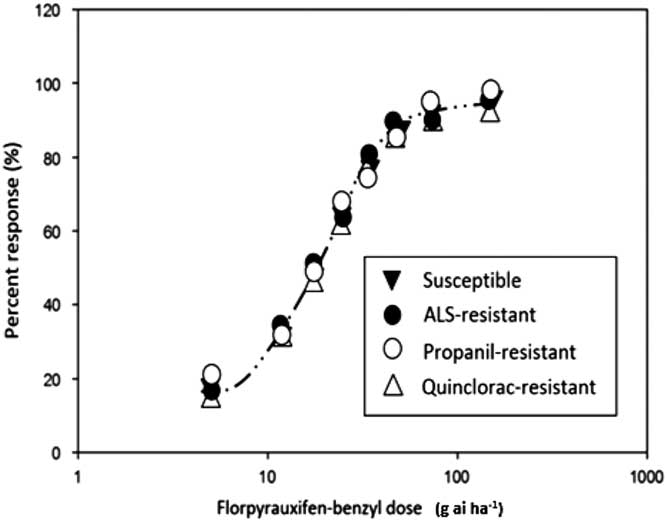
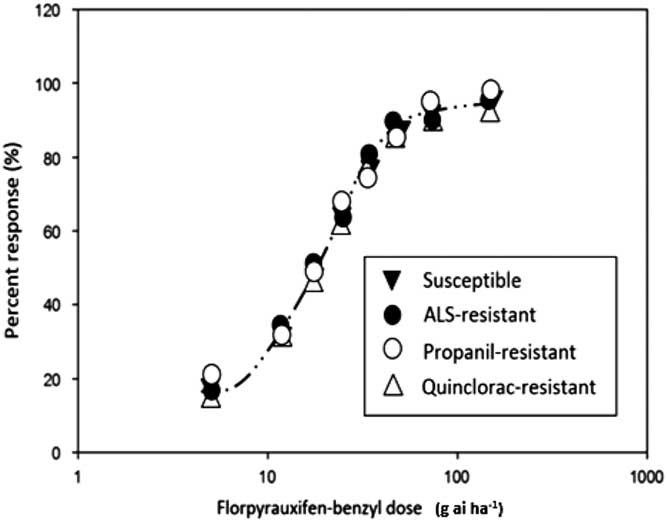
After an initial model was fit for each of the biotypes evaluated, further analysis found no difference (control, P=0.3106; height reduction, P=0.2723; biomass reduction, P=0.1982) between the curves of the individual biotypes for the parameters evaluated. Therefore, a single curve was fit for each parameter. For the susceptible, ALS-, propanil-, and quinclorac-resistant biotypes evaluated in the dose-response study, the ED90 value of percent control was 25.7 g ai ha−1 (±1.9) of florpyrauxifen-benzyl (Figure 2). This rate falls below the anticipated labeled rate of 30 g ai ha−1 (H. Miller, personal communication). Therefore, florpyrauxifen-benzyl, with its unique binding site, is expected to provide an effective option for existing herbicide-resistant barnyardgrass biotypes and serve as a resistance management tool (Epp et al. Reference Epp, Alexander, Balko, Buysse, Brewster, Bryan, Daeuble, Fields, Gast, Green, Irvine, Lo, Lowe, Renga, Richburg, Ruiz, Satchivi, Schmitzer, Siddall, Webster, Weimer, Whiteker and Yerkes2016) (Figure 2). As stated previously, no significant differences were observed between the regression models, indicating that all of the biotypes evaluated in this experiment responded similarly to applications of florpyrauxifen-benzyl regardless of their resistance to other herbicides.
Susceptible and acetolactate synthase (ALS)-, propanil-, and quinclorac-resistant barnyardgrass control 21 days after treatment with florpyrauxifen-benzyl. Regression parameters correspond to the four-parameter log-logistic regression model Y=C+{D−C/1+exp[B(logX−logE)]}, where Y is the response, X is the dose of florpyrauxifen-benzyl, B is the slope of the curve, C is the lower limit, D is the upper limit, and E is the inflection point for the fitted line. Model parameters and standard errors included B (−1.97±0.4), C (21.2±1.3), D (99.8±0.2), ED50 (13.8±2.2), and ED90 (25.7±1.9).
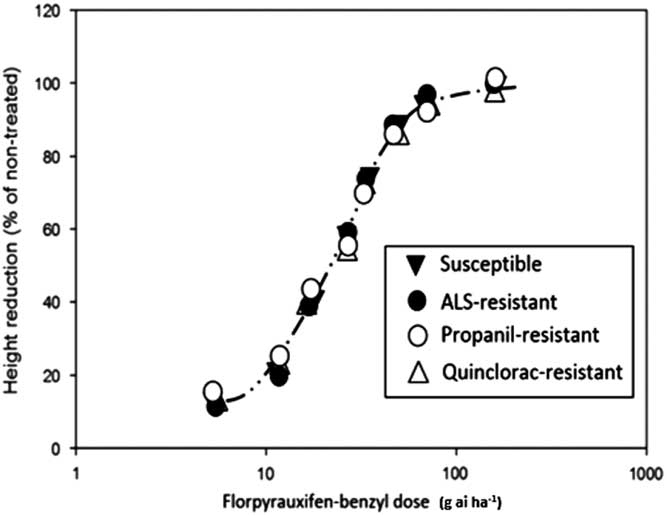
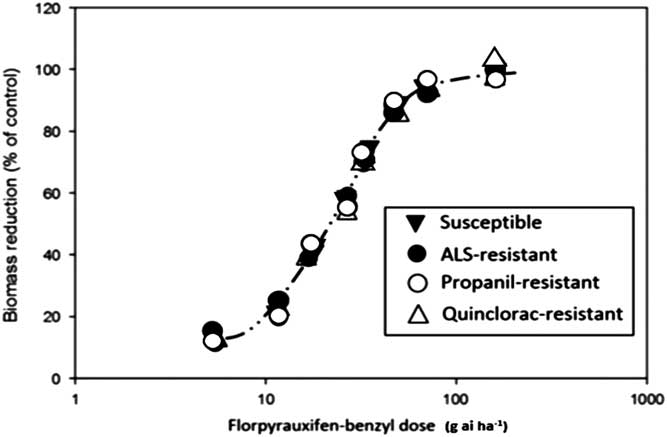
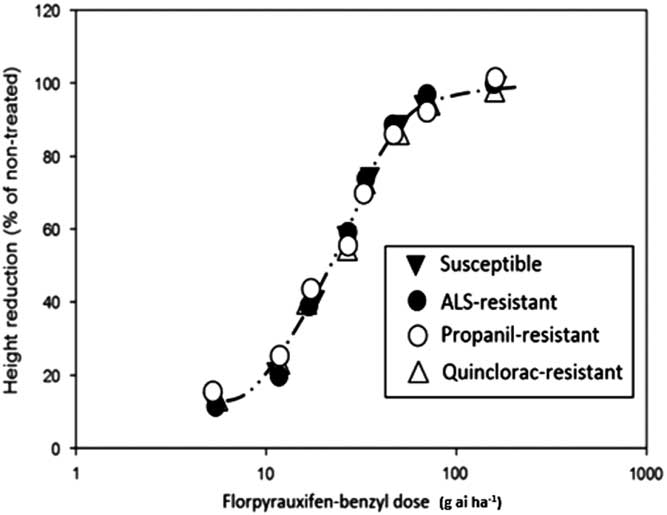
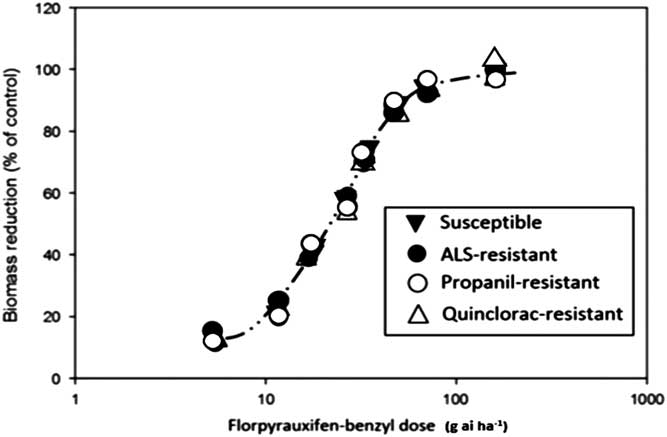
According to Mitich (Reference Norsworthy, Bond and Scott1990), barnyardgrass growth and reproduction can be quite plastic and depends on numerous environmental factors. Even so, each of the four biotypes had an ED90 for plant height and biomass reductions of 28.6±0.9 and 28.1±0.5 for each of the responses, respectively (Figures 3 and 4). Another important consideration is that this experiment was conducted in a greenhouse environment in the absence of flooding. In a typical rice field in the midsouthern United States, producers would likely flood shortly after an EPOST or PREFLD application (Hardke Reference Hardke2014). Barnyardgrass can be a large biomass accumulator as a result of its highly efficient C4 photosynthetic pathway, which allows it to aggressively compete with C3 grass crops such as rice (Bagavathiannan et al. Reference Bagavathiannan, Norsworthy, Smith and Neve2012; Holm et al. Reference Jesche1997; Mitich Reference Norsworthy, Bond and Scott1990; Norsworthy et al. Reference Norsworthy, Scott and Johnson2013). Given the time between the herbicide application and the collection of the response variables (21 DAT), nontreated controls were given ample time and conditions to accumulate vegetative tissue. Therefore, it was not surprising in this study to find that the proposed rate (30 g ai ha−1) reduced plant height and growth by ≥90%.
Susceptible and acetolactate synthase (ALS)-, propanil-, and quinclorac-resistant barnyardgrass height reduction 21 days after treatment with florpyrauxifen-benzyl. Regression parameters correspond to the four-parameter log-logistic regression model Y=C+{D−C/1+exp[B(logX−logE)]}where Y is the response, X is the dose of florpyrauxifen-benzyl, B is the slope of the curve, C is the lower limit, D is the upper limit, and E is the inflection point for the fitted line. Model parameters and standard errors included B (−2.91±0.4), C (11.8±1.1), D (98.4±0.5), ED50 (15.9±0.6), and ED90 (28.6±0.9).
Susceptible and acetolactate synthase (ALS)-, propanil-, and quinclorac-resistant barnyardgrass biomass reduction 21 days after treatment with florpyrauxifen-benzyl. Regression parameters correspond to the four-parameter log-logistic regression model Y=C+{D−C/1+exp[B(logX−logE)]}, where Y is the response, X is the dose of florpyrauxifen-benzyl, B is the slope of the curve, C is the lower limit, D is the upper limit, and E is the inflection point for the fitted line. Model parameters and standard errors included B (−2.31±0.1), C (6.1±0.7), D (73.9±1.2), ED50 (20.2±0.8), and ED90 (28.1±0.5).
It is worth noting that florpyrauxifen-benzyl controlled the quinclorac-resistant biotype in this experiment. As mentioned previously, no significant differences were observed among the regression models for any of the response variables collected (data not shown). This indicates that while quinclorac, an auxin herbicide in the quinolonecarboxylic acid family, is ineffective in cases where quinclorac-resistant barnyardgrass occurs, applications of florpyrauxifen-benzyl remain highly effective. Structurally, the florpyrauxifen acid is comprised of a highly substituted 4-amino-pyridine ring (4-amino-3-chloro-6-(4-chloro-2-fluoro-3-methoxyphenyl)-5-fluro-pyridine-2-benzel ester). Molecular studies found the new herbicide to exhibit strong binding affinity for auxin signaling F-box proteins, with preference for the AFB5-Aux/IAA coreceptor instead of favoring TIR1, which is the case with 2,4-D and several other auxin herbicides (Bell et al. Reference Bell, Schmitzer, Weimer, Napier and Prusinska2015; Jeschke Reference Jesche2015a,Reference Jescheb). Thus far, little evidence has been provided to indicate the mechanism of quinclorac resistance (Gang et al. Reference Gang, Wu, Cai, Wang, Zhao and Wu2013; Matzenbacher et al. Reference Mitich2015). Structurally, quinclorac is comprised of 3,7-dichloroquinoline-8-carboxylic acid, and in sensitive grass species, such as susceptible barnyardgrass, quinclorac stimulates phytotoxic levels of cyanide in plant tissue as a coproduct of the herbicide stimulating ethylene biosynthesis through preferential binding to the TIR1/AFB receptors (Grossman Reference Grossman2009). With the previous research conducted by Bell et al. (Reference Bell, Schmitzer, Weimer, Napier and Prusinska2015), it is believed that through structural differences and strong affinity for the AFB5 co-receptor the acid form of florpyrauxifen exhibits unique auxin characteristics allowing for effective control of quinclorac-resistant barnyardgrass.
Conclusions and Practical Implications
Results gathered from these experiments provide insight into the potential uses of florpyrauxifen-benzyl as a viable barnyardgrass control option in rice. Furthermore, this research highlights consistent barnyardgrass control with florpyrauxifen-benzyl and its efficacy at the recommended rate and use pattern. Florpyrauxifen-benzyl provided a consistent, high level of control of the 152 barnyardgrass accessions collected from various fields, suggesting that it will control already existing herbicide-resistant biotypes under field conditions. However, this herbicide should not be the only weed management tactic deployed in a rice weed management program, but should instead be integrated into a diverse control regime that utilizes multiple effective chemical and nonchemical methods. Further research should focus on the characterization of florpyrauxifen-benzyl, including molecular, greenhouse, and field research, to continue to build a better understanding of the behavior of this new herbicide.
Acknowledgements
Funding for this research was provided by the Arkansas Rice Promotion Board and Dow AgroSciences.