

International relations (IR) research on international law (IL) has traditionally focused on the degree to which IL constrains the actions of sovereign states and creates conditions that facilitate compliance. While IL scholarship has focused considerable attention on political elites and the factors that influence their willingness to accept specific international legal obligations, little is known about the determinants of public support for IL, even though public opinion can influence elites’ decision-making and, thus, states’ foreign policies. Reference Aldrich, Gelpi, Feaver, Reifler and Sharp1,Reference Berinsky2,Reference Sobel3
In the present research, we were interested in factors influencing laypeople’s beliefs about one particularly prominent example of IL, namely, the Geneva Conventions (GC). We focused on the GC because they represent a body of IL that the public is likely to have some familiarity with, and some opinions regarding, which is not necessarily true for other types of conventions (e.g., economic, environmental, or weapons). Additionally, the GC have been connected to questions regarding the war on terror (e.g., Guantánomo Bay, CIA waterboarding, etc.). Indeed, debate has swirled among researchers and practitioners over whether and under what conditions suspected terrorists are entitled to protections guaranteed by the GC. Reference Heller and Ohlin4,Reference Jinks5,Reference Rona6 This debate is complex, centering on conflicting interpretations of the legal status of suspected terrorists and, arguably, also influenced by moral considerations. Laypeople presumably have their own attitudes about this contentious issue, but to our knowledge, no research thus far has examined correlates or determinants of those attitudes. From an IR perspective, it is important to ask to what extent the GC have been internalized by the masses and what factors influence attitudes about compliance. The GC are a major aspect of the IL of armed conflict that have arguably been internalized, thus establishing a standard of behavior, but research has yet to systematically examine whether attitudes about compliance or who the law should apply to have to been internalized by a critical mass. From the perspective of psychological science, attitudes about terrorism and the GC represent a rich real-world domain to which we can apply recent theorizing about the neurocognitive underpinnings of authoritarianism. We describe this critical theorizing next.
Handedness and the neuroscience of authoritarianism
As an aspect of personality, authoritarianism refers to prioritizing submission to authority over personal freedom and desiring well-defined social hierarchies based on fixed groups. Authoritarian individuals tend to be politically conservative, cognitively rigid, and hostile toward certain targeted out-groups (e.g., those perceived as challenging authoritarianism). Although theorizing about the origins of authoritarianism has traditionally focused on socialization and situational factors, Lyle and Grillo Reference Lyle and Grillo7 recently argued that authoritarianism might be partially determined by neurocognitive factors.
The basis of Lyle and Grillo’s argument was the finding that several authoritarian characteristics (i.e., submission to authority, identification with a conservative political party, and hostility toward authoritarian out-groups) were positively related to a behavioral trait known as “consistent-handedness,” which refers to having a strong, unwavering preference for one hand over the other when performing unimanual actions (e.g., writing, throwing, combing hair). Compared with inconsistent-handedness, which is characterized by making relatively greater use of both hands, consistent-handedness is thought to be a marker for reduced interhemispheric interaction and greater cognitive rigidity. Reference Prichard, Propper and Christman8 According to some studies, consistent-handed individuals have thinner corpora callosa, Reference Cowell, Kertesz and Denenberg9,Reference Habib, Gayraud, Oliva, Regis, Salamon and Khalil10,Reference Luders, Cherbuin, Thompson, Gutman, Anstey, Sachdev and Toga11 indicating fewer or less thickly myelinated neurons transmitting information between the left and right hemispheres of the brain. Consistent-handers also exhibit more strongly lateralized activity in motor cortex during unimanual movement, Reference Dassonville, Zhu, Ugurbil, Kim and Ashe12 which can be taken as a neurofunctional indicator of lesser interhemispheric interaction. Reference Bloom and Hynd13 Examples of consistent-handers’ cognitive rigidity include findings that they are less persuadable and less likely to update their self-concept in response to bogus feedback about their personality Reference Christman, Henning, Geers, Propper and Niebauer14 and that they are less adept at counterfactual thinking. Reference Jasper, Barry and Christman15 Drawing on theories suggesting that the left and right hemispheres must interact to achieve cognitive flexibility, Reference Gazzaniga16,Reference Ramachandran17 Lyle and Grillo proposed that limited interhemispheric interaction fosters greater rigidity among consistent-handers and predisposes consistent-handers to certain authoritarian characteristics, including rigidly adhering to the dictates of authorities and being unable to accept groups that express or otherwise represent divergent perspectives. Reference Christman18
The idea that consistent-handedness is linked to authoritarianism via innate neurocognitive characteristics is plausible in light of several considerations. First, interindividual variability in consistent-handedness is observable in the first years of life Reference Nelson, Campbell and Michel19 and associated with genetic variation. Reference Arning, Ocklenburg, Schulz, Ness, Gerding, Hengstler, Falkenstein, Epplen, Güntürkün and Beste20 Second, preschool-aged children’s expressions of authoritarian-like behaviors are positively correlated with parents’ authoritarianism, Reference Tagar, Federico, Lyons, Ludeke and Koenig21 suggesting that authoritarianism could be driven by neurocognitive characteristics inherited from parents. Third, political conservatism, which is strongly related to authoritarianism, has been shown to have neurostructural correlates. Reference Kanai, Feilden, Firth and Rees22 Together, these findings (while by no means conclusive) are consistent with the notion that handedness and authoritarianism may be influenced by innate brain-based factors.
The influence of authoritarianism and contextual factors on attitudes about the GC
In the context of the present research, we thought that authoritarianism might influence people’s beliefs about the applicability of the GC to terrorist suspects. Insofar as terrorism presents a clear threat, not only to physical safety but also to social order, terrorists can be conceptualized as an authoritarian out-group — that is, a group to which authoritarians will respond with intolerance and punitiveness. Reference Feldman and Stenner23 Therefore, we reasoned that authoritarian individuals would express relatively low support for granting GC protections to terrorist suspects. If we could show, as in prior research, 24,25 that authoritarianism is also linked to consistent-handedness, it would raise the quite novel possibility that laypeople’s attitudes about IL are partially determined by neuropsychological factors.
We were also interested in whether attitudes about the GC are fixed and immutable or dependent on contextual factors. We were especially interested in two potentially important contextual factors. The first is whether individuals have recently encountered detailed information about GC provisions. Although many laypeople have heard of the GC and may know generally what they pertain to, many people presumably lack precise knowledge about the protections guaranteed under the GC. We sought to test whether providing people with detailed information would alter people’s attitudes. Conceivably, making people more knowledgeable about the GC could increase or decrease support for granting protections to terrorist suspects. For example, the GC protections could be seen as moral imperatives, regardless of the acts any given individual has or has not committed. Alternatively, from a more punitive perspective, GC protections could be seen as “too good” for people accused of committing despicable acts. Several previous experiments have investigated whether providing more information about IL influences attitudes about the legality of terrorism and the use of torture. Findings have been somewhat inconclusive. While Wallace Reference Wallace26 found that support for torture was reduced when people were informed that torture violates IL (see also Chilton Reference Chilton27 ), Chilton and Versteeg Reference Chilton and Versteeg28 found only a nonsignificant effect in the same direction. These experiments do not directly speak to our question, however, which concerned people’s attitudes about the application of IL, as opposed to attitudes about torture. We considered this aspect of our research exploratory, and, although we thought it possible that informing people about the GC would alter their attitudes, we did not venture a directional hypothesis.
The second contextual factor of interest is whether individuals have recently been primed with the idea that a terrorist suspect bears an Islamic religious affiliation. Given America’s history of conflictual relations with the Muslim world, Reference Ernst29,Reference Gerges30 some people might perceive Islamic terrorism as posing a greater threat to America than terrorism perpetrated by non-Muslims. If that is the case, priming people with the idea of Islamic terrorism might increase punitiveness and thereby reduce support for application of GC protections to terrorist suspects.
In considering how the idea of Islamic terrorism, as opposed to other types, might influence public attitudes about the GC, we again thought that authoritarianism and consistent-handedness might be important. Authoritarianism is characterized by aggression toward targeted out-groups, Reference Sibley and Duckitt31 likely including Muslims. Reference Hall, Cohen, Meyer, Varley and Brewer32 Since consistent-handedness is associated with authoritarianism, we reasoned that priming consistent-handers, but not necessarily inconsistent-handers, with the idea of Islamic terrorism might reduce support for granting GC protections to terrorist suspects.
To explore the issues described here, we conducted an experiment in which we measured participants’ degree of consistent-handedness and their level of authoritarian submission, as well as their support for applying the GC to terrorist suspects. Critically, support for applying the GC to terrorist suspects was (for some participants) measured after participants read a news report about the detainment of an individual who had attempted to destroy a passenger flight. We manipulated two aspects of this report: whether it contained detailed information about the GC and whether the alleged terrorist’s religious affiliation was identified as Muslim, Christian, or Buddhist. The two variables were fully crossed, producing six different conditions. In a seventh (control) condition, participants did not read any version of the report. We had five primary hypotheses, summarized as follows:
- H1:
Individuals who are more authoritarian would express less support for granting GC protections to terrorist suspects.
- H2:
Consistent-handed individuals would be more authoritarian than inconsistent-handed individuals.
- H3:
Consistent-handed individuals would express less support than inconsistent-handed individuals for granting GC protections to terrorist suspects, with authoritarianism being a crucial mediating factor.
- H4:
Priming consistent-handers, but not inconsistent-handers, with the idea of Islamic terrorism would decrease support for granting GC protections to terrorist suspects.
- H5:
Providing individuals with detailed information about GC provisions would alter support for granting GC protections to terrorist suspects (either increasing or decreasing it).
Why do agents comply with international laws and norms?
The conventional wisdom in IR, which privileges state and international levels above the individual, is that states follow IL because of expectations of reciprocity from other countries, a desire to uphold international order, and/or fear of punishments or reprisals. Reference Burgstaller33,Reference Nelson34 Realists and neorealists hold that IL is weak and that states only follow it when it is in their material interests to do so. Reference Mearsheimer35 Conversely, liberals, neoliberal institutionalists, and constructivists contend that IL has been internalized by most states and constrains their behavior by establishing what behaviors are appropriate. Reference Finnemore and Sikkink36,Reference Simmons and Hopkins37 Examples of the growing influence of IL and norms on state behavior include evidence about ethical state behavior during war, Reference Legro38,Reference Thomas39 the nonuse of nuclear and chemical weapons, Reference Price40,Reference Tannenwald41 and evolving global rules for humanitarian intervention. Reference Finnemore42 In addition to the foregoing studies, others have investigated the conditions under which compliance with IL is more likely. These studies suggest that compliance with treaties is determined by strong internal public support Reference Simmons43 and prior records of IL compliance. Reference Stiles and Thayne44
While some IR studies recognize that public opinion can impact whether and to what extent states comply with ILs, neither IR realist nor nonrealist approaches have given serious consideration to factors that could influence individual-level attitudes about IL. This is a consequence of the discipline’s emphasis on the structural and state levels of analysis. We believe an examination of individual-level attitudes is justified and important, as research suggests that public opinion can shape states’ foreign policies. 45,46,Reference Van Der Meulen and Soeters47,48 Moreover, because the views of individuals and groups play an important role in determining democratic countries’ positions on international issues, uncovering factors that influence micro-level IL attitudes can enhance the field’s understanding of the causes of variation in compliance between different states. Indeed, scholars have recently begun to investigate the intersection between public opinion and IL compliance.
The nascent literature on public opinion and IL investigates how individual-level variables influence views on ILs. Scholars have investigated this intersection from a number of perspectives. First, some studies have examined the relationship between the actions of human rights–focused nongovernmental organizations and public opinion on IL. McEntire, Leiby, and Krain Reference McEntire, Leiby and Krain49 found that the use of certain framing strategies by human rights organizations to mobilize opposition to human rights violations indeed helped to rally mass support for human rights causes, especially if personal narratives were evoked. Relatedly, Davis, Murdie, and Garnett Reference Davis, Murdie and Garnett50 noted how international human rights organizations were able to impact public opinion in repressive states by informing the public in said regimes about domestic human rights violations. However, these studies mainly focused on the role that organizations (an elite epistemic community) play in the process.
Second, there are studies that have focused on the role of preexisting beliefs and experiences. Chaudoin Reference Chaudoin51 showed that preexisting preferences regarding free trade (for or against) strongly determine attitudes on international trade deals. Meernik and King Reference Meernik and King52 analyzed data from a 1999 Red Cross survey of individuals who were involved in internal conflicts and found that individual views regarding the morality of the given conflict, the extent of personal victimization during the war, and perceived competency of international institutions were key determinants of preferences regarding the venue in which violations of international law should be settled (e.g., local or international tribunal). Similarly, Ausderan 53 suggested that individual denizens of a country will perceive the human rights conditions at home more negatively when their country is shamed in the international community for human rights violations. Another study Reference Hertel, Scruggs and Heidkamp54 drew on public opinion data to demonstrate that Americans view the right to minimum standards of living as a human right. Finally, Grillo and Pupcenoks Reference Grillo and Pupcenoks55 found that public support for humanitarian intervention (not codified law, but a norm) is more likely when individuals perceive that the victims of international human rights abuses belong to their religious in-group.
We aim to contribute to this literature on public opinion and IL by focusing on how both intrinsic and extrinsic factors influence attitudes about IL. Intrinsic factors are authoritarianism and consistent-handedness. External factors are the provision of information about a specific example of IL (i.e., the GC) and priming the idea of Islamic terrorism (versus terrorism associated with other religions). The external factors are manipulated as part of presenting participants with a realistic scenario about an alleged terrorist. Using a real-life scenario not only increases external validity Reference Abrahms56 but also brings the issue closer to home by forcing participants to think about whether an individual allegedly trying to destroy a plane full of Americans on American soil should receive rights mandated by IL. Examining the effect of priming particular religious affiliations is important because studies in psychology have consistently demonstrated that people favor their in-group, have less empathy for out-group members, and are more willing to support putative measures against out-group members. Reference Cikara, Bruneau and Saxe57,Reference Van Prooijen and Lam58 Religious affiliation is a major marker of in-group/out-group status for many Americans, with Muslims often considered an out-group. Research suggests that group dynamics matter in the domestic legal system, where the law is not equally applied to African Americans versus whites. Reference Mitchell59 If such group dynamics influence how laws are applied to African Americans in the context of domestic law, then it is likely that the same dynamics would influence American’s beliefs about how international law should be applied to Muslims (i.e., an out-group in the United States).
Intrinsic factors of interest in this research are authoritarianism and its possible neurocognitive underpinnings, for which consistent-handedness may be a marker. Neurocognitive influence on attitudes about IL has not yet been examined by IR scholars, yet it has important implications in that it raises the possibility that support for certain aspects of IL may not be only socially determined but also a product of innate neurocognitive factors and their influence on personality.
We acknowledge that the conditions under which terrorist suspects should be given GC protections is a heavily debated issue, 60 and our experimental treatment notes that it is a debated issue. Ultimately, our study focuses on analyzing the views of laypeople toward potential humanitarian protections given to suspected terrorist groups — and how these views may change depending on psychological variables. Therefore, the legal/moral debate about the conditions under which humanitarian laws such as the GC apply to terrorist suspects is beyond the scope of this research.
Method
Participants
We recruited 700 American participants from Amazon Mechanical Turk (valid
 $N=647$
). Each participant was compensated $0.50. Participants were roughly evenly distributed across seven different conditions (12% to 17% in each). Most were female (381, 58%). Age ranged from 18 to 81 years (
 $M=33.0$
). Utilizing the classification scheme described later, 228 (35%) participants were inconsistent-handed and 429 (65%) were consistent-handed. Most participants were white (530, 80%) and either college graduates (309, 47%) or high school graduates (178, 27%). For party identification, 266 (40%) identified as Democrat, 242 (37%) as independent, and 94 (14%) as Republican. Lastly, the largest proportions of participants were agnostics and atheists (295, 44%), followed by Christians (246, 37%). Catholics, evangelicals, and mainline Protestants were evenly distributed, with each group accounting for 12% to 13%.
Materials
Our measure of consistent-handedness was a modified version of the Edinburgh Handedness Inventory.
Reference Oldfield61
This inventory and its variants
Reference Edlin, Leppanen, Fain, Hackländer, Hanaver-Torrez and Lyle62
have been used or referenced more than 8,000 times. Our version
63,Reference Lyle, McCabe and Roediger64
measures direction and consistency of hand use for 10 unimanual activities (e.g., writing, drawing, using a spoon). Response options (and corresponding point values for the purpose of scoring) are always right (
 $+$
10), usually right (
 $+$
5), no preference (0), usually left (
 $-$
5), and always left (
 $-$
10). Total scores can range from
 $-$
100 (exclusive left-hand use) to
 $+$
100 (exclusive right-hand use). The inventory approach to measuring handedness, although simple and reliant on self-report, has proven extremely fruitful. Prichard, Propper, and Christman
65
provide a review of the diverse ways in which differences in consistent-handedness, as measured by inventories, have been linked to neuroanatomy, neurofunction, and cognition.
We used the American National Election Studies (ANES) measure of authoritarian submission, which presents four pairs of attributes. Participants select the attribute from each pair that is “most important for a child to have.” One attribute in each pair focuses on submission to authority/moral traditionalism, which many argue are central to the authoritarian personality and its various characteristics.
Reference Duckitt, Bizumic, Krauss and Heled66,Reference Hetherington and Weiler67
The pairs (with the authoritarian attribute listed second in each) are (1) independence versus respect for others, (2) self-reliance versus obedience, (3) curiosity versus good manners, and (4) being considerate versus being well-behaved. The number of authoritarian attributes selected is summed for each participant (range
 $=$
0–4, overall sample
 $M=1.43$
).
To assess knowledge of the GC, the following open-ended prompt was administered: “Briefly describe what the Geneva Conventions state about the protections given to prisoners of war.” To present information about an alleged terrorist, we adapted a Politico article that reported a Nigerian national’s attempt to blow up a passenger flight as it was landing in Detroit. Reference Siegel and Lee68 We used the article verbatim with some modifications, such as making the suspect Filipino and listing a religious and terrorist group affiliation. Additionally, we added text about how the event prompted a debate in Congress over whether the suspect should be transferred to Guantánamo Bay, where he would not be granted rights mandated by the GC.
In the six experimental conditions, the article differed with regard to the religious affiliation of the suspect and whether the article contained information about the GC. The suspect was identified as a Muslim affiliated with al-Qaeda, a Christian linked to the militia group Hutaree, or a Buddhist associated with the 969 Movement. We made the suspect Filipino because the Philippines has Christian, Muslim, and Buddhist populations. Affiliation was fully crossed with manipulation of whether the article contained information about the GC. This information noted that the GC constitutes IL about how prisoners of war should be treated and provided examples of key rights guaranteed by the conventions. We stated that the article was from CNN, which is more middle of the road than Politico (see Appendix A in the supplemental document online).
Attitudes about extending the GC to terrorists were assessed by having participants rate their agreement with four statements scored on a scale from 1 (strongly disagree) to 5 (strongly agree) (see Appendix B in the supplemental document). The first statement probes whether participants believe the GC should be applied unconditionally, while the second and third explore whether participants believe the GC should be applied only conditionally. The fourth statement probes whether participants think that the GC should never be applied. We reverse-scored the first statement so that higher ratings for all four statements indicate support for limiting application of the GC. An exploratory factor analysis with varimax rotation indicated that the four ratings loaded on a single factor. A reliability analysis suggested the factor has strong internal consistency (
 $\unicode[STIX]{x1D6FC}=0.75$
). We averaged the four ratings to create a composite measure we call limit application (
 $M=2.56$
).
A post-test survey queried participants’ sex, age, education, race, political party affiliation, political ideology, and religiosity. Response options for education were less than high school, high school graduate, vocational training, college graduate, or postgraduate degree. Response options for race were American Indian or Alaska Native, Asian, black or African American, white, or two or more races. Response options for political party were Democrat, independent, Republican, or something else. Participants selected political ideology on the ANES scale ranging from 1 (extremely liberal) to 7 (extremely conservative) (
 $M=3.24$
).
Our measure of religiosity was the Religious Commitment Inventory-10.
Reference Worthington, Wade, Hight, Ripley, McCullough, Berry and Schmidt69
Participants responded to 10 statements (e.g., “My religious beliefs influence all my dealings in life”) on a scale from 1 (not at all true of me) to 5 (totally true of me). The sum of all ratings constituted a participant’s religiosity score (range
 $=$
10–50,
 $M=18.4$
,
 $\unicode[STIX]{x1D6FC}=0.95$
).
Procedure
The experiment was administered online and took roughly 10 minutes to complete. Participants first completed measures of handedness, authoritarian submission, and knowledge of the GC. Participants were then randomly assigned to either the control condition or one of six experimental conditions. Participants in the experimental conditions read the scenario at their own pace and then reported their attitudes regarding applying the GC protections to terrorist captives, while those in the control just reported their attitudes. All participants then responded to another prompt querying their knowledge of the GC. Finally, all participants completed the post-test survey, which contained demographics and questions about religiosity, political ideology, and political party affiliation.
Following practice in numerous previous investigations, 70,Reference Lyle, Logan and Roediger71,Reference Lyle and Martin72 we classified participants as consistent-handed if the absolute value of their score on the handedness measure was 80 or greater. Otherwise, participants were classified as inconsistent-handed. Using this cutoff, we dummy coded handedness: 1 (consistent-handed) or 0 (inconsistent-handed). Note that this coding scheme ignores direction of hand preference, combining left- and right-handers in each consistency group. Similar to proportions in studies cited earlier, 65% of participants were classified as consistent-handed.
To quantify participants’ knowledge of the GC at the beginning and end of the procedure, we coded responses with Stata’s txttool module.
Reference Williams and Williams73
After eliminating all common words (e.g., a, and, the) and reducing words to their stems (e.g., prohibits, prohibited, prohibiting
 $=$
prohibit), we generated a dictionary that provided a count of the number of times each word appeared in all open responses. Next, for each participant we tallied the total number of words that constituted correct information about the GC (e.g., hygiene, shelter, food) in participants’ pre-test (
 $M=1.88$
) and post-test (
 $M=3.96$
) responses. What we counted as correct information was based on key words (and their synonyms) in the treatment. Since the module provided frequencies for all words appearing in the open responses, this allowed us to also account for correct information that may have been misspelled. It should also be noted that we did not examine whether correct information was stated in the context of voicing support for or opposition to granting GC protections to terrorist suspects. Rather, we were solely concerned with whether the information was correct and therefore indicated that participants possessed accurate knowledge about the GC.
Results
Effect of authoritarianism on attitudes
We conducted a multiple linear regression to test whether authoritarianism predicted limiting GC application to terrorists. Predictor variables were entered sequentially in two blocks. The first block comprised control variables: age, sex, race (dummy coded as white or nonwhite), education, religiosity, and ideology. The second block comprised only authoritarianism. All variables were entered in stepwise fashion. For efficiency, we report only results for the full model, which was significant,
 $F(3,653)=35.36,p<0.001$
. Of the control variables, only ideology and race were significant. Both were associated with greater desire to limit application. Of greater interest, authoritarianism was a significant positive predictor of limiting application.
Authoritarianism’s relationship with consistent-handedness
We next examined whether consistent-handedness was positively related to authoritarianism. We replicated Lyle and Grillo’s analysis, calculating the partial correlation between scores on the ANES measure and the absolute value of scores on the handedness inventory, controlling for age, sex, religiosity, and race. The partial correlation was significant,
 $r(651)=0.085,p=0.030$
. Additionally, we analyzed the relationship between consistent-handedness and authoritarianism when treating consistency as categorical (inconsistent or consistent). We submitted ANES scores to a one-way ANCOVA with age, sex, religiosity, and race as covariates. Inconsistent-handed individuals reported significantly less authoritarian submission (
 $M=1.29$
) than their consistent-handed counterparts (
 $M=1.51$
),
 $F(1,651)=4.65$
,
 $p=0.031$
,
 $\unicode[STIX]{x1D702}_{p}^{2}=0.007$
. A final continuity between the present findings and those of Lyle and Grillo’s is that self-described political ideology did not differ significantly between inconsistent-handers (
 $M=3.16$
) and consistent-handers (
 $M=3.28$
),
 $F<1$
. Both groups were, on average, slightly liberal. Hence, consistent-handers exhibited greater authoritarian submission but did not necessarily see themselves as more conservative. Because consistent-handers and inconsistent-handers differed in authoritarianism, it is possible that their support for limiting application of the GC to alleged terrorist captives would be differentially impacted by priming with the idea of a Muslim terrorist — a possibility we explore next.
Effects of contextual factors and their interaction with consistent-handedness
We submitted support for limiting GC application to a 2 (GC information: provided or not)
 $\times$
3 (religious affiliation: Buddhist, Christian, or Muslim)
 $\times$
2 (handedness: inconsistent or consistent) ANCOVA with age, sex, religiosity, race, and ideology as covariates. Race and ideology were significant covariates (largest
 $p=0.005$
), echoing the results of the multiple linear regression. The factor of providing information about the GC did not have a significant main effect and was not involved in any significant interactions, largest
 $F(1,528)=1.44$
,
 $p=0.231$
. The only significant effect of the other two factors was their simple interaction,
 $F(2,528)=3.11$
,
 $p=0.045$
,
 $\unicode[STIX]{x1D702}_{p}^{2}=0.012$
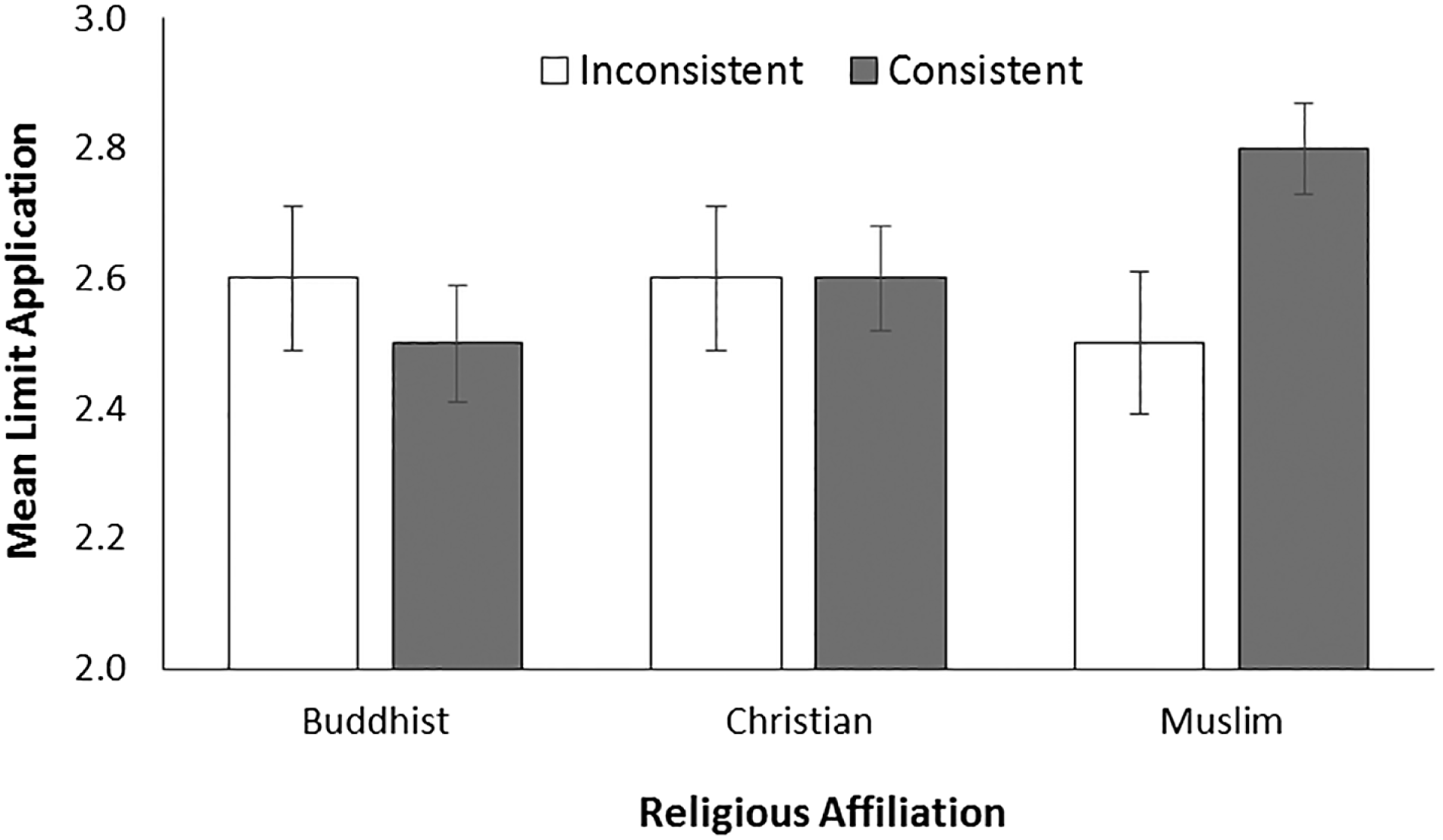
, which is depicted in Figure 1.
To explore the interaction, we ran a separate one-way ANCOVA for each handedness group with religious affiliation as the independent variable and the same covariates as the previous analysis. Because GC info did not have any significant effects in the initial analysis, it was not included as a factor in this or subsequent ANCOVAs. For inconsistent-handers, the effect of religious affiliation was not significant,
 $F<1$
. For consistent-handers, however, there was a significant effect of religious affiliation,
 $F(2,351)=3.48$
,
 $p=0.032$
,
 $\unicode[STIX]{x1D702}_{p}^{2}=0.019$
. Because we hypothesized that participants might respond differently following a Muslim prime (an out-group for authoritarians) versus Buddhist or Christian primes (non-out-groups), we combined ratings following the latter two primes and compared them with ratings following the Muslim prime. Again, we utilized the previous covariates. Consistent-handers expressed significantly greater desire to limit GC application following the Muslim prime (
 $M=2.8$
) than the other primes (
 $M=2.5$
),
 $F(1,352)=6.65$
,
 $p=0.010$
,
 $\unicode[STIX]{x1D702}_{p}^{2}=0.019$
. For inconsistent-handers, the effect was in the opposite direction (
 $M=2.4$
and 2.6 for the Muslim and non-Muslim primes, respectively) and did not approach significance,
 $F<1$
. As a whole, 57% of all participants agreed to strongly agreed that all alleged terrorist captives should always be given the rights and protections outlined in the GC.
The preceding analysis suggests that while the idea of a Muslim terrorist increases consistent-handers’ desire to limit GC application, the same is not true for inconsistent-handers. As an additional test of this pattern, we compared support for limiting application following a Muslim prime with support in the control condition (no prime). We conducted a 2 (handedness)
 $\times$
2 (prime: Muslim or control) ANCOVA with the same covariates as in preceding analyses. In the Muslim-prime condition, we combined data from participants who did and did not receive information about the GC. There were no conventionally significant effects in this analysis, but, critically, the handedness X prime interaction was significant at the 0.10 level,
 $F(1,298)=3.59$
,
 $p=0.059$
,
 $\unicode[STIX]{x1D702}_{p}^{2}=0.012$
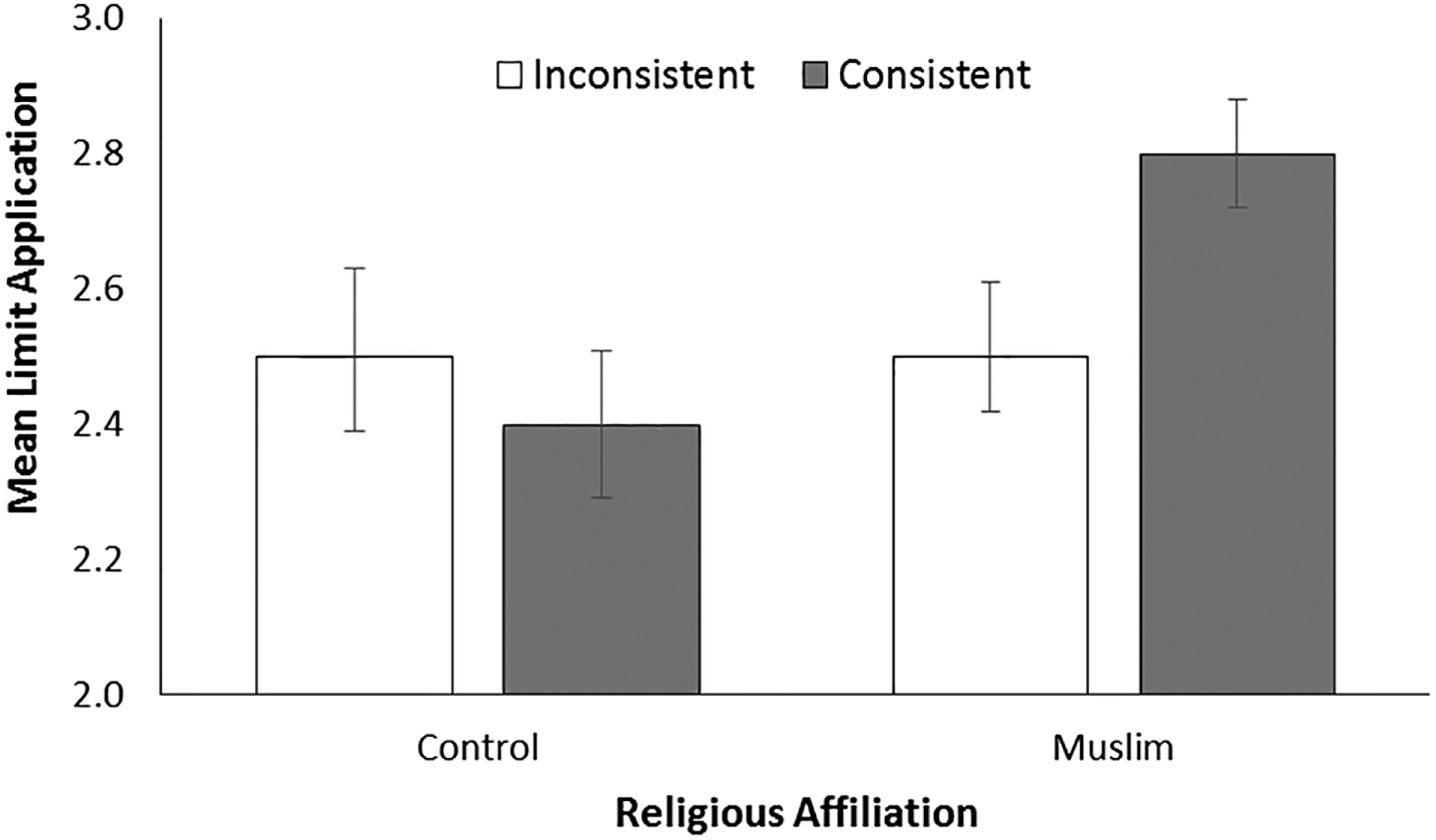
. Examination of the estimated marginal means (see Figure 2) strongly suggests an interaction.
Mean support for limiting application of the GC as a function of handedness consistency and primed religious affiliation. Estimated marginal means are plotted. Errors bars indicate
 $\pm 1$
SEM.

For inconsistent-handers, support for limiting application was identical (
 $M=2.5$
) following either the Muslim prime or no prime. For consistent-handers, however, support for limiting application was significantly greater following a Muslim prime (
 $M=2.8$
) than no prime (
 $M=2.4$
),
 $F(1,197)=10.05$
,
 $p=0.002$
,
 $\unicode[STIX]{x1D702}_{p}^{2}=0.049$
. Also of note is the fact that, following a Muslim prime, consistent-handers reported significantly greater desire to limit application than did inconsistent-handers,
 $F(1,188)=4.20$
,
 $p=0.042$
,
 $\unicode[STIX]{x1D702}_{p}^{2}=0.022$
. In the control condition, the handedness groups did not differ significantly,
 $F<1$
.
Effects of contextual factors and consistent-handedness on knowledge of the GC
As reported earlier, attitudes were not significantly affected in any way by providing participants with information about the GC. In light of this, it is important to confirm that our participants actually acquired knowledge about the GC from the provided information. We therefore analyzed participants’ responses to our pre-test and post-test open-ended question probing for GC knowledge. We should find that, in those conditions in which we provided information, participants’ responses contain more correct information at post-test than pre-test. We submitted the number of correct words appearing in participants’ pre- and post-test responses to an ANCOVA with the same design as used to analyze attitudes about limiting application of the GC, but also including the within-participants factor of time (pre-test versus post-test). There were significant main effects of providing information,
 $F(2,528)=52.08$
,
 $p<0.001$
,
 $\unicode[STIX]{x1D702}_{p}^{2}=0.09$
, and time,
 $F(1,528)=51.59$
,
 $p<0.001$
,
 $\unicode[STIX]{x1D702}_{p}^{2}=0.09$
, but these were qualified by a significant interaction of the two factors,
 $F(1,528)=90.31$
,
 $p<0.001$
,
 $\unicode[STIX]{x1D702}_{p}^{2}=0.15$
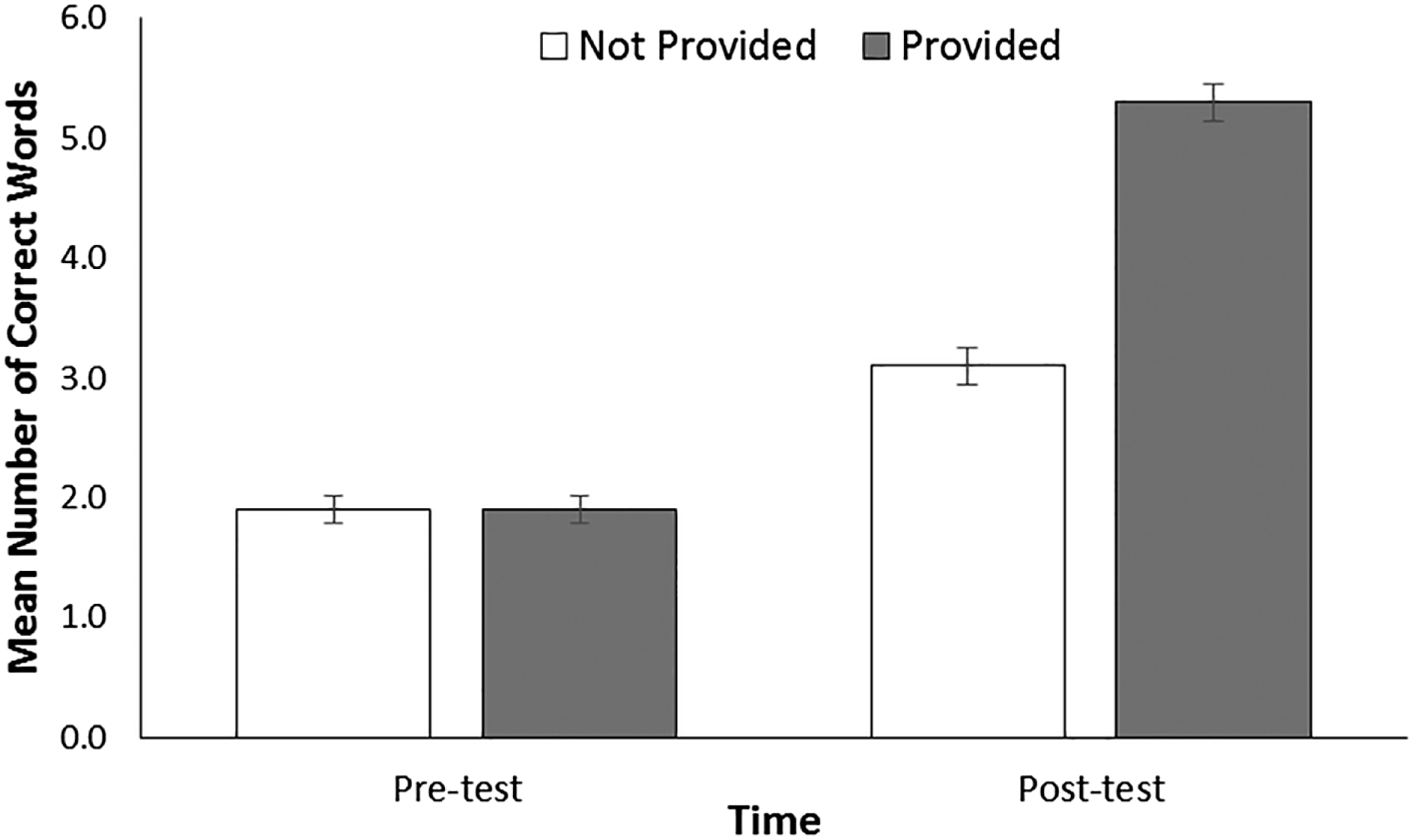
. Figure 3 shows that, at pre-test, participants possessed, on average, identical levels of knowledge about the GC, regardless of group assignment (
 $M=1.9$
). At post-test, however, participants who received information about the GC possessed significantly more knowledge (
 $M=5.3$
) than participants who did not receive information (
 $M=3.1$
),
 $t(535.41)=11.27$
,
 $p<0.001$
. Hence, our effort to increase participants’ knowledge about the GC was successful.
Mean support for limiting application of the GC as a function of handedness consistency and primed religious affiliation. Estimated marginal means are plotted. Errors bars indicate
 $\pm 1$
SEM.

Mean number of correct words relating to the GC as a function of pre-test versus post-test and whether information about the GC was provided. Estimated marginal means are plotted. Errors bars indicate
 $\pm 1$
SEM.

Post-test scores were significantly higher than pre-test scores in the conditions in which information was provided,
 $t(282)=20.44$
,
 $p<0.001$
, but, unexpectedly, this was also true in the conditions in which no information was provided,
 $t(261)=8.25$
,
 $p<0.001$
. The latter effect may reflect a phenomenon known to memory researchers as hypermnesia in which repeated attempts to retrieve the same body of information (in this case, GC information) yield additional recall.
Reference Erdelyi and Becker74
Also unexpectedly, there was a significant main effect of handedness consistency whereby inconsistent individuals (
 $M=3.2$
) had slightly higher knowledge scores than consistent individuals (
 $M=2.9$
),
 $F(1,528)=5.00$
,
 $p=0.026$
,
 $\unicode[STIX]{x1D702}_{p}^{2}=0.009$
. Apparently, inconsistent-handers were somewhat more knowledgeable about the GC than consistent-handers, regardless of whether information about the GC was provided.
We also compared conditions that received information about the GC with the control condition, collapsing across the terrorist’s religious affiliation in the former case. Knowledge scores were submitted to an ANCOVA with the same design as earlier, minus the factor of religious affiliation. Critically, the interaction between providing information and time was again significant,
 $F(1,386)=70.64$
,
 $p<0.001$
,
 $\unicode[STIX]{x1D702}_{p}^{2}=0.16$
. At pre-test, participants who received information (
 $M=1.9$
) did not differ from those in the control condition (
 $M=1.8$
),
 $t(393)=0.04$
,
 $p=0.97$
, but at post-test the former had significantly greater knowledge (
 $M=5.3$
) than the latter (
 $M=2.7$
),
 $t(393)=9.55$
,
 $p<0.001$
. This provides additional evidence that participants learned about the GC, although it apparently did not change their attitudes.
Path model
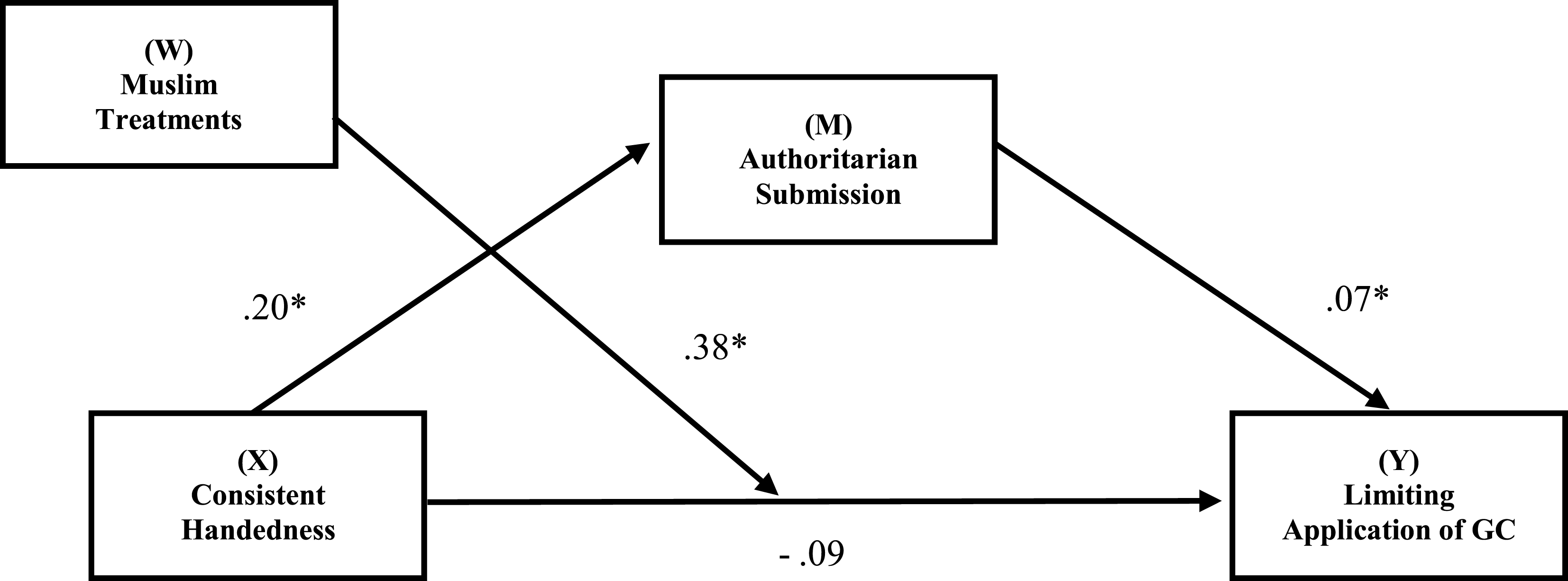
We have yet to address how our findings fit with previous work on consistent-handedness and authoritarianism. We explore the relationship with a moderated mediation analysis. We contend that consistent-handedness (X) leads to authoritarian submission (M) which then leads to limiting GC application (Y). Furthermore, the relationship between X and Y is facilitated by an interaction between consistent-handedness (X) and the Muslim frame (W). The path analysis was conducted in SPSS using the custom dialog PROCESS.
Reference Hayes75
For the analysis, we dummy coded the experimental treatments (1
 $=$
Muslim treatments, 0
 $=$
control and Christian and Buddhist treatments). As Figure 4 shows, the results support our hypotheses.
Results for moderated mediation analysis. Indirect effect of X on Y
 $=$
0.01 (bootstrap confidence intervals
 $=$
0.00 to
 $0.03$
). White had a significant effect on limiting GC application,
 $\unicode[STIX]{x1D6FD}=-0.27$
,
 $t(-3.19)=0.00^{\ast \ast }$
as well as ideology
 $\unicode[STIX]{x1D6FD}=0.16$
,
 $t(6.38)=0.00^{\ast \ast }$
.
 $R2=0.16$
,
 $F(11,645)=11.21$
,
 $p=0.000$
.
 $^{\ast }p<0.05$
,
 $^{\ast \ast }p<0.01$
.

The path from consistent-handedness to authoritarian submission is significant and positive, where being consistent (versus inconsistent) is associated with an increase in wanting to limit application. The path from authoritarian submission to limiting application is also significant and positive. The direct effect from consistent-handedness to limiting application is not significant. The bootstrap confidence intervals (95%) do not cross zero, suggesting that the indirect effect of authoritarian submission on the relationship between handedness consistency and limiting application is significant. Combined, results for the direct and indirect effects suggest that mediation has occurred.
The results also suggest that an interaction between handedness consistency and the Muslim treatments was associated with an increase in limiting application. Regarding the covariates, only race and ideology were significant. Unsurprisingly, being conservative was associated with an increased likelihood of wanting to limit GC application to terrorists. Interestingly, unlike the previous ANCOVA being white was associated with decreased support for limiting application. Age, religiosity, education, female (dummy coded), and being Republican (dummy coded) were not significant.
Discussion
This study finds support for H1 (authoritarians support restriction of GC protections), H2 (consistent-handed individuals are more authoritarian), H3 (consistent-handers express less support for granting GC protections to terrorist suspects, with authoritarianism being a crucial mediating factor), and H4 (priming the idea of Islamic terrorism reduces support for granting GC protections to terrorist suspects, but only among consistent-handers). The evidence rejects H5 (more knowledge about GC will change attitudes about application). The following discussion further explains our results and their implications for political psychology and international relations.
Regarding H1 and H2, we found evidence that individuals’ support for applying the GC to terrorist suspects varies systematically with the personality trait of authoritarianism. We obtained the expected negative relationship between authoritarianism and willingness to extend the GC to terrorists. Insofar as authoritarianism and political conservatism are strongly interrelated (as they were in this sample), our finding is generally consistent with Smith et al.’s Reference Smith, Aquino, Koleva and Graham76 finding that the use of torture with terrorist suspects is deemed more justifiable by politically conservative individuals than liberal ones. There are multiple reasons why more authoritarian individuals would be more willing to withhold GC protection from terrorists. One is that some prominent leaders in the United States have expressed belief that the GC do not apply to terrorists and/or have endorsed harsh treatment of terrorist captives. Greater authoritarianism might promote greater acceptance of those ideas. Also, more authoritarian individuals might be more sensitive to the threat posed by terrorism and therefore more supportive of measures that could possibly increase safety. These measures could include torturing terrorist captives, which some people believe yields useful intelligence in the fight against terrorism. Yet another consideration is that terrorists are likely seen as an out-group and more authoritarian individuals, being more hostile toward out-groups, might see them as less deserving of GC protections. This study was not designed to adjudicate between these various possibilities, but that is one avenue for future research.
Furthermore, while we found that consistent-handers displayed more authoritarian tendencies and were more likely to want to limit GC application when exposed to a prime about a terrorist from an out-group (i.e., Muslim), we also found that a majority of participants, regardless of handedness behavior or experimental condition (57%), agreed to strongly agreed that alleged terrorists should be given protections provided by the GC. Thus, contrary to H5, we found that majorities of our respondents support applying GC protections to all terrorist suspects across the board, and different treatments do not have an effect. Furthermore, participants generally disagreed or were neutral to statements suggesting that the United States should only apply the GC if terrorist groups do the same (63%) or only apply them if it is in its security interests (87%). This suggests that, overall participants believe that international humanitarian law should be applied to all suspects, regardless of the situation. This may be a result of the fact that the GC is a long-standing codified IL.
Conversely, research has suggested that support for newer, less established international norms, is less prominent. For example, in one study, well below 50% of American participants supported hypothetical military humanitarian intervention in Syria. 77 In sum, there may be popular support for well-established, codified ILs and an apparent lack of public support for still-emerging, and potentially contested, ILs and norms (such as military humanitarian intervention).
In regard to H3, our results suggests that the relationship between consistent-handedness and limiting GC application is mediated by authoritarianism. This suggests a clear causal path between consistent-handedness, authoritarianism, and attitudes about IL. Additionally, we found that the relationship between handedness and limiting application was moderated by the Muslim religious affiliation of the suspect. The results of the path model present a clear causal chain for how consistent-handedness, context, authoritarianism, are interlinked and prompt support for limiting the application of IL.
Our findings contribute to IR scholarship on IL and norms in two important ways. On the one hand, the overall distribution of support for the GC that we found in our experiment, when compared with some recent research on mass attitudes toward international law, suggests that there is an empirically quantifiable distinction between support for well-established codified ILs such as the GC, and norms such as humanitarian intervention. 78 On the other hand, we found evidence that the neurocognitive makeup of individuals plays a role in how they process information, which can then influence attitudes about how ILs and norms should be applied. This neurocognitive dimension of decision-making counters the conventional wisdom put forth by both realist and nonrealist lines of research.
These findings are interesting because they run contrary to the conventional rationalist wisdom that IL is mainly followed only when it is beneficial to the given state and is usually trumped by security interests. Our participants were willing to provide support for the GC even if terrorist groups did not reciprocate. Participants also rejected the premise that the United States should only provide protections if it is in the security interests of the United States. These responses provide some evidence against the basic realist assertion that individuals make decisions based on rational self-interest and pragmatic national security considerations and provide further evidence that the GC are deeply internalized.
Regarding H4, we found that for some individuals, but not all, support for applying the GC to terrorists depended on the immediately preceding context. Specifically, when consistent-handed individuals had recently been exposed to a news report about an alleged Muslim terrorist, their support for extending the GC was lower than when the terrorist’s religious affiliation was given as Christian or Buddhist and when no news report had been presented. Among inconsistent-handers, support was unaffected by presentation of the report, regardless of the alleged terrorist’s stated religious affiliation. Critically, we also found, as in prior research, 79 that consistent-handers scored higher on authoritarian submission than did inconsistent-handers. This makes plausible the assertion that differential levels of authoritarian submission were responsible for consistent- and inconsistent-handers’ differential response to the news report prime. Our moderated mediation analysis supported this assertion.
An important implication of the effect of our priming manipulation is that ordinary people’s attitudes about applying the GC to terrorists are not necessarily entirely rationally determined. In our study, primed participants read about a single alleged terrorist, but they were not asked how that particular individual should be treated. Rather, primed participants, like unprimed ones, were asked for their opinion regarding the application of the GC to “terrorist captives,” implying all captives or captives in general. Our participants presumably came into the study already familiar with a large number of terrorist acts, the act described in the prime was not novel (i.e., attempting to blow up a commercial airliner), and the prime did not provide any new information about terrorism or terrorists. Therefore, it makes little rational sense for people to change their attitudes about the GC’s application based on the prime, but this is what appears to have happened for consistent-handed individuals presented with a Muslim terrorist. Simply making salient the idea of a single alleged Muslim terrorist reduced consistent-handers’ support for extending the GC’s protections to all terrorists. Inconsistent-handers’ support, in contrast, was not influenced by the prime, suggesting more rational information processing. Note that, in the present study and many others utilizing the same handedness classification scheme, 80,81,82 inconsistent-handedness was a minority phenomenon. If consistent-handedness is normative, then it may be appropriate to assume not merely that some people’s attitudes about the GC are susceptible to irrational influences, but that most people’s attitudes are (albeit not all).
Why did priming the idea of a Muslim terrorist reduce consistent-handers’ support for applying the GC to terrorist captives? The Muslim prime reduced support relative not only to the control condition, in which no terrorist act was mentioned, but also to the Christian and Buddhist conditions, which mentioned the same terrorist act as in the Muslim condition, and hence the reduction apparently was not a reaction to mortality threat caused by increasing the salience of terrorism in general. Reference Das, Bushman, Bezemer, Kerkhof and Vermeulen83 Rather, we theorize the reduction was caused by increasing the salience of Muslims in particular. Lyle and Grillo 84 previously found that consistent-handers were more authoritarian than inconsistent-handers and reported colder feelings toward Muslims and several other groups likely to draw the ire of authoritarians (e.g., liberals and homosexuals). Although we did not measure participants’ feelings toward Muslims in the present research, we replicated Lyle and Grillo’s finding that consistent-handers are more authoritarian and, given other evidence that Americans perceive Muslims as an out-group, Reference Grillo85,Reference Kalkan, Layman and Uslaner86 we think it is likely that our consistent-handed participants perceived Muslims as a hostility-provoking out-group. We suggest that, for consistent-handers, the Muslim prime activated negative feelings and these feelings were then directed (consciously or unconsciously) toward terrorist captives in general, who were consequently perceived as less deserving of GC protections. By this theory, inconsistent-handers were not affected by the Muslim prime because the idea of the Muslim faith did not arouse in them sufficiently negative feelings.
While the nonrationality of behavior and the importance of context suggested by our findings support constructivist claims against rationality, our findings depart from constructivist research in that they suggest that authoritarian personality traits, which may be at least partially neurocognitive in origin, can produce variation in attitudes about the applicability of IL and norms. This neurocognitive dimension, and indeed psychological variables in general, are usually absent from constructivist accounts, which tend to emphasize socialization at various levels as the primary cause of individual and state behavior. This is because most constructivists accept the a priori assumption that agents are blank slates prior to social interaction or, at best, possess a base practical rationality. From this perspective, our findings are significant because they suggest that attitudes about the applicability of IL may indeed be hardwired, which is a notion that the majority of constructivists would reject.
In sum, our findings suggest that public attitudes about how international laws and norms should be applied are not as simple as rationalist and constructivist approaches often present. The results of this study suggest that these attitudes may be more than just a product of rationalist concerns for reciprocity and/or utility maximization or a strict product of socialization, with personality and neurocognitive factors also playing a role. While we did not examine the attitudes of elites in this study, we believe that the findings from this study may also apply to elites, as they are not immune to the effects of the contextual, psychological, and neurocognitive factors explored in this study. This is most certainly an avenue for future research. The neurocognitive aspect is something that IR scholars have yet to explore and one that can have implications for many questions in the discipline.