Implications
This study evaluated the effectiveness of a gonadotropin-releasing hormone (GnRH) vaccine, Improvac™ (Pfizer Ltd), in suppressing aggressive and sexual behaviour of entire male pigs. We found that immunocastrated pigs demonstrated much less aggressive and mounting behaviour after the second injection than entire males of the same age. However, timing of the second vaccination is crucial, as the full castration effect is not obtained until then.
Introduction
In most countries, male piglets are castrated to avoid the occurrence of boar taint in the meat of sexually mature males, in spite of better production characteristics in entire male pigs than in castrates (Babol and Squires, Reference Babol and Squires1995; Andersson et al., Reference Andersson, Schaub, Andersson, Lundström, Thomke and Hansson1997; Bonneau, Reference Bonneau1998). Boar taint or boar odour occurs to a varying extent in the pork of entire male pigs. It is mainly caused by accumulation in fat of at least one of two compounds: skatole (Vold, Reference Vold1970) produced by bacteria in the hindgut and androstenone (Patterson, Reference Patterson1968) synthesized in the testes. Castration is usually performed surgically during the first days of life. The strongest argument against pig castration in welfare discussions is based on the pain animals experience during and shortly after surgery. Undoubtedly castration without anaesthesia is painful for the piglet (Horn et al., Reference Horn, Marx and von Borell1999; Prunier et al., Reference Prunier, Mounier and Hay2005 and Reference Prunier, Bonneau, von Borell, Cinotti, Gunn, Fredriksen, Giersing, Morton, Tuyttens and Velarde2006). However, animal welfare would not necessarily improve if castration was to stop. Entire male pigs have raised levels of the male sex hormone testosterone, which is synthesized in the testes, and this has a number of behavioural effects (Signoret, Reference Signoret1976). Entire males are more likely than castrates to show aggressive behaviour and they also display more sexual behaviour, such as mounting (Cronin et al., Reference Cronin, Dunshea, Butler, McCauly, Barnett and Hemsworth2003). As a result, pigs raised with entire males can be exposed to high levels of injury and poor welfare during the growing–finishing period (Rydhmer et al., Reference Rydhmer, Zamaratskaia, Andersson, Algers, Guillemet and Lundström2006).
An alternative to surgical castration is active immunization against GnRH, so-called immunocastration. GnRH is a neuropeptide that is released from the hypothalamus to stimulate the secretion of luteinizing hormone (LH) and follicle stimulating hormone (FSH), which controls the production of testicular steroids. Immunological blocking of the signal from GnRH decreases the production of LH and testicular steroids. It has been demonstrated that vaccination against GnRH reduces the concentration of testicular steroids, including androstenone, along with the size of reproductive organs and sperm numbers (Bonneau et al., Reference Bonneau, Dufour, Chouvet, Roulet, Meadus and Squires1994; Jaros et al., Reference Jaros, Bürgi, Stärk, Claus, Hennesey and Thun2005; Einarsson et al., Reference Einarsson, Andersson, Wallgren, Lundström and Rodriguez-Martinez2009).
Tuyttens (Reference Tuyttens2002) reviewed the effects of castration on welfare of pigs and concluded that ‘Evaluating the animal welfare implications of not castrating male piglets requires the delicate balancing of an abolishment of a short-term pain sensation, the preservation of the animal’s integrity, and a potentially lower morbidity and mortality, on the one hand, against a likely increase in agonistic behaviour on the other’. Likewise, when deciding which castration method to choose, the possibility to decrease pain, injuries, fear and stress should be considered. In 2009, immunocastration became available as an alternative castration method in Europe. However, according to a position paper of the Federation of veterinarians of Europe ‘Many people in the pig industry fear that immunocastration would have an adverse affect on the public’s image of pork meat’ (FVE, 2009). In the ongoing discussion with different stakeholders, detailed knowledge about the effect of immunocastration on pig behaviour related to animal welfare is needed.
The aim of our study was to evaluate the effectiveness of a GnRH vaccine, Improvac™ (Pfizer Ltd), in suppressing aggressive and sexual behaviour of entire male pigs. The effect of Improvac on steroid hormones, boar taint compounds and performance of the pigs in this study has been reported elsewhere (Zamaratskaia et al., Reference Zamaratskaia, Andersson, Chen, Andersson, Madej and Lundström2008a). Our hypothesis was that vaccination against GnRH would decrease the amount of aggressive and sexual behaviour and increase the time pigs spent resting.
Material and methods
Animals and treatment
A total of 136 crossbred male pigs (Swedish Yorkshire dams × Swedish Landrace sires) from 35 litters were included in this study, comprising two batches. The study was performed at Funbo-Lövsta Research Station, SLU, Uppsala, in accordance with Swedish regulations for use of pigs. The sires used were randomly selected from sires available for artificial insemination.
The first batch comprised 88 pigs (40 entire males, 24 immunocastrated and 24 surgically castrated). Piglets within litter were randomly allocated to treatments at birth. The growing–finishing period started when the pigs were at a mean age of 69.3 days (s.d. 3.3 days) and with a mean live weight (LW) of 26.3 kg (s.d. 5.2 kg). The pigs were raised in single-sex pens with eight pigs in each pen. Surgically castrated, immunocastrated and entire male pigs were kept in different pens, but in the same stable. All pigs were fed the same commercial diet (12.4 MJ ME/kg, digestible CP 13.5%) twice a day according to appetite (semi ad libitum). Surgical castration was performed using castration without anaesthesia on 24 male piglets before the age of 1 week. Twenty-four male pigs received the vaccine Improvac containing a modified form of GnRH (200 μg GnRH-protein conjugate/ml) in an aqueous adjuvant system. Injections were performed twice, 4 weeks apart, with the first injection given 8 weeks before slaughter (age 111.2 days, s.d. 7.5 days; LW 57.8 kg, s.d. 7.6 kg), and the second injection given 4 weeks before slaughter (LW 89.5 kg, s.d. 9.5 kg). Before the first injection, pigs from all treatments were weighed and the four heaviest in each pen were marked with colour. These marked pigs were injected 2 weeks earlier than their lighter pen mates at both first and second occasion. The remaining 40 male pigs were kept uncastrated throughout the study and served as controls. The surgically castrated and the entire male pigs were not treated with a placebo substance. Live weights of the pigs were recorded at start of the experiment, then every 2nd week and the day before slaughter.
Pigs from the first batch were slaughtered at a mean age of 167.2 days (s.d. 7.4 days) and a mean LW of 123.5 kg (s.d. 10.2 kg). Slaughter was carried out on two occasions per pen, 2 weeks apart. The four pigs in each pen that were heaviest at the time of first injection were always slaughtered at the first occasion, regardless of their weight at that time. All pigs were mixed with unfamiliar pigs during transport and lairage, in order to simulate normal transport and slaughter conditions. All pigs were slaughtered after 2 h in lairage at the abattoir. The abattoir was a commercial slaughterhouse located approximately 10 km from the Research Station.
The second batch included 48 pigs (24 entire males and 24 immunocastrated). Piglets within litter were randomly allocated to treatments at birth. When entering the study, these pigs had a mean age of 70.1 days (s.d. 2.9 days) and a mean LW of 29.6 kg (s.d. 5.2 kg). Pigs were raised in conditions similar to those in the first batch except that the first Improvac injection was given 8 to 11 weeks before slaughter (age 101.5 days, s.d. 3.3 days; LW 55.2 kg, s.d. 10.2 kg). This change was done to simplify the vaccination routine, as more pigs could be vaccinated at the same occasion. The second injection was given 4 weeks before slaughter (LW 93.9 kg, s.d. 9.3 kg). Pigs from the second batch were slaughtered as described for the first batch, but without mixing with unfamiliar pigs during transport and lairage. They were slaughtered at a mean age of 168.4 days (s.d. 6.8 days) and a mean LW of 125.1 kg (s.d. 11.3 kg).
Behavioural studies
Activity and social interactions of pigs from all treatments were studied by direct observations at four occasions per pen: 1 week before and 1 week after the first injection, 1 week after the second injection and 1 week after the number of pigs per pen was reduced from eight to four due to slaughter. Since all pigs in the pen were not vaccinated at the same time, behaviour was observed 3 weeks after injection for half of the pigs in the pen and 1 week after injection for the other pigs. The observations were recorded by one observer per batch. The observer stood outside the pen and observations did not start until pigs were accustomed to the observer and no longer seemed to pay attention to the observer. All observations were performed between 1000 h and 1530 h. Nine observation rounds per pen were made in a consecutive pen order to distribute the observations of pens equally over time, and each pen was studied for a 10-min session per round. The observations consisted of two kinds of sampling and recording: instantaneous scan sampling of activity behaviours, and continuous recording of frequencies of social interactions. Instantaneous scan samplings of activity behaviours were performed at the beginning and end of each observation round. Between these scan sampling observations; frequencies of social interactions were recorded for a total of 8 min. Thus, one observation day gave 18 instantaneous scan samples and a total of 72 min of social interactions per pen. Sexual behaviour was recorded both at the instantaneous scan sampling of activity behaviour and during the continuous frequency recording of social interactions.
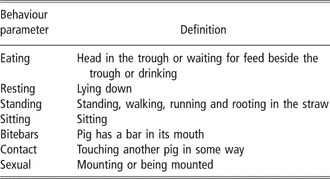
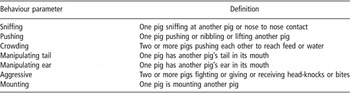
The definitions of all behaviour parameters are presented in Table 1 (activity) and Table 2 (social interactions). During the scan sampling of activity behaviour, priorities sometimes had to be made. If a pig had any social contact with another pig, it was always recorded as contact and if a pig was drinking while sitting, drinking was given priority, and registered as the main activity. Contact included aggressive as well as non-violent behaviour. In the continuous frequency recording of social interactions, aggressive and non-violent social behaviour (sniffing, pushing, crowding and manipulating ear or tail) were recorded separately. Different social interactions were recorded as new events, regardless of whether they were performed by the same or several different pigs. A new event was recorded as soon as new pigs interacted or when the interaction stopped for 3 s or more, and then started again.
Definitions of behaviour parameters used at the scan sampling

Definitions of social interactions during continuous recording

Skin lesions
Skin lesions were recorded four times on each pig (before first injection, between first and second injection, between second injection and first slaughter occasion and after first slaughter occasion). Records from these inspections were used to classify the pigs into two groups: without skin lesions or with skin lesions. Pigs with only a few light skin lesions were classified as ‘without lesions’. In the analysis, percentage of pigs without skin lesions was compared between treatments. Additionally, skin lesions were recorded in the first batch at cutting using a 6-point scale (0: no visible skin damage; 5: very highly damaged skin).
Statistical analysis
Activity behaviour parameters measured number of pigs per pen performing a certain activity in each round (2 scan samplings) and social interaction parameters measured frequency of each behaviour performed per pen in each round (8 min). All records were added together per pen and observation occasion (18 scan samples and 72 min, respectively), that is, pen was the statistical unit. Activity behaviour data were then arcsine-transformed and social interaction data were square root-transformed to improve the normality of the distribution before the statistical analysis. Activity behaviours were recorded as the percentage of pigs performing a particular behaviour at each scan sampling occasion and were analyzed as percent of time, whereas social interactions were recorded as the total frequency of each behaviour performed per pen and hour. These parameters were evaluated within each observation occasion with Proc Mixed in SAS (version 9.1, SAS Institute, Cary, NC, USA). The model included treatment (control, immunocastration and surgical castration) as fixed factor and batch as random factor.
Immunocastrated pigs that received the second injection 3 weeks before the observation day were compared with pigs that received this injection only 1 week before the observation day. Group (marked and unmarked) within pen was the statistical unit in this comparison.
The impact of treatment on skin lesions recorded on living pigs and at slaughter was tested as a logistic regression using a binomial distribution with a logit link function. These analyses were done with Proc Genmod and the model included the effect of treatment.
Results
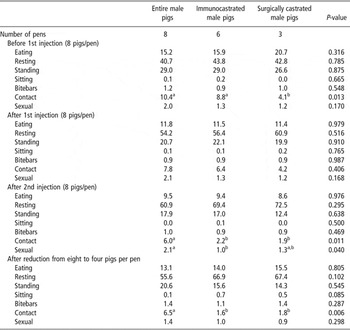
Treatment did not significantly affect the time that pigs spent eating, resting, standing, sitting or bitebars at any observation occasion. Contact and sexual behaviour differed significantly between treatments at some observation occasions, as shown in Table 3. According to the scan sampling before the first injection, surgically castrated pigs had less social contact with each other than entire male pigs and immunocastrated pigs (P = 0.004 and 0.021, respectively). After the first injection, no difference between treatments in social contact was found. After the second injection, immunocastrated pigs spent less time on contact compared with entire male pigs (P = 0.011) but similar to surgically castrated pigs (P = 0.579). The same result was also observed at the fourth observation occasion, when the number of pigs per pen was reduced from eight to four (P = 0.003 and 0.853, respectively). Before and after the first injection no difference in sexual activity was found between treatments. After the second injection, the immunocastrated pigs used less time performing sexual activity than the entire male pigs (P = 0.015), but similar time as surgically castrated pigs (P = 0.587; Table 3).
Percent of time used for different behavioursFootnote 1 (LS means)Footnote 2

LS means = least square means.
1 See Table 1 for definitions of behaviour parameters used at the scan sampling.
2 Means with different superscript within row differ significantly (P < 0.05).
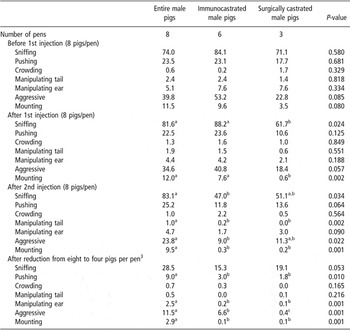
Before the first injection, social interactions did not differ significantly between treatments (Table 4). However, there was a tendency that surgically castrated pigs performed less aggressive and mounting interactions that the other pigs (P = 0.085 and 0.080, respectively). After the first injection, mounting frequency was significantly lower for surgically castrated pigs than for entire male and immunocastrated pigs (P = 0.001 and 0.009, respectively). A tendency (P = 0.057) to lower aggressive interactions was also found for the surgically castrated pigs in comparison with entire male and immunocastrated pigs (P = 0.049 and 0.019, respectively). At the observation occasion after the second injection, the number of aggressive and mounting interactions observed were fewer among immunocastrated pigs compared with entire male pigs (P = 0.009 and 0.001, respectively), but similar to surgically castrated pigs (P = 0.667 and 0.806, respectively). The reduction in aggressive behaviour during the time period from before to after the second injection was 78% for immunocastrated compared with 31% for entire male pigs. Those entire males that were heaviest (marked with colour) tended to perform fewer mountings than their pen mates at this observation occasion (3.4 v. 5.9 per 4-pig group and hour; P = 0.064), whereas no difference in behaviour between the heavy and the light group was found for immunocastrated (P = 0.373) or surgically castrated pigs (P = 0.556). After reduction from eight to four pigs per pen, immunocastrated pigs still were less aggressive and performed fewer mountings than entire male pigs (P = 0.024 and 0.001, respectively).
Frequency of observed social interactionsFootnote 1, per pen and hour (LS means)Footnote 2

LS means = least square means.
1 See Table 2 for definitions of social interactions.
2 Means with different superscript within row differ significantly (P < 0.05).
3 Note that these frequencies are the sum of four pigs’ records, as compared with eight pigs at the other testing occasions.
After the first injection, sniffing behaviour (P = 0.024) occurred more often among entire male and immunocastrated pigs than among surgically castrated pigs (P = 0.023 and 0.008, respectively). After the second injection, the frequencies of sniffing and tail manipulating behaviours decreased for the immunocastrated pigs to the same level as for surgically castrated pigs (Table 4). The same pattern, but only as tendencies, were seen for pushing and ear manipulating. After reduction from eight to four pigs per pen, immunocastrated pigs showed lower frequencies of sniffing, pushing and ear manipulating behaviours than entire male pigs (Table 4). These frequencies were comparable with surgically castrated pigs.
Immunocastrated pigs that received the second injection 3 weeks before the observation day were compared with pigs that received this injection only 1 week before the observation day. Frequencies of observed social interactions did not differ between these two groups of immunocastrated pigs in any behavioural trait (P ≥ 0.20).
Before and after the first injection, percentage of pigs without skin lesions was higher for surgically castrated pigs (74% and 78%) compared with entire male (48% and 39%) and immunocastrated pigs (36% and 40%; P = 0.011 and 0.003). After the second injection, the percentage of immunocastrated pigs without skin lesions increased to 66% and was similar to surgically castrated male pigs (74%), as compared with 46% for the entire male pigs (P = 0.024). After the reduction in number of pigs per pen from eight to four, more immunocastrated and surgically castrated pigs were without skin lesions, 74% and 100% compared with 38% for entire male pigs (P = 0.001).
Treatment significantly affected skin lesions recorded at slaughter (P = 0.009; only recorded in the first batch). More entire male pigs had skin lesions (70%) compared with surgically castrated pigs (30%) and immunocastrated pigs (46%). The frequency of skin lesions at the testing occasion just before the pigs were sent to slaughter did not significantly relate to skin lesions recorded at slaughter (r = 0.16 and P = 0.152).
Discussion
Sexual behaviour, such as mounting, is part of pigs’ normal behaviour repertoire (Hemsworth and Tilbrook, Reference Hemsworth and Tilbrook2007) and is highly influenced by castration. In accordance with others (Cronin et al., Reference Cronin, Dunshea, Butler, McCauly, Barnett and Hemsworth2003; Rydhmer et al., Reference Rydhmer, Zamaratskaia, Andersson, Algers, Guillemet and Lundström2006), we found that entire male pigs express more sexual behaviour than castrated pigs, regardless of castration method. Suppression of sexual behaviour by immunocastration has also been shown in stallions (Janett et al., Reference Janett, Stump, Burger and Thun2009). According to the scan sampling in this study, no immunocastrated pigs performed sexual behaviour at any testing occasion after the second injection. During that period, immunocastrated pigs had higher growth rate and higher feed intake than the entire male pigs (Zamaratskaia et al., Reference Zamaratskaia, Andersson, Chen, Andersson, Madej and Lundström2008a). Dunshea et al. (Reference Dunshea, Colantoni, Howard, McCauley, Jackson, Long, Lopaticki, Nugent, Simons, Walker and Hennessy2001) and Cronin et al. (Reference Cronin, Dunshea, Butler, McCauly, Barnett and Hemsworth2003) also found higher feed intake in immunocastrated pigs than in entire male pigs. They proposed that this could be an effect of reduction in mounting events and aggressions. In addition, reduced oestrogen levels in immunocastrated pigs might partly be responsible for the increased feed intake, as oestrogens are known to have a direct negative effect on feed intake (Bonavera et al., Reference Bonavera, Dube, Kalra and Kalra1994). Rydhmer et al. (Reference Rydhmer, Zamaratskaia, Andersson, Algers, Guillemet and Lundström2006) found that male pigs performing many mountings had a lower growth rate than male pigs not mounting. The negative relationship between mounting and growth rate could reflect an unfavourable effect of frequent mountings on pig welfare. Other negative consequences of the sexual behaviour on welfare are increased risk of leg problems and skin lesions (Rydhmer et al., Reference Rydhmer, Zamaratskaia, Andersson, Algers, Guillemet and Lundström2006).
It is well-known that surgical castration without anaesthesia is painful and Moya et al. (Reference Moya, Boyle, Lynch and Arkins2008) showed that the pain and discomfort remain for at least 4 days. We did not measure pain, but the negative effect of surgical castration on piglets could be seen in the reduced early growth rate from birth to weaning reported by Zamaratskaia et al. (Reference Zamaratskaia, Andersson, Chen, Andersson, Madej and Lundström2008a). Surgical castration without anaesthesia has been banned in Norway (2002) and Switzerland (2009) and European Union is seeking more humane alternatives (Leidig et al., Reference Leidig, Hertrampf, Failing, Schumann and Reiner2009). Although anaesthesia reduces pain during surgery, part of the discomfort that piglets experience during castration is due to manipulation of piglets and the time needed for this increases with anaesthesia, as shown by Leidig et al. (Reference Leidig, Hertrampf, Failing, Schumann and Reiner2009). They concluded that the welfare benefits of local anaesthesia ‘may not fully meet expectations’ or requirements of the European Union.
To avoid castration would, of course, completely eliminate the pain, fear and stress related to surgery. No castration can, however, lead to low welfare of male pigs (and females if both sexes are reared together) due to increased aggressive behaviour, as discussed by Cronin et al., Reference Cronin, Dunshea, Butler, McCauly, Barnett and Hemsworth2003; Rydhmer et al., Reference Rydhmer, Zamaratskaia, Andersson, Algers, Guillemet and Lundström2006 and Fredriksen et al., Reference Fredriksen, Lium, Marka, Mosveen and Nafstad2008. We found that immunocastrated pigs performed much less aggressive behaviour after the second injection than entire male pigs of the same age, in the direct observation of undisturbed behaviour. Velarde et al. (Reference Velarde, Gispert, Oliver, Soler, Tibau and Fàbrega2007) reported from a small study that immunocastrated pigs performed less aggressions than entire males when observed 2 weeks after the second injection. Cronin et al. (Reference Cronin, Dunshea, Butler, McCauly, Barnett and Hemsworth2003) also found that immunocastrated pigs performed less aggressive behaviour than entire male pigs. Furthermore, immunocastration has been shown to reduce aggressive behaviour in bulls (Price et al., Reference Price, Adams, Huxsoll and Borgwardt2003; Huxsoll et al., Reference Huxsoll, Price and Adams1998) and bucks (Godfrey et al., Reference Godfrey, Walkden-Brown, Martin and Speijers1996).
A high aggression level performed by entire male pigs may increase the risk of leg problems (Rydhmer et al., Reference Rydhmer, Zamaratskaia, Andersson, Algers, Guillemet and Lundström2006). In this study, no leg problems were observed and the entire males did not spend more time sitting than the immunocastrated and the surgically castrated pigs. Even without leg problems, it seems plausible that aggressive behaviour results in fear, stress and pain.
Although pigs are social animals, a high frequency of non-violent social behaviours can probably be stressful if the activity hinders pigs from resting. In our study, entire males performed more non-violent social interactions (sniffing, pushing and manipulating ear and tail) than immunocastrated and surgically castrated pigs. The entire males also spent more time in contact with each other after the second injection, as compared with immunocastrated and surgically castrated pigs. In addition, the entire males tended to spend less time resting than the immunocastrated and surgically castrated pigs at the last observation occasion, although this difference was not significant. In the study by Velarde et al. (Reference Velarde, Gispert, Oliver, Soler, Tibau and Fàbrega2007), entire males were more active than immunocastrated and surgically castrated pigs when observed 2 weeks after the second injection. Cronin et al. (Reference Cronin, Dunshea, Butler, McCauly, Barnett and Hemsworth2003) reported that at age 17 weeks entire males spent 22% of their time standing, compared with 16% for castrates (P = 0.04) and the corresponding figures at age 21 weeks were 18% v. 15% (P = 0.12). In agreement with our results, they found that time spent standing by entire male pigs did not differ from that spent by immunocastrated pigs, neither at 17 weeks (1 week before second injection) nor at 21 weeks (4 weeks after second injection).
After the second injection, immunocastrated pigs had fewer skin lesions than entire males, but were similar to castrates. Turner et al. (Reference Turner, Farnworth, White, Brotherstone, Mendl, Knap, Penny and Lawrence2006) showed that the number of skin lesions is correlated with both the duration of engagement in reciprocal aggression and the duration of receipt of non-reciprocal aggression. In contrast to previous studies of entire males (Rydhmer et al., Reference Rydhmer, Zamaratskaia, Andersson, Algers, Guillemet and Lundström2006; Fredriksen and Hexeberg, Reference Fredriksen and Hexeberg2009), the frequency of observed aggressive behaviour did not increase after sending the first pigs in each pen to slaughter. The proportion of entire males without skin lesions did, however, decrease from 46% to 38% after the removal of pigs, whereas the corresponding proportion increased for immunocastrated pigs from 66% to 74%.
Rydhmer et al. (Reference Rydhmer, Zamaratskaia, Andersson, Algers, Guillemet and Lundström2006) found more scratches on the skin of pigs in single-sex pens with entire males than in pens with females and mixed pens. Presumably many of those scratches were caused by mounting rather than fighting because more scratches were found on pigs being mounted than on pigs not being mounted, and no relationship was found between received aggressions and frequency of scratches. Mixing with unfamiliar pigs at the slaughterhouse causes more skin lesions in entire males than in females (Andersson et al., Reference Andersson, Andersson, Zamaratskaia, Rydhmer, Chen and Lundström2005). In our study, there tended to be less skin lesions recorded on immunocastrated pigs than on entire male pigs at slaughter. Jago et al. (Reference Jago, Cox, Bass and Matthews1997) studied the behaviour of cattle during lairage before slaughter. The behaviour of uncastrated bulls did not differ significantly from immunocastrated bulls, but uncastrated bulls showed more sexual and aggressive behaviour than surgically castrated steers.
After the second injection, the behaviour of immunocastrated pigs that received the second injection only 1 week before the observation day did not differ from pigs that received the second injection 3 weeks before the observation day. Thus, this study demonstrates that sexual as well as aggressive and non-violent social behaviour is influenced very soon after the booster injection. We have previously shown that the effects of immunocastration on behaviour and boar taint last several months after vaccination (Zamaratskaia et al., Reference Zamaratskaia, Rydhmer, Andersson, Chen, Lowagie, Andersson and Lundström2008b), which means that the vaccination can be performed earlier than in this study. The first injection can be given from 8 weeks of age and the second injection as early as 4 weeks later, but at least 4 weeks before slaughter. Thus, the time span within which the vaccination could be performed is large. When deciding the optimal time for the second injection, both positive (more efficient animals) and negative (restlessness, aggression and mounting) effects of rearing entire males should be taken into account. Ideally, the second injection should be given just before the males’ fighting and mounting start to become harmful. We assume that the right time for the second injection varies with the pigs’ genetic background and the environment.
Conclusion
We conclude that immunocastration can improve animal welfare compared with raising entire male pigs, since immunocastrated pigs perform less aggressive and sexual behaviour than entire males. Immunocastrated pigs also perform less non-violent social behaviour, which could result in a calmer environment. However, it should be noted that timing of the second injection is crucial because it is only after this that full effect of immunocastration is obtained.
Acknowledgements
This work was supported by grants from Swedish Animal Welfare Agency. Pfizer is gratefully acknowledged for providing additional financial support and Improvac. The authors thank Mr Michael Pearce for valuable comments on the manuscript. They also thank Eva Norling and the staff at Funbo-Lövsta Research Station for taking excellent care of the animals, Johanna Öijer and Elin Eriksson for collecting behavioural data and Ulla Schmidt for all assistance.