1. Introduction
At this point in time, there are a great number of ensemble approaches to digital music, most famously the various ‘laptop orchestras’ that have sprung up in recent years (Trueman Reference Trueman2007). I have been involved in similar ensemble development beginning with the ‘Montreal Genetic Laptop Orchestra’ (MGLO 2006), wherein I invited composer Kim Cascone to direct us in developing a performance piece. MGLO and related projects that I have developed around the laptop orchestra paradigm are certainly inspiring to the pedagogically motivated work I will present in this article, in particular the collectivist approach to developing a performance practice, sonic content, digital instrumentation and compositional structure. At the same time I have felt it important to expand this scope to include awareness of the body in relation to listening practices, physical space and the materiality of sound delivery mechanisms. This expansion has allowed me to focus on enhancing awareness and listening capabilities in participants from a variety of academic backgrounds, as well as teaching the fundamentals of working with sound through combined listening/creation experiences. The commitment to this goal is influenced by my experience of studying as well as teaching Deep Listening practice (Oliveros Reference Oliveros2005) since the early 2000s. At the same time, my personal experience as a composer and improviser of electroacoustic music (Van Nort Reference Van Nort2010) has taught me not only the considerable influence of material, acoustic and social factors on the overall musical experience, but has convinced me that these aspects should remain in the foreground in developing an electroacoustic music pedagogy, and that they should be taught in an experiential fashion.
Drawing on these influences I have developed a collection of pedagogical practices that I have presented in workshops as well as in classroom settings. These practices are grounded by a conviction in the importance of merging three key areas:
-
1. a focused approach to listening to sound itself (moving towards what we might call reduced listening after Schaeffer (Reference Schaeffer1966));
-
2. an embodied approach to listening that incorporates direct engagement with sound production and awareness of the environment (what we might call global listening (Oliveros Reference Oliveros1979)); and
-
3. a collaborative approach to music-making that requires cooperative action in order to achieve a final goal that is partially prescribed and partially emergent.
In particular there are two pedagogical approaches that I have developed in recent years that explore the above areas, and which inform the new workshop structure that is the primary focus of this article. First, I have previously explored themes 1 and 3 through a series of eight compositions called Genetic Orchestras (Van Nort Reference Van Nort2009a; Genetic Orchestras n.d.) that allow a digital music ensemble to evolve a variety of sonic textures and gestures in a bottom-up fashion, through collective voting and decision-making. During this process sound transformations from respective members of the group co-mingle across multiple generations of sonic evolution, and a larger structure emerges from a cross-breeding of musical ideas. To my mind, this process is an immediate and concret way of approaching collective music-making: decisions on musical direction and structure arise from all individuals rating precisely the same digital sound material, as shared through an online server. This project balances an immediate and personal interaction with sound materials with a distributed approach to composing the larger work. I have explored the distributed nature of this collective structure-creation process by conducting these pieces over the Internet, both with professional musicians as well as with groups of electroacoustic music students. The emphasis on aesthetic decision-making and basic sound transformations does not demand any specific musical training of participants, and I have also conducted Genetic Orchestra pieces in the context of non-music student courses focused on listening and sound appreciation.
A second practice, aimed at enhancing listening and creative collaboration, has arisen from teaching Deep Listening classes in recent years. In this context I have explored the combination of themes 2 and 3, merging the art of phonography and sound hunting with structured and embodied listening sessions, wherein participants engage in a sound walk and field recording journey based on a particular theme (e.g. finding pulses in the environment), only to return to the classroom space and collectively decide on how to merge these recordings into a new soundscape. While immersed in this new sound world, students engage in movement practices and variants on sonic meditations (Oliveros Reference Oliveros2005), thereby moving from a purposeful walk within a natural sonic environment into a mixture of re-lived and re-captured environments. Through this transition, the experience shifts away from awareness of time passing and goal-oriented thinking towards awareness of the very act of listening and moving in tandem. Through re-experiencing their environment as an abstract musical event, students gain an enhanced appreciation for the ecological nature of listening (Clarke Reference Clarke2005) balanced with their experience of human organised sound.
Now, these two ongoing practices are grounded in a larger pedagogical philosophy that I maintain. This philosophy is centred around the belief that developing attentive listening is a pathway to enhancing creativity, and further that learning to pick apart and recognise the inner details of sonic matter is an important part to this development – though only one part. Rather, this practice must be enacted in tandem with developing a sensitivity towards the influence of the physical environment on sound delivery, the body on sound reception and finally an understanding that all organised sonic structures that we might call ‘music’ ultimately take on such meaning relative to a larger system of social and cultural conditions. Among other things, such conditions include the participation in the creation of musical dialogue, or the constructed ritual of concert-based music reception that helps define how and what one is listening to. With this philosophy in mind, the two aforementioned practices have informed a more recent pedagogical construct, developed for a workshop environment, that brings together the aforementioned three ‘key areas’ in an integrated fashion. The invitation to first present this workshop resulted from a particular sound installation of mine, and so I will explain this piece in order to set the context and inspiration for this more recent pedagogical development.
2. Constellate
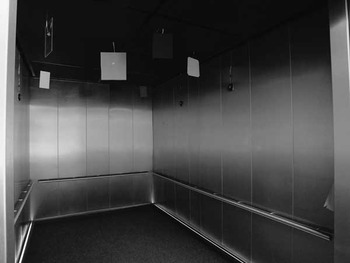
I was invited to propose a sound piece for the working elevator at the Tang Museum, Skidmore College in Saratoga Springs, NY (Constellate 2012). In visiting this fairly large space (9′ W × 13′ D × 9′ H) I was struck by the resonant quality of the large steel walls when hit with hand or fist, and at this moment decided that the elevator itself must be used as the medium for sound delivery, as well as a source of sound. Forgoing any traditional speaker systems, I mounted tactile bass transducers to these steel walls. Through various tests using portable playback means inside the elevator, I decided to remove the ceiling light panels and install planar sheets – each outfitted with an array of transducers – in their place. Through listening, testing of sonic and physical materials, and moving the transducers as though each were a stethoscope searching for the resonant pulse of the materials, I settled on a particular choice of material (so-called ‘gatorboard’) and transducer placement (a linear array of four). Finally, to add idiosyncrasy and variety to the spatio-sonic character of this sculpture, I hung eight unique planar objects, each mounted with a transducer, and comprising various types of paper, wood, plastic and cardboard. The final installation and placement of the wall transducers, ceiling panels and hanging objects can be seen in Figure 1.
An open-door view of the site-specific piece Constellate, created for a working elevator.

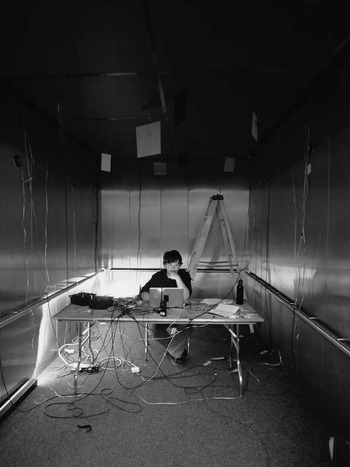
The process of arriving at the various speaker-objects for this piece was an act of improvisation guided by attentive listening to the interaction of the materials, both sonic and physical. Certainly David Tudor's series of Rainforest (Driscoll and Rogalsky Reference Driscoll and Rogalsky2004) pieces were an inspiration and guiding light in these actions, and in fact has been close to my mind in recent years as I've become an active member of Composers Inside Electronics (Collins Reference Collins2004). At the same time, I wanted to move away from Tudor's pure delight in the resonance of everyday objects and the creation of a diverse field of such idiosyncratic objects. Rather, I was intent on developing a highly sculpted and immersive experience that was strongly composed, while considerate of the non-linear nature with which most people would experience it, as they passed through the elevator. As a result, the true realisation of the piece was through composing in situ, with all of the speaker-objects in place (see Figure 2).
The artist composing the ten-channel sound for Constellate while in the elevator space.

It became clear that there were three layers to work with: small, defined directional points (dipoles) from the hanging objects; a spectrally broad-band stereo field from each of the overhead panels; and finally the low-frequency resonances of the walls, enhanced by the enclosing space in order to form a massive subwoofer that extended into the lower vocal range. From a compositional point of view, three strategies for using these layers became quite clear:
-
1. Moving between discrete sources, revealing the sonic character of the material.
-
2. Mapping the same sound source to many different materials, thereby creating a sort of spectral panning where the spatial location of a sound changed drastically when one moved their head or body.
-
3. Using low frequencies to excite incidental sounds in the elevator, and mixing this elevator-as-source with the elevator-as-medium.
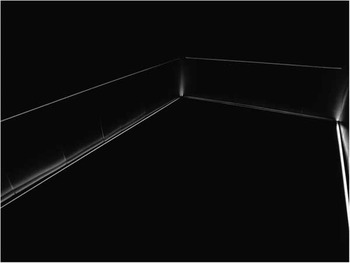
The resulting work, Constellate, is an exploration in resonance and the materiality of sound, as well as in creating an immersive and transformative experience. The name is a verb which means ‘to cluster together, as stars in a constellation’ (Constellate n.d.); it references not only the creation of a constellation of objects, but the clustering and dispersion of sonic points and events. To focus on the perceived effect of the sonic constellation rather than the physical objects, and to further evoke a sense of potentially limitless space, I created a minimal lighting design, as seen in Figure 3.
A closed-door view of the site-specific piece Constellate, created for a working elevator.

3. From site-specific piece to collaborative sound sculpting
Through the popularity of the piece with Skidmore students, I was invited to present a workshop that in some way presented the inner workings and spirit of the piece. I decided to develop a (minimum) 6–8 hour process that abstracted the principles which I was implicitly working with in the various creation stages, from gathering and shaping sound materials to gathering and testing physical materials, and composing the final work inside the elevator. In addition to providing participants with specific skills to engage in this type of work, the goal was to address larger ideas in regards to sound sculpting, site-specific composing, material considerations and resonance, and the importance of active and engaged listening that underlies all of these. For the remainder of this article, I will outline the various steps and reflect on the overall experience and pedagogical strengths of the workshop.
3.1. Step 1: manual construction
This first step is the process of making custom cable/transducer stereo pairs, using the same configuration as I did in Constellate. Beyond revealing the laborious nature of building electroacoustic installations from scratch, it gives participants practical knowledge in regards to soldering, audio cables, passive speakers and basic electrical properties. Working with a spool of two-conductor microphone cable, students solder a ¼″ TRS connector to one end, while soldering to a stereo pair of transducers on the other. I have used a variety of 8-ohm transducers from partsexpress.com, including ones manufactured by Dayton and Hiwave. In this process, students learn about polarity and a basic understanding of current flow (e.g. through the realisation that there is a sharing of ground between transducers). This step is also where participants decide if they would like a matched pair of transducers or two that specialise to different frequency ranges, as well as begin to think about how they will apply these two transducers to an object or objects. This choice can be considered as the lowest level of compositional decision-making, as this is the point at which one begins to think about both the spectral characteristics of their resultant speaker-objects and how this will project sound spatially (e.g. two transducers on a single object versus a left–right pair of objects that create a stereo field). A variety of finished examples are presented in order to facilitate this choice.
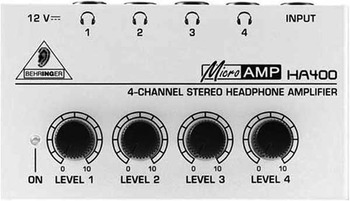
Once this process is complete, participants learn about the basics of passive speakers, serial versus parallel wiring, and impedance through the introduction of an amplifier. In this workshop I have used a Behringer HA400 headphone amplifier (see Figure 4); this specific amplifier was chosen as it provides sufficient power, is cost-effective and portable, and can map a given stereo input to multiple stereo outputs – an affordance that invites collaborative exploration, as I will discuss in step 4.
Behringer HA400 headphone amplifier, used to increase spatial possibilities and promote collaborate piece creation.

3.2. Step 2: learning digital sound transformation
This step shifts from manual engagement back to the abstracted world of digital sound, while presenting basic knowledge in acoustics and perception related to pitch, timbre and dynamics. I find the use of Audiosculpt (Audiosculpt n.d.) to be important in demonstrating simultaneously a temporal, spectral and spectro-temporal view of a given sound. In this demonstration I draw from the same sounds that will be explored by participants in the workshop, which is important so that participants begin to experience these same sounds repeated in different contexts (e.g. with graphical representation, through headphones, through speaker-objects). After explaining the fundamental features of sound during this exposition, three basic sound-processing methods are presented: pitch shifting without time alteration, time stretching/dilation without pitch change and graphical equalisation. At this point in the workshop I mention to participants that the world of sound transformation can become far more complex than these three processes. At the same time, I try to counter-balance this statement by noting that radical and profound transformations can occur with only these three effects through attentive listening to the sound materials coupled with many repeated iterations of the basic processing types. The goal here is to help people realise that attention to the sonic materials at every step of the process will trump an over-reliance on sophisticated sound manipulation techniques.
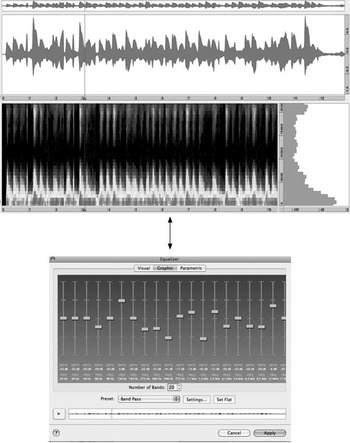
Next, I find it instructive to display a spectrogram created using very short time windows – and thus large spectral bins – so as to visually show a conceptual link between the displayed spectrogram and the act of graphic equalisation (see Figure 5). When it comes to distributing software to participants, I prefer to use simple cross-platform software tools, and in particular I have been using Wavepad (Wavepad n.d.), as it can accomplish the three aforementioned sound processing types as well as basic audio cutting and exporting. Additionally, one can apply a breakpoint envelope to speed and pitch transformations, thereby allowing one to introduce the creation of more unique sonic gestures (Wishart Reference Wishart1994) to participants. This serves to illustrate that convincing and expressive sonic forms often have several features that vary together over time.
Graphical tools can help create an intuitive link between temporal, spectral and spectro-temporal sound qualities and simple sound processing such as graphic equalisation.

At this point, participants are given time to familiarise themselves with the act of sound transformation, and crafting their own unique sound objects. Essential to the collective creation environment is that all sounds are shared on a central server, with all participants having access to this collective pool. I have allowed people to bring their own sounds, so long as they are accessible to the group. Thus far, I find that restricting the pool of sounds to around sixty wav files of 20–30 seconds works well in order to provide variety while maintaining focus within the group. All files are named with numbers, so as to emphasise the sonic matter of each file rather than the original source, recording context or other causal associations.
3.3. Step 3: understanding resonance
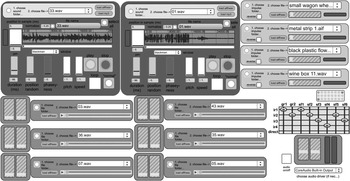
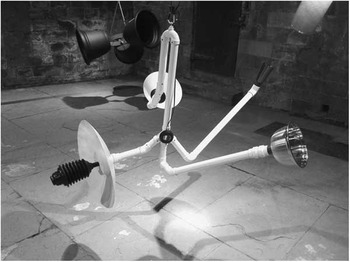
Once people have had time to familiarise themselves with the pool of sounds as well as the three basic sound processing types, the attention turns towards conceptually bridging this digital content with physical materials. While step 2 focused attention towards sonic detail (and the manipulation of this), step 3 is concerned with bringing awareness to those material influences that help shape a given sound event before it ultimately reaches our ears. Therefore, in order to facilitate a listening-oriented intuition on acoustic resonance, I have created a Max/MSP patch (see Figure 6) that allows for direct sample playback, samples convolved with impulse response (IR) files, or granular playback that is either direct or convolved. Through an exposition based on this tool, participants hear how an object can shape the character of a sound purely from a sonic point of view, allowing them to focus on the sonic imprint of the imagined physical objects. The introduction of a granular player is key, as it allows me to demonstrate in real-time the drastic change in output when a given input file is pitch shifted. Through this demonstration I reinforce the need for exploration in matching the resonant qualities of physical materials, transducers, acoustic space and the spectral content of the transformed sound. The impulse response files that are used in this presentation come from the recent instantiation of Rainforest V (Rainforest V 2011) (courtesy of John Driscoll and Phil Edelstein), which provides IRs from an idiosyncratic array of physical objects. After listening to some examples, I display an image (as in Figure 7) of those objects that have been ‘excited’ virtually, thereby returning attention to the sonic/physical material interplay that is at the heart of the workshop. This intuitive and conceptual link with objects and resonance helps to frame an understanding of the acoustic underpinnings of this hands-on creation process. If the pedagogical structure of the workshop were mapped out across a larger time frame, such as in an academic course, this could be an opportune time to delve into specifics of convolution, impulse responses or relating this to room reverberation, particularly with an acoustics-savvy group.
Max/MSP patch that allows direct sample playback, samples convolved with impulse response files, or granular playback that is either direct or convolved.

Rainforest V objects whose impulse response files are used for virtually demonstrating resonance and sound–object interaction (photo by Phil Edelstein).

3.4. Step 4: collectively crafting sound/physical material pairings
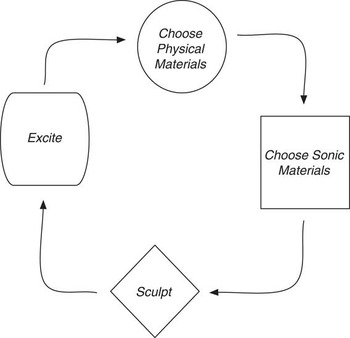
After listening to the sonic influence of different materials in step 3, the next step is to introduce raw scrap materials in a variety of sizes, including multiple types of paper, plastic, styrofoam, metal, wood and glass. This will allow participants to explore the manual sculpting of sound through material choice and transducer placement, as well as playing with spatial arrangements. People are welcomed to discover their own physical objects in any shape or size, while I provide primarily planar objects. The reason for introducing flat surfaces is that they tend to radiate in a directional and fairly predictable manner, allowing for more focus on the act of sculpting sound in space rather than on idiosyncrasies of sound propagation. At the outset of this step I emphasise that this work is a dialogue between sound and physical material, and that this exploration is an iterative process, as in Figure 8.
The iterative process of choosing sound/physical materials and sculpting sound digitally as well as physically through choice and placement of excitation (transducer).

Now, recall the Behringer amps with their single stereo input and four stereo outputs. I used them in Constellate because of their ability to expand the number of output channels, with individual gain settings for each output. The physical affordances of these amplifiers suggested a structure in creating the piece, and I drive this point home by developing a collaborative approach in the workshop environment. To this end, I split up participants into groups of four, which I've found to be a reasonable number in terms of my ability to attend to all participants, though perhaps a larger number could work. With this configuration there are now eight distinct points of sound per group, to be applied to four to eight different objects. There are four possible roles that one may assume within their group:
-
1. A person in charge of selection and playback of source sounds.
-
2. An operator of the four amplifier gain controls (see Figure 4), and applier of transducers to object surfaces.
-
3. An observer and listener to all four to eight objects, taking notes on effective pairings.
-
4. One who continues to work with headphones and sound transformations, uploading their work to the shared server sound pool.
By having each participant assume these various roles, the iterative nature of Figure 8 is strongly reinforced, as people will necessarily find themselves at each of the different points of the diagram. Each person is thus required to choose sound material, sound transformation, physical object or transducer placement as their one variable to react to in a given context, deepening their understanding that each step has an important influence on the overall sonic result. In terms of sound files, each group works from a different sub-directory on the server, so that the evolution of sound transformations takes on its own sonic character within each group. Further, this evolution is completely collective, as one person applies sound processing to a given file that someone else has previously worked with, much like the aforementioned Genetic Orchestra pieces. I have tended to encourage appending short descriptions to a given file name, so that the group can track the history of transformations.
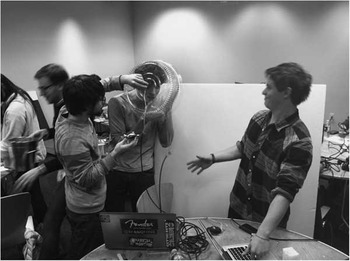
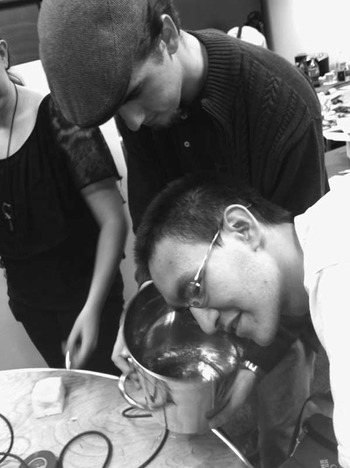
The highly physical and embodied act of coordinating these separate steps in the process is a collaborative performance in and of itself, and requires a shared reflection on a collective listening experience. Figure 9 illustrates the coming together of three of these roles: sound choice, transducer application and careful listening. It is also important to allow for improvisation, as in Figure 10 wherein students began exploring the influence of water in a metal bucket that is being driven by transducers.
Workshop participants sharing the act of sound input, material excitation and listening/inspection (photo by Susi Kerr).

Workshop participants improvising through the use of a found bucket, with water inside (photo by Susi Kerr).

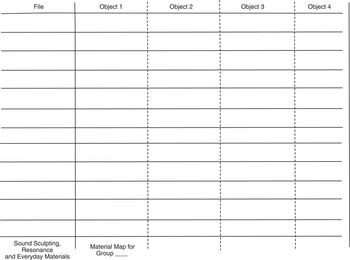
The final selection of physical materials is a personal one: each participant has a transducer pair and so they arrive at the final decision of object. However, the final selection of sound materials is a collective decision: participants are provided with a template like that in Figure 11, and are asked to write in their suggested sound/physical object mappings when they are in the role of listener/observer. If a given mapping receives a majority vote, then the sound file is kept and the mapping used in the composition process. The choice of all final materials – meaning both the digital sound source and physical object sound resonator – is a collective decision. Therefore, this step requires a balance between focused listening to materials and an embodied listening approach (e.g. engaging manually with the sounding body, changing listening orientations) wherein the final result is emergent and socially constructed.
Basic template for mapping sounds to physical materials.

3.5. Step 5: composing within sub-groups
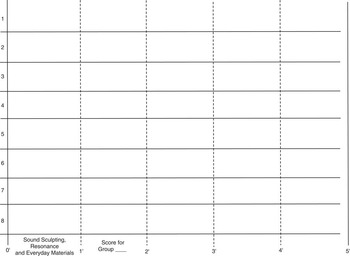
With all of the sound and speaker-object materials chosen, the groups must now turn their attention towards composing a piece and arranging the objects spatially. In terms of hanging objects, I have utilised plastic grids such as those used in lighting. This is a nice option in that it provides flexibility: by using monofilament and s-hooks, a variety of orientations may be tried quickly. It also allows for portability, which becomes important in the next step when choosing the final site of installation. As with the choice of source materials, the process of composing a temporal structure is decided amongst the group. In this case, a score template much like that in Figure 12 is given to each group, having different tracks, minute markings and a total length of 5 minutes. Participants have three actions at their disposal: they can write in a file name with a start/stop time, indicate if the file should be looped or draw in a dynamic level curve in the given box. While one person's computer is used for the digital sequencing of files for practical reasons (e.g. using Audacity or Pro Tools if available), everyone has an equal say in the creation of the piece. Each group once again self-organises and votes on the final decision of each sound's placement and dynamic level. Either each sound that was kept from step 4 should be used, or the group should be prepared to discuss why the file was excluded. This invites participants to begin analysing their compositional approach to materials. I have found that participants discover the principle of an economy of materials, and that they have accumulated far more sound sources than are needed for the overall structure that they desire.
Basic template for groups to collectively compose a piece for their speaker-objects.

In arranging this 5-minute composition, the groups only have one single stereo input at their disposal. This process teaches them to effectively use each channel both independently and as one stereo source. It also illustrates how a form of spectral panning is achieved by sending the same source input to unique speaker-objects – and so my second compositional strategy noted in the section on Constellate becomes a primary structuring principle in this collective composing action. At the end of this sub-group composition session, each group should present their composed work for the workshop in a mini-recital.
3.6. Step 6: influence of low frequencies and choosing a location
The next phase of the workshop focuses on an understanding of what it means to work site-specifically, using the room as part of the overall piece. To this end I employ tactile bass transducers and bass-specific amplifiers so as to be able to excite larger objects with sufficient power. This part of the process involves the entire group in an improvisation with their environment: the goal is to hunt out walls, doors, seats, trash cans, and so on, that might interact with low frequencies in an immersive and visceral fashion. In this step, the group collectively probes different surfaces using these larger transducers and low sine tones, moving about to experience how the effect is heard and felt in the entire space. This step is both the definition of the bass layer as well as a selection of the final site for the collective work. The ability to suspend the hanging grid also factors in to this decision. This step is in the spirit of the elevator walls of Constellate, yet the result is absolutely unique to the workshop location. Thus far the groups have discovered highly engaging spaces including a medium-sized hallway with glass walls acting as subwoofer in one case, and the stall walls of a bathroom in another. If the final piece is going to remain installed for the public, then the group must anticipate the audience flow and consider if the space is accessible and inviting for a given amount of time. This step encourages participants to re-think the reception of the work from the audience point of view, as well as helping them reflect on the fact that this social consideration is a factor in the composition of the final temporal structure of the piece. Once a location is chosen, the groups should listen to excerpts or all of their composition through the bass channel only, given that low frequencies so strongly interact with a surrounding environment. This will provide the group with a chance to consider any incidental sounds that arise from bass vibrations, further turning attention outward from the sound structures and speaker-objects to the influence of the occupied space.
3.7. Step 7: process of merging: de-composing and re-composing
With the final location and bass layer chosen, the final step is that of merging the various sub-components. How the various pieces are hung and spatially juxtaposed is a product of participants’ memory of hearing the sub-pieces, as well as the practicalities of the space. The spatial arrangement should be set, and the headphone and bass amplifiers should be hooked into one single multi-channel source. Thus far I have used a ten-channel sound card for the centralised playback of sound: eight speaker-object channels and two bass channels. Once the playback and arrangement of objects are centralised, the group should listen to the sub-group pieces again in this final location. At this point the influence of the space will be apparent. Should any piece be tweaked? Should each sub-piece be fed to the bass channels, or a new bass layer constructed? Do the sub-pieces flow well together, and in which order? Finally, should each piece be layered and merged, or should one sub-piece be re-mapped into other speaker-object constellations?
As any composer or sound artist could attest, these questions could be explored for weeks or months before a final piece is realised, and so my 6–8-hour workshops have only touched upon this re-composing step. In fact, I have seen this process effectively play out over a much longer time frame, as I have previously engaged in similar long-term explorations such as the piece Blindfield – an academic course-based collaboration with fellow electroacoustic composer Francisco López, visual artist Michael Oatman and sixteen students at Rensselaer Polytechnic Institute (Blindfield 2010). While I imagine that there are other courses that explore collaborative development of compositional structures, I believe that this workshop process offers a unique experience of the act of co-creating with sound in that these final compositional structures emerge from shared decisions that privilege focused listening, manual engagement and cooperative planning at every step in the process.
4. Discussion
This workshop is a pedagogical construct that helps participants understand a few key elements of electroacoustic music practice. Primary among these is the embodied nature of listening through a manual engagement with sound creation. It fosters an appreciation for active and attentive listening to sound qualities through shared, iterative transformations of sound material that are presented with no a priori associations or source identities. Through the process of working with sounds and larger structures, the creation of imagined sonic gestures (Godøy Reference Godøy2006; Van Nort Reference VanNort2009b) is communicated to non-specialists in a way that would be much more difficult if done by first presenting electroacoustic music theory outside of this practice-oriented and creative goal-driven context. Vital to this success is not just that this is a goal, but that students are reshaping their surrounding space to the whims of their own collective imagination (Neary and Winn Reference Neary and Winn2009).
Additionally, the concepts of resonance, and the radical influence of sound delivery systems as well as room acoustics are strongly reinforced through a bottom-up creation of the very context for sonic transmission and reception: first the creation of speaker-objects, and then the scouting of a location that includes exploration of low frequencies and the incidental sounds they can create. Along the way participants learn that solid objects and open spaces are both viable sound vibrational mediums, each with their own resonant sensitivities.
The subjective nature of listening and the influence of posture and orientation are learned through actively moving within the arrangement of speakers, and creating different constellations in differing contexts. This approach recognises the importance of the body in the reception of music and creation of musical meaning (Leman Reference Leman2008). In some realisations of this workshop process I have led students through an extreme slow walk exercise (Oliveros Reference Oliveros2005), which challenges their normal rhythm of movement and brings attention to the balance between environmental sound and body sensation. In my experience of Deep Listening practice, radically slowing down motion and priming participants to note this balance (or lack thereof) is an effective way to bring awareness to the profound impact that movement has on the experience of a piece such as Constellate, or a given piece that results from this workshop process. Talking about this effect simply does not convey this impact.
Finally the collective creation element is key to the pedagogical success of the workshop environment. When several actions of the electroacoustic composition process are split apart and made collaborative, participants appreciate the involved nature of composing with sound sources, while also gaining an appreciation for improvised creative dialogue. Most participants thus far are, in fact, not musicians but are instead enthusiasts who are curious about experimental and electroacoustic music. Thus this experience is often the first time they will have seen a creative action on their part be ‘picked up’ by another and mimicked, transformed or otherwise engaged with in dialogue. I have seen the power in this realisation, and liken it to one who is opened to the dialogic power of free improvisation for the first time. The efficacy of an approach based on sharing roles in a collective act of creation, as well as having a final goal with public showing, has been reinforced through a recent study on the incorporation of music technology to music collaboration in the secondary school environment (Dillon Reference Dillon2009).
5. Conclusion
I believe that a pedagogical strength of this workshop is that it teaches participants about the material nature of working with sound as a plastic art and the act of presenting this in a given space in a way that requires balancing focused listening to materials with global listening that considers one's bodily orientation and surroundings. The structure that is employed requires collaborative creation of musical meaning in this process, and the goal-directed nature is an important catalyst for ensuring that all roles within a group are balanced and attended to. While this particular pedagogical construct is certainly not intended to replace traditional forms of music education, I have observed firsthand how this process has positively influenced an awareness of listening practices, creative collaboration and sonic materiality in non-specialists. As such I personally intend to expand this working structure into more involved contexts that involve developing a repertoire of works – perhaps the site-specific installation equivalent of the laptop orchestra – and possibly extend this into an academic course environment. In moving from a creative workshop to a grade-based environment, assessment of learning outcomes will of course become crucial. Certain learning steps can be easily tested, such as an understanding of the interplay between object resonance and a sound's spectrum. Other learning steps emerge from the process, and so must be assessed through observation of the aforementioned desired outcomes, many of which are never made explicit. This includes a student's level of improvisation with materials and environment (e.g. the water bucket improvisation of Figure 10), and a group's ability to effectively converge to the shared testing of sonic/physical materials as expressed in the diagram of Figure 8. An example of such a collaborative success can be found in the postures, orientation and object awareness of the participants in Figure 9. Whether it manifests as workshop or academic course, my hope is that this project can inspire or influence other initiatives that enhance listening practices and appreciation for the crafting, transmission, reception and social construction of electroacoustic music.