1. INTRODUCTION
This paper presents a comparative synchronic corpus investigation of Danish at måtte, Norwegian å måtte and Swedish må, måtte and måste. The prototypical meanings of these modals are given in (1) below (see Eide Reference Eide2005:82–84).Footnote 1
(1)


In this study, Swedish må, måtte and måste are compared to the present and past tense of Danish at måtte and Norwegian å måtte, må and måtte, respectively. Swedish må and måtte are the original cognates of Danish at måtte and Norwegian å måtte but they have now been largely replaced by måste, which is a loanword from Middle Low German and can be considered to be the present-day equivalent of Danish at måtte and Norwegian å måtte (see Section 4 below). Nowadays, the Swedish modals må and måtte are highly grammaticalized forms as they predominantly occur in specific constructions and contexts (see Teleman et al. Reference Teleman, Hellberg, Andersson and Christensen1999; Wärnsby Reference Wärnsby2006; and Section 5 below).Footnote 2 Because of this, little attention has been paid to må and måtte in synchronic studies of Swedish modals.
The development of modals has attracted much attention in the literature (e.g. Hansen & de Haan Reference Hansen and de Haan2009 and references therein). Semantically, modals have the ability to express different aspects of the modal spectrum. They may convey dynamic, deontic and epistemic meanings, or a subset of these. Formally, modals are forms on their way from full verb to auxiliary status. Therefore, modals have properties of main verbs and auxiliaries to various extents.
It has been noted that there is much variation, both intra- and cross-linguistic, when it comes to degrees of grammaticalization involving Germanic modals (Nuyts Reference Nuyts2001; Mortelmans, Boye & van der Auwera Reference Mortelmans, Boye, van derAuwera, Hansen and de Haan2009). The English modals are generally considered to be the most grammaticalized among the Germanic languages (Heine Reference Heine1993:72ff; Nuyts Reference Nuyts2001). In their comparison of Danish, Dutch, English and Icelandic modals, Mortelmans et al. (Reference Mortelmans, Boye, van derAuwera, Hansen and de Haan2009:59) propose a ‘grammaticalization cline’ in which English has the most, and Icelandic the least, grammaticalized modal system. The Danish modals share many similarities with the English modals, and the Dutch and German modals take a middle position between English and Icelandic.
As pointed out by de Haan & Hansen (Reference de Haan and Hansen2009:2) ‘there is a considerable lack of work comparing the degree of the grammaticalisation of modal elements in different languages’, a topic which is thoroughly addressed in their book on modals in the languages of Europe (Hansen & de Haan Reference Hansen and de Haan2009). In this paper, the etymology, grammaticalization paths, formal properties and semantic distributions of Mainland Scandinavian må, måtte and måste are compared and discussed. Since the Mainland Scandinavian languages are also Germanic languages, one might expect må, måtte and måste to develop according to the observed tendencies for its cognates in the Germanic languages. That is, like the other Germanic languages, they should also be able to express various aspects of the modal spectrum and show a tendency to move towards auxiliary status. Being closely related language varieties, the Mainland Scandinavian languages can be expected to have gone through similar developmental stages and have comparable degrees of grammaticalization for må, måtte and måste. The following research questions will be addressed:
(2) Do Danish, Norwegian and Swedish differ with respect to the semantic distributions, formal properties and development of må, måtte and måste? More specifically, do the Mainland Scandinavian languages differ in the degree of grammaticalization of these modals?
In order to determine the degree of grammaticalization for må, måtte and måste both formal and semantic criteria are taken into account. As regards the formal side of grammaticalization, factors like the inflectional paradigm (full or defective), syntactic positions (fixed or free) and the number of specific constructions and contexts in which a form may occur (few or many) are taken into account. Defective inflectional paradigms, fixed syntactic positions and frequent occurrence in specific constructions and contexts are all signs of (advanced) grammaticalization.
The modal forms må, måtte and måste developed a wide range of different meanings and uses in the domain of necessity, possibility and beyond. These include, inter alia, deontic, epistemic, optative, concessive and eventuality meanings. The distributions of the different meanings and uses of these modal forms in Danish, Norwegian and Swedish are compared with regard to differences in proportions between premodal, modal and postmodal meanings that they carry.
The idea is that premodal meanings give rise to modal meanings which in turn may develop postmodal meanings. Premodal meanings are lexical source concepts (e.g. a full verb) that may develop modal meanings, i.e., qualificational meanings in the domain of necessity and possibility.Footnote 3 Postmodal meanings are meanings that can originate in either possibility or necessity, for example, optative or concessive meanings (Van der Auwera & Plungian Reference Van der Auwera and Plungian1998:1).
Premodal meanings are non-grammaticalized, modal meanings are grammaticalized, and postmodal meanings are most grammaticalized. Thus, if a modal has predominantly postmodal meanings, e.g., optative or concessive, it is more grammaticalized than if it has predominantly modal meanings, e.g. deontic or epistemic meaning. It will be shown that må, måtte and måste represent different stages of grammaticalization, both formally and semantically, in the Mainland Scandinavian languages.
2. SOURCES AND METHOD
Random samples of sentences with må, måtte and måste have been taken from modern online corpora. For Danish and Norwegian both the present tense, må, and the past tense, måtte, of at måtte and å måtte, respectively, are investigated because past tense may be used to convey modal dimensions (e.g. Perkins Reference Perkins1983). For Swedish, samples of the forms må, måtte and måste have been selected since the inflectional paradigms of these modals consist of one form only, i.e., it is not possible to distinguish between present and past tense. See Section 5.2 and Table 2 for more details.
The Danish data have been selected from KorpusDK (http://ordnet.dk/korpusdk), which is a modern online corpus of Danish texts from different sources and genres, with a total of 56 million words. The texts were collected between the years 1990 and 2002. The corpus consists of two subcorpora: Korpus 2000, which consists of texts from the period 1998–2002, and Korpus 90, which consists of texts from the period 1983–1992. KorpusDK is mainly designed for linguistic analysis with the particular aim to identify recent developments in the Danish language. There are 71,814 hits for må (present tense) and 25,810 hits for måtte (past tense). Random samples of 500 sentences have been taken for both må and måtte.
The Norwegian data have been collected from Norsk Aviskorpus (http://avis.uib.no/). This continually updated corpus of about 765 million words (as counted in September 2009) consists of newspaper texts from the year 1998 up to the present day. Approximately 200,000–250,000 words of running text are being added to the corpus each day. Texts from various types of newspapers are part of the corpus: tabloids, broadsheets, national and regional newspapers as well as general, business and financial newspapers. There are 814,457 hits for må (present tense) and 253,166 hits for måtte (past tense). Random samples of 500 sentences have been taken for both må and måtte.
The Swedish data have been taken from Språkbankens konkordanser (http://spraakbanken.gu.se/konk/). This corpus contains a subset of modern and historical corpora, and includes texts from various sources: newspapers, literature, non-specialist literature, government debates, law texts and historical texts. The entire corpus has approximately 99 million words. There are 4,782 hits for må, only 735 hits for måtte and as many as 133,478 hits for måste in the entire corpus. These numbers clearly show that må and måtte became restricted to specific contexts after they were replaced by måste. Random samples of 1000, 134 and 500 sentences with må, måtte and måste, respectively, have been taken from the subcorpora P95-98, which all contain newspaper texts from the 1990s.Footnote 4
The corpora KorpusDK, Norsk Aviskorpus and Språkbankens konkordanser are different types of corpora, yet comparable in the sense that they all contain newspaper texts from the same time span (from the 1990s up to the year 2002). It is aimed for comparable samples by selecting data from the subcorpora P95-98 of Språkbankens konkordanser, Norsk Aviskorpus which consists of newspaper texts only, and KorpusDK which contains texts from different sources and genres, inter alia newspaper texts. Because of this, the Danish corpus is less comparable to the Norwegian and Swedish corpora in the present study.
Only declarative clauses in which må, måtte and måste function as auxiliaries are considered, infinitival and perfect forms as well as questions are excluded. Since modal meanings are contextually dependent (Coates Reference Coates1983), other factors that might complicate the classification of the modals, for example modal combinations (e.g. Norwegian vil måtte ‘will must’) are excluded. The corpus data are classified according to their meanings and uses as exemplified in (3). The semantic distributions of må, måtte and måste include inter alia deontic meanings as illustrated with Danish må in (3a), optative meanings exemplified with Swedish måtte in (3b), epistemic meanings as represented by Swedish måste in (3c), concessive meanings as shown by Swedish må in (3d) and eventuality meanings as is the case for Norwegian måtte in (3e).
(3)
The meaning of må, måtte and måste was determined on the basis of context and paraphrases. For example, deontic meanings can be paraphrased as ‘it is necessary/obligatory/desirable/permitted that’. For some semantic categories there are additional syntactic clues. For instance, in optative context må and måtte occur mainly in clause-initial position and epistemic constructions are generally of the form ‘must (well) be X/must (well) have been X’. See Section 3.1 and 3.2 for more details on the delimitation of the semantic categories.
In addition to the semantic categories in (3), there is a category ‘excluded’ which contains examples of må, måtte and måste in questions, modal combinations, perfect form, infinitival form, noun (mat), or with lexical meaning (‘feel well/bad for Swedish må). The classification of the data was checked by one more linguist and native speakers were consulted in case of debatable example sentences. The classified corpus data, i.e., the counts per semantic category, are analyzed by means of a Chi-square test. This is a statistical method to check whether or not there is an association between two categorical variables (Field Reference Field2005:682–702). That is, in this case, if there is a statistical relation between language and the semantic distribution of a modal.
If there is a relation between language and the semantic distribution of a modal, the semantic distributions of må, måtte and måste are significantly different for Danish, Norwegian and Swedish. If there is no relation between language and the semantic distribution of a modal, the semantic distributions of må, måtte and måste are not significantly different in the Mainland Scandinavian languages. Thus, if Danish, Norwegian and Swedish have similar degrees of grammaticalization for må, måtte and måste, these modals express the same types of meaning in similar proportions. If the Mainland Scandinavian languages have different degrees of grammaticalization for these modals, må, måtte and måste express different types of meanings in dissimilar proportions.
Values for Cramer's V, a measurement to determine the strength of an association between categorical variables (Field Reference Field2005:689, 693), are also given since Chi-square only states whether or not there is a significant association between two categorical variables. It does not provide information about the strength of a statistical relationship. Cramer's V is always between 0 and 1: 0 means that there is no association at all, 1 means that there is a perfect association, and values larger than .5 indicate a strong relation between two categorical variables.
3. RESULTS
In this section the results of the comparative corpus investigation of the modal forms må, måtte and måste are presented. Section 3.1 discusses the results of the comparison for Danish må (present tense), Norwegian må (present tense), Swedish må (originally present tense) and Swedish måste (unclear tense). Section 3.2 examines the results of the comparison for Danish måtte (past tense), Norwegian måtte (past tense), Swedish måtte (originally past tense) and Swedish måste (unclear tense). Since måste does not distinguish between present and past tense forms, the percentages for the semantic distribution of måste as presented in Section 3.1 are also used for its comparison with måtte in Section 3.2.
3.1 Results for må (present tense) and måste
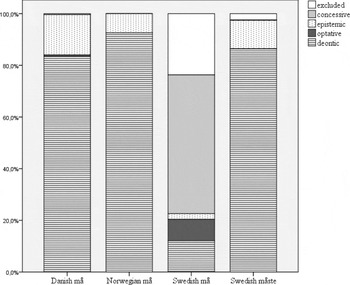
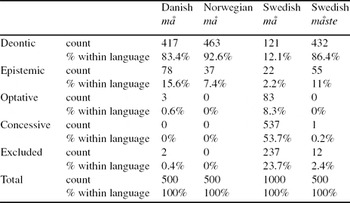
The distribution of the different meanings and uses of Swedish måste and Danish, Norwegian and Swedish må is shown in Figure 1. See appendix Table A1, for an overview of the counts per semantic category in each language.
Bar chart of the semantic distribution of må (present tense) and måste in the Danish, Norwegian and Swedish random samples.

The semantic distribution of må is significantly different in Danish, Norwegian and Swedish (p < .01, χ2 = 1510, df = 8 and Cramer's V = .614), which indicates different degrees of grammaticalization in the Mainland Scandinavian languages. The high value of Cramer's V signifies a strong association between type of meaning and language. It points to a language-specific development for Swedish må, the distribution of which is clearly different from Danish and Norwegian må. Postmodal meanings, i.e., optative and concessive, are most frequent for Swedish må, but not for Danish and Norwegian må which have predominantly deontic meanings.Footnote 5
The semantic distributions of Danish and Norwegian må and their Swedish equivalent måste is also significantly different (p < .01, χ2 = 17.13, df = 2 and Cramer's V = .108).Footnote 6 The low value of Cramer's V indicates a weak association for language and meaning pointing to a more general development in all languages. Danish and Norwegian må and Swedish måste all have predominantly deontic meanings; epistemic meanings come in second place. The development of epistemic meaning out of deontic meaning is a widely attested phenomenon in the Germanic languages; see Section 4 for more details. The development is attested in Danish, Norwegian and Swedish, and seems to be most established in Danish as epistemic meaning is most frequent for Danish må compared to Norwegian må and Swedish måste.
3.1.1 Deontic meanings
Deontic meanings are associated with necessity, obligation, permission and desirability. This is a broader characterization than the traditional definition of deontic modality in terms of permission and obligation. I include, in line with Nuyts, Byloo & Diepeveen (Reference Nuyts, Byloo and Diepeveen2010), notions of (degrees of) moral acceptability or necessity in the domain of deontic modality. Unlike Nuyts et al., I do not distinguish between the directive use (permission, obligation) and moral acceptability or necessity meanings (‘deontic meanings’); in this study these meanings are all part of the category deontic meanings.
Deontic meanings are by far the most frequent meanings of Danish and Norwegian må and Swedish måste. They constitute 83.4% of the Danish sample, 92.6% of the Norwegian sample, and 12.1% and 86.4% of the Swedish samples involving må and måste, respectively. These high frequencies were to be expected as notions like necessity, obligation, permission and desirability are prototypical for modals meaning ‘must, may’.
The permission meaning is frequent in Danish, as at måtte can have either a permission or an obligation meaning. In Swedish the permission meaning occurs in archaic constructions and in Norwegian in fixed expressions. The deontic meanings of Swedish må are predominantly older, archaic uses, i.e., permission meanings (see Section 4), or more or less fixed expressions, as in (4c). Corpus examples of deontic meanings of må and måste are given in (4).
(4)
3.1.2 Epistemic meanings
Epistemic meanings are concerned with speaker judgments on degrees of possibility and probability. The modals må, måtte and måste express epistemic necessity which encompasses high degrees of probability, logical conclusion or inference. Epistemic meanings occur frequently in constructions like ‘must be X’ or ‘must have been X’ and are often accompanied by modal particles that reinforce the uncertainty of the utterance even more. For example, da ‘thus, then’ or vel ‘well’ as in the Danish example in (5a). Epistemic meanings are present in all samples and constitute 15.6% of the Danish sample, 7.4% of the Norwegian sample and 2.2% and 11% of the samples for Swedish må and måste respectively. Corpus examples of epistemic meanings of må and måste are given in (5).
(5)
3.1.3 Optative meanings
Optative meanings are about wishes and desires of the speaker and are only part of the Danish and Swedish samples. Norwegian må may express optative meaning (Faarlund, Lie & Vannebo Reference Faarlund, Lie and Vannebo1997) but this use seems to be too infrequent to be part of the sample. Swedish måste cannot express optative meaning (Teleman et al. Reference Teleman, Hellberg, Andersson and Christensen1999).
In optative expressions, må occurs often as the first constituent of the clause but may also occur in subordinate clauses or co-occur with verbs expressing hope or desire. Optative meanings constitute 0.6% of the Danish sample and 8.3% of the Swedish sample. Corpus examples of optative meanings of må are given in (6).
(6)
3.1.4 Concessive meanings
Concessive constructions involve clauses that ‘indicate that the situation in the matrix clause is contrary to expectation in the light of what is said in the concessive clause’ (Quirk et al. Reference Quirk, Greenbaum, Leech and Svartvik1985:1089). They are of the general form in (7), of which there are various subtypes (see Crevels Reference Crevels2000:1).
(7) although p, q
Concessive meanings are only part of the sample of Swedish må and constitute by far its most frequent meaning, 53.9% of the sample. There are various specific concessive constructions and expressions in which må occurs. The most prototypical constructions are (8a, b), with or without the adversative connector men ‘but’. In addition to these constructions, there are a number of concessive expressions like Må det, Må så vara or Det må vara hänt, all meaning ‘so be it’/‘be that as it may’, in which må occurs. Corpus examples of concessive meanings of Swedish må are given in (8).
(8)
3.2 Results for måtte (past tense) and måste
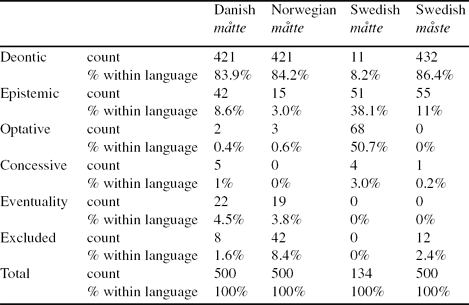
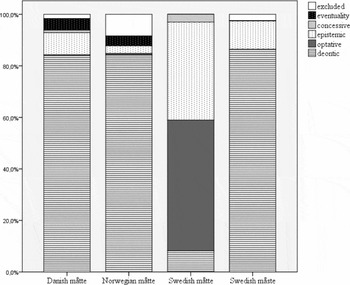
The distribution of the different meanings and uses of Swedish måste and Danish, Norwegian and Swedish måtte is shown in Figure 2. See appendix Table A2 for an overview of the counts per semantic category in each language. Recall that the percentages for the semantic distribution of måste presented in the previous section are also relevant to the discussion in this section.
Bart chart of the semantic distribution of måtte (past tense) and måste in the Danish, Norwegian and Swedish random samples.

The semantic distribution of måtte is significantly different in Danish, Norwegian and Swedish (p < .01, χ2 = 715.4, df = 8 and Cramer's V = .564), which signifies different degrees of grammaticalization.Footnote 7 The high value of Cramer's V indicates a strong association between meaning and language. It points to a language-specific development for Swedish måtte, the distribution of which is clearly different from Danish and Norwegian måtte. Optative and concessive, and also epistemic, meanings are not as frequent in Danish and Norwegian måtte as in Swedish måtte.
The distributions of Danish and Norwegian måtte and their Swedish equivalent måste is also significantly different (p < .01, χ2 = 81.82, df = 8 and Cramer's V = .166). The low value of Cramer's V indicates a weak association for language and meaning pointing to a more general development for all languages, i.e., the development of epistemic meaning out of deontic meaning is a well-known tendency in semantic change, see Section 3.1 above and Section 4 below. A striking difference is that eventuality is expressed by Danish and Norwegian måtte, but not by Swedish måtte and måste.
3.2.1 Deontic meanings
Deontic meanings are part of the semantic distribution of all Mainland Scandinavian languages and constitute 84.2% of the Danish sample, 84.2% of the Norwegian sample and 8.2% and 86.4% of the Swedish samples of måtte and måste, respectively. The high percentages were to be expected as deontic meanings are prototypical meanings for these modals. The percentages are comparable to the results of må. This shows that Danish and Norwegian må and måtte predominantly express present and past tense of deontic meanings, unlike Swedish må and måtte, which have developed into two different modals (see Figures 1 and 2). Corpus examples of deontic meanings of måtte are given in (9).
(9)
3.2.2 Epistemic meanings
Epistemic meanings are present in all samples. They occur mainly in constructions like ‘mustPAST be X’ or ‘mustPAST have (been) X’ and are often accompanied by modal particles. Epistemic meanings constitute 8.4% of the Danish sample, 3% of the Norwegian sample, and 38.1% and 11% of the Swedish samples involving måtte and måste, respectively. Corpus examples of epistemic meanings of måtte are given in (10).
(10)
3.2.3 Optative meanings
Optative meanings are part of all samples but occur very infrequently in Danish and Norwegian, only 0.4% and 0.6% of the samples, respectively. For Swedish måtte, optative is by far the most common meaning, it constitutes 49.3% of the sample. In optative contexts, måtte is predominantly the first constituent of the clause. Corpus examples of optative meanings of måtte are given in (11).
(11)
3.2.4 Concessive meanings
Concessive meanings occur very infrequently in the Danish and Swedish samples, only 1% and 3%, respectively. Note that the concessive meanings in the sample occur in specific constructions, see also (8c) above. For Norwegian no examples are attested in the sample, but the constructions in (8c) and (12) below are possible in Norwegian as well.
A remarkable difference between Danish and Norwegian on the one hand and Swedish on the other hand is that Norwegian and Danish use past tense forms in concessive constructions, whereas Swedish uses the original present tense form må in concessive contexts, see also Section 3.1.4 above. Corpus examples of concessive meanings of måtte are given in (12).
(12)
3.2.5 Eventuality meanings
Eventuality meanings are about latent or hypothetical possibilities, i.e., things that could possibly happen. Not all linguists would agree on a separate category of eventuality as this meaning could be argued to be subsumed under epistemic meanings because there is an evaluation of possibilities. However, I think this potential or hypothetical use is different from inferred conclusions as expressed by epistemic necessity. The eventuality meaning is also mentioned as a separate use of at/å måtte in the literature, grammars and dictionaries (e.g. Falk & Torp Reference Falk and Torp1903–1906; Faarlund et al. Reference Faarlund, Lie and Vannebo1997; Eide Reference Eide2005:44ff.). In Old Norse, potentiality used to be a third meaning besides permission (retained in Danish) and necessity (Falk & Torp Reference Falk and Torp1903–1906), the latter of which is nowadays the most frequent meaning of Danish at måtte and Norwegian å måtte.
The eventuality meaning is only attested in the Danish and Norwegian samples, 4.4% and 3.8% respectively. In these contexts måtte is often accompanied by adverbs meaning ‘could possibly’, e.g. Danish eventuel and Norwegian eventuell. Corpus examples of eventuality meanings of måtte are given in (13).
(13)
4. ETYMOLOGY AND DEVELOPMENT OF MÅ, MÅTTE AND MÅSTE
Formally, the Germanic core modals (i.e., the cognates of can, shall, may and must), are a special class of linguistic items because they are so-called preterite-present verbs. This means that they derive from strong verbs whose past tense was used as a present tense. Subsequently, new infinitival and past tense forms were created. In the case of ‘must’ we get the infinitive *mōtan- and past tense *mōt-ta-, which became *mōssa- because of regular sound change. The form *mōssa- could not be recognized as a past tense form, so -t was attached in order to mark past tense. This resulted in *mōsta- as the past tense form (Philippa et al. Reference Philippa, Debrabandere, Quack, Schoonheim and van der Sijs2003. Examples are Dutch moest, German musste and English must.
The precise etymology of Germanic ‘must’ is unknown. It derives from a root *mōt- but its semantic development is unclear. There are two main proposals. According to one line of thought ‘must’ has developed from a meaning ‘can, have the opportunity’. Another proposal is that ‘must’ origins in a meaning ‘to measure’. Swedish borrowed ‘must’ (i.e., måste) from Middle Low German moste which is the imperfect tense of moten ‘to have permission/to be obliged’ (Wessén Reference Wessén1965:243).
Swedish må and måtte, Danish at måtte and Norwegian å måtte ultimately derive from another preterite-present verb, ‘may’, which goes back to the root *mag-. The original meaning of ‘may’ is ‘be able to, can’. The predecessors of the modern modals må and (at/å) måtte are lexical verbs meaning ‘to be strong, to have the power/strength’ (< Old Danish mughu/mugha, Old Norse mega and Old Swedish magha; see Birkmann Reference Birkmann1987).
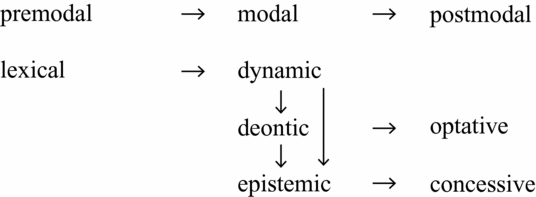
The development of modal and postmodal meanings is a well-known instance of semantic change that follows predictable grammaticalization paths. That is, there are cross-linguistic synchronic and diachronic correlations between premodal, modal and postmodal meanings, as illustrated in Figure 3, which is based on work by Bybee, Pagliuca & Perkins (Reference Bybee, Pagliuca and Perkins1994), Van der Auwera & Plungian (Reference Van der Auwera and Plungian1998), Heine & Kuteva (Reference Heine and Kuteva2002) and Traugott & Dasher Reference Traugott and Dasher2002.
Cross-linguistic grammaticalization paths for modal and postmodal meanings.

The mechanisms by which semantic change takes place are generally considered to be metaphor and metonymy (e.g. Hopper & Traugott Reference Hopper and Traugott2003). Metaphor captures the general picture of a semantic change from the beginning to the end. At the micro-level semantic change is best described in terms of metonymy, i.e., the small gradual steps that lead to a single change. The idea is that change of meaning occurs in specific contexts that trigger certain inferences (see The Invited Inferencing Theory of Semantic Change as proposed by Traugott & Dasher Reference Traugott and Dasher2002:34–40). When these inferred, pragmatic meanings spread through the speech community they become conventionalized and eventually reanalyzed as semantic meanings. As will become clear in the remainder of this section, there are contiguous relations between premodal, modal and postmodal meanings as premodal meanings give rise to modal meanings which in turn may develop postmodal meanings. In this section I will only mention plausible paths for meaning change in the modal domain without detailed reference to the small, gradual steps that eventually lead to change of meaning.
Swedish still has a lexical verb att må (bra/illa) ‘feel (well/bad)’ which has the same origin as the modals må and måtte.Footnote 8 The meaning ‘feel (well/bad)’ is closely related to the original meaning ‘be strong/have the power’ as it arose in contexts in which one is inquiring after the power/strength or well-being of someone, as in modern Swedish Hur mår du? ‘How are you doing?’ (see Andersson Reference Andersson2007:67). The original meaning ‘be strong, have the power/strength’ did not survive in Danish, Norwegian and Swedish, but is retained in forms like Swedish förmå, and Norwegian and Danish formå, all meaning ‘to have the ability/capacity’.
From this original meaning it is only a small step to dynamic meanings which are concerned with ability and capacity. Once these meanings were established, they developed further into ‘have the opportunity’, which in turn developed further into the deontic meaning ‘have permission to’.Footnote 9 The necessity meaning arose later, as is the case for German müssen ‘must’, which originally meant ‘have the opportunity’ (Falk & Torp Reference Falk and Torp1903–1906).
Traugott & Dasher (Reference Traugott and Dasher2002:124) propose a plausible grammaticalization path for necessity meanings out of permission meanings. Contexts of denied or negative permission, i.e., ‘you may not’, may give rise to obligation meanings, i.e., ‘you must’. Since ‘you may not’ implies ‘be obliged to not’, the weak permission meaning is strengthened to deontic obligation. Eventually, the stronger implication of ‘you may not’, i.e., ‘you must’, became the conventionalized meaning. For Swedish må the expression of necessity was fairly restricted in Old Swedish (Andersson Reference Andersson2007:199). This might have been a reason that Middle Low German moste ‘to have permission/to be obliged’ was borrowed to express deontic, and at a later stage, also epistemic necessity.
Deontic meanings may also give rise to optative and epistemic meanings. A probable grammaticalization path for optative meanings is a development from deontic possibility (permission) to optative. The idea is that ‘a wish is like an appeal to circumstances (destiny) to allow the realization of a state of affairs’ (Van der Auwera & Plungian Reference Van der Auwera and Plungian1998:107).
It is generally assumed that epistemic necessity derives from deontic necessity (obligation). A clause like He must be in the office is ambiguous, when taken out of context, between deontic (i.e., he is obliged to be in the office) and epistemic readings (i.e., it must be the case that he is in the office). The transfer, or invited inference, of the obligation meaning is that when something is obligatory it has a high probability to occur because it is mandatory.
Epistemic meanings may in turn give rise to concessive meanings. The status of concessive meanings is unclear. Van der Auwera. Kehayov & Vittrant (Reference Van der Auwera, Kehayov, Vittrant, Hogeweg, de Hoop and Malchukov2009) note that concessive meanings may be a subtype of ‘general’ epistemic possibility or a further development. In this paper, concessive meaning is classified as a postmodal meaning because it is clearly different and more complex than ‘general’ epistemic possibility.
Concessive meanings come in various types and are likely to be derived from epistemic meanings. Epistemic necessity may lead to concessive constructions like She may jog, but she sure looks unhealthy to me (example from Traugott & Dasher Reference Traugott and Dasher2002:115). In these clause types of the general form ‘although p, q’, the inferred conclusion (‘although she may jog, as you say. . .’, paraphrase by Traugott & Dasher ibid.) contrasts with the speaker's own opinion, see also (8a, b) above. Epistemic possibility may give rise to concessive constructions in which various latent possibilities are contrasted, for example, ‘whatever X may be, Y’, ‘whether or not X, Y’ or ‘be it X or Y, Z’, see also (9c–e) above. These latter types are closely related to eventuality meanings, the status of which is unclear as well. There are two types of eventuality meanings. The first type denotes latent possibilities as illustrated in Section 3.2.5 above. The second type resembles the postmodal meaning ‘conditional’, as mentioned in Van der Auwera & Plungian (Reference Van der Auwera and Plungian1998:93), who illustrate this type with Dutch mocht ‘in case that, if’, as in example (14a). This second type is accompanied by the conditional marker om ‘in case that, if’ in Danish and Norwegian as in (14b).
(14)
For these kinds of hypothetical meanings one can think of several developmental paths. The expression of latent possibilities by måtte may be a subtype or specialization of general possibility, a meaning which now has been taken over by the modal ‘can’ or a remnant of a former optativus-potentialis form (Björkstam Reference Björkstam1919:154, 166).Footnote 10 Björkstam describes two types of optative, wish and assumption. The eventuality meaning of måtte is, according to Björkstam (ibid.), a development from an optative form expressing assumption to an auxiliary denoting potentiality. As noted in Section 3.3 above, Falk & Torp (Reference Falk and Torp1903–1906) mention potentiality as third distinct meaning of måtte besides permission and necessity.
5. DEGREES OF GRAMMATICALIZATION
The development of modals is a prototypical instance of grammaticalization because modals are forms on their way from lexical to grammatical status, both formally and semantically. Grammaticalization can be defined as ‘the change whereby lexical items and constructions come in certain linguistic contexts to serve grammatical functions, and once grammaticalized, continue to develop new grammatical functions’ (Hopper & Traugott Reference Hopper and Traugott2003:18).Footnote 11 The change in function or meaning is accompanied by formal changes, the most important of which is decategorialization (Hopper Reference Hopper, Closs Traugott and Heine1991:22). That is, the shift from lexical (e.g. verb) to grammatical status (e.g. auxiliary) of a linguistic item.
The small steps by which semantic and formal transitions tend to occur is called a ‘cline’ or ‘pathway’ of change. Grammaticalizing items can be located at different clustering points along a cline, representing variant degrees of grammaticalization. In the case of må, måtte and måste, these clustering points are premodal, modal and postmodal meaning as regards the semantic dimension, and full verb and auxiliary with respect to the formal dimension. There are intermediate positions between two clustering points for items that have properties of two clustering points. For example, modals have properties of both full verbs and auxiliaries to various extents, and individual modals can be located in the middle of the cline or more towards the lexical or grammatical end of the cline.
Throughout this paper I have regarded postmodal meanings as more grammaticalized than modal or premodal meanings. But in what way are postmodal meanings more grammaticalized than modal meanings? The formal side of determining degrees of grammaticalization for modals has been exhaustively discussed in the literature, but there are generally no strong claims on semantic change in relation to degrees of grammaticalization (e.g. Van der Auwera & Plungian Reference Van der Auwera and Plungian1998; Nuyts Reference Nuyts2001). Nevertheless, Van der Auwera & Plungian (Reference Van der Auwera and Plungian1998:115) propose a cross-linguistic cline, see (15), based on observations about correlations between semantic change and formal grammaticalization as described in Plank (Reference Plank and Rosengren1981). The symbol ≤ stands for ‘exhibits an equal or lower degree of formal grammaticalization’. The term ‘participant-internal’ is roughly equivalent to dynamic modality and ‘participant-external’ corresponds roughly to deontic modality.
(15) participant-internal ≤ participant-external ≤ epistemic modality
Van der Auwera & Plungian (Reference Van der Auwera and Plungian1998:116) note that, in principle, ‘the degree of formal grammaticalization of postmodals could be either higher, equal or lower’. A higher degree of formal grammaticalization is what one would expect and this is indeed frequently attested. An example is optative may, whose canonical position is clause-initial. In Sections 5.1 and 5.2 I will show that the postmodal meanings of må and måtte are more grammaticalized because of more complex semantics, especially more (inter)subjective meanings, accompanied by more restricted formal properties.
5.1 Semantic properties
The distribution of the different meanings and uses of a given form provides information about the degree of grammaticalization of that linguistic item. The more a linguistic item grammaticalizes, the more general, abstract and (inter)subjective its meaning(s) become.
The coexistence of different meanings for a given form, i.e., synchronic variation, is called layering (see Hopper Reference Hopper, Closs Traugott and Heine1991). A word or construction gets another meaning or function besides the meaning(s) or function(s) it already has. The new and older meanings may coexist for hundreds of years, eventually some meanings may disappear, as shown in (16).
(16)
The cline in (16) is a well-attested tendency (Bybee et al. Reference Bybee, Pagliuca and Perkins1994; Van der Auwera & Plungian Reference Van der Auwera and Plungian1998; Traugott & Dasher Reference Traugott and Dasher2002), not an absolute claim on the directionality of semantic change, as grammaticalization is by no means deterministic. Changes do not have to occur and if a change takes place it does not have to go through all transition stages along the cline (Hopper & Traugott Reference Hopper and Traugott2003:130–131). The fact that Swedish må and måtte developed into a highly grammaticalized markers with primarily concessive and optative meanings is not to say that Danish and Norwegian måtte have to go through the same development.
Recall that premodal meanings are non-grammaticalized, modal meanings are grammaticalized and postmodal meanings are most grammaticalized. If a modal has predominantly postmodal meanings, i.e., optative or concessive meanings, it is more grammaticalized than if it has predominantly modal meanings, i.e., deontic or epistemic meanings. For modal meanings the degree of grammaticalization also increases as the various possibility and necessity meanings develop. Deontic meanings are more grammaticalized than dynamic meanings and epistemic meanings are the most grammaticalized modal meanings, see Figure 3 and the clines in (15) and (16) above. The meanings become more general, abstract and (inter)subjective from dynamic, deontic to epistemic modality. As observed by Traugott (e.g. Reference Traugott, Davidse, Vandelanotte and Cuyckens2010), meanings tend to shift towards greater (inter)subjectivity over time. That is, ‘meanings come to express grounding in the speaker/writer's perspective explicitly’ in the case of subjectification and ‘meanings come to express grounding in the relationship between speaker/writer and addressee/reader explicitly’ in the case of intersubjectification (Traugott & Dasher Reference Traugott and Dasher2002:6). Subjectification and intersubjectification are common types of semantic change that may accompany processes of grammaticalization.
Dynamic and deontic modality, also termed ‘root modality’, are traditionally distinguished from epistemic modality because they do not express speaker judgments. However, deontic modality comprises permission and obligation meanings, which do have (inter)subjective dimensions because they are directive uses. Epistemic meanings are the speaker's subjective evaluation of the likelihood of a state of affairs. The speaker judges from his/her own perspective that something is probable or must be the case. Optative meanings concern the speaker's personal or collective wish, which are clearly (inter)subjective. A wish may also be directed towards someone else in which case it is intersubjective. Concessive meanings involve evaluations of situations in the modalized matrix clause that are contrary expectation with respect to what is said in the concessive clause. Concessive meanings are (inter)subjective because they are grounded in the speaker/writer's perspective and there may also be interaction between speaker/writer and addressee/reader. In this respect, modal and postmodal meanings are not only a further development or extension of premodal or modal meanings but they also involve a more complex (inter)subjective component.
Traugott & Dasher (Reference Traugott and Dasher2002:115) hypothesize that ‘since the metatextual meanings [i.e., postmodal meanings KB] are the most (inter)subjective, they are probably the latest to develop semasiologically’. Especially the development of Swedish må and måtte (see Andersson Reference Andersson2007:191–194) is a good illustration of the observed tendencies for meaning change and (inter)subjectification in the modal domain. In Old Swedish the dominating meanings of må, måtte are dynamic meanings and deontic possibility. Optative meanings occur rarely in Old Swedish. In Early Modern Swedish, many root modal meanings of må, måtte were lost, i.e., ability/capacity and permission meanings. The modal kunna ‘can, may’ takes over several meanings associated with må, which started to lose some of its earlier meanings. The uses of må become more idiomatic and there is a decrease in frequency for må and måtte. Concessive meanings are now common in fixed constructions. The use of må, måtte seems to be bound to the perspective of the speaker and occurs mainly in dialogue. Optative meanings are used more and more to express feelings/emotions, e.g. in exclamations.
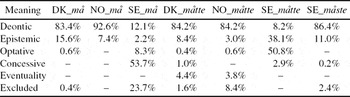
Table 1 summarizes the relative frequencies for the different meanings and uses of må, måtte and måste in the corpus data shown in Figures 1 and 2 above.
Relative frequencies for the semantic categories of må, måtte and måste in the Danish (DK), Norwegian (NO) and Swedish (SE) random samples.

Danish and Norwegian måtte (present and past tense) and Swedish måste have predominantly modal meanings, i.e., deontic and epistemic meanings. Swedish må has primarily concessive meanings and Swedish måtte expresses mainly epistemic and optative meanings. Semantically, Swedish må and måtte are more grammaticalized than Danish and Norwegian måtte because epistemic, concessive and optative meanings are more grammaticalized meanings than deontic meanings and they constitute the largest part of the semantic distributions of må and måtte.
5.2 Formal properties
Factors like the inflectional paradigm, syntactic properties and occurrence in specific constructions and contexts give insight into the degree of grammaticalization of a given form. Restrictions on these factors are signs of (advanced) grammaticalization. The inflectional paradigms for må, måtte and måste are given in Table 2.
Inflectional paradigms for må, måtte and måste in Danish, Norwegian and Swedish.

The shift from main verb to auxiliary is a case of decategorialization (Hopper Reference Hopper, Closs Traugott and Heine1991:22). This means that a linguistic item shifts from a major category (e.g. verb) to a minor category (e.g. auxiliary) and gradually loses the morphosyntactic properties of the major category, such as inflection. The Swedish modals have defective inflectional paradigms. They lack infinitival forms and they do not distinguish between the present and the past tense. Swedish måste has a perfect form, but Swedish må and måtte lack perfect forms. Danish at måtte and Norwegian å måtte do have infinitival and perfect forms and inflect for tense. All modals have deficient verbal paradigms in the sense that they lack present participles, imperative and passive forms. They all take bare infinitives as their complement and are syntactically dependent on the main verb of the clause.
The degree to which the modals have lost main verb properties indicates their auxiliariness. Danish and Norwegian at/å måtte are modal auxiliaries, but they have retained properties of main verbs to various degrees. For Norwegian, there are as many as 14,010 occurrences of the infinitival form å måtte in Norsk Aviskorpus, and for Danish the infinitival form at måtte occurs 396 times in KorpusDK. For Swedish måste the perfect form har måst occurs 312 times in Språkbankens konkordanser, but perfect forms are more frequent in Danish, 1732 occurrences of har måttet in KorpusDK, and much more frequent in Norwegian, 11,252 hits for har måttet in Norsk Aviskorpus.
When grammaticalizing, the form of the modals does not change but their syntactic properties get more restricted the more (post)modal the meanings get. Syntactic fixation (see Lehmann Reference Lehmann1995) is a useful criterion in determining the degree of grammaticalization. Since grammaticalization generally involves syntactic fixation, a decrease in syntactic freedom would imply (advanced) grammaticalization.
In deontic contexts the modals are free to combine with other verbs, in epistemic contexts the construction gets more restricted in that the prototypical form of epistemic expressions is ‘must be X/must have been X’. For optative contexts the syntactic positions are generally restricted to the first position in the clause or subordinate constructions introduced by a complementizer. As far as concessive contexts are concerned, there are a number of specific constructions in which må and måtte may convey concessive meaning. For Danish and Norwegian, the past tense is preferred to express concessive meanings (see Sections 2.1.5 and 2.2.4 above) and also used to express hypothetical dimensions like eventuality.
Defective inflectional paradigms, fixed syntactic positions and occurrence in specific constructions are all signs of (advanced) grammaticalization. These criteria all apply to Swedish må and måtte, which have become highly grammaticalized elements. Formally, Swedish må, måtte and måste are more grammaticalized than Danish and Norwegian måtte.
6. CONCLUDING REMARKS
In this paper significant differences, both formally and semantically, have been found with respect to the development of modal and postmodal meanings in the Mainland Scandinavian modals må, måtte and måste.
Danish at måtte has primarily deontic meanings in both the present and past tense. Epistemic meanings seem to be more established in Danish compared to Norwegian å måtte and Swedish måste. Postmodal meanings like concessive, optative and eventuality may be expressed by at måtte but are far less frequent than deontic and epistemic meanings. The inflectional paradigm of Danish at måtte is deficient in the sense that it lacks present participles and passive and imperative forms. Infinitival and perfect forms occur far less frequent in the sample than the corresponding forms of Norwegian å måtte. Postmodal meanings occur for the most part in specific constructions.
Norwegian å måtte has predominantly deontic meanings in both the present and past tense. Postmodal meanings like eventuality, optative and concessive (not attested in the sample) are possible, but occur infrequently compared to deontic and epistemic meaning. The inflectional paradigm of Norwegian å måtte lacks passive and imperative forms as well as present participles. Infinitival and perfect forms are very frequent and postmodal meanings occur mainly in specific constructions
Swedish må expresses mostly concessive meanings and Swedish måtte has predominantly epistemic and optative meanings. Both må and måtte have defective paradigms because they lack tense marking, present participles as well as infinitival, perfect, imperative and passive forms. The deontic meanings of Swedish må concern primarily older, archaic uses, i.e., permission meanings. Its epistemic meanings are highly context-dependent and hard to distinguish from related deontic and concessive meanings. Deontic and epistemic meanings are nowadays expressed by måste, which has replaced må and måtte. The modals må and måtte continued to exist and have developed into highly grammaticalized linguistic elements denoting (post)modal dimensions and occur for the most part in specific constructions and contexts.
Swedish måste is formally a grammatical item (see English must) because of its defective inflectional paradigm, but semantically it is a deontic modal that may also express epistemic modality. Because måste is a borrowed modal form, which originally is a past tense form that is now indecisive between present and past tense, one might wonder whether it ever had a full verbal paradigm. More historical research on the introduction and spread of måste in the Swedish language is needed in order to get a clearer picture of the evolution of its inflectional properties. The modals må and måtte have lost their inflectional properties in the course of time, but other Swedish core modals (e.g. kunna ‘can’ or böra ‘should’) are like Danish and Norwegian å/at måtte. They have infinitival and perfect forms as well as tense marking, but they also lack present participles and imperative and passive forms.
Swedish må, måtte are semantically and formally more grammaticalized than Danish and Norwegian måtte. They have mainly (post)modal meanings, defective inflectional paradigms and occur primarily in specific constructions and expressions. Swedish måste is formally more grammaticalized than its Danish and Norwegian counterpart at/å måtte because of its defective inflectional paradigm. Semantically Swedish måste and Danish and Norwegian måtte have the same degree of grammaticalization. They all have mainly deontic and epistemic meanings.
These findings conform to Van der Auwara & Plungian's (Reference Van der Auwera and Plungian1998:115) observation that in the domain of modality semantic change seems to precede formal grammaticalization. Swedish måste might seem to contradict this tendency, but it is unclear if måste ever had a full inflectional paradigm. If måste did not have a full inflectional paradigm, it could also not lose the verbal properties that are typical in a process of auxiliation. This then explains why it is formally more grammaticalized than one would expect on the basis of its semantic distribution.
The development of modal and postmodal meanings has thus led to higher degrees of grammaticalization for the Mainland Scandinavian modals må, måtte and måste, which is reflected in more complex semantics, especially more (inter)subjective meanings, accompanied by more restricted formal properties. The development of Danish at måtte, Norwegian å måtte and Swedish må, måtte and måste is in line with observed developmental tendencies for its Germanic cognates. That is, these modals have the ability to express various modal and postmodal dimensions and are moving towards auxiliary status.
There is also quite some language-specific variation. Swedish borrowed ‘must’ from Middle Low German and retained a lexical variant of må. In the Swedish samples there were no instances of eventuality meanings which are frequent for Danish and Norwegian måtte. Danish at måtte and Norwegian å måtte resemble each other very much, which could be due to the fact that Danish has been the official langue in Norway because of the union between the two countries from 1536 to 1814.
The overall picture is that the closely related Mainland Scandinavian languages generally conform to observed cross-linguistic tendencies, but they display different degrees of grammaticalization and manifest other language-specific developments. This goes to show that language change is by no means deterministic. General tendencies can be identified, but changes do not have to occur and if a change does take place it does not have to go through all transition stages along a cline.
ACKNOWLEDGEMENTS
Parts of this paper were presented at the 31st TABU Day, University of Groningen (June 2010); the 24th Scandinavian Conference of Linguistics, University of Eastern Finland (August 2010); Semantics in the Netherlands VIII, Radboud University Nijmegen (November 2010); and the ACLC workshop on Grammaticalization, University of Amsterdam (November 2010). I am grateful to the audiences for discussion, questions and suggestions. I thank Muriel Norde, Camilla Wide and the three anonymous reviewers for Nordic Journal of Linguistics for their questions, suggestions and comments on earlier versions of this paper that have been very useful in writing the final version.
APPENDIX
An overview of the counts per semantic category in each language
Cross table of the frequencies for the different semantic categories of må (present tense) and måste in the Danish, Norwegian and Swedish random samples.

Cross table of the frequencies for the different semantic categories of måtte (past tense) and måste in the Danish, Norwegian and Swedish random samples.