Introduction
The DSM-5 Obsessive-Compulsive Spectrum Sub-Workgroup is recommending the inclusion of a new diagnostic category, called hoarding disorder (HD) (APA, 2010; Mataix-Cols et al. Reference Mataix-Cols, Frost, Pertusa, Clark, Saxena, Leckman, Stein, Matsunaga and Wilhelm2010), to account for the majority of individuals whose severe hoarding behavior and associated features present independently from the other mental disorders to which hoarding has previously been ascribed (e.g. obsessive–compulsive disorder, OCD) (Mataix-Cols et al. Reference Mataix-Cols, Frost, Pertusa, Clark, Saxena, Leckman, Stein, Matsunaga and Wilhelm2010). Furthermore, it is proposed that HD should appear under a broader umbrella of obsessive–compulsive spectrum disorders in DSM-5, primarily for historical reasons but also because certain similarities between HD and OCD are apparent (Phillips et al. Reference Phillips, Stein, Rauch, Hollander, Fallon, Barsky, Fineberg, Mataix-Cols, Ferrao, Saxena, Wilhelm, Kelly, Clark, Pinto, Bienvenu, Farrow and Leckman2010). The Sub-Workgroup is also proposing the removal of the hoarding criterion of obsessive–compulsive personality disorder, a recommendation that is also endorsed by the DSM-5 Personality Disorders Workgroup (Mataix-Cols et al. Reference Mataix-Cols, Frost, Pertusa, Clark, Saxena, Leckman, Stein, Matsunaga and Wilhelm2010).
The proposed DSM-5 criteria for HD (APA, 2010), which are rooted in a pre-existing operational definition of ‘compulsive hoarding’ (Frost & Hartl, Reference Frost and Hartl1996), have quickly gained traction and are already being used internationally by several clinical research groups (Mataix-Cols et al. Reference Mataix-Cols, Fernández de la Cruz, Nakao and Pertusa2011). Initial empirical testing of the proposed criteria, across a wide range of mental health professionals working in different settings and with differing degrees of experience with hoarding cases, has indicated excellent sensitivity, specificity and acceptability of the HD diagnosis and each individual criterion (Mataix-Cols et al. Reference Mataix-Cols, Fernández de la Cruz, Nakao and Pertusa2011). An HD-specific field trial is now needed to confirm these encouraging findings and to supplement the ongoing DSM-5 Field Trials in Academic/Large Clinic Settings, which, despite including HD, do not specifically recruit individuals with severe hoarding symptoms or allow a detailed evaluation of its diagnostic criteria and specifiers. It is also essential to establish whether the criteria are sufficiently conservative to avoid false positives or the overpathologization of normative behavior (Mataix-Cols & Pertusa, Reference Mataix-Cols and Pertusa2012).
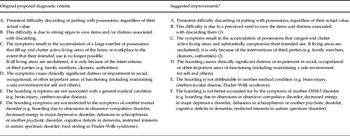
The current field trial, commissioned by the DSM-5 Obsessive-Compulsive Spectrum Sub-Workgroup, field-tested the proposed HD criteria (Table 1, left column), in an unselected sample of individuals reporting hoarding difficulties. It examined the sensitivity and specificity of the diagnosis and each constituent criterion, along with their inter-rater reliability. From the patients' perspective, it also examined the perceived acceptability, usefulness and stigma associated with the new diagnosis. An unselected sample of individuals self-defined as ‘collectors’ was also recruited. Collectors are an optimal population with which to explore the diagnostic boundaries of HD because collecting behavior mirrors several of the core features of hoarding (e.g. the acquisition of and emotional attachment to a potentially large number of objects) and is generally considered a benign form of object amassment (Nordsletten & Mataix-Cols, Reference Nordsletten and Mataix-Cols2012).
Proposed diagnostic criteria for hoarding disorder (HD) used in the London field trial and suggested improvements

Justification of the proposed changes:
(1) Criterion B is intended to capture the idea that the saving of possessions is intentional and purposeful. This helps to discriminate hoarding disorder from other forms of psychopathology that are characterized by the passive accumulation of items or the absence of distress when possessions are removed. Many of our participants did not report urges to save items but rather distress when asked to discard them. Our raters felt that the word ‘urges’ was not clearly understood by the participants. The usability of the criterion could be improved by changing the wording from ‘urges to save’ to ‘perceived need to save’ the items.
(2) Criterion C is worded too conservatively as it can only be endorsed if the affected living spaces are impossible to use. The current field trial has identified several individuals who managed to use some of their ‘key’ living spaces but were still significantly distressed and impaired and met all other diagnostic criteria. Therefore, we suggest rewording Criterion C slightly to reflect that some living areas may still be useable, albeit with difficulty. Additional suggested changes to Criterion C include removing ‘of the home or workplace’ because this can be easily added to the accompanying text, along with other examples.
a Other minor changes to the wording of the criteria are the result of internal discussions with members of the Obsessive-Compulsive Spectrum Sub-Workgroup and the DSM-5 Taskforce that took place while the present manuscript was under review.
Method
Participants
Two different samples were recruited between October 2010 and December 2011. We first recruited an unselected, consecutive sample of individuals who self-identified as hoarders (n = 50). They were identified in the community through a London-based hoarding support group and advertisements placed in patient organization websites. Some individuals were participants of previous studies conducted by our research group. Crucially, no exclusion criteria were specified, as we were interested in recruiting a broad range of individuals with hoarding difficulties, regardless of etiology, diagnosis and severity.
We also recruited an unselected, consecutive sample of individuals who self-identified as collectors (n = 20). They were mainly recruited through a circular email sent to King's College London staff and flyers left at collectors' shops across London. The only inclusion criterion was that participants have at least one collection of objects of a similar type or theme. Specific collections included comics, stamps, glass elephants, coins, books, vintage wireless radios, CDs, toy soldiers and model submarines, among others. No other inclusion or exclusion criteria were specified, as it could not be assumed that these individuals would not meet criteria for HD or other mental disorders.
The basic sociodemographic characteristics of the participants in the two groups are shown in Supplementary Table S1.
Procedures and materials
The King's College London Research Ethics Committee approved the study. Written informed consent was obtained and participants were compensated with £15 for their time.
All individuals participated in clinical interviews taking approximately 2–3 hours. In addition, participants completed self-report questionnaires. Whenever possible, participants were interviewed face-to-face [hoarding sample: n = 47 (94%); collectors sample: n = 20 (100%)] and in their own homes [hoarding sample: n = 25 (50%); collectors sample: n = 8 (40%)]. When home visits were not possible because of the extent of the clutter or other reasons, participants were interviewed at the Institute of Psychiatry [21 hoarders (42%) and 11 collectors (55%)]. One participant in the hoarding group and one collector were interviewed in their workplace for practical reasons. Three individuals in the hoarding group only agreed to be interviewed by telephone. All individuals not seen in their own homes were asked to bring representative photographs of their living spaces, although not all agreed. Nine (36%) of the 25 hoarders and four (33.3%) of the 12 collectors who were not interviewed at home provided photographs. There were no statistically significant differences on any demographic or clinical variables between those who were interviewed at home and those who were not (data available upon request).
The Mini International Neuropsychiatric Interview (MINI; Lecrubier et al. Reference Lecrubier, Sheehan, Weiller, Amorim, Bonora, Harnett Sheehan, Janavs and Dunbar1997; Sheehan et al. Reference Sheehan, Lecrubier, Sheehan, Amorim, Janavs, Weiller, Hergueta, Baker and Dunbar1998) was administered to identify the major DSM-IV Axis I diagnoses. The Structured Interview for Hoarding Disorder (SIHD; Pertusa & Mataix-Cols, unpublished; available upon request) was used to diagnose HD. The SIHD asks detailed questions about each of the proposed diagnostic criteria and specifiers. Through a series of skip rules, it also helps clinicians to exclude any other possible causes of hoarding (Criteria E and F). The Clutter Image Rating (CIR; Frost et al. Reference Frost, Steketee, Tolin and Renaud2008) was used to objectively assess the degree of clutter in the cases where a home visit was possible. When a home visit was not possible, photographs were used to confirm the endorsement of the clutter criterion. When home visits were not possible and photographs were not available, the presence of significant clutter was determined based on patient report. The Brown Assessment of Beliefs Scale (BABS; Eisen et al. Reference Eisen, Phillips, Baer, Beer, Atala and Rasmussen1998) was used as a measure of overvalued ideation. Finally, hoarding participants (n = 50) were asked questions regarding the acceptability, usefulness and stigma associated with the new diagnosis on a four-point Likert scale (see online Supplementary Material).
Self-administered scales of hoarding and acquiring severity included the Hoarding Rating Scale – Self-Report (HRS-SR; Tolin et al. Reference Tolin, Frost and Steketee2010b), the Saving Inventory – Revised (SI-R; Frost et al. Reference Frost, Steketee and Grisham2004), the Compulsive Acquisition Scale (CAS; Frost et al. Reference Frost, Steketee and Williams2002), the Saving Cognitions Inventory (SCI; Steketee et al. Reference Steketee, Frost and Kyrios2003) and the self-report version of the CIR (Frost et al. Reference Frost, Steketee, Tolin and Renaud2008). In the current study, the clinician and self-report versions of the CIR showed a high level of agreement [n = 23; intraclass correlation coefficient (ICC) 0.87, 95% confidence interval (CI) 0.73–0.94], suggesting accurate self-reporting of clutter. The Work and Social Adjustment Scale (WASAS; Marks, Reference Marks1986; Mundt et al. Reference Mundt, Marks, Shear and Greist2002) was included as a measure of functional impairment. Finally, a new dimensional rating scale for HD developed by the DSM-5 Sub-Workgroup to be used alongside the diagnostic criteria was also included and piloted. This scale is based heavily on the HRS-SR (Tolin et al. Reference Tolin, Frost and Steketee2010b) and consists of five hoarding-specific questions measured on a five-point Likert scale (see online Supplementary Material). The scale includes four items adapted from the HRS Interview (HRS-I) pertaining to difficulty discarding, clutter, distress and impairment, and further adds an avoidance question (‘How much do these symptoms cause you to avoid doing anything, going anyplace, or being with anyone?’).
All interviews were conducted by a trained clinical psychologist (Rater 1) and scored independently by a second rater (Rater 2), who was either a qualified clinical psychologist or a non-clinical PhD student specializing in HD. Both raters were present in most (94%) of the home visits and face-to-face interviews. All interviews were audiotaped and rated later, if required. The telephone interviews were also audiotaped and rated at a later stage.
The ‘true’ diagnoses were established using a best-estimate diagnosis procedure (Leckman et al. Reference Leckman, Sholomskas, Thompson, Belanger and Weissman1982). The research team, which included the two raters and two other HD researchers, reviewed all available evidence from the interviews, questionnaire scores and other available information, and reached a consensus regarding the most suitable diagnosis (or diagnoses) including the endorsement of each individual diagnostic criterion. The raters who had conducted the interviews did not reveal their original diagnostic decisions and only provided additional information and clinical impressions when asked during the consensus meetings. The best-estimate diagnoses were used as the criterion standard against which each of the raters' independent diagnoses were compared.
Results
Best-estimate diagnoses
According to the best-estimate procedure, 29 (58%) of the 50 individuals in the hoarding sample met full criteria for HD. Five (10%) participants did not meet criteria for HD because the symptoms were better attributed to OCD (Criterion F). All these individuals met diagnostic criteria for OCD on the MINI and had other prototypical OCD symptoms that were diagnosable in their own right. In these cases, the accumulation of objects was ego-dystonic and explained primarily by ‘need to know’ obsessions, fears of making mistakes and/or the avoidance of time-consuming compulsions such as counting or checking meticulously before each item is discarded. Sixteen (32%) individuals did not meet criteria for HD because they did not have sufficient clutter to totally impede the use of key living spaces (Criterion C). In addition, of these 16 individuals, six either did not have urges to save the items and/or distress associated with discarding (Criterion B) or reported insufficient levels of distress/interference due to their symptoms (Criterion D), or both. Thus, there were 10 individuals who did not strictly endorse the clutter criterion and yet met all other criteria.
Twenty (69%) of the 29 participants meeting criteria for HD had at least one co-morbid disorder (Supplementary Table S2). The most common co-morbidities were generalized anxiety disorder (n = 9; 31%) and recurrent major depressive disorder (n = 9; 31%). Seven (24%) individuals met criteria for co-morbid OCD, that is the hoarding symptoms were judged to be primary and unrelated to the OCD presentation and therefore both diagnoses were endorsed. One participant met criteria for psychotic disorder and another for mood disorder with psychotic features, but in neither case was the hoarding deemed related or secondary to the psychotic symptoms.
None of the 20 collectors met criteria for HD. Most met Criterion A (difficulties discarding; n = 18; 90%) and Criterion B (urges to keep objects/distress associated with discarding; n = 17; 85%), but none met Criterion C (clutter) and only two (10%) met Criterion D (distress/impairment). In one of these cases, the collection caused distress to the partner rather than the collector; in another, the collection impaired access to some, but not all, of the spaces in the property. All met Criteria E and F, that is their collecting behavior was not judged to be the consequence of a general medical condition or a mental disorder. Eight collectors (40%) met criteria for other mental disorders, primarily recurrent major depressive disorder and generalized anxiety disorder (see online Supplementary Table S2).
Sensitivity and specificity
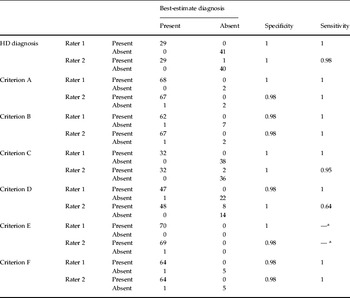
Sensitivity (proportion of true positives) and specificity (proportion of true negatives) of the HD diagnosis and each individual criterion were established by tabulating the ‘true’ (best-estimate) diagnosis against the diagnoses independently arrived at by Rater 1 and Rater 2. The results are shown in Table 2. Both raters showed near-perfect sensitivity and specificity (ranging from 0.98 to 1) for the HD diagnosis and high sensitivity/specificity (ranging from 0.64 to 1) for each of the individual criteria. Rater 2 (not clinically qualified) had the lowest specificity (0.64) for Criterion D, rating some subclinical individuals as clinically distressed/impaired.
Sensitivity and specificity of the hoarding disorder (HD) diagnosis and each individual criterion (n = 70)

a Statistics cannot be calculated due to division by zero.
Additional analyses (Supplementary Tables S3 and S4) showed that raters were equally able to accurately discriminate HD from (a) individuals with subclinical HD symptoms or other mental disorders and (b) normative collectors.
Inter-rater reliability
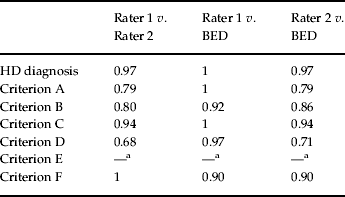
κ coefficients were used to calculate inter-rater reliability for the diagnosis of HD and each individual criterion between Raters 1 and 2 and also each of the raters with the best-estimate diagnosis. As shown in Table 3, the level of agreement between raters, and of each rater with the best-estimate diagnosis, was outstanding for the diagnosis of HD and substantial or outstanding for each of the constituent criteria (Landis & Koch, Reference Landis and Koch1977).
Inter-rater reliability (κ coefficients) of the hoarding disorder (HD) diagnosis and each individual criterion across both participant groups (n = 70)
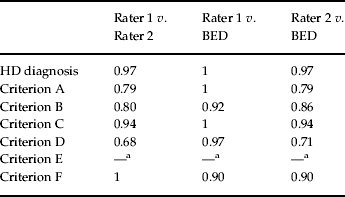
BED, Best estimate diagnosis.
a Statistics cannot be calculated as values are constant.
Raters had perfect agreement regarding Criterion E.
All p values <0.001.
Specifiers
The two raters assessed the excessive acquisition and insight specifiers independently. According to Rater 1, all 29 individuals meeting HD criteria endorsed the excessive acquisition specifier. According to Rater 2, 28 (96.6%) of the participants with HD endorsed this specifier. The main source of excessive item acquisition was the obtainment of free items (both raters, n = 27, 93.1%), followed by excessive buying (Rater 1: n = 22, 75.9%; Rater 2: n = 18, 62.1%; κ = 0.68, p = 0.000). A minority of individuals reported having stolen items (both raters, n = 2, 6.9%).
Regarding the insight specifier, Rater 1 classified 25 (86.2%) participants as having ‘good or fair’ insight, three (10.3%) as having ‘poor’ insight, and one (3.4%) as having ‘absent’ (delusional) insight. Rater 2 classified 26 (89.7%) individuals as having ‘good or fair’ insight, two (6.9%) as having ‘poor’ insight, and one (3.4%) as having ‘absent’ insight. The ordinal ratings of Raters 1 and 2 showed good inter-rater agreement (ICC 0.66, 95% CI 0.38–0.83). The degree of insight, measured on an ordinal scale (good/fair, poor, absent/delusional), was poorly correlated with the BABS, a measure of overvalued ideation (Rater 1: Spearman's ρ = −0.34, p = 0.08; Rater 2: Spearman's ρ = −0.24, p = 0.21).
Acceptability of the proposed disorder
All but one participant meeting criteria for HD regarded the diagnosis as very or somewhat acceptable and useful for the development of more specific treatments. Views about perceived stigma were more mixed but the majority of individuals with HD (n = 17; 58.6%) reported that the diagnosis would not be too stigmatizing (Fig. 1). Qualitative analysis of the open-ended questions revealed themes such as concern with the potential misunderstanding of the diagnostic label (e.g. ‘you may be thought you are dirty’), social acceptability of the label (e.g. ‘not socially acceptable’, ‘mental health issues generally not understood’) and confidentiality (e.g. ‘better if it remains private’). However, other participants highlighted the advantages of receiving such a label (e.g. ‘a diagnosis is needed to receive support outside the family’, ‘it is a step towards a better understanding’, ‘if people understand, they may help’, ‘a label is useful in other disorders because you get help’).
Perceived acceptability, usefulness and stigma associated with the new diagnosis among individuals meeting diagnostic criteria for hoarding disorder (HD) (n = 29). The vertical axis represents the percentage of individuals. The figures above the bars represent the number of individuals providing each response.

‘Subclinical’ HD cases
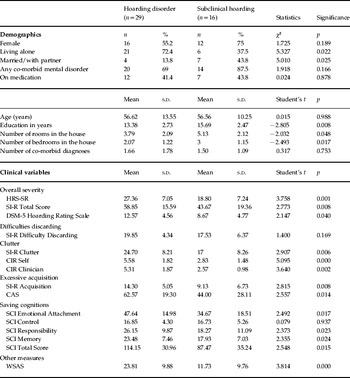
Compared to cases meeting full criteria for HD, individuals who did not have sufficient levels of clutter (n = 16) were more likely to be married/in a relationship, less likely to live alone, had higher levels of education and were more likely to live in larger properties that had, on average, an additional room (Table 4).
Comparison of individuals meeting criteria for hoarding disorder (HD) and ‘subclinical’ hoarding participants

HRS-SR, Hoarding Rating Scale – Self-Report; SI-R, Saving Inventory – Revised; CIR, Clutter Image Rating; CAS, Compulsive Acquisition Scale; SCI, Saving Cognitions Inventory; WSAS, Work and Social Adjustment Scale; s.d., standard deviation.
Although both groups reported comparable discarding difficulties, ‘subclinical’ individuals had lower overall severity, less clutter, fewer saving cognitions (with the exception of control), lower scores on excessive acquisition, and lower overall functional impairment. Compared to full-blown HD cases, fewer ‘subclinical’ individuals endorsed the excessive acquisition specifier (Rater 1: 100% v. 62%; Rater 2: 97% v. 47%; both χ2 tests p < 0.001). However, the average scores on several of the hoarding severity scales were within the clinical range (Table 4).
DSM-5 Hoarding Disorder Rating Scale
The scale was administered to a subsample of 55 participants (37 hoarders and 18 collectors). A principal components analysis revealed a single factor structure, explaining 82.4% of the variance. Factor loadings ranged from 0.96 (item 2, distress) to 0.85 (item 4, avoidance). Internal consistency was high (Cronbach's α = 0.95). As expected, the scores of the new scale were highly correlated (Spearman's ρ, all p < 0.001) with scores on the HRS-SR (0.89), the SI-R (0.91), the self-reported CIR (0.75) and the clinician-administered CIR (0.73).
Discussion
The current study represents the first field test of the proposed diagnostic criteria for HD. We recruited an unselected sample of individuals suffering from hoarding symptoms, regardless of their etiology, diagnosis and severity. This design allowed us to test whether the criteria suitably discriminate between various forms of object accumulation (e.g. hoarding secondary to another mental disorder), while also testing their ability to differentiate severe from subclinical hoarding. Recruitment of an unselected sample of collectors allowed us to examine the boundaries of the diagnostic criteria and test the hypothesis that these individuals would not receive a diagnosis of HD.
The criteria for HD are valid and reliable
The proposed diagnostic criteria for HD discriminated between HD and other forms of object accumulation (e.g. hoarding secondary to OCD), subclinical hoarding and also normative collecting with high sensitivity and specificity. Furthermore, the inter-rater reliability of the HD diagnosis and each individual criterion was excellent. These results confirm and extend the findings of a recent DSM-5 survey conducted among experts and random members of the American Psychiatric Association (APA) directory (Mataix-Cols et al. Reference Mataix-Cols, Fernández de la Cruz, Nakao and Pertusa2011).
Specifiers
All (or 97%, according to one rater) participants meeting HD criteria endorsed the excessive acquisition specifier and inter-rater reliability was nearly perfect, suggesting that the specifier can be easily and reliably ascertained by clinical interview. Previous research among self-selected hoarding samples indicated that the vast majority (85–95%) of hoarding individuals also acquire excessively (Frost et al. Reference Frost, Tolin, Steketee, Fitch and Selbo-Bruns2009). Meanwhile, a recent population-based survey has reported that approximately one-third of all hoarders did not endorse excessive acquisition (Timpano et al. Reference Timpano, Exner, Glaesmer, Rief, Keshaviah, Brahler and Wilhelm2011). In light of the available evidence, it seems sensible to retain excessive acquisition as a specifier rather than a core symptom. In addition, consistent with previous studies (Frost et al. Reference Frost, Tolin, Steketee, Fitch and Selbo-Bruns2009; Timpano et al. Reference Timpano, Exner, Glaesmer, Rief, Keshaviah, Brahler and Wilhelm2011), the most common forms of excessive acquisition were the taking of free items and excessive buying, with stealing being far less common. Thus, the wording of the specifier seems adequate.
Regarding the insight specifier, most (>85%) individuals were rated as having good or fair insight, which is consistent with the self-selected nature of the hoarding sample. The inter-rater reliability was excellent, despite the limited range of insight in our sample. Importantly, the degree of insight was weakly and non-significantly correlated with the BABS, a measure of overvalued ideation. This is consistent with the wording of the specifier, which mainly refers to the individual's degree of awareness of the consequences of the symptoms (e.g. in terms of safety for self and others, impairment, consequences for family members, neighbors, etc.), in addition to hoarding-related beliefs (e.g. beliefs about the importance of possessions for future use). One of the most striking features of some patients with HD is their failure to recognize that their hoarding is problematic, despite clear evidence to the contrary, and their reluctance to seek help (Tolin et al. Reference Tolin, Fitch, Frost and Steketee2010a). The types of therapeutic approaches required for patients with absent (delusional) insight may well differ from those required for individuals with good insight. For example, the use of motivational interviewing techniques may be particularly useful in patients with poor/absent insight (Steketee et al. Reference Steketee, Frost, Tolin, Rasmussen and Brown2010). Overall, it is clear that the insight specifier is easy to use and should be retained.
Is the clutter criterion too strict?
A number of individuals in the hoarding group had several key features of HD but did not have sufficient clutter to make key living areas unusable. This raises the question of whether the wording of Criterion C is too stringent and whether some of these ‘subclinical’ cases may represent false negatives.
We chose to strictly follow the wording of the criterion which specifies individuals must be unable to use their ‘key’ living spaces, for example cooking in the kitchen or sleeping in their own bed. Individuals who could still use their kitchens, bathrooms or bedrooms, albeit with difficulty, were not considered to endorse this criterion. A less stringent interpretation of the criterion, which considered difficulty rather than total inability to use the living space, would mean that several of these individuals would have met HD criteria. A retrospective review of our cases revealed that a minimum of three additional ‘subclinical’ individuals (but none of the normative collectors) would have potentially endorsed full criteria for HD. Consistently, post-hoc analyses revealed that, although individuals with full-blown HD had more excessive acquisition, clutter and disability, ‘subclinical’ individuals reported comparable difficulties discarding possessions and their scores on some of the hoarding severity scales were within the clinical range. Taken together, these results suggest that slightly rewording Criterion C would achieve the right balance between false positives and false negatives (Table 1, right column).
We also found that ‘subclinical’ cases were more likely to be in a relationship, be highly educated and live in larger properties than individuals meeting full criteria for HD. These findings suggest that there may be certain ‘protective’ factors that may help to reduce excessive acquisition, clutter and disability in individuals with hoarding problems. This is consistent with our clinical observation that many hoarders report symptom onset or exacerbations after the death of their spouses or their children leaving the family home (Landau et al. Reference Landau, Iervolino, Pertusa, Santo, Singh and Mataix-Cols2011). Criterion C has a clause indicating that, if living areas are uncluttered, it is only because of the interventions of third parties and, as such, it encapsulates some of these ‘protective factors’. Taking all these variables into consideration and gathering additional information from informants (e.g. relatives) should facilitate the diagnostic process.
The new diagnosis is perceived as acceptable, useful and moderately stigmatizing
This study extended previous findings of high acceptability of the HD diagnosis, by experts and random members of the APA (Mataix-Cols et al. Reference Mataix-Cols, Fernández de la Cruz, Nakao and Pertusa2011), to sufferers themselves. The vast majority (>95%) of participants in the HD group found the diagnosis very or somewhat acceptable. Similarly, most participants (>95%) were of the opinion that creating the new diagnosis would be helpful to develop better treatments. Only one participant found the diagnosis not at all acceptable or useful. Of note, this individual had the lowest levels of insight (absent) as determined by the insight specifier. The majority of the HD group (59%) found the HD label not too stigmatizing or not at all stigmatizing. Despite being moderately stigmatizing for some individuals, the majority indicated that benefits of a diagnosis (i.e. access to treatment) outweigh the disadvantages (i.e. stigma).
Collectors do not have a ‘mental disorder’
As predicted, none of the self-defined collectors fulfilled a diagnosis of HD. Understandably, most collectors reported that they would be reluctant to discard their collections and that they would be distressed about this (Criteria A and B) but none met Criterion C (clutter), even if relaxed as proposed in Table 1 (right column). Therefore, it does seem unlikely that the criteria can be misused to pathologize this widespread human activity. It is important to note that ours was a volunteer sample and not necessarily representative of the entire collector population. However, the majority of these participants had substantial collections, often comprising hundreds of voluminous objects and occupying dedicated rooms in their homes. Furthermore, some reported volunteering for the study because they or their partners thought they might be ‘hoarders’.
It remains plausible that, in some cases, individuals described in the literature as ‘extreme’, ‘passionate’, ‘obsessive’, ‘excessive’ or even ‘multiple’ collectors could potentially meet all the criteria for HD (Nordsletten & Mataix-Cols, Reference Nordsletten and Mataix-Cols2012), and further research on this topic is needed. However, as research indicates that such collectors represent a minority of the collecting community (Nordsletten & Mataix-Cols, Reference Nordsletten and Mataix-Cols2012), it seems reasonable to deduce that the majority of collectors will not fulfill HD criteria.
DSM-5 Hoarding Disorder Rating Scale
A preliminary examination of the psychometric properties of the DSM-5 Hoarding Disorder Rating Scale suggested a one-factor structure, high internal consistency and good convergence with various other hoarding measures. This is not surprising as the scale is heavily based on the HRS-SR (Tolin et al. Reference Tolin, Frost and Steketee2010b). Although the new scale does not seem to have clear advantages over the HRS-SR, which is already widely used by researchers in the field, it may be a useful alternative for those who want to specifically measure avoidance in HD. One potential drawback of the DSM-5 scale may be that it does not include an excessive acquisition item.
Limitations
The present study has several limitations. First, the sample sizes of both studied groups were relatively modest. Second, most participants were from urban areas in London, thus potentially limiting the generalization of the results to other contexts. Third, the HD criteria remain to be tested in low-insight individuals who may not necessarily self-define as hoarders or seek help; recruiting these individuals for study is extraordinarily difficult. Fourth, not all the participants could be interviewed at home or provided photographs of their homes, and in these cases the clutter could not be studied first-hand. However, there were no statistically significant differences on any demographic or clinical variables between those who were interviewed at home and those who were not. Furthermore, given the good insight displayed by most individuals, self-reported clutter severity seemed to be reliable given the high correlation with clinician-reported clutter severity. Fifth, the collectors sample may not have been entirely representative of the collecting community as a relatively high proportion of these individuals met criteria for mental disorders. However, even though our collectors sample was potentially enriched with individuals with emotional difficulties, none met diagnostic criteria for HD. Sixth, we did not specifically screen or test for possible autism spectrum disorders (ASD), which are known to sometimes be associated with hoarding (Pertusa et al. Reference Pertusa, Bejerot, Eriksson, Fernández de la Cruz, Bonde, Russell and Mataix-Cols2012). However, during the clinical interviews, it was our clinical impression that most of the participants meeting criteria for HD did not have ASD features. Two participants self-reported having an ASD diagnosis, although their hoarding behavior was judged to be unlike the narrow, circumscribed interests that characterize some individuals with ASD.
Conclusions
The proposed criteria for HD are valid, highly reliable and perceived as acceptable and useful by the sufferers. Crucially, they seem to be sufficiently conservative and unlikely to overpathologize normative behavior. Slight wording modifications, particularly in the clutter criterion, should ensure an adequate balance between false positives and false negatives and improve the usability of the criteria (Table 1, right column).
Supplementary material
For supplementary material accompanying this paper visit http://dx.doi.org/10.1017/S0033291712001560.
Acknowledgments
We thank Drs A. Pertusa, T. Nakao and M. Grau for their help with some of the home visits and consensus meetings and S. Singh for assisting with the recruitment of participants.
Declaration of Interest
D.M.-C. is Advisor to the DSM-5 Obsessive-Compulsive Spectrum Sub-Workgroup of the Anxiety, Obsessive-Compulsive Spectrum, Post-Traumatic, and Dissociative Disorders Workgroup.