Nearly four decades have passed since the first magnetic resonance imaging (MRI) system was introduced in the late 1970s (Reference Banta and Luce4). During this period, MRI technology was adopted and diffused for use under various scenarios in different countries, and also diffused within one country by differing routes and for various settings (i.e., in public versus private hospitals). Despite its high cost, being a highly effective technology, MRI has had a rapid diffusion, especially among high income countries, and by 1998, there were more than 8880 MRI units in the Organization for Economic Cooperation and Development (OECD) member countries (Reference Korogi and Takahashi13;16;Reference Passariello19).
Diffusion of MRI has been investigated from several perspectives on country (Reference Hillman and Schwartz9;Reference Kung, Tsai, Yaung and Liao14;Reference Olsson18), regional (Reference Hutubessy, Hanvoravongchai and Edejer11;Reference Rublee21), and global levels (Reference Oh, Imanaka and Evans17). Hillman and colleagues (Reference Hillman, Winkler, Phelps, Aroesty and Williams10) studied influential factors on MRI diffusion under a theoretical framework on the diffusion of innovations (Reference Rogers20). This study defined four principal elements, (i) the characteristics of MRI, such as its safety and efficacy; (ii) communication channels (commercial and professional) through which information about MRI spreads over society; (iii) time, which refers to the sequential stages through which the diffusion of MRI is fulfilled; and (iv) the health system, with elements such as potential acquirers, health planning and regulation, and reimbursement policies. The authors concluded that, among the factors with positive or negative influence on MRI diffusion, characteristics such as the uniqueness of the technology and its potential applications had a positive influence on its diffusion. Another study described factors influential to the diffusion of MRI from a different perspective (Reference Oh, Imanaka and Evans17) by defining five categories of variables and putting them into three groups: (i) physician demand and patient needs, as predisposing factors in a group with a positive effect on diffusion; (ii) purchasing power, as an enabling factor in a group with a positive effect on diffusion; and (iii) government regulations and payment methods, as reinforcing factors in a group with negative/positive effects on diffusion. The authors came to the conclusion that the diffusion of MRI was significantly related to two factors: purchasing power, as measured by total health expenditure per capita; and the method of payment.
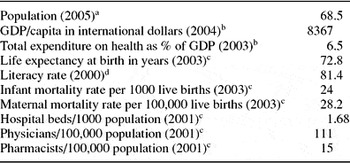
The Islamic Republic of Iran is a middle income country located in southwest Asia in the Middle East region. Demographic, economic, and health indicators of Iran are presented in Table 1.
Demographic, Economic, and Health Indicators of Iran

a Statistical Center of Iran. Last accessed March 2006: www.sci.org.ir
b World Health Organization. Last accessed May 2006: www.who.int
c World Health Organization. Eastern Mediterranean Region Office. Health System Profile, Islamic Republic of Iran; December 2004.
d Iran Demographic and Health Survey. The Ministry of Health and Medical Education. Islamic Republic of Iran, October 2000.
GDP, gross domestic products.
Health care in Iran is provided by the public (government) sector, health insurance organizations, and the private sector (Reference Azizi, Gouya, Vazirian, Dolatshahi and Habibian3). At the national level, the Ministry of Health (MOH) is in charge of policy making, planning, financing, and supervision. The universities specializing in the medical sciences have certain responsibilities regarding financing and planning at the provincial level. At the district level, the executive units are urban and rural health centers and district hospital. The MOH finances primary health care, which is emphasized (Reference Asadi-Lari, Sayyari, Akbari and Gray1), whereas secondary and tertiary health care is financed through insurance schemes. According to the World Health Report 2006 (25), the government share and private share for financing healthcare services were 47.3 percent and 52.7 percent, respectively, in 2003. According to the 4th Development Plan of the country regarding public–private interaction, the MOH is required to transfer management, but not assets, of health facilities to the private sector through the provinces (24). This process continued slowly, but had been stopped at the time of the study.
Assessment of health technology is carried out by certain divisions of the MOH. Assessment in the pharmaceutical field, for example, is done by the Deputy Minister for Food and Drug Affairs. Iran has a national drug list and each drug, before being registered on the list, should be evaluated for efficacy, safety, and cost-effectiveness by the respective committee within the deputy office of Food and Drug Affairs. For medical equipment assessment, however, there is a Directorate General at the Deputy Minister for Health Affairs evaluating the price of equipment and attempting to verify whether devices perform according to manufacturer assertions. Governmental endeavors to establish a health technology assessment unit are still in the early stages (24).
Diffusion of MRI in Iran has not been previously studied, and little attention has thus far been paid to this issue since MRI was introduced into the country. This finding is mainly because health technology assessment is not an organized scientific effort performed by either governmental or private sectors. The aim of this study, therefore, is to describe MRI diffusion in Iran and to compare MRI availability in the country with other OECD member countries.
MATERIALS AND METHODS
Data Collection
The study was conducted in 2005. Data on the diffusion of MRI were collected from two sources, the Medical Equipment Office (MEO) of the MOH and all the universities of medical sciences across the country. An official letter was sent to the MEO from the Center for Network Development and Health Promotion (CNDHP), also of the MOH. The letter contained a questionnaire (available on request from the first author) about characteristics of existing MRI devices in Iran. The questions sought answers about the geographic distribution of MRI (province and city), equipment brand name, magnetic strength, year of installation, purchase cost, ownership (public or private), and the site of installation (hospital-based [teaching or nonteaching] or non–hospital-based). The reply received from the MEO did not provide answers to all questions within the questionnaire that would allow for tracking MRI units and their characteristics by province and city. Because it was intended to count all MRI sites and MRI machines in Iran, we, therefore, decided to obtain the data from the universities specializing in medical sciences. There is at least one medical university in each province. In provinces with more than one medical university, questionnaires were distributed according to catchment areas; all of them were included in the study.
The same self-administered questionnaire submitted earlier to CNDHP, with one additional question (year of purchase of MRI machines), was sent by means of this division of the MOH to forty-one medical universities in the country. After 2 months, thirty-three universities had completed and returned the questionnaire. A reminder was mailed to the remaining eight universities, and 1 month later, a follow-up phone call was made to two remaining universities who eventually sent their written responses to the questionnaire. This effort resulted in a response rate of 100 percent. Due to incomplete answers made by several universities, data on the year of purchase for twenty-seven MRI units and the year of installation for seven MRI units are not available. Twenty-four of twenty-seven MRI units belong to Tehran province, and the remaining units belong to the other provinces of Kerman and Khozestan. All data regarding MRI units owned by the private sector were obtained from the universities of medical sciences. For international comparisons, we used the most recent data released by the OECD (16), on the number of MRI units per one million inhabitants and the healthcare expenditure (HCE) per capita in member countries. The analysis presents the cumulative number of MRI units since the year of first adoption, and the number of MRI units per million inhabitants is compared between the provinces.
Ethical Approval
The study was approved by the Iranian National Ethical Committee of the Undersecretary for Research and Technology of the Ministry of Health.
RESULTS
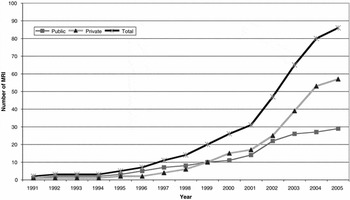
The year of first purchase of MRI technology in Iran was in 1990. The brand name of this MRI unit was Bruker and its magnetic strength was .23 Tesla (T). It was installed in 1991 in a teaching hospital in the Kerman province. In a subsequent 16-year period, Iran has purchased ninety-three MRI machines, and of these, sixty-three MRI units belong to the private sector and thirty are owned by the public sector. Therefore, approximately 67 percent of MRI units which are in use in Iran were installed in private hospitals and MRI centers. Figure 1 illustrates the diffusion of MRI in the public and private sectors from 1991 to mid-2005. At the time of this study, the number of MRI units per million inhabitants was 1.36.
Cumulative number of magnetic resonance imaging (MRI) units installed in public and private sectors by year in Iran.

The adoption of MRI technology has occurred more frequently in outpatient settings (50.6 percent) than in hospitals (35.5 percent). Thirty-three MRI units were located in hospital settings, eighteen of which were installed in medical university-affiliated hospitals. Forty-seven MRI units were located in nonhospital settings, such as charity foundations and free-standing MRI centers. Three MRI centers, in fact, had more than one MRI unit. Seven MRI units were purchased but not yet installed at the time of the study. Of these, five (5.4 percent) are to be installed in hospitals (two teaching and three nonteaching hospitals) and two of them (2.1 percent) in MRI centers. The location of six remaining MRI units is unknown (6.4 percent).
A wide range of magnet strengths are in use in Iran. Forty-four MRI units have magnet strength equal to or smaller than .5 T (47.3 percent). The magnet strength of 13 MRI machines is 1 T (14 percent). The number of MRI units with larger magnet strength (1.5 T) is 35 (37.7 percent). More than 25 of these high field (1.5 T) machines have been installed between 2002 and 2005. The magnet strength of one MRI was not known (1 percent).
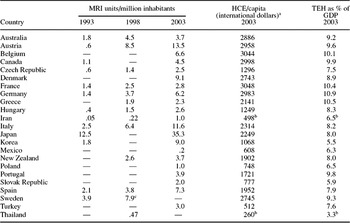
The number of MRI units per million inhabitants among OECD countries from 1993 to 2003 is presented in Table 2. HCE per capita and total expenditure on health as a percentage of gross domestic products as two potential determinants of the number of MRI units have been compared between countries. As seen in Table 2, Iran, Poland, Mexico, Slovak Republic, and Thailand, with the lowest HCE per capita (less than 780), had the lowest number of MRI per million inhabitants. Korea and Turkey, considering their relatively low HCE per capita, had a high number of MRI units per million inhabitants. Taking into consideration the growth rate of MRI technology diffusion per million inhabitants in each country from 1993 to 2003, it becomes clear that, in the case of Iran, there has been a 20-fold increase in the number of MRI units per one million inhabitants.
Magnetic Resonance Imaging (MRI) Units per Million Inhabitants, Health Care Expenditure (HCE) per Capita, and Total Expenditure on Health (TEH) as Percentage of Gross Domestic Product (GDP) in Iran, Thailand, and OECD Member Countries

Note. Source is OECD health data, 2006. Last accessed October 2006: www.oecd.org/health/healthdata
a International dollars are derived by dividing local currency units by an estimate of their purchasing power parity compared with U.S. dollars. www.who.int
b World Health Organization. Last accessed November 2006: www.who.int c In 1999.
OECD, Organization for Economic Cooperation and Development.
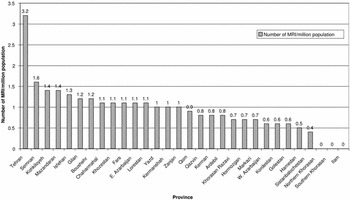
Regional comparison shows that the number of MRI units per one million inhabitants ranges from .43 to 3.2. Three of the thirty provinces in Iran did not have any MRI units at the time of the study. In the provinces where MRI units could be found, there were usually one or two MRI machines located in the capital cities. Fifteen provinces, each with one MRI machine, had the lowest number of MRI units in the country, while eleven provinces had between two to six MRI units. Tehran, the capital city of Iran, had thirty-nine MRI units (Figure 2). This geographic distribution shows that the total number of MRI units was lower in the eastern, southern, and southwestern regions of the country. These regions entail nine of the thirty provinces of the country.
Number of magnetic resonance imaging (MRI) units per million population by province in Iran in mid-2005.

DISCUSSION
This study, the first of its kind in Iran, describes the diffusion of MRI from the year of first adoption to mid-2005. Substantial growth in the number of MRI units between 1993 and 2003 was unique by international comparison, and is quite a remarkable finding of this study. Nevertheless, the total number of MRI units is still relatively low compared with high income countries. Comparisons show a large regional variation in the number of MRI units per million inhabitants, ranging from .43 to 3.2.
The response rate to our questionnaire was 100 percent. Response rates are considered to vary depending on the questionnaire characteristics so that response rates are negatively correlated with the number of questions and the length of questionnaire (Reference Dillman5). We used a one-page questionnaire containing nine questions about MRI characteristics, their geographic distribution, year of purchase and installation, ownership, and the site of installation. Another study (Reference Asch, Jedrziewski and Christakis2) demonstrated the positive effect of written or telephone reminders on increasing the response rates. We also contend that using written and telephone reminders and sending the questionnaire to the medical universities through an official letter from the Ministry of Health were the most important reasons for the high response rate.
The findings of this study demonstrate that diffusion of MRI technology in Iran follows an S-shaped curve (Figure 1). Rogers (Reference Rogers20) contends that the adoption of an innovation when plotted on the basis of a cumulative number of adopters looks like an S-shaped curve. The S-shaped curve rises very slowly in the early stages of diffusion, which indicates a very slowly increasing number of adopters who are usually referred to as innovators. Our results support this contention as seen in the diffusion curve of MRI in Iran during the period of 1991–95. Afterward, the rate of adoption sped up and the curve consequently accelerated. Hillman and colleagues (Reference Hillman, Winkler, Phelps, Aroesty and Williams10) argue that the spread of information regarding an innovation by means of communication channels is necessary for its acceptance. This step was taken in Iran through the marketing of MRI technology by manufacturers to medical societies and leading physicians. Other reasons that could explain such a low rate of adoption of MRI technology in its early stages of introduction are technical and financial uncertainties (Reference Hillman and Schwartz9) and its high cost (Reference Evens, Jost and Evens6).
The increasing number of MRI units during the accelerated phase of its diffusion in Iran could be due to the increasing number of physicians across the country and to additional factors, such as increasing awareness, rising incomes, and increasing insurance coverage, as Mahal et al. (Reference Mahal, Varshney and Taman15) have pointed out in their study in India. Demonstrated increased cost-effectiveness and decreased complication rates among patients have also been emphasized in another study (Reference Greenberg, Peterburg, Vekstein and Pliskin8). Slade and Anderson (Reference Slade and Anderson22) demonstrated that there is a relationship between income and diffusion of health technologies. They showed that countries with higher incomes tend to have more MRI units per capita at any given time. The number of physicians in Iran has increased considerably over the past two decades, and we contend that, as a demand side factor, it has had an influence on the diffusion of MRI technology in Iran, as elsewhere (Reference Fuchs and Sox7;Reference Sloan, Valvona, Perrin and Adamache23).
We found that major investment in the acquisition of MRI technology is done by the private sector, represented mostly by physicians or joint physician–nonphysician investors. Most of these physicians are radiologists who are responsible for the operation of MRI units and who are also responsible for the interpretation of imaging examinations. The increasing role played by the private sector in the Iranian health system began in 1999, and is still the case today. There are at least two reasons for shifting investment from the public to private sector. One reason derives from the privatization policies initiated by the government and accentuated by the MOH in the Iranian health system (24), and the other reason is economic incentive, that is, higher tariffs for MRI examinations in the private sector than those of the public sector. This active role since the year 1999 is contiguous to the starting point for the higher adoption rate of MRI, suggesting that, in Iran, speedier MRI acquisition is fueled by the private sector.
Our results further demonstrate a greater number of MRI units placed in outpatient settings, reflecting the likely preference of MRI owners for being separate from hospital organizations, which is finding in contrast to the results from a study in Japan (Reference Korogi and Takahashi13). Hillman and Schwartz (Reference Hillman and Schwartz9) pose that MRI machines are logically installed outside of the hospitals because this technology could be best fitted to stable and cooperative patients. Nevertheless, it raises questions regarding the differences between the utilization pattern of MRI in hospital and nonhospital settings, as well as the number of staff required. More research is needed to address these questions.
Currently, the products of ten MRI manufacturers are in use in Iran. The variety of brand names of MRI in Iran indicates that the Iranian health market has been quite accessible to foreign manufacturers. Two important factors could influence market penetration: first, regulations (Reference Hillman, Winkler, Phelps, Aroesty and Williams10;Reference Mahal, Varshney and Taman15) issued by the government to restrict the importation of poor-quality products as many importing countries require evidence on outcome for new technology they adopt (Reference Jonsson and Banta12), and, second, the marketing by manufacturers.
Regional comparison shows that three provinces do not have any MRI units, indicating that their respective inhabitants do not have access to MRI services. According to a directive issued by the MOH in the year 2000, each province should have one MRI unit per 1.5 million inhabitants (.6 MRI units per million inhabitants). Based on this directive, among those provinces with MRI, two provinces have not yet reached this level. On the other hand, twenty-seven of thirty provinces with at least one MRI machine indicate a broad distribution of this health technology across the country so that, at the time of the study, 90 percent of provinces had at least one MRI facility. Tehran, with 3.2 MRI units per million inhabitants, had the highest number of MRI units. One probable reason is higher demand by physicians (Reference Mahal, Varshney and Taman15) for medical equipment due to the concentration of subspecialty facilities and top physicians in this province, which serves as a referral province in Iran.
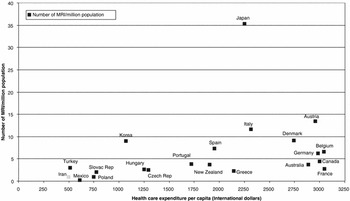
By international comparison, as Figure 3 demonstrates, Iran, Mexico, Poland, and the Slovak Republic are the countries with the lowest rate of MRI diffusion per million inhabitants. Considering HCE per capita in these countries in 2003, which are in purchase power adjusted U.S. dollars (international dollars), $498, $608, $748, and $777, respectively, we find that a higher fraction of HCE per capita has been spent by these countries toward the purchase MRI units.
Healthcare expenditures per capita and number of MRI units per million population in Organization for Economic Cooperation and Development member states and Iran in 2003.

CONCLUSION
We demonstrated that MRI acquisition has had considerable growth in Iran since its introduction. Regional variation of the number of MRI units indicates that the distribution of MRI throughout provinces is not in direct proportion to the size of their population, despite governmental policy. On the other hand, twenty-seven of thirty provinces (90 percent) have at least one MRI unit. Most of the provinces have achieved the goal set by the MOH (.6 MRI units per million inhabitants). In an international comparison, however, availability of MRI technology is still low in Iran.
POLICY IMPLICATION
Regulating the adoption rate and the geographical distribution of health technologies may lead to their rational adoption and equitable diffusion. The Ministry of Health should establish a mechanism for health technology assessment.
CONTACT INFORMATION
Mohammad Palesh, MD (mohammad.palesh@ki.se), Ph.D. student, Department of Public Health Sciences, Karolinska Institutet, Nobels väg 9, SE-171 77 Stockholm, Sweden
Sten Fredrikson, MD, PhD (sten.fredrikson@ki.se), Professor of Neurology, Division of Neurology Huddinge, Department of Clinical Neuroscience, Karolinska Institutet, Karolinska University Hospital Huddinge, S-14186 Stockholm, Sweden
Hamidreza Jamshidi, PharmD, PhD (Jamshidih@hotmail.com), Associate Professor, Faculty of Medicine, Shaheed Beheshti University of Medical Sciences, Velenjac Street, Tehran, Iran
Pia Maria Jonsson, MD, PhD (pia.maria.jonsson@ki.se), Senior Researcher, Medical Management Centre, MMC, Karolinska Institutet, Berzelius väg 3, SE-171 77 Stockholm, Sweden
Goran Tomson (goran.tomson@ki.se), Professor, International Health IHCAR Public Health Science, Professor, Head Health Systems and Policy, Karolinska Institutet, SE-171 77 Stockholm, Sweden