Over the course of the nineteenth century, the rapid growth and proliferation of business corporations transformed the organization of the American economy. The corporation became a familiar part or economic life, and the financial assets issued by these enterprises became popular investments among ordinary households. The very early history of the American corporation, however, was quite different. In the years following the ratification of the Constitution, business corporations were extremely rare, and their ownership was likely dominated by households who were anything but ordinary.Footnote 1 The first wave of incorporations in this era, which included the Bank of the United States, the Bank of New York, and the Society for the Establishment of Useful Manufactures, created businesses that were larger than any the country had ever known. Critics expressed fears of the power and influence of the new corporations, and argued that they undermined popular democracy and created an “aristocracy” of wealthy stockholders endowed with exclusive legal privileges. The Federalist legislators who granted charters to these enterprises were accused of what John Wallis has termed “systematic corruption”—the abuse of political power to manipulate the structure of the economy. The political struggles over the creation of these institutions contributed in no small measure to the factional divisions that led to the emergence of the Republican Party.Footnote 2
Yet over the first decades of the nineteenth century, the American state governments, under the control of those same Republicans, created more business corporations than the world had ever known. As the economy grew, and experienced what some historians have termed the “market revolution,” the corporate form was quickly adapted into new industries to capitalize on the abundant economic opportunities that became available.Footnote 3 With the vast expansion of markets, the earlier dominance of a relatively small number of elite merchants and institutions was diminished. Bray Hammond puts it well: “business was becoming democratic. It was no longer a select and innumerous aristocracy—business opportunities were falling open to everyone.”Footnote 4 Likewise, corporations were no longer innumerous, and many new entrants contested the markets formerly dominated by the established firms, or entered new ones.
Although state legislatures facilitated enormous numbers of incorporations, petitions for charters remained contentious, and the familiar tropes of eighteenth-century anticorporate rhetoric found continued use. Much of this rhetoric was directed at the owners of these institutions. Bank stockholders were called “Englishmen and Foreigners,” “Federalists and Tories,” and a “Gentry,” drawn from the “unproductive part of society” or the “wealthy and aristocratic class,” with the power to “corrupt and subdue Republican notions.”Footnote 5 To a lesser extent, similar arguments were made about all corporations, which were likened to “aristocracies” and “monopolies,” often controlled by “parcels of speculators.”Footnote 6 Defenders of corporations argued that they were owned by huge numbers of investors, including ordinary people and “widows and orphans,” and that stockholding was open to anyone with the resources to purchase a share.Footnote 7 Some even argued that access to the corporate form could enable those of “small means” to “come into fair and safe competition with the skillful and wealthy.”Footnote 8
Did corporations remain dominated by elites, or were those of the “middle order of citizens” able to incorporate their enterprises, or at least purchase shares, in the era of Republican governments? As politics became more democratic, did corporate ownership become more democratic as well? The answers to these questions are central to our understanding of the development of American capital markets and businesses organizations. Moreover, historians have long appreciated the importance of anticorporate rhetoric in American politics in the nineteenth century, but it is difficult to evaluate or interpret these sentiments without a clear understanding of who actually created and owned corporations at the time. Although an enormous literature has developed around these questions, very little evidence is available on the extent of corporate ownership, or the wealth and status of stockholders, in the early nineteenth century.
Using newly collected data from New York's corporations in 1791 and in 1826, this article analyzes the wealth and status of early stockholders in New York City. Stockholders lists of both existing corporations in the state in 1791, and nearly half of existing corporations in 1826, were transcribed and matched to city directories, tax assessment lists, and the census. In addition, random samples of the population were taken from city directories in both periods, and also matched to tax lists and the census, in order to compare the stockholders to the general population. The article uses these data to investigate the diffusion of shareholding within New York City, both socially and geographically, and to analyze how the ownership of corporations evolved over time. Among the many corporations in existence in 1826, there was considerable variation in the average wealth, status, and neighborhood locations of their shareholders, and we investigate econometrically the corporate characteristics that were correlated with these different ownership characteristics. Although New York's rapid growth in population and large financial institutions may have been atypical of other cities, its central role in the development of the economy and capital markets of the United States makes it an important setting in which to study corporations and stockholding.
The results of the analysis indicate that in 1791, only 6 percent of New York City's households owned corporate stock, but in 1826, at least 11 percent did, and in some parts of the city the rate was as high as 35 percent. Although stock was held principally by the city's elite merchants in both 1791 and 1826, share ownership became more widespread over time among less affluent households. In particular, the corporations created in the 1820s were owned by investors who were less wealthy than the stockholders of corporations created in earlier, less democratic periods in the state's history. The main result of the article is that democratization itself paid dividends, as a new generation of businessmen gained access to corporate charters and sold shares to increasingly “ordinary” households. In a clear reflection of the changes in the politics of the city and state, the wealthiest stockholders in 1791 were public officials—the very men who controlled access to the corporate form—but in 1826 public officials were totally unimportant as investors in the state's corporations, and most of the prominent figures in state politics and government were not stockholders at all.
The results of this article contribute to several areas of research. A substantial literature on the financial history of the United States has asserted that corporate stock was quite widely held throughout Wall Street's history. But there is little evidence available on this topic, and although this view is accepted quite generally, there are dissenters.Footnote 9 In addition, several studies have used the records of antebellum corporations in specific industries to analyze the wealth and status of their shareholders or directors.Footnote 10 Many of these studies have found strong evidence that early corporations were quite widely held.
This article builds on the approach of those studies in several ways. First, it compares the stockholders of New York's corporations to random samples of the population, in order to carefully assess how atypical stockholders were. Second, it analyzes corporate shareholding both in the earliest phase of the development of the business corporation, in 1791, and then 35 years later, in 1826, when there were hundreds of corporations in the state, in order to analyze the evolution of stockholding over time. Finally, the 1826 sample includes a large number of corporations in a variety of industries, and thus allows for unparalleled investigation across many economic sectors. Moreover, those 1826 corporations were created over a long time period that spans enormous political and economic changes. As a result, they varied substantially in their size, charter provisions, and locations, and the effects of these differences on their ownership can be investigated.
NEW YORK'S CORPORATIONS IN 1791
In 1791 aristocratic landowners and merchants dominated New York City and State politics. The families that owned manorial estates along the Hudson had controlled the colonial government and continued to exert overwhelming influence in the early national period.Footnote 11 The state's conservative 1777 constitution was designed to maintain their position: it imposed significant property qualifications for voting; created a “Council of Appointment” that selected many important officials such as the mayor of New York City; and created a “Council of Revision” within the state government that checked the power of the elected legislature.Footnote 12 New York's elite families also benefited from cultural norms that held that ordinary people should show respect and deference toward their betters, in social interactions and in politics.Footnote 13
The social status and authority of New York's aristocratic officeholders entitled them to the presumption that their actions were disinterested and “responsible and wise,”Footnote 14 even though they frequently pursued private gain while in office. For example, New York City's (appointed) mayor was not paid a salary, but was instead permitted to personally collect most of the licensing fees paid to the city, an extremely lucrative source of income.Footnote 15 Other political figures undertook major business investments while in office, and even received the support of the state in their efforts. New York's chancellor, Robert R. Livingston, was granted a twenty-year monopoly on the manufacture and operation of steamboats in New York in 1798, a year in which he also ran for governor of the state.Footnote 16 New York's aristocratic families were not homogeneous in their interests. In the 1790s partisan divisions among them became quite pronounced and political factions with different visions of the appropriate role of government emerged. But each of these factions was led, at least initially, by members of the traditional elite.
By 1791 New York's political system had granted only two charters to incorporate businesses. Both were located within New York City: The Bank of New York and the New York Society for the Establishment of Manufactures (“New York Manufacturing Society”).Footnote 17 The two enterprises were typical of early American business corporations generally, in that they both served quasi-public purposes, and their performance was typical of other corporations in their industries, in that the bank was successful and the manufacturing company was not.Footnote 18
The Bank of New York opened as an unincorporated company in April 1784, just a few months after the British ended their occupation of the city, and was immediately profitable.Footnote 19 The bank was founded by Federalist merchants and closely associated with Alexander Hamilton, who drafted its charter. Strong demand for its services from within New York's merchant community, coupled with the fact that it faced little competition, contributed to its immediate profitability. But accusations that the bank favored Federalist borrowers and interfered in elections on behalf of Federalist candidates stirred virulent opposition to the bank's efforts to obtain a charter. As one critic of the bank wrote,
The present company which compose that body, are a combination of wealthy men, odious to the people, and formidable to the state…it is an institution formed for private emolument, injurious to the public welfare…and derogatory to the dignity of government.Footnote 20
In 1791, when it finally received its charter, it had $318,250 in paid-in capital, divided into 636.5 shares of $500 each, a very high sum typical of the earliest banks. Median assessed wealth in New York City at the time was $570. Its charter granted the bank the right to expand its capital stock to $900,000, and subsequent revisions increased it to more than $1 million. Typical of the earliest American banks, it played a semiofficial role in public finance in the state, and it enjoyed great longevity—it continues to exist today.
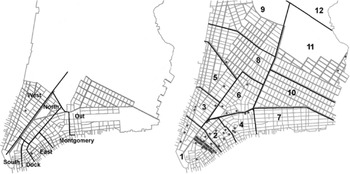
The New York Manufacturing Society, chartered in 1790, was one of the earliest manufacturing corporations in the United States. Like many of its counterparts, it was founded with the dual purpose of promoting manufacturing industries, and actually engaging in manufacturing. It received financial support from the state government, which subscribed to 100 of its $25 shares, whose low par value was intended to make the shares affordable to artisans. The Manufacturing Society built a large brick factory on Vesey Street in New York's West Ward (see Figure 1), and produced cotton textiles using spinning jennies.Footnote 21 Although the firm operated for several years, at one point having 150 employees and more than 11,000 in total assets, it never achieved profitability and was shut down by 1793.Footnote 22 Its unsuccessful struggle to achieve profitability was quite representative of early manufacturing corporations.
Who owned these firms? The stockholder lists for each were transcribed, and the New York City stockholders were matched to the Federal Census of 1790, the city directory for 1791, and the city's 1789 tax assessment list. For purposes of comparison, a 15 percent sample of household heads was taken from the 1791 New York City directory, and those names were also matched to the census and tax list.
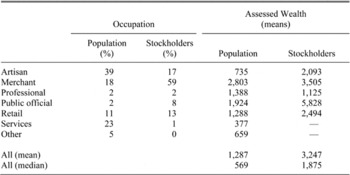
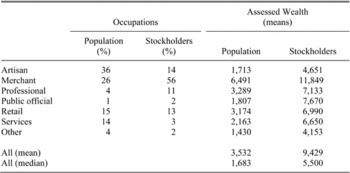
These comparisons are presented in Table 1. The occupations of stockholders tended to be quite concentrated within the category with the highest average level of assessed wealth, “merchants”—the elite of the world of commerce. Stockholders were also much less likely than the population as a whole to be artisans, service providers (for example, tavern keepers, hairdressers, and cartmen), or fall into the “other” category (mostly maritime), all occupational groups with low average levels of assessed wealth. For all the occupational categories except “professionals,” which includes attorneys and doctors, the stockholders were far wealthier than the population average. There were, for example, artisan stockholders, but those artisans were clearly much wealthier than their peers. The average assessed wealth of stockholders was about 2.5 times larger than that of the population.
NEW YORK CITY STOCKHOLDERS VS. POPULATION: WEALTH AND OCCUPATIONS, 1791

Notes:
Mean assessed wealth is the mean value of taxable (real and personal) recorded on assessment lists. Population statistics calculated from a 15 percent sample, taken from the 1791 directory.
Sources:
See the Data Appendix.
Slavery was legal and relatively common in New York City in the 1790s.Footnote 23 Stockholders were much more likely to own slaves, with about 66 percent of stockholding households reporting the presence of at least one slave in the census, compared to about 22 percent for all households in the city. The strong correlation between slaveholding and stockholding was clearly driven by the fact that both occurred principally at higher levels of wealth, but the connection may have been somewhat deeper. Slaves were an important investment for New York households, and wills commonly specified that slaves would take care of the owner's family or be rented out and produce an income for the family if the owner died. To the extent that the shares of New York's earliest corporations also represented an asset that could generate income for future generations, one would expect to see similar households attracted to these investments.
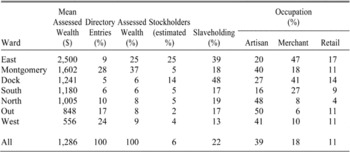
STOCKHOLDING, WEALTH, AND OCCUPATIONS BY NEW YORK CITY WARD, 1791

Notes:
Mean assessed wealth is the mean value of taxable (real and personal) wealth recorded on assessment lists for household heads whose primary residence is listed in each ward, and may include real estate located in other wards. Percent of directory entries indicates the share of total individuals and businesses (usually household heads and partnerships) in each ward. Percent of assessed wealth is the share of taxable wealth of all sampled households. The percent of households that owned stock is estimated by apportioning the stockholders that could not be uniquely identified in the directory into wards at the same rate as the stockholding households listed in the directory; see the Data Appendix for details. Percent slaveholding is calculated from the 1790 Federal Census.
Sources:
See the Data Appendix.
A striking feature of the data in Table 1 is that the wealthiest stockholders by far were the public officials—their average assessed wealth, $5,828, was more than 50 percent higher than that of merchants. Among the stockholders of note were Governor George Clinton (taxed at $2,500; 8 slaves); U.S. Senator Aaron Burr ($7,500; 5 slaves); U.S. Senator Rufus King, who was also a director of the Bank of New York ($1,500; no slaves); Chief Justice of the U.S. Supreme Court John Jay ($8,700; 5 slaves); Mayor Richard Varick ($2,425; 1 slave); former mayor and current U.S. District Court Judge James Duane ($8,125, 1 slave); New York State Senator Isaac Roosevelt, who was president of the Bank of New York ($29,050; no slaves); and U.S. Treasury Secretary Alexander Hamilton ($3,000; no slaves). That Burr and Hamilton were both stockholders in the Bank of New York is also worth noting. Although the Bank of New York was strongly associated with the Federalist Party, there were prominent Republicans among its shareholders. The New York Manufacturing Society had both Republican and Federalist shareholders as well.
The highest average level of wealth within New York City, as shown in Table 2, was found in New York's East Ward, where a relatively large portion of households were headed by merchants, slaveholding was relatively common, and around 25 percent of households owned stock. A map of the city's wards is presented in Figure 1. Households in the western and northern part of Manhattan, the Out and West Wards, had far lower levels of wealth and were more often headed by artisans. The rate of stock ownership there was also quite low. The overall rate of households owning stock was 6 percent.
Taken together, the data in Tables 1 and 2 indicate that the city's stockholders in 1791 were quite atypical of the population. They lived in exclusive neighborhoods; were quite wealthy and likely owned slaves; and they were unlikely to be artisans or hold other modest occupations. They were often elite merchants, with ties to the state's aristocratic landowning families. The city was an extraordinarily unequal and economically segregated place, and the individuals who invested in stock were drawn from the very top ranks of the wealth distribution. Given the initially uncertain prospects of these firms, this may have represented an efficient allocation of risks, and may even have been inevitable.
But the elites who owned these firms also controlled the government of the state and of the city. A corporation could only have been formed by a special act of the state legislature, which meant that these shareholder-politicians could protect their firms from competition and enrich themselves by simply refusing to grant potential competitors a corporate charter. This is exactly what they did. The next bank to be created in New York, the Bank of the Manhattan Company, was not incorporated until 1799, and was granted a charter only because its Republican founders deceived the legislature about their intentions.Footnote 24 But a process of significant economic and political change was well underway by the early nineteenth century, which made broader use of the corporate form inevitable.
NEW YORK'S CORPORATIONS IN 1826
The 35 years that elapsed after 1791 witnessed a transformation of the economy of New York. Transportation networks expanded and developed. Steamboats traveled the Hudson River and the Erie Canal opened a waterway to the West. The port of New York City emerged as the nation's largest center for trade; successful, large-scale manufacturing enterprises emerged, and began to replace household production of goods such as textiles; and financial markets deepened. Increasingly specialized producers and distributors transacted in a market that was becoming far more integrated. The population of New York City grew from 33,131 in 1790 to more than 166,036 in 1825, as it surpassed Philadelphia to become the nation's largest city. Economic opportunity abounded in the city, and its population became more prosperous.
NEW YORK CITY, 1791 AND 1826

The state government used the law creatively and aggressively to promote economic development.Footnote 25 This meant granting ever greater numbers of charters to businesses in many industries, partly to provide services the state was unable or unwilling to finance, and partly for purely private businesses. In some sectors, particularly banking, incumbent firms successfully limited access to the corporate form, but enormous numbers of charters were granted in other industries.Footnote 26 Turnpike roads, bridge companies, water companies, gas companies, trading firms, steamboat lines, insurance companies, and many other types of firms were incorporated. The state even enacted a general incorporation act for manufacturing firms in 1811, facilitating open access to the corporate form in several industries.Footnote 27 From 1790 to 1825, 812 corporations were created, and in 1826 there were approximately 282 corporations in existence in the state, of which about 73 were located in New York City. Over time, access to incorporation expanded significantly, and a broad range of individuals and interests formed new firms.
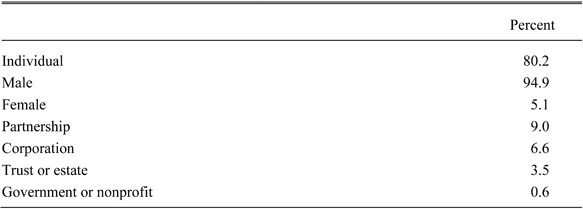
OWNERSHIP, 1826 CORPORATIONS
Sources:
See the Data Appendix.
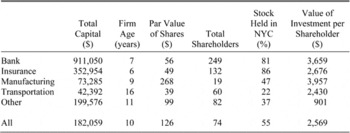
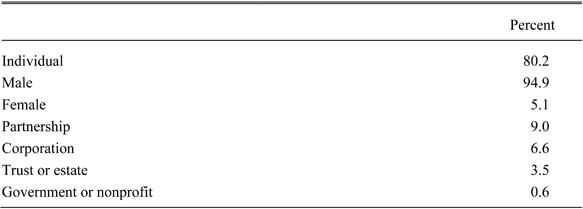
Table 3 presents summary statistics for the shareholders of the 133 (out of the 282) corporations for which a stockholder list could be found. The corporations were owned overwhelmingly by individuals and partnerships, and it is these owners who will be the focus of the analysis. A substantial portion of some corporations' shares were owned by trusts or estates, but the shareholder lists typically named the trustees and executors, rather than the ultimate beneficiaries.Footnote 28 Those shares were therefore excluded from the sample.
The average size and ownership structures of the corporations varied widely across industries. Banks had substantially more capital than the firms in other industries shown in Table 4. In many respects, though, the manufacturing firms were the most unusual. They had the highest par value for their shares, the lowest number of shareholders by far, and the largest average value of investment per shareholder. Banks and insurance companies both had very large average numbers of shareholders, reflecting their greater size, and reasonably low par values, which likely improved the liquidity of the shares.Footnote 29 The shares of nearly all of the banks and insurance companies in the sample were traded on the New York Stock & Exchange Board (later known as the NYSE).
INDUSTRY AVERAGES, 1826 CORPORATIONS

Sources:
See the Data Appendix.
For the 133 corporations in the sample, the addresses and occupations of all stockholders residing in New York City who could be found in the city directory were recorded. Their names and addresses were then used to obtain measures of their wealth from the city's tax assessment rolls. The assessments list real and personal wealth separately, and exclude corporate wealth.Footnote 30 Although assessors were sworn to record accurate property values, their assessments likely understated the true values.Footnote 31 As with the analysis for 1791, a random sample of households was taken from the 1826 city directory, to serve as a basis of comparison to the stockholders. This sample was equivalent in size to 10 percent of the population of directory entries.
STOCKHOLDERS VS. POPULATION: WEALTH AND OCCUPATIONS, 1826

Notes:
Occupation data is for household heads listed in the directory. Assessed wealth includes both real and personal wealth, but does not include corporate wealth. Population data is calculated from a 10 percent sample of directory entries.
Sources:
See the Data Appendix.
At least 3,000 New York City households owned shares of stock in 1826, a tenfold increase from 1791. Information on wealth and occupations in Table 5 suggests that New York's population in 1826 was a scaled-up version of its 1791 population. The occupational structure remained quite similar. The only significant changes were a decline in the share engaged in the provision of services and a small increase in the share of those listed as merchants. Average wealth grew nearly threefold from 1791, a clear sign of rising prosperity in the city, and the rising property values that accompanied that prosperity. The average taxable wealth of stockholders also grew by the same proportion, and the ratio of the stockholders' wealth to the population's wealth remained essentially constant between the two periods, at about 2.5.Footnote 32
Among the stockholders, the occupational distribution was also similar to the 1791 values, with two important exceptions. First, the share of professionals increased substantially. This group included many individuals whose livelihoods depended on corporations either directly (such as bank cashiers) or indirectly (such as attorneys). The large size of this group potentially indicates a growing effect of corporations on employment patterns in the city. Second, public officials were no longer important stockholders.Footnote 33 Although the public officials who owned stock were quite wealthy, they were no longer the wealthiest category of stockholders. More importantly, neither the governor, DeWitt Clinton, nor U.S. Senator Martin Van Buren, the most powerful figure in the state's Republican Party, were stockholders in any New York corporation. As in 1791, within every occupational category, the stockholders were wealthier than the general population: artisans and retailers did own stock, but they were the more successful or wealthy members of those groups.
As New York's population grew and shifted uptown over time, the city's wards were reconfigured repeatedly. By 1826 the ward boundaries had almost no relationship with those of 1790/91. Figure 1 presents maps of the city for 1791 and 1826, with the ward boundaries in place at those times, and the location of each operating business corporation marked. In 1826, the majority of corporations were located in the First Ward, and nearly all of those were headquartered on Wall Street. Many of these Wall Street firms were banks and insurance companies whose shares were traded on the NYSE, but they also included some manufacturing and mining firms.
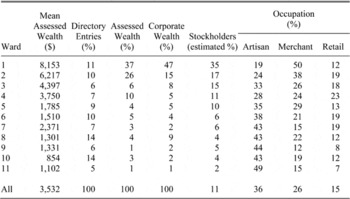
Comparisons of Tables 2 and 6 indicate that the proportion of households that owned stock had nearly doubled, from about 6 percent in 1791 to 11 percent, and in the richest First Ward the rate was 35 percent. But there was greater inequality across wards in 1826, with households in the First Ward having an average level of taxable wealth that was nearly tenfold higher than that of the poorest ward. In fact, although the First Ward accounted for only 11 percent of directory entries, households there held 37 percent of total assessed wealth and 47 percent of total corporate stock. Following the rows down the table, and thus moving toward the “mechanic” wards uptown, the proportion of artisans increases, the average level of wealth decreases, and the rate of stock ownership decreases. But wealth and stockholding were imperfectly correlated, and even in some of the wards where average household wealth was relatively low, the rate of stock ownership was as high as 10 percent. The overall Gini coefficient for the distribution of assessed wealth was .65, which was essentially unchanged from its 1791 value of .66.
Did the composition of stockholders vary by industry? Perhaps the shares of companies in specific industries were attractive to particular types of investors. One might imagine, for example, that large publicly traded banks and insurance companies would be attractive to passive investors from middle-income households, whereas shares in manufacturing companies, which were highly illiquid, would have been more attractive to individuals with some knowledge of or connection to the firm, as Lance Davis has shown of New England's textile companies.Footnote 34
STOCKHOLDING, WEALTH, AND OCCUPATIONS BY WARD, 1826

Notes:
Mean assessed wealth is the mean value of taxable (real and personal) wealth recorded on assessment lists for household heads whose primary residence is listed in each ward, and may include real estate located in other wards. Percent of directory entries indicates the share of total individuals and businesses (usually household heads and partnerships) in each ward. Percent of assessed wealth is the share of taxable wealth held in each ward. Percent of corporate wealth is the total stock owned by households or businesses located in each ward as a share of total stock owned by all individuals and businesses where an address could be found. The percent of households that owned stock is estimated by apportioning the stockholders who could not be identified uniquely in the directory into wards at the same rate as stockholding households listed in the directory.
Sources:
See the Data Appendix.
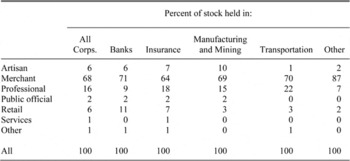
Table 7 presents a breakdown of the occupations of shareholders by industry.Footnote 35 The occupational distributions of the stockholders across industries were generally similar, and those of bank and insurance companies were nearly identical to one another. In manufacturing firms, artisans owned shares at a substantially higher rate than they did in other industries. It is worth noting that the transportation companies, which included turnpike roads, bridges, canals, and steamboat companies, were mostly located outside of New York City, and it was probably wealthy merchants who owned land in the areas where the companies were located who bought shares in those firms—their local shareholders may have had a somewhat different occupational distribution.Footnote 36 In any case, the investors in transportation companies and companies grouped into the residual “other” category (which included a water company, a trading company, a gas company, etc.) were highly concentrated in the elite categories of merchants and professionals, and received very little investments from almost any other occupational group.
OCCUPATIONS OF NEW YORK CITY STOCKHOLDERS BY INDUSTRY

Notes:
Values calculated based on total holdings of all households whose occupation could be identified.
Sources:
See the Data Appendix.
STOCKHOLDING AND POLITICAL AND ECONOMIC CHANGE
In the 35-year interval between 1791 and 1826, New York's politics changed considerably. Popular participation in politics expanded, and the old aristocracy saw its influence in the state's politics gradually diminish.Footnote 37 Progress was made toward the elimination of slavery through a gradual manumission act in 1799, which was then strengthened in 1817.Footnote 38 Political “societies” and voluntary organizations emerged, mobilizing political participation and creating the foundations for the Second Party System of the Jacksonian Era.Footnote 39 A relatively new species of political figure, the professional politician, emerged. Beliefs in “inherent, irradicable differences among men” which formed the basis of the hierarchical order of society were rejected.Footnote 40 To be sure, many aristocratic landowners and merchants remained important figures in the state's politics, but individuals of more modest levels of wealth demanded much greater influence. And in 1821 this process of democratization culminated in a new constitution that abolished the Councils of Appointment and Revision and effectively eliminated property qualifications for voting by adult white males.Footnote 41
Did this political transformation expand access to the corporate form, or change the character of the corporations that were created? Certainly the names chosen by incorporators for their enterprises began to change. Whereas early New York charters were granted to the Bank of New York, Merchants Bank (incorporated 1805), and New York Insurance (1798), later incorporations included the Mechanics Bank (1810), Farmers Fire Insurance and Loan (1822), Tradesmen's Bank (1823), and Tradesmen's Insurance (1825). This tradition would ultimately continue with institutions such as the Butcher's and Drover's Bank (1830) and the Leather Manufacturers' Bank (1832). Likewise, petitions and memorials seeking corporate charters claimed that they would operate in the uptown “mechanic” wards of Manhattan—neighborhoods that had attracted few investments from “persons owning large quantities of property.” They argued that the profits from providing services in those neighborhoods should be earned by a company in which “those who have to pay the money have an interest.”Footnote 42 But whether these newer corporations were actually owned or managed by groups previously excluded from access to the corporate form, or whether these were merely cynical gestures intended to win political support for a charter, is unclear.
If the process of democratization of the state's politics actually did allocate corporate charters to previously excluded groups or create corporations owned by households that were less wealthy than their predecessors, then the aggregate statistics for the ownership of all corporations in 1826 presented in Table 5 likely concealed this pattern of change. In order to investigate the effects of democratization on incorporations, the ownership of corporations of different “vintages” in 1826 are compared. The hypothesis to be investigated is that newer corporations—those created in more democratic eras—would have been owned by less wealthy or prominent shareholders. As the New York City stockholders that are the focus of this article frequently constituted a small minority of the total shareholders of upstate corporations, the analysis will focus on the 53 corporations located within the city for which an ownership list could be found for 1826.
Before examining the data, it is worth noting that any initial differences in the ownership of corporations created in different eras likely dissipated over time. One might expect, for example, that the ownership of new corporations would be quite concentrated in the hands of the founders, but would gradually diffuse as the founders sold off their stakes and other investors purchased the shares.Footnote 43 Moreover, if newer companies' prospects were less certain, one would expect their shares to be held by specialized investors who would be best able to gauge and perhaps hedge their risks. This would imply that older corporations would tend to have more diffuse ownership and larger numbers of small investors than they had initially, thus obscuring any differences between those corporations and their successors created in a more democratic era.
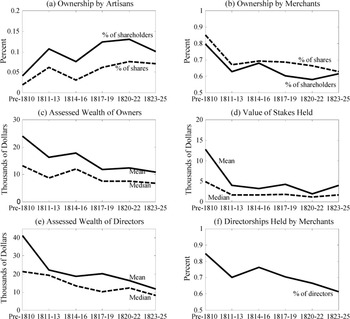
Figure 2 presents the ownership of New York City's corporations in 1826 by charter year. The data are grouped into three-year periods because in some years there were very few incorporations. Panels A and B plot the ownership rates of artisans and merchants, both in terms of the percentage of the stock held, and the percentage of the stockholders. Although the rate of ownership by artisans generally was low for corporations of all ages, newer corporations tended to be owned at a higher rate by these men, and the rate of ownership of merchants was generally lower for newer firms as well. Corporations chartered in later years attracted investments from less-elite households at higher rates —and these households were less elite not only in terms of their occupations, but also in their level of wealth. Panel C plots the mean and median assessed wealth of stockholders, which was generally lower for firms incorporated in later years. In fact, the average wealth of investors of corporations chartered prior to 1810 was nearly 2.5 times as high as that of the investors in corporations chartered in 1823 or later—a difference of the same magnitude as that between stockholders and all households. Panel D plots the size of the blocks in which the shares of corporations were held. This was generally higher for corporations that had been formed earlier, although most of this difference was due to corporations chartered in the earliest period. Although the ownership of corporate stock was still relatively uncommon and median household wealth ($1,683) was quite low relative to the cost of a single share (usually $50), stock ownership was clearly becoming more common among less-elite segments of society. Thus, despite the tendency of the shares of older firms to become widely held, persistent differences in the wealth and status of owners among corporations created in different eras were clearly observable in the stockholder lists of 1826.
1826 STOCKHOLDERS' CHARACTERISTICS, BY CHARTER YEAR OF CORPORATION (New York City corporations only)

If the stockholders of newer corporations were less wealthy, what about the men who actually controlled the enterprises, and were best able to profit from their operations? Perhaps the directors of the newer firms were drawn from the same parts of society as their counterparts in the older ones and simply acted to attract investments from more ordinary households. This possibility is investigated in panel E of the figure, which compares the wealth and status of the directors of corporations of different vintages for the 44 corporations for which both a list of directors and a stockholder list could be found. As the panel makes clear, the contrast in the level of wealth of directors of newer and older corporations was even more dramatic than the contrast in the level of wealth of the shareholders. Older corporations were managed by much wealthier directors than new ones. And as panel F makes clear, the directors of new corporations were much less likely to be drawn from the city's elite merchants.Footnote 44
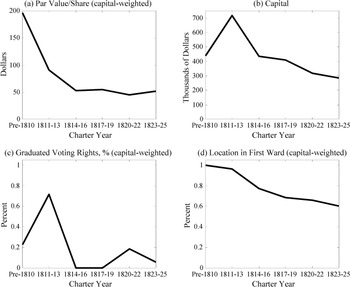
Did the charters of the newer corporations contain provisions that made an investment in their shares more attractive to small investors? Figure 3 plots several firm characteristics by year of incorporation. The average par value of the shares of corporations in panel A falls dramatically, from about $200 for early charters to about $50 for corporations chartered in 1814–1816, and remains roughly the same for corporations chartered subsequently. Although lower par values would likely have made the shares more liquid, and thus more attractive to any investor, this effect would probably be greatest for an investor making a small investment. Thus, it probably made the shares more accessible and appealing to investors of limited wealth. Larger firms seeking to raise significant amounts of capital from subscribers might have been forced to appeal to small shareholders. The average capital per corporation in panel B is generally lower for corporations chartered later, except for the group chartered in 1811–1813, when the state chartered several enormous banks in the aftermath of the expiration of the charter of the Bank of the United States. The percentage (weighted by capital) located in New York's First Ward in panel D was lower for newer corporations. Finally, panel C plots the percentage of corporations whose charters imposed a “graduated voting rights” scheme, in which the votes per share to which an investor was entitled was a decreasing function of the number of shares that investor held.Footnote 45 These measures were commonly imposed in early corporations, as a mechanism for protecting small investors. They became increasingly uncommon over time, however.Footnote 46
1826 CORPORATIONS' CHARACTERISTICS, BY CHARTER YEAR (New York City corporations only)

In sum, in 1826 the investors and directors in the city's newest corporations were quite different than those of the city's older corporations. This could have been due to efforts to configure newer corporations' charters in a way that made them appealing to nonelite stockholders, to efforts to market the shares to ordinary households, or simply to the persistence of elite ownership among the older firms. On the other hand, this may have been due to the subtly changing industrial composition of the firms over time. Moreover, it is not clear to what extent the changes in ownership were due to changes in the characteristics of the firms, such as the decreases in the par values, or to other factors such as the political orientation of the government that authorized the charter.
Regression Results
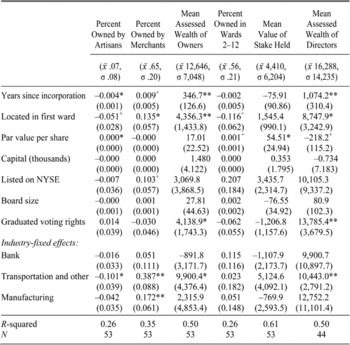
We investigate these issues in greater depth by aggregating the above data to the firm level and performing regressions to analyze the correlates of individual firms' ownership structures. In order to understand the extent to which the changing characteristics of firms over time explains differences in their ownership structure, we include data on firm locations, par values of shares, board sizes (sometimes used to expand shareholder representation), capital, and indicators for whether or not the firm's shares were traded on the NYSE, whether or not its charter specified graduated voting rights for its shareholders, and industry fixed effects. With the number of years since incorporation also included in the regressions, these specifications will enable us to investigate the extent to which the characteristics of firms can account for their changing ownership structures, conditional on the firms' ages. It is important to note that many firm characteristics were endogenously chosen by incorporators, or as in the case of listing on the NYSE, may even have been influenced by the ownership structure itself. Therefore, the estimated correlations cannot be interpreted as causal. Nonetheless, they do shed some light on which characteristics of corporations were correlated with their ownership structures.
Table 8 presents the results of regressions for six different measures of ownership structure. The results for all of them convey the same insight, which is that the owners of older corporations were likely to be wealthy elites. In all but two of the specifications, the years since incorporation variable exerts a powerful and statistically significant effect, even with the corporate characteristics added into the regression as covariates, indicating that these characteristics can only partly account for the differences in ownership across firms of different vintages.
With all but one of ownership variables, the corporation's location clearly mattered. The assessed wealth of owners, the percent owned by merchants, and the assessed wealth of directors were all about half of a standard deviation higher for corporations located in the First Ward. Corporations in the First Ward also had fewer shareholders from the upper wards and fewer artisan shareholders, and these differences were also equivalent to about half a standard deviation. Corporations in the First Ward clearly attracted investments from the wealthy merchants living there, whereas those in the upper wards were more likely to attract investments from local artisans. It is possible that these firms attracted investments from their local customers, but it may also have been the case that investors preferred to hold shares in nearby companies that were familiar to them, a pattern that has been observed among modern investors.Footnote 47 It is also likely that entrepreneurs anticipated these ownership patterns in their decision over where to locate their firms, and operated in the neighborhoods where they hoped to attract investments.
REGRESSIONS: OWNERSHIP STRUCTURE IN 1826 NEW YORK CITY CORPORATIONS

Notes:
+ denotes significance at 10 percent.
* denotes significance at 5 percent.
** denotes significance at 1 percent.
Notes:
Robust standard errors are in parentheses. The excluded industry category is insurance. In the column headings,  denotes the sample mean, and σ the standard deviation.
The total ownership of merchants, who included brokers and speculators, was about half a standard deviation greater for companies whose shares were traded on the NYSE. The mean assessed wealth of the owners of these firms was also substantially higher, although this latter effect was estimated imprecisely. And firms grouped into the “Transportation and other” category were much more likely to be owned by merchants, had wealthier stockholders and directors, and were much less likely to be owned by artisans, relative to the excluded industry, insurance companies. These transportation industry effects were all equivalent in size to around a full standard deviation.
Finally, corporations with graduated voting rights attracted investments from wealthier stockholders, and were operated by wealthier directors, although the occupational distribution of their shareholders was no different. This result may seem counterintuitive, if those voting structures were intended to protect “small shareholders.” However, graduated voting rights protected investors holding small numbers of shares, not necessarily those with little wealth. If wealthier investors were more conservative, they may have been attracted to holding stakes in companies with voting rights configured in that way. Alternatively, since graduated voting rights were more common among older firms, it may simply have been the case that wealthy investors preferred to invest in these well-established companies, and the years since incorporation variable in the regression may not be fully capturing the effects of firm age.
Taken together, these results indicate that only some of the variation in the ownership structure of corporations of different ages can be explained by changes in the characteristics of the companies chartered over time. The corporations of the 1820s were created in a more democratic economy, by a more democratic government, and their ownership responded in ways that cannot be fully explained by the provisions written into their charters, or the other characteristics of the corporations included in the regressions. Perhaps other factors much more difficult to measure, such as efforts to promote the shares to particular segments of the population, or the reputations of the founders, may also have influenced the ownership of the firms.
Discussion of the Results
It is important to note that these results do not in fact indicate that as New York became more democratic, potential incorporators from throughout society were able to obtain corporate charters as frequently as they wanted, or on the terms they wanted. Powerful incumbent interests may have dictated the terms under which newer corporate charters were granted and imposed conditions on new entrants that prevented them from competing too directly, either for capital or in markets for goods and services, with existing firms. The decision to operate in uptown wards, or to make the shares attractive to small investors, may have been imposed on the new firms as a condition on their existence. Indeed, the announcement by potential incorporators of their intention to operate in neighborhoods “remote from the vicinity”Footnote 48 of Wall Street may have been intended as a pledge not to compete too directly with incumbent firms. The requirement to adhere to this pledge was sometimes written into law.Footnote 49
But the results clearly indicate that New York granted access to corporate charters to increasingly less wealthy and lower status individuals over time. In light of these data, what are we to make of the virulent anticorporate rhetoric of the 1820s and 1830s? If we are to accept this rhetoric at face value, then perhaps critics of corporations distinguished between the enterprises themselves, on the one hand, and their owners, on the other, and intended to attack the former rather than the latter. One prominent anticorporate pamphlet characterized some of New York's 1820s corporations as “pernicious vermin” that would “destroy all equality,” while at the same time referring to individuals who have “fairly invested their money, and have a fair right to profits.”Footnote 50
Alternatively, critics of corporations may have distinguished among corporations of different vintages, and the character of the rhetoric aimed at the newer corporations may have come from different sources. Conservative jurist James Kent referred to New York's profligate grants of charters in the 1820s as “improvident” and “evil,” and legislator John King, at New York's 1821 Constitutional Convention, argued that newer corporations had produced “great public mischief.”Footnote 51 Both men fundamentally respected the vested rights of incumbent corporations, and opposed Republican governments' openness to petitions for charters from the “less respectable” orders of society, for fear that the rights of existing corporations would be eroded. Many of the incorporators criticized by Kent and King were keenly aware of the erosion of vested privileges created by widespread use of the corporate form, and explicitly offered this justification for their own requests for access to charters.Footnote 52
However, much of the anticorporate rhetoric of the era certainly should not be accepted at face value. Charges of “monopoly” were a powerful weapon in the era of Republican governments, and were cynically wielded by men who competed with, or hoped to compete with, incorporated businesses. This rhetoric may have helped produce the broader ownership of New York's newer corporations in the 1820s, perhaps by pushing legislators to grant broader access to charters, or to configure charters in ways intended to appeal to less wealthy investors. As Pauline Maier has noted, the agenda behind anticorporate agitators may have been to influence the design of corporations that got created, rather than to block the creation of corporations. The data in this article has shown that these agitators were at least partially victorious.Footnote 53
CONCLUSION
The proliferation of business corporations in the early nineteenth century exemplifies the zeal of early state governments to use the law to promote economic development. Access to the corporate form was expanded over time, and the corporation became a familiar part of economic life. Within the 35 years between 1791 and 1826, the ownership of corporations changed as well. In 1791 aristocratic landowners and merchants controlled both the state government and the corporations it created. By 1826 political figures were no longer important stockholders, and a much broader segment of society participated in the creation and ownership of corporations. Charters were granted for businesses that operated even in the “mechanic” wards of uptown Manhattan, and ownership of shares of stock spread into those neighborhoods as well. To be sure, the elite merchants who dominated commerce in New York also held the majority of corporate stock. When measured as a percentage of total capital, the stockholdings of artisans and those of modest wealth were relatively small. But at least some of the new enterprises incorporated in the 1820s were created to be owned and managed by men who lacked the pedigree and wealth of the prominent merchants who controlled the older, better-established corporations in the city. Stanley Engerman and Kenneth Sokoloff have argued that the rapid economic growth of the period was associated with an institutional evolution that facilitated broader access to economic opportunity; the results presented here represent a noteworthy example of this process.Footnote 54
The liberal use of the corporate form in the 1820s was not the same as free or open access to incorporation. Petitions for charters in some industries remained highly contentious, and often failed, as incumbent firms and their allies worked against the creation of firms that threatened their interests. In the legislature, intense lobbying, “log-rolling” strategies, and even bribery were all part of the politics of chartering. The dramatic change marked by the era of broader participation in politics was that political figures supported by mechanics and tradesmen were able to successfully compete within this legislative environment, and managed to create corporations that were quite different from those of earlier generations. There was certainly a fair measure of cynicism in these efforts, and the creation of the “Tradesmen's Bank” should not be confused with a purely altruistic effort to benefit tradesmen. Nonetheless, the results of this article have shown that the corporations created in the 1820s were in fact managed and owned by men of less wealth and lower status than those created in earlier eras.
Data Appendix
1791 Sources and Data: The list of stockholders for the Bank of New York in 1791 is in Nevins, History, and that of the New York Manufacturing Society in the New York Daily Advertiser, 17 March 1789. The Manufacturing Society list does not include the number of shares held by each investor. Names were then matched to the Federal Census of 1790, the city's 1789 tax assessment list, and the 1791 New York Directory and Register, which provided addresses and occupations. In 1791 there were 343 unique shareholders, of which 300 likely resided in New York City, and of these, 262 could be uniquely identified. A random sample of households was taken from the 1791 directory, by recording all of the entries on every sixth page, which yielded 776 out of 4,752 total entries, or 16.33 percent. These were also matched to the 1790 Federal Census, and to the 1789 tax assessment list. In addition to the two corporations, the 1791 New York City directory lists an unincorporated joint stock insurance company in operation, the Mutual Assurance Society, which would become incorporated in 1798. Eleven of the twelve directors of the Society were stockholders in one or both of New York's corporations, and four of the twelve were directors in one of the corporations. It is quite likely that the ownership of this third enterprise was substantially the same as the two incorporated firms.
1826 Sources and Data: The stockholder lists for the 1826 corporations are held mostly in the New York State Archives in various record groups associated with the comptroller's office, including A0833, A0829, and A0847. The sample of 133 corporations includes $26.3 million of the $48 million total paid-in capital in the state and $19.1 million of the $34.8 million incorporated capital held in New York City. The 1826 shareholders' names were matched to entries in Longworth's American Almanac, New-York Register, and City Directory (1826) to determine the address and occupation of shareholders who lived in New York City. The corporations had a total of 6,534 unique stockholders, 6,019 of which were individuals or partnerships and 2,999 of those were listed as residing in New York City, of which 1,743 could be uniquely identified in the city directory. Household heads with no occupation listed, which included many prominent figures such as John Jacob Astor and Nathaniel Prime, were classified as merchants. We then located the addresses on contemporary maps, particularly W. Hooker's Plan of the City of New York (1825) and S. Marks' A New Map of the City of New York, Comprising All the Late Improvements (1827), in order to identify the ward within which the stockholder resided. Most stockholders had only one address listed, but some had two addresses. The tabulations in the article are based on primary business addresses. With the address, we were able to look up each shareholder within the city's tax assessment records for 1826 to determine the assessed value of real and personal wealth, which were combined to calculate total assessed wealth. Real and personal property assessed at primary and secondary addresses were recorded, but any real estate holdings not corresponding to a listed address could not be included: there is no index to the assessment lists. For 1826 a sample of households from the city directory was collected by entering every tenth page of the city directory. This produced a sample of 2,798 out of 27,500 total entries (or 10.17 percent). The sample households were also matched to the directory and to the tax lists. Charters for all New York City corporations were coded from Laws of New York, 1791–1825. Lists of directors for New York City corporations were found by searching contemporary newspapers, including the New York Evening Post, Commercial Advertiser, Enquirer, and American. Finally, corporations were denoted as NYSE traded if a price could be found for them in any month in 1825 or 1826 in Sylla, Wilson, and Wright, Price Quotations.