Introduction
Many legislatures have recently considered the legalization of euthanasia, physician-assisted death, or assisted suicide Footnote 1,Footnote 2,Footnote 3 The claim presented here is that most of these initiatives will probably lead either to no legal changes at all or to the introduction of essentially unhelpful and frustrating laws. This is because the matter involves competing ideologies that cannot be easily reconciled.
The most popular demand is that suffering should be stopped, even if it means hastening death deliberately, if nothing else helps. Top media stories focus on terminally ill patients who are in intense pain and on people suffering from slow-onset diseases. The former may or may not face inadequate palliative care; and the latter are expected, in time, to become unable to look after themselves or make decisions for themselves. Therefore, there are two main concerns here. People worry about suffering that they cannot control, and they worry about inability to function because of illness and old age.
The most popular ethical and political justification for assisted dying is our right to decide about our own treatment. We are autonomous individuals and we are the ones who should make the choices that have an impact on our life and health, death, and dying. This right to decide can be limited, if our choices and actions threaten to harm others or to violate widely accepted moral rules or deeply rooted cultural beliefs. The standard reading in medical ethics and law is that the harm to others has to be quite probable, as in the case of infectious diseases warranting quarantines. With moral rules and cultural beliefs, the reading is not so clear. A presumption prevails, however, that uncoerced, self-directed, well-informed choices regarding our medical treatment should be respected. Footnote 4
The problem here, put briefly, is that the justification and the popular demand appeal to two separate, and partly competing, ways of thinking, and address different issues. A commitment to self-determination offers no relief to the suffering of very young children with incurable diseases. Nor does it help in the cases of advanced dementia or other types of disorientation and anxiety associated with illness and ageing. Similarly, the pity felt for suffering infants does not readily extend to rational adults who want to die because they are bored with their lives.
How this tension dwarfs principled legislative change will be clarified in the following. The first section offers a concise analysis of the fears that we have in relation to death and causing death. The second shows how a simple set of liberal premises collides with the professional code of physicians. And the third goes on to show how autonomy-based justifications can support only a limited set of legislative changes; a set that addresses poorly popular demands for humane treatment in cases of irremovable suffering and confusion.
Our Fears
Matters of life and death in medicine can be usefully approached by explicating four interrelated notions, namely:
-
• The fear of death
-
• The fear of unintentionally causing death
-
• The fear of life
-
• The fear of intentionally causing death
I will consider these in some more detail.
Death as Evil, and the Fear of Causing it Unintentionally
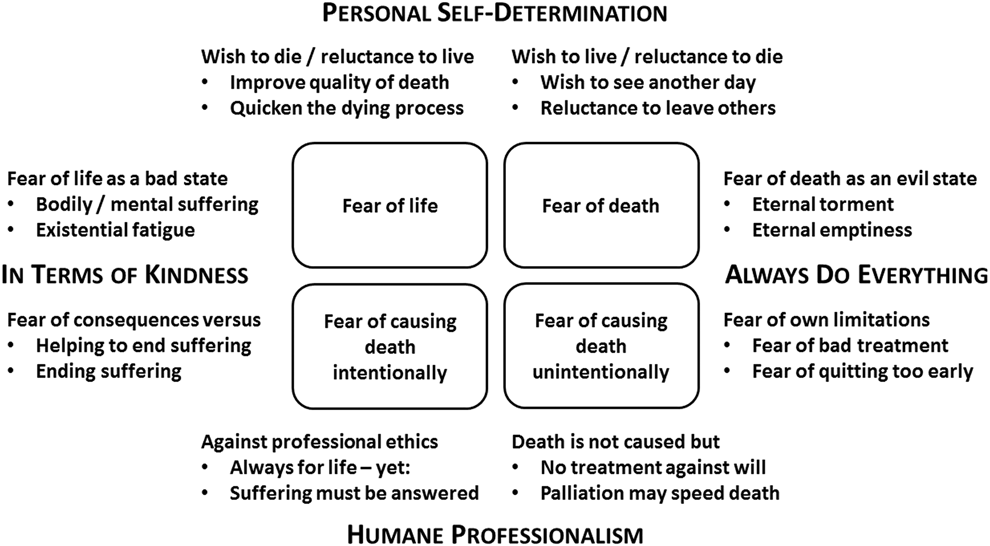
The fear of death in its most atavistic form means being afraid of death as another kind of being, as opposed to the life we live now. Many interpretations are possible; however, in some of the world’s most pervasive religions the ideas of utter emptiness or eternal torment feature prominently. Some kind of hell awaits us when we die, and this makes for a strong incentive to keep on living, maybe for as long as we can.
The fear of causing death unintentionally is related to professional and emotional insecurities. Some doubt, in the early stages of their career quite reasonably, their own skills in situations that involve prolonging lives. Others, also later on into their professional lives, recognize the social and financial pressures that may contribute to suboptimal treatment. And all those whose work involves seriously ill or old and frail patients have to face the difficult choice between continuing a course of treatment (even if it does not seem to make the patient any better) and letting go (without feeling that one has abandoned the patient).
A combination of these two factors, fear of death as a positive evil and fear of causing death by doing something wrong or deserting those in our care, can lead to an attitude, more prevalent a few decades ago than now, that everything always has to be done to keep the patient alive. This is fairly natural given the premises. If death is a very bad thing and we as health professionals stand between that very bad thing and our patients, our duty is clear.
Another reason to fear death is provided by the hope and wish to keep on living. This hope can be self-regarding: a wish to experience yet another day. Or it can be other-regarding: a wish not to leave near and dear ones behind. A normal stance in this matter is probably a mixture of both: I do not want to die just yet, and besides, what would happen to my family and friends if I were not here? (Yes, it does sound arrogant put this way, more like a rationalization of one’s own desire by projecting it onto others. Perhaps it is just that, at least in some cases.)
Death as Good, and the Fear of Causing it Intentionally
Most people in most situations prefer to keep on living. However, preferring can go both ways, and in some situations some people do not want to continue living. They may wish an inevitable end to come quicker, or they may wish to die more easily. The motivation in these cases comes from a fear of life, as experienced by the one living it. And the source of this fear can be physical suffering, mental suffering, or (as in some recent Belgian cases) existential fatigue. Footnote 5
A legal and ethical system that is aimed at promoting people’s wishes places high value on the idea of personal self-determination. This implies, roughly, that individuals themselves are the best judges when it comes to decisions concerning their lives and deaths, well-being and ill-being, as long as the consequences of these decision are not harmful to other, unconsenting parties. The questions of freedom, liberty, autonomy, self-rule, and harm to self and others, have been abundantly discussed in philosophical literature, Footnote 6,Footnote 7,Footnote 8,Footnote 9,Footnote 10 and the concepts and their use are, and will remain, debated. The meaning of the term personal self-determination in the present context will become clearer as I proceed to its alternative in matters of accelerating the end of life.
As for causing death intentionally, two sets of motives clash in the minds and practices of medical professionals. There are circumstances in which suffering seems unbearable and helping to end it is desirable. Professionals can then show how their patients can end their lives themselves quickly and safely. (There are many names for this activity, but they are all ideologically biased, and will not be used here.) Or professionals can administer medication that is meant to end the patient’s life quickly and safely. The other set of motives offers an opposite force. Legislation in most countries, common morality in most cultures, religious rules, and the self-proclaimed professional ethics of physicians agree that physicians are not, and should not be, allowed to kill their patients (or help them to kill themselves; but this is more ambiguous).
The prohibition of killing can, however, be interpreted in many ways. Hardly anyone currently believes that everything should always be done to keep patients alive. Compassion and caring prompt physicians to find creative solutions to real-life situations. A variety of excuses is available to end-of-life experts who do not want to prolong their patients’ suffering. Pain and anxiety can be managed adequately, and even if the medication required for the job would be likely to shorten the patient’s life a little, this can be ignored in the name of kindness. Treatments can also be withdrawn at the patient’s request, and laws in many countries actually make this obligatory for medical professionals.
Tensions Created by Our Fears
The sum total of these considerations is that there are two main tensions. Aspirations to be kind and caring struggle to find their place alongside with the “always preserve life” rule of the medical profession. And even if the balancing act succeeds, humane professionalism will not be entirely compatible with the more general principle of individual self-determination. These tensions and considerations are presented schematically in Figure 1 .
The elements of fear in life-and-death decisionmaking.

How Tensions Are Fuelled By Interpretations
Some Liberal Assumptions as a Pathway to Trouble
A set of relatively innocuous-looking liberal (for want of a better word) presuppositions shows how tensions can start to build. I will assume, first of all, that there is no life after death, at least not in the sense of there being any kind of hell. This assumption will promptly remove half of the foundation for the “Everything must always be done to postpone death” outlook.
The wish to live still provides a strong argument for not hastening a patient’s death, but this discussion can be limited to cases in which this wish is not present. This article is mainly concerned with situations in which the patient wants to die rather than continue living. Fear of death, in some sense, may be present, but if an individual can convince us that death is, on balance, preferable to continued life, then there is a solid liberal case for respecting the preference.
Professional hesitation can be well justified, or not. No one wants bad care, and no one wants the exhaustion or inexperience of a physician to dictate important decisions. Inadequate arrangements for palliative care are also a concern, as are the psychological effects on healthcare professionals, but doing everything, always, to preserve life, whatever its quality and whatever the patient wants, is surely not the answer.
Going down the liberal path, then, it seems that the only good alternative for physicians is to pay close attention to the condition and views of those in their care, and to opt for the humane professionalism approach. Patients can refuse treatments, pain medication can be increased even at the risk of hastening death, professional codes will be observed, and everyone should be satisfied. Stretched to the limit, this means that a patient whose death is looming and whose pain cannot be controlled by even the most advanced palliative care, can be put to sleep, terminally sedated, in the sure and certain expectation of a timely and painless end (not a universally approved alternative, but a technically possible one).
The Difference Between Humaneness and Taking Autonomy at its Full Value
Why does this not convince the liberal? Because the decision will still be a medical one, and individual autonomy is only a contributing factor, not the foundation, of the choice. The medical judgement will be preference observing, but not, as such, autonomy driven. This may seem like an artificial distinction; however, it is a real one, and it does have an impact on current attempts to effect legislative change. The professional verdict, well supported as it may be, takes responsibility for matters that it does not need to, and muddles the motives and justifications involved in end-of-life decisions. A general example will clarify this.
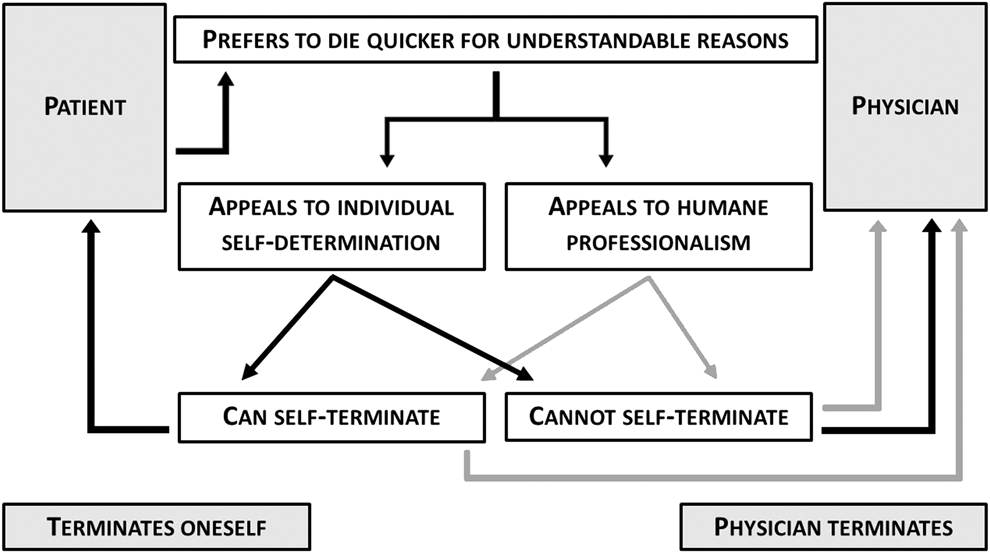
Assume that a person wants to die sooner rather than later, for reasons that are understandable. (The next section will list a variety of reasons that have been found understandable in life-and-death situations). The two main lines of justification open to the person are individual self-determination and humane professionalism. Another variable is that the person can be either capable or incapable of causing the preferred death without decisive action from others.
An appeal to humaneness implies that whether self-termination is possible or not, the final decision should be made, and the final deed committed, by a physician. This is what a consistently liberal view would take issue with. It is entirely possible that patients do not explicitly want to make the ultimate choices and act them out. The liberal outlook, however, assigns duties as well as rights. Footnote 11 If the selected justification is self-determination, then it stands to reason that those who are capable of self-termination (by administering the lethal dose themselves or otherwise) should take the responsibility for it. If this is not physically possible, they can ask physicians to lend a helping hand, but they should not impose the task on others if they can perform it themselves.
The elements of the different scenarios are presented schematically in Figure 2.
The elements of choice in life-and-death decisionmaking.

Why is all this so important? Why would it matter who makes the final decision, and pushes the button? Some very caring physicians argue that because the situation is medical, and they have the appropriate medical knowhow, it is, in the end, their job to do what is needed. This is partly because they do it best (safely, efficiently, and without complications), but also because they feel that as carers they have a professional duty to help their patients also when times get rough. Footnote 12 And there is absolutely nothing wrong with this attitude. It is just that the mixture of motivations and justifications involved becomes complicated when society tries to apply these considerations to legislative reforms. I will discuss how, exactly, this happens.
Understandable Reasons and their Uneasy Relationship with Legislative Justifications
The Diversity of Understandable Reasons and Preconditions
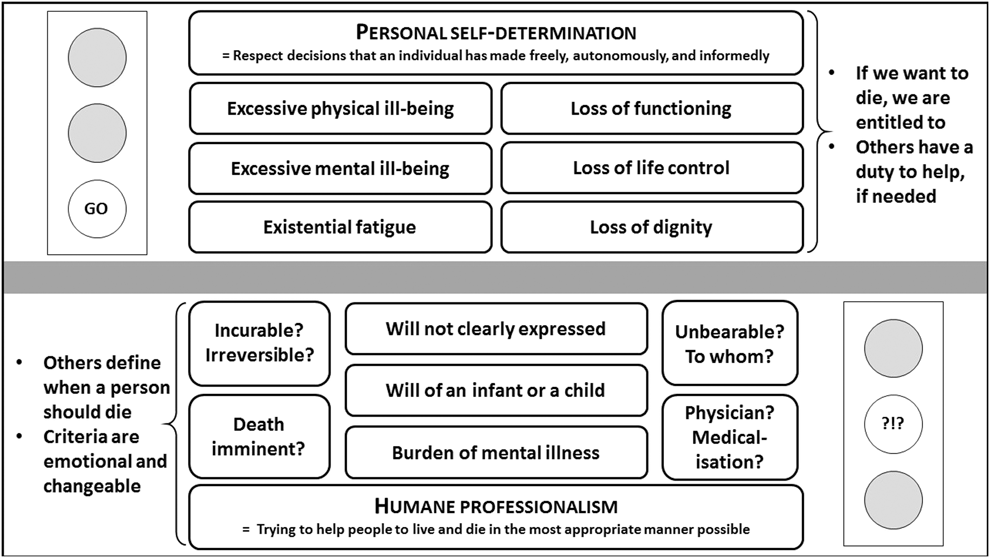
The main understandable reasons given for a preference to die sooner rather than later are excessive physical ill-being, excessive mental ill-being, and existential fatigue. They are usually considered to be either more or less reasonable in the order given here, but they all have their advocates. The language of pain, suffering, and anguish is often used in the first two cases, but there are so many types of physical and mental ill-being that no one word can sufficiently describe the variety. Existential fatigue is the most ambiguous, but it, too, has been gaining ground lately as a reason for choosing to die.
Apart from how we feel, there is the functional side of things to be considered. This is where fears reenter the scene. We can be afraid of losing our capability to do things, losing the ability to control our lives, or losing our dignity. These are all formidable fears, and when slow-onset diseases threaten our performance and self-esteem in the foreseeable future, they provide good grounds for making anticipatory end-of-life plans and arrangements.
There is another, quite different, set of understandable reasons, however. Specifications are regularly made that the medical condition in question must be irreversible and incurable, and the expected death almost imminent. Noteworthy considerations, perhaps, but what exactly do they mean and imply? We are all irreversibly drifting towards death anyway. My incurable hay allergy is hardly grounds for euthanasia. Moreover, why should we stipulate that death must be around the corner? In many cases it is precisely the uncertain prolongation of ill-being that prompts the wish to die.
Other popular requirements are that the patient’s suffering must be unbearable, and that physicians should in the end be the ones to do what needs to be done. But what does “unbearable” mean here? Whose judgment are we to trust? Is it sufficient that the patient says that a condition is unbearable? Or should there be some objective checks? What if the patient lies? What if the situation is unbearable to family and carers rather than to the patient, who is possibly oblivious of the external world? And then there is the question of the physician coming back as the final arbiter. Does this restored power of the physician imply medicalizing death even more than it already is? At least autonomy in its strict liberal sense is not the primary principle acted upon here.
Matters become more and more muddled as one considers the quality of patient decisions. In some instances, the will of the patient is clear and in no doubt. This is when the choice is made and expressed freely, autonomously, and informedly by a competent individual of age in a calm and considered manner. Unfortunately, this is seldom the case except in liberal dreams. In real life, the will of the patient has more often been stated unclearly, and we as medical professionals have little or no way of knowing what the motivation behind the wish is, or has been. If the individual cannot communicate meaningfully anymore, decisions have to be made on other grounds. The situation is similarly unsatisfactory with infants, children, and people with mental issues or temporary emotional disturbance. The ill-being of a 2-year-old in severe pain and with poor survival prospects, or of a perplexed 96-year-old receiving dubious care, may concern us deeply, and these are the kinds of cases that instigate public outcries for assisted dying. However, they are deeply problematic from the viewpoints of autonomy and transparent and predictable regulation.
How Attempts to Reconcile the Elements Are Destined to Fail
How does one sort all this out? With great difficulty, it seems. The motivations and justifications, partly running parallel and partly clashing, are deeply-felt pity and a (perhaps impossibly) high standard of individual self-determination. In an ideal philosophical world, the direction of any new legislation would be clear. If autonomous individuals can make a good appeal, based on physical and mental ill-being, and possibly existential fatigue, for a quicker death, they should either be helped to reach the goal by their own actions (if they can) or others should do what is needed for them. The upsides of this are relative clarity and a fitting assignment of duties, at least from a liberal angle. The downside, if it is a downside, is that proximity of death and many other traditional caveats would have to be abandoned. If a person wants to die, for understandable reasons, there should be no time or other irrelevant caveats in play. The tabloid headlines following such a legislative reform can be easily predicted, however: “A new culture of death!” “Live as you like and die when you wish —hedonistic nihilism reaches a new high!” (Except that the difficult words “culture,” “hedonism,” and “nihilism” would give way to some more colloquial expressions.)
The success of the alternative approach is a matter of luck and cultural acceptance, or at least a notable lack of cultural disapproval. The citizens and governments of the Benelux countries and Colombia have trusted their physicians enough to allow the active ending of life in specified circumstances. Opposition is not nonexistent, but it is not markedly strong, either. It is questionable that similar constellations could be found elsewhere.
Surveys do show that some kind of end-of-life help would be welcome among the general population and healthcare professionals other than physicians, Footnote 13 but it is not clear what exactly it is that people want. Yes-answers to the question “Should euthanasia be legalized in your country?” do not mean much before it is known what kind of help and in what kinds of situations people have in mind. Judging by the popular media, it seems that they do not want Grandma Rosina or Little Billy to suffer unnecessarily. No one does. But when it comes to making laws about this, all sorts of questions of definition arise. When are conditions incurable and irreversible, when is death imminent, what amount and form of suffering is unbearable and to whom, and why and to what extent does all this matter? Add to this that physicians in most countries seem to be set to oppose changes, and that resistance from religious groups and nongovernmental organizations is likely to be strong in many parts of the world, and the success of any systematic reforms begins to appear unlikely.
Figure 3 presents a schematic presentation of the factors to be considered; above the line the formally well-defined liberal case and below the line the real-life muddle to be confronted.
Self-determination and other factors in legal end-of-life considerations.

What Else Could Be Done?
If principled attempts to legalize reasonable forms of euthanasia are doomed to fail, what can be done? Unfortunately, the answer is very little. A healthier attitude toward the finitude of life might help, but such revolution is not forthcoming anytime soon. Footnote 14 Palliative care, if extremely well organized and executed, would solve most problems, but financial aspects will prevent its widespread perfection, as they have in the past. Medically assisted self-help in dying could be a solution; however, cultural and ideological reasons block this. Therefore, people should be prepared, in most countries, to settle for what we now have: tabloid outrages, unnecessary ill-being, and empty talk about personal autonomy.