Figurines present researchers a unique, if sometimes challenging, opportunity to study the cultures that produced them. In addition to providing archaeologists with a representational medium (Bailey Reference Bailey2005), figurines offer a good deal of information about the culture of a people and the ways in which distinct cultures may have interacted across time and space. Some scholars have sought to assign a functional meaning to figurines by interpreting use through contextual information (Flannery and Marcus Reference Flannery and Marcus2005; Marcus Reference Marcus1998; Talalay Reference Talalay1993). Others have sought to look at what figurines might have meant to those who made and used them (Bailey Reference Bailey2005; Gimbutas Reference Gimbutas1989, Reference Gimbutas1991; Meighan Reference Meighan1972; Mountjoy Reference Mountjoy and Stocker1991). Still others have turned to figurines for information regarding the link between what is being represented and those who constructed the representation (Grove Reference Grove1987; Lesure Reference Lesure1999; Marcus Reference Marcus1998). Not only can figurines help to distinguish chronological sequences (Lubensky Reference Lubensky and Stocker1991; Vaillant Reference Vaillant1938); they can also help in the establishment of a cultural sequences (Meighan Reference Meighan1974), show evidence of cultural contact (Gomez Reference Gomez and Brambila1998), and offer ethnographic information about many aspects of life in ancient societies (Marcus Reference Marcus1998). However, these “other” ceramics are often overlooked in archaeology and relegated to simple mentions in site analyses. This is an unfortunate oversight due to the wide variety of information that items such as ceramic figurines, stamps, and pipes can offer archaeologists.
The Tarascan empire, which appeared around a.d. 1350 and lasted until the arrival of the Spanish in a.d. 1525 (Fisher et al. Reference Fisher, Pollard and Frederick1999), was very different from many other Mesoamerican empires (Pollard Reference Pollard1993:174). Perhaps most important to the discussion of state development is the fact that the Tarascan state possessed a high degree of centralization within the Lake Patzcuaro Basin in Michoacan. What remains unclear is the reason for the observed differences in empire-building strategies between these cultures. It has been suggested that Tarascan centralization was the result of rapid consolidation of the smaller polities in the Lake Patzcuaro Basin during the Middle Postclassic period (a.d. 1100–1300) (Pollard Reference Pollard1993:175–176). The purpose of the present analysis is to demonstrate that sufficient evidence exists in the figurine record to support ideas about the high degree of ethnic continuity in the periods leading up to and following the formation of the Tarascan state and that this continuity may help to explain the highly centralized nature of the Tarascan state during the Postclassic period.
One of the ways that figurines have been useful to archaeologists is as markers of chronological sequence (Mountjoy Reference Mountjoy and Stocker1991; Vaillant Reference Vaillant1931). For such sequencing to be useful, however, typologies must be created for the figurines of a particular region. Because no previous typology for figurines from the Classic through the Postclassic periods exists, I have attempted to identify typological markers within the figurine complex. Although this typology is still being developed, it demonstrates the utility of figurines as markers of cultural continuity between pre-state and later, state-level groups in the Tarascan region. Based on this preliminary typology, this paper synthesizes chronological and cultural data to provide insight into how the people of Michoacan constructed their ethnic identity.
CONTEXT OF CULTURAL CONTINUITY
To provide a context for understanding the Patzcuaro Basin figurines, it is helpful to review evidence for continuity in the archaeological and cultural records of the Tarascan region in the periods leading up to and following the rise of the Tarascan state. This is not meant to be an exhaustive review of Tarascan culture (see Pollard Reference Pollard1993 for a more detailed examination of the Tarascan state) but, rather, to serve as a cultural context within which to place the ceramic figurine traditions for the region.
There has been a long history of occupation of the Lake Patzcuaro Basin, with the first signs of settlement occurring near the beginning of the Early Classic period (ca. 100 b.c.), with evidence for an Archaic-period occupation (7000–2000 b.c.) in northern Michoacan (Pollard Reference Pollard1993:6). Occupation in the Lake Patzcuaro Basin eventually gave rise to the Tarascan empire during the Late Postclassic period (a.d. 1350–1525) with the arrival of the Chichimec group called the uacusecha, who eventually came to represent the ruling elite of the Tarascan empire (Relación de Michoacán Reference Mendoza2000 [1541]). Throughout the sequence, there seems to be evidence of cultural continuity within the region despite contact with neighboring cultural and ethnic groups. The Lake Patzcuaro Basin (Figure 1), which eventually became the core of the Tarascan empire, seems to have had a surprising degree of cultural unity dating back as far as the Preclassic period that may be linked to the region's distinctive Purepecha language. In addition to the distinct language of the Tarascan people, the unique structure of the stepped ceremonial platforms known as yacatas found at Tzintzuntzan (Pollard Reference Pollard1993:45–50), distinctive clothing styles that do not include several common highland styles, and metallurgical practices serve as defining characteristics of the Tarascan culture, all of which set it apart from other Mesoamerica civilizations (Pollard Reference Pollard1993:174).
Map of Michoacan after Pollard Reference Pollard, Foster and Gorenstein2000:Figure 5.1.

While there are important distinctions among many of the Tarascan ceramic complexes, one of the most convincing pieces of archaeological evidence for cultural continuity comes from molcajete fragments that have been found in various excavations throughout Michoacan (Pollard Reference Pollard, Williams, Weigand, Mestas and Grove2004). Molcajetes represent a specialized ceramic bowl that was used for the grinding of chilies throughout Mesoamerica. In most Mesoamerican molcajetes, the grinding surfaces are constructed by a series of crossing incisions. However, in the Michoacan region the molcajetes were formed with angled punctates that act much like those found in a metal cheese grater. According to Pollard (personal communication 2005), there is little to no evidence for the use of these punctates in the manufacture of molcajetes outside the traditionally Purepecha-speaking regions of Mexico. Stanislawski (Reference Stanislawski1947:47) suggests that the people of the region “felt themselves to have a basic unity [that] was reflected in their material culture.” Despite frequent contact with other cultures and regions, the adoption of other styles of ceramic production appears limited. This has led to the notion that the maintenance of the Michoacan style may be related to ideas of cultural or ethnic identity. Furthermore, based on the formal typology I have created for the figurines, there seems to be little variation throughout the chronological sequence, suggesting that figurine styles were not changed in response to outside influences.
METHODOLOGY
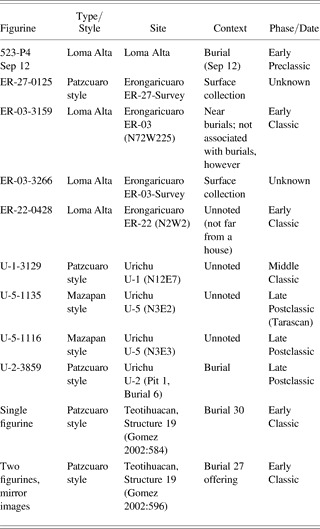
The first stage in the process of creating a working typology for the figurines used in this study involved defining the sample that would be used for analysis. The initial sampling pool included 116 figurine fragments from the sites of Erongaricuaro and Urichu (about 1–2 km apart) and published figurines from the site of Loma Alta (Carot Reference Carot2001). The Patzcuaro style emerged during examination of this sample, of which about 40 figurine fragments (Table 1) were eventually selected for study.
A sample of figurines used in this study

Figurine features were chosen for this study based on comparability between figurines, both within the sample and with those of other figurine collections. The majority of the figurines used in this research consist of broken fragments (the major exception being those found by Gomez [1998] at Teotihuacan). Because they offer the greatest amount of information, the study of the figurines from the Lake Patzcuaro Basin focused on head and torso pieces. As a result of this focus, the majority of the defining characteristics relate to these parts of the figurines. The features selected for the typology included: (1) eyes; (2) head construction; (3) adornment/jewelry; (4) overall construction methods; and (5) archaeological context.
Eyes
Eyes were selected as a defining feature of the figurines due to the small degree of variability among the figurines for which eyes are present. In addition, the eyes are a means of linking the figurine tradition of Michoacan to those from other times and regions. Factors in the definition of eye style for the figurines included shape, decoration (e.g., paint), and construction technique. Decoration of the eyes was also taken into consideration when attempting to classify the figurines.
Head construction
Head construction was chosen as a defining characteristic of the figurines due to the generalized shapes found in most of the figurines from the Erongaricuaro and Urichu excavations. Of importance to this feature was the angle of the head at the point of attachment to the body. No measurements were taken because of the broken nature of the figurines, but simple visual analysis was used to approximate and compare attachment angles. Face shape was also taken into consideration in defining the Patzcuaro style. The final source of construction data was formation of facial features such as the nose, chin, and mouth.
Adornment
The third feature analyzed was the style and type of personal adornment on the figurine. This included hairstyles and headdresses, necklaces/collars, beads, and earspools. Hair/headdress styles were chosen because they represent an important cultural feature and are present on all figurine heads studied. Necklaces/collars are defined by their placement on the throat/neck region of the figurine. Beads are sometimes seen on the figurines and were selected as evidence of personal adornment important to the Patzcuaro-style figurines, despite their absence in a number of the later examples. A final characteristic included in the adornment descriptions was the presence and type of earspools, hollow or solid, on the figurines.
Construction method
The methods of figurine construction were analyzed and included as an important part of the definition of types. Included in this aspect of the figurine construction were the manufacturing process, surface treatment through slip and paint, firing techniques and completeness, and, when possible, a typing of the paste. Most of these techniques and characteristics could be observed macroscopically. The paste analysis was conducted under a dissection microscope by Helen Pollard and results were based on previously identified paste types from the region (Pollard Reference Pollard1993).
Context
The context in which they are found is vital to the study of any type of artifact. Because context is often used in more detailed analyses of figurines, it was decided that context should be taken into consideration when attempting to classify the figurine fragments for the typology. While the contexts for the figurines are widely varied, this may offer insight into the uses of the figurines in the lives of those who made or used them. Furthermore, context can assist in the understanding of changes in the chronological sequencing of the figurines.
TYPOLOGY
This typology was first presented in a more preliminary form at the 2002 Midwest Mesoamericanist Meetings at the University of Kentucky (Begun Reference Begun2004). The purpose of this typology, for which further typological breakdown of some figurine styles may be possible, is to allow for a better understanding of the figurine sequence within the region of Michoacan. The major classification groups of the Michoacan figurines are those of the Chupicuaro tradition (Gorenstein and Wilson Reference Gorenstein, Wilson and Gorenstein1985; Porter Reference Porter1956, Reference Porter and Frierman1969), those of the Patzcuaro style, of which the Loma Alta type has been designated, and those of Colonial period styles. A larger sample is needed for further identification of types within the Patzcauro style.
Chupicuaro Tradition
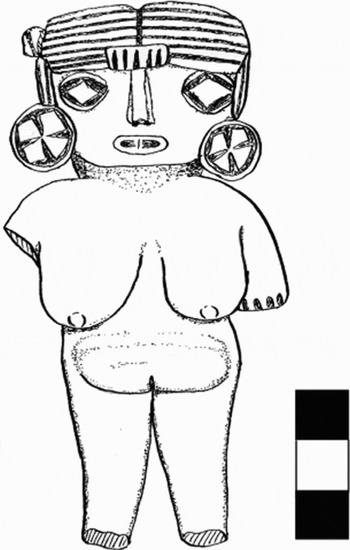
One of the first figurine styles to appear in the Michoacan region was that of the Late Preclassic Chupicuaro tradition (400 b.c.–a.d. 1) (Figure 2) (see Porter Reference Porter1956, Reference Porter and Frierman1969, for more complete analyses). While this tradition seems to have been centered more in the northern parts of Michoacan (particularly in the Lake Cuitzeo area), the importance of the Chupicuaro-style figurines, when dealing with the figurines of the Lake Patzcuaro Basin, is undeniable. The Chupicuaro figurine tradition represents one of the more widespread figurine traditions in Preclassic period western Mexico. Although Porter (Reference Porter1956) points out a similarity between the common “slant-eye” type of Chupicuaro figurines and Vaillant's H4 type (Vaillant Reference Vaillant1931), it seems more reasonable to look for a local origin of the style than to assume the figurine style originated in the Basin of Mexico. Vaillant (Reference Vaillant1931) points out that the Chupicuaro-style and H4 figurine types seem to correspond to the later Tarascan culture of Michoacan. Like many other aspects of the Purepecha-speaking culture, there is a good deal of continuity that can be seen between these early figurines and those of the later phases.
A Chupicuaro figurine from a looted site near the Lake Cuitzeo Basin showing some of the common features from the figurine complex, including eyes, earspools, and body shape.

The eyes of the Chupicuaro figurines are much more varied than those of the later figurine types, including slanted eyes, squint eyes, button eyes, and diamond eyes (Porter Reference Porter1956). Heads are very large compared with the rest of the body and sit at a vertical orientation to the torso most of the time. The adornment of the Chupicuaro figurines is one of the more varied aspects of their construction, with elaborate hair, headdress, and jewelry designs included in their construction. As with all figurines in the region, the Chupicuaro figurines are hand modeled and fired with paint and slip on some of them. Unlike later figurine styles, the Chupicuaro figurines are often found in association with burials (Porter Reference Porter1956), accounting for the completeness of many examples.
Also unique to the Chupicuaro figurine tradition are the large, hollow figurine types defined by Porter (Reference Porter1956). While there is no evidence that such hollow figurine types exist later than the Preclassic period, the designs and techniques used to decorate them seem shift to other types of ceramics after the decline of the Chupicuaro tradition and a widespread simplification of the figurine complex as a whole (Meighan Reference Meighan1974). Defining features of the Chupicuaro style include:
Eyes: “Slant eye,” “button eye,” “diamond eye,” or “squint eye.”
Head: Little to no noticeable head angle; flat and wide; small hair/headdress styles.
Adornment: Headdress with incision or appliqué decoration, some paint; jewelry, earspools, necklace at neck attachment area.
Construction: Hand modeled; unpainted for the most part; slip is rare.
Context: Burials.
Patzcuaro Style
Figurines of the Patzcuaro style (Figure 3) seem to occur throughout the chronology in the Lake Patzcuaro Basin, appearing during the Late Preclassic period (ca. 150 b.c.) and lasting until the arrival of the Spanish at the end of the Postclassic period (early 1500s). This early phase is sometimes referred to as the Mixtlan phase, with possible evidence having been found at the site of Acambaro (Gorenstein et al. Reference Gorenstein, David Chodoff, Hyslop, Pollard and Wilson1985:97). However, it seems that the Acambaro material shows less resemblance to Patzcuaro-style material and more of a resemblance to the Chupicuaro style. This is not unexpected, given the proximity of the Acambaro site to the Cuitzeo Basin, which seems to have been heavily influenced by the earlier Chupicuaro occupation. Unlike the Chupicuaro styles, however, there is no evidence suggesting the existence of hollow figurines in the Patzcuaro style.
Figurines of the Patzcuaro style. (a) No. 3129 from U-1 N12E2 at Urichu, Loma Alta phase (possibly Loma Alta type); (b) ER-27-S no. 0125, showing a Patzcuaro-style figurine from Erongaricuaro.

The heads of the Patzcuaro-style figurines are either round or triangular in construction and are set at angles to the bodies. This feature seems to differentiate them from the earlier Chupicuaro style, for which the head–neck angle is much less pronounced. One feature that all of the head fragments have in common is the “double eye” or “coffee bean” forms of eyes. That is, the eyes are composed of two laterally set indentations within an appliqué eye or a single lateral running slit in an oval-shaped eye. These are occasionally accompanied by paint, usually white, in the indented parts of the eye.
Figurine heads are topped with headdresses, for which the greatest variability exists. While the stylistic aspects of the headdresses have not been the object of detailed analysis, the presence of the headdress alone is a key feature of the Patzcuaro style. Earspools are another very common adornment encountered in the Patzcuaro style. The presence of earspools seems to be a continuity of style from the earlier Chupicuaro tradition. While there is no apparent overlap of the Chupicuaro figurines with those of the Patzcuaro style within any single site, this does not mean they were not contemporaneous during the Late Preclassic period. However, unlike those of the Chupicuaro figurines, these earspools are of simple construction with either flat surfaces or simple “hollow” shapes in which the centers have been reduced.
With few exceptions, Patzcuaro-style figurines seem to have a predominantly household or midden association. Most of the figurines included in this analysis were broken at the time of discovery. Common breakage points include the head–torso attachment area, the waist, and the limbs. It is unclear whether the breakage was intentional or the result of geological processes and other disturbances after deposition.
The Patzcuaro-style figurines seem to be hand modeled throughout the sequence. No molds have been recovered; nor do the figurines have the flat-backed, standardized appearance of mold-made figurines. This has led to the conclusion that they are hand molded. Furthermore, all of the figurines of this type that come from the Lake Patzcuaro Basin have undergone visual paste analysis by Pollard. Her findings suggest that the figurines were made locally, mostly from the Yaguarato paste complex, with a small number of figurines made from Sipiho Gray clays.
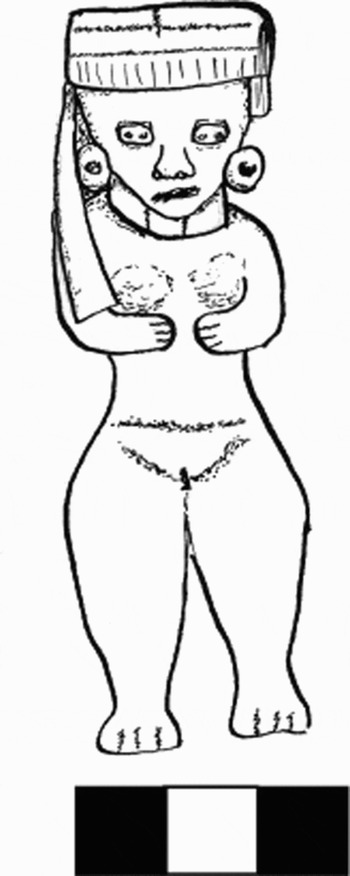
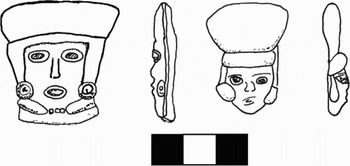
Figurines of the Patzcuaro style have been found at the site of Teotihuacan in a barrio that seems to have direct linkages to the part of central Michoacan where the Patzcuaro-style figurines are found. The figurines were found in a mortuary context, in Burial 27 within the Structure 19 part of the site (Gomez Reference Gomez and Brambila1998; Pollard Reference Pollard, Williams, Weigand, Mestas and Grove2004). Although they show a few differences from the majority of the Patzcuaro-style figurines, the similarities are remarkable (Figure 4). Defining features of the Patzcuaro style include:
Eyes: Double punctate or coffee-bean-shaped eyes.
Head: Angled attachment; triangular-shaped head; headdress.
Adornment: Headdress with incision or appliqué decoration, some paint; jewelry, earspools, necklace at neck-attachment area.
Construction: Hand modeled; unpainted for the most part; slip is rare; local clays.
Context: Households or middens linked to households.
Figurine from Burial 27 at Structure 19 (Teotihuacan) showing features that place it in the Patzcuaro style complex from Michoacan.

Loma Alta
Anthropomorphic figurines of the Patzcuaro style have been found at sites in both the Patzcuaro region and in the neighboring Zacapu Basin. It is based on these figurines that the Loma Alta type, as a subset of the Patzcuaro style, has been defined. It is between these two regions (the sites of Erongaricuaro and Loma Alta) that a direct stylistic connection can be made. Figurines with a high level of similarity have come from these two sites. In addition to having the main features of the Patzcuaro-style figurines, these two have a similar decorative style in their headdresses and hair. Both have squared-off headdresses with a distinct pattern of crisscrossing lines that make a “web” pattern on the headdress. In addition to this headdress style, these figurines have other features in common, such as the eye, mouth, and nose shape; manufacturing process; and types of personal adornment represented (Figure 5).
Loma Alta-style figurines demonstrating the similarities in the features of the figurines. (a) ER-22-0428; (b) 523-P4 Sep 12 (after Carot Reference Carot, Arnauld, Carot and Fauvet-Berthelot1993); (c) ER-03-3159.

One of the defining characteristics of the Loma Alta-type figurines is in the shape of the face and the construction of a tall, square headdress that is formed from a solid piece attached to the head before a thin slab has been folded over to create a double-layer effect. In some instances (ER-22-0428 and 523-P4), there is incision decorating this headdress, but not in all cases (e.g., ER-03-3159). The face is made of a triangular shape and set at an angle to the body. Hair is sometimes present in the decoration of these figurine heads but, again, not in all cases.
Eye construction is one of the more important characteristics for the definition and identification of the Loma Alta-type figurines. Unlike the broader Patzcuaro style, the Loma Alta type is found only with punctate eyes, usually of the double-eye variety. This seems to be one of the more indicative features of Loma Alta-type figurines and can also be used to tie this subset of the Patzcuaro style to the earlier Chupicuaro styles in which these eye forms were sometimes used. Eyes are set in the middle of the head and occasionally include paint for decoration.
Where present, the noses of the Loma Alta-type figurines are bulbous and seem to have been constructed from a pinching or appliqué process once the basic shape of the head had been constructed. The mouth is a simple, slightly agape slit that has been pressed into the face below the nose. Lips are never represented in detail. Three of the four figurines possess earspools of varying sizes and styles. The fourth does not appear to have had earrings or earspools.
Another important feature of Loma Alta-type figurines is that they are hand modeled. While this feature is itself indicative of all Patzcuaro-style figurines, it also makes it difficult to assign other classifying characteristics due to the large amount of artistic and stylistic variation that results. This lack of press molding is not unique to the Patzcuaro style of figurine and can be seen in the earlier Chupicuaro figurines and in neighboring regions. As with the broader Patzcuaro style, Loma Alta-type figurines that have undergone paste analysis (those from the Lake Patzcuaro Basin) are made from local clays (usually Yaguarato Cream). Defining features of the Loma Alta type include:
Eyes: Double-punctate eyes (sometimes with paint) set in the middle of the face.
Head: Triangular face shape with high, squared headdress, slit mouth, no lips, bulbous nose.
Adornment: High headdress, sometimes with hair on dorsal surface; necklace/collar sometimes with beads; earspools/ears.
Construction: Handmade; unslipped/unpainted for the most part, with paint decorating some features of the face, headdress, jewelry; local clays.
Context: Household context; possible burial context in Zacapu Basin.
Colonial Figurines
Surprisingly, few Colonial period figurines have been found in excavations within the Lake Patzcuaro Basin. To date, only three or four examples have been reported from the sites of Urichu and Erongaricuaro combined. There has yet to be a systematic study of the Colonial period figurines from the region, although preliminary analysis suggests changes in subject matter and construction techniques.
While there have always been a scattering of zoomorphic figurines in the earlier contexts, these seem to become a larger part of the figurine record during colonial times, with a shift from canines to bovids as the main subject being represented. In addition, there is a shift in the anthropomorphic figurines; instead of portraying free-standing, hand-modeled figurines, the figurines begin to depict religious icons of Spanish origin and finally make the shift to mold production. A final and important difference comes in the quality of the firing, as well. Rather than the often incomplete firing of earlier times, the Colonial period figurines take on the “flower pot” look common to ceramics fired at higher temperatures in kilns suggesting, a drastic shift in figurine-production techniques.
FIGURINES AS ETHNIC MARKERS
Figurines are an excellent source of cultural information (Bailey Reference Bailey2005; Grove and Gillespie Reference Grove, Gillespie and Stocker1991; Marcus Reference Marcus1998). As previously suggested, they can offer a large amount of information with regard to clothing, personal adornment, social-status markers, and ritual importance. These features also make them good sources for mapping cultural interactions. As with other aspects of Tarascan culture, there seems to be a relatively low level of cultural borrowing in the styles of figurines and the methods of figurine production.
Unlike in parts of central Mexico, there was never a change in production technique from hand modeling to press molding. Although this led to a greater level of individuality among the figurines, it also causes difficulties in classifying the figurines. In central Mexico, the use of figurine molds resulted in clear stylistic changes that can be tracked over time. No such easy chronology exists in this region of western Mexico. However, the importance of the hand-modeling method should not be overlooked. While there is clear evidence that the people of Michoacan knew of mold techniques, in the form of Mazapan-style figurines made from local clays, and had contact with cultures for which molds were the primary method of figurine construction, there is significance in the fact that such a shift in production never appears in the region.
Despite the fact that the Michoacan figurines remain handmade across time, a handful of characteristics exist that the majority of the Patzcuaro basin figurines seem to have in common. These are often characteristics that seem to suggest a potential chronological progression with origins in the Preclassic period Chupicuaro tradition. This progression is tentative at best, and there seem to be only two really distinct pre-Hispanic temporal phases among the Michoacan figurines: that of the Chupicuaro style and that of the Patzcuaro style (of which the Loma Alta type is but one category that has been identified). The Chupicuaro style seems to decline with the beginning of the Early Classic period, at which point the Patzcuaro style of figurine appears. While the Chupicuaro figurines tend to continue in the Chupicuaro region of northern Michoacan until the Early Classic period (ca. a.d. 200) (Gorenstein et al. Reference Gorenstein, David Chodoff, Hyslop, Pollard and Wilson1985:97), there seems to be no overlap of the two figurine traditions in the Patzcuaro Basin or surrounding area.
The Patzcuaro style, in turn, seems to have continued until the time of Spanish contact, at which point a Colonial style of figurine production took over throughout much of Mesoamerica, thus ending the distinct cultural identities present in figurines. Evidence for this merging of figurine styles is suggested by the similarities between Colonial-period figurines from Erongaricuaro and those found at Teotihuacan (Cynthia Otis Charlton, personal communication 2002). That said, it is possible to see a distinction between the ethnic identity of a region and the styles employed in the figurine production.
The presence of a number of Chupicuaro-like features in the Patzcuaro figurines suggests a tie between the cultures. The Chupicuaro influence can be seen throughout much of western Mexico, including Michoacan and parts of Colima (Meighan Reference Meighan1972) to the northwest. It is this linkage that suggests the origins of the ethnic identity in the region may extend much farther into the past than previously thought. Despite the various polities that existed before the formation of the Tarascan state, the continuity in figurine production throughout the region suggests a similarity in origins and ethnic identity. In addition, the continuation of Patzcuaro-style features through the Postclassic period suggests that there was, possibly, either little state (uacusecha) control over figurine production or the local styles of figurines were adopted and maintained by the Tarascan elites.
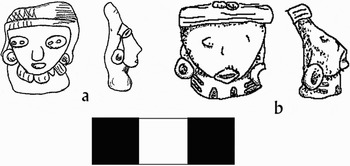
The fact that the shift to mold production never occurred seems to be one of the more convincing pieces of evidence that figurine-construction techniques had cultural significance. While two figurine fragments made of local clays were found at Urichu that seem to have been made by mold pressing, they do not resemble the local figurine types. Rather, they bear a strong resemblance to the Mazapan-style figurines from the areas near Tula (Figure 6). This seems to further support the idea that, while knowledge of mold production may have existed among figurine makers, a conscious decision was made to continue hand modeling those of the Patzcuaro style. Figurines of the Patzcuaro style (but not the Loma Alta type) have been found at the site of Teotihuacan near the Oaxacan Barrio (Structure 19) that has been linked to Michoacan (Gomez Reference Gomez and Brambila1998). The Structure 19 figurines were found in a burial context (Burial 27), and while the context of the figurines is different from the majority of those from the Lake Patzcuaro Basin, the similarities between these figurines and those from Michoacan are remarkable.
Mazapan-style figurines from Urichu.

The continuity in figurines throughout the occupation sequence in the Michoacan region suggests that, as with other types of ceramic forms, there are cultural decisions being made with regard to production. These decisions and the resulting products of such decisions can be used to assess the ethnic identity of the makers of the artifacts. The nature of the Tarascan empire was one of centralized government and cultural unity, despite the fact that the ruling class seems to have come from an intrusive population (Pollard Reference Pollard1993; Relación de Michoacán Reference Mendoza2000 [1541]). Unlike the Aztec empire to the east, the Tarascans remained a fairly unified ethnic entity. The continuity that exists in the material culture, demonstrated here through the figurines, suggests that this ethnic unity may have origins in the Preclassic- and Classic-period occupations.
CONCLUSION
Figurines are one of the more intriguing types of artifacts found in Mesoamerica and in many other places around the world. They are unique in that they show a different aspect of a culture from many other artifacts. While some artifacts can hint at how people lived, figurines can sometimes show us a picture of the people themselves through the features they represent. Clothing styles, hairstyles, clues about views on gender, and the ways in which a culture saw various aspects of the human figure are all represented in the figurines. This representation is very helpful in allowing archaeologists to understand a larger dimension of the culture of the people who once occupied a site or a region because they offer glimpses at a unique form of ethnographic information absent in other types of artifacts.
A greater sample of figurine fragments from the Classic and Postclassic periods needs to be examined to identify some of the deeper complexities of figurines from the region. This would allow for expansion of the typology to include categories beyond those presented here. Furthermore, a larger sample may help in identifying more features of the figurines that make them useful as chronological and ethnic markers. Of particular importance are those figurines for which primary context is known, rather than those found in survey or museum collections. Currently, there seem to be few commonalities in the context in which the figurines are found between sites. While these figurines are more commonly seen in household or midden deposits, their presence in burials needs to be given further consideration.
From this analysis of Patzcuaro-style figurines it can be concluded that, even in the period before the rise of the Tarascan state, a high level of cultural unity existed throughout at least part of the region of Michoacan. These pre-state societies may have had a similar level of homogeneity, as seen in the early Chupicuaro tradition, or there may simply have been a higher degree of trade among the various communities. Either way, the figurines suggest recognizable ethnic and cultural linkages within the Michoacan region, based on figurine-production techniques, that was distinctly different from neighboring cultures. These figurines represent a people maintaining traditional methods of manufacture despite knowledge of alternative means of production. This can be seen as an example of how people might seek to define a part of their ethnic identity.
RESUMEN
Las figurillas son un tipo de artefacto de información arqueológica muy importante. Muchas de las investigaciones de las figurillas prehispánicas de Mesoamérica usan aspectos de las figurillas para comprender las culturas que los produjeron. En este artículo, trato de usar las figurillas de Michoacan para marcar la continuidad cultural y étnica en la región del Lago de Patzcuaro. El trabajo anterior acerca de las figurillas del Lago de Patzcuaro condujeon al desarrollo de una tipología preliminar adoptada en este estudio para demostrar cómo se puede usar las figurillas como marcadores de la continuidad cultural entre la región de Michoacan antes de la formación del estado Tarasco. Esta tipología incluye unas figurillas del estilo Patzcuaro y el tipo de Loma Alta. De acuerdo con esta tipología, este estudio combinará datos cronológicos y culturales en una síntesis para demostrar como construyó la identidad étnica a la gente de Michoacan durante las épocas prehispánicas. Para hacer eso, este artículo discute la progresión de estilos que empiezan con la tradición de Chupicauro y continua con el estilo Patzcuaro (y un tipo de eso que se llama Tipo Loma Alta), y finalmente discute los cambios que ocurrieron cuando llegaron los españoles. Entonces, esta evidencia para la continuidad cultural se utiliza para sugerir la coherencia étnica como una razón posible para el grado alto de centralización que ocurrió durante el ascenso del estado Tarasco. La aplicación de la tipología preliminar demuestra un grado alto de la continuidad en las figurillas y sostiene la hipótesis que los orígenes étnicos de los Michoacanos prehispánicos pueden extender hasta el período preclásico tardío/clásico temprano.