Introduction
Mirids (Sahlbergella singularis (Haglund), Distantiella theobroma (Distant), Helopeltis spp. and Bryocoropsis spp.) are economically significant insect pests in cocoa production, particularly in West Africa (Padi and Owusu, Reference Padi and Owusu1998; Anikwe et al., Reference Anikwe, Omoloye and Okelana2009) where around 71% of the world's cocoa is grown. Both adults and nymphs cause damage, piercing their feeding mouthparts into pods, chupons and soft portions of the branches. This creates a characteristic vivid circular lesion that turns brown and later black after a couple of hours on pods, and elliptical dark lesions on chupons and young stems (Entwistle, Reference Entwistle and Wood1975). In Ghana, mirid damage is a contributory factor to low yields (Dormon et al., Reference Dormon, Van Huis and Leeuwis2007). It has been estimated that approximately 30% of cocoa beans in Ghana are lost to mirids annually (Adu-Acheampong et al., Reference Adu-Acheampong, Jiggins, van Huis, Cudjoe, Johnson, Sakyi-Dawson, Ofori-Frimpong, Osei-Fosu, Tei-Quartey, Jonfia-Essien, Owusu-Manu, Nana Karikari Addo, Afari-Mintah, Amuzu, Nyarko Eku-X and Quarshie2014). Control of mirids has been through the use of conventional insecticides applied to mature cocoa with a motorized knapsack sprayer (Eguagie, Reference Eguagie1973; Sonwa et al., Reference Sonwa, Coulibaly, Weise, Akinwumi Adesina and Janssens2008; Awudzi et al., Reference Awudzi, Ackonor, Cudjoe, Dwomoh and Sarfo2009). The current recommended time for the start of insecticide application is August since historical reports have shown that the pest increases in numbers in that month (Owusu-Manu, Reference Owusu-Manu1995). Recent mirid population studies carried out by Awudzi (Reference Awudzi2014) have suggested that a rapid mirid population build-up starts from June and not August. This may be due to the use of hybrid (progenies from biparental crosses produced in seed gardens) materials producing pods all year round and changes in climate over the years. Adu-Acheampong et al. (Reference Adu-Acheampong, Jiggins, van Huis, Cudjoe, Johnson, Sakyi-Dawson, Ofori-Frimpong, Osei-Fosu, Tei-Quartey, Jonfia-Essien, Owusu-Manu, Nana Karikari Addo, Afari-Mintah, Amuzu, Nyarko Eku-X and Quarshie2014) also studied the population dynamics of major mirid species in 1991, 1999, 2003 and 2012 to determine the appropriate timing for the application of insecticides for the control of the pest. They recommended a needs-based system for pest control on cocoa, a shift from the current calendar-based recommendation.
Over the years, various insecticides with different active ingredients have been used for mirid control (Entwistle et al., Reference Entwistle, Johnson and Dunn1959; Eguagie, Reference Eguagie1973; Awudzi et al., Reference Awudzi, Ackonor, Cudjoe, Dwomoh and Sarfo2009). Most of the insecticides used in the 1960s are no longer in use because of their high mammalian toxicity and new maximum residue levels that the European Union has introduced (Raw, Reference Raw1959; Prins, Reference Prins1965; Bateman, Reference Bateman2009). Until recently, only three insecticides were recommended for the control of cocoa mirids in Ghana (Awudzi et al., Reference Awudzi, Ackonor, Cudjoe, Dwomoh and Sarfo2009). Their active ingredients are bifenthrin, thiamethoxam and imidacloprid. The Cocoa Research Institute of Ghana (CRIG) conducts research on the safe use of these insecticides and gives recommendations on dosage and application techniques. However, since coverage of extension services in Ghana is limited (Baah, Reference Baah2002), it is not clear to what extent farmers have access to such information. Lack of adequate information may result in incorrect timing of insecticide applications and mirid numbers reaching their economic thresholds before insecticides are applied. Furthermore, the use of unapproved insecticides, resulting in unacceptable residues in beans and other health problems, can arise if farmers feel mirids are threatening their crop. Mirids have developed resistance to some insecticides in the past due to incorrect application (Dunn, Reference Dunn1963; Prins, Reference Prins1965; Owusu-Ansah et al., Reference Owusu-Ansah, Koranteng-Addo, Boamponsem, Menlah and Abole2010). The excessive use of insecticides without advisory service can have a negative impact on the economic viability of cocoa farming as the cost of pesticides may outweigh crop sales and also because the insecticides destroy beneficial and other non-target organisms (Rejesus et al., Reference Rejesus, Palis, Lapitan, Truong Thi Ngoc and Hossain2009).
It is unclear whether membership of farmer associations/cooperatives improves access to information. Most farmers in Ghana do not use research recommendations from the CRIG for the control of cocoa mirids because of the difficulty in accessing the information (Gerken et al., Reference Gerken, Suglo and Braun2001). There is evidence that farmers get the bulk of their information on how to access and use farming innovations and techniques from other farmers (Pomp and Burger, Reference Pomp and Burger1995). There is also a strong peer effect on farmer adoption of innovation in Ghana, with ethnicity and religious affiliation playing a role (Munshi, Reference Munshi2002). In Ghana, a cocoa disease and pest control programme, CODAPEC, was introduced in 2001 to help manage diseases and pests on cocoa to enhance yield (Asante et al., Reference Asante, Baah and Adu-Acheampong2002). This involves the application of recommended insecticides and fungicides on farms at no direct cost to the farmer. Farmers ensure that their farms are weeded and cocoa trees are well pruned for good aeration. They also need water for insecticide and fungicide applications using CODAPEC sprayers. Even though the programme has helped to increase yields, the late start in some areas has been a challenge, and some farmers do not carry out the needed cultural practices before the application is done (Adjinah and Opoku, Reference Adjinah and Opoku2010; Kumi and Daymond, Reference Kumi and Daymond2015). The perception that some farmers are unable to afford recommended pesticides to complement CODAPEC's efforts could be another drawback to the pest control programme.
To develop forecasting systems to provide information for effective mirid control, there is a need to investigate farmers' willingness to use such information. The most acceptable mode of conveying this information must also be investigated since a farmer may not access an innovation if the medium of information transfer is inappropriate. A forecasting system for this study is defined as a method of collecting data, processing it and sending the resultant information to the end user (cocoa farmer) for decision-making and farm management. For mirid control on cocoa in Ghana, such information might be provided on the basis of the phenology of the crop, climate and/or monitoring of mirid populations.
A survey on farmers' access to such information for mirid control, its implications on yield and the acceptability of a forecasting system to inform pest management decisions then becomes necessary.
The specific objectives of this study were to:
-
1 Assess farmers' knowledge on insecticide use for mirid control;
-
2 Examine whether farmers who are members of farmer association/cooperatives have better access to information on mirid control;
-
3 Test farmers' acceptance of a forecasting system to inform pest management decisions for the control of cocoa mirids; and
-
4 Identify the most appropriate medium to send information to cocoa farmers to aid mirid control.
Methodology
Study area
A total of 280 farmers were interviewed from the Ashanti and Eastern regions of Ghana. District cocoa officers in the regions were contacted to provide the names of major cocoa-growing communities. Farmers were then interviewed in these communities.
Design of the questionnaire and interview
A structured questionnaire with open and closed-ended questions was designed for the study. At the end of each working day, completed questionnaires were cross-checked to ensure they were completed. All incomplete or doubtful entries were sent back to the respondents for clarification. This ensured that the views of each respondent were represented, enhancing the reliability of the data collected and information to be deduced from it (Baah, Reference Baah2006). In most cases, questions were translated to the local language of the area (Twi), taking care not to lose any information. Selection of farmers for interview was not biased towards any sex, or religious or political affiliation. We briefed village chiefs, chief farmers and other appropriate opinion leaders in each selected community on the purpose of the study before any farmer was interviewed. This ensured that farmers received the interviewers through the proper chain of command in each community to enhance the accuracy of information given. The following variables were used to assess the socio-economic background of farmers: sex, age, education, marital status, farm ownership status, age and size of farm, as well as membership of a farmer group or association. Farmers were also assessed on their knowledge on mirid control, access to information for mirid control, effect of timely insecticide application on mirid numbers and yield, and percentage crop loss to mirid damage. An assessment of insecticides used by farmers was made as well as the timing of applications. Finally, the questionnaire also covered the issue of willingness to use the forecasting system for mirid control and the most preferred medium to receive this information. Willingness to use the forecasting system was determined with a ‘yes’ or ‘no’ question.
Reliability of the questionnaire
A pre-testing exercise was carried out in four communities in the Eastern Region (Nobi, Asafo, Obubanase and Tontro) to assess whether there were any ambiguities in the questions. A total of 30 cocoa farmers in these villages were interviewed from 15 November to 6 December 2011. We modified any questions that most farmers were not able to answer due to lack of clarity. The actual surveys with the final questionnaire started on 26 December 2011 and were completed on 6 April, 2012.
Data analysis
Data were analysed using the SPSS statistical package version 16. Variation in responses was analysed to show frequencies and their percentages. Relationship analysis was conducted using a χ2 test to find whether personal and farm characteristics were associated with farmers' access to information on mirid control, willingness to use a forecasting system for mirid control and the most preferred medium for information transfer. Relationships were also explained between personal/farm characteristics and membership of a cooperative/farmer association.
Results
Farmers' personal and farm characteristics
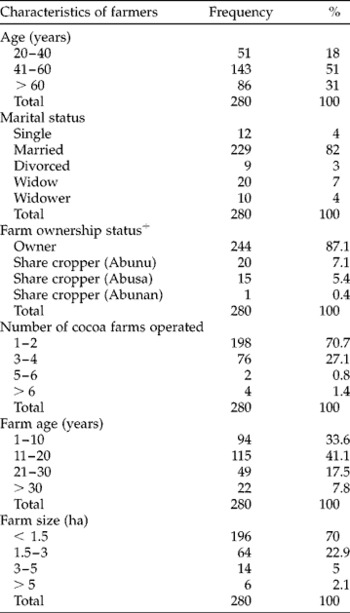
Of the farmers interviewed, 76% were males and 24% females; their ages ranged from 20 to 80 years. The age group 40–60 years was the most represented, accounting for 51% of the respondents. In contrast, 18% of the respondents fell within the 20- to 40-year age group. A greater percentage of the respondents were farm owners (87%). The respondents with a Middle School Certificate/Junior High School educational qualification were the most represented (61%), with 15% having no formal education. A summary of the personal characteristics of the farmers is presented in Table 1.
Farmer and farm characteristics (frequency distribution)

+ Definition of sharecropper (Abunu, Abusa and Abunan): proceeds from the farm are shared between the caretaker and the landlord, with the caretaker getting 75% (Abusa), 50% (Abunu) or 25% (Abunan).
Farmer associations and farm practices
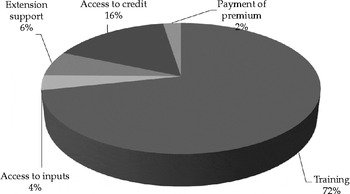
Most farmers interviewed (71%) were not part of any farmer association, certification scheme or cooperative society. Approximately 81 farmers were part of a farmer group. Among the farmers that were part of a farmer group, 90% belonged to local farmer associations or cooperative societies. The remainder had some association with Organic Cocoa Certification (4%) and the Cadbury Livelihoods Programme (now Cocoa Life) (6%). The majority of the farmers that were part of farmer associations were motivated to do so because of the training they received on Good Agricultural Practices (72%), while access to credit motivated 16%. The sources of motivation for joining a farmer association are shown in Fig. 1. Access to training was by far the most cited reason for joining an association. Neither sex (χ2= 0.043, P= 0.84), age of farmer (χ2= 1.96, P= 0.91), marital status (χ2= 4.46, P= 0.35), educational status (χ2= 7.79, P= 0.17) or farm ownership (χ2= 1.36, P= 0.71) had any significant relationship with membership of farmer group, farmer association or cooperative society.
Farmers' motivation for joining farmer associations (n= 81).

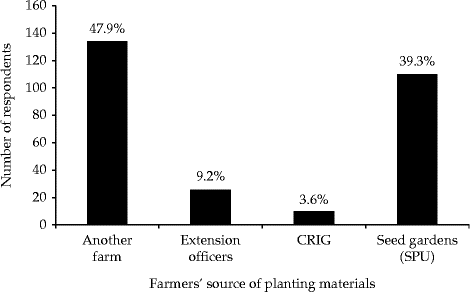
Most farmers had hybrid cocoa (progenies of biparental crosses produced in seed gardens) on their farms (38%), while 14% had Amelonado (a traditional variety), 29% ‘Amazon’ (early generation hybrids) and 19% mixed materials. The most frequently cited source of planting materials by the respondents was pods from neighbouring farms (48%) followed by cocoa seed gardens (39%) (Fig. 2). Cocoa in most farms was not planted in regular lines (78%); however, the proportion planted in lines was greater among those farmers who were members of farming groups (χ2= 6.55, P= 0.01). Furthermore, members of farmer groups/associations were more likely to grow hybrids (χ2= 8.43, P= 0.04) and sourced planting materials from a recommended outlet (i.e. Seed Production Unit and CRIG) (χ2= 19.69, P< 0.001). A relationship was also observed between farmer age and variety grown, in that the highest proportion of the farmers that had hybrid cocoa trees on their farms (49% of the farmers) were between the ages 20 and 40 years (χ2= 12.32, P= 0.05). A significant association between the age of farm and planting material was observed (χ2= 30.36, P< 0.001), such that a large proportion (85%) of more recently established farms (>20 years) were planted with hybrid trees sourced from recommended outlets (e.g. Seed Production Unit and CRIG). Furthermore, a greater proportion of trees were planted in lines (as opposed to uneven planting) on more recently established farms (χ2= 22.82, P< 0.001) (78% were on farms up to 20 years old vs. 22% on farms older than 20 years).
Farmers' source of planting materials (n= 280) (CRIG, Cocoa Research Institute of Ghana; SPU, Seed Production Unit).

Insect pests on cocoa and insecticide application
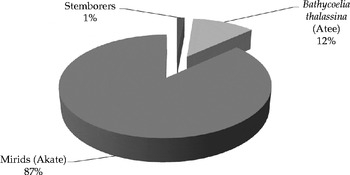
The majority of the farmers (86.8%) considered mirids to be the most economically important insect pest on cocoa. A pest gaining importance is Bathycoelia thalassina (stink bug) (‘atee’ in the local Twi language), which ranked second with 12% of the farmers considering it as critical to yield losses. A pictorial presentation of the respondents' perception of the most economically important insect pests on cocoa is shown in Fig. 3.
Farmers' perception of the group of pests that they consider to be the most economically important (n= 280).

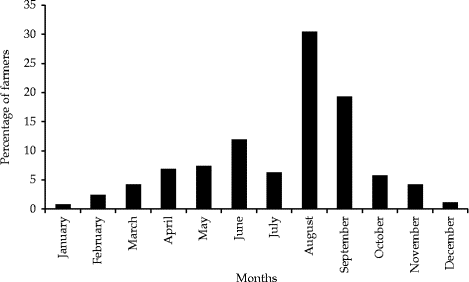
The vast majority of the farmers (92.9%) applied insecticides for mirid control on their farms. Only 7.1% did not apply any insecticide mainly due to logistical problems on the farmer's part or on the part of the CODAPEC programme. Confidor (imidacloprid 200 SL) was the most applied insecticide (50.8% of the respondents), with Actara (thiamethoxam) being used by 25.8% of the respondents and Akatemaster (bifenthrin) by 18.8% of the respondents. A small proportion (1.1 %) of the respondents used unapproved insecticides for mirid control and 3.5% of the respondents (under organic certification) applied crude aqueous neem extract. The vast majority (93.9%) of the respondents graded the performance of insecticides applied as effective against mirids, while 3.8% judged them as providing no change and 2.3% as not being effective against the pests. Among the respondents who recalled the timing of insecticide application, August was the month in which most respondents (30.3%) applied insecticides for the first time in the season, with 19.2% spraying in September, 11.9% in June and 7.3% in May (Fig. 4).
Frequency distribution of months in which the respondents first applied insecticides (n= 261).

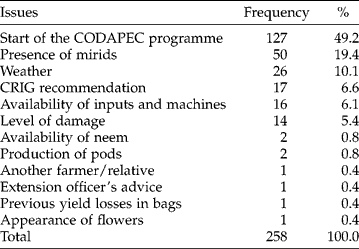
The issues that informed the farmers' choice of the month to start insecticide application for mirid control are summarized in Table 2. The start of the CODAPEC spraying programme was the most cited reason (49.2% of the respondents), while 19.4% of the farmers also relied on the visual presence of mirids to start insecticide application. The majority of the farmers (90.8%) interviewed stated that they had benefited from the CODAPEC programme.
Issues that informed farmers' choice of the month to start insecticide application

CODAPEC, cocoa disease and pest control; CRIG, Cocoa Research Institute of Ghana.
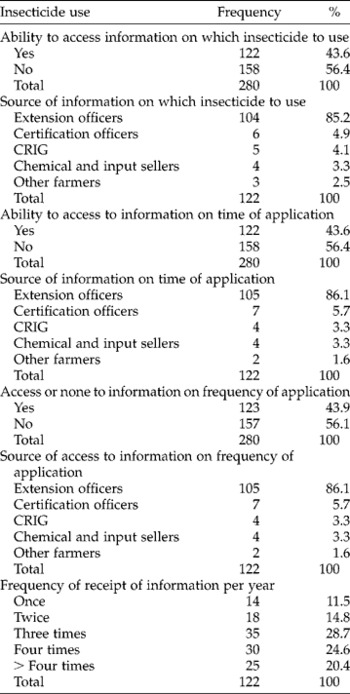
Source of information on insecticide usage
Less than half of the farmers interviewed (43.6%) received information on which insecticide to use for mirid control. Among these, 85.2% of them did so through extension officers, 4.1% from the CRIG, 4.9% from certification officers and the rest (5.8%) received their information from other farmers and input suppliers. In terms of the timing of insecticide application, 43.6% of the farmers received information on the appropriate time of the year to apply insecticides. Among this group, 86.1% cited extension officers as the source of that information, while fewer farmers cited certification officers (5.7%), the CRIG (3.3%) and contributions from other farmers and suppliers (4.9%). With regard to the frequency of insecticide application, 43.9% of the farmers were able to access information and, among these, most farmers (86.1%) received the information from extension officers. Among those farmers who had access to information on which insecticide to use as well as on the timing and frequency of application, the vast majority (95.9%) found the information useful for mirid control. Details of the farmers' sources of information on insecticide use are presented in Table 3. A significant relationship was observed between a farmer's age and access to information on insecticide use. Farmers between 20 and 40 years were more exposed to information on insecticide use (57% of farmers: χ2= 5.65, P= 0.05) than any other age group. Furthermore, ability to access information on which insecticide to use was significantly greater for those farmers in a group or association (χ2= 75.58, P< 0.001). This was also the case regarding information on time of application (χ2= 75.56, P< 0.001), frequency of application (χ2= 78.76, P< 0.001) as well as factors influencing the choice of when to start insecticide application for mirid control (χ2= 41.77, P< 0.001). Farmers who were members of farmer associations relied mostly on CRIG recommendations and the level of mirid damage in farms to decide on the month to start insecticide application, while non-members relied on the start of the CODAPEC spraying programme. Extension service personnel were invited to provide such information or give training at these meetings. Cocoa farmers acknowledged the importance of timely application of insecticides, as 97.1% of them suggested increased mirid damage and a reduction in yield when insecticides were applied later than required. The largest proportion of the farmers (47%) attributed 30–40% of cocoa losses to mirid damage annually.
Farmers' sources of information on insecticide use (frequency distribution)

CRIG, Cocoa Research Institute of Ghana.
Forecasting system
Almost all farmers interviewed (99.6%) thought that it would be useful to have forecasting systems to inform them of the expected mirid peak periods in each year, which insecticide to use, the time to start insecticide application and the required frequency of applications. Farmers' reasons for the need for an information system are as follows (with corresponding percentages): to enhance production (52.3%), to reduce mirid damage to cocoa (25%), to broaden farmers' knowledge base on mirid control (15.9%), and to effectively control mirids (6.8%). Most farmers (70%) preferred to receive information on mirid control on a quarterly basis. Some farmers (14.6%) preferred to be informed twice a year, with 10% as and when necessary. The majority of the farmers (89.6%) would be willing to support (financially) a forecasting service if the Ghana Cocoa Board (COCOBOD) is unable to meet the full cost.
Channel for dissemination of information
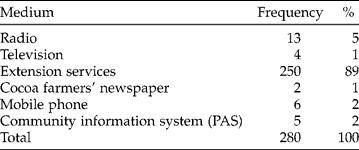
The majority of the farmers interviewed (89.3%) preferred extension services as the medium to relay information to them on insecticide use for mirid control. Farmers' preferences for access to information are presented in Table 4.
Farmers' preferences for medium of information transfer

PAS, public address system.
The main reason for the choice of extension service as the most preferred medium for information transfer was the opportunity to see demonstrations (72.1% of the farmers), followed by reliability and ease of access (26.1% of the farmers), affordability (1.1% of the farmers) and avoidance of language gap problems (0.7% of the farmers).
Discussion
Access to information is a key component that enables cocoa farmers to optimize their management and hence increase yields. In many developed countries, both public and private institutions provide farmers with farm management information through a range of systems (Just and Zilberman, Reference Just and Zilberman2002). However, in Ghana and other cocoa-growing countries in West Africa, the lack of systems to provide accurate, accessible and timely information on pest management presents a number of challenges to cocoa farmers. Farmers sometimes rely on ‘word-of-mouth’ for decision-making, which may not be accurate or timely.
Forecasting systems consist of data that have been processed to be meaningful to the end user (Acebedo et al., Reference Acebedo, Tunez and Bienvenido2008). A forecasting system is, therefore, a system to collect data, process it and transmit it to the end user (cocoa farmer) for effective decision-making and farm management. This study, therefore, examined the willingness of cocoa farmers in Ghana to use such forecasting systems for mirid control, and whether particular groups of farmers are more willing to take up such information.
The survey showed that cocoa farming is a male-dominated profession. This is the case for most cocoa-growing countries in West Africa (Olujide and Adeogun, Reference Olujide and Adeogun2006). Most cocoa farmers interviewed were over the age of 40 years, highlighting the need to encourage young people to take up cocoa farming as a profession. The ageing farmer population has sometimes led to cocoa farms being abandoned after the death of their owners (Asante et al., Reference Asante, Baah and Adu-Acheampong2002). The current economic status of cocoa farmers in Ghana makes it difficult for them to encourage their children to take up the enterprise after completion of their studies since they are interested in non-agricultural employment in the cities. This study also showed that farmers' age is important when it comes to adopting innovative practices, as most of the farmers between 20 and 40 years had more access to information on insecticide use and have adopted the use of hybrid materials and are planting them in lines on their farms. The results suggest that more effort needs to be made to encourage older farmers to adopt innovations.
West Africa is responsible for approximately 71% of world cocoa production (ICCO, 2012/13), which smallholder farmers produce, as exemplified in the present study (70% of the farms surveyed were less than 1.5 ha). Many of these smallholder farms are ageing and require some rehabilitation or replanting. This study showed that at least 14% of the farmers still grow traditional Amelonado cocoa, and less than half grow the recommended hybrid varieties. Replacing old, low-yielding trees with recommended hybrid materials is an important step to enhance cocoa production. However, when replanting, nearly half of the respondents obtained seeds from neighbouring farms. A survey of cocoa seed gardens in Cameroon, Ghana and Nigeria has suggested that the majority of farmers use seeds from neighbours' farms because of lack of nearby seed gardens (Asare et al., Reference Asare, Afar-Sefa, Gyamfi, Okafor and Mva Mva2010). The amount of hybrid seeds available from seed gardens to cocoa farmers in Ghana is considered inadequate. Asare et al. (Reference Asare, Afar-Sefa, Gyamfi, Okafor and Mva Mva2010) estimated that seed gardens meet less than 60% of the demand for seeds for new planting material in Ghana. As a result, cocoa farmers are using inappropriate seed, segregating F3 and F4 seed populations as planting materials. Farmers' lack of understanding of the development of hybrid materials is also a reason for the use of segregated seeds. Therefore, it is important that new planting materials are made available for replanting through increased availability of hybrid seeds/seedlings from seed gardens in Ghana.
Replacing old material with high-yielding varieties will produce higher yields if pest and disease challenges of the crop are well managed. Cocoa mirids have been cited as the most important insect pest on cocoa in Ghana (Owusu-Manu, Reference Owusu-Manu1995; Padi, Reference Padi1997; Awudzi et al., Reference Awudzi, Ackonor, Cudjoe, Dwomoh and Sarfo2009). The majority of the farmers (87%) interviewed agreed with this assessment, with 47% of them attributing a 30–40% loss in yield to mirids. This perception is similar to the published estimates of losses to mirids in the region of 30% (Owusu-Manu, Reference Owusu-Manu1995). Over 90% of the farmers applied insecticides in the 2011/2012 cocoa season. The month during which most respondents (30.3%) first applied insecticides for mirid control was August. This could be due to factors such as the start of the CODAPEC spraying programme (which is scheduled to start in August each year) or the perceived increase in mirid numbers and damage in farms. The results of the survey showed that most farmers relied on the start of the CODAPEC programme (49.2%), presence of mirids (19.4%) and the weather (10.1%) to decide on the month to first apply insecticides each season. We noted that not all farmers followed recommendations or labelled instructions on recommended insecticides. Some farmers think that the higher the concentration of insecticide solution, the greater the efficacy (Matthews et al., Reference Matthews, Wiles and Baleguel2003). The inconsistencies in the dosages of insecticides applied in cocoa farms could increase the risk of mirid resistance to approved insecticides. Effective farmer education on pest identification and accessibility to information on insecticide use is, therefore, important.
The survey also showed that less than 30% of the farmers interviewed were members of a farmer or cooperative group. Farmers' associations such as Cocoa Abrobopa, Kuapa Kookoo and the Cadbury Livelihood Programme (now Cocoa Life) are training farmers on best cultural practices. These practices are geared towards improving farm sanitation to minimize pest and disease damage to enhance yield. Some farmer associations also support farmers with inputs such as fertilizers, insecticides and fungicides on credit (Baah, Reference Baah2008). Recent certification of cocoa has led to the development of certification schemes such as Rainfall Alliance, Naturland (organic certification) and UTZ certification that train farmers to meet particular standards. According to Baah (Reference Baah2008), farmer associations have helped the expansion and growth of the cocoa industry in Ghana through farmer training. In this study, most farmers who were members of farmer associations also had easy access to information on insecticide use, time of application and frequency of applying insecticides for mirid control. This study also demonstrated the effectiveness of membership of a farmer group in the adoption of innovations such as the use of hybrid materials, planting in lines and sourcing planting materials from recommended bodies, thereby demonstrating the potential of such associations to play a part in increasing cocoa production. Another reason why encouraging the formation of farmer groups across the entire cocoa landscape could boost production is that most farmers are able to learn and adapt new farm practices from fellow farmers who can recognize their needs (Baah, Reference Baah2008). Membership of a farmer association was closely related to the farmer's choice of month to start insecticide application, with a greater proportion relying on the presence of mirids (21%) and the CRIG recommendations (16%) compared with those who were non-members who relied mainly on the start of the CODAPEC programme. Relying on the start of the CODAPEC programme is not the best approach as logistical problems such as late arrival of pesticides at various districts and the frequent breakdown of spraying machines could delay the start of the programme (Baffoe-Asare et al., Reference Baffoe-Asare, Abrefa Danquah and Annor-Frempong2013). Significant losses of cocoa can occur due to mirid damage when there is a delay in the start of the programme.
An overwhelming response from farmers for the need for a forecasting system for mirid control was demonstrated. Farmers were aware of the difficulty in managing cocoa mirids and the need for accurate information for effective pest management. Information could be sent to farmers on when to apply recommended insecticides and at what frequency. This would ensure that insecticide application is carried out on a needs-based system and not on the blanket application system in use. Such an approach would help reduce insecticide residue problems in cocoa beans as well as address health issues related to insecticide use. Because farmers were willing to pay towards an information system, it is indicative of the importance that they attach to a more targeted mirid control system. Farmers' willingness to help sustain a forecasting system for mirid control stems from the need to get accurate information for mirid management to produce more, and to contribute to the enhancement of their living conditions and also to ensure that a programme of that nature does not ‘breakdown’ due to national budgetary constraints.
Extension services were the most preferred means of information and technology transfer to cocoa farmers in Ghana, with 89.3% of the respondents opting for this route. For extension to be effective, extension services need to develop farmer-centred and interactive information technologies. Furthermore, Adu-Acheampong et al. (Reference Adu-Acheampong, Jiggins, van Huis, Cudjoe, Johnson, Sakyi-Dawson, Ofori-Frimpong, Osei-Fosu, Tei-Quartey, Jonfia-Essien, Owusu-Manu, Nana Karikari Addo, Afari-Mintah, Amuzu, Nyarko Eku-X and Quarshie2014) pointed to the low number of extension officers in the cocoa sector in Ghana. Even though radio is the most important medium for communicating with rural populations in developing countries (Odame and Kassam, Reference Odame and Kassam2002), it is limited in its ‘one-way’ communication nature. This limitation has improved in Ghana, as farmers are calling into radio programmes for clarification when necessary. The COCOBOD in partnership with Cadbury, ‘Kuapa Kookoo’ (a cooperative) and West Africa Fair Fruits Limited has agreed to support cocoa extension as well as implement interventions to enhance the livelihood of cocoa-growing communities in Ghana (Government of Ghana, 2011). Cocoa extension in Ghana has also been revived under the Cocoa Health and Extension Division (a division of the COCOBOD); extension could be used as a tool in any information system to disseminate information on mirid management to cocoa farmers. From the results of the survey, the success and adoption of any information system depends on the inclusion of extension services and local farmer organizations. The CODAPEC programme in Ghana could be further enhanced with the addition of an information system to provide forecast information on expected pest situations to improve its effectiveness.
Conclusion
Cocoa mirids continue to be the most important insect pest on cocoa in Ghana and other cocoa-producing countries in West Africa. Control has been achieved with blanket application of conventional insecticides based on a specific calendar date. This has led to the development of residue problems as well as changes in the status of some pests that hitherto have been regarded as minor. The root of this problem is inadequate farmer knowledge on approved insecticides, and timing and the frequency of application within a growing season. From this study, even though information on insecticide use and mirid management on cocoa is available, many farmers have little or no access to such information. Farmers (over 99%) accepted that there is a need for a forecasting system through which they could be informed of mirid activity on their farms as an early warning system, and how to manage the pest in a more environmentally sensitive manner. This study has also shown that local farmer groups and extension services will be vital for the success of a forecasting system for mirid control in Ghana.
Acknowledgements
The authors would like to express their gratitude to Mondelez Inc. and BBSRC-Dorothy Hodgkin Postgraduate Award for sponsoring this study, and CRIG management for logistical support. They are also grateful to the staff of the Entomology and Social Science divisions of CRIG for their help. This paper is published with the kind permission of the Executive Director of CRIG.