


Introduction
The archaeological site of Chalcatzingo occupies a significant place in the landscape and is renowned for its Middle to Late Formative architecture, monuments and rock art (c. 900–500 BC) (Grove Reference Grove1987). Some 90km south-east of Mexico City, the site is located at the southern extent of the range of prominent volcanic peaks, including the Popocatepetl (5393m above sea level (asl)) and Iztaccihuatl (5230m asl), that define the eastern mountain range of the Valley of Mexico. Nestled between the volcanic hills known as Cerro Chalcatzingo (1623m asl) and Cerro Delgado (1486m asl) (Figure 1), composed mostly of andesites and basalt (Urrutia-Fucugauchi Reference Urrutia-Fucugauchi1981), the site contains diverse structures and monuments as well as numerous large and imposing petroglyphic panels.
Location of the archaeological site of Chalcatzingo (top), nestled between the Cerro Chalcatzingo (pictured left in the photograph) and the Cerro Delgado (pictured right) (basemap from mapbox; photograph by Christophe Helmke).

At present, more than 50 panels have been documented, carved into exposed rock surfaces (Córdova Tello et al. Reference Córdova Tello2022). The formality of these sculptures is evidenced by the quality of the carvings and the coherence of the iconography, rendering imposing mythological tableaux over broad bedrock outcrops (Angulo Reference Angulo and Grove1987). These should therefore not be considered merely petroglyphic panels, but formal iconographic panels represent some of the finest Formative sculptures in Mesoamerica. What further distinguishes these panels is their distinctively ‘Olmec style’, which can be stylistically dated to between 900 and 500 BC (e.g. Cook de Leonard Reference Cook de Leonard1967; Bernal et al. Reference Bernal1973; Covarrubias Reference Covarrubias, Cordy-Collins and Stern1977). Given the dramatic setting between two prominent peaks that are riddled with caves, many deem the site’s backdrop to be phenomenologically charged, especially given the importance of caves and mountains in Mesoamerican cosmology and ritual life (e.g. Brady & Prufer Reference Brady and Prufer2005; Grove Reference Grove, Grove and Joyce1999, Reference Grove, Clark and Pye2000, Reference Grove2007). The rock art extensively modified the natural landscape and speaks of deliberate cultural attempts to imbue the natural surroundings with symbolically significant scenes that materialise sacred geography (e.g. Brady & Ashmore Reference Brady, Ashmore, Ashmore and Knapp1999). In this sense, these cultural modifications constitute a form of place-making, inscribing cosmological meaning onto the dramatic volcanic massifs, which dominate both the site and the wider viewshed of the valleys of eastern Morelos.
Most of the modifications to the Chalcatzingo hill (to the south) take the form of sculpted rocky outcrops, whereas painted rock art is predominantly found in the Delgado hill (to the north) (compare Angulo Reference Angulo and Grove1987 with Apostolides Reference Apostolides and Grove1987). Themes and motifs of great significance to Mesoamerican cultures appear among the carved panels, including the origin of maize and the propitiation of rains from earth lords. The symbolic importance of felines and birds of prey is also readily apparent in the rock art, as is their role in ritual violence. Particularly important are the representations of animated caves (referred to in earlier literature as ‘earth monsters’; e.g. Grove Reference Grove, Clark and Pye2000; Joralemon Reference Joralemon1971) that exhale life-giving rain clouds (Mon. 1) and serve as the point of emergence of the Olmec maize deity (Mon. 13). Monument 9 (now on exhibit at the site museum, after its recent repatriation to Mexico from a private collection in the USA) most likely served as a prop in re-enactments of such mythological events centred on the first appearance of maize and other life-sustaining cultigens from a primordial mountain of sustenance. The life-like relief carvings of young squash plants (Mon. 6) creeping over the rock surface (next to Mon. 1) reinforce this intimate association between cave rituals and the intended agricultural bounty. Chalcatzingo is thus a place of special ritual significance and may even have been considered the place of origin of maize, since the two peaks resemble the split in the earth from which sprouting plants emerge—in keeping with conventions of Olmec iconography (Taube Reference Taube1996; Grove Reference Grove, Clark and Pye2000).
Yet, Chalcatzingo was not exclusively a Formative period site: it also witnessed sporadic occupation in later periods. During the Postclassic period (AD 1000–1519), for instance, one of the most inaccessible caves (Cave 4) of the Cerro Delgado saw the construction of a series of multi-storey houses. Likewise, a rockshelter (Cave 19) was the locus of ritual activity during the Classic period (AD 350–550), at which point distinctive Teotihuacan glyphs were painted on its walls. The location of this cave within the body of Cerro Delgado situates the glyphs painted on its walls within a mountain long imbued with religious significance—maintaining earlier traditions of landscape sacralisation. This little-known Classic period use of caves as ritual spaces at Chalcatzingo between the fourth and sixth centuries is the focus of this article, following the renewed documentation of Cave 19 in August 2022.
Although Chalcatzingo was rediscovered in 1932 by archaeologist Eulalia Guzmán Barrón (Reference Guzmán Barrón1934) who first recorded the rock carvings of the surrounding hills it was not until 1953 that archaeologist Roman Piña Chan carried out test excavations of the main architectural complex. These excavations revealed diagnostic Teotihuacan ceramic types such as fine orange, and ceramics of the Coyotlatelco complex (Piña Chan Reference Piña Chan1955: 22), indicating that the Teotihuacan culture left its mark on the site. Teotihuacan settlements are also found elsewhere in eastern Morelos, such as San Ignacio, located some 13km to the south of Chalcatzingo, which was first recorded in the 1970s by Kenneth Hirth (Reference Hirth1980: 63, 68, 73–76) and currently under investigations by Erick Leslie Jurado (Reference Jurado2021).
Cave 19
The rockshelter, designated as Cave 19, is located some 330m from the centre of the archaeological site of Chalcatzingo, approximately a third of the way up the western face of the 110m high Cerro Delgado (Figure 2). Perched on the escarpment, Cave 19 was visually and symbolically integrated into this stunning sacred topography. Given the terrain and steepness of the western face, the rockshelter is currently only accessible by ascending to the summit, via the eastern face, and abseiling down the precipitous escarpments of the western face to the cave. We surmise that in antiquity the cave might have been accessed instead from the base of the hill, via a series of scaffold-like ladders. In places, neat footholds and crude steps have been carved out of steep inclines to facilitate passage.
The western face of the Cerro Delgado (top), showing the location of Cave 19. Painted glyphs can be seen in the back of the cave (below) with fire-clouding above them (photographs by Christophe Helmke).

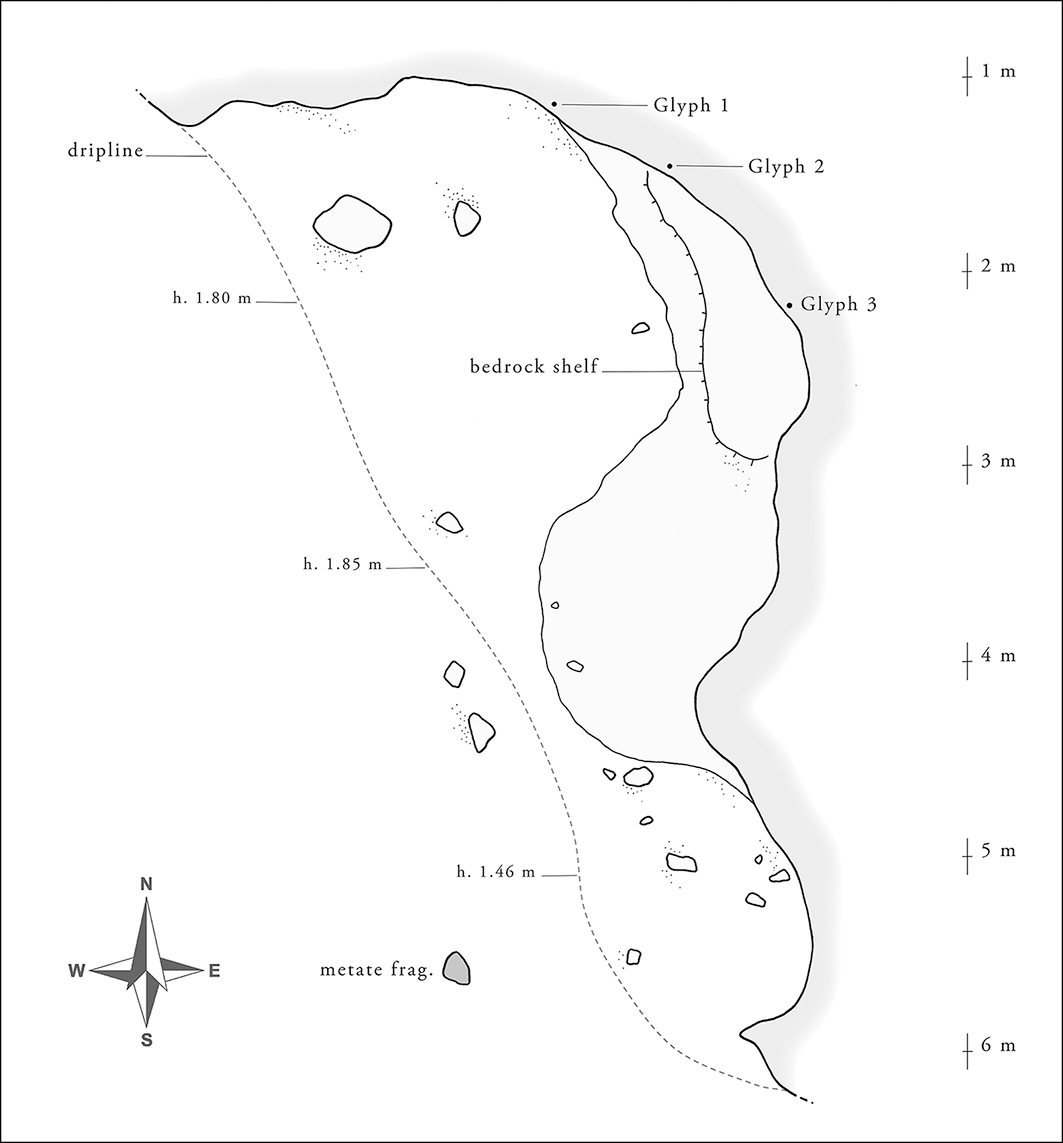
The cave itself is relatively small (Figure 2) and faces predominantly westwards, measuring just 5.43m wide (north–south) with a dripline that ranges in height between 1.46 and 1.85m. As the depth is not appreciable, measuring at most 2.24m deep, with a total surface area of about 7.4m2 (Figure 3), the site is better described as a small rockshelter. During documentation in 2022, scattered ceramic sherds were noted on the floor and a small metamorphic metate (quern) fragment was found at the southern end. In the furthest recess of the cave is a small, low bedrock shelf, measuring some 1.45m wide and 0.52m deep. Part of the back wall and the ceiling area above this shelf is blackened by fire-clouding, suggesting that this was the locus of a pyrolytic ritual. The position of the shelf and the fire-clouding is significant with respect to the position of the painted glyphs, as one perfectly frames the shelf while two more are painted on the section of wall immediately to the north. The northernmost glyph (glyph 1) measures 293mm wide by 282mm high and the middle glyph (glyph 2) measures 384mm wide by 541mm high. The last glyph of the set (glyph 3) is considerably larger, measuring 1.02m wide by 0.60m high, and forms a type of rectangular frame across the blackened back wall.
Plan of Cave 19 (plan and survey by Christophe Helmke).

The glyphs
The glyphs of Cave 19 were painted in clear lines and in dark red pigment (presumably derived from haematite), undoubtedly using a paintbrush. These glyphs were first documented by Apostolides (Reference Apostolides and Grove1987: 191–93) within the framework of the larger documentation project focused on the pictographs in and around the site of Chalcatzingo. This work showed that these glyphs contrast markedly with much of the painted rock art of Chalcatzingo, which is typically more schematic and created using black and/or red pigment. Much can be stylistically dated to the Formative period, but other rock art is more generic; depictions of simple faces, ‘vulvas’ and geometric designs could conceivably have been made in any period. The glyphs of Cave 19 differ from the other painted rock art, as these constitute glyphs rendered almost as a linear text, using signs that are drawn from the Teotihuacan writing system (see Langley Reference Langley1986; Taube Reference Taube2000; Helmke & Nielsen Reference Helmke and Nielsen2021; Helmke & Domenici Reference Helmke and Domenici2024). Like the glyphs from Cave 19, writing in Mesoamerica was predominantly rendered in either black or red pigment.
The glyphs were measured, plotted on the plan and photographed using a Canon EOS M50 digital SLR camera. The photographs were analysed using direct channel functions in DStretch and colour channels were processed in Adobe Photoshop 2023. Processing of the contrasts between the different alpha channels of the RAW images (in this case CR3) defined the areas with pigmentation (Figure 4a), and juxtaposition of the lightness and alpha channels created artificial colour renditions of preserved pigment (Figure 4b). In this case, the processing of channels in Photoshop proved highly effective at highlighting the painted glyphs, as did the LAB-based Red Enhance (LRE) and LAB-based Decorrelation Stretch (LDS) functions of DStretch (Figure 4c & d).
Chromatic analyses and photographic enhancement: a) alpha channels in Adobe Photoshop; b) contrasting lightness and alpha channels in Adobe Photoshop; c) LAB-based Red Enhance (LRE) colourspace in DStretch; d) LAB-based Decorrelation Stretch (LDS) colourspace in DStretch. Scale bar = 100mm (photographs and post-processing by Christophe Helmke).

Only the right side of glyph 1 remains; the left side extends beyond the dripline and being exposed to the elements, has completely weathered away (Figure 5). The central element is a sign representing a stylised mountain, with an identical sign disposed laterally to the right. Although eroded, we surmise that a third stylised mountain sign was also painted symmetrically to the left. The central mountain sign is qualified by two large scrolls that emanate from an open mouth, which together constitute a toponymic sign compound (Helmke & Nielsen Reference Helmke and Nielsen2014: 91–94).
Glyph 1: a) photograph; b) YUV-based BlacK (YBK) colourspace enhancement in DStretch; c) drawing (figure by Christophe Helmke).

Glyph 2 presents a complex array of objects (Figure 6). At its centre is a large, beaded necklace, which is draped above a segment of cloth, such as a type of cloak or tippet (a narrow, scarf-like garment). An upright dart is positioned as if stabbing through the necklace. This is a short projectile such as those cast by an atlatl (spear-thrower); the pointed dart head is visible below and the feather fletching above. Together, these three elements are part of warrior attire at Teotihuacan and we interpret this combination of signs as a record of a particular martial title. Similar compositions of martial trophies or tropaion are found in other examples of Teotihuacan writing (see García-Des Lauriers Reference García-Des Lauriers2008: fig. 4a–b, where these are interpreted as warrior bundles), which likewise represent upright atlatl darts, as mounts for items of regalia.
Glyph 2: a) photograph; b) contrastive lightness and alpha channels in Adobe Photoshop; c) drawing (figure by Christophe Helmke).

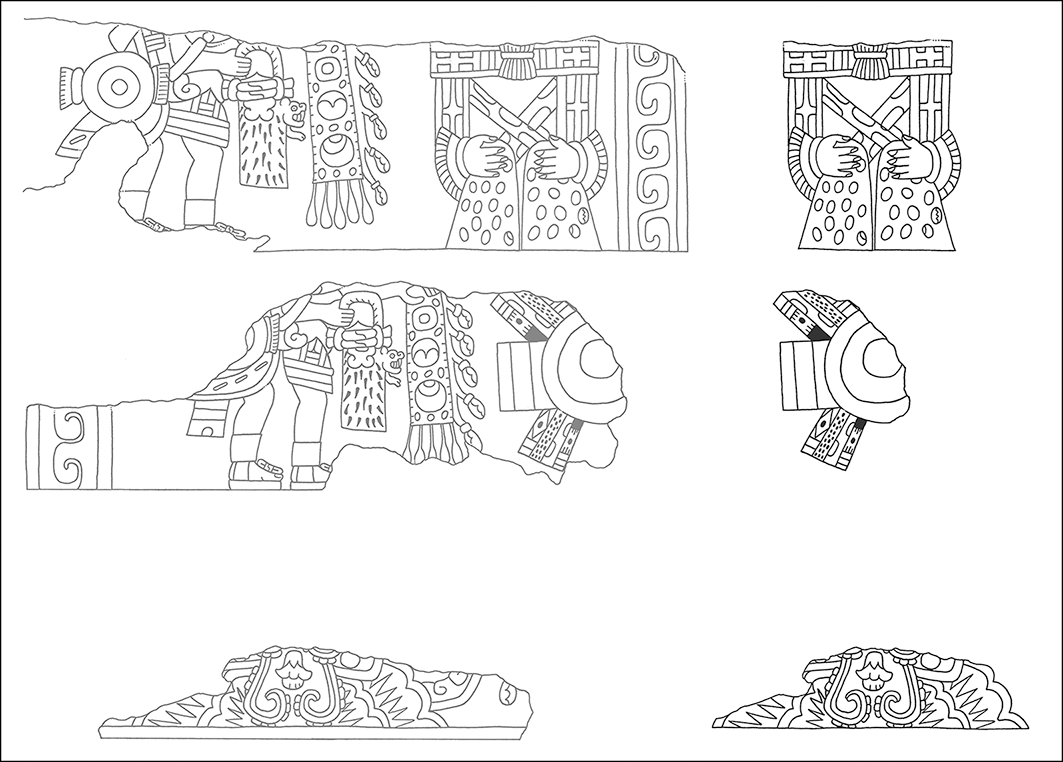
Glyph 3 differs from the other two in that it does not appear to record actual elements of writing. Instead, we see a large rectangular frame that is adorned by a series of five-pointed stars (Figure 7). The positioning of this frame, centred on the bedrock shelf where some form of burning took place, appears intentional. It is not possible, however, to determine whether a censer was once placed there or whether the shelf may once have supported a funerary bundle while it was cremated as all traces of associated materials have long-since disappeared, due the site’s exposure. Similar rectangular frames are represented on the elaborate theatre-style figurative censers of Teotihuacan culture (Figure 8a) where these represent a type of arched awning that was constructed as part of ritual events to celebrate deceased warriors. Representations of such awnings are found in several examples of Teotihuacan iconography (Figure 8b & c) (Taube Reference Taube and López Luján2006; Conides Reference Conides2018: 99–104) where they form an integral part of the worship of fallen warriors (Berlo Reference Berlo and Berlo1983). Given the importance of pyrolytic rituals at Teotihuacan—involving both the burning of incense and the cremation of exalted warriors (Nielsen & Helmke Reference Nielsen, Helmke, Tiesler and Scherer2018)—the association of glyph 3, with its starry awning, and the evidence of burning is unlikely to be coincidental.
Glyph 3: a) photograph (note the fire-clouding on the cave wall above); b) Custom-RGB (CRGB) colourspace enhancement in DStretch; c) drawing. Scale bars = 100mm (figure by Christophe Helmke).

Rectangular frames and starry, feathered awnings in Teotihuacan imagery: a) as represented on a polychromatic vase. Height of panel = 100mm (drawing by Christophe Helmke); b) rendered on an incised tripod vase. Height of panel = 110mm (after Caso Reference Caso1966: fig. 39b); and c) used as a framing device on the lid of an elaborate ‘theatre-style’ censer from Teotihuacan. Maximum width = 380mm (drawing by Nicolas Latsanopoulos).

The glyphs in the context of Teotihuacan writing
For decades, Teotihuacan has often been characterised as a state without a true writing system (Marcus Reference Marcus1992: 3; Pasztory Reference Pasztory1997: 192–94). Despite the evidence of glyphic signs evident in the murals, ceramics and carved monuments of the great metropolis of Teotihuacan (Langley Reference Langley1986; von Winning Reference von Winning1987), scholars have long debated whether these constitute a formal writing system. References to a ‘notational system’ (Langley Reference Langley1986), ‘graphic conventions’ (Langley Reference Langley1991) or ‘emblematic glyphs’ (Langley Reference Langley1991; cf. Berlo Reference Berlo, Diehl and Berlo1989) subtly deny Teotihuacan the same standing afforded to the writing systems of the Maya or Aztec.
Part of this hesitation stems from the structural features of Teotihuacan texts, which are typically terse, often consisting of just a single glyphic compound. The absence of lengthy glyphic passages or monuments bearing extended historical narratives has contributed to the prevailing view that Teotihuacan writing was at best a system of figurative signs, perhaps designed more for aesthetic or emblematic purposes than for full linguistic expression (Cowgill Reference Cowgill2015: 213–17). As Barthel (Reference Barthel1987: 10) warned, a “wholly ‘visual approach’ tempts one to conceive of the graphemes as interculturally understandable signals [akin to] airport pictograms”, rather than as elements of a functioning script (see Marcus Reference Marcus1992).
Despite the uncertainties that have plagued our predecessors, significant advances in recent years now demonstrate that Teotihuacan did, in fact, possess a true writing system—one that was logo-phonetic in nature and fundamentally comparable to the deciphered hieroglyphic scripts of Mesoamerica, such as those of the Classic Maya and Postclassic Aztec. Through a cumulative body of research (Taube Reference Taube2000, Reference Taube, Boone and Urton2011; Nielsen & Helmke Reference Nielsen and Helmke2011; Helmke & Nielsen Reference Helmke and Nielsen2014; Helmke & Domenici Reference Helmke and Domenici2024), scholars have identified calendrical notations, toponyms, anthroponyms, titles and even verbal predicates in the glyphic corpus. When viewed as a whole, the writing system of Teotihuacan exhibits the core features of other Mesoamerican logo-phonetic scripts: the use of discrete graphemes with a preponderance of logograms and a repertoire of signs—at present estimated at almost 120 (Helmke & Nielsen Reference Helmke and Nielsen2021: 47–48; Helmke & Domenici Reference Helmke and Domenici2024).
Teotihuacan writing can therefore no longer be dismissed or considered as a set of isolated or emblematic symbols. It was a genuine script, embedded in the sociopolitical and religious life of the city, and likely recorded the dominant prestige language of the metropolis, though its precise linguistic affiliation remains the subject of ongoing debate (Nielsen & Helmke Reference Nielsen and Helmke2011: 345–49; Pharao Hansen & Helmke Reference Pharao Hansen and Helmke2025). The task that now lies ahead is to expand the known corpus, refine the inventory of signs and advance decipherment efforts grounded in script-internal evidence and comparative linguistics.
Against this backdrop, the glyphs of Cave 19 are best understood as part of the wider Teotihuacan script rather than as isolated motifs. Each compound can be framed within the semiotic repertoire of the metropolis and interpreted with reference to its script tradition and characteristic sign behaviour.
The first glyph, although partially eroded, represents a stylised ‘tri-mountain’ sign (Taube Reference Taube and López Luján2006; Helmke & Nielsen Reference Helmke and Nielsen2014: 83–84, fig. 6a–f), flanked by lateral scrolls issuing from an open mouth. In Teotihuacan writing, such scrolls represent speech and song (Nielsen Reference Nielsen, Helmke and Sachse2014; Helmke Reference Helmke2023: 29–31), suggesting that this glyph records a toponym to be understood as ‘Singing Mountain’. This interpretation is strengthened by local toponymy as one of the nearby hills was historically known in Nahuatl as Cuicatepec, meaning ‘Singing Mountain’ (Helmke & Nielsen Reference Helmke and Nielsen2014: 94). The glyph may therefore constitute a self-referential designation of Cerro Delgado, demonstrating a remarkable continuity in naming practices from at least the Classic period to the early Colonial era (c. sixteenth–seventeenth centuries AD).
A compelling correspondence is found in the polychromatic murals of Teotihuacan that depict a ritual procession. In these murals, a series of ritual participants bear incense pouches and conduct what are known as scattering rituals, spreading pellets of incense (Figure 9). Each figure is accompanied by a large, emblematic glyph, successively rendering not only the verbal predicate ‘to scatter’, but also anthroponyms of the participants and the toponym for where this event took place (Helmke & Nielsen Reference Helmke and Nielsen2014: 91–94, Reference Helmke and Nielsen2021: 45–46). The toponym recorded in these murals at Teotihuacan also names the locality as the ‘Singing Mountain’ (Helmke & Nielsen Reference Helmke and Nielsen2014: 93–94). If Cerro Delgado is understood as the ‘Singing Mountain’, then we have evidence from both Teotihuacan and Chalcatzingo that this place was an important pilgrimage destination and that Teotihuacanos made the journey to conduct rituals at this religiously important locality.
Excerpts of the murals of Patio 1 at the Tetitla compound at Teotihuacan, which show the procession of priestly figures, conducting scattering rituals as part of a procession to the ‘Singing Mountain’. The verbal glyph is highlighted above, an anthroponym in the middle and the toponym at the bottom. Murals are preserved to a maximum height of 500mm (drawings by Christophe Helmke).

The second glyph presents a compound and each of its elements is found in the signary of Teotihuacan (Langley Reference Langley1986: 245–46, 306, Reference Langley and Ruiz Gallut2002: 299, 301) and are evidently tied to martial regalia. Comparable compounds in the Teotihuacan corpus functioned as martial trophies (García-Des Lauriers Reference García-Des Lauriers2008: fig. 4a–b). Although García-Des Lauriers (Reference García-Des Lauriers2008: 39) identifies these glyphic groupings as warrior funerary bundles, we believe that the Cave 19 example is best understood as a martial title, perhaps referring to a particular warrior order within Teotihuacan society. Later central Mexican sources strengthen this interpretation. In Postclassic Nahuatl song traditions, terms such as atlatl (‘spear-thrower’) and cozcatl (‘necklace’) appear together in poetic expressions to evoke wealth, prestige and military prowess (see Nielsen Reference Nielsen, Helmke and Sachse2014; Helmke Reference Helmke2023: 12–14, 41–44). The pairing in glyph 2 therefore probably cues a comparable metaphorical compound, one that celebrated the attributes of warriors through the symbolic juxtaposition of arms and regalia.
The third glyph differs in that it does not appear to serve as a logogram, and thereby does not record linguistic information per se. Instead, it is drawn from the iconographic register and its placement, centred on the bedrock shelf where burning occurred, is significant. Comparable rectangular frames, embellished with stylised stars, are depicted on the elaborate theatre-style censers of Teotihuacan (Figure 8a), where they represent ritual awnings erected for the commemoration of deceased warriors. In other depictions, such awnings are shown as part of ceremonies venerating the war dead (Taube Reference Taube and López Luján2006; Conides Reference Conides2018: 99–104). We therefore hypothesise that this frame and the modified bedrock shelf served as the background and elevated base for a Teotihuacan pyrolytic ritual. The association with stars further links the glyph to Teotihuacan’s martial orders, as one military group is identified by star signs paired with their totemic animals, large felines and coyotes (Helmke & Nielsen Reference Helmke and Nielsen2014: 89–92). A comparable order survived among the Aztec as the citlalcoyotl or ‘star-coyotes’, who donned black attire speckled with white feather dots denoting the night sky. Glyph 3 thereby further alludes to the commemoration of warriors, perhaps even to the cremation of a funerary bundle, situating the Cave 19 rituals within a broader tradition of Teotihuacan martial cults.
Teotihuacan presence in eastern Morelos
Over the past decades, evidence has emerged indicating the strong influence Teotihuacan exerted across several regions of Mesoamerica, including the Maya area, Oaxaca, Queretaro, Michoacan and the Pacific Coast of Chiapas and Guatemala, from the third to the fifth centuries AD. Although the relationships between Teotihuacan and sites in these regions were not unidirectional, and there is growing evidence that foreign groups were attracted to the metropolis (Rattray Reference Rattray, McClung de Tapia and Rattray1987, Reference Rattray1993; Ortega & Archer Velasco Reference Ortega and Archer Velasco2014; Ortega Cabrera et al. Reference Ortega Cabrera2016, Reference Ortega Cabrera2025), epigraphic, iconographic and archaeological data suggest that Teotihuacan groups established themselves in areas with important resources, in some cases leading to military conquests (e.g. Stuart Reference Stuart and Carrasco2000, Reference Stuart2024; Nielsen et al. Reference Nielsen2019a & Reference Nielsenb; Hirth et al. Reference Hirth2020; García-Des Lauriers & Murakami Reference García-Des Lauriers and Murakami2022). In other cases, the draw of a particular location may have been based on religious precepts rather than strategic economic and/or political interests. Thus, while Xihuingo in Hidalgo (approximately 30km north-east of Teotihuacan) appears to have had a special importance in the calendrical ritual cycle and year counts of Teotihuacan (e.g. Wallrath & Rangel Ruíz Reference Wallrath, Rangel Ruíz and Broda1991; Wallrath Reference Wallrath2001), Chalcatzingo may have been associated with emergence and origins.
A systematic settlement survey conducted to the south of Chalcatzingo revealed evidence of Teotihuacan occupation in the immediate vicinity of the site during the Classic period (Hirth Reference Hirth1980), demonstrating that, in this part of the Valley of Morelos, Classic components represent a distinct expansion of Teotihuacan populations into the region, marked by the establishment of a network of rural settlements articulated around larger centres. The identification of these occupations rests primarily on the recovery of diagnostic ceramics—most notably Thin Orange ware and cylindrical tripod vessels—that were retrieved through systematic surface collections. In nearly all cases, materials were recovered from plough zones exposed by modern agricultural activity, although in selected locations test-pitting was employed to document stratigraphy and site chronologies. While the ceramic assemblages thus derive largely from surface contexts, they provide secure chronological placement owing to the presence of highly diagnostic Teotihuacan types (Hirth Reference Hirth1980: 24–26, 183, 185–88).
Within this settlement network, Site 079 (San Ignacio), just 13km south of Chalcatzingo, emerges as the largest Teotihuacan occupation in the region. Distinguished both by its scale and material assemblage, San Ignacio comprised a substantial cluster of mound groups arranged in rectilinear fashion, incorporating low platforms supporting domestic superstructures as well as larger rectangular mounds consistent with civic or ceremonial architecture, including a ballcourt (Hirth Reference Hirth1980: 132–33, fig. 13). The overall orientation of the principal structures accords broadly with Teotihuacan’s urban grid, signalling the imprint of central Mexican site-planning principles in this provincial setting. The associated ceramic materials include Thin Orange ware, cylindrical tripod vessels and a range of other Classic period diagnostics, complemented by evidence for obsidian from sources in the Basin of Mexico and ritual paraphernalia typical of Teotihuacan religious practice. These elements, together with the extent of the site and the density of mounds, mark San Ignacio as the primary Teotihuacan enclave south of Chalcatzingo during the Classic period (Hirth Reference Hirth1980: 190–92).
The survey data further contribute to understanding the broader context of Teotihuacan’s expansion into Morelos. Hirth (Reference Hirth1980) situates this development in the early to middle Classic period (c. AD 200–400), when Teotihuacan was consolidating its influence across central Mexico. This dating accords well with contemporaneous expansions into other regions of Mesoamerica, including Oaxaca (AD 200–300), the Pacific Coast of Chiapas and Guatemala (AD 200–350), Queretaro (AD 300–350) and the Maya lowlands (AD 350–378). The impetus for colonisation appears to have been both economic and strategic: the fertile valleys of Morelos offered agricultural surpluses, while the region’s location provided access to vital trade routes leading southward into Guerrero and Oaxaca. The establishment of enclaves such as San Ignacio thus reflects a deliberate expansionist strategy by the Teotihuacan state, securing both resources and communication corridors essential to the maintenance of its far-reaching political and economic networks (Hirth Reference Hirth1980: 194–96). With a renewed and more intensive programme of excavations at San Ignacio, we are quickly gaining a more informed perspective on the particulars of Teotihuacan presence in the region (Jurado Reference Jurado2021).
Conclusion
The presence of three painted glyphs and their association with a rocky shelf and fire-clouding in Cave 19 at Chalcatzingo reveals the enactment of Teotihuacan rituals at this locality, sometime between the fourth and sixth centuries. This stylistic dating of the glyphs postdates the first establishment of nearby Teotihuacan-related archaeological sites, such as San Ignacio, signalling a Teotihuacan presence on Cerro Delgado and the continued ritual use of Chalcatzingo centuries after its Formative heyday. The glyphic compounds refer both to the name of the locality and to martial titles, with comparable examples found within the metropolis of Teotihuacan itself. The glyphs therefore underscore the importance of the cave and its role in the commemoration of deceased warriors, perhaps even encompassing a cremation ritual, where writing, ritual and landscape converged in the religious practices of Teotihuacan. Beyond their immediate context, the glyphs from Cave 19 add to the growing corpus of Teotihuacan logograms and signs, broadening our understanding of this ancient Mesoamerican writing system and its temporal and geographic spread.
Funding statement
The research was funded by the Velux Foundation (grant# 115078) as part of the ‘Central Mexican writing systems and calendars’ project in which Helmke and Nielsen served as Principal Investigators from 2019–2024.
Data availability statement
The original images and processed files, as well as the plans and sections produced remain with the authors and with the Proyecto Arqueológico Chalcatzingo. For access, contact the corresponding author.
Author contributions: CRediT categories
Christophe Helmke: Conceptualization-Equal, Data curation-Equal, Formal analysis-Lead, Funding acquisition-Equal, Investigation-Equal, Resources-Equal, Visualization-Lead, Writing - original draft-Lead, Writing - review & editing-Lead. Jesper Nielsen: Conceptualization-Equal, Formal analysis-Equal, Funding acquisition-Equal, Investigation-Equal, Writing - original draft-Supporting, Writing - review & editing-Supporting. Carolina Meza Rodríguez: Conceptualization-Equal, Data curation-Equal, Formal analysis-Supporting, Funding acquisition-Supporting, Investigation-Equal, Project administration-Lead, Resources-Lead, Writing - original draft-Supporting, Writing - review & editing-Supporting. Mario Córdova Tello: Conceptualization-Equal, Data curation-Equal, Formal analysis-Supporting, Investigation-Equal, Project administration-Lead, Writing - original draft-Supporting.





 Open access

