INTRODUCTION
Marine turtles are ideal hosts for a great variety of epibionts of several phyla because they offer a suitable substrate for settlement that is temporally stable at the scale of duration of epibiont life cycles (Frazier et al., Reference Frazier, Margaritoulis, Muldoon, Potter, Rosewater, Ruckdeschel and Salas1985, Reference Frazier, Goodbody and Ruckdeschel1991, Reference Frazier, Winston and Ruckdeschel1992; Dodd, Reference Dodd1988; Frick et al., Reference Frick, Williams and Robinson1998). Some epibionts are considered ectoparasites, e.g. the leech Ozobranchus margoi (see Schwartz, Reference Schwartz1974) or the copepod Balenophilus manatorum (Badillo et al., Reference Badillo, Puig, Montero, Raga and Aznar2007), but the vast majority of them are commensals (Frick et al., Reference Frick, Williams and Veljacic2002). Most of the latter use marine turtles as any buoyant, inanimate substrate (‘facultative’ commensals sensu Frick & Pfaller, Reference Frick, Pfaller, Wyneken, Lohmann and Musick2013), but some of them have developed a variable degree of association with living organisms, including turtles (‘obligate’ commensals, Frick & Pfaller, Reference Frick, Pfaller, Wyneken, Lohmann and Musick2013). The distinction between ‘obligate’ and ‘facultative’ epibionts is of degree rather than kind, and the fundamental point is to establish (1) the extent to which epibionts have developed adaptations to dwell on living substrates and (2) their populations specifically depend on associations with marine turtles. Obligate epibiosis could have evolved when ancestral epibionts accrued significant benefits by using hosts as refuges from depredation and competition (Wahl & Mark, Reference Wahl and Mark1999; Zardus & Hadfield, Reference Zardus and Hadfield2004; Seilacher, Reference Seilacher2005), or as a mean to gathering an improved energetic positioning (Pfaller et al., Reference Pfaller, Bjorndal, Reich, Williams and Frick2008a) or expanding range (Schärer & Epler, Reference Schärer and Epler2007), with few detrimental effects for the hosts (Frick & Pfaller, Reference Frick, Pfaller, Wyneken, Lohmann and Musick2013). Thus, epibiont assemblages represent suitable models to investigate the ecological and evolutionary factors governing biotic associations, and are also useful tools to trace marine turtle movements, distribution and ecology at several spatial and temporal scales, which is particularly valuable when conservation measures are at stake (Caine, Reference Caine1986; Casale et al., Reference Casale, Freggi, Basso and Argano2004, Reference Casale, D'Addario, Freggi and Argano2012; Reich et al., Reference Reich, Bjorndal, Frick, Witherington, Johnson and Bolten2010; Frick & Pfaller, Reference Frick, Pfaller, Wyneken, Lohmann and Musick2013).
Descriptive surveys about the epibiont fauna of marine turtles have significantly increased over the last two decades. However, studies that investigate the factors driving diversity and composition of epibiont communities are comparatively scarce (Caine, Reference Caine1986). Recently, Frick & Pfaller (Reference Frick, Pfaller, Wyneken, Lohmann and Musick2013) proposed a conceptual model that could readily be applied to investigate this issue. According to this model, geographic and ecological overlaps between turtles and potential epibionts define the subset of epibiont species that can contact individual turtles. When contact is possible, epibiosis is more likely to occur when the balance of costs and benefits is positive for potential epibionts, and positive or neutral for hosts. Frick & Pfaller's (Reference Frick, Pfaller, Wyneken, Lohmann and Musick2013) model should hold substantial predictive power when there is significant geographic and ecological signal. But for this to occur, turnover of epibiont taxa should be low at a large spatial scale; otherwise, epibiont communities would change rather idiosyncratically from one locality to another. To our knowledge, no study on marine turtle epibionts has quantitatively tested Frick & Pfaller's (Reference Frick, Pfaller, Wyneken, Lohmann and Musick2013) model.
The most diverse communities of epibiont fauna of all seven species of marine turtles have been reported in the loggerhead marine turtle, Caretta caretta (Frick et al., Reference Frick, Williams, Veljacic, Pierrard, Jackson and Knight2000a and references therein). Studies on this species cover a wide geographic region, i.e. the north-western Atlantic (Caine, Reference Caine1986; Frick et al., Reference Frick, Williams and Robinson1998; Pfaller et al., Reference Pfaller, Frick, Reich, Williams and Bjorndal2008b), Australia (Monroe & Limpus, Reference Monroe and Limpus1979) and especially the Mediterranean Sea, where surveys are, however, concentrated in central (Gramentz, Reference Gramentz1988; Zakhama-Sraieb et al., Reference Zakhama-Sraieb, Karaa, Bradai, Jribi and Charfi-Cheikhrouha2010; Casale et al., Reference Casale, D'Addario, Freggi and Argano2012) and eastern (Gramentz, Reference Gramentz1988; Kitsos et al., Reference Kitsos, Christodoulou, Arvanitidia, Mavidis, Kirmitzoglou and Koukouras2005; Fuller et al., Reference Fuller, Broderick, Enever, Thorne and Godley2010) waters. In the western Mediterranean, where the loggerhead turtle is by far the most common marine turtle (Casale et al., Reference Casale, Margaritoulis, Aksissou, Aureggi, Benhardouze, Bradai, Broderick, Carreras, Demetropoulos, Fuller, Glen, Godfrey, Godley, Hadjichristophorou, Hamza, Haxhiu, Jony, Jribi, Kaska, Khalil, Kusetogullari, Lazar, Levy, Misfsud, Nada, Oliver, Panagopoulou, Rees, Saad, Tiwari, Tomás, Türkozan, Žiza, Casale and Margaritoulis2010), there are just two preliminary surveys (Laurent, Reference Laurent1988; Badillo et al., Reference Badillo, Aznar, Tomas, Raga, Margaritoulis and Demetropoulos2003), and both are based on very small sample sizes (N ≤ 13). The western Mediterranean is peculiar in that no regular nesting of marine turtles occurs; the area serves as a foraging ground for juveniles of loggerhead turtle from three different origins, namely, north-western Atlantic, north-eastern Atlantic and eastern Mediterranean (Monzón-Argüello et al., Reference Monzón-Argüello, Rico, Naro-Maciel, Varo-Cruz, López, Marco and Lopez-Jurado2010; Wallace et al., Reference Wallace, DiMatteo, Hurley, Finkbeiner, Bolten, Chaloupka, Hutchinson, Abreu-Grobois, Amorocho, Bjorndal, Bourjea, Bowen, Duenas, Choudhury, Costa, Dutton, Fallabrino, Casale, Girondot, Godfrey, Hamann, Lopez-Alexandre, Marcovaldi, Mortimer, Musick, Mendilaharsu, Pilcher, Seminoff, Troeng, Witherington and Mast2010; Carreras et al., Reference Carreras, Pascual, Cardona, Marco, Bellido, Castillo, Tomás, Raga, Sanfelix, Fernández and Aguilar2011; Clusa et al., Reference Clusa, Carreras, Pascual, Gaughran, Piovano, Giacoma, Fernández, Levy, Tomás, Raga, Maffucci, Hochscheid, Aguilar and Cardona2014).
In this study we provide, for the first time, detailed data about the epibiont fauna of loggerhead turtles from the western Mediterranean based on a large sample size (N = 104). Also, we use Frick & Pfaller's (Reference Frick, Pfaller, Wyneken, Lohmann and Musick2013) model to investigate the factors that provide structure to this epibiont assemblage based on a comparison of patterns of epibiont occurrence in all available surveys conducted to date.
MATERIALS AND METHODS
Data collection
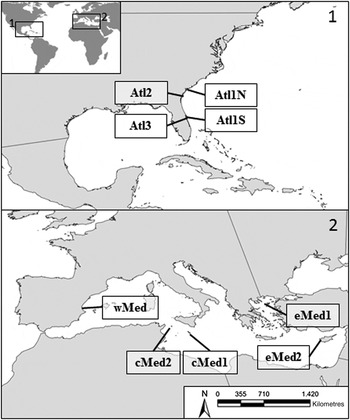
Altogether 104 loggerhead marine turtles were examined for epibionts. Individuals were found stranded along the coast of Valencia region, East Spain (644 km of coastline) between 1995 and 2006 (Figure 1). All the turtles were considered to be juveniles (mean Curved Carapace Length (CCL) ± SD = 57.1 ± 10.5 cm, N = 104), assuming that 70 cm is the minimum CCL for adult loggerhead turtles from Mediterranean or Atlantic populations (Dodd, Reference Dodd1988; Margaritoulis et al., Reference Margaritoulis, Argano, Baran, Bentivegna, Bradai, Caminas, Casale, De Metrio, Demetropoulos, Gerosa, Godley, Haddoud, Houghton, Laurent, Lazar, Bolten and Witherington2003; Casale et al., Reference Casale, Freggi, Basso and Argano2005). The exact cause of death could not be reliably determined in many turtles, but at least 39 turtles exhibited signs of interaction with pelagic longline fishery. Two procedures were used to detect and collect epibionts. First, the external surface of 47 turtles was examined with the naked eye, epibionts being scraped and collected. Second, in 57 turtles, the external surface was thoroughly examined under a magnifying glass (20×) and epibionts were collected. Then, each turtle was washed over a 0.2 mm light sieve to collect epibionts that could have been missed. Specimens were preserved in 70% ethanol and identified at the lowest taxonomic level based on appropriate literature.
Distribution map of samples of loggerhead turtle, Caretta caretta used to compare diversity and composition of epibiont assemblages (see also Table 1).

Following Frick & Pfaller (Reference Frick, Pfaller, Wyneken, Lohmann and Musick2013), epibiont taxa were classified as ‘obligate commensals’ if they are known as epibionts of marine turtles or other motile organisms, and ‘facultative commensals’ to include taxa that typically occur on inanimate substrates, or predominantly as free-living forms. In the latter, we further distinguished ‘chelonophilic facultative commensals’ to include species that show a marked association with marine turtles (see also the Discussion).
Geographic comparison
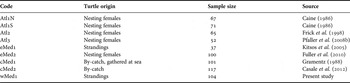
A comparison of similarity among epibiont assemblages at a global geographic scale was conducted based on published data on occurrence. Only surveys with a description of the whole epibiont assemblage were selected. Overall, nine turtle samples (N ≤ 37) were used, including that from the present study (Table 1; Figure 1). Four samples came from nesting populations in north-western Atlantic Ocean: North Cape Canaveral (Florida) to South Carolina (N = 67; Caine, Reference Caine1986); Georgia (N = 65; Frick et al., Reference Frick, Williams and Robinson1998); South Florida 1 (N = 71; Caine, Reference Caine1986) and South Florida 2 (N = 52; Pfaller et al., Reference Pfaller, Frick, Reich, Williams and Bjorndal2008b). Five samples came from the Mediterranean Sea: Aegean Sea, Greece (N = 37; Kitsos et al., Reference Kitsos, Christodoulou, Arvanitidia, Mavidis, Kirmitzoglou and Koukouras2005); Cyprus (N = 100; Fuller et al., Reference Fuller, Broderick, Enever, Thorne and Godley2010); Malta (N = 101; Gramentz, Reference Gramentz1988); Lampedusa Island (N = 117; Casale et al., Reference Casale, D'Addario, Freggi and Argano2012), and Valencia region, Spain (this study). These nine surveys sampled all body parts of the turtle, with the exception of Caine (Reference Caine1986), in which only the carapace was analysed for epibionts. However, epibiont communities tend to aggregate on the carapace, as opposed to the skin (Frick & Pfaller, Reference Frick, Pfaller, Wyneken, Lohmann and Musick2013).
Available samples of loggerhead turtle, Caretta caretta, worldwide with a minimum sample size (N ≥ 20) that provide data on occurrence of whole carapace epibiont assemblages.

Presence/absence data for each epibiont species were used to obtain a matrix of similarities between samples of turtles using the Bray–Curtis coefficient. The resulting matrix was used to perform a group-average hierarchical cluster of turtle samples (see Santoro et al., Reference Santoro, Badillo, Mattiucci, Nascetti, Bentivegna, Insacco, Travaglini, Paoletti, Kinsella, Tomás, Raga and Aznar2010). Statistical evidence of genuine clusters was investigated through 20,000 random permutations of the matrix of presence/absence values (SIMPROF procedure, see Clarke & Gorley, Reference Clarke and Gorley2006 for details). Statistically significant clustering (P < 0.05) was then interpreted according to geographic and ecological similarities between turtle samples. The similarity matrix was also represented in a two-dimensional plot using non-metric multidimensional scaling (NMDS) and superimposed onto the hierarchical cluster to show the congruence between graphical representation of the similarity matrix and statistically significant clusters (Clarke & Gorley, Reference Clarke and Gorley2006). We examined the contribution of individual taxa to the separation between significant clusters involving the turtle sample from this study through a decomposition of average Bray–Curtis dissimilarities between clusters (SIMPER procedure, see Clarke & Gorley, Reference Clarke and Gorley2006). Since we dealt with presence/absence data of a very large number of taxa (Supplementary Appendix 1), we selected only the first N taxa that accounted for ~25% of dissimilarity. Statistical analyses were performed using the software Primer v.6 (Clarke & Gorley, Reference Clarke and Gorley2006).
RESULTS
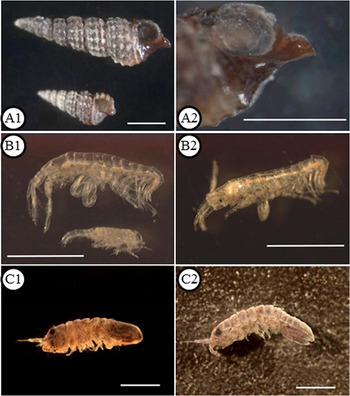
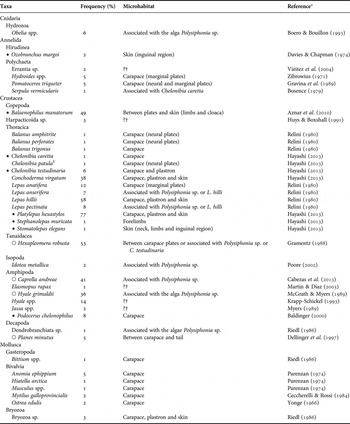
Thirty-nine epibiont taxa were found (Table 2). Eight species were considered obligate commensals, including barnacles (Chelonibia testudinaria, Chelonibia caretta, Platylepas hexastylos, Stomatolepas elegans and Stephanolepas muricata), copepods (Balaenophilus manatorum), amphipods (Podocerus chelonophilus) and hirudineans (Ozobranchus margoi). A second group included two amphipods (Caprella andreae and Hyale grimaldii), one tanaid (Hexapleomera robusta) and one decapod (Planes minutus) that could be considered as chelonophilic facultative commensals (Table 2; see also the Discussion). Finally, there was a group of 27 facultative commensal taxa that, in addition to turtles, are usually reported on a variety of non-living substrates. This group included nine barnacles, five bivalves, three amphipods, four polychaetes, one gastropod, one decapod, one copepod, one isopod, one hydrozoan and one bryozoan (Table 2). Three taxa reported here are new records for the loggerhead turtle i.e. Bittium sp. (Gastropoda), Idotea metallica (Isopoda) and Jassa sp. (Amphipoda), and three are new records for Mediterranean loggerheads, i.e. Lepas anserifera (Cirripedia) and Hiatella arctica and Musculus sp. (Bivalvia) (Figure 2). As many as five taxa were detected only when turtles were washed, namely, Harpacticoida sp., Errantia sp., Elasmopus rapax, Hyale spp., Jassa spp. (Table 2).
New epibiont species found on loggerhead turtles, Caretta caretta, in the western Mediterranean. Bittium sp.; ventral view (A1), and detail of siphonal canal and operculum (A2); Jassa sp.; lateral view (B1), dorsal view (B2); Idotea metallica, ventral view (C1) lateral view (C2). Scale bars 2 mm.

Frequency of occurrence and microhabitat of epibiont fauna associated with 104 loggerhead turtles, Caretta caretta stranded along the coasts of central eastern Spain during the period 1995–2006.

* Reference used to assess the type of association, i.e. obligate vs facultative epibiont.
• Obligate epibiont taxa for marine turtles.
○ Chelonophilic facultative epibiont taxa for marine turtles.
† Specimens were found only after washing the turtle under a sieve (see Materials and methods).
‡ Recent evidence (Cheang et al., Reference Cheang, Tsang, Chu, Cheng and Chan2013) indicates that C. patula and C. testudinaria are conspecific. However, we leave both taxa apart to provide more information about the morphs of C. testudinaria occurring in turtles.
The epibiont assemblage of loggerhead marine turtle in the western Mediterranean was numerically dominated by obligate commensals and chelonophilic facultative commensals. Out of seven species with a frequency of occurrence >30%, five belonged to this category, including B. manatorum, P. hexastylos, H. robusta, C. andreae and H. grimaldii (Table 2). The other two numerically important taxa were two generalist barnacles, i.e. Lepas hilli and Conchoderma virgatum.
Only three epibiont taxa were distributed throughout the whole body of the turtles, i.e. C. virgatum, L. hilli and Bryozoa sp., the remaining being associated with more specific sites (Table 2). Sixteen species were found attached to the carapace or plastron, either on the whole surface (Balanus trigonus, C. caretta, C. testudinaria, P. chelonophilus, Bittium spp., Anomia ephippium, Ostrea edulis, H. arctica, Musculus spp. and Mytilus galloprovincialis), or following specific distribution patterns (Hydroides spp., Pomatoceros triqueter, Balanus amphitrite, Balanus perforatus, Chelonibia patula, Lepas anatifera). Five species appeared only on soft body parts, either on the skin, i.e. O. margoi and P. minutus (the latter selecting the space between the supracaudal scales and tail) or more or less embedded in the epidermal tissue (S. muricata, S. elegans and B. manatorum). Finally, eight taxa (Obelia spp., Serpula vermicularis, L. anserifera, Lepas pectinata, I. metallica, C. andreae, H. grimaldii and Dendrobranchiata sp.) occurred exclusively associated with algae or other epizoites; Hexapleomera robusta was found either between the plates of the carapace or associated with other epibionts.
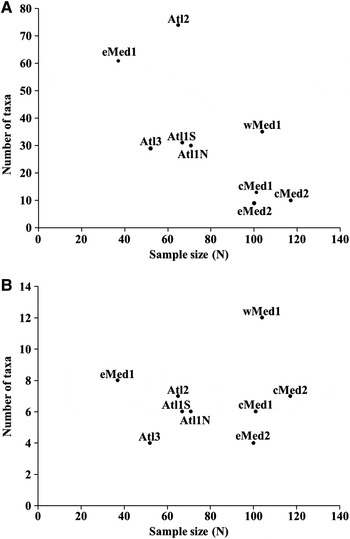
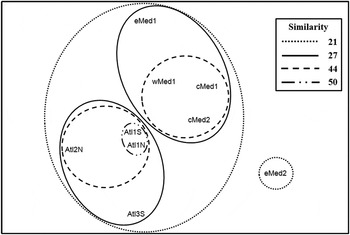
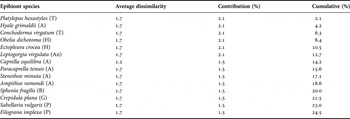
A total of 166 taxa was used to analyse the similarity among nine epibiont assemblages (Supplementary Appendix 1). Sampling effort did not have a significant positive influence upon the richness of epibiont taxa (Spearman rank correlation, rs = −0.533, N = 9, one-tailed P = 0.930; Figure 3A). The NMDS scatterplot of epibiont assemblages with significant clusters superimposed is shown in Figure 4. The NMDS had a very low stress (0.02) and, therefore, it provides a suitable bi-dimensional representation of ranked similarities between assemblages (Clarke & Gorley, Reference Clarke and Gorley2006). The SIMPROF indicated significant clustering of epibiont assemblages (P < 0.005; Figure 4). Two major subdivisions appeared. First, the Mediterranean sample eMed2 differed from the remaining samples. This sample had the lowest diversity of epibiont taxa of all samples (Figure 3) and contained five unique taxa, i.e. the amphipods Caprella fretensis, Apohyale prevostii and Hyale schmidti, the tanaid Parasinelobus chevreuxi and the hydrozoan Laomedea flexuosa (Supplementary Appendix 1). Second, there was segregation between other Mediterranean samples and the Atlantic samples. The SIMPER analysis pinpointed 16 taxa that accounted for ~25% of dissimilarity between Mediterranean vs Atlantic samples (Table 3). Mediterranean samples shared the barnacle C. virgatum as an exclusive taxon, whereas the Atlantic samples shared four unique taxa, i.e. the amphipod Caprella equilibra, the hydrozoans Obelia dichotoma and Ectopleura crocea and the anthozoan Leptogorgia virgulata (Supplementary Appendix 1).
Relationship between epibiont species richness and sample size of loggerhead turtles, Caretta caretta. Sample codes are shown in Table 1. (A) Total epibiont richness. (B) Richness of ‘obligate’ and ‘chelonophilic facultative’ epibionts (see Materials and methods for details).

Non-metric multi-dimensional scaling (NMDS) of nine epibiont assemblages from loggerhead turtles, Caretta caretta, with a group-average hierarchical cluster superimposed onto it as circles. Only significant clusters (P < 0.005) indicated by a Similarity Profile Analysis (SIMPROF) are shown, indicating the level of similarity. Epibiont assemblage codification is described in the Materials and methods section. Sample codes are shown in Table 1.

Epibiont species that contribute the most to dissimilarity between Atlantic and Mediterranean epibiont assemblages on the loggerhead turtle, Caretta caretta. The sample EMed2 was excluded in this comparison (see Table 1 and Figure 4). Only species that contribute up to ~25% of cumulative dissimilarity are shown.

T, Thoracica; A, Amphipoda; H, Hydrozoa; An, Anthozoa; B, Bivalvia; G, Gastropoda; P, Polychaeta.
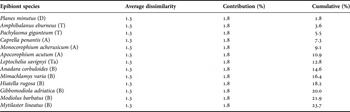
Secondary significant subdivisions were found within Mediterranean samples, and within Atlantic samples (Figure 4). The SIMPER analysis pinpointed 14 taxa that accounted for ~25% of dissimilarity between eastern vs central-western Mediterranean samples (Table 4). The eastern sample (eMed1) differed from samples collected in central and western Mediterranean in having a higher diversity of molluscs and annelids and other generalist species (38 taxa), but lacking the decapod P. minutus, which was shared by all samples from central and western Mediterranean (Supplementary Appendix 1). Within Atlantic samples, significant clustering was more complex and involved a number of epibiont taxa (see Supplementary Appendix 1). There is no evidence of geographic signal between samples north and south to Cape Canaveral (Figure 1).
Epibiont species that contribute the most to dissimilarity between eastern and central-western Mediterranean epibiont assemblages on the loggerhead turtle, Caretta caretta. The sample EMed2 was excluded in this comparison (see Table 1 and Figure 4). Only species that contribute up to ~25% of cumulative dissimilarity are shown.

D, Decapoda; T, Thoracica; A, Amphipoda; Ta, Tanaidacea; B, Bivalvia.
DISCUSSION
Similar to other localities, the epibiont community of loggerhead turtles from the western Mediterranean was composed of several types of epibionts. A first group included obligate epibionts that are chelonophilic, i.e. they have been reported almost exclusively in marine turtles worldwide, including Platylepas hexastylos, Chelonibia caretta, Stephanolepas muricata, Stomatolepas elegans, Podocerus chelonophilus and Ozobranchus margoi (ERC, 2007; McGowin et al., Reference McGowin, Truong, Corbett, Bagley, Ehrhart, Bresette, Weege and Clark2011; Hayashi, Reference Hayashi2013). A second group included two species of obligate epibionts, namely, Balenophilus manatorum and Chelonibia testudinaria, which occur on marine turtles but also on other hosts, including manatees, Trichechus manatus and some crab species (Aznar et al., Reference Aznar, Badillo, Mateu and Raga2010; Zardus et al., Reference Zardus, Lake, Frick and Rawson2014). Finally, four facultative chelonophilic epibiont taxa can survive either as commensals or free-living forms, i.e. Hyale grimaldii, Hexapleomera robusta, Caprella andreae and Planes minutus. Hyale grimaldii have been reported in flotsam (Krapp-Schickel, Reference Krapp-Schickel and Ruffo1993) and H. robusta in rock crevices, algae and other solid substrates (Morales-Vela et al., Reference Morales-Vela, Suarez-Morales, Padilla-Saldivar and Heard2008). However, both species have developed a strong association with the loggerhead turtle throughout its geographic range (Zakhama-Sraieb et al., Reference Zakhama-Sraieb, Karaa, Bradai, Jribi and Charfi-Cheikhrouha2010; Bamber, Reference Bamber2012; Blazewicz-Paszkowycz et al., Reference Blazewicz-Paszkowycz, Bamber and Anderson2012) and, indeed, H. robusta has been considered as an obligate epibiont of marine turtles in previous studies (e.g. Pfaller et al., Reference Pfaller, Frick, Reich, Williams and Bjorndal2008b; Enciso-Padilla et al., Reference Enciso-Padilla, Cisneros-Calderón, Gastélum-Gastélum and Jacobo-Pérez2012; Frick & Pfaller, Reference Frick, Pfaller, Wyneken, Lohmann and Musick2013). Caprella andreae is a ‘rafter’ species adapted to live exclusively on floating objects. However, a recent study suggests that this species prefers turtles instead of floating objects to settle on because carapaces probably provide better conditions for survival (Cabezas et al., Reference Cabezas, Navarro-Barranco, Ros and Guerra-García2013). Finally, P. minutus is a pelagic species typically associated with flotsams of Sargassum spp. in the central Atlantic (Chace, Reference Chace1951) but, in the Mediterranean Sea, its population appears to be sustained almost exclusively by loggerhead turtles (Dellinger et al., Reference Dellinger, Davenport and Wirtz1997; Frick et al., Reference Frick, Williams and Veljacic2000b, Reference Frick, Williams, Bolten, Bjorndal and Martins2004).
The above groups of epibionts represent the most predictable element of epibiont assemblages of the loggerhead turtle throughout its range (Frick & Pfaller, Reference Frick, Pfaller, Wyneken, Lohmann and Musick2013) and, therefore, subsets of them are expected to show up in most samples of loggerhead turtles regardless of geographic origin. In addition, our study also shows that loggerhead turtles function as passive samplers of many fouling species; the likelihood of colonization would depend in this case on the duration of turtle exposure to settlement by local biotas in a given area (Frick & Pfaller, Reference Frick, Pfaller, Wyneken, Lohmann and Musick2013). In the western Mediterranean, faunal composition of facultative epibionts is compatible with the hypothesis of flexible habitat exploitation by turtles (see Casale et al., Reference Casale, Abbate, Freggi, Conte, Oliverio and Argano2008). Pedunculate barnacles, i.e. Conchoderma virgatum and Lepas spp., some of which were detected with high frequency, are known to favour pelagic habitats, mainly in the oceanic realm (Casale et al., Reference Casale, D'Addario, Freggi and Argano2012; Frick & Pfaller, Reference Frick, Pfaller, Wyneken, Lohmann and Musick2013). Other species are associated with floating objects in both neritic and oceanic zones. For instance, the isopod Idotea metallica is abundant in coastal plankton and frequently appears on drifting objects or on flotsams of Posidonia sp. (Poore, Reference Poore, Houston and Beesley2002). Finally, there were invertebrate species that seemingly colonize turtles when turtles forage on the bottom of inshore areas, e.g. Balanus spp., Obelia sp. or Elasmopus rapax (Relini, Reference Relini1980; Gili & Hughes, Reference Gili and Hughes1995; Martín & Díaz, Reference Martín and Díaz2003). Two new records for the loggerhead turtle belong to this category. Gastropods of the genus Bittium have a cosmopolitan distribution with six species occurring in communities of benthic algae from the Mediterranean Sea (Parenzan, Reference Parenzan1970). Amphipods of the genus Jassa are cosmopolitan, with four species having been reported in the Mediterranean (Myers, Reference Myers and Ruffo1989). Species of Jassa build tubes among algae, hydroids, sponges, tunicates and solid surfaces in the benthos (Myers, Reference Myers and Ruffo1989).
In the geographic comparison of epibiont assemblages we assumed that differences of host sample size do not seriously confound geographic or ecological signals. In fact, sample size varied considerably between some turtle samples (range: 35–117), but there was no indication that sample size influenced epibiont richness. Similarly, although not all the sampling checked the body of the turtles completely, carapaces were always carefully analysed. As the vast majority of epibionts in C. caretta occur on the carapace (Frick & Pfaller, Reference Frick, Pfaller, Wyneken, Lohmann and Musick2013), we consider that the basic pattern is not confounded by methodological bias. However, the origin of samples (stranded vs free-living) could have an impact on epibiont diversity. First, potential pre-mortem illness could have led to greater likelihood of recruitment of some species (Casale et al., Reference Casale, D'Addario, Freggi and Argano2012). Second, analysis of dead turtles could be more detailed than examination of living hosts on the shore, particularly when dealing with tiny, rare epibionts. Indeed, as many as five taxa were found in this study only when turtles were carefully rinsed with water and examined under a magnifying glass. The case of B. manatorum is particularly notable because it is a frequent obligate epibiont that was by far more often detected in turtles when using this method. This species had never been reported in wild loggerhead turtles except in the study area (Badillo et al., Reference Badillo, Puig, Montero, Raga and Aznar2007, Aznar et al., Reference Aznar, Badillo, Mateu and Raga2010). However, evidence shows that B. manatorum occurs in marine turtles and manatees from the Pacific and Atlantic oceans, respectively (Suárez-Morales & Lazo-Wasem, Reference Suárez-Morales and Lazo-Wasem2009; Aznar et al., Reference Aznar, Badillo, Mateu and Raga2010) and could have been missed in some studies due to their small size and transparency. In summary, it is difficult to quantitatively assess the influence of the origin of turtle samples on patterns of diversity and composition of their epibiont assemblages. However, we still found patterns that could be geographically and ecologically interpretable, as we discuss below.
Results from the NMDS and cluster analysis generally support predictions of Frick & Pfaller's (Reference Frick, Pfaller, Wyneken, Lohmann and Musick2013) model. First, there was a segregation between Mediterranean and Atlantic samples, with the only exception being loggerhead turtles nesting in Cyprus (eMed2), whose epibiont fauna is extremely poor and includes five exclusive facultative commensals (Supplementary Appendix 1). Apart from the potential effect of differential sampling effort of epibionts (see above), it is possible that local conditions have somehow limited the supply of epibionts in this area, blurring geographic and/or ecological signals at a higher scale. In the other samples, the SIMPER analysis indicated that, out of the 14 taxa that contributed the most to Atlantic–Mediterranean segregation, 11 (10 of them facultative commensals) exhibit a geographic signal. Eight species seem to occur only in the western Atlantic, e.g. the amphipods Caprella equilibra and Paracaprella tenuis, the bivalve Sphenia fragilis, the gastropod Crepidula plana, the polychaete Sabellaria vulgaris, the hydrozoans Obelia dichotoma and Ectopleura crocea and the anthozoan Leptogorgia virgulata (Supplementary Appendix 1; WoRMS, 2014), whereas the amphipod H. grimaldii is known to have a Mediterranean and north-eastern Atlantic distribution (Supplementary Appendix 1; WoRMS, 2014). Ecological factors seem also to contribute to segregation of Mediterranean vs Atlantic samples. The barnacles P. hexastylos and C. virgatum have a very wide geographic distribution (Frick et al., Reference Frick, Ross, Williams, Bolten, Bjorndal and Martins2003; Hayashi, Reference Hayashi2013) but they were found only in Mediterranean samples. However, although reported in neritic habitats, both species largely occur in oceanic-pelagic habitats (Casale et al., Reference Casale, D'Addario, Freggi and Argano2012; Frick & Pfaller, Reference Frick, Pfaller, Wyneken, Lohmann and Musick2013 and references therein). In agreement with this ecological distribution, all Mediterranean samples in the cluster included juvenile individuals that exploit pelagic/oceanic habitats (references in Table 2; M. Christodoulou, personal communication), whereas samples of Atlantic origin were all composed only of nesting females that stay in coastal areas for several months (Hopkins-Murphy et al., Reference Hopkins-Murphy, Owens, Murphy, Bolten and Witherington2003).
Within Mediterranean samples, the only significant separation concerned the epibiont assemblage from eastern Mediterranean (eMed1) vs the groups of samples from central and western Mediterranean. Out of the 13 most important epibiont species pinpointed by the SIMPER analysis, at least 11 are benthic-neritic taxa of wide geographic distribution but that were found only in the eastern Mediterranean sample, including littoral taxa such as cirripeds (Amphibalanus eburneus), amphipods (Caprella penantis, Monocorophium acherusicum, Apocorophium acutum), tanaids (Leptochelia savignyi) and bivalves (Andara corbuloides, Mimachlamys varia, Hiatella rugosa, Gibbomodiola adriatica, Modiolus barbatus, Mytilaster lineatus). Conversely, a single oceanic taxon, P. minutus, was shared only by turtles from central and western Mediterranean. This segregation conforms to the hypothesis that the sample of the eastern Mediterranean is comparatively enriched with turtles dwelling in coastal habitats for long periods, i.e. nesting females. In fact, according to sex and body size distribution (M. Christodoulou, personal communication) some of the turtles from this sample appear to be adult females; this is not the case with samples from western and central Mediterranean.
Interestingly, no further significant segregation was found between turtles from western vs central Mediterranean, suggesting that the whole of this area might represent a rather homogeneous unit for epibiont recruitment. This impression is reinforced by other preliminary reports on epibionts, especially barnacles, in the region, including the north-west Adriatic (Scaravelli et al., Reference Scaravelli, Affronte, Costa, Margaritoulis and Demetropoulos2003), west Mediterranean (Laurent, Reference Laurent1988) and Malta (Mifsud et al., Reference Mifsud, Schembri, Rizzo, Baldacchino, Stevens, Gruppetta, Demetropoulos and Turkozan2009), all of which have repeatedly ‘sampled’ from the same pool of species, i.e. Chelonibia spp. Platylepas spp., Lepas spp. and C. virgatum. Most turtles from western and central Mediterranean waters are juvenile–subadult individuals that use the area as a foraging ground (Casale et al., Reference Casale, Margaritoulis, Aksissou, Aureggi, Benhardouze, Bradai, Broderick, Carreras, Demetropoulos, Fuller, Glen, Godfrey, Godley, Hadjichristophorou, Hamza, Haxhiu, Jony, Jribi, Kaska, Khalil, Kusetogullari, Lazar, Levy, Misfsud, Nada, Oliver, Panagopoulou, Rees, Saad, Tiwari, Tomás, Türkozan, Žiza, Casale and Margaritoulis2010). Regardless of their geographic origin (see Carreras et al., Reference Carreras, Pascual, Cardona, Marco, Bellido, Castillo, Tomás, Raga, Sanfelix, Fernández and Aguilar2011; Clusa et al., Reference Clusa, Carreras, Pascual, Gaughran, Piovano, Giacoma, Fernández, Levy, Tomás, Raga, Maffucci, Hochscheid, Aguilar and Cardona2014), most of these turtles appear to move into and out of the continental shelf area and apparently exploit both pelagic and benthic habitats (Casale et al., Reference Casale, Abbate, Freggi, Conte, Oliverio and Argano2008) thus being exposed to a similar pool of epibiont propagules.
In summary, this survey provides data about the epibiont fauna of loggerhead turtles in a newly surveyed geographic area, and empirically confirms, for the first time, some of the predictions made by Frick & Pfaller's (Reference Frick, Pfaller, Wyneken, Lohmann and Musick2013) model about the factors that drive diversity and composition of epibiont assemblages. A combination of specific geographic and ecological factors allows us to understand why turtles from the western Mediterranean harbour the particular epibiont fauna we have described, and why it is so similar to that found in turtles from other Mediterranean localities that presumably exploit habitats in a similar fashion. Note, however, that our analysis dealt only with presence-absence data, which equate common and rare species. Future studies should increase sampling effort of epibionts, standardize sampling protocols and, if possible, provide complete censuses of epibiont individuals. In this way, more refined analyses could be conducted, and more subtle geographic and ecological patterns could possibly be unveiled.
ACKNOWLEDGEMENTS
We thank the staff of the Marine Zoology Unit, especially Francisco Montero, for assistance with the collection and processing of epibiont samples. Rafael García March helped us with the identification of some epibiont taxa. We also thank Madgalini Christodoulou for providing unpublished data about the sex and size of turtles from the sample eMed 1.
FINANCIAL SUPPORT
This study was made possible thanks to the support of the Conselleria de Medio Ambiente, Agua, Urbanismo y Vivienda of the Generalitat Valenciana, and projects CGL2012–39545 from the Ministry of Economy and Competitiveness of Spain and PROMETEO/2011/040 from the Generalitat Valenciana.
Supplementary materials and methods
The supplementary material for this article can be found at http://www.journals.cambridge.org/MBI