The study of volatile cheese components has received much attention in the past and continues to do so as they include those compounds responsible for odour and flavour. The techniques used in these studies have been very varied, and other new ones are continuously being introduced. Knowledge about volatile cheese components, in spite of the great number of studies carried out, has increased very slowly. It is well known that the volatile components profile of a cheese appears to be different depending on the technique and methodology used in its study. Some techniques are only able to extract volatile components of low molecular weight, others modify the headspace of the cheese and others are not able to extract certain components (Férnandez-García, Reference Férnandez-García1996; Canac-Arteaga et al. Reference Canac-Arteaga, Viallon and Berdagué1999; Hannon et al. Reference Hannon, Kilkawley, Wilkinson, Delahunty and Beresford2007). Furthermore, there are significant differences in relation to the repeatability of many of the techniques and methodologies used.
The volatile components of cheeses such as Cheddar, Parmesan, Camembert, Gruyere, Emmental, or Roquefort among others (Barbieri et al. Reference Barbieri, Bolzoni, Careri, Mangia, Parolari, Spagnoli and Virgili1994; Leclercq-Perlat et al. Reference Leclercq-Perlat, Latrille, Corrieu and Spinnler2004; Thierry et al. Reference Thierry, Maillard, Herve, Richoux and Lortal2004; Burbank & Qian, Reference Burbank and Qian2005; Carunchia et al. Reference Carunchia Whetstine, Cadwallader and Drake2005; Karlshoj & Larsen, Reference Karlshoj and Larsen2005; Schlichtherle-Cerny et al. Reference Schlichtherle-Cerny, Gauch and Imhof2006) have been very widely studied, some of these cheeses being the subject of more than one hundred papers. The aim of most of these papers was to contribute to the development of knowledge about the compounds responsible for the widely known sensorial properties of these cheese varieties. All the above mentioned cheeses are made from cow's milk, apart from Roquefort; cheeses made from sheep's milk are less common than those made from cow's milk and have also been studied less. Taking all the above into account, this paper deals with the study of the volatile components of artisanal Idiazabal cheese; this is a ripened sheep cheese which until now have received scant attention (Barrón et al. Reference Barrón, Redondo, Aramburu, Pérez-Elortondo, Albisu, Nájera and de Renobales2005). The aim of this study is not only to extend the knowledge of the volatile components of this cheese, among which there are many compounds responsible for their odour and taste, but also to analyze their distribution in the various cheese regions in order to determine the homogeneity of volatile compounds’ distribution.
Materials and Methods
Samples and preparation
Four Shepherd's Idiazabal cheeses manufactured in May from the same milk batch and under the same operating conditions were the subject of study. The cheese was manufactured with raw ewe's milk of the Latxa breed (usually seven litres of milk are required to obtain one kg of cheese) whose quality was monitored by the dairy laboratory of the Asociación Lechera de Vacuno y Ovino (Lekunberri, Navarra, Spain); the composition of the milk used was 6·54%±0·68 total fat, 5·48%±0·06 total protein, and 10·95%±0·12 not fat solids; the milk total somatic cell numbers were 31·1±0·11 107/l and the total microbiological counts were 5±2 107 cfu/l. A heterofermentative farmhouse culture (Lactococcus lactis subsp. lactis, Lactococcus lactis subsp. cremoris, Lactococcus lactis subsxp. lactis biovar. diacetylactis and Streptococcus thermophilus), from Danisco (Calgary, AB, Alberta, Canada), with mesophilic predominance, was used in the manufacture of these cheeses, as recommended by the Denomination of Origin Council. The rennet (dried stomachs of suckling lambs, ground and mixed with salt at 50% and, before its use, diluted with water (9 g/40 ml water)) was prepared by the same artisan and added (in the proportion 0·3 g/l) to the milk at 30°C. After milk coagulation, and milling up to 5–10 mm curd grain size, the curd was heated to around 37°C for 30 min. After pressing and moulding, the cheeses were brined (at concentrations of around 23% of salt in weight) for twelve hours and ripened for two months at 11°C and 87% relative humidity. These cheeses have a cylindrical shape and are of around one kg in weight. They fulfil all requirements (the average percentages in weight of fat and protein on a dry basis, as well as of dry matter, were 51·2, 32·4 and 65·3% respectively; all of them determined by conventional methods (FIL-IDF, 1958, 1964, 1969)) included in the regulations of the Idiazabal Denomination of Origin (BOE, 1993). From each cheese four regions were studied: Rind comprising a 3 mm deep strip all around the cheese; Exterior comprising a strip all around the cheese that goes from 3 to 15 mm deep; an Intermediate region that comprises of a strip all around the cheese extending from 15 to 27 mm deep; and the Interior region that consists of the rest of the cheese and coincides with the cheese heart. After separation, each one of these cheese parts was ground and approximately 1 g of the chopped sample was weighed into a 4 ml amber vial Screw Top, acquired from Supelco (St Louis, MO, USA), sealed with a hole cap PTFE/silicone septum and frozen at −40°C until its study.
Generation of the headspace and extraction of its components by SPME
Vials containing 1 g of the cheese sample were introduced into a water bath maintained at 50°C. After a period of sample equilibration (15 min) a fibre coated with DVB/CAR/PDMS (Divinylbenzene/Carboxen/Polydimethylsiloxane, 50/30 μm film thickness, 1 cm length), acquired from Supelco, was inserted into the headspace of the sample and was maintained for 60 min. The selection of the fibre type and of the extraction operating conditions was based on previous studies carried out in our laboratory (Guillén et al. Reference Guillén, Ibargoitia, Sopelana and Palencia2004a, Reference Guillén, Ibargoitia, Sopelana, Palencia and Fresnob).
Gas Chromatography/Mass Spectrometry study
Fibers were desorbed in the injector of a Hewlett-Packard gas chromatograph model HP 6890 Series II, equipped with a Mass Selective Detector 5973 and a Hewlett-Packard Vectra XM Series 4 computer operating with the ChemStation program. The column used and all operating conditions have been broadly described in previous papers (Guillén et al. Reference Guillén, Ibargoitia, Sopelana and Palencia2004a, Reference Guillén, Ibargoitia, Sopelana, Palencia and Fresnob).
As in previous studies (Guillén & Ibargoitia, Reference Guillén and Ibargoitia1996; Guillén & Manzanos, Reference Guillén and Manzanos1996) many components were identified by using standards (see the bottom of Tables 1–6) when these were available commercially. Others were identified by retention times and mass spectra (a higher than 85% match with mass spectra from a commercial library was taken as identification criteria (Wiley 275.L, Mass Spectral Database, Wiley 1990). Due to the overlapping of the signal of many compounds, semi-quantification was made on arbitrary units of the base peak ion of their mass spectrum divided by 106, and on some occasions the total ion current was used. However, the same method was used for the quantification of a compound in the four cheese regions.
Compounds found only in the headspace of the Rind, or in the headspace of this and other regions with a great difference of concentration between the cited region and of the other ones. Ion/TIC: ion or ions used for their quantification. Abundances of these compounds expressed as average area counts multiplied by 10−6, their sd and the significance levels of the differences (SL) in the abundances of the several cheese regions (R: Rind; E: Exterior; M: Intermediate; I: Interior) obtained by the ANOVA test

† Compounds identified by standards; is.: isomer; tr: area counts smaller than 105; *****P⩽0·001; ****P⩽0·005; *P⩽0·1
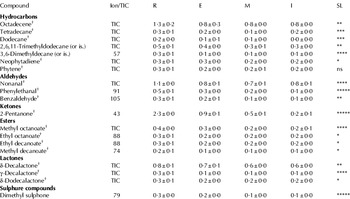
Compounds being in the greatest concentration in the headspace of the cheese Rind, and something smaller in the other cheese regions. Ion/TIC: ion or ions used for their quantification. Abundances of these compounds expressed as average area counts multiplied by 10−6, their sd and the significance levels of the differences (SL) in the abundances of the several cheese regions (R: Rind; E: Exterior; M: Intermediate; I: Interior) obtained by the ANOVA test

† Compounds identified by standards; is.: isomer; tr: area counts smaller than 105; *****P⩽0·001; ****P⩽0·005; ***P⩽0·01; **P⩽0·05; *P⩽0·1; ns: difference statistically no significant
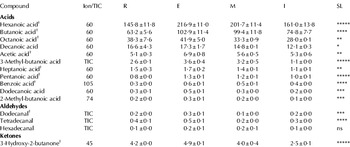
Compounds having the greatest concentration in the headspace of the Exterior cheese region. Ion/TIC: ion or ions used for their quantification. Abundances of these compounds expressed as average area counts multiplied by 10−6, their sd and the significance levels of the differences (SL) in the abundances of the several cheese regions (R: Rind; E: Exterior; M: Intermediate; I: Interior) obtained by the ANOVA test

† Compounds identified by standards; tr: area counts smaller than 105; *****P⩽0·001; ****P⩽0·005; ***P⩽0·01; **P⩽0·05; *P⩽0·1; ns: difference statistically no significant
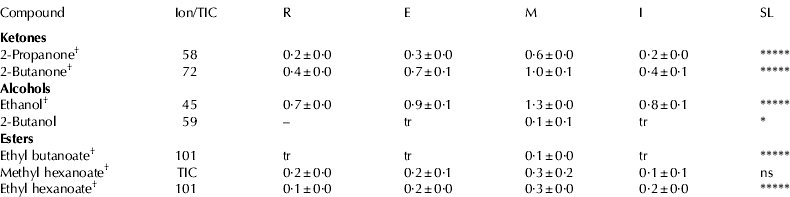
Compounds being in the greatest concentration in the headspace of the Intermediate cheese region. Ion/TIC: ion or ions used for their quantification. Abundances of these compounds expressed as average area counts multiplied by 10−6, their sd and the significance levels of the differences (SL) in the abundances of the several cheese regions (R: Rind; E: Exterior; M: Intermediate; I: Interior) obtained by the ANOVA test

† Compounds identified by standards; tr: area counts smaller than 105; *****P⩽0·001; *P⩽0·1; ns: difference statistically no significant
Compounds having the greatest concentration in the headspace of the Interior cheese region. Ion/TIC: ion or ions used for their quantification. Abundances of these compounds expressed as average area counts multiplied by 10−6, their sd and the significance levels of the differences (SL) in the abundances of the several cheese regions (R: Rind; E: Exterior; M: Intermediate; I: Interior) obtained by the ANOVA test

† Compounds identified by standards; tr: area counts smaller than 105; *****P⩽0·001; ***P⩽0·01
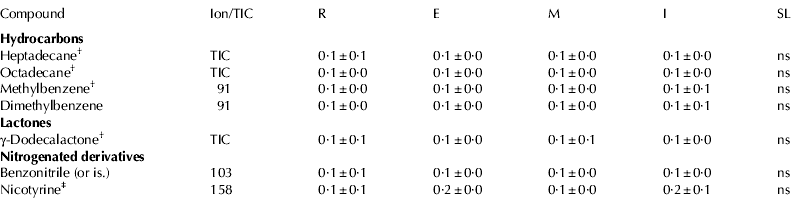
Compounds being in similar abundance in the headspace of all cheese regions. Ion/TIC: ion or ions used for their quantification. Abundances of these compounds expressed as average area counts multiplied by 10−6, their sd and the significance levels of the differences (SL) in the abundances of the several cheese regions (R: Rind; E: Exterior; M: Intermediate; I: Interior) obtained by the ANOVA test

† Compounds identified by standards; is.: isomer;
‡ 3-(1-methyl-1H-pyrrol-2-yl)-pyridine ns: difference statistically no significant
The average abundances of the compounds found in the headspace of the several cheese regions were determined, in most of the cases, from three extraction experiments of different cheeses and are given in Tables 1–6. Abundances, expressed in area counts, under 105 are indicated as ‘tr’ in the several tables.
Statistical analysis
The repeatability of the abundances found was confirmed by their sd, which are given in Tables 1–6. In addition, the significance level of the differences of the abundances of each compound in the several cheese regions was determined by the One-Way Analysis of Variance (ANOVA test) using the SPSS statistical software package; the results are indicated in Tables 1–6. The abundances indicate as ‘tr’ in Tables 1–6 were included as zero in the ANOVA test.
Results and Discussion
Some cheeses are non-homogeneous systems in which continuous changes are produced in each region, in function of their microorganisms and environmental conditions. In order to study in detail the volatile components of this cheese and its homogeneity, in terms of content in volatile compounds, this cheese was divided in four regions; these regions were defined by their distance from the cheese rind and were studied separately, as mentioned before. This approach permits, in addition, those compounds which are present in low abundance in only one cheese region to be detected.
In this way, more than 190 different compounds were identified in this cheese (B Abascal, Doctoral Thesis, 2009), many of them not previously described as components of this cheese. However, in this study, only those compounds whose abundance, expressed in area counts of the mass spectrum ion used for their quantification, was higher than 105 at least in one of the cheese regions are considered. The detailed study of the chromatograms of the different regions of this cheese shows that this cheese does not have a homogeneous distribution of their volatile components. For this reason the volatile compounds found were grouped in different tables by virtue of their functional groups and of their abundance in the different cheese regions. Thus, Table 1 gives those volatile components which are present either only in the Rind of the cheese, or also in other cheese regions but in much smaller concentration than in the Rind. The significance level of the differences of the abundances of these compounds in the several cheese regions, determined by the One-Way Analysis of Variance (ANOVA test), is also given in Table 1; the high significance level of these differences for most of these compounds can be observed, which provides statistical support, in most of the cases, for their inclusion in this table. This group of compounds is the most numerous and their components will contribute mainly to the odour of the entire cheese piece. It is constituted by: branched, linear, and aromatic hydrocarbons; one acid, 2-ethyl-hexanoic which is the only acid found in the greatest concentration in the Rind; only one aldehyde with a low number of carbon atoms; a great number of ketones, with between six and eleven carbon atoms, among which there are linear, branched, cyclic and aromatic ketones, the abundance of 2-nonanone and 2-heptanone in Rind being especially significant; three alcohols, two of them 2-nonanol and 2-heptanol whose origin is probably associated with their homologue ketones, and the third, 2-ethyl-hexanol probably related to 2-ethyl-hexanoic acid above cited; two esters derived from the latter cited alcohol and whose origin is probably associated with them; three well known aromatic furan derivatives; some phenol derivatives also with well known aromatic notes; three aromatic esters; and finally two chlorine derivatives that can be considered as contaminants.
The presence in cheeses of different types of hydrocarbons, such as those found here, is known. However, their specific location in the cheeses has not been previously reported, and the same is true for the acid 2-ethyl-butanoic. The sharp negative gradient of abundance, between Rind and Exterior, observed for ketones in general, and specifically for some methylketones, has also been observed in Camembert cheese (Leclercq-Perlat et al. Reference Leclercq-Perlat, Latrille, Corrieu and Spinnler2004). The formation of methyl ketones has been very profusely described as an initial β-oxidation of the acids to give β-cetoacids, and subsequent decarboxilation, giving rise to the corresponding ketones having one carbon atom fewer than the original acid. This process requires the participation of oxygen and probably of fungi and/or lactic acid bacteria. It is also worth noting the presence of cyclic and aromatic ketones, furan and phenol derivatives, as well as of ethers in the headspace of Rind in more abundance than in the other regions. The presence of these five latter kinds of compounds in cheeses has been infrequently described. Thus, alkyl cyclopenten-1-ones and aromatic ketones have been recently found in fresh cheese (Morales et al. Reference Morales, Fernández-García, Gaya and Núñez2003) and their formation has been associated with the activity of Lactococcus lactis strains; furan derivatives, and especially furanmethanol have been found in some cheeses (Qian & Reineccius, Reference Qian and Reineccius2002; Panseri et al. Reference Panseri, Giani, Mentasti, Bellagamba, Caprino and Moretti2008) and in fermented milk (Kawasaki, 2006). However, to the best of our knowledge 1-(2-furanyl)-ethanone is described here as a cheese component for the first time. This is a well known smoke component (Guillén & Manzanos, Reference Guillén and Manzanos1996; Guillén & Ibargoitia, Reference Guillén and Ibargoitia1996) which has been found recently in smoked San Simon da Costa cheese (Garabal et al. Reference Garabal, Rodríguez-Alonso, Franco and Centeno2010); its presence in this latter cheese is attributable to the smoking process. Finally phenol and alkyl phenol derivatives, like aromatic ethers, are not very common cheese components, but some of them have also been found in some cheeses (Valero et al. Reference Valero, Sanz and Martínez-Castro2001; Morales et al. Reference Morales, Fernández-García, Gaya and Núñez2003; Barrón et al. Reference Barrón, Redondo, Aramburu, Pérez-Elortondo, Albisu, Nájera and de Renobales2005; Hayaloglu et al. Reference Hayaloglu, Cakmakci, Brechany, Deegan and McSweeney2007).
All these components in Table 1, most of them with well known aromatic notes, if they have perception thresholds smaller than their concentrations in the cheese Rind, will contribute mainly to the odour of the Rind, which can be considered the odour of the entire cheese piece; however, their contribution to the odour of the rest of cheese regions will be null or very small as a function of their abundance in each cheese region.
Table 2 gives those volatile compounds that also are in the greatest abundance in the headspace of the Rind, being also present in the headspace of the other cheese regions in somewhat smaller abundance than in the Rind. The significance levels of the differences of their abundances between the different cheese regions, determined by the ANOVA test are also given in Table 2; these values are, in general, smaller than for compounds in Table 1, as might be expected. Some of these compounds belong to groups present in Table 1. Among them there are: saturated and unsaturated linear and branched hydrocarbons, the unsaturated having a high number of carbon atoms; linear and aromatic aldehydes having between 7 and 9 carbon atoms; only one methyl ketone of five carbon atoms; and methyl and ethyl esters derived from octanoic and decanoic acids. In addition, in Table 2 there are two kinds of compounds not included in Table 1, namely lactones such as delta lactones of ten and twelve carbon atoms and gamma dodecalactone; and one sulphurated derivative.
It is noteworthy that, in general, the size of the hydrocarbons and aldehydes in Table 2 are higher than those found in Table 1, while the opposite is true for ketones. All compounds in Table 2 that are in higher concentrations than their perception thresholds contribute to the odour of the corresponding cheese regions, in all cases with the greatest intensity in the Rind. Many of these compounds provide floral and fruity notes.
The volatile compounds with their greatest abundance in the headspace of the Exterior cheese region are few in number, as Table 3 shows; the significance level of the differences in the abundances of each one of these compounds in the several cheese regions is also given in Table 3; it can be observed that these differences are statistically significant in most of the cases. The compounds included in this group are: all acids detected in this cheese, with the exception of 2-ethyl-hexanoic acid; three aldehydes, having a higher number of carbon atoms than those included in Tables 1 & 2; and only a hydoxylated ketone of smaller number of carbon atoms than ketones included in Table 2. Acids are the main volatile components in all regions of this cheese and among them there are linear, branched and aromatic acids. However, the linear acids having an even number of carbon atoms between two and ten are detected in the greatest abundance. It should be mentioned that some methodologies used to study volatile cheese components are not able to extract and detect acids and perhaps for this reason they have not always been included among the compounds which are mainly responsible for the odour and taste of some cheeses.
Likewise, as Table 4 shows, the number of compounds being in higher abundance in the headspace of the cheese Intermediate region than in the others is reduced and their abundances are small; the differences of their abundances in the several cheese regions are in most of the cases statistically significant, as is indicated in Table 4. The compounds included are: only some alcohols and methylketones of very small molecular weight; and some methyl or ethyl esters of butanoic or hexanoic acids (methyl or ethyl butyrate or caproate). These are the smallest esters of all those found in this cheese. As a result the aromatic notes of these compounds will be more marked in the Intermediate region of the cheese than in the others.
In the same way, only a reduced number of alcohols, which are present in very low abundance, are shown to be in higher abundance in the headspace of the Interior region of this cheese than in the other regions, as Table 5 shows. These are 2,3-butanediol and two primary alcohols of four and six carbon atoms; the differences of the abundances of these compounds in the several cheese regions are also statistically significant, as indicated in Table 5.
All the results mentioned indicate the non-homogeneous distribution of an important number of volatile components of this cheese. In fact, only the volatile compounds given in Table 6 have been found to be homogeneously distributed in the different cheese regions; this homogeneity in their distribution is corroborated by the ANOVA test which indicates that there are no significant differences in the abundances of these compounds in the different cheese regions. The compounds of this group are: a reduced number of hydrocarbons among which there are linear saturated hydrocarbons with a very high number of carbon atoms and certain methyl benzene derivatives; one lactone, gamma-dodecalactone; and two nitrogenated derivatives. All of them are in low abundance, however the perception thresholds of some of them, especially of gamma-dodecalactone, are very low and for this reason they could contribute to the odour and aroma of this cheese.
From these results it is evident that the volatile components of this cheese, and of others similar to it, are not homogeneously distributed in all cheese regions; this distribution is governed by several factors. So, ketones of six or more carbon atoms have their higher concentration in Rind and this decreases very sharply toward the interior regions; however this decrease in concentration is not so pronounced in ketones of five carbon atoms and even this trend is opposite in ketones of three or four carbon atoms. The origin of ketones in cheese has been associated with beta-oxidation of acids which requires the presence of oxygen and probably the activity of certain microorganisms, for these reasons its formation preferentially occurs in the Rind; the difficulty or facility to diffuse towards the cheese interior regions associated with its size could explain their distribution in the cheese. These same factors could also explain the distribution of secondary alcohols, which have been considered, derived from methyl ketones, and of other compounds, such esters, the formation of which could be favoured in the Rind. Other compounds such as acids, with the exception of 2-ethyl-hexanoic acid, are distributed in all cheese regions having, in general, the smaller abundance in the Rind; this could be due to the presence of oxygen and microorganisms in this region that favoured the evolution of these compounds to form new derivatives in this way decreasing their abundance in the Rind. In short, this wide variation in distribution patterns of the volatile components in this cheese is not produced at random but is governed by microbiological, chemical and physical effects.
This work has also been supported by the Spanish Ministry of Science and Innovation (MCINN, AGL2009-01381) and the Basque Government (EJ-GV, GIC10/-IT-463-10).